INTRODUCTION
Seabreams (Sparidae) are found in coastal waters worldwide and sustain important recreational and commercial fisheries (Fischer et al., Reference Fischer, Schneider and Bauchot1987). In the South Iberian region, seabreams are a dominant component of the continental shelf demersal fish community where more than 20 species are found (Baro, Reference Baro1996; Baro & Serna-Quintero, Reference Baro and Serna-Quintero2000; Erzini et al., Reference Erzini, Bentes, Coelho, Correia, Lino, Monteiro, Ribeiro and Gonçalves2001). One of these important species is the axillary seabream, Pagellus acarne (Risso, 1827). This demersal fish species inhabits various types of sea bottoms, especially seagrass beds and sand, down to 500 m depth (more commonly occurring between 40 and 100 m), the young are found closer to the shore (Bauchot & Hureau, Reference Bauchot, Hureau, Whitehead, Bauchot, Hureau, Nielsen and Tortonese1986). The axillary seabream is a protandric hermaphrodite with sex inversion occurring between 14 and 29 cm total length (TL) (Baro, Reference Baro1996) and is considered very vulnerable to exploitation (Morato et al., Reference Morato, Solà, Grós and Menezes2001). This species is widely distributed along the European and African coasts, from Denmark to Senegal and around the Macaronesia Islands, in the Mediterranean and in the Black Sea (Bauchot & Hureau, Reference Bauchot, Hureau, Whitehead, Bauchot, Hureau, Nielsen and Tortonese1986).
Pagellus acarne is of high commercial importance and is targeted by the demersal fleets operating along the eastern Atlantic coasts and the Mediterranean Sea. In the eastern central Atlantic, the axillary seabream population is considered to be a single stock that is exploited by the high-seas cephalopod fishery, as well as the coastal and artisanal multispecies demersal fleets, not only by the coastal countries but also by the international fleet fishing in Morocco and Mauritania (FAO Fishery Committee for the Eastern Central Atlantic, 2003, 2004). Axillary seabream is one of the main target species of small-scale commercial fisheries in the northern Atlantic Algarve (Erzini et al., Reference Erzini, Bentes, Coelho, Correia, Lino, Monteiro, Ribeiro and Gonçalves2001), Azores (Morato et al., Reference Morato, Solà, Grós and Menezes2001) and Canary Islands (Pajuelo & Lorenzo, Reference Pajuelo and Lorenzo1994, 2000). This species also represents a highly valued resource in the Mediterranean (Spedicato et al., Reference Spedicato, Greco, Sophronidis, Lembo, Giordano and Argyri2002). In the Gulf of Cadiz, several fishing techniques are used to fish sparids because of their high commercial value (Anonymous, 1994). In the northern Alboran Sea, Pagellus acarne is targeted by multispecies fisheries (bottom-trawl and artisanal fleets) and is considered the most important demersal fish species in terms of volume of catch and economic importance (Baro, Reference Baro1996).
Total landings of seabreams in general, and of axillary seabreams in particular, have declined in recent years. In the Gulf of Cadiz, the landings decreased from a combined total of approximately 328 m per year in 1993 to less than 120 mt pear year from 2004 to 2007, representing a decrease of up to 60% (data obtained from the Spanish Institute of Oceanography database). In the Alboran Sea, landings have decreased from over 1500 mt pear year in 1985 (Gil de Sola, Reference Gil de Sola1993) to less than 250 mt from 2004 to 2008 (data obtained from the Spanish Institute of Oceanography database), for a decrease of up to 80%. These trends have also been reported recently in other areas such as the Atlantic coast of Morocco (FAO Fishery Committee for the Eastern Central Atlantic, 2003, 2004), the Canary Islands (Pajuelo & Lorenzo, Reference Pajuelo and Lorenzo2000) or the South of Portugal (Erzini et al., Reference Erzini, Bentes, Coelho, Correia, Lino, Monteiro, Ribeiro and Gonçalves2001; Coelho et al., Reference Coelho, Bentes, Correia, Gonçalves, Lino, Monteiro, Ribeiro and Erzini2005), making it necessary to establish management measures.
The study of some aspects of reproductive biology such as sexual differentiation and spawning season and the analysis of the evolution of maturity stages is important for assessment and management (Erzini et al., Reference Erzini, Bentes, Coelho, Correia, Lino, Monteiro, Ribeiro and Gonçalves2001). Ageing and growth parameter estimation are also fundamental prerequisites for stock assessment. Knowledge of the rate of growth is essential for studies in population dynamics and knowledge of age structure is fundamental to determinate age at first capture and age at first maturity. The interest in axillary seabream for aquaculture has stimulated studies on its reproduction, feeding and growth (Greco et al., Reference Greco, Genovese and Micale1995), and due to the economic importance of this fishery, it has been the focus of several studies in the recent past. Specifically, its biology has been studied in the Mediterranean (Andaloro, Reference Andaloro1982), the Atlantic coast of Morocco and Western Sahara (Mennes, Reference Mennes1985; Lamrini, Reference Lamrini1986), the Canary Islands (Pajuelo & Lorenzo, Reference Pajuelo and Lorenzo2000) and the southern coast of Portugal (Santos et al., Reference Santos, Monteiro and Erzini1995; Coelho et al., Reference Coelho, Bentes, Correia, Gonçalves, Lino, Monteiro, Ribeiro and Erzini2005). However, there is scarce information available concerning the axillary seabream from the waters off southern Spain. Baro (Reference Baro1996) analysed aspects of the fishery and biology of this species in the northern Alboran Sea and these results constitute the only information available on the biology of Pagellus acarne in this area to date.
The objective of this paper is to study the age, growth and reproduction of two closed populations of axillary seabream separated by the Strait of Gibraltar, one from the Gulf of Cadiz (Atlantic southern coast of Spain) and the other from the Alboran Sea (Mediterranean southern coast of Spain). The present study also investigates the importance of the Strait of Gibraltar as a barrier between two marine biogeographical provinces, the Mediterranean Sea and the north-east Atlantic.
MATERIALS AND METHODS
Sampling
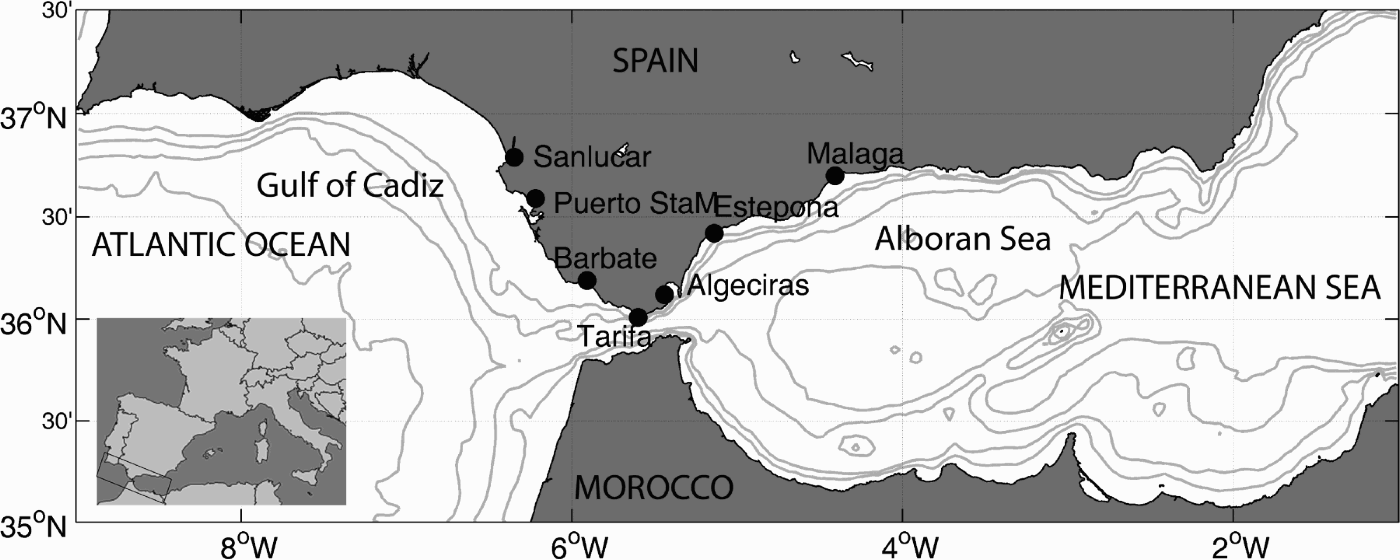
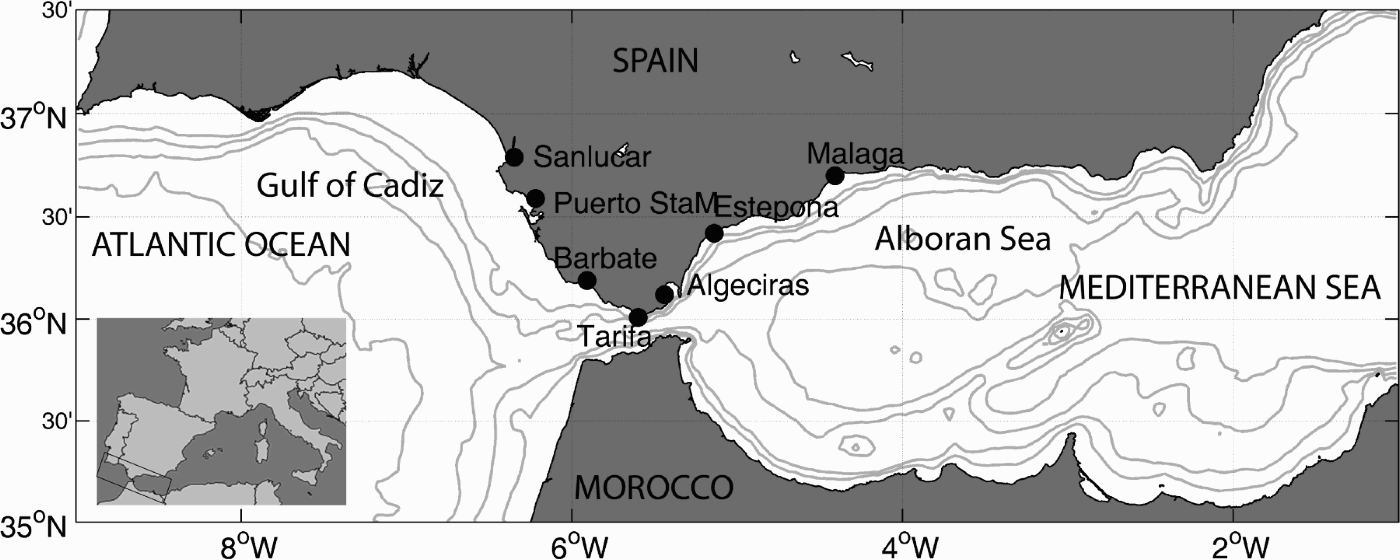
Monthly samples of Pagellus acarne were obtained from commercial catches landed by Andalusian fleets (75% bottom trawlers and 25% artisanal fleet, both gillnets and traps) in the ports of the Gulf of Cadiz (Sanlucar de Barrameda, Puerto de Santa Maria, Barbate and Tarifa) in the north-east Atlantic (7°23′–5°50′W), and in the ports of the Alboran Sea (Algeciras, Estepona and Malaga) in the south-west Mediterranean (5°50′–2°11′W) (Figure 1). In addition, samples were taken using a trawl net during the annual surveys in those areas. Axillary seabreams were sampled between October 2003 and September 2004. A total of 884 fish were analysed (477 from the Gulf of Cadiz and 407 from the Alboran Sea).
Location of the study area. The ports in the Gulf of Cadiz were Sanlucar de Barrameda, Puerto de Santa Maria, Barbate and Tarifa, and the ports in the Alboran Sea were Algeciras, Estepona and Malaga.
Specimens were measured for total length (TL) to the nearest 1 mm and weighed (total weight (TW) and eviscerated weight (EW) with a precision of 0.01 g. The gonad weight (GW) was recorded to the nearest 0.01 g, and the gonadosomatic index (GSI) was calculated as the percentage of gonad weight/eviscerated weight.
The parameters of the length–weight relationships were estimated by linear regression analysis on log-transformed data.
It was not possible to calculate the sex-ratio for the entire population because the sampling was non-random; therefore, we used data from past annual surveys to calculate the male:female ratio. 711 individuals captured in four annual surveys (1992–1995) were used for the Gulf of Cadiz, and data from 3373 individuals captured in two annual surveys (1990–1991) were used for the Alboran Sea. This study, however, analyses the proportion of males to females by size intervals. Statistically significant deviations of a null hypothesis (proportion 1:1) were tested by χ2 in those size intervals with ten or more individuals.
Reproduction
For the histological examination of reproductive organs, 867 gonads were dissected (461 from the Gulf of Cadiz and 406 from the Alboran Sea), fixed in 10% phosphate buffered formaldehyde (pH 7.2) for 24 hours, dehydrated with increasing concentrations of ethanol and embedded in paraffin wax. Gonads were sectioned in cross-sections (3 µm thickness) and stained with haematoxylin–eosin and haematoxylin–VOF (Gutiérrez, Reference Gutiérrez1967). Histological sections were reviewed under a light microscope and micrographs were taken. The specimens of axillary seabream were separated into the following groups: females (with ovaries or ovotestes with functional ovary), males (with ovotestes with functional testes), hermaphrodites (with ovotestes at the same maturity stage) and indeterminate (with unidentifiable gonads). The sex was recorded for each fish sampled and the gonads were examined microscopically to determine the maturation state. The oocytes were sorted according to the histological features described by Mandich et al. (Reference Mandich, Massari, Bottero and Marino2002). Each ovary was classified into distinct maturation stages based on the presence and absence of different types of oocytes and the most advanced oocyte stage present in the ovary. Based on these characteristics, five distinct stages of ovarian maturation were proposed: (I) previtellogenic; (II) vitellogenic; (III) maturation; (IV) spawning; and (V) post-spawning. Classification of the testes was based on the gonad development criteria described by Micale et al. (Reference Micale, Maricchiolo and Genovese2002), modified for this species into a five-stage scale: (I) immature/resting; (II) developing; (III) mature; (IV) spawning; and (V) recovering spent/post-spawning. Testes were classified according to the male germ cell stages present in the testis and the presence and development of sperm within the sperm sinuses.
The size of sexual inversion was calculated following Shapiro (Reference Shapiro, Potts and Wooton1984) during the reproductive season. Size at first sexual maturity (L50) was defined as the size at which 50% of males and females become mature (Batts, Reference Batts1972) and was estimated using specimens collected during the months of reproductive activity. The percentage of mature individuals was estimated for size intervals of 1 cm and sex, and the data were fitted with a non-linear regression. The logistic curve used was Y = 1/[1 + e−k (L-L50)] where Y is the proportion of mature individuals in each size interval, L the mean length of the interval, and k the constant of the logistics function. To evaluate the differences in size at first maturity between sexes the variance of the L50 of each sex was calculated. Assuming that L50 estimates are normally distributed, then the Z statistic can be computed as: Z = [(a1/b1) − (a2/b2)]/[√(V1 + V2)] where ai and bi are the logistic regression coefficients and Vi the L50 variances of each sex compared. Z values can be used to test the null hypothesis of parameter equality (Gunderson, Reference Gunderson1977).
Stereological methods (Weibel, Reference Weibel1979) were applied to estimate total and relative fecundity using histological sections of ovaries in stage II and stage III of maturation with the help of image analysis. Several images from different fields of each histological section were captured and digitized. Gonads with postovulatory follicles were not appropriate for fecundity estimation because such females were considered to have begun to spawn at the time of sampling. Thus, these specimens were excluded from the fecundity estimation. Total fecundity was defined as the total number of vitellogenic or advanced yolked oocytes at any time in the ovary (Hunter et al., Reference Hunter, Macewicz, Lo and Kimbrell1992). Relative fecundity was calculated for each organism as total fecundity divided by eviscerated weight. To establish the relation between the total fecundity (Y) and eviscerated weight, total length or gonad weight of the fish, regression analyses were carried out to adjust, in each case, the data to two models: linear (Y = a + bX) and power (Y = aXb), where Y is the total fecundity, X is TL, TW or GW; and a and b are parameters of the equation.
Age and growth
Sagittal otoliths from 247 specimens were used for age determination. Whole otoliths were immersed in a 30% aqueous solution of glycerine for 2 hours, prior to being read under reflected light, on a black background. Two readings from two independent readers were carried out for each otolith. Whenever there was a discrepancy between the four readings, the age data were excluded from the study. The criteria used to determine age were: (1) the date of birth was considered to be 1 June according to the reproduction season (summer) observed in this study; (2) each year a translucent and an opaque growth band are deposited on the otolith; and (3) the age of the fish corresponds to the number of complete translucent bands (n). Monthly proportions of opaque and translucent bands along the edge of the otoliths were examined in order to validate the annual periodicity of band formation. The fact that the formation of the rings was regular implied that the otoliths could, therefore, be used to determine growth. Apart from the number of annuli on each otolith, the otolith radius (OR) (distance from the focus to the otolith posterior end) and the type of marginal formation were also recorded. The measurements were determined using image analysis (Program Visilog 6 + TNPC 3.2, described by IFREMER). The back-calculation method reconstructs the size of individuals at a younger age, based on growth recorded in their calcified structures (Casselman, Reference Casselman, Weatherley and Gill1987). An age–length key was constructed. Whole length distributions by age were used to estimate the growth rate of axillary seabream. The parameters of the von Bertalanffy equation for the pooled data of both sexes from each sampling area were estimated by using the program FISAT II. The total length distribution by age-class was fitted to the von Bertalanffy equation. Lt = L∞[1 − exp(−k(t − t0))]. In this equation, Lt is the mean fish length at age t; L∞, k and t0 the parameters that determine the shape of the growth curve. L∞ is defined as the asymptotic mean length; k the rate at which the curve approaches the asymptote and t0 the age at which mean length is zero. All the parameters were calculated using FISAT II (Gayanillo et al., Reference Gayanillo, Sparre and Pauly1993). Growth curves were compared with other studies using the phi-prime test (Ф′) following Munro & Pauly (Reference Munro and Pauly1983), where Φ′ = log10k + 2 log10 L∞. A nested ANOVA was carried out to detect differences in growth between the areas of study following Sokal & Rohlf (Reference Sokal and Rohlf1995).
RESULTS
Sample characteristics
The overall ratio of males to females was 1.7:1 in the Gulf of Cadiz and 1.5-2.2:1 in the Alboran Sea.
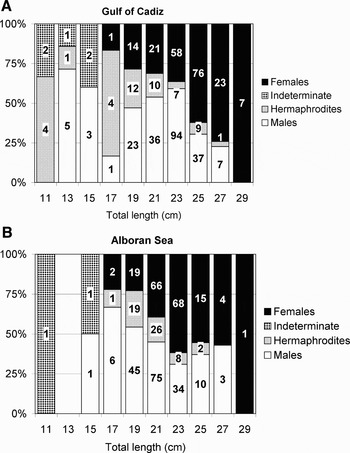
Of the total number of axillary seabream examined in the Gulf of Cadiz, there were 206 males, 200 females, 48 hermaphrodites and 5 indeterminate. The range of the total lengths of the fish sampled was 11.3–30.9 cm (mean length = 22.9 cm, SD = 3.2 cm). The proportion of males and females grouped into 2 cm length intervals significantly deviated from the expected 1:1 ratio (χ2-test, P < 0.05) for most size categories, with the exception of lengths between 20 and 22 cm (Figure 2A). Males predominated in smaller size intervals (range TL 13–27 cm, mean TL 22.7 cm, SD = 2.8 cm), whereas most females were equal to or larger than 25 cm (range TL 19–31 cm, mean 24.3 cm, SD = 2.4 cm). Hermaphrodites made up 10.6% of the specimens examined and were observed in smaller and intermediate sizes (11–27 cm).
Length–frequency distributions for males, females and hermaphrodites by size intervals in the two study areas: (A) Gulf of Cadiz, and (B) Alboran Sea. Number of individuals (N) is indicated inside the columns.

Of the 405 specimens examined in the Alboran Sea, there were 174 males, 175 females, 56 hermaphrodites and 2 indeterminate. The range of TL was 10.7–29.4 cm (mean length = 21.8 cm, SD = 2 cm). Although the proportion of males seems to decrease as length increases (range TL 15–27 cm, mean TL 21.5 cm, SD = 1.9 cm), and the females ranged between 17 and 29 cm (mean TL 22.4 cm, SD = 1.8 cm), the χ2 test showed that there were no significant differences except in the 18–20 cm and 22–24 cm ranges. Hermaphrodites were present in all size intervals except in the range between 26 and 28 cm (Figure 2B).
In both areas, hermaphrodites were present only during the period of sexual repose, maturing as males or females during the spawning season.
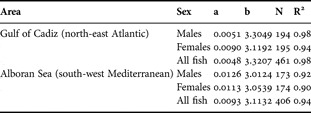
The parameters of the total length–total weight relationship are given in Table 1 where positive allometry can be observed. In both sampled areas, there was no significant difference in the allometric coefficient of the regression between the sexes (ANOVA for comparison of regression lines, P > 0.1), so data can be pooled. However, the analysis between areas showed that there were significant differences in the regression coefficients for males (ANOVA for comparison of regression lines, P < 0.05) but not for females (P > 0.1).
Parameters of total length (mm)–total weight (g) relationship.

N, number.
Reproduction
SPAWNING PERIOD
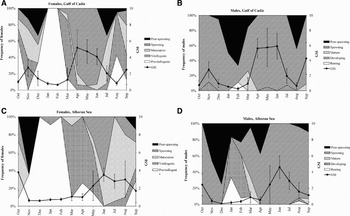
In the Gulf of Cadiz, the previtellogenic females appeared from December to March and August to October (Figure 3A). After these periods, the females began to develop the gonads and were present in vitellogenic and maturation stages successively. Females at the spawning stage were collected in autumn, spring and the beginning of summer, although they occurred in higher quantities between April and June. However, spawning males were present in every sampled month, although higher percentages were observed in autumn, spring and early summer (Figure 3B). It is significant to note the scarce number of resting, developing and mature males. Males with post-spawning testes were collected during the same periods as the females but higher percentages were observed one month later.
Maximum values of the gonadosomatic indices were found from April to June in both sexes (Figure 3A, B), when there was a maximum occurrence of spawning specimens, corresponding to the peak of the spawning season. The mean GSI for females was lowest at the previtellogenic and vitellogenic stages of the ovary, and for males with post-spawning testes. For both sexes, minimum values were observed from December to March and August.
Monthly variation in the average of the gonadosomatic index (GSI) and monthly changes in the per cent frequency of the maturity stages of gonads for females (A) and for males (B) of Pagellus acarne from the Gulf of Cadiz and for females (C) and for males (D) from the Alboran Sea. Bars indicate standard deviation.

In the Alboran Sea, previtellogenesis started in September and continued until May, although peaks were observed from December to February (Figure 3C). The higher percentage of females with vitellogenic ovaries was observed in March and April. Finally, females at maturation and spawning stages were collected in summer and the beginning of autumn. Few resting males were present from January to March and in August, and developing males were also present in these months (Figure 3D). Males reached maturity in March and September. Spawning males were present almost throughout the year, although the highest percentage was observed from May to October.
Peaks in gonadosomatic indices, both in females and males, coincided with the spawning period as determined by changes in stages of maturity (Figure 3C, D). The highest values of the GSI for both sexes occurred between May and October, with a maximum in June. The values were low and remained almost unvaried from November to April, corresponding with the months of decreased reproductive activity and rest of the gonads.
SIZE OF SEXUAL INVERSION AND SIZE AT SEXUAL MATURITY
The range of lengths where both males and females were found in the same length-class was quite wide for this species. Estimated size of sexual inversion was 23.5 cm in the Gulf of Cadiz (overlap range between 20.5 and 26.5 cm) and 21.5 cm in the Alboran Sea (overlap range between 18.5 and 26.5 cm).
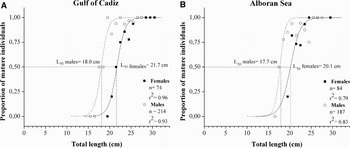
Differences in size at maturity were observed between males and females from the Gulf of Cadiz (Figure 4A), where estimated L50 was 21.7 cm for females and 18.04 cm for males. A significant difference in L50 (z-test, P < 0.05) was found between both sexes. Estimates of size at first maturity and parameters of the logistic equation fitted for females and males from the Gulf of Cadiz are summarized in Figure 4A. The data for the estimation of length at sexual maturity for females and males provided a good fit (r2 = 0.96 and 0.93, respectively).
Sexual maturity curves for females and for males of Pagellus acarne from the Gulf of Cadiz (A) and the Alboran Sea (B). Parameter estimates and L50 obtained from the maturity analyses of males and females are shown.

The sexual maturity curves for females and males from the Alboran Sea are shown in Figure 4B. The estimated length at which 50% of the females in the population reached sexual maturity was 20.1 cm, and 17.7 cm for males, with significant differences (z-test, P < 0.05).
ESTIMATION OF FECUNDITY
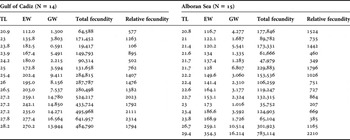
Fourteen females from the Gulf of Cadiz were analysed to estimate total fecundity (Table 2). These estimates came from axillary seabream ranging in total length from 20.9 to 28.2 cm, eviscerated weight from 112.0 to 277.4 g, and gonad weight 0.59 to 16.56 g. Total fecundity estimates reached values ranging from 19,417 to 641,957 oocytes (mean = 290,070; SD = 196,617). Relative fecundity showed a wide variation among females. The maximum and minimum was 106 to 2314 oocytes per gram of individual respectively, with an average of 1314 ± 667 oocytes per gram of individual.
Total and relative fecundity of Pagellus acarne from the Gulf of Cadiz and Alboran Sea.

TL, total length (cm); EW, eviscerated weight (g); GW, gonad weight (g); N, number.
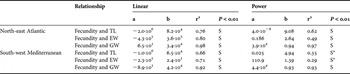
Regression analysis showed significant positive correlation between total fecundity and total length (ANOVA P < 0.01), eviscerated weight (ANOVA P < 0.01) and gonad weight (ANOVA P < 0.01). The models are shown in Table 3. In all cases, the best fit was obtained with the linear model. A comparison of determination coefficient reveals that the relationship between total fecundity and gonad weight was more significant (r2 = 0.98, P < 0.01) than that of fecundity and eviscerated weight (r2 = 0.80, P < 0.01) or fecundity and total length (r2 = 0.76, P < 0.01).
Linear and power models used to express the relation between total fecundity and total length (TL) or eviscerated weight (EW) or gonad weight (GW) of Pagellus acarne from the Gulf of Cadiz and the Alboran Sea. Significant relationship between total fecundity and each of the measured parameters (TL, EW and GW) was found using analysis of variance (ANOVA), ‘a’ and ‘b’ = estimated parameters; r2 = determination coefficient; S = significant at P < 0.01; S* = significant at P < 0.05.

In the Alboran Sea, maximum fecundity (783,114 oocytes) was observed in a specimen with a total length of 29.4 cm and eviscerated weight of 354 g, and the minimum fecundity (35,752 oocytes) was observed in a specimen with a total length of 23 cm and 173 g eviscerated weight (Table 2). The average total fecundity was 173,509 ± 183,076 oocytes. Relative fecundity varied between 207 and 2210 oocytes per gram of individual (mean = 954; SD = 575).
Table 3 shows a significant correlation between all measured parameters and total fecundity, although the highest coefficients were observed between total fecundity and gonad weight (r2 = 0.93, P < 0.01), followed by eviscerated weight (r2 = 0.71, P < 0.01) and total length (r2 = 0.66, P < 0.01). The best relationship between total fecundity and gonad weight was expressed by the power equation. However, the relationship between total fecundity and eviscerated weight and the equation between total fecundity and total length were linear.
The null hypothesis (total fecundities from the two areas had the same mean) was accepted (ANCOVA, F = 1.94; P = 0.1759).
Age and growth
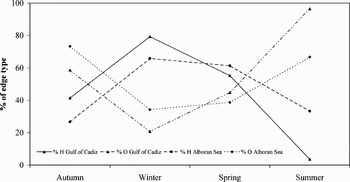
The otoliths showed a seasonal variation in the formation of hyaline and opaque zones during the period of the study (Figure 5). Rapid-growth rings (opaque) were formed mainly in summer–autumn and slow-growth rings (hyaline) were more frequent in winter–spring. The observation and interpretation of the otoliths had a success rate of 73%, based on the independent and concordant readings of 2 different observers. The relationship between otolith radius (OR) and fish length, both in mm, was established. The slopes of the total length and OR regression did not differ between sexes or sampling areas (ANOVA for comparison of regression lines, P > 0.1). The relation is given by equation: TL = 27.7 OR – 1.8 (r = 0.96). Fish length and otolith size were closely correlated (r2 = 0.93). The proportionality between fish growth and increase in otolith size allowed the use of back-calculation for determining growth.
Evolution of the occurrence percentage of edge type in otoliths in both areas of study.

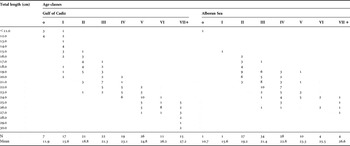
Full agreement was obtained in the age readings of 247 otoliths. Axillary seabreams aged I up to VII years were present in the samples (Table 4), where 12 was the maximum age observed. The calculated theoretical maximum length value for the Gulf of Cadiz (31.6 cm) is close to the size of the largest fish sampled, while the theoretical maximum length value for the Alboran Sea is higher than the length of the largest fish in this area (because of the lack of individuals older than 7 years, the L∞ used is the one calculated by Baro (Reference Baro1996) 32.14 cm for the Alboran Sea). During the first year of life, fish attain nearly 50% of their theoretical maximum length in both sampling areas.
Length–age key of the axillary seabream in the two sampling areas.

N, number.
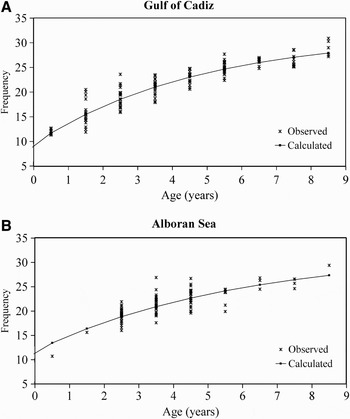
The von Bertalanffy growth curves are shown in Figure 6. The phi-prime (Ф′) test estimations present similar values:
Von Bertalanffy growth curves for all individuals of Pagellus acarne off the Andalusian coast obtained from otolith readings from the Gulf of Cadiz (A) and the Alboran Sea (B).

Gulf of Cadiz: L∞ = 31.65 cm, k = 0.21 yr−1, t0 = −1.76 yr and Ф′ = 2.32.
Alboran Sea: L∞ = 32.14 cm (Baro, Reference Baro1996), k = 0.17 yr−1, t0 = −2.69 yr and Ф′ = 2.24.
The nested ANOVA showed no differences in growth between axillary seabream from the Gulf of Cadiz and from the Alboran Sea (P = 0.935).
DISCUSSION
The positive allometry of the total length–total weight relationship was also observed for the species in other studies (Pajuelo & Lorenzo, Reference Pajuelo and Lorenzo1994, Reference Pajuelo and Lorenzo2000; Santos et al., Reference Santos, Monteiro and Erzini1995; Coelho et al., Reference Coelho, Bentes, Correia, Gonçalves, Lino, Monteiro, Ribeiro and Erzini2005). Differences between males and females in the length–weight relationship are explained by the different size distributions of the two sexes as a consequence of the protandric hermaphroditism. These differences had already been described by Pajuelo & Lorenzo (Reference Pajuelo and Lorenzo2000).
The sex-ratio of 1.7–2:1 in favour of males is similar to that obtained by Arculeo et al. (Reference Arculeo, Brusle'-Sicard, Potoschi and Riggio2000). The spawning period of axillary seabream in the study areas extended from the end of spring to early autumn with a peak in the summer months, while the resting period occurred mainly during the winter months. These results agree with previous reports (Andaloro, Reference Andaloro1982; Lamrini, Reference Lamrini1986; Santos et al., Reference Santos, Monteiro and Erzini1995; Baro, Reference Baro1996; Arculeo et al., Reference Arculeo, Brusle'-Sicard, Potoschi and Riggio2000; Coelho et al., Reference Coelho, Bentes, Correia, Gonçalves, Lino, Monteiro, Ribeiro and Erzini2005), with the exception of Pajuelo & Lorenzo (Reference Pajuelo and Lorenzo2000) in the Canary Islands and Le-trong & Kompowsky (Reference Le-trong and Kompowsky1972) on the north-west African coast, where there seems to be a tendency for this species to spawn between winter and spring in low latitudes and later in the year in higher latitudes. The temperature appears to be the most important environmental factor influencing the reproduction of fish (Wootton, Reference Wootton1990). On the other hand, this long reproductive period in the Gulf of Cadiz and the Alboran Sea is similar to the results obtained by Coelho et al. (Reference Coelho, Bentes, Correia, Gonçalves, Lino, Monteiro, Ribeiro and Erzini2005) on the south coast of Portugal and Baro (Reference Baro1996) in the Alboran Sea. The gonadosomatic index shows that this species spawns 1 or 2 months earlier in the Gulf of Cadiz than in the Mediterranean, as Santos et al. (Reference Santos, Monteiro and Erzini1995) pointed out.
The present study revealed that males reached sexual maturity at a smaller size (approximately 3 cm) than females, which seems to be a characteristic of protandric species. Likewise, individuals from the Gulf of Cadiz reached first maturity at a larger size than those in the Alboran Sea. Lamrini (Reference Lamrini1986) reported that the axillary seabream on the north-west African coast reached first maturity at a total length of 20.9 cm. Later, Santos et al. (Reference Santos, Monteiro and Erzini1995) obtained the same size at first maturity for females from south Portugal and 19.7 cm for males. Our results agree with these authors. However, the size at first maturity in this study is higher than the results obtained by other authors such as Pajuelo & Lorenzo (Reference Pajuelo and Lorenzo1994, Reference Pajuelo and Lorenzo2000) in the Canary Islands and Coelho et al. (Reference Coelho, Bentes, Correia, Gonçalves, Lino, Monteiro, Ribeiro and Erzini2005) in the south of Portugal. In the Mediterranean Sea, Andaloro (Reference Andaloro1982) observed a size at sexual maturity of 16.5 cm for males and females, while Baro (Reference Baro1996) reported 19 cm for both sexes. These lengths at first maturity were smaller than those found in the Alboran Sea, where males were sexually mature at 17.7 cm and females at 20.1 cm.
There are few references in the literature regarding the fecundity of P. acarne, apart from Le-trong & Kompowsky (Reference Le-trong and Kompowsky1972) for the north-west African coast and Baro (Reference Baro1996) for the Alboran Sea. Le-trong & Kompowsky (Reference Le-trong and Kompowsky1972) estimated that total fecundity ranged from 85,000 to 536,000 oocytes, values similar to our results. However, Baro (Reference Baro1996) estimated batch fecundity based on counts of hydrated oocytes and, consequently, it is difficult to compare our results. The use of this method could explain why the values of fecundity obtained by this author were lower than our results. However, this author wrote about the possibility that if all the yolked oocytes were spawned, the total fecundity could be between 70,000 and 500,000 oocytes. This possible result would concur with our study. Compared to other species of the same genus, the total fecundity of P. acarne in the present study is somewhat higher than the results estimated for P. erythrinus by Larrañeta (Reference Larrañeta1964) and lower than that estimated for P. bogaraveo by Krug (Reference Krug1990, Reference Krug1998). These differences between species may be partly due to differences in oocyte size.
The observation and interpretation of the otoliths for the axillary seabream is considered to be adequate and consistent for estimating ages of this species (Erzini et al., Reference Erzini, Bentes, Coelho, Correia, Lino, Monteiro, Ribeiro and Gonçalves2001; Coelho et al., Reference Coelho, Bentes, Correia, Gonçalves, Lino, Monteiro, Ribeiro and Erzini2005; Abecasis et al., Reference Abecasis, Bentes, Coelho, Correia, Lino, Monteiro, Gonçalves, Ribeiro and Erzini2008). Previous studies have used otoliths to age P. acarne (Andaloro, Reference Andaloro1982; Baro, Reference Baro1996; Pajuelo & Lorenzo, Reference Pajuelo and Lorenzo2000; Erzini et al., Reference Erzini, Bentes, Coelho, Correia, Lino, Monteiro, Ribeiro and Gonçalves2001; Coelho et al., Reference Coelho, Bentes, Correia, Gonçalves, Lino, Monteiro, Ribeiro and Erzini2005).
The marginal increment analyses in the otoliths showed that a pair of bands (one opaque and one hyaline) was deposited with an annual periodicity, with the opaque bands more frequent during summer and autumn. This analysis validated the use of otoliths for assessing age in this species. The same annual pattern had already been observed for this species in the south of Portugal where the opaque band was deposited mainly in summer (Erzini et al., Reference Erzini, Bentes, Coelho, Correia, Lino, Monteiro, Ribeiro and Gonçalves2001; Coelho et al., Reference Coelho, Bentes, Correia, Gonçalves, Lino, Monteiro, Ribeiro and Erzini2005) and in the Canary Islands where the opaque bands were formed between May and August (Pajuelo & Lorenzo, Reference Pajuelo and Lorenzo2000).
The von Bertalanffy growth curve fitted to otolith based age–length data explains the growth pattern for the observed size-range of axillary seabream. The relative low value of k is characteristic of a slow growing, long lived species. In this study, the oldest observed fish was 12 years old, although age-classes above 7 years are poorly represented in the landings. The zero age-class is not represented because individuals smaller than 15 cm were not found in the markets. In the Mediterranean, Andaloro (Reference Andaloro1982) found that individuals of this species can reach an age of 8 years, while in the Atlantic, Pajuelo & Lorenzo (Reference Pajuelo and Lorenzo2000) found axillary seabreams up to 10 years old in the Canary Islands and Erzini et al. (Reference Erzini, Bentes, Coelho, Correia, Lino, Monteiro, Ribeiro and Gonçalves2001) found an 18-year-old specimen in the south of Portugal. The fitted growth model probably does not properly describe juvenile growth in this species because of the lack of individuals smaller than 14 cm in the sample, due to the nature of the sampling itself (commercial fishing vessels are not allowed to fish this species under 17 cm).
The k values estimated at 0.21 for the Gulf of Cadiz and 0.17 for the Alboran Sea are close to the k values reported by Mennes (Reference Mennes1985) for Morocco and Erzini et al. (Reference Erzini, Bentes, Coelho, Correia, Lino, Monteiro, Ribeiro and Gonçalves2001) for the south coast of Portugal, although they are lower than the ones reported by other authors (Andaloro (Reference Andaloro1982) estimated k = 0.32 for females and k = 0.42 for males for the Mediterranean; Pajuelo & Lorenzo (Reference Pajuelo and Lorenzo1994) estimated a k value of 0.23 for the Canary Islands). The estimated value of L∞ of 31.65 cm in the Gulf of Cadiz is similar to the L∞ estimated by Baro (Reference Baro1996) for the Alboran Sea. Both Pajuelo & Lorenzo (Reference Pajuelo and Lorenzo1994) for the Canary Islands and Erzini et al. (Reference Erzini, Bentes, Coelho, Correia, Lino, Monteiro, Ribeiro and Gonçalves2001) for the south coast of Portugal calculated a L∞ of 32 cm, similar to the value obtained in our study, while Andaloro (Reference Andaloro1982) estimated a value of L∞ of 26.2 cm for males and 29.8 cm for females. The calculated values are reasonable, given the maximum observed length of 30.9 cm in the north-west Atlantic and 29.4 cm in the Alboran Sea.
Differences between growth of axillary seabream in the Gulf of Cadiz and the Alboran Sea were not observed, according to the results of a nested ANOVA. Because this species is a protandric hermaphrodite in the study area, males appeared mostly in the lower length-classes and the females in the higher ones. This type of hermaphroditism had previously been described for this species (Alekseev, Reference Alekseev1967; Andaloro, Reference Andaloro1982; Lamrini, Reference Lamrini1986; Pajuelo & Lorenzo, Reference Pajuelo and Lorenzo1994, Reference Pajuelo and Lorenzo2000; Baro, Reference Baro1996; Arculeo, 2000; Erzini et al., Reference Erzini, Bentes, Coelho, Correia, Lino, Monteiro, Ribeiro and Gonçalves2001; Coelho et al., Reference Coelho, Bentes, Correia, Gonçalves, Lino, Monteiro, Ribeiro and Erzini2005), and explains why individuals are mainly male in the earlier years of life and mainly female in the later years, as well as the presence of individuals with ovotestes. Sexual inversion should occur between 20 and 26.5 cm (between 3 and 6 years of age), very similar to that described by Erzini et al. (Reference Erzini, Bentes, Coelho, Correia, Lino, Monteiro, Ribeiro and Gonçalves2001) or Coelho et al. (Reference Coelho, Bentes, Correia, Gonçalves, Lino, Monteiro, Ribeiro and Erzini2005) in the Algarve (length of 20–24 cm, between 3 and 6 years old), but at older ages than those observed by Pajuelo & Lorenzo (Reference Pajuelo and Lorenzo1994) for the Canary Islands. Baro (Reference Baro1996) observed a wider range of lengths of sexual inversion (between 14 and 29 cm) in the Alboran Sea.
The phi-prime test (Ф′) estimates provide an indication of estimation reliability, since it has been suggested that phi-prime values are similar for the same species and genera (Bellido et al., Reference Bellido, Pierce, Romero and Millán2000). The results obtained in the present study are very similar to those found in other areas of distribution of P. acarne (Andaloro, Reference Andaloro1982; Mennes, Reference Mennes1985; Pajuelo & Lorenzo, Reference Pajuelo and Lorenzo1994, Reference Pajuelo and Lorenzo2000; Baro, Reference Baro1996; Erzini et al., Reference Erzini, Bentes, Coelho, Correia, Lino, Monteiro, Ribeiro and Gonçalves2001; Coelho et al., Reference Coelho, Bentes, Correia, Gonçalves, Lino, Monteiro, Ribeiro and Erzini2005; Abecasis, 2008).
In Spain, current legislation for Pagellus acarne stipulates a minimum landing size of 17 cm from communitarian waters (Regulation CE 1967/2006, DOCE L409) and 12 cm from national waters (Regulation RD 560/1995, modified by RD 1615/2005) in the south-east Mediterranean ports. Management of axillary seabreams is based on minimum landing sizes, minimum mesh sizes, protection of juvenile areas and regulation of effort. Due to the special life-history characteristics of protandric hermaphrodites, where both males and females reach sexual maturity at sizes larger than the allowed minimum size of capture in the northern Alboran Sea, and because of the alarming decrease in landings of this species in the area of study, we believe current regulation may not be appropriate and minimum landing size for this species should be increased as a precautionary measure on the basis of accurate maturity data. Another problem is that no minimum size exists for landing in the Gulf of Cadiz. In order to preserve the stock in the Gulf of Cadiz, an appropriate minimum landing size should be established for this species in this area.
ACKNOWLEDGEMENTS
We thank the staff at the Spanish Institute of Oceanography (Cadiz and Malaga) and the El Toruño Institute for Research and Training in Agriculture and Fisheries for collecting this data. This study was supported in part by the Fisheries Ministry of the Region of Andalucia (Consejería de Pesca of the Junta de Andalucía).