

Policy convergence toward globalization in less-developed countries (LDCs) has drawn much scholarly attention.Footnote 1 The debate surrounding the effects of market-oriented policies on income inequality has further driven interest in this area.Footnote 2 However, missing from the globalization and inequality discussion is the role of credit rating agencies (CRAs). While political economy studies have investigated the determinants of bond ratings,Footnote 3 the effects of CRA ratings on LDCs has garnered less attention.Footnote 4 The lack of research is surprising as CRAs rate sovereign bonds, determining the costs of capital for bond issuers.Footnote 5
In this paper, we investigate the impact of changes in bond ratings on income inequality in the developing world. Using a sample of seventy LDCs from 1990–2015, we find that bond ratings from the main CRAs—Moody's Investor Services (Moody's) and Standard and Poor's (S&P)—have significant, yet indirect, effects on income inequality. We see that interest rate spreads, and, to a lesser degree, tax, labor, and monetary policies, mediate the relationship between ratings and income inequality. Specifically, LDCs receiving bond downgrades observe a rise in interest rate spreads. Countries with higher interest rate spreads tend to have less available credit, which reduces output and production, promoting surplus labor and its consequences (e.g., lower wages and job prospects) for those at the bottom of the income distribution. Conversely, wealthier households may offer high, interest-bearing loans to the middle class and poor who desperately need access to credit, further widening the income distribution gap. Bond downgrades also compel LDCs to pursue neoliberal reforms, endorsed by the CRAs, in an attempt to lift their ratings. Neoliberal reforms promote privatization, a lowering of tax rates, and labor and monetary reforms to boost investment and to support increased job creation. The effects of tax, labor, and monetary policies, in particular, appear to enlarge disparities between the rich and the poor.
The findings presented here hold important implications regarding income inequality for LDCs. First, the results complement work by Reuveny and Li (Reference Reuveny and Li2003), Rudra (Reference Rudra2008), and Wibbels (Reference Wibbels2006), who contend that efficiency pressures of globalization harm those who can least afford it. The effects of limiting interest rate spreads also bolster the studies by Rodrik (Reference Rodrik1997) and Katzenstein (Reference Katzenstein1985) on the compensation hypothesis, where globalization has the potential to reduce income equality. Second, the notion that rating agencies influence policy-making in the capital-scarce developing world builds on work in the CRA literature.Footnote 6 We find that bond downgrades compel sovereign issuers to adopt (or intensify) neoliberal policies in an attempt to boost their ratings, which contributes to a widening in the income distribution gap. In sum, our research helps to identify the mechanism by which CRAs and globalization affect wealth disparities in the developing world.
Income inequality and changes in bond ratings in the developing world
Since the late 1980s, the popularity of the neoliberal approach to globalization has ignited interest in understanding the determinants of income inequality. A common concern raised with globalization is that opening markets to foreign competition and reduced government spending exacerbates income inequality in the LDCs, because they have limited social safety nets to address job losses caused by exposure to global markets.Footnote 7 Whether it is because of foreign direct investment (FDI) and the cost-cutting pressures of multinational corporations,Footnote 8 or that increased trade widens the wage differential between local skilled workers and their unskilled counterparts, further reinforcing income inequality,Footnote 9 much research shows that globalization appears to spur greater income inequality.Footnote 10
Despite the extensive literature on the impact of globalization on income inequality, few studies consider the importance of sovereign bonds as a capital source and the part played by CRAs. CRAs hold a pivotal role because they determine the interest rates countries charge on their sovereign bonds and appear to impact markets independently.Footnote 11 Regarding the key role CRAs play, the United States Securities and Exchange Commission (SEC) uses the ratings of the largest CRAs to determine brokers-dealers capital requirements, affecting the cost of capital.Footnote 12 The Bank for International Settlements (2017) also relies on CRAs, claiming that their ratings help to gauge the health of bond markets.Footnote 13 Hanusch and Vaaler (Reference Hanusch and Vaaler2013, 251) further declare that CRAs offer “guiding principles, if not binding rules, on lending and investment decisions taken by banks, pension funds, finance ministries and central banks.”
In their capacity as capital gatekeepers,Footnote 14 CRAs monitor the economic and political circumstances of sovereign bonds issuers and assess the likelihood of future bond default, recommending policies to reduce the chance of default.Footnote 15 When CRAs submit a bond downgrade, it can affect the probability of default and impact the overall economic and social welfare of the populace.Footnote 16 However, missing from the literature are the effects of bond downgrades on income inequality.
From bond rating change to income inequality
We argue that LDCs receiving rating downgrades are more prone to see increased income inequality because of three reasons: 1) decreased social spending; 2) implementation of neoliberal reforms; and 3) widening interest rate spreads.
First, sovereign issuers receiving downgrades will likely decrease social spending, contributing to worse conditions for the poor. Specifically, a risk premium associated with rating downgrades means that sovereign bond issuers will need to raise interest rates on their bonds in order to attract prospective buyers, increasing the cost of capital for the bond issuers and limiting the funds available to pay for social programs. Unlike developed countries that have higher income levels, and who can spend countercyclically during down periods to help those less well off,Footnote 17 most LDCs suffer from low domestic savings rates and poor capital endowments, who act at the mercy of capital markets. LDCs have less access to capital markets under economic crises and are more likely to “cut social spending at exactly the times it is most needed.”Footnote 18
Driven by the efficiency hypothesisFootnote 19 of fiscal restraint during economic downturns (e.g., high inflation, capital flight, default), bond downgrades also signal that the CRAs not only will more closely monitor the affairs of sovereign issuersFootnote 20 but that the raters have increased policy leverage over them. CRAs will typically prescribe economic austerity and fiscal discipline, including cutting government spending and lowering budget deficits, to help the sovereign issuers get their economic house in order to support repaying of bond debt.Footnote 21 Although LDCs could raise taxes rather than reduce spending, developing countries usually find it difficult to collect taxes,Footnote 22 and opt to cut spending rather than raise taxes.Footnote 23 Lowered government spending increases the probability of flat or reduced social spending, intensifying income inequality.
Second, after changes in sovereign bond ratings, LDCs often recognize that they must implement longer-term economic reforms if they hope to receive higher bond ratings in the future.Footnote 24 CRAs tend to favor neoliberal policies including privatization and tax and labor reforms, which exacerbate income distributions. As is well known, public ownership of firms allow politicians to engage in feather bedding, creating more positions than are necessary to fulfill an operation.Footnote 25 Unlike the political goals of state companies, efficiency gains and increasing profits motivates private firms. The privatization of state firms leads to better salaries for those at the top, increased corporate profits, and the sacking of redundant state employees.Footnote 26 Additionally, the state frequently offers subsidies for state services to earn popular backing. Following privatization, state subsidies normally disappear and private owners may earn monopoly rents, which contribute to relatively higher costs for those less well off, who pay a larger share of their paychecks to the privatized entity, leading to increased income inequality.
Equalizing tax rates under tax reforms and a more flexible labor market tied to labor reforms similarly foster greater income inequality. Although free market supporters prefer a minimal role for the state, they favor reducing tax rates for the wealthy to boost entrepreneurial investment and increase job creation. While the effect of lowering tax rates may eventually lead to new jobs, at least in the short term, the effect of tax cuts for the more well-heeled enhances wealth disparities between the rich and the poor. Similarly, while greater labor flexibility allows productivity to shape wage levels, it also facilitates the hiring and firing of employees.Footnote 27 The expectation is that as more workers lose jobs, it induces lower wages. The result is that workers and those at the bottom of the income bracket quite possibly confront higher costs as compared to those at the top, who may see higher profits through ownership of private firms, lowered tax rates, and reduced wages for their employees, which increases income inequality.
Third, changes in bond ratings can increase income inequality by widening interest rate spreads. Prior research has shown that CRA ratings have an independent influence on bond yields, beyond publicly available information, which affect interest rate spreads.Footnote 28 Rated securities are especially critical for LDCs, where a lack of transparency limits reliable data, raising default risk, and boosting the standing of CRAs in the international financial community.Footnote 29
Consistent with previous studies,Footnote 30 states with low interest rate spreads tend to allocate credit efficiently, helping to support higher output and subsequently better income distribution. Conversely, states with high interest rate spreads have less available credit, leading to sustained periods of reduced output and surplus labor, resulting in lower wages and worse job prospects for the middle and lower classes.Footnote 31 Higher interest rate spreads also affect capital distribution to the poor. According to Aghion and Bolton (Reference Aghion and Bolton1997), lower interest rates promote greater capital accumulation, supporting trickle-down and redistribution policies. Redistribution improves efficiency because the poor need to borrow less to invest, and therefore their incentives to maximize profits are not as distorted. By contrast, when interest rates increase, there are fewer incentives for capital to trickle-down, which reduce the wages of the poor. The lower wages slow down the capital accumulation of the poor, preserving a surplus of labor, which reinforces the low wage rates,Footnote 32 increasing inequality.
Widened interest rate spreads brought on by bond downgrades also may arise from economic shocks that favor high income households at the expense of all remaining households, worsening income inequality.Footnote 33 Economic shocks increase financial credit demand at the bottom of the income distribution while higher-income households may provide interest-bearing loans, increasing income inequality.Footnote 34 While these trends occur whether interest rates spreads widen or not, when accompanied with an increase in interest rate spreads, the accumulation of capital at higher incomes rises, speeding up the process of capital accumulation and exacerbating income inequality. Alternatively, when interest rate spreads decrease, the compression in domestic spreads results in a combination of a lower cost of borrowing and a higher return to saving.Footnote 35
We also report some brief examples where governments appear responsive to the advice of CRAs following ratings changes. As national governments are reticent to attribute policy changes to rating downgrades, we cannot fully rule out the possibility of unintentionally contemporaneous policy decisions. However, there are instances where leaders enact policies consistent with CRA recommendations that produce short-term economic deteriorations, running contrary to expectations, as officials, for political reasons, often prioritize short-term gains over long-term sustainability.
Starting with Brazil, in the summer of 2002, both S&P and Moody's downgraded its sovereign bonds. Moody's (2002) recommended Brazil maintain high primary surpluses, cut government spending by restraining minimum and public sector wages to lower its fiscal deficits, and intensify neoliberal policies to promote longer-term growth. The newly-elected Luiz Inácio “Lula” da Silva, a leftist labor leader, who for decades had supported increased spending for the working class and poor and opposed market reforms, reduced government expenditures by nearly 8 percent in 2003 and 13 percent in 2004.Footnote 36 The government cut public employee wages by 6.2 percent in 2003,Footnote 37 and in 2004, its “nonfinancial public sector surplus reached 5.8 percent of the GDP.”Footnote 38 The government also expanded trade and financial reforms and privatization by introducing a fully flexible exchange rate. S&P and Moody's boosted Brazil's ratings in September 2004, with Moody's (2004) noting “the positive developments in the overall Brazilian economy are closely linked to the maintenance of a tight fiscal policy and a fully flexible exchange rate regime,” policies endorsed by the CRAs.
Similarly, Moody's and S&P both downgraded Vietnam's sovereign bonds in 2012. Moody's provided two recommendations: 1) improve the banking system's credit profile, decreasing contingent risks to the government; and 2) increase fiscal and macroeconomic management transparency.
In 2013, Vietnam's government implemented aggressive economic restructuring designed to deal with the issues raised by the CRAs. First, the government took action to stabilize the exchange rate, while increasing foreign currency reserves and cutting interest rates, to shore up domestic markets and improve the banking system's credit profile. Next, Prime Minister Nguyen Tan Dung announced that starting in February of 2013, foreign strategic investors would be allowed to hold up to a 20 percent (up from 15 percent) stake in domestic financial institutions to speed up bank restructuring and clean up bad debt.Footnote 39 Moody's would revise its rating upward, citing a strengthening of the balance of payments and external payments position, and an increase in transparency, policies it had earlier recommended to limit the government's balance sheet risks.
In Malaysia, after the East Asian financial crisis, Moody's (1998) reported that the imposition of capital controls and a fixed exchange rate would “result in an increase in government debt.” Both Moody's and S&P downgraded Malaysia's bond rating, with Moody's decreasing it by three notches. In response, the Mahathir government phased out capital and currency control measures, despite their contribution to economic recovery, in an apparent attempt to curry CRA favor.
Brazil, Vietnam, Malaysia, and othersFootnote 40 illustrate a trend where countries abandon policies that would produce short-term benefit and pursue reforms that mirror those recommended by CRAs. While CRAs prioritize stability and decreasing debt, political leaders are incentivized to take action that produces the greatest benefit in the short-term. Our cases suggest that policy-makers may pay attention to policy recommendations attached to ratings changes.
Based on the previous discussion, we present our three hypotheses.
Hypothesis 1: Sovereign bond rating downgrades will increase income inequality in developing countries by decreasing social spending.
Hypothesis 2: Sovereign bond rating downgrades will increase income inequality in developing countries by pressuring states into adopting (or intensifying) privatization and tax, labor, and monetary reforms.
Hypothesis 3: Sovereign bond rating downgrades will increase income inequality in developing countries by increasing interest rate spreads.
Data and methods
We used a sample of seventy developing countries between 1990 and 2015 and sovereign bond ratings from Moody's and S&P to assess the effect of changes in ratings on income inequality. We analyzed the years 1990–2015, because the number of LDCs receiving bond ratings dramatically increases around 1990.Footnote 41 Less than 10 percent of the developing countries that would receive bond ratings by 2015 had done so by 1990. Therefore, we exclude observations prior to 1990 to avoid biasing our results in the direction of larger and more established LDCs.Footnote 42 The countries in our sample have an average of fifteen years of bond ratings data.
As we are concerned with how changes in sovereign bond ratings influence changes in income inequality, our primary dependent variable is the yearly change in the country-year Gini coefficient of net income inequality from the Standardized World Income Inequality Database (SWIID).Footnote 43 The SWIID contains a standardized measure of income inequality, taken from combined sources and employing the Luxemburg Income Study as the baseline, which is comparable across counties and years.Footnote 44 Due to the comparability and coverage of the SWIID, it is widely used in similar panel data research.Footnote 45 The calculated Gini index has been described as “exactly one half of the relative mean difference, which is defined as the arithmetic average of the absolute values of differences between all pairs of incomes.”Footnote 46 We scale the variable from 0, indicating complete income equality, to 100, signifying complete inequality.
Our independent variable of interest is the yearly change in annual sovereign bond ratings. For our measure of sovereign bonds ratings, we use data from the two largest CRAs—Moody's and S&P. Because not all the agencies provide coverage for the same countries and years, we have an unbalanced data set. We convert CRA rating letters into ordinal numbers on a seventeen-point (0–16) scale, a common practice in the literature,Footnote 47 with higher bond ratings reflecting better rating scores. We further lag the change in CRA sovereign bond ratings by one year.
Consistent with previous literature, we include a litany of economic, demographic, and political control variables identified as primary determinants for income inequality.Footnote 48 Among the economic covariates, to control for the level of economic development, we include logged GDP, GDP growth, inflation, current account balance, natural resources, trade, unemployment, general government revenue, social contributions, and participation in an IMF Structural Adjustment Program.Footnote 49 The models also utilize country specific demographic factors, including logged population as a measure of country magnitude. We also control for the percentage of the population over sixty-five years of age, as older populations place additional pressures on government social services without necessarily providing economic incentives.
For the political determinants of income inequality, we include democracy, regime durability, government ideology, national elections, as well as an interaction between election and Left leaders. Because democracy has the potential to impact inequality,Footnote 50 we employ the Freedom House imputed Polity2 measure,Footnote 51 which has been shown to perform better in terms of validity and reliability than its counterparts.Footnote 52 The Freedom House measure places democracy on a 0 to 10 scale, with higher values assigned to countries that are more democratic. Political regimes in LDCs can be unstable, and this can prolong income inequality. We account for instability by controlling for regime durability,Footnote 53 using the number of years since the most recent regime change.Footnote 54 Executive ideology is also expected to affect government concern for addressing income inequality.Footnote 55 We measure executive ideology by recording 1 for leftist leaders and 0 for executives from all other parties. Ideology data come from Beck et al. (Reference Beck, Clarke, Groff, Keefer and Walsh2001). Incumbent governments are often likely to implement election-period policies designed to produce short-term benefits, which have long-term consequences, especially for bond spreads.Footnote 56 To account for this political business cycle, we include a dummy variable for years with executive elections, as well as an interaction between election years and Left leaders.
Regarding the order of investigation, first, we will study the causal relationship between bond ratings and income inequality, and second, we will turn to examining the factors that mediate the relationship. One of the methodological difficulties in determining the direction and strength of the relationship between changes in sovereign bond ratings and inequality is that they share many of the same determinants, producing potential endogeneity in the models. While there is more than a little anecdotal evidence linking changes in sovereign bond ratings to income inequality, there is a potential that the relationship is endogenous, with income inequality responding to the same macroeconomic trends that the CRAs evaluate to determine sovereign bond ratings.Footnote 57 Economic and political factors identified as important to bond ratings analysisFootnote 58 similarly appear in inequality research.Footnote 59 CRAs assess the likelihood of future bond default over a 3–5 year period after the initial rating. The CRAs inform us that they incorporate various economic and political factors into their ratings methodology, providing some guidance to bond issuers. Among the economic variables, GDP growth, GDP per capita, inflation, debt levels, balance of payments situation, monetary flexibility, external liquidity, and debt burden are used to evaluate the likelihood of debt repayment.Footnote 60 As income inequality is often affected by changes to larger economic trends (Dabla-Norris et al. Reference Dabla-Norris, Kochhar, Suphaphiphat, Ricka and Tsounta2015), which are suspected to comprise the ratings calculations made by CRAs, it is possible that income inequality and sovereign bond ratings have a cyclical relationship. Because of concerns about the causal direction in our analysis, we follow the lead of previous research and employ an instrumental variable (IV) approach using 2SLS analysis, to account for endogeneity in the models.
To account for unobserved country-specific and year-specific trends, we include country and year fixed effects. As is customary in the literature, we lag all political, demographic, and economic controls one year, as it takes time to recognize changes in political, demographic, and economic circumstances. One additional concern with our modeling strategy is that we relate fast moving variables, such as CRA ratings and economic policies, to a slow moving variable, inequality, in a time-series panel, which increases the likelihood that our results are biased due to autocorrelation. Although we should expect first-order autocorrelation (AR1) in the model, Arellano and Bond (Reference Arellano and Bond1991) argue that the first difference estimates will be consistent if there is no second-order autocorrelation (AR2) in the residuals.Footnote 61
The first step to justify the 2SLS estimator is testing for the presence of endogeneity with a Hausman test.Footnote 62 The second step is to show that instrumental variables are exogenous to the endogenous components of explanatory variables, conditional on the control variables. Finally, we need to verify that the instruments are valid and not correlated with the error-term in the equation of interest through an over-identifying restrictions test. Although the credit rating literature provides little guidance on how to select appropriate instruments, we employ two identification methods that appear to satisfy requirements for instrumental variables. Before showing how the variables satisfy these requirements, we will briefly discuss each set of instruments.
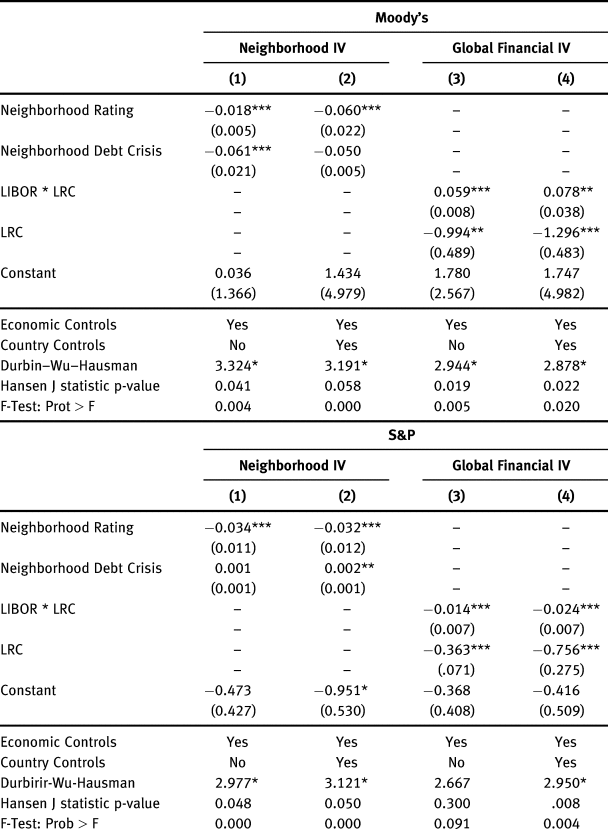
First, we employ a method similar to DiGiuseppe and Shea (Reference DiGiuseppe and Shea2016) and Clay and DiGiuseppe (Reference Clay and DiGiuseppe2017), which uses neighbors’ bond ratings, and counts of external debt crises experienced in a country's geographical region, as sources of exogenous variation. We include two incremental repressors in the first stage of our analysis—the lagged value of the yearly average regional sovereign bond rating, excluding a country's individual rating, and the total number of countries in the region who experienced debt crises. The relevance of these variables can be tested empirically. We test the overidentification restriction that the instruments, excluded and included, are independently distributed of the error process using the Sargan-Hansen test. The results presented in table 1 indicate that three of the models reach significance at the 0.05 level, while the fully specified Moody's model falls slightly outside of that confidence level. We test for weak instruments with an F-test.Footnote 63 As we have more than one endogenous repressor, we test for weak instruments using the Cragg-Donald (Reference Cragg and Donald1993) multivariate version of the F-statistic. All of the F-statistics are greater than 10 (Stock and Yogo, Reference Stock and Yogo2005) and significant at the p > 0.05 level, indicating that we should not suspect a weak instrument problem in the models.

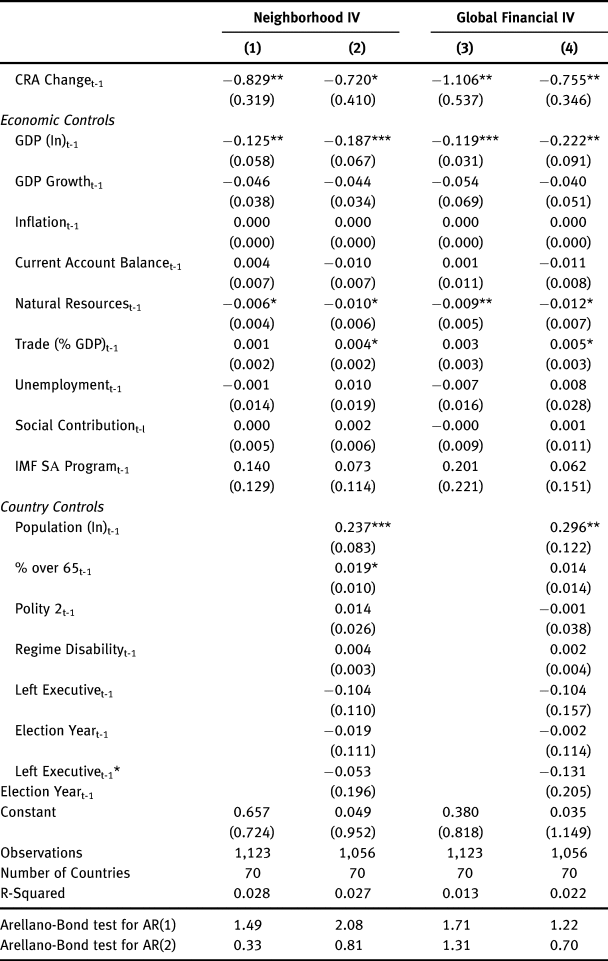
The Effects of CRA Rating Change on Income Inequality (Moody's)

Dependent variable: Yearly change in Income Inequality (SWIID). Note: All regressions include country and year fixed effects, and all standard errors are robust. All independent variables lagged 1 year. Tie Arellano-Bond ARC 1) and AR (2) tests test for first- and second-order autocorrelation (z-scores reported). A significant value represents the presence of autocorrelation. The lack of significant AR(2) disturbances indicates that the models have been correctly specified. Significance level- * p < 0.1; ** p < 05; *** p < 01
While the relevance of the instrument can be tested empirically, the excludability is untestable and must be justified theoretically. Previous research indicates that bondholders often lack resources and are understaffed, often only relying on a few persons to monitor an entire region, and so must use informational shortcuts to assess risk, such as the credit risks of nearby countries, which is referred to as the “neighborhood effect.”Footnote 64 Additionally, the larger number of countries rated in a particular year reinforces concern about CRAs using shortcuts. However, we have no reason to believe that there is a correlation between “neighborhood effect” and levels of inequality, as inequality stems from the responses to economic conditions,Footnote 65 rather than the conditions themselves. This informational reliance on neighboring states can contribute to contagion that influences bond rates that spread from one state to another. We exploit the exogenous contagion process here to satisfy the exclusion restrictions.
Second, we use a method similar to Lang (Reference Lang2016) that employs exogenous variation in global financial trends interacted with a country's likelihood of experiencing a ratings change to introduce exogenous variation such that the isolated interaction effect is excludable from alternative channels. We include two incremental repressors in the first stage of our analysis; the first is a measure of global financial trends, measured with the London Interbank Offer Rate (LIBOR). The second is an interaction between this time-variant variable and a country-variant variable, indicating a country's likelihood of experiencing a ratings change (LRC). Again, we can test the relevance of the instruments empirically using a number of specification tests. Results of a Sargan–Hansen J-test (the p-values are reported) of overidentifying restrictions are reported, and three of the four models indicate a decisive rejection of the model's overidentifying restrictions. An F-test also indicates that the three models do not show evidence of a weak instrument problem.Footnote 66
The LIBOR and LRC meet the exclusion restriction by producing an interaction that varies both across countries as well as over time. CRA ratings assess the likelihood that the government fulfills its debt obligations, and Bulow and Rogoff (Reference Bulow and S1988) were among the first to show that exchange rate variations influence a country's ability to generate revenue and make payments on its external debt. The ability to repay debt obligations is increasingly tied to global financial conditions.Footnote 67 Additionally, CRA ratings take into consideration global investors' risk aversion, which correlates with international financial trends.Footnote 68 As such, these economic conditions play an important role in determining sovereign bond ratings. Previous literature has shown that global financial trends have a spill-over effect that can affect inequality in developing countries,Footnote 69 but again, these effects are consistently dependent on how the state reacts to growing globalization-related pressure. After controlling for the constituent variables, the interaction also introduces exogenous variation to the extent that the isolated interaction effect is excludable from alternative channels.Footnote 70 Thus, even if there were endogeneity between the time-variant level variable and the outcome, the exclusion restriction would only be violated if the unobserved variables driving this endogeneity were correlated with the country-specific likelihood.Footnote 71
While we acknowledge that both of these methods retain the potential for exclusion restriction violations,Footnote 72 they are the two best methods currently available for controlling for endogeneity, and consistent findings between the methods produce some evidence of a causal relationship.
Results
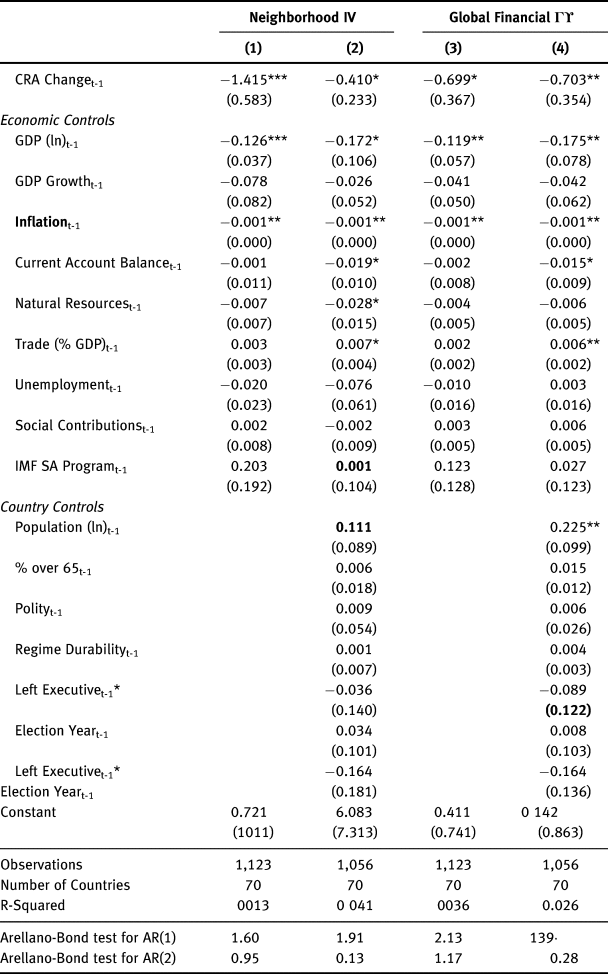
Our analysis examines the relationship between CRA ratings change and income inequality in developing countries. We present our results for Moody's and S&P in tables 2 and 3, respectively. For both tables, columns 1 and 3 show results with just economic controls, while columns 2 and 4 correspond to the full specification with political and demographic controls. The results provide evidence of a relationship between bond rating changes and income inequality, after employing two methods to control endogeneity. The negative and significant relationship for change in rating indicates that as CRAs downgrade sovereign bonds, the expected levels of income inequality within a country will increase. Likewise, if a CRA increases a country's sovereign bond rating, that country will experience a decrease in income inequality. This finding is consistent for both CRAs and model specifications. On average, a nation experiencing a one point increase (decrease) in its sovereign bond rating, leads to a 0.74 points decrease (increase) in a country's average expected level of income inequality. To put it into context, a one-point change in a sovereign bond rating produces an expected change in a nation's level of income inequality by at least 32 percent, and as much as 57 percent, of a standard deviation within one year. Though this change may sound small, a change of this size is far from common, as only about 12 percent of the sample experienced a change of this magnitude in a single year. These findings indicate that a change in CRA-sovereign bond ratings can have a substantial impact on a nation's level of income inequality.
The Effects of CRA Rating Change on Income Inequality (S&P)

Dependent variable: Yearly change in Income Inequality (SWIID). Note: All regressions include country and year fixed effects, and all standard errors are robust All independent variables lagged I year The Arellano–Bond AR(1) and AR (2) tests test for first- aid second-order autocorrelation (z-scores reported). A significant value represents the presence of autocorrelation The lack of significant AR(2) disturbances indicates thar the models have been correctly specified. Significance level. *p < 0.1; **p < 0.05; ***p < 0.01
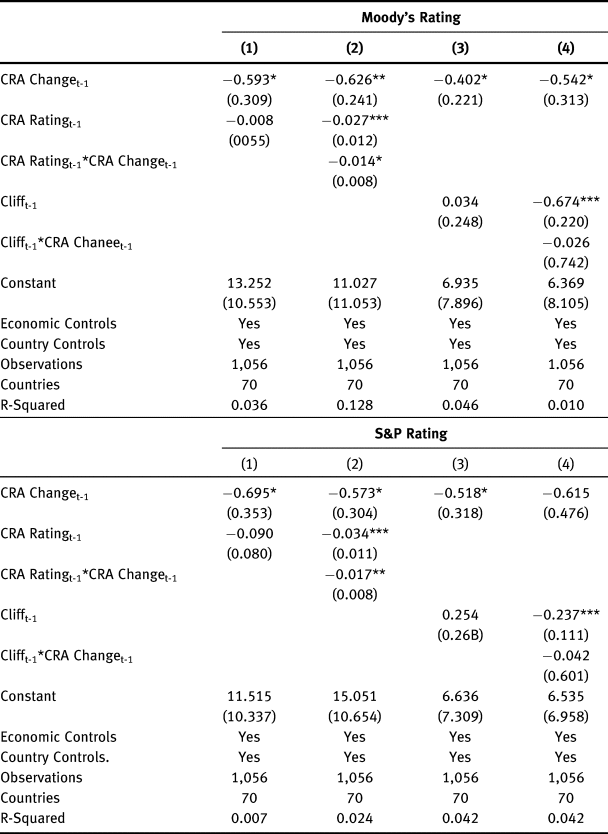
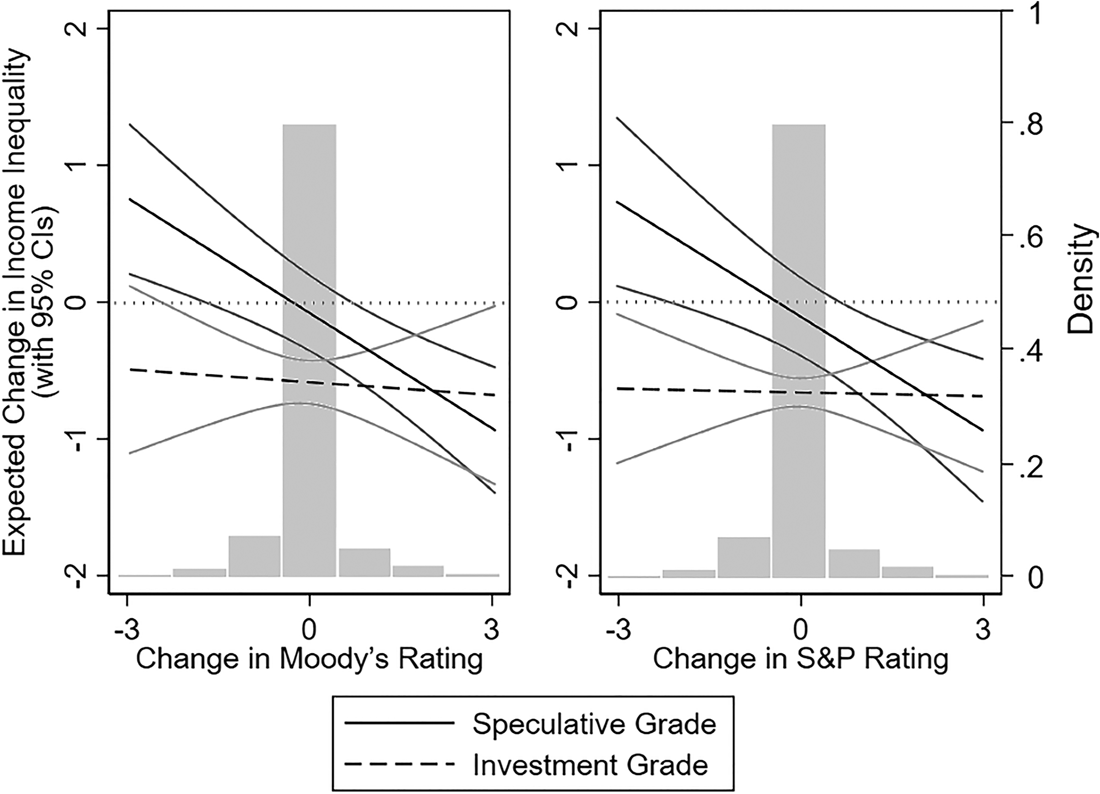
Since the effect of changes in sovereign bond ratings may be contingent on the current rating, we interact bond ratings change with the current rating to determine if changes over a particular scale drive bond ratings change. We also test for the possibility of a “cliff effect,” as bonds transition from speculative to investment grade, or vice versa.Footnote 73 Table 4 presents the results of our analysis. The results indicate that the effect that a change in bond ratings has on inequality is contingent on previous levels, as countries with lower bond ratings observe larger expected effects from changes to their ratings. Consistent with our theory, countries with lower overall bond ratings tend to experience a greater effect from bond downgrades. We graph the results in figure 1, and for both Moody's and S&P, the interactive term (columns 2) is negative and significant. Countries with lower bond ratings often suffer from poor capital endowments, which makes them even more dependent on foreign capital.Footnote 74 These countries face a greater effect from the added risk premium associated with rating downgrades. Given the increased cost of capital from widening interest rate spreads, social spending is likely to decrease, as CRAs recommend fiscal restraint.
Interactive and Cliff Effects

Dependent variable: Yearly change in Income Inequality (SWIID) Note: All regressions include country and year fixed efficts, and all standard errors are robust. All indepentlem variables lagged 1 year.
Significance level: *p < 0.1; **p < 0.05; ***ρ<0.01.
Expected Change in Income Inequality – Speculative and Investment Grade Bonds

Finally, we expect several factors mediate the relationship between sovereign bond ratings and income inequality. Consistent with the first hypothesis, we use four measures of social spending,Footnote 75 including income assistance, all social assistance, social contributions, and total government spending.Footnote 76 Our income assistance and social assistance measure is the percentage of the population in a country covered by both conditional and unconditional income transfers plus human capital investment. Our income assistance measure is for programs specifically designed to provide financial assistance, while the social assistance measure includes programs designed to improve health and nutritional outcomes, as well as improve education, the network of social services, the wellbeing of the elderly, and tackle the intergenerational transmission of poverty. The data come from the UNU-WIDER SAPI Database (2018). Our social contributions measure is the yearly change in all social contributions, including social security contributions, by employees, employers, and self-employed individuals as a percentage of total government revenue. As an additional measure of social spending, we include the yearly change in gross government spending.
To test the second hypothesis, we include four measures of neoliberal policy from the Heritage Foundation's Index of Economic Freedom. First, we employ tax burden, which measures a country's individual and corporate income tax rates. Second, we use labor freedom, which assesses the ability of businesses in a country to contract freely for labor and dismiss redundant workers. Third, we include investment freedom, capturing the degree that a free and open investment environment provides maximum entrepreneurial opportunities and incentives for expanded economic activity, as one would expect with private enterprises. Fourth, we employ a measure of monetary freedom, which examines government intervention into the monetary supply, price controls, and inflationary policy.
For the third hypothesis, we use three measures of interest rate spreads. First, we include a measure of rate spreads, which is the percentage difference between the lending rate less deposit rate in a country.Footnote 77 A narrow spread means low transaction costs, which reduces the cost of funds for investment, while a high spread indicates higher transaction costs, which can hinder economic prosperity. Next, we include a measure of the lending rate in a country, which is the bank rate that usually meets the short- and medium-term financing needs of the private sector.Footnote 78 Finally, we include interest rate minus LIBOR, or the average difference between the percentage LIBOR and the deposit rate.Footnote 79
While mediation analysis can take different forms,Footnote 80 we employ a linear structural equation model (LSEM) fitted using Maximum Likelihood to identify an average causal mediation effect (ACME).Footnote 81 This strategy, based on the approach initiated by Baron and Kenny (Reference Baron and Kenny1986), and further specified by Imai, Keele, and Yamamoto (Reference Imai, Keele and Yamamoto2010), tests the way that a number of potential variables mediate the relationship between CRA ratings and income inequality. LSEMs are desirable for two reasons. First, they allow specification of correlated errors through time for panel analysis.Footnote 82 Second, LSEMs provide an ideal condition to identify ACMEs that are causally valid and are relatively easy to interpret.Footnote 83 To focus on the within-country effects of changes in bond ratings, we use a country and year fixed-effects framework.Footnote 84 Furthermore, under a set of assumptions, LSEMs produce the most asymptotically consistent estimates of mediation effects.
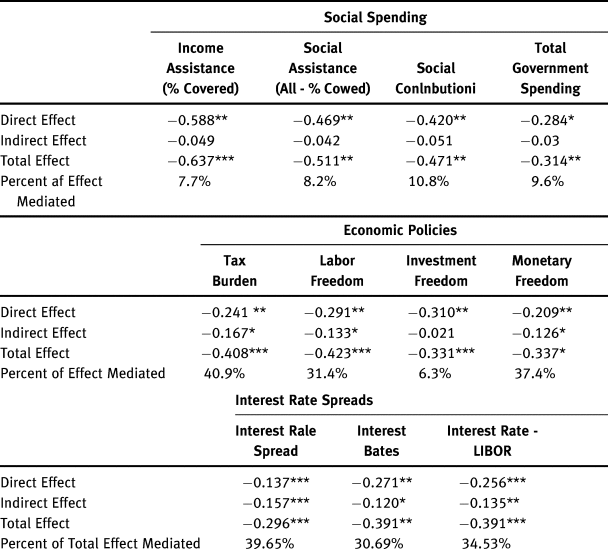
We begin by examining the relationship among bond rating changes, social spending, and income inequality. The results in table 5 provide limited evidence that social spending mediates the relationship between bond ratings changes and income inequality. In fact, none of our social spending variables mediates more than 11 percent of the relationship between rate changes and inequality. In none of the fully specified models do we find evidence that social spending mediates the relationship between bond rating change and income inequality as none of the indirect relationships reaches statistical significance. Thus, the results appear to provide little to no support for Hypothesis 1—that sovereign bond rating downgrades decrease social spending, resulting in higher income inequality.Footnote 85
Mediation Effects

Note: Full models available in the appendix.
We next examine the relationship between bond rating changes, economic policy, and income inequality. The results presented in table 5 indicate that economic policy seems to mediate the relationship between rating changes and income inequality. The results show that rating changes have a negative influence on tax burden, suggesting that when bond ratings decrease, governments are likely to implement more neoliberal tax reforms. The inequality stage of these models appears to provide support for Hypothesis 2—that bond downgrades lead to more neoliberal tax policies and the economic reforms contribute to higher income inequality, as tax burden mediated more than 40 percent of the relationship. We find similar results for labor freedom, as greater labor openness mediated 31.4 percent of the relationship between rating change and inequality. This indicates that when countries experience bond rating decreases, they are likely to implement more open labor policy, which leads to higher income inequality. We also find support for monetary policy mediating the relationship between rating changes and inequality, noting that monetary policy mediates 37.4 percent of that relationship. However, we find no such support for this relationship existing for investment policy. The results, in general, provide support for Hypothesis 2—that neoliberal reforms mediate the relationship between bond ratings and income inequality.
Lastly, we investigate if interest rate spreads mediate the relationship between sovereign bond ratings and income inequality. First, we examine the relationship between changes in sovereign bond ratings and changes in interest rate spreads. Results of our analysis, presented in table 5, show that changes in interest rate spreads accounts for almost 40 percent of the relationship between changes in sovereign bond ratings and income inequality. This indicates that when CRA ratings increase, interest rate spreads decrease, reducing the cost of capital. We obtain similar results when using alternative measures for interest rate spreads—interest rate and interest rate minus LIBOR. Moreover, in all of the models, CRA ratings change has a significant negative relationship to interest rate spreads, but when the mediating effects of interest rate spreads are included in the inequality models, the relationship between CRA ratings and income inequality becomes insignificant. This, combined with the significant coefficient for interest rate spreads in all of the inequality models, indicates that CRA ratings are affecting interest rate spreads and these, in turn, are affecting levels of income inequality. Using the interest rate spreads measure, we find a 1-point increase in bond ratings leads, on average, to a decrease in interest rate spreads by about 1 point. The results offer strong support for Hypothesis 3—that interest rate spreads mediate the relationship between sovereign bond ratings and income inequality.
Conclusion
Previous empirical research on the relationship between globalization and income inequality has investigated economic measures including FDI and trade. Absent from the literature is the role of CRAs and their rating of sovereign bonds, a financial instrument of growing importance. Much like international financial institutions or foreign governments put pressures on countries to change policy course, changes in the ratings by CRAs can serve as a catalyst for policy reforms, which affect income inequality in the developing world.
In the first study that we know of to consider the effects of CRAs on income inequality, we provide evidence that rating downgrades increase income inequality. However, when we dig deeper to uncover the mechanism through which CRAs effect income distributions, we find interest rate spreads, and, to a lesser extent, tax, labor, and monetary policy, mediate the relationship between bond ratings and income inequality. In the case of interest rates, bond rating downgrades lead to a widening in interest rate spreads, which limit available credit and reduce production, contributing to lower wages and worse job opportunities for the poor. The better off also may offer high interest-rate loans to those in dire need of credit, further increasing income inequality. In terms of neoliberal policy, we found that fiscal, labor, and monetary policy related to tax, worker, and financial reforms mediated the relationship between bond ratings and income distribution, but private investment reforms appeared to have minimal impact on income inequality.
The results complement previous studies, indicating that the rating decisions of CRAs can and do affect policy-making in the developing world.Footnote 86 Similar to the pressures that the IMF imposes on borrower nations, the financial power of CRAs hold substantial sway over policy-making, especially in the LDCs. In addition, the findings build on earlier work tied to the efficiency and compensation hypotheses, showing how bond rating downgrades or upgrades can promote cost cuttingFootnote 87 or enhanced government spending,Footnote 88 respectively.
The analysis and results presented in this article serve as a first step in understanding the influence that CRAs have on developing countries. While the results say a lot about this influence, we recognize the limitations of using aggregate data. Ideally, for future research, we invite further inquiries as to the specific motivations of leaders and government officials in individual countries to gain a deeper sense of the quantitative results. Notwithstanding the limitations, the results presented here show how CRA ratings indirectly affect income inequality, giving us a better understanding, more broadly, of the effects of globalization on income distribution in the developing world.
Supplementary material
To view supplementary material for this article, please visit https://doi.org/10.1017/bap.2020.1.