With the ascent of the developmental/life-course paradigm in criminology (Farrington, Reference Farrington2003a), greater theoretical and empirical attention is being devoted to how crime and delinquency unfolds across the lifespan. Theoretical and methodological advances have spurred an increase in research on these topics, broadening our understanding of trajectories of crime over time. Research has examined an array of topics, including whether distinct groups of offenders can be identified and the predictive factors that may play a role in identifying the heterogeneous groups observed within the offending population. One of the most important theoretical perspectives has been the developmental taxonomy, proffered by Moffitt and colleagues (Moffitt, Reference Moffitt1993, Moffitt & Caspi, Reference Moffitt and Caspi2001; Moffitt, Caspi, Dickson, Silva, & Stanton, Reference Moffitt, Caspi, Dickson, Silva and Stanton1996; Moffitt, Caspi, Harrington, & Milne, Reference Moffitt, Caspi, Harrington and Milne2002).
Moffitt argued that the prototypical “age–crime curve,” which has been identified and examined in the literature for decades (see Hirschi & Gottfredson, Reference Hirschi and Gottfredson1983; Sweeten, Piquero, & Steinberg, Reference Sweeten, Piquero and Steinberg2013), does not characterize a general pattern of offending over the life course for the population at large. Rather, the age-crime curve actually reflects two (or more) distinct groups of individuals: those who begin to offend in adolescence and return to conformity in early adulthood, and those who, due to neuropsychological and personality deficits, act out early in childhood and subsequently are severely antisocial throughout life. Much work has been carried out examining Moffitt's taxonomy, which has resulted in both challenges and adjustments to the theory, including the number of distinct trajectories that can be empirically identified and predicted using her specific criteria (see Laub & Sampson, Reference Laub and Sampson2003; Moffitt, Reference Moffitt, Cicchetti and Cohen2006).
One particular theoretical adjustment, with which we concern ourselves in the current study, arose during the course of Moffitt's own research using longitudinal data from the Dunedin Study in which she identified a set of individuals who did not seem to meet the criteria of membership in either the life-course persistent (LCP) or the adolescence-limited (AL) groups (Moffitt et al., Reference Moffitt, Caspi, Dickson, Silva and Stanton1996). These boys were similar to the LCP individuals in early childhood, but intriguingly, did not grow up to be severely delinquent in adolescence. Labeled as “recoveries,” the offending patterns of this group tended to be somewhat short-lived. However, in a follow-up study, Moffitt et al. (Reference Moffitt, Caspi, Harrington and Milne2002) discovered that the recoveries had poor psychological profiles and many life problems.
The existence of this group of offenders has several theoretical and policy implications, yet persons characterized as recoveries have not been the subject of much empirical work beyond Moffitt and colleagues' own research. In this regard, we focus on two specific research questions: Is there a group of individuals who begin life seemingly on track for an antisocial existence but somehow “make it out?”; and if so, what do they look like and how might they be identified? This study presents the first replication of Moffitt et al.'s (Reference Moffitt, Caspi, Harrington and Milne2002) work, identifying individuals resembling LCP, AL, and recoveries (as well as the youth who completely abstain from offending). Using data on a sample of British males from the Cambridge Study in Delinquent Development (CSDD) from childhood through late middle adulthood, we report on an examination of these four groups, including their offending and psychological profiles over the life course. Accordingly, our work offers one of the most comprehensive and long-term investigations of the recoveries group.
In the next section, we provide a brief overview of prior research on criminal careers and a more extensive discussion of the heterogeneity that has been identified in the offending population. This heterogeneity has helped to spur interest in developmental/life-course explanations that have been a prominent feature of theoretical criminology in the past 25 years.
Criminal Career Research and Theory
While criminology arguably became “adolescence-limited” in the mid-20th century, focusing as it did on cross-sectional studies of youth delinquency (Cullen, Reference Cullen2011), the history of the field has generally sought to examine offending over time. In the 20th century, while relatively rare, several longitudinal studies contributed to knowledge about the life-course development of crime (Glueck & Glueck, Reference Glueck and Glueck1950; McCord, Reference McCord1978; Robins, Reference Robins1978; Tracy & Kempf-Leonard, Reference Tracy and Kempf-Leonard1996; Tracy, Wolfgang, & Figlio, Reference Tracy, Wolfgang and Figlio1990; Wolfgang, Figlio, & Sellin, Reference Wolfgang, Figlio and Sellin1972). These works examined why certain youth become involved in crime and delinquency, why some persist and why others do not.
Among the most important findings arising from these pioneering efforts were that not all youth who were from disadvantaged backgrounds and who had been delinquent grew up to be persistent criminals. The Gluecks' work focused on explaining this finding by appealing to what they called “maturational reform” (Glueck & Glueck, Reference Glueck and Glueck1937; see also Rocque, Reference Rocque2014). Robins's (Reference Robins1966) longitudinal study of over 500 children with behavioral problems in St. Louis found that while there was considerable continuity in behavior (e.g., maladjusted adults nearly always had been maladjusted children), many maladjusted children were not troubled adults. In a later review of longitudinal studies, Robins (Reference Robins1978) made the now famous statement that “most highly antisocial children do not become highly antisocial adults” (p. 611, emphasis in the original). These findings have important implications for research and policy, as they may shed light on the process of desistance from crime.
Research on criminal careers, with a specific focus on initiation, prevalence, length of offending career, and desistance (cessation of crime), became a mainstay in the 1980s (Blumstein, Cohen, Roth, & Visher, Reference Blumstein, Cohen, Roth and Visher1986; Piquero, Farrington, & Blumstein, Reference Piquero, Farrington, Blumstein and Tonry2003). In the now classic “criminal career debates,” criminologists argued over the value of examining different types of crimes and various elements of the criminal career, such as when individuals begin to offend, how long they offend, and how much they offend. On one side of the debate, Gottfredson and |Hirschi (Reference Gottfredson and Hirschi1986, Reference Gottfredson and Hirschi1987) argued that the same factors can explain all of these elements; thus, they are unnecessary as unique foci of study. On the other side of the debate were those who argued that, in order to fully understand how crime unfolds over time, it is necessary to examine each facet of the criminal career, separately, and such questions about different influences were primarily empirical, not theoretical (see Blumstein et al., Reference Blumstein, Cohen, Roth and Visher1986; Farrington, Reference Farrington1992; Piquero, Farrington, & Blumstein, Reference Piquero, Farrington and Blumstein2007). The debate is not a mere academic historical curiosity, because it has real implications for understanding and reducing criminal behavior.
Heterogeneity in Longitudinal Offending Patterns
The creation of offender typologies is certainly not a new development in criminology (see Gibbons, Reference Gibbons1975). However, the growth of criminal career research spurred an interest in identifying and explaining why some offenders persist while others desist. Empirical studies had uncovered these disparate tracks in the early to mid-20th century. In the late 20th century, theoretical work sought to make sense of these findings. One early theory was developed by Gerald Patterson, who suggested that there were two primary tracks of delinquency: late onset and early onset offenders (Patterson, Reference Patterson and Lenzenweger1996; Patterson, DeBaryshe, & Ramsey, Reference Patterson, DeBaryshe and Ramsey1990; Patterson & Yoerger, Reference Patterson, Yoerger and Hodgins1993). The early onset track or trajectory, according to the theory, indicated a longer and more severe criminal career, while late onset offending was short-lived and restricted to the period of adolescence.
Perhaps the most well-known and empirically investigated developmental/life-course theory is Moffitt's (Reference Moffitt1993, Reference Moffitt and Thornberry1997) taxonomy of LCP and AL offenders. She sought to show that the general age-crime curve that has been recognized for decades actually disguises two distinct groups of offenders. She labeled the “normative” group ALs. This group constitutes the majority of individuals, who are stable and healthy as children but during adolescence become caught in a maturity gap in which, biologically, they are adults but socially they are treated as juveniles. Thus, in a process of social mimicry (see Moynihan, Reference Moynihan1968), these youth assert their independence by engaging in delinquent acts, such as smoking, drinking, and theft. Their delinquency can be quite serious but tends to dissipate upon adulthood. When social independence catches up to biological independence, delinquency and criminal behavior lose their appeal as other concerns become paramount, such as the search for a career and creation of a family. However, some youth become “ensnared” in criminal pathways due to the collateral consequences of their misdeeds (e.g., becoming pregnant or incarcerated).
The second group, representing perhaps 5% of the population, is composed of LCP offenders. These individuals suffer disadvantages early in life, often with what Moffitt terms “neuropsychological deficits” or cognitive and personality impairments, which themselves are exacerbated in distressed economic and familial environments that do not typically have the resources needed to help children overcome their early life deficits. These factors result in children with severe conduct disorder and antisocial behavior that escalates over time and tends to be more violent and severe during adolescence than with ALs. LCPs serve as the role models for ALs during adolescence. As the term implies, LCPs persist in antisocial behavior over time and comprise the right-hand tail of the age-crime curve, while ALs drop out into conformity as adulthood ensues and they are able to obtain all of the things that they had coveted as teenagers.
Much research has been conducted on Moffitt's taxonomy, with some supporting as well as some conflicting findings. Research examining whether there are differences between adolescent onset and childhood onset tracks has tended to support the theory (see Moffitt & Caspi, Reference Moffitt and Caspi2001; Moffitt et al., Reference Moffitt, Caspi, Dickson, Silva and Stanton1996, Reference Moffitt, Caspi, Harrington and Milne2002). However, work that has utilized group-based trajectory analyses has identified, at least empirically, distinct trajectories of offending, but they generally include more than two groups (see, e.g., Blokland, Nagin, & Nieuwbeerta, Reference Blokland, Nagin and Nieuwbeerta2005; Ezell & Cohen, Reference Ezell and Cohen2005; Laub & Sampson, Reference Laub and Sampson2003; White, Bates, & Buyske, Reference White, Bates and Buyske2001; see reviews in Jennings & Reingle, Reference Jennings and Reingle2012; Piquero, Reference Piquero and Liberman2008). Moffitt and colleagues’ own work has often identified more than two groups of offenders (Moffitt et al., Reference Moffitt, Caspi, Dickson, Silva and Stanton1996, Reference Moffitt, Caspi, Harrington and Milne2002). Detailed overviews of research on the taxonomy may be found in Moffitt (Reference Moffitt, Cicchetti and Cohen2006) and Piquero and Moffitt (Reference Piquero, Moffitt and Farrington2005).
Two unique groups that have emerged in empirical research include youth who are abstinent from crime or delinquency, and those who appear on the life-course track in childhood but seem to “recover” over time. The first group, abstainers, represents a small number of individuals who are restrained either socially or interpersonally from normal development. These restrictions prevent the process of social mimicry, and thus these youth do not engage in typical delinquency. Research on this group has indicated that, while abstainers are removed from delinquent peers, they may not be as abnormal in terms of personality traits as the theory hypothesized (Barnes, Beaver, & Piquero, Reference Barnes, Beaver and Piquero2011; Chen & Adams, Reference Chen and Adams2010; Piquero, Brezina, & Turner, Reference Piquero, Brezina and Turner2005).
The fourth group has received far less attention in the literature. Not anticipated in the initial taxonomy, this group was termed “recoveries” by Moffitt et al. (Reference Moffitt, Caspi, Dickson, Silva and Stanton1996, Reference Moffitt, Caspi, Harrington and Milne2002), as youth who “had been extremely antisocial as children [but] did not meet our research criterion for extreme antisocial status as adolescents” (Moffitt et al., Reference Moffitt, Caspi, Dickson, Silva and Stanton1996, p. 408). The identification of this group was not expected by Moffitt et al., and thus was the subject of increased attention in subsequent analyses. Of importance, the number of persons characterized as recoveries was quite small, representing less than 6% of the total sample. As adolescents, these boys were still somewhat antisocial, engaging in relatively normative delinquency. However, according to the taxonomy, childhood-onset problem behavior should be strongly related to the sort of persistent antisocial behavior that is characteristic of LCP offenders, and this did not appear to be the case. Moffitt et al. argued that their data “provided no insights” as to how the recoveries escaped LCP status (Moffitt et al., Reference Moffitt, Caspi, Dickson, Silva and Stanton1996, p. 419).
Moffitt et al. (Reference Moffitt, Caspi, Harrington and Milne2002) followed up the same Dunedin sample to further explore the preidentified groups to age 26. In this study, the researchers examined the four groups with respect to behavior and personality characteristics, such as depression and anxiety. At age 26, Moffitt et al. argued that the label of “recoveries” was a “misnomer” as this group experienced multiple adjustment problems in adulthood. Many had internalizing issues, and life troubles, as indicated by low-paying jobs and financial instability. Analyses of the recoveries showed that only about 15% of Dunedin's 87 young boys with childhood-onset conduct problems truly “recovered,” escaping all adjustment problems. However, this group did engage in much less crime, particularly serious crime, than the AL or LCP groups.
Research on these recoveries is consistent with previous work on “false positives,” or children who would be predicted to engage in long-term, serious antisocial behavior. Robins's (Reference Robins1966) study found that while a significant portion of youths who were antisocial or had psychiatric problems as children improved as adults, many of these replaced antisocial problems with other problems: “[t]he finding that more than a third of the sociopathic group have given up much of the antisocial behavior that brought them into contact with court martial boards, social agencies, the police, and the divorce courts, does not mean that at present they are strikingly well-adjusted and agreeable persons. Many of them report current interpersonal difficulties, irritability, hostility toward wives, neighbors, and organized religion” (p. 236). Nevertheless, “they are in many cases no longer either a threat to the life and property of others nor a financial drain on society” (Robins, Reference Robins1966, p. 236, see also Moffitt et al., Reference Moffitt, Caspi, Harrington and Milne2002, p. 197).
Aside from Moffitt's work with the Dunedin data, there have been only a handful of other investigations of the offending patterns of a group of persons resembling recoveries. For example, in an analyses of data from the CSDD, Farrington, Gallagher, Morley, and St. Ledger (Reference Farrington, Gallagher, Morley and St. Ledger1988) examined youth from criminogenic backgrounds who, by age 32, did not grow up to be antisocial or criminal adults. These “vulnerable but resilient” youth were those who came from disadvantaged childhoods but did not engage in serious crime as adults. Again, these individuals represented a relatively small portion of the group (17 of 63). Similar to the findings from Robins and Moffitt et al., these individuals suffered significant adult adjustment problems. In a previous analysis, Farrington, Gallagher, Morley, St. Ledger, and West (Reference Farrington, Gallagher, Morley, St. Ledger, West, Jenkins and Brown1988) found that “unconvicted vulnerable boys were often the least successful in many aspects of their lives” (Farrington, Gallagher, Morley, & St. Ledger Reference Farrington, Gallagher, Morley and St. Ledger1988, p. 123). However, in the follow-up, this group was rated as the most successful in life adjustment.
Current Study
In sum, research assessing the longitudinal variability in offending across a range of data sources has consistently identified distinct trajectories of persons who follow rather unique paths of offending that vary in shape and level over time. Within these heterogeneous patterns, one of the least-researched groups includes a small group of “recoveries,” who end up being, in the parlance of Moffitt's developmental taxonomy, false positive LCP offenders. It is interesting that before Moffitt et al. identified such persons in her Dunedin data, Farrington, Gallagher, Morley, and St. Ledger (Reference Farrington, Gallagher, Morley and St. Ledger1988, p. 116) stated that “[s]urprisingly few researchers have addressed this issue.” In the handful of studies that exist on this topic, most have identified a small number of persons who would be characterized as LCP in childhood who do not engage in persistent antisocial behavior as adults. As well, these studies do report that these same persons tend to have a higher prevalence of noncrime problems in early adulthood suggesting that “prevention programs targeting antisocial children will not be wasted on the half who are not on course to become LCP offenders” (Moffitt et al., Reference Moffitt, Caspi, Harrington and Milne2002, p. 197). More research is needed to explore outcomes of vulnerable but resilient youth to determine if poor adult outcomes are unavoidable or if true recoveries do exist. If so, research on the correlates of recoveries will contribute much to policy and theory related to life-course offending patterns.Footnote 1
Accordingly, this study presents a long-term investigation of the recovery group using longitudinal data from a large sample of males from South London followed into late middle adulthood. In this regard, our effort offers several advantages over previous investigations, including the manner in which we differentiate between distinct offending typologies; the larger array of adult outcomes that we examine in addition to offending, such as personality characteristics, psychopathology, as well as personal and economic life circumstances and problems; and the extent to which we are able to measure these outcomes in late middle adulthood (the longest window of time available for researchers to examine outcomes among recoveries).
Data and Methods
The CSDD is a prospective longitudinal study of the development of offending and antisocial behavior in a cohort of 411 boys born in 1953 (on average) in South London. These men have been interviewed since they were 8 years of age and up to age 48. Further, the men represented a complete population of boys who were 8 years of age at that time (1961–1962) and were attending one of six primary schools in a deprived area of South London. With regard to general demographic characteristics, the overwhelming majority of the males were White (97%) and were raised in two-parent working-class households (West & Farrington, Reference West and Farrington1973). In addition, the males were also predominantly of British origin (Farrington, Reference Farrington1995). Findings from the CSDD have been well documented in the literature in over 200 publications and several books (see Farrington, Reference Farrington, Thornberry and Krohn2003b; Farrington et al., Reference Farrington, Coid, Harnett, Jolliffe, Soteriou and Turner2006; Farrington, Coid, & West, Reference Farrington, Coid and West2009; Farrington, Piquero, & Jennings, Reference Farrington, Piquero and Jennings2013; Piquero et al., Reference Piquero, Farrington and Blumstein2007).
Variables
CSDD offending and offending typologies
Official offending was measured from two different strands of conviction data. The first of these was used to estimate the males’ offending trajectories (see Piquero et al., Reference Piquero, Farrington and Blumstein2007) when most of the males were approximately age 40.Footnote 2 In the second, conviction searches of the CSDD males’ criminal records for any offenses that may have occurred beyond age 40 and up until age 56 were performed, which were obtained in 2011 (Farrington et al., Reference Farrington, Coid, Harnett, Jolliffe, Soteriou and Turner2006, Reference Farrington, Piquero and Jennings2013). Relying on the conviction data from ages 10–18, we constructed typologies by following Moffitt et al.'s (Reference Moffitt, Caspi, Harrington and Milne2002) classification scheme in order to represent the four groups theoretically discussed and empirically analyzed in their study. Specifically, males who had no convictions up to age 18 were classified as abstainers. Comparatively, males who were convicted during late childhood/early adolescence (ages 10–12) and during middle to late adolescence but whose adolescent offending (ages 13–18) was not extreme (e.g., less than two convictions) were coded as recoveries, whereas those males who offended during late childhood/early adolescence (ages 10–12) and during middle to late adolescence and accumulated two or more adolescent convictions (ages 13–18) were categorized as LCPs. The males who were only convicted during middle to late adolescence (e.g., ages 13–18) and not in late childhood/early adolescence were coded as ALs.
Adult adjustment problems (adult outcomes)
Consistent with Moffitt et al. (Reference Moffitt, Caspi, Harrington and Milne2002), we included and categorized the adult adjustment problems into six life-course domains: official offending (4 measures), self-reported offending (2 measures), personality (5 measures), psychopathology (6 measures, personal life (8 measures), and economic life (2 measures). Official offending is based on adult convictions that were dichotomized (yes/no) for each developmental period of the adult life course in order to (a) mirror Moffitt et al.'s adulthood conviction developmental period (e.g., ages 19–26), and (b) to measure the prevalence of conviction at three more developmental periods in adulthood (e.g., ages 27–36, 37–46, and 47–56) that have yet to have been examined in this fashion in the literature as it relates to Moffitt et al.'s (Reference Moffitt, Caspi, Harrington and Milne2002) typology of abstainers, recoveries, LCPs, and ALs. In addition, self-reported offending was measured at age 32 and age 48, and these two dichotomous measures include self-reported offending for the following crimes: burglary, theft of vehicle, theft from vehicle, shoplifting, theft from machines, theft from work, fraud, assault, drug use, and vandalism.
Personality traits were assessed using the Psychopathy Checklist: Screening Version (PCL-SV; Hart, Cox, & Hare, Reference Hart, Cox and Hare1995). The PCL-SV was scored from information gathered between ages 18 and 48 years. The PCL-SV is a 12-item version of the Hare Psychopathy Checklist—Revised (Hare, Reference Hare1991, Reference Hare2003). Like the Hare Psychopathy Checklist—Revised, each item is scored on a 3-point scale (0 = not present, 1 = possibly present, 2 = definitely present), with a total score that can vary between 0 and 24. In this study, we use the PCL total score as well as each of the four PCL facets. Further information regarding the PCL in the CSDD may be found elsewhere (Farrington, Reference Farrington2005, Reference Farrington and Patrick2006, Reference Farrington, Felthous and Sass2007; Piquero et al., Reference Piquero, Farrington, Fontaine, Vincent, Coid and Ullrich2012). The psychopathology domain was measured by drinking problems (driven after drinking 10 + units, heavy drinking of 40 + units in a typical week, and/or binge drinking by drinking 13 + units in one evening), drug problems (smoked marijuana and/or used another drug), and/or mental health problems (anxiety/depression based on the General Health Questionnaire; see Goldberg, Reference Goldberg1978) at ages 32 and/or 48.
Personal life adult adjustment problems were assessed as having a poor accommodation history (not a home owner, poor home conditions, and more than one to two addresses in the last 5 years), a poor cohabitation history (not living with female partner, not married/cohabiting in the last 5 years, divorced in the last 5 years, and not getting along well with female partner), being involved in fights, and perpetrating intimate partner violence in the last 5 years (slapping, shaking, throwing an object at, kicking/biting or hitting with a fist, hitting with an object, twisting arms, beating up [multiple blows], choking or strangling, and threatening with a knife or gun; Straus, Reference Straus, Straus and Gelles1990; see also Piquero, Farrington, Nagin, & Moffitt, Reference Piquero, Farrington, Nagin and Moffitt2010). All three of these personal life problems were measured at the age 32 and age 48 interviews, respectively. Finally, the domain of economic life adult adjustment problems was measured by having employment problems (not currently employed, low social class, low take home pay, and unemployed greater than 9 months in last 5 years). Again, these economic adult adjustment problems were measured at ages 32 and 48.Footnote 3
Analytic strategy
The analysis proceeds in a series of stages. In the first stage, we present descriptive information on the prevalence of the four typologies that were initially identified and analyzed by Moffitt et al. (Reference Moffitt, Caspi, Harrington and Milne2002; e.g., abstainers, recoveries, LCPs, and ALs) in their Dunedin data among the male participants in the CSDD. These CSDD prevalence estimates for the four groups are presented alongside the prevalence estimates of the four groups identified by Moffitt et al. (Reference Moffitt, Caspi, Harrington and Milne2002) based on their cohort of Dunedin males. The second stage of the analysis provides statistical comparisons for the four groups across the host of 27 outcomes distributed across the 6 life-course domains of official offending; self-reported offending; personality; psychopathology; personal life; and economic life. In the final stage of the analysis, the total numbers of adult adjustment problems are evaluated to determine how their frequency of occurrence may be differentially distributed across the abstainer, recovery, LCP, and AL pathways.
Results
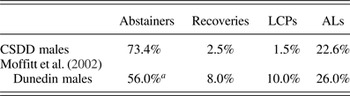
Table 1 presents the prevalence of the four CSDD offending groups based on the categorization schema reported in Moffitt et al. (Reference Moffitt, Caspi, Harrington and Milne2002). Similar to Moffitt et al. (Reference Moffitt, Caspi, Harrington and Milne2002), the abstainer group (73.4%) represented the largest group among the CSDD males, and this group had no convictions before the age of 18.Footnote 4 In addition, roughly equivalent percentages of ALs, or males whose adolescent criminal history was confined to between the ages of 13 and 18, were found in the CSDD (22.6%) compared to the Dunedin male cohort (26.0%). Compared with the Dunedin male cohort, a smaller proportion of the CSDD males were identified as recoveries (2.5% vs. 8.0%) and LCPs (1.5% vs. 10.0%), which could be due to several reasons, including the length of follow-up and the measure of offending.
CSDD male offending typology

Note: CSDD, Cambridge Study in Delinquent Development; LCP, life-course persistent offenders; AL, adolescence-limited offenders.
a This abstainer group combines those males who Moffitt et al. (Reference Moffitt, Caspi, Harrington and Milne2002) categorized “abstainers” (5% of males who had no antisocial behavior reported by age 18) and those they categorized as “unclassified” (51% of males whose antisocial behavior was approximately normative; Moffitt et al., Reference Moffitt, Caspi, Harrington and Milne2002, p. 183).
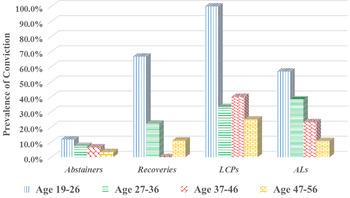
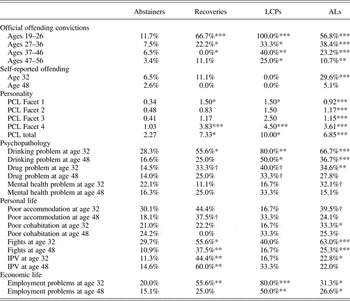
Table 2 provides the statistical comparisons for the multitude of outcomes for the six domains of adult adjustment problems. As presented and graphically illustrated in Figure 1, the overwhelming majority of the abstainers are not convicted at any point in their adult lives up to age 56. In contrast, a large proportion of the recoveries, all of the LCPs, and some of the ALs go on to be convicted at some point in their adult lives to varying degrees. ALs also are more likely to self-report offending in adulthood compared with the abstainers. Regarding personality traits, the recoveries, the LCPs, and the ALs had significantly higher PCL total scores, and scores for Facet 1 and Facet 4 in particular, when compared with the abstainers. Similarly, the many psychopathology problems (drinking, drug use, and mental health) are disproportionately concentrated among the recoveries, ALs, and considerably more concentrated in the LCPs, relative to the abstainers. In addition, all four groups experience personal life adult adjustment problems at various levels, although involvement in fights and perpetrating intimate partner violence seem to be noticeably characteristic of the recoveries. Finally, economic life (employment) problems are apparent among the recoveries and ALs relative to the abstainers, and the clear majority of LCPs show significant employment problems in adulthood.
(Color online) Prevalence of conviction over ages 19–56 for Cambridge Study in Delinquent Development males by offending typology.

Comparisons of adult adjustment problems for CSDD males by offending typology

Note: CSDD, Cambridge Study in Delinquent Development; LCP, life-course persistent offenders; AL, adolescence-limited offenders; PCL, Psychopathy Checklist; IPV, intimate partner violence. Asterisks indicate that this particular group differs significantly from the abstainer group.
†p < .10. *p < .05. **p < .01. ***p < .001. One-tailed test.
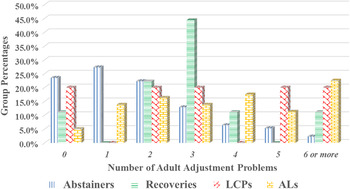
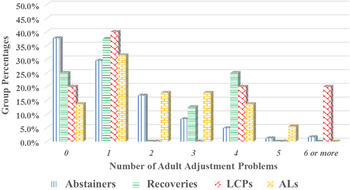
The last stage of the analysis is graphically depicted in Figures 2 and 3. As can be seen, there is a general trend observed in the data that abstainers have the least number of adult adjustment problems and that the recoveries typically have a few adult adjustment problems. These trends can be observed at age 32 (Figure 2) but even more so at age 48 (Figure 3). Further, the LCPs and ALs are more evenly distributed across the number of observed adult adjustment problems at age 32, although there is a trend for the ALs to have fewer adult adjustment problems and for the LCPs to have four or more adult adjustment problems at age 48.
(Color online) Number of adult adjustment problems among Cambridge Study in Delinquent Development males at age 32 by offending typology.

(Color online) Number of adult adjustment problems among Cambridge Study in Delinquent Development males at age 48 by offending typology.

Discussion
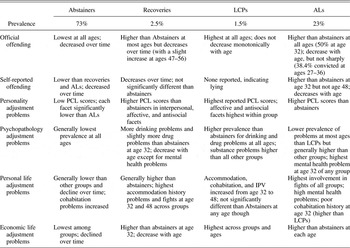
The purpose of this study was to conduct a longitudinal analysis of Moffitt's recoveries group into late middle adulthood. Our work with data from the CSDD through age 56 provided an additional 30 years of data above and beyond what had been previously used to study recoveries (see Moffitt et al., Reference Moffitt, Caspi, Harrington and Milne2002). Below, we summarize how each of the four offending groups in the CSDD compared to those observed in Moffitt et al.'s (Reference Moffitt, Caspi, Harrington and Milne2002) Dunedin sample, as well as the veracity of Moffitt et al.'s predictions on how individuals in the groups would fare across several life domains as they aged. A summary of the findings, described below, is presented in Table 3.
Summary of findings for CSDD males by offending typology

Note: CSDD, Cambridge Study in Delinquent Development; LCP, life-course persistent offenders; AL, adolescence-limited offenders; PCL, Psychopathy Checklist; IPV, intimate partner violence.
The abstainers
Abstainers were originally defined by Moffitt et al. as males with no delinquent or antisocial behavior (self-reported or official) between ages 5 and 18, ~5% of their Dunedin sample. However, because refraining from antisocial behavior in adolescence can be considered abnormal, a second group called “unclassified” offenders (the 51% of males who show some antisocial behavior, but minor enough to be more normative) are also included in the final abstainer category as described in the current study. In total, a little over half of the Dunedin sample were classified as abstainers, while 73% of the CSDD males in the present study fit the classification of the abstainer group.
Similar to findings from Moffitt et al.'s (Reference Moffitt, Caspi, Harrington and Milne2002) study, the abstainers in the Cambridge data showed the most successful and problem-free lives throughout the follow-up period. Even up to age 56, abstainers consistently decreased in the prevalence of both official and self-reported offending (from 12% to 3% and 7% to 3%, respectively), and other adult adjustment problems such as alcohol problems (28% to 16%), fighting (30% to 11%), accommodation problems (30% to 18%), and mental health problems (22% to 16%), as the abstainers aged. The abstainers showed no significant levels of psychopathy. The only adult adjustment issues that increased over time among abstainers were the prevalence of cohabitation issues (21% to 24%) and intimate partner violence (11% to 15%). Still, abstainers in our study had the fewest overall number of adult adjustment problems across their entire life course when compared to the remaining three, more criminogenic, groups. In short, the pattern of long-term life-course issues among the Cambridge abstainers, already low to begin with, appear to further decline as the abstainers grow older, as predicted by Moffitt et al. (Reference Moffitt, Caspi, Harrington and Milne2002).
The recoveries
The recovery group in Moffitt et al.'s (Reference Moffitt, Caspi, Harrington and Milne2002) study originally consisted of males who experienced stable, pervasive, and extreme antisocial problems in childhood, but recovered in adolescence to only evince moderate criminal behavior not significant enough to meet the LCP criteria. This group was initially a surprise to developmental/life-course theorists, because Moffitt's original (Reference Moffitt1993) taxonomy predicted that a complete recovery among persistent and early onset offenders would be extremely rare. While 8% of males in the Dunedin cohort fit the recovery description, Moffitt et al.'s (Reference Moffitt, Caspi, Harrington and Milne2002) analysis showed that more than a quarter of the recoveries were convicted of crimes by age 26, and 10% had been arrested for violent offenses. Consequently, it was expected that the recovery group, which showed a drop-off in offending during adolescence but an increase by their late 20s, would resemble Nagin, Farrington, and Moffitt's (Reference Nagin, Farrington and Moffitt1995) description of “low-level chronic offenders” as time went on (Moffitt et al., Reference Moffitt, Caspi, Harrington and Milne2002). To date, no other study has evaluated the veracity of this hypothesis by assessing the offending patterns and adjustment issues of the recovery group beyond age 26.
In the present study 2.5% of the Cambridge males qualified as recoveries, as they initially showed stable and pervasive delinquency during childhood, but reduced their level of offending as they aged. Between ages 19 and 26, two out of three recoveries had convictions on their records, 22% of these offenders had official convictions between ages 27 and 36, and none of those in the recovery group had an official conviction between ages 37 and 46. Similarly, approximately 11% of recoveries admitted to criminal activity at age 32, while again none of the recoveries self-reported criminal behavior at age 48. Because no follow-up of recoveries beyond age 26 has ever been conducted, there is no analogous group available to compare the present results beyond age 26. Future comparative work is needed.
Despite the dramatic decrease in official and self-reported offending among the recoveries beyond age 26, suggesting that a rare “complete recovery” may have occurred, an interesting finding emerged as 11% of the CSDD recovery males began offending again between ages 47 and 56, according to official records. These results mirror the sudden uptick in offending seen by recoveries in Moffitt et al.'s (Reference Moffitt, Caspi, Harrington and Milne2002) sample, albeit nearly 30 years later in the lives of the recoveries.
With respect to future negative life outcomes, recoveries were expected to suffer from several internalized forms of psychopathology to explain the group's social isolation from their offending counterparts, such as depression, anxiety, and neuroticism, as well as outcomes resulting from these pathologies, including social withdrawal, low-paying jobs, accommodation problems, and more (Farrington, Gallagher, Morley, & St. Ledger, Reference Farrington, Gallagher, Morley and St. Ledger1988; Moffitt et al., Reference Moffitt, Caspi, Harrington and Milne2002). As expected, recoveries in the Dunedin sample experienced numerous life impairments such as agoraphobia and social phobia, mental illness, difficulties making friends, and none had married (Moffitt et al., Reference Moffitt, Caspi, Harrington and Milne2002). It appears, then, that the recoveries, who were unlikely to be involved with drugs, alcohol, crime, and other relative social activities, were actually “protected” by their social isolation (Moffitt et al., Reference Moffitt, Caspi, Harrington and Milne2002).
Similar results emerged in our analysis in the nearly 40-year follow-up of the recoveries in the Cambridge data. At age 32, when the rate of offending among recoveries was low, 44% had a poor accommodation history, 22% had a poor cohabitation history, and more than half had employment problems. In comparison, at age 48, the proportion of recoveries exhibiting a poor accommodation history decreased to 38%, those with a poor cohabitation history decreased to 0%, and about one quarter experienced employment problems. Of interest, the recoveries showed the highest proportion of individuals experiencing poor accommodation histories at ages 32 and 48. In addition, levels of psychopathy among the CSDD recoveries were also significantly increased in the hypothesized PCL facets (affective and antisocial) suggesting that this group shows strong and pervasive personality problems with respect to emotional and social issues.
However, unlike findings from both Farrington, Gallagher, Morley, and St. Ledger (Reference Farrington, Gallagher, Morley and St. Ledger1988) and Moffitt et al. (Reference Moffitt, Caspi, Harrington and Milne2002), the group of recoveries in the Cambridge sample experienced fewer drinking and drug problems at age 48. The recoveries were actually found to have higher levels of mental illness and intimate violence at age 48 when they were concurrently increasing their criminal participation, even though mental illness and violence was expected to be lower when the recoveries were “in remission” from crime. The recoveries had the most fights of any group at age 48, and the highest rates of intimate partner violence at both ages 32 and 48. Therefore, it appears that even the current sample of recoveries, which completely desisted from criminal behavior between ages 37 and 46, do not truly recover from their offending and long-term negative life consequences.
The LCPs
LCPs are similar to the recoveries in that they show stable, pervasive, and extreme antisocial behavior in childhood, but unlike the recovery group, the LCP's rate of criminal behavior does not significantly decline in adolescence. Approximately 10% of the Dunedin sample of males were LCPs, compared to only 1.5% of males in the Cambridge data. According to Moffitt's taxonomy and subsequent research, LCPs experience neurological and biological abnormalities that result in high levels of ongoing psychopathologies, criminality, and other adjustment issues throughout adulthood.
The results of the present study corroborate Moffitt's hypotheses regarding the criminal behavior, psychopathologies, and life problems exhibited by LCPs. In this regard, official criminal records were found for all of the Cambridge LCPs between ages 19 and 26, 40% of the LCPs between ages 37 and 46, and 25% of the LCPs were still offending according to official records as late as ages 47 to 56. Not a single LCP offender admitted to offending at age 32 or age 48, suggesting an inclination toward deception and pathological lying as predicted by Moffitt's taxonomy. The average total psychopathy score on the PCL-SV was highest among the LCPs, with the affective and antisocial psychopathy subcomponents being the most significant issues among the offenders.
The LCPs also showed evidence of other psychopathologies in adulthood, as half reported having a drinking problem, a third had drug addictions, and a third had mental health problems at age 48. It should also be noted that the LCPs had more drinking, drug, and employment problems at ages 32 and 48, when compared to the remaining three offending groups. Similarly, the personal lives of LCPs significantly worsened during the follow-up period as predicted by Moffitt, as a third of the LCPs had a poor accommodation history, a third had a poor cohabitation history, a third committed intimate partner violence, and half experienced employment problems at age 48. These findings align with Moffitt's prediction that LCP males tend to have substance-dependence problems, get into conflicts at work, possess extreme personality traits such as callousness and negative emotionality, try to control women, and lack the ability to form healthy social bonds that may serve to protect them from criminality and negative outcomes throughout the life course (see Piquero, Farrington, et al., Reference Piquero, Farrington, Nagin and Moffitt2010).
Overall, the LCPs in the Cambridge data reflect those seen in Moffitt et al.'s (Reference Moffitt, Caspi, Harrington and Milne2002) study, because both samples of LCPs had two to three times more convictions at the latest time period when compared to the ALs and the recoveries, and had consistent and pervasive negative life outcomes relating to drugs, alcohol, employment, and psychopathology. These findings provide empirical support for Moffitt's taxonomy.
The ALs
Originally, the AL offending group was defined as males who showed little or no antisocial behavior in childhood, but began to commit a high level of criminal behavior in adolescence and generally desisted from offending in their middle to late 20s. It was theorized that the ALs commit crime partly as a social activity during the more rebellious teenage years, and not because of innate psychopathologies that will persist throughout the life course. Therefore, the level of criminal behavior and adjustment issues beyond the ALs’ late 20s were originally predicted to be very low, as the ALs have the skills to reintegrate into society in adulthood and live a relatively crime-free and problem-free life.
In the Cambridge data, 23% fit the criteria for ALs by age 18, aligning closely with the 26% of AL males in the Dunedin Study (Moffitt et al., Reference Moffitt, Caspi, Harrington and Milne2002). In line with Moffitt's taxonomy, more than 50% of the ALs in the current sample had official records between ages 19 and 26. However, the sharp drop in criminal behavior among the ALs in adulthood did not occur as anticipated. As seen in Moffitt et al.'s (Reference Moffitt, Caspi, Harrington and Milne2002) sample, a significant proportion of the ALs in the Cambridge data had official convictions beyond adolescence (in this case, almost 40% of the AL males were convicted of a crime between ages 27 and 36, 23% had convictions between ages 37 and 46, and most surprising, approximately 11% of the ALs were still committing crimes and incurring official convictions into their late 50s). In one respect, then, these persons may not really be considered ALs.Footnote 5 While Moffitt et al.'s (Reference Moffitt, Caspi, Harrington and Milne2002) study illustrated the unexpected continuation of the ALs’ offending into early adulthood, our study is among the first to track the pattern of AL criminal behavior into late middle age, raising the possibility that the AL offending may not be limited solely to adolescence (see also Nagin et al., Reference Nagin, Farrington and Moffitt1995).
Unexpected as well was the number of psychopathologies and negative life outcomes that a high proportion of ALs experienced in adulthood. The psychopathy scores of the ALs were significantly higher than those of the abstainers. Pervasive irregularities with interpersonal issues and behavior were shown in other areas of the ALs' adult lives as well, as the ALs had the highest proportion of individuals involved in fights, experiencing mental health problems, and displaying a poor cohabitation history at age 32, even when compared to the LCPs. The ALs also showed a consistently high level of other significant issues beyond adolescence, including drinking problems, drug addictions, intimate partner violence, and employment problems at ages 32 and 48.
In short, it appears that some of the ALs may have been inaccurately expected to only confine their criminal behavior to the adolescent years when offending is a social activity used to close the “maturity gap.” While the conviction records of the ALs in the Cambridge sample were not as extensive as the conviction records of the LCPs, it is clear that some of the ALs’ criminal and negative life problems extend far beyond what was originally theorized. In this vein, a follow-up of the ALs to age 56 in the current study illustrated the many poor and unexpected outcomes experienced by a number of individuals in this group, as well as the noticeable proportion of ALs who offended well beyond adolescence. Similar findings were uncovered by Moffitt et al.'s (Reference Moffitt, Caspi, Harrington and Milne2002) follow-up of the ALs to age 26 in the Dunedin Study, although it was suggested that AL was still an appropriate title for the group because adolescence is the apex of the group's offending. Further, while many ALs desist in adulthood, those who encounter life “snares” may find themselves on a trajectory similar to the LCPs through adulthood even though they may have started off very differently. In other words, given a significant follow-up period to allow the life-course offending patterns of the AL and LCP offenders to fully unfold, many ALs desist as expected, while others appear to be on a “trajectory toward equifinality with the LCP men's very poor outcomes … proving (Moffitt's) theory wrong” (Moffitt et al., Reference Moffitt, Caspi, Harrington and Milne2002, p. 201). Additional research is needed to further evaluate the variability in behavior and outcomes among AL offenders throughout the life course.
Conclusion
Taken together, the results from the current study provide some support for Moffitt's expectations while at the same time raising several directions for further inquiry. For example, the best prediction of later life outcomes emerged for the abstainer group as the overwhelming majority of individuals in this group live crime free and adult adjustment problem free lives. In contrast, yet consistent with Moffitt et al. (Reference Moffitt, Caspi, Harrington and Milne2002), the group categorized as recoveries based on their childhood and adolescent offending are by and large not generally true recoveries once the follow-up is extended beyond age 26 up to age 56 and multiple life-course domains of adult adjustment problems are considered. In addition, while the LCPs do remain criminally active and typically display elevated levels of adult adjustment problems (in type and number) up through late middle age, there remains a sizeable percentage of ALs who remain criminally active and exhibit adult adjustment problems as well. It is therefore important for future research to continue this line of inquiry to further unpack the nature and etiology of why some individuals’ adult offending and life outcomes more closely align with the expectations of their offending typology group membership and others do not. Attention to other issues that we were unable to examine, such as recoveries across race and gender, as well as other life-course domains and outcomes in adulthood, are also important to consider in the future. In addition, larger samples may help to increase the proportion of LCPs and recoveries identified in order to carry out more fine-grained analyses.
In addition, because our focus was on Moffitt's (Reference Moffitt1993) developmental taxonomy in general (and the recovery group in particular) we did not explicitly make any direct linkages to other developmental/life-course theories. Nevertheless, it would be interesting for future research to explore the extent to which there may be a recovery group among the early onset type of offenders as described within the context of Patterson and Yoerger's (Reference Patterson, Yoerger and Hodgins1993) early onset model (see also Patterson & Yoerger, Reference Patterson, Yoerger and Osgood1997, Reference Patterson, Yoerger, Reid, Snyder and Patterson2002). Continued research in this vein and beyond is encouraged to further flesh out the nature of offending and associated life-course experiences and outcomes among recoveries as well as the applicability of this offender group for other developmental/life-course theories. Finally, because our original intent was to provide a near exact replication to the fullest extent possible of Moffitt et al.'s (Reference Moffitt, Caspi, Harrington and Milne2002) initial empirical test of the recovery group, we adopted and relied on their classification scheme in order to construct the abstainer, recoveries, LCP, and AL offender groups. We are certainly aware of and appreciate alternative methodologies and strategies to construct offender groups, particularly semiparametric group-based trajectory models (Jennings & Reingle, Reference Jennings and Reingle2012; Nagin, Reference Nagin2005; Piquero, Reference Piquero and Liberman2008), and to relate these identified groups to later life outcomes (Piquero, Farrington, et al., Reference Piquero, Farrington, Nagin and Moffitt2010). Future research should consider employing group-based trajectory models in an effort to identify recoveries and assess the degree to which our (and Moffitt et al.'s, Reference Moffitt, Caspi, Harrington and Milne2002) results and classification scheme align with those produced from group-based trajectory models.
It is also important to highlight some areas where prevention and intervention may be relevant stemming from the results of the current study. For example, the evidence suggests that some (initially) high-rate offenders can recover from their antisocial ways, and efforts to promote such change from offending should be considered. In this regard, prior research has shown that there are several promising prevention (and especially) intervention efforts that can help avert initial offending and/or thwart continued offending pathways, including cognitive behavioral therapy (Landenberger & Lipsey, Reference Landenberger and Lipsey2005), life-skills training (Hawkins, Kosterman, Catalano, Hill, & Abbott, Reference Hawkins, Kosterman, Catalano, Hill and Abbott2005), and self-control modification programs (Piquero, Jennings, & Farrington, Reference Piquero, Jennings and Farrington2010). In addition, Piquero, Farrington, Welsh, Tremblay, and Jennings (Reference Piquero, Farrington, Welsh, Tremblay and Jennings2009) have also demonstrated the utility of nurse home visitation and family parent training programs for reducing conduct problems, delinquency, and a host of later life adverse outcomes. Ultimately, policy and programming would benefit from investing in early prevention and intervention programs such as these that provide the “best bang for the buck” (Cohen, Piquero, & Jennings, Reference Cohen, Piquero and Jennings2010) and have implications for promoting desistance or “recovery” among those children who exhibit early onset problem behavior.