European diplomats appointed to Baghdad, Mosul and Basra at the end of the eighteenth century and the beginning of the nineteenth century together with researchers posted there enabled the accumulation of information about the history of this part of Mesopotamia by producing drawings, plans and maps of local settlements and making small collections of finds gathered there.Footnote 1 This was the time when Mesopotamian cultures and history began to be discovered, and so this growing knowledge and associated finds increased interest in the region. Mesopotamia became a target for people from a range of occupations, especially diplomats, who supplied objects to museums and private collections back in their home countries. Accordingly, monumental settlements such as Qalat-Shergat/Assur, Nimrud/Kalhu, Khorsabad/Dūr-Šarrukin and Koyunjuk/Nineveh, which had served as capitals of the Assyrian Empire, became the centre of various excavations and surveys from the mid-nineteenth century onwards. Diplomats such as Paolo Emilio Botta and Austen Henry Layard played important roles in furthering the political, economic and geopolitical interests of their countries as well as in unearthing remains of Assyria and transporting these to museums in Europe. In many ways, rivalry between France and Britain turned into a competition to acquire objects for the Louvre and the British Museum respectively.Footnote 2
It was in this competitive political environment that the excavation and survey work that we can consider as the beginning of Assyrian archaeology started with Paolo Emilio Botta. Sent to Mosul in 1842, and following research in and around the city and the mounds of Nebi Yunus and Kuyunjik, Botta set several employees to work at Nebi Yunus,Footnote 3 a site that was partly covered by a village, in order to examine old stone foundations. However, he was forced to halt this excavation due to strong opposition from Muhammed/Mehmed Pasha and local religious leaders who feared that these activities would damage the tomb of the prophet Yunus as well the village's mosque. After the difficulties he experienced at Nebi Yunus, Botta switched his attention and that of a group of workers to Kuyunjik in 1842.Footnote 4
Around the time that Botta's employees started their work at Kuyunjik, a visitor from the village of Khorsabad, c. 25 kilometers from Mosul, mentioned that stones with reliefs and inscriptions were to be found above a hill there. Khorsabad/Dūr-Šarrukin was a settlement built as a capital city by Sargon II (722–705 bce), and so represented a key site for Assyrian history and archaeology. However, this capital had been abandoned after Sargon II's death. Therefore, Khorsabad/Dūr-Šarrukin reflected the architectural and technological innovations and original designs of the period in which it was built, and as such, contained a past that was frozen along with its context. Botta's excavations at Khorsabad threatened the destruction of this past.
Following three months of difficult and inconclusive work at Kuyunjik, Botta dispatched a group of workers to Khorsabad/Dūr-Šarrukin on 20 March 1843.Footnote 5 Three days after these excavations had started, reports of reliefs and inscriptions reached him and he decided to shift to Khorsabad. A series of problems then arose between Botta and the Pasha of Mosul, and Botta was only able to resume his excavations following the intervention of the French ambassador, Baron de Bourqueney.Footnote 6 Employing 300 workers he continued for six months, from mid-May to the end of October 1844,Footnote 7 when he closed the excavations and turned his attention to how to transport the Assyrian reliefs and statues to France. Moving these ancient artifacts as far as the river Tigris took until June 1845. Once his loaded carts arrived in Mosul, the sculptures were loaded on large keleks (rafts) made of hundreds of inflated sheep skins, which sailed first to Baghdad and then on to the Persian Gulf. In Basra, the objects were transferred onto a French ship which left for Le Havre for onward dispatch to Paris, where they duly arrived in February 1847. After exactly four years after Botta had started his excavations at Khorsabad, the first collection of Assyrian objects was opened to visitors at the beginning of May 1847.Footnote 8
Botta's discovery of Khorsabad and the transportation of the objects excavated there to Paris via this long and arduous journey understandably took several months. In the meanwhile, together with Henry Creswicke Rawlinson's discoveries about cuneiform writing,Footnote 9 the British and French governments had reassessed the value of excavations taking place in Assyria. Sites there now represented an area of competition, and so it was in this context that Victor PlaceFootnote 10 was contacted by Jules Mohl, scientific circles in Paris and the Louvre Museum to restart excavations at Khorsabad.Footnote 11 He was also charged with researching mounds near the Tigris, and collecting further finds for the museum. Place promptly accepted the task and was appointed consul to Mosul, following in the footsteps of Botta: by then, as Place later noted, the Khorsabad excavations had been stopped for eight years.Footnote 12
Once the budget set for the Khorsabad excavations had been approved with the support of the interested French government, Place left Paris in September 1851.Footnote 13 During his journey he stayed in Greece for several weeks to recuperate following a serious accident. He was also forced by illness to stop for a long time in Samsun. There he encountered Rawlinson, who was following the same route to Baghdad. The two reached an agreement regarding their particular interests in Assyria.Footnote 14 Agreeing that it was the contribution to science that mattered, they promised to respect each other during the excavations, that they would not be rivals, and that they would support each other instead of harming each other's interests through competition. Eventually Place arrived in Mosul on 12 January 1852, beginning work at Khorsabad three weeks later. He had brought Gabriel TranchandFootnote 15 with him to photograph the excavations.Footnote 16 Felix Thomas, who had previously worked at Fulgence Fresnel's excavations at Babylon, now left that excavation due to problems and headed north to Mosul.Footnote 17 A significant team was thus formed, with Thomas continuing to draft the plans and make drawings at Khorsabad.Footnote 18
In the spirit of his agreement with Rawlinson, Place gave up excavations that he had started at sites such as Qalat-Shergat and Kuyunjik,Footnote 19 and moved about 100–130 of his workmen to Khorsabad.Footnote 20 There he proceeded to uncover more and more of the palace that Botta had previously been excavating.Footnote 21 In due course, this amounted to over 9,000 square metres, comprising 78 rooms, 131 doorways, four large corridors and eight inner courtyards of the Khorsabad Palace.Footnote 22 But this intensive excavation programme was occasionally interrupted by difficulties, and eventually, in July that year thanks in large part to a lack of funds combined with the hot weather, work at Khorsabad stopped. Though Place was planning to secure new funding to enable work to restart in the autumn, in August 1853 he was ordered to call a halt to the excavations. Though he wanted to carry on, he had to comply with the July 1854 order of the MinistryFootnote 23 and use what remained of his funds to transport the existing finds back to France.Footnote 24 For this to happen, the artifacts had first to be taken from Mosul to Basra. Indeed, December 1853 onwards, specially constructed vehiclesFootnote 25 had started taking heavy pieces from Khorsabad to the other side of the Tigris at Mosul.Footnote 26 These included two large bulls (Lamassu) and two demons with human faces. Each bull weighted 32 tons and was difficult to carry, which is why Botta had not taken the risk earlier: Place simply now cut them into six pieces in order to move them.Footnote 27
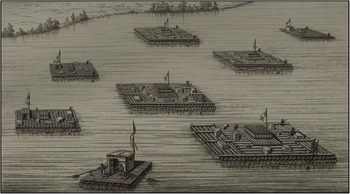
Place then waited in Mosul for around sixteen months.Footnote 28 The French Ministry of Fine Arts had hired a 237-ton three-mast ship, the Manuel, which, according to the contract signed in Paris in December 1854 was supposed to arrive at Basra in late April 1855. The expectation that this voyage would take four months was an over-optimistic estimate since it usually took about half a year to travel from Europe to this part of Mesopotamia. Place himself was informed about the contract in February 1855.Footnote 29 Like Botta before him, Place now organised the building of keleks (rafts) in order to transport the artifacts to Baghdad.Footnote 30 Eventually he loaded all the materials onto eight keleks which left from Mosul on 29 April 1855. The rafts travelled along the Tigris and arrived in Baghdad without any incidents on 4 May 4 (Fig. 1).Footnote 31 The rafts were then supposed to move on to Basra where the Manuel would be waiting.
Victor Place's keleks loaded with antique artifacts on the Tigris (V. Place, Ninive et l'Assyrie: avec des essais de restauration par Félix Thomas, Vol. 1 (Paris, 1867), Pl. 43/3).

But Place's keleks were not in good condition. The normal practice was to unload and then reload rafts in Baghdad because the inflated skins out of which they were made lost buoyancy as they got wet. But instead of this taking place, their load was instead increased, with the addition of 41 crates containing the results of Fresnel's excavations at Babylonia, plus crates from Kuyunjik for the Louvre, and another 80 destined for Berlin.Footnote 32 Place, it seems, had promised to load the artifacts from the British Museum's Nimrud and Kuyunjik excavations onto the same ship.Footnote 33
Travelling from Baghdad to Basra was the most dangerous stage in this journey. The political unrest in the vicinity of Basra, which under siege by Bedouin, disrupted traffic along this route. Rawlinson and even the Pasha in Baghdad told Place that the roads were dangerous, that Arab tribes were in revolt, that he should wait, and that he should not go any further south than Baghdad. Yet, despite these warnings, Place wanted the keleks to leave—after all, the ship sent from France was about to arrive in Basra and the crates had to be ready and waiting on the dock.Footnote 34
But just as the journey to Basra entered its most dangerous stage, Place was instructed by the French Ministry to go to Galatz. Under these circumstances, he had no choice but to appoint M. Clément, a language teacher in Baghdad, as Honorary Consul to oversee the transportation process, providing him with detailed instructions and necessary documents as well as gifts for various Bedouin sheikhs along the way. Concerned with security, Place also requested that a British East India Company warship, that was in the vicitnity, should accompany the ship and the rafts, but his request was refused. The fleet—a 50–60-ton ship and four rafts loaded with 235 crates—set sail on 13 May 1855, and Place duly left Baghdad the same day headed north for Mosul.Footnote 35
Further mishaps followed. The 60-ton ship that Place had hired in Baghdad was replaced by another one without his knowledge, and though this vessel was quite large it was very old and leaked. According to Larsen, Clément lost control of its crew. Shortly after leaving Baghdad, crew members went ashore to load silk bales, belonging to merchants in the city, which were to be smuggled into Basra.Footnote 36 The addition of these smuggled goods meant that the ship, which was already in a bad condition, became even more overloaded.
Problems then increased when Clément, on meeting the first Arab sheikh, had to hand over all the gifts prepared for the entire trip. Moreover, the small fleet was repeatedly robbed. On 21 May 1855, a few miles from Kurna where the Tigris and the Euphrates meet, members of the rebel Arab tribes attacked the ship. It seems that the captain purposefully took the ship to the shore, where it was boarded by tribesmen armed with spears, swords and shields, resulting in the ship breaking in two, and the stern end sinking under three fathoms of water.Footnote 37 The attackers looted the ship and the rafts, and then broke them into pieces.
The ship sank on the right side of the Shatt-el-Arab, three miles north of Kurna. One of the keleks that was carrying a huge 32-ton-winged bull went down near the left shore of the river about an hour and a half travel downstream from Kurna. Another kelek sank into the deep waters in the middle of the Shatt-al-Arab quite a way south of Kurna and its exact position could not be identified. The two remaining keleks, which had probably been further away from the shore when the attack took place, made it safely to Basra on the morning of 22 May 1855. However, the one that was carrying the second 32-ton-winged bull got stuck in the mud on the right side of the Shatt-el-Arab. The other was carrying a 14-ton-winged genie and 15 small ancient objects when it drifted ashore at Maaghill.Footnote 38
On 27 May, Clément wrote a letter to Place reporting that he had arrived at Maaghill on the evening of the disaster. However, Clément had arrived there only a few hours before daybreak on 22 May, which was when the two keleks also reached there. Clearly, the disaster had taken place on 21 May, as testified by contemporary reports by Clément and Michel.Footnote 39 Indeed, during the looting Clément had been beaten, which meant that he arrived at the French representative's residence in Basra in a very bad physical condition. As Clément later described his situation: “For a couple of weeks it was impossible for me to move. I was at Maaghill but had to stay in bed”. NaouchyFootnote 40 and Yusuf, workers who were with Clément during the incident, were also distraught. It was Lieutenant-Colonel Mesud Bey who proved to be most active in supervising the rescue work.Footnote 41 The local authorities reported the wreck and the rescue work to the Ottoman state. But detailed documents recently found in the Ottoman archives shed new light on the negligence that caused this accident, and so prompt the need for some rethinking about what happened.Footnote 42
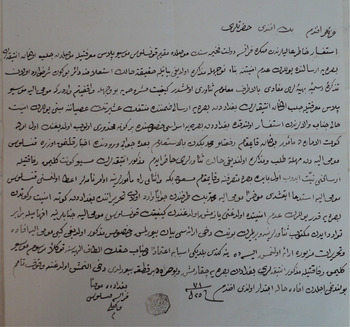
On 25 Şevval 1271/11 July 1855, Achille Murât,Footnote 43 the French interim vice consul in Baghdad, reported to the Governor of Baghdad;
It became clear that Monsieur Place, who caused the accident of the ship that sank in Kurna, did not believe the obstacles related to the insecurity of the roads and acted in haste, the work conducted and precautions taken about the issue were actually appropriate, the issue was reported to the consulate and they did not have anything to say.
An inquiry was made about whether there were any obstacles to send the antiquities from Baghdad to Basra as the Muntafiq tribe revolted and the roads were insecure. I was there when this inquiry was made to Mehmet Bey, an officer at Kut al Amara, and when Mehmet Bey asked the consul for time. The consul, who intended to send the antiquities with the help of Monsieur Clément requested that orders were provided to road officers by the governor of Basra and by kaymakam Mesut Bey. Later the report from Mehmet Bey said that the roads were safe from Baghdad to Kut, but unsafe from Kut to Basra. However, the consul again did what he pleased and trusting God he had the antiquities set on the road from Baghdad to Basra with the help of Monsieur Clément. I know that a firman was granted at that time.Footnote 44 (See Fig. 2).
Interim vice consul of France at Baghdad Achille's report to the governor of Baghdad (Hariciye Nezâreti Mektubî Kalemi: HR.MKT. 116/80, 1 Zilhicce 1271/15 August 1855).

A petition dated 11 Şevval 1271/27 June 1855 likewise asked about the position of the ancient stones from Mosul that Place was bringing to Baghdad but which sank at Kurna. This document stated that Mehmet Halis Efendi, the accountant of the Iraq and Hijaz army that was near Hille while the ancient stones were being transported, was left as the kaymakam at Baghdad. It reported that Mehmet Halis had not approved the transportation of the stones due to the insecurity of the roads. Despite Place's insistence to the contrary, it had been emphasised to him that since the convoy could not be protected from Arab bandits, it was not appropriate to transport the antiquities, and that he should wait until conditions improved. In addition, Bab al Murad Efendi and the cavalry kaymakam Mehmet Bey, who was in the region of Kut al Amara between Baghdad and Basra, had sent a letter concerning the issue of safety. In this it was stated that the letter had been shown to both Monsieur Place and the French vice consul Monsieur Achille but neither were convinced, and, moreover, the report presented by Monsieur Achille that stated that the stones had to be transported was attached for the ministry's consideration. The report's conclusion was that the incident had been caused by the imprudence and haste of officials, no one else had been involved in it, the incident was very unfortunate, some of the stones had been retrieved by governor (mutasarrıf) of Basra Veys Pasha, and efforts were continuing to retrieve the rest.Footnote 45
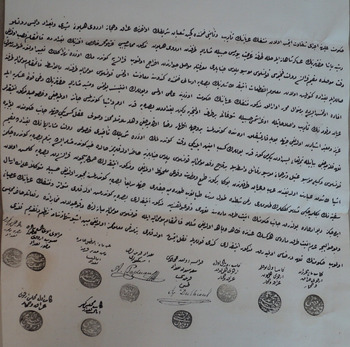
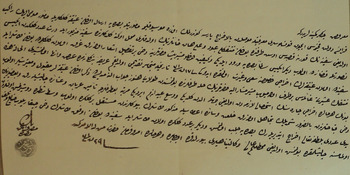
Similarly, another document (Fig. 3), this time signed by ten people including clerks of the Iraq and Hijaz army, quarantine doctors in Baghdad, the chief manager of the Royal Stables (Istabl-i Amire), Anatolian army colonels and Baghdad officials, also confirmed that Place had chosen to set out on the journey, ignoring all the government warnings:
The roads are unsafe due to the revolt of the Arab Muntafiq tribe against the government and efforts by the military forces continue to put the tribe in line [sic]. Therefore, transportation of either persons or materials from Baghdad to Basra is impermissible until this problem is solved. Through vice consul Achille in Baghdad and his translator Monsieur Rafael, Consul Place has been informed several times that we cannot consent to their transportation during such disorder as the antiquities are valuable goods, that it should be postponed for now as the roads would be safe again in 5, 10, 20 days. However, Place stated that the objects to be sent to Basra consisted of stones, the Arabs would not deign to harm them, and the ship that came to Basra from France would not wait for them. Also, since the skins of the keleks would not last long in the river, the antiquities had to be sent quickly to Basra.
Therefore, he stated that he would trust God and send them, and transported the antiquities on his own decision, without taking the government's warnings into account, without approval from the government even though the insecurity of the area was known to all.Footnote 46
Document signed by ten people including scribes of the Iraq and Hijaz army, Baghdad quarantine doctors, the chief manager of the Royal Stables (Istabl-i Amire), colonels of the Anatolian army and Baghdad officials (Hariciye Nezâreti Mektubî Kalemi: HR.MKT. 116/80, 1 Zilhicce 1271/15 August 1855).

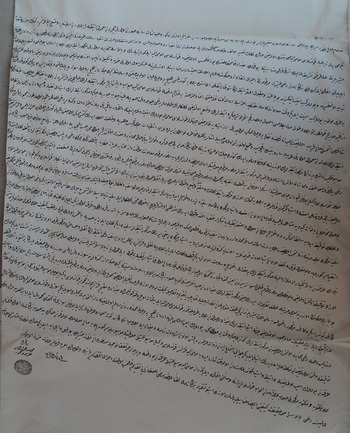
Baghdad kaymakam Mehmet Halis Efendi's report dated 27 Şevval 1271/13 July 1855 related the causes of the disaster in a step-by-step fashion:
Antiquities made of stone with depictions of oxen and animals excavated by the French consul in Mosul Monsieur Place were sent from Mosul to Baghdad by the river (on rafts called keleks under the patronage of the consul on 27 Şaban/May15 to be loaded on a ship in Basra and sent to France). At that time the army arrived to the Hille area in order to quell the bandits of the Muntafiq tribe and as I was left at the Baghdad kaymakam house I met with the consul. The consul stated that the aforementioned antiquities would be sent to Basra and he would return to Mosul. And I stated that soldiers were sent upon the Muntafiq tribe because of banditry and disobeying the government, that there would be war, therefore the roads were unsafe, until this tribe was disciplined the roads could not be secured and that sending such valuable antiquities to Basra amid such disorder would not be appropriate in any way. I told the consul clearly and repeatedly that we could not promise that the antiquities would arrive at their destination safely, but that this transportation could be done once this trouble is dodged, in about 5, 10, 20 days. However, the consul stated that a ship from France had arrived in Basra to carry the antiquities, a long wait of the ship at Basra would increase costs and the keleks carrying the antiquities would not last in the water for much longer and would decay and he would not be able to carry the large and heavy antiquities. Thus, the consul expressed that he could not delay until the next year and ignored the security conditions of the roads and acted in haste. In addition, the consul stated that the antiquities would not interest Arab tribes as they were made of stone, that it would be possible to give some gifts to the Arab bandits in dangerous areas and go. As the consul insisted to send the antiquities and stated that he would place a French man named Monsieur Clément to guard the antiquities on the way, I gave him an order to assist this person on the way. The antiquities were loaded on a ship in Baghdad by British vice consul Captain Jones.Footnote 47 While they were acting under the supervision of Monsieur Clément, Clément or the translator that accompanied him, for their personal interest, let three hundred thousand kurush worth of goods belonging to some merchants to be smuggled through the customs and loaded them on the aforementioned keleks and on the ship loaded with the antiquities. As the weight was too much with this smuggled load and the danger increased, British vice consul Captain Jones was informed about this situation and personally went to the spot and observed the situation and unloaded the merchants’ goods from the ship. The ship and the keleks were sent on their way only with the antiquities. However, Monsieur Clément halted the ship and the keleks at a place called Karara, which is about an hour from Baghdad. He secretly loaded the goods mentioned above on the ship. Therefore, the ship and the keleks became too heavy. As the large stones were not placed methodically and the ship was damaged, it violently went ashore stem first as soon as it arrived at a place that is four hours from Basra and sank. While the ship sank the Arab bandits in the vicinity saw that there was a lot of merchandize on it. They looted the sinking and damaged the merchandize like it was their own. The antiquities sank into the water together with the ship and two keleks. Basra governor [mutasarrıf] Veys Pasha was immediately informed about the situation and he sent men who retrieved some of the antiquities. They were sent to Basra together with the two surviving keleks. The ship that had arrived from France did not accept these objects as they were heavy and the ship that sank was damaged and they were left there. This situation was a result of Monsignor Clément's bad intentions, that is the loading of the three hundred thousand kurush worth of merchandize. The ship left Baghdad even it was known that the Arabs would loot. He sent a letter stating that they were promised that they would go to Basra safely. I heard that this letter was presented to the Foreign Ministry. I do not accept this situation as stated in Monsignor Clément's letter and the truth has to be said. I have personally met this consul three times between the time that these antiquities arrived in Baghdad and the time they were sent to Basra and corresponded with him in writing four or five times through French vice consul Monsignor Achille and his translator Monsignor Rafael. The consul ignored my words about the insecurity of the roads and therefore the risk to send the antiquities and acted leaving his task to God. People who were present at those meetings are witnesses to this. The letter sent by cavalry kaymakam Mehmet Efendi, who is at Kut al Amara with his soldiers, and by Bab al Arab Murad Efendi about the insecurity of the roads and against the sending of the objects to Monsignor Place through Monsignor Achille was returned to me. This report is presented by me, and the necessary actions depend on you.Footnote 48 (Fig. 4).
Baghdad kaymakam Mehmet Halis Efendi's report, dated 13 July 1855 (Hariciye Nezâreti Mektubî Kalemi: HR. MKT. 116/80, 1 Zilhicce 1271/15 August 1855).

These archival records shed new light on all stages of the accident that took place at Kurna, and so provide details that Place did not include in his later book. For instance, Place not knowing that the ship had been replaced, as Larsen stated, Clément's loss of control over the ship's crew, and the merchandise that was illicitly loaded on the ship, are all explained in the report by Baghdad kaymakam Mehmet Halis Efendi quoted above. Having to leave Mosul on the orders of the ministry and not wanting to abandon the artifacts that he had excavated seem to have made Place determined to proceed. Hence, despite being warned, he failed to take the approaching danger seriously.
There is also some confusion about the exact date when the shipwreck took place. The letter that Mesud Bey wrote to Place on 27 May stated: “On May 24th, at 6 am they told me that Clément came. I saw him in a bad situation, his feet were bloody”. If Clément and Mesud Bey did meet on 24 May, then the wreck must have taken place the previous day, namely 23 May. Indeed, Jules Oppert also wrote that the wreck took place on that date.Footnote 49 Pillet, who investigated mistakes in dates, mentioned that information provided by the kelekçibaşı (chief of the keleks) Sultan Agha was more complicated. Kelekçibaşı Sultan Agha, it would seem, stated that the convoy encountered the Abou-Chelfa tribe on 4 Ramazan 1271 in the Hijri calendar, that is supposedly 23 May according to the Gregorian calendar. However, Sultan Agha later stated that the wreck happened on 10 Ramazan 1271, a date that corresponded to 27 May.Footnote 50 On the other hand, 4 Ramazan 1271 corresponded to 21 May 1855, and not to 23 May as Pillet stated. In this case, the date Hijri 4 Ramazan 1271/Gregorian 21 May 1855 given by Kelekçibaşı Sultan Agha as the day of the encounter between the convoy and the Abou-Chelfa tribe should be regarded as the correct one.
A few days after the disaster on the river, that is on 23 May, Place eventually arrived in Mosul. In a report dated 18 June, he mentioned his concerns regarding a possible problem having occurred during the transportation, and so although he was supposed to wait for the consul to replace him in Mosul, on 19 June he suddenly decided to leave. By then, he had been informed in full about the magnitude of the shipwreck. However, in his report, he stated that it was only after he had left Mosul and arrived in DiyarbakırFootnote 51 that he was joined by a courier and given the news of what had happened at Kurna. He also wrote that he could not return to Iraq to save his antiquities because of the return order for his new post.Footnote 52 Thus, there are clearly discrepancies regarding when, where and how Place learned about the disaster.
Place briefly mentioned the looting of the fleet. He pointed out that rumours about expensive goods loaded on the convoy had spread, with the result that tribes on the right side of the Shatt-al-Arab had forced the ship to the shore where they had looted it. According to him, these Arabs, angry that they could not find any treasure on the ship, then destroyed and sank the two keleks that had also been forced to the shore.Footnote 53 However, Place did not mention the smuggled merchandise loaded on the ship, nor those on board who had accepted this contraband in the first place.
On the day of the shipwreck, that is on 21 May 1855, an Arab named İbn Souériche managed to save the small crates on one of the keleks. Mesud Bey reached Basra and organised the rescue of the winged bull and genie that had been carried by the two keleks that had sunk. While the winged genie was retrieved, the kelek with the winged bull could be dragged for only a few metres by one hundred men and so remained in the mud. These two artifacts stayed there until September that year,Footnote 54 when Clément and Mesud Bey, together with British naval forces, the British Consul at Basra W. Taylor, Basra's governor (mutasarrıf) Veys Pasha and the Baghdad governor Said Mehemmed, participated in the rescue work.Footnote 55
As the Ottoman archives now make clear, the Ottoman government also engaged in correspondence related to the rescue of the artifacts that had sunk in the vicinity of Kurna. For instance, the subject was discussed in a letter sent from Istanbul to Basra's governor (mutasarrıf) Veys Mehmet:
Correspondence about the efforts that will be made to retrieve the part of the ancient artifacts taken out of Mosul for France and sent to Basra to be transferred to Paris that sank on the upper part of the village of Kurna was read and understood. Retrieval and transfer to Basra of seven of these stones has been very appropriate, necessary efforts should be made to retrieve the others, necessary precautions to completely retrieve the objects that sank and submit them to the officials should be taken.Footnote 56
In response (Fig. 5), Veys Mehmet set out the story of the shipwreck and subsequent rescue work:
We have reported in detail about how the ship and two of the four keleks sank when the ship with Monsignor Clément and keleks carrying the ancient artefacts that were taken out of Mosul and sent to Basra to be transported to Paris arrived at a spot in front of a place where there were Muntafiq houses on the upper part of the village of Kurna and how the other two keleks safely arrived in Basra. The efforts made to retrieve the stones and antiquities that were on the ship that sank were reported on the letter dated 17 Ramazan 1271/3 June 1855. As the problems with the Muntafiq tribe could not be resolved so far and the army is around Hille we did not get a response yet. Since these antiquities are valuable objects, they should be retrieved no matter what, and for now the crimes of the Arab tribe are ignored as far as possible. Seven of the larger stones on one of the keleks that sank in the middle of the river were pulled out of the water and sent to Basra. We report that efforts to prevent the loss of the smaller stones on another kelek and on the ship and pull them out of the water continue. 29 Ramazan 1271/15 June 1855 Basra governor (mutasarrıf) Veys Mehmet.Footnote 57
The ship Manuel, which had arrived in Basra on 8 June, and not on 29 April as stated, also took part in these rescue efforts.
Report by Basra governor (mutasarrıf) Veys Mehmet about rescue work (Hariciye Nezâreti Mektubî Kalemi: HR. MKT. 115/71, 18 Zilkade 1271/2 August 1855).

What we do know for certain is that there was no inventory made of the objects being transported, and 28 out of 235 crates were rescued and sent on to the Louvre Museum.Footnote 58 Their contents included a winged bull, a huge genie relief, 16 crates of artifacts from British excavations and two crates that belonged to Place; but the contents of the remaining eight crates are not known.Footnote 59 The other 207 crates lost at Kurna could not be found. These apparently contained a winged bull, a winged genie, 41 crates belonging to Fresnel, 80 crates for Berlin Museum, and 84 crates containing Place's personal belongings.Footnote 60 The loading of the rescued materials was completed on 25 November 1855, and an inventory of the crates together with a record of the the date was attested by Manuel's captain J. Loquay, Clément, and British Vice consul in Basra, Taylor.Footnote 61 Meanwhile rescue efforts continued until the end of February 1856, and following further official attempts, it was determined in March 1857 that it was impossible to retrieve any more material.Footnote 62
As this account highlights, almost all the finds that Place was transporting from Khorsabad to Mosul, everything that had been found by Fresnel at Babylon, and almost all the crates that belonged to Berlin and the British Museum all sank beneath the waters of the Tigris. Place, upon arriving in Istanbul and learning in detail about the consequences of the disaster, wrote to the then Minister of State, M. Achille Fould:
Your excellency, I cannot find the words to tell you the state I am in or how I feel as I think about the ancient artifacts we excavated after all our work and the costs. I worked tirelessly and relentlessly for four long and tiring years as I thought about how our finds would enrich our Museum. I hope your excellency will forgive me and will not deny me your generosity. All my hopes were lost in a moment and everything is dark for me. I beg you to not to hold me responsible after all this loss. Because I am the one most saddened and ruined for this great loss.Footnote 63
Place referred in his letter to the loss of all his personal belongings but continued:
But this is a completely personal matter and compared to the consequences of a disaster in which irreplaceable objects were lost it is insignificant. I hope other explorers never encounter such a painful disappointment.Footnote 64
Having arrived in Istanbul, Place was told to proceed to the village of Yassi instead of Galatz as originally planned. He arrived there in September 1855 and stayed until June 1856. In the meantime, the crates carried by Manuel from Basra arrived at Le Havre on 20 May 1856, and at the Louvre Museum on 1 July 1856.Footnote 65 Following the disaster of the shipwreck, Place published his work on Khorsabad in three volumes with the help of Félix Thomas. Various finds that Thomas had taken with him when he left Mosul together with drawings and plans of the Khorsabad Palace proved very helpful in this respect. After serving in various posts in Andrinople, Calcutta and New York, Place eventually settled in Romania in 1873, where he died on 10 January 1875, aged 56.Footnote 66
Conclusion
After Botta, the excavations carried out by Victor Place at Khorsabad effectively erased various forms of Assyrian memory belonging to the capital of Sargon II. The excavation techniques of these years together with the destruction that they caused, as well as the catastrophe that befell the excavated objects during their transportation back to Europe, are the main reason for this assessment. Existing studies have sought to explain the misfortune that befell Place and the Khorsabad artifacts. However recently-identified archival data—such as the document with ten signatures and seals of Baghdad kaymakam Mehmet Halis Efendi, Basra governor (mutasarrıf) Veys Pasha, and French vice consul in Baghdad—provide a somewhat different perspective on the shipwreck at Kurna.
According to these Ottoman state documents, Place's activities at Khorsabad were destined to end in disaster. It is clear that Place encountered serious problems before and during the transportation of the artifacts, including the revolt of the Arab Muntafiq tribe, the resulting insecurity of the roads, the inappropriateness of the method of transportation, the lack of protection from Arab bandits, and the likely harm to be done to the transported antiquities. But despite frequent warnings and advice that he should wait, Place did not want to leave behind the artifacts that he and his team had unearthed. Thus, in his own subsequent account, he listed various justifications for the immediate transportation of these antiquities. According to him, pressures caused by the impending arrival of the ship from France to take the artefacts in Basra, the costs of a long wait, the likelihood that the keleks would quickly decay, all placed him in a difficult situation. Under these circumstances, his solution was to send the Khorsabad finds under Clément's supervision. Place insisted that stone antiquities would not interest Arab tribesmen, and he assumed that simply distributing presents to them would take care of that potential difficulty.
Other problems included the replacement ship in Baghdad being in a poor condition, and Arab bandits coming to know of the smuggled merchandise that was secretly reloaded despite having earlier been removed by the British vice consul Jones in Baghdad. In earlier accounts, these efforts of Jones to protect the crates that were destined for the British Museum do not seem to have been mentioned. The subsequent reloading of these smuggled goods after the ship had left Karara upset the balance. They undoubtedly attracted the attention of various looters along the river, and this, together with inaction on the part of Clément (whether knowingly or unknowingly), directly contributed to the disaster. In the end, Place failed to take the dangers that awaited him and his finds en route to Basra sufficiently seriously, and by focusing instead on the impact that the Khorsabad finds would create in France, he became a victim of his own ambition.
The Khorsabad/Dūr-Šarrukin excavations, which had begun with Botta and continued under Place, laid the foundations of Assyrian archaeology. The permanent abandonment of Khorsabad/Dūr-Šarrukin following Sargon II's death in 705 had resulted in the preservation of that period of Assyrian history albeit under the ground. However, the destruction caused by these mid-nineteenth century excavations and the loss of the finds in the Tigris irreversibly destroyed Khorsabad and its memory. Accordingly for the last c.165 years the world of archaeology has been discussing the artefacts that constituted the physical memory of Khorsabad and the artefacts recovered from the excavations in Babylon, Nimrud and Kuyunjik. Hopefully, we will not be waiting for another 165 years before these artefacts and associated epigraphic material are retrieved from where they sank back in 1855.