Introduction
Australia has one of the highest incidences of cutaneous malignancies in the world because of the high ultraviolet radiation exposure, with up to 75 per cent reported in the head and neck region.Reference de Vries, van de Poll-Franse, Louwman, de Gruijl and Coebergh1,Reference Moore, Weber, Prieto, El-Naggar, Holsinger and Zhou2 The annual incidence of non-melanomatous cutaneous malignancies in the head and neck region has been reported to be 1200 out of 100 000,Reference Staples, Elwood, Burton, Williams, Marks and Giles3 with the incidence of cutaneous squamous cell carcinomas (SCCs) being 387 out of 100 000.
The peri-auricular region has been found, particularly among males, to be one of the most common sites of primary cutaneous SCC in the head and neck region.Reference Brantsch, Meisner, Schonfisch, Trilling, Wehner-Caroli and Rocken4,Reference Iversen and Tretli5 Tumours in the peri-auricular region, including primary cutaneous SCC of the pinna and external auditory canal as well as locally advanced metastatic parotid cutaneous SCC, can be challenging to manage. Treatment may involve surgical resection, radiotherapy, chemotherapy, immunotherapy or a combination of these modalities. Local invasion of the temporal bone is common,Reference Yeung, Bridger, Smee, Baldwin and Bridger6 as well as metastasis to parotid and neck nodal basins, which further complicates complete surgical resection and limits reconstructive options.
In order to ensure complete surgical resection whilst preserving function and limiting adjuvant radiation toxicity, lateral temporal bone resections are often required as part of the surgical resection.Reference Essig, Kitipornchai, Adams, Zarate, Gandhi and Porceddu7,Reference Moffat, Wagstaff and Hardy8 However, there is still conflicting evidence regarding the staging, surgical and adjuvant treatment decisions for patients presenting with peri-auricular cutaneous SCC.Reference Kovatch, Smith, Birkeland, Hanks, Jawad and McLean9
This single-centre study analysed the various prognostic factors associated with overall survival and disease recurrence, including post-operative outcomes. The diagnostic accuracy of various imaging modalities for identifying the extent of malignant disease was also assessed.
Materials and methods
A retrospective analysis was performed on all patients who underwent lateral temporal bone resection for peri-auricular cutaneous SCC between January 2015 and December 2019 at the Peter MacCallum Cancer Centre. Ethical approval for this study was obtained from the Peter MacCallum Cancer Centre Ethics Committee.
All patients who underwent oncological lateral temporal bone resection for a primary or metastatic cutaneous SCC were included in this study. Patients who underwent lateral temporal bone resections for non-malignant conditions were excluded.
Patient demographics, including age, co-morbidities, and site and date of diagnosis, were collected and analysed, along with previous surgical and radiation treatment of primary malignancies. Intra-operative and post-operative data, including adverse events and adjuvant treatment, were also collected. All computed tomography (CT), magnetic resonance imaging (MRI) and positron emission tomography (PET) findings were reported by a radiologist, with all histopathological examinations performed by a pathologist. Sensitivity, specificity, positive predictive value, negative predictive value and accuracy were calculated for each imaging modality in terms of their ability to determine the presence of disease at various anatomical sites.
Lateral temporal bone resections were defined as resections of the structures lateral to the facial nerve and otic capsule as part of the oncological resection of peri-auricular cutaneous SCC. The type of lateral temporal bone resection performed was classified according to Medina et al.Reference Medina, Park, Neely and Britton10 Specifically, type 1 involved resection of the tympanic bone and external auditory canal, with preservation of the middle ear. Type 2 consisted of cortical mastoidectomy, with removal of the tympanic membrane, malleus and incus, but with preservation of the facial nerve and inner ear.
Resection was performed, and separate specimens of or from the following were sent for histopathological examination: primary tumour; external auditory canal with tympanic membrane and tympanic bone; malleus and incus; parotidectomy and neck dissection. The decision to perform concurrent parotidectomy and neck dissection was dependent on local disease burden and radiological staging.
Pre-operative clinical and post-operative pathological staging was assessed using the modified University of Pittsburgh staging system.
Overall survival was defined as the time from the date of surgery to the date of death or last follow-up appointment. Recurrence-free survival was defined as the time from the date of surgery to the date of recurrence, death or last follow-up appointment. Disease-specific survival was defined as the time from the date of surgery to the date of death, disease-related recurrence or last follow-up appointment.
Statistical analysis was performed using Prism software (version 8.0; GraphPad, San Diego, California, USA). Categorical variables were reported as numbers and percentages, and quantitative variables were reported as medians with interquartile ranges. Categorical variables were compared using a two-sided Fisher exact test, and continuous variables were compared using the Mann–Whitney U test. Time-to-event endpoints were described using the Kaplan–Meier method and differences were examined using the log-rank test. No multivariable analysis was performed. A p-value lower than 0.05 was considered significant.
Results
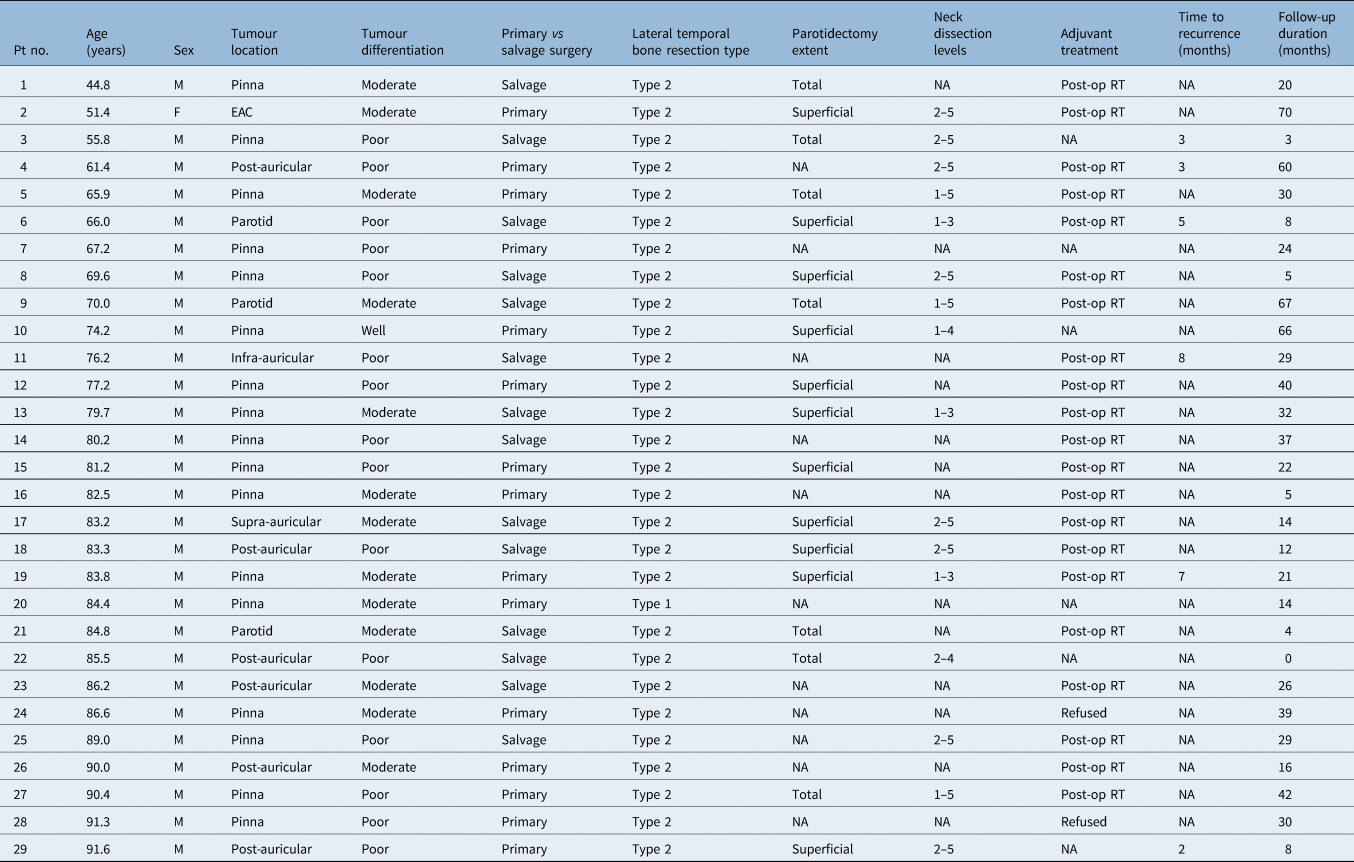
Twenty-nine patients were included in this study, all of whom underwent lateral temporal bone resection between January 2015 and December 2019. The mean age was 77 years (range, 45–92 years). One patient (3.4 per cent) was female. Fifteen patients (51.7 per cent) presented with a primary cutaneous SCC, and 55.8 per cent of malignancies occurred at the pinna. Specific information on each patient is shown in Table 1. Apart from the predominantly male patient demographic, no significant differences between demographic factors were found. Mean follow-up duration was 36 months (range, 0—70 months). Fourteen patients underwent salvage surgery, while 15 underwent primary resection.
Patient demographics, pathology and surgical details

Pt no. = patient number; M = male; NA = not applicable; post-op = post-operative; RT = radiotherapy; F = female; EAC = external auditory canal
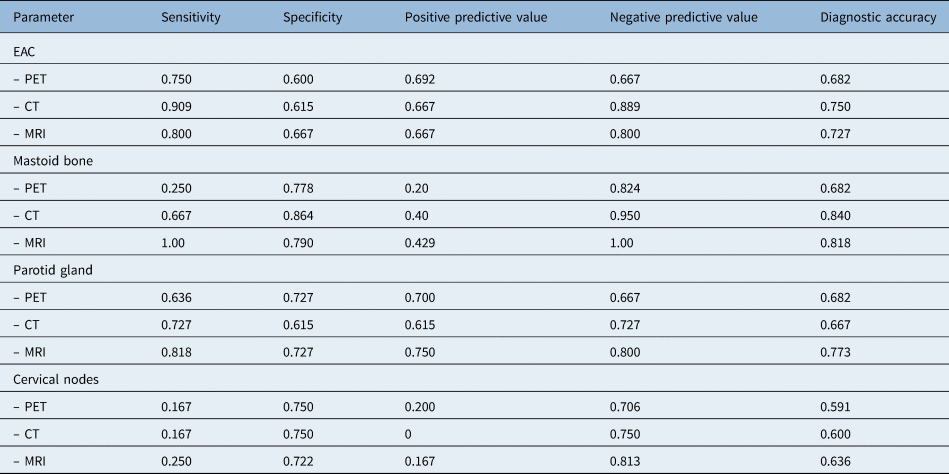
Computed tomography, MRI and PET were performed in 24, 22 and 22 patients, respectively. All imaging modalities showed good diagnostic accuracy in identifying malignant disease in the parotid gland, external auditory canal and mastoid bone, but had poor sensitivity and positive predictive values in identifying cervical nodal metastasis (Table 2). Positron emission tomography was also less sensitive in identifying disease in the mastoid bone.
Sensitivity, specificity, positive and negative predictive values, and diagnostic accuracy of imaging modalities for staging disease*

Data represent percentages. *Locoregional disease in peri-auricular cutaneous squamous cell carcinoma. EAC = external auditory canal; PET = positron emission tomography; CT = computed tomography; MRI = magnetic resonance imaging
Twenty-eight patients underwent type 2 lateral temporal bone resection, while one underwent type 1 resection. Four patients had concurrent parotidectomy, 2 underwent neck dissection, and 14 underwent both parotidectomy and neck dissection. Of the 18 patients who underwent parotidectomy, 9 were for suspected direct local invasion by the primary tumour, while 9 were for metastatic parotid lymph nodes. Five required free-flap reconstruction.
All patients were discharged home at a mean of 9.8 days (range, 3–36 days) post-operatively. Adverse events included: wound infection, in three cases; haematoma, in three cases; pneumonia, in one case; pulmonary embolus, in one case; and death secondary to post-operative respiratory failure, in one case. No unexpected, permanent facial nerve palsy was reported. Two patients had disease involving the facial nerve, which was sacrificed, and required subsequent facial reanimation surgery. One patient received a delayed bone-anchored hearing aid (BAHA) for conductive hearing loss. No vertigo, sensorineural hearing loss, shoulder or other neurological dysfunction was reported.
Fifteen tumours showed poor differentiation. Disease was present in 6 out of 16 neck dissections and in 14 out of 18 parotidectomies. The median maximum tumour dimension was 44 mm, and the median depth of invasion was 22 mm. Perineural invasion was present in 11 tumours and lymphovascular invasion was present in 7 tumours. Microscopically margin-negative (‘R0’) resection was achieved in 25 patients and microscopically margin-positive (‘R1’) resection was reported in 2 patients. One patient had significant tumour progression into the sigmoid sinus, and one patient had significant tumour involvement of the jugular foramen; hence, macroscopic resection was not possible.
Twenty-one patients were offered post-operative radiotherapy, with two declining adjuvant treatment. Six patients were not offered post-operative radiotherapy because they had tumour stage T1 disease with no high-risk pathological features. Pre-operative and pathological staging are shown in Table 3.
Pre-operative and pathological TNM and I–IV staging*

Data represent numbers of cases. *Based on modified Pittsburgh criteria. TNM = tumour–node–metastasis
Six patients had recurrence at a median of 4.8 months (range, 2.3–8.1 months) post-operatively: two recurrences were local, two were nodal and two were distant. Eleven deaths occurred, with one caused by post-operative respiratory failure, two related to distant metastatic recurrence and eight resulting from other medical conditions. The recurrences occurred in three patients undergoing salvage surgery and in three patients undergoing primary resection (p = 1).
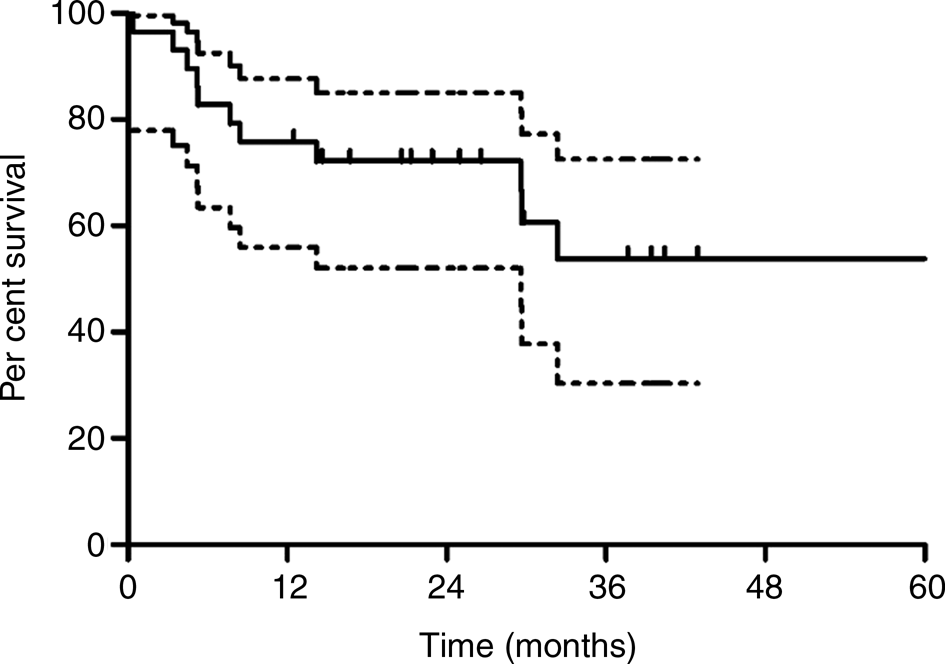
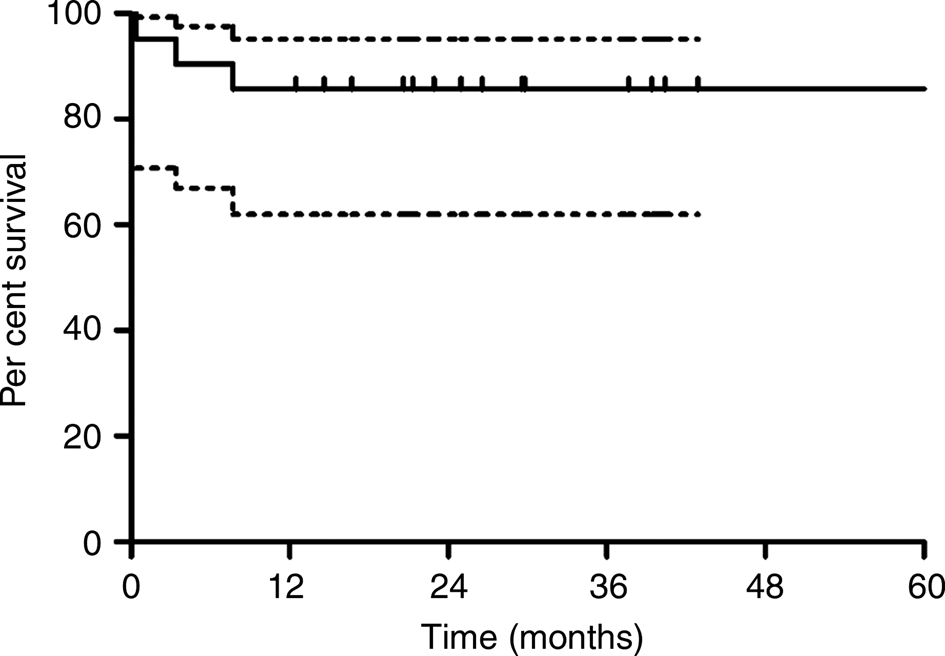
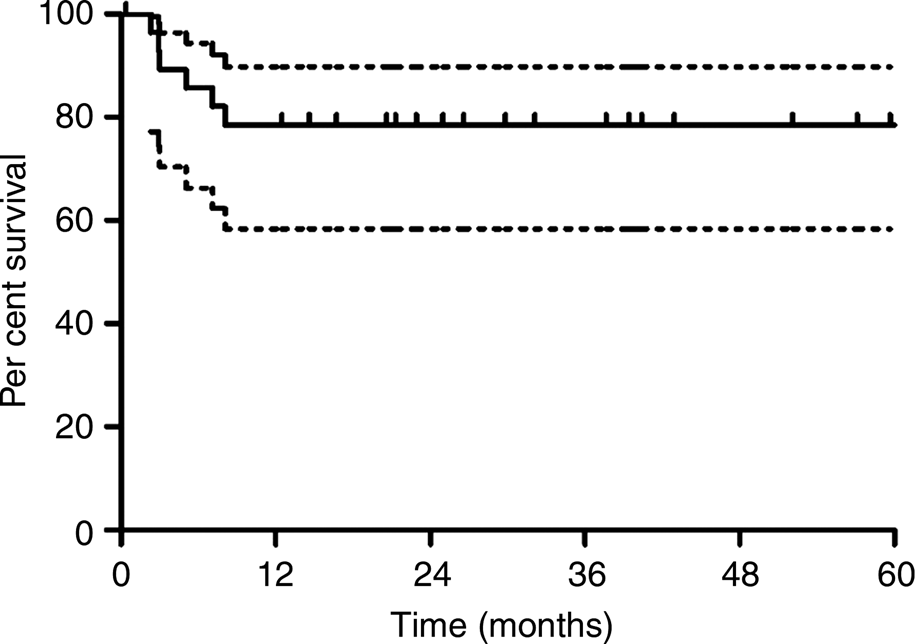
At six months and two years, the overall survival rates were 83 per cent (95 per cent confidence interval (CI) = 63–92 per cent) and 72 per cent (95 per cent CI = 52–85 per cent) (Figure 1), the recurrence-free survival rates were 86 per cent (95 per cent CI = 66–95 per cent) and 79 per cent (95 per cent CI = 59–90 per cent) (Figure 2), and the disease-specific survival rates were 90 per cent (95 per cent CI = 67–98 per cent) and 86 per cent (95 per cent CI = 62–95 per cent) (Figure 3), respectively.
Kaplan–Meier curve with 95 per cent confidence intervals (dotted lines), demonstrating estimated overall survival up to five years for all patients.

Kaplan–Meier curve with 95 per cent confidence intervals (dotted lines), demonstrating estimated recurrence-free survival at five years for all patients.

Kaplan–Meier curve with 95 per cent confidence intervals (dotted lines), demonstrating estimated disease-specific survival at five years for all patients.

Tumour differentiation (p = 0.0040, hazard ratio = 0.076, 95 per cent CI = 0.013–0.440) and post-operative radiotherapy (p = 0.0199, hazard ratio = 8.91, 95 per cent CI = 1.41–56.2) were associated with significantly better recurrence-free survival. Tumour differentiation and post-operative nodal N0 staging were associated with better disease-specific survival, which approached significance.
Discussion
Lateral temporal bone resection was first described by Parsons and Lewis in the 1950s as an en bloc oncological resection for tumours involving the lateral skull base,Reference Parsons and Lewis11 becoming a single-staged procedure in the following decades.Reference Lewis12 However, these reports analysed tumours of the temporal bone rather than cutaneous peri-auricular tumours. Furthermore, they described a technique involving sacrifice of the facial nerve and otic capsule, resulting in significant morbidity.
Subsequent approaches, including that utilised on a series from our centre described in a study published in 1978,Reference Millar13 ensured complete surgical resection, while improving functional outcomes and minimising post-operative radiotherapy toxicity.Reference Medina, Park, Neely and Britton10,Reference Goodwin and Jesse14 These subsequent approaches also minimised serious complications such as osteoradionecrosis of the temporal bone, which can result in chronic or recurrent infections, hearing loss, cholesteatoma, and a stenotic or distorted external auditory canal, which is difficult to manage.Reference Sharon, Khwaja, Drescher, Gay and Chole15
For peri-auricular cutaneous SCC, lateral temporal bone resection is indicated as the minimum surgical treatment option for any T1 or T2 tumours involving the temporal bone, as well as locally advanced peri-auricular cutaneous tumours.Reference Homer, Lesser, Moffat, Slevin, Price and Blackburn16
Our median age of 77 years was consistent with that reported in previous studies,Reference Essig, Kitipornchai, Adams, Zarate, Gandhi and Porceddu7,Reference Kovatch, Smith, Birkeland, Hanks, Jawad and McLean9,Reference Nam, Moon, Kim, Kim, Choi and Son17 supporting the higher prevalence of cutaneous head and neck malignancies in the elderly resulting from the increased cumulative ultraviolet radiation exposure in the ageing population.Reference Garcovich, Colloca, Sollena, Andrea, Balducci and Cho18,Reference Leiter, Eigentler and Garbe19 Likewise, our study showed a disproportionately larger number of male patients, similar to figures previously reported,Reference Kovatch, Smith, Birkeland, Hanks, Jawad and McLean9,Reference Nam, Moon, Kim, Kim, Choi and Son17,Reference Subramaniam, Olsen, Thompson, Whiteman, Neale and Sun20 with cutaneous head and neck malignancies of the scalp and ears being up to 10 times more prevalent in males than in females. One theory is that the female scalp hair distribution offers some protection from ultraviolet radiation.
Pre-operative staging of patients with peri-auricular cutaneous SCC with radiological imaging is important, not only in guiding surgical decisions to ensure tumour excision, but also to minimise morbidity. Our study showed that a combination of CT, MRI and PET provides adequate diagnostic accuracy for identifying disease involving the parotid gland, external auditory canal and mastoid bone. This is consistent with previously reported sensitivity, specificity and accuracy values of 71.4, 81.3 and 78.3 per cent, respectively, for PET-CT in the nodal (‘N’) staging of external auditory canal tumours.Reference Toriihara, Nakadate, Fujioka, Oyama, Tsutsumi and Asakage21 Moreover, the use of PET-CT and MRI in combination has been shown to have the greatest diagnostic performance when assessing patients with locoregional recurrence of malignant head and neck tumours.Reference Kim, Yoon, Moon, Baek, Han and Seo22 This is particularly relevant in our cohort, as nearly half of the patients in our study underwent salvage surgery for recurrent tumours. Utilising a combination of CT, MRI and PET imaging modalities will therefore be crucial in differentiating disease from post-surgical or post-radiotherapy changes. A trend is seen for tumours to be upstaged in pre-operative investigations compared with post-operative staging. This is likely because of the post-treatment changes in recurrent tumours, and stresses the importance of multi-modality imaging in correlation with clinical findings.
The presence of nodal metastases was shown by our study to be a predictor of disease-specific survival, which is supported by previous studies.Reference Moore, Weber, Prieto, El-Naggar, Holsinger and Zhou2,Reference Haisma, Plaat, Bijl, Roodenburg, Diercks and Romeijn23,Reference Kyrgidis, Tzellos, Kechagias, Patrikidou, Xirou and Kitikidou24 Our study showed low sensitivity and positive predictive values, across the three imaging modalities, for identifying cervical nodal disease, with the majority of nodal disease that is not identified on pre-operative imaging being attributed to single small cervical nodal metastases. The poor diagnostic accuracy of CT and PET imaging in the detection of nodal disease was shown in a meta-analysis of clinically node-negative head and neck cancer patients,Reference Kim, Pak and Kim25 with low specificity and negative predictive values reported for PET-CT for cutaneous head and neck cancers with nodal metastases.Reference Hirshoren, Olayos, Herschtal, Ravi Kumar and Gyorki26 Given the low diagnostic accuracy of identifying nodal disease, as well as the propensity for locoregional metastases and recurrence in peri-auricular cutaneous SCC,Reference Clark and Soutar27 there should be a low threshold for considering concurrent neck dissection in patients with complex malignancies requiring lateral temporal bone resection.
Although not utilised in this cohort, sentinel lymph node biopsies may be considered in patients with equivocal clinical or radiological findings, as up to 15 per cent of sentinel lymph node biopsies for peri-auricular cutaneous SCC may reveal positive disease,Reference Kovatch, Smith, Birkeland, Hanks, Jawad and McLean9,Reference Durham, Lowe, Malloy, McHugh, Bradford and Chubb28 resulting in completion neck dissection. However, because of a lack of prospective evidence supporting the routine use of sentinel lymph node biopsy in head and neck malignancies,Reference Durham, Lowe, Malloy, McHugh, Bradford and Chubb28,Reference Seim, Wright and Agrawal29 its role in the management of peri-auricular cutaneous SCC remains unclear.
Similarly, prophylactic parotidectomy has been suggested by multiple studies to address metastatic parotid nodes in the management of advanced cutaneous SCCs involving the temporal bone,Reference Leong, Youssef and Lesser30–Reference Zanoletti, Marioni, Franchella, Lovato, Giacomelli and Martini32 with one study suggesting total parotidectomy for locally advanced disease.Reference Homer, Lesser, Moffat, Slevin, Price and Blackburn16 However, these studies assessed patients with primary tumours of the temporal bone arising from the external auditory canal, middle ear or mastoid bone, rather than cutaneous disease as observed in our patient population. Compared with peri-auricular cutaneous SCC, these tumours are exceedingly rare, with an incidence of 1.3 cases per million.Reference Madsen, Gundgaard, Hoff, Maare, Holmboe and Knap33 Therefore, the decision on parotidectomy in peri-auricular cutaneous SCC should be based on pre-operative staging, similarly to previous Australian studies,Reference Essig, Kitipornchai, Adams, Zarate, Gandhi and Porceddu7 given the great diagnostic accuracy of all imaging modalities demonstrated in our study at identifying disease involving the parotid gland. For patients with parotid involvement, our previous study showed good outcomes with superficial parotidectomy and post-operative radiotherapy, with radical parotidectomy not routinely required.Reference Hirshoren, Ruskin, McDowell, Magarey, Kleid and Dixon34
When compared with cutaneous SCCs at other head and neck subsites, peri-auricular cutaneous SCCs have higher rates of recurrenceReference Lee, Nash and Har-El35,Reference Yoon, Chougule, Dufresne and Wanebo36 and are associated with a worse survival outcome.Reference Batsakis and Batsakis37 This may be a result of their pattern of invasion, with initial disease extending medially towards the parotid gland, perineurally as well as involving bony and cartilaginous structures, before becoming clinically apparent laterally at the skin.Reference Essig, Kitipornchai, Adams, Zarate, Gandhi and Porceddu7
Our five-year overall survival rate fell to 54 per cent, which was likely because of the age and significant other medical co-morbidities in our cohort. Overall survival, recurrence-free survival and disease-specific survival in this study at 24 months compared favourably with previously reported survival outcomes for surgically treated peri-auricular cutaneous SCC in the literature.Reference Brantsch, Meisner, Schonfisch, Trilling, Wehner-Caroli and Rocken4,Reference Essig, Kitipornchai, Adams, Zarate, Gandhi and Porceddu7–Reference Kovatch, Smith, Birkeland, Hanks, Jawad and McLean9 A review of temporal bone malignancies demonstrated highly variable two-year survival rates by tumour staging: T1 = 48–100 per cent, T2 = 28–100 per cent, T3 = 17–100 per cent and T4 = 14.3–54 per cent. Our data are consistent with these reported figures (T1 = 86 per cent, T2 = 63 per cent, T3 = 100 per cent and T4 = 50 per cent), with a trend towards better outcomes in less locally advanced disease.Reference Prasad, D'Orazio, Medina, Bacciu and Sanna38 An important aspect of the Modified Pittsburgh staging system is that perineural invasion of the facial nerve upstages a tumour immediately to T4. While we did not observe a significant association between perineural invasion and survival outcomes, there was a trend towards poorer disease-specific survival. This also highlights the importance of utilising MRI in the pre-operative staging of peri-auricular cutaneous SCC.
Poor tumour differentiation has been found in multiple studies to be a prognostic indicator associated with poor survival and a predictor of recurrence in cutaneous SCC,Reference Breuninger, Black and Rassner39–Reference Schmults, Karia, Carter, Han and Qureshi41 with our study finding a significant association with recurrence-free survival. Although data on cutaneous head and neck malignancies are limited, a few series have demonstrated poorer outcomes in patients with poorly differentiated tumours,Reference Moore, Weber, Prieto, El-Naggar, Holsinger and Zhou2,Reference Haisma, Plaat, Bijl, Roodenburg, Diercks and Romeijn23,Reference Kyrgidis, Tzellos, Kechagias, Patrikidou, Xirou and Kitikidou24 with a recent study showing a 2.34-fold likelihood of developing recurrence in patients with poorly differentiated tumours.Reference Harris, Bayoumi, Rao, Moore, Farwell and Bewley42
Similarly, patients who receive post-operative radiotherapy have been shown to have better survival,Reference Masterson, Rouhani, Donnelly, Tysome, Patel and Jefferies43,Reference Spector44 which is consistent with our results. The UK national guidelines on lateral skull base cancer recommend the use of post-operative radiotherapy in patients with T2–4 disease, while those with selected T2 disease without high-risk features such as perineural invasion or lymphovascular invasion may have clinical surveillance without post-operative radiotherapy.Reference Homer, Lesser, Moffat, Slevin, Price and Blackburn16 Post-operative radiotherapy should also be given to patients with positive microscopic margins.
Although margin status has often been reported to be an important predictor of survival and recurrence in previous studies,Reference Essig, Kitipornchai, Adams, Zarate, Gandhi and Porceddu7,Reference Huang and Boyce45,Reference Moody, Hirsch and Myers46 our study found that only 14 per cent of tumours were resected with positive margins, with two of these patients undergoing palliative resections of significant locally advanced disease. This compares favourably with previous reported rates of positive margins.Reference Essig, Kitipornchai, Adams, Zarate, Gandhi and Porceddu7,Reference Kovatch, Smith, Birkeland, Hanks, Jawad and McLean9 Our two-year disease-specific survival of patients with clear surgical margins was consistent with the findings of a previous Australian study analysing peri-auricular cutaneous SCC (disease-specific survival of 96 per cent in patients with clear margins vs 50 per cent in those with positive margins).Reference Essig, Kitipornchai, Adams, Zarate, Gandhi and Porceddu7
• Australia has one of the highest worldwide incidences of cutaneous squamous carcinomas (SCC), particularly in the head and neck
• Peri-auricular cutaneous SCCs differ from other temporal bone malignancies, and management can be challenging because of surgical resection morbidity
• Lateral temporal bone resections were the ‘gold standard’ for locally advanced peri-auricular cutaneous SCCs, but evidence for staging, surgical and adjuvant treatment decisions is conflicting
• This study analysed prognostic factors associated with overall survival and disease recurrence, and the diagnostic accuracy of imaging for identifying extent of malignant disease
• The study showed the importance of pre-operative staging using a combination of imaging modalities to assess extent of surgical resection
• It also highlighted the need for aggressive treatment in patients with poorly differentiated cutaneous SCCs
Our study showed favourable functional outcomes following lateral temporal bone resection, with only one patient choosing to have a BAHA inserted for conductive hearing loss and three patients with permanent facial nerve palsy following nerve sacrifice. No patients had other otological or neurological deficits. Although middle-ear-preserving lateral temporal bone resection has been proposed,Reference Medina, Park, Neely and Britton10,Reference Ghavami, Haidar, Maducdoc, Tjoa, Moshtaghi and Lin47 there is very little evidence to suggest its routine use in the management of peri-auricular cutaneous SCC. Long-term patient outcome monitoring would be warranted for middle-ear-preserving techniques.
Limitations of this study include its retrospective nature, which is subject to errors in data and in radiological and pathological reporting. As lateral temporal bone resection is not a common procedure in head and neck surgery, a multi-centre study may be helpful in analysing a larger cohort with a longer follow-up period to ensure more accurate analysis of survival outcomes.
Conclusion
Lateral temporal bone resection is an important treatment modality for patients with peri-auricular cutaneous malignancies and it has good oncological outcomes in carefully selected patients. Pre-operative considerations for the extent of surgical resection, including neck dissections, require clinico-radiological correlation with CT, MRI and PET, particularly in patients with poorly differentiated tumours.
Acknowledgement
The authors wish to thank Lumine Na, biostatistician at Peter MacCallum Cancer Centre.
Competing interests
None declared