This article reports a study of regional variation in the syntactic factors bearing on the choice between that and zero complementizer in nonrelative embedded clauses, as illustrated in (1)–(9).Footnote 1
(1) Complement to verb
He heard (that) the pies were good at that café.
(2) Complement to adjective
They were sure (that) the door had not been locked.
(3) Verb complement following an indirect object
The firm had warned customers (that) the product was not waterproof.
(4) Extraposed complement to verb
He announced the same night (that) the chairman would resign.
(5) It-subject construction
It was a pity (that) he couldn't be here to see it.
Copula construction
(6) What we were told was (that) the council would pay.
(7) It could be (that) the soil is too dry.
(8) The trouble is (that) the soil is too dry.
(9) It was only later (that) we heard the news of his death.
The that/zero choice in English has been extensively studied in the complements to verbs, where there is general agreement that the zero complementizer is grammatical in principle. Because the that/zero choice does not carry an obvious semantic or pragmatic distinction, the phenomenon is useful for the study of extra-linguistic factors in language variation.Footnote 2 A number of factors influencing the choice of that or zero in the complements to verbs have been identified or proposed in corpus-based studies, and the main factors will be reviewed in more detail later.
Syntactic theorists, on the other hand, are more interested in categorical patterns of that and zero distribution rather than in variation, and focus on the contrast between complements to verbs and adjectives, in which a zero complementizer is grammatical in principle, and contexts in which a zero complementizer is commonly agreed to be rare or impossible, such as in the complements to nouns. Although corpus-based studies occasionally confirm that zero is excluded in certain syntactic contexts, the study of syntactic factors in zero distribution is mainly based on data provided by intuition. A goal for syntactic theory is to account for the syntactic constraints on the distribution of zero complementizer, which generally has the more limited distribution.Footnote 3 The main syntactic characteristics of contexts considered to license a zero complementizer will also be reviewed in more detail later.
The present study combines aspects of the two traditional approaches to complementizer distribution. The main focus is on a comparison of the distribution of that/zero choice in different syntactic contexts in addition to verb complement clauses, but the study is based on corpus data and also takes nonsyntactic factors into account, chiefly regional variation.Footnote 4 I shall present different syntactic patterns of zero distribution in data from New Zealand, Australian, American, and British English, which indicate that adjacency to a lexical head plays a greater part in licensing zero in American and British English, and a lesser part in Australian and New Zealand English.
FACTORS IN THAT/ZERO CHOICE IN THE COMPLEMENTS TO VERBS
The main nonsyntactic influences on the rate of zero in complements to verbs are genre, style, and channel, the form of the embedded subject, clause-initial adverbials in the embedded clause, characteristics of the matrix verb, and regional variation. I shall discuss these factors in turn and comment on how they relate to the present study.
Style, genre, and channel
It is generally proposed that less formal texts have a higher rate of zero than more formal texts (Bolinger, Reference Bolinger1972:22; Burchfield, Reference Burchfield1996:773, para 2; Elsness, Reference Elsness1984:519; Finegan & Biber, Reference Finegan, Biber, Aarts and Meyer1995:256, fn. 6; Huddleston & Pullum, Reference Huddleston and Pullum2002:953; Poutsma, Reference Poutsma1929:615; Quirk, Greenbaum, Leech & Svartvik Reference Quirk, Greenbaum, Leech and Svartvik1985:734–735; Storms Reference Storms1966:262; see also Kroch & Small, Reference Kroch, Small and Sankoff1978 for that/zero choice and prescriptivism). This observation is linked to a number of different ways of identifying formality, and specific corpus-based findings are often more precisely framed in terms of genre and channel. It is consistently found that conversational language has a higher zero rate than written language in general (Biber, Johansson, Leech, Conrad & Finegan, Reference Biber, Johansson, Leech, Conrad and Finegan1999:680; Bolinger, Reference Bolinger1972:14; Finegan & Biber, Reference Finegan, Biber, Aarts and Meyer1995:242, among others), and in this case the difference in channel is considered to correlate with a difference in formality—conversation is overall less formal than written texts.
Differences in zero rate have also been reported in different text genres, with academic prose having the lowest zero rate, light fiction a fairly high zero rate, and newspaper reportage a rate intermediate between the two (Biber et al., Reference Biber, Johansson, Leech, Conrad and Finegan1999:680–681; Elsness, Reference Elsness1984; Finegan & Biber, Reference Finegan, Biber, Aarts and Meyer1995:242; Fowler, Reference Fowler1926:632; Jespersen, Reference Jesperson1932:33). Again, these differences among genres correlate to some extent with different levels of formality.
The embedded subject
Characteristics of the embedded subject are invariably found to have an effect on that/zero distribution. A number of authors have found that the form of the embedded subject has a marked effect on that/zero choice (among others Elsness, Reference Elsness1984; Finegan & Biber, Reference Finegan, Biber, Aarts and Meyer1995; Hawkins, Reference Hawkins, Rohdenburg and Mondorf2003; Rissanen, Reference Rissanen, Aijmer and Altenberg1991; Rohdenburg, Reference Rohdenburg, Neumann and Schülting1999; Roland, Elman & Ferreira, Reference Roland, Elman and Ferreira2005; Thompson & Mulac, Reference Thompson and Mulac1991a). The commonest finding is that the rate of zero is increased by a pronominal embedded subject, in contrast to a full noun phrase.Footnote 5 It has also been found that the length of the embedded subject is relevant, and a long NP inhibits zero more than a short NP (Elsness, Reference Elsness1984; Hawkins, Reference Hawkins, Rohdenburg and Mondorf2003; Roland et al., Reference Roland, Elman and Ferreira2005).
Some researchers have proposed that differences are found among different pronoun subjects. Hawkins (Reference Hawkins, Rohdenburg and Mondorf2003:191) suggested that a subject with nominative case marking assists in parsing the onset of an embedded clause, and so reduces the likelihood of that more than a noncase-marked pronoun. Elsness (Reference Elsness1984:526) found a higher rate of zero where the embedded subject is coreferential with the matrix subject, and that 1st and 2nd person embedded subjects produce a higher zero rate than 3rd person embedded subjects.
Thompson & Mulac (Reference Thompson and Mulac1991a) suggested that a pronoun subject promotes zero because pronouns express definite reference and mark topics, thus increasing the overall topicality of the embedded clause. The proposed relevance of topicality is consistent with Elsness's (Reference Elsness1984) observation that definite embedded subjects occur with a higher zero rate than indefinites, and also with his finding that an embedded subject which is coreferential with the matrix subject favors zero. Ferreira & Dell (Reference Ferreira and Dell2000) also found that zero was more likely to occur in speech production in cases in which the embedded subject was repeated from previous discourse or prompted by a cue to recall—both of these characteristics suggest a current or revived topic as referent.Footnote 6
Intervening elements
It is generally observed that elements in the matrix clause which intervene between the matrix verb and the embedded subject tend to inhibit zero (Bolinger, Reference Bolinger1972; Elsness, Reference Elsness1984; Finegan & Biber, Reference Finegan, Biber, Aarts and Meyer1995; Hawkins, Reference Hawkins, Rohdenburg and Mondorf2003; Jespersen, Reference Jesperson1932; McDavid, Reference McDavid1964; Rissanen, Reference Rissanen, Aijmer and Altenberg1991; Rohdenburg, Reference Rohdenburg, Neumann and Schülting1999; Tagliamonte & Smith, Reference Tagliamonte and Smith2005; Thompson & Mulac, Reference Thompson and Mulac1991a). The main intervening elements the authors discuss are indirect objects and matrix adverbials, as illustrated in (10)–(11).
(10) He assured them (that) the damage would be made good.
(11) She discovered to her surprise (that) the basement was under water.
Elements intervening between the matrix verb and the embedded subject also include initial adverbials in the embedded clause, as in (12).
(12) He also admitted (that) had he opened negotiations with BMW sooner, the price would have been cheaper.
Properties of the matrix verb
It has long been established that individual verbs have varying rates of zero complementizer, many being biased towards zero or that. Epistemic verbs (think, believe, know, suppose, etc.) have high zero rates, and this is frequently explained in terms of the altered informational status of many uses of epistemic verbs as epistemic modifiers on the embedded clause, rather than as expressions of the main proposition (Thompson & Mulac, Reference Thompson and Mulac1991a, Reference Thompson, Mulac, Traugott and Heine1991b; Tagliamonte & Smith, Reference Tagliamonte and Smith2005; Urmson, Reference Urmson and Caton1963). Lists of verbs that allow the zero complementizer, grouped according to broad semantic classes, are given in Storms (Reference Storms1966:266–267) and McDavid (Reference McDavid1964:109).
The zero rate with individual verbs is often claimed to correlate positively with frequency, the most frequent verbs having the highest zero rate. Bolinger (Reference Bolinger1972) claimed that verb frequency was important in predicting the appearance of zero, but cited no quantitative results to support this. Highly frequent verbs, particularly say, think, know, and tell, have been the main focus of historical studies in that/zero distribution (Finegan & Biber, Reference Finegan, Biber, Aarts and Meyer1995; Rissanen, Reference Rissanen, Aijmer and Altenberg1991), possibly in part because only frequent verbs can return enough data from the available historical texts for quantitative analysis. Studies of conversational data have also noted that the verbs with the highest zero rates, particularly think, are also the most frequent in the data (Tagliamonte & Smith, Reference Tagliamonte and Smith2005; Thompson & Mulac, Reference Thompson and Mulac1991a). However, none of these studies had enough data for individual infrequent verbs to assess their actual frequency and zero rate.
The only study I am aware of that quantifies the frequencies and zero rates for a wide range of less frequent verbs is Roland et al. (Reference Roland, Elman and Ferreira2005). Roland et al. examined a very large corpus (142,956 tokens) of 100 verbs that may take either a nominal object or a sentential complement, as identified by Garnsey, Pearlmutter, Myers & Lotocky (Reference Garnsey, Pearlmutter, Myers and Lotocky1997). They found that verb frequency was the weakest factor of those studied in predicting that/zero choice, but was still significant.
Regional variation
Some regional variation has been observed in the distribution of null complementizer in the presence of wh-gaps (e.g., Henry, Reference Henry1995, on Irish English), but regional variation in that/zero choice in other contexts has been little studied.Footnote 7 Staum (Reference Staum2005) found that I think occurred with a lower zero rate among speakers of the northeast United States compared with other American speakers, but she noted that this may be a result of interaction with other factors. The present study is the first that I am aware of to examine regional variation in different syntactic contexts for that/zero choice where wh-gaps are not involved.
To sum up this section, it has been observed previously that zero complementizer is more frequent in more informal registers—zero is more frequent in conversation that in written texts generally, and the lowest rate of zero is found in highly formal texts such as academic prose. The subject of the embedded clause is a factor in zero rates, and the following effects have been observed or hypothesized. Zero complementizer is more frequent with (i) a pronominal embedded subject (cf. a full NP); (ii) a shorter NP subject (cf. a longer NP); (iii) a morphologically marked nominative subject (cf. no case morphology); (iv) an embedded subject with a discourse-familiar or topical referent (cf. a new referent or no referent); (v) a 1st or 2nd person embedded subject (cf. 3rd person). Finally, material intervening between the matrix verb and the embedded subject has been found to inhibit zero complementizer. Intervening elements include indirect objects, matrix adverbials, and clause-initial adverbials in the embedded clause. Later I report how these factors were taken into account in the present study.
SYNTACTIC FACTORS IN THAT/ZERO DISTRIBUTION
A full discussion of the syntactic theoretical literature on zero complementizer is well beyond the bounds of this paper, and my approach here will be very focussed on present concerns. My purpose is to identify the main components of syntactic contexts that have been identified as contributing to the ungrammaticality of a zero complementizer in certain contexts, contrasted with the complements to verbs and adjectives, in which zero is generally agreed to be grammatical in principle.
One of the most consistent points of agreement is the observation that zero complementizer does not occur in the complements to nouns, as in (13).
(13) *John's belief he would win the race was misguided (Stowell, Reference Stowell1981:398).
Syntactic theorists continue to assume that zero in the complement to a noun is ungrammatical (e.g., Bošković & Lasnik, Reference Bošković and Lasnik2003; Pesetsky & Torrego, Reference Pesetsky, Torrego, Guéron and Lecarme2004). Corpus-based studies occasionally confirm this (Biber et al., Reference Biber, Johansson, Leech, Conrad and Finegan1999:645), but it is sometimes noted that zero can occur in a noun complement clause (Bolinger, Reference Bolinger1972:19–20). Syntactic theoretical accounts simply stipulate that zero is ungrammatical in noun complement clauses, and the potential zero-licensing syntactic factors of interest in this article are not appealed to, so noun complement clauses are not included in the present study.Footnote 8
The characteristics to be considered here are the complement status of the embedded clause, the adjacency of the embedded clause to a lexical head, and the major or minor status of an adjacent lexical head.
Complement status
Stowell (Reference Stowell1981:398–400) pointed out that manner-of-speaking verbs (sigh, mutter, whisper, etc.) cannot license a null complementizer, in contrast with other verbs of saying. The contrast is illustrated in (14)–(15).
(14) Ben sighed *(that) he was sick of not getting fed.
(15) Ben suggested (that) he was sick of not getting fed.
Stowell attributed this contrast to a difference in status between the two types of embedded clauses, arguing that the manner-of-speaking verb takes a clause in apposition, whereas the clause following the other verbs of saying is a true complement. This contrast in the status of the embedded clause is also supported, Stowell argued, by different passivization possibilities, as in (16)–(17). The embedded clause following the manner-of-speaking verb sigh in (14) is not a complement to the verb and the corresponding passivized sentence in (16) is ungrammatical. The embedded clause with suggest in (15) is a true complement to the verb and the sentence can be passivized, as in (17).
(16) *That he was sick of not getting fed was sighed by Ben.
(17) That he was sick of not getting fed was suggested by Ben.
Stowell argued that these (and related data) illustrate the general principle that a null complementizer must be in a clause that is selected as an argument by a lexical head—in the terms of Government and Binding (GB) theory, a null complementizer must be properly governed.
Adjacency
Within the GB framework, Stowell's (Reference Stowell1981) analysis also predicted that the embedded clause must generally be adjacent to the selecting head for a null complementizer to be licensed. Briefly, the proper government relation between the selecting head and the clause with the null complementizer requires the verb to assign a theta-role to the clause; theta-role assignment, in turn, requires that the verb assign case to the clause under adjacency. The importance of adjacency is illustrated in (18)–(19). The embedded clause in (18) is separated from its selecting head believed by the adverbial, and the null complementizer is judged ungrammatical, in contrast with (19), where the verb and clausal complement are adjacent.
(18) They believed at the time *(that) the gate was locked.
(19) At the time they believed (that) the gate was locked.
The main exception to the adjacency requirement is the grammaticality of null complementizer in a clause that is separated from its selecting verb by an indirect object, as in (20).
(20) John told his mother (that) he'd be home late.
Stowell proposed that the class of verbs with this complementation pattern are exceptional, in that they can assign a theta-role to a nonadjacent argument, and therefore, in this case, proper government of a null complementizer does not require adjacency.
Stowell's account of the licensing of null complementizer by proper government (adopted and modified by Pesetsky Reference Pesetsky1991) was framed within GB theory. With the development of the Minimalist Program (MP) the notion of government was no longer available, and the insights of earlier work were reframed. Bošković and Lasnik (Reference Cacoullos and Walker2003) proposed that a null complementizer is an affix that must adjoin to a suitable lexical head at PF (phonetic form), and that this operation requires adjacency. Like Stowell, Bošković and Lasnik proposed a lexical work-around for the problem of indirect objects, suggesting that the clausal complement with these verbs may be an IP rather than a CP, and thus no complementizer, null or otherwise, would be present to require licensing.
Note that whether null complementizer is licensed under proper government, which generally entails adjacency, as in the GB account, or null complementizer is licensed by affixation to a lexical head, which also entails adjacency, as in the MP account, the descriptive prediction is the same: Null complementizer must be adjacent to the head that selects the embedded clause, except when the intervening element is an indirect object.
Bošković and Lasnik also differ from earlier accounts (e.g., Stowell, Reference Stowell1981:397) in judging the null complementizer to be grammatical in it-subject constructions, as in (21).
(21) It is a pity__John doesn't have any friends.
Here Bošković and Lasnik (Reference Bošković and Lasnik2003:538) suggested that the null complementizer at issue is able to adjoin to the adjacent lexical head (in this case pity). In this structure the lack of a selection relationship between pity and the clause is immaterial, and adjacency is the only consideration.
Finally, in both government-based and affixation-based accounts, the licensing head—the proper governor of a null complementizer or the host to a complementizer affix—must be of a major lexical category. In particular, copula be is not a major lexical verb and thus it is not a potential licenser of null complementizer (Bošković & Lasnik, Reference Bošković and Lasnik2003:529, fn. 5), and this accounts for the ill-formedness of (22).
(22) *What the students believe is__they will pass the exam.
Descriptively, the main potential syntactic factors in the licensing of null complementizer (setting aside noun complement clauses) are as follows:
1. Complement status:
Null complementizer is licensed in a complement to a lexical head.
2. Adjacency:
Null complementizer is licensed where it is adjacent to a lexical head:
(a) a lexical head that selects the clause; or
(b) the predicate in an it-subject construction.
3. Lexical category:
Null complementizer is licensed in the complement to or adjacent to a major lexical category, but not a minor lexical category.
The data representing these factors in the present study will be introduced in the next section.
THE CORPUS
The full corpus on which the present study is based is comprised of 8,000 tokens of embedded finite clauses, 1,000 tokens from each of the following broadsheet newspapers: the Boston Globe (US), the Los Angeles Daily Times (US), The Age (Australia), the Daily Telegraph (Australia), the Guardian (UK), the Daily Telegraph (UK), the Christchurch Press, (NZ) and the Sunday Star Times (NZ), in the period 2002–2004. All the embedded finite clauses found were collected, except for relative clauses and clauses with wh-gaps. For each embedded clause, the full containing sentence was collected. The data collection and initial coding were carried out by research assistants, and all codes were checked by the author. As noted earlier, noun complement clauses were not included in the present study, because the syntactic factors of interest here are not predicted to be involved in noun complement clauses.Footnote 9 Also excluded from the present study were embedded clauses in noninitial conjoined positions or parataxis, as illustrated in (23)–(24).
(23) “It is absolutely my commitment that no company gets treated like a dinosaur, [that every job is fought for] and [no job becomes extinct],” Romney added. Boston Globe, October 8, 2002.
(24) The plan is that roaster companies pay farmers a decent price; [that stocks of coffee are cut partly by destroying at least 5 million bags in an effort funded by rich countries and roasters]. Christchurch Press, September 23, 2002.
Constructions like (23)–(24) were omitted because the syntactic status of the embedded clauses is not entirely clear, and their significance for the issues under discussion is difficult to judge.
Coding for nonsyntactic factors
Following the initial preparation of the corpus, and before proceeding to an analysis of the main syntactic construction types, preliminary analyses were carried out to assess the effects of the proposed nonsyntactic factors in that/zero choice as reviewed earlier. The issues identified were style, genre, and channel, properties of the embedded subject, the presence of indirect objects, matrix adverbials between the main verb and a verb complement clause, clause-initial adverbials in the embedded clause, and properties of the matrix verb. I will address these issues in turn.
Style, genre, and channel
Data were taken from a single major genre of broadsheet newspaper prose. Data were further identified for three textual subtypes: quoted direct speech, general reportage and columns, and letters to the editor. These textual subtypes were found to have different overall rates of zero: quoted speech, 65%; news and columns, 58%; and letters, 27%.
The relative zero frequencies here may also reflect differences in formality. Quoted speech transcribed from interviews reflects the generally more informal nature of spoken language, and is slightly less formal than general written reportage. Letters to the editor commonly reflect the writer's awareness of a kind of public performance, and are usually serious in tone.
Of the three textual subtypes, quoted speech comprised 18% of the data, letters 5%, and news and columns 77%. Given the relatively small numbers of quoted speech and letters tokens, it would not be possible to carry out multifactorial analysis including all three types.Footnote 10 It was decided to exclude quoted speech and letters from further analysis. Consequently, the zero-promoting effect of quoted speech and the zero-inhibiting effect of letters are excluded.
The embedded subject
Recall that several properties of the embedded subject have been observed or hypothesized to influence the that/zero choice, as cited below.
1. A pronoun embedded subject promotes zero in comparison with a full NP.
2. A shorter NP subject promotes zero in comparison with a longer NP subject.
3. A subject marked with morphological nominative case may promote zero in comparison with a noncase-marked subject.
4. A topical or discourse-familiar embedded subject promotes zero in comparison with a nontopical subject.
5. A 1st or 2nd person subject promotes zero in comparison with a 3rd person subject.
A preliminary examination of the potential factors mentioned in points 1–5 was carried out on a subset of the data. To exclude the effects of syntactic construction, only verb complements adjacent to the verb were included. In addition, for reasons discussed below under properties of the matrix verb, complements to say were excluded, and tokens in which an adverbial in the embedded clause preceded the pronominal subject were also excluded. I review the results briefly here, and will show that only one of the proposed distinctions was evident in the present data.
Length of the embedded subject
A preliminary calculation of the relative zero rates with embedded subject pronouns, short NPs (1–2 words, not including pronouns), and long NPs (3 or more words) revealed significant differences, including a significant difference between short and long NPs (p ≤ .0000, Pearson's chi square Goodness of Fit (GFX)).
pronoun embedded subject 73% zero
short NP embedded subject 51.4% zero
long NP embedded subject 38% zero
Accordingly, the length of the embedded NP was retained as a factor in the final analysis.
Nominative case
Nominative embedded subjects (he, she, we, they) were compared with noncase-marked pronominal subjects (you, it, this).Footnote 11 The nominative subjects (n = 626) occurred with a 76% zero rate, slightly lower than the nonnominative subjects (n = 319) zero rate of 80%, although the difference was not statistically significant (Pearson's GFX, p ≤ .2341). Roland et al. (Reference Roland, Elman and Ferreira2005:25) reported a similar finding. The presence or absence of nominative case marking on pronominal embedded subjects was not retained as a factor in the final analysis.
Topicality
The general issue of topicality was tested in two ways. First, embedded subject pronouns he and she were coded for coreferentiality with the matrix subject. Coreferential he/she (n = 166) and noncoreferential he/she (n = 123) occurred with the same zero rate of 69%. This is consistent with results from Finegan & Biber (Reference Finegan, Biber, Aarts and Meyer1995:254–255) and Cacoullos & Walker (Reference Cacoullos and Walker2003), who also found that coreferentiality does not affect zero rates.
Second, the potential relevance of definite reference or topicality was also tested by comparing zero rates with embedded subjects anaphoric (referential) it and dummy (nonreferential or cataphoric) it. Examples from The Age (Australia) are given in (25)–(28).
(25) Meanwhile, in the Federal Court yesterday, the Australian Securities and Investments Commission insisted that it did not oppose the administrators' decision to let Ansett trade while they settled the Tesna deal even though Ansett was suffering hefty losses. February 9, 2002. (it refers to the ASIC)
(26) Air New Zealand said yesterday it was prepared for a “Qantas attack” on its domestic market after the Australian international airline confirmed_it had plans to expand in New Zealand. February 5, 2002. (it refers to Qantas)
(27) Sports hack Stuart (Iain Glen) and financial whiz Cara (Sharon Small) realise that it's not just the newspapers' future that is at stake. February 6, 2002. (nonreferential or cataphoric it)
(28) The parents defied the ban, insisting_it was their religious obligation and personal right to maintain the modest dress code, generally applied after puberty, for their young daughters. February 6, 2002. (nonreferential or cataphoric it)
Referential it (n = 249) occurred with 78% zero, slightly higher than the 71% zero rate with dummy it (n = 79), although the difference was not significant (p ≤ .2012, Pearson's GFX). Topicality of the embedded subject was not retained as a factor in the final analysis.
Person features of the embedded subject
The possible effect of the person of the embedded subject was tested. Embedded 1st and 2nd person subjects (I, we, you: n = 66) were compared with all 3rd person pronominal subjects (n = 358).Footnote 12 Both groups of pronouns had the same zero rate of 70%. I note that Elsness's results on the effect of the person features of the embedded subject do not explicitly distinguish between 3rd person pronouns and 3rd person noun phrases. Consequently, the zero-promoting effect of I, we, you observed by Elsness may be due to the independently established effect of embedded subject pronouns in comparison with full noun phrases, assuming that noun phrases were included in his 3rd person subjects. The person of the embedded subject was not retained as a factor in the final analysis.
To sum up, none of the potential differences among pronominal embedded subjects was found to significantly affect the rate of zero complementizer in the present data. In what follows, distinctions will not be maintained among pronominal embedded subjects.
Intervening elements
Elements intervening between the selecting head (typically the matrix verb) and the subject of the embedded clause include indirect objects, matrix adverbials, and clause-initial adverbials in the embedded clause. Verbs that select an indirect object and a clausal complement are treated as an exceptional lexical class in the syntactic theoretical approaches previously reviewed, and are coded as a separate construction type in the present study.
Verb complement clauses separated from the head by an intervening matrix adverbial are predicted by syntactic theory not to be possible environments for zero, as the complementizer position is not adjacent to the selecting head. Clauses of this type, traditionally called extraposed clauses, are also coded as a separate construction type in this study.
Embedded clauses with a clause-initial adverbial were compared with clauses in which the subject is the first element of the embedded clause. The clause-initial adverbial was found to inhibit zero significantly (p ≤ .0000, Pearson's GFX): clause-initial adverbial occurred with 8% zero, and clause-initial subject with 55% zero. Embedded clauses with a clause-initial adverbial constituted only 5% of the data, and given the small number of tokens, it would be impossible to include them in a multifactorial analysis. Accordingly, tokens with a clause-initial adverbial in the embedded clause were excluded from the final analysis, and the zero-inhibiting effect of these adverbials is excluded.
Properties of the matrix verb
Data for the present study were identified and coded manually,Footnote 13 and it was not possible to collect a large enough corpus for the effects of lexical type frequency to be consistently calculated. Preliminary analysis of verbs adjacent to their clausal complements showed that say was by far the most frequent of all verbs in the corpus (38% of all verb complement tokens), and also had an extremely high zero rate of 90%, in comparison with the overall zero rate of all other verbs of 57%. However, say was not equally frequent in the data from the regional sources. Of all (adjacent) verb complements, say tokens comprised 39% of Australian data, 44.5% of American data, 46% of New Zealand data, but only 28% of British data. If the say tokens are included in the data representing the complements to verbs, the strong zero-promoting effect of say is under-represented in the British data in comparison to the other varieties. For this reason the say tokens were removed from the general verb complement data for the final analysis.
Overall, the main purpose of the study is to compare zero rates across constructions and regional sources, so the main issue is whether or not the most frequent lexical types are fairly evenly distributed across the compared groups. I will comment on this issue as it arises in the presentation and discussion of results.
Summary
To sum up, the influence of textual subtypes within the genre of newspaper prose was reduced by removing two less frequent subtypes: quoted speech, which had a higher zero rate, and letters to the editor, which had a low zero rate. The strong zero-inhibiting effect of clause-initial adverbials in the embedded clause was countered by removing these tokens. Proposed contrasts in zero rates among different types of pronominal subject were found not to be significant in the present data, and pronominal embedded subjects were coded alike as “pronoun.” The proposed effect of embedded subject length (pronoun, short NP of 1–2 words, long NP of 3 or more words) was found to be significant, and embedded subject length was retained as a factor. The very strong zero-promoting effect of say with complements to verbs was unequally represented across regional sources, and say tokens were removed to counter the potential distortion of zero rates for complements to verbs. The remaining corpus comprised 3,145 tokens. Tokens were also coded for the regional source, Australia, New Zealand, America, and Britain.
Coding for syntactic factors
All tokens were coded into six major construction types, identified in accordance with the syntactic licensing of zero complementizer, discussed in the earlier section titled “Syntactic Factors in That/Zero Distribution”. Next, these constructions are discussed further.
Complement to verb
Complements to verbs included all complements to verbs (other than say) that immediately followed the selecting verb. In the majority of tokens the embedded clause was a complement to an active verb, as in (29).
(29) But Oxfam's research suggests_we're drinking deep from the cup of inequity. Christchurch Press, September 23, 2002.
Complements to passive verbs or raising verbs with dummy it subjects as in (30)–(31) were initially coded separately.
(30) Although it was assumed_McCarty had played his last game for Boston when the Celtics lost in the Eastern Conference finals, the versatile forward signed a one-year, veteran-minimum contract worth $762,435. Boston Globe, October 11, 2002.
(31) It seems that every nation but the English has a one-pot stew. The Guardian, January 4, 2003.
These tokens were then compared with active verb complements like (29) and with other it-subject constructions as discussed in the subsection below on i t-subject construction. It was found that complements to raising and passive verbs did not differ significantly in zero rates from complements to active verbs. Raising/passive verbs with it subjects had a zero rate of 57%, similar to the 59% zero rate with active verbs. On the other hand, embedded clauses in the remaining it-subject constructions had a significantly lower zero rate of 18%. Syntactic theory also classes examples like (30) and (31) with examples like (29), in that the clause is analyzed as the selected complement to the verb in all these structures. Accordingly, complements to passive and raising verbs with it subjects were coded as verb complements.
Complement to adjective
Complements to adjectives included basic adjectives, as in (32), and also participial adjectives, as in (33).
(32) Are you watching BBC? sang the fans, still angry that the match hadn't been televised. Daily Telegraph (UK), January 6, 2003.
(33) He was particularly annoyed that his elderly mother in Sweden became embroiled. The Guardian, October, 11, 2002.
As with raising verbs, complements to raising adjectives with it subjects, as in (34), were initially coded separately, and were then compared with both nonraising adjectives and other it-subject constructions.
(34) It's unlikely_the Andersen brand would survive. The Age, February 9, 2002.
The raising adjectives had a zero rate of 44%, closer to the overall 55% rate for complements to other adjectives than to the 18% zero rate for the remaining it-subject constructions. As was noted for passive and raising verbs with it subjects, syntactic theory analyzes examples like (32)–(33) and (34) alike, in that the embedded clause is a selected complement to the adjective. Accordingly, examples like (34) were coded as adjective complements.
Complement to verb preceded by an indirect object
The syntactic theories reviewed briefly earlier identify verbs that select an indirect object and a clausal complement, as in (35), as a special case. Although the embedded clause is not adjacent to the selecting head, zero complementizer is considered to be grammatical. In contrast, zero complementizer is generally considered to be ungrammatical in a complement clause that is separated from its selecting head by a matrix adverbial (see the following subsection).
(35) Lawyers acting for Lundy advised the court_he did not contest Mrs. Weggery's application. Christchurch Press, September 25, 2002.
Complements to passive verbs, as in (36), were also included in this group. In a transformational analysis the surface subject is moved from the position immediately following the verb, leaving a trace that intervenes between the verb and clause complement.
(36) All were told_they were going to Australia. The Age, February 5, 2002.
Extraposed complement to verb
In traditional syntactic discussion a number of different sentence types may be described as instances of extraposition, including a range of sentence types with a dummy it subject. However, sentences that may be described as extraposition may differ in the general syntactic factors of interest here, particularly in whether or not the embedded clause is a complement selected by a major lexical head. To focus on the issue of adjacency to the selecting head, I have included in this class only verb complements that are separated from the verb by a matrix adverbial, as illustrated in (37).
(37) Rosenthal said yesterday_he is convinced authorities could have caught the sniper by now if they had been able to match spent projectiles from the first shooting to a ballistic fingerprint database of newly made guns. Boston Globe, October 24, 2002.
It-subject construction
As discussed, the complements to passive and raising verbs with it subjects, and the complements to raising adjectives with it subjects, were coded respectively as verb complements and adjective complements. The remaining it-subject constructions included only constructions in which the clause is interpreted as the subject of the main predicate, as illustrated in (38)–(39).
(38) The dust is an irritant so it's possible_it could aggravate existing respiratory problems. Los Angeles Daily News, November 28, 2002.
(39) It is evident that other passengers feel the same way. Daily Telegraph (Australia), January 17, 2004.
Copula constructions
Copula constructions include several types of constructions in which the main verb of the matrix clause is copula be. In the first type, illustrated in (40)–(41), the embedded clause gives the content of a fact- or proposition-denoting nominal, which is the matrix subject.
(40) The only problem is_certain individuals don't quite live up to your hopes for them. Daily Telegraph (Australia), January 1, 2002.
(41) Bucksbaum said a sure sign that 2002's batch of films are being received better overall is that more of the films have what the industry calls “legs” meaning their popularity is sustained week after week. Los Angeles Daily News, November 28, 2002.
In the second type of copula construction, illustrated in (42), an it-subject frame serves to express a modal modification on the embedded clause.Footnote 14
(42) It may be that you need to follow this military strategy if you expect to do any entertaining this fall. Boston Globe, October, 8, 2002.
Copula constructions also include wh-clefts, as in (43)–(44). The predicational structure of these examples is similar to that of (40)–(41), in that the wh-clause matrix subject refers to a proposition that is spelled out in the embedded clause.
(43) What we didn't say was_this was a policy we wanted to impose. The Guardian (UK), November 22, 2002.
(44) What people haven't been told is that this delay was the result of a decision to expand the catalogue to become a major and definitive publication of McCahon and his work. Sunday Star Times (NZ), October 27, 2002.
Finally, copula constructions include it-clefts, as in (45)–(46). Here the it-subject format focuses an adverbial which is interpreted within the embedded clause.
(45) It is here_he has practised three days a week since April and it is at the centre of the dispute. Sunday Star Times (NZ), October 27, 2002.
cf. He has practised here three days a week since April.
(46) But it was under Mr. Helms that the first cracks in the agency's reputation appeared. Boston Globe, October 24, 2002.
cf. The first cracks in the agency's reputation appeared under Mr. Helms.
For these constructions, the question arises (see also endnote 14) as to whether they should be classified as it-subject constructions, which represent the potential zero-licensing factor proposed by Bošković & Lasnik—that is, the null complementizer can be licensed by affixation to the adjacent matrix predicate even though the embedded clause is not a complement to the predicate. Bošković & Lasnik (Reference Bošković and Lasnik2003) do not specifically discuss it-cleft constructions. However, their analysis for it-subject constructions appeals to the idea that the matrix predicates in it-subject constructions form a special class, and that this underlies their ability to host an affixal null complementizer. The generalization does not extend to it-clefts, in which the expression following the copula (here in (45), under Mr Helms in (46)) is a focused element construed within the embedded clause.Footnote 15
Overall, the examples I have grouped as copula constructions share the characteristic that the embedded clause is not a complement or subject of any major lexical predicate, but is nevertheless a required component of the sentence type (e.g., it is not an optional adjunct).
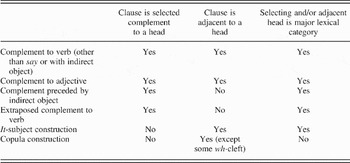
The six construction types and the syntactic factors they represent are summarized in Table 1.
Syntactic construction types in the study

ANALYSIS AND MAIN RESULTS
In this section I present three groups of results. The first subsection reviews the results for each of the factor groups of regional source, construction type, and embedded subject type. The results show that the overall zero rates differ significantly across regional sources with the ranking: New Zealand > Australia > United States > Britain. In addition to the canonical syntactic licensing contexts, zero complementizer also occurs fairly frequently in contexts in which it is predicted not to be licensed. Nevertheless, the overall ranking of construction types by zero rates is broadly consistent with the syntactic licensing factors that the constructions represent. The highest zero rates occur in cases in which all licensing factors are present—the embedded clause is adjacent to and complement to a major lexical head (verb or adjective). The lowest zero rates occur in cases in which none of the licensing factors are present—in the copula construction the embedded clause is not adjacent to nor complement to a major lexical head. The predicted effect of the embedded subject type is robust, and appears across construction types.
The second subsection examines the regional differences in zero rates for the construction types individually, taking into account the possible effects of embedded subject type and lexical type. The overall ranking by zero rates (New Zealand > Australia > United States > Britain) is broadly preserved across the separate constructions. New Zealand is always in the group of regional sources with the highest zero rate, and Britain is always in the group of regional sources with the lowest zero rate. If Australia and the United States differ, the difference is that Australia has a higher zero rate than the United States. However, the individual construction types do not show the same patterns of differences in zero rates among regional sources. The constructions differ in whether or not the regional sources do have significantly different zero rates at all, and if so, how the regional sources are grouped. This suggests that the regional varieties do not group the constructions by zero rate in the same way—the syntactic factors influencing zero rates may operate differently across regional sources.
This issue is explored in the third subsection, in which the within-region patterns of zero rates across construction types are identified and compared. Here I show that in cases in which the embedded clause is not adjacent to a potential licensing head, the zero-inhibiting effect of nonadjacency is weaker in the New Zealand and Australian data than in the United States and British data.
The factors of regional source, construction type, and embedded subject
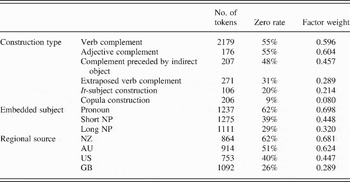
A logistic regression analysis was performed using goldvarb (2001) software (Cedergren & Sankoff, Reference Cedergren and Sankoff1974) for the factors of construction type, embedded subject, and regional source, with the results shown in Table 2. All factors were significant.
Results of logistic regression analysis

Regional source
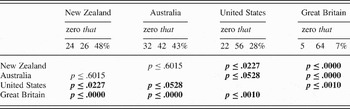
The regional sources for the data showed differences in zero rate: New Zealand 62%, Australia 51%, United States 40%, and Britain 26%. All differences were significant (p ≤ .0000, Pearson's GFX).
The question arises as to whether the differences here may reflect differences in style among the sampled newspapers; for example, The Guardian and The Telegraph may be more formal than the other newspapers sampled, and this might partly account for the lower zero rate in the British data. Differences in formality within a main register type such as broadsheet newspaper reportage are difficult to examine in the absence of finely tuned independent measures of formality. One possible measure of formality is the frequency of contraction of auxiliary verbs and negation (he's, isn't).Footnote 16 To check for evidence of differences in formality, the data were coded for the contraction of contractible auxiliaries and not, and the rate of contraction for each regional subcorpus was calculated. The results – 0.06% of New Zealand tokens with contraction, Australia 9.3%; United States 11.7%, and Britain 6.29% – do not produce the same ranking as the overall zero rates. Although the New Zealand data have the highest zero rates, they have a very low rate of contraction, and the United States data have a higher contraction rate than the Australian data, but a lower zero rate. I conclude that the regional differences in zero rates in the present data do not primarily reflect different levels of formality.
Construction types
The zero rates across construction types show that a clear-cut distinction into grammatical and ungrammatical contexts for zero is not easy to maintain. Syntactic theory predicts that zero complementizer is not licensed in extraposed complements to verbs, but the overall zero rate for this construction is 31%. The 31% zero rate in extraposed complements to verbs is actually higher than the 20% zero rate in it-subject constructions, although Bošković & Lasnik (Reference Bošković and Lasnik2003) predicted that zero is ungrammatical in extraposed clauses and grammatical in it-subject constructions. Syntactic theory also predicts that zero complementizer is not licensed in copula constructions. The observed zero rate of 9% for copula constructions is the lowest for all the construction types, but still high enough to indicate that zero is not categorical in this type of context.
Nevertheless, the relative zero rates give a ranking that does reflect the syntactic factors proposed in the licensing of zero. The three construction types with the highest overall zero rates (complement to verb 55%, complement to adjective 55%, and complement preceded by an indirect object 48%) are all instances of an embedded clause that is a selected argument of a major lexical head. The lowest zero rates are found in copula constructions (9%), which is consistent with expectations, given that copula constructions contain no suitable lexical head that might serve as a licenser of zero. In all the copula constructions except wh-clefts, the null complementizer is adjacent to the copula, but the copula is not a major lexical category and cannot license zero.
The intermediate frequency of zero in extraposed complements to verbs (31%) and in it-subject constructions (20%) suggests that lack of adjacency or lack of complement status both have an effect. This issue is explored further in the subsection on varietal patterns of potential syntactic zero-licensing factors.
Embedded subject
The effect of the embedded subject is consistent with previous findings. A pronoun embedded subject strongly promotes zero, and a long NP inhibits zero more than a short NP does. The difference between short and long NPs is significant (p ≤ .0000, Pearson's GFX). This supports the view that the embedded subject effect depends largely on the length of the embedded subject, and I shall assume Hawkins' (Reference Hawkins, Rohdenburg and Mondorf2003) account of this phenomenon in terms of processing efficiency.
Briefly, Hawkins (Reference Hawkins, Rohdenburg and Mondorf2003) argued that the parsing load in recognizing embedded clauses is proportionate to the amount of material from the left boundary of the clause that must be processed before the clause is unambiguously recognized as an embedded clause. If the finite complementizer that is present, this may promote immediate recognition of the embedded clause onset. Alternatively, in cases in which that is absent, an embedded finite clause is recognized when the subject and finite verb are processed. The delay in reaching the finite verb is proportional to the length of the embedded subjectFootnote 17. In cases in which the embedded subject is longer, the processing load in the absence of that is increased. Accordingly, a longer embedded subject promotes the presence of that to increase parsing efficiency, whereas a pronominal subject causes little delay in reaching the finite verb, and is easily processed with a zero complementizer.
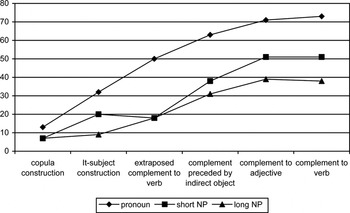
The embedded subject effect is fairly consistent across construction types, as shown in Figure 1. In all construction types a pronominal embedded subject occurs with a higher zero rate. The difference between short and long NPs is smaller, and is not evident in extraposed complements to verbs or copula constructions. The general trend in Figure 1 suggests that the embedded subject effect is largely confined to pronoun subjects in contexts in which zero is more infrequent, and the difference between short and long NPs appears mainly in cases in which the overall zero rate is around 50% or more. This is consistent with a parsing efficiency account of the embedded subject effect. In contexts such as the complements to verbs and adjectives where other constraints, such as syntactic constraints, play a lesser part in determining that/zero choice, effects of parsing efficiency are more prominent, and the length of an NP subject has a greater effect.
Zero rates across construction types and embedded subject types.

Varietal differences in particular constructions
Although the zero rates for the different construction types do not support a categorical division into licensing and nonlicensing contexts for null complementizer, the relative zero rates do broadly reflect the presence of the potential zero-licensing factors identified in syntactic theory. Adjacent complements to verbs and adjectives have the overall highest zero rates, and copula constructions have the lowest zero rates. The constructions with some, but not all, licensing factors present—extraposed verb complements, verb complements with indirect objects, and it-subject constructions—have zero rates intermediate between the other two groups.
A conservative assumption would be that any effects of syntactic licensing factors would operate uniformly across the regional data, and thus that the overall regional ranking by zero rates of NZ > AU > US > GB would be preserved across the individual constructions. If so, it would appear that the regional differences reflect different regional sensitivities to nonsyntactic factors in the that/zero choice. To check this hypothesis, I now compare the zero rates of the four regional subcorpora in individual constructions. The possible effects of lexical type frequency and types of embedded subject are also considered. I shall show that significant differences in zero rates across regional sources are not constant across construction types, although the overall ranking is never reversed. The results for each construction will be presented in turn, and then summarized at the end of the section.
Complements to verbs
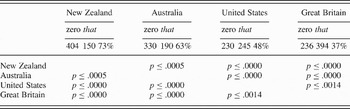
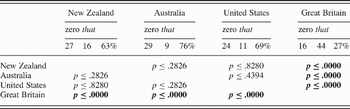
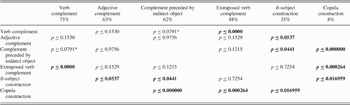
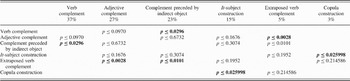
We saw in the previous section that the total zero rates of the regional sources were significantly different, and ranked as follows: New Zealand > Australia > United States > Britain. The most frequent construction type in the data is complement to verb, representing 60% of the corpus, and the overall ranking of the regional sources reflects the relative zero rates in verb complements, as shown in Table 3. The probability values shown (Pearson's GFX) indicate the significance levels of the difference between the row region and column region, for example, the second cell in the top row shows that the difference between New Zealand at 73% and Australia at 63% is significant, at p ≤ .0005.
Significant regional differences in zero rates in complements to verbs

To control for potential interference from lexical type frequency, the zero rates were also calculated excluding the four most frequent lexical types think, believe, suggest, and know, which also had higher than average zero rates. The relative rankings were unchanged and the differences were still significant: New Zealand 67%, Australia 57%, United States 40%, and Britain 29%, showing that the differences in zero rate across regional sources were not produced by unequally represented frequent lexical types.
The proportions of pronominal embedded subjects in verb complements for each regional source were also calculated, and were New Zealand 36%, Australia 35%, United States 44%, and Britain 34%. The rates of pronominal embedded subjects were uniform except for the slightly higher rate in the United States data. However, the United States zero rate ranked second lowest, and the slightly higher pronoun subject rate does not appear to have altered the relative ranking of regional sources by zero rates in verb complements.
Complements to adjectives
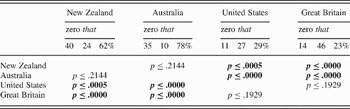
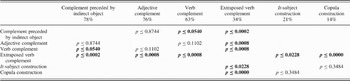
The zero rates in adjective complements were not significantly different among New Zealand, Australia, and the United States, but the British zero rate was significantly lower than each of the other regional sources, as shown in Table 4 (significance levels calculated with Pearson's GFX). The significant differences are shown in bold.
Significant regional differences in zero rate in complements to adjectives

The zero rates were also calculated excluding lexical types with ten or more tokens (aware, concerned, confident, convinced, sure). The results showed the same grouping by region: New Zealand 55%, Australia 76%, United States 54%, and Britain 7%. The British data had a significantly lower zero rate than the other regional sources, which were not significantly different from each other. The large drop in zero rates for the British data (all adjectives 27%, excluding high-frequency lexical types 7%) indicates that zero is almost confined to the most frequent lexical types in the British data.
The rates of pronominal embedded subjects in complements to adjectives were New Zealand 33%, Australia 39%, United States 54%, and Britain 34%, showing a higher rate for the United States data. Excluding all tokens with pronominal embedded subjects, the zero rates were New Zealand 62%, Australia 74%, United States 60%, and Britain 15%, showing the same grouping of regional sources. The British data had a significantly lower zero rate than the other regional sources, which were not significantly different from each other.
Verb complements preceded by indirect objects
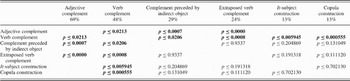
In verb complements preceded by indirect objects we see a different grouping of regional sources, as shown in Table 5 (significance levels calculated with Pearson's GFX).
Significant differences in zero rates in verb complements preceded by indirect objects

The most frequent lexical type in this construction is tell, representing 71% of tokens. Analyzing tokens with tell only, the zero rates are New Zealand 73%, Australia 82%, United States 31%, and Britain 31%, showing the same grouping of regional sources, with the same significant differences.
It was hypothesized that the length of the indirect object might affect zero rates in this construction, as well as the length of the embedded subject. The forms of indirect object were initially coded as pronoun, “trace” (with a passive verb), short NP, and long NP, with the following zero rates: pronoun 60%, trace 57%, short NP 41%, and long NP 15%. A logistic regression analysis was performed including the factors of regional source, form of embedded subject, and form of indirect object, and all factors were retained as independently significant.
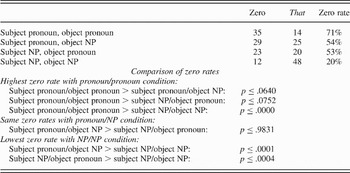
A cross-product analysis of subject and indirect object type was carried out. Given the small number of tokens (n = 207) the embedded subjects were coded as pronoun or NP, and the indirect objects as pronoun (including trace) or NP, giving four combinations. Results are shown in Table 6.
Zero rates in verb complements preceded by an indirect object, comparing combinations of embedded subject type and indirect object type

As expected, the combination of two pronouns has a higher zero rate than other conditions, significant compared to the combination of two NPs, and approaching significance compared with the two pronoun/NP conditions. The combination of two NPs has a zero rate significantly lower than the other three conditions. Given the demonstrated effects of both the embedded subject and the indirect object on zero rates, both factors must be taken into account in comparing zero rates across regional sources.
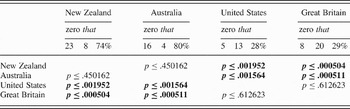
The two pronoun/NP conditions have the same zero rate and comprise almost half the available data. Accordingly, the cross-regional differences can be checked by comparing the zero rates for these two conditions only. The results, as shown in Table 7, give the same grouping of regional sources as in Table 3. The significance levels here are calculated with Fisher's Exact text.
Significant regional differences in zero rate in verb complements preceded by indirect objects, controlling for embedded subject type and indirect object type

Extraposed complements to verbs
Zero rates in extraposed complements to verbs also group the New Zealand and Australian data separately from the United States and British data, as shown in Table 8. The significance levels were calculated using Pearson's GFX.
Significant regional differences in zero rates in extraposed verb complements

Excluding the most frequent lexical types of the selecting verbs (admit, announce, confirm, know, say, tell, n ≥ 10) yields the same pattern of significant differences among regional sources, except for the difference between New Zealand (zero rate = 48%) and the United States (zero rate = 28%), which approaches significance (p ≤ .0828).
The rates of pronominal embedded subjects were New Zealand 43%, Australia 37%, United States 38%, and Britain 29%, showing a slightly higher rate for the New Zealand data and a lower rate for the British data. The zero rates were recalculated excluding all tokens with a pronominal embedded subject, producing the same grouping of regional sources. The zero rates were New Zealand 34%, Australia 29%, United States 11%, and Britain 2%. The New Zealand and Australian zero rates remained significantly higher than the United States rate (NZ > US, p ≤ .0167; AU > US, p ≤ .0391).
It-subject constructions and copula constructions
There were no significant regional differences in zero rate in it-subject constructions, the rates being New Zealand 35%, Australia 21%, United States 13%, and Britain 15%. The zero rates in copula constructions were New Zealand 8%, Australia 14%, United States 13%, and Britain 3%, the only significant difference being that between the Australian and British data (p ≤ .019778, Fisher Exact).
Summary
The significant regional differences in zero rates in the individual constructions are summarized next: “>” represents a significant difference in zero rates, and “=” represents no significant difference.
Complement to verb NZ > AU > US > GB
Complement to adjective NZ = AU = US > GB
Complement clause preceded
by an indirect object NZ = AU > US = GB
Extraposed complement to verb NZ = AU > US > GB
It-subject construction NZ = AU = US = GB
Copula construction NZ = AU = US = GB
Complements to verbs and adjectives represent the canonical syntactic environment in which that/zero alternation is free—any constraints on that/zero alternation in this environment are expected to be nonsyntactic. I take it that the ranking of different regional zero rates in the complements to verbs reflects regional differences in the sensitivity to nonsyntactic zero-promoting and zero-inhibiting factors. No regional differences appear for it-subject constructions and copula constructions, nor for adjective complements, with the exception of the lower zero rate for the British data.
The differences that may bear on regional syntactic differences are those for complement clauses with indirect objects and extraposed verb complements. Here the New Zealand and Australian data do not differ significantly from each other, though both have significantly higher zero rates than the United States and British data. Bearing in mind that these two construction types represent complement clauses that are not adjacent to the licensing head, it would appear that the New Zealand and Australian data reflect a lower sensitivity to the zero-inhibiting effect of nonadjacency. More generally, the regional sources may differ in the relative strength of the syntactic factors in the that/zero choice. This issue is explored further in the next section.
Varietal patterns of potential syntactic zero-licensing factors
To assess the significance of licensing factors for each regional variety, the relative zero rates across construction types were compared within each regional subcorpus. The significance of interconstructional differences in zero rates was calculated using Pearson's GFX, or Fisher's Exact test in cases in which there were fewer than five tokens in one of the cells.Footnote 18 The results for each regional source, showing the significant differences in zero rates across constructions, are given in the next subsection. These results are then summarized, showing how the regional sources compare in assigning the construction types to three broad categories. Then I argue that the differences reflect a greater zero-inhibiting effect from nonadjacency in the New Zealand and Australian data, compared to the United States and British data.
Differences in zero rates across constructions in individual regional sources
Table 9 shows the patterns of difference in zero rates for the New Zealand data. Significant differences are shown in bold. Cells with nonbold text show which constructions are not significantly different from each other in zero rates.
Significant differences in zero rates across constructions in the New Zealand data

The New Zealand data fall into three main blocks. The main contexts for zero are complements to verbs, complements to adjectives, and complements preceded by an indirect object, although the difference between verb complements and complements preceded by an indirect object approaches significance (starred in the table). The lowest zero rate occurs as expected in copula constructions. Extraposed verb complements and it-subject constructions have similar zero rates in the range of 35–40%, intermediate between the two other blocks.
In the New Zealand data the different constructions had pronominal embedded subjects in the range of 33–36%, except for a slightly higher rate with extraposed verb complements (43%) and a slightly lower rate with copula constructions (23%). To check for possible interference from the unequally distributed pronominal embedded subjects, zero rates excluding tokens with pronominal subjects were compared for verb complements, extraposed verb complements, and copula constructions. The relationships were unchanged: extraposed verb complements still had a significantly lower zero rate than verb complements, but a significantly higher zero rate than copula constructions.
Results for the Australian data are shown in Table 10. The Australian data also have the highest zero rates in verb complements, adjective complements, and complements preceded by indirect objects. Surprisingly, the highest overall zero rate is in complements preceded by indirect objects, with a zero rate significantly higher than in verb complements. Unlike the New Zealand data, it-subject constructions do not have significantly higher zero rates than copula constructions.
Significant differences in zero rates across constructions in the Australian data

In the Australian data the pronominal embedded subject rates were in the range of 31–37%, except adjective complements with 39%, and it-subject constructions with 18%. Zero rates were compared, excluding tokens with pronominal subjects, for verb complements, adjective complements, it-subject constructions, and copula constructions. Adjective complements had a higher zero rate than verb complements, the difference approaching significance (p ≤ .0753). There was no significant difference between it-subject constructions and copula constructions.
Table 11 shows results for the United States data. The pattern in the United States data is quite different: adjective complements and verb complements have the highest zero rates, but all the other construction types, including complements preceded by indirect objects, have zero rates that are not significantly higher than in copula constructions.
Significant differences in zero rates across constructions in the United States data

Rates of pronominal embedded subjects in the United States data were in the 38–44% range, except for a higher rate of 54% in adjective complements and a lower rate of 26% in copula constructions. Excluding tokens with pronominal subjects, zero rates were checked for adjective complements, verb complements, complements preceded by an indirect object, extraposed verb complements, and it-subject constructions. Adjective complements still had a significantly higher zero rate than verb complements (p ≤ .0401), and the zero rates with complements preceded by indirect objects, extraposed verb complements, and it-subject constructions are still not significantly higher than in copula constructions.
Finally, results for the British data are shown in Table 12. As in the United States data, verb and adjective complements have the highest zero rates. Unlike the United States data, complements preceded by an indirect object and it-subject constructions have intermediate zero rates, lower than those for verb and adjective complements but higher than those for copula constructions. Extraposed verb complements have zero rates not significantly higher than copula constructions.
Significant differences in zero rates across constructions in the British data

In the British data the rates of pronominal embedded subjects across constructions were 33–34%, except for a slightly lower rate of 29% in extraposed verb complements and a slightly higher rate of 45% in it-subject constructions. Excluding tokens with pronominal embedded subjects, only one relationship shown in Table 12 was changed: the zero rate with it-subject constructions was not significantly higher than in copula constructions (p ≤ .165473). I shall assume that the high subject pronoun rate in it-subject constructions contributes to the difference from copula constructions shown in Table 12, and that it-subject constructions should be grouped with copula constructions for the British data.
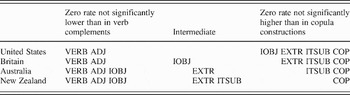
With the adjustment to the British data as noted, the groupings of constructions by zero rate across the regional sources can be summarized as shown in Table 13. The table displays the regional patterns against three main divisions according to the potential syntactic licensing factors discussed previously. The left column represents contexts in which zero is predicted to be fully licensed. The typical construction for this column is taken to be verb complements, as verb complements are the canonical context in which zero is considered to be syntactically licensed. Constructions are listed in this column if they do not have a significantly lower zero rate than verb complements. The right column represents contexts in which zero is predicted not to be licensed. The typical construction for this column is taken to be copula constructions, as none of the potential syntactic licensing factors appears in a copula construction. Constructions are listed in this column if they do not have a significantly higher zero rate than copula constructions. The middle column represents constructions of intermediate status that have lower zero rates than verb complements and higher zero rates than copula constructions.
Groups of constructions by zero rates across regional sources

Note. VERB = verb complement (not extraposed, no indirect object), ADJ = adjective complement, IOBJ = verb complement preceded by indirect object, EXTR = extraposed verb complement, ITSUB = it-subject construction, COP = copula construction.
In all four varieties, adjective complements have a zero rate no lower than verb complements, as syntactic theory would predict; that is, the embedded clause in both verb and adjective complements is adjacent to and selected by a major lexical head. In all four varieties copula constructions have the lowest zero rate, once again consistent with syntactic predictions, that is, the embedded clause in a copula construction is neither adjacent to nor selected by a major lexical head. However, the regional rankings differ with respect to the intermediate constructions, which have at least one syntactic licensing factor, but not all, including extraposed verb complements, complements with indirect objects, and it-subject constructions.
The effects of complement status and adjacency on zero rates: adjacent and nonadjacent complements
Extraposed verb complements have a lower zero rate than verb complements for all regional sources, showing that the intervening adverbial inhibits zero to some extent in all varieties. However, extraposed verb complements have a significantly higher zero rate than copula constructions for the New Zealand and Australian data, but not for the United States and British data. This suggests that the lack of adjacency between the verb and the extraposed complement clause inhibits zero to a much weaker extent in the New Zealand and Australian data.
A similar regional pattern appears in complements with indirect objects. In the New Zealand and Australian data the intervening indirect object does not significantly inhibit zero, and the construction has a zero rate not significantly lower than in adjacent verb complements. In contrast, complements with indirect objects in the United States and British data have significantly lower zero rates than in adjacent verb complements, and in the United States data, zero in complements with indirect objects is not significantly more frequent than in copula constructions.Footnote 19
The effect of adjacency may also be investigated by comparing zero rates in the complements to heads such as the conjunctions except, now, and purpose so with zero rates in the complements to degree head so, such.Footnote 20 Complements to these heads are illustrated in the examples in (47)–(52). The complements to conjunctions are adjacent to their selecting heads, as shown in (47)–(50), whereas complements to degree so are separated from the selecting head, as shown in (51)–(52).
(47) It's his version of pre-game jitters, except_they usually occur days before any USC game. Los Angeles Daily News, November 28, 2002.
(48) It can be partially alleviated by rejetting or fitting a Weber carb—except that the latter could cost more than the car is worth. Daily Telegraph (UK), January 4, 2003.
Purpose so
(49) The lifting of US sanctions against Iran so_aid can flow more freely has been welcomed by the Iranian regime, with officials in Tehran stating they hope the thaw in relations can be permanent. Daily Telegraph (Australia), January 3, 2004.
(50) Boardwalks were erected through the sanctuary so that visitors could have a good view of the trees and birds while allowing the undergrowth to regenerate. Christchurch Press, September 24, 2002.
Degree so
(51) The “good” Victorians of the novel are so busy spouting warnings about maintaining moral purity_you'd think they were refugees from the 700 Club. Boston Globe, October 8, 2002.
(52) According to Stealth, central London's airwaves are so overcrowded that the suburbs are the best option for a new station. The Guardian, November 22, 2002.
Conjunction except
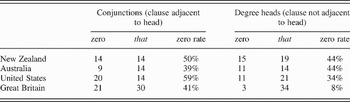
Constructions of these types were selected from the main corpus from which the present study is drawnFootnote 21, and all were found to show that/zero variation for all regional sources, that is, neither that nor zero was categorical. However, zero rates in adjacent clauses were significantly higher than in nonadjacent clauses for the United States and British data, but not for the New Zealand and Australian data. The results are shown in Table 14.
Zero rates with conjunctions and degree heads

NZ: head-adjacent zero rate > head-nonadjacent zero rate, p = .6441; AU: head-adjacent zero rate > head-nonadjacent zero rate, p = .7324; US: head-adjacent zero rate > head-nonadjacent zero rate, p = .0467; GB: head-adjacent zero rate > head-nonadjacent zero rate, p = .000424.
To sum up so far, with complement clauses the New Zealand and Australian data reflect much less sensitivity to adjacency as a requirement for licensing zero complementizer than the United States or British data. The only zero-inhibiting effect of nonadjacency in the New Zealand and Australian data is the significant difference in zero rates between extraposed verb complements and adjacent complements to verbs and adjectives. There is no significant difference in zero rates in verb complements with and without indirect objects, nor in the (adjacent) complements to selected conjunctions and the (nonadjacent) complements to degree heads.
The British and United States data, on the other hand, show a strong adjacency effect in zero rates. The presence of an indirect object significantly lowers the zero rate, in comparison with complements adjacent to the selecting verb or adjective. Zero rates are also significantly higher in the (adjacent) complements to selected conjunctions than in the (nonadjacent) complements to degree heads.
The results for it-subject constructions are more difficult to interpret. Recall that it-subject constructions are included here to represent the syntactic predictions in Bošković & Lasnik (Reference Bošković and Lasnik2003). In their analysis, zero complementizer in it-subject constructions (their “extraposed clauses”) is licensed by affixation to the adjacent matrix predicate, even though the clause is not a complement to the matrix predicate. The potential effect of adjacency to the matrix predicate in an it-subject construction would be expected to appear in a comparison with copula constructions, where the adjacent matrix predicate is copula be, not a major lexical head, and not a potential host for an affixal null complementizer. As noted previously, this prediction is consistent with the overall zero rates found in the present study: that is, the total zero rate of 20% in it-subject constructions is significantly higher than the total zero rate of 9% in copula constructions (p ≤ .0050).
However, considering the regional sources individually, it-subject constructions have a significantly higher zero rate than copula constructions only for the New Zealand data, a pattern that does not appear for any other construction. I draw no conclusions concerning regional differences from the present results of it-subject constructions, and leave this particular issue for further research.
CONCLUDING REMARKS
The distribution of that and zero complementizer in the complements to verbs has been the target of numerous corpus-based studies, but there has been little research into that/zero choice in a wider range of syntactic contexts. In addition, although considerable research has revealed regional differences in the distribution of that and zero in clauses with a wh-gap, there has been little or no study of regional differences in other contexts.
This paper aims to increase our understanding of both of these issues. I have shown that in the genre of contemporary newspaper prose the overall rates of zero complementizer are significantly different across regional varieties, giving the ranking: New Zealand English > Australian English > American English > British English. This pattern is preserved in the complements to verbs, where according to the predictions of syntactic theory zero complementizer is fully licensed. I have suggested that the overall regional ranking by zero rates indicates different degrees of sensitivity to nonsyntactic factors in the that/zero choice.
I have also shown that the regional rankings by zero rates are not uniform across different syntactic types of context, and that cross-regional differences are stronger in some contexts than in others. The fact that the differences pattern according to syntactically identified contexts suggests that the regional differences are at least partly a result of differences in the syntax of null complementizer. In particular, I have argued that the chief regional syntactic difference concerns the importance of adjacency between a lexical head and the clause it selects, which contains the complementizer concerned. New Zealand and Australian English show less inhibition of zero where the clause is not adjacent than American and British English.
Overall, complement status appears to be a more powerful licenser than adjacency to a lexical matrix predicate. Given complement status, whether or not adjacency is also required is the main syntactic regional difference to emerge here. Among noncomplements, the contrast between it-subject constructions, in which the embedded clause is adjacent to a lexical matrix predicate, and copula constructions, where it is not, is much weaker. Adjacency correlates with a significantly higher zero rate only for the New Zealand data.
The results reviewed here also raise issues for syntactic theory. One obvious issue, identified earlier, is that the categorical predictions of formal syntactic theory are not upheld, in that the grammatical/ungrammatical dichotomy is not found. However, the factors identified by syntactic theory—the complement or noncomplement status of the embedded clause, and adjacency or nonadjacency to a lexical matrix predicate—do correlate with the probability of zero complementizer. Zero complementizer is most frequent where the embedded clause is a complement and is adjacent to the selecting lexical head; it is least frequent where the embedded clause is not a complement and not adjacent to a lexical matrix predicate; and intermediate rates of zero complementizer occur where the embedded clause is a complement but not adjacent to a lexical matrix predicate, or adjacent to a lexical matrix predicate but not a complement. Although a full discussion of the issues would go beyond the bounds of this paper, the present results indicate that a probabilistic approach to the syntax of zero complementizer would provide a superior account.
Finally, I note that the results suggest an interesting puzzle for the Minimalist goal of eliminating government from syntactic explanation, particularly in accounting for complements preceded by indirect objects and extraposed verb complements. Recall that the syntactic accounts reviewed in the first section propose that verbs which select an indirect object and complement clause form a special class, with the consequence that nonadjacency does not degrade null complementizer. Stowell argued that this class of verbs can theta-mark, and thus properly govern, a nonadjacent complement, and Boškovic & Lasnik proposed that this class of verbs can select a clause which lacks the complementizer position altogether. Both analyses predict that a null complementizer preceded by an indirect object should have the same acceptability as a null complementizer adjacent to the clause-selecting verb. Although this pattern is seen in the New Zealand and Australian data, in the British and United States data the null complementizer is significantly less frequent in verb complement clauses where an indirect object intervenes. I shall assume that the verbs selecting an indirect object and clausal complement do not form a special class of the proposed type in these varieties.
If no special verb class is involved with indirect objects, we would expect the intervening indirect object to have the same effect as an intervening adverbial in disrupting the licensing of a null complementizer. This is plausible for the United States data, in which constructions with an indirect object or adverbial intervening between the verb and its clausal complement have zero rates not significantly higher than in copula constructions, where none of the proposed licensing factors are available. But the British data present a different pattern. The intervening indirect object produces a zero rate that is significantly lower than in an adjacent verb complement, but significantly higher than in an extraposed clause with an intervening adverbial. The constructions are illustrated with the simplified examples in (53).
(53) zero rates: (a) > (b) > (c)
a. He decided [CP (that) …]
b. He told his friend [CP (that) …]
c. He said yesterday [CP (that) …]
The difference between (a) and (b) indicates that (b) does not involve a special class of verbs, and therefore a special verb class cannot be appealed to for the difference between (b) and (c). In addition, the embedded clause in (b) and (c) is a complement clause and nonadjacent to the selecting head in both contexts, so these two factors cannot characterize the difference between the two constructions as a context for null complementizer.
It is possible, however, to differentiate the relationship between the verb and complement clause using the notion of government in combination with current versions of phrase structure, as I shall briefly outline here. In current versions of phrase structure it is possible to argue that the verb governs its complement “through” an indirect object but not “through” an adverbial, without appealing to a special lexical class with indirect objects, as in Stowell's account.
First, for an indirect object followed by a clausal complement I shall assume the structure shown in (54).

For extraposed clauses I shall assume for convenience the analysis introduced by Cinque (Reference Cinque1999) in which adverbs are specifiers of functional heads. On this approach, and assuming the same surface position for the verb, it follows that the functional projection hosting the adverb is between PredP and VP, as shown in (55). The default assumption is that the complement clause is in its base-generated position.

The relationship between the CP and the base position of the verb is the same in both structures, so the difference between the structures presumably concerns the surface position of the verb in Pred. Applying concepts of government based on the Barriers framework (Chomsky Reference Chomsky1986), it can be shown that the null complementizer is properly governed by the verb in Pred in (54) but not in (55). The relevant structural relations I assume are defined in (56)–(59).
(56) C-command:
X c-commands Y if X does not dominate Y and every node that dominates X also dominates Y.
(57) Government:
X governs Y if X c-commands Y and neither (a) nor (b) holds.
(a) There is an element Z intervening between X and Y such that Z is a potential governor for Y of the same type as X.
(b) There is an element Z intervening between X and Y such that Z is a maximal projection (other than S/IP/TP) and Z is not selected by a lexical head.
(58) Proper government:
X properly governs Y if X governs Y and either (a) or (b) holds.
(a) X is the antecedent of Y.
(b) X head-governs Y.
(59) Head government:
X head-governs Y if X governs Y and X is a lexical head which selects or case-marks Y.
For convenience, simplified representations for the structures at issue are given next. (57a) represents the construction with an indirect object and (57b) represents an extraposed clause.

First, the raised verb c-commands the CP in both structures (see (56)), and in both structures the verb is a potential head-governor and thus a potential proper governor, in that the verb is a lexical head that selects CP (see (59). The remaining points to be considered are the presence of any intervening elements to block government, as defined in clauses (a) and (b) of (57). In (57a) the maximal projection VP intervenes between the verb in Pred and the CP, but VP is selected by Pred. Although Pred is functional rather than lexical, it is lexicalized by the raised verb told, and I will assume that the lexicalized Pred can then count as a lexical head in the terms of clause (b) of (57), and so VP does not block government of the CP by told. Given that the verb is a proper governor, the CP and its head zero/that are properly governed by the verb.
In (57b) there are two elements that might block government of CP by the verb in Pred. The intervening head F appears to be a possible element Z as defined in clause (a) of (57)—F is a head intervening between Pred and CP. However, F is not lexical, so it cannot be the same kind of governor as the verb in Pred, and I assume F does not block government of CP by the verb in Pred. In (57b) there are also two maximal projections, FP and VP between the verb in Pred and the CP that might fit clause (b) in (57). Applying the same reasoning as for (57a), FP is selected by Pred, Pred is lexicalized by the raised verb, and so FP does not satisfy clause (b) of (57). VP, on the other hand, is selected by F, which is functional, not lexical, and is not lexicalized by any raised element. VP then fits the description in clause (b) of (57) and blocks government of CP by the verb in Pred. However the details are formalized, the analysis sketched here illustrates the general idea that the structural relationship between the verb in Pred and the CP is interrupted by the presence of the functional projection FP, which, unlike Pred (or AGR), is not one of the functional projections considered to be a kind of extended projection of VP. FP, in some sense, introduces a more distinct domain between PredP and VP.
In the context of moves to eliminate government from syntactic explanation, the licensing of a null complementizer is of particular interest in that it does not appear to involve locality constraints on movement or binding-like relations, both of which fell under antecedent government in the period of largely government-based theory. The more recent Minimalist developments seeking to eliminate government have generally focused on antecedent government. The main head-government-related issue to be addressed in detail has been the case properties of DPs, now reanalyzed in terms of feature-checking (with or without movement) between the DP and a case-related functional projection. However, S′/CP has always been considered to contrast strongly with NP/DP in not requiring, or indeed allowing, the assignment of case, as argued by Stowell (Reference Stowell1981). It is not clear that the feature-checking model for the licensing of DP arguments, based on case, can be extended to CP arguments in such a way as to capture the contrast between intervening indirect objects and intervening adverbials.
In conclusion, the findings presented here represent a fairly small study in an area that has had little previous investigation. The cross-regional differences found in this study suggest directions for further research before firm conclusions can be drawn. In particular, further study of indirect object constructions and a wider range of extraposition constructions would give a clearer picture of the role of adjacency, and it is hoped that work in progress on the distribution of null complementizer in noun complements will clarify the importance of the lexical category of the selecting head. The discussion of syntactic issues, particularly the possible need for some relation corresponding to head government, is speculative and incomplete—in particular, the combination of the notion of government with more recent versions of phrase structure raises a number of questions which could not be addressed here. It is to be hoped that further research will shed more light on these issues.