Introduction
Head and neck squamous cell carcinoma accounts for 3 percent of all cancers in the USA, but constitutes nearly one-third of cancers in Southern Asia and the Pacific Islands.Reference Bray, Ferlay, Soerjomataram, Siegel, Torre and Jemal1,Reference Dandekar, Tuljapurkar, Dhar, Panwar and D'Cruz2 Except for human papilloma virus driven oropharyngeal cancers, the majority of these cases fare poorly, especially in high-risk regions and transitioning countries.Reference Bray, Ferlay, Soerjomataram, Siegel, Torre and Jemal1–Reference Devaraja, Aggarwal, Verma and Gupta3 One of the significant contributors to the dismal prognosis in head and neck squamous cell carcinoma is early metastasis to the cervical lymph nodes. Because of this, addressing the neck has become an integral part of any existing therapeutic regimen for locally advanced tumours.
For head and neck squamous cell carcinoma requiring surgical intervention, concurrent neck dissection on one or both sides of the neck imparts a considerable survival advantage.Reference D'Cruz, Vaish, Kapre, Dandekar, Gupta and Hawaldar4,Reference Hutchison, Ridout, Cheung, Shah, Hardee and Surwald5 Neck dissection not only clears the possible metastatic regional lymph nodes, but also provides crucial prognostic information such as the number, location and size of the metastatic node(s) as well as the status of extranodal extension. As per the latest edition of the American Joint Committee on Cancer staging manual, most of this predictive pathological information obtained by the neck dissection is critical for planning the adjuvant treatment.Reference Majercakova, Valero, López, García, Farré and Quer6–Reference Lydiatt, Patel, O'Sullivan, Brandwein, Ridge and Migliacci8
Two more pathological indices related to neck dissection that have also proven their independent prognostic value in head and neck squamous cell carcinoma are lymph node yield and lymph node ratio.Reference Zhu, Zhao, Zhou, Zhang, Cao and Tao9–Reference Choi, Bin-Manie, Roh, Cho, Lee and Choi18 While the lymph node yield is the total number of lymph nodes removed in a given neck dissection, the lymph node ratio (also known as lymph node density) represents the ratio of metastatic lymph nodes to the total number of lymph nodes harvested. Though lymph node yield and lymph node ratio are yet to find their places in mainstream clinical guidelines and practice, they are the only available parameters at present for qualifying and quantifying the adequacy of neck dissection.
From a prognostic point of view, numerous systematic reviews and meta-analyses have highlighted that the survival rates in head and neck squamous cell carcinoma can be improved by increasing the lymph node yield or by decreasing the lymph node ratio.Reference Cheraghlou, Otremba, Kuo Yu, Agogo, Hersey and Judson13–Reference Talmi, Takes, Alon, Nixon, López and de Bree17 As a result, surgeons and pathologists worldwide have been looking for effective ways to increase the lymph node yield and reduce the lymph node ratio.Reference Muttagi, Patil, Godhi, Arora, Hallikerimath and Kale19–Reference Liao, Hsueh, Lee, Lin, Fan and Wang23
Apart from the expertise and dedication of the surgeon and the pathologist, a few other determinants could also affect these outcomes of neck dissection.Reference de Ridder, Marres, Smeele, van den Brekel, Hauptmann and Balm21,Reference Marres, de Ridder, Hegger, van Velthuysen, Hauptmann and Navran22,Reference Robbins, Shaha, Medina, Califano, Wolf and Ferlito24–Reference Holcomb, Perryman, Goodwin, Penn, Villwock and Bur27 One such factor is the variability in lymph node sampling method employed during the neck dissection. While some surgeons prefer to sample cervical lymph nodes separately level-by-level, many others excise multiple levels of lymph nodes together as en bloc.Reference Dulguerov, Broglie, Henke, Siano, Putora and Simon25,Reference Miller and Goldenberg26 Despite the American Head and Neck Society recommending the former approach, strict adherence by surgeons is not yet a reality.Reference Robbins, Shaha, Medina, Califano, Wolf and Ferlito24–Reference Miller and Goldenberg26 Although the intra-operative convenience associated with the en bloc technique, such as the surgical ease and time involved, could be one of the reasons for its preference, the lack of compelling evidence on the level-by-level method's effectiveness also seems to make a major contribution to the non-compliance. In other words, the lack of convincing evidence is not just hampering the standardisation of the neck dissection sampling technique, but is also affecting universal adherence.Reference Simon, Nicolai, Paderno and Dietz28,Reference Cramer, Speedy, Ferris, Rademaker, Patel and Samant29 The present study attempted to address this lacuna in the existing literature.
We designed the current study to analyse the outcomes of two different neck dissection sampling techniques: the excision of lymph nodes level-by-level and the extraction of multiple levels together en bloc. As the objective was to compare the outcomes related to the procedural variations themselves, we considered lymph node yield as the primary outcome variable rather than the lymph node ratio. This research also aimed to identify the differences in technique-related outcome measures, separately among the various types of neck dissection and according to the different levels of lymph nodes included in the neck dissection.
Materials and methods
Study design and participants
This retrospective chart review was conducted at a tertiary care referral hospital attached to a comprehensive cancer care centre. After obtaining the approval of the institute's ethical committee (number: IEC 366/2020), the medical records of all those head and neck squamous cell carcinoma patients who had undergone neck dissection between March 2017 and February 2020 were assessed for possible inclusion in the study.
The inclusion criteria consisted of biopsy-proven patients with head and neck squamous cell carcinoma who had undergone neck dissection along with the excision of their primary tumour. Excluded were patients who underwent salvage neck dissections (conducted in previously irradiated cases) and revision neck dissections, as they have been directly linked to significantly lower lymph node counts.Reference Lippert, Dang, Cannon, Harari, McCulloch and Hoffman30–Reference Hussain, Kanaan, Höing, Dominas, Lang and Mattheis32 Patients who lacked complete clinical and pathological details were also omitted from the analysis.
The medical records of the included subjects were analysed in detail, and the clinicopathological characteristics of each case were tabulated in an Excel® spreadsheet. Along with the demographics of included patients, the primary tumour site and the particulars of neck dissection were also deduced from the operative notes as well as from the histopathological reports of surgical specimens. Factors noted in each case were: the type of neck dissection, the levels of lymph nodes extracted, the sampling technique used for extraction of these lymph nodes intra-operatively, and the total number of lymph nodes excised as confirmed by the pathological report.
Processing of surgical specimens
The pathological processing of neck dissection specimens of all the cases had been carried out as per the standard guidelines laid down by the College of American Pathologists’ cancer reporting protocol. Accordingly, each of the surgical specimens was evaluated by the pathologist-in-charge in the dissection room for identification of lymph nodes by manual palpation and confirmation by cut section. After counting these nodes, the tissues were sent for processing. In the case of minute nodes not discernible by palpation, multiple sections from the fibrofatty tissue were sent for processing. In the case of inadequate sampling or unsatisfactory tissue on the microscopy slide, resections from the suspect tissue were provided.
All the tissue samples were fixed in neutral buffered formalin for 12 hours after receipt at the laboratory; subsequently, the paraplast-embedded blocks were cut by a semi-automated microtome and stained with haematoxylin and eosin. The slides were then subjected to microscopy in order to characterise the node as positive or negative for malignant deposits. When in doubt, further step or deeper sections were carried out to confirm the exact nature of the lymph node and its features, including extracapsular spread. The same procedure of grossing, sectioning and microscopy was followed for all the cases, irrespective of the intra-operative method followed for lymph node sampling. Each of the separately sent specimens was evaluated and reported separately, and when the multiple levels of lymph nodes were forwarded together, they were reported together.
Study groups
Each neck dissection was designated into one of two study groups, based on the sampling technique used for lymph node extraction. Neck dissections in which the cervical lymph nodes had been excised level-by-level and sent separately for pathological examination were included in group A, and neck dissections that had coalesced two or more lymph node levels together during the excision were considered under group B. Given the thin boundary between IIa and IIb and the technical difficulty in separating them from each other, isolated merger of sublevels IIa and IIb was not considered as en bloc, and such neck dissections were assigned to group A, provided all other levels had been sent separately. However, the similar merger of Ia and Ib was considered as en bloc, as these sublevels are separated by a distinct anatomical boundary.Reference Robbins, Shaha, Medina, Califano, Wolf and Ferlito24 Also, the sublevels Ia and Ib represent discrete draining sites and carry autonomous prognostic values, necessitating their separate removal.
Neck dissection subgroups
We utilised the National Comprehensive Cancer Network and American Head and Neck Society guidelines for classifying the neck dissection in our cohort by taking into account the number of cervical lymph node levels that had been removed.Reference Robbins, Shaha, Medina, Califano, Wolf and Ferlito24,33 Comprehensive neck dissection comprised cases with extirpation of all the lymph node levels from I to V for clinically positive metastatic cervical lymph nodes. Selective neck dissection included those patients in whom some of the lymph node levels, but not all, were removed, as per the clinical indication. In our study, selective neck dissection incorporated two subgroups, one with removal of levels I, II, and III with or without level IV, in clinical node-negative cancers of the oral cavity, and the other with removal of levels II, III, and IV with or without level V, in laryngeal or hypopharyngeal tumours. In cases of bilateral neck dissections performed in the same patient, the neck dissection on each side was counted separately for the outcome analyses and was grouped according to its type and the levels included.
Outcome measures
We considered lymph node yield as the primary outcome of each neck dissection, and its measure of central tendency in each group was used to compare the two different sampling methods.
Though lymph node ratio has a better predictive ability and has been the most commonly used outcome measure of neck dissection in previous studies, we preferred lymph node yield over lymph node ratio for the following reasons. The prognostic interpretation of the lymph node ratio can be misleading at times.Reference de Ridder, Marres, Smeele, van den Brekel, Hauptmann and Balm21,Reference Spillane, Winstanley and Thompson34 For instance, finding a single metastatic node out of 5 excised lymph nodes would give the same lymph node ratio as in a case with 4 positive nodes out of 20 nodes dissected; however, in reality, these scenarios carry a different risk index and need additional consideration of lymph node yield for appropriate interpretation.Reference de Ridder, Marres, Smeele, van den Brekel, Hauptmann and Balm21,Reference Spillane, Winstanley and Thompson34 Besides, more than being affected by the neck dissection sampling technique per se, the lymph node ratio is likely to be affected by various other factors like the size and depth of the primary tumour, which would make it a less reliable outcome measure for the present study.
We used an additional and novel outcome measure called ‘average nodes per level’ to corroborate the results of lymph node yield and negate any effect of disproportionate distribution of different types of neck dissection between the comparison groups.
Statistical analysis
All the analyses were conducted using SPSS Statistics for Windows software, version 22 (IBM, Armonk, New York, USA).
The segregated data were subjected to a normality check by utilising skewness, kurtosis, Shapiro–Wilk test's measure of significance and a histogram.Reference Ghasemi and Zahediasl35 There exists some controversy regarding whether or not to check for normality of the data upfront, with each approach having specific pros and cons.Reference Ghasemi and Zahediasl35–Reference Kwak and Kim37 However, despite knowing that the preliminary testing of normality was not mandatory in our study with the sample size we had, we still choose to perform it, for two reasons.Reference Kwak and Kim37 Firstly, according to previous reports, the distribution of lymph node yield in the study population has a high likelihood of being skewed.Reference Johnstone, Miller and Moore31,Reference Batsakis38 Secondly, we did not want to risk violating the parametric test assumptions by overlooking the distribution dynamics, as this could possibly have hampered the validity of our results.Reference Ghasemi and Zahediasl35,Reference Nahm39,Reference Hoekstra, Kiers and Johnson40
Baseline associations between the sampling techniques of neck dissection and some of the potential clinical determinants of lymph node yield, such as age, gender and site of the primary tumour, were determined statistically to rule out any confounding effects of these factors on our primary outcomes.
Based on the results of normality tests, appropriate statistical tests were used to determine whether there existed any significant differences between the two sampling methods in terms of the lymph node yield and the average nodes per level in the primary study cohort (of all neck dissections combined).Reference Rochon, Gondan and Kieser36 Similar differences in the outcome measures were also verified separately in subcohorts of comprehensive neck dissection and selective neck dissection (subgroup analysis -1). Furthermore, as two different sets of lymph node levels had been addressed selectively in node-negative primary tumours of the oral cavity compared with those of the larynx and hypopharynx, separate analyses were carried out according to the primary tumour location in these subgroups of selective neck dissection (subgroup analysis -2). A p-value of less than 0.05 was considered statistically significant in all these analyses. The effect size for each statistical difference was calculated using an appropriate formula according to the nature of the data and the statistical test of significance.Reference Fritz, Morris and Richler41,Reference Trafimow42
Results
We assessed the medical records of 138 head and neck squamous cell carcinoma patients who had undergone neck dissection during the study period, of which 123 cases met the eligibility criteria, as shown in Figure 1. The analysed patients had a mean age of 54.5 years (median = 55 years), ranging from 22 to 80 years. Among these, 98 were men and 25 were women.
Flow diagram showing the selection of subjects for the study.

The neck dissection in these patients had been conducted for squamous cell carcinoma arising from the tongue in 49, buccal mucosa in 26, upper alveolus in 6, lower alveolus in 5, retromolar trigone in 3, larynx in 27 and hypopharynx in 8 patients. One patient had a double primary in the form of carcinoma of buccal mucosa on one side and lateral border of tongue cancer on the other side.
In our surgical cohort of 123 patients, 64 had undergone neck dissection on one side only, and 59 had undergone bilateral neck dissection, making this an analysis of 182 neck dissections in total. On evaluating the surgical notes and the histopathological reports, 133 of 182 cases were identified as selective neck dissections, and the remaining 49 were comprehensive neck dissections. Fifty-five of all the neck dissection cases belonged to group A (lymph nodes sampled separately level-by-level), and the remaining 127 belonged to group B (removed en bloc).
On normality testing, the collected data on outcome variables were found to have a skewed distribution, prompting us to use non-parametric tests for statistical analysis. There were no significant associations between the sampling techniques and possible clinical confounders like age, gender or site of the primary tumour in the baseline data, as shown in Table 1.
Baseline characteristics and their distribution in groups A and B

Group A = sampling of lymph nodes level-by-level; group B = sampling by en bloc removal of nodes. *Total n = 182; †n = 55; ‡n = 127. **Asymptotic significance (two-tailed), with degree of freedom of 1 for all the factors
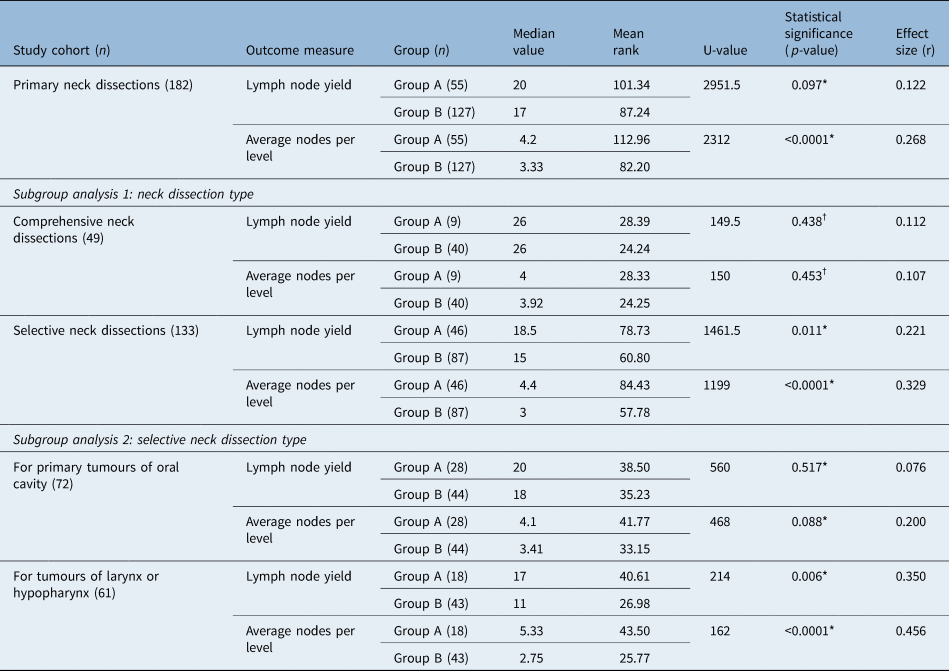
For the primary study cohort (comprising all neck dissections together), the lymph node yield was higher in group A (median = 20) than in group B (median = 17) clinically, but the Mann–Whitney test indicated that this difference was statistically insignificant (U = 2951.5, p = 0.097).
On analysing the selective neck dissection cases separately, more lymph nodes were yielded in group A (median = 18.5) than in group B (median = 15), and the gain was statistically significant (U = 1461.5, p = 0.011). However, for the comprehensive neck dissection cases, the lymph node yield between the groups A and B was not different clinically (median of 26 in both the groups) or statistically (U = 149.5, p = 0.438).
In the subgroup analysis of selective neck dissection based on the primary tumour location, group A demonstrated a higher lymph node yield (median of 20 and 17, respectively) compared to group B (median of 18 and 11, respectively) in both the subgroups. However, the difference was statistically significant only among the selective neck dissections that had been performed for laryngeal and hypopharyngeal cancers (U = 214, p = 0.006), but not in those carried out for oral cavity tumours (U = 560, p = 0.517). Such tumour location-based subgroup analysis was not feasible for the comprehensive neck dissections, as group A in this subcohort had only nine cases. Moreover, considering that all I–V levels of the cervical lymph nodes had been addressed in comprehensive neck dissection irrespective of the site of the primary tumour, such location-based analysis was not necessary in this subcohort.
On calculating the average nodes per level for each of the groups and subgroups, it was found that the median counts for groups A and B were 4.2 and 3.33 for the primary study cohort, 4.4 and 3.0 for the subcohort of selective neck dissection, and 4 and 3.92 for the subcohort of comprehensive neck dissection, respectively. These clinical differences in average nodes per level between groups A and B were also statistically significant for the primary study cohort (U = 2312, p < 0.001) and for selective neck dissection (U = 1199, p < 0.001), but not for comprehensive neck dissection (U = 150, p = 0.438). Similarly, when the site-specific subgroups of selective neck dissection were considered separately, the average nodes per level was higher in group A than in group B for both oral cavity (4.1 and 3.41) and laryngeal or hypopharyngeal (5.33 and 2.75) tumours, but was statistically significant only for the latter (U = 162, p < 0.001), with a ‘moderate’ effect size (r = 0.456).
The effect sizes for each of the statistical differences (between the non-parametric quantitative data) were calculated using the formula r = Ɀ divided by the square root of n, where Ɀ is a standardised test statistic obtained via SPSS software during the Mann–Whitney test, and n is the total sample size considered for the test.Reference Fritz, Morris and Richler41,Reference Trafimow42 A detailed account of all the statistical estimates, including the calculated effect size, is summarised in Table 2.
Outcome variables and corresponding statistical analysis findings

Statistical measures on Mann–Whitney U test. Group A = sampling of lymph nodes level-by-level; group B = sampling by en bloc removal of nodes. *Asymptotic significance (two-tailed); †exact significance (2 × (one-tailed significance)), taken owing to sample size of less than 40. n = number of neck dissection specimens included
Discussion
To our knowledge, this is the first study to have compared the two neck dissection sampling techniques of level-by-level and en bloc dissection, by considering clinically relevant outcomes in the form of lymph node yield and average nodes per level. We noted a trend of higher lymph node yield from level-by-level sampling of the cervical lymph nodes compared to the yield from en bloc sampling. This increase was consistent across the overall cohort and in the neck dissection subcohorts, except for comprehensive neck dissection.
One could attribute the similar lymph node yield from both sampling techniques in comprehensive neck dissection to a probable increase in vigilance on the part of the surgeon or the pathologist, as these cases come with the baggage of ‘clinical node positivity’. However, before drawing this conclusion, one has to acknowledge the gross differences in the number of cases included under each sampling method (9 vs 40 cases) in this subcohort of comprehensive neck dissection. Theoretically, the differences in median lymph node yield could be affected by the asymmetry between the comparison groups, as this outcome measure of central tendency depends, to a certain extent, on the sample size of each group. Similarly, we presume that the unequal distribution of comprehensive neck dissection cases between the two sampling methods in our primary study cohort could also have affected the corresponding outcome measure. This is because the lymph node yield depends on the total number of lymph node levels being addressed, and, among the primary cohort of all neck dissections, only one-sixth (9 of 55) of the included cases were of comprehensive neck dissection in the level-by-level sampling group as opposed to one-third (40 of 127) in the en bloc group.
We believe that the inability to reach a statistically significant difference in lymph node yield among the primary study cohort of all neck dissections (despite an evident clinical gain with the level-by-level technique) could have been overcome by a larger sample size and a balanced distribution of neck dissection types between the comparison groups. A clear demonstration of higher lymph node yield with the level-by-level technique (which was both clinically and statistically significant) in the subcohort of selective neck dissection led us to this conjecture. Our supposition is also well supported by the fact that the increased average nodes per level with level-by-level dissection was statistically significant even in the overall study cohort of all neck dissections.
We believe that average nodes per level is better reflective of the adequacy of neck dissection than lymph node yield, as it analyses each of the procedure separately according to the number of levels being included in the given neck dissection. Especially when comparing two different neck dissection sampling techniques, average nodes per level seems more reliable, as it is not affected by the variable distribution of different types of neck dissection between the groups.Reference Marres, de Ridder, Hegger, van Velthuysen, Hauptmann and Navran22,Reference Liao, Hsueh, Lee, Lin, Fan and Wang23,Reference Lippert, Dang, Cannon, Harari, McCulloch and Hoffman30 Interestingly, in our study, the differences in the average nodes per level between the two sampling techniques not only paralleled the gains in lymph node yield across the primary study cohort and all subcohorts of neck dissection, but outperformed lymph node yield in most of these analyses in favour of the level-by-level sampling method. Simply said, the gain in average nodes per level turned out to be a better proponent of the level-by-level technique in all types of neck dissection than the lymph node yield.
On independent analysis of selective neck dissection according to the location of the primary tumour (that is, according to the levels included), the level-by-level technique provided significantly greater lymph node yield than en bloc technique in laryngeal and hypopharyngeal tumours that had resection of lymph node levels II, III, and IV with or without V. Though the gain in lymph node yield achieved by level-by-level dissection was seen even in oral cavity tumour cases, in which levels I, II, and III with or without IV had been excised, this increase was statistically insignificant. Generally, a lymph node yield of more than 15–18 is considered a satisfactory outcome of selective neck dissection.Reference de Kort, Maas, Van Es and Willems14,Reference Zenga, Divi, Stadler, Massey, Campbell and Shukla20,Reference Pou, Barton, Lawlor, Frederick, Moore and Hasney43,Reference Merz, Timmesfeld, Stuck and Wiegand44 Furthermore, nearly 75 per cent of the neck dissections are expected to have a yield of more than 18.Reference Cramer, Speedy, Ferris, Rademaker, Patel and Samant29 Our results were on a par with the literature-reported rates in both these regards, except in a subgroup of laryngeal and hypopharyngeal tumours that had undergone en bloc excision of lymph nodes. For some reason unknown, the lymph node yield in this subcohort was undesirably lower than the standard expectation. In other words, though level-by-level neck dissection sampling seemed advantageous in most of the neck dissection groups and subgroups in our study, the benefit was most robust for the subset of selective neck dissection cases with laryngeal and hypopharyngeal tumours.
• There exists a technical variability in lymph node sampling methods used during neck dissection, and there is no consensus as to the optimal technique
• Of 182 neck dissections, the level-by-level method yielded more lymph nodes compared to en bloc method
• Average nodes per level were also significantly greater, both in comprehensive and selective neck dissection
• These gains in lymph node yield and nodes per level seem more relevant in node-negative locally advanced laryngeal tumours undergoing selective neck dissection and total laryngectomy
• Surgeons must sample each lymph node level separately during neck dissection, as increased yield could improve survival in head and neck squamous cell carcinoma
Concerning the effect size, most of the differences in outcome measures in our study were of ‘small’ to ‘moderate’ size; however, they are by no means negligible.Reference Sawilowsky45,Reference Cohen46 What makes even the small effect size more relevant with regard to lymph node yield is the fact that many larger studies, having studied thousands of patients, have reported an incremental improvement (also statistically significant) in survival rates for every additional lymph node harvested during the neck dissection.Reference Ho, Kim, Tighiouart, Gudino, Mita and Scher47–Reference Lemieux, Kedarisetty, Raju, Orosco and Coffey49 When the lymph node yield can be increased, even marginally, by making a small and inexpensive change in the neck dissection technique, why not consider it, especially if it could favour survival? After all, the effect size has to be weighed against the risk involved in the intervention, the clinical gain and the effect of an alternative intervention.Reference Glass, McGaw and Smith50 Overall, the present study shows that the separate sampling of cervical lymph nodes according to their levels is likely to yield more lymph nodes and thus could contribute to survival benefit. However, further prospective studies are required to better quantify and correlate the gain in lymph node yield attained by level-by-level sampling with its impact on survival rates in head and neck squamous cell carcinoma.
The level-by-level sampling technique discussed here should not be equated with ‘berry picking’ or piecemeal dissection of each lymph node level. The ideal way of performing this level-by-level sampling is to dissect one lymph node level (bounded by distinct anatomical boundaries) and surrounding fibrofatty tissue entirely from its bed and remove it as a single specimen, before proceeding to the next level.Reference Robbins, Shaha, Medina, Califano, Wolf and Ferlito24
Over and above increasing the lymph node yield of neck dissection, this level-by-level sampling technique could offer additional benefits over en bloc sampling. Firstly, orientating the neck dissection specimen after en bloc removal is not easy. Despite surgeons and pathologists taking the utmost care to organise the sample and mark the levels separately, the lymph nodes could get mixed up, even after tagging or mounting on a frame.Reference Marres, de Ridder, Hegger, van Velthuysen, Hauptmann and Navran22,Reference Robbins, Shaha, Medina, Califano, Wolf and Ferlito24,Reference Dulguerov, Broglie, Henke, Siano, Putora and Simon25 Handling by trainees and technicians in the operating theatre or the gross room could further compromise the reliability.Reference de Ridder, Marres, Smeele, van den Brekel, Hauptmann and Balm21,Reference Marres, de Ridder, Hegger, van Velthuysen, Hauptmann and Navran22,Reference Robbins, Shaha, Medina, Califano, Wolf and Ferlito24 Separating the lymph nodes level-by-level during the neck dissection itself and sending them as separate specimens would be the most reliable way to overcome these technical issues. Secondly, sampling two or more lymph node levels en bloc could negatively affect crucial decision-making, as the pathologist may not be able to accurately assign the lymph node level to a positive node found in intermediate zone or in unmarked specimen. This information on the metastatic status of the lymph nodes according to their levels is of particular importance for deciding upon the adequacy of neck dissection, for planning adjuvant treatment, and for predicting survival.Reference Majercakova, Valero, López, García, Farré and Quer6,Reference Lemieux, Kedarisetty, Raju, Orosco and Coffey49,Reference Lim, Koo and Choi51–Reference Feng, Xu, Qin, Li and Han53 Thus, separate sampling of each level during the neck dissection would aid in appropriate risk stratification and adjuvant therapy, contributing to improved survival in head and neck squamous cell carcinoma.
The current study is not without drawbacks, most of which are reflective of unavoidable concerns intrinsic to the study methodology and the design. For instance, though we excluded known predictors of lymph node yield like pre-operative radiotherapy from our study, and we accounted for a few others, such as age, gender and ‘number of excised levels of lymph node’ in our analysis, we could not scrutinise the effect of interpersonal variations related to the surgeons’ and the pathologists’ expertise on lymph node yield. Nevertheless, as the patients included in this single-centre study had been treated by a closed group of a few surgeons and pathologists who had no technical preferences, we hope that the impact of these technical factors on the outcomes was negligible. The other methodological issue we encountered was a ‘third group’ of lymph node sampling in some cases, in which some of the levels had been excised separately and a few others en bloc. Because such cases had multiple combinations of various lymph node levels, we could not analyse them individually, and assigned all such non-level-by-level cases to the en bloc group; as a result, some overestimation of the yield in this group cannot be ruled out. Lastly, though this study aimed to evaluate the sampling techniques in terms of immediate surgical outcome, it would have been worthwhile to quantify the differences between the sampling techniques in terms of survival rates as well. Further studies with the focused objective of survival analysis will answer this.
Regarding the study design, there is no doubt that a randomised, controlled trial would have been a better option for verifying the study hypothesis. However, designing and running a surgical trial comes with its own issues, such as the inability to blind the surgical team to intervention, along with particular ethical and financial hurdles. Nevertheless, a retrospective study like this does not just provide preliminary verification of the hypothesis and its direction, but also suggests an approximate effect size for future studies, possibly even a randomised trial.Reference de Kort, Maas, Van Es and Willems14,Reference Ebrahimi, Clark, Amit, Yen, Liao and Kowalski16,Reference Talmi, Takes, Alon, Nixon, López and de Bree17,Reference Iocca, Farcomeni, De Virgilio, Di Maio, Golusinski and Malvezzi54
Other considerations that could have provided more robust statistical results include use of the arithmetic mean in place of the median, and parametric tests instead of non-parametric ones. According to the central limit theorem, we had an adequate sample size to skip the preliminary normality check and to assume a normal distribution.Reference Kwak and Kim37 However, we checked for normality and used non-parametric tests accordingly, as we did not want to compromise the validity of the study results, but were ready to accept relatively less powerful statistical analyses. Lastly, though Box–Cox transformation or log-normal distribution would have converted the data to a normal distribution, we chose not to do this, as it could have further complicated the interpretation of results with respect to the clinical context.
Conclusion
Compared with the en bloc sampling technique of neck dissection, level-by-level sampling of cervical lymph nodes provides a higher lymph node yield and significantly more lymph nodes per level in primary head and neck squamous cell carcinoma. The difference seemed most evident in node-negative locally advanced laryngeal tumours undergoing selective neck dissection along with total laryngectomy. Based on our results, we suggest that the level-by-level method of sampling should be the standard for any neck dissection. However, further prospective studies are needed to validate our findings and to verify whether this gain in lymph node yield achieved by the level-by-level method translates into a survival benefit in head and neck squamous cell carcinoma.
Competing interests
None declared