Introduction
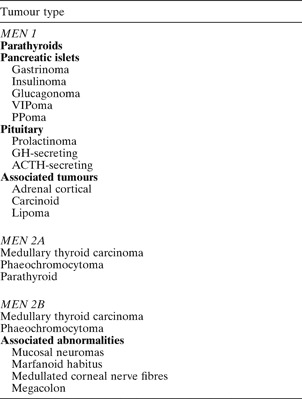
Multiple endocrine neoplasia syndromes are inherited autosomal cancer syndromes.Reference Peczkowska and Januszewicz1 They can be divided into types one and two (Table I).
Multiple endocrine neoplasia syndromes and characteristic tumours

MEN = multiple endocrine neoplasia; VIPoma = Vasoactive Intestinal Polypeptide; PPoma = Pancreatic Polypeptide; GH = growth hormone; ACTH = adrenocorticotrophic hormone
Multiple endocrine neoplasia type one affects the parathyroid glands, the pancreatic islets and the anterior pituitary gland. Multiple endocrine neoplasia type two is caused by germ-line mutations of the Rearranged during Transfection (RET) proto-oncogene and can be divided further into three clinically distinct forms: multiple endocrine neoplasia type 2A, familial medullary thyroid carcinoma and multiple endocrine neoplasia type 2 B.
Multiple endocrine neoplasia type two A is the most common subtype (>90 per cent) and is characterised by medullary thyroid carcinoma, phaeochromocytoma (about 50 per cent) and hyperparathyroidism (about 20 per cent), secondary to parathyroid hyperplasia.
Familial medullary thyroid carcinoma is characterised by a hereditary medullary thyroid carcinoma which is not usually associated with any other endocrine abnormalities.2
In patients with multiple endocrine neoplasia type 2 B, multiple mucosal neuromas are a common presentation. Although these lesions have been observed on the lips, tongue and buccal cavity, there are no articles in the English literature describing the appearance of mucosal neuromas in the larynx.
We report the case of a young girl diagnosed with multiple endocrine neoplasia type 2 B at a young age, and with a rare presentation of laryngeal mucosal neuromas. We discuss the clinical manifestations of multiple endocrine neoplasia type 2 B, as well as issues relating to the management and histopathological appearance of laryngeal mucosal neuroma.
Case report
An 11-year-old girl was diagnosed with multiple endocrine neoplasia type 2 B in 1999.
In 1996, the patient had been noted to have slight dysmorphic features with a normal intellect, but had presented with delayed motor development resulting in mild proximal weakness in her legs. Routine blood tests had revealed a marginally elevated thyroid-stimulating hormone concentration, with a normal thyroxine level and elevated calcium level. Chromosomal analysis had been normal. The patient had been referred to a specialist hospital for investigation of her gross motor delay. A diagnosis of ligamentous laxity had been made.
In 1998, the patient had been noted to demonstrate coarse facies: a small nose, long philtrum and prominent lips. She had also been noted to have: poorly developed musculature; truncal obesity; poor, carious teeth; erythematous palms and soles; and a recurring blister on the tip of her tongue. Investigations for mucopolysaccharidosis had been negative.
In 1999, repeated genetic testing revealed a M918T mutation in the RET proto-oncogene, and a diagnosis of multiple endocrine neoplasia type two B was made.
Towards the end of that year, the patient underwent prophylactic thyroidectomy. Histology revealed C-cell hyperplasia with frank medullary carcinoma in both lobes of the thyroid.
In 2002, a positron emission tomography scan showed an abnormal mediastinum; malignant disease was subsequently resected from the neck and upper mediastinum. During that year, a painful, benign tongue neuroma was also excised.
In 2003, mediastinal lymph nodes were resected, but the patient was diagnosed with miliary metastases of the right lung.
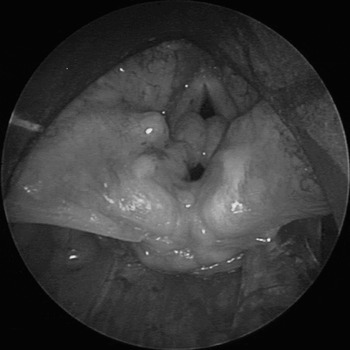
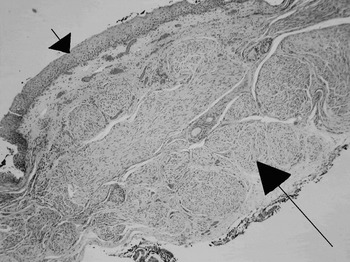
In October 2005, whilst undergoing general anaesthesia for routine dental treatment, the anaesthetic team were concerned by masses on the patient's vocal folds, which they felt could compromise her airway. The ENT team were informed of the situation, and an urgent microlaryngoscopy was performed. Large, smooth lesions were excised from the vocal processes bilaterally (Figure 1). A biopsy was reported as showing benign mucosal neuromas (Figure 2). The patient was discharged the following day without complications.
Microlaryngoscopic view of the laryngeal mucosal neuromas.

Photomicrograph of vocal fold biopsy, showing irregular neural bundles (large arrow) within the lamina propria, immediately beneath the normal surface squamous epithelium (small arrow). Immunohistochemically, these bundles were positive for S100, consistent with a neuroma. (Image courtesy of Dr John Bridger, Histopathology Department, Torbay Hospital.) (H&E; ×5)

In November 2005, the patient presented with acute stridor. Flexible nasoendoscopy was not performed at this time. The patient's symptoms settled with conservative management, and she was discharged 48 hours later. Two days later, she re-presented with stridor; flexible nasoendoscopy revealed a recurrent lesion on the vocal folds. She improved over the next few days without surgical intervention.
Discussion
Multiple endocrine neoplasia type two B is the most aggressive of the multiple endocrine neoplasia two subtypes, and accounts for approximately 5 per cent of all cases of multiple endocrine neoplasia type two. Although medullary thyroid carcinoma presents both in types two A and two B, the onset of the tumour presents at an earlier age (approximately 10 years earlier) in the latter.Reference Peczkowska and Januszewicz1 Due to the early development and aggressive nature of the medullary thyroid carcinoma, patients are likely to develop metastatic medullary thyroid carcinoma at an early age; early prophylactic thyroidectomy (before the age of one year) is thus advised. Prior to surgical intervention, the average age of death in patients with multiple endocrine neoplasia type two B was 21 years.3 Phaeochromocytomas occur in approximately 40–50 per cent of patients,Reference Peczkowska and Januszewicz1 and individuals who go undiagnosed may die from peri-operative cardiovascular complications.3 Patients with multiple endocrine neoplasia type two B do not develop hyperparathyroidism.
As well as developing medullary thyroid carcinoma and phaeochromocytomas, individuals with multiple endocrine neoplasia type 2 B may be identified in infancy or early childhood with other distinctive features. The face may be elongated, the eyelids may be thickened and everted, and the eyebrows may appear large and prominent. Neuromas may be present on the eyelids, conjunctiva and corneal nerves. The lips have a marked ‘blubbery’ appearance, and sub-mucosal neuromas may be present on the vermilion border. The oral presentation of mucosal neuromas on the dorsal aspect of the tongue is an early clue pointing towards the syndrome in infancy or early childhood. The presence of this is pathognomonic of the presence of medullary thyroid carcinoma.Reference Carney, Sizemore and Lovestedt4 Mucosal neuromas may also be seen in the pharynx. Other oral features include a high arched palate and a prominent jaw. Musculoskeletal manifestations include Marfanoid habitus, presenting with proximal muscle weakness and wasting. Joint laxity, kyphoscoliosis or lordosis, pes cavus and slipped capital femoral epiphysis have also been reported.Reference Morrison and Nevin5 Gastrointestinal manifestations include ganglioneuromatosis of the gastrointestinal tract (40 per cent) with associated abdominal distension, megacolon, constipation or diarrhoea.3
We would like to highlight certain features of this case. Within the first year of life, the patient had presented with dysmorphic features typical of multiple endocrine neoplasia type 2 B, despite negative chromosomal analysis. The continued suspiciousness of her clinical presentation warranted repeated analysis, which resulted in the diagnosis of multiple endocrine neoplasia type 2 B, three years later. The M918T mutation is associated with the highest risk of medullary thyroid carcinoma and a subtle clinical phenotype of mucosal neuromas.Reference Hoff, Cote, Lee, Evans, Gagel, John and Stephen6 Thus, repeated chromosomal testing, against a background of high clinical suspicion, is crucial. Due to the early development and aggressive nature of medullary thyroid carcinoma, evidence suggests that a prophylactic thyroidectomy should be performed at the age of one year. Due to a later diagnosis, our patient underwent thyroidectomy at the age of three years, but with an unfortunate metastatic spread.
• Multiple endocrine neoplasia syndromes are inherited autosomal cancer syndromes
• Multiple mucosal neuromas are a common presentation in patients with multiple endocrine neoplasia type 2 B
• Although mucosal neuromas have been observed on the lips, tongue and buccal cavity, there are no articles in the English literature describing the appearance of such lesions in the larynx
• This paper describes the case of a girl diagnosed with multiple endocrine neoplasia type 2 B at a young age, and with a rare presentation of laryngeal mucosal neuromas
As discussed above, our patient had earlier presented with a ‘recurring blister on her lip’ which was more likely to be a neuroma of the lip, typical of multiple endocrine neoplasia type 2 B. Clinically, the masses on the patient's vocal folds were not in keeping with multiple endocrine neoplasia type 2 B. It was only after confirmation by histology that the association was appreciated.
Although mucosal neuromas have been widely observed on the lips, tongue and buccal mucosa of patients with multiple endocrine neoplasia type 2 B,Reference O'Riordain, O'Brien, Crotty, Gharib, Grant and Van Heerden7 there has been limited documentation of laryngeal mucosal neuromas in the larynx. The exact incidence of laryngeal mucosal neuromas is uncertain. Tolkemitt et al. reported mucosal neuromas of the glottis and supraglottis, within the scope of multiple endocrine neoplasia type 2 B,Reference Tolkemitt, Jaehne, Sagowski and Jakel8 and Shimazaki et al. described multiple, solitary laryngeal mucosal neuromas in a 73-year-old patient without multiple endocrine neoplasia type 2 B.Reference Shimazaki, Yoshida, Izumani and Nakashima9
Conclusion
Laryngeal mucosal neuroma can manifest as potentially airway-compromising lesions in patients with multiple endocrine neoplasia type 2 B. Although apparently rare, we feel our case highlights the need for vigilance and prompt recognition of this treatable condition.