


Introduction
This article presents the datasets on the “Italian political class” compiled by the Centre for the Study of Political Change (CIRCaP) and the Laboratory of Political and Social Analysis (LAPS) at the University of Siena between 2020 and 2021. The datasets come in the wake of a consolidated tradition of studies on the Italian ruling class, dating back to Mosca (Reference Mosca1896). This tradition gained significant empirical momentum with Sartori's (Reference Sartori1963) project on parliamentarians and the post-war political class, which inspired generations of Italian researchers (Cotta, Reference Cotta1979; Calise, Reference Calise and Morlino1989) and American scholars alike (Di Renzo, Reference Di Renzo1967; Putnam, Reference Putnam1973; Barnes, Reference Barnes1977).
The interest in the Italian political class has long been driven by the peculiarities of a fragmented and highly polarised party system (Sartori, Reference Sartori1976), historically contributing to marked government instability. Another distinct element is its territorial complexity, notably highlighted by the implementation of the regional government system in 1970, which multiplied the elective positions and generated a broad space for “political professionals” with diverse identities and levels of social capital (Putnam et al., Reference Putnam, Leonardi and Nanetti1993). The transformations during the crisis of the party system in 1992–1994, marked by the advent of Silvio Berlusconi and a long season of bipolarism interrupted by the emergence of the Five Star Movement in 2013, have reshaped some characteristics of the system without resolving issues of political class accountability and credibility.
Our datasets boast five innovative characteristics. First, they represent one of the most extensive efforts in recent decades to map Italian political representatives, encompassing both biographical data on more than 20,000 politicians and a survey of over 2000 politicians from this population.Footnote 1
Second, the datasets cover all four levels of polity: urban and metropolitan areas, regions, the national and the European Union (EU) levels. Previous investigations into the Italian “power elite” have selected limited numbers of elected representatives (Carboni, Reference Carboni2007), while studies on the Italian political class typically focused on a single level, whether municipal (Barberis, Reference Barberis1978), regional (Putnam et al., Reference Putnam, Leonardi and Nanetti1993; Vassallo, Reference Vassallo2013) or national (Verzichelli, Reference Verzichelli2010; Bellucci and Conti, Reference Bellucci and Conti2012).
Third, our datasets compile information on a broad spectrum of individual-level variables, including the social and political characteristics of the entire Italian political class, as well as the attitudes and opinions of a sample of representatives across all levels of government. This multilevel approach represents a unicum in the study of Italian elites.
Fourth, the survey data cover a wide set of attitudes, opinions and policy preferences of politicians, employing both standard questions and survey experiments (Martini and Olmastroni, Reference Martini and Olmastroni2021). The questionnaire addresses five crucial dimensions of political representation: the focus and locus of representation; changes in representative democracy; the role of public opinion in the democratic process; elites' responsiveness to their constituencies and politicians' perceived congruence on various policy issues. This makes it one of the largest surveys ever conducted on the Italian political elites at different levels using an identical questionnaire.
Last, the survey was carried out at a timely moment of the history of the Republic, after years of endogenous shocks resulting from institutional reforms and exogenous challenges, including the Great Recession, the refugees' crisis and the COVID-19 pandemic.
A map of the Italian political class: the population dataset
To build our population dataset, we drew upon the open-data archive of the Ministry of the Interior (Department of Internal and Territorial Affairs) on elected representatives at the municipal, regional, national and European levels of government. For municipalities, we referenced the Registry of Local Administrators, specifically considering units with a population exceeding 15,000 inhabitants as identified by the 2011 census data of the Italian National Institute of Statistics (ISTAT).Footnote 2 This process involved 727 municipalities (out of 7914 total at the time of the research), including three newly established units, through data cross-referencing among the Ministry of the Interior, ISTAT and the Italian Association of Municipalities. After excluding instances under receivership, we identified a total of 672 municipalities. The same Registry was used to collect information on the 20 Italian regions (actually 21 units, including the two autonomous provinces of Trento and Bolzano). At both the national level (parliamentarians elected to the Chamber of Deputies and the Senate of the Republic) and the European level data were sourced from the preceding national general elections in March 2018 and the European Parliament elections in May 2019, respectively.
Since the Ministry of the Interior's data are updated only periodically, we supplemented and updated the characteristics of the Italian political class by incorporating information on resignations and replacements from the websites of selected Italian municipalities, regions, parliaments (Chamber of Deputies, Senate and European parliament) and political parties. Interns and university students assisted in this process, producing a comprehensive dataset of elected politicians in office as of September 2020 for the municipal level (prior to the local elections held in that month), January 2021 for the regional and European levels and October 2021 for the national level, thus covering the entire 18th legislature (2018–2022). The population dataset encompasses a total of 20,564 political representatives: 18,511 at the municipal level (including councillors, assessori and mayors),Footnote 3 1032 at the regional level (including councillors, assessori and regional presidents), 944 at the national level (comprising both deputies and senators) and 77 at the European level (Italian members of the EU parliament).Footnote 4
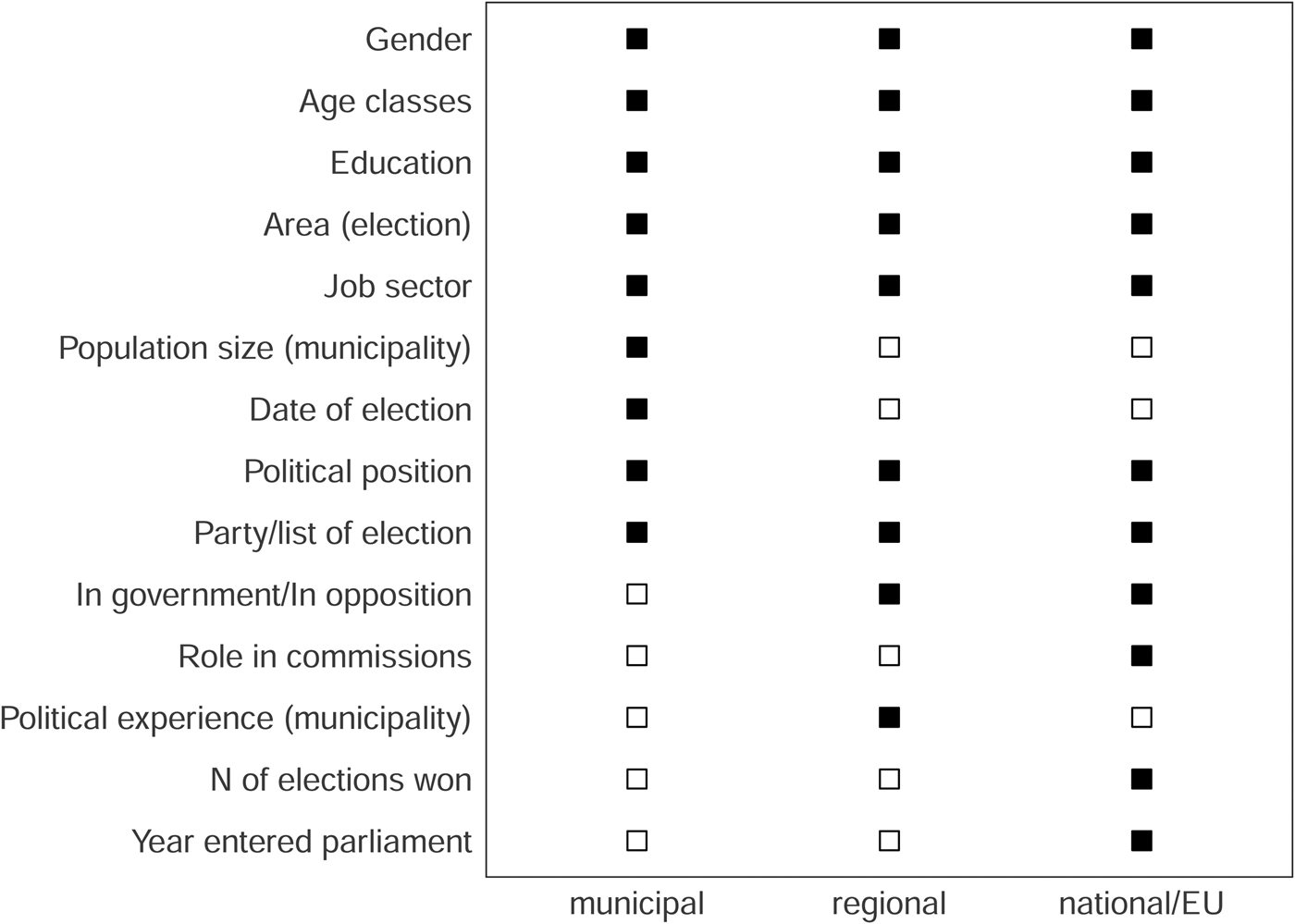
As shown in Figure 1, information on our population of politicians includes a broad spectrum of individual-level variables: socio-demographic characteristics (gender, age, education, job position, geographic macro-area of election); date of election (for municipal and regional representatives); political position; political list of election; whether the list was in government (for regional, national/EU levels); detailed information about previous political experience (for regional representatives) and level of seniority, considering factors such as the number of elections won, year of entry into the (national) parliament or additional work in specific commissions (for national/EU representatives).
Information covered in the population dataset across levels of election.
Note: Black squares show where this information is available.
This information has been collected drawing upon publicly available curricula on institutional websites. Despite recent efforts to enhance transparency through more stringent regulations,Footnote 5 this information is not always complete. However, the coverage level for socio-demographic variables is very high: 98.4% for age, 95.4% for education and 93.5% for the job sector.Footnote 6
Interviewing Italian representatives: the survey dataset
Sampling frame
The mapping of Italian political class not only provides a detailed description of the target population but also enables the identification of the sampling frame relevant for survey research. This includes the names and contacts of elected representatives collected via web scraping of institutional websites. The survey's target population is slightly larger than previously discussed, as six regional governments held elections during the fieldwork (Campania, Marche, Puglia, Toscana, Veneto and Valle d'Aosta). For these units, representatives elected both at the beginning of the survey and during the fieldwork were included, resulting in a total of 20,697 politicians (18,511 at the municipal level, 1165 at the regional level, 944 at the national level and 77 at the European level).
We gathered at least one e-mail contact (including work e-mails, publicly available personal e-mails and certified e-mails) for approximately 82.5% of the target population. Overall, our sampling frame comprised of 17,085 e-mail contacts: 14,944 at the municipal level, 1121 at the regional level, 943 at the national level and 77 at the European level. Collecting e-mail was easier for higher levels of representation, with significant challenges encountered at the municipal level, where nearly all missing contacts were concentrated (around 98%). Despite efforts to improve coverage through direct personal contacts, missing contacts were particularly pronounced in small cities (15,000–50,000 inhabitants), accounting for 82.6% of the total missing contacts (2946 out of 3568), and in southern regions and major islands, comprising almost 42% of all missing contacts.
Another challenge emerged during the contact stage as we encountered several stumbling blocks. Due to technical issues, some invitations did not reach the intended recipients, or their mailboxes were saturated. On average, unachieved targets, including bounced back and rejected e-mails or full inboxes, ranged from 0.06% for the national and European levels, 0.05% for the regional level, to a significant 24% for the municipal level. Moreover, even when e-mails were successfully delivered, many remained unopened. Specifically, we recorded an “email opening rate” of 24% for the national and European levels, 22% for the regional level and 31% for the municipal level. This information highlights the “accessibility” of Italian politicians to the citizenry through online tools.
Fieldwork
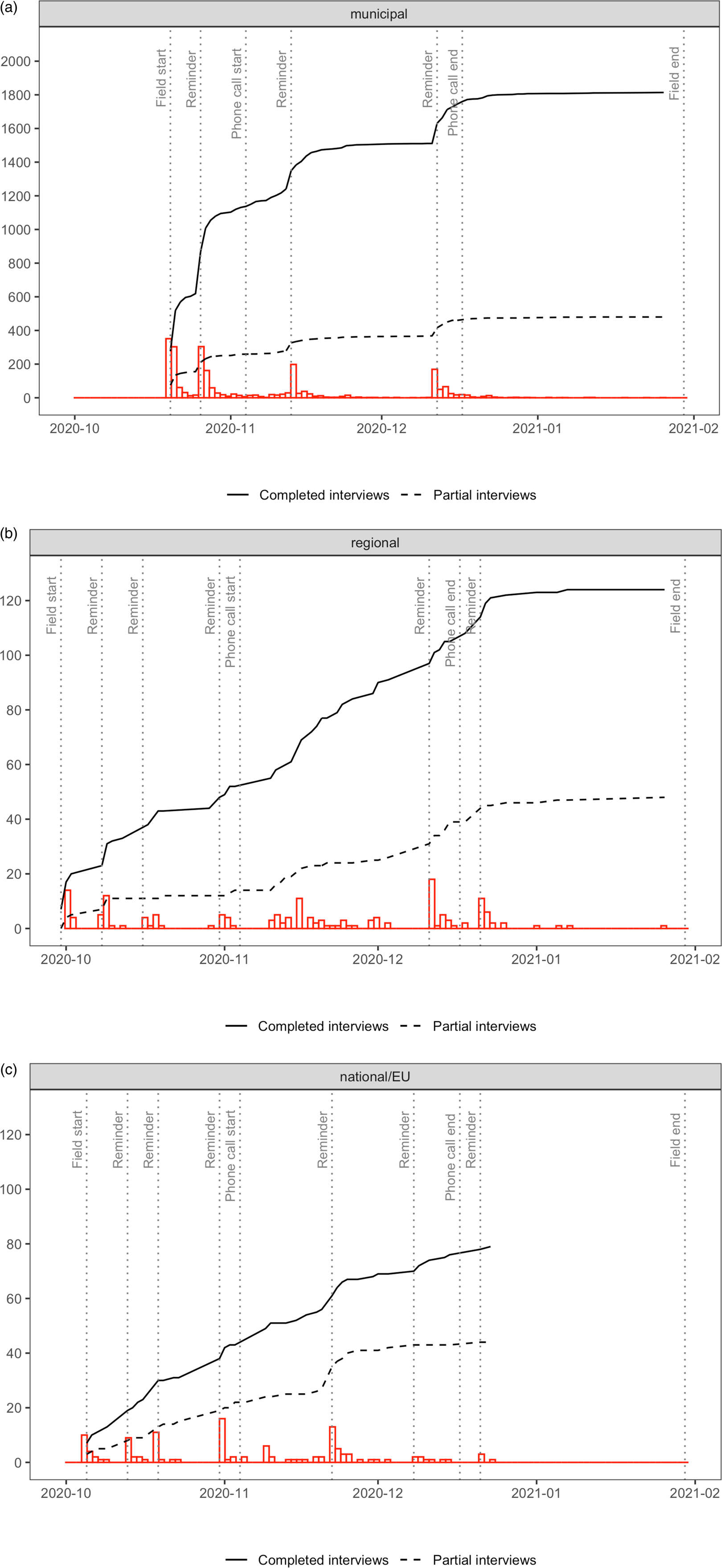
The survey fieldwork spanned approximately 4 months, starting in the last week of September 2020 and concluding at the end of January 2021. Due to the survey's complexity, we staged three separate fieldworks: one for the municipal level, one for the regional level and one for the national and European levels. Following an official invitation letter introducing the project and its rationale, along with a subsequent e-mail containing the questionnaire link, we issued multiple reminders to enhance the response rate: three reminders for the municipal level, five for the regional level and six for the national and European levels. This approach was justified by the inherent difficulty in reaching members of parliaments. Additionally, a small team of interviewers assisted in telephone reminders, contacting those who had left their interview incomplete.
Figure 2 shows the progress of the three different fieldworks throughout the period, displaying the daily number of completed interviews alongside the cumulative numbers of both completed and partial interviews. Moreover, the figure pinpoints the commencement and conclusions dates of each fieldwork, the timing of reminder dispatches and the duration of phone calls outreach. As can be seen, reminders notably impacted survey response, especially in the case of municipal-level politicians (panel a). Conversely, direct phone contacts appear to be more effective for politicians at higher levels (panels b and c).
Three different fieldworks: progress of interviews over the period.
Note: The red bars report the daily number of completed interviews, while the solid and dashed lines represent the cumulative numbers of completed and partial interviews per day, respectively.
Response rates and sample bias
A total of 2589 politicians accepted our invitation, with 2134 completing at least 50% of the questionnaire, resulting in an overall response rate of 12.5%. This rate is consistent with other surveys of political representatives (Kertzer and Renshon, Reference Kertzer and Renshon2022) and other elite surveys conducted by CIRCaP–LAPS (for response rates, see American Association for Public Opinion Research, 2023).Footnote 7 Specifically, we interviewed 1917 municipal representatives, 128 regional representatives, 75 national representatives and 14 members of the European Parliament. When breaking down response rates by the level of election (and considering respondents who completed at least 50% of items), those for politicians at the municipal and regional levels are close to the average score (12.9 and 11.4%, respectively), while the response rate decreases at the national level (7.9%) and increases at the European level (18.1%). Dropouts were particularly high at the start of the interview, notably in the first block on policy preferences, with over one-fifth of dropouts concentrating on the item about taxes and public services. Additionally, politicians appeared more sensitive about questions regarding aspects influencing political decisions and the role of public opinion (see Figure A1 in the online Appendix).
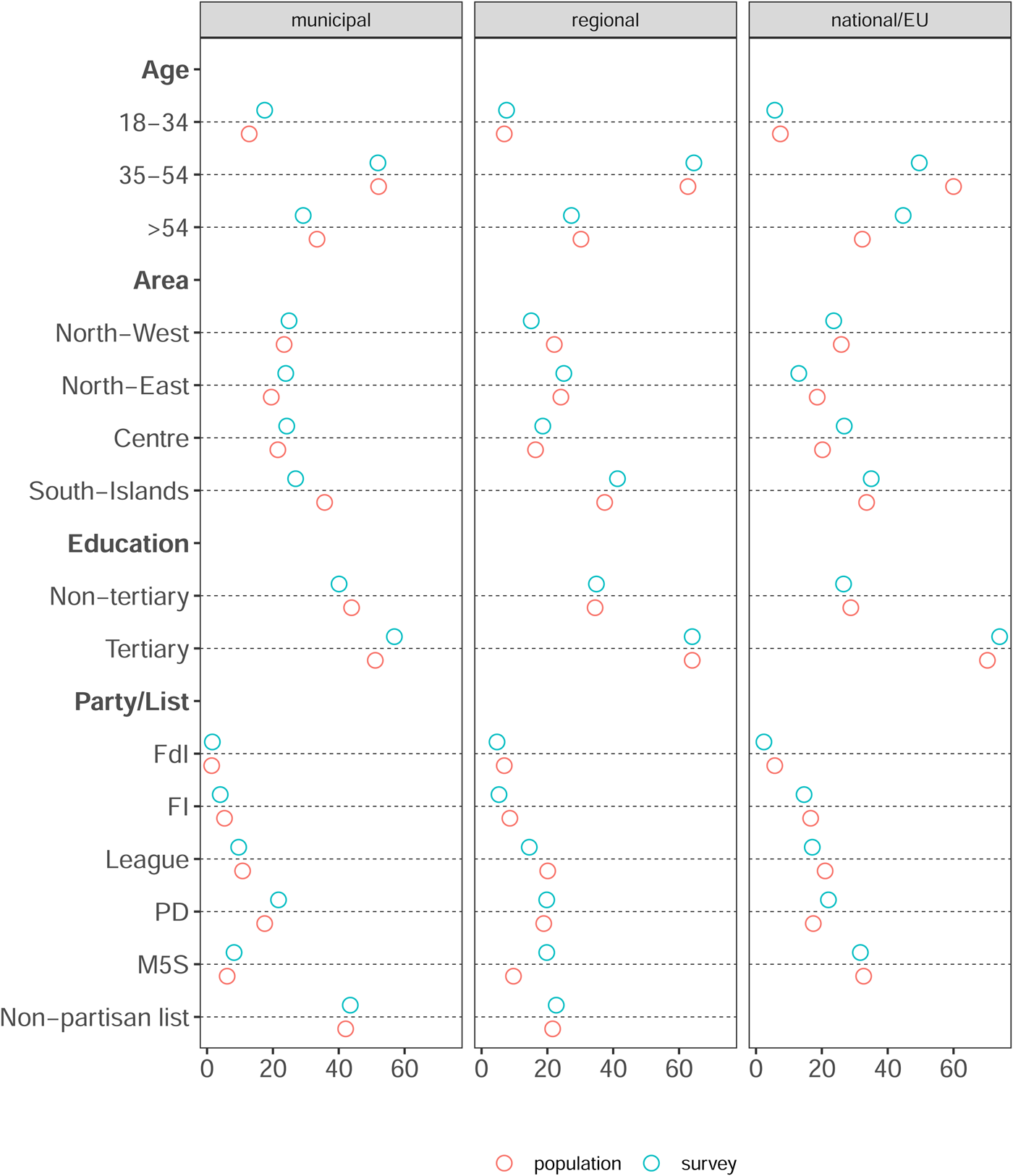
Figure 3 indicates that our sample does not significantly differ from the population in terms of some basic socio-political characteristics (see Table A1 in the online Appendix for tabular results). While it is important to acknowledge that some individuals were systematically excluded due to the absence of a valid e-mail contact or technical impediments (e.g. bounced back e-mails, full mailboxes, etc.) and that, as with any opinion survey, low response rates may result in biased estimates, especially if some key characteristics correlate with non-response, this survey marks the first attempt to collect the views of Italian representatives in an extensive and detailed way, ensuring a robust level of variation across many relevant variables. It thus constitutes an initial endeavour upon which future investigations can build. Last, when it comes to survey experiments, recent studies have revealed substantial similarities between experimental treatment effects obtained from non-representative and representative population samples (Mullinix et al., Reference Mullinix, Leeper, Druckman and Freese2015).
Population and sample characteristics.
Note: FdI, Brothers of Italy; FI, Go Italy!; PD, Democratic Party; M5S, Five Star Movement; Non-partisan list, not affiliated to any specific party but usually to a local political leader. Gender is not considered in our comparison as the aspect is not included in the public survey data file.
Questionnaire design
Due to space constraints, we are unable to present the questionnaire in detail (for full information see the online Appendix). Yet, Figure 4 provides an overview of the topics covered and the number of items related to each. The questionnaire explores five thematic areas using various formats, including single-item questions, Likert scale batteries and multi-response items,Footnote 8 alongside survey experiments employing factorial and conjoint designs (Martini and Olmastroni, Reference Martini and Olmastroni2021). Most of the questions were drawn from existing elite and mass national and international comparative surveys, ensuring continuity with previous studies and enhancing comparability of responses between political representatives and citizens.Footnote 9
Survey questionnaire: number of items by topic.

First, the questionnaire addresses the respondent's position on current democratic challenges, encompassing questions on populist attitudes, opinions on different political systems, satisfaction with democracy, assessments of the declining reputation of politicians and two experiments on the features of the ideal good politician (Clarke et al., Reference Clarke, Jennings, Moss and Stoker2018) and the legitimacy of different institutional decision-making procedures (traditional delegation vs. innovative direct or deliberative forms of decisions), respectively.
Then, it incorporates indicators exploring the focus of representation, namely, evaluations of the main aspects concerning the role of the representative, the interpretation of representation – whether as a means of advancing the interests of citizens vs. interest groups, or as a way to translate citizens' opinions into public policy vs. garnering voter support for one's own party platform – and, eventually, the role of elections.
Additionally, it explores the locus of representation, understood as the individual level of attachment to different polities (city, region, country or Europe), the importance attributed to different political offices, and, relatedly, opinions on the reduction of the number of parliamentarians, a constitutional reform ratified in 2020.
Moreover, the questionnaire investigates politicians' propensity for responsiveness by probing into the three most important factors that influence a political decision, the relevance of public opinion at different stages of the decision-making process, and the stability of public opinion. It also features two experiments investigating the role of public opinion in decision-makers' calculations, building upon prior research (Merkley and Owen, Reference Merkley and Owen2020).
Last, the questionnaire contains measures of individual positions on relevant policy issues (ranging from the economy, to immigration, European integration and COVID-19), the estimated position of public opinion and the politician's party/list of elections on the same topic, as well as individual left-right self-placement and the perceived position of major parties on the same continuum to gauge perceived issue and ideological congruence. The questionnaire concludes by eliciting a set of socio-demographic variables (e.g. age, education, English proficiency, geographic area, political list, religiosity).
Theoretical and empirical relevance of the datasets
The two datasets on the Italian political class hold relevance for (at least) three main research programmes (for preliminary results see Isernia et al., Reference Isernia, Martini and Verzichelli2023). The first is the study of the transformation of political elites across different levels of authority (local, regional and national) in terms of both socio-political characteristics and attitudinal distributions. In this regard, our datasets enable the investigation of a topic particularly relevant in Southern Europe (Kakepaki et al., Reference Kakepaki, Kountouri, Verzichelli, Coller, Cordero and Coller2018), such as descriptive representation, that is, the level of overlap between the characteristics of the political class at the different levels and the population they represent (Pitkin, Reference Pitkin1967). Relatedly, these datasets may contribute to research on elite selection and de-selection (Putnam, Reference Putnam1976) and the study of political careers (Cotta and Best, Reference Cotta and Best2007) across local contexts (Dal Bó et al., Reference Dal Bó, Finan, Folke, Persson and Rickne2017). This agenda has been recently renewed due to the emergence of new parties and leaders.
The second research programme is the study of how accountability works in practice, exploring the connection between what the representatives think of their role and the one of their constituencies, exploring the elite-mass gap in terms of ideological and policy congruence (Müller et al., Reference Müller, Jenny, Ecker, Best, Lengyel and Verzichelli2012; Merkley and Owen, Reference Merkley and Owen2020). In this connection, the survey dataset includes variables that are relevant to examine politicians' attitudes towards elections, participation, and several policy issues. The Italian case is especially conductive to analysing the evolving relationship between voters and elected representatives, given the substantial changes in the party system and ruling class over the past decade.
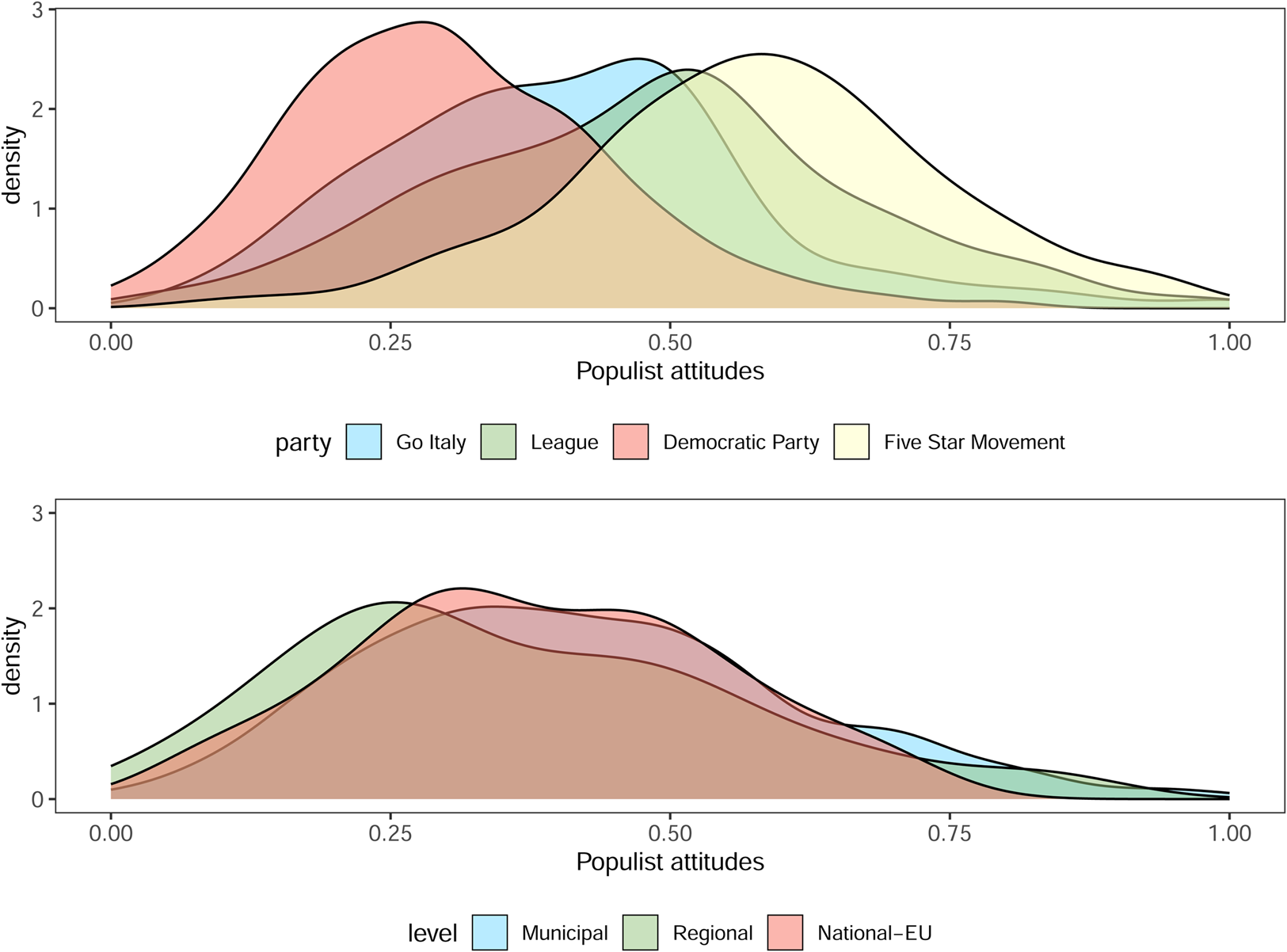
A third research programme involves studying the changing meaning of political delegation and the challenges to democratic representation (Cotta and Russo, Reference Cotta and Russo2020). Indeed, the survey delves into the elites' perspective on the difficulties associated with the traditional model of representation epitomised by party government, as well as on alternative populist and technocratic forms of representation (Caramani, Reference Caramani2017). For example, Figure 5 illustrates variations in populist attitudes (Akkerman et al., Reference Akkerman, Mudde and Zaslove2014) across party members, mirroring existing party classifications for Italy (Rooduijn et al., Reference Rooduijn, Pirro, Halikiopoulou, Halikiopoulou, Froio, Van Kessel, De Lange, Mudde and Taggart2023), while showing no systematic diversity across authority levels. This study on the Italian case provides a country-specific focus that can be replicated in the future and extended to other similar (or dissimilar) cases.
Distribution of populist attitudes by main parties and levels.
To conclude, data concerning municipal representatives' biographical characteristics and attitudinal orientations can be linked to contextual data from ISTAT territorial units, enabling the matching of information available at local levels (e.g. average levels of income, unemployment, immigration, etc.). This linkage offers a granular perspective, allowing for the examination of the institutional and socio-economic context in which representation occurs.Footnote 10
Funding
Research was funded by the “Department of Excellence 2018–2022” (2272-2018-IA-PROFCMIUR 001), Ministry of Education, University and Research. Principal investigator: Pierangelo Isernia. https://interdispoc.unisi.it/.
Data
The public files of the Italian political class dataset are available at: https://osf.io/54jsb/. The replication dataset is available at http://thedata.harvard.edu/dvn/dv/ipsr-risp.
Supplementary material
The supplementary material for this article can be found at https://doi.org/10.1017/ipo.2024.17
Acknowledgements
We would like to thank Greta Comedini, Ludovico Conti, Cristina Fontanelli, Davide Giordani, Paolo Marzi, Luca Mazzacane, Marta Ponzo and Giulia Vicentini for their support in data collection, as well as all students of the courses of “Public Opinion” (class 2019–2020) and “Italian Political System” (classes 2019–2020 and 2020–2021) at the University of Siena who contributed to this project.
Competing interests
The authors declare none.


 Open access

