Introduction
The knowledge of Antarctic Teloschistaceae has expanded significantly in recent years (Søchting & Øvstedal Reference Søchting and Øvstedal1992, Reference Søchting and Øvstedal1998; Olech & Søchting Reference Olech and Søchting1993; Søchting & Olech Reference Søchting and Olech1995, Reference Søchting and Olech2000; Olech Reference Olech2004; Søchting et al. Reference Søchting, Øvstedal and Sancho2004, Reference Søchting, Søgaard, Elix, Arup, Elvebakk and Sancho2014; Lindblom & Søchting Reference Lindblom and Søchting2008; Søchting & Castello Reference Søchting and Castello2012), and numerous new species have been described, all in the genus Caloplaca. The highest diversity has been recorded in the maritime Antarctic, and particularly towards the lower latitudes as is the general trend for lichens (Peat et al. Reference Peat, Clarke and Convey2007). However, recent expeditions to continental Antarctica have brought back lichen collections disclosing species that are unknown in the more mesic parts of Antarctica, in spite of those parts having been most intensively explored (Olech Reference Olech2004; Søchting et al. Reference Søchting, Øvstedal and Sancho2004). Two such species, which appear to have so far passed unnoticed also by the Antarctic lichen flora authors (Dodge Reference Dodge1973; Øvstedal & Smith Reference Øvstedal and Smith2001), are described here as new to science. The phylogenetic analysis of three loci has made it possible to establish their taxonomic affiliation in relation to the recently published taxonomy of the Teloschistaceae (Arup et al. Reference Arup, Søchting and Frödén2013). Based on their position in the molecular phylogenetic tree of Teloschistaceae, we have found it necessary to place them in two new genera, also including the Arctic species known as Caloplaca approximata (Lynge) H. Magn.
Material and Methods
The study includes material collected during Antarctic expeditions to continental Antarctica by the Italian Antarctic Research Programme (PNRA) (1988–1996), Australian Antarctic Division (1971–2010) and New Zealand Antarctic Program (2007, 2009). The collections are kept in designated herbaria. Collections formerly in ADT are now lodged in the Tasmanian Herbarium (HO). Distribution data for Amundsenia (Caloplaca) approximata are based on specimens from C, LD, O and UPS.
Morphology and anatomy
Macroscopic descriptions are based on observations made with a Wild Heerbrugg, M5-53204 dissecting microscope. Measurements were made using a mounted Nikon DS-Fi1 camera combined with the software NIS-Elements. For the apothecia, only the thickness of the whole margin and the proper exciple was measured because the distinction of thalline and proper exciple was frequently unclear. Sections were cut by hand or using a Reichert-Jung Cryostat 2800 Frigocut E microtome. Measurements were taken using an Olympus BX60 microscope. All measurements were made on material mounted in water. Ascospores were measured outside the asci, and ascospore size is given as an average with standard deviation; extremes are given in brackets. The thickness of spore septa is measured at the outer wall in accordance with Vondrák et al. (Reference Vondrák, Frolov, Arup and Khodosovtsev2013). The number of measurements is indicated in brackets.
PCR-amplification and alignment
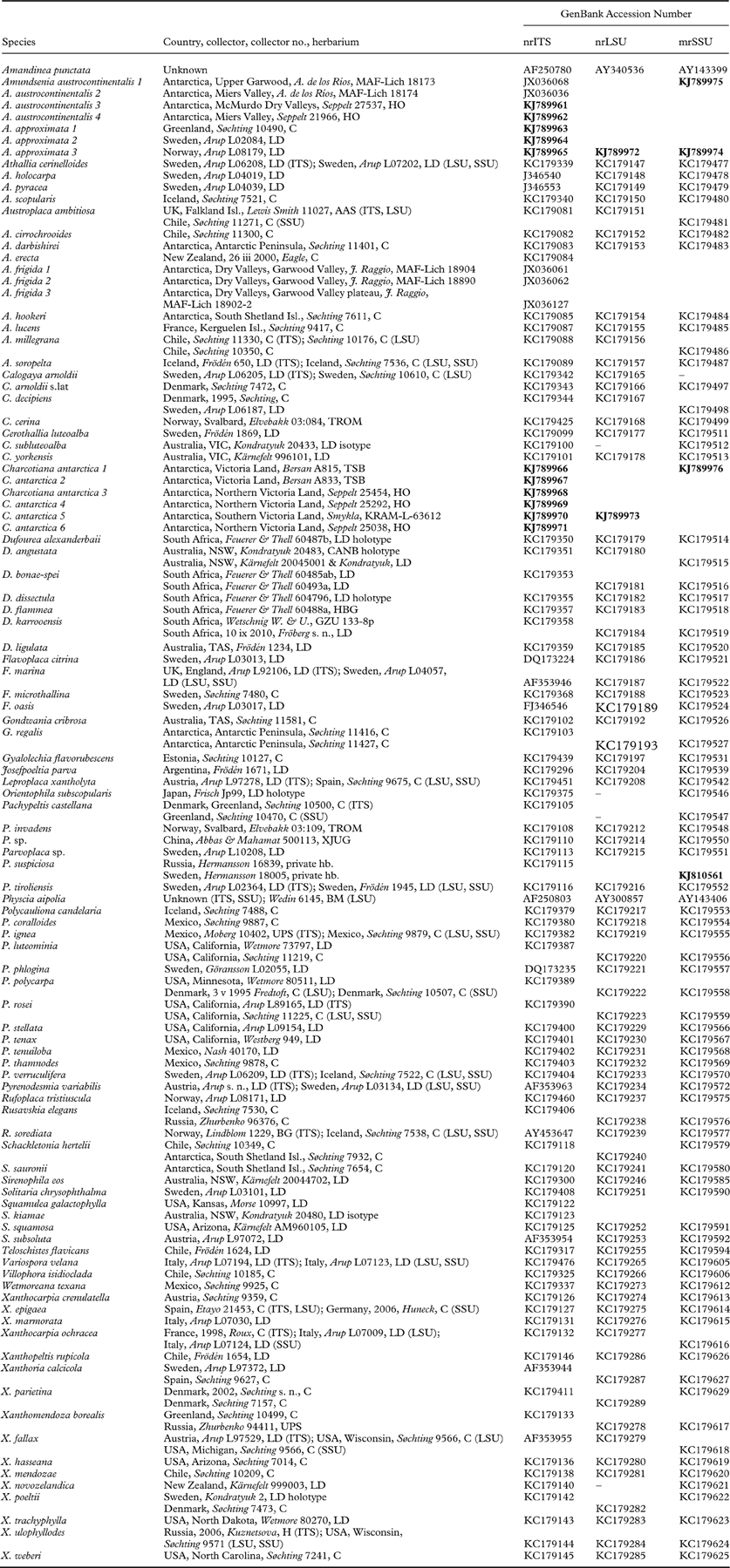
Thirteen new nuclear rDNA sequences of the internal transcribed spacer region (nrITS) and three of the large subunit (nrLSU), together with a further three new sequences of the small subunit of the mitochondrial ribosomal RNA gene (mrSSU), were produced. The PCR amplifications were carried out using direct PCR following Arup (Reference Arup2006). The primers used were ITS1F (Gardes & Bruns Reference Gardes and Bruns1993) and ITS4 (White et al. Reference White, Bruns, Lee, Taylor, Innis, Gelfand, Sninsky and White1990) for ITS, AL1R (Döring et al. Reference Döring, Clerc, Grube and Wedin2000), LR5 or LR6 (Vilgalys & Hester Reference Vilgalys and Hester1990) for nrLSU, and mrSSU1 (Zoller et al. Reference Zoller, Scheidegger and Sperisen1999) and mrSSU7 (Zhou & Stanosz Reference Zhou and Stanosz2001) for mrSSU. The PCR settings followed Ekman (Reference Ekman2001) or Arup et al. (Reference Arup, Søchting and Frödén2013). PCR products were electrophoresed in a 1% agarose gel and visualized using ethidium bromide or GelRedTM (Biotium). Products were cleaned using a Cycle Pure Kit (Qiagen or Five Prime). The primers used for the PCR were also used in the sequencing reaction in combination with LR3 and LR3R (Vilgalys & Hester Reference Vilgalys and Hester1990) for nrLSU; sequencing was carried out by Macrogen Inc., Korea. Sequences were assembled using CLC Main Workbench ver. 4.1.2. Additional sequences were downloaded from GenBank. Voucher information and GenBank accession numbers are provided in Table 1 for both the new and the downloaded sequences.
Sequences used in any of the two analyses, newly produced in bold and others downloaded from GenBank.

Two alignments were produced: one combined alignment with 86 species including three loci, nrITS, nrLSU and mrSSU, representing the three subfamilies in Teloschistaceae, and another with 39 ITS sequences representing relevant clades of the subfamily Xanthorioideae (Arup et al. Reference Arup, Søchting and Frödén2013). For the combined analysis, Physcia aipolia (Ehrh. ex Humb.) Fürnr. and Amandinea punctata (Hoffm.) Coppins & Scheid. were used as outgroups. For the ITS analysis, Parvoplaca tiroliensis (Zahlbr.) Arup et al. was used as outgroup. Ambiguously aligned regions were removed from all alignments before analyses.
Phylogenetic analyses
The alignments of the three different genes were first analyzed separately to check for incongruence between genes, but no incongruences were found. A conflict was assumed to be significant if two different relationships (one monophyletic and one non-monophyletic) were both supported with posterior probabilities 0·95 or higher (Buckley et al. Reference Buckley, Arensburger, Simon and Chambers2002). A suitable model of molecular evolution for each of the loci was selected using the Bayesian Information Criterion (BIC) as implemented in jModeltest ver. 2.1.4 (Guindon & Gascuel Reference Guindon and Gascuel2003; Darriba et al. Reference Darriba, Taboada, Doallo and Posada2012), evaluating only the 24 models available in MrBayes 3.2.0 (Ronquist et al. Reference Ronquist, Teslenko, van der Mark, Ayres, Darling, Höhna, Larget, Liu, Suchard and Huelsenbeck2012). The GTR+I+G was found to be optimal for both the nrITS and nrLSU data sets for the combined analysis, but HKY+I+G for the mrSSU data set. The ITS alignment was also analyzed separately using the evolutionary model GTR+ I+G. Bayesian tree inference was carried out using Markov chain Monte Carlo (MCMC) as implemented in MrBayes 3.2.0. In the combined analysis, the three genes included were treated as separate partitions. Parameters used in the analyses followed those of Arup et al. (Reference Arup, Søchting and Frödén2013), except for the branch length prior that was set to an exponential with mean 1/10. Three parallel runs of Markov chain Monte Carlo were performed, each with 7 chains, 6 of which were incrementally heated with a temperature of 0·10. Analyses were diagnosed every 100 000 generations and automatically halted when convergence was reached. Convergence was defined as a standard deviation of splits (with frequency ≥0·1) between runs below 0·01. Every 1000th tree was sampled and the first 50% of the runs were removed as burn-in. PAUP* 4.0b10 (Swofford Reference Swofford2002) was used to construct 50% majority-rule consensus trees from the post-burn-in tree samples, and FigTree 1.4 (http://tree.bio.ed.ac.uk/software/figtree/) and Apple Works 6.2.9 (Apple Computers Inc.) to illustrate them.
Secondary chemistry
The secondary metabolite pattern was identified using HPLC and analyzed separately for thallus and apothecia. The relative composition of the secondary compounds was calculated based on absorbance at 270 nm, according to Søchting (Reference Søchting1997).
Results and Discussion
Molecular analyses
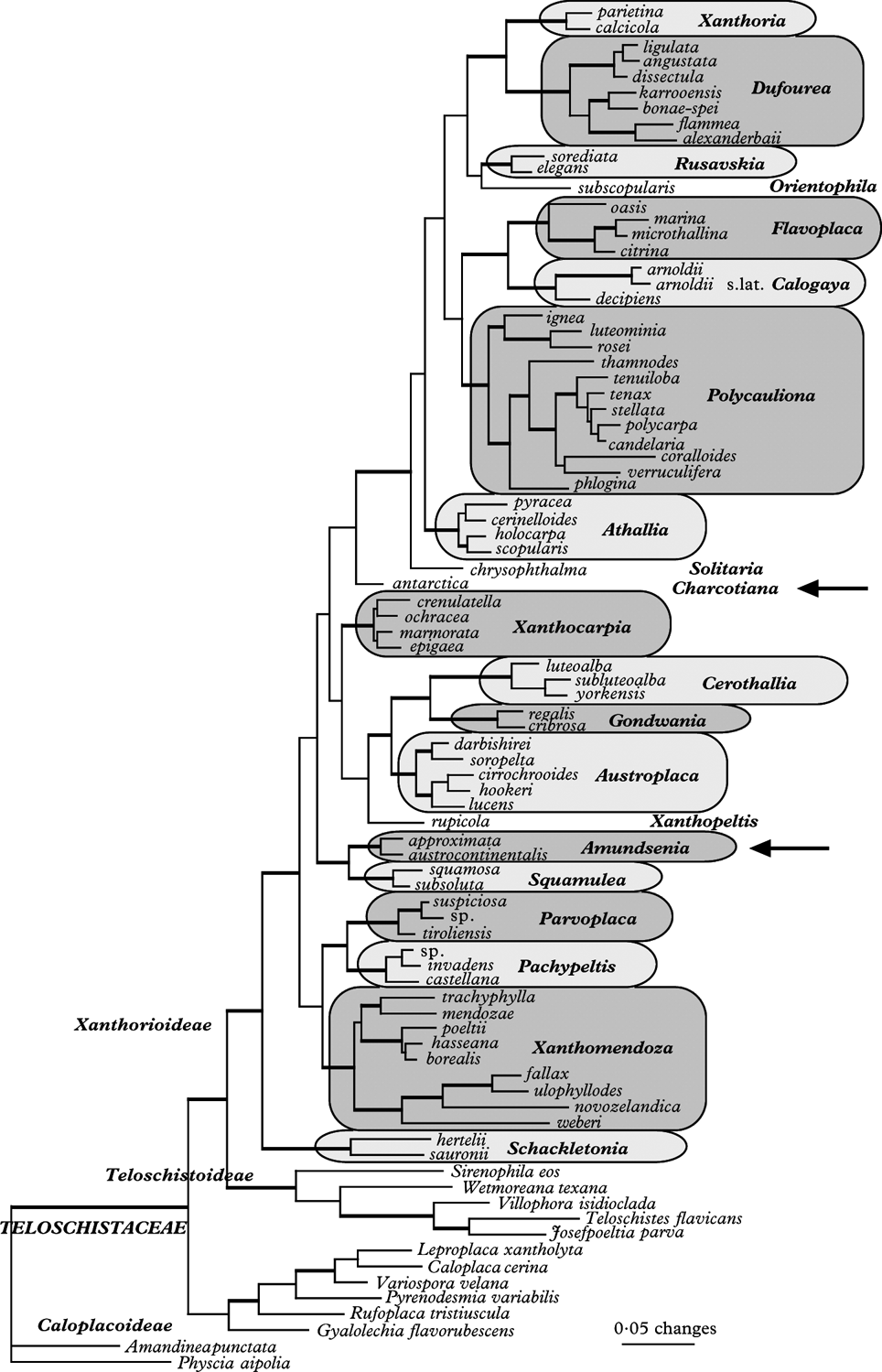
The combined analysis of the nrITS, nrLSU and mrSSU data set included 41 terminal species and a total of 2030 positions. A 50% majority-rule consensus tree is presented in Figure 1. The tree splits into three main clades corresponding to the three subfamilies proposed by Arup et al. (Reference Arup, Søchting and Frödén2013). Xanthorioideae and Teloschistoideae are well supported here, in concordance with Arup et al. (Reference Arup, Søchting and Frödén2013), but Caloplacoideae has lower support (PP= 0·84) in this rather limited analysis. All the new sequences are clearly nested within Xanthorioideae, with the new genus Charcotiana on a separate branch in the middle of the subfamily. For practical reasons, the analyses presented here include fewer taxa than those presented in Arup et al. (Reference Arup, Søchting and Frödén2013) and the support for the backbone structure of the tree is therefore lower for many nodes. However, even in analyses with three genes and a more extensive species sampling, the placement of Charcotiana is the same and we have been unable to accommodate it within any of the already defined genera in the subfamily. The other new genus, Amundsenia, appears as the sister clade of Squamulea with high support (Fig. 1).
50% majority-rule consensus tree of nrITS, nrLSU and mrSSU data using Bayesian MCMC. Nodes with posterior probabilities ≥0·95 are shown in bold.

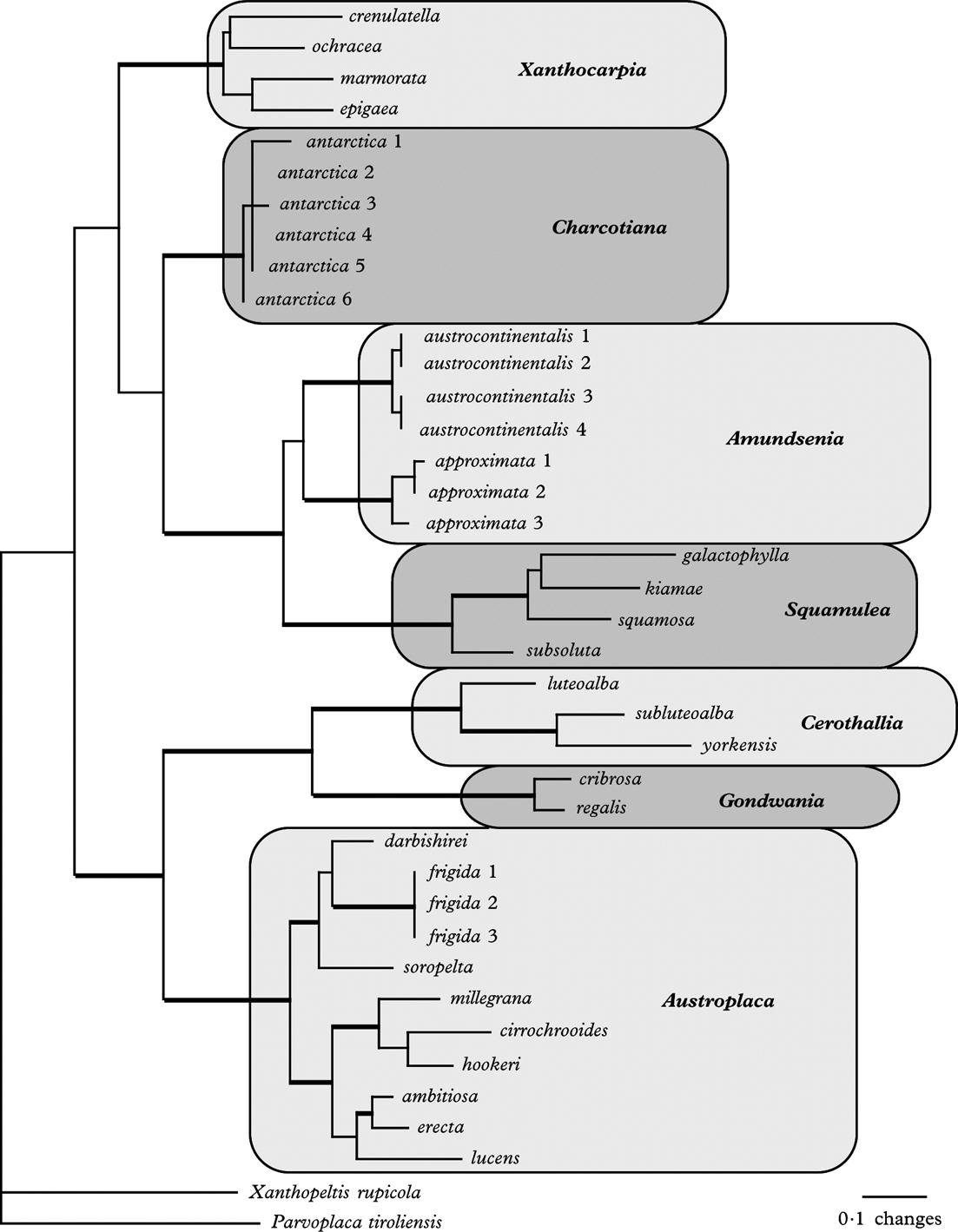
The analysis of only ITS data included 39 sequences and a total of 544 positions. A 50% majority-rule consensus tree is presented in Figure 2. In this analysis, the genus Amundsenia is weakly supported, whereas the support is strong in the combined three gene analyses with a strong posterior probability (PP=1). The two species of the genus show some infra-specific variation, one variable position in A. austrocontinentalis and six variable positions in A. approximata with up to 5 differences between specimens, but they clearly appear as monophyletic with full support. The variation is slightly greater in Charcotiana antarctica, with eight variable positions with up to five differences between specimens. Caloplaca frigida Søchting is well nested within the genus Austroplaca, with the two sorediate species A. darbishirei and A. soropelta as its closest relatives.
50% majority-rule consensus tree of nrITS data using Bayesian MCMC. Nodes with posterior probabilities ≥0·95 are shown in bold.

Secondary chemistry
Only chemosyndrome A of Søchting (Reference Søchting1997) was shown to occur in the two new species.
This chemosyndrome is dominated by parietin, but in addition has small proportions of emodin, teloschistin, parietinic acid and fallacinal. It is the most frequent chemosyndrome in the subfamily Xanthorioideae.
Taxonomy
Charcotiana Søchting, Garrido-Benavent & Arup gen. nov.
MycoBank No.: MB 808600
Type: Charcotiana antarctica Søchting, Garrido-Benavent, Pérez-Ortega, Seppelt & Castello
Thallus saxicolous, crustose, areolate, orange.
Apothecia sparse or abundant, zeorine with orange disc. Spores polardiblastic.
Secondary chemistry
Apothecia and thalli contain parietin (dominant) and small proportions of teloschistin, fallacinal, parietinic acid and emodin. Chemosyndrome A of Søchting (Reference Søchting1997).
Etymology
The genus is named after the significant French polar explorer and scientist Jean-Baptiste Charcot (1867–1936).
Distribution
Charcotiana is known only from continental Antarctica.
Notes
So far, C. antarctica is the only species included in the genus. Charcotiana is defined primarily on molecular phylogenetic characters and is similar to several other crustose genera in the subfamily with regard to main morphology, anatomy and chemistry. However, it has a strong tendency to develop stipitate apothecia, a feature that is rare in most genera. Such apothecia occur, for example, in Austroplaca, Calogaya and Gondwania, but the species in those genera normally produce distinct lobes or are subfruticose. Stipitate apothecia also occur in Gyalolechia stipitata (Wetmore) Søchting et al. in subfamily Caloplacoideae, but this genus is characterized by a fragilin dominated chemistry (Arup et al. Reference Arup, Søchting and Frödén2013).
Charcotiana antarctica Søchting, Garrido-Benavent, Pérez-Ortega, Seppelt & Castello sp. nov.
MycoBank No.: MB 808602
Thallus crustose, orange, bullate to areolate with minutely lobate margins, most often distinctly stipitate, particularly when fertile. Apothecia crowded, often stipitate and irregular, with excluded margin. Spores polardiblastic, 12·0×6·5 µm; septum c. 3·5 µm.
Type: Antarctica, Northern Victoria Land, Daniell Peninsula, Cape Phillips, 73°05′S, 169°35′E, on volcanic rock, 7 January 1996, F. Bersan (TSB A833—holotype; MA-Lich 18175, C—isotypes).
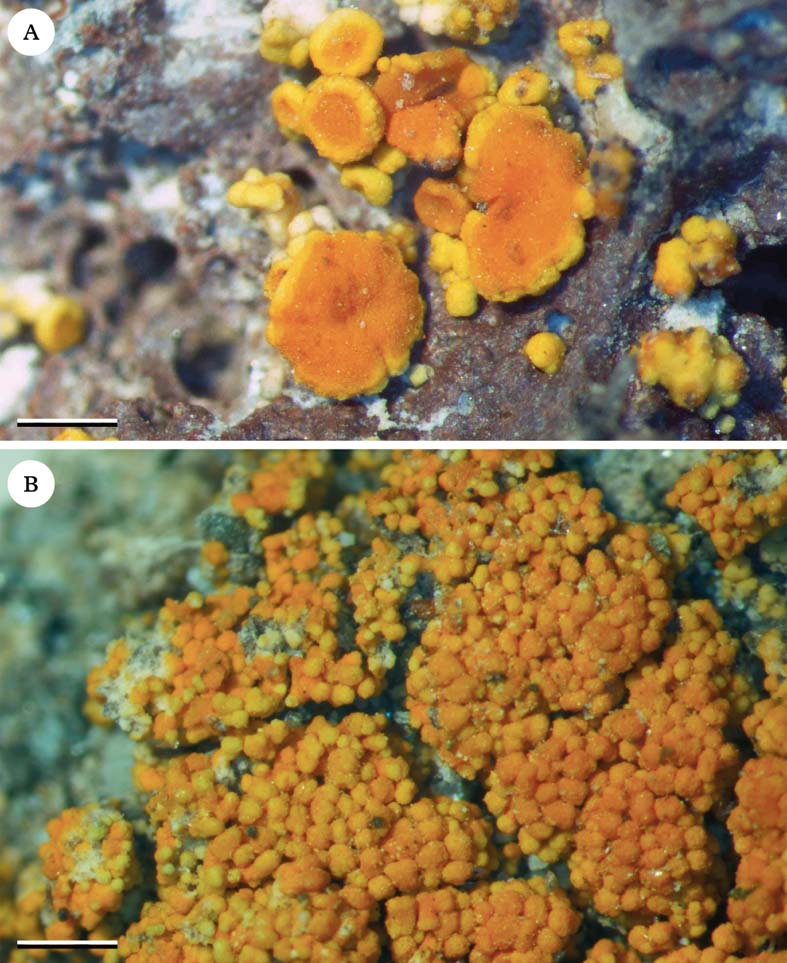
(Fig. 3)
Charcotiana antarctica, habitus. A, holotype; B, sterile, granular thallus on sandy soil (TSB A580). Scales A & B=0·5 mm. In colour online.
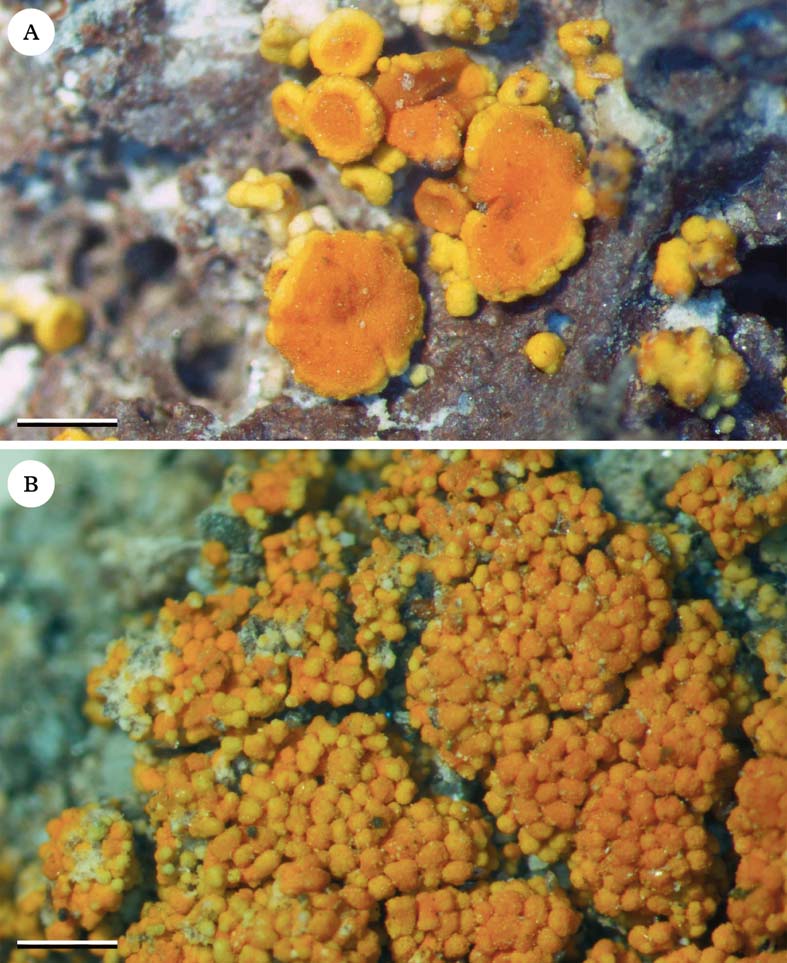
Thallus crustose, saxicolous, up to 3 cm wide, consisting of scattered areoles. Prothallus absent. Areoles small, initially isolated and bullate, eventually coalescing, forming larger irregular-shaped areoles that are minutely lobate at margins, pale to deep orange, 0·1–3·0 mm wide (n=40) and 0·1–0·6 mm (n=34) thick (Fig. 3A). A large proportion of the specimens studied have a ramified structure with finger-like protrusions that continue branching, thus giving an overall coralloid appearance (Fig 3B). Yellowish white dead tissue abundant in some samples, especially in old or abraded areoles. Thallus cortex paraplectenchymatous with cell lumina 2·5–4·5 µm wide (n=12). Photobiont trebouxioid.
Apothecia lecanorine to mostly zeorine, mainly one per areole, numerous, rather crowded, regular to deformed by compression, sessile, often stipitate on top of finger-like protrusions of the thallus, in which case they are slightly constricted at the base, 0·2–1·2 mm diam. (n=26) (Fig. 3A). Disc flat to somewhat convex in mature apothecia, deep orange to dark orange-brown when old, sometimes bright, epruinose. Apothecial margin particularly in very young apothecia rather thick, (60–)95±16(–120) µm (n=24). Thalline exciple rarely persistent, more often excluded early but still visible below the proper exciple of older apothecia, mainly pale orange. Proper exciple distinct, thin, often difficult to observe in deformed mature apothecia, (20–) 43±11(–70) µm thick (n=45), concolorous with the disc. Proper exciple tissue prosoplectenchymatous, fan-shaped, consisting of non-isodiametric cells with lumina 4·5–6·0 µm long (n=7) and c. 2 µm wide (n=4). Hypothecium hyaline, consisting of densely interwoven hyphae. Hymenium hyaline, (51–) 58±6(–66) µm high (n=8). Epithecium with dark orange, medium coarse epipsamma. Paraphyses (1·6–)2·3±0·4(–3·9) µm thick (n= 64), simple to apically sparingly branched, septate, cylindrical with attenuate apex to moniliform and apically gradually slightly inflated, with (2·9–)5·2±0·9(–7·0) µm thick (n=49) apical cells. Asci clavate, with 8 spores, (39·5–)48·0±6·0(–61·0) µm (n= 18) long and (13·5–)16·0±2·5(–21·0) µm (n=16) wide. Ascospores polardiblastic, ellipsoid, rarely subcylindrical with rounded ends, (8·5–)12·0±1·5(–16·0)×(5·0–)6·5±0·7(–8·0) µm (n=90); length/breadth ratio (1·3–) 1·9±0·3(–2·9); ascospore septa (2·4–)3·6± 0·7(–5·7) µm thick; ratio of ascospore length/ septum width (2·0–)3·4±0·5(–4·6).
Conidiomata not seen.
Chemistry
Thallus and apothecia K+ purple. Chemosyndrome A of Søchting (Reference Søchting1997).
Etymology
The name reflects the distribution of this species, so far known only from continental Antarctica and nearby islands.
Ecology and distribution
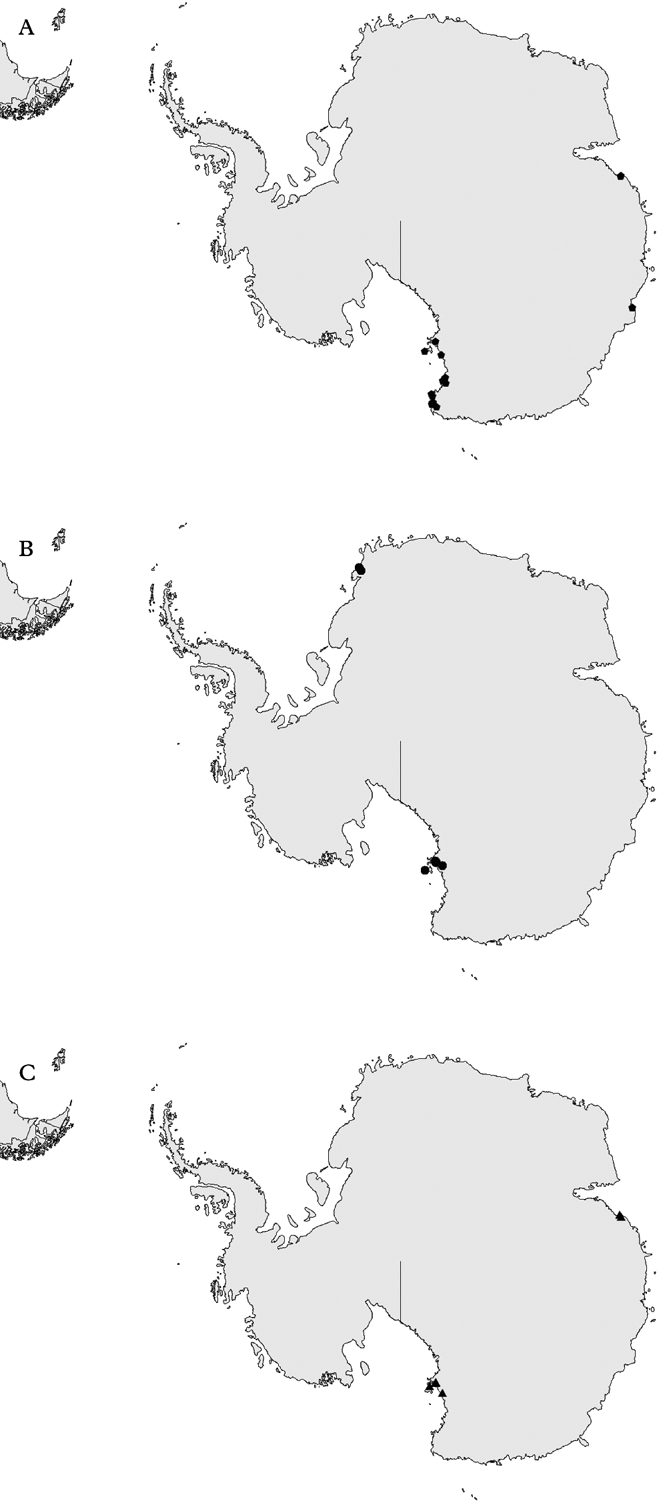
Based on the known localities, the species can grow on acid rocks, sand and dead mosses. Charcotiana antarctica grows in a wide spectrum of microhabitats including large stones, scoria debris, pebbles, rubble or gravel, silt, vulcanites, charnockite and coarse-grained granite. It is commonly found growing in small crevices of rocks where it may be able to retain a more humid environment. It is known from coastal sites at 25 m a.s.l. to high mountain ranges at 1457 m a.s.l, but most of the samples were collected 215–652 m a.s.l. Accompanying species are, for example, Buellia frigida Darb., Lecanora mons-nivis Darb., Lecanora physciella (Darb.) Hertel, Lecidea cancriformis C. W. Dodge & G. E. Baker, Pleopsidium chlorophanum (Wahlenb.) Zopf, Umbilicaria decussata (Vill.) Zahlbr. and Rusavskia elegans (Link) S. Y. Kondr. & Kärnefelt. The moss Syntrichia sarconeurum Ochyra & R. H. Zander was also seen accompanying them. Charcotiana antarctica is so far known from continental Antarctica, including several islands close to the continent margin (Coulman, Ross and Windmill Islands) (Fig. 7A). According to the number of extant collections, C. antarctica is expected to be a common but often neglected species in continental Antarctica. It has, however, never been recorded from maritime Antarctica or the Subantarctic Islands.
Notes
Specimens growing on sandy soil and mosses (ADT 25057, ADT 25393, ADT 25233, ADT 25051) develop a continuous, granular thallus, up to 10 mm wide, consisting of strongly aggregated, sometimes slightly fused, bullate (granule-like) areoles, (80·0–)157·0±49·5(–260·0) µm wide (n= 20). They can be somewhat more greenish yellow when growing in the shade. Old areoles may become black. Moreover, these thalli are strongly coralloid (Fig. 3B) and usually sterile; apothecia from epigaeic specimens were seen only in ADT 25051.
Additional material studied. Antarctica: Northern Victoria Land: Cape Hallett region, Football Saddle, 652 m, 72°30′20·1″S, 169°42′42·7″E, 2004, R. D. Seppelt (ADT 25067, ADT 25040, ADT 25051, ADT 25038, ADT 25057, ADT 25454); 72°31′S, 169°45′E, 1996, F. Bersan (TSB A829); NW end of Cape Hallett summit, 373·6 m, 72°19′20·9″S, 170°15′ 20·8″E, 2004, R. D. Seppelt (ADT 25292, ADT 25286); Cape Christie, 523·8 m, 72°17′41·2″S, 169°55′39·9″E, 2004, R. D. Seppelt (ADT 25388); 448·8 m, 72°18′10·4″S, 169°58′53·9″E, 2004, R. D. Seppelt (ADT 25393); Red Castle Ridge: 323 m, 72°26′50·9″S, 169°56′44·7″E, 2004, R. D. Seppelt (ADT 25233); 342 m, 72°26′53·5″S, 169°56′51·0″E, 2004, R. D. Seppelt (ADT 25223); Daniell Peninsula, Cape Phillips, 73°05′S, 169°35′E, 1994, R. Bargagli (TSB A922, TSB A580); Wood Bay, Mt. Melbourne, Edmonson Point, 74°21′S, 165°06′E, 1995, F. Bersan (TSB A815); Deep Freeze Range, Boomerang Glacier, 74°33′S, 163°54′E, 1991, S. Sedmak (TSB A885); Coulman Island, 73°19′S, 169°45′E, 1989, P. Modenesi (TSB A353). Southern Victoria Land: Ross Island, Cape Crozier, 182 m, 77°31·801′S, 169°17·458′E, 2007, L. G. Sancho (MAF-Lich 18885, MAF-Lich 18885-2, MAF-Lich 18886, MAF-Lich 18886-2, MAF-Lich 18888, MAF-Lich 18889, MAF-Lich 18891, MAF-Lich 18891-2, MAF-Lich 18894, MAF-Lich 18895, MAF-Lich 18898, MAF-Lich 18903, MAF-Lich 18891, MAF-Lich 18903-2, MAF-Lich 18905); 158 m, 77°31·877′S, 169°16·652′E, 2007, L. G. Sancho (MAF-Lich 18900); 212 m, 77°31·682′S, 169°17·345′E, 2007, L. G. Sancho (MAF-Lich 18882, MAF-Lich 18883, MAF-Lich 18884, MAF-Lich 18887, MAF-Lich 18887-2, MAF-Lich 18892, MAF-Lich 18893, MAF-Lich 18896, MAF-Lich 18897, MAF-Lich 18882 MAF-Lich 18897-2, MAF-Lich 18897-3, MAF-Lich 18897-4, MAF-Lich 18899); Cape Crozier, 77°27′S, 169°14′E, 2010, J. Smykla (KRAM-L-63612 as Caloplaca erecta); Tripp Bay, Cape Ross, 76°45′S, 163°00′E, 1994, R. Bargagli (TSB A684); Dry Valleys, Miers Valley, 480 m, 78°05′47·1″S, 163°41′33·6″E, 2000, R. D. Seppelt (ADT 21960). Windmill Islands: Ford Island, central, 66°24′S, 110°32′E, 1983, R. D. Seppelt (ADT 14247); Holl Island, central part of the island, 66°25′S, 110°25′E, 1989, R. D. Seppelt (ADT 19258). Ingrid Christensen Coast: Vestfold Hills, gully on south side of Trajer Valley, 68°36′00·0″S, 78°27′30·0″E, 1979, R. D. Seppelt (ADT 8755); east end of Lake Druzhby, 25 m, 68°34′25·0″S, 78°24′00·0″E, 1979, R. D. Seppelt (ADT 8278).
Amundsenia Søchting, Garrido-Benavent, Arup & Frödén gen. nov.
MycoBank No.: MB 808601
Type: Amundsenia austrocontinentalis Garrido-Benavent, Søchting, Pérez-Ortega & Seppelt
Thallus saxicolous, crustose, orange.
Apothecia sparse, dispersed, orange. Spores polardiblastic, small, with short spore septum.
Secondary chemistry
Apothecia and thalli contain parietin (dominant) and small proportions of teloschistin, fallacinal, parietinic acid and emodin. Chemosyndrome A of Søchting (Reference Søchting1997).
Etymology
The genus is named after the successful Norwegian polar explorer Roald Amundsen (1872–1928), who was the first man to reach the South Pole.
Distribution
Amundsenia is so far known only from the Arctic and subarctic, and from continental Antarctica.
Notes
As seen from Fig. 1, the genus Amundsenia is a monophyletic clade that belongs in the subfamily Xanthorioideae. Its sister group, the genus Squamulea, has a different proper exciple consisting of paraplectenchymatous tissue, usually a squamulose to lobate thallus and it occurs in subtropical to temperate regions. Therefore we have chosen not to merge the two sister groups. Currently two species are accepted in Amundsenia.
Amundsenia approximata (Lynge) Søchting, Arup & Frödén comb. nov.
MycoBank No.: MB 808603
Caloplaca vitellinula f. approximata Lynge, Lich. N. Zemlya: 222 (1928).—Caloplaca approximata (Lynge) H. Magn., Ark. Bot. 33A (1): 130 (1946); type: Russia, Novaya Zemlya, Mashigin Fjord, Langs en bæk på N-siden af Blaafjell Basin, 1 August 1921, Lynge (O-L-1206—lectotype, selected here).
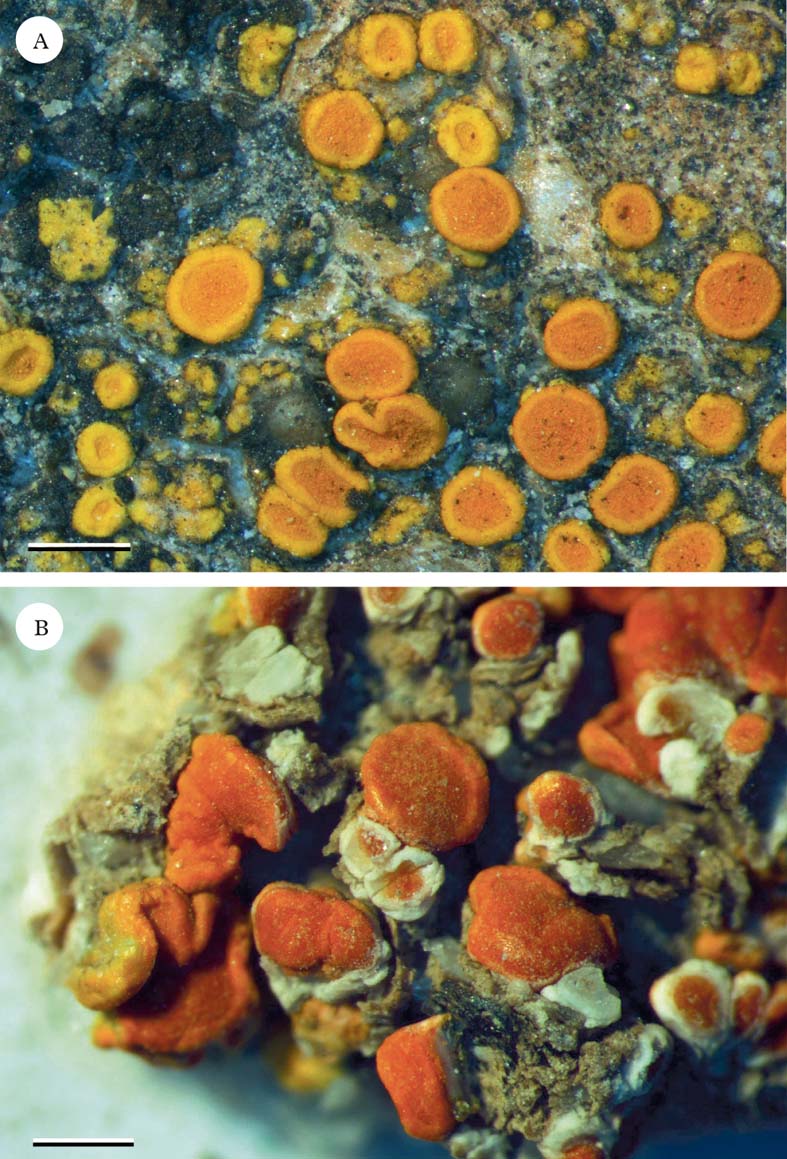
(Fig. 4A)
Amundsenia sp. habitus. A, A. approximata (U. Søchting 4471); B, A. austrocontinentalis (MAF-Lich 18901). Scales: A & B=0·5 mm. In colour online.
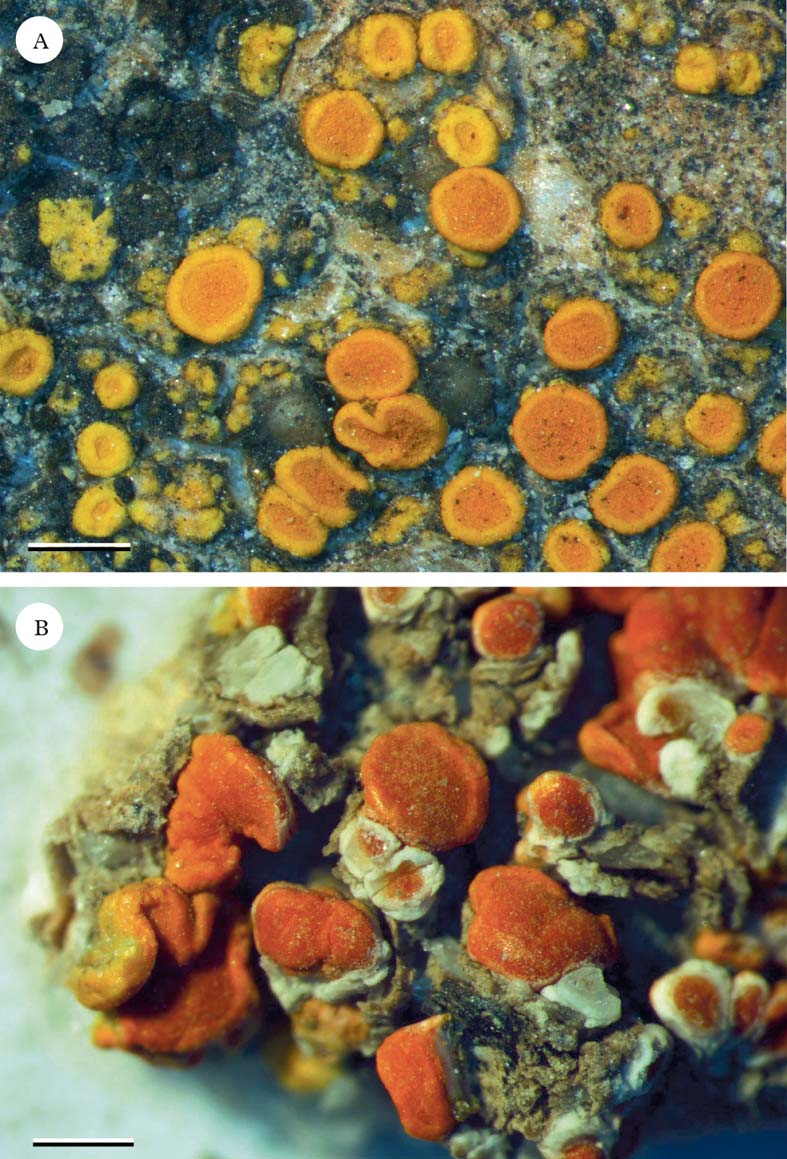
For a description of A. approximata see Hansen et al. (Reference Hansen, Poelt and Søchting1987).
Distribution
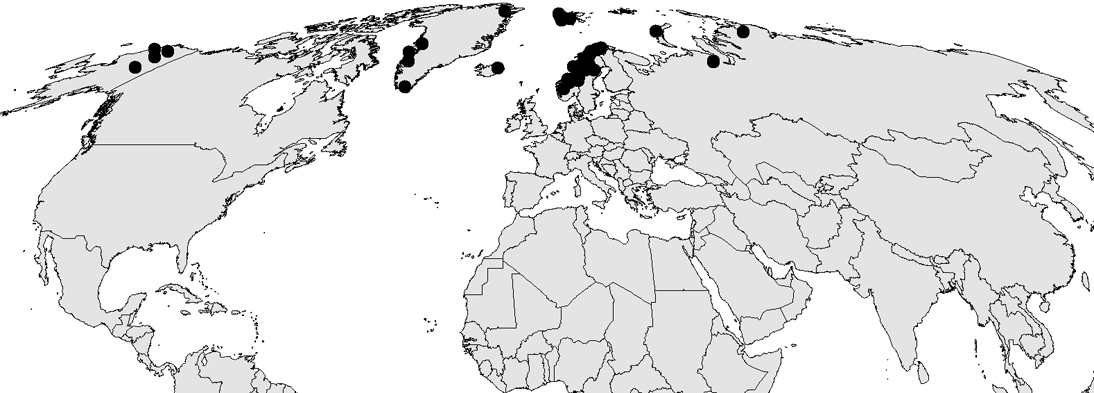
Amundsenia approximata is widely distributed in the Arctic region, as shown in Figure 5. It was previously recorded from Antarctica based on a collection from McMurdo, Ross Island, in continental Antarctica (Søchting & Øvstedal Reference Søchting and Øvstedal1992), where the other species of the genus, A. austrocontinentalis, is fairly common. With the present knowledge, we assume that the specimen was actually A. austrocontinentalis. A further record from Signy Island, South Orkney Islands (RILS 1056, BAS) cited by Øvstedal & Smith (Reference Øvstedal and Smith2001) proved to be an erroneous identification. Accordingly, A. approximata is not considered to occur in Antarctica.
Amundsenia approximata, distribution.

Notes
The distinction of Caloplaca cacuminum Poelt from A. approximata is not clear. Caloplaca cacuminum was described from the Alps in 1953, and was later reported from Greenland (Hansen et al. Reference Hansen, Poelt and Søchting1987). Molecular studies are needed to establish if the two species can be merged.
Selected material studied. Greenland: Disko Island, Qeqertarsuaq/Godhavn, 69·271°N, 53·503°W, 1982, Poelt & Ullrich (GZU); S-Greenland, Narsaq Community, Narsarssuaq, Sutuluaqqap Quappaa Kua, 61°9·3′N, 45°24·0′W, 2005, Søchting 10490 (C); Umanak, Marmorilik, 71·322°N, 51·374°W, 1983, Poelt & Ullrich (GZU).—Iceland: N-Múlasysla, NW of Mödrudalur, Vegaskard, 65°26′30″N, 15°58′W, 1997, Søchting 7529 (C).—Norway: Finnmark: Alta county, Vassbotndalen, UTM: EC 6964, 1983, Søchting 4471 (C). Hordaland: Ulvik kommune, Finse, Mt. St. Finsenuten, UTM: 32W 041606 672088., 2002, Arup L02346 (UPS). Nordland: Vega Island, Valla, 65·666°N, 11·929°E, 1972, Degelius (UPS). Oppland: Dovre, Grimsdal at Verkensætri, UTM: NP 2881, 1985, Søchting 5321 (C); Dovre, Tverråi, N of Grimsdalshytta, UTM: NP 3385, 1985, Søchting 5443 (C). Sør-Trøndelag: Oppdal, Alpine Station, UTM: NQ 1457, 1983, Sivertsen (C). Troms: S of Skibotndalen, between Luhcajávri and Stuoraoaivi, 69°15′N, 20°24′E, 2003, Søchting 10080 (C).—Svalbard: Albert I Land, Mitrahalvøya, Erlingvatnet, UTM: VJ 26 01, 1989, Søchting 6039 (C); Nordenskjöld Land, Reindalen N of Sørhytta, UTM: WG 2058, 1989, Søchting 5530 (C); Oscar II Land, Brøggerhalvøya, Kiærstranda, UTM: VH2464, 1989, Søchting 6117 (C); Sabine Land, Sassendalen at Fredheim, 78°21′23″N, 16°57′42″E, 1986, Søchting 5855 (C).—Russia: Central Siberia: Taimyr Peninsula, Byrranga Mts, in the vicinity of northern extremity of Levinson-Lessing Lake, 74°33′N, 98°34′E, 1994, Zhurbenko 94474 (C); Jamalo-Nenetskij, Raiis Massive, Alpine meadow W of 134 km railway post, 67°N, 65°35′E, 1993, Søchting 6693 (C).—Sweden: Härjedalen: Ulvberget, Arup L02239 (LD); Tännäs, 6 km SE of Mt. Skarsen, 1988, Santesson 32467 (UPS). Jämtland: Undersåker par., Mt. Välliste, 8 km WSW of Undersåker, UTM: RT90: 702049 136637, 2002, Arup L02084 (LD); Åre, Stalltjärnstugan, 63·475°N, 12·559°E, 1952, Sundell (UPS). Norrbotten: Lule Lappmark, Jokkmokk par., Padjelanta National Park, foot of Allak c. 3·5 km SSW of the peak Allaktjåhkkå, UTM: RT90: 7479814 1535934, Arup L04213 (LD); Torne Lappmark, Abisko, Abiskojåkk, 68·308°N, 18·661°E, 1919, Magnusson 2683b (UPS). Västerbotten: Åsele Lappmark, Vilhelmina parish, c. 20 km ESE of Saxnäs, UTM: WN 356021, 1991, Søchting 6294 (C).—USA: Alaska: Denali Park at access road, 65°33′N, 148°53′W, 1996, Søchting 7454 (C).
Amundsenia austrocontinentalis Garrido-Benavent, Søchting, Pérez-Ortega & Seppelt sp. nov.
MycoBank No.: MB 808604
Thallus crustose, composed of flat areoles that are irregular to minutely lobate at the margins, deep yellow to pale orange. Apothecia sessile, with flat, matt discs, usually with orange pruina. Apothecium margin very thick in young apothecia. Spores polardiblastic, 11·0×5·5 µm; septum c. 3 µm.
Type: Antarctica, Ingrid Christensen Coast, Vestfold Hills, Mule Peninsula, west of Clear Lake, 8 m, 68°39′00·0″S, 077°57′20·0″E, on small stones in a glacial till, 2 February 1979, R. D. Seppelt (ADT 8895—holotype; C—isotype).
(Fig. 4B)
Thallus crustose, saxicolous, areolate, up to 3 cm wide. Prothallus absent. Areoles 0·2–0·8 mm wide (n=26) and 0·1–0·3 mm high (n=25), flat, with irregular to sometimes minutely lobate margins, deep yellow to pale orange, becoming whitish when abraded or dead. Thallus cortex paraplectenchymatous with cell lumina 2·2–3·5 µm wide (n=20). Photobiont trebouxioid.
Apothecia lecanorine to zeorine when mature, usually one per areole, scarce to numerous, rather dispersed but occasionally aggregated, regular to deformed by compression, sessile, 0·2–1·5 mm wide (n=61). Disc mainly flat, rarely slightly concave when well developed, and sometimes somewhat convex when mature, mostly pale orange, matt, usually with orange pruina. Apothecial margin initially very thick, but eventually often excluded and hidden below the disc, (50–) 117±35(–220) µm thick (n=38). Thalline exciple often persistent, but may also be excluded early, deep greenish yellow to pale orange. Proper exciple distinct, thick even in mature apothecia, (30–)61±14(–90) µm (n=56), concolorous with the disc or slightly paler. Proper exciple tissue prosoplectenchymatous consisting of non-isodiametric cells with lumina 3·8–7·5 µm long and 1–2 µm wide (n=15). Hypothecium hyaline, consisting of densely interwoven hyphae. Hymenium hyaline, (43·0–)58·0±7·5(–76·0) µm high (n=43). Epithecium with dark orange medium coarse epipsamma. Paraphyses (1·7–)2·4±0·4(–3·1) µm thick (n=63), septate, simple to sparingly branched at the top, mostly moniliform, apically gradually slightly inflated or rarely with an attenuated cap, (3·1–)4·7±0·7(–6·2) µm thick (n= 120) apical cells. Asci clavate, with 8 spores, (41·5–)46·5±4·0(–54·0) µm long and (12·0–)12·5±1·0(–14·5) µm wide (n=10). Ascospores polardiblastic ellipsoid, rarely subcylindrical with rounded ends, (8–)11±1·0 (–13·5)×(4·0–)5·5±0·5(–6·5) µm (n= 86); length/breadth ratio (1–)2±0·2(–2·6); ascospore septa (2·0–)2·9±0·3(–3·5) µm thick; ratio of ascospore length/septum width (3·0–)3·8±0·4(–5·0).
Conidiomata not seen.
Chemistry
Thallus and apothecia K+ purple. Chemosyndrome A of Søchting (Reference Søchting1997).
Etymology
The name austrocontinentalis is based on the currently known distribution of the new species, which has been found in continental Antarctica.
Ecology and distribution
Amundsenia austrocontinentalis is frequently found growing on granite rocks but some specimens have been found on stone flakes in moraine debris, rock fragments amongst dolerite blocks in felsenmeer or on scoria rubble in scree. This species commonly grows in small crevices of large granitic rocks in more or less exposed areas. It is known from the supralitoral level in coastal sites (8 m a.s.l.) to mountains, 320–750 m a.s.l. Accompanying species: Austroplaca darbishirei (C. W. Dodge & G. E. Baker) Søchting et al., Lecanora spp., Lecidea cancriformis, Muellerella pygmaea (Körb.) D. Hawksw. and Rhizoplaca melanophthalma (DC.) Leuckert. The species is so far known only from continental Antarctica, in the Vestfold Hills (Ingrid Christensen Coast) and Southern Victoria Land (Fig. 7B). It may be locally abundant, for example in McMurdo Dry Valleys.
Notes
There are three samples (ADT 21115, ADT 20302, ADT 19147) whose spore morphology and septum differ from the other specimens analyzed, and that better resemble those of Amundsenia approximata, especially in the shorter septa, (2·1–)2·5± 0·2(–2·9) µm, ratio of ascospore length/septum width (4·3–)5·5±0·8(–8·3) (n= 26). However, the spore size of these peculiar specimens is far greater compared with the latter species: (11·0–)13·5±1·5(–17·5)× (5·5–)6·5±0·5(–8·0) µm, length/breadth ratio (1·5–)2·1±0·3(–2·8) (n=26), whereas A. approximata has mean values of 11·0± 1·5×4·0±0·5 µm (n=10). Accordingly, we have decided not to use any quantitative data of the three samples mentioned above when computing the different measurements for A. austrocontinentalis. Moreover, the apothecia of the sample ADT 21115 are clearly stipitate as in Charcotiana antarctica, with a protrusion (stipe) 0·10–0·25 mm tall and overall height between 0·3–0·7 mm (n=7). Morphology, colour, chemistry and other microscopic features are the same as in the other A. austrocontinentalis samples. At present, ITS sequences are not available for these three specimens; therefore, we cannot corroborate the novelty of a putative new species either.
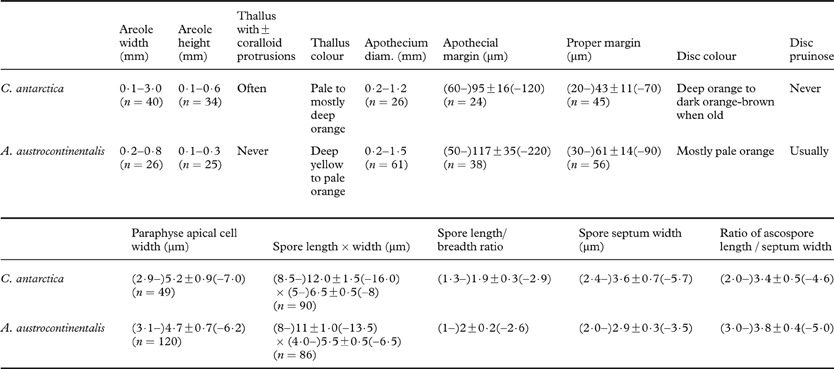
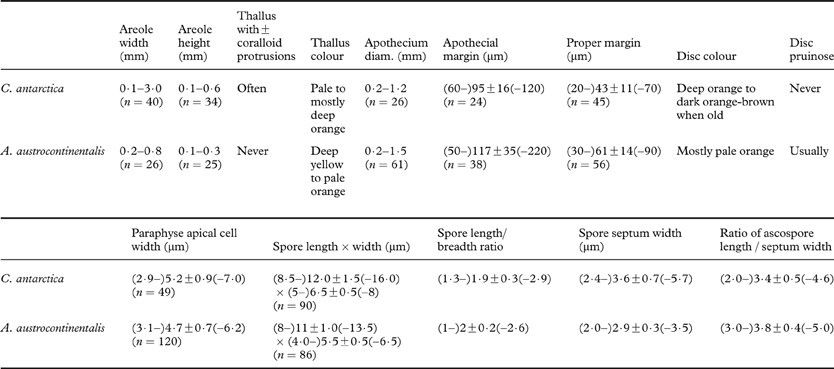
Even though C. antarctica and A. austrocontinentalis are molecularly well delimited and normally also macroscopically distinct, they may occasionally be difficult to separate (Table 2). Charcotiana antarctica can be distinguished by its deeper orange thallus, with scattered, bullate areoles that usually form protrusions, which can develop into somewhat branched-coralloid structures, deep orange, epruinose discs, and stipitate apothecia with thin apothecial margins. The latter feature should be used with caution because both species are quite variable, even within the same sample, and show overlapping value ranges. Additionally, the thallus of A. austrocontinentalis is commonly paler, with flat areoles, with flat, matt discs covered by orange pruina, and with thicker apothecial and proper margins. Microscopically, it can be difficult to separate the two species due to the overlapping ranges, but C. antarctica tends to have longer spores with thicker septa compared to those of A. austrocontinentalis.
Morphological and anatomical comparison between Charcotiana antarctica and Amundsenia austrocontinentalis.
Both C. antarctica and A. austrocontinentalis tend to reduce their interface with the rock substratum by the formation of microstipitate areoles and apothecia. This is a characteristic of many other Antarctic lichens, including Austroplaca frigida (see below), and is even more pronounced where the thallus becomes microfruticose with all photosynthetically active parts elevated from the rock, as seen in Caloplaca scolecomarginata and Huea coralligera (Ott & Sancho Reference Ott and Sancho1993; Søchting & Olech Reference Søchting and Olech2000); this separation from the rock may improve temperature conditions in the photosynthetic and reproductive parts of the lichen and was previously noted, particularly in eutrophicated sites, by Lamb (Reference Lamb1968), Jacobsen & Kappen (Reference Jacobsen and Kappen1988) and Olech (Reference Olech1990).
Additional material studied. Antarctica: Ingrid Christensen Coast: Vestfold Hills, 500 m South of Pauk Lake, 25 m, 68°34′40·0″S, 78°28′30·0″E, 1979, R. D. Seppelt (ADT 9015). Southern Victoria Land: Ross Island, Scott Base Area, 150 m NW seismic station, 77°51′S, 166°45′E, 1997, R. D. Seppelt (ADT 20302); Kar Plateau, south eastern end, 76°56′S, 162°20′E, 1992, R. D. Seppelt (ADT 19147); McMurdo Dry Valleys, Garwood Valley, 78°02·046′S, 163°56·237′E, 1999, R. D. Seppelt (ADT 21115); 360 m, 78°1′36·4″S, 163°51′ 36·4″E, 2009, J. Raggio (MAF-Lich 18901)); Upper Garwood, 688 m, 78°02·173′S, 163°50·191′E, 2009, A. de los Rios (MAF-Lich 18171); 671 m, 78°03·454′S, 163°48·531′E, 2009, A. de los Rios (MAF-Lich 18173); Upper Garwood/Upper Miers Valleys area, c. 1 km ESE of Shangri-La Camp, 750 m, 78°03′28·4″S, 163°46′10·0″E, 2009, R. D. Seppelt (ADT 27534); c. 1·5 km ENE of Shangri-La Camp, 750 m, 78°03′29·6″S, 163°49′17·8″E , 2009, R. D. Seppelt (ADT 27537); Miers Valley, 320 m, 78°05′50·6″S, 163°43′07·3″E, 2000, R. D. Seppelt (ADT 21966); between both glaciers, close to a stream, 171 m, 78°06·012′S, 163°48·603′E, 2009, A. de los Rios (MAF-Lich 18174); plateau, 521 m, 78°06·825′S, 163°51·225′E, 2009, A. de los Rios (MAF-Lich 18172).
Austroplaca frigida Søchting & Garrido-Benavent nom. nov.
MycoBank No.: MB 808605
Caloplaca frigida Søchting in Søchting & Olech. Bibl. Lichenol. 75: 24 (Reference Søchting and Olech2000), nom. illeg., non Caloplaca frigida (Paulson) Zahlbr. (1930)
Type: Antarctic Continent, Dronning Maud Land, Vestfjella, the nunatak Basen, January 1992, Thor 10559 (S—holotype; C, CRA—isotypes).
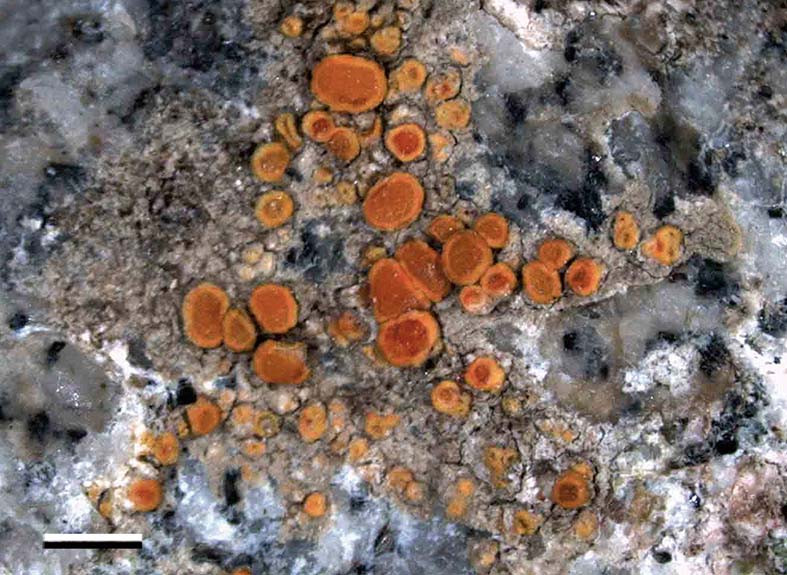
(Fig. 6)
Austroplaca frigida, habitus (MAF-Lich 18902-2). Scale=0·5 mm. In colour online
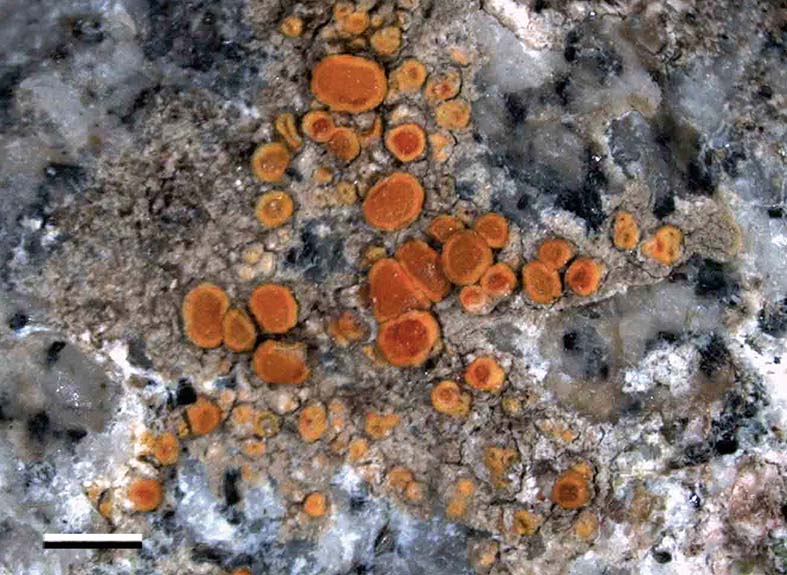
This is another characteristic saxicolous lichen from continental Antarctica (Fig. 9). It was described in Søchting & Olech (Reference Søchting and Olech2000) as Caloplaca frigida by Søchting, who overlooked that the combination Caloplaca frigida (Paulson) Zahlbruckner had been made in 1930 in Cat. Lich. Univers. 7: 139 based on the basionym Placodium frigidum Paulson 1925.
The molecular analysis based on ITS sequences has shown Caloplaca frigida Søchting to belong in Austroplaca (Fig. 2), and to be closely related to two Antarctic species, A. soropelta and A. darbishirei, which have well-developed orange-yellow thalli producing soredia (Søchting & Castello Reference Søchting and Castello2012). Austroplaca frigida is often reduced to scattered apothecia; it may be confused with the above species, but has a narrower spore septum (1·5–2·0 µm).
Austroplaca frigida may be an overlooked species in continental Antarctica. It has so far not been collected outside continental Antarctica (Fig. 7C).
Distributions. A, Charcotiana antarctica; B, Amundsenia austrocontinentalis; C, Austroplaca frigida.

Selected material studied. Antarctica: Southern Victoria Land: Kar Plateau south east end, 76°56′S, 162°20′E, 1992, R. D. Seppelt (ADT 19175); Garwood Valley, 78°2·046′S, 163°56·237′E, 1999, R. D. Seppelt (ADT 21118); 78°02·103′S, 163°56·380′E, 1999, R. D. Seppelt (ADT 21126); 78°02·046′S, 163°56·237′E, 1999, R. D. Seppelt (ADT 21117); 78°02·103′S, 163°56·380′E, 1999, R. D. Seppelt (ADT 21125); 78°02·103′S, 163°56·380′E, 1999, R. D. Seppelt (ADT 21123); 78°02·890′S, 165°42·290′E, 2009, Sancho & Seppelt (MAF); McMurdo Dry Valleys, Upper Garwood Valley area, c. 1 km W of Shangri-La camp, 78°02′53·5″S, 163°42′17·5″E, 2009, R. D. Seppelt (ADT 27513); 340 m, 78°01′38·4″S, 163°50′20″E, 2009, J. Raggio (MAF-Lich 18890, MAF-Lich 18890-2, MAF-Lich 18904); plateau, 78°01′38·4″S, 163°30′20″E, 2009, J. Raggio (MAF-Lich 18902, MAF-Lich 18902-2). Windmill Islands: Ford Island, central, 66°24′25″S, 110°30′50″E, 1983, R. D. Seppelt (ADT14232).
Lisbeth Knudsen is thanked for skilled assistance in the molecular and HPLC laboratories and Bjørn Hermansen for production of the distribution maps. Helen Peat, British Antarctic Survey, Cambridge, is thanked for the loan of specimens and Teuvo Ahti, Helsinki, for nomenclatural advice. This work was made possible due to a Carlsberg Foundation grant (2008_01_0645) to the first author and a SYNTHESYS scholarship to the second author (DK-TAF-3064), which is financed by the European Community Research Infrastructure Action (Project http://www.synthesys.info/). The project was also supported by the Spanish Economy and Competitiveness Ministry grants CTM2012-38222-C02-01/02 and FPU AP2012-3556. We are also grateful to the New Zealand Antarctic Program and the University of Waikato Antarctic Research Program, and to the Italian Antarctic Research Programme (PNRA) and the National Antarctic Museum (MNA). The New Zealand Foundation for Research, Science and Technology (FRST), the University of Waikato Vice Chancellor's Fund, and the Department of Biological Sciences, University of Waikato also provided financial support.