As the world's population moves to achieving a more sustainable way of living, the environmental impact associated with the production of food becomes a growing concern. Dairy products make up a large proportion of the human diet, particularly in developed countries, and, as a result, their sustainable production is of particular concern.
Life cycle assessment (LCA) is an analysis technique that is used to assess the environmental impact of a product or service throughout its life cycle, whilst also providing information relating to the most significant contributors to this impact. In recent years, LCA has been implemented to estimate various aspects of the environmental impact of the dairy sector. A number of studies have been performed examining the environmental impact of manufacturing fluid milk (Nutter et al. Reference Nutter, Kim, Ulrich and Thoma2013) and cheese (Kim et al. Reference Kim, Thoma, Nutter, Milani, Ulrich and Norris2013) within the USA dairy industry. Vergé et al. (Reference Vergé, Maxime, Dyer, Desjardins, Arcand and Vanderzaag2013) estimated the carbon footprint of 11 Canadian dairy products using national-level data. Djekic et al. (Reference Djekic, Miocinovic, Tomasevic, Smigic and Tomic2014) performed an environmental LCA of dairy products in Serbia using data from 7 dairy processing factories. It is also important to note that raw milk production is, in most cases, a very large contributor to the overall environmental impact associated with producing dairy products, particularly when examining the overall Global Warming Potential (GWP). This has previously been demonstrated in a number of studies, including Kim et al. (Reference Kim, Thoma, Nutter, Milani, Ulrich and Norris2013), Vergé et al. (Reference Vergé, Maxime, Dyer, Desjardins, Arcand and Vanderzaag2013), Djekic et al. (Reference Djekic, Miocinovic, Tomasevic, Smigic and Tomic2014) and Finnegan et al. (Reference Finnegan, Goggins, Clifford and Zhan2017a, Reference Finnegan, Goggins, Chyzheuskaya and Zhanb). At the dairy factory, it was observed that the major contributors to the environmental impact were related to energy requirements and input of goods. We have assessed the global warming potential associated with a number of Irish dairy products (Finnegan et al. Reference Finnegan, Goggins, Clifford and Zhan2017a, Reference Finnegan, Goggins, Chyzheuskaya and Zhanb) and conducted an investigation into the environmental impact of manufacturing milk powder and butter in the Republic of Ireland (Finnegan et al. Reference Finnegan, Goggins, Clifford and Zhan2017c). In this current paper, the environmental impact associated with the manufacture of the main dairy products in the Republic of Ireland is presented. The methodology employed to perform the analysis, which is based on LCA, has been detailed. The main Irish dairy products have been selected for analysis and are compared for each of the impact categories used to assess their environmental impact. Additionally, a brief comparison to international studies has been included, along with a discussion on the main findings of the study.
Material and methods
This study has been structured in accordance with the LCA guidelines of the International Organisation for Standardisation (ISO): ISO 14040 (ISO, 2006). Furthermore, particular attention was paid to the LCA methodology for assessing the carbon footprint of the dairy industry, which was published by the International Dairy Federation (FIL-IDF, 2015). The life cycle inventory data sets used in this study are based on site specific data, national data and the ecoinvent database Version 3 (Weidema et al. Reference Weidema, Bauer, Hischier, Mutel, Nemecek, Reinhard, Vadenbo and Wernet2013).
Goal, scope and system boundaries of the study
The primary goal of this study is to perform an environmental LCA of selected dairy products manufactured in the Republic of Ireland from farm gate to dairy processing factory gate. The selected dairy products are:
• milk powder (includes skim milk powder, whole milk powder and full fat milk powder)
• butter
• fluid milk (includes whole milk, semi-skimmed milk and skimmed milk)
• cream
• infant formula
• cheese (mainly cheddar)
• whey powder
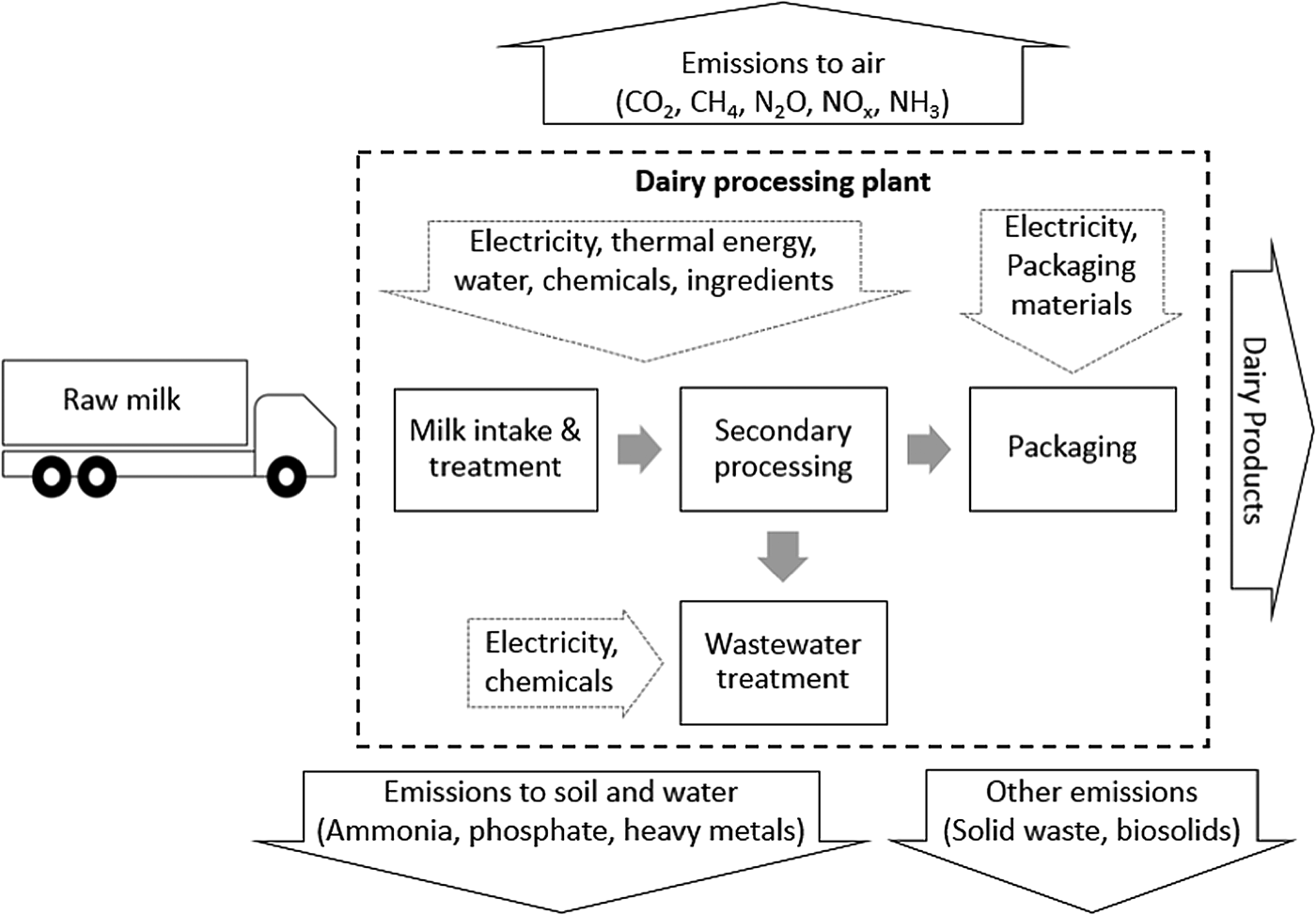
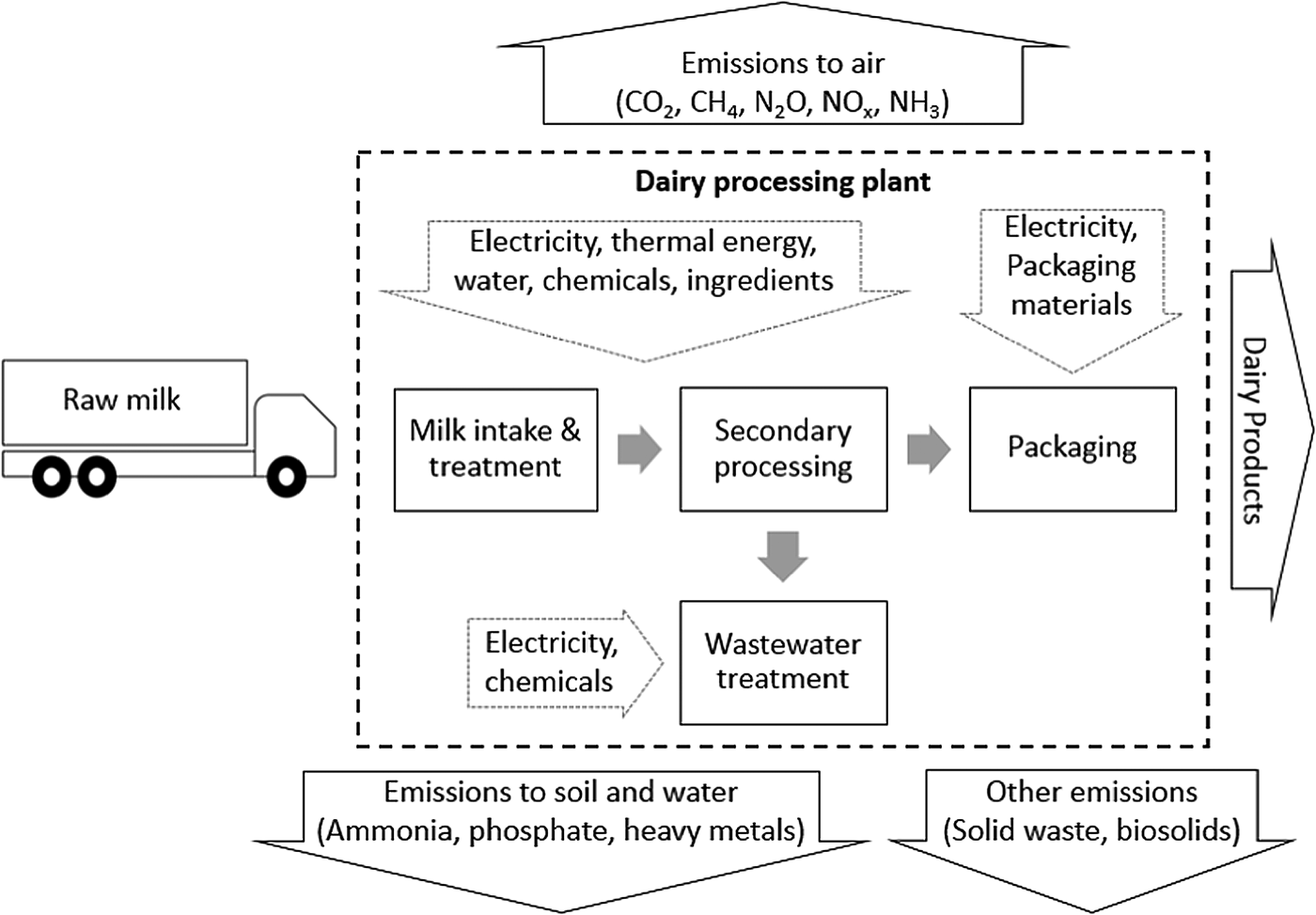
The life cycle stages included within the system boundary of the study are raw milk transportation to the processing factory, processing of raw milk into each product and packaging of the final product, which are summarised graphically in Fig. 1. The functional unit used in this study is defined as 1 kilogram (kg) of product, as advised by FIL-IDF (2015).
Summary of the system boundary conditions, which are included in the analysis: raw milk transportation, processing and packaging (adapted from Finnegan et al. (Reference Finnegan, Goggins, Clifford and Zhan2017c)).
Life cycle inventory analysis
The life cycle inventory was generated using the results of a survey of 11 dairy processing factories within the Republic of Ireland, which process approximately 49% of the total raw milk processed (2·85 billion litres out of a total of 5·8 billion litres). Operational data for years circa 2013 was obtained, which includes:
• volume raw milk processed
• raw milk transportation details
• dairy production details
• electrical and thermal energy consumption (including the breakdown between manufacturing processes)
• water consumption (including the breakdown between manufacturing processes);
• chemical usage
• packaging details and raw materials used
• on-site wastewater treatment details
• quantity of solid waste generated, including disposal details
Where factors used in the survey were not monitored on-site, engineering estimates or national averages were used. It should be noted that it is assumed that all solid waste is disposed of as specified in the survey (landfill, incineration or recycled). Furthermore, in the case of recycled solid waste, there is a positive net environmental impact observed as the materials generated avoid the impact incurred by their production from raw materials.
Life cycle impact assessment
The life cycle impact assessment methods used in this study are the Intergovernmental Panel on Climate Change (IPCC) 2013 GWP 100a, Cumulative Energy Demand and the ReCiPe Midpoint (H), which has also been used in the study by Kim et al. (Reference Kim, Thoma, Nutter, Milani, Ulrich and Norris2013) of cheese and whey production in the USA. Consequently, the environmental impact categories, along with their associated comparative units, employed in this analysis are: global warming potential (GWP), kg CO2 eq; cumulative energy demand (CED), MJ; freshwater eutrophication potential (FEP), kg P eq; marine eutrophication potential (MEP), kg N eq; terrestrial acidification potential (AP), kg SO2 eq; and water depletion (WD), m3 water.
Results and discussion
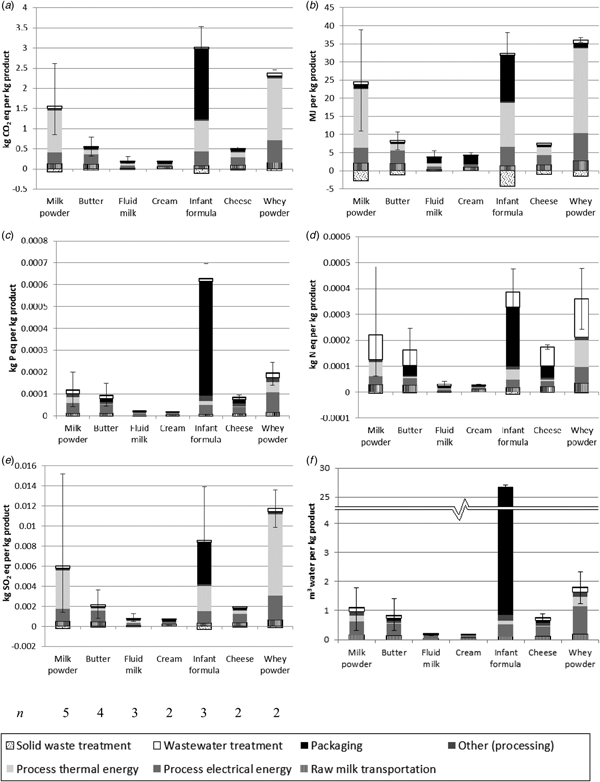
A summary of the results of the analysis are presented in Fig. 2. For each of the 6 impact categories assessed, the 7 dairy products are compared using the functional unit (per kg product). The average environmental impact associated with the manufacture of each dairy product, along with error bars indicating the range of variation between dairy processing factories, are presented (Fig. 2). These variations are influenced by a number of factors including the number of factories surveyed for the dairy product (displayed as n in Fig. 2), the number of different products being manufactured and the scale of production at the site.
A comparison of the average environmental impact associated with the manufacture of each dairy product and the error bars represent the range of variation between dairy processing factories, where (a): global warming potential; (b): cumulative energy demand; (c): freshwater eutrophication potential; (d): marine eutrophication potential; (e): terrestrial acidification potential; and (f): water depletion (where n is the number of dairy processing factories surveyed).

The dairy product with the highest environmental impact is infant formula. However, packaging is the largest contributor to its environmental impact as a result of the quantity of packaging materials used, while the majority of the other dairy products are bulk packaged. Therefore, examining raw milk transportation and processing only, whey powder has the highest environmental impact for each of the 6 impact categories. For each of the dairy products, other than infant formula, energy usage is the most significant contributor to its environmental impact.
The results presented in this paper may be used as a benchmark for the Irish dairy processing industry. Therefore, we can compare to other studies for the same life cycle stages. For example, Kim et al. (Reference Kim, Thoma, Nutter, Milani, Ulrich and Norris2013) reported that for one kg of cheddar cheese produced in the USA, for raw milk transportation, processing and packaging, the GWP, CED and FEP is 0·828 kg CO2 eq., 10·8 MJ and 5·16 × 10−4 kg P eq., respectively. These values are greater than the average values for GWP, CED and FEP that are presented in this paper of 0·48 kg CO2 eq., 6·59 MJ and 8·39 × 10−5 kg P eq., respectively. Additionally, Nutter et al. (Reference Nutter, Kim, Ulrich and Thoma2013) found that for one kg of packaged fluid milk produced in the USA, for processing and packaging, the GWP is estimated to be 0·131 kg CO2 eq., which is less than the values found in the present study of 0·167 kg CO2 eq.
In conclusion, the environmental impact associated with the Irish dairy processing industry has been presented. In order for the industry to remain competitive, sustainability needs to be improved and reducing its environmental impact is essential in achieving this. Packaging materials, particularly for infant formula, and energy usage, across each of the life cycle stages, should be targeted as these are the most significant contributors to the overall environmental impact. The results from this study, although based on Irish data, can also be applied internationally as there is very little difference between dairy processing technologies in Ireland and other developed countries.
The authors would like to acknowledge the funding provided by the Department of Agriculture, Food and the Marine for the DairyWater project (Ref.: 13-F-507); for additional details see http://www.dairywater.ie. Additionally, the DairyWater research team would like to the members of the Irish dairy sector for their cooperation and contributions throughout the research project.