INTRODUCTION
Pitch Lake, at La Brea in southwest Trinidad, is a natural asphaltic lake covering nearly 100 hectares. The lake is an important economic resource for Trinidad and Tobago, having been harvested commercially since the 1850s, although documented history of its use stretches to at least the 16th century (e.g., Whitehead Reference Whitehead1997:131; Wiltshire Reference Wiltshire2007:12–13; Boomert Reference Boomert1984:23–24; Newson Reference Newson1976:211) and it was likely an important resource prior to this (Boomert and Harris Reference Boomert and Harris1984). During the course of this commercial activity, dredging of the lake has yielded a small selection of prehistoric carved wooden artifacts as well as a number of human skeletal remains. The wooden artifacts are mostly functional domestic items such as weaving tools, bowls, and paddles (compared to the more elaborate pieces recovered elsewhere in the Caribbean, e.g. Ostapkowicz et al. Reference Ostapkowicz, Bronk Ramsey, Brock, Higham, Wiedenhoeft, Ribechini, Lucejko and Wilson2012), which could suggest they were accidentally lost or deliberately disposed of into the lake by inhabitants of lakeside ancient settlements. However, the discovery of human skeletal remains raises the potential question of whether any of the items were burial offerings intended to accompany the dead into the next world.
It is unclear how many artifacts have been dredged from the lake over the century and a half of commercial activity, but 10 wooden artifacts and a human cranium are currently housed in three public collections: the National Museum & Art Gallery of Trinidad & Tobago, the Pointe-a-Pierre Wildfowl Trust (Peter Harris collection) in Trinidad, and the Peabody Museum of Natural History at Yale University in New Haven, USA. These pieces were studied as part of a project investigating the chronology, history, and provenance of the Pitch Lake artifacts. They were radiocarbon (14C) dated to establish whether they belonged to a particular period or represented a larger timeframe of human activity around the lake—a unique resource on the island—and how they fitted into the wider corpus of prehistoric wooden carvings in the Caribbean.
However, the presence of the pitch on and potentially within the artifacts presents a significant challenge to 14C dating. The pitch itself is likely to be of geological age, and hence 14C-dead, and so any remaining after pretreatment will result in an erroneously old date. Therefore, should any dates be earlier than expected, it is imperative to be able to demonstrate the effectiveness of the pretreatment process in removing the pitch from the artifacts prior to dating. As the wooden artifacts are carved from tropical woods that do not have annual rings, dendrochronological techniques that would have avoided the issues caused by the presence of pitch could not be employed in this instance.
There appears to be a constant cycling of material within the lake, with branches of varying sizes appearing at the lake’s surface before slowly sinking down again. These branches often have a thick coating of pitch, but in some instances the internal tissues appear relatively free of it. It is impossible to state from just looking at them how long these branches have been in the lake (and if they have entered the lake relatively recently from surrounding trees and grassland) and hence they may not be comparable to the prehistoric carvings that have been submerged for hundreds of years. Temperatures and pressures within the lake (which is up to 250 m deep) are not known, and it is not clear how wooden artifacts and bone would have been affected by the pitch over such long periods of time. One might assume that pitch, or at least lower molecular weight and/or volatile organic compounds from it, would have permeated the objects over time but in general bulk flow of pitch into wood cells would be unlikely, as the majority of the cells in wood have no openings to permit such bulk flow. Chemical species fully permeating the wood by diffusion should be below the molecular weight exclusion limit for wood (approximately 6000 Mw: Flourney et al. Reference Flournoy, Kirk and Highley1991)
Several studies have discussed the difficulties in removing bitumen and/or tar from Egyptian mummified specimens prior to 14C dating (e.g. Aufderheide et al. 2004; Quiles et al. Reference Quiles, Delqué-Količ, Bellot-Gurlet, Comby-Zerbino, Ménager, Paris, Souprayen, Vieillescazes, Andreu-Lanoë and Madrigal2014). However, the success in dating both bone and plant remains from the tar pits of Rancho La Brea in California, USA (e.g. Ward et al. 2005; O’Keefe et al. Reference O’Keefe, Fet and Harris2009 and references therein; Fuller et al. Reference Fuller, Fahrni, Harris, Aisling, Coltrain, Gerhart, Ward, Taylor and Southon2014, Reference Fuller, Harris, Farrell, Takeuchi and Southon2015, Reference Fuller, Southon, Fahrni, Harris, Farrell, Takeuchi, Nehlich, Richards, Guiry and Taylor2016), indicated that it might be possible to produce reliable 14C dates on the artifacts and skeletal remains from Pitch Lake.
Over 3 million late Pleistocene plant and animal fossils from over 600 species have been recovered from the open asphalt seeps and tar pits of Rancho La Brea (Friscia et al. Reference Friscia, Van Valkenburgh, Spencer and Harris2008). More than 200 14C dates have been published on fossils from these tar pits (O’Keefe et al. Reference O’Keefe, Fet and Harris2009 and references therein; Fuller et al. Reference Fuller, Fahrni, Harris, Aisling, Coltrain, Gerhart, Ward, Taylor and Southon2014, Reference Fuller, Harris, Farrell, Takeuchi and Southon2015), spanning the whole 14C spectrum from modern to >50,000 years ago. Plant specimens from the site are described as being asphalt-impregnated, and bones as having a characteristic color from “coffee to black” (Ho et al. Reference Ho, Marcus and Berger1969), indicating levels of tar contamination that penetrate further into the samples than observed in many of the Pitch Lake artifacts. All published studies of wood and bone pretreated for stable isotope analysis or 14C dating from Rancho La Brea include a thorough solvent extraction protocol of some form (e.g. soxhlet extraction or ultrasonication with a range of organic solvents) to remove petroleum-based contamination (e.g. Ho et al. Reference Ho, Marcus and Berger1969; Coltrain et al. Reference Coltrain, Harris, Cerling, Ehleringer, Dearing, Ward and Allen2004; Fox-Dobbs et al. Reference Fox-Dobbs, Stidham, Bowen, Emslie and Koch2006; Friscia et al. Reference Friscia, Van Valkenburgh, Spencer and Harris2008; O’Keefe et al. Reference O’Keefe, Fet and Harris2009; Fuller et al. Reference Fuller, Fahrni, Harris, Aisling, Coltrain, Gerhart, Ward, Taylor and Southon2014; Reference Fuller, Harris, Farrell, Takeuchi and Southon2015). However, several of these (e.g. Ho et al. Reference Ho, Marcus and Berger1969; Coltrain et al. Reference Coltrain, Harris, Cerling, Ehleringer, Dearing, Ward and Allen2004; Fuller et al. Reference Fuller, Fahrni, Harris, Aisling, Coltrain, Gerhart, Ward, Taylor and Southon2014, Reference Fuller, Harris, Farrell, Takeuchi and Southon2015) suggest that the solvent extraction itself is insufficient to remove the tar from the Rancho La Brea samples, with insoluble aggregates, residues and colloidal asphaltenes thought to be remaining (Fuller et al. Reference Fuller, Fahrni, Harris, Aisling, Coltrain, Gerhart, Ward, Taylor and Southon2014). Consequently, bone specimens in particular, have subsequently undergone further rigorous pretreatments prior to dating, including isolation of amino acids by liquid chromatography (Ho et al. Reference Ho, Marcus and Berger1969), amino acid analysis (Stafford et al. Reference Stafford, Hare, Currie, Jull and Donahue1991), and a double ultrafiltration procedure (Fuller et al. Reference Fuller, Fahrni, Harris, Aisling, Coltrain, Gerhart, Ward, Taylor and Southon2014, Reference Fuller, Harris, Farrell, Takeuchi and Southon2015).
However, the asphalt from Pitch Lake is unlikely to be chemically identical to that from Rancho La Brea, and the conditions within the lake will differ from those of the tar pits. Hence, it cannot be assumed that a 14C pretreatment protocol that is effective at one site will also be the most suitable pretreatment at the other. This paper details the comprehensive experimental work undertaken to test a range of published solvent extraction protocols to identify and then apply the most suitable one for removing Pitch Lake contamination from human remains and wooden artifacts.
The project is constrained by the fact that particular care needs to be taken with objects of cultural patrimony held in museum collections, where conservation as well as aesthetic issues severely limit sampling sizes. This limited the opportunity for multiple dates on individual artifacts using different 14C protocols that could have provided additional confidence in the dating. Given the lack of stratigraphy or contextual information for the pieces from the lake, it was vital to be able to demonstrate the effective removal of pitch from the pieces to provide confidence in the dates, especially those objects with the earliest dates. However, this is particularly difficult for the wooden artifacts, as a large component of pitch is degraded organic plant matter, and so chemically indistinct from the sample material. Hence techniques sometimes applied for the quality assurance of 14C dates on wood, such as comparison of δ13C stable isotopic values and FTIR are not applicable in this instance. Instead, optical microscopy techniques and pyrolysis-GC/MS, which are less commonly applied in 14C dating, were used to look for visual signs of residual pitch and the presence of compounds indicative of pitch contamination, respectively. The efficiency of pitch removal from three of the artifacts that yielded the earliest dates from the corpus—the human cranium, a weaving tool, and a small bowl—is assessed here.
Detailed descriptions of the 10 Pitch Lake wooden artifacts and the human cranium, the sampling strategies involved, the 14C dates and their interpretation will be published separately by Ostapkowicz et al. (Reference Ostapkowicz, Brock, Weidenhoeft, Snoeck, Pouncett, Baksh-Comeau, Schulting, Claevs, Mattielli, Richards and Boomertin press).
METHODS
Pitch Decontamination
Initial Dissolution Experiments
Initial tests were undertaken to visually assess the impact of different organic solvents on crust material recently collected from the surface of Pitch Lake. Aliquots of crushed pitch crust were treated three times for 15 min each with ultrasonication with fresh aliquots of the following solvents: acetone, hexane, dichloromethane, petroleum ether, chloroform, and toluene. Each solvent was chosen as it is ultilized in at least one published method for bitumen or asphalt removal prior to 14C dating specimens from Rancho La Brea or mummified Egyptian artifacts (e.g. Ho et al. Reference Ho, Marcus and Berger1969; O’Keefe et al. Reference O’Keefe, Fet and Harris2009; Aufderheide et al. Reference Aufderheide, Nissenbaum and Cartmell2014; Fuller et al. Reference Fuller, Fahrni, Harris, Aisling, Coltrain, Gerhart, Ward, Taylor and Southon2014; Quiles et al. Reference Quiles, Delqué-Količ, Bellot-Gurlet, Comby-Zerbino, Ménager, Paris, Souprayen, Vieillescazes, Andreu-Lanoë and Madrigal2014). The color released on each wash and a visual estimation of the amount of pitch dissolved was noted.
Pitch Contamination of Chromosorb® and Removal
Recently collected pitch from the surface crust of Pitch Lake was ground using a pestle and mortar and mixed in a 1:4 ratio with Chromosorb, a carbon-free silica substrate used in previous “contamination-removal” experiments (Dee et al. Reference Dee, Brock, Bowles and Bronk Ramsey2011) and placed in two separate glass vials. The Chromosorb and pitch were mixed thoroughly by vortexing before placing each vial in separate wide-necked conical flasks, each containing two open glass vials of water. The flasks were sealed with rubber bungs held in place with wire and kept at 60°C for 1 month to artificially age the pitch onto the Chromosorb. While no viscous pitch was available for this experiment (due to concerns about transporting flammable material from Trinidad to the UK), Chromosorb is much more absorbant than wood or bone, and the crust will not bond to Chromosorb as it would with wood or bone within Pitch Lake, experiments such as these allow for the removal of pitch to be assessed relatively quickly and cheaply, by applying different solvent extraction protocols and measuring the remaining carbon present on the Chromosorb by mass spectrometry (Dee et al. 2001). Once the most effective pretreatment for removing the pitch from the Chromosorb was identified, it could be tested by deliberately contaminating known-age wood with pitch and dating the pretreated material.
Nine different solvent extraction protocols were applied in triplicate to ca. 10 mg aliquots of pitch-contaminated Chromosorb as described below. Note: in the following, peth=petroleum ether; ace=acetone; hx=hexane; chl=chloroform; MeOH=methanol; tol=toluene; DCM=dichloromethane; MQ=ultrapure Milli-Q water; u/s=ultrasonication.
A: peth, ace, hx sequence consisting of 5×5 min washes with fresh solvent and u/s followed by 2 hr soaking per solvent before progressing to the next solvent. (O’Keefe et al. Reference O’Keefe, Fet and Harris2009).
B: ace (1 hr, 45°C), MeOH (1 hr, 45°C), chl (1 hr, room temperature). This is the routine solvent extraction applied to samples at the Oxford Radiocarbon Accelerator Lab (ORAU) (Brock et al. Reference Brock, Higham, Ditchfield and Bronk Ramsey2010).
C: 2×hx (15 min); 2×DCM (15 min); 2×chl (15 min), all with u/s (Quiles et al. Reference Quiles, Delqué-Količ, Bellot-Gurlet, Comby-Zerbino, Ménager, Paris, Souprayen, Vieillescazes, Andreu-Lanoë and Madrigal2014)
D: 2×tol. (30 min, u/s); 2×2:1 tol: MeOH (30 min, u/s); 2:1 tol: MeOH (30 min, u/s, then left to soak overnight for a minimum of 17 hr); 2:1 tol: MeOH (30 min, u/s); 2×MeOH (30 min, u/s); 2×MQ (30 min, ultrasonication). Based on Fuller et al. (Reference Fuller, Fahrni, Harris, Aisling, Coltrain, Gerhart, Ward, Taylor and Southon2014).
E: 4×2:1 tol: MeOH (30 min, u/s), 2:1 tol:MeOH (30 min, u/s, then left overnight for min 17 hr), 2:1 tol: MeOH (30 min, u/s), 2×MeOH (30 min, u/s), 2×MQ (30 min, u/s). Adapted from Fuller et al. (Reference Fuller, Fahrni, Harris, Aisling, Coltrain, Gerhart, Ward, Taylor and Southon2014).
F: 2×DCM (30 min, u/s); 2×2:1 DCM: MeOH (30 min, u/s); 2:1 DCM:MeOH (30 min, u/s, then left to soak overnight for a minimum of 17 hr); 2:1 DCM: MeOH (30 min, u/s); 2×MeOH (30 min, u/s); 2×MQ (30 min, u/s).
G: 4×2:1 DCM: MeOH (30 min, u/s), 2:1 DCM:MeOH (30 min, u/s, then left overnight for min 17 hr), 2:1 DCM: MeOH (30 min, u/s), 2×MeOH (30 min, u/s), 2×MQ (30 min, u/s).
H: 2×chl (30 min, u/s); 2×2:1 chl: MeOH (30 min, u/s); 2:1 chl:MeOH (30 min, u/s, then left to soak overnight for a minimum of 17 hr); 2:1 chl: MeOH (30 min, u/s); 2×chl (30 min, u/s); 2×MQ (30 min, u/s).
I: 4×2:1 chl: MeOH (30 min, u/s), 2:1 chl:MeOH (30 min, u/s, then left overnight for min 17 hr), 2:1 chl: MeOH (30 min, u/s), 2×MeOH (30 min, u/s), 2×MQ (30 min, u/s).
The final products were air-dried before the remaining Chromosorb was analyzed for carbon content using mass spectrometry as described by Brock et al. (Reference Dee, Brock, Bowles and Bronk Ramsey2010). The levels of carbon present on uncontaminated Chromosorb and Chromosorb contaminated with pitch were also measured.
(De-)Contamination of Known-Age Wood
Several small (ca. 5×5×10 mm) pieces of known-age Irish bog oak, dendrochronologically dated to AD 1481–1490 (Brock et al. Reference Brock, Higham, Ditchfield and Bronk Ramsey2010) were taken to Trinidad, and stored in fresh viscous pitch collected from Pitch Lake for 3 days. The samples then underwent the most effective solvent extraction sequence for removing Pitch Lake crust material from Chromosorb (method E, above) prior to dating by both α-cellulose extraction and the routine ABA-bleach method for wood samples at ORAU (see below) to ensure that accurate dates for the wood could be achieved.
14C Dating
Detailed descriptions of the complete corpus of wooden artifacts and skeletal remains from Pitch Lake studied in this project, and the sampling strategy applied, are provided by Ostapkowicz et al. (Reference Ostapkowicz, Brock, Weidenhoeft, Snoeck, Pouncett, Baksh-Comeau, Schulting, Claevs, Mattielli, Richards and Boomertin press). However, the work presented here focused on three pieces in particular:
-
∙ A human cranium mounted in pitch (National Museum and Art Gallery of Trinidad and Tobago)
-
∙ A small wooden bowl (National Museum and Art Gallery of Trinidad and Tobago
-
∙ A weaving tool without handle (henceforth “weaving tool”) (Harris Collection/Pointea-Pierre Wildfowl Trust, Trinidad)
Areas of the artifacts heavily contaminated with pitch were avoided during sampling where possible. Wooden objects were sampled from the outermost rings to represent the time when the tree was felled and most likely carved. Sampling locations also needed to be sympathetic to the carvings and cranium, without causing visual damage in key areas of interest. Therefore, for many of the 10 wooden artifacts dated from Pitch Lake, the amount of material available for dating was limited, ranging from 14 to 105 mg, with most being ca. 30 mg. For the 2 pieces discussed here, 78 mg was sampled from the small wooden bowl and 52 mg from the weaving tool. The pretreatment protocols applied to each are described below. All solutions and water washes were carried out with ultrapure Milli-Q™ water, and all solvents used were Distol grade. Following pretreatment, samples were freeze-dried before being combusted and the resultant CO2 cryogenically distilled, graphitized and AMS 14C dated as described by Brock et al. (Reference Brock, Higham, Ditchfield and Bronk Ramsey2010).
Solvent Removal
All samples underwent solvent extraction method E, as described above. Care was taken in particular to ensure that the bone powder from the human cranium was not heated unnecessarily during ultrasonication to avoid damaging the collagen present.
14C Dating Pitch
Two aliquots of pitch were directly dated with no pretreatment. One sample was collected from the surface of a ceremonial bench previously dated by Ostapkowicz et al. (Reference Ostapkowicz, Bronk Ramsey, Brock, Higham, Wiedenhoeft, Ribechini, Lucejko and Wilson2012). A second sample of crust collected from the surface of Pitch Lake in 2014 was also dated.
Bone Pretreatment
Bone powder (145 mg) was sampled from the human cranium, taking care to avoid any obvious regions of pitch. Following solvent extraction as described above, the sample underwent a modified Longin (Reference Longin1971) extraction procedure consisting of an acid-base-acid (ABA) wash (0.5M HCl, 3–4 times over ~18 hr; 0.1M NaOH, 30 min; 0.5 M HCl, 1 hr, all at room temperature and with thorough rinsing with ultrapure water in between each step) followed by gelatinization at pH3 and 75°C for 20 hr. The resultant solution was then filtered using a cleaned 45–90 μm Ezee-filter™ (Elkay, UK; Brock et al. Reference Brock, Higham, Ditchfield and Bronk Ramsey2010) prior to freeze-drying. To demonstrate that the final date of the cranium was not affected by laboratory-introduced contamination, especially from the extensive solvent pretreatment, or influenced by the small size of the sample, a similar-sized aliquot (210 mg) of a known-age in-house laboratory bone standard (a pig rib from the wreck of the Mary Rose, dating to ca. AD 1545 AD) was treated alongside the cranium sample.
Wood Pretreatment
Two separate pieces of the known-age wood that had been contaminated with pitch were each dated twice, using α-cellulose extraction and acid-base-acid (ABA)-bleach protocols, as described below. The α-cellulose method is more rigorous, but the harsh conditions require a high starting weight (min. 50 mg) that was not available for most of the samples due to the difficulties in sampling described above. Therefore, only the ABA-bleach method could be applied to most of the samples in this study, including the small bowl and weaving tool detailed here.
The α-cellulose method (described in detail by Staff et al. Reference Staff, Reynard, Brock and Bronk Ramsey2014), is as follows: 4% (1.12M) HCl (70°C, 20 min); 17.5% w/v NaOH (1 hr, room temperature, ultrasonication under constant nitrogen atmosphere); 5% (1.4M) HCl (70°C, 10 min), with thorough rinsing with ultrapure water after each stage (3–6 washes).
The routine ABA-bleach wood method is described by Brock et al. (Reference Brock, Higham, Ditchfield and Bronk Ramsey2010; lab code UW) as follows: 1M HCl (80°C, 20 min); 0.2M NaOH (80°C, 20 min); 1M HCl (80°C, 1 hr); 5.0% (w/v) NaClO2 bleach (pH3, 80°C, up to 30 min), with thorough rinsing with ultrapure water between each step.
Pyrolysis-GC/MS
Untreated material from the human cranium and weaving tool, as well as pretreated material from the weaving tool were analysed using Py-GC/MS at the NERC LSMSF facility at the University of Bristol, UK. Py-GC/MS was performed using a Chemical Data Systems (CDS) 5200 series pyroprobe pyrolysis unit attached to an Agilent 6890A gas chromatograph (GC) fitted with a CPSil-5CB fused column (Varian 100% dimethylpolysiloxane; 50 m, 0.32 mm i.d.; 0.45 μm film thickness) and a ThermoElectron MAT95 double focussing mass spectrometer (ThermoElectron, Bremen) operated in electron ionization (EI) mode (source temperature 200°C, interface 310°C) with helium as a carrier gas (2 mL/min). Samples were pyrolysed in a quartz tube at 610°C for 20 s, transferred to the GC via a pyrolysis transfer line (310°C) and injected onto the GC using a split ratio of 10:1; the injector port temperature was maintained at 310°C. The oven was programmed to heat at 4°C/min from 50°C (held for 4 min) to 300°C (held for 15 min). The MS scanned the range m/z 50–650 at a rate of one scan per second and there was a solvent delay of 7 min. Data was collected using MAT95InstCtrl v1.3.2 and viewed using QualBrowser v1.3 (ThermoFinnigan, Bremen). Compounds were identified using the National Institute of Standards and Technology (NIST) database and a laboratory MS library.
Optical Microscopy
Thin sections of treated wood specimens were placed on labelled microscope slides. A drop of 1:1 glycerine:95% ethanol was added to each sample, with a coverslip placed atop this. The slides were heated on a hot plate at ca. 120°C until air bubbles stopped exiting the wood material. The camera was white balanced against the glycerine mounting medium for each slide and each magnification prior to images being recorded. Exposure times for the digital camera (Point Grey Flea 3 Model FL3-U3-88S2C-C) were manually adjusted to maximize the dynamic range of the sensor (“white” areas without tissue with RGB intensity peaks between 220 and 255).
RESULTS AND DISCUSSION
Pitch Decontamination
Initial visual tests demonstrated that chloroform and toluene were the two most successful individual organic solvents at dissolving pitch, followed by dichloromethane. The chloroform had dissolved the majority of the pitch after the first 15 min wash with ultrasonication. A much slower response was observed with petroleum ether, the second wash resulting in some loss of sample. Hexane and acetone appeared to have very little effect on the pitch. This is generally as expected, as Attwooll and Broome (Reference Atwooll and Broome1954) reported the solubility of viscous pitch from Pitch Lake as highest in chloroform (53%) and toluene (50%) and lowest in petroleum ether (35%) and acetone (26%). Ho et al. (Reference Ho, Marcus and Berger1969) also reported that extensive soxhlet extraction of asphalt-impregnated samples from Rancho La Brea with petroleum ether was unsuccessful, while Fuller et al. (Reference Fuller, Fahrni, Harris, Aisling, Coltrain, Gerhart, Ward, Taylor and Southon2014) predicted the success of toluene in removing Rancho La Brea tar given its affinity for aromatic compounds.
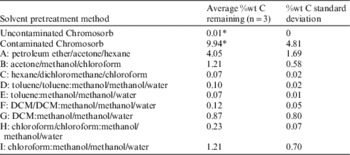
The results of the different solvent extraction protocols are given in Table 1.
Average percentage of carbon within the pitch-contaminated Chromosorb after each solvent extraction procedure (*n = 4).

Analysis of the uncontaminated Chromosorb confirms that only trace levels of carbon are present, and any carbon on the contaminated Chromosorb is present as pitch. Presence of pitch on the contaminated stock Chromosorb is clearly variable, no doubt due to the difficulty of producing an entirely homogeneous mix of pitch and Chromosorb.
The effectiveness of the different solvent sequences at dissolving pitch will depend on the polarity of both the solvents used and the components of the pitch itself. A non-polar solvent is required initially to dissolve the many hydrocarbons within the pitch; use of a solvent that is too polar for the initial treatment may inhibit the solubility of polar components in subsequent treatments with more polar solvents. Comparison of the “paired” solvent treatments (e.g. D vs. E, F vs. G, H vs. I) suggests that the binary mixes of DCM:methanol and chloroform:methanol are not sufficiently non-polar to dissolve the large non-polar component of the pitch, and hence remove less of the pitch from the Chromosorb than the same treatments preceded with an initial DCM or chloroform wash. However, toluene is less polar than both DCM and chloroform, and it appears that the toluene:methanol mixture (method E) was as effective at removing the pitch as method F, which started with an initial toluene-only wash.
Of the nine methods tested, the most successful at removing the pitch from the Chromosorb were the toluene and methanol-based procedure based on that of Fuller et al. (Reference Fuller, Fahrni, Harris, Aisling, Coltrain, Gerhart, Ward, Taylor and Southon2014) and the hexane/dichloromethane/chloroform sequence proposed for removal of bitumen from Ancient Egyptian samples by Quiles et al. (Reference Quiles, Delqué-Količ, Bellot-Gurlet, Comby-Zerbino, Ménager, Paris, Souprayen, Vieillescazes, Andreu-Lanoë and Madrigal2014), with just 0.07% residual carbon from both. It was decided to apply the toluene and methanol-based procedure (method E) to the Pitch Lake samples because of the success of dating the Rancho La Brea samples by Fuller et al. (Reference Fuller, Fahrni, Harris, Aisling, Coltrain, Gerhart, Ward, Taylor and Southon2014, Reference Fuller, Harris, Farrell, Takeuchi and Southon2015) using this protocol, and also because Quiles et al. (Reference Quiles, Delqué-Količ, Bellot-Gurlet, Comby-Zerbino, Ménager, Paris, Souprayen, Vieillescazes, Andreu-Lanoë and Madrigal2014) highlighted that their method, while effective at removing modern bitumen, was less effective at removing it once it was aged.
In some of the decontaminated Chromosorb, small black specks of solid material could be observed against the white of the Chromosorb, highlighting the presence of insoluble residues. However, these were very clear to the naked eye, and it was anticipated that they could be removed from pretreated collagen or wood manually prior to combustion if necessary.
The least successful method for removing the pitch was that based on the petroleum ether/acetone/hexane method used by O’Keefe et al. (Reference O’Keefe, Fet and Harris2009) for pretreating specimens from Rancho La Brea, with an average of 4.05% carbon remaining on the Chromosorb after treatment. However, Fuller et al. (Reference Fuller, Harris, Farrell, Takeuchi and Southon2015) previously identified that the dates generated by O’Keefe et al. (Reference O’Keefe, Fet and Harris2009) may have been slightly older than the true date, and that the original pretreatment applied was insufficient to remove all remaining tar. It should also be stressed that as the asphalt from the two sites is likely to be chemically different, it should not be assumed that the same solvent sequence will remove the contaminant from material from both sites.
Two pieces of known-age wood that had been contaminated with pitch were each solvent extracted using the toluene/methanol sequence (method E) before being dated twice, once following α-cellulose extraction and once using an acid-base-acid-bleach protocol. The α-cellulose dates were 369±23 BP and 368±23 BP, and the ABA-bleach dates were 378±22 BP and 374±26 BP. All four dates were within the expected range given the known age of the material (AD 1481–1490). While this experiment could not replicate removal of pitch from wood that had been submerged in it for hundreds of years, it did provide some confidence in applying the ABA-bleach method to those samples for which there was insufficient material (i.e. <50 mg) for the more rigorous α-cellulose method.
14C Dating
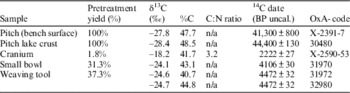
The results of the 14C dating of the pitch, the human cranium, and the two wooden artifacts (the bowl and the weaving tool), are presented in Table 2 (see Ostapkowicz et al. Reference Ostapkowicz, Brock, Weidenhoeft, Snoeck, Pouncett, Baksh-Comeau, Schulting, Claevs, Mattielli, Richards and Boomertin press, for further discussion).
14C results for the pitch, the human cranium, and two wooden artifacts. The percentage yield, δ13C value, and % carbon content on combustion of all samples are recorded, as well as the C:N ratio of the cranium.

Pitch 14C Dates
The two uncalibrated 14C dates on the different samples of pitch both gave similar results close to background 14C levels, of 41,300±800 BP and 44,400±1300 BP (Table 2). These dates are in agreement with dates for Rancho La Brea tar, as recorded by Fuller et al. (Reference Fuller, Fahrni, Harris, Aisling, Coltrain, Gerhart, Ward, Taylor and Southon2014). The asphalt from both sites is expected to be geological in origin and therefore beyond the range of 14C, but the dates likely reflect the input of modern carbon from plant material and sediment into the lake and tar pits.
14C Date of the Human Cranium
The sample of bone from the human cranium yielded 1.8% wt collagen, which dated to 2222±27 BP. The collagen was fluffy with a very pale golden color, in contrast to some of the contaminated collagen from Rancho La Brea, which was described as “tan” and “very dark brown to black” by Fuller et al. (Reference Fuller, Fahrni, Harris, Aisling, Coltrain, Gerhart, Ward, Taylor and Southon2014). Several small black specks, presumably of insoluble pitch, were clearly visible within the freeze-dried collagen but were easily removed by hand prior to combustion and dating. The C:N ratio of the collagen was 3.2, within the acceptable range of 2.9–3.5 (Ambrose Reference Ambrose1990), and the range of 3.2–3.5 suggested by Fuller et al. (Reference Fuller, Harris, Farrell, Takeuchi and Southon2015) for bones from Rancho La Brea. The %C content of 41.7% was consistent with recorded values for collagen (Ambrose Reference Ambrose1990). Neither the C:N ratio and %C suggested the presence of additional carbon which would have been expected with residual pitch.
The known-age bone standard that was treated and dated alongside the cranium to assess for any contamination introduced during pretreatment (especially the extensive solvent extraction sequence) produced a date in line with expected values (Brock et al. Reference Brock, Bronk Ramsey and Higham2007), indicating that the pretreatment process itself had not added any old carbon to the sample.
The sample was not ultrafiltered (either to collect the >30 kDa fraction as routine at ORAU (Brock et al. Reference Brock, Higham, Ditchfield and Bronk Ramsey2010) or the >3 kDa and <30 kDa fractions outlined by Fuller et al. (Reference Fuller, Harris, Farrell, Takeuchi and Southon2015) for tar-steeped samples) primarily because ultrafiltration tends to result in a reduced sample yield. As the sample was already small (145 mg starting weight) any unnecessary loss of collagen was to be avoided where possible.
The original plan was also to use single amino acid dating on the cranium to verify the date, but there was insufficient material to do this. However, the combination of the pale golden color of the collagen, the %C content and C:N ratio of the collagen, and the date of the associated known-age standard, all indicate that the collagen extracted from the cranium sample was not contaminated with pitch and that the date of 2222 ±27 BP is accurate.
14C Dating of Wooden Artifacts
Both the small bowl and the weaving tool yielded pretreated material that gave no indication by color of any residual pitch contamination. A few small specks of black insoluble residue were visible in both samples, as for the cranium, but were easily removed manually prior to dating. Both objects gave much older 14C dates than expected of 4106±30 BP and 4472±32 BP, respectively. There was not sufficient material available to redate either piece from scratch to confirm these dates, but there was sufficient pretreated material remaining from the weaving tool to combust and date again. The second date, however, was identical to the first (4472±32 BP), indicating that there had been no residual insoluble pitch in the first sample dated: it is highly unlikely that exactly identical amounts of contamination would have been present in both fractions to result in the same dates, and hence a contaminated sample would have been expected to yield two different dates.
Pretreated material from both the small bowl and the weaving tool therefore required further analysis to be able to demonstrate with confidence whether or not any pitch remained in the wood after pretreatment that could have resulted in older dates than expected.
It should be noted that two dates on a sample taken from a different location on the small bowl were also much older than expected (4197±32 BP (OxA-31395) and 4273±29 BP (OxA-31496); Ostapkowicz et al. Reference Ostapkowicz, Brock, Weidenhoeft, Snoeck, Pouncett, Baksh-Comeau, Schulting, Claevs, Mattielli, Richards and Boomertin press) but no untreated or treated material remained for further investigation.
Pyrolysis-GC/MS
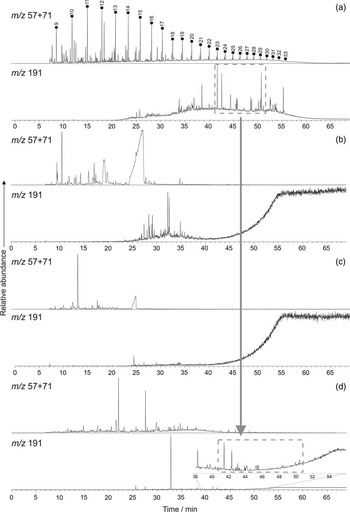
Py-GC/MS is a highly sensitive technique, and has been used to characterise geological and petrochemical samples, including the use of asphalt in historical artwork (Languri et al. Reference Languri, van der Horst and Boon2002). The technique was used to look for specific markers in the pretreated sample material that would have been present in pitch but not in plant wood, in particular the presence of alkene/alkane doublets typical of asphaltenes and hopanes (m/z 191). Attwooll and Broome (Reference Atwooll and Broome1954) state that 33% of total soluble bitumen from Pitch Lake is comprised of asphaltenes. Figure 1(a–c) depicts py-GC/MS mass chromatograms obtained for the pitch crust and two weaving tool samples. Both n-alkene/n-alkane doublets and hopanes, used as proxies for total contamination, were detected in a sample of crust collected from Pitch Lake in 2014, but neither were detected in either the untreated or treated material from the weaving tool, suggesting that the 14C date was reliable.
Full m/z 57+71 (alkane) and m/z 191 (hopane) mass chromatograms for (a) pitch crust (peaks with filled circles indicate n-alkene/n-alkane doublets, indicative of asphaltenes; accompanying numbers indicate the carbon chain lengths of the homologues), (b) untreated weaving tool, (c) treated weaving tool, and (d) cranium (minor contamination, as shown by the hopane distribution matching that of the pitch crust).

Material from the small bowl was not analysed using py-GC/MS as pitch was clearly visible in the untreated sample, and there was insufficient material remaining of the pretreated wood.
No distribution of n-alkene/n-alkane doublets, indicative of asphaltenes, was observed in untreated bone powder from the cranium. A low intensity distribution of hopanes, paralleling those observed in the pitch tar, was observed, however (Figure 1d). This indicates that sampling had been largely successful in avoiding surface pitch contamination, but confirmed that some pitch was present prior to pretreatment.
Optical Microscopy
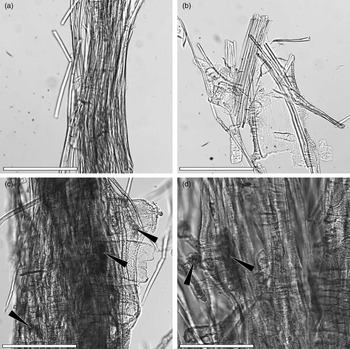
Pretreated material from both the weaving tool and the small bowl were studied using optical microscopy to look for visual indications of residual pitch. No pitch was observed within the pretreated material from the weaving tool (Figure 2a, b), but pitch was clearly still present in the treated wood from the small bowl (Figure 2c, d). The weaving tool, while black in color, had not appeared to be heavily contaminated with pitch when sampling, unlike the small bowl that did clearly contain large quantities of pitch across the surface of the bowl, as well as retaining some within its cavity.
(a) and (b): images of weaving tool. (a): a group of fibers show hyaline cell walls and no cell contents. (b): the cell walls are similarly hyaline in fibers, parenchyma cells, and a partial vessel element. (c) and (d): images of small bowl. (c): arrowheads show tar inclusions in cells. Partial vessel elements and individual fiber cell walls are hyaline but fiber groups and parenchyma cells show a general pigmentation and areas of tar retention. (d): a higher-magnification image with individual cells showing pigmented contents. Scale bars: (a)–(c)=200 µm; (d)=100 µm.

The microscopy analysis supports the findings of the py-GC/MS, indicating that after pretreatment the sample from the weaving tool was not contaminated with pitch and that the 14C date is reliable. However, the small bowl was still contaminated, and the date is therefore likely to be too old and can only be considered a terminus post quem. It is extremely difficult to estimate the extent of the pitch contamination within the small bowl from the microscopy alone, although we cautiously estimate it is no more than 10%, and maybe as low as 1–5%. A similar date to that given for the bowl could be produced from a sample with a date of ~3400 BP and just 10% pitch contamination; a date of ~3700 BP would yield a similar date with 5% residual pitch.
Comparison of 14C Dating Wood and Bone from Rancho La Brea, California, and Pitch Lake, Trinidad
The results from this study highlight the potential differences in chemical structure and behaviour of the asphalt at the Rancho La Brea tar pits in California and Pitch Lake in Trinidad.
The artifacts from Pitch Lake do, however, seem remarkably clean of pitch in general, compared to the descriptions of material from Rancho La Brea, where samples are described as heavily impregnated with pitch. The reason for the difference in pitch penetration between the two sites is unclear. It may be related to differences in chemical composition of the pitch, and may also reflect the fact that many of the Rancho La Brea specimens were submerged for many thousands of years longer than those in Pitch Lake. A co-author of this communication (ACW) has studied plant material from both sites, and noted that the botanical specimens from Rancho La Brea were often much smaller than the Pitch Lake artifacts, and so may have been fully impregnated far more readily, especially over the extended period submerged in pitch.
The general lack of surface pitch on many (but not all) of the Pitch Lake pieces may also be influenced by unrecorded cleaning of the artifacts when they first emerged from the lake. Verbal reports from locals living close to Pitch Lake suggest that at least some of the artifacts dredged from the lake may have been cleaned in kerosene to remove pitch, but there are no further details or written records to support this.
CONCLUSIONS
As the wooden artifacts and human skeletal remains from Pitch Lake had been submerged in pitch for hundreds of years, it was vital to demonstrate the absence of pitch in the material for dating after pretreatment, especially where dates were earlier than anticipated based on current understanding of the archaeology of Trinidad.
A solvent extraction sequence comprising toluene and methanol similar to that applied to dating fossil material from the Rancho La Brea tar pits in California (Fuller et al. Reference Fuller, Fahrni, Harris, Aisling, Coltrain, Gerhart, Ward, Taylor and Southon2014) was identified as the most effective method of removing pitch contamination from wooden artifacts and human skeletal remains from Pitch Lake. Remaining insoluble residue was clearly visible in any pretreated wood or collagen and could easily be removed manually prior to combustion and dating.
14C dates for several artifacts were earlier than had been anticipated, potentially indicating the presence of residual pitch after pretreatment. As well as routine laboratory quality assurance criteria, more rigorous techniques were required to identify the presence of residual pitch, in particular for wooden artifacts due to the plant origins of much of the pitch. Py-GC/MS and optical microscopy were therefore applied to untreated and pretreated material where suitable and when sufficient material was available.
Py-GC/MS demonstrated that bone powder from the human cranium had successfully been sampled away from regions of pitch contamination with only trace amounts of pitch-derived chemical markers remaining. The C:N ratio and %C content of the collagen were both within expected ranges and did not suggest the presence of an additional source of carbon. The pale golden color of the collagen further supported this, and overall we conclude that the date of 2222±27 BP is accurate.
Two identical dates of 4472±32 BP were produced from the same sample of pretreated material from the weaving tool. Not only was this the earliest date from this corpus, it is also earlier than cotton cultivation was expected to have started in Trinidad (Arie Boomert, personal communication). The pretreated wood was pale yellow in color as expected, and gave no visual indication of residual pitch other than several small specks of insoluble pitch which were easily removed manually prior to dating. Py-GC/MS did not detect the typical asphaltene (n-alkene/n-alkane doublets) and hopane signatures characteristic of pitch in either untreated or pretreated material from the artifact, indicating that sampling had occurred sufficiently far away from any pitch. This is further supported by optical microscopy analysis of the pretreated material that did not find any erroneous contaminants (see also Ostapkowicz et al. Reference Ostapkowicz, Brock, Weidenhoeft, Snoeck, Pouncett, Baksh-Comeau, Schulting, Claevs, Mattielli, Richards and Boomertin press).
The small bowl, which was clearly contaminated with pitch, gave a date of 4106±30 BP. Microscopy demonstrated the presence of residual pitch, and hence in this case we conclude that the pretreatment protocol was not rigorous enough and the date can be treated only as a terminus post quem.
This study demonstrates the importance of using varied and relevant techniques to assess the presence of remaining contamination when dating difficult samples. In the case of artifacts from Pitch Lake, it appears that the chemical pretreatments applied here are suitable for some samples but were not rigorous enough for the more-heavily contaminated small bowl.
ACKNOWLEDGMENTS
The “Black Pitch, Carved Histories” project was funded by AHRC grant AH/L00268X/1, while Brock was employed at the Oxford Radiocarbon Accelerator Unit, University of Oxford. The authors wish to thank the following institutions: The National Museum and Art Gallery of Trinidad & Tobago, particularly Lorraine Johnson for supporting work relating to the human cranium and the small bowl; Molly Gaskin (Pointe-a-Pierre Wildfowl Trust, Trinidad), Chris Harris and the late Peter O’Brien Harris, for permissions to sample the weaving tool. We also thank Marlon Green of the National Trust of Trinidad and Tobago and Jalaludin Khan, heritage conservation consultant, for their support of the project. Arie Boomert provided the sample of pitch crust. Ben Fuller and John Southon are thanked for helpful discussions on removal of tar from Rancho La Brea specimens. The authors thank the Natural Environment Research Council, UK, for partial funding of the mass spectrometry facilities at Bristol (Contract No. R8/H10/63; http://www.lsmsf.co.uk).