INTRODUCTION
A defining feature of the late Mesolithic culture known as the Ertebøllekultur (=EBK: ~5400– 3900 cal BC) in Denmark is the occurrence of the so-called køkkenmøddinger (Andersen Reference Andersen2007, Reference Andersen2008). These large shell middens (or “kitchen middens”) occur predominantly in northeastern Jutland and represent the most notable archives of information on the lifeways of the last hunter- gatherers in southern Scandinavia. Moreover, it is at some of these sites that continuity in occupation from the EBK to the Tragtbægerkultur (Funnel Beaker culture=TRB: 4000–3300 cal BC) has been documented and, thus, the Mesolithic–Neolithic transition attested (Andersen Reference Andersen1995, Reference Andersen2008). This was characterized by a change in subsistence from hunter-fisher-gatherer adaptations to economies that relied on a mixture of wild and domestic resources (Price Reference Price2015).
Shell middens that cover the sequence from the EBK to the TBK are characterized by a shift in taxonomic dominance from European flat oyster (Ostrea edulis Linnaeus 1758) to common cockle (Cerastoderma edule Linnaeus 1758) (e.g. Andersen Reference Andersen1995). Shellfish are unlikely to have represented major staple resources (Milner Reference Milner2002, Reference Milner2005, Reference Milner2013), but would have been important in maintaining the balance of the hunter-gatherer economies of northeastern Jutland, particularly “to plug seasonal gaps” in resource availability (Rowley-Conwy Reference Rowley-Conwy1984). A shift from oysters to cockles may, thus, have required readjustments in the seasonal cycles of the late EBK and early TBK economies. Some scholars have even argued that the impact of such a shift may have been so dramatic as to have favored the introduction of agro-pastoralism into southern Scandinavia (Rowley-Conwy Reference Rowley-Conwy1984).
A recent study by Lewis et al. (Reference Lewis, Ryves, Rasmussen, Olsen, Knudsen, Andersen, Weckström, Clarke, Andrén and Juggins2016) investigated the cause of the above-mentioned oyster-to- cockle shift that took place at numerous sites in Jutland, exploring different hypotheses that may explain it, such as (1) a decline in salinity of inner coastal waters, (2) a reduction in tidal amplitude, (3) a temperature decline at the end of the Holocene thermal maximum, (4) the effect of increased sedimentation on the availability of suitable habitats for oysters, and (5) changes in food culture favoring cockles during the TBK. Lewis et al. (Reference Lewis, Ryves, Rasmussen, Olsen, Knudsen, Andersen, Weckström, Clarke, Andrén and Juggins2016) conclude that the shift from oysters to cockles was the result of a decline in temperature and of increased sedimentation, which would have reduced suitable habitats for oysters.
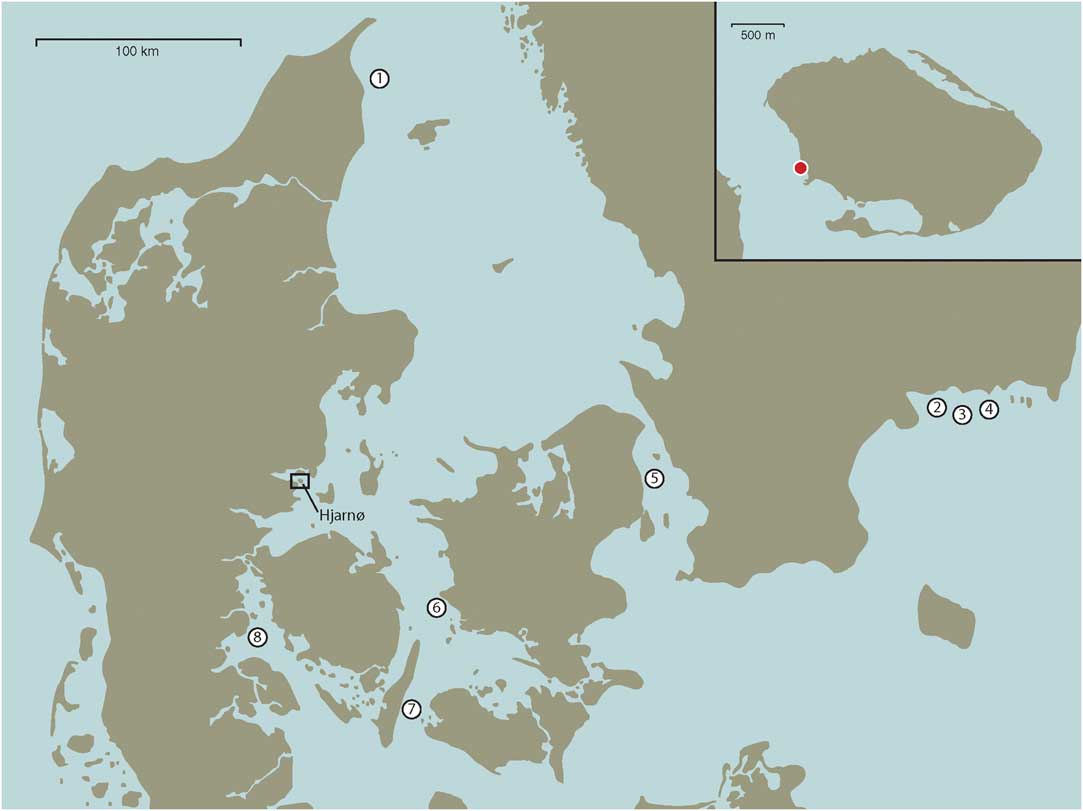
The present distribution, both in space and time, of known Mesolithic shell middens probably reflects post-depositional disturbance on the archaeological record resulting from relative sea level rise (Andersen Reference Andersen1995, Reference Andersen2000, Reference Andersen2007, Reference Andersen2008). For this reason, it remains to be established whether middens may have been present in parts of southern Scandinavia that are now submerged, as well as earlier than the classic Ertebølle period. The recent discovery and excavation of a submerged Mesolithic site (Hjarnø Sund; Figure 1) on the island of Hjarnø in Horsens Fjord (Skriver et al. Reference Skriver, Borup and Astrup2017) provides us with a rare opportunity to explore both these issues. Here we report the results of the accelerator mass spectrometry radiocarbon (AMS 14C) dating of shells and charcoal recovered at the site, as well as preliminary findings of the zooarchaeological study on the marine mollusk remains, which are essential to contextualize the 14C dates.
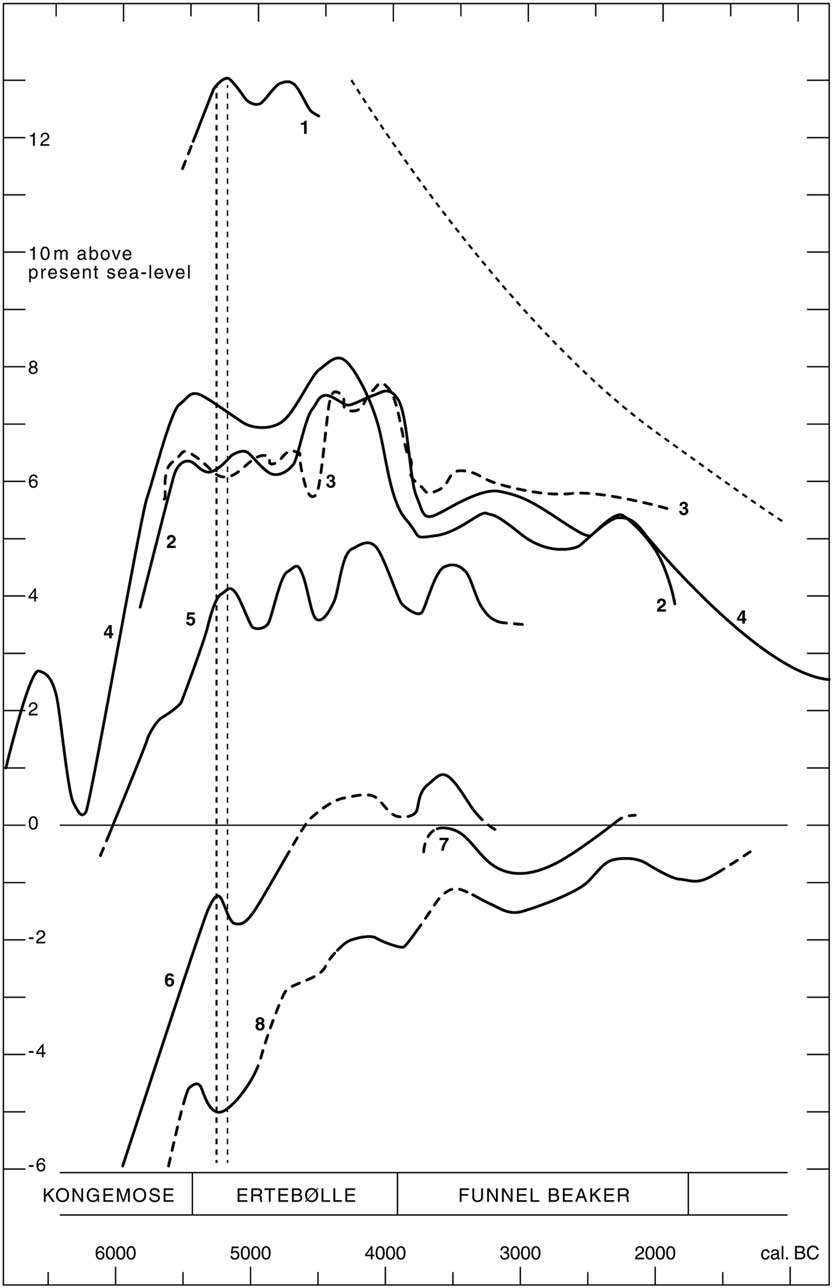
Location of Hjarnø in Horsens Fjord (central-eastern Jutland). The position of the shell midden of Hjarnø Sund is indicated by the red circle in the inset on the top right corner. The position of the eight shoreline displacement curves mentioned in Figure 5 are shown by the following points: (1) Yderhede; (2–4) Blekinge; (5) Vedbæk; (6) Halsskov; (7) Langeland; (8) Western Baltic. Modified after Christensen and Nielsen (Reference Christensen and Nielsen2008: figure 6: 36).

The Site and Its Excavation
Hjarnø Sund is one of 37 submerged sites that have been identified in Horsens Fjord (central- eastern Jutland; Figure 1) and currently lies at a depth of 0.5–2.0 m, as a result of sea level rise from the Atlantic chronozone onwards in the Holocene (Borup Reference Borup2003; Skriver et al. Reference Skriver, Borup and Astrup2017). The site has been known since the 1950s, but interventions on it only started after 2008, when it was noticed that the gyttja deposits covering it had started eroding and that the site is under threat. For this reason, emergency excavations or recoveries of eroding finds have been performed at the site almost every year since 2010 (Skriver et al. Reference Skriver, Borup and Astrup2017). The artifacts from the site include objects made of flint (e.g. transverse arrowheads), antler (e.g. pressure flakers, ax heads) and wood (e.g. paddles, tool shafts). On typological grounds, these finds can be attributed to the late Kongemose and Ertebølle cultures. One of the two paddles found has been 14C dated to 4700–4540 cal BC, which chronologically coincides with the middle of the Ertebølle period (Skriver et al. Reference Skriver, Borup and Astrup2017).
The work carried out at Hjarnø Sund, including campaigns of coring to establish its horizontal and vertical extension, has shown that the gyttja deposits also protect stratified shell deposits (Skriver et al. Reference Skriver, Borup and Astrup2017). At least two such accumulations have been located at the site: one discovered accidentally during sand dredging aimed at determining the vertical extent of the anthropic deposits; the second observed on the surface during the survey of the sea bed for the recovery of the artifacts eroding from the gyttja sealing it. The coring conducted at the site has shown that the former shell deposit covers an area of at least 120 m2 and that the shells were mainly of Ostrea edulis, Cerastoderma edule and Littorina littorea. All of these mollusks are typically found in Danish Mesolithic køkkenmøddinger, although their proportions in the deep deposit are yet to be quantified. The latter shell deposit, which is eroding and has been investigated through a 10-m-long trench, was located on a relatively steeply-shelving part of the shore and was probably stratified for much of its extent, containing predominantly the same three species mentioned above.
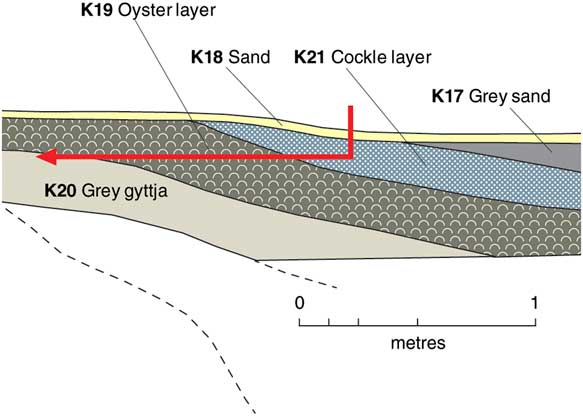
The stratified shell layers that are the object of the present article were sampled during the 2015 excavation (Skriver Reference Skriver2015). In most of the excavated area (ca. 10 m2; quadrats 1–10) only a layer dominated by O. edulis was present (Layer 1), probably as a result of marine erosion, which is still ongoing and which removed the upper part of the stratigraphic sequence (Figure 2). In the southern part of the excavated transect, however, in a small area corresponding to Quadrat 9 it was possible to intercept what appeared to be a higher portion of the stratigraphy (Layer 2). Observations in the field suggested that this layer was dominated by C. edule and clearly superimposed the layer dominated by O. edulis. It should be added that Layer 2, which was only partly investigated in 2015 (when the shell samples were taken), extends horizontally over more than three metres and is overlain by gray sand and gyttja (Figure 2). The financial and temporal limitations of the excavations conducted to date, as well as the difficulty of working underwater, have prevented the full exploration of the sequence vertically below the cockle layer. Field observations, however, suggested that the material from Quadrat 9 directly overlain the material from Layer 1, which is represented by our sample from Quadrat 1. To verify the observations made in the field, regarding the composition and stratigraphic relationships of the shell layers, we undertook zooarchaeological and 14C analyses on shells from quadrats 1 and 9.
Stratigraphic section of the shell midden, showing the area in which the “oyster layer” (K19=Layer 1) is overlain by the “cockle layer” (K21=Layer 2). The red line indicates the area of the site from which bulk samples were taken for the study of the mollusk assemblage and for the AMS radiocarbon dating reported in this paper. Overall, the stratigraphic sequence includes, from the oldest to the youngest layers and moving from left (north end) to right (south end): a layer of grey gyttja (K20) overlying the bedrock, the “oyster layer” (K19), the “cockle layer” (K21), a grey sand layer (K17) and a brown gyttja layer (K1; to the right of the section displayed here). More information on the excavation and stratigraphy is provided by Skriver (Reference Skriver2015).

MATERIALS AND METHODS
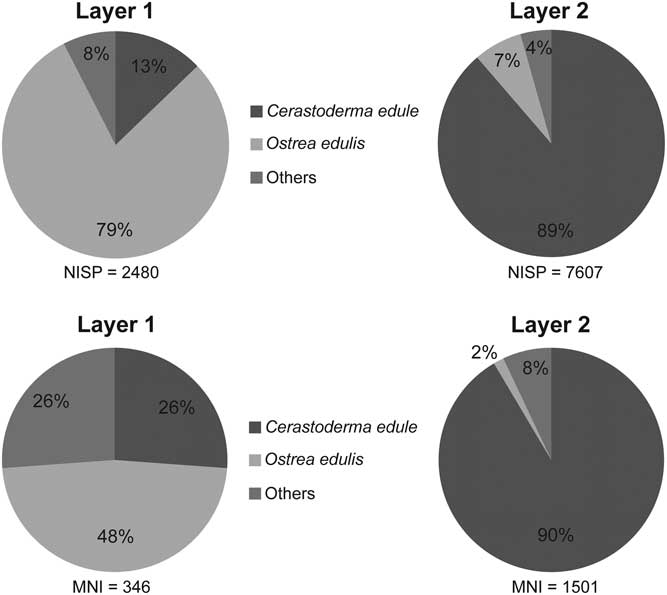
Here we report the preliminary results of the zooarchaeological study of the shells from quadrats 1 and 9 at Hjarnø Sund, which are essential to contextualize the absolute dating, and present the AMS 14C dates obtained on shells and charcoal fragments from the site. All shells recovered in quadrats 1 and 9 were sorted in the laboratory, after sieving through a 0.6-cm mesh. Shell material obtained through this screening was then quantified both with NISP (number of identified specimens) and MNI (minimum number of individuals) counts (Figure 3).
Percentages of the NISP and MNI counts for the main molluskan taxa in Layer 1 (=Quadrat 1) and Layer 2 (=Quadrat 9). In both layers/quadrats the category “Others” includes mainly Littorina littorea (common periwinkle) and Mytilus edulis (blue mussel), both of which are also commonly found in Danish Mesolithic shell middens.

A total of 8 shells were sampled for 14C dating: 4 specimens of O. edulis from Layer 1 and 2 specimens of both O. edulis and C. edule from Layer 2 (Table 1
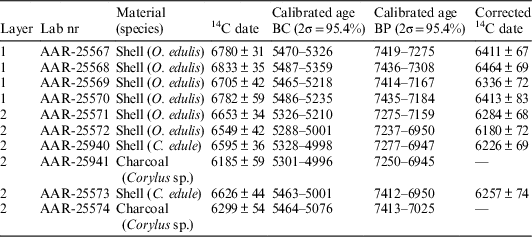
14C dates and calibrated ages of the shell and charcoal samples from Hjarnø dated at the AMS laboratory of Aarhus University (laboratory code: AAR). The shell and charcoal pairs from Layer 2 are AAR-25940 / AAR-25941 and AAR-25573 / AAR-25574. Calibrated ages have been obtained by calibration with OxCal 4.3 and IntCal13 (Bronk Ramsey Reference Bronk Ramsey2009; Reimer et al. Reference Reimer, Bard, Bayliss, Beck, Blackwell, Bronk Ramsey, Grootes, Guilderson, Haflidason, Hajdas, Hatté, Heaton, Hoffmann, Hogg, Hughen, Kaiser, Kromer, Manning, Niu, Reimer, Richards, Scott, Southon, Staff, Turney and van der Plicht2013), after subtracting the average local reservoir age R=369±59 14C yr (as shown in the column on the right). Unmodeled calibrated ages are displayed here.

; Figure 4). The latter two specimens were specifically selected because they contained charcoal fragments. These were identified as belonging to Corylus sp. (hazelnut), a relatively short-lived tree species, and were thus dated. The objective of the latter was also to have terrestrial materials for dating Layer 2 and, given that the charcoal was found in clear association with the cockles, to estimate the reservoir effect for the area and time in question (which is useful to improve Bayesian models).
Bayesian model for Hjarnø Sund, based on the AMS 14C dates reported in Table 1.

Shell samples were cleaned in demineralized water in an ultrasonic bath for a few minutes. The outer 20–25% of the shells were removed by adding the equivalent amount of 1M HCl at RT. Possible organic contaminations were removed by wet oxidation with 7–8 drops of 0.25M KMnO4 in 25 mL demineralized water for 16–20 hr at 80°C. The samples were dissolved in 100% H3PO4 in evacuated seal-cap glass tubes. The evolving CO2 was graphitized using the H2 reduction method and an iron catalyst (e.g. Vogel et al. Reference Vogel, Southon, Nelson and Brown1984).
Charcoal samples were pretreated with a standard ABA method (1M HCl, 1M NaOH at 80°C to remove carbonates and humic substances, and 1M HCl at RT to remove any CO2 obtained during the NaOH step). They were converted to CO2 by combustion in sealed evacuated quartz tubes containing 200 mg pre-cleaned CuO. 14C dates were measured at the Aarhus AMS Centre, Department of Physics and Astronomy, Aarhus University. Dating results are reported as conventional 14C dates BP (Stuiver and Polach Reference Stuiver and Polach1977), while calibrated ages as cal BC. The dates were calibrated with OxCal 4.2 and IntCal13 (Bronk Ramsey Reference Bronk Ramsey2009; Reimer et al. Reference Reimer, Bard, Bayliss, Beck, Blackwell, Bronk Ramsey, Grootes, Guilderson, Haflidason, Hajdas, Hatté, Heaton, Hoffmann, Hogg, Hughen, Kaiser, Kromer, Manning, Niu, Reimer, Richards, Scott, Southon, Staff, Turney and van der Plicht2013).
Reservoir ages of cockle shells were calculated by simple subtraction of the 14C ages of shell-charcoal pairs.
RESULTS
Zooarchaeology
The examination of the mollusk remains from Hjarnø Sund testifies that they represent shell waste resulting from human consumption. In facts, the mollusk assemblage includes a limited array of species and almost exclusively those that were typically collected by Mesolithic hunter- gatherers for food, such as Ostrea edulis Linnaeus 1758, Cerastoderma edule (Linnaeus 1758), Littorina littorea (Linnaeus 1758) and Mytilus edulis Linnaeus 1758 (e.g. Andersen Reference Andersen1995, Reference Andersen2000, Reference Andersen2007, Reference Andersen2008; Milner Reference Milner2002, Reference Milner2005, Reference Milner2013; Nielsen Reference Nielsen2008). Taphonomic observations on the shells indicate that practically all of the thousands of specimens examined have pristine internal valves. Epizootic infestations (e.g. Polydora, Balanus and Cliona) are limited to the outer surfaces, which is compatible with live collection and subsequent discard of the shells following the consumption of mollusk flesh. It should also be noted that the shells were not found paired, as occurs in natural shell beds, and biometric analyses show that specimens of O. edulis and C. edule are almost exclusively large (adult) specimens. Moreover, the shell layers at Hjarnø Sund are clearly anthropogenic given that, as one would expect in the case of middens (e.g. Bailey Reference Bailey1993), they contain artifacts, bones of terrestrial and marine fauna, charcoal and land snails. This evidence also testifies that the shell deposits accumulated, in all likelihood, when the site was still emersed.
The results of our zooarchaeological investigation confirm the observations made in the field on which species were most abundant in the two excavated shell layers. Layer 1 (=Quadrat 1) is dominated by O. edulis, while Layer 2 (=Quadrat 9) is dominated by C. edule (Figure 3). The proportional representation of cockles is higher in both cases using MNI counts (respectively 26% and 90%), but this does not affect the relative importance of the taxa in the two layers. It can, thus, be concluded that during the accumulation of Layer 1, collection by hunter-gatherers on Hjarnø was focused on oysters, although cockles accounted for between a tenth and a quarter of the marine mollusks discarded at the site. During the accumulation of Layer 2, on the other hand, cockles were by far the most important taxon and oysters accounted for less than 10% of the marine mollusks dumped onto the shell midden. A preliminary biometric analysis does not suggest a decrease in the size neither of O. edulis nor of C. edule (although in the case of the former only a limited number of intact specimens is available from Layer 2).
Radiocarbon Dating
The results of the AMS 14C dating on shells and charcoal are reported in Table 1. The calibrated ages span from ~5500 to ~5000 BC. As the oldest køkkenmøddinger date to ~5600 BC (Andersen Reference Andersen2007), the eroding shell midden at Hjarnø Sund is clearly one of the earliest-known in Denmark. However, it should be added that the excavations conducted to date only explored part of this midden and it cannot be excluded that both middens at the site contain older layers.
Reservoir ages (R) were calculated for two cockles by subtracting the 14C ages of the charcoal fragments from those of the shells within which they were found. For the first pair R is 410±69 14C yr, for the second 327±70 14C year, while the average R is 369±59 14C yr (weighted average of the two R values; the uncertainty is the standard deviation of the two, as it is larger than the variance of the weighted mean, which would be 49 14C yr). The reservoir ages for “our” pairs are the same as for pairs from Horsens Fjord measured by Olsen et al. (Reference Olsen, Rasmussen and Heinemeier2009) and dating to around 7150 cal BP (ca. 5200 cal BC). These authors obtained an R of 340±88 for a pair of shell and terrestrial sample from 6950–7259 cal BP and an R of 349 yr (154–502, 95.4%) as the difference between the age model and the shell age model from the same time. The reservoir age reconstructions for Horsens Fjord from our study and from Olsen et al. (Reference Olsen, Rasmussen and Heinemeier2009) overlap and are within error margins from each other. We, thus, used the average R of 369±59 14C yr to correct all shell dates obtained for this study. As Hjarnø Sund is located in a shallow fjord, atmospheric influence was assumed to be greater than oceanic influence and the terrestrial calibration curve IntCal13 (Reimer et al. Reference Reimer, Bard, Bayliss, Beck, Blackwell, Bronk Ramsey, Grootes, Guilderson, Haflidason, Hajdas, Hatté, Heaton, Hoffmann, Hogg, Hughen, Kaiser, Kromer, Manning, Niu, Reimer, Richards, Scott, Southon, Staff, Turney and van der Plicht2013) was used, after subtracting the average reservoir age from the shell dates.
For a simple Bayesian age model (Figure 4), we assumed that the samples from one layer fall within one phase, and that Layer 1 is older than Layer 2, based on the measured 14C ages (Table 1) and the archaeological observations on the stratigraphy described above. These assumptions are supported by a good agreement in the model. This enables us to estimate the date for the transition from phase 1 to phase 2, and to calculate a possible time gap between the two phases. The Bayesian model estimates that the first phase is ~5500–5300 BC, while the second phase is ~5300–5200 BC. Each phase represents the accumulation of a single layer. The distance in time between the two phases is, with 95.4% probability, between 0 and 163 yr; a hiatus between the phases can, therefore, not be established.
DISCUSSION
The AMS 14C dating conducted for this study attests that the Mesolithic shell midden at Hjarnø Sund, which is currently being eroded by currents and wave action, is one of the oldest such deposits in Denmark (Andersen Reference Andersen1995, Reference Andersen2000, Reference Andersen2007, Reference Andersen2008). A site that overlaps in age with Hjarnø Sund and, during the occupation of which the same shellfish were exploited, is Norslund in Norsminde Fjord (Andersen and Malmros Reference Andersen and Malmros1966; Andersen Reference Andersen1995). The fact that these two sites are not far from each other and have layers attesting contemporary occupations, may be useful for reconstructing relative sea level change in Horsens Fjord.
The available chronology for Hjarnø Sund attributes the shell-matrix layers at the site to a time interval that ranges from the transition between the Kongemose and Ertebølle cultures (Layer 1: 5500–5300 cal BC) to sometime during the early Ertebølle (Layer 2: 5300–5200 cal BC). The 14C data presented here support the observations made during the 2015 excavations at Hjarnø Sund, namely that the layer dominated by O. edulis was chronologically succeeded by that dominated by C. edule (which overlapped with the former only in a small part of the deposits sampled for the present study; Figure 2). The fact that both the shell layers extend over tens of meters suggests that the shift documented in this research was a real shift and not an “artifact” of the relatively small area over which our zooarchaeological investigation has shown C. edule to dominate the mollusk assemblage. We will now briefly discuss what factors may lie behind the oyster-to-cockle shift documented at Hjarnø Sund, given that numerous papers have already dealt in detail with this issue (e.g. Milner Reference Milner2002, Reference Milner2005, Reference Milner2013; Lewis et al. Reference Lewis, Ryves, Rasmussen, Olsen, Knudsen, Andersen, Weckström, Clarke, Andrén and Juggins2016).
A range of cultural factors can lead to the oyster-to-cockle shift in middens accumulated as a result of human consumption and discard (Milner Reference Milner2002, Reference Milner2005, Reference Milner2013). The establishment of dietary taboos may cause changes in mollusk consumption practices, but this is unlikely to explain the data at hand given that oysters continued being exploited, albeit in lower numbers. Human overexploitation can also be discarded as a possibility, given that available data do not show significant changes in shell size. Moreover, overexploitation of oysters would not directly result in an increase in cockles, because these two taxa require different substrates and thrive in different coastal habitats (e.g. Lewis et al. Reference Lewis, Ryves, Rasmussen, Olsen, Knudsen, Andersen, Weckström, Clarke, Andrén and Juggins2016). In addition, although the shift at Hjarnø occurred around the cultural transition between the Kongemose and the Ertebølle, which is thought to date ~5400 BC (Sørensen Reference Sørensen2017), it is unlikely that hunter-gatherers would suddenly (within 0–163 yr) ignore a locally available resource. This possibility is even more remote considering that oysters, and middens composed predominantly by them, are a defining feature of the Ertebølle, so much so that it has even been called the køkkenmøddingtid or “kitchen- midden-Age” (Andersen Reference Andersen2001).
As kitchenmiddens are accumulations of shells discarded following consumption of marine mollusks for food by humans, and foragers are selective in what they exploit, we should not assume that their taxonomic constituents and proportions are high fidelity representations of the communities available on nearby shores. In the case of very large middens such as Hjarnø Sund and other Ertebølle køkkenmøddinger in Jutland, however, this is the most parsimonious interpretation both on archaeological grounds (e.g. Andersen Reference Andersen1991, Reference Andersen1993, Reference Andersen1995, Reference Andersen2000, Reference Andersen2001, Reference Andersen2007, Reference Andersen2008) and ethnographic grounds. In fact, ethnographic and ethnoarchaeological studies show that foragers are unlikely to transport shellfish more than a few kilometres from their shores of collection and even less likely to do so in the case of taxa that occur in large concentrations, such as oysters (Waselkov Reference Waselkov1987). For instance the Anbarra people from Australia, would take shellfish back to base camp when this was located 1 km away from the shell beds, whereas when it was located 3 or more kilometers away, they would process mollusks at the shore and discard shells either at processing sites or “dinner-time” camps (Meehan Reference Meehan1982). In all these cases, middens will thus provide us with a good indication of what edible species may have been most abundant in their vicinity. According to Andersen (Reference Andersen1995, Reference Andersen2000, Reference Andersen2007, Reference Andersen2008), the location of Ertebølle sites depended upon the stability and access to marine resources in their vicinity and, although, he suggests that localities where fishing was most profitable were preferred, it should be noted that in most cases oyster beds were also nearby (i.e. easily within a few kilometers). We do not yet know the full extension of the two shell middens at Hjarnø Sund and our study has exposed just “the tip of the iceberg” of their accumulation, but it is likely that the hunter-gatherers at this site behaved in similar ways to those at other Ertebølle settlements.
The timing of the oyster-to-cockle shift at Hjarnø is intriguing, not only because it is the earliest similar shift documented at a Danish Mesolithic midden, but also because it coincides with an interval characterized by relative sea level fluctuations, linked to the Littorina Sea transgressions (Mertz Reference Mertz1924; Christensen Reference Christensen1995) at most of the localities for which shoreline displacement models are currently available (Figure 5; Christensen and Nielsen Reference Christensen and Nielsen2008). Ideally such models should be generated for every fjord, but at present this kind of data is not available for Horsens Fjord. This may be even more limiting in the case of this fjord that lies on the so-called tilt line and that may have been subject to subsidence at an unknown time in the past (Lykke-Andersen Reference Lykke-Andersen1979). Nevertheless, it is worth noting that the chronology of the oyster-to-cockle shift at Hjarnø coincides with a change in relative sea level attested by the shoreline displacement model for Halsskov Fjord on the Storebælt coast of Zealand, the closest locality for which such data are available (curve 6 in Figure 5). In the Storebælt, rapid sea level rise stopped around 5500–5400 cal BC. Within a century or so, the relative sea level fell and then started rising again (Christensen et al. Reference Christensen, Fischer and Mathiassen1997).
Sea level change (y-axis) over time (x-axis) at different localities in Denmark from Kongemose through the Ertebølle (coinciding with the Atlantic chronozone) and up to the Neolithic (Funnel Beaker period, coinciding with the Subboreal chronozone). The localities are: 1. Yderhede; 2. Blekinge (i); 3. Spjälkö; 4. Blekinge (ii); 5. Vedbæk; 6. Halsskov; 7. Langeland; 8. Western Baltic. Modified after Christensen and Nielsen (Reference Christensen and Nielsen2008: figure 5: 35).

We, thus, hypothesize that the oyster-to-cockle shift at Hjarnø Sund chronologically coincides with the stop in sea level rise and the consequent drop suggests that similar shifts were ultimately caused by relative sea level changes and their effect on shoreline displacement. This general tendency towards less exposed marine conditions is also corroborated by the fact that the explored sequence accumulated rapidly and was sealed by a gyttja layer, which must have deposited when the shore was more sheltered. In Horsens Fjord sea levels probably started rising again, soon after that, from ~7,000 yr ago (Borup Reference Borup2003).
During shoreline regression, beach ridges and other progradational coastal features are likely to have developed, which is also in line with the conclusions of the study by Lewis et al. (Reference Lewis, Ryves, Rasmussen, Olsen, Knudsen, Andersen, Weckström, Clarke, Andrén and Juggins2016) who state that the shift was the result of increased sedimentation, which would have reduced suitable habitats for oysters. Lewis et al. (Reference Lewis, Ryves, Rasmussen, Olsen, Knudsen, Andersen, Weckström, Clarke, Andrén and Juggins2016: 319) stated that “The underlying causes behind increased sedimentation rates in Danish Fjords in the Late Mesolithic / Early Neolithic period need to be investigated further” and that “individual fjord sedimentation rates are likely to be heavily influenced by topographical features such as fjord area, water depth and watercurrent systems.” The Atlantic chronozone was characterized by transgressions and regressions during the time of the Littorina Sea, when shorelines would have changed noticeably from area to area depending on local topography, bathymetry and substrate (e.g. Berglund et al. Reference Berglund, Sandgren, Barnekow, Hannon, Jiang, Skog and Yu2005; Christensen and Nielsen Reference Christensen and Nielsen2008). Our study shows that one worthwhile line of research to pursue in order to find the “underlying cause” may be the detailed investigation of shoreline displacements throughout Denmark. This is something that Christensen (Reference Christensen1995: 21) had already proposed to investigate the cause of the shift, given that it would have resulted “in a reduction in the exchange of water in the fjords and sounds or a complete closure of these.”
In fact, generating a local shoreline displacement model for the Horsens Fjord would also be the most direct way of testing our hypothesis for the data from Hjarnø Sund. We plan to investigate the case of Hjarnø by undertaking combined sclerochronological and isotopic analyses on the C. edule from the site to investigate the temperature, salinity, and turbidity (e.g. Milano et al. Reference Milano, Schöne and Witbaard2017) in Horsens Fjord before and after the oyster-to-cockle shift. Our hypothesis that this shift would have occurred (especially in fjords) whenever relative sea level rise stopped and was followed by a drop can, more generally, be tested broadly by matching zooarchaeological data from shell middens dated at high resolution, as we have done in this paper, with data for local shoreline displacement curves. However, at present this is not possible due to the lack of suitable relative sea level change data or of sites in areas for which archaeological data is available. For instance, it would be theoretically interesting to verify what effects the high frequency shoreline displacements that occurred in northeastern Zealand around Vedbæk from around 5200 to 3200 BC (Christensen Reference Christensen1995: fig 4: 17) may have had on the exploitation of shellfish by local hunter-gatherers. Unfortunately, archaeological evidence for shell middens is not available for northern Zealand and one can wonder whether this is a case of absence of evidence (and lack of research) or evidence of absence. If the latter were the case, it could be speculated that the reason for the lack of large shell middens may be due to the difficulties that foragers would have faced when relying intensively (even if only seasonally) on a resource subject to continual shifts in presence and abundance.
CONCLUSIONS
The 14C dating conducted as part of this study demonstrates that the intensive exploitation of marine mollusks, which in Denmark characterized the Ertebølle with the accumulation of large shell middens, dates back at least to the beginning of this Mesolithic period, if not to the Kongemose–Ertebølle cultural transition. A possible way to establish to what extent such subsistence strategies were also practiced earlier in the Kongemose is to excavate the shell midden threatened by marine erosion at Hjarnø Sund, as well as other submerged sites around Horsens Fjord and farther south in Denmark. This would allow us to improve our understanding of how shellfish exploitation developed during the Mesolithic in southern Scandinavia, as well as to reconstruct human adaptations to changing environmental conditions and specifically to changes in relative sea level.
To conclude, our study also shows that hunter-gatherers were clearly capable of adapting their subsistence strategies to rapid changes in environments. At Hjarnø Sund they did so by continuing to exploit locally available shellfish, despite the supposedly deleterious taxonomic shift from oysters to cockles.
ACKNOWLEDGMENTS
We thank the Aarhus University Research Foundation (Aarhus Universitets Forskningsfond) for funding the starting grant awarded to Marcello A. Mannino for the DEDiT (Danish and European Diets in Time) project (AUFF grant no. 21276), within the remit of which this research and the 14C dating have been conducted. For Johan S. Larsen, the write-up of this article was supported by the Danish National Research Foundation under the grant DNRF119 – Centre of Excellence for Urban Network Evolutions (UrbNet). M.A.M. is grateful to Søren H. Andersen for useful discussions on the topic of the oyster-to-cockle shifts. We would also like to acknowledge Louise Hilmar and Ea Rasmussen of the Grafisk Tegnestue at Moesgaard Museum and Emma O. Nielsen for assisting us in preparing the illustrations. Thanks are due to Peter Hambro Mikkelsen for identifying the charcoal fragments.