Introduction
Life events often precipitate the onset of medically unexplained symptoms (MUS) such as stomach ache, headache and fatigue (Mayou & Farmer, Reference Mayou and Farmer2002). For example, several studies have shown that infectious mononucleosis might precipitate chronic fatigue syndrome (Candy et al. Reference Candy, Chalder, Cleare, Peakman, Skowera, Wessely, Weinman, Zuckerman and Hotopf2003; Petersen et al. Reference Petersen, Thomas, Hamilton and White2006) and that MUS are associated with stressful events and difficulties prior to onset (Hotopf et al. Reference Hotopf, Mayou, Wadsworth and Wessely1999; Hatcher & House, Reference Hatcher and House2003). Traumatic events have also been described as precipitating factors for MUS (Escobar et al. Reference Escobar, Hoyos-Nervi and Gara2002; Hasset & Sigal, Reference Hassett and Sigal2002; Engel, Reference Engel, Schnurr and Green2003). Most of the studies that relate traumatic stress to MUS have been performed among Gulf War veterans and have found higher prevalence rates of unexplained symptoms among veterans than among control groups (Unwin et al. Reference Unwin, Blatchley, Coker, Ferry, Hotopf, Hull, Ismail, Palmer, David and Wessely1999; Gray et al. Reference Gray, Reed, Kaiser, Smith and Gastanaga2002; Thomas et al. Reference Thomas, Stimpson, Weightman, Dustan and Lewis2006). The majority of studies after disasters have focused on mental health problems such as post-traumatic stress disorder (PTSD), depression and anxiety, but a few have also examined physical symptoms comparable to MUS and found elevated levels among survivors (Escobar et al. Reference Escobar, Canino, Rubio-Stipec and Bravo1992; Van den Berg et al. Reference Van den Berg, Grievink, Yzermans and Lebret2005a, Reference Van den Berg, Grievink, Stellato, Yzermans and Lebretb).
Although high levels of symptoms are found among survivors, not every survivor develops symptoms, implying that some survivors are more at risk than others. Risk factors for physical symptoms among survivors of disasters have not often been studied; only a few potential risk factors, such as female gender and high levels of damage, have been consistently identified in disaster studies (Van den Berg et al. Reference Van den Berg, Grievink, Yzermans and Lebret2005a). Risk factors for symptoms that are often referred to as MUS have been studied most frequently among the general population and among war veterans, showing that female gender (Kroenke & Price, Reference Kroenke and Price1993; Wolfe et al. Reference Wolfe, Proctor, Davis, Borgos and Friedman1998; Hotopf et al. Reference Hotopf, Mayou, Wadsworth and Wessely1999; Feder et al. Reference Feder, Olfson, Gameroff, Fuentes, Shea, Lantigua and Weissman2001; Gray et al. Reference Gray, Reed, Kaiser, Smith and Gastanaga2002; Haug et al. Reference Haug, Mykletun and Dahl2004), low socio-economic status (Kroenke & Price, Reference Kroenke and Price1993; Wolfe et al. Reference Wolfe, Proctor, Davis, Borgos and Friedman1998; Hotopf et al. Reference Hotopf, Mayou, Wadsworth and Wessely1999), living alone (Kroenke & Price, Reference Kroenke and Price1993; Hotopf et al. Reference Hotopf, Mayou, Wadsworth and Wessely1999; Feder et al. Reference Feder, Olfson, Gameroff, Fuentes, Shea, Lantigua and Weissman2001) are risk factors for these symptoms. In addition to these predisposing factors, co-morbid psychological problems such as PTSD and anxiety have been described as perpetuating factors that maintain and exacerbate symptoms (Kroenke & Price, Reference Kroenke and Price1993; Wolfe et al. Reference Wolfe, Proctor, Davis, Borgos and Friedman1998; Feder et al. Reference Feder, Olfson, Gameroff, Fuentes, Shea, Lantigua and Weissman2001; Haug et al. Reference Haug, Mykletun and Dahl2004; Hotopf et al. Reference Hotopf, David, Hull, Nikalaou, Unwin and Wessely2004). Several studies among war veterans have indicated that these psychological problems, especially PTSD, mediate the relationship between traumatic exposure and physical symptoms (Schnurr & Green, Reference Schnurr, Green, Schnurr and Green2003; Norris et al. Reference Norris, Maguen, Litz, Adler and Britt2005).
Insight into factors that predict symptoms among survivors of disasters is useful to better understand the relationship between traumatic exposure and physical symptoms. In addition, information about risk factors could be important for health-care workers and policy makers as it facilitates both the detection of those at risk and the implementation of preventive interventions to reduce risk. It is, however, not known whether the risk factors that have been found in studies among the general population and among war veterans are similar for survivors of disasters. In addition, precipitating factors such as destroyed house and peritraumatic dissociation, which have been described as potential risk factors for symptoms (Engel, Reference Engel, Schnurr and Green2003), have not been examined in previous studies. In the present longitudinal study, we addressed two research questions. First, what are the predisposing (e.g. gender), precipitating (e.g. house destroyed) and perpetuating (e.g. anxiety) factors for physical symptoms (e.g. headache, fatigue) among survivors of a man-made disaster? Second, are risk factors for symptoms comparable between survivors and non-traumatized controls?
Method
Study design and participants
On 13 May 2000 a fireworks depot exploded in a residential area in the city of Enschede, The Netherlands. As a result of the explosion and subsequent fire, 23 people died, more than 900 were injured and about 1200 were forced to relocate because their houses were severely damaged or destroyed. The Dutch government declared this a national disaster and started a longitudinal study into the health consequences of the disaster.
Details of the study population and procedures have been described elsewhere (Roorda et al. Reference Roorda, Van Stiphout and Huijsman-Rubingh2004; Van den Berg et al. Reference Van den Berg, Grievink, Stellato, Yzermans and Lebret2005b; Van Kamp et al. Reference Van Kamp, van der Velden, Stellato, Roorda, van Loon, Kleber, Gersons and Lebret2006; Grievink et al. Reference Grievink, van der Velden, Stellato, Dusseldorp, Gersons, Kleber and Lebret2007).
In summary, the first wave (T1) of this study was performed 3 weeks post-disaster. Residents of the affected area were invited to participate in the health survey by means of letters and announcements in the local media. In total, 1567 affected residents (estimated response ≈30%) completed a questionnaire at T1.
Approximately 18 months post-disaster, from November 2001 to January 2002, the second wave (T2) was performed. All T1 participants who had given informed consent for future contact and who were not lost to follow-up due to death or emigration received an announcement letter. In addition, a sample of 1600 residents was drawn from the registry office in the city of Tilburg, The Netherlands, to serve as a control group. The control group was stratified according to sex, age and country of origin to make it comparable to the survivors who participated at T1.
To stimulate participation, survivors and controls were telephoned at home after the announcement letter was sent. If a respondent agreed to participate, a questionnaire was sent to their home address in their preferred language (Dutch, German, English or Turkish). Interpreters were available at a community centre to assist in completing the questionnaires. At T2, 1116 survivors out of 1551 eligible survivors (response 72%) and 821 controls out of 1600 eligible controls (response 52%) completed a questionnaire.
Nearly 4 years post-disaster (January–March 2004), a third survey (T3) was performed. Except for participants who were lost to follow-up, all survivors of T1 and all controls from T2 who had given written informed consent for future contact were invited to participate. Participation was encouraged by means of home visits and telephone calls. As at wave 2, interpreters were available at community centres to assist in completing the questionnaires. At T3, 51 survivors and 28 controls were lost to follow-up. In total, 995 out of 1516 eligible survivors (response 66%) and 589 out of 793 eligible controls (response 74%) completed a questionnaire at T3.
Measures
The questionnaires were comparable for survivors and controls but disaster-related questions were not included in the control questionnaire.
Physical symptoms
At T1, symptoms were measured by a 13-item questionnaire about subjective health complaints (VOEG-13; Van Sonsbeek, Reference Van Sonsbeek1990), a validated scale that has often been used for studies in the Dutch population. The items asked respondents whether they regularly had symptoms such as stomach ache, fatigue, headache and backache. At T2 and T3, this questionnaire was extended to 21 different symptoms (VOEG-21). In this study, the extended scale measured at T2 and T3 was used as the outcome variable (Van den Berg et al. Reference Van den Berg, Grievink, Stellato, Yzermans and Lebret2005b).
Predisposing factors
The following demographic and lifestyle characteristics were measured: sex, age, educational level, occupational status (having a paid job), cigarette smoking and immigrant status (first and second generation, mainly of Turkish origin). For survivors, self-reported pre-disaster psychological and relational problems reported at T1 were included.
Precipitating factors
Several experiences during or soon after the disaster were measured at T1: relocation due to a severely damaged or destroyed house; the loss of loved ones (family, colleagues, friends); and injury requiring medical treatment. In addition, several questions asked about what survivors had seen, heard and felt during the disaster. A scale was made for the 29 items; survivors with 18 or more experiences (80th percentile) were defined as having a high disaster exposure. Finally, the extent to which survivors had experienced peritraumatic dissociation during or immediately after the disaster was measured by the Peritraumatic Dissociative Experiences Questionnaire. The total score of this scale ranges from 10 to 50. Survivors with a score higher than 35 (80th percentile) were defined as having high levels of peritraumatic dissociation (Marmar et al. Reference Marmar, Weiss, Metzler, Wilson and Keane1997).
Perpetuating factors
Several mental health problems were measured at all waves of the health survey. For the survivors, the impact of event scale (IES) was used to measure intrusions and avoidance reactions, which serve as an indication for a clinical level of PTSD (Horowitz et al. Reference Horowitz, Wilner and Alvarez1979; Van der Ploeg et al. Reference Van der Ploeg, Mooren, Kleber, van der Velden and Brom2004). Survivors with an overall score above 25 were defined as having a high level of intrusions and avoidance reactions. Among survivors and controls, feelings of depression, anxiety and hostility were measured by the Dutch version of the 90-item Symptom Checklist (SCL-90; Derogatis et al. Reference Derogatis, Lipman and Covi1973). We dichotomized the scales into high (80th percentile) versus low scores, according to established references for the healthy Dutch population (Arrindell & Ettema, Reference Arrindell and Ettema1986). Sleeping difficulties were measured by the Groninger Sleep Quality Scale; the scale ranges from 0 to 10, respondents with a score above 4 were defined as having severe sleeping difficulties (Meijman et al. Reference Meijman, de Vries-Griever, de Vries and Kampman1985).
Statistical analysis
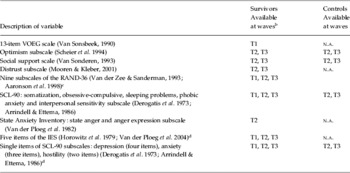
For both survivors and controls, all wave completers had different characteristics compared with non-respondents at follow-up (Van den Berg et al. Reference Van den Berg, van der Velden, Stellato and Grievink2007). Because deleting the incomplete cases might lead to biased results, we corrected for this selective response by means of multiple imputation (MI) (Rubin, Reference Rubin1987). This statistical method makes use of the intercorrelations of variables from the non-missing data to estimate plausible values for the data that are missing. MI is considered a better method for dealing with missing data than other more commonly used methods such as mean imputation (Rubin, Reference Rubin1987; Schafer & Graham, Reference Schafer and Graham2002). The outcome of interest (21 physical symptoms) and all risk factors, measured at the different waves, were included in the MI model. In addition, variables that correlated highly with the potential risk factors and with the symptom scale were selected because this increases the power of the multiple imputation model (Schafer & Graham, Reference Schafer and Graham2002). Table 1 presents the additional variables included in the MI model. We did not dichotomize any of the continuous variables entered in the model. We applied an adapted version of predictive mean matching using an SAS (SAS Institute Inc., Cary, NC, USA) macro that makes partial use of the SAS version 9.1 MI procedure (Lazzeroni et al. Reference Lazzeroni, Schenker and Taylor1990). Five datasets were generated in which the non-missing data are the same and the values imputed for the missing data vary between datasets. We analysed these datasets separately and combined the results using the mianalyze procedure in SAS, which produces valid confidence intervals by taking the uncertainty due to missing data into account.
Variables used in the multiple imputation model, in addition to the 21-item symptom scale and the selected potential risk factorsFootnote a

VOEG, Questionnaire into Subjective Health Complaints [Vragenlijst voor Onderzoek naar de Ervaren Gezondheid]; RAND-36, RAND 36-Item Health Survey; SCL-90, 90-item Symptom Checklist; IES, Impact of Event Scale; n.a., not available.
a Additional scales and items correlated r>0.50 with the 21-item symptom scale and the selected potential risk factors.
b To be included in the random coefficient analyses (RCA), scales had to be available at all three waves of the health survey.
c The subscales Physical functioning, Energy/fatigue and Mental well-being were not measured at T1.
d The IES was missing when two or more items were missing and the SCL-90 subscales were missing when three or more items were missing. As the individual items were less often missing and highly correlated with the subscales, these items were included in the imputation model.
Pearson correlation analysis was performed to investigate the relationships between the precipitating factors, perpetuating factors and reported symptoms.
Because the survey data were collected longitudinally, with three measurements times for the survivors, random coefficient analysis (RCA) was used to examine risk factors for symptoms among survivors. RCA takes into account the correlation between repeated measurements on a subject, and both subject-level (e.g. gender) and time-varying (e.g. depression) variables can be included simultaneously in the model. In the current analyses, random intercept models were used, which means that each subject has their own intercept (Singer & Willett, Reference Singer and Willett2003). Before performing RCA, multiple regression analyses were performed for symptoms at T2 and T3 separately to confirm that the direction and strength of associations between the risk factors and symptoms were similar for the two waves. RCA proceeded in four steps. In the first model we studied whether predisposing factors predicted symptoms at T2 and T3. In the second model, we added the precipitating factors to the model. In the third model, perpetuating factors at an earlier point in time (T–1) than the reported symptoms were added. In the fourth model, concurrent perpetuating factors were added.
As disaster-related factors were not measured in the control survey, considerably fewer risk factors were examined for the controls. The control group was included only at T2 and T3, and therefore risk factors could only be studied for symptoms reported at T3. For these reasons, multiple regression models were used to compare risk factors between survivors and controls. The survivor and control groups were analysed separately to determine whether the direction and strength of associations between the risk factors and symptoms reported at T3 were similar. These stratified analyses revealed that risk factors for symptoms among survivors and controls were comparable. The two groups were thus analysed in one model, with an indicator for ‘disaster exposure’ (survivors versus controls). Although the confidence intervals were overlapping, some factors appeared to differ between survivors and controls. For these factors, interaction effects were tested in the combined model.
Because respondents with chronic diseases could have symptoms that are associated with their disease, all results were adjusted for concurrent chronic diseases such as diabetes, cancer, asthma and chronic stomach disorders.
Results
Correlation analysis
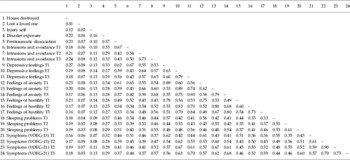
Table 2 shows the Pearson correlation coefficients among precipitating factors, perpetuating factors and physical symptoms reported by survivors. The correlation between physical symptoms at T1, T2 and T3 and the precipitating factors was low (0.05<r<0.19). There was a relatively strong correlation between psychological problems and physical symptoms (0.36<r<0.70). The correlation between the physical symptoms reported at the different points in time was also strong (0.57<r<0.90). The correlation coefficients were comparable for the control group (data not shown).
Pearson correlation coefficients among precipitating factors and perpetuating factors selected for random coefficients analyses for physical symptoms reported by survivors (n=1567) at T2 and T3Footnote a

VOEG, Questionnaire into Subjective Health Complaints.
a Continuous variables were used in the correlation analysis, except for house destroyed, lost a loved one and injury self.
Risk factors for symptoms reported by survivors
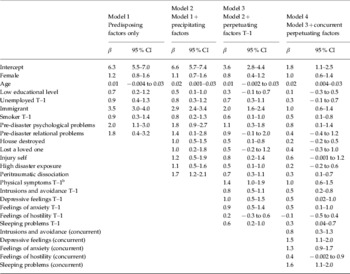
Table 3 presents the results of the RCA for symptoms reported by survivors at T2 and T3. In model 1, female gender, immigrant status, pre-disaster psychological problems and pre-disaster relational problems were the most important risk factors for self-reported symptoms. For example, female survivors reported on average 1.2 symptoms more on the 21-item symptoms scale than male survivors (β=1.2, 95% CI 0.8–1.6). These associations remained when precipitating factors were added to the regression model. Model 2 shows that disaster-related factors were associated with a higher mean number of symptoms among survivors. For example, survivors who had lost a loved one reported on average one symptom more than those who had not (β=1.0, 95% CI 0.2–1.8). These associations diminished after entering perpetuating factors into the model (models 3 and 4). With the exception of gender, the associations between predisposing factors and symptoms also diminished after adding perpetuating factors; the effects of low educational level and pre-disaster relational problems disappeared in model 3 (β=0.3, 95% CI −0.1 to 0.7 and β=0.9, 95% CI −0.1 to 2.0 respectively). In model 3, all distress reactions measured at an earlier time point, with the exception of feelings of hostility (β=0.2, 95% CI −0.3 to 0.6), were positively associated with a higher mean number of symptoms. This relationship diminished when concurrent perpetuating factors were added (model 4), indicating stronger associations between concurrent distress and symptoms. The full model showed a strong association between concurrent psychological problems and physical symptoms. In addition, female gender, immigrant status and pre-disaster psychological problems were important risk factors for self-reported symptoms at T2 and T3 in model 4.
Associations between predisposing, precipitating and perpetuating factors and physical symptoms among survivors (n=1567) reported at T2 and T3 of the longitudinal health surveyFootnote a

CI, Confidence interval.
a The regression coefficient (β) is adjusted for concurrent chronic diseases and represents the increase or decrease of symptoms reported on the 21-item symptom scale for survivors with that characteristic. Symptoms are: listlessness, fatigue, forgetfulness, ringing in the ears, pain in the chest and the region of the heart, lump in the throat, stomach ache, pain in the bones and muscles, nausea, dizziness, pain in the neck and shoulders, cold fingers, hand and feet, excessive sweating, pain in the back, headache, deafness, tight feeling in the chest, tingling in arms and chest, poor vision, shortness of breath, fainting.
b 13-item symptom scale (VOEG-13).
Risk factors for symptoms reported by survivors and controls
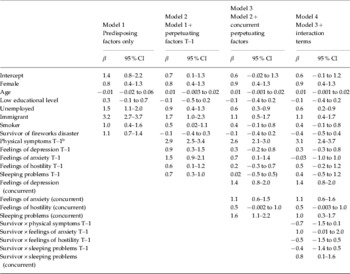
Table 4 shows the results of the multiple regression analysis in which potential risk factors for symptoms among survivors and controls were analysed together. When predisposing factors were controlled for, survivors of the disaster reported on average 1.1 symptoms more (β=1.1, 95% CI 0.7–1.4) at T3 than control subjects (model 1). When psychological problems were entered in the model (model 2), the associations between predisposing factors and symptoms diminished and the effect of disaster exposure disappeared (survivor of the fireworks disaster β=−0.1, 95% CI −0.4 to 0.3). In model 2, physical symptoms and different psychological problems measured at an earlier point in time were statistically significantly related to self-reported symptoms. These effects diminished or disappeared when concurrent psychological problems were added in model 3. Model 4 showed that among survivors and controls, female gender, no paid job, immigrant status, physical symptoms at an earlier point in time, as well as concurrent feelings of depression, anxiety and sleeping problems, were associated with physical symptoms at T3. There was an interaction effect between disaster survivor and concurrent sleeping problems (β=0.8, 95% CI 0.1–1.6), indicating that survivors with a high level of sleeping problems at T3 reported on average nearly one symptom more at T3 than did controls with a high level of sleeping problems. The associations between the other risk factors and symptoms were similar between survivors and controls.
Associations between possible risk factors and physical symptoms among survivors (n=1567) and controls (n=821) reported at T3 of the longitudinal studyFootnote a

CI, Confidence interval.
a The regression coefficient (β) is adjusted for chronic diseases and represents increase or decrease in symptoms on the 21-item symptom scale for survivors with that characteristic. Symptoms are: listlessness, fatigue, forgetfulness, ringing in the ears, pain in the chest and the region of the heart, lump in the throat, stomach ache, pain in the bones and muscles, nausea, dizziness, pain in the neck and shoulders, cold fingers, hand and feet, excessive sweating, pain in the back, headache, deafness, tight feeling in the chest, tingling in arms and chest, poor vision, shortness of breath, fainting.
b 13-item symptom scale (VOEG-13).
Discussion
In the present longitudinal study, we examined predisposing, precipitating and perpetuating factors for physical symptoms reported by survivors of a fireworks disaster. Female gender, immigrant status and pre-disaster psychological problems were the most important predisposing factors for symptoms reported 18 months and 4 years post-disaster. In addition, physical symptoms, intrusions and avoidance, depression and anxiety measured at an earlier point in time as well as concurrent intrusions and avoidance, depression, anxiety and sleeping problems were associated with a higher mean number of symptoms among survivors. The effect of precipitating factors, such as having one's house destroyed, was mediated by the perpetuating factors. Risk factors were comparable between survivors and non-traumatized controls.
In line with previous studies, female gender and pre-disaster psychological problems were important predisposing factors for symptoms (Kroenke & Price, Reference Kroenke and Price1993; Feder et al. Reference Feder, Olfson, Gameroff, Fuentes, Shea, Lantigua and Weissman2001). In the present study, immigrant status was also an important predisposing factor for physical symptoms. Immigrant status has less often been studied in relation to physical symptoms, and little is known about the relationship between ethnicity and physical symptoms. Despite this, it can be hypothesized that non-western immigrants are more likely to express feelings of distress in a somatic rather than in a psychological way. Indeed, Terheggen et al. (Reference Terheggen, Stroebe and Kleber2001) showed that Tibetan refugees were more likely to have a high score on somatically phrased items than on items that were phrased in a psychological way.
The analyses showed that the correlation between disaster-related factors, such as house destroyed and loss of a loved one, and self-reported physical symptoms at T2 and T3 was low. This finding differs from other disaster studies, in which it was found that high levels of damage due to the disaster was a risk factor for physical symptoms (Van den Berg et al. Reference Van den Berg, Grievink, Yzermans and Lebret2005a). Although disaster-related factors were related to physical symptoms in our regression models, this association diminished after adding distress reactions such as feelings of depression and anxiety to the model. Previous studies did not adjust for distress after the disaster. In addition, the association between peritraumatic dissociation, which has been proposed as a potential risk factor for physical symptoms and other distress reactions, also diminished after adjusting for psychological distress (Engel, Reference Engel, Schnurr and Green2003; Van der Velden et al. Reference Van der Velden, Kleber, Christiaanse, Gersons, Marcelissen, Drogendijk, Grievink, Olff and Meewisse2006).
These results support the hypothesis that distress following traumatic exposure mediates the association between exposure and physical health problems (Schnurr & Green, Reference Schnurr, Green, Schnurr and Green2003; Norris et al. Reference Norris, Maguen, Litz, Adler and Britt2005). Schnurr & Green (Reference Schnurr, Green, Schnurr and Green2003) proposed PTSD as the primary pathway through which trauma leads to physical health problems. In our study, the associations between depression and anxiety and symptoms were as strong as, or even stronger than, the association between symptoms of PTSD and physical symptoms. This suggests that PTSD might not be the primary pathway, but that other post-disaster distress reactions also mediate the relationship between exposure and physical symptoms.
High correlations were found among the different perpetuating factors and between the perpetuating factors and physical symptoms. High correlations between factors might result in unstable estimates and high standard errors. Collinearity diagnostics indicated that collinearity was not a problem in our regression models. However, the strong correlations do indicate a high level of co-morbidity among the disaster survivors. Previous studies among the general population and war veterans also found high levels of co-morbidity between depression, anxiety and PTSD and MUS (Kroenke & Price, Reference Kroenke and Price1993; Feder et al. Reference Feder, Olfson, Gameroff, Fuentes, Shea, Lantigua and Weissman2001). In addition, we found that about 65% of survivors with 10 to 14 symptoms and about 85% of survivors with 15 or more symptoms on the symptom scale reported high levels of depression and anxiety, suggesting that symptoms are related to, but not fully dependent on, psychological problems (Van den Berg et al. Reference Van den Berg, Grievink, Yzermans and Lebret2005a).
Although the results show a high level of co-morbidity between physical symptoms and psychological problems, the direction of the association is not clear. Psychological problems and sleeping problems are perpetuating factors in our model, but it is likely that physical symptoms also perpetuate sleeping problems and feelings of anxiety and depression. Therefore, health-care workers should be alert not only for physical symptoms among patients with sleeping problems, feelings of anxiety or depression but also for sleeping problems and psychological problems among patients with physical symptoms.
In the analyses comparing survivors and controls, the effect of disaster exposure disappeared after adding perpetuating factors to the model. This result supports the hypothesis that physical symptoms are more strongly related to distress than to the traumatic exposure and confirms previous findings that psychological problems are important risk factors for physical symptoms (Kroenke & Price, Reference Kroenke and Price1993; Wolfe et al. Reference Wolfe, Proctor, Davis, Borgos and Friedman1998; Feder et al. Reference Feder, Olfson, Gameroff, Fuentes, Shea, Lantigua and Weissman2001; Haug et al. Reference Haug, Mykletun and Dahl2004; Hotopf et al. Reference Hotopf, David, Hull, Nikalaou, Unwin and Wessely2004).
Risk factors for physical symptoms among survivors were also comparable with the risk factors for symptoms that are referred to as MUS among the general population and war veterans and were similar between survivors and controls (Kroenke & Price, Reference Kroenke and Price1993; Wolfe et al. Reference Wolfe, Proctor, Davis, Borgos and Friedman1998; Hotopf et al. Reference Hotopf, Mayou, Wadsworth and Wessely1999; Feder et al. Reference Feder, Olfson, Gameroff, Fuentes, Shea, Lantigua and Weissman2001; Gray et al. Reference Gray, Reed, Kaiser, Smith and Gastanaga2002; Haug et al. Reference Haug, Mykletun and Dahl2004). This indicates that risk factors for symptoms among disaster survivors are similar to risk factors for physical symptoms among other populations.
Some of the risk factors, such as pre-disaster psychological problems and pre-disaster relational problems, were not available for the controls and could not be studied for survivors and controls in the combined regression model. However, previous studies in the general population have shown that previous psychological problems and social problems are risk factors for physical symptoms, and therefore it is likely that these factors were also predisposing factors for symptoms among the controls (Katon & Walker, Reference Katon and Walker1998; Aggarwal et al. Reference Aggarwal, McBeth, Zakrzewska, Lunt and Macfarlane2006).
In the present study we examined risk factors for symptoms reported in a 21-item symptom scale. Although studying a high level of symptoms might provide information that is more useful for clinicians, we did not dichotomize the symptoms as there is no generally accepted convention on a cut-off point or a case definition for symptoms (Hiller et al. Reference Hiller, Rief and Brahler2006). In addition, the distribution of symptoms among survivors did not show a clear cut-off point and dichotomizing symptoms into a high and a low level of symptoms would have resulted in a loss of information. As studies have shown that different functional somatic syndromes (that exist of clusters of symptoms) share common risk factors (Aggarwal et al. Reference Aggarwal, McBeth, Zakrzewska, Lunt and Macfarlane2006), it is unlikely that clusters of symptoms among survivors of the fireworks disaster would have different risk factors.
This study has several strengths. First, information about disaster exposure was obtained 3 weeks post-disaster. Delay in data collection may introduce recall bias and important data may be lost forever. Second, we included a control group at T2 and T3, which gave us the opportunity to compare risk factors for symptoms between survivors and controls. Third, in contrast to most of the previous disaster studies that examined risk factors for physical symptoms, we were able to longitudinally analyse the risk factors, showing that, in addition to concurrent distress, distress reactions reported at an earlier point in time were risk factors for symptoms. This information is useful for screening of people at risk for developing symptoms.
Despite these strengths, some potential limitations should be considered. First, because only 30% of all affected residents participated in the first health survey, selective response and possible bias are of concern in this study. Shortly after the disaster, all affected adult residents were registered at an information and advice centre (IAC) that was established to supply information to survivors and to coordinate their needs. To detect possible selective participation, the database of the IAC was used to compare demographic characteristics of participants with those of the non-participants. Participation was somewhat selective: women, those living with a partner, those aged 45–64 years and immigrants were more likely to participate. However, further analyses of MI indicated that the prevalence estimates of health problems were barely affected by this selective participation (Grievink et al. Reference Grievink, van der Velden, Yzermans, Roorda and Stellato2006). In this database, it was also registered whether or not survivors had to relocate because of serious damage to their house. It was confirmed that participants and non-participants in the health survey did not differ with regard to relocation. Despite this, no information on emotional distress or loss of a loved one was registered in the IAC database. It is therefore unclear whether or not survivors with high levels of emotional distress were less likely to participate in the health survey, resulting in biased prevalence estimates of (psychological) health problems among survivors in the health survey. In addition, no information on personal injuries due to the disaster was available from this database. It is, however, possible that those with personal injuries were less able to participate in the health survey, which was completed at an air force base outside the city of Enschede 3 weeks post-disaster.
In addition, there was some selective response at T2 and T3. Among survivors, all wave completers (n=815) were more likely to be female, middle-aged, highly educated, native Dutch and to have a paid job than survivors who did not participate at all three surveys. Among the controls, those who participated at both surveys (n=793) were younger, more highly educated, and more likely to have a paid job than the controls who participated only at the first survey. Analyses of MI showed that this selective response hardly affected the prevalence estimates of health problems among survivors (Van den Berg et al. Reference Van den Berg, van der Velden, Stellato and Grievink2007).
Despite these results, we used MI in the present study to correct for selective response and to increase the power of the regression models. We believe that the MI model was adequate for predicting the missing data because it included variables related to missingness (e.g. gender, age, education). We also expected that the inclusion of additional variables in the imputation model (Table 1) that were strongly correlated with the variables of interest (containing missing values) increased the power of the MI model (Schafer & Graham, Reference Schafer and Graham2002). We have performed the RCA both with and without imputing the missing data for non-respondents. The results of the RCA without MI were similar to the results of the RCA with imputed values. This is in line with the findings that selective response hardly affected the prevalence estimates of health problems among survivors (Grievink et al. Reference Grievink, van der Velden, Yzermans, Roorda and Stellato2006; Van den Berg et al. Reference Van den Berg, van der Velden, Stellato and Grievink2007).
A second limitation of the current study is that symptoms were measured by means of a questionnaire. Symptoms reported in a questionnaires might be an overestimation of symptoms that are reported to the general practitioner (GP) because not all individuals seek medical care for their symptoms (Green et al. Reference Green, Fryer, Yawn, Lanier and Dovey2001). In addition, because only examination by a GP can exclude medical disorders, it is not known whether the symptoms reported by survivors and controls are medically unexplained (MUS) or can be explained by a medical disorder. However, in a recent study we found that symptoms reported by the survivors showed features similar to those of MUS, such as associations with functional impairment and high levels of psychological problems (Van den Berg et al. Reference Van den Berg, Grievink, Stellato, Yzermans and Lebret2005b). In addition, when presented to the GP, the majority of symptoms (56–91%) reported by survivors could not be explained by a medical disorder and were labelled as MUS (Donker et al. Reference Donker, Yzermans, Spreeuwenberg and van der Zee2002; B. van den Berg, unpublished manuscript).
Third, pre-disaster questionnaire data were not available for the population affected by the fireworks disaster. At T2 and T3 we included a stratified controls group to compare health problems among survivors with those of unaffected controls. Compared to this control group, the survivors of the fireworks disaster reported significantly more psychological problems and physical symptoms (Van den Berg et al. Reference Van den Berg, Grievink, Stellato, Yzermans and Lebret2005b; Grievink et al. Reference Grievink, van der Velden, Stellato, Dusseldorp, Gersons, Kleber and Lebret2007). Pre-disaster GP data were also available for the survivors of the fireworks disaster, and analyses of the GP data showed a considerable increase in health problems among survivors after the disaster compared to pre-disaster (Yzermans et al. Reference Yzermans, Donker, Kerssens, Dirkzwager, Soeteman and ten Veen2005).
To our knowledge, this is the first study that has thoroughly studied risk factors for physical symptoms among survivors of a disaster. Female gender, immigrant status and pre-disaster psychological problems were important predisposing factors for symptoms. Psychological problems such as PTSD and depression were important perpetuating factors for symptoms and mediated the relationship between traumatic exposure and symptoms that are often referred to as MUS. The risk factors were similar between survivors and controls and were comparable with risk factors that have been found in studies among the general population and war veterans. These results indicate that health-care workers should be alert for physical symptoms especially among females, immigrants and individuals with pre-disaster psychological problems. The high level of co-morbidity between psychological problems and physical symptoms that was found in this study also suggests that health-care workers might prevent the development and perpetuation of physical symptoms by treating these psychological problems.
Acknowledgements
This longitudinal study was part of the Enschede Firework Disaster Health Monitoring Project (GGVE) and was performed under the authority of and funded by the Ministry of Health, Welfare and Sports in The Netherlands. We thank Dr S. van Buuren and G. Jacobusse (TNO Quality of Life) for their statistical advice and Dr H. Boshuizen (RIVM) for the use of her SAS macro for predictive mean matching.
Declaration of Interest
None.