


It is well-understood that across groups and societies, people hold discriminatory attitudes toward social outgroups. One of the most politically consequential ways these attitudes can manifest is in preferences for exclusion, including exclusion from political institutions and power (Sidanius and Pratto Reference Sidanius and Pratto2001), the “imagined community” of a nation (Anderson Reference Anderson1983), or the country itself via restrictive immigration policies (Citrin and Sides Reference Citrin and Sides2008). Yet, despite such barriers and opposition, the ethnic and religious composition of many Western democracies continue to diversify and, in recent decades, at an accelerating pace (Putnam Reference Putnam2007). Within this context of growing diversity, cooperation across social groups is necessary for building and maintaining successful and well-functioning societies (Habyarimana et al. Reference Habyarimana, Humphreys, Posner and Weinstein2009; Singh Reference Singh2011). A crucial question then emerges: Can individuals with a strong preference for outgroup exclusion nevertheless put these preferences aside to cooperate and solve challenges of collective action?
There are many examples of the relevance of this question. Following the decline of de jure racial segregation in the United States, white citizens had to decide whether to cooperate with African Americans citizens or to retreat into enclaves of non-cooperation, thus hindering the provision of public goods such as schools. In South Africa, a similar challenge was faced with the end of apartheid and the increase in interactions across racial groups. Currently, anti-immigrant political parties and candidates in the United States and Western Europe have gained support, yet immigration to these places continues; to what degree are supporters of anti-immigrant policies willing to cooperate with immigrants in their communities? And in Israel, are Jewish citizens willing to cooperate with Palestinian Citizens of Israel (PCI)—despite the prevalence of exclusionary preferences toward this large and growing national minority?
Put in more general terms, the issue at stake is whether and to what degree exclusionary attitudes hinder cooperation. This question has implications for both the success of outgroup members in making political and economic gains and the ability of society as a whole to work together for the greater good. Are exclusionary attitudes separable from behaviors? Even if members of the hegemonic group express a preference for the exclusion of outgroup members, will they still work with outgroup members for their mutual benefit in the creation and allocation of public goods?
On the one hand, there is reason to believe that attitudes are separable from behaviors. Cooperation is often treated as a strategic choice that can be updated with repeated interactions with outgroup members and other learning processes (Axelrod Reference Axelrod2006). There is also evidence that private attitudes toward outgroups may not predict certain behaviors because the behaviors are guided by social norms (Paluck Reference Paluck2009) or because attitudes, as reported in surveys, are unstable and do not reflect the more careful deliberation that may proceed behavior (Zaller Reference Zaller1992). Yet, on the other hand, attitudes may strongly predict non-cooperative behaviors in light of evidence that exclusionary preferences are a matter of deeply held prejudicial distaste (Hainmueller and Hiscox Reference Hainmueller and Hiscox2010; Hainmueller and Hangartner Reference Hainmueller and Hangartner2013; Hopkins, Sides, and Citrin Reference Hopkins, Sides and Citrin2016).
These two approaches have very different implications for addressing the challenges faced by diverse societies. If cooperation is mostly a strategic choice, then economic incentives, interactions, or learning can result in a stable equilibrium of cooperation. But if non-cooperation reflects prejudicial exclusionary preferences, it might not be addressed simply by material incentives for cooperation or by providing new information about outgroups.
The connection between cooperation and exclusion remains underexplored in the theoretical and empirical literature because the two components of the relationship, cooperative behaviors and intergroup attitudes, tend to be studied separately in political science. Political scientists have developed a powerful standard toolkit for studying cooperative behaviors but have focused on institutional and contextual moderators of cooperation rather than on intergroup attitudes. Thus, whether exclusionary attitudes, in fact, predict discriminatory behavior remains understudied, as reflected in long-standing debates about the topic in other disciplines, including sociology and psychology (LaPiere Reference LaPiere1934; Pager and Quillian Reference Pager and Quillian2005; Paluck Reference Paluck2009).
We combine these two elements, deploying a large-scale multi-site lab-in-the-field study and in-depth survey in Israel to examine actual costly cooperation and how it is related to exclusionary attitudes of the Jewish majority toward PCI.Footnote 1 We measure cooperative behaviors using an economic decision-making game, the public goods game, that captures the challenge of cooperation in diverse societies (Habyarimana et al. Reference Habyarimana, Humphreys, Posner and Weinstein2009). In measuring exclusionary preferences, we rely on an underutilized measure among political scientists: social distance (Bogardus Reference Bogardus1926). The social distance scale captures individuals’ preference for sharing social space with a member of another group, by asking them to choose the degree of proximity to which they would accept outgroup members, ranging from a family relative (closest) to none at all (most distant), with other relationships in between. This scale is widely used in psychology and sociology but has largely been overlooked by political scientists, especially in the context of behavioral games. Despite the relative lack of attention to social distance, because it captures the inclusion or exclusion of minority groups, it has implications for the study of immigration, pluralism, and a wide range of other scholarship. To our knowledge, this is the first direct exploration of the relationship between social distance and cooperation. In the aggregate, such a relationship is likely to carry major implications for diverse societies.
In this article, we make several contributions. First we explore the levels of exclusionary preferences among the Jewish majority toward PCI. We find that (1) levels of exclusionary attitudes are high; (2) as predicted by some social-psychology theory, levels of exclusionary preferences are highest among low-status Jews (the relatively poor and uneducated ultra-Orthodox population)—we explore the nature of these preferences and find that (3) exclusionary attitudes appear symbolic in nature, indicating they are stable and powerfully affect other attitudes. We then turn to the behaviors associated with these attitudes, and (4) find that the cooperation of Jewish and PCI is strongly predicted by preferences for exclusion: Jews who endorse greater exclusion of Arabs, that is, greater social distance, systematically cooperate less with PCI. Finally, we ask if this strong connection between attitudes and behaviors can be moderated by factors thought to promote cooperation and we find that (5) the relationship holds even when accounting for perceptions of Arabs’ trustworthiness, suggesting that outgroup exclusionary attitudes do not merely reflect statistical, stereotype-based discrimination. We also look at measures of repeated interaction between groups and find that the connection between exclusionary attitudes and cooperation is unaffected. In short, we find that exclusionary attitudes are a robust predictor of cooperative behavior, one that appears to be deeply rooted in individual psychology and not easily modifiable.
Substantively, the strong link between attitudes and behaviors suggests that diverse societies must directly address the sources of exclusionary preferences to overcome collective action problems rather then merely focus on the material benefits of cooperation, provide information about the trustworthiness (or other stereotypes) of minorities, or assume that repeated interactions will by themselves induce cooperation. These findings resonate with important research on the limited ability of material benefits to address core elements of national conflicts in general and the Palestinian-Israeli conflict in particular (Manekin, Grossman, and Mitts Reference Manekin, Grossman and Mitts2016). Additionally, our findings that low-status members within the hegemonic majority are, in fact, more likely to hold exclusionary preferences toward and to practice non-cooperation with the low-status minority (and see also Gidron and Hall (Reference Gidron and Hall2017)), sheds light on the deep barriers for political cooperation across low-status groups.
Theoretically, these findings contribute to the literature on intergroup relations in diverse societies (Alesina, Baqir, and Easterly Reference Alesina, Baqir and Easterly1999; Lieberman and McClendon Reference Lieberman and McClendon2013; Uslaner Reference Uslaner2012), which has largely neglected psychological characteristics. Our analysis also contributes to research on ethnic and racial discrimination, not only in political science, but also in sociology and economics (Charles and Guryan Reference Charles and Guryan2011; Hainmueller and Hangartner Reference Hainmueller and Hangartner2013; Pager and Shepherd Reference Pager and Shepherd2008; Zussman Reference Zussman2013).
Methodologically, our combination of survey and experimental evidence allows us to address a longstanding debate regarding the relationship between discriminatory attitudes and discriminatory behaviors. Because collecting behavioral data is often costly and cumbersome, much research assumes, without empirical validation, that survey measures of discrimination are proxies for discriminatory behaviors (Pager and Quillian Reference Pager and Quillian2005). However, currently “most of the existing literature on discrimination finds that stated attitudes are practically useless in explaining behaviour” (Zussman Reference Zussman2013, 436).Footnote 2 In fact, recent scholarship has also claimed that even implicit measures of prejudice (Greenwald, McGhee, and Schwartz Reference Greenwald, McGhee and Schwartz1998) are poor predictors of discriminatory behavior (Mitchell and Tetlock Reference Mitchell and Tetlock2017). By showing the strong and robust connection between exclusionary attitudes and cooperation, we present a counterpoint to these claims. We suggest that a possible path forward in research on prejudice and discrimination, rather than relying on noisy self-reported measures of behavior or poorly understood laboratory constructs, is to make use of the social distance scale next to well-validated tools of behavioral economics.
Relatedly, our evidence for a direct connection between attitudes and behaviors also represents an important improvement over much of the literature on intergroup relations—a literature plagued by unresolved controversies over the nature and meaning of survey attitudes (e.g., Sniderman and Tetlock (Reference Sniderman and Tetlock1986); Hochschild (Reference Hochschild2000)). Because we focus on questions that directly measure exclusion and connect these to revealed behaviors in an economic game, our outcomes are less likely than many others to reflect artifacts of measurement error (Achen Reference Achen1975), capture nonattitudes (Zaller Reference Zaller1992), or suffer from false positives (Kramer Reference Kramer and Weisberg1986). It is, perhaps, not surprising if a survey attitude is correlated with another survey attitude measuring a similar concept, especially given the large menu of survey items often available to researchers. However, as discussed above, it is not obvious that a survey attitude will correlate with a behavior, especially a potentially costly one like non-cooperation. By demonstrating this connection, we move beyond determining the meaning of survey attitudes by examining other survey attitudes and, instead, show that these attitudes are meaningful because they are tied to costly behaviors.
EXCLUSION
We define exclusion as closing all or part of a society from certain groups of people. Conflicts over the legal exclusion of low-status populations have been central to the politics of countries across the globe (Sidanius and Pratto Reference Sidanius and Pratto2001) and are at the heart of many political conflicts in advanced democracies. We focus on preferences for exclusion, not just from the country in the form of restricting immigration, but from national and subnational communities, in the form of excluding individuals from local institutions, such as a workplace.
To measure exclusion, we turn to the concept of social distance. Social distance is a commonly used concept in sociology and psychology (see, for example, Liviatan, Trope, and Liberman (Reference Liviatan, Trope and Liberman2008)), but has seen little use in political science (but see, in the Israeli context, Halperin, Canetti-Nisim, and Pedahzur (Reference Halperin, Canetti-Nisim and Pedahzur2007)). It measures a person’s willingness to participate in relationships of varying degrees of closeness with a member of a group in order to capture “personal-group relations” (Bogardus Reference Bogardus1933)—that is, the affective feelings of an individual toward a group. Psychological studies have treated social distance as a “commonly accepted general measure of ethnic prejudice” (Weaver Reference Weaver2008, 779)Footnote 3 but for the purposes of political science research, it is especially useful because it captures behavioral intentions (Binder et al. Reference Binder, Zagefka, Brown, Funke, Kessler, Mummendey, Maquil, Demoulin and Leyens2009) about the political question of exclusion, so that a stated desire to exclude may translate into political behavior, such as voting (see, for example, Hainmueller and Hangartner (Reference Hainmueller and Hangartner2013)).
The scale, developed by Bogardus, measures the degree to which respondents prefer to exclude outgroup members by asking whether they would accept a member of the group at increasing levels of closeness. The scale ranges from family relative (minimal distance) to friend, neighbor, coworker, citizen, visitor, and none (maximal distance). Agreement with any one of the items implies agreement with the previous items. For instance, it is assumed that if someone will accept a person as a family member, they will also accept them as visitor and everything in between.
This scale has attractive properties that may improve over other common measures of intergroup attitudes. Political scientists often measure intergroup attitudes through culturally specific stereotypes (e.g., asking if a group is “intelligent” (Kinder and Kam Reference Kinder and Kam2009)) through questions specific to one group, such as African Americans (e.g., Tarman and Sears (Reference Tarman and Sears2005)); or through questions about specific policy measures, such as immigration (e.g., Enos (Reference Enos2014)). While these measures can all certainly be useful, group-specific measures make it difficult to compare attitudes across different groups (e.g., African Americans and Muslims) and individuals may also hold negative feelings about a group without endorsing specific stereotypes (Cuddy, Fiske, and Glick Reference Cuddy, Fiske and Glick2007). Furthermore, attitudes about specific policies are problematic for capturing the attitudes of the large majority of most mass publics that have low engagement in politics and hold unstable attitudes (Zaller Reference Zaller1992).
The social distance scale, in contrast, was intended as a general measure to be used across multiple groups (Bogardus Reference Bogardus1926). It captures basic affective attitudes: a person does not have to endorse specific stereotypes to know that they do not want to have a person from an outgroup as a spouse or coworker.Footnote 4 This allows comparisons across groups, so that, for example, in the American context, attitudes about African Americans can be compared to attitudes about Latino immigrants. Thus, in Israel, we can usefully compare exclusion toward PCI to exclusion of other social groups, for instance, as we do in this study, different groups of Jews. Other measures commonly found in political science, such as feeling thermometers, have similar properties but responses to these questions tend to have little variation, calling into question their ability to usefully discriminate between attitudes (Krosnick Reference Krosnick1991). Finally, the widespread use and cross-cultural applicability of this scale allows it to be compared to measurements taken in other contexts, both in existing and future studies.Footnote 5
A crucial question for predicting the relationship between exclusionary attitudes and cooperation is whether these preferences are symbolic attitudes. In the intergroup context, symbolic attitudes are attitudes developed around affective responses to a particular group that are socialized early in life, are stable over a lifespan, and tend to dominate other attitudes (Tarman and Sears Reference Tarman and Sears2005). The canonical example of symbolic attitudes is attitudes toward blacks and other racial and ethnic groups in the United States (Sears and Henry Reference Sears and Henry2003). Recent empirical work in American politics suggests that attitudes toward immigrants are also symbolic attitudes (Hopkins, Sides, and Citrin Reference Hopkins, Sides and Citrin2016).
Whether social distance should be understood as a symbolic attitude is important because it speaks to its likelihood of dominating other attitudes and also of changing in the face of shifting demographics. If exclusionary preferences are symbolic attitudes, they are likely to dominate other attitudes, meaning other attitudes will be shaped by the symbolic attitudes—not the other way around. This means that symbolic attitudes are predicted to strongly affect opinion when brought to bear on political questions. For example, turning to the American context, classic literature demonstrates how whites’ attitudes toward blacks dominates other considerations in policy questions from school busing (Kinder and Sears Reference Kinder and Sears1981) to health care (Tesler Reference Tesler2012).
COOPERATION
We connect preference for exclusion with cooperative behaviors. Cooperation is necessary to maintain public goods provision, from roads to schools (Habyarimana et al. Reference Habyarimana, Humphreys, Posner and Weinstein2009), and for the operation of democratic institutions, such as legislatures (Axelrod Reference Axelrod2006)—but the logic of collective action means that cooperation is often difficult to achieve (Olson Reference Olson1971). Given the central importance of cooperation, social scientists have developed a toolkit for measuring it, including the prisoner’s dilemma or public goods game. This game rewards participants for mutual cooperation, but rewards them more for defecting and allowing the other player to carry the cost. This tends to lead to mutual defection, where neither player cooperates.
The public goods game has been argued to mimic the dynamics underlying the challenges to societies in allocating public goods and the tendency for diverse societies in particular to fail at doing so. It “is the conventional behavioral experiment used to study the conditions under which groups can overcome individual incentives to defect” (Grossman and Baldassarri Reference Grossman and Baldassarri2012, 965). As Baldassarri (Reference Baldassarri2015, 367) notes, “designed to induce a social dilemma, [public goods games] capture how players balance self-interest and the well-being of the group.” Habyarimana et al. (Reference Habyarimana, Humphreys, Posner and Weinstein2009) argue that the public goods game “captures the challenge of public goods provision directly” and use results from such games to argue that the failure to cooperate across ethnic groups in social situations analogous to the public goods game is the primary reason that diverse societies fail to allocate desirable public goods.
Habyarimana et al. (Reference Habyarimana, Humphreys, Posner and Weinstein2009) attribute this lack of cooperation across ethnic groups to a lack of norms of cooperation. In other social science work, variation in play in the public goods game is ascribed to differences in institutions (Alexander and Christia Reference Alexander and Christia2011), culture (Henrich et al. Reference Henrich, McElreath, Barr, Ensminger, Barrett, Bolyanatz, Cardenas, Gurven, Gwako and Henrich2006), geographic context (Enos Reference Enos2017), or statistically based stereotypes (Fershtman and Gneezy Reference Fershtman and Gneezy2001). The focus in political science and economics on norms and institutions as determinants of cooperative behavior is understandable given the intellectual foundation of both disciplines. Yet this focus may neglect important sources of variation. Cooperation is also likely structured by individual-level differences, including psychological traits such as the attitudes associated with exclusionary preferences. Robust findings from psychology point to this connection: The cognitive biases associated with ingroup favoritism cause individuals to seek maximum distinctiveness between groups, even when it is costly to their own group (Tajfel et al. Reference Tajfel, Billig, Bundy and Flament1971; Tajfel and Turner Reference Tajfel, Turner, Austin and Worchel1979; Turner and Oakes Reference Turner and Oakes1986). In other words, when choosing how to allocate money, anti-outgroup or pro-ingroup biases (Brewer and Miller Reference Brewer, Miller, Brewer and Miller1984) cause people to forgo allocations that are beneficial to their own group or mutually beneficial to both groups, to select allocations that maximize the difference in monetary payout between groups. A bias for maximizing differences would predict defection in a public goods game, rather than mutually beneficial cooperation. Furthermore, evolutionary psychologists have hypothesized that the evolution of the cognitive adaptations for social exclusion are a result of selective pressures for efficient within-group cooperation and between-group competition (Kurzban and Leary Reference Kurzban and Leary2001).Footnote 6 Also drawing on evolutionary reasoning, Sidanius and Pratto (Reference Sidanius and Pratto2001) argue that the competition between groups to maintain group-based status hierarchies and to exclude low-status groups from power causes a range of discriminatory and non-cooperative behavior.
Despite the reasons to believe that exclusion and cooperation are related, as noted above, the relationship between discriminatory attitudes and discriminatory behaviors is heavily contested in the literature, and other scholarship may point to reasons to believe these attitudes and behaviors should be unrelated. In particular, strategic behavior in situations like the public goods game may not reflect prejudicial attitudes like preferences for exclusion—after all, a central premise of both cognitive psychology and behavioral economics is that the mind is characterized by two systems (Kahneman Reference Kahneman2003), one of which makes the fast, heuristic decisions associated with affective associations, like exclusionary preferences, and another which makes the slower, more deliberate decisions that characterize strategic choice. The latter system is known to overrule the former when the stakes are high. Laboratory cooperation games are intentionally made to be costly and invoke this sort of strategic behavior.
Indeed, there are real-world examples of the separation of strongly held prejudices and cooperative behavior in costly situations. For example, Axelrod (Reference Axelrod2006), drawing on the logic of the public goods game, describes the system by which opposing forces in World War I, despite the presumably strong feelings involved, developed cooperative systems of “live and let live” to avoid the devastating costs of trench warfare.
In the face of these contrasting theoretical intuitions and empirical findings, our analyses take the first step toward showing that exclusion and cooperation are strongly related and, as such, further shed light on the challenges that diversifying societies face in overcoming barriers for cooperation. Because we cannot randomly assign a preference for exclusion, we cannot, of course, speak directly to the causal effect of exclusionary attitudes on cooperation. However, even though demonstrating so is not our focus, we do show that exclusionary attitudes can be characterized by associations that suggest they are developed early in life and are, therefore, causally prior to cooperative behavior.
INTERGROUP RELATIONS IN ISRAEL
With its high levels of diversity along multiple dimensions, Israel provides a fertile case for the study of intergroup relations. While there are, of course, unique features of Israeli society, it is a case that is useful in understanding social dynamics in other societies that are becoming increasingly heterogeneous. As Canetti-Nisim, Ariely, and Halperin (Reference Canetti-Nisim, Ariely and Halperin2008, 92) write, “Israel’s ethno-national character as a Jewish state, the ongoing Arab-Israeli conflict, [and] the complex relations between Jews and Arabs in Israel [. . .] have turned Israel into a laboratory conducive to the study of the development of negative political attitudes toward various minority groups.”
We focus on intergroup relations between Jewish and PCI, a highly salient social-political cleavage defined on religious and nationalistic lines. PCI constitute around 20% of the Israeli population.Footnote 7 As a marginalized minority, the PCI are characterized by a low socioeconomic status and labor market participation and are subject to discrimination by state institutions (Okun and Friedlander Reference Okun and Friedlander2005).
There is long-standing research on Israeli public opinion about both domestic and international Jewish-Arab tensions (Smooha Reference Smooha1987, Reference Smooha1992, Reference Smooha2002, Reference Smooha2004; Gubler and Kalmoe Reference Gubler and Kalmoe2015; Gubler, Halperin, and Hirschberger Reference Gubler, Halperin and Hirschberger2015; Zeitzoff Reference Zeitzoff2014, Reference Zeitzoff2016), with clear evidence for widespread prejudice toward PCI. Pedahzur and Yishai (Reference Pedahzur and Yishai1999) document “deep resentment toward the Arabs,” with 56.5% of Jewish respondents in their sample opposed to granting Arab and Jewish citizens equal social rights. Bar and Zussman (Reference Bar and Zussman2017) show that around 40% of Jewish Israelis would be willing to pay more to receive services from Jewish workers rather than from Arab workers and Zussman (Reference Zussman2013) reports that more than half of the respondents in his sample would prefer not to have an Arab neighbor.
The PCI are not only a national-religious minority within a state defined by Jewish nationality; they are also often perceived as a security threat or a “fifth column” in the context of Israel’s armed conflicts with its surrounding Arab neighbors (Canetti-Nisim, Ariely, and Halperin Reference Canetti-Nisim, Ariely and Halperin2008). Smooha (Reference Smooha2004) shows that a substantial share of Jewish Israelis believe that PCI support terrorism and may rebel against Israel in the future. This makes the case of exclusion of PCI potentially informative for thinking about minority groups elsewhere: perceptions of security threats affect attitudes toward Muslim immigrants to Western countries (Hellwig and Sinno Reference Hellwig and Sinno2016) and stereotypes of organized, even transnational, criminality are often associated with Latin American immigrants to the United States. Furthermore, the situation of a minority group having cultural and familial ties to neighboring states can also be found elsewhere, again such as with Latino immigrants to the United States.
We focus on the general issue of exclusion by Jewish Israelis toward PCI, but also on the particular question of the attitudes of ultra-Orthodox Jews. Ultra-Orthodox Jews are distinctive among the Jewish majority because of their religious and social traditions, including low formal education and widespread nonparticipation in the workforce, resulting in a population that is substantially poorer than the general Jewish population. Furthermore, there are also barriers for cooperation between the ultra-Orthodox and the rest of the Israeli Jewish population (Enos and Gidron Reference Enos and Gidron2016). The ultra-Orthodox thus present an informative point of reference in their relations with the PCI because they are, arguably, close to PCI on a social hierarchy. According to prominent social-psychological theories, they may therefore hold more exclusionary attitudes due to greater perceived threat to their relative status (Blumer Reference Blumer1958; Bobo and Hutchings Reference Bobo and Hutchings1996; Sidanius and Pratto Reference Sidanius and Pratto2001). Competition over resources is often most relevant to the low-income portion of a majority group that shares social welfare institutions with low-status minority groups (Bobo and Hutchings Reference Bobo and Hutchings1996).Footnote 8 Of course, less well-off subgroups of the hegemonic population having politically relevant exclusionary preferences toward low-status minorities has obvious parallels in the other societies (Gidron and Hall Reference Gidron and Hall2017). For example, the tendency for poor whites in the United States to oppose the social integration of African Americans has a long been noted (Key Reference Key1949).
In some analyses below, we divide the sample into secular and ultra-Orthodox based on respondents’ self-identification. By dividing the sample, we can see whether the exclusionary preferences of the low-status ultra-Orthodox group are higher than those of other Jews. Additionally, we compare preferences for exclusion and cooperative behaviors of Jews toward PCI with preferences for exclusion and cooperative behaviors toward ultra-Orthodox and secular Jews. This allows us to compare the preferences and behaviors toward a Jewish outgroup to preferences and behaviors toward the PCI outgroup.
DATA AND RESEARCH DESIGN
Our data was collected through lab-in-the-field experiments across twenty locations in Israel, with wide variation in the local proportion PCI.Footnote 9 Not only does using a laboratory allow for careful measurement of play in the economic games necessary for this design, but bringing the lab to the respondents—rather than the other way around—increases the external validity of the results in two primary ways. First, we are able to have a sample that is more representative of the Israeli Jewish population than could be obtained when relying on university students—a limitation that may be especially problematic when needing variation in exclusionary intergroup attitudes. College students tend to have a distinct psychological profile (Sears Reference Sears1986; Jones Reference Jones2010), including strong norms of equality and low levels of prejudice (Sidanius et al. Reference Sidanius, Levin, Van Laar and Sears2008) and their play in economic games varies substantially from the play of other populations (Henrich et al. Reference Henrich, McElreath, Barr, Ensminger, Barrett, Bolyanatz, Cardenas, Gurven, Gwako and Henrich2006). Second, and of particular importance for the focus of this research, stationary laboratory experiments, in contrast to lab-in-the-field experiments, are limited in their ability “to inform the study of cooperation in social dilemmas” (Grossman Reference Grossman2011). And as Baldassarri (Reference Baldassarri2015) notes, lab-in-the-field experiments, especially—as in our case—when complimented by additional survey data, can overcome the limited ability of laboratory experiments to represent the contexts in which group identities and norms of cooperation operate.
Fieldwork and data collection were conducted during the summer of 2013 by a professional survey team and under our direct supervision. Our sample includes 439 subjects, all of whom are Jewish Israelis. Since we are interested in the implications of exclusion, we choose to focus on the hegemonic majority group because that is the group with the power to exclude. We used quotas for gender and age to generate a balanced sample on these covariates. While the sample is broadly representative of the Jewish population of Israel, ultra-Orthodox Jews are intentionally overrepresented (see Table A.1 in the Online Appendix).
Respondents were selected to participate in our study using a random walk strategy, with a participation rate of about 17%. Participation took around 40 minutes and was conducted inside participants’ homes. Participants were told that this research deals with “Israeli society” and worked independently on computers provided by our fieldworkers. Compensation for participation was determined by randomly selecting the outcome of one of the economic decision-making games.
Participants were first asked to play a public goods game with three rounds in a random order: against a PCI, Jewish secular, or ultra-Orthodox opposing player. The opposing players were all real people, whose decisions in the public goods game, as we explained to subjects, were recorded in advance.Footnote 10 Participants were shown a picture of the opposing players next to their name, age, and city of residence. The names provided a strong indicator whether the opposing player was Jewish or PCI, and the distinctive clothes of the ultra-Orthodox players clearly distinguished them from Jewish secular players. Almost 95% of our players were able to identify the ethnicity of the opposing player based on these cues.
The structure of our public goods game is drawn from previous work on intergroup relations in ethnically diverse societies (Habyarimana et al. Reference Habyarimana, Humphreys, Posner and Weinstein2009). In each round, participants were given twenty Israeli Shekels (NIS) and had to decide whether to cooperate by sharing the full sum or defect by keeping the full sum to themselves. After announcing their decision, they were informed of the opposing player’s decision, which we recorded in advance. In line with the standard procedure of the public goods game, payoffs were multiplied by 1.5 and divided equally between the two participants. This means that if both sides cooperated, each participant ended the game with 30 NIS. If one cooperated and the other did not, the person who cooperated received 15 NIS and the person who did not cooperate received 35 NIS. If both sides did not cooperate, both remained with their initial sum of 20 NIS. Thus, as is the standard in the public goods game, cooperation is the mutually beneficial strategy.
We measure cooperation as a binary variable measured by play in the game against the PCI player, coded one if the subject cooperated, zero otherwise. Overall, only 33% (N = 147) of subjects cooperated with the PCI player, while 61% cooperated with the secular player (N = 268) and 63% cooperated with the ultra-Orthodox player (N = 277).Footnote 11
After completing the experimental games, respondents were asked a series of demographic survey questions. They were then asked for their opinions about intergroup relations in Israel, including how they would position different outgroup members—including PCI—along the social distance scale, using the following wording: “Below are some groups of people in Israel. Look at each of them and say which is the closest relationship you would find acceptable for each group. For example, if you would accept someone from a group living on your street, but not as a close friend, then you would choose neighbors.” Respondents were asked to choose from relative, friend, neighbor, coworker, citizen, visitor, and none. We also asked participants about the trustworthiness of different groups in Israel, including PCI, using the following wording: “Below are some groups of people in Israel. For each, please mark how much you trust people from that group.” Possible responses were “none,” “little,” “some,” and “a lot.”
RESULTS
Before exploring the relationship between exclusionary preferences, as measured by social distance and cooperation, as measured by the public goods game, we first examine the distribution of preferences for exclusion and how social distance should be characterized. Because social distance is rarely used in political science literature, this will help us to interpret the meaning of the variable and its relationship with cooperation.
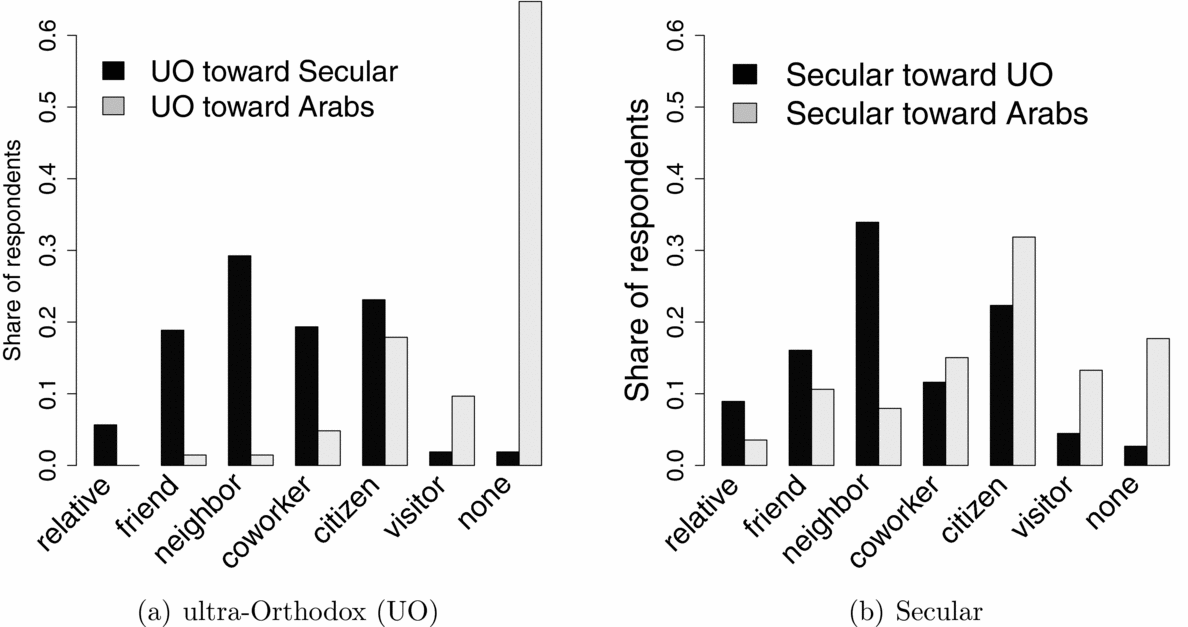
In Figure 1, we show the distribution in our sample of social distance attitudes among ultra-Orthodox Jews toward secular Jews and PCI, and secular Jews toward ultra-Orthodox Jews and PCI.Footnote 12 The distribution of Jews’ preferred social distance from PCI is striking: only a minority of Israeli Jews, either secular or ultra-Orthodox, expresses a willingness to have even minimal interpersonal relationships with PCI. The high share of ultra-Orthodox Jews who would prefer PCI to not be citizens of Israel is especially noteworthy: over 60% of ultra-Orthodox respondents would prefer not to admit PCI to Israel at all—not even as visitors. Less than 10% would event accept PCI as coworkers, and levels of acceptance for closer relationships are vanishingly small.
Social Distance by Group

Notably, for both ultra-Orthodox and secular Jews, the distribution of exclusion toward a Jewish outgroup is starkly different. Even though many secular Jews have marked hostility toward ultra-Orthodox (Enos and Gidron Reference Enos and Gidron2016), secular Jews are far more accepting of this group than of the PCI outgroup, with a majority willing to accept ultra-Orthodox as neighbor or closer but a majority not willing to accept PCI in any personal relationship, not even as a coworker. The differences between levels of exclusion toward the Jewish outgroup and toward PCI suggests that hostility does not necessarily result in exclusionary attitudes and that exclusionary attitudes are an independent and consequential attitude, separate from other types of affect.
Exclusionary Preferences as Symbolic Attitudes
We speculated that social distance, as an indicator of exclusionary attitudes, is a symbolic attitude. Given the centrality of the PCI in Israeli political discourse, this might mean that attitudes toward PCI influences public opinion over a range of topics. A common quantitative test of whether an attitude is symbolic is to see if it is a significant predictor of attitudes and behaviors when included in multiple regression analysis with other considerations (Sears et al. Reference Sears, van Laar, Carillo and Kosterman1997; Sears and Henry Reference Sears and Henry2003). We take this up below.
First, we test for another marker of symbolic attitudes: whether social distance attitudes are related to slow-moving variables that tend to be socialized early in life. In an ideal study, we would test the stability of these attitudes using longitudinal panel data over the course of a lifetime, starting with early adult socialization—however, such data is unavailable. As such, we use a method common in the literature and turn to whether these preferences are predicted by traits that were likely established early in life. The literature on attitudes toward outgroup minorities in general and in Israel in particular points to several such factors:
• Religiosity: Stronger religiosity may strengthen and reinforce ingroup identity and outgroup exclusionary preferences, especially when national dividing lines follow religious cleavages, as in Israel. Conversely, religious beliefs may generate a sense of solidarity toward the less well-off, which under certain circumstances may also encompass minority outgroups (Ben-Nun Bloom, Arikan, and Courtemanche Reference Ben-Nun Bloom, Arikan and Courtemanche2015; Johnson, Rowatt, and LaBouff Reference Johnson, Rowatt and LaBouff2010; Knoll Reference Knoll2009).
• Political ideology: Right-wing ideological self-identification, which is likely to be linked with strong national sentiments, may be associated with stronger exclusionary preferences (Golder Reference Golder2003; Semyonov, Raijman, and Gorodzeisky Reference Semyonov, Raijman and Gorodzeisky2006).
• Education: Higher education is associated with greater cultural openness (Stubager Reference Stubager2008, Reference Stubager2009), which may lead to greater openness toward outgroups. Indeed, Pedahzur, Halperin, and Canetti (Reference Pedahzur, Halperin and Canetti2007) find that in Israel, higher education—more than other measures of socioeconomic status such as employment—is associated with lower social distance from minority groups.
Education is, for most people, stable after adolescence or early adulthood. Religiosity also tends to be stable in the Israeli context (Coopermanm, Sahgal, and Schiller Reference Coopermanm, Sahgal and Schiller2016), so it is reasonable to assume these variables are established prior to attitudes about exclusion. The relationship between ideology and exclusionary attitudes, on the other hand, is less clear. While there are prominent theories of ideology that posit that it is a deeply rooted dispositional (Jost et al. Reference Jost, Glaser, Kruglanski and Sulloway2003) or even physiological (Oxley et al. Reference Oxley, Smith, Alford, Hibbing, Miller, Scalora, Hatemi and Hibbing2008) trait, other prominent scholarship sees issue positions as more malleable and subject to elite influence (Zaller Reference Zaller1992). As such, we treat the relationship between ideology and exclusionary attitudes as weaker evidence for the symbolic nature of these attitudes.
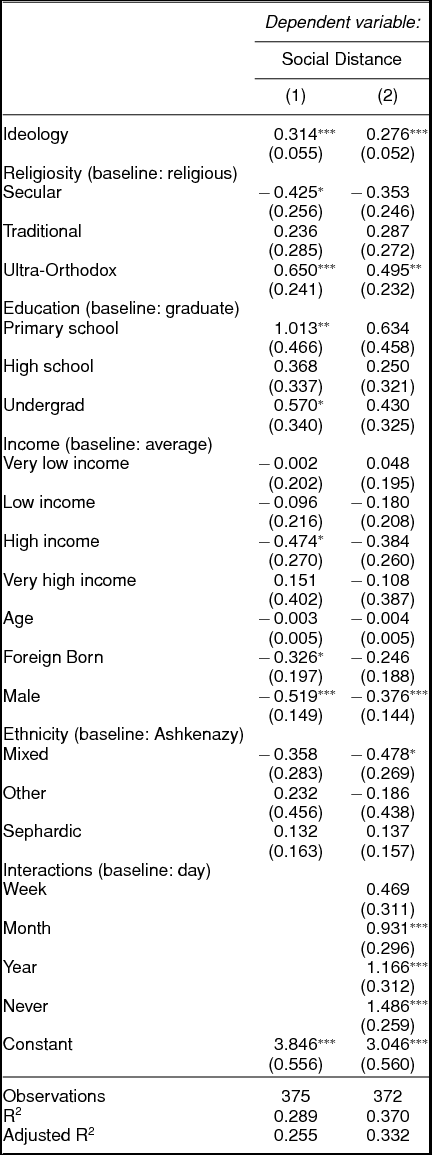
In Table 1, we present the results of OLS regressions, with social distance regressed on ideology, education, religiosity, and other demographic variables.Footnote 13 Political ideology, education, and religiosity all appear to be strongly related to social distance, with more right-wing, more religious, and less-educated subjects expressing more exclusionary preferences.
Social Distance with PCI

Note: *p < 0.1; **p < 0.05; ***p < 0.01
OLS regressions of social distance with PCI (range 1–7) on individual-level variables (Column 1) and frequency of interactions with PCI (Column 2).
In Model 2, we also include a measurement of self-reported social interactions with PCI. This variable takes values of “daily,” “weekly,” “monthly,” “yearly,” or “never.” The results in this model suggest that those who interact with PCI more frequently are also likely to report lower exclusionary attitudes.Footnote 14 Of course, there is a question of endogeneity: it might be that those who are more accepting of PCI are more willing to interact with them, rather than the other way around. Nevertheless, note that with the inclusion of this variable, ideology and religion remain strong predictors of social distance, suggesting that social distance is rooted, at least to some degree, in slow-moving individual-level features. While exclusionary attitudes do appear to be influenced by social interactions, such variables do not explain all of the variation.
The results in Table 1 are also consistent with theories that prejudice can spring from threats to status. Ultra-Orthodox Jews, who share with the PCI several characteristics of low status, express strong social distance from PCI.
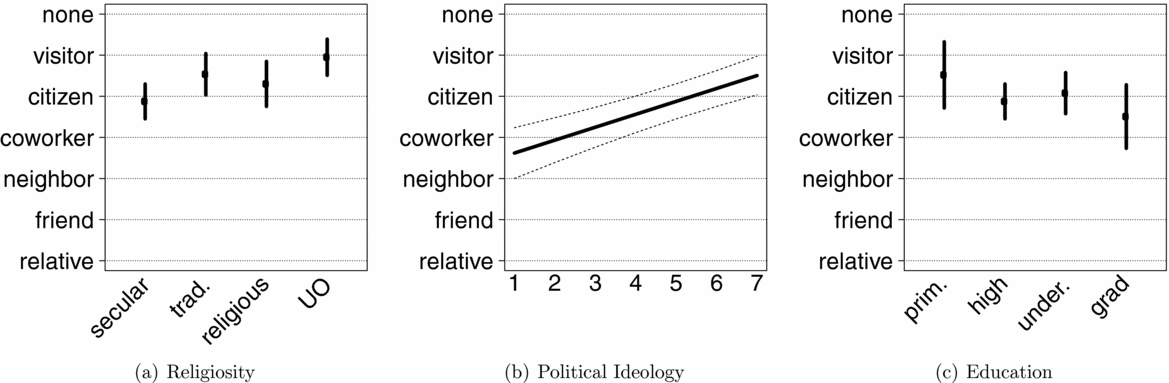
We display predicted values of exclusionary preferences from Model 1 in Table 1 in Figure 2. In these figures, we predict values for a secular, 38-year-old Sephardi male with average income, high-school education, and center-right political identity (5 on the 1–7 scale). Religiosity, ideology, and education vary in subfigures a, b, and c, respectively. Note that in all these figures, predicted values range only between coworker and visitor, reflecting the high levels of exclusionary preferences in our sample of Israeli Jews.
Religiosity, ideology, education, and social distance

Having established that social distance is predicted by slow-moving and stable characteristics of a person, we next examine whether social distance is a strong predictor of policy preferences in the face of competing considerations, as would be predicted if social distance is a symbolic attitude that dominates other attitudes. We focus on respondents’ perceptions of whether PCI receive too much or too little from the government. Social distance overwhelmingly predicts perceptions of governmental spending on PCI, as shown in Table A.2 in the Online Appendix, even when accounting for demographic and other related factors such as political ideology. As is expected with symbolic attitudes, social distance appears to dominate other considerations when forming policy preferences.
These results strongly suggest that social distance is a symbolic attitude. It is associated with slow-moving variables that are socialized early in life and dominates other considerations in forming policy preferences. This makes us suspect that exclusionary attitudes, as measured by social distance, influence political behavior, including even costly behaviors. We now turn to examine the relationship between exclusionary preferences and cooperative behavior and examine the predictive strength of social distance in the face of mitigating factors.
Preferences for Exclusion and Cooperation
To examine the relationship between exclusionary preferences and cooperation, we created a dichotomous variable of high and low exclusion based on whether or not the subject would accept an outgroup member as a coworker or closer, meaning that respondents who would accept PCI as coworkers, neighbors, friends, or relatives are coded as low exclusionary preference and everyone else is coded as high exclusionary preference.Footnote 15
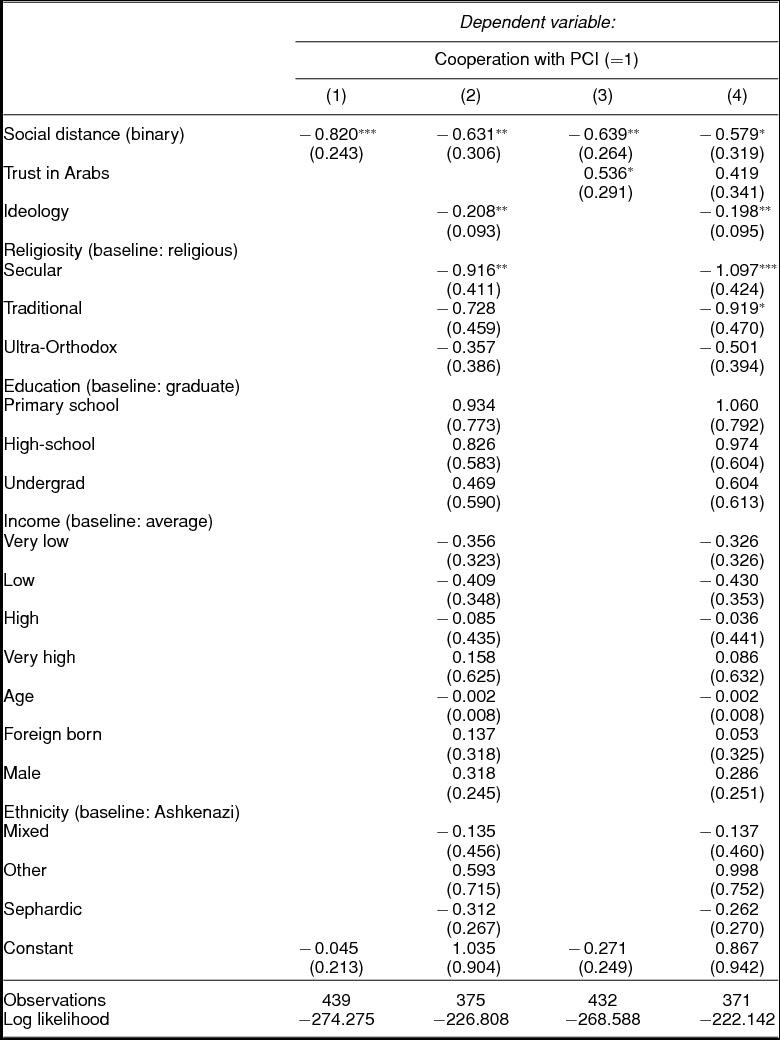
Looking at cooperation as a function this dichotomous variable, a t-test for difference of means yields μ = 0.19, t = 3.26, p < 0.001, indicating that high exclusion subjects are significantly less likely to cooperate with PCI (cooperation σ = 0.47, Cohen’s D = 0.40). To test whether this relationship will hold when controlling for other variables that may explain cooperation, we use social distance as a predictor of cooperation in multivariate regression. The coefficient estimates from this logit regression are presented in Table 2.Footnote 16 Strong exclusionary attitudes are highly predictive of non-cooperation, both with and without individual-level covariates (Columns 1 and 2, respectively). Notably, in these regressions, we include a number of variables that might also influence economic decision-making, including gender and income, and yet the influence of this basic exclusionary attitude remains large and statistically significant.
Behavioral Consequences of Social Distance, Public Goods Game

Note: *p < 0.1; **p < 0.05; ***p < 0.01
Logit regressions of cooperation with PCI in public goods game (range 0–1) on social distance, trust in Arabs, and additional individual-level variables.
Not only do exclusionary preferences powerfully predict cooperation, suggesting that people who advocate for the exclusion of minority groups will not subsequently come to cooperate, but a preference for exclusion seems to dominate other attitudes, as is expected if exclusionary preferences are symbolic attitudes. Even with control variables, moving from low exclusion to high exclusion reduces the predicted probability of cooperation by 14.6 percentage points [95% CI: −0.287:−0.003]. Given that only 33% of subjects chose to cooperate with the PCI player, this represents an over 40% decrease in the average probability of cooperation.
Potential Mitigating Factors in the Preferences-Behavior Link
We now turn to investigate the power of exclusionary attitudes to predict behavior in the face of possibly mitigating covariates. If exclusionary preferences are symbolic attitudes, their relationship with behaviors should not be affected by changes in other non-symbolic attitudes or contexts. We focus on three such factors that may affect cooperation: stereotypes of the trustworthiness of outgroup members, repeated interactions with outgroup members, and the local residential environment.Footnote 17
First, it could be that lack of cooperation stems not from symbolic exclusionary preferences toward PCI but rather from general stereotypes that PCI are untrustworthy and therefore likely to defect in the public goods game.Footnote 18 For instance, Zussman (Reference Zussman2013) finds that Jews discriminate against PCI in the Israeli car market due to concerns over trustworthiness. We therefore include a binary variable for respondents’ perceptions of whether PCI can be trusted, with and without individual level covariates in Table 2 (Columns 3 and 4 respectively).Footnote 19 Again, exclusion predicts a lack of cooperation, suggesting that the failure to cooperate is not rooted merely in statistical discrimination based on outgroup stereotypes, but in exclusionary preferences.
Second, we examine whether repeated interactions with outgroups may nudge individuals with a distaste for the outgroup toward cooperation, as argued by the important work of Axelrod (Reference Axelrod2006) on the evolution of cooperation. By Axelrod’s logic, the payoffs for cooperation change as the frequency of interaction increases, making cooperation a more attractive strategy. Thus, we should expect the influence of exclusionary attitudes to become weaker as interactions increase. To test this, we interact the binary social distance variable with respondents’ self-reported frequency of interaction with PCI. The results, presented in Table A.6 in the Online Appendix, suggest that repeated interactions across groups do not significantly moderate the relationship between prejudice and lack of cooperation, again suggesting that, as would be expected of a symbolic attitude, preferences for exclusion are slow-moving and not immediately responsive to changes in other variables, even potentially powerful influences such as interpersonal interactions. We note that measuring interpersonal contact through self-reports is standard in the literature (Islam and Hewstone Reference Islam and Hewstone1993) and even considered necessary by some scholars (Hewstone Reference Hewstone2015). Furthermore, there is some evidence that even shallow contacts, such as momentary contact in a public place, can improve intergroup relations (Enos Reference Enos2017). Nevertheless, such self-reports are also likely subject to measurement error that may bias the result toward zero. With this caveat in mind, our finding does suggest that interpersonal contact (Allport Reference Allport1954; Pettigrew and Tropp Reference Pettigrew and Tropp2006), a common policy solution for intergroup harmony in the academic literature, has little effect on cooperation in this context.
Third, we examine whether social distance merely reflects the local residential context. It may be that exclusionary social distance is associated with a residential context characterized by a low share of PCI or by a segregated PCI community, either because residential selection reflects exclusionary preferences or the segregation causes exclusionary preferences. Indeed, local residential context has previously been shown to be a powerful predictor of intergroup attitudes in Israel (Enos and Gidron Reference Enos and Gidron2016). As such, we again estimate our regressions, but also include the percent of the local non-Jewish population and levels of segregation for each locality. The results are presented in Table A.7 in the Online Appendix.Footnote 20
Even when accounting for the local residential context, social distance remains a strong predictor of cooperative behaviors. It is important to note that we are not arguing that local context does not matter for shaping intergroup attitudes or behaviors. Instead, our results demonstrate that social distance remains a strong predictor of behavior even in the face of potentially strong contextual influences.Footnote 21
Robustness Checks
It could also be that exclusionary attitudes reflect a more general orientation toward cooperation or trust (see Dinesen and Sønderskov (Reference Dinesen and Sønderskov2015)) and not attitudes toward PCI in particular. To look for this, we tested for the relationship between exclusionary preferences toward PCI and cooperation with the ingroup (secular for secular Jews and ultra-Orthodox for ultra-Orthodox). Table A.8 in the Online Appendix shows no relationship between social distance and cooperation with the ingroup. This supports the argument for a direct link between social distance toward a specific group and cooperative behaviors with individuals from this group.
There is, of course, a concern about cooperation inducing preferences for exclusion, so that once a subject chooses not to cooperate with the outgroup, they report survey attitudes in line with their previous behavior. If this were the case, the connection between exclusion and cooperation we find might be described as a survey artifact, not a meaningful relationship between attitudes and behavior. However, that social distance is strongly predicted by variables that necessarily are prior to the decision to cooperate, including education and religiosity, indicates that it is unlikely that preferences for exclusion are merely stated to justify behavior.
Furthermore, if social distance merely reflects a justification of non-cooperative behavior, we should also expect to see cooperation affect perceptions of trustworthiness—an obvious way to justify non-cooperation—thus confounding the relationship between cooperation and exclusionary attitudes. However, as noted above, the inclusion of trust in the model does not significantly affect the relationship between cooperation and exclusionary preferences, thus not indicating any significant confounding and lessening concerns that cooperative behavior is causing preferences for exclusion.
CONCLUSION
In this article, we have shown that social distance, a measure of exclusionary preferences, is strongly predictive of cooperation in a public goods game. Furthermore, we have shown that this tendency likely springs from basic prejudices, rooted in slow-moving features of a person’s socialization. Even within the same institutional context and when holding other variables constant, those with more exclusionary attitudes were less likely to choose a cooperative strategy when facing an outgroup member.
Our findings suggest potentially important future research agendas. We have focused on cooperative behaviors because they are often argued to be an important ingredient of successful diverse societies. But, of course, other consequential behaviors may be related to exclusionary attitudes. These may include more basic discriminatory behaviors, such as those reflected in other-regarding preferences (Habyarimana et al. Reference Habyarimana, Humphreys, Posner and Weinstein2007; Enos and Gidron Reference Enos and Gidron2016) or that manifest in socially consequential behaviors, such as hiring discrimination (Bertrand and Mullainathan Reference Bertrand and Mullainathan2004). Preferences for social exclusion may also affect other types of cooperation, including cooperation found outside of the laboratory (Hjort Reference Hjort2014). Furthermore, exclusionary attitudes may be correlated with other prejudicial attitudes, such as specific stereotypes.
There is also the question of the source of exclusionary attitudes. We have established that responses to the social distance scale have the characteristics of a symbolic attitude. This suggests that these attitudes will arise early in life and be stable by adulthood. A natural question then is what causes the acquisition of these attitudes early in life (Sears Reference Sears, Iyengar and McGuire1993). In the American context, the literature suggests several sources for symbolic attitudes and how these attitudes can be influenced by some later life experiences (see, for example, Sidanius et al. (Reference Sidanius, Levin, Van Laar and Sears2008)). There is a rich literature on political socialization from colleges (Mendelberg, McCabe, and Thal Reference Mendelberg, McCabe and Thal2017), schools, and families (Jennings and Niemi Reference Jennings and Niemi2015; Clark and Clark Reference Clark and Clark1950). Further research should investigate how these and other influences shape exclusionary attitudes, especially as they relate to cooperative behaviors, and how the literature developed in the United States may or may not be applicable to the socialization of symbolic attitudes in other countries.
What do our findings say about the ability of diverse societies to provide public goods? Our results suggest that exclusionary preferences are strongly implicated in inadequate cooperation that is related to poor public goods provision. A large faction of individuals in many countries express a desire to exclude immigrants and other minorities, but nevertheless find themselves in increasingly diverse societies as the flow of immigrants is unabated. Our results suggest that these individuals may be unwilling to engage with these immigrants as they become fellow citizens. Indeed, this could be the phenomenon described by Putnam (Reference Putnam2007), who argued that diversity causes people to “hunker down” and avoid pro-social activities. Our findings suggest that many people, as a result of socialization, may have always preferred not to engage cooperatively with their neighbors who are different from them, and the hunkering down reflects a behavioral response to the increased exposure to an outgroup.
We have also noted that the correlations between slow-moving demographic features of an individual and exclusionary preferences suggest that social distance is unlikely to change within an individual as other features of that individual or her context change. However, this does not mean that exclusionary preferences will not change within a society across time. Notably, Parrillo and Donoghue (Reference Parrillo and Donoghue2005) showed that average social distance toward a number of groups in the United States, including African Americans, has become less exclusionary in the over 80 years since the social distance scale was created and even significantly less exclusionary in the last 40 years.Footnote 22 While this does not signal that inclusion and harmony happens quickly, it does suggest that a society’s psychological barriers to cooperation can be lowered over time.
Of course, this does not mean that aggregate exclusionary preferences will necessarily lessen with time. In Israel, in particular, that the most exclusionary preferences are found among ultra-Orthodox reinforces the potential for aggregate exclusionary attitudes to shift in a more exclusionary direction. Ultra-Orthodox represent the fastest-growing segment of the Jewish population of Israel and aggregate preferences for exclusion among Jewish Israelis may increase as this population grows. If these attitudes are induced by threats to position on a social hierarchy, as suggested by some scholarship, then this speaks to the need for welfare-enhancing policies and institutions in promoting harmonious attitudes and cooperation.
More generally, our findings suggest that diverse societies have to directly face the challenge of exclusionary attitudes to overcome barriers to cooperation, as simply stressing the material incentives for cooperation or providing counter-stereotypical information will not suffice to enhance cooperation. Rather, if these preferences are rooted in symbolic attitudes that are socialized early in life, then the roots of these attitudes should be addressed. As our analyses of ultra-Orthodox/PCI non-cooperation suggests, this point is also especially relevant for understanding intergroup relations among low-status groups. Because low status groups exist in every society, including those diversifying via immigration, this issue is relevant for a large variety of contexts.
In Israel in particular, attitudes among ultra-Orthodox show little hope of a mass-level coalition of low-status groups; even though both ultra-Orthodox Jews and PCI have lower socio-economic status compared to secular Jewish Israelis, and both groups face institutional barriers for inclusion in mainstream Israeli society and the labor market, our results show little prospect for the type of cooperative behavior necessary to build a bottom-up political coalition that is often pointed to as a potential source of political empowerment for low status groups in other contexts (Browning, Marshall, and Tabb Reference Browning, Marshall and Tabb1984; Krochmal Reference Krochmal2016). Our findings here indicate that, despite well-intentioned calls for such coalitions, the psychology of threats to status may be a stronger guide to behavior.
SUPPLEMENTARY MATERIAL
To view supplementary material for this article, please visit https://doi.org/10.1017/S0003055418000266.
Replication materials can be found on Dataverse at: https://doi.org/10.7910/DVN/DAR56O.




Comments
No Comments have been published for this article.