

INTRODUCTION
Non-pollen palynomorphs (NNPs) are defined as all microfossils, excluding pollen grains, that survive the pollen extraction process and appear on palynological microscope slides (van Geel, Reference van Geel2001). Among NPPs, only a few algal taxa (e.g., Botryococcus and Pediastrum) are normally included in the pollen counts of most palynologists; these types are easy to identify and are known to provide important paleoenvironmental information. However, there are a wide variety of NPPs with distinct features that allow for confident identification. These taxa represent a broad range of environmental conditions and thus complement the interpretation derived from pollen records. Such NPPs include fungal spores, algal spores, testate amoebae, and plant and zoological microremains. A barrier to the regular identification of NPPs is the lack of regional atlases to assist in identification and the lack of data on the ecology of NPPs that can help in interpreting fossil records.
Descriptions of zoological and botanical NPPs were first published in the early 1900s (e.g., Rudolph, Reference Rudolph1917; Hoogenraad, Reference Hoogenraad1935), although the formal use and description of NPPs in palynological studies did not start until the 1970s (van Geel Reference van Geel1972, Reference van Geel1976). Since then, the application of NPPs in paleoecological research has been increasingly widespread, primarily for records from Europe (van Geel et al., Reference van Geel, Coope and van der Hammen1989; Prager et al., Reference Prager, Barthelmes, Theuerkauf and Joosten2006; Revelles et al., Reference Revelles, Burjachs and van Geel2016), but also in Asia and South America (Medeanic and Bagatin Silva, Reference Medeanic and Bagatin Silva2010; Montoya et al., Reference Montoya, Rull and van Geel2010; Leipe et al., Reference Leipe, Demske, Tarasov, Wünnemann and Riedel2014; Miao et al., Reference Miao, Jin, Liu, Herrmann, Sun and Wang2015). Studies of NPPs in North America are still fairly limited in Canada (Kuhry, Reference Kuhry1997; Graf and Chmura, Reference Graf and Chmura2006; Pieńkowski et al., Reference Pieńkowski, Mudie, England, Smith and Furze2011; Mudie and Lelièvre, Reference Mudie and Lelièvre2013) and the United States (Davis, Reference Davis1987; Chmura et al., Reference Chmura, Stone and Ross2006; Davis and Shafer, Reference Davis and Shafer2006; Anderson et al., Reference Anderson, Ejarque, Brown and Hallett2013, Reference Anderson, Ejarque, Rice, Smith and Lebow2015; Ejarque et al., Reference Ejarque, Anderson, Simms and Gentry2015; Orbay-Cerrato et al., Reference Orbay-Cerrato, Oswald, Doughty, Foster and Hall2017).
Although many NPPs are considered cosmopolitan and most of the published references from Europe can be helpful to the identification and the ecological interpretation of NPPs in other regions, at present there are no atlases or keys for NPPs in North America comparable to those available for pollen identification. An obvious solution, therefore, is the publication of images and descriptions of taxa to aid in identification. References used by phycologists, mycologists, and entomologists are often not suitable for microfossil studies because modern samples have not gone through the acetolysis procedure used to prepare fossil pollen, and thus the diagnostic structures do not appear the same (Miola, Reference Miola2012). Moreover, fossil NPPs are often represented by fragments or single spores, and the chemical digestion process can further contribute to the fragmentation of some NPPs and the loss of features used for identification by mycologists and other specialists. Images of NPPs treated with standard pollen extraction techniques, combined with taxonomic descriptions and ecological details, represent the ideal reference material for paleoecological studies. Even if some NPPs remain taxonomically unidentified, they still may be useful as paleoenvironmental indicators if the ecological context in which they occur can be established (van Geel, Reference van Geel2001).
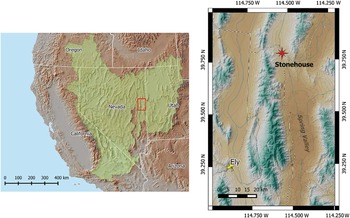
In this article, we present images and descriptions of known and unknown NPPs from Stonehouse Meadow, located in Spring Valley in the eastern part of central Nevada, USA (Fig. 1). We compare modern NPPs with fossil NPPs and pollen from a sediment core from the same site, allowing us to validate the use of the NPPs in a reconstruction of 8000 yr of vegetation history.
Location (left) and site (right) maps of Stonehouse Meadow. Green shading (left) represents the physiographic boundary of the Great Basin. (For interpretation of the references to color in this figure legend, the reader is referred to the web version of this article.)

STUDY AREA
Stonehouse Meadow in Spring Valley, Nevada (39°47.13′N, 114°32.57E; ~1740 m elevation; 2.5 ha), is a spring-fed sedge (Carex spp.) meadow (Fig. 1). The meadow and surrounding slopes are grazed by cattle. Vegetation around the meadow is representative of the Great Basin (Lowry et al., Reference Lowry, Ramsey, Boykin, Bradford, Comer, Falzarano and Kepner2005), including Artemisia tridentata (big sagebrush), Atriplex spp. (salt desert scrub), and scattered Ephedra sp. (Mormon tea). Pinus monophylla (pinyon pine) and Juniperus osteosperma (Utah juniper) are the dominant trees in the nearby mountains, with Cercocarpus sp. (mountain mahogany) also present. The pinyon-juniper woodland lower elevational limit averages about 2400 m. Subalpine conifers present in the adjacent Schell Creek Range include Abies concolor (white fir) in pockets above 2600 m and scattered Pinus flexilis (limber pine), Pinus longaeva (bristlecone pine), and Picea engelmannii (Engelmann spruce) above 3000 m elevation (Charlet, Reference Charlet1996).
The hydrogeology of Spring Valley is characterized by both valley-fill and carbonate-rock aquifers (Plume, Reference Plume1996; Mankinen et al., Reference Mankinen, Roberts, McKee, Chuchel and Moring2006; Welch et al., Reference Welch, Bright and Knochenmus2007). Average January and July maximum temperatures are 3.9°C and 30.5°C, respectively, with annual precipitation of 224.8 mm at McGill (1935 m elevation), the closest climate station to the study area (Western Regional Climate Center, http://www.wrcc.dri.edu/ [last accessed June 15, 2013]). Annual precipitation has a spring maximum (31% of annual precipitation) with the remainder fairly equally divided between the other three seasons: 21% in winter, 25% in summer, and 23% in fall (Benson and Klieforth, Reference Benson and Klieforth1989). Snow supplies the majority of groundwater recharge (Welch et al., Reference Welch, Bright and Knochenmus2007).
MATERIAL AND METHODS
Modern samples
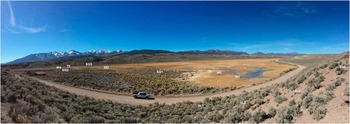
Thirteen surface-sediment samples for calibration of NPPs were collected in January 2015. Four samples were collected in the wetland (M1–M4; Fig. 2). The samples collected in the wetland are represented by sediment (1–2 cm depth) and roots of aquatic plants. M1 and M2 were collected in standing water within 1 m of the dry edge of the wetland; M3 and M4 were collected 15–20 m from the edge. Eight surface soil samples (1–2 cm depth) and one moss polster (SL1) were collected from the upland sites in three different environments following a moisture gradient, from the wettest to driest areas: two from the transition zone between the wet meadow and the upland areas (T1 and T2), three from an area of sagebrush vegetation (SG1–SG3), and four from the slopes farthest from the wetland (SL1–SL4; Fig. 2).
(color online) Photograph of Stonehouse Meadow and modern non-pollen palynomorph sampling locations. M1–M4 are sample sites taken within the wet meadow. T1 and T2 are in the transition zone between the wet meadow and surrounding uplands. SG1–SG3 and SL1–SL4 are on the upland slopes dominated by sagebrush.

Samples were stored in a refrigerator at 4°C in the Paleoecology Laboratory of the University of Nevada, Reno (Geography Department), until the NPP extraction was carried out. Samples were amalgamated, and a 1.2 cm3 subsample was dried at 100°C for 24 h. Each sample was then ground with a mortar and pestle and sieved with 250 μm mesh. Lycopodium spores were added for calculating concentrations (Stockmarr, Reference Stockmarr1971). Pollen and NPP extraction followed a modified version of Faegri and Iversen (Reference Faegri and Iversen1989) as follows: 10% HCl, 10% KOH, 37% HF, and acetolysis mixture (1:9 H2SO4 and acetic anhydride). The specimens were stained with safranin and stored in silicon oil. We counted all the terrestrial pollen grains and all the NPPs present on one microscope slide per sample, as well as all Lycopodium spores, for the calculation of the pollen percentages and NPP concentrations. Pollen and NPPs were identified and counted at 400× magnification. Microcharcoal particles were counted on the pollen slides and divided into two size ranges: 50–125 μm and >125 μm (Sadori and Guardini, Reference Sadori and Guardini2007).
NPPs were identified based on published literature (e.g., Ellis, Reference Ellis1971; van Geel, Reference van Geel1978; van Geel et al., Reference van Geel, Coope and van der Hammen1989, 2011; Doveri, Reference Doveri2004; van Geel and Aptroot, Reference van Geel and Aptroot2006; Gelorini et al. Reference Gelorini, Verbeken, van Geel, Cocquyt and Verschuren2011; Payne et al., Reference Payne, Lamentowicz, van der Knaap, van Leeuwen, Mitchell and Mazei2012), using nomenclature established by van Geel (HdV: Hugo de Vries-Laboratory, University of Amsterdam, Netherlands). Unknown NPPs were named using the code PLN (Paleoecology Laboratory, Nevada).
Principal component analysis (PCA) was performed using the package vegan (Oksanen et al., Reference Oksanen, Blanchet, Kindt, Legendre, Minchin, O’Hara and Simpson2016) for the R environment (R Core Team, 2015). A constrained hierarchical clustering was performed with the PAST software package (paleontological statistics software package for education and data analysis; Hammer et al., Reference Hammer, Harper and Ryan2001). All the NPPs and pollen counted were included in the statistical analyses, and both the PCA and the cluster analysis were performed on percentage data. The NPP and pollen diagrams were graphed using C2 software (Juggins, Reference Juggins2007). Pollen and NPP values are expressed and plotted as percentages of the total terrestrial pollen grains (aquatic plants and NPPs excluded) to normalize the NPP types.
Fossil samples
Pollen and NPPs
NPP analysis was conducted on a 7.0-m-long sediment core recovered from Stonehouse Meadow in 2010. The pollen record from the core was published by Mensing et al. (Reference Mensing, Sharpe, Tunno, Sada, Thomas, Starratt and Smith2013), and the details of sediment core recovery and pollen analysis are described in that study. NPPs were counted from the same 26 strata previously analyzed for pollen, following the protocol described previously.
NPP and pollen percentages were calculated on the sum of terrestrial pollen, excluding aquatic taxa. A constrained single-link dendrogram was created to interpret the zonation, using the 12 most common taxa plus %TOM (percent total organic matter) and %TC (percent total carbon; Mensing et al., Reference Mensing, Sharpe, Tunno, Sada, Thomas, Starratt and Smith2013) in a cluster analysis program modified from Birks and Gordon (Reference Birks and Gordon1985). Microcharcoal particles were counted in the fossil samples and divided into the same two categories (50–125 μm and >125 μm) used for the modern samples and expressed as total counts.
RESULTS
NPPs from modern surface samples
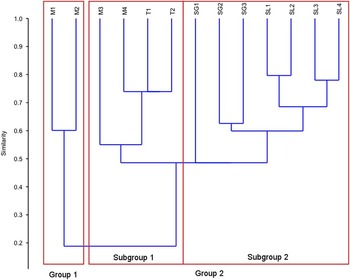
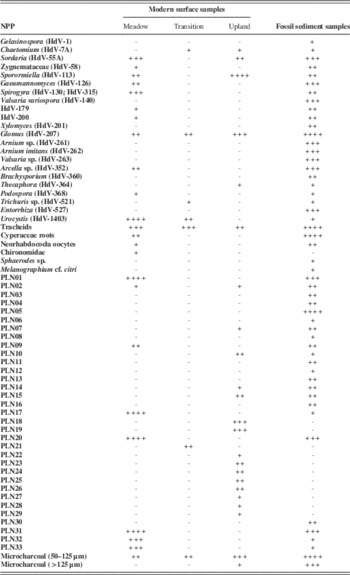
A total of 43 NPPs were counted (Table 1), and new codes were assigned to 23 unidentified NPPs. The cluster analysis revealed two main groups (Fig. 3): group 1 (including two marsh sites, M1 and M2) and group 2, which we further subdivided into subgroup 1 (including two marsh sites, M3 and M4, and two sites between the marsh and upland, T1 and T2) and subgroup 2 (including all upland sites). Site SG1 was grouped with the upland sites, along with the other samples from sagebrush vegetation.
(color online) Cluster analysis of all non-pollen palynomorphs, pollen, and charcoal from the modern surface samples. Two groups and two subgroups were identified: group 1, represented by two samples from the wetland (M1 and M2); group 2, represented by the rest of the samples. In the subgroup 1 samples, M3 and M4 from the wetland cluster together with samples T1 and T2 from the transition zone. Subgroup 2 is represented by the samples from the upland (SG1–SG3 and SL1–SL4).

List of all the non-pollen palynomorphs (NPPs) and their relative abundances in the modern and fossil samples (+, present; ++, low; +++, common; ++++, abundant).

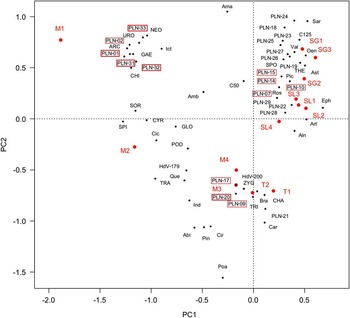
The differentiation of wetland (wet meadow), transitional, and dryland (upland) sites is also well expressed in the results of the PCA (Fig. 4). Principal component 1 explains about 24% of the variance and separates the NPPs and pollen into three main groups. We interpret this as a moisture gradient with the wettest sites, M1 through M4, having negative values, to the left of the central axis, and the drier sites having positive values to the right of the central axis (T1 and T2, SL1–SL4, and SG1–SG3).
Principal component analysis of all non-pollen palynomorphs (NPPs), pollen, and charcoal from the modern samples showing the relationship between the NPP types (in black) and the sites (in red). NPP taxa are noted in all uppercase letters; pollen taxa are noted in upper- and lowercase. The NPPs present in both modern and fossil samples are highlighted by a red box. The boxes with the thicker line represent the NPPs mentioned in the text. PC1, principal component 1; PC2, principal component 2. (For interpretation of the references to color in this figure legend, the reader is referred to the web version of this article.)

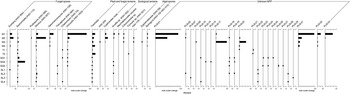
M1–M4 are characterized by aquatic NPPs, zoological remains, and algal spores (Figs. 4 and 5). The wetland sites group (Fig. 4) with known NPPs related to the aquatic environment, such as Gaeumannomyces (HdV-126), Spirogyra (HdV-130, HdV-315), Chironomidae, Cyperaceae roots, and unknown NPPs, some of which appear only in the wetland samples such as PLN-01, PLN-20, PLN-31, PLN-32, and PLN-33 (Figs. 5 and 6).
Non-pollen palynomorph (NPP) diagram of the modern samples. NPP values are expressed as percentages of the total terrestrial pollen. Note that some NPPs have a different scale.
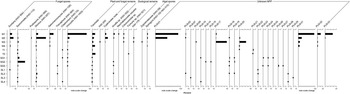
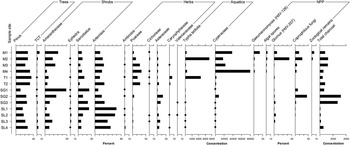
Non-pollen palynomorphs (NPPs), selected pollen taxa (<1%), and microcharcoal of the modern samples. NPP and pollen are expressed as percentages of the total terrestrial pollen. Aquatic plant values are expressed as concentration (grains per gram of dry sediment). Total microcharcoal is the sum of the two size range categories (50–125 μm and >125 μm) and is expressed as concentration (grains per gram of dry sediment). Filled circles represent pollen presence in quantities too small to graph at the scales shown.

The upland group is primarily characterized by known fungal spores (e.g., Sordaria, Sporormiella, and Glomus) and unknowns (e.g., PLN-23, PLN-24, PLN-25, PLN-26, PLN-27, and PLN-28).
The distribution of the pollen in the modern samples compared with a selection of NPPs (Fig. 6) shows a relationship between Geumannomyces (HdV-126) and Cyperaceae pollen. Geumannomyces is only present in the marsh samples with high amounts of Cyperaceae. Algal spores are also only present in the marsh samples.
NPPs and pollen from the fossil record
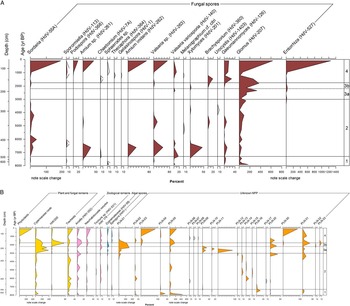
The zonation of the fossil record follows Mensing et al. (Reference Mensing, Sharpe, Tunno, Sada, Thomas, Starratt and Smith2013) in which four zones were identified from cluster analysis: zone 1, 8000–7300 cal yr BP (690–496 cm); zone 2, 7300–3000 cal yr BP (496–250 cm); zone 3, divided into subzone 3a (3000–2200 cal yr BP [250–180 cm]) and subzone 3b (2200–1750 cal yr BP [180–160 cm]); and Zone 4, 1750 cal yr BP to present (160–0 cm) (Fig. 7).
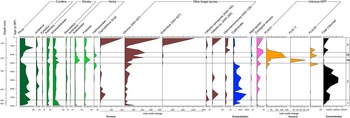
(color online) (A) Diagram of fossil fungal spores identified in the sediment core. (B) Diagram of fossil plant and fungal remains, zoological remains, algal spores, and unknown non-pollen palynomorphs (NPPs) identified in the sediment core. NPP values are expressed as percentages of the total terrestrial pollen.

A total of 52 NPPs were counted (Table 1), and new codes were assigned to 22 unknowns. Twelve of the 22 unknowns appear in both modern and fossil samples (Table 1, Fig. 4).
Zone 1 (8000–7300 cal yr BP) features several types of fungal spores, three unknown NPPs (PLN-03, PLN-05, and PLN-30), plant parts such as Cyperaceae root remains, and an increase in small (50–125 μm) charcoal particles. The fungal spores are mainly those of coprophilous fungi, such as Sordaria (HdV-55A) and Podospora (HdV-368), and parasitic fungi, such as Entorrhiza (HdV-527) and Gaeumannomyces (HdV-207). The pollen record suggests that the vegetation included Pinus, Juniperus, and Amaranthaceae (Fig. 8).
(color online) Stratigraphic distribution of selected pollen taxa and non-pollen palynomorphs (NPPs) in the Stonehouse sediment core. Pollen and NPPs are expressed as percentages of the total terrestrial pollen. Coprophilous fungi include Sordaria (HdV-55A), Sporormiella (HdV-113), Podospora (HdV-368), Arnium sp. (HdV-261), and Arnium imitans (HdV-262). Charcoal is graphed as the sum of the two sizes of particles (50–125 μm and >125 μm) and expressed as concentration (particles per gram of dry sediment). Zoological remains are represented by Arcella (HdV-352), Neorhabdocoela oocytes (Haas, Reference Haas1996), Trichuris (HdV-531) (van Geel et al., Reference van Geel, Hallewas and Pals1983; Brinkkemper and van Haaster, Reference Brinkkemper and van Haaster2012), and HdV-179. Algal spores include Zygnemataceae and Spirogyra.

In zone 2 (7300–3000 cal yr BP), NPPs are dominated by Glomus (HdV-207), Sordaria (HdV-55A), and Cyperaceae root remains (Fig. 9). Zone 2 has the highest variety of fungal spores (Figs. 7 and 8) and several unknown NPPs. PLN-01 begins to increase at the end of zone 2. Most of the zoological remains encountered in the record were found in this zone, including Arcella sp. (HdV-352), Trichuris sp. (HdV-531), Neorhabdocoela oocytes, and the NPP HdV-179 (described in van Geel et al., Reference van Geel, Hallewas and Pals1983). Charcoal particles (50–125 μm) reach a maximum (~3800 cal yr BP). The vegetation is dominated by Pinus, Amarathaceae, and Artemisia; the upper part of the zone (~3350 cal yr BP) features a peak of Valerianaceae (erroneously reported as Ranunculaceae by Mensing et al. [Reference Mensing, Sharpe, Tunno, Sada, Thomas, Starratt and Smith2013]). Aquatic plants have higher concentrations in zone 2 than in the previous zone. Around 3100 cal yr BP (257 cm), pollen grains of Nymphaea were identified; this finding is noteworthy given that Nymphaea is reported as a nonnative taxon in the Great Basin.
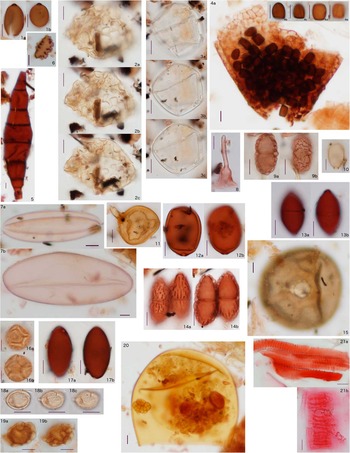
(color online) (1) Sordaria-type, HdV-55A (van Geel and Aptroot, Reference van Geel and Aptroot2006). (2) Zygnaema type HdV-314 (van Geel et al., Reference van Geel, Bohncke and Dee1981). (3) Zygnemataceae spores, HdV-58 (van Geel, Reference van Geel1978; van Geel and Grenfell, Reference van Geel and Grenfell1996). (4) Sporormiella-type, HdV-113 (van Geel, Reference van Geel2001; van Geel and Aptroot, Reference van Geel and Aptroot2006). (5) Xylomyces (HdV-201). (6) Gaeumannomyces hyphopodia, HdV-126 (van Geel et al., Reference van Geel, Coope and van der Hammen1989; van Geel, Reference van Geel2001; van Geel and Aptroot, Reference van Geel and Aptroot2006). (7) Spirogyra sp. spores HdV-315, HdV-130 (van Geel et al., Reference van Geel, Bohncke and Dee1981, Reference van Geel, Coope and van der Hammen1989; van Geel and Grenfell, Reference van Geel and Grenfell1996). (8) Cyperaceae root hair. (9) Valsaria variospora type HdV-140 (van Geel et al., Reference van Geel, Buurman, Brikkemper, Schelvis, Aptroot, van Reenen and Hakbijl2003; van Geel and Aptroot, Reference van Geel and Aptroot2006). (10) HdV-179 identified by van Geel et al. (Reference van Geel, Coope and van der Hammen1989) as a zoological remain, similar to the lorica of Trachelomonas or Strombomonas algal species (Wołowski and Grabowska, Reference Wołowski and Grabowska2007; Wołowski and Walne, Reference Wołowski and Walne2007). (11) Glomus cf. fasciculatum, HdV-207 (van Geel et al., Reference van Geel, Coope and van der Hammen1989, Reference van Geel, Buurman, Brikkemper, Schelvis, Aptroot, van Reenen and Hakbijl2003). (12) Arnium-type, HdV-261 (van Geel and Aptroot, Reference van Geel and Aptroot2006). (13) Arnium imitans-type, HdV-262 (van Geel and Aptroot, Reference van Geel and Aptroot2006). (14) Valsaria-type, HdV-263 (van Geel et al., Reference van Geel, Buurman, Brikkemper, Schelvis, Aptroot, van Reenen and Hakbijl2003; van Geel and Aptroot, Reference van Geel and Aptroot2006). (15) Arcella sp., HdV-352 (van Geel et al., Reference van Geel, Bohncke and Dee1981; Payne et al., Reference Payne, Lamentowicz, van der Knaap, van Leeuwen, Mitchell and Mazei2012). (16) Thecaphora, HdV-364 (van Geel et al., Reference van Geel, Bohncke and Dee1981). (17) Podospora-type, HdV-368 (van Geel and Aptroot, Reference van Geel and Aptroot2006; Ejarque et al., Reference Ejarque, Anderson, Simms and Gentry2015). (18) Entorrhiza sp. (Menozzi et al., 2010). (19) Urocystis, HdV-1403 (Ejarque et al., Reference Ejarque, Anderson, Simms and Gentry2015). (20) Neorhabdocoela oocytes (Haas, Reference Haas1996). (21) Tracheids (Schweinggruber, Reference Schweinggruber1990; Prager et al., Reference Prager, Theuerkauf, Couwenberg, Barthelmes, Aptroot and Joosten2012). Scale bar=10 μm.

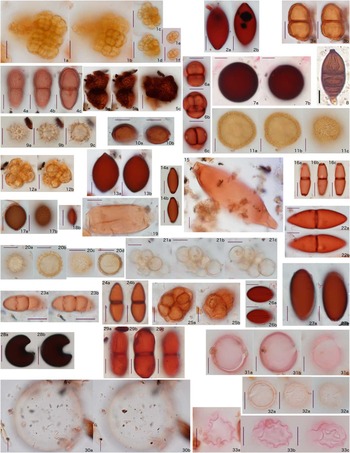
(color online) (1) PLN-01. (2) PLN-02. (3) PLN-03. (4) PLN-04. (5) PLN-05. (6) PLN-06. (7) PLN-07. (8) PLN-08. (9) PLN-09. (10) PLN-10. (11) PLN-11. (12) PLN-12. (13) PLN-13. (14) PLN-14. (15) PLN-15. (16) PLN-16. (17) PLN-17. (18) PLN-18. (19) PLN-19. (20) PLN-20. (21) PLN-21. (22) PLN-22. (23) PLN-23. (24) PLN-24. (25) PLN-25. (26) PLN-26. (27) PLN-27. (28) PLN-28 (cf. Melanographium cf. citri, Doveri, Reference Doveri2004). (29) PLN-29. (30) PLN-30. (31) PLN-31. (32) PLN-32. (33) PLN-33. Scale bar=10 μm.

Subzone 3a (3000–2200 cal yr BP) is characterized by the lowest percentages of NPPs in the core, while the NPP PLN-11 appears exclusively in this zone, and charcoal virtually disappears. PLN-01 becomes important in subzone 3a, reaching its maximum for the record in subzone 3b. Subzone 3a features the lowest percentages of trees, shrubs, and aquatic plants in the record, as well as a sudden increase in percentages of Poaceae and Asteraceae (Fig. 7). Subzone 3b (2200–1750 cal yr BP) has an increase in charcoal and a peak in HdV-200 (Fig. 7). Pollen assemblages are dominated by Pinus, Artemisia, and Amaranthaceae, with relatively high percentages of Poaceace, Asteraceae, and Cichorieae. Another peak in Valerianaceae appears in this zone.
Zone 4 (1750 cal yr BP to present) is characterized by the highest percentages of coprophilous fungi in the record (Figs. 7 and 8), mainly because of an increase of Sordaria, along with peak values for PLN-30. A sudden decline of Pinus and a sharp increase in Entorrhiza occur in the lower part of this zone. Herbaceous species remain relatively high and consistent to the end of the zone. Most of the phytoclasts encountered in the record (mainly unidentified, burned plant remains) were found in the upper part of this zone.
Morphological description and ecological interpretation of unknown NPPs
Subsequently, we briefly describe the morphological features of new, still unidentified NPPs encountered in this study (Fig. 9), and, where possible, we provide ecological information about these NPPs.
PLN-01 (Fig. 10: panel 1): Multiple yellow-colored cells clustered into colonies, rarely found as isolated cells; probably algae. The colonies have irregular shapes and a range of sizes >10 μm to more than 30 μm. This NPP is present in the modern material only in the wet meadow (Figs. 4 and 5), and it occurs in the fossil record before and after 2500 cal yr BP (Fig. 7). Montoya et al. (Reference Montoya, Rull and Vegas-Villarúbia2012) report an unknown NPP similar to PLN-01 that is correlated to a shallow aquatic environment (littoral zone).
PLN-02 (Fig. 10: panel 2): Oblong brown fungal spore with two pores at the poles; ~20 μm long and ~7 μm wide. This NPP is present in both the fossil and modern samples but is not related to specific environmental conditions.
PLN-03 (Fig. 10: panel 3): Monoseptate, yellow hyaline fungal spore with one aperture on each opposite side. This NPP is present in fossil material during the last 2000 yr.
PLN-04 (Fig. 10: panel 4): Unequal one-septate, light-brown fungal spore with a distinguished thick, finely verrucate wall. This NPP is present in the fossil material.
PLN-05 (Fig. 10: panel 5): Globose, light-brown, irregularly shaped spore (probably fungal), 15–25 μm in length. This type is typically a single spore, but when two are connected they form an hourglass shape. The surface has a distinct irregular reticulate pattern. This NPP is present in fossil samples often associated with charcoal (Fig. 8); this potential relationship should be investigated further.
PLN-06 (Fig. 10: panel 6): Globose, dark-brown spore with one distinct pore, usually clustered in groups of four cells, but also found as a single cone-shape cell with a rounded base. This NPP is rarely present and was only found in the fossil material.
PLN-07 (Fig. 10: panel 7): Spherical, dark-brown, one-celled spore with a smooth surface and a single pore. This NPP is present in one fossil sample and one modern sample (SL3).
PLN-08 (Fig. 10: panel 8): Multiseptate, dark-brown fungal spore, constricted at the apices with a pore at each end. Only one spore was found in the fossil material.
PLN-09 (Fig. 10: panel 9): Globose, thick-walled, one-celled yellowish spore (~10 μm long) characterized by a deeply reticulate surface with polygonate areolae, which gives a spiny appearance to the external wall. This NPP is similar to the smut fungi Tilletia sp. and Ustilago sp. and is present but rare in both the modern and the fossil material.
PLN-10 (Fig. 10: panel 10): Ellipsoidal, one-celled, light-brown fungal spore with apical apertures present at both poles. This NPP is present in the modern material on upland sites and in the fossil material.
PLN-11 (Fig. 10: panel 11): Globose, light-yellow spore (20–30 μm long), with an irregular reticulate surface that appears subrugulate at 1000× magnification. The thick walls appear to have columellae. This NPP is present in the fossil material exclusively during the period centered from about 2700 to 2300 cal yr BP (see “Discussion” and Figs. 7 and 8).
PLN-12 (Fig. 10: panel 12): Multiple yellow hyaline colored cells clustered into colonies. This NPP is similar to PLN01, but less dense with groups formed by bigger cells. It is present only in the fossil material.
PLN-13 (Fig. 10: panel 13): Ellipsoidal, one-celled, dark-brown fungal spore with rounded apical sides and with one end having a very well-defined pore and the other end being rostrate. This NPP is present only in the fossil material.
PLN-14 (Fig. 10: panel 14): Elongate, light-brown fungal spore (~15 μm long) with a smooth surface and one pore present on each polar apical side. This NPP is present in the modern samples from SG2, as well as the fossil material, and is relatively abundant when present.
PLN-15 (Fig. 10: panel 15): Large (~70–80 μm long and 30 μm wide), ellipsoidal, asymmetrical, light-brown, one-celled fungal spore with ends nearly pointed, although one side more than the other. This NPP is present in the modern samples from upland sites and also in the fossil material.
PLN-16 (Fig. 10: panel 16): Three-septate fungal spore with dark-brown central cells and smaller hyaline apical cells. The apical cells are often missing. This NPP is present though rare in the fossil material.
PLN-17 (Fig. 10: panel 17): Brown, one-celled, ellipsoidal ascospore with a finely verrucate surface and one aperture on one polar side. The outer side of the wall is surrounded by a light-brown membrane, which is not always present, especially in broken spores. This NPP is abundant in modern wet meadow samples and present in the fossil material.
PLN-18 (Fig. 10: panel 18): Ellipsoidal, brown fungal spore (~10 μm long) with a smooth surface and a germ slit extending along the entire length of the cell. This NPP is mainly present in the modern upland samples.
PLN-19 (Fig. 10: panel 19): Ellipsoidal, light-brown, subrectangular microfossil (~40–50 μm long) with a smooth surface and flat, poorly defined ends. This NPP is relatively abundant in the modern upland samples.
PLN-20 (Fig. 10: panel 20): Globose, light-yellow, hyaline microfossil of unknown origin (12–15 m long) with a distinctive double wall and the surface characterized by an irregular reticulum clearly visible at 1000× magnification. This NPP is abundant in the modern wet meadow samples and is present in the fossil material before 2700 cal yr BP and after 2000 cal yr BP (Figs. 7 and 8). It is similar in occurrence to PLN-01.
PLN-21 (Fig. 10: panel 21): Spherical, hyaline, colonial NPP with the cells aggregated into groups and rarely isolated. The size and number of cells in the colony is variable, but each single cell is ~10 μm. This NPP is present in the modern samples and in the fossil sample before 2700 cal yr BP and after 2000 cal yr BP.
PLN-22 (Fig. 10: panel 22): Large (40–45 μm), uniseptate, light-brown, two-celled fungal spore. The two cells have an irregular conical shape and pointed ends, with one cell being larger than the other. This NPP is present in the modern upland samples.
PLN-23 (Fig. 10: panel 23): Three-septate, light-brown fungal spore, with a slightly curved shape. The four cells are slightly constricted at the septa, with the central cells being irregularly squared, whereas the external cells come to rounded points. This NPP is present in upland modern samples.
PLN-24 (Fig. 10: panel 24): Uniseptate, brown fungal spore with conical cells. This NPP is similar to PLN-22 but significantly smaller (~20 μm) and constricted at the septum. It is present in the modern upland samples and co-occurs with PLN-23.
PLN-25 (Fig. 10: panel 25): Light-brown NPP of unknown origin consisting of eight grouped cells. The surface is verrucate, and the group seems to be surrounded by a membrane. This NPP is present in the modern upland samples.
PLN-26 (Fig. 10: panel 26): Ellipsoidal, dark-brown fungal spore with a distinct germinal slit present along the entire length of the cell. This NPP is relatively abundant in one modern upland sample (SG3).
PLN-27 (Fig. 10: panel 27): Ellipsoidal, dark-brown, one-celled fungal spore (30–35 μm long) with a pore at each end. This NPP is present in the modern upland sample and co-occurs with PLN-26.
PLN-28 (Fig. 10: panel 28): Single, c-shaped, dark-brown fungal cell with a germinal slit along the entire length of the shortest side. This NPP is tentatively identified as Melanographium cf. citri. (Doveri, Reference Doveri2004) and is present in the modern upland samples.
PLN-29 (Fig. 10: panel 29): Uniseptate, light-brown fungal spore that is slightly constricted at the septum, with a germinal slit asymmetrically present on each side of the two cells (two slits per cell). This NPP is present in the modern upland samples.
PLN-30 (Fig. 10: panel 30): Rounded, hyaline cell with a relatively thick wall and a symmetrical regularly scabrate surface. The shape and morphological features suggest that this NPP is likely of animal origin. This NPP is relatively abundant in the fossil material near the surface of the core.
PLN-31 (Fig. 10: panel 31): Spherical, hyaline, pink-colored (likely safranin stained), thin single-walled NPP presumably of algal origin with a circular aperture that is not always visible. This NPP is variable in size (20 to 40 μm long) and is present in the modern wet meadow samples and in the fossil material.
PLN-32 (Fig. 10: panel 32): Spherical, hyaline, pink-colored (likely safranin stained) NPP with a long, circular aperture and thin, short spines on the surface that are particularly visible at 1000× magnification but that appear as very small pores at 400× magnification. This NPP is present in the modern wet meadow samples and in the fossil material (Fig. 4 and 7).
PLN-33 (Fig. 10: panel 33): Globose, irregularly shaped, hyaline, fluted, thin-walled, pink NPP (likely safranin stained) that is variable in size (15 to 30 μm). This NPP is present in the modern wet meadow samples and in the fossil material.
DISCUSSION
Modern NPP interpretation
The modern NPPs analyzed from the samples collected in Stonehouse Meadow appear to be spatially heterogeneous. Approximately 25% (11 of 43) are present exclusively in one sample (e.g., PLN-07, PLN-14, PLN-15, etc.). Others, such as PLN-17 and PLN-20 are present in two or three samples, but they are much more abundant in one sample (Fig. 5). This variability between samples collected along a transect in a wet meadow environment can likely be attributed to minimal disturbance of the sediments. This suggests that sediment cores from wet meadows provide very local environmental information from NPPs and may explain why so many fossil NPPs, such as Trichuris (HdV-531), PLN-07, and PLN-08, appear only in one layer of the Stonehouse Meadow sediment core.
Fungal spores in general and coprophilous fungi in particular seem to be unrelated to variations in moisture. However, Sporormiella (HdV-113) (Fig. 9: panel 4) percentages were particularly high in two of the sagebrush samples, and Sordaria (HdV-55A) (Fig. 9: panel 1) was found mainly in the wet meadow samples (Fig. 5). Coprophilous fungi have been widely used to reveal the presence of herbivores (e.g., Davis and Shafer, Reference Davis and Shafer2006; Graf and Chmura, Reference Graf and Chmura2006; van Geel and Aptroot, Reference van Geel and Aptroot2006; Cugny et al., Reference Cugny, Mazier and Galop2010; Baker et al., Reference Baker, Bhagwat and Willis2013), and the abundance of Sporormiella (HdV-113) and Sordaria (HdV-55A) in Stonehouse Meadow sediments can be explained by the presence of livestock, in particular bovines. At the same time, Sordaria (HdV-55A) and Podospora (HdV-368) are not strictly coprophilous (van Geel and Aptroot, Reference van Geel and Aptroot2006), and thus the high percentages of these fungi may also be related to the presence of decomposing biomass in the wetland.
The fungus Gaeumannomyces (Fig. 9: panel 6) has been reported as a parasite growing on Cyperaceae species by the hyphopodia attached to the epidermis of species of Carex (van Geel et al., Reference van Geel, Hallewas and Pals1983). This fungus can be used as an indicator of the presence of these plants, often having the same trend and abundance of Cyperaceae pollen grains and the hyphopodia remains (Pals et al., Reference Pals, van Geel and Delfos1980). In our study, the ecological characteristics of the fungus were confirmed by the modern samples, in which Gaeumannomyces was detected only in the wet meadow samples, in association with Cyperaceae (Figs. 5 and 6), and down core, where the stratigraphic trend of the hyphopodia clearly follows that of Cyperaceae (Fig. 8). Although Gaeumannomyces has been reported mostly in peat and bog sediments of northwest Europe (van Geel and Aptroot, Reference van Geel and Aptroot2006), this study shows that this parasite occurs in wet meadows in an arid environment.
As revealed by the PCA (Fig. 4), most of the known NPPs that characterized the wetland are from plants related to the presence of water (e.g., algal spores). Based on this relationship, several of the unknown NPPs are likely related to the aquatic environment as well, including PLN-01, PLN-20, PLN-31, PLN-32, and PLN-33.
The presence of tracheids in the modern samples seems favored by the proximity to water because they are almost completely absent in the upland samples (Fig. 5). This could be either because tracheids are only preserved in water or because they originate from aquatic plants and sedges.
Trichuris sp. was only found in one of the upland modern samples. The eggs of this intestinal parasite have been found in samples from European archeological excavations, in association with various hosts (humans, livestock, dogs, and foxes) (Brinkkemper and van Haaster, Reference Brinkkemper and van Haaster2012).
Fossil NPP interpretation
Pollen, diatoms, mollusks, and sediments from Stonehouse Meadow showed that an extended dry period persisted in the eastern part of central Nevada between ~2800 and 1900 cal yr BP (Mensing et al., Reference Mensing, Sharpe, Tunno, Sada, Thomas, Starratt and Smith2013). The comparison of these data with other multiple proxy records across the Great Basin suggests that this dry period was probably regional. The study of NPPs adds new proxy evidence that can support this paleoclimate reconstruction. In this context, NPPs represent an important element to future studies aimed at reconstructing periods of environmental change.
The abundance of PLN-01 (Fig. 10: panel 1) found in the wet meadow samples at the edge of the meadow (Fig. 5) is particularly interesting when compared with the down-core data (Figs. 7 and 8). In the fossil record, this NPP appears in two specific periods: immediately before and after the extended dry period that occurred in the Great Basin between ~2600 and 1900 cal yr BP as reported by Mensing et al. (Reference Mensing, Sharpe, Tunno, Sada, Thomas, Starratt and Smith2013), suggesting a transitional period when the wet meadow was drying and shrinking and then expanding once again. The presence of PLN-01 in these particular periods supports the ecological and climatic interpretation derived from the pollen records. The presence of this particular NPP in both modern and fossil samples provides additional information about the contraction of the wet meadow surface area during the driest period. PLN-01 is still under study for taxonomic identification but probably has algal origins. PLN-20 (Fig. 10: panel 20) shows a trend similar to PLN-01 in the fossil data (Figs. 7 and 8), but this NPP was found in the modern samples in a wetter part of the meadow (Fig. 5). Further research is needed to definitively interpret the ecology of these NPPs.
Like PLN-01, Valerianaceae pollen (possibly Valeriana occidentalis or V. edulis) is abundant prior to and following the driest period (Fig. 8). This family of herbaceous species requires a moist habitat without standing water (Cronquist et al., Reference Cronquist, Holmgren, Holmgren, Reveal and Holmgren1984; Hickman, Reference Hickman1993), and their flowers require an entomophilous pollination; therefore, the high abundance of this pollen type likely indicates the local presence of Valerianaceae. We suggest that the presence of Valerianaceae pollen and the PLN-01 NPP indicate a period when the wet meadow contracted to its smallest extent and then expanded as moisture returned.
The NPPs contribute to interpreting the fossil pollen (Mensing et al., Reference Mensing, Sharpe, Tunno, Sada, Thomas, Starratt and Smith2013), which suggests that a drought occurred between 2500 and 1900 cal yr BP. The driest period is characterized by the dramatic decrease of conifers (Pinus and Abies) and shrubs (Fig. 8) and a large increase in Poaceae and Asteraceae. The NPP PLN-11 (Fig. 10: panel 11) only appears during the apparent peak of the dry period, suggesting its presence could be related to the drier climatic conditions associated with dry grassy meadow (Figs. 7 and 8). This must be tested with modern samples from grassy meadow sites because this NPP did not appear in our modern samples. The lack of charcoal particles may be explained by a shift from trees and shrubs to herbaceous plants, as the reduction in biomass likely would have limited the occurrence and/or intensity of fires.
Tracheids may also support an interpretation of drought. This NPP is present throughout the entire core with the lowest percentages during the driest period (around 2500 yr BP). The absence of this type of plant remain in the dry period could be because of the low percentage of shrubs and trees in response to a drier climate (Fig. 8).
The increase of the coprophilous fungi in the surface of the sediment core (Fig. 8) can be linked to the intensification of grazing activities in the area in the twentieth century.
The reason for the high abundance of Entorrhiza spores in the upper zone (1750 cal yr BP to present) of the core is not clear. Entorrhiza is a smut fungus that parasitizes different hosts, primarily Cyperaceae and Juncaceae (Vánky, Reference Vánky1994; Riess et al., Reference Riess, Bauer, Kellner, Kemler, Piątek, Vánky and Begerow2015), and thus it is common in aquatic environments. The very high abundance in the upper 100 cm of the core might be also related to the abundance of undecomposed roots near the surface.
CONCLUSIONS
Stonehouse Meadow appears to have a rich diversity of NPPs that can be used to enhance paleoecological reconstructions for the Great Basin. This study identified 64 microfossils, 33 of which had not been previously identified. Comparison between modern and fossil samples allowed us to determine the ecological conditions of some NPPs and contribute to the interpretation of the fossil paleoenvironmental record of the Great Basin spanning the last 8000 yr.
The analysis of modern NPPs from Stonehouse Meadow shows a clear separation between wetland and the upland taxa. Furthermore, the presence of unknown NPPs, in particular PLN-01, on the edges of the wet meadow allowed the identification of a transitional zone between the water body and the land. The analysis of NPPs in the modern and fossil samples reveals a high diversity within the same environment and provides another source of indicators of ecological conditions. Further refinement of ecological interpretation of the NPPs will require additional modern calibration studies.
ACKNOWLEDGMENTS
We thank the Southern Nevada Water Authority (Zane Marshall and Brandon Humphries) for providing permits and allowing us access to recover sediment cores and take samples. The pollen data presented in this work have been previously published in 2013 and based on work supported by the National Science Foundation under grant EPS-0814372. We are grateful to Bas van Geel for support and help in learning the process of identification and analysis of NPPs, as well as critical review of the manuscript. We also acknowledge helpful comments from an anonymous reviewer.