“Give up detesting everything appertaining to Oscar Wilde,” George Bernard Shaw told his friend Reginald Golding Bright in a letter of 1894, adding: “There is always a vulgar cry both for and against every man or woman of any distinction[;] . . . you have heard it about Whistler, Sarah Grand, Ibsen, Wagner—everybody who has a touch of genius.”Footnote 1 Shaw's high opinion of the social-realist author Sarah Grand, best known for her provocative, hugely successful novel The Heavenly Twins (1893) and for coining the term “New Woman,” is surprising if refreshing, especially when she is considered in company with the other illustrious names he lists.Footnote 2 It is conventional to put Grand alongside Oscar Wilde to mark their differences, as the politicized works of New Women writers are usually seen as at odds with the art-for-art's-sake amoralism of decadent aesthetes. Grand herself declared, “We appreciate art, but not for art's sake; art for man's sake is what we demand,” and, as Marilyn Bonnell has shown, she implied that the aesthetic aspect of her work was subordinated to its political impact.Footnote 3 Thus Grand, a more politically focused writer, might seem the antithesis of Wilde, a proponent of beauty and pleasure, who declared in the preface to The Picture of Dorian Gray (1891) that “An ethical sympathy in an artist is an unpardonable mannerism of style.”Footnote 4 Certainly her own attitude toward Wilde's decadent aestheticism seems incontrovertible. She disliked Dorian Gray, calling it “the outcome of an unlovely mind . . . , poor, forced stuff, conceited, untrue to all that is elevating and inert, and not improved by being polished up in passages of a laboured smartness,” and she commented of its author: “I know little of him personally and now feel that I should certainly hate him if I knew more.”Footnote 5
However, Grand also had a strategic rhetorical aim in distancing herself and her social agenda from male decadence. Conservative reviewers of the 1890s such as Hugh E. M. Stutfield had indiscriminately lumped New Woman writers together with male decadent authors, an editorial for the Speaker explicitly referring to the former as “creatures of Oscar Wilde's” and designating him “their high priest and spokesman.”Footnote 6 Unsurprisingly, therefore, pioneering feminist scholars of our own time have also been at pains to stress the essential differences in terms of style and objectives between the New Women and their decadent male compeers.Footnote 7 The Wilde trials of 1895 gave impetus to Grand's own efforts to “dissociate” the New Woman from “the charge of moral degeneracy”; hence we see her lampooning effeminate aesthetes in the unsympathetic Alfred Cayley Pounce in The Beth Book (1897), while Wilde has been claimed as her model for the effete poet Colin Drindon in The Winged Victory (1916).Footnote 8
In recent years there has been more of an effort to uncover and understand Victorian women writers’ often complex relationship with literary decadence. This includes those who engaged with decadence or were influenced by it as well as those who shared points of contact even while not necessarily sympathizing with it or identifying with its aims. Although one of Grand's short stories appears in Elaine Showalter's influential anthology Daughters of Decadence: Women Writers of the Fin de Siècle (1993), there have been few other attempts to indicate her own points of contact with decadence.Footnote 9 Yet in spite of Grand's stated antipathy to Wilde, they had more in common than might at first appear, which extends to their literary work. As this essay will show, key elements in Grand's The Heavenly Twins anticipate explorations of desire and identity more often associated with queer decadence.
By way of preface, one should note that in fashioning their literary identities, Grand and Wilde share some strikingly similar characteristics. Like Wilde, Grand was accomplished at inventing herself as a public figure and celebrity, skillfully controlling her image and stage-managing her interviews, appearances, and artfully posed photographs. Both writers were adept at the charm offensive to win over those who might be suspicious of their views. Personal aesthetics certainly played a large part in this for Grand, as she understood the importance of appearance and cannily exploited her graceful feminine demeanor, voice, manners, and tasteful dress to help make her views more palatable; she also urged other female activists to do the same, declaring that “unprepossessing” women had set back the fight for female suffrage.Footnote 10
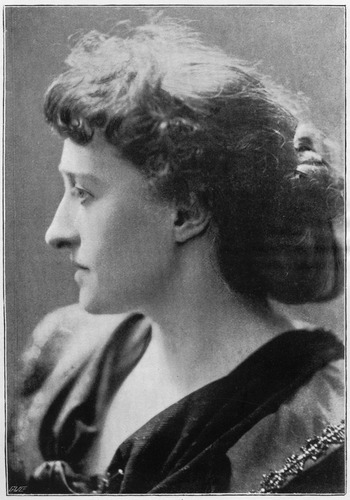
Both Grand and Wilde loved clothes and supported the contemporary Rational Dress Movement for women that eschewed tight-lacing and constriction in favor of simplicity of line; this was a major influence on the kinds of fashionable “aesthetic dress” worn by Constance Wilde and Grand herself (fig. 1). (Indeed, Grand may have known rather more about Wilde than her letter of 1891 suggests, in that she names “Mrs Oscar Wilde” as among a number of inspiring “women of high character and great ability” with whom she came into “close contact” in the early 1890s when she served on the committee of the Rational Dress Society. “With these new friends,” she wrote, “I was in a new world.”)Footnote 11 Just as Wilde carefully choreographed his early journalistic interviews with artfully arranged props that included flowers, books, and perfume bottles, Grand's later interviews exploited the ambience of her Kensington flat, photographs of which suggest an affinity with aesthetic design. In an interview of around 1899, Helen C. Black described Grand's surroundings as “naturally beautiful and artistic” and mentioned that flowers, which for her, as for Wilde, were a “passion,” were “always to be found in abundance according to the season of the year.”Footnote 12
Photographic portrait of Sarah Grand, by H. S. Mendelssohn, The Humanitarian 8 (March 1896): 160. Credit: “Bath in Time”

Grand's self-invention included various strategic deceptions of which Wilde would have approved. Having escaped an unhappy marriage and left her husband and son behind her, Frances Bellenden Clarke McFall created a new independent life for herself in 1890, subsequently moving to London and taking the name “Madame Sarah Grand” when she published The Heavenly Twins. Her pseudonym, as John Kucich points out, “pretends to a personal and social authority that is deeply at odds with her own humble background. (Her father served with the coastguard in Ireland.)”Footnote 13 Recently branded an “Irish New Woman,” Grand was not, like Wilde, an Irish native, but was born and spent her early years in Ireland and maintained a lifelong affection for it.Footnote 14 Kucich also notes that “several striking lies mark her own account of her life,” with these tending to confer additional luster and status. The social aspirations of both Grand and Wilde meant that they were attracted by the glamour of the English upper class with its representatives peopling her novels and his dramas.
Grand's best-selling novel The Heavenly Twins, a searing indictment of sexual double standards made visible by the Victorian syphilis epidemic, is usually seen as a realist fiction that, through its examination of the lives of its three central female characters, makes an important contribution to debates about marriage, sexuality, and women's rights. Yet critics past and present have noticed that her substantial novel, although cast in the traditional three-decker mold and comprising six books and many hundreds of pages, brings together different kinds of narrative writing that disturb these conventions. While the larger part of the action charts the separate but interrelated stories of Evadne Frayling, Angelica Hamilton-Wells, and Edith Beale and is more recognizably realist, the novel opens with a lyrical and fabular proem, features a protracted playful, cross-dressing “Interlude” in book 4, and in book 6 switches from an impersonal third-person narrative to a male first-person narrator directly involved in the story.
Even the most conservative Victorian realist novels contravene the order, coherence, and stability of the realist ideal at some point, but Grand's more egregious departures made many early reviewers complain about what they regarded as her novel's chaotic production, claiming that such differently styled narratives were “thrown together in a hap-hazard fashion,” resulting in a work that was certainly “not a novel, nor even a well-ordered story.”Footnote 15 Modern critics are now more likely to see Grand's novel as open-ended, experimental, and protomodernist, and she herself declared that a novel “should be like life itself—an unfolding, and not a regular structure.”Footnote 16 The inventive faculty and theatricality we find in Grand's own self-projection as author arguably also give her novel its shape-shifting properties. Nowhere is this more apparent than in book 4, titled “The Tenor and the Boy: An Interlude” which, occupying over a hundred pages (355–462), takes time out from the more overtly polemical realist action to present a stand-alone narrative that, like the proem, owes more to the romance mode. Using a distinction made in The Decay of Lying (1889), Wilde might have called the interlude “imaginative reality” rather than “unimaginative realism” (1076), and it is the interlude that provides some of the most fruitful points of contact between himself and Grand.
Seemingly a departure from the focus on women's lives, the interlude charts the deepening relationship between an adolescent “Boy” and the enigmatic “Tenor,” a celebrated vocalist in the cathedral choir. Grand's feminist purpose emerges only in the last few pages, where it turns out that the Boy is actually a girl, and moreover a married woman cross-dressing to experience greater freedom. The seeming independence of the interlude partly stems from the fact that Grand first wrote it much earlier between 1879 and 1881 as a separate narrative, which she unsuccessfully attempted to publish in 1889, shortly before she began trying to publish The Heavenly Twins (written between 1888 and 1890).Footnote 17 When developing the various storylines that comprise The Heavenly Twins, Grand incorporated “The Tenor and the Boy” into the larger novel, making the Boy, who initially had no brother, into Angelica Kilroy (née Hamilton-Wells) masquerading as her own twin, Theodore, better known by his nickname of “Diavolo.”Footnote 18 The Boy/Angelica is thus identified as one of the anarchic “Heavenly Twins” whom readers have already encountered as riotous children and adolescents in books 1–3 of the novel, where they provide welcome comic relief amid the more somber overarching themes. Thus, meeting the Boy in book 4, most readers assume that “he” is Diavolo, only to discover along with the Tenor in the last few pages that “he” is in fact Angelica, now Mrs. Kilroy of Ilverthorpe. The dénouement of the interlude and the ensuing events of book 5 (titled “Mrs Kilroy of Ilverthorpe”) tie this episode into the wider themes and fabric of the novel, and it could even be regarded as a germ of the larger book. Yet the interlude arguably does have a life of its own, something clearly felt by Grand herself, who later believed—questionably, I think—that it was not an essential part of the action, and even went on to publish The Tenor and the Boy separately in 1899 in the series Heinemann's Popular Novels.Footnote 19
Grand's interlude almost certainly shares a decadent antecedent with Wilde. Although The Heavenly Twins name-checks various nineteenth-century French novels as sexually lax and morally dubious (221), Grand, a fluent French speaker, had almost certainly read all of these herself. Théophile Gautier's Mademoiselle de Maupin (1835), signaled as “shocking” in book 1 (104), is nonetheless an influence on “The Tenor and the Boy,” as Gautier's eponymous cross-dressing heroine adopts the name “Théodore,” also the given name of Angelica's twin brother. As this influence helps make clear, the interlude deals with the decadent theme of the secret double life, a key element in best-selling and provocative fin de siècle fictions such as R. L. Stevenson's Strange Case of Dr Jekyll and Mr Hyde (1886) and Wilde's The Picture of Dorian Gray (famously decried by the Daily Chronicle as “spawned from the leprous literature of the French decadents”).Footnote 20 Yet Stevenson's and Wilde's novels were written well after “The Tenor and the Boy,” and while these male-authored fictions examine the freedoms available to the man who leads a double life, what is striking about Grand's text is its focus on the female double life and, specifically, a heroine who masquerades as male to escape the constraints placed on her as a woman.
Nonetheless, Wilde also published a fiction dealing with the female double life. As it bears interesting comparison with Grand's interlude, it is helpful to examine this frequently overlooked short story before considering her text in more detail. “Lady Alroy,” later retitled “The Sphinx without a Secret,” appeared in the society journal The World in May 1887 when Wilde was preparing to become editor of The Lady's World (which he would rename The Woman's World). The story was published shortly after Wilde had begun his own “double life” following his seduction by the youthful Robert Ross in 1886. Thereafter he would maintain the outward appearance of a respectable married man while pursuing sexual relationships with other men and liaisons with male prostitutes.
In “Lady Alroy,” the eponymous heroine, a beautiful and wealthy widow, is discovered by her admirer and suitor, Lord Murchison, to be leading a double life.Footnote 21 Disturbed by what subsequently transpires, he confides his story to the narrator, a former college friend now a sophisticated man of the world, who warmly vouches for Murchison as an “honourable” man, known “to speak the truth” (205). Valued for his “frankness,” Murchison is nonetheless attracted to the opacity of the “strangely picturesque” Lady Alroy, finding her all the more alluring for her reticence and “the indefinable atmosphere of mystery that surrounded her” (205, 206). Having fallen straightaway “passionately, stupidly in love,” he pursues her and, although professing himself “sick and tired of the incessant secrecy she imposed on all my visits,” her enigmatic behavior fuels his passion: “I was infatuated with her: in spite of the mystery, I thought then—in consequence of it, I see now.” Despite his hasty self-correction—“No; it was the woman herself I loved”—he appears unable to separate Lady Alroy's personal appeal from “the mystery [that] troubled me, maddened me” (206, 207).
On the day he has resolved to propose marriage, Murchison sees by chance Lady Alroy letting herself into a house in a shabby London street. Clearly suspecting her of having an affair, he confronts her at home that evening, but she declares that she met no one. Refusing to believe her, he departs in a rage, returns unopened the letter she sends him, and embarks on a trip abroad. On his return he is racked with grief when he discovers that Lady Alroy has died after a sudden illness. When he investigates the house he saw her enter, he discovers that she was a lodger who paid the landlady “three guineas a week merely to sit in my drawing-rooms now and then,” and that she met no one there but “simply sat in the drawing-room . . . , reading books, and sometimes had tea” (208). At this point the narrator, who prides himself on his superior knowledge of women, takes it upon himself to explain to his puzzled friend that “Lady Alroy was simply a woman with a mania for mystery. She took these rooms for the pleasure of going there with her veil down, and imagining she was a heroine. She had a passion for secrecy, but she herself was merely a Sphinx without a secret” (208).
As the story concludes, Lord Murchison still seems uncertain as to the truth of the matter, perhaps reluctant to give up the mystery of his beautiful inamorata for such a prosaic ending. But for his friend, the confident, more worldly-wise narrator, Lady Alroy is a fantasist and drama queen who uses mystery to make herself appear more interesting but is ultimately unable to push her double life beyond a disappointing replication of drawing-room respectability. For him, her double life is a letdown because she remains pretty much the same—her tea-drinking and novel-reading being activities she could just as easily pursue in her own Park Lane home. This type of existence bears similarity to the kind Cecily reproaches Algernon with in The Importance of Being Earnest (1895): “I hope you have not been leading a double life, pretending to be wicked and being really good all the time” (378). For Wilde's male characters, aided by Bunbury or a magic portrait, the double life is an escape route that allows one to indulge in illicit behavior, and its deception or insincerity is a way of multiplying or extending one's personality. In light of this, Lady Alroy's actions look like a failure of nerve and vision. She attracts Murchison by virtue of her imaginative self-projection, but ultimately her imagination does not carry her far enough.
Wilde clearly liked his coinage “Sphinx without a secret” as he recycles it in Dorian Gray and A Woman of No Importance (1893). In both cases when the cynical dandy aristocrats Lord Henry Wotton and Lord Illingworth are challenged by women to “Define us as a sex,” they riposte: “Sphinxes without secrets” (143, 476). For both men, women have a mystique that is merely superficial and illusory, but then both are undoubtedly misogynists. The worldly narrator of “Lady Alroy” also likes to pronounce about women—witness his annoyingly smug quip “women are meant to be loved, not understood” (205)—but arguably it is he who lacks imagination. He fails to understand that simply enacting the part of an upper-class woman might be in itself stifling and that such a woman might wish to escape and find herself a private room of her own, away from social calls and duties, where she can relax, read, dream, think, and explore other aspects of herself. Like Lord Murchison, he cannot conceive of a woman having a secret life that does not revolve around a sexual liaison with a man. It seems impossible for both these men to imagine that a woman might want to abscond from her daily round merely to explore her identity. But then the narrator is not an advocate of “understanding” women, and Murchison is a man who falls in love ridiculously easily with a woman he does not know; indeed, his not knowing her, the aura of female mystery upon which he inscribes his fantasy, is a positive inducement to love. Both men overlook Lady Alroy's skills as a maker of fictions: she is a novelist manqué or a dramatist who writes a script, pulls Murchison's strings, and makes him dance to her tune, thus prefiguring Gwendolen and Cecily's manipulation of their suitors in The Importance of Being Earnest, where Jack and Algernon are forced to act out roles already carefully scripted for them.
Although “The Tenor and the Boy” was already in existence by 1887, it is unclear whether at that point the “Boy” (Angelica) had acquired her married name of Mrs. Kilroy. While we can't know whether Grand read Wilde's story, it is tempting to think that by using the name “Kilroy” she might be responding to his “Lady Alroy.” Angelica Kilroy shares the strong performative and theatrical propensities of Wilde's heroine; she, too, is a writer of scripts and will make more than one man dance to her tune. While similarly rebelling against the strictures of her own upper-class female existence, Angelica nonetheless out-dares Lady Alroy, showing that women can harbor genuinely scandalous secrets and enact the most audacious and imaginative kind of double life.
Angelica's true identity emerges only at the end of the interlude, where most readers share the Tenor's shock at her transformation from Boy to woman and learn the story behind her deception. Intellectually able and a talented violinist, she is unable to pursue the musical career she craves because of the social limitations placed on her as the daughter of an aristocratic family. The horrifying madness and death of her recently married friend Edith—the result of female ignorance about the dangers of venereal disease—leave her raging at sexual inequality and double standards. After her twin, Diavolo, has been sent off to Sandhurst, Angelica is desperate to escape the ordeal of being “brought out.” Thus she unconventionally proposes to an older, trusted, mild-mannered family friend, Mr. Kilroy of Ilverthorpe, with the words “Marry me, and let me do as I like” (321). He accepts her on her terms for what is an amicable (although presumably as yet unconsummated) marriage. Angelica, now twenty-two, declines to accompany her MP husband to London but still finds herself unfulfilled by the role of an upper-class married woman. Resenting her lack of freedom, she acquires a blond short-haired wig and suit of boy's clothes, which she dons to enjoy the freedom of walking in the cathedral Close at night, confident “that it was danger without danger for me, because I knew I should be mistaken for my brother” (452).
In the Close she meets the Tenor, a leading singer in the cathedral choir, who is himself incognito having taken the position while recovering from a personal tragedy. Yearning for sympathetic companionship and unaware that the “Boy” is a girl, he forms a friendship with her that flourishes as they spend convivial evenings together, sharing their love of music. The Tenor is surprisingly incurious about the Boy's name and background (402), and Angelica easily passes herself off as her brother. Having seen the Boy's “sister,” the “real” Angelica from afar at cathedral services, the Tenor has conceived an idealized courtly love for her, and the Boy enjoys the irony of this, poking fun at his friend's fantasized projection and his limited understanding of actual women. But, as the Boy, Angelica also relishes the opportunity to savor a relationship with a man who—inadvertently—treats her on equal terms. The Tenor confides in her the story of his upbringing and the tragedy that has caused him to take the position in the choir. She in turn begins to use her connections to engineer a future career for him as an opera singer. However, things come to a crisis after a boat trip down the river when she falls overboard and the Tenor dives in to save her. Although he rescues her, her wig is washed away and her identity as a woman is revealed. The last pages of the interlude feature a conversation in which Angelica tries to defend her conduct and holds forth about the limitations of women's lives. The Tenor, who has conventional views about women's roles, is scandalized by her deception but eventually agrees to forgive her. There the interlude ends. However, the relationship is not allowed to continue, as in book 5 the Tenor dies, having developed pneumonia as a result of his soaking, his death becoming a turning point in Angelica's life and making her reevaluate her marriage and the opportunities available to her as a force for social change.
Theatricality and performance are key elements in the (decadent) double life. In Grand's interlude, this is emphasized by the Shakespearean tropes of look-alike boy and girl twins (Viola and Sebastian in Twelfth Night) and girls dressed as boys (Rosalind in As You Like It), and frequent references to Shakespeare's plays occur throughout her novel. Wilde, too, was fascinated by the Shakespearean cross-dressing actor as illustrated by “The Portrait of Mr. W. H.” (1889), while Sibyl Vane attracts Dorian when appearing as Rosalind, a “pretty boy” (49). In Grand there is also a dash of the Victorian pantomime tradition in which the principal boy is played by a woman. Angelica as the Boy is a spritelike figure evoking Puck or Ariel, and, with her nighttime habit of entering through open windows, an odd presentiment of Peter Pan, another character played by a woman in stage productions. Clearly aware of the dramatic possibilities of her interlude, Grand even collaborated on a play version, which unfortunately never reached the stage.Footnote 22
The theatrical “twins” trope traditionally offers excellent potential for deception with attendant farce and comedy, although Grand's use of mixed-sex twins strategically points up the inequities in the different ways Victorian males and females are treated, regardless of their potential. The narrator is aware that mixed-sex twins cannot be identical, and the Hamilton-Wells siblings have different hair coloring, some variation in physical build, and different temperaments. Confounding gender stereotypes, it swiftly emerges that Angelica has the edge in terms of intellect and daring: “Angelica was the dark one, and she was also the elder, taller, stronger, and wickeder of the two, the organizer and commander of every expedition” (7). Yet the twins’ physical similarity is enough to confuse others. As Angelica later admits to the Tenor: “Our own parents do not know us apart when we are dressed alike” (452). When defending herself against her willful misrepresentation as the Boy, she declares: “Well, I told you nothing that was not absolutely true . . . from Diavolo's point of view. I assumed his manner and habits when I put these things on, imitated him in everything, tried to think his thoughts, and looked at myself from his point of view; in fact my difficulty was to remember that I was not him. I used to forget sometimes and think I was. But I confess that I never was such a gentleman as Diavolo is always under all circumstances” (452). However, as that last sally suggests, rather than merely duplicating her brother, Angelica actively creates the identity of the Boy—arguably the closer “twin” of her own self. This replicates physical reality: when the Tenor compares the Boy with the “real” Angelica he has seen at cathedral services, he comments: “You are exactly like her” (382). This is self-evidently true, because—unlike Angelica and Diavolo (the latter being safely out of the picture)—Angelica and the Boy are identical apart from their dress, deportment, and hair color. To Angelica, whom he sees only at a distance in church, the Tenor attributes an idealized character based on his notions of “womanly reserve,” but when the Boy is finally unmasked as a woman, “he was somewhat surprised . . . to perceive how like the Boy she was. This was the Boy again, exactly, but in a bad mood” (455).
Angelica's performance as her double, the Boy, might be understood as the expression of her “true self,” liberated from the physical and mental constraints of upper-class Victorian womanhood. Yet Grand hints that the self is less predictable than that, even perhaps containing elements of a trans identity:
“I thought I should like to see the market-place by moonlight, and then all at once I thought I would see it by moonlight. That was my first weighty reason for changing my dress. But having once assumed the character, I began to love it; it came naturally; and the freedom from restraint, I mean the restraint of our tight uncomfortable clothing, was delicious. I tell you I was a genuine boy. I moved like a boy, I felt like a boy; I was my own brother in very truth. Mentally and morally, I was exactly what you thought me, and there was little fear of your finding me out, although I used to like to play with the position and run the risk.” (456)
If “I was my own brother in very truth” means “I was an actual boy,” this suggests that Angelica might very well have desires that would not be satisfied by modern unisex clothing and gender equality. Grand's narrative intimates the possibility of another kind of sexual identity, as Angelica's double, prefiguring the decadent male double, takes her into previously unimagined areas of the self. It is impossible to know if, given the choice, she would want to be a boy full-time; while her generally low opinion of men suggests that she would not care to become an adult male, the Tenor will offer her a new and attractive model of masculinity (457).
Her performance also anticipates the transgressive pleasure-seeking of the decadent double. When unmasked, she and the Tenor assume that she has been “breaking the law of the land” (451, 452). In actuality, cross-dressing in public was not a criminal act, although it defies a biblical injunction (Deuteronomy 22:5) and would have been considered scandalous behavior. Angelica firmly declares that she has “broken no commandment” and that she finds no “pleasure” in “the morally wrong” (454, 459). She thus avoids the depravity associated with the decadent male—“the terrible pleasure of a double life,” as Dorian Gray styles it (178). Nonetheless, pleasure, which Wilde thought “the only thing one should aim for” (1244), is arguably the keynote of the interlude, which takes a holiday from the novel's darker themes. It is a motivating force for Angelica, who derives intense pleasure from her masculine alter ego and having the Tenor accept her as a boy (387, 399). The exaggerated physical performance she enacts as the Boy—the “lolling,” “lolloping,” and “gesticulating”—may undoubtedly represent, as the Tenor unwittingly intuits it, the Boy's “delight in the free play of his muscles as if he were only let out to exercise them occasionally” (384), but it also communicates Angelica's own exuberant relish of her boyish persona—simultaneously an escape from adulthood. While Dorian's visible age remains static, Angelica's decreases. At twenty-two, she is an odd mixture of sophistication and immaturity, but the Boy, her double, is—like Dr. Jekyll's Hyde (though lacking his malignity)—necessarily younger. For the masquerade to work, the Boy has to be an adolescent without the obvious marks of manhood. When first seen by the Tenor, he seems “A tall, slender lad of sixteen or seventeen” (375), but he often appears younger than that, a kind of puer aeternus, with Angelica delighting in a juvenility in which she is relieved of responsibilities and absolved for minor misdemeanors. When she explains to the Tenor that “the charm . . . has all been in the delight of associating with a man intimately who did not know that I was a woman” (458), she might equally have said, “the delight of associating with a man intimately who thought that I was a boy.”
The decadent double allows access to forbidden knowledge. As the Boy, Angelica has an awareness of sexual attraction that she lacks or denies having as an adult woman. Unmasked, she is appalled when the Tenor asks her if she is in love with him, though she later admits “it did occur to me that I might have cared for you as a lover had I not been married. But of course the thought did not disturb me. It was merely a passing glimpse of a might-have-been. When one has a husband one must be loyal to him, even in thought, whatever terms we are on” (460). Yet, despite Angelica's self-censorship, the Boy is positively flirtatious, remarking to the Tenor: “It is your mouth that appeals to me. You have a regular Rossitti[sic]-Burne-Jones-Dante's-Dream-and-Blessed-Damosel kind of mouth, with full firm lips. I should think you're the sort of fellow that women would like to kiss” (412). Grand's narrator has made it clear that, prior to the interlude, Angelica has experienced little active sexual feeling and that Edith's fate has also caused her some sexual revulsion. Her Boy identity, allowing her “intimate association” with a man she trusts, could be seen as enabling her to experience sexual attraction in a safe, nonthreatening way. Yet it is also possible that she experiences that attraction only as the Boy, allowing her to overlook it or disavow it when she is once more Angelica Kilroy.
The male-dominated action of Stevenson's and Wilde's novels of duality is apparently present in “The Tenor and the Boy.” We also find a comparable homoerotic resonance, perceptible in the deep and loving attachment of the Tenor to the “dainty” Boy “with his fragile form, and delicate, effeminate features” (400, 402, 392): “he could not help noticing, by no means for the first time, what a graceful creature the latter was. His slender figure showed to advantage in the light flannels” (436). The Tenor himself has “delicate features, dark dreamy gray eyes, and a tumbled mop of golden hair” (359). Such romantic, aestheticized language sounds like Wilde's when he describes Dorian Gray or “Mr. W. H.,” the youth supposedly the object of Shakespeare's affections. However, intriguingly, Grand's language also emphasizes the resemblance between the Tenor and Boy. When Angelica is in disguise, both are “fair-haired”; both are also tall, slender, have pale skin, gray eyes, and finely formed limbs (xliv, 256, 306, 359, 392). Moreover, despite apparent differences, they share some striking other qualities. Both assume false identities with palpably false pseudonyms—the Tenor as “Mr Jones” (364), the Boy as “Claude” (402, 419). Both are musical; a talented violinist, Angelica is also, like the Tenor, a competent singer, and they share “the sensitive, nervous, artistic temperament” (410), love flowers (366, 400), and are highly susceptible to natural beauty (425, 440). Despite her name, Angelica is certainly no “angel in the house,” but as the Boy she possesses the androgynous qualities of an airy sprite, referring to herself as “a bright particular spirit” (393). The Tenor is often compared to an angel or seraph on account of his celestial voice and ethereal appearance (xlvi, 401, 412, 513). This mirroring reinforces the queer desire that Angelica experiences as the Boy, suggesting that she is attracted to the Tenor's highly refined, aestheticized, and spiritualized masculinity and wishes to emulate it (457), while the Tenor's desire allows him to see himself reflected in the Boy—believing that “there was the making of a distinguished man in him” (385), he is determined to be a formative influence for the good.
The Tenor fancies himself in love with the Boy's sister, although, as the Boy points out, he knows nothing of her real self. Like Lord Murchison he has fallen in love with an image or, as Angelica later calls it, “an ideal creature,” “a phantom that never existed” (461). He is possibly attracted to the Boy because he looks like Angelica—he sees her first at the cathedral and then meets the Boy shortly after—but it seems just as probable that he develops his idealized love for Angelica because she looks like the Boy. It is the Boy who swiftly becomes the focus of the Tenor's life: “As the days grew gradually to weeks, his one connecting link with the outer world became dearer and dearer to the lonely Tenor. The nights that brought the Boy were happy nights, looked forward to with eagerness” (404). When Angelica is unmasked, the Tenor loses both the idealized beloved of his chivalric fantasies and the Boy who has been his constant companion. Stricken by the “cruel fraud” and a double bereavement, it is ultimately the Boy he misses and mourns (446): “‘If even the Boy had been left me!’ he thought, and it was the one distinct regret he formulated” (501). In book 5, the Tenor's dying vision is of those who meant most to him—his dead foster father, his former benefactor, and the Boy—and his loving imagination revivifies the Boy and makes him real again: “‘Where is the Boy?’ he said, ‘Is the window open? It is time he came.’ ‘Israfil, I am here,’ was the soft response. The Tenor's face became radiant. All whom he had ever cared for were present with him, coming as he called them” (510).
With its summer eventide meetings and its lyrical pastoral sequences, the interlude is an idyll, a time devoted to play and pleasure, temporarily suspended from the demands of actuality. This idyllic, ludic text anticipates Wilde's The Importance of Being Earnest, which its author called “a delicate bubble of fancy” and Ian Gregor “a world of idyll, of pure play.”Footnote 23 Critics have noticed that George Bernard Shaw included literary echoes from both Grand's novel and Wilde's play in his 1897 drama You Never Can Tell.Footnote 24 Yet no one has yet suggested the possible direct influence of Grand on Wilde's Earnest, although it seems inconceivable that Wilde would not have encountered and read Grand's book at a time when it was the novel du jour. What if Wilde's decadent drama with its intricate play of doubling and pairing was itself a disguised double of Grand's interlude? Both texts feature upper-class characters who create playful fictional identities so that they can escape the constraints of their lives. Supposedly impersonating her younger brother, Angelica creates the mischievous Boy so she can escape her boring married life, and the Boy then takes on a life of his own, becoming a reality for both Angelica and the once torpid Tenor—“everything was a pleasure to him now” (433). Jack Worthing creates the fiction of a reprobate younger brother named Ernest in order to escape the boredom of the country. Ernest's supposed scrapes allow Jack the excuse of going to town to sort him out, but, once there, he then becomes “Ernest” so he can experience pleasure without repercussions—in other words, he becomes his own badly behaved brother. His friend Algernon Moncrieff, no stranger to tactical deception himself, becomes privy to Jack's secret, then steals and assumes the fictional Ernest identity for himself when he visits Jack's country home and poses as Jack's brother. But these fictional identities prefigure realities; Jack, an adopted foundling, will discover his true identity as “Ernest Moncrieff,” meaning that Algernon is indeed his real-life brother.
In the interlude, Angelica as the Boy controls the relationship, which takes place only during her nighttime visits. She manipulates the Tenor, soliciting his sympathy, hospitality, and companionship, feeding him stories of “Angelica,” and winning his trust so that he confides his own story; she also begins to organize the trajectory of his future career. As well as shaping the developing narrative, in book 5 we discover that she has also been telling her own unwitting husband the story of “The Tenor and the Boy” as it unfolds (479–84, 547), which—until finally disabused—Mr. Kilroy regards merely as an entertaining fiction. Wilde's women also determine the action: Lady Bracknell charges Jack to discover his parentage before he can marry Gwendolen; Gwendolen and Cecily co-opt their suitors into already-conceived roles and storylines and force them to conform by undergoing rituals such as christening; Miss Prism, a once-aspirant novelist, inadvertently sets in motion Jack's personal history and, prompted by Lady Bracknell, supplies the salient detail that gives the drama its dénouement.
Other aspects of Grand's interlude can't have escaped Wilde's attention. As a baby the mysterious Tenor, visibly “gentle by birth” (426), is found abandoned on the bed of a poor but kindly collier who raises him as his own. After his foster father's death, he is adopted as an adolescent by a wealthy gentleman who spots his talent as a singer, has him educated and his voice trained, and leaves him well provided for. In Earnest, Wilde sends up the “fairy-tale” romance trope of the gentle-born foundling perhaps not uncommon in novels of the three-volume kind. As a baby, Jack Worthing is famously left in place of a three-volume novel in a handbag at Victoria Station where he is discovered by a well-to-do gentleman, adopted as his ward, and raised as the heir to three properties; he subsequently turns out to have always been a gentleman by birth. Grand's novel is regarded as somber, but exchanges between the Tenor and the Boy sparkle, powered by the Boy's vivacious and ironic humor. Told by the Tenor that his verse is derivative, he is completely unabashed, responding in a manner worthy of Wilde: “My verses always tremble with agreeable reminiscences. They set the sensitive sympathetic chords of memory vibrating pleasurably. You can hardly read anything I write without being reminded of some one or other of your best friends in the language. I have written some verses which I can assure you were a triumph of this art” (424).Footnote 25 Something of a dandy, the Boy also amuses the Tenor by his insatiable appetite, consuming, in spite of his slight appearance, vast quantities of fried eggs and potatoes—a joke intensified by the fact that he is really a “young lady,” and therefore not supposed to have a hearty enjoyment of food. Wilde exploits the same visual joke in Algernon Moncrieff, an elegant dandy, similarly possessed of a voracious appetite, who devours platefuls of cucumber sandwiches and muffins.
Finally, the elaborate doublings and pairings of Wilde's play are of course shared with the interlude. This partly derives from their mutual debt to Shakespearean comedies (The Comedy of Errors and Twelfth Night) that revolve around look-alike doubles and mistaken identity. In Wilde's play, Jack and Algernon are not twins but turn out to be brothers (presumably with the possibility of physical resemblance). Both have a double life, and both assume the imaginary identity of “Ernest.” They pair with Gwendolen and Cecily, who share romantic ambitions of marrying a man named Ernest, keep sensational diaries, are able to speak in spontaneous synchrony, and end by “calling each other sister” while becoming future sisters-in-law (372, 401). To these couples are added the older comic duo of Miss Prism and Dr Chasuble. In Grand's interlude, Angelica pairs with her twin, Diavolo, the Boy with Angelica, and—most intriguingly—Angelica with the Tenor.
There is even a hint that our two protagonists might possibly be related. The Tenor's background is the topic of much gossip and romantic speculation in Morningquest, with some saying that he is the “the son of an actress and some great nobleman” (407). Yet, apart from his birth name—“David Julian Vanetemple,” written on a scrap of paper left with him as a foundling—he knows nothing of his parents (427). The Boy, not immune to speculation, mischievously tells the Tenor that his sister, Angelica, “feels quite sure that the Duke of Morningquest himself is your father. He was a loose old fish, they say. And there is a sort of family likeness between you” (407). The duke is, in fact, the twins’ maternal grandfather and bears a strong physical resemblance to Angelica (142), so this suggests that she is consciously or unconsciously imagining the Tenor as an “uncle” or blood relative, a replacement for her absent twin, or the kind of masculine type she herself would like to be. Early on, as the Boy, she tells the Tenor, “treat me like a younger brother” (383), and she subsequently draws from him “expressions of tenderness which were almost paternal” (405). Angelica's idle speculation about the Tenor's paternity is never proven, although it later transpires that at Oxford the Tenor has been a close friend of her own high-minded maternal uncle, Lord Dawne (528, 543).
Wilde, of course, takes things a step further, realizing a “family likeness” by making Jack and Algernon brothers. This essay has similarly teased out the hidden “family likeness” between Grand's interlude and Wilde's own work, showing how Grand anticipates the decadent theme of the double life but also brings her own perspective to it. Her dreamlike suspensive interlude frees up the play of identity and desire, allowing queer affections to flourish outside of expected social conventions for those daring enough to break boundaries. Wilde's own literary exploration of identity and desire is much more conspicuously aesthetic and decadent, but Grand's novel—the literary sensation of 1893 that was “reviewed, talked of, discussed wherever one went”Footnote 26—looks as if it caused Earnest to “tremble with agreeable reminiscences.”