Introduction
Bilinguals have to manage two competing languages in their daily life by selecting one of them and inhibiting the other, a process usually called language control (Green, Reference Green1998). Supporting this idea, there is evidence about a reciprocal language interference due to the simultaneous activation of both languages during language processing and production in bilinguals (Rodriguez-Fornells, van der Lugt, Rotte, Britti, Heinze & Münte, Reference Rodriguez-Fornells, van der Lugt, Rotte, Britti, Heinze and Münte2005; Rodriguez-Fornells, de Diego Balaguer & Münte, Reference Rodriguez-Fornells, de Diego Balaguer and Münte2006). It has been proposed that the inhibition of the unintended language and/or the selection of the intended one during speech production engages general cognitive control mechanisms (Abutalebi & Green, Reference Abutalebi and Green2008). Beyond, it has been suggested that due to their experience controlling two languages, bilinguals could have an advantage in executive mechanisms under non-verbal conditions (Bialystok, Craik & Luk, Reference Bialystok, Craik and Luk2012). More specifically, it has been proposed that bilinguals are more efficient than monolinguals in the inhibition of conflicting information (Colzato, Bajo, den Wildenberg, Paolieri, Nieuwenhuis, La Heij & Hommel, Reference Colzato, Bajo, van den Wildenberg, Paolieri, Nieuwenhuis, La Heij and Hommel2008; Costa, Hernández & Sebastián-Gallés, Reference Costa, Hernández and Sebastián-Gallés2008), in the information storage in working memory (Bialystok, Craik, Klein & Viswanathan, Reference Bialystok, Craik, Klein and Viswanathan2004), and task-switching (Garbin, Sanjuan, Forn, Bustamante, Rodríguez-Pujadas, Belloch, Hernandez, Costa & Ávila, Reference Garbin, Sanjuan, Forn, Bustamante, Rodríguez-Pujadas, Belloch, Hernandez, Costa and Ávila2010; Prior & Gollan, Reference Prior and Gollan2011; Prior & MacWhinney, Reference Prior and MacWhinney2010). Hence, part of the literature suggests that bilinguals enjoy some kind of benefit in up to three of the major components of the executive control proposed by Miyake, Friedman, Emerson, Witzki, Howerter, and Wager (Reference Miyake, Friedman, Emerson, Witzki, Howerter and Wager2000) and Miyake and Friedman (Reference Miyake and Friedman2012): interference control, updating of working memory representations, and shifting between tasks and mental sets.
Nevertheless, the existence of such a ‘bilingual advantage’ is still an alive and contentious matter of debate among researchers in the field due to an increase in studies challenging the bilingual advantage (see de Bruin & Della Sala, Reference de Bruin and Della Sala2015; Sanchez-Azanza, López-Penadés, Buil-Legaz, Aguilar-Mediavilla & Adrover-Roig, Reference Sanchez-Azanza, López-Penadés, Buil-Legaz, Aguilar-Mediavilla and Adrover-Roig2017 for bibliometric evidence), and the claim for several methodological problems of the topic (Paap, Johnson & Sawi, Reference Paap, Johnson and Sawi2015). For instance, recent relevant research has evidenced that the benefits of executive control for bilinguals seem to be absent in both children (Dick, Garcia, Pruden, Thompson, Hawes, Sutherland, Riedel, Laird & Gonzalez, Reference Dick, Garcia, Pruden, Thompson, Hawes, Sutherland, Riedel, Laird and Gonzalez2019) and adults (Lehtonen, Soveri, Laine, Järvenpää, de Bruin & Antfolk, Reference Lehtonen, Soveri, Laine, Järvenpää, de Bruin and Antfolk2018). As a complementary approach, the exploration of the relations between measures of executive control and distinctive bilingualism-related factors in bilingual individuals could overcome, in part, some of the claimed methodological issues (Festman & Münte, Reference Festman and Münte2012; Festman, Rodriguez-Fornells & Münte, Reference Festman, Rodriguez-Fornells and Münte2010; Gollan, Kleinman & Wierenga, Reference Gollan, Kleinman and Wierenga2014; Soveri, Rodriguez-Fornells & Laine, Reference Soveri, Rodriguez-Fornells and Laine2011). Crucially, it has been asserted that the bilingual advantage might be mediated by a spectrum of individual factors, including the age of second language acquisition (AoA; Luk, De Sa & Bialystok, Reference Luk, De Sa and Bialystok2011; Tao, Marzecova, Taft, Asanowicz & Wodniecka, Reference Tao, Marzecova, Taft, Asanowicz and Wodniecka2011), language proficiency (Iluz-Cohen & Armon-Lotem, Reference Iluz-Cohen and Armon-Lotem2013), and language switching (LS) habits (Prior & Gollan, Reference Prior and Gollan2011).
Findings regarding the association of the AoA on bilinguals’ inhibitory processes seem inconclusive. Tao et al. (Reference Tao, Marzecova, Taft, Asanowicz and Wodniecka2011) found that Chinese–English bilinguals who acquired their second language (L2) late, through L2 immersion at or after the age of 12, showed an enhanced efficiency on inhibitory processes. Late bilinguals showed reduced interference effect in errors (incongruent vs. congruent trials) as compared to early bilinguals (L2 immersion at or before the age of 6) in a lateralized attentional network task. Tao et al. (Reference Tao, Marzecova, Taft, Asanowicz and Wodniecka2011) suggested that late AoA involves more intense training of inhibition processes due to a greater interference of L1 on L2. In contrast, Luk et al. (Reference Luk, De Sa and Bialystok2011) reported greater advantages in inhibitory control (smaller flanker interference effect in RT) for early bilinguals who showed an active use of L2 before the age of 10, as compared to late bilinguals. These results led Luk et al. (Reference Luk, De Sa and Bialystok2011) to conclude that the amount of experience in active bilingualism is associated with advantages in cognitive control. The lack of coherence among these results could lie in the different definitions of AoA between studies. While Tao et al. (Reference Tao, Marzecova, Taft, Asanowicz and Wodniecka2011) defined it as the age of immersion in the L2 environment, Luk et al. (Reference Luk, De Sa and Bialystok2011) characterized it as the age at which bilinguals actively and regularly began using L2. Furthermore, early and late bilinguals in the former study differed in their L1 and L2 proficiency, variables that have been related to the modulation of executive control in bilinguals. In this vein, studies conducted on children (Iluz-Cohen & Armon-Lotem, Reference Iluz-Cohen and Armon-Lotem2013) and young adults (Tse & Altarriba, Reference Tse and Altarriba2012) showed that greater L1 and L2 proficiency were associated with better functioning in executive components, such as inhibition of interference and shifting. However, note that the contribution of these studies to confirm or reject the bilingual advantage hypothesis is limited. The correlational nature of the analyses performed does not allow to disentangle whether language proficiency affects executive control abilities or vice versa.
Central to this study, natural LS is a behavior that characterizes bilingual communities and individuals who commonly need to alternate between two languages due to linguistic, psycholinguistic, or sociolinguistic reasons (Rodriguez-Fornells, Krämer, Lorenzo-Seva, Festman & Münte, Reference Rodriguez-Fornells, Krämer, Lorenzo-Seva, Festman and Münte2012). The relation between executive control mechanisms and natural LS occurring in daily-life situations is a topic that is gaining increased attention. For instance, Prior and Gollan (Reference Prior and Gollan2011) showed that the self-reported high frequency of everyday LS appears to influence to some extent the reduced task-switching costs in bilinguals. More recently, Verreyt, Woumans, Vandelanotte, Szmalec, and Duyck (Reference Verreyt, Woumans, Vandelanotte, Szmalec and Duyck2016) reported that proficiency-balanced bilinguals who frequently switch between languages showed a reduced interference effect, as compared to balanced bilinguals who do not often switch between languages. Hence, these authors have highlighted the importance of controlling LS habits when evaluating the purported bilingual advantage. However, null results regarding the association between LS and executive control can be also found in the literature. This is the case of Paap, Myuz, Anders, Bockelman, Mikulinsky, and Sawi (Reference Paap, Myuz, Anders, Bockelman, Mikulinsky and Sawi2017), where no relations between the frequency of LS and switching costs were found. Nevertheless, the specific type of LS accounting for the underlying processes that motivated this behavior was not established in any of these three studies, since one-item Likert scales were used to measure the frequency of LS without addressing either its directionality (i.e., switching from L1 to L2, or vice versa) or type (i.e., contextual or unintended).
The study of different manifestations of natural LS on executive control started with Soveri et al. (Reference Soveri, Rodriguez-Fornells and Laine2011), where factors underlying LS behavior were explored and assessed via the Bilingual Switching Questionnaire (BSWQ; Rodriguez-Fornells et al., Reference Rodriguez-Fornells, Krämer, Lorenzo-Seva, Festman and Münte2012). This questionnaire allows the quantification of switches from the second to the first language (L1S) and vice versa (L2S) with the purpose of apprehending linguistic and psycholinguistic factors of LS such as proficiency and semantic differences across languages (Grosjean, Reference Grosjean1982, Reference Grosjean, Ritchie and Bhatia2006; Paradis, Genesee & Crago, Reference Paradis, Genesee and Crago2011). This questionnaire also taps into individual differences in the frequency of contextual switches (CS) in specific situations or environments, referring to the sociolinguistic factors of LS (Ritchie & Bhatia, Reference Ritchie, Bhatia, Ritchie and Bhatia2006). Finally, this instrument includes a measure of unintended switching (US), defined as the involuntary use of the current non-target language during target-language production (Festman et al., Reference Festman, Rodriguez-Fornells and Münte2010) that is not completely explained by sociolinguistic or linguistic factors (Poulisse & Bongaerts, Reference Poulisse and Bongaerts1994). The use of this questionnaire is increasing either for sample description purposes (Branzi, Della Rosa, Canini, Costa & Abutalebi, Reference Branzi, Della Rosa, Canini, Costa and Abutalebi2016; Christoffels, de Haan, Steenbergen, van den Wildenberg & Colzato, Reference Christoffels, de Haan, Steenbergen, van den Wildenberg and Colzato2015) or to explore the relation between LS habits and measures of executive control. For example, Soveri et al. (Reference Soveri, Rodriguez-Fornells and Laine2011) found an association between a high rate of everyday LS in bilingual adults and a smaller mixing cost in terms of errors in a task-switching paradigm. Notwithstanding, this result was not replicated in a similar study that found a different pattern of results (Jylkkä, Soveri, Wahlström, Lehtonen, Rodriguez-Fornells & Laine, Reference Jylkkä, Soveri, Wahlström, Lehtonen, Rodriguez-Fornells and Laine2017), as evidenced by a relation between CS and larger RT switching cost in a number-letter task. In this case, higher CS scores were related to worse performance in the switching task. In contrast, Jylkkä, Soveri, Laine, and Lehtonen (Reference Jylkkä, Soveri, Laine and Lehtonen2019) found associations between high CS and better executive control in a recent study. Thus, the results of this type of LS (i.e., CS) seem feeble and mixed. Interestingly, these authors found that a higher rate of US predicted larger error rates in a spatial n-back task (Jylkkä et al., Reference Jylkkä, Soveri, Wahlström, Lehtonen, Rodriguez-Fornells and Laine2017); a pattern of results that has been paralleled in their more recent reports (Jylkkä et al., Reference Jylkkä, Soveri, Laine and Lehtonen2019), where associations between higher rates of US and larger n-back effect in terms of RT were found. Moreover, Rodriguez-Fornells et al. (Reference Rodriguez-Fornells, Krämer, Lorenzo-Seva, Festman and Münte2012) reported some divergent associations between measures of the directionality of LS and US with executive control measures in a sample of young adults. The frequency of switches from L1 to L2 (L2S) was associated with lower verbal fluency scores, as well as diminished incongruence cost in a Stroop task for both errors and RT. However, a larger number of US was significantly associated with both a higher latency of inhibitory processes and lower verbal fluency. These outcomes suggest that US could be related to both poorer inhibitory mechanisms and to decreased verbal fluency, which would be in turn associated with problems in the control of the activation of the non-target language. Overall, US has been introduced as a special category of LS that might involve different executive control processes, since this measure reflects the frequency of internally unaware switches (Rodriguez-Fornells et al., Reference Rodriguez-Fornells, Krämer, Lorenzo-Seva, Festman and Münte2012).
On the other hand, the directionality of LS has been only addressed by Rodriguez-Fornells et al. (Reference Rodriguez-Fornells, Krämer, Lorenzo-Seva, Festman and Münte2012), who failed to provide a clear pattern of results and interpretation. The directionality of switching, although understudied, has a potential interest in the field considering it might provide information on an individual's bilingual reality in terms of the linguistic and psycholinguistic precursors of LS and the idiosyncratic linguistic environment (i.e., single or dual interactional context). This individual variability in interactional exchanges is hypothesized to influence an individual's executive control experience and the nature of the purported bilingualism-related cognitive benefits (Green & Abutalebi, Reference Green and Abutalebi2013).
In sum, several studies have previously set its scope on the interplay between executive control and self-reported natural LS behavior. In particular, the aforementioned research has investigated how the individual differences in bilinguals’ natural LS are associated with the inhibition of distracting information (Jylkkä et al., Reference Jylkkä, Soveri, Laine and Lehtonen2019, Reference Jylkkä, Soveri, Wahlström, Lehtonen, Rodriguez-Fornells and Laine2017; Rodriguez-Fornells et al., Reference Rodriguez-Fornells, Krämer, Lorenzo-Seva, Festman and Münte2012; Soveri et al., Reference Soveri, Rodriguez-Fornells and Laine2011; Verreyt et al., Reference Verreyt, Woumans, Vandelanotte, Szmalec and Duyck2016), response suppression (Rodriguez-Fornells et al., Reference Rodriguez-Fornells, Krämer, Lorenzo-Seva, Festman and Münte2012), working memory updating (Jylkkä et al., Reference Jylkkä, Soveri, Laine and Lehtonen2019, Reference Jylkkä, Soveri, Wahlström, Lehtonen, Rodriguez-Fornells and Laine2017), and task-switching (Jylkkä et al., Reference Jylkkä, Soveri, Laine and Lehtonen2019, Reference Jylkkä, Soveri, Wahlström, Lehtonen, Rodriguez-Fornells and Laine2017; Prior & Gollan, Reference Prior and Gollan2011; Soveri et al., Reference Soveri, Rodriguez-Fornells and Laine2011), with varying samples, tasks, and results, that depict a blurred picture of the phenomenon. Thereby, associations between different kinds of LS and executive control measures seem inconsistent across studies. Mixed observations encourage further research to examine the potential usefulness of exploring the role of LS behavior when studying executive control processes in bilinguals. Moreover, these reports highlight the need for further scrutinizing the specific nature of the LS process in terms of directionality (L1S and L2S) and type (contextual and unintended).
Previous literature also seems incomplete for the purpose of disentangling the differential relevance of the various individual factors that can modulate bilinguals’ executive control. As far as we know, no study has explicitly explored the association of executive control with natural LS's directionality and type, along with other bilingualism-related factors such as AoA and language proficiency. In this regard, Verreyt et al. (Reference Verreyt, Woumans, Vandelanotte, Szmalec and Duyck2016) explored the association of LS and L2 proficiency with executive control in tasks measuring inhibition but the effect of the AoA was not explored. Yow and Li (Reference Yow and Li2015) examined language proficiency balance, the balance of the frequency of use of the two languages, and AoA in English–Mandarin bilinguals who performed computerized tasks tapping into inhibition, updating, and shifting components of executive control. Regression and structural equation models showed that later AoA was associated with greater interference effect in a Stroop task. Besides, they found that L1/L2 balanced use and proficiency were associated with better inhibitory (in the Stroop but not in the flanker task) and shifting abilities. However, LS frequency, although available, was not explored in relation to executive control. Hence, it seems that natural LS habits have been explored separately from other bilingualism-related factors and/or in relation to specific domains of executive control.
Note that, although the associations between executive control and bilingual's individual factors (such as language proficiency and LS) could be interpreted as executive control influencing linguistic performance, most of the research in bilingualism tends to accept the assumption that language behavior has effects on executive control. Unfortunately, the statistical procedures and methods used in the literature (and in our study) do not allow to convincingly untwine these two explanations (Hilchey, Saint-Aubin & Klein, Reference Hilchey, Saint-Aubin, Klein and Schwieter2015). Notwithstanding, although causality cannot empirically be accounted for in this study, the inconsistent and mixed evidence regarding the existence of a link between LS and executive control, even at an associative level, asks for more data to be clarified and encourages further research.
Consequently, this study aimed to explore how several components of executive control are associated with the direction and type of natural LS behavior and other bilingualism-related variables such as self-reported AoA and language proficiency. For this purpose, a single, homogeneous, and a relatively large sample of Catalan–Spanish bilingual adults was assessed by means of a LS questionnaire and three computerized tasks tapping into three dimensions of executive control (Miyake & Friedman, Reference Miyake and Friedman2012; Miyake et al., Reference Miyake, Friedman, Emerson, Witzki, Howerter and Wager2000). In this vein, a flanker task was used to assess inhibition in terms of resistance to distractor interference. The block-tapping task was implemented to measure the updating of visuospatial representations in working memory since this task demands remembering an increasing number of spatial localizations. Finally, the feature-switching task, in which participants are required to select a matching object based on a changing target feature, was used to evaluate the shifting between task-sets. Following the above-reviewed literature partially supporting the idea that repeated LS seems to engage executive control at several domains and the literature supporting benefits for bilinguals in executive processes, we first hypothesized that higher natural LS frequency would be related to enhanced executive control. More in detail, it is expected that higher rates of LS would be related to better inhibition (as indexed by a reduced interference produced by distractors in the flanker task), better performance when updating visuospatial information in working memory (block-tapping task), and better switching abilities (feature-switching task). Second, we predicted that frequent US, but neither CS nor L1S nor L2S, would be related to lower outcomes in executive control.
Method
Participants
We collected data from 114 participants. However, two of the participants showed unreliable task executions (accuracies below 50%), and they were removed from all the analyses. Thus, the total sample comprised 112 undergraduates (86 female) from the University of the Balearic Islands. All participants were Catalan–Spanish bilinguals between 19 and 44 years of age, M = 21.46, SD = 4.27, and had between 1 and 6 years of university education, M = 2.23, SD = 1.08. Catalan was the first language (L1) for all participants, who considered themselves as bilinguals and learned their second language (L2, Spanish) early, at approximately 3 years of age, M = 2.62, SD = 1.93. The overall proficiency score was computed for each language as the mean of oral and writing expressive proficiency, and oral comprehension scores obtained by means of five-point Likert self-reported scales quantifying the competence in each of these language skills (0 = very poor, 1 = poor, 2 = intermediate, 3 = good, 4 = very good). Participants were proficient in both languages, M = 3.67, SD = 0.39, and M = 3.32, SD = 0.57 for L1 and L2 overall proficiency, respectively.
All participants received half-extra points in the final qualification of a particular subject to participate in the study. No participant reported psychiatric or pharmacological treatment at the time of testing, and none presented non-corrected visual or auditory deficits. This study was carried out under the recommendations of the Committee on Research Ethics of the Balearic Islands University. All participants were informed about the nature of the study and provided informed consent following the Declaration of Helsinki.
Materials
Bilingual Switching Questionnaire
The Spanish version of the Bilingual Switching Questionnaire (BSWQ; Rodriguez-Fornells et al., Reference Rodriguez-Fornells, Krämer, Lorenzo-Seva, Festman and Münte2012) was used to evaluate participants’ individual differences in natural LS. The BSWQ is a 12-item self-reported instrument that requires answers in a five-point Likert scale quantifying the frequency of the behavior described in each question (1 = never, 2 = rarely, 3 = occasionally, 4 = frequently, 5 = always). This instrument provides scores on four scales: tendencies to switch from L2 (Spanish in this study) to L1 (Catalan in this study), named here L1S; tendencies to switch from L1 (Catalan) to L2 (Spanish), named here L2S; contextual switches (assessing the frequency of switches in particular situations or environments), named here CS; and unintended switches (measuring the frequency of involuntary language switches), named here US.
Computerized executive tasks
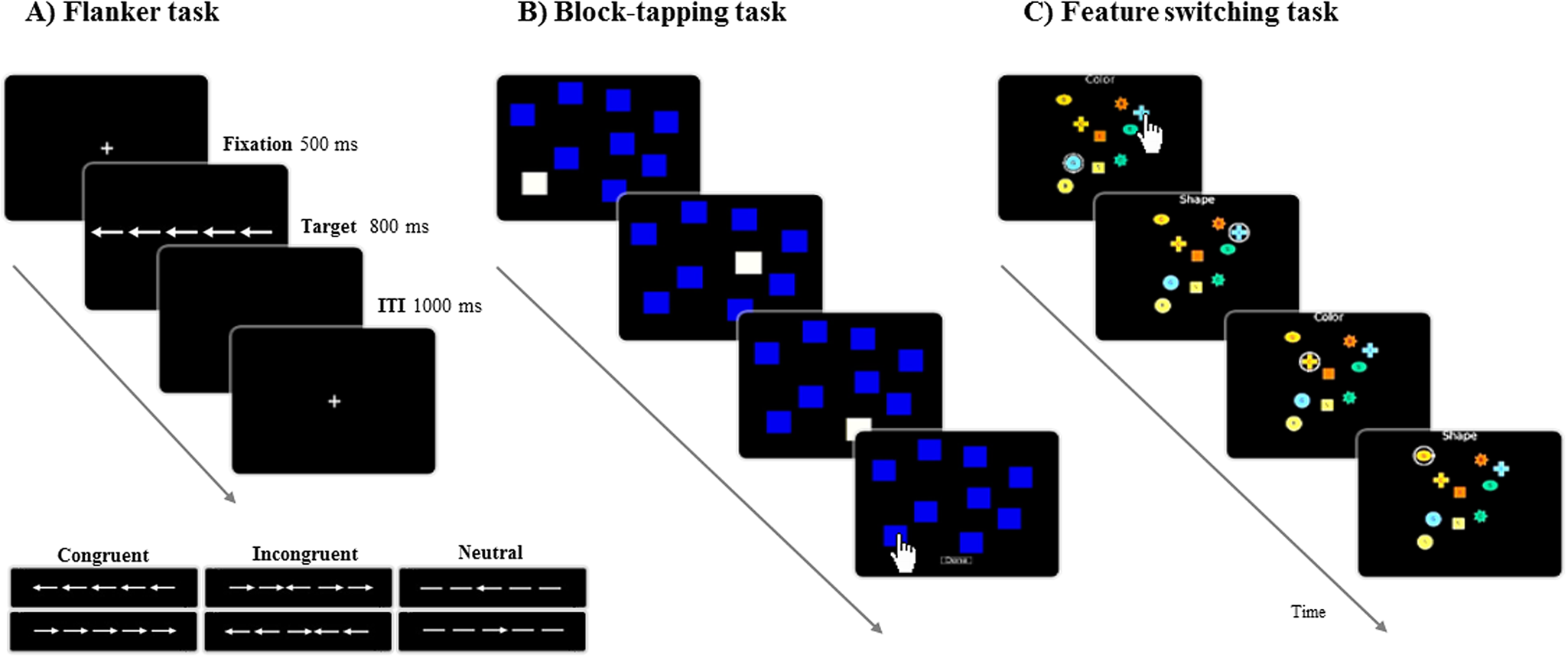
The three computerized executive tasks (flanker, block-tapping, and feature-switching) were administered using the Psychology Experiment Building Language (Mueller & Piper, Reference Mueller and Piper2014). Graphical descriptions of each task are depicted in Figure 1.
Graphical description of computerized tasks of executive control.

Computerized executive tasks: Flanker task
A modified version of the original flanker task (Eriksen & Eriksen, Reference Eriksen and Eriksen1974) was used to explore resistance to distractor interference, an inhibition-related process defined as the ability to resist interference from external task-irrelevant stimuli (Friedman & Miyake, Reference Friedman and Miyake2004). On each of the 120 trials, following a fixation cross displayed for 500 milliseconds (ms), five horizontally aligned white arrows (the target arrow was the central one) were presented in the middle of a black screen until a response was given or up to a maximum of 800 ms. The inter-trial-interval (ITI) was 1000 ms (see Figure 1A). At a viewing distance of approximately 60 cm, the set of arrows filled 5.5° of visual angle horizontally and 0.8° vertically. One-third (40 trials) were congruent (i.e., flanker arrows and target pointed in the same direction), one third were incongruent (i.e., flanker arrows and target pointed in opposite directions), and one third were neutral (i.e., horizontal lines with no arrowhead instead of flanker arrows). Trials were displayed in a different random order for each participant, who was instructed to respond by pressing – with the left or the right index finger – the appropriate keyboard button (Z or M key on a Spanish QWERTY keyboard) in accordance with the direction of the central arrow. Before the actual test, participants performed 12 practice trials that were not analyzed, with the same characteristics above mentioned. The number of errors was counted and reaction times (RTs) were recorded and averaged for each experimental condition and participant. RTs shorter than 200 ms (anticipation, 0.07% of trials) or greater than 800 ms (timeout, 1.90% of trials) were excluded from the analysis. The flanker interference effect was obtained by calculating the differences between incongruent and congruent trials on the number of errors and RTs.
Computerized executive tasks: Block-tapping task
A computerized version of the Corsi (Corsi, Reference Corsi1972) block-tapping task (Croschere, Dupey, Hilliard, Koehn & Mayra, Reference Croschere, Dupey, Hilliard, Koehn and Mayra2012) was used to assess the visuospatial updating of information through a working memory span measure. On each trial, nine blue squares were presented on a black screen (see Figure 1B). At a viewing distance of approximately 60 cm, the set of squares filled 15.8° of visual angle horizontally and 12.4° vertically. These squares lit up (changed from blue to yellow; 1000 ms duration) one at a time in a sequence. Participants were instructed to remember and click on the squares in the same order they lit up (forward) after the sequence was completed. The task started with a sequence of two squares length. After the presentation of two sequences of the same length, the following sequence increased its length in one square. The task finished when the participant failed to remember two consecutive sequences of the same length. Three practice sequences of three squares length were presented before the actual test. These practice sequences were not used for computing memory scores. The total score was computed for each participant as the product of the length of the last correctly remembered pair of sequences (block span) and the total number of correctly remembered sequences. The total score included the correct performance on both trials of an equal length, being considered as more reliable than the block span alone (Kessels, van Zandvoort, Postma, Kappelle & de Haan, Reference Kessels, van Zandvoort, Postma, Kappelle and de Haan2000).
Computerized executive tasks: Feature-switching task
A computerized feature-switching task (Anderson, Deane, Lindley, Loucks & Veach, Reference Anderson, Deane, Lindley, Loucks and Veach2012) was used to assess the ability to flexibly switch back and forth between tasks or mental sets: that is, participants’ task-switching ability (Friedman & Miyake, Reference Friedman and Miyake2004). On each of the 108 trials, ten objects were presented on a black screen. The objects were characterized as a function of three features: shape (circle, plus, ellipse, square, and star), color (blue, green, orange, red, and yellow), and the letter appearing inside (from A to Z). Each object matched a single other object on only one feature. When the task started, one object was circled and, at the top of the screen, the participant was prompted to select a matching object based on the displayed target feature (see Figure 1C). Once participants had correctly matched the object, a different target feature was specified, to which they should switch and find the object that matched the current object based on that new target feature. The task was divided into nine blocks of 12 trials each with different object configurations being presented on each block. At a viewing distance of approximately 60 cm, the set of objects filled, at its maximum, 11° of visual angle horizontally and 10° vertically. RTs shorter than 200 ms (anticipation, none of the trials met this exclusion criterion) or further than 3 SDs from the mean (timeout, 1.76% of trials) were excluded from the analysis. The number of errors was counted and RTs were recorded and averaged for the entire task.
Procedure
First, all participants received online forms of self-reported instruments, such as the BSWQ and the language background questionnaire including the questions about AoA and language proficiency. Once all participants had answered the self-reported instruments, the experimental session took place, which lasted about 60 minutes. The order of task administration was fixed and started with the flanker task, followed by the block-tapping task, and the feature-switching task. The consent form, the background information questionnaire, and oral instructions of the computerized tasks were presented in their L1, Catalan. Only the BSWQ was administered in Spanish (L2) because it was already published and available in that language.
Statistical analyses
Descriptive statistics were obtained for the self-reported measures of the study (BSWQ, AoA, and L1 and L2 proficiency) and measures from computerized tasks. Internal consistency coefficients (alpha and mean inter-item correlation) were computed for the BSWQ scales. Pearson bivariate correlations were obtained to assess the interrelations between BSWQ scales.
In order to explore the relationship between LS behavior and executive control, a series of stepwise linear regression analyses were performed on those of each computerized task's variables that better represented the specific subcomponents of executive control. The stepwise procedure is typically used to identify a subset of variables that is useful for predicting a given output while eliminating those variables that do not provide additional information to the model. In this statistical technique, variables are entered one at each step if they account for a significant increase in the model's explained variance (R 2). Furthermore, variables entered at an earlier step may also be removed from the model later at any step where they no longer contribute to the regression because of the relation between them and other variables in the equation at that step (Draper & Smith, Reference Draper and Smith1998). More in detail, the stepwise procedure begins with no explanatory variables in the model. The candidate independent variable explaining the most variance in relation to the dependent variable is considered for inclusion at the first step. If this variable does not reach the inclusion criterion (in our case, the significance level associated with the change in R 2 should be p < .05) no regression equation is computed. Alternatively, if this first variable reaches the inclusion criterion, it is retained, a regression equation is computed and the second step is started. In the second step, the variable that causes the most increase in the model's explained variance among the remaining candidates is considered for inclusion and entered into the regression if the criterion is also met. The inclusion criterion is tested for all candidate variables not yet in the regression equation at each subsequent step. A removing criterion (change in R 2 p > .1 in this case) is also tested at each step for all the already entered variables. When no variables in the current equation can be removed and the next best candidate variable cannot hold the inclusion criterion, the process stops. For the flanker task, four different regressions were calculated: one for each of the interference measures (i.e., both the number of errors and the mean RT), one for the global number of errors, and one for the mean global RT for correct responses (global measures include data from congruent, neutral, and incongruent trials). For the block-tapping task, one regression model was performed on the total score. Finally, for the feature-switching task, two different regressions were conducted on the number of errors and the mean RT for correct responses. BSWQ L1S, L2S, CS, and US scales, AoA, and L1 and L2 language proficiency were used as candidate independent variables.
Results
Descriptive statistics, internal consistency, and BSWQ interrelations
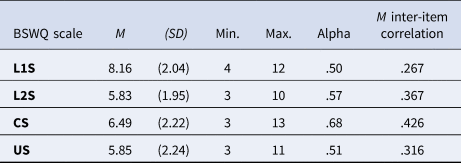
Descriptive statistics and internal consistency coefficients (alpha and inter-item correlations) for each BSWQ scale (L1S, L2S, CS, and US) are shown in Table 1. Alpha scores of the BSWQ were not excellent, maybe due to the small length of the scales (Streiner, Reference Streiner2003). However, mean inter-item correlations, which are not affected by the number of items (Clark & Watson, Reference Clark and Watson1995), suggested adequate internal consistency of the BSWQ scales.
Descriptive and internal consistency statistics for BSWQ scales

Note. BSWQ: Bilingual Switching Questionnaire; L1: Catalan; L2: Spanish; L1S: switch from L2 to L1 (Catalan); L2S: switch from L1 to L2 (Spanish); CS: contextual switching; US: unintended switching
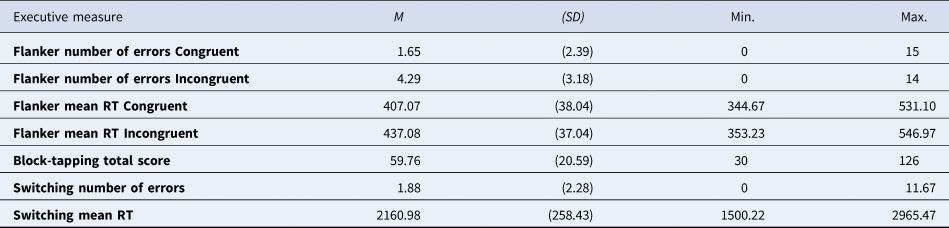
Descriptive statistics for measures of executive control are shown in Table 2. In the flanker task, a greater number of errors and slower responses to incongruent as compared to congruent trials was obtained, F(1, 111) = 92.146, p < .001, ɳp2 = .454 and F(1, 111) = 304.787, p < .001, ɳp2 = .733, for errors and RT, respectively. Hence, since the expected flanker interference effect was found, differences between incongruent and congruent conditions were calculated and used as indicators of interference control on the following analyses.
Descriptive statistics for executive measures from computerized tasks

Note. RT: reaction time (ms)
With regard to BSWQ interrelations, scores in L1S were moderately and positively correlated to CS, r(110) = .219, p < .05, and scores in LS2 were strongly and positively correlated to CS, r(110) = .552, p < .01, and US, r(110) = .337, p < .01, which also showed strong positive correlations among them, r(110) = .348, p < .01. However, L1S scores were not significantly related either to L2S or to US, rs(110) < .177, ps > .06. These results suggest that BSWQ scales do not measure a unitary construct, thus questioning the appropriateness of computing an overall score of LS with this questionnaire.
Bilingualism-related factors and executive control
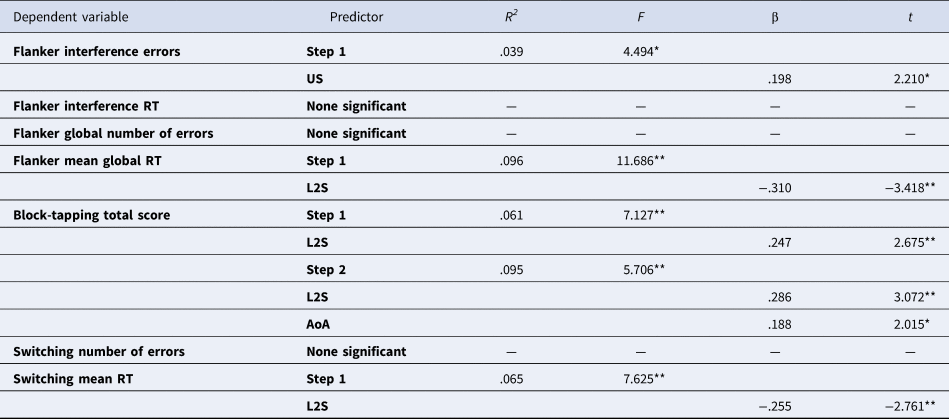
Table 3 shows the summary of the stepwise regression models obtained for the executive control measures using BSWQ scale scores, AoA and L1 and L2 proficiency scores as candidate independent variables.
Summary of the stepwise linear regression analyses with L1S, L2S, CS, US, AoA, and L1 and L2 language proficiency considered as candidate independent variables

Note. L1: Catalan; L2: Spanish; L1S: switch from L2 to L1 (Catalan);L2S: switch from L1 to L2 (Spanish); CS: Contextual switching; US: unintended switching; AoA: age of L2 acquisition; RT: reaction time (ms). None significant: no variable reached the inclusion criterion; consequently, no regression equation was computed.
*p < .05. **p < .01.
Flanker task
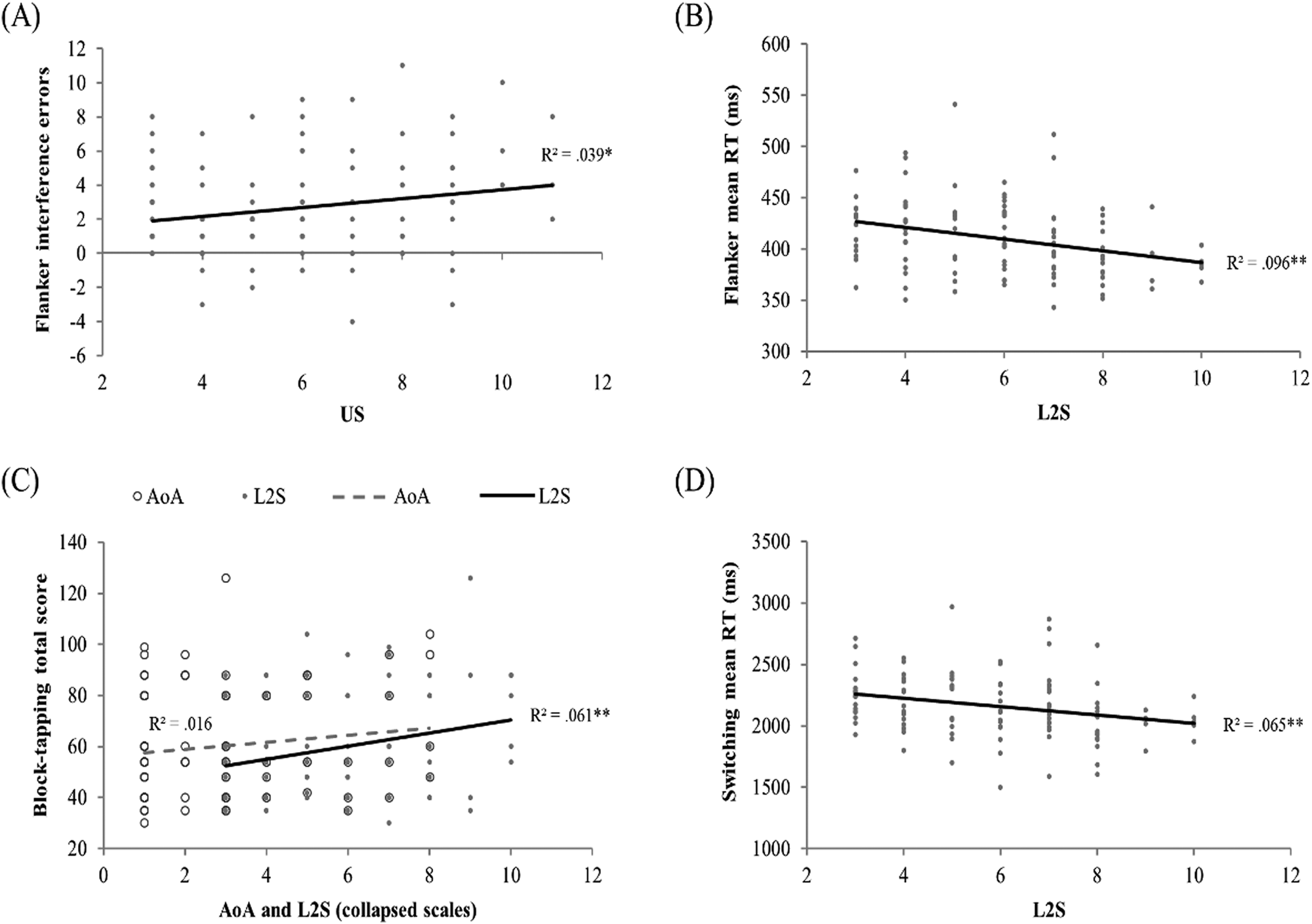
The flanker interference effect as measured in errors was significantly predicted by US scores (3.9% of variance explained), with greater scores on the US scale being associated with a larger interference effect. None of the remaining variables accounted for a significant increase in the variance since they did not meet the inclusion criterion of p < .05, βs < .16, ts < 1.73, ps > .087, thus being not entered in the model, and stopping the procedure after the first step. Interestingly, L2S emerged as the unique significant predictor for mean global RT to correct responses (9.6% of variance explained), indicating that more frequent L2S was associated with faster responses in this task. None of the remaining variables accounted for a significant increase in the variance, βs < |.05|, ts < |0.54|, ps > .588, thus being not entered in the model, and stopping the procedure after the first step.
For the flanker interference effect as measured in terms of RT and the global number of errors, no variable emerged as a significant predictor, thus no model was computed in these cases.
Block-tapping task
Again, L2S was the best predictor for scores in the block-tapping task (6.1% of variance explained), indicating that frequent L2S was related to better performance in this task. Moreover, AoA rose as a significant predictor (increment of 3.4% of variance) in a second step in which L2S entered first. None of the remaining variables accounted for a significant increase in the variance, βs < |.12|, ts < |1.26|, ps > .211, thus being not entered in the model, and stopping the procedure after the second step.
Feature-switching task
Mean RT to correct responses in the feature-switching task was significantly predicted by L2S (6.5% of variance explained), indicating that frequent L2S was associated with faster responses in this task. None of the remaining variables accounted for a significant increase in the variance, βs < .12, ts < 1.31, ps > .193, thus being not entered in the model, and stopping the procedure after the first step.
For the number of errors in the feature-switching task, no variable emerged as a significant predictor, thus no model was computed for this dependent variable.
Note that L1 and L2 proficiency scores were not significantly associated with any executive measure.
Significant associations between bilingualism-related factors and executive measures observed in the regression analyses are illustrated by scatterplots depicting direct (not partial) associations (Figure 2). Regarding the block tapping task, the direct association between L2S and the block-tapping total score was greater than the direct association between AoA and the block-tapping total score, which was nonsignificant (see Figure 2C).
Direct associations A) between US scores and flanker interference effect in errors, B) between L2S scores and flanker mean global RT, C) of L2S and AoA with the block-tapping total score, and D) between L2S and mean RT in the feature-switching task.

Discussion
This study aimed to identify the key linguistic factors that could contribute to the understanding of individual differences in executive control among bilinguals. Hence, the association of natural language switching (LS), age of L2 acquisition (AoA), and L1 and L2 proficiency, with executive control measures was explored in a sample of Catalan–Spanish early bilingual young adults. First, we expected that higher rates of LS would be associated with better executive control, as evidenced by reduced interference produced by distractors, better performance when updating visuospatial information in working memory, and enhanced ability to shift between task-sets. Second, we predicted that unintended language switches (US) would be specifically related to lower outcomes in executive function. In order to test for these hypotheses, three experimental tasks – tapping into three executive control processes (Miyake & Friedman, Reference Miyake and Friedman2012; Miyake et al., Reference Miyake, Friedman, Emerson, Witzki, Howerter and Wager2000) – were administered along with self-reported measures of directionality and type of natural LS, AoA, and L1 and L2 proficiency.
Partially confirming our first hypothesis results from stepwise regression analyses suggest that frequent switches from L1 to L2 (L2S) are associated with benefits in non-verbal tasks involving working memory and shifting. Those bilinguals who more frequently exert L2S evidenced better performance in the block-tapping task, suggesting that the updating of working memory contents is susceptible to the positive effects of repeated LS from L1 to L2. Moreover, frequent L2S appeared to be also associated with faster RT in the task that requires shifting from one relevant task-set to another (feature-switching task), suggesting that the executive shifting ability would also improve due to language practice. In this vein, our first hypothesis was not fully supported by results regarding inhibitory control since reiterated LS did not predict interference measures per se (i.e., interference effect), but faster global responses in the flanker task. Regarding the literature about nonlinguistic tasks of interference, results supporting the hypothesis of a bilingual inhibitory control advantage (BICA), as indexed by a smaller interference effect for bilinguals (i.e., differences between incongruent and congruent trials) are, at least, infrequent (Lehtonen et al., Reference Lehtonen, Soveri, Laine, Järvenpää, de Bruin and Antfolk2018). Our results nuance the relation between interference inhibition and language control, suggesting that the frequency of LS might not be the most relevant mechanism associated with inhibitory control. In other words, it seems that the frequency of L2S does not modulate the assumed bilingual's ability to better perform in non-linguistic interference tasks. In this vein, this finding is consistent with results advocating that inhibitory control is not a central factor in language control as measured through a linguistic switching task (Branzi, Calabria, Boscarino & Costa, Reference Branzi, Calabria, Boscarino and Costa2016), even though a certain relation seems to exist, as our US results hint. Alternatively, it has been proposed that a bilingual executive processing advantage (BEPA; Hilchey & Klein, Reference Hilchey and Klein2011) – that is, a superior general executive control evidenced by faster global RTs, instead of a specifically enhanced inhibitory control – would be on the basis of the bilingual advantage (Bialystok et al., Reference Bialystok, Craik and Luk2012; Hilchey & Klein, Reference Hilchey and Klein2011) in studies comparing bilinguals and monolinguals (Bialystok et al., Reference Bialystok, Craik, Klein and Viswanathan2004; Costa et al., Reference Costa, Hernández and Sebastián-Gallés2008). Although the results supporting the BEPA hypothesis, and the bilingual advantage in general, seem to be in a downward tendency (Hilchey et al., Reference Hilchey, Saint-Aubin, Klein and Schwieter2015; Lehtonen et al., Reference Lehtonen, Soveri, Laine, Järvenpää, de Bruin and Antfolk2018), these global processing advantages have been more commonly observed under high monitoring conditions (i.e., congruent and incongruent trials are evenly distributed; Costa, Hernández, Costa-Faidella & Sebastián-Gallés, Reference Costa, Hernández, Costa-Faidella and Sebastián-Gallés2009). Our results concerning the global RT of the flanker task, in which the occurrence of congruent and incongruent trials is equiprobable, would fit better with the hypothesis of an advantage in a global conflict monitoring system (Costa et al., Reference Costa, Hernández, Costa-Faidella and Sebastián-Gallés2009), that is, the BEPA hypothesis (Hilchey & Klein, Reference Hilchey and Klein2011). Therefore, frequent LS in nearly simultaneous bilinguals would be redounding in long-term effects on a general mechanism of conflict monitoring rather than on inhibitory control.
It is worth noting that only tendencies to L2S (but not to L1S) have a significant association with behavioral measures of the three major executive control components. This suggests that switching to L2 in a natural environment possibly requires greater executive processing than switching to L1, thus involving more demanding training in terms of allocating cognitive resources. This suggestion seems to be counterintuitive when faced with the asymmetrical switching cost effect (i.e., L1S being more costly than L2S because of negative priming produced by a greater inhibition of the L1 lexical representations; Meuter & Allport, Reference Meuter and Allport1999), usually observed in laboratory language switching paradigms among unbalanced bilinguals. However, according to the characteristics of our sample (i.e., highly proficient bilinguals in both L1 and L2), such asymmetry should not be expected (Calabria, Hernández, Branzi & Costa, Reference Calabria, Hernández, Branzi and Costa2012; Costa & Santesteban, Reference Costa and Santesteban2004; Costa, Santesteban & Ivanova, Reference Costa, Santesteban and Ivanova2006; Prior & Gollan, Reference Prior and Gollan2013). Beyond the asymmetry hypothesis that is founded on inhibitory processes, our results suggest that L2S has no differential association with inhibitory control, but with global processing mechanisms. This result could be speculatively explained in terms of the socio-linguistic context and the characteristics of the sample. In this vein, Catalan–Spanish bilinguals are immersed in a dual-language interactional context, which is assumed to enhance conflict monitoring and other cognitive control processes that allow these individuals to fluently switch between task sets (i.e., task disengagement and engagement), and to detect cues that may support goal maintenance mechanisms required to speaking in one language rather than the other (Green & Abutalebi, Reference Green and Abutalebi2013). Thus, our results suggest that L2S better captures individual differences in the extent of engagement in dual-context conversational exchanges.
Further, switching from L1 to L2 was mostly associated with RTs but not with accuracy measures of inhibition and shifting, selectively affecting the processing speed but not the execution outcomes. This pattern suggests that the purported training effect produced by frequent L2S is easily apprehended through global efficiency measures of executive control (RT) rather than specific enhancements in execution (accuracy).
On the other hand, US was confirmed as a relevant variable to be explored in the field of bilingualism and executive control. Consistent with the second hypothesis of this study, unintended internally directed switches were associated with poorer inhibitory control, as indexed by a larger flanker interference effect measured by means of the number of errors. In contrast with the results found for L2S, higher US was associated with worse outcomes in a specific measure of inhibitory control, rather than with global measures of conflict monitoring. Attending to the divergent executive mechanisms associated with L2S and US, it seems that the exploration and control of linguistic variables regarding bilinguals’ tendencies in the direction and type of natural LS could contribute to a better understanding of results supporting BICA and BEPA hypotheses.
Altogether, the results of the present study suggest the existence of a link between self-perceived frequency of L2S and behavioral non-linguistic measures of executive control. Thus, it is likely that frequent natural LS (especially L2S in the present study) involves the training of general executive processing. Although this linkage could be inversely interpreted as an influence of executive control on linguistic performance, we are more prone to adopt the training hypothesis based on theoretical and empirical arguments (Zhang, Kang, Wu, Ma & Guo, Reference Zhang, Kang, Wu, Ma and Guo2015). Notwithstanding, the direction of the negative association between US and the execution in the task involving inhibition could be less intuitively explained in terms of training. We believe that incurring in US might not be a contributor (a cause) to a poor inhibitory control but a linguistic consequence of poor inhibitory control. Future research should empirically test for these relationships and their causality throughout the application of specific types of structural equation modeling that allow researchers to disentangle the direction of the associations between a set of variables (Edwards & Lambert, Reference Edwards and Lambert2007). Once this question is clarified, the use of measures of US tendencies would be encouraged with sample description purposes. Beyond, the occurrence of US could serve as a natural screening measure of baseline executive control, specifically in terms of inhibitory processes. Consequently, the exploration of this measure might contribute to a more comprehensive explanation of executive control in bilinguals.
Taking into account the results of the regression analyses, tendencies to L2S are postulated as more relevant for explaining bilinguals’ individual differences in executive control than other explored variables, such as AoA and language proficiency. AoA only emerged as a predictor of enhanced working memory. This result is in line with the idea of more intense training of executive control in bilinguals who acquire L2 later, maybe due to a greater interference of L1. Note that this assumption comes from literature reporting results in the inhibitory domain of executive control (e.g., Tao et al., Reference Tao, Marzecova, Taft, Asanowicz and Wodniecka2011), while the current finding is about spatial working memory. Still, results from our analyses regarding AoA should be cautiously interpreted. None of the participants in this study would be considered late bilinguals following Tao et al.'s (Reference Tao, Marzecova, Taft, Asanowicz and Wodniecka2011) or Luk et al.'s (Reference Luk, De Sa and Bialystok2011) AoA cut-off (12 and 10 years, respectively). Beyond, the association between later AoA and larger spatial working memory was only evident in the second step of the stepwise regression analysis, after controlling for the variance explained by L2S that emerged as the first predictor. The nonsignificant correlation between AoA and the working memory score evidences that there was not a direct association between these two variables. This also suggests that L2S could act as a confounding variable that accentuated the relationship between AoA and working memory in the regression analysis (MacKinnon, Krull & Lockwood, Reference MacKinnon, Krull and Lockwood2000). Consequently, we are not confident about the robustness of the association found in the second step of the regression analysis, which is only manifested after partialling, making this result more difficult to interpret (see Lynam, Hoyle & Newman, Reference Lynam, Hoyle and Newman2006 for a study addressing this issue in another research field). Besides, language proficiency was related to none of the executive measures. This result is congruent with some reports (Verreyt et al., Reference Verreyt, Woumans, Vandelanotte, Szmalec and Duyck2016), but contends against several studies that found associations between language proficiency and measures of inhibition (Tse & Altarriba, Reference Tse and Altarriba2012) and shifting (Iluz-Cohen & Armon-Lotem, Reference Iluz-Cohen and Armon-Lotem2013; Yow & Li, Reference Yow and Li2015). The greater relevance of L2S over AoA and language proficiency when predicting executive control found in our study suggests that inconsistent associations of executive control with AoA and language proficiency reported in previous studies might have been mediated by variations in L2S, which were not explicitly analyzed in those previous studies. In line with Verreyt et al. (Reference Verreyt, Woumans, Vandelanotte, Szmalec and Duyck2016), our results suggest that the crucial factor that seems to actually exercise executive control is LS; thus, AoA and language proficiency would not suffice to explain executive control differences among bilinguals.
The scarce influence of other bilingual-related factors beyond LS in our work could be alternatively explained by the homogeneity of the current sample, which was composed by Catalan–Spanish undergraduate bilinguals who learned Spanish early in life and were proficient in both Catalan and Spanish. These and other characteristics of the sample, such as the similarity of the two languages, could reduce the variability of potentially relevant variables, such as AoA and language proficiency. Simultaneously, these specific characteristics of the sample (early proficient bilinguals) could probably allow a purer exploration of the contribution of LS behavior to executive control. Catalan–Spanish languages are highly similar Romance languages sharing a large number of cognate words with similar phonetics and semantics, which has been estimated to be 76% (Lewis, Simons & Fennig, Reference Lewis, Simons and Fennig2014). Furthermore, exposure to Catalan and Spanish in the region where the sample was recruited is considerably balanced in terms of usage, being present at educational, social, and media settings. In sum, the environment is very favorable for the incidence, and, consequently, for the study of LS habits. Note that the specific social characteristics of the environment could explain the pattern of associations observed between the direction of LS (i.e., frequency of L1S and L2S) and the type of LS (i.e., contextual and unintended) reported in the present study. While switching to Spanish (L2S) was related to both contextual and unintended switching, switching to Catalan (L1S) was only associated with CS. In the region where the sample was recruited, it is common to find Spanish monolingual people with a reduced comprehension of Catalan, inducing bilingual speakers to switch to Spanish (L2S) either voluntary and/or involuntary in order to achieve effective communication. However, the inverse situation is not as frequent, since Spanish is a dominant language effortlessly acquired across different sub-groups of speakers immersed in our stable bilingual community (Gathercole & Thomas, Reference Gathercole and Thomas2009). Consequently, L1S could be restricted to voluntary switching to, for example, find the appropriate word to express an idea. It could be of interest to study the associations between the BSWQ scales and executive control in other bilingual samples in order to understand this phenomenon under different environmental conditions.
We would like to note some aspects regarding the measures used in this study, and thus the results reported here. First, the task-switching paradigm administered – namely, the feature-switching task – is rather unconventional, because participants have to set-shift in all trials (i.e., since there are no repeat trials, continuous alternation is required, and no switching costs could be calculated). In order to contextualize our results with those of the task-switching paradigms more commonly used in the field, we will hereby present the effect of the main feature-switching task characteristics and how these are expected to modulate switching costs. In this regard, when comparing continuous set alternations with other set-shifting conditions, the former showed it enhances the switching performance of participants (Lu, Akinola & Mason, Reference Lu, Akinola and Mason2017; Sio, Kotovsky & Cagan, Reference Sio, Kotovsky and Cagan2017). Furthermore, the proportion of switch trials has been shown to modulate the RT of both switching and repeat trials, making them similar when switch trials are more frequent than repeat trials (Mayr, Kuhns & Rieter, Reference Mayr, Kuhns and Rieter2013). This effect was suggested to reflect the participants’ tendency to not fixate on a specific set but to increase set flexibility to adapt properly to the context at hand. In other words, it seems that individuals were prone to allocate their limited cognitive resources to switching, rather than to inhibition (of other irrelevant features of the stimuli) in order to attain a balanced performance when switches were more likely. Conversely, the perceptual set-shifting nature of this task and the fact that the competing feature sets were present have been evidenced to enlarge switching costs (Ravizza & Carter, Reference Ravizza and Carter2008). In sum, it is hard to harmoniously reconcile our results with those obtained using more common switching paradigms that allow the computation of switch costs. However, we confidently assume that the task at hand involves shifting executive processes and that the measures obtained here could capture individual differences in those processes, not in terms of derived measures, such as costs, but in terms of direct indices of execution. Second, the BSWQ was the questionnaire of choice in this study because it offers the possibility of examining different dimensions regarding the nature of the LS behavior. However, the BSWQ shows limitations related to item ambiguity (Podsakoff, MacKenzie & Podsakoff, Reference Podsakoff, MacKenzie and Podsakoff2012), which are produced by both the phrasing of some items, and the self-reported retrospective-related biases accentuated by the absence of instructions about the period to be considered by the respondent. Moreover, its use entails some considerations, mainly related to its reliability and convergent validity. In our study, the internal consistency of each scale is moderately below the desired standards. However, two known alpha coefficient characteristics might account for this outcome, which are the length of the scales and the relatively fuzzy limits between them. These two issues have been shown to underestimate the alpha values of a test by increasing measurement error (Streiner, Reference Streiner2003). Altogether, these elements might explain why several authors have tended to cluster some of its scales when using the BSWQ (e.g., Morales, Yudes, Gómez-Ariza & Bajo, Reference Morales, Yudes, Gómez-Ariza and Bajo2015; Soveri et al., Reference Soveri, Rodriguez-Fornells and Laine2011). Nevertheless, our results evidence that the mean inter-item correlation of each scale is rather adequate (Clark & Watson, Reference Clark and Watson1995), and thus, they seem to be trustworthily assessing their objective constructs. Alternatively, the reliability and validity issues related to the retrospective measurement of LS behavior could be overcome by using more ecological measures. For instance, Jylkkä et al. (Reference Jylkkä, Soveri, Laine and Lehtonen2019) assessed LS using the Ecological Momentary Assessment (EMA), in which participants were asked to report their intended, unintended, and contextual LS (by answering one question for each type of LS) every two-hours during 14 days. Although it could be interesting to include items asking for the directionality of the switch (i.e., L1S and L2S), the assessment of LS with EMA emerges as a promising instrument with the potential of improving those single and multiple-item retrospective scales previously used in the field.
In conclusion, just because the methodological considerations of the present research are sometimes arguable, this does not necessarily invalidate this study, its strengths and its contributions to the field. The exploration of individual differences regarding the direction and type of natural LS is confirmed as a fruitful venue for research on bilingualism. In light of the current results, we encourage further systematic control and exploration of bilingualism-related factors such as the directionality and type of LS to clarify and reconcile previous studies about bilinguals’ cognitive peculiarities and to extend what is known about the bilingual advantage.
Acknowledgements
This study received the support of FEDER/Ministerio de Ciencia, Innovación y Universidades, Agencia Estatal de Investigación/EDU2017-85909-P and EDU2013-45174-P, and a predoctoral fellowship from the Ministerio de Economía y Competitividad (Spain) to the second author (BES-2014-069063; AEI/FEDER, EU).