Introduction
We disagree with the view that resilience is often referred to as a trait that develops from an individual's experience with extreme adversity. Much of the research that holds to this view includes traumatised individuals (e.g., Cicchetti, Rogosch, Lynch, & Holt, Reference Cicchetti, Rogosch, Lynch and Holt2009; Egeland, Carlson, & Sroufe, Reference Egeland, Carlson and Sroufe1993; Haglund, Nestadt, Cooper, Southwick, & Charney, Reference Haglund, Nestadt, Cooper, Southwick and Charney2007; Luthar, Cicchetti, & Becker, Reference Luthar, Cicchetti and Becker2000; Nomura, Chemtob, Fifer, Newcorn, & Brooks-Gunn, Reference Nomura, Chemtob, Fifer, Newcorn and Brooks-Gunn2006). Our idea is that resilience is actually a regulatory or coping capacity that develops from infants’ experiences with everyday stress. Specifically, resilience develops in all individuals, regardless of age, due to the intermittent and frequent experiencing of stressors, in varying degrees and intensities, by simply living in a world of complex social relationships and ever-changing, volatile situations. It is how the individual successfully or unsuccessfully regulates the stress that affects the development of resilience. Stressors are reiteratively and chronically regulated at different psychobiological levels to mould individuals’ regulatory capacities. As such, resilience emerges from the successful resolution of stresses, such that the capacity to cope increases as successful experiences accumulate.
Stress may not be readily associated with infancy, nor is the idea of resilience. Yet both characterise infancy and early childhood. During in home observations of healthy, typical infants and their mothers, we have found that infants at 3 and 6 months of age were in distressed states 11 per cent of the time, lasting on average about 3 min. They were in heightened, highly aroused but affectively positive states 13 per cent of the time, with an average duration of 4 min. Even when playing with their mothers in face-to-face interactions, infants expressed sad or negative affect about 3 per cent of the time, fussy vocalisations about 3 per cent of the time and distress indicators (e.g., spitting up) about 1 per cent of the time (Weinberg, Tronick, Cohn, & Olson, Reference Weinberg, Tronick, Cohn and Olson1999). Research findings, however, are hardly needed to demonstrate the ubiquitousness of infants experiencing stress. Supporting evidence is everywhere, from infants crying for a bottle, fussing because they are wet or because they cannot reach an object, crying in protest when their mother leaves them alone, or for no apparent reason (i.e., the mythical gas). Infants also get highly aroused while playing an exciting game such as peek-a-boo, where over-arousal transforms laughter into tears or spitting up. These common bouts of distress, however, are limited in duration by the infant's self-regulation of the distress (e.g., thumb sucking, attending to an interesting object) or by a care giver's regulatory scaffolding (e.g., picking the infant up). Although these observations may seem boringly quotidian, they are not, because it is not only coping abilities that are at stake, but development depends on infants’ active engagement with the world of people and things, and failure to cope – to be regulated – precludes engagement with the world.
For infants, the capacity to effectively deal with stressors is not entirely in their hands. Infants come to depend on their main care giver, typically the mother, to intervene when necessary. The mother's ability to attend to her infant's signals and to respond appropriately is instrumental to the development of stress regulation and of resilience. We propose that it is the micro-temporal ubiquitous mis-steps in communication with their attendant micro stress experience and its resolution – the mismatches of intentions and affect and their re-coordination – between the mother and infant that lead to resilience. However, experience with stress is not sufficient to build the infant's developing capacity for resilience. Specifically, mis-steps in communication within the dyad need to be followed by a reparatory process, a dyadic coping mechanism that focuses on the process of transforming stressful mismatching states into non-stressful states (Gianino & Tronick, Reference Gianino, Tronick, Field, McCabe and Schneiderman1988; Tronick, Reference Tronick2006; Tronick & Beeghly, Reference Tronick and Beeghly2011).
On the one hand, when reparation is successful, the infant's stress level decreases, matching returns and the reiteration of successful reparation builds the infant's capacity for resilience. On the other hand, dysregulation occurs when reparation fails and dysregulation precludes an infant's engagement with the animate and inanimate world. Moreover, when engagement is chronically disrupted, negative cascading processes have the potential to disrupt development in a number of different domains, including biological, relational and behavioural realms. Thus, stress regulation is critical to typical development. Note that this view is substantially different from trauma model(s), which seem to focus on singular or even multiple singular events. Certainly such events happen, but our assertion would be that such events (almost) always occur in the context of chronically disrupted cascading processes.
The Everyday Stress Resilience Hypothesis
Our approach to questions about the emergence of a resilient, biobehavioural phenotype during the first years of life is formulated in the Everyday Stress Resilience Hypothesis. The hypothesis states that coping with everyday stressors influences infants’ regulatory capacities for typical stressors and prepares them to cope with later, more taxing stressors. In short, everyday coping experiences develop regulatory capability and capacity or a ‘regulatory resilience’. Furthermore, based on human and animal research, we also argue that successful regulation of stress and the growth of regulatory resilience is not solely dependent on infants’ internal self-organised regulatory capacities (Calkins & Hill, Reference Calkins, Hill and Gross2007; Hofer, Reference Hofer1987, Reference Hofer2006; Kopp, Reference Kopp1989; Tronick, Reference Tronick2006). Rather, stress regulation and its potential growth toward resilience are critically dependent on the quality of the infant–care giver relationship. Although theories have emphasised the importance of the care giver's regulatory role (Field, Reference Field1994; Hofer, Reference Hofer2006), the unique contribution of the Everyday Stress Resilience Hypothesis furthers this notion by contextualising the early development of resilience in the typical, everyday process of dyadic regulation. In particular, of critical importance is the infant–care giver dyad's capacity for continual, mutually coordinated regulation of infants’ psychobiological states of stress – quotidian and intense – into non-stressful states.
A useful analogy for the Everyday Stress Resilience Hypothesis is training for a marathon. Runners do not run marathons to train for a marathon. Instead they run a specific distance each day and increase that distance over the course of weeks. However, it is not until they actually run the marathon that they complete the full distance. Training within capacity does not lead to improvement, rather, progressive training develops the runner's stamina, or coping capacities. Progressive training leads to a bit-by-bit accumulation of capacity, culminating in the capacity to go the full distance. The increase in capacity is not related to a singular change but to changes in many different metabolic and muscular characteristics. Effective training is specifically aimed at processes that relate to running the marathon. Training does not prepare one for a triathlon or long-distance skiing. Of course, without the training, had runners tried to go the full daunting distance they would surely fail; the stress would exceed their capacity. Or, had they over-trained, their capacity would actually diminish because different systems would not have been able to recover from the inherent stress of training. Their capacity also diminishes when training is ended. Thus a progressive increase of training and reiterated chronic training is needed to maintain and grow capacity; with it, one becomes marathon resilient and without it marathon resilience is not achieved. This analogy is similar to the inoculation analogy for stress (Parker, Buckmaster, Sundlass, Schatzberg, & Lyons, Reference Parker, Buckmaster, Sundlass, Schatzberg and Lyons2006), but differs in that it is not an all-or-none model but an ontogenetic model. It allows for a consideration of the loss of capacity and the need for recovery, or reparation.
Stress at the Macro-developmental Level and the Micro Real-time Processes that Regulate it
We frame our understanding of the development of resilience using a dynamic systems perspective. Dynamic self-organising biological systems have a hierarchical organisation operating at multiple levels and temporal scales. They are information-rich, with specific, intense and continuous dynamic interactions with local contexts. Complex systems exhibit emergent properties at different levels. Self-organising processes generate these emergent properties and lead to an increase in the complexity and coherence of the system. Prigogine (Prigogine & Stengers, Reference Prigogine and Stengers1984) states that a primary principle governing the activities of open biological systems is that they must acquire energy and information from the environment to maintain and increase their coherence and complexity. The developing infant is just such a system. Its impressive features of very rapid development of emergent capacities, striking increases in complexity, and almost continuous informational exchanges with the external environment are reflections of continuously active powerful self-organising capacities.
Critically, it is necessary to recognise that ontogenetic change requires disorganisation and reorganisation. Stress travels with this process. Despite the smooth, step-by-step characterisation of development seen in graphs charting developmental milestones, development does not proceed so smoothly. Development proceeds in an irregularly serrated pattern. Periods of stability (sometimes thought of as periods of practising) in developmental domains are followed by periods of dismantling an already organised capacity and reorganising it into a more complex and coherent form of organisation. The transitions between periods of stability (attractor states) are inherently stressful, not only because they are energetically demanding, but because the transitions are unstable. During transitions the infant may actually lose complexity and coherence until the new organisation emerges. Crawling, for example, needs to be dismantled to allow for the self-organised emergence of walking (Trevarthen, Reference Trevarthen and Bever1982; van de Rijt-Plooij & Plooij, Reference van de Rijt-Plooij and Plooij1992); or, how infants who learn how to crawl across a risky slope, must then relearn how to cross the same slope while walking (Adolph, Reference Adolph1997). Furthermore, because the disorganisation of one system often disorganises other systems, the stress may be exacerbated in intensity and duration (Brazelton, Reference Brazelton1992; van de Rijt-Plooij & Plooij, Reference van de Rijt-Plooij and Plooij1993).
A consequence of this developmental disorganisation is that the moment-by-moment biobehavioural organisation of the infant is threatened. Thus, during periods of instability infants are less able to maintain homeostasis and are more likely to become fatigued, over-aroused and distressed. A primary feature of our systems model, however, is that disorganisation is typical. Indeed disorganisation is necessary for the emergence of a new capacity and for generating an increase in complexity and coherence; it is the wellspring of change. By contrast, fixed systems do not develop. Nonetheless, for all of its benefits, the process of macro-development is costly and stressful.
Of course, it is not only the process of development that is stressful for the infant. There are everyday internal stressors, such as hunger, fatigue, metabolic processes, lack of diurnal regulation and myriad others. There are common external forces that stress the infant: a wet nappy, too bright a light, or a loud noise. Furthermore, there are also quotidian stressful interchanges with the environment, such as desiring an out-of-reach-object, not getting a care giver's attention, and playing with a frustrating toy. In essence, there is a veritable ubiquitousness of stressors which can amplify each other and cumulate to create cascades of stress which, in turn, make the infant more vulnerable. Thus, one can only wonder how the infant is able to regulate stress in the face of such demands?
Dyadic Regulatory Systems
To overcome the ubiquitous stressor problem, humans evolved an exceptional, though hardly unique, method for regulating this stress. Humans form a dyadic regulatory system in which the infant's regulatory capacity is supplemented – scaffolded – by an external regulator – a care giver, typically the mother. The dyadic regulatory process is referred to as the Mutual Regulation Model (Beebe et al., Reference Beebe, Jaffe, Markese, Buck, Chen, Cohen and Feldstein2010; Brazelton, Koslowski, & Main, Reference Brazelton, Koslowski, Main, Lewis and Rosenblum1974; Hofer, Reference Hofer1994; Stern, Reference Stern, Rexford, Sander and Shapiro1976; Tronick, Reference Tronick1989); see also Fogel's theory of co-regulation (Fogel, Reference Fogel1993). The Mutual Regulation Model stipulates that mothers and infants are linked sub-systems that form a larger, more integrated dyadic regulatory system responsible for regulating infants’ biobehavioural organisation, including stress.
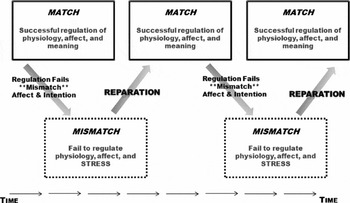
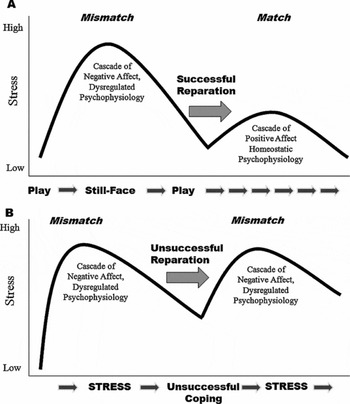
As the infant and mother transition from a matched to a mismatched state, the stress level within the dyad increases and the infant transitions to a negative state (e.g., increased negative affect, dysregulated physiology). With reparation (i.e., moving once again towards a matched state), the infant transitions back to a positive state (e.g., increased positive affect, regulated physiology).
The regulatory functioning of the infant–care-giver dyadic system is guided by communicative processes (Fogel, Reference Fogel1993; Trevarthen & Aitken, Reference Trevarthen and Aitken2001; Trevarthen, Aitken, Vandekerckhove, Delafield-Butt, & Nagy, Reference Trevarthen, Aitken, Vandekerckhove, Delafield-Butt, Nagy, Cicchetti and Cohen2006; Tronick, Reference Tronick1989). Communicative signals convey the infants’ biobehavioural status to a receptive care giver. However, the communication within even typical mother–infant dyads is far from perfect. As seen in Figure 1, in typical interactions the dyad oscillates between states of matching (synchronous) to mismatched states (asynchronous) and back to matched states through the process of reparation (Tronick & Beeghly, Reference Tronick and Beeghly2011; Tronick & Gianino, Reference Tronick and Gianino1986). When the regulatory function of the dyad operates successfully there is a fittedness of maternal regulatory input to infants’ signalled regulatory needs. For example, a maternal smile in response to her infant's attentional bid, or an empathic frown when her infant is distressed.
The process of matching, mismatching, and reparation in the dyad.

As a consequence of successful matching, the infants become more coherently organised than they could on their own. On the one hand, dysregulation can be overcome when, for example, a care giver in real time uses a crooning voice and gentle patting with a crying infant who is coping with the stress of the dismantling of crawling in the service of eventual walking. The mother's compassionate intervention helps transform the infant's distressed state into a calmer, organised alert state, leading to reparatory success. On the other hand, continual mismatching of regulatory input and infant needs results in reparatory failure. For example, giving a hungry infant an object will not repair his distressed state, whereas if the dysregulated hunger state is instead repaired with maternal nursing then the infant is likely to progress into a non-stressful state. In the moment when the care giver appropriately scaffolds the infant's regulatory capacity, the infant's stress is reduced and homeostatic balance is restored. Consequently, the infant can continue to engage the world and its challenges. A care giver who ignores the distress, or mistakenly interprets the distress, creates a mismatch between the infant's regulatory demands and the regulatory resources available. The stressful state continues and engagement is precluded.
Paradoxically, mutual regulation in real time is stressful (Tronick, Reference Tronick2006; Tronick & Cohn, Reference Tronick and Cohn1989). The stressors that occur during real-time mutual regulatory processes are micro-stressors, mismatches between external input and infant needs. These micro-stressors occur at rates measured as fast as tenths of seconds. They occur because regulation in real time cannot be perfect. When regulation is even briefly disrupted, stress and negative affect are generated (Tronick, Reference Tronick2006). Micro-stress emerges from a host of factors that make mismatches inevitable: (i) the speed at which signals are emitted – as fast as 0.25 seconds (Trevarthen & Schogller, Reference Trevarthen, Schogller and Grund2005); (ii) the demands on infants’ and care givers’ abilities to detect and decode such fast signals; (iii) the response time demanded – in the order of tenths of a second (Beebe et al., Reference Beebe, Jaffe, Markese, Buck, Chen, Cohen and Feldstein2010; Condon & Sander, Reference Condon and Sander1974; Trevarthen et al., Reference Trevarthen, Aitken, Vandekerckhove, Delafield-Butt, Nagy, Cicchetti and Cohen2006); (iv) non-perfect signalling – the occurrence of miscues; (v) the likelihood of missed signals, given their rate of occurrence; (vi) the mismatching of intentions between the interactants and unpredictable changes in their intentions; (vii) rapidly changing regulatory demands as affected by their ongoing interactive state; (viii) changes in biobehavioural state; and (ix) dynamic changes resulting from preceding regulations and states affecting current states (Cohn & Elmore, Reference Cohn and Elmore1988; Cohn & Tronick, Reference Cohn and Tronick1987, Reference Cohn and Tronick1988; Tronick, Cohn, & Shea, Reference Tronick, Cohn, Shea, Brazelton and Yogman1986).
Add to these reasons the fact that the infant has limited and immature regulatory, behavioural and attentional capacities, and the likelihood of mismatches becomes quite high. Mismatched states, or asynchronous/mis-coordinated states, tend to be more the norm than the exception in face-to-face interactions, even with typical mother–infant samples. In our studies, we have found that periods of mismatching in mother–infant dyads can make up as much as 70–80 per cent of face-to-face interactive exchanges (Tronick & Cohn, Reference Tronick and Cohn1989). Typically, however, interactive disorganisation is quickly repaired into a more organised state (i.e., distress becomes quiet alertness).
For example, in studies of typical face-to-face interaction at 6 months of age, mismatches occur at a high rate and repairs occur at about once every 3–5 seconds. More than one-third of the repairs are successful at the next step in the interaction (Tronick & Gianino, Reference Tronick and Gianino1986). Observations by Beebe and Lachmann (Reference Beebe and Lachmann1994) and Isabella and Belsky (Reference Isabella and Belsky1991) replicate these findings to support the hypothesis that the normal interaction is a process of matches changing to mismatches, with quick reparation back to matches.
Although typical interactions fluctuate between instances of coordination and mis-coordination, a key point is that reparations do occur. Mis-steps are corrected. Thinking in these terms expands our notion of stressors from intense, perhaps traumatic, stressors to everyday stressors to micro-stressors. Without reparation and regulation, even micro-stressors have the potential to accumulate and disrupt development. The process of mutual regulation, in particular stress and its reparation, has been most carefully studied using an experimental stress-induction procedure, the Face-to-Face Still-Face paradigm (Harrison & Tronick, Reference Harrison and Tronick2007; Mesman, van IJzendoorn, & Bakermans-Kranenburg, Reference Mesman, van IJzendoorn and Bakermans-Kranenburg2009; Tronick, Als, Adamson, Wise, & Brazelton, Reference Tronick, Als, Adamson, Wise and Brazelton1978). The Face-to-Face Still-Face paradigm highlights the match–mismatch–reparation process at a simulated macro-temporal level, which allows for detailed measurement of infants’ and care givers’ reactions (Figure 2A). The paradigm consists of three episodes: (1) an episode of typical infant–care giver face-to-face play; (2) the still-face episode where the care giver stops interacting with her infant and holds a still, expressionless face; and (3) a reunion episode where the care giver resumes interacting with her infant.
Two possible consequences of a mismatch–match state in the dyad. (A) The successful reparation of stress, compared to (B) the unsuccessful reparation and continuation of stress.

Most infants enjoy and come to depend on the reciprocal nature of social interactions with their care giver (e.g., reciprocal smiling, playful touching), and the violation of this expectation of reciprocity and the loss of regulatory scaffolding during the still-face is stressful. Affective and behavioural responses are striking and include decreases in positive affect, increases in negative affect, and infant behaviours that are aimed at changing the mother's behaviour or reducing stress, such as increases in protest, gaze aversion and turning away, back arching and postural collapse (Adamson & Frick, Reference Adamson and Frick2003; Mesman et al., Reference Mesman, van IJzendoorn and Bakermans-Kranenburg2009). Infants also show signs of physiological activation, with increases in heart rate (Bazhenova, Plonskaia, & Porges, Reference Bazhenova, Plonskaia and Porges2001; Moore & Calkins, Reference Moore and Calkins2004; Weinberg & Tronick, Reference Weinberg and Tronick1996) and skin conductance (Ham & Tronick, Reference Ham and Tronick2008), and a suppression of respiratory sinus arrhythmia (RSA) (Bazhenova et al., Reference Bazhenova, Plonskaia and Porges2001; Ham & Tronick, Reference Ham and Tronick2006; Moore, Reference Moore2009; Moore & Calkins, Reference Moore and Calkins2004; Weinberg & Tronick, Reference Weinberg and Tronick1996). Hypothalamic–pituitary–adrenal (HPA) axis activation, as measured by increases in salivary cortisol, has also been observed in infants during the still-face (Feldman, Singer, & Zagoory, Reference Feldman, Singer and Zagoory2010; Haley & Stansbury, Reference Haley and Stansbury2003; Ham & Tronick, Reference Ham and Tronick2006; Montirosso, Tronick, Morandi, Ciceri, & Borgatti, Reference Montirosso, Tronick, Morandi, Ciceri and Borgatti2013). During the reparation of the reunion episode, the mother once again interacts with her infant and attempts to re-establish dyadic regulation. In return, infants gaze more toward her and express more positive affect. Negative affect and stress-reduction behaviours also decrease, although they may still express higher levels of anger (Weinberg & Tronick, Reference Weinberg and Tronick1996). Cardiac measures recover (Bazhenova et al., Reference Bazhenova, Plonskaia and Porges2001; Feldman et al., Reference Feldman, Singer and Zagoory2010; Haley & Stansbury, Reference Haley and Stansbury2003; Moore & Calkins, Reference Moore and Calkins2004; Weinberg & Tronick, Reference Weinberg and Tronick1996), although Ham and Tronick (Reference Ham and Tronick2006) found that skin conductance remained high during the reunion episode.
Reparation is a dyadic process of matching regulatory input to regulatory need in order to provide the scaffolding for infants’ intrinsic regulatory capacities. The Everyday Stress Resilience Hypothesis sees reparation as central to the development of regulatory capacities. As already noted, with development the regulatory task becomes increasingly self-organised and new ways of regulating distress (e.g., speech, executive functioning, inhibitory control and emotion display rules) begin to emerge. However, it is not until later in childhood that these capacities begin to take their mature form (Carlson & Wang, Reference Carlson and Wang2007; Casey, Reference Casey1993; Cole, Martin, & Dennis, Reference Cole, Martin and Dennis2004; Eisenberg, Hofer, & Vaughan, Reference Eisenberg, Hofer, Vaughan and Gross2007; Saarni, Reference Saarni1979; Saarni, Mumme, & Campos, Reference Saarni, Mumme, Campos, Damon and Eisenberg1998; Stegge & Meerum Terwogt, Reference Stegge, Meerum Terwogt and Gross2007; Thompson, Reference Thompson1994). Although emerging regulatory capacities are internalised by the infant, their development is critically dependent on the successful provision of external regulation by the care giver (Bernier, Carlson, & Whipple, Reference Bernier, Carlson and Whipple2010; for review see Calkins & Hill, Reference Calkins, Hill and Gross2007; Kopp, Reference Kopp1989). External regulation serves to foster the development of infants’ self-regulatory capacities to cope with everyday stressors, and it is this development that propels and boosts their resilience when under greater duress. When deprived of regulatory support, infants, as well as the young of other species, show deficits in their regulatory capacities (Blandon, Calkins, Keane, & O’Brien, Reference Blandon, Calkins, Keane and O’Brien2008; Champagne & Curley, Reference Champagne and Curley2009; Fogel, Reference Fogel1993, Reference Fogel2000; Meaney, Reference Meaney2010; Tronick & Reck, Reference Tronick and Reck2009; Weaver et al., Reference Weaver, Cervoni, Champagne, D’Alessio, Sharma, Seckl and Meaney2004). They are chronically dysregulated and constantly recruit their resources to self-regulate, which, in turn, undermines and disrupts their engagement with the world (Figure 2B). Consequently, the quality and form of the mutual regulation relationship between the infant and mother, often referred to as ‘maternal sensitivity’, is important to infants’ development of regulatory capacity, as well as overall development (Ainsworth, Bell, & Strayton, Reference Ainsworth, Bell, Strayton and Richards1974; Beebe et al., Reference Beebe, Jaffe, Markese, Buck, Chen, Cohen and Feldstein2010; Beeghly, Fuertes, Liu, Delonis, & Tronick, Reference Beeghly, Fuertes, Liu, Delonis, Tronick, Davis and Logsdon2011).
‘Reparatory sensitivity’
Sensitivity is an omnipresent concept in psychology, with developmental effects that are viewed as wide reaching. From Freud (Reference Freud1974) to Bowlby (Reference Bowlby1980) the quality of maternal sensitivity has been seen as influencing the infants’ development of relationships with others over their lifespan. Higher levels of maternal sensitivity in infancy are associated with regulation, including physiological regulation (Calkins, Smith, Gill, & Johnson, Reference Calkins, Smith, Gill and Johnson1998; Conradt & Ablow, Reference Conradt and Ablow2010; Moore et al., Reference Moore, Hill-Soderlund, Propper, Calkins, Mills-Koonce and Cox2009) and stress management (Bugental et al., Reference Bugental, Blue, Cortez, Fleck, Kopeikin, Lewis and Lyon1993; Conway & McDonough, Reference Conway and McDonough2006; Waters et al., Reference Waters, Virmani, Thompson, Meyer, Raikes and Jochem2010). Higher levels of maternal sensitivity are also associated with later secure attachment (Ainsworth, Blehar, Waters, & Wall, Reference Ainsworth, Blehar, Waters and Wall1978; Bigelow et al., Reference Bigelow, MacLean, Proctor, Myatt, Gillis and Power2010; Isabella, Belsky, & von Eye, Reference Isabella, Belsky and von Eye1989), sociability (Hobson, Patrick, Crandell, García Pérez, & Lee, Reference Hobson, Patrick, Crandell, García Pérez and Lee2004), temperament (McElwain & Booth-Laforce, Reference McElwain and Booth-Laforce2006), lower levels of aggression (Crockenberg, Leerkes, & Bárrig Jó, Reference Crockenberg, Leerkes and Bárrig Jó2008; Leerkes, Nayena Blankson, & O’Brien, Reference Leerkes, Nayena Blankson and O’Brien2009), and gains in both cognitive (Bernier et al., Reference Bernier, Carlson and Whipple2010; Tamis-LeMonda, Bornstein, Baumwell, & Melstein Damast, Reference Tamis-LeMonda, Bornstein, Baumwell and Melstein Damast1996) and socio-emotional development (Leerkes et al., Reference Leerkes, Nayena Blankson and O’Brien2009).
However, at face value maternal sensitivity is a multidimensional, complex psychological construct that can be measured in many different ways under many different circumstances. It can be measured by observing synchrony within the dyad or the matching of affect during times of distress, non-distress or both, as well as during heightened states of positive arousal. When thinking about the mother's regulatory role within the dyad, we think it is more fitting to tease apart the construct of ‘maternal sensitivity’ and limit our consideration to what we define as ‘reparatory sensitivity’. Reparatory sensitivity refers to the quality and form of the mutual regulation relationship between the infant and mother during times when infants’ regulatory strategies are overtaxed and they cannot self-regulate their states, be the states negative or positive. Reparatory sensitivity occurs at multiple stress levels, including the micro-temporal level where the mother provides regulatory scaffolding that leads to interactive reparation of the micro-stress that is associated with short-lived, rapidly occurring mismatches.
The idea of reparatory sensitivity can be conceptualised in terms of Selye's (Reference Selye1936) classic General Adaptation Syndrome to stress theory. Selye stated that, depending upon their regulatory resilience in the face of a stressor, individuals may progress through three biobehavioural states – the alarm state, the resistance state and the exhaustion state. The alarm state prepares the individual for the stressor, which is then followed by the resistance state where the individual may use emotion regulation or stress-behaviour modification techniques to self-regulate. If those attempts fail, the individual succumbs to the stressor and moves into the exhaustion state, where they are now vulnerable to stress-related diseases.
In Selye's model, how the individual adapts during the resilience stage is central to any understanding of how he or she copes with stress, but more recent thinking points to factors not considered in the model. Selye's original model did not consider development and the changes that occur in the regulatory systems ontogenetically. Also, he did not consider the phenomena of plasticity, sensitive-periods, and how experience can modify development through learning and changes in gene expression, as researched in the emerging field of epigenetics (Barry, Kochanska, & Philibert, Reference Barry, Kochanska and Philibert2008; Champagne, Reference Champagne2010; Champagne & Curley, Reference Champagne and Curley2009; Meaney, Reference Meaney2010; Montirosso et al., Reference Montirosso, Provenzi, Tavian, Morandi, Bonanomi, Missaglia and Borgatti2015; Weaver et al., Reference Weaver, Cervoni, Champagne, D’Alessio, Sharma, Seckl and Meaney2004). Importantly in this context, Selye saw adaptations as intrinsic to the individual organism, something the individual organised and did, rather than considering the idea we are advancing that successful regulation for the infant is a dyadic process and that dyadic failure leads to stress. For example, mismatched affect within the dyad is a key factor for behavioural and physiological disorganisation in infants (Tronick et al., Reference Tronick, Cohn, Shea, Brazelton and Yogman1986).
Nonetheless, these developmental and dyadic ideas can be readily incorporated into Selye's stress theory where the mother acts as a constant external regulator, a fail-safe, not only knowing when her infant's regulatory tolerance level has been exceeded and when to step in to intervene, but also when to let her infant self-regulate. With this organisation of regulatory sensitivity the mother allows her infant to experience a certain amount of stress or discomfort, a level that she knows her infant can cope with. Furthermore, through her scaffolding during the process of dyadic mismatches, matches and reparation, the mother helps her infant build a self-soothing repertoire. More specifically, we believe that reparatory sensitivity to typical interactive macro- and micro-stressors leads to individual differences in infants’ regulatory capacities and, consequently, the growth of resilience.
This brings us back to the marathon example. The marathon runner runs a series of shorter, but progressively longer, less-traumatic distances every day in order to prepare for the actual shock of the marathon. It is this practice that prepares the runner for the longer distance. Self-monitoring and monitoring by coaches and training mates prevents over-training and damage that is not easily repaired, but at the same time allows for a level of training stress that can be repaired, resulting in a growth of capacity. Similarly, the mother's reparatory sensitivity to the match–mismatch process monitors infant's stress within the dyad. The mother acts to prevent stress that would overwhelm the infant's resources, while allowing for appropriate levels of capacity increasing stress. Thus the infant does not necessarily need to be in a distressed state during a mismatch. Instead, mismatches can be small and occur quite frequently in everyday social encounters. What is important is how the infant copes during mismatches. This everyday coping, fostered by the mother's reparatory sensitivity, is what leads to increased everyday resilience.
The Effects of Sensitivity on Development
Research suggests that the quality of maternal sensitivity remains consistent across non-stressful and stressful contexts (Conradt & Ablow, Reference Conradt and Ablow2010; Leerkes et al., Reference Leerkes, Nayena Blankson and O’Brien2009; McElwain & Booth-Laforce, Reference McElwain and Booth-Laforce2006; Mills-Koonce et al., Reference Mills-Koonce, Propper, Gariepy, Barnett, Moore, Calkins and Cox2009; Moore et al., Reference Moore, Hill-Soderlund, Propper, Calkins, Mills-Koonce and Cox2009). The stability of maternal sensitivity as broadly characterised in the literature, what we would prefer to see as ‘reparatory sensitivity’, fits well with the Everyday Stress Resilience Hypothesis, with its emphasis on chronic on-going events; that is a chronic progressive exposure to reparable levels of stress. Infants of mothers who showed greater maternal sensitivity at 6 months were less likely to show externalising and internalising behavioural problems at 24 and 36 months, i.e., problems reflecting regulatory issues (Leerkes et al., Reference Leerkes, Nayena Blankson and O’Brien2009). Calkins and colleagues found that greater maternal sensitivity to toddler's negative emotions, coupled with a flexible parenting style, increases young children's physiological regulation across multiple stressors (Calkins et al., Reference Calkins, Smith, Gill and Johnson1998). Adding to this, recent epigenetics research emphasises the protective nature of maternal sensitivity. Propper et al. (Reference Propper, Moore, Mills-Koonce, Halpern, Hill-Soderlund, Calkins and Cox2008) found that infants with a genetic vulnerability for physiological dysregulation during stressors were likely to show signs of successful physiological coping (e.g., RSA withdrawal) at 12 months if their mothers were rated as more sensitive at 3 and 6 months. Greater levels of maternal sensitivity at 12 months have also been associated with later gains in executive functioning abilities related to the development of self-regulating capacities (Bernier et al., Reference Bernier, Carlson and Whipple2010). Montirosso and colleagues (Reference Montirosso, Provenzi, Tavian, Morandi, Bonanomi, Missaglia and Borgatti2015) found that maternal sensitivity protected infants with a short allele of the serotonin transporter promoter polymorphism (5-HTTLPR) from stress. In contrast, a lack of maternal sensitivity, especially during distress, has been shown to be a predictor of later behavioural and emotional regulation problems (Crockenberg & Leerkes, Reference Crockenberg and Leerkes2006; Leerkes et al., Reference Leerkes, Nayena Blankson and O’Brien2009; McElwain & Booth-Laforce, Reference McElwain and Booth-Laforce2006; Pauli-Pott, Mertesacker, & Beckmann, Reference Pauli-Pott, Mertesacker and Beckmann2004). These findings highlight the important role of sensitivity in the development of the infant's self-regulation capabilities.
The development of successful coping and emotion regulation strategies fostered by maternal sensitivity is also associated with later secure attachment (Bakermans-Kranenburg, van IJzendoorn, & Juffer, Reference Bakermans-Kranenburg, van IJzendoorn and Juffer2003; Braungart-Rieker, Garwood, Powers, & Wang, Reference Braungart-Rieker, Garwood, Powers and Wang2001; Cassidy, Reference Cassidy1994; de Wolff & van Ijzendoorn, Reference De Wolff and van Ijzendoorn1997; Hill-Soderlund et al., Reference Hill-Soderlund, Mills-Koonce, Propper, Calkins, Granger, Moore and Cox2008; McElwain & Booth-Laforce, Reference McElwain and Booth-Laforce2006). In the attachment literature, secure attachment develops from an infant's expectation that their needs and affective signals will be attended to (Ainsworth & Bell, Reference Ainsworth and Bell1970; Ainsworth et al., Reference Ainsworth, Blehar, Waters and Wall1978; Cassidy, Reference Cassidy1994). In a study by McElwain and Booth-Laforce (Reference McElwain and Booth-Laforce2006), infants whose mothers showed greater sensitivity at 6 months during a free-play session were more likely to be classified as secure at 15 months. This general pattern was replicated in a study by Fuertes and colleagues, who found that mothers higher in sensitivity during play interactions at 9 months were more likely to have securely attached infants at 1 year (Fuertes, Lopes-dos-Santos, Beeghly, & Tronick, Reference Fuertes, Lopes-dos-Santos, Beeghly and Tronick2009). Sensitive parenting builds a secure and trusting relationship, whereas insensitive parenting leads to mistrust and insecurity. Trust in the mother and in oneself helps the infant cope with the stress of building new relationships and of exploring the environment (Ainsworth & Bell, Reference Ainsworth and Bell1970). Infants in secure relationships are also more attentive to their mothers and it is this increase in attention that provides the mother with more opportunities to help her infant regulate during and after stressful experiences (Beebe et al., Reference Beebe, Jaffe, Markese, Buck, Chen, Cohen and Feldstein2010; Crockenberg & Leerkes, Reference Crockenberg and Leerkes2006; Evans & Porter, Reference Evans and Porter2009; Koulomzin et al., Reference Koulomzin, Beebe, Anderson, Jaffe, Feldstein and Crown2002).
By contrast, insecure attachment styles are related to less-adaptive regulatory capacities (Hill-Soderlund et al., Reference Hill-Soderlund, Mills-Koonce, Propper, Calkins, Granger, Moore and Cox2008) and infants who are avoidant are more likely to disregard their mothers’ regulatory attempts. Under duress, 1-year-old infants classified as insecure-avoidant did not show the expected RSA withdrawal response during the socially stressful Ainsworth Strange Situation Paradigm. Adding to this finding, these infants also had higher levels of salivary alpha-amylase compared to securely attached infants. This pattern suggests the insecure-avoidant infants had less of a parasympathetic response to the social stressor and, overall, were generally over-aroused, regardless of the presence of an external stressor, when compared to securely attached infants (Hill-Soderlund et al., Reference Hill-Soderlund, Mills-Koonce, Propper, Calkins, Granger, Moore and Cox2008).
Perhaps as a result of learning or emulation, infants’ expression of emotions and regulation comes to resemble their mothers’ expression and regulation. For example, mothers of avoidant infants show a narrower range of emotional expressions (Ainsworth et al., Reference Ainsworth, Blehar, Waters and Wall1978). Likewise, avoidant infants have been shown to have a heightened physiological reaction when under duress, even though they appear less distressed when solely observing their expressive behaviour (Spangler & Grossmann, Reference Spangler and Grossmann1993). Following this same line of thought, mothers with disorganised attachment have been shown to be biased in their attention. Atkinson et al. (Reference Atkinson, Leung, Goldberg, Benoit, Poulton, Myhal and Kerr2009) found that disorganised mothers responded more slowly during an emotional Stroop task involving negative attachment and negative emotion stimuli. As their reaction time increased, so did the likelihood of having the dyad classified as disorganised. Therefore disorganised mothers may have difficulty attending and, consequently, reacting to negative situations (Atkinson et al., Reference Atkinson, Leung, Goldberg, Benoit, Poulton, Myhal and Kerr2009). This behaviour has the potential to affect the timing and quality of the mother's intervention, thereby disrupting the level of trust within the dyad and the stability of the mother's relationship with her developing infant.
Several additional studies highlight the important link between the timing and efficiency of reparation and infant recovery (Kogan & Carter, Reference Kogan and Carter1996; Leerkes et al., Reference Leerkes, Nayena Blankson and O’Brien2009; McElwain & Booth-Laforce, Reference McElwain and Booth-Laforce2006; Moore & Calkins, Reference Moore and Calkins2004; Porter, Reference Porter2003; Thompson, Reference Thompson1994). Timing and efficiency are often related to levels of synchrony within the dyad. Synchrony within the dyad is the result of infants’ increased levels of distress and the need for the dyad to achieve regulatory homeostasis (Tronick & Cohn, Reference Tronick and Cohn1989). For example, in dyads which experienced more unilateral patterns of communication during play, where only one part of the dyad is engaged in some sort of communication while the other member is inattentive (e.g., the infant is looking away), infants showed lower vagal tone, a cardiac marker for poor physiological regulation (Porter, Reference Porter2003). Due to the lack of attention, infants had less of an opportunity to experience their mothers’ attempts to change their emotional state and to redirect their attention, compared to infants who were part of more synchronous dyads. Additionally, in synchronous dyads infants exhibited more positive behaviours and greater vagal tone, indicating greater physiological regulation. This suggests the important role of dyadic synchrony in situations where reparation is necessary (Porter, Reference Porter2003).
All in all, in our terms parents who intervene both on time and efficiently are high in reparatory sensitivity. They recognise when their infant needs help and provide the appropriate level of attention and intervention. Intervening too soon may lead infants to seldom experience regulation on their own. As a consequence, when faced with a stressor in the absence of the care giver, the infant may be unable to cope. Likewise, intervening too late may result in an inconsolable infant who is unable to utilise the care giver's soothing input. Observations by Beebe and Lachmann (Reference Beebe and Lachmann1994) and Isabella and Belsky (Reference Isabella and Belsky1991) found that sensitivity in the mid-range, rather than at the low or high end, typifies normal interactions. Given this work, and work by Tronick and colleagues (e.g., Tronick & Cohn, Reference Tronick and Cohn1989; Tronick & Gianino, Reference Tronick and Gianino1986), it is hypothesised that mid-range sensitivity – reparatory sensitivity – is also characterised by mismatches and repairs, yielding strong, but not perfect, behavioural measures of synchrony and matching. This is compared to interactions where the mother is never sensitive (i.e., high mismatch/low synchrony and no reparation) or always overly sensitive (i.e., low mismatch/low synchrony and no reparation).
Research suggests that a lack of sensitivity, as seen with frequent maternal emotional withdrawal, affects infants’ later-developing physiological stress responses. Specifically, infants with emotionally absent mothers (e.g., mothers suffering from postpartum depression) were more likely to have elevated resting cortisol levels (Bugental, Martorell, & Barraza, Reference Bugental, Martorell and Barraza2003), a maladaptive response indicative of a hyper-responsive HPA axis (Dickerson & Kemeny, Reference Dickerson and Kemeny2004; Hellhammer, Wüst, & Kudielka, Reference Hellhammer, Wüst and Kudielka2009; Lovallo & Thomas, Reference Lovallo, Thomas, Cacioppo, Tassinary and Berntson2000; Sapolsky, Reference Sapolsky1996). Elevated basal cortisol levels, including elevated levels during reactivity, may help the child cope in the here and now, but chronically elevated levels have the potential for negative effects later in life, including problems regulating future stressors, suppressed immune function and the development of stress-related disorders (Bugental et al., Reference Bugental, Martorell and Barraza2003; Cacioppo, Reference Cacioppo2000; Feldman et al., Reference Feldman, Granat, Pariente, Kanety, Kuint and Gilboa-Schechtman2009; Uchino, Smith, Holt-Lunstad, Campo, & Reblin, Reference Uchino, Smith, Holt-Lunstad, Campo, Reblin, Cacioppo, Tassinary and Berntson2007). These effects may emerge because mothers suffering from postpartum depression typically are not able to balance their own need for regulation in order to help their infant regulate (Cohn, Campbell, Matias, & Hopkins, Reference Cohn, Campbell, Matias and Hopkins1990; for a review see Goodman, Reference Goodman2007). As a consequence, their timing is off and they tend to respond more slowly and are less responsive overall to their infant's attentional bids (Zlochower & Cohn, Reference Zlochower and Cohn1996). In effect, the infant is left to regulate on their own and, when faced with higher levels of distress, are likely unable to regain homeostatic balance.
Paradoxically, too much sensitivity, where a child is rarely allowed to experience reparation, can also lead to negative consequences. A hypervigilant parent tries to buffer their child from experiencing any stress. Mothers who are over-involved or intrusive in interactions with their infant are less likely to have securely attached infants (Isabella & Belsky, Reference Isabella and Belsky1991; Isabella et al., Reference Isabella, Belsky and von Eye1989). Over-involvement, or intrusive styles of interaction, both have the potential to limit the infant's regulatory growth due to fewer opportunities for regulating stress. This inexperience may result in a lack of confidence when faced with a stressor in the absence of their mother, where the infant is likely to withdraw from the situation. In both cases of under- and overly sensitive mothers, it is our hypothesis that the infant is at a disadvantage for developing coping mechanisms used to regulate their physiological, behavioural and emotional reaction. Reparatory sensitivity is intertwined with the mother's ability to regulate her own psychological state in addition to her infant’s. In sum, the maternal sensitivity findings make it clear that the development of infants’ resilience, as seen in the development of self-soothing and regulatory strategies, is both maintained and expanded by sensitive reductions in physiological arousal.
Conclusion
The concept of resilience is usually associated with coping and regulation under extreme amounts of stress. For that reason, examples of resilient behaviour tend to focus more on the against-all-odds types of stories. The inner-city youth who grew up in poverty and lost both parents to violence, or the physical abuse survivor, both of whom managed to become influential leaders in society. In this review, we put forth a hypothesis, the Everyday Stress Resilience Hypothesis, to present the argument that resilience can be thought of as a process of regulating and coping with everyday life stressors. The more experience one has in regulating everyday life stressors successfully, the more prepared the individual is for greater challenges. For an infant, this can consist of coping with micro-stressors, the ubiquitous disruptions in the typical flow of communication within the mother–infant dyad. But infants’ coping experience is not solely dependent on their own capacities. They are part of a larger dyadic regulatory system, and their experience with the reparation of mismatches within the dyadic system is critical to successful regulation of stress in the short run, and to the enhancement of the infants’ regulatory resilience in the long run (Leerkes et al., Reference Leerkes, Nayena Blankson and O’Brien2009; McElwain & Booth-Laforce, Reference McElwain and Booth-Laforce2006; Thompson, Reference Thompson1994). Thus, it is the quality of behavioural and biological synchrony within the mother–infant dyad that serves as a protective regulatory function, and as a function of preparing, expanding and developing the infant's regulatory capacity. The positive feedback loop within the dyad creates a greater propensity to regulate, and makes mutual regulation easier.
There are several necessary pieces in order for the Everyday Stress Resilience Hypothesis to be valid. First, the building blocks of self-regulation must be in place. Studies have demonstrated individual differences in behavioural and physiological reactivity early in infancy, and these individual differences have been linked to difficulties in self-regulation and later emotion regulation capacities (Calkins, Reference Calkins1997; Hill-Soderlund & Braungart-Rieker, Reference Hill-Soderlund and Braungart-Rieker2008; Kagan & Snidman, Reference Kagan and Snidman2004; Kagan, Snidman, & Arcus, Reference Kagan, Snidman and Arcus1992, Reference Kagan, Snidman and Arcus1998). For example, using typical measures of heart-rate variability, infants who have less variability at rest and who showed greater suppression during challenges have less temperamental difficulties, show more regulatory behaviours and are typically more attentive (Fox, Reference Fox1989; Fox & Porges, Reference Fox and Porges1985; Porges, Arnold, & Forbes, Reference Porges, Arnold and Forbes1973; Porges, Doussard-Roosevelt, & Maiti, Reference Porges, Doussard-Roosevelt and Maiti1994; Porter, Reference Porter2003; Stifter & Corey, Reference Stifter and Corey2001; Stifter & Fox, Reference Stifter and Fox1990; Stifter & Jain, Reference Stifter and Jain1996). This is compared to infants who have greater heart-rate variability at rest and who also showed less suppression during challenges. Infants who have this pattern of variability were more likely to have difficult temperament styles and, when under duress, took longer to recover (Bazhenova et al., Reference Bazhenova, Plonskaia and Porges2001; Beauchaine, Reference Beauchaine2001; Field & Diego, Reference Field and Diego2008; Fox, Reference Fox1989; Moore & Calkins, Reference Moore and Calkins2004; Porges et al., Reference Porges, Doussard-Roosevelt and Maiti1994; Stifter & Fox, Reference Stifter and Fox1990).
Second, the stressors experienced during infancy must be typical and not extreme or chronic. Numerous studies and reviews have demonstrated the toxic effect of chronic, high levels of stress on development (de Bellis et al., 1999a, 1999b; Kaltsas & Chrousos, Reference Kaltsas, Chrousos, Cacioppo, Tassinary and Berntson2007; Nelson & Carver, Reference Nelson and Carver1998). Adding to this, when mothers need to cope with chronic, intense stress, their parenting and functioning is also compromised. They are inattentive and the timing and appropriateness of their responses are disrupted. As care givers they have deficits in, or lack, regulatory sensitivity. Therefore, not only are the infants experiencing an extreme amount of stress, but they also lack the external support or scaffolding needed to regulate successfully. Thinking back to Selye's model, these infants are more likely to progress to the exhaustion or disease state, a state that is a recipe for a developmental disaster (Selye, Reference Selye1936). In a way, the condition is not unlike that of the marathon runner who continually over-trains and does not provide his body with an opportunity to recover. In the end, his body progressively weakens.
This paper has not focused on the implications of the everyday stress hypothesis for adults. One thought in that direction is that during early development and into adulthood it is likely that the environment is relatively stable. This is a period of time when the characteristics of brain and physiological regulatory systems are being sculpted by experience (Tronick & Perry, Reference Tronick, Perry, Marlock, Weiss, Young and Sothin press). If an individual's early experience is chronically stressful during early development, the regulatory systems become structured and dysfunctional over time, and their dysfunction is likely to continue into adulthood. At the very least, the early sculpting becomes more and more difficult to overcome. Thus, even if the environment becomes more benign, the adult who has been stressed early in development is burdened with dysfunctional regulatory structures and is likely to be less able to cope with even typical stressors experienced in adulthood. So much the worse for those individuals whose regulatory systems have been chronically overwhelmed by trauma and chronic stress.
Finally, an implication of the Everyday Stress Resilience Hypothesis is that moderate levels of ‘reparatory sensitivity’ lead to the most successful regulatory development and, consequently, the greatest resilience. Following a classic inverted U-shaped distribution, both extremely low and extremely high levels of reparatory sensitivity may contribute to suboptimal regulation skills, or vulnerabilities, in the developing infant. This idea is based on evidence associating moderate levels of maternal sensitivity and secure attachment (Beebe & Lachmann, Reference Beebe and Lachmann1994; Isabella & Belsky, Reference Isabella and Belsky1991).
Future research is needed on many of the implications related to our hypothesis. A primary area of interest involves stress as a factor inducing regulatory capacity. How much stress is appropriate; how much is too little or too much? What markers can we develop to evaluate and predict outcomes? As to biomarkers, one of the most exciting is the use of hair samples to measure cortisol. These samples allow for observations of cortisol deposits from the past six months, much like the rings of a tree. This measurement is easily collected and serves as a biomarker for the chronic stress experienced by the individual, such as, for example, the effects of multiple placements in different foster homes or chronic trauma. Are there sensitive periods when stress is required, and does the stress need to be of a specific type to induce a positive effect? If there are sensitive periods, can they be overcome later in development? To explore these questions, more research involving micro-analytic coding methods should be conducted at various ages in order to determine the dynamics of the interplay of behaviour and physiology, including their effects on reparation. Another area of research involves children who do not fit the hypothesis because they function well despite the extremes of chronic, toxic stress and trauma. Are these children at the extreme of the continuum of individual differences in regulatory capacity? Do they have deficits that go unnoticed? Even under situations of extreme stress where there is a slim possibility that the child comes out unscathed, they may show deficits in some areas of functioning compared to others. Was there some fail-safe in their daily experience that protected them and allowed for normal development? The Everyday Stress Resilience Hypothesis represents a critical first step in building a more comprehensive theory of resilience. The hypothesis demands a detailed knowledge of an individual's experience, in particular the details of their relational experience, rather than a global characterisation of events in their lives. Finally, how do differences in types of stress and types of infants fit into the picture? Is regulatory capacity specialised to context and stimulus, or is it unbounded? Does a sense of regulatory sensitivity extend to all domains (e.g., social, cognitive and executive functioning)? Do temperamental differences predetermine infants’ regulatory capacity regardless of their mothers’ reparatory sensitivity? Carefully modifying these variables in future studies opens the door to understanding the scope of everyday resiliency.
Small stressors are ubiquitous in everyday experience, even for infants. Unfortunately, traumatic, chronic stress is also far too common. As argued here, it is our view that understanding resilience in the face of extreme stress requires broadening our perspective and focusing on the developmental processes that lead to resilience – the reparation of the stress of simply being in and engaging with the world.