1 Introduction
In its most generally accepted use, the Froude number
 $Fr$
represents a ratio of the speed with which two processes, namely advection and wave propagation, carry information of a disturbance throughout a system. Locally, the Froude number also represents the partitioning between kinetic and potential energy of the flow and identifies the flow as sub- or supercritical. For flow over an isolated sill, the critical value of
 $Fr=1$
can only occur at the sill crest and indicates that the flow here is under hydraulic control, meaning that the energetics of the flow are equally partitioned and cannot support any greater volume flux above the obstacle (Armi Reference Armi1986; Farmer & Armi Reference Farmer and Armi1986). In the simple case of inviscid open channel flow in water much shallower than the horizontal scale of the topography, the Froude number is given by
 $Fr=v/\sqrt{gd}$
, where
 $v$
is the local depth-averaged velocity,
 $d$
is the local depth, and
 $g$
is the acceleration due to gravity. Upon extension to two flowing layers with different densities, Armi (Reference Armi1986) defines a Froude number for each of
 $i=1,2$
layers as
 $Fr_{i}=u_{i}/\sqrt{g^{\prime }\unicode[STIX]{x1D6FF}_{i}}$
, where
 $u_{i}$
and
 $\unicode[STIX]{x1D6FF}_{i}$
are, respectively, the flow speed and thickness of layer
 $i$
,
 $g^{\prime }=g(\unicode[STIX]{x0394}\unicode[STIX]{x1D70C}/\unicode[STIX]{x1D70C}_{0})$
is the reduced gravity, and
 $\unicode[STIX]{x0394}\unicode[STIX]{x1D70C}$
is the density difference between the two layers. Armi uses these layer Froude numbers to characterize the criticality of the flow by computing the composite Froude number,
 $G$
, which, along with the Boussinesq approximation and subcritical bulk flow (
 $v/\sqrt{gd}\ll 1$
, with
 $v=(u_{1}\unicode[STIX]{x1D6FF}_{1}+u_{2}\unicode[STIX]{x1D6FF}_{2})/d$
and
 $d=\unicode[STIX]{x1D6FF}_{1}+\unicode[STIX]{x1D6FF}_{2}$
), is defined as
 $G^{2}=Fr_{1}^{2}+Fr_{2}^{2}$
.
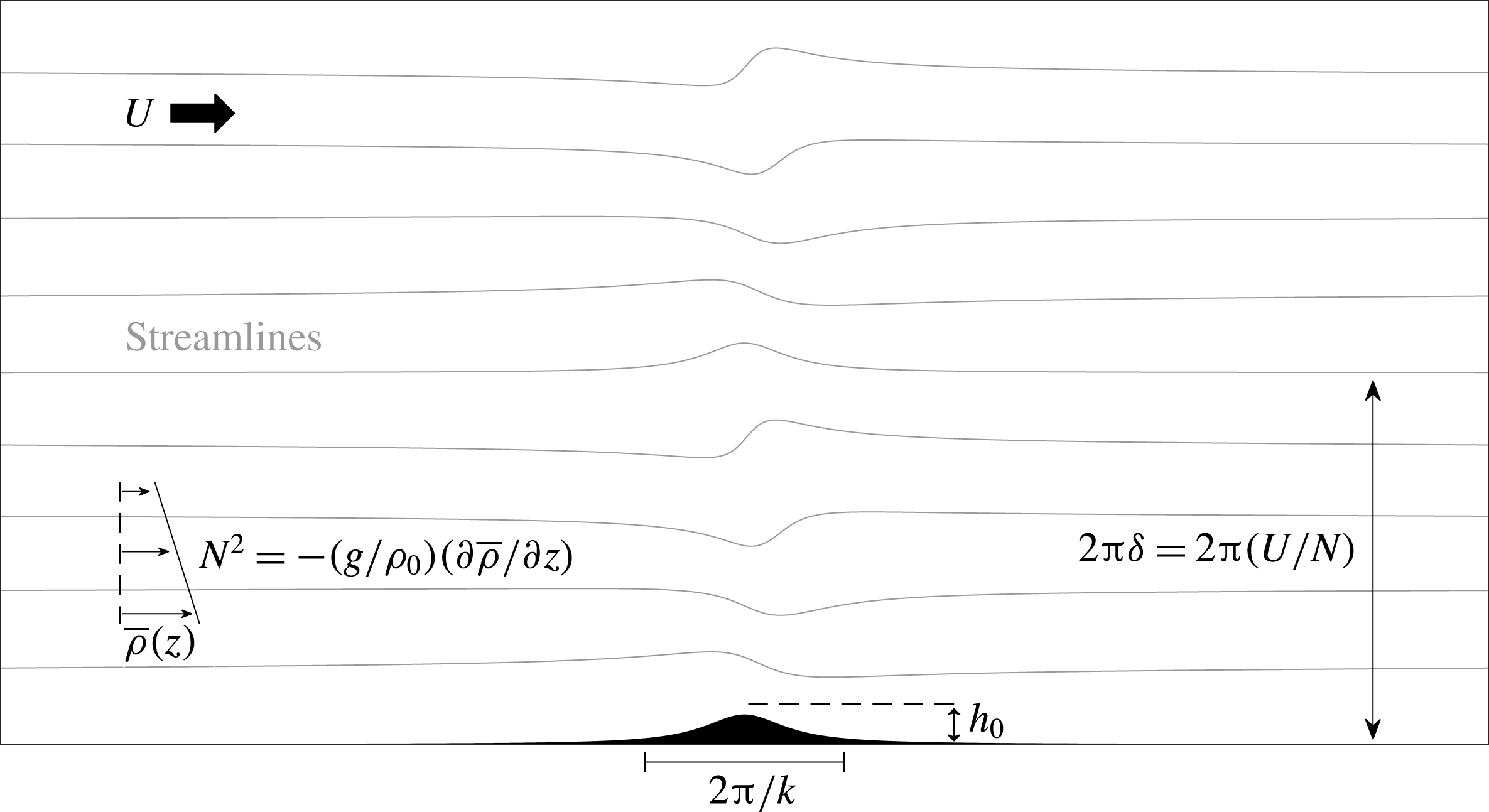
In the case of continuously stratified flow over an isolated ridge, the relevant parameters are the ridge height
 $h_{0}$
, its width
 $2\unicode[STIX]{x03C0}/k$
, the depth
 $D$
, and velocity and stratification scales for the unperturbed flow,
 $U$
and
 $N^{2}=-(g/\unicode[STIX]{x1D70C}_{0})\bar{\unicode[STIX]{x1D70C}}_{z}$
(see figure 1). Using these parameters, one can form three independent dimensionless numbers that resemble a Froude number, namely
 $U/(ND)$
,
 $U/(Nh_{0})$
, and
 $Uk/N$
. However, not all of these numbers represent a ratio of advection to wave propagation speed or relate to the criticality of the flow, and thus referring to all of them as Froude numbers robs the concept of its intuitive dynamical significance. In his seminal text on stratified flow over topography, Baines (Reference Baines1995) proposed that, as a solution to this ‘Froude for everything syndrome,’ one should only refer to the most obvious extension of open channel flow as a Froude number. That is,
 $Fr=U/(ND)$
, where
 $ND$
is a scale for the first-mode (fastest) internal gravity wave speed (which is given exactly by
 $ND/\unicode[STIX]{x03C0}$
from linear theory with uniform
 $N$
).
Stratified flow over a two-dimensional hill with height
 $h_{0}$
, width
 $2\unicode[STIX]{x03C0}/k$
, and upstream flow
 $U$
and stratification
 $N$
. Streamlines represent a solution of Long’s equation over a Witch of Agnesi with
 $\unicode[STIX]{x1D716}=Uk/N=0.01$
and
 $J=Nh_{0}/U=0.5$
obtained with the iterative method of Laprise & Peltier (Reference Laprise and Peltier1989b
).

For relatively shallow flows over topography, such as tidal flows over a sill in an inlet (Farmer & Smith Reference Farmer and Smith1980),
 $U/(ND)$
is indeed a dynamically significant Froude number. However, for lee waves generated by abyssal hills at the bottom of the ocean,
 $Fr=U/(ND)$
is very small and offers little information about the system. For example, in the Drake Passage region of the Antarctic Circumpolar Current (ACC), where abyssal lee waves are predicted to be dynamically important,
 $U\approx 0.1$
m s
 $^{-1}$
,
 $N\approx 10^{-3}$
rad s
 $^{-1}$
, and
 $D\approx 4000$
m, giving
 $U/(ND)\approx 0.025$
(Nikurashin & Ferrari Reference Nikurashin and Ferrari2010). In these systems, the dynamics are captured elegantly by considering the case of an infinitely deep ocean, implying
 $U/(ND)=0$
, for which solutions describe a stationary wave above the topography with energy propagating upwards at an angle downstream to infinity (Long Reference Long1953).
In such deep systems, the relevant dimensionless number is
 $Nh_{0}/U$
, which has various names in the literature. Miles (Reference Miles, Vincenti and Hetnyi1969) refers to it as the Russell number,
 $Ru$
, after the fluid mechanician John Scott Russell, who described the reduction in drag on shipping vessels when propelled faster than the shallow water wave speed
 $\sqrt{gd}$
. Aguilar & Sutherland (Reference Aguilar and Sutherland2006) refer to it as the Long number,
 $Lo$
, in honour of Robert Long’s pioneering work on the lee-wave problem (Long Reference Long1953). Nikurashin & Ferrari (Reference Nikurashin and Ferrari2010) refer to it as a steepness parameter,
 $\unicode[STIX]{x1D716}$
, after showing that, in the hydrostatic limit,
 $Nh_{0}/U$
is identical to the ratio of the topographic slope to the slope of the internal wave phase lines, a parameter that the internal tide literature commonly refers to as
 $\unicode[STIX]{x1D716}$
(Garrett & Kunze Reference Garrett and Kunze2007). Finally, in much of the literature,
 $Nh_{0}/U$
is simply referred to either as an inverse Froude number,
 $Fr^{-1}$
(Drazin Reference Drazin1961; Kitabayashi Reference Kitabayashi1977; Durran Reference Durran1986; Kimura & Manins Reference Kimura and Manins1988; Smolarkiewicz & Rotunno Reference Smolarkiewicz and Rotunno1989; Crook, Clark & Moncrieff Reference Crook, Clark and Moncrieff1990; Scinocca & Peltier Reference Scinocca and Peltier1994; Legg & Klymak Reference Legg and Klymak2008; Eckermann et al.
Reference Eckermann, Lindeman, Broutman, Ma and Boybeyi2010; Winters & Armi Reference Winters and Armi2012), or a vertical Froude number,
 $Fr_{z}$
(Peltier & Clark Reference Peltier and Clark1983; Clark & Peltier Reference Clark and Peltier1984; Laprise & Peltier Reference Laprise and Peltier1989a
,Reference Laprise and Peltier
c
; Afanasyev & Peltier Reference Afanasyev and Peltier1998; Welch et al.
Reference Welch, Smolarkiewicz, Rotunno and Boville2001; Klymak, Legg & Pinkel Reference Klymak, Legg and Pinkel2010). However, none of these papers offer either mathematical or physical justification for their association of
 $Nh_{0}/U$
with the Froude number.
Winters & Armi (Reference Winters and Armi2012) consider a continuous extension of the layer Froude number,
 $Fr_{\unicode[STIX]{x1D6FF}}=u_{0}/\sqrt{g^{\prime }\unicode[STIX]{x1D6FF}}$
, where
 $u_{0}$
,
 $g^{\prime }$
, and
 $\unicode[STIX]{x1D6FF}$
are, respectively, the perturbation velocity over the topography, the reduced gravity arising from the perturbation density, and the characteristic vertical scale of the perturbation, and find that
 $Fr_{\unicode[STIX]{x1D6FF}}$
is held at a constant critical state for flows in which
 $Nh_{0}/U>O(1)$
. Note, however, that the internal Froude number defined by
 $Fr_{\unicode[STIX]{x1D6FF}}$
does not represent a ratio of advection to wave speed, since
 $\sqrt{g^{\prime }\unicode[STIX]{x1D6FF}}$
is not the speed of propagation of an internal gravity wave.
By non-dimensionalizing the equations describing infinitely deep stratified flow over topography, the purpose of this paper is to show that, regardless of its name,
 $Nh_{0}/U$
is in fact identical to both the square of the internal Froude number
 $Fr_{\unicode[STIX]{x1D6FF}}$
and a ratio of the vertical velocity within the lee wave to the group speed of the wave itself,
 $w_{0}/c_{g}$
, which we refer to as
 $Fr_{vert}$
. The results suggest that it is indeed appropriate to define the lee-wave Froude number as
 $Fr_{lee}=Nh_{0}/U$
.
Additionally, we discuss how our scaling breaks down as
 $Nh_{0}/U$
approaches 1, in which case the height of the topography approaches the vertical scale of the lee wave,
 $U/N$
, and the flow becomes hydraulically controlled, or blocked, with the internal Froude number held constant at
 $Fr_{\unicode[STIX]{x1D6FF}}=1$
, indicating a saturation of the internal wave field energetics (Winters & Armi Reference Winters and Armi2012). Thereafter,
 $Nh_{0}/U$
informs instead the magnitude of nonlinear dynamics such as upstream blocking (Smith Reference Smith1989) or downslope windstorms (Laprise & Peltier Reference Laprise and Peltier1989a
).
2 Non-dimensional equations
In this section we develop a scaling for internal (perturbation) quantities of the flow field in a lee wave based on the characteristic external (background) quantities. As discussed in the Introduction, the steady, two-dimensional (in the horizontal
 $x$
, and vertical
 $z$
directions) lee wave formed by the flow of a stratified, inviscid fluid over an isolated hill of height
 $h_{0}$
and width
 $2\unicode[STIX]{x03C0}/k$
with an infinite depth is characterized by the external dimensional quantities
 $U$
,
 $k$
,
 $N$
, and
 $h_{0}$
(See figure 1). Rotation is neglected for simplicity, and it is assumed that the depth of the domain,
 $D$
, is irrelevant, i.e.
 $U/(ND)\ll 1$
.
Following Winters & Armi (Reference Winters and Armi2012), we separate the flow into its external and internal quantities such that
 $\boldsymbol{u}_{total}=U\boldsymbol{e}_{x}+\boldsymbol{u}^{\prime }$
,
 $\unicode[STIX]{x1D70C}_{total}=\overline{\unicode[STIX]{x1D70C}}(z^{\ast })+\unicode[STIX]{x1D70C}^{\prime }$
, and
 $p_{total}=\unicode[STIX]{x1D70C}_{0}\overline{p}(z^{\ast })+\unicode[STIX]{x1D70C}_{0}p^{\prime }$
, where it is assumed that physical quantities are dimensional, dimensional coordinates are indicated with the
 $^{\ast }$
, and
 $\boldsymbol{e}_{x}$
is a unit vector in the
 $x$
direction. Under these definitions, the governing dimensional equations after employing the Boussinesq approximation are given by
 $$\begin{eqnarray}\displaystyle U\frac{\unicode[STIX]{x2202}u^{\prime }}{\unicode[STIX]{x2202}x^{\ast }}+\boldsymbol{u}^{\prime }\boldsymbol{\cdot }\unicode[STIX]{x1D735}^{\ast }u^{\prime } & = & \displaystyle -\frac{\unicode[STIX]{x2202}p^{\prime }}{\unicode[STIX]{x2202}x^{\ast }},\end{eqnarray}$$
 $$\begin{eqnarray}\displaystyle U\frac{\unicode[STIX]{x2202}w^{\prime }}{\unicode[STIX]{x2202}x^{\ast }}+\boldsymbol{u}^{\prime }\boldsymbol{\cdot }\unicode[STIX]{x1D735}^{\ast }w^{\prime } & = & \displaystyle -\frac{\unicode[STIX]{x2202}p^{\prime }}{\unicode[STIX]{x2202}z^{\ast }}-\frac{\unicode[STIX]{x1D70C}^{\prime }}{\unicode[STIX]{x1D70C}_{0}}g,\end{eqnarray}$$
 $$\begin{eqnarray}\displaystyle U\frac{\unicode[STIX]{x2202}\unicode[STIX]{x1D70C}^{\prime }}{\unicode[STIX]{x2202}x^{\ast }}+\boldsymbol{u}^{\prime }\boldsymbol{\cdot }\unicode[STIX]{x1D735}^{\ast }\unicode[STIX]{x1D70C}^{\prime } & = & \displaystyle \frac{\unicode[STIX]{x1D70C}_{0}N^{2}}{g}w^{\prime },\end{eqnarray}$$
where
 $\unicode[STIX]{x1D735}^{\ast }=\boldsymbol{e}_{x}\unicode[STIX]{x2202}/\unicode[STIX]{x2202}x^{\ast }+\boldsymbol{e}_{z}\unicode[STIX]{x2202}/\unicode[STIX]{x2202}z^{\ast }$
,
 $N^{2}=-g/\unicode[STIX]{x1D70C}_{0}~\unicode[STIX]{x2202}\overline{\unicode[STIX]{x1D70C}}/\unicode[STIX]{x2202}z^{\ast }$
, subject to continuity
 $\unicode[STIX]{x1D735}^{\ast }\boldsymbol{\cdot }\boldsymbol{u}^{\prime }=0$
and the dimensional kinematic boundary condition at
 $z^{\ast }=h^{\prime }(x^{\ast })$
 $$\begin{eqnarray}U\frac{\unicode[STIX]{x2202}h^{\prime }}{\unicode[STIX]{x2202}x^{\ast }}+u^{\prime }\frac{\unicode[STIX]{x2202}h^{\prime }}{\unicode[STIX]{x2202}x^{\ast }}=w^{\prime },\end{eqnarray}$$
where
 $h^{\prime }$
is the topography as a deviation from a flat bottom.
The equations are non-dimensionalized using the inner variable scales defined by
 $$\begin{eqnarray}\displaystyle & \displaystyle u^{\prime }=u_{0}u, & \displaystyle\end{eqnarray}$$
 $$\begin{eqnarray}\displaystyle & \displaystyle w^{\prime }=w_{0}w, & \displaystyle\end{eqnarray}$$
 $$\begin{eqnarray}\displaystyle & \displaystyle \unicode[STIX]{x1D70C}^{\prime }=R\unicode[STIX]{x1D70C}, & \displaystyle\end{eqnarray}$$
 $$\begin{eqnarray}\displaystyle & \displaystyle p^{\prime }=Pp, & \displaystyle\end{eqnarray}$$
 $$\begin{eqnarray}\displaystyle & \displaystyle x^{\ast }=k^{-1}x, & \displaystyle\end{eqnarray}$$
 $$\begin{eqnarray}\displaystyle & \displaystyle z^{\ast }=\unicode[STIX]{x1D6FF}z, & \displaystyle\end{eqnarray}$$
where non-primed inner variables and
 $x$
and
 $z$
are assumed to be dimensionless. Using these scales, non-dimensionalizing the kinematic bottom boundary condition (2.4), and requiring a balance between the linear terms to leading order implies
 $w_{0}=kh_{0}U$
, which gives the non-dimensional kinematic bottom boundary condition
 $$\begin{eqnarray}\frac{\unicode[STIX]{x2202}h}{\unicode[STIX]{x2202}x}+\left(\frac{u_{0}}{U}\right)u\frac{\unicode[STIX]{x2202}h}{\unicode[STIX]{x2202}x}=w.\end{eqnarray}$$
The vertical scale of the flow as indicated by
 $\unicode[STIX]{x1D6FF}$
is not the same as the hill height
 $h_{0}$
, since
 $\unicode[STIX]{x1D6FF}$
must be finite as
 $h_{0}\rightarrow 0$
(the linear limit). The vertical scale is thus dictated by continuity, which requires
 $ku_{0}=w_{0}/\unicode[STIX]{x1D6FF}$
. Combined with the scaling for the kinematic bottom boundary condition, this implies
 $\unicode[STIX]{x1D6FF}=w_{0}/(ku_{0})=kh_{0}U/(ku_{0})=Uh_{0}/u_{0}$
.
Non-dimensionalizing the
 $x$
-momentum equation (2.1) gives
 $$\begin{eqnarray}ku_{0}U\frac{\unicode[STIX]{x2202}u}{\unicode[STIX]{x2202}x}+ku_{0}^{2}\boldsymbol{u}\boldsymbol{\cdot }\unicode[STIX]{x1D735}u=-kP\frac{\unicode[STIX]{x2202}p}{\unicode[STIX]{x2202}x}.\end{eqnarray}$$
If we require a leading-order balance between the pressure gradient and the linear momentum advection term, we must have
 $P=u_{0}U$
, which gives
 $$\begin{eqnarray}\frac{\unicode[STIX]{x2202}u}{\unicode[STIX]{x2202}x}+\left(\frac{u_{0}}{U}\right)\boldsymbol{u}\boldsymbol{\cdot }\unicode[STIX]{x1D735}u=-\frac{\unicode[STIX]{x2202}p}{\unicode[STIX]{x2202}x}.\end{eqnarray}$$
In a similar manner, the non-dimensional density transport equation (2.3) is given by
 $$\begin{eqnarray}kUR\frac{\unicode[STIX]{x2202}\unicode[STIX]{x1D70C}}{\unicode[STIX]{x2202}x}+ku_{0}R\boldsymbol{u}\boldsymbol{\cdot }\unicode[STIX]{x1D735}\unicode[STIX]{x1D70C}=\frac{k\unicode[STIX]{x1D70C}_{0}h_{0}N^{2}U}{g}w,\end{eqnarray}$$
which implies
 $$\begin{eqnarray}R=\frac{\unicode[STIX]{x1D70C}_{0}N^{2}h_{0}}{g}\end{eqnarray}$$
for the linear terms to balance. The non-dimensional density transport equation is then given by
 $$\begin{eqnarray}\frac{\unicode[STIX]{x2202}\unicode[STIX]{x1D70C}}{\unicode[STIX]{x2202}x}+\left(\frac{u_{0}}{U}\right)\boldsymbol{u}\boldsymbol{\cdot }\unicode[STIX]{x1D735}\unicode[STIX]{x1D70C}=w.\end{eqnarray}$$
Finally, the non-dimensional vertical momentum equation is given by
 $$\begin{eqnarray}k^{2}h_{0}U^{2}\frac{\unicode[STIX]{x2202}w}{\unicode[STIX]{x2202}x}+k^{2}h_{0}Uu_{0}\boldsymbol{u}\boldsymbol{\cdot }\unicode[STIX]{x1D735}w=-\frac{P}{\unicode[STIX]{x1D6FF}}\frac{\unicode[STIX]{x2202}p}{\unicode[STIX]{x2202}z}-\frac{gR}{\unicode[STIX]{x1D70C}_{0}}\unicode[STIX]{x1D70C}.\end{eqnarray}$$
If we require a vertical hydrostatic balance to leading order, then we must have
 $$\begin{eqnarray}\frac{P}{\unicode[STIX]{x1D6FF}}=\frac{gR}{\unicode[STIX]{x1D70C}_{0}}=N^{2}h_{0},\end{eqnarray}$$
and
 $$\begin{eqnarray}P=\unicode[STIX]{x1D6FF}N^{2}h_{0}=\frac{N^{2}h_{0}^{2}U}{u_{0}},\end{eqnarray}$$
which gives
 $$\begin{eqnarray}\unicode[STIX]{x1D716}^{2}\left[\frac{\unicode[STIX]{x2202}w}{\unicode[STIX]{x2202}x}+\left(\frac{u_{0}}{U}\right)\boldsymbol{u}\boldsymbol{\cdot }\unicode[STIX]{x1D735}w\right]=-\frac{\unicode[STIX]{x2202}p}{\unicode[STIX]{x2202}z}-\unicode[STIX]{x1D70C},\end{eqnarray}$$
where
 $$\begin{eqnarray}\unicode[STIX]{x1D716}=\frac{Uk}{N}\end{eqnarray}$$
is the non-hydrostatic parameter and represents a ratio of the frequency with which the flow over the hill excites a wave,
 $Uk$
, to the frequency of the buoyant response,
 $N$
. A propagating wave is only possible if the excitation frequency is smaller than the buoyancy frequency (
 $\unicode[STIX]{x1D716}<1$
). Otherwise, the perturbation by the flow over a hill occurs faster than the buoyancy time scale, giving evanescent behaviour. Within the propagating regime, one can also think of
 $\unicode[STIX]{x1D716}$
as a ratio of the vertical wavelength of the wave (
 $U/N$
) to the width of the hill (
 $k^{-1}$
). For wavelengths much smaller than the hill length (
 $\unicode[STIX]{x1D716}\ll 1$
), the wave is approximately hydrostatic and its group velocity is vertically oriented with magnitude
 $c_{g}=\unicode[STIX]{x1D716}U$
(Gill Reference Gill1982).
Returning to the pressure, since the non-dimensional vertical momentum equation (2.20) requires
 $P=N^{2}h_{0}^{2}U/u_{0}$
and the non-dimensional horizontal momentum equation (2.13) requires
 $P=u_{0}U$
, this implies that
 $u_{0}=Nh_{0}$
and thus
 $$\begin{eqnarray}\frac{u_{0}}{U}=\frac{Nh_{0}}{U}\equiv J,\end{eqnarray}$$
as deduced in Baines (Reference Baines1995), equation (5.2.2). In terms of
 $J$
, the governing non-dimensional equations are given by
 $$\begin{eqnarray}\displaystyle & \displaystyle \frac{\unicode[STIX]{x2202}u}{\unicode[STIX]{x2202}x}+J\boldsymbol{u}\boldsymbol{\cdot }\unicode[STIX]{x1D735}u=-\frac{\unicode[STIX]{x2202}p}{\unicode[STIX]{x2202}x}, & \displaystyle\end{eqnarray}$$
 $$\begin{eqnarray}\displaystyle & \displaystyle \unicode[STIX]{x1D716}^{2}\left(\frac{\unicode[STIX]{x2202}w}{\unicode[STIX]{x2202}x}+J\boldsymbol{u}\boldsymbol{\cdot }\unicode[STIX]{x1D735}w\right)=-\frac{\unicode[STIX]{x2202}p}{\unicode[STIX]{x2202}z}-\unicode[STIX]{x1D70C}, & \displaystyle\end{eqnarray}$$
 $$\begin{eqnarray}\displaystyle & \displaystyle \frac{\unicode[STIX]{x2202}\unicode[STIX]{x1D70C}}{\unicode[STIX]{x2202}x}+J\boldsymbol{u}\boldsymbol{\cdot }\unicode[STIX]{x1D735}\unicode[STIX]{x1D70C}=w, & \displaystyle\end{eqnarray}$$
subject to
 $\unicode[STIX]{x1D735}\boldsymbol{\cdot }\boldsymbol{u}=0$
and the kinematic bottom boundary condition
 $$\begin{eqnarray}\left(1+Ju\right)\frac{\unicode[STIX]{x2202}h}{\unicode[STIX]{x2202}x}=w.\end{eqnarray}$$
These non-dimensional equations imply that the problem is uniquely characterized by
 $\unicode[STIX]{x1D716}$
and
 $J$
, and the relevant inner scales (non-dimensionalized by
 $N$
and
 $U$
) are given by
 $$\begin{eqnarray}\displaystyle & \displaystyle \frac{u_{0}}{U}=J, & \displaystyle\end{eqnarray}$$
 $$\begin{eqnarray}\displaystyle & \displaystyle \frac{w_{0}}{U}=\unicode[STIX]{x1D716}J, & \displaystyle\end{eqnarray}$$
 $$\begin{eqnarray}\displaystyle & \displaystyle \frac{gR}{\unicode[STIX]{x1D70C}_{0}UN}=J, & \displaystyle\end{eqnarray}$$
 $$\begin{eqnarray}\displaystyle & \displaystyle \frac{P}{U^{2}}=J, & \displaystyle\end{eqnarray}$$
 $$\begin{eqnarray}\displaystyle & \displaystyle \frac{\unicode[STIX]{x1D6FF}N}{U}=1. & \displaystyle\end{eqnarray}$$
An interesting property of this scaling is that the vertical scale
 $\unicode[STIX]{x1D6FF}$
, which defines the vertical wavelength of the lee wave
 $2\unicode[STIX]{x03C0}\unicode[STIX]{x1D6FF}$
, is determined exclusively from the upstream quantities of the flow,
 $U$
and
 $N$
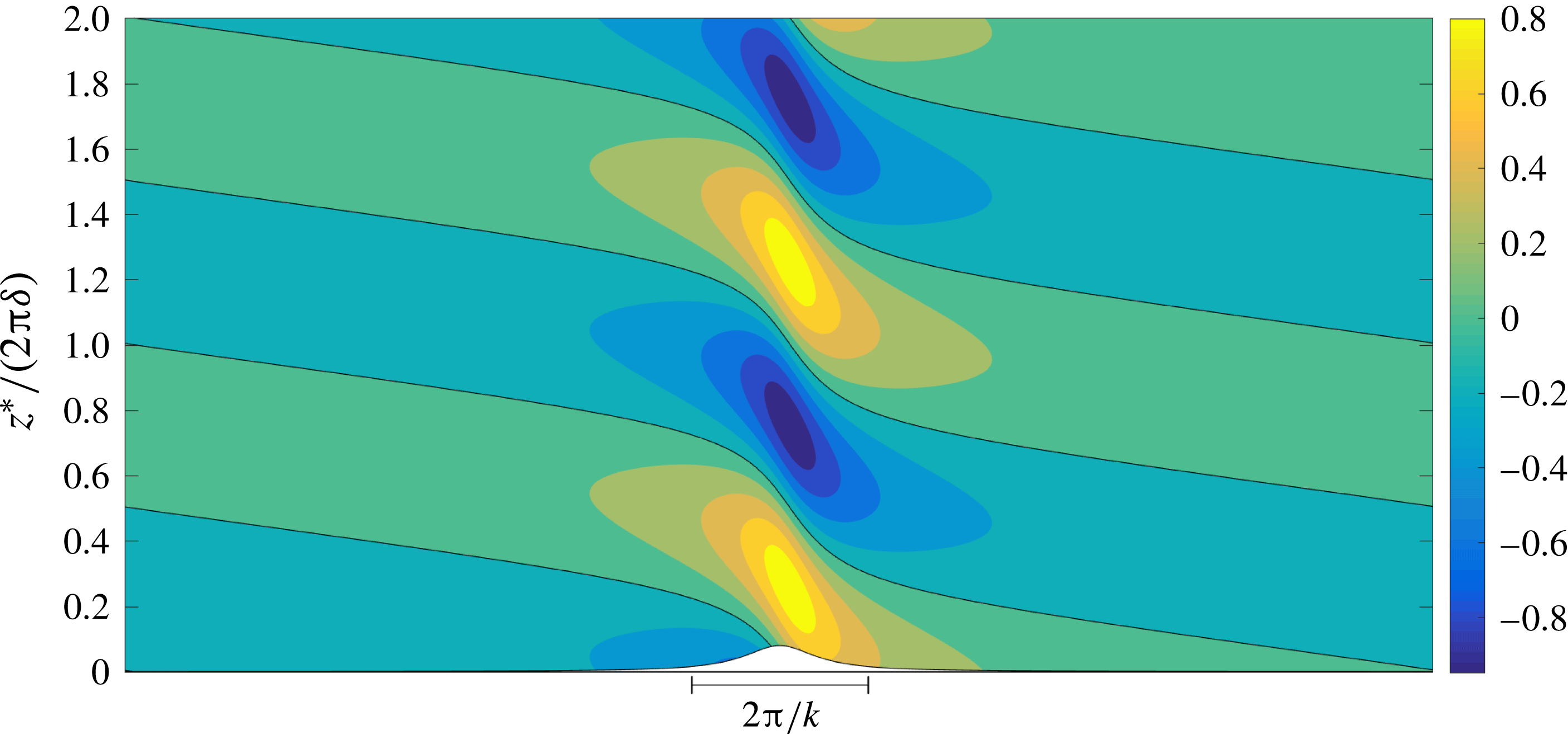
, as we expect from linear theory. To test this scaling, we plot the horizontal perturbation velocity normalized by
 $JU$
for the case shown in figure 1 in figure 2. This figure shows that the maximum perturbation horizontal velocity is
 $O(JU)$
and that the vertical wavelength of the lee wave is
 $\unicode[STIX]{x1D706}=2\unicode[STIX]{x03C0}\unicode[STIX]{x1D6FF}$
.
Dimensionless horizontal perturbation velocity,
 $u^{\ast }/(JU)=u/J$
, corresponding to the streamlines plotted in figure 1. The aspect ratio is greatly exaggerated to display vertical structure. Contours of
 $u=0$
are indicated to identify the ‘layers’ of the perturbation and to emphasize that they have a characteristic thickness of
 $\unicode[STIX]{x03C0}\unicode[STIX]{x1D6FF}$
.
If we now borrow from Winters & Armi (Reference Winters and Armi2012) and use the inner scales to define the internal Froude number as
 $Fr_{\unicode[STIX]{x1D6FF}}=u_{0}/\sqrt{g^{\prime }\unicode[STIX]{x1D6FF}}$
, where
 $g^{\prime }\unicode[STIX]{x1D6FF}=g(R/\unicode[STIX]{x1D70C}_{0})\unicode[STIX]{x1D6FF}=JU^{2}$
, this gives
 $Fr_{\unicode[STIX]{x1D6FF}}=J^{1/2}$
. Therefore, although it appears to represent an inverse Froude number when expressed in terms of external variables, this scaling shows that it is in fact appropriate to refer to
 $J=Nh_{0}/U$
as the square of an internal Froude number because of the relationship between the internal and external variables.
3 Discussion
Our scaling has shown that
 $J=Nh_{0}/U$
can be interpreted as the square of the internal Froude number,
 $Fr_{\unicode[STIX]{x1D6FF}}$
, as defined by Winters & Armi (Reference Winters and Armi2012). However, this interpretation alone is not sufficient to unambiguously define
 $J$
as a Froude number because it is not readily apparent that
 $Fr_{\unicode[STIX]{x1D6FF}}$
is a ratio of advection to wave speed. Nonetheless, for the special case of the hydrostatic lee wave, our scaling identifies
 $J$
as just such a ratio. Recall that in the hydrostatic limit the group velocity of the wave is oriented vertically with magnitude
 $c_{g}=\unicode[STIX]{x1D716}U$
(Gill Reference Gill1982). Comparing this wave speed to the scale for the vertical perturbation velocity,
 $w_{0}=\unicode[STIX]{x1D716}JU$
, we form the ratio
 $w_{0}/c_{g}=J$
. Thus, with our scaling
 $J$
emerges as a Froude number in its most generally accepted sense, that is, as a ratio of an advection speed to a wave speed. In this case, it is the ratio of vertical advection speed within the lee wave to the nearly vertical propagation speed of the lee wave. Such an interpretation justifies reference of
 $J$
as the ‘vertical’ Froude number,
 $Fr_{z}$
or
 $Fr_{vert}$
, following Laprise & Peltier (Reference Laprise and Peltier1989a
,Reference Laprise and Peltier
c
).
This identification of
 $J$
as a Froude number derives from a balance of the linear terms in the Euler equations, and is therefore mathematically unjustifiable for lee waves with significant perturbation velocities. Indeed, from the literature it is clear that the character of the lee wave changes as
 $J$
approaches
 $O(1)$
. A precondition on the wave solution to the flow is that it remains stable to both convective and shear instabilities (Long Reference Long1953; Miles Reference Miles1961). Asymptotic and fully nonlinear solutions for the streamlines of the flow using Long’s model (Long Reference Long1953) show both vertical streamlines (convective instability) and Richardson numbers smaller than 0.25 (shear instability) developing when
 $J=O(1)$
for flow over various ridge shapes (e.g. Miles Reference Miles, Vincenti and Hetnyi1969; Laprise & Peltier Reference Laprise and Peltier1989b
). Furthermore, laboratory experiments and numerical simulations demonstrate that in the
 $J>1$
regime, the wave field saturates and
 $J$
reflects instead the strength of non-wave dynamics such as upstream blocking and downslope windstorms (Laprise & Peltier Reference Laprise and Peltier1989a
,Reference Laprise and Peltier
c
; Baines Reference Baines1995). For this reason,
 $J$
is often interpreted as a nonlinearity parameter rather than a Froude number (Miles Reference Miles, Vincenti and Hetnyi1969; Baines Reference Baines1995; Aguilar & Sutherland Reference Aguilar and Sutherland2006; Eckermann et al.
Reference Eckermann, Lindeman, Broutman, Ma and Boybeyi2010; Klymak et al.
Reference Klymak, Legg and Pinkel2010; Nikurashin & Ferrari Reference Nikurashin and Ferrari2010).
The upper limit on the valid identification of
 $J$
as a Froude number is evident when using
 $Fr_{\unicode[STIX]{x1D6FF}}$
to devise a physical interpretation of
 $J$
. As discussed in the Introduction,
 $Fr_{\unicode[STIX]{x1D6FF}}$
is the continuous extension of the layer Froude number as defined by Armi (Reference Armi1986), and represents the partitioning of energy within the lee wave between perturbation kinetic energy,
 $u_{0}^{2}$
, and perturbation potential energy,
 $g^{\prime }\unicode[STIX]{x1D6FF}$
. The scaling
 $u_{0}^{2}=JU=N^{2}h_{0}^{2}$
indicates that the perturbation kinetic energy results from the conversion of the potential energy of a displaced isopycnal in the wave,
 $N^{2}h_{0}^{2}=g(R/\unicode[STIX]{x1D70C}_{0})h_{0}=g^{\prime }h_{0}$
, into kinetic energy. This conversion takes place within the vertical scale of the lee wave,
 $\unicode[STIX]{x1D6FF}=U/N$
, and thus sets a limit on the maximum possible isopycnal displacement. In this sense, we can think of
 $\unicode[STIX]{x1D6FF}$
as a maximum wave-making capacity; the largest that
 $u_{0}$
can become is when
 $h_{0}=\unicode[STIX]{x1D6FF}$
, at which point
 $u_{max}=N\unicode[STIX]{x1D6FF}=U$
and the perturbation energetics are equally partitioned between kinetic and potential energy. As
 $h_{0}$
grows beyond this height, the wave component of the flow will no longer change, as it has saturated its energetic capacity. Indeed, in their recent study for flow past a half-cylinder when
 $J>1$
, Winters & Armi (Reference Winters and Armi2012) show that in this regime,
 $Fr_{\unicode[STIX]{x1D6FF}}$
is held constant at unity, the energetics of the wave are equally partitioned, and, in analogy to hydraulic control of a two-layer exchange flow over a sill, the flow of the lowest unblocked layer exhibits a transition from subcritical flow upstream to a supercritical jet downstream followed by a dissipative hydraulic jump. Note that this scaling argument for saturation also confirms that it is inaccurate to identify
 $J$
as
 $Fr_{vert}$
when
 $J>O(1)$
because we can no longer expect
 $w_{0}$
to scale with
 $J$
in this supercritical regime.
It is thus clear that the relationships we have identified between
 $J$
,
 $Fr_{vert}$
, and
 $Fr_{\unicode[STIX]{x1D6FF}}$
hold only up to
 $J=Nh_{0}/U=O(1)$
. Below this limit, waves accommodate the disturbance of the hill adiabatically, and carry it away from the site of generation. As
 $J$
approaches
 $O(1)$
, the kinetic component of the wave energetics grows to the same magnitude as the potential component. All of this is consistent with the dynamical significance of a Froude number, and our scaling thus unambiguously identifies
 $J$
with the Froude number for lee waves in the deep ocean. It is therefore appropriate to simply refer to
 $J$
as the lee-wave Froude number,
 $Fr_{lee}=Nh_{0}/U$
, noting that
 $Fr_{lee}$
informs the degree of blocking or other nonlinear processes once
 $Fr_{lee}=O(1)$
.
Acknowledgement
We gratefully acknowledge the support of ONR Grant N00014-16-1-2256 (scientific officer: Dr T. Paluszkiewicz).