1. Introduction
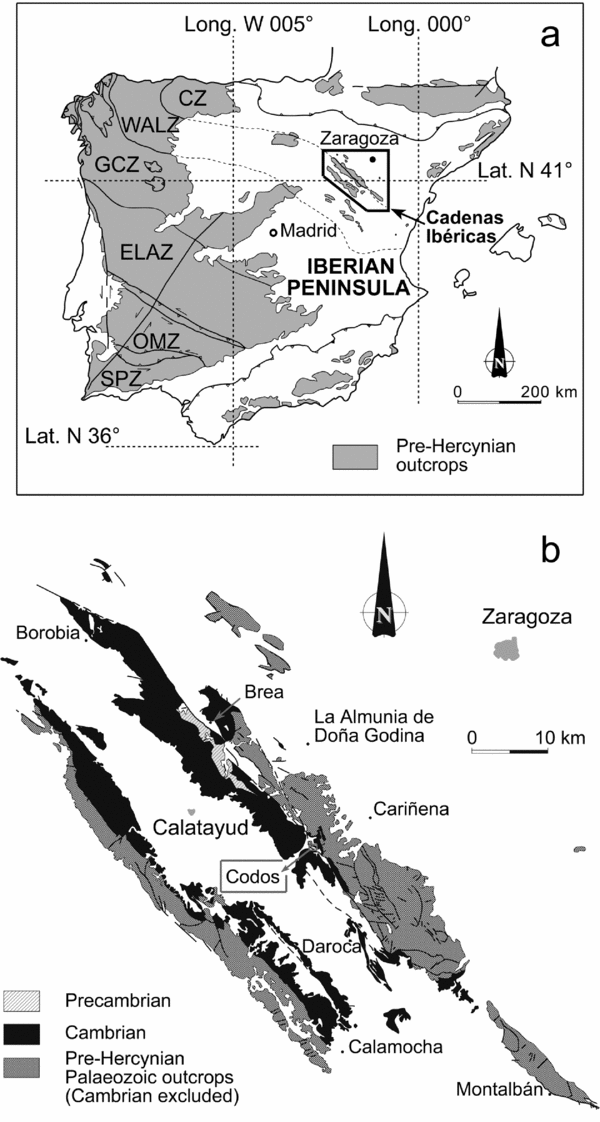
In Spain, uppermost Edicaran and lowermost (pre-trilobite) Cambrian skeletal fossils are distributed in the Galician–Castilian, East Lusitanian – Alcudian, and Ossa-Morena tectonostratigraphic zones (Liñán Guijarro, Reference Liñán Guijarro1978; Liñán, Palacios & Perejón, Reference Liñán, Palacios and Perejón1984; Palacios Medrano, Reference Palacios Medrano1989; Vidal et al. Reference Vidal, Palacios, Gámez-Vintaned, Díez Balda and Grant1994; Rodríguez Alonso et al. Reference Rodríguez Alonso, Alonso Gavilán, Liñán, Gámez Vintaned, Pérez Garsía, Rodríguez Alonso and Alonso Gavilán1995; Vidal et al. Reference Vidal, Palacios, Moczydłowska and Gubanov1999; Fernández-Remolar, Reference Fernández-Remolar2001, Reference Fernández-Remolar2002, Reference Fernández-Remolar, Vintaned, Liñán and Valenzuela-Ríos2005; Liñán et al. Reference Liñán, Gozalo, Palacios, Gámez Vintaned, Ugidos, Mayoral, Gibbons and Moreno2002; Gubanov, Fernández Remolar & Peel, Reference Gubanov, Fernández-Remolar and Peel2004; Fernández Remolar, García-Hidalgo & Moreno-Eiris, Reference Fernández-Remolar, García-Hidalgo and Moreno-Eiris2005; Jensen, Palacios & Martí Mus, Reference Jensen, Palacios, Martí Mus, Vickers-Rich and Komarower2007, Reference Jensen, Palacios and Martí Mus2010; Cortijo et al. Reference Cortijo, Martí Mus, Jensen and Palacios2010, Reference Cortijo, Martí Mus, Jensen and Palacios2015; Zhuravlev et al. Reference Zhuravlev, Liñán, Gámez Vintaned, Debrenne and Fedorov2012) (Fig. 1a).
(a) Map showing pre-Hercynian outcrops and tectonostratigraphic zones of the Iberian Peninsula, with the Cadenas Ibéricas outlined. (b) Geological sketch of the Cadenas Ibéricas (Codos is arrowed) (modified from J. A. Gámez Vintaned, unpub. thesis, Univ. Zaragoza, 2007). Zones: CZ – Cantabrian; ELAZ – East Lusitanian – Alcudian; GCZ – Galician–Castilian; OMZ – Ossa-Morena; SPZ – South Portuguese; WALZ – West Asturian – Leonese.

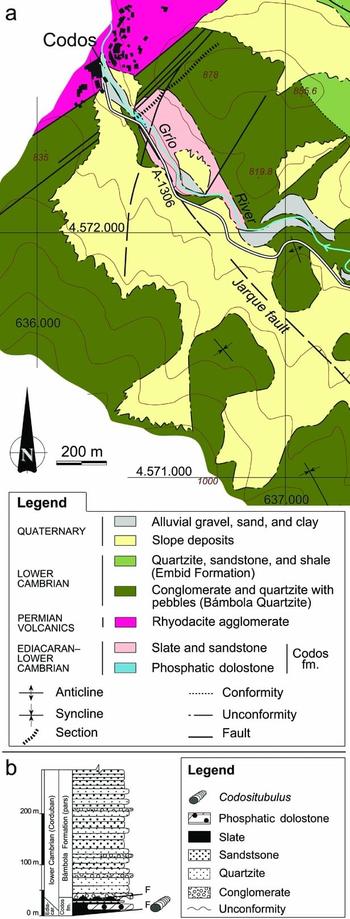
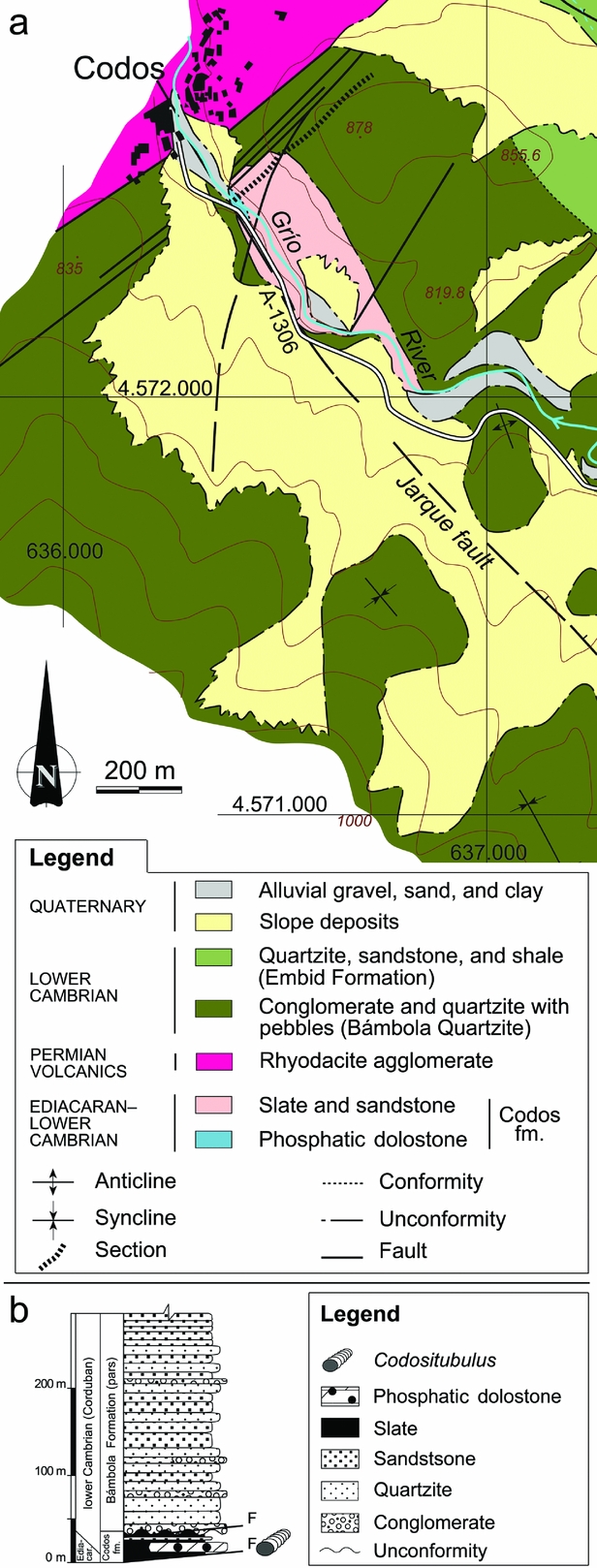
During recent decades, in the Cadenas Ibéricas (NE Spain) Cloudina-like microfossils have been reported within an isolated outcrop of phosphatic dolostone, near Codos, Zaragoza Province, Aragón (Liñán, Grant & Navarro Vázquez, Reference Liñán, Grant and Navarro Vázquez1994; Álvaro & Blanc-Valleron, Reference Álvaro and Blanc-Valleron2002; Álvaro et al. Reference Álvaro, Bauloz, Gil Imaz and Simón2008) (Figs 1b, 2a). Field observations in the Codos locality and further laboratory studies allow us to recognize a rich assemblage of about seven skeletal genera. New data from ongoing studies are provided.
Geological map and lithostratigraphy of the Codos area, Cadenas Ibéricas, NE Spain. (a) Geological map, coordinates refer to the UTM grid, zone 30 T, 100 km-square XL. (b) Lithostratigraphic column. F – fault; fm. – formation.
2. Geological setting and age of the Codos locality
The Codos locality occurs on the southeastern outskirts of the village of Codos, in the Grío River valley. Here an unnamed and undated succession is unconformably overlain by the lower Cambrian Bámbola Formation (Liñán, Grant & Navarro Vázquez, Reference Liñán, Grant and Navarro Vázquez1994). The succession itself is traced immediately to the north of the NW–SE-trending Jarque Fault and is subdivided into two lithosomes, a lower siliciclastic one, and an upper mixed one, separated by a secondary fault trending NNE–SSW (Fig. 2a). The lower, siliciclastic lithosome (up to 58 m thick), not figured on the stratigraphic column (Fig. 2b), is located to the southeast of the later fault and is represented mostly by green, dark grey, and black parallel-laminated silicified slate (lutite) with limonitized framboidal pyrite inclusions and greenish-grey parallel-laminated medium to fine-grained micaceous subarkosic sandstone interbeds. Some simple trace fossils (such as Cochlichnus ichnosp.) are observed on lutite bedding planes.
The upper, mixed lithosome is located to the north-west of the NNE–SSW-trending fault and is composed of a phosphatic dolostone (7 m thick) and silicified lutite (13 m thick). This lithosome is informally named here as the Codos formation (Fig. 2b). Skeletal fossils are restricted to phosphatic dolostone, which consists of black mudstone and bioclast and oolite wackestone to packstone with an admixture of clay minerals and pyrite framboids. The phosphate itself composes 4.50–5.84% of the whole rock.
The Codos formation is unconformably, with an erosional contact, overlain by pinkish-white conglomerate and quartzite of the Bámbola Formation, the basal conglomerate layers of which contain angular pebbles of the underlying greenish-grey sandstone. Towards the northwest in the Cadenas Ibéricas, in the Borobia and Brea areas, the Bámbola Formation yields lower Corduban (lower Cambrian) arthropod trace fossils including Monomorphichnus lineatus, Rusophycus cantabricus (=R. bonnarensis) and R. fasciculatus (=R. avalonensis); the overlying sandstones and quartzites of the Embid Formation additionally contain Cruziana cantabrica and Astropolichnus hispanicus (Gámez Vintaned, Schmitz & Liñán, Reference Gámez Vintaned, Schmitz, Liñán, Craig, Thurow, Thusu, Whitham and Abutarruma2009).
Liñán, Grant & Navarro Vázquez (Reference Liñán, Grant and Navarro Vázquez1994) correlated the Codos strata with the uppermost Neoproterozoic Paracuellos Group of the Cadenas Ibéricas, based on possible Cloudina finds. The Paracuellos Group itself was defined by Liñán & Tejero (Reference Liñán and Tejero1988) in the Jalón Valley, to the northwest of the Codos section, where the lowermost Cambrian Bámbola Formation caps the Paracuellos Group with an erosive unconformity attributed to the Cadomian orogeny. However, Cloudina as well as other distinct Ediacaran fossils (such as Namacalathus and Sinotubulites) are not found in the Codos locality within a relatively rich small shelly fossil assemblage. Álvaro et al. (Reference Álvaro, Monceret, Monceret, Verraes and Vizcaïno2010, fig. 2; Reference Álvaro, Shields-Zhou, Ahlberg, Jensen and Palacios2015, fig. 2), contrary to their previous opinion (Álvaro & Blanc-Valleron, Reference Álvaro and Blanc-Valleron2002; Álvaro et al. Reference Álvaro, Bauloz, Gil Imaz and Simón2008), correlated the Codos formation with other phosphorite-rich units of Spain (Herrería Formation, lower member; Cantabrian tectonostratigraphic zone) and France (Heraultia Limestone) of presumably Tommotian age. However, each of these units either yields its own unique small shelly fossil assemblage of a different age (see below) or lacks this kind of fauna (Herrería Formation).
The Codos shelly fossils discovered by us are diverse and morphologically complicated. The microfauna of this locality includes thick-walled tubicolous Cupittheca, thick-walled cornute Cobboldiella, sharply annulated tubicolous Pseudorthotheca, halkieriid sclerites and some new genera. Cupittheca, commonly under its synonymic name Actinotheca, is known from lower Cambrian strata of China, Australia, probably Kazakhstan (Bengtson et al. Reference Bengtson, Conway Morris, Cooper, Jell and Runnegar1990), Siberia (Rozanov et al. Reference Rozanov, Parkhaev, Demidenko, Karlova, Korovnikov, Shabanov, Ivantsov, Luchinina, Malakhovskaya, Melnikova, Naimark, Ponomarenko, Skorlotova, Sundukov, Tokarev, Ushatinskaya and Kipriyanova2010, pl. 59, fig. 9), and southern France (Turcutheca sp. indet. in Kerber, Reference Kerber1988, pl. 1, figs 1–6). In Spain, it was described and figured from the Pedroche Formation of the Ossa-Morena tectonostratigraphic zone (Fernández-Remolar, Reference Fernández-Remolar, Vintaned, Liñán and Valenzuela-Ríos2005) and the Pusa Formation of the Galician–Castilian zone (Jensen, Palacios & Martí Mus, Reference Jensen, Palacios and Martí Mus2010) where it occurs in trilobite-bearing strata. Cobboldiella is described from the lower Cambrian Heraultia Limestone of the Montagne Noir, southern France, only (Kerber, Reference Kerber1988; Devaere et al. Reference Devaere, Clausen, Steiner, Álvaro and Vachard2013). Pseudorthotheca occurs in Cambrian Stage 1 to Stage 3 strata of South China, the Siberian Platform, Kazakhstan (Maly Karatau) and southern France (e.g. Cobbold, Reference Cobbold1935; Rozanov & Missarzhevsky, Reference Rozanov and Missarzhevsky1966; Chen, Chen & Qian, Reference Chen, Chen and Qian1981; Missarzhevsky & Mambetov, Reference Missarzhevsky and Mambetov1981; Kerber, Reference Kerber1988) and is mentioned in the Norretorp Formation of Bornholm, Denmark (Poulsen, Reference Poulsen1967), although this genus differs from hyolithelminthes by the tube composition only (primarily calcareous vs phosphatic) and its presence in certain localities requires further study. Halkieriid sclerites are widespread globally from lower to middle Cambrian strata (Reference PorterPorter, 2004a), and a halkieriid sclerite sensu lato (Eremactis) was recorded in the Pedroche Formation (Fernández-Remolar, Reference Fernández-Remolar2001). Any molluscs, hyoliths and primarily phosphatic fossils, as well as trilobites, brachiopods and archaeocyaths, are completely absent from the Codos locality.
A certain fossil assemblage similarity is observed between the Codos formation and the Heraultia Limestone Member of the Marcou Formation in northern Montagne Noir, southern France. The latter phosphatic limestone yields Cupittheca, Cobboldiella and Pseudorthotheca, and similarly to the Codos formation lacks archaeocyaths, trilobites, small shelly fossils with genuine phosphatic composition, and brachiopods but yields some brachiopod-like stem group lophophorates (Cobbold, Reference Cobbold1935; Kerber, Reference Kerber1988; Devaere et al. Reference Devaere, Clausen, Steiner, Álvaro and Vachard2013, Reference Devaere, Holmer, Clausen and Vachard2015) and is attributed to the Terreneuvian Series (Devaere et al. Reference Devaere, Clausen, Steiner, Álvaro and Vachard2013). Due to the high phosphatic content of the rock matrix, a taphonomic bias in favour of the preservation of primarily calcareous skeletons can be ruled out. Nonetheless, the Heraultia Limestone differs in its rich molluscan and hyolithan faunas which are completely absent in Codos. Despite this difference, a lowermost Cambrian age of the Codos formation cannot be omitted.
Unfortunately, the bare stratotype section of the Precambrian/Cambrian boundary in Newfoundland and a misuse of trace fossil taxonomy, on which the Cambrian lower boundary Global Stratotype Section and Boundary Point is grounded, cannot help in resolving this stratigraphic problem in detail. On the contrary, there are more and more data indicating the presence of Cambrian-type shelly fossils in strata pre-dating the so-called Trichophycus pedum trace fossil assemblage defining the lower Cambrian boundary in its stratotype on Newfoundland. Such a fauna, including phosphatic embryos, anabaritids, protoconodonts, carinachitids and Pseudorthotheca, is discovered in the upper Ingta Formation of the Wernecke Montains, NW Canada, where Trichophycus pedum-type ichnofossils appeared in the overlying Vampire Formation only (Pyle et al. Reference Pyle, Narbonne, Nowlan, Xiao and James2006). A similar stratigraphic pattern with appearance of Cambrian-type small shelly fossils (anabaritids, protoconodonts, orthothecid hyoliths and various tubicolous problematics) before Cambrian-type trace fossils is observed in continuous upper Ediacaran – lower Cambrian fossiliferous sections of the northern and southeastern Siberian Platform, dated by by U–Pb zircon (northern area) and by faunas (Zhuravlev et al. Reference Zhuravlev, Liñán, Gámez Vintaned, Debrenne and Fedorov2012; Nagovitsin et al. Reference Nagovitsin, Rogov, Marusin, Karlova, Kolesnikov, Bykova and Grazhdankin2015; Rogov et al. Reference Rogov, Karlova, Marusin, Kochnev, Nagovitsin and Grazhdankin2015), and probably in South China and Maly Karatau (Kazakhstan) where transitional assemblages of Ediacaran and lower Cambrian mostly tubicolous fossils are found (Yang et al. Reference Yang, Steiner, Zhu, Li, Liu and Liu2016).
In summary, stratigraphic and palaeontological data suggest an uppermost Ediacaran – lowermost Cambrian age for the Codos fauna, an equivalent of the Nemakit–Daldynian Stage of the Siberian Platform, the lower part of which contains Ediacaran skeletal fossils, with some genera trespassing the Ediacaran/Cambrian boundary, and the upper part of which is characterized by a lower Cambrian shelly fossil assemblage. In Codos, this fauna includes almost exclusively tubicolous fossils of probable lophotrochozoan affinities and, thus, is typical of the latest Ediacaran – earliest Cambrian ‘tube world’ as defined by Budd & Jackson (Reference Budd and Jackson2016).
3. Systematic palaeontology
Phylum, Classis et Ordo indet
Genus Codositubulus gen. nov
Type species. Codositubulus grioensis gen. et sp. nov.
Derivation of name. After the village of Codos and from Latin tubulus, meaning small tube.
Diagnosis. Tubular subcylindrical, slightly tapering shell with straight aperture perpendicular to the tube longitudinal axis. Cross-section is oval to lenticular. Outer surface pattern consists of pronounced transverse annuli and dense diminutive tubercles. Annuli are continuous, equally spaced, slightly sinuous, and expressed as ribs with equally dipping sides, divided by shallow grooves. Inner surface smooth.
Discussion. The new genus differs from the morphologically closest genera Hyolithellus Billings (Reference Billings1871), Coleolus Hall (Reference Hall1879), Torellella Holm (Reference Holm1893), Pseudorthotheca Cobbold (Reference Cobbold1935), Coleolella Missarzhevsky (Rozanov et al. Reference Rozanov, Missarzhevsky, Volkova, Voronova, Krylov, Keller, Korolyuk, Lendzion, Michniak, Pykhova and Sidorov1969), Conotheca Missarzhevsky (Rozanov et al. Reference Rozanov, Missarzhevsky, Volkova, Voronova, Krylov, Keller, Korolyuk, Lendzion, Michniak, Pykhova and Sidorov1969), Rugatotheca He (Yin et al. Reference Yin, Ding, He, Li and Shen1980), Koksuja Missarzhevsky (Missarzhevsky & Mambetov, Reference Missarzhevsky and Mambetov1981), Sinotubulites Chen, Chen & Qian (Reference Chen, Chen and Qian1981), Conotubus Zhang, Li & Dong (Ding, Zhang & Dong, Reference Ding, Zhang, Li and Dong1992), and Rajatubulus Yang et al. (Reference Yang, Steiner, Zhu, Li, Liu and Liu2016), in its evenly sloped transverse annuli and tuberculation; from Tommotitubulus Fedorov (Reference Fedorov1986) and Tayshira Esakova (Esakova & Zhegallo, Reference Esakova and Zhegallo1996), in the presence of annulation; from Spiralella Esakova (Esakova & Zhegallo, Reference Esakova and Zhegallo1996) by the absence of flattened flanks and twisting; and from Khagnura Esakova (Esakova & Zhegallo, Reference Esakova and Zhegallo1996) by the absence of transverse constrictions. As well, the transverse sculptures of Hyolithellus and Torellella are represented by terraced steps rather than by ribs with equally dipping sides, the ribs of Pseudorthotheca and Coleolella are sharpened, Rugatotheca has irregularly spaced incomplete rugae and wrinkles, Rajatubulus develops strongly flaring collars, and Conotubus consists of nested funnel-shaped elements like those of Ediacaran calcareous Cloudina. Besides, Coleolus and Coleolella possess helically coiled tubes and ribs with inclination from the longitudinal axis. The new genus differs from Hyolithellus and other phosphatic tubicolous fossils (Torellella, Koksuja) as well as from Conotubus, Sinotubulites and Tommotitubulus by the primary composition and microstructure of the tube (see below; microstructures of other comparable fossils are not studied in detail).
Occurrence. Codositubulus finds are restricted to the upper Ediacaran / lower Cambrian Codos formation of the Cadenas Ibéricas, Aragón, NE Spain.
Codositubulus grioensis gen. et sp. nov
Figures 3–5
Derivation of name. After Grío River.
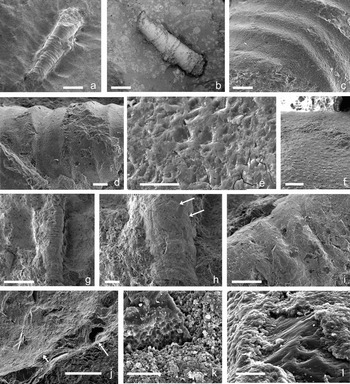
Material and repository. The specimens are housed in the Museo de Ciencias Naturales de la Universidad de Zaragoza (Museum of Natural Sciences of the University of Zaragoza), Spain – formerly known (until 2012) as the Museo Paleontológico de la Universidad de Zaragoza – in repository MPZ. Holotype – MPZ 2007/1894 (Figs 3a–f, l, 4a, b) from the Codos locality, Cadenas Ibéricas, NE Spain; Codos formation, upper Ediacaran/lower Cambrian. Paratypes – MPZ 2007/3898, 3905–3908 from the same locality. All the material is represented by mechanically extracted fragmentary tubes. The fossils were studied as both coated and uncoated samples under scanning electronic microscopes (SEM), JEOL JSM 6400 with Oxford INCA Energy 300 X-ray analyser and in a variable pressure, Hitachi SEM S-3400N with Röntec XFlash detector, in both secondary electron emission (ESED) and backscattering (BSE) regimes. ESED provides better results for the sculptural observations whereas BSE in combination with an energy-dispersive X-ray spectrometer analysis allows detection of semi-quantitative chemical composition and visible mineralogical differences. The observations were made under low-vacuum conditions with water-vapour pressure at 60–90 Pa, at an accelerating voltage of 15 kV, and a beam which sampled 1–10 µm craters of specimen in a single analysis. Each specimen was analysed at several sites to obtain information about the composition of specific areas or layers. Specimens were initially cleaned with water, but their bedding surfaces were not removed.
Codositubulus grioensis gen. et sp. nov. from Codos, Cadenas Ibéricas, NE Spain, upper Ediacaran / lower Cambrian; SEM. (a–f, l) Holotype, MPZ 2007/1894: (a) longitudinal view, (b) longitudinal view in backscattering regime, (c) surface ornamentation, (d) ribs, (e) middle platy layer, (f) tubercles, (l) middle layer showing up where the outer layer is eroded. (g–k) Paratype, MPZ 2007/3898: (g) tube fragment, (h) phosphatized microdolomite crystals (arrows) suggestive of primary high-Mg calcite tube composition, (i) cavities after mica flakes, (j) epitaxial cement crust (long arrow) on the tube surface (short arrow), (k) imprints of outer layer euhedra on the middle layer, (l) individual lath with multiple fibrils. Scale bar for a–b and g represents 1 mm; for c–e and j, 100 µm; for f, 25 µm; for k–l, 10 µm; for h, 250 µm; for i, 200 µm.

Description. Tubicolous phosphatized microfossil up to 4.2 mm in length in the largest (incomplete) specimen, and up to 1.1×1.7 mm in diameter (Fig. 3a, b). The angle of tube divergence is 6°. The wall thickness is 0.03–0.04 mm. The rib density is seven ribs per 1 mm on average due to an uneven distribution of ribs (Fig. 3c, d). The tubercle diameter is c. 0.005 mm (Fig. 3f).
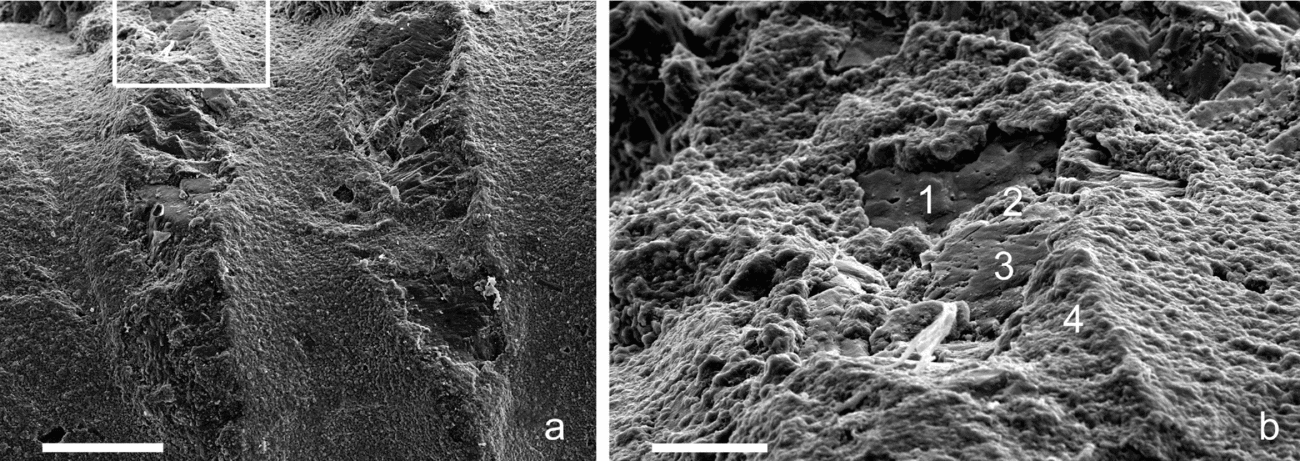
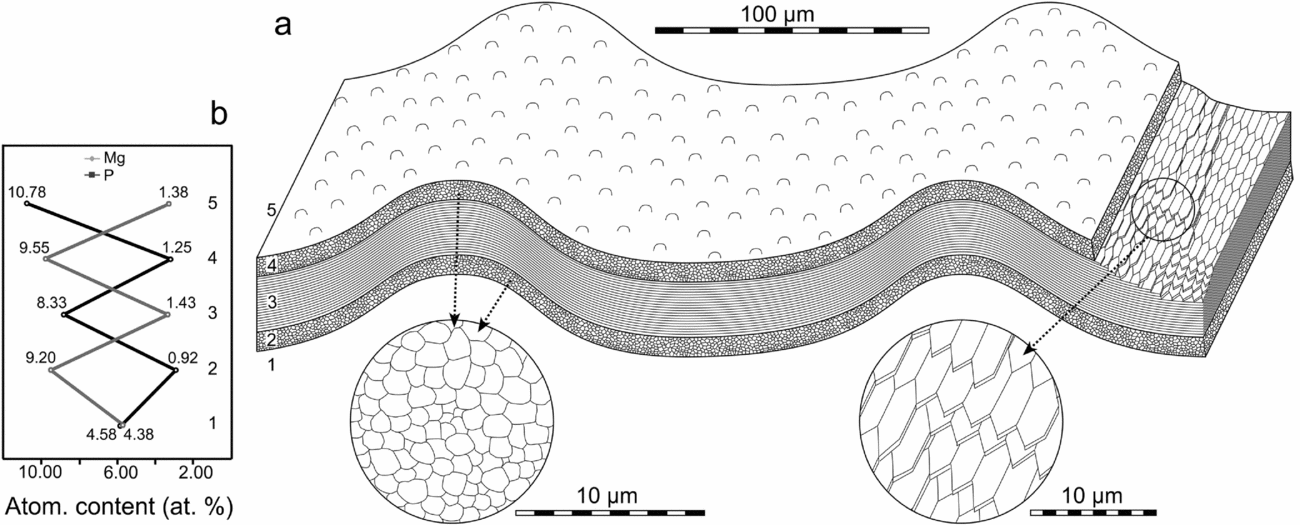
The tube consists of three layers. The outer and inner homogeneous layers of 6–8 µm in thickness each are made of an aggregation of minute euhedral crystallites 1–2 µm in size (Figs 3k, l, 4a, b, 5a). The middle platy layer, which is 16–22 µm thick, is formed by polygonal, probably rhombohedral, platy crystals (laths) with arrow-pointed endings which coalesce laterally and are arranged into folia (Figs 3e, 4a, b, 5a). Individual laths are 5–7 µm in size, 2–3 µm thick, and comprise multiple fibrils imparting them a compound appearance and slightly ragged margins (Fig. 3l). The uppermost laths bear imprints of euhedra of the outer homogeneous layer (Fig. 3k).
Tube wall structure of Codositubulus grioensis gen. et sp. nov., holotype, MPZ 2007/1894; SEM. (a) Longitudinal view, (b) insertion showing rock matrix (1) homogeneous inner layer (2), middle platy layer (3) and homogeneous outer layer (4). Scale bar for (a) represents 100 µm; for (b), 25 µm.

4. Biomineralization of Codositubulus skeleton
The tube of Codositubulus was originally calcareous, as expressed in its energy-dispersive X-ray spectra revealing a selective phosphatization of shell. In places, phosphorus is absent while calcium and magnesium are still determinable. The middle platy layer and epitaxial cement are especially rich in magnesium and poor in phosphorus, while both inner and outer layers are rich in phosphorus and poor in magnesium (Fig. 5b). In general, the magnesium content varies in accordance with the phosphorus content, but while one of these elements is increasing, the other is always decreasing (Fig. 5b). The paratype MPZ 2007/3898 possesses a thick epitaxial cement overgrowth along the whole tube length (Fig. 3j). The prismatic crystals of the cement initiated from the tube surface and the cement layer itself followed the undulating tube relief and, in places, captured foreign particles such as mica flakes (Fig. 3i). Two tubes preserve phosphatic replicas of rhombohedral microcrystals with apparent polygonal growth bands which are typical of dolomite (Fig. 3g, h). All these features taken together point to a primary high-Mg calcite composition of the skeleton. The matrix almost lacks phosphate and shows very low magnesium content. Manganese, silica, and aluminium are mostly restricted to the matrix; this probably reflects its primary clay composition.
Sketch of the three-layered structure and elementary composition in tube wall of Codositubulus grioensis gen. et sp. nov. (a) Tube is built of homogeneous outer and inner layers, consisting of fine euhedral crystallite aggregation, and of the middle layer which is formed by polygonal, probably rhombohedral, platy crystals (laths) with arrow-pointed endings which coalesce laterally and are arranged into folia. (b) Variations in magnesium (Mg) and phosphorus (P) contents across rock matrix (1), inner (2), middle (3) and outer (4) tube layers, and epitaxial cement (5) showing in averaged normalized atomic per cent [Atom. C (at.%)].

The tube microstructure of Codositubulus differs markedly from those of other Ediacaran and Cambrian tubicolous fossils that have been studied. The tube walls of Hyolithellus and Torellella are densely laminated, and individual lamellae consist of fibres of different orientation (Grigorieva & Zhegallo, Reference Grigorieva and Zhegallo1979; Bengtson et al. Reference Bengtson, Conway Morris, Cooper, Jell and Runnegar1990; Vinn, Reference Vinn2006; Skovsted & Peel, Reference Skovsted and Peel2011). The Sinotubulites tube has a multilayer structure with lamellae being distinctly separated from each other by a broad space and the outermost ones being folded (Chen et al. Reference Chen, Bengtson, Zhou, Hua and Yue2008), and the Conotubus tube is built entirely of pyrite framboids which are indicative of its primary organic composition as well as features of plastic deformations (Cai et al. Reference Cai, Schiffbauer, Hua and Xiao2011).
The tube microstructure of Codositubulus shares certain features with skeletal microstructures of some molluscs, brachiopods, bryozoans, and some extinct Palaeozoic probable lophophorates, all of which belong to the lophotrochozoan clade. The middle platy layer of Codositubulus very much resembles a nacreous aragonite or laminar (foliated and semi-nacreous) calcite microstructure of these groups (e.g. Taylor & Weedon, Reference Taylor and Weedon2000, fig. 5a; Vendrasco et al. Reference Vendrasco, Porter, Kouchinsky, Li and Fernandez2010, fig. 14; Vinn & Zatoń Reference Vinn and Zatoń2012, fig. 5a; Vendrasco & Checa, Reference Vendrasco and Checa2015, fig. 2) while its homogeneous layers have some similarities with the homogeneous microstructure of molluscs (Kobayashi & Samata, Reference Kobayashi and Samata2006, fig. 10) and cyclostome bryozoans (Taylor & Weedon, Reference Taylor and Weedon2000, fig. 1d). A high-Mg calcite variety of the foliated microstructure occurs in shells of craniid brachiopods (Williams, Cusack & Brown, Reference Williams, Cusack and Brown1999).
In animal exoskeletons, homogeneous outermost layers resist dissolution, while an energy-dissipative fracture-resistant platy inner layer protects against mechanical deterioration and, in general, more energy is required to penetrate the deeper layers (Connors et al. Reference Connors, Ehrlich, Hog, Godeffroy, Araya, Kallai, Gazit, Boyce and Ortiz2012). Multilayered skeletal elements of both carbonate and phosphate composition decrease the yield stress between each layer from the outer surface inward by a factor of up to ten, while the energy dissipation during penetration increases by a factor of up to four, indicating that more energy is required to penetrate the deeper layers, when a predator tries to bite through the scale or sclerite (Bruet et al. Reference Bruet, Song, Boyce and Ortiz2008; Song, Ortiz & Boyce, Reference Song, Ortiz and Boyce2011; Connors et al. Reference Connors, Ehrlich, Hog, Godeffroy, Araya, Kallai, Gazit, Boyce and Ortiz2012). The gradients at the junctions between layers by themselves are effective transitional zones for stress redistribution between layers, increasing the penetration resistance (Bruet et al. Reference Bruet, Song, Boyce and Ortiz2008). Thus, multilayered composite provides a load-dependent stiffness and hardness, which are not achievable in homogeneous structures. Besides, organic membranes enveloping individual crystals and organic layers interlaying with heavily mineralized impart mechanical anisotropy to the skeleton, increasing energy dissipation and decreasing crack propagation (Li, Xu & Wang, Reference Li, Xu and Wang2006). Skeletal microelements (platelets), although behaving under a petrographic microscope as monocrystals, in turn are complex organic–inorganic cohesive-frictional composites consisting of nanometre-sized domains which can deform and rotate, allowing individual platelets to exhibit considerable plasticity before fracture upon penetration (Bruet et al. Reference Bruet, Qi, Boyce, Panas, Tai, Frick and Ortiz2005; Tai et al. Reference Tai, Dao, Suresh, Palazoglu and Ortiz2007).
Thus, the tripartite structure of the Codositubulus tube, being a heterogeneous multilayered composite, satisfies the requirements for better protection of predator teeth, jaws or claws.
5. Conclusions
Skeletons of Codositubulus reveal microdolomite crystals and increased magnesium content, features indicative of high-Mg calcite original composition, while increased phosphorus and neodymium contents point to a secondary phosphatization. Other fossils, which are present at the Codos locality, also bear features of primarily calcareous composition. Halkieriid sclerites (three morphological types) were probably aragonitic because the scaly outer surfaces of the sclerites display an arrangement of platy rhombohedral crystals angled into transverse serrate imbricating ridges. This interpretation of primary mineralogy of halkieriid sclerites concurs with observations on these fossils from other localities (Bengtson et al. Reference Bengtson, Conway Morris, Cooper, Jell and Runnegar1990; Reference PorterPorter, 2004a). Cupittheca and Cobboldiella from Codos possess the same microstructure as the shell outer layer, and a new cone-like shell bears well-expressed tubercles on its outer surface which strongly resemble a mollusc-type microornamentation (e.g. Kouchinsky, Reference Kouchinsky2000; Parkhaev, Reference Parkhaev2006). Thus, all the fossils of Codos had primary high-Mg calcite and aragonite composition and their phosphatic appearance is a result of an early diagenesis. The latter phenomenon itself may be due in part to enrichment of seawater by phosphate during the Ediacaran – earliest Cambrian (Terreneuvian) episode of phosphogenesis manifested in a high number of phosphatic deposits and fossil accumulations having undergone secondary shell phosphatization, as well as in quantitative analysis of phosphorus content of carbonates, which is a proxy of its abundance in seawater (Cook & Shergold, Reference Cook and Shergold1984; Reference PorterPorter, 2004b; Brasier & Callow, Reference Brasier and Callow2007; Shimura et al. Reference Shimura, Kon, Sawaki, Hirata, Han, Shu and Komiya2014).
In summary, the small shelly fossils assemblage discovered in the Codos locality of the Cadenas Ibéricas is the richest fossil assemblage in the pre-trilobite Cambrian strata of Spain. It includes seven genera, only three of which (Cupittheca, Cobboldiella and Pseudorthotheca) were known before. Although all the fossils are preserved in phosphate now, the phosphate replicas of the primary microstructures and energy-dispersive X-ray spectrometer analysis reveal their primary carbonate (aragonite and high-Mg calcite) composition.
Acknowledgements
This is a contribution to the projects: CGL2011–24516 (Ministerio de Ciencia e Innovación-FEDER–EU, Spain), ACI2009–1307 by AECID (Ministerio de Asuntos Exteriores y de Cooperacion, Spain), Grupo Consolidado E–17 (“Patrimonio y Museo Paleontológico”; Gobierno de Aragón), and IGCP projects 587 (“Of Identity, Facies and Time: the Ediacaran (Vendian) Puzzle”) and 597 (“Amalgamation and Breakup of Pangæa: the type example of the supercontinent”) (IUGS-UNESCO). J.A.G.V. received financial support from the Ministerio de Ciencia e Innovación of Spain (“Juan de la Cierva” contract, ref. JCI–2009–05319). AZ benefited from the grants MI042/2006, Departamento de Ciencia, Tecnología y Universidad (Gobierno de Aragón), and CB 3/08 and CB 18/11 of Programa Europa XXI de Estancias de Investigación (CAI–CONAI+D) 2008 and 2011, and ACI2008–0796 by AECID. We thank Isabel Pérez Urresti (MEC – European Social Fund – Universidad de Zaragoza) for her help with preparing the figures, and Ignacio Tacchini Ciudad (Instituto de Carboquímica, CSIC, Zaragoza) and Ana Cristina Gallego Benedicto (Servicios de Apoyo a la Investigación, Universidad de Zaragoza) for their assistance with SEM. Olev Vinn and Michael Vendrasco are acknowledged for kind and useful reviews.