INTRODUCTION
Diversity and variability are key characteristics of animal life (Spicer & Gaston, Reference Spicer and Gaston1999). Environmental factors influence an animal's condition at several levels of biological organization, including organismal (e.g. feeding rate and metabolic rate: Sanford, Reference Sanford, Schneider and Root2002) subcellular levels (e.g. protein synthesis and gene expression: Somero, Reference Somero2002). To understand the effects of climate change on biological phenomena throughout the biosphere (Hofmann, Reference Hofmann2005) is important to evaluate the organism's responses to environmental variations. As a result, there has been increasing interest in determining the variability in physiological condition and life-history traits of organisms in their natural habitats (Colman, Reference Colman1933; Wagner et al., Reference Wagner, Durbin and Buckley1998; Dahlhoff, Reference Dahlhoff2004; Pulgar et al., Reference Pulgar, Alvarez, Morales, Garcia-Huidobro, Aldana, Ojeda and Pulgar2011). Physiological constraints are important determinants of the distribution limits of species and populations (Gaston & Spicer, Reference Gaston and Spicer1998; Chown & Gaston, Reference Chown and Gaston2000); however, processes associated with environmental tolerance explaining for example differential habitat use at the local scale, or species distribution patterns at the geographical scale, remain poorly understood.
Rocky intertidal habitats experience a wide range of physical conditions, with daily and seasonal variability including: degree of immersion; isolation; nutrient availability; and exposure to different levels of wave action (Newell, Reference Newell1970; Truchot & Duhanel-Jouve, Reference Truchot and Duhanel-Jouve1980). Organisms that inhabit intertidal rocky shores are strongly influenced by a vertical tidal emersion (Denny, Reference Denny1988; Helmuth & Hofmann, Reference Helmuth and Hofmann2001; Somero, Reference Somero2002) and a horizontal wave exposure gradient (Jones & Demetropoulos, Reference Jones and Demetropoulos1968; Dahlhoff et al., Reference Dahlhoff, Stillman and Menge2002). In intertidal organisms, biochemical and physiological processes and ultimately organismal performance, are modified in response to environmental conditions (Stickle & Bayne, Reference Stickle and Bayne1987; Pulgar et al., Reference Pulgar, Alvarez, Morales, Garcia-Huidobro, Aldana, Ojeda and Pulgar2011). For instance wave action exerts great forces on sessile or less mobile organisms, with the risk of dislodgement being an important selective pressure (e.g. Carrington, Reference Carrington1990; Gaylord et al., Reference Gaylord, Blanchette and Denny1994; Denny, Reference Denny1999). Under these conditions animals face an energetic trade-off between survival (ability to attach to the substrate) and reproduction (reproductive tissue) (Brown & Quinn, Reference Brown and Quinn1988; Sibly, Reference Sibly1991). In intertidal molluscs, evidences also indicate that morphological features such as shell morphology and body size are associated with differences in wave energy (Etter, Reference Etter1988; Trussell et al., Reference Trussell, Johnson, Rudolph and Gilfillan1993).
Among the biochemical indicators used to determine physiological condition and metabolic activity in situ the RNA:DNA ratio is widely used as an index to determine condition of organisms in the field (Chícharo & Chícharo, Reference Chícharo and Chícharo2008). This index measures the protein biosynthetic capacity and is usually correlated with the nutritional status under a given set of environmental conditions (Buckley & Caldarone, Reference Buckley and Caldarone1999). Organisms in good condition, therefore tend to have higher RNA:DNA ratios. This index has been used on a wide range of marine organisms such as those constituting the phytoplankton (Dortch et al., Reference Dortch, Roberts, Clayton and Ahmed1983) and zooplankton (Ikeda et al., Reference Ikeda, San, Yamaguchi and Matsuishi2007), larval fish (Caldarone et al., Reference Caldarone, Onge-Burns and Buckley2003), juvenile and adult fish (Thorpe et al., Reference Thorpe, Talbot and Villarreal1982), bivalves (Chícharo et al., Reference Chícharo, Chícharo, Alves, Amaral, Pereira and Regala2001), crustaceans (Lemos et al., Reference Lemos, Garcia-Carren, Hernández and Toro2002) and intertidal fish (Pulgar et al., Reference Pulgar, Alvarez, Morales, Garcia-Huidobro, Aldana, Ojeda and Pulgar2011).
To address physiological responses to wave exposure in a sessile organism we studied morphometric, reproductive and in situ physiological variables in the intertidal limpet Fissurella crassa (Lamarck, 1882) sampled at exposed and sheltered intertidal sites. Fissurella crassa is distributed from Peru to Chile (McLean, Reference McLean1984; Oliva & Castilla, Reference Oliva and Castilla1992), inhabiting sheltered and exposed intertidal zones (Pino et al., Reference Pino, Oliva and Castilla1994). These limpets are dioecious without external sexual dimorphism, bearing a single gonad. Individuals may release gametes during two major spawning events (Bretos et al., Reference Bretos, Tesorieri and Alvarez1983, Reference Bretos, Gutiérrez and Espinoza1988; Bretos & Chihuailaf, Reference Bretos and Chihuailaf1993). Fissurella crassa shows seasonal differences in growth rate: in late summer and autumn, there is an accelerated growth, which declines again in late autumn and winter. This decrease in growth rate may coincide with the spawning period (Mclean, Reference McLean1984; Oliva & Castilla, Reference Oliva and Castilla1986).
MATERIALS AND METHODS
Quantification of wave action and collection of F. crassa specimens
Wave action was measured in winter 2009 in intertidal sheltered (Sh) and exposed (E) sectors in central Chile (Quintay (33°11′S 71°41′W)), using the methodology described by Doty (Reference Doty1971) and Gerard & Mann (Reference Gerard and Mann1979). This method involves the measurement of the rate at which plaster shapes dissolve assuming their diffusion rate is proportional to the mass flow of water in motion (Guiñez & Pacheco, Reference Guiñez and Pacheco1999). For these measurements ten wear units were used; these units were dried to constant weight, and during a complete tidal cycle the units were removed and dried at 40°C until achieving constant weight. The decrease in weight of the units (measured as the difference in weight, Δ) is considered an estimation of wave action intensity in each site (Guiñez & Pacheco, Reference Guiñez and Pacheco1999).
Individuals of F. crassa were sampled from exposed (summer E-S, N = 22, winter E-W, N = 22), sheltered (summer Sh-S, N = 22, winter Sh-W, N = 22) sectors during 2008 and winter 2009. Limpets sampled at both seasons from each sector were deposited in labelled plastic bags and then transported to the laboratory. Limpet foot weight (g), gonad weight (g), and individual total weight (g) were measured using an analytic balance (+/– 0.01 g precision). We considered gonadal weight as an indirect estimator of reproductive tissue investment and foot weight as a direct estimator of substrate attaching capability of F. crassa. Total limpet shell length (cm), shell width (cm) and shell height (cm) were measured using a digital caliper (Mitutoyo) (+/– 0.01mm) and analytic balance (0.01 g). Limpet sexual condition was determined by direct observation of gonad colour; male gonads are yellow and female gonads are green (Olivares et al., Reference Olivares, Jofré, Alvarez and Bustos2009).
F. crassa food availability
Food availability for F. crassa in low intertidal of both E and Sh study sectors, was evaluated using 100-m long transects parallel to the coast. For each season and degree of exposure considered, 50 × 50 cm quadrats randomly chosen were surveyed (E-S, N = 12 quadrat; E-W, N = 15, Sh-S, N = 13; and Sh-W, N = 13). In each quadrat, macroalgae cover (as percentage of total) of Rodophyta (Mazzaella spp.) and Chlorophyta (Ulva spp.) were considered as indirect estimator of food F. crassa availability.
Molecular analyses
For molecular analyses, limpets were collected both in winter (E sectors N = 8 limpets, Sh, N = 9) and summer (E, N = 10 and Sh, N = 10). The extraction of RNA and DNA was performed using TRIZOL® Reagent for the isolation of total RNA from cells and tissues (Chomczynski & Sacchi, Reference Chomczynski and Sacchi1987). We extracted 200 mg of foot tissue from each individual. During the homogenization of the sample previously extracted, TRIZOL® Reagent maintains the integrity of the RNA, while disrupting cells and dissolving cell components. Addition of chloroform followed by centrifugation separates the solution into an aqueous phase and an organic phase. RNA remains exclusively in the aqueous phase. After transfer of the aqueous phase, the RNA is recovered by precipitation with isopropyl alcohol. After removal of the aqueous phase, the DNA in the supernatant can be recovered by sequential precipitation (Chomczynski, Reference Chomczynski1993). After extracting, the RNA and DNA were reconstituted in 50 and 900 µl of nuclease-free water respectively. Both RNA and DNA were quantified spectrophotometrically to 260/280 nm (Perkin Elmer Lambda Bio L7110184) and expressed as μg/μl, corrected for body and sample size.
Statistical analyses
One-way analysis of variance (ANOVA) (general linear models) was used to compare loss of weight of waste units among sheltered and exposed sectors. Two-way ANOVA (general linear models) was used to compare seasonal variations of the morphological and reproductive characteristics of F. crassa, and algae richness and abundance between exposed and sheltered intertidal sampled sites. Season and wave exposure represent extreme intertidal ecological conditions and were considered fixed factors. The Tukey a-posteriori test was used to assess specific differences between factor levels.
Residual analysis was used to evaluate the effect of season and wave exposure, on foot and gonad weight; results were expressed with respect to total individual weight. Residual analysis was also used to compare RNA:DNA ratios between exposed limpets and sheltered shore limpets, in relation to fresh body limpet weight. A significance level of P < 0.05 was selected for rejection of a null hypothesis of no significant differences (Zar, Reference Zar1996).
RESULTS
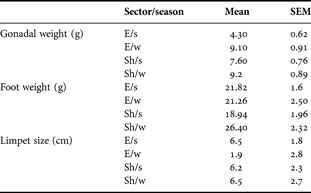
Data describing limpet morphological variables such as gonadal weight, foot weight and limpet size, are indicated in Table 1.
Basic morphological description of keyhole limpet in sampled sectors (sheltered and exposed) during both seasons studied (summer, s; winter, w). Results are expressed as mean ± 1 SEM. E/s, exposed/summer; E/w, exposed/winter; Sh/s, sheltered/summer; Sh/w, sheltered/winter.

Habitat variability: wave action and food availability
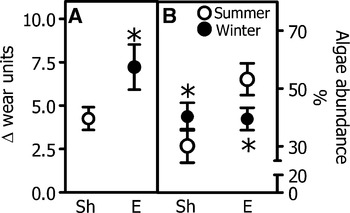
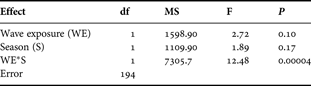
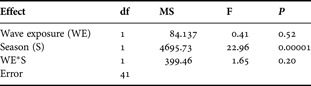
Wear units showed a greater weight loss in E than Sh sectors (Figure 1A; Table 2), indicating that the former sectors are subjected to greater wave energy. Algae cover was significantly greater in winter in Sh, and in summer in E sites (Figure 1B; Table 3), indicating differences in the amount of food availability to F. crassa depending on the season and wave exposure.
Habitat variability: wave action and food availability. (A) Wave energy exposition measured as the decrease in weight of wear units (Δ) in sheltered (Sh) and exposed (E) sectors: (B) seasonal algae cover (%) in Sh and E sampled sites. Vertical bars indicate ± 1 SEM, *P < 0.05.

General linear model (analysis of variance) results comparing the decrease in mean mass of the waste units from sheltered and exposed zones. df, degrees of freedom; MS, mean square; F, F value; P, probability value.

General linear model (analysis of variance) results comparing algae abundance of sheltered and exposed zones during summer and winter. df, degrees of freedom; MS, mean square; F, F value; P, probability value.
Limpet morphology: shell structures
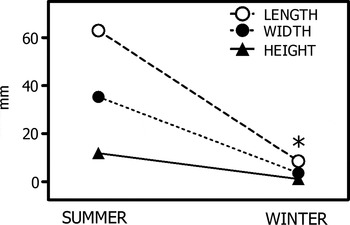
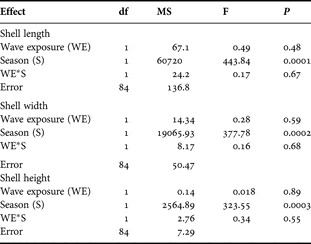
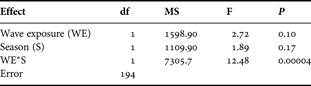
Analyses of shell morphometric characteristics of F. crassa indicate that independent of wave exposure length, width and height shell s were thinner in winter than summer (Figure 2; Table 4).
Limpet morphology: hard structures. Shell morphometric variability in summer and winter. Vertical bars indicate ± 1 SEM, *P < 0.05.

General linear model (analysis of variance) results comparing Fissurella crassa shell length (cm), shell width (cm), shell height (cm) of sheltered and exposed zones during summer and winter. df, degrees of freedom; MS, mean square; F, F value; P, probability value.

Limpet morphology: soft structures
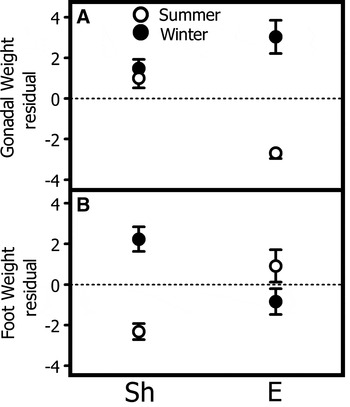
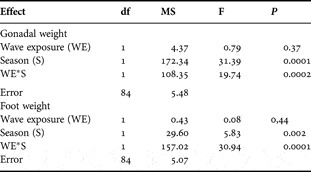
Limpets from the Sh sector showed greater gonadal weight in summer than in winter. In contrast, individuals from the E sector showed higher gonadal weight in winter (Figure 3A; Table 5: Tukey a-posteriori test P < 0.05). Residual of foot weight of F. crassa was higher in winter in the Sh sector whereas in animals from the E sector the foot weight was higher in summer (Figure 3B; Table 4: P < 0.05).
Limpet morphology: soft structures. Seasonal Fissurella crassa gonadal (A) and foot (B) weight residual in sheltered (Sh) and exposed (E) sectors. Vertical bars indicate ± 1 SEM.

General linear model (analysis of variance) results comparing Fissurella crassa gonadal and foot weight of sheltered and exposed zones during summer and winter. df, degrees of freedom; MS, mean square; F, F value; P, probability value.

Molecular analysis
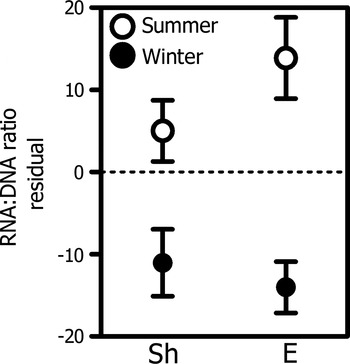
Residual of the relationship between RNA:DNA ratio to foot and gonadal weight indicates that regardless of exposure, animals present higher RNA:DNA ratios in summer compared to winter (Figure 4; Table 6).
Molecular analysis: RNA:DNA ratio. Seasonal RNA:DNA ratio in limpets from sheltered (Sh) and exposed (E) sectors. Vertical bars indicate ± 1 SEM.

General linear model (analysis of variance) results comparing Fissurella crassa RNA:DNA ratio from sheltered and exposed zones during summer and winter. df, degrees of freedom; MS, mean square; F, F value; P, probability value.

DISCUSSION
Our results indicate that, in the intertidal limpets F. crassa, traits associated with survival and reproduction, as well as biosynthetic capabilities present environmental and seasonal variation. Whereas hard structures were thinner in winter, soft structures showed both exposition and season-related variations. Gonadal tissue weight was similar between seasons and foot weight was greater in winter in sheltered sectors. In the exposed sectors, gonadal weight was higher in winter and foot weight higher in summer. At the molecular level, a greater RNA:DNA ratio was observed in summer regardless of intertidal exposure.
The balance between energy acquisition and expenditure is critical for animal survival and reproductive success (Sibly, Reference Sibly1991). This balance depends on the interplay between food intake, digestion, and the allocation of energy to various functions such as growth and reproduction (Karasov, Reference Karasov1986; Wiener, Reference Wiener1992). In animals inhabiting an environment with high physical variability, such as the intertidal system, traits related to energy allocation dealing with survival (foot development), and reproduction (reproductive tissue), are under strong selective pressure (Sibly & Calow, Reference Sibly and Calow1986; Stearns, Reference Stearns1992; Weiner, Reference Wiener1992). Intertidal invertebrates inhabit a wide range of variation in a number of physical–chemical variables (Moore & Seed, Reference Moore and Seed1986; Raffaelli & Hawkins, Reference Raffaelli and Hawkins1996). In this heterogeneous habitat (e.g. substrate characteristics and physical–chemical variables), wave action can affect energy intake, the time for or success in feeding, and some predator species may benefit from wave prey dislodgement (Sebens, Reference Sebens2002). We characterized two sectors as sheltered and exposed depending upon the energy of the wave action observed (Figure 1A). Our results indicated seasonal variability in algae abundance in these two sites, with the sheltered sector displaying higher abundance in winter and exposed sites displaying higher algae abundance in summer (Figure 1B). To understand how the variable environment in these two sites may affect energy allocations, we determined a number of presumably related morphological parameters in F. crassa. We observed thinner keyhole shell in winter (Figure 2), probably associated with wave action, which reportedly affects animal shell mineral deposition (Moore & Seed, Reference Moore and Seed1986; Raffaelli & Hawkins, Reference Raffaelli and Hawkins1996). The effect of wave exposure has been described as a modulator of body shape, corporal position, movements and thread production in intertidal organisms (Denny & Blanchette, Reference Denny and Blanchette2000; Astorga et al., Reference Astorga, Guiñez, Ortiz and Castilla2002; Moeser et al., Reference Moeser, Leba and Carrington2006). The foot weight and F. crassa shell variability found in Sh animals and E sites may be interpreted as wave exposure action on our sampled population (Figure 2).
The most important energetic trade-off reported occurs between reproduction and growth energy allocation, where compensatory responses to habitat variability reveal the action of natural selection on reproduction and survival (Warner, Reference Warner1984; Spicer & Gaston, Reference Spicer and Gaston1999; Zera & Harshman, Reference Zera and Harshman2001). In limpets, gonadal weight is associated with reproductive potential whereas muscular foot weight, responsible for mobility and attachment to the substrate, could be associated with individual survival (Serra et al., Reference Serra, Chelazzi and Castilla2001). Our results indicate that gonadal weight as well as foot weight development showed a seasonal response to environmental variability (Figure 3). Limpet gonadal weight in sheltered habitats did not show seasonal changes whereas in exposed habitats gonadal tissue weight increased from summer to winter (Figure 3A). On the other hand, foot weight in sheltered habitats increased from summer to winter, whereas in the exposed sector foot weight decreased from summer to winter (Figure 3B). The increased foot weight in winter would enable individuals to remain associated with substrate and the decrease in foot weight in exposed sites would evidence the costs of inhabiting a physically stressful habitat in comparison to animals from the most benign sheltered habitat. We interpret the opposite variation of gonadal weight and foot tissue weight, i.e. increase in winter in exposed sites and in summer in sheltered sites (Figure 3), as a strategy to differentially allocate energy resources associated with different intertidal wave exposure. The change in allocated energy to growth or reproduction processes is the principal trade-off described for animals that inhabit environmental gradients (Chown & Gaston, Reference Chown and Gaston1999; Smith et al., Reference Smith, Green, Kelley, Prufert-Bebout and Bebout2008).
Environmental variability associated with the sheltered habitat is related to foot weight increase from summer to winter, without affecting reproduction investment (Figure 3B). However, in exposed habitats energetic restrictions are evident, and thus drastic decline in foot weight from summer to winter is necessary to offset the summer to winter increase in gonadal tissue weight (Figure 3A).
Our results indicate that in sheltered habitats, limpets may have low maintenance costs compared with limpets inhabiting exposed sites, and this fact would allow the former to experience an increase in foot weight during winter with no effects on reproduction. In opposition, animals from stressful habitats may show physiological compensation (Hernandez et al., Reference Hernandez, Neill, Pulgar, Ojeda and Bozinovic2002; Tomanek & Helmuth, Reference Tomanek and Helmuth2002), that would result in allocation of resources in limpets to reproduction at the expense of survival (Stearns, Reference Stearns1992; Roff, Reference Roff2002). Our evidences indicate that animals in exposed habitats reallocate energy among competing energy functions (Stearns, Reference Stearns1989; Ricklefs & Wikelski, Reference Ricklefs and Wikelski2002).
Energetic allocation for the herbivorous F. crassa, is dependent on season, intertidal wave exposure and food availability. The greater food availability in sheltered sites in winter as well as the greater food availability in exposed sites in summer is associated with increased limpet foot weight in both habitats indicating that the energy budget is mostly allocated to enhance survival (Figures 1 & 3).
Understanding the mechanisms by which environmental variability modifies physiological performance of organisms in nature is of great interest when considering the foundations of community dynamics (Parmesan & Yohe, Reference Parmesan and Yohe2003; Dahlhoff, Reference Dahlhoff2004). The RNA:DNA ratio is considered as an in situ indicator of the physiological status, because of its association with the nutritional condition and growth in several marine organisms (Buckley & Caldarone, Reference Buckley and Caldarone1999; Chícharo & Chícharo, Reference Chícharo and Chícharo2008). We observed a higher RNA:DNA ratio in summer animals, regardless of their intertidal location (Figure 4); in this context summer limpets would be increasingly well-off nutritionally (Palumbi, Reference Palumbi2003).
A higher RNA:DNA ratio in F. crassa in summer suggests greater protein synthetic activity producing greater foot weight gain in exposed sites in summer, and greater gonadal weight gain in sheltered habitats. At the molecular level our evidences indicate a dynamic seasonal change in the F. crassa biosynthetic capability (Figure 4), and no effect of intertidal exposure. A higher summer limpet RNA:DNA ratio may be associated with an accelerated growth (McLean, Reference McLean1984; Oliva & Castilla, Reference Oliva and Castilla1986) and greater gonadal tissue weight in summer than in winter (Bretos et al., Reference Bretos, Gutiérrez and Espinoza1988); this evidence may help to understand dynamic reproductive cycles in an important intertidal herbivore. To our knowledge this represents the first evidence of adjustments in the rates of energy acquisition and/or energy expenditure in the commercially important herbivorous mollusc F. crassa. This species is also an important component in the control of the algal community (Aguilera, Reference Aguilera2011). These allocations are thought to be ultimately responsible for positive energy budgets in animals (Hammond & Wunder, Reference Hammond and Wunder1991; Piersma & Lindstrom, Reference Piersma and Lindstrom1997) associated with organism ‘decisions’ regarding energy allocation into maintenance, growth and reproduction (Wiener, Reference Wiener1992).
ACKNOWLEDGEMENTS
This study was funded by grants DI0508 and DI 17-10/R and DI-16-12/R to J.P., Universidad Andres Bello. We thank the Molecular Biology Laboratory staff of Universidad Andres Bello for their strong support with the molecular biology experiments.