On 16 September 1944, just five days after Allied bomb attacks caused severe damage to the Württembergische Staatstheater complex in Stuttgart, the company's Generalintendant (head administrator), Gustav Deharde, sent a distraught letter to the musicologist Fred Hamel:
Due to the terrible attacks on Stuttgart, the charming Kleines Haus [Small House] has been totally burned out, and irreparable damage also occurred in the Großes Haus [Big House], all the sets burned, and though the essential furniture, props, and costumes have been saved, total chaos has ensued, which we are trying with all our might to get under control. Under these circumstances, all of our beautiful plans have dissolved [zu Wasser geworden].Footnote 1
Most of Germany's major civic opera houses – architectural monuments that had been strategically located at the literal and symbolic centres of cultural life – were heavily damaged by the bombing campaigns that targeted German cities in the final years of the Second World War. After the war's end, iconic images showing landmark buildings in rubble evoked a complex mixture of emotions from observers, from a sense of just retribution to horror at the destruction and wastefulness.Footnote 2 The ‘rubble’ archetype of total obliteration acquired a kind of photographic charisma, with gaping spaces asking to be remembered and then filled in by the new.Footnote 3 Bombed buildings became metonyms for German suffering and victimhood, sometimes additionally serving as alibis to avoid post-war reckoning. Historians have interpreted the ways in which ruined cityscapes were treated – rebuilt, renewed, modernized, monumentalized – as evidence of highly local dynamics of mourning, memory-making, and narration.Footnote 4
Once the opera houses’ ‘rubble’ had been alchemized to mere debris, it could eventually be cleared and, in its place, a bumper crop of modern opera houses could emerge.Footnote 5 West German metropolises such as Frankfurt, Cologne, Hamburg, and West Berlin contributed both to a golden age of development in modern theatrical design and to a rejection (some might even say, a betrayal) of the history that had taken place in the old theatres. In contrast, Munich, like Vienna, took the exceptional route and reconstructed its theatre ‘faithfully’, avoiding said betrayal, but arguably failing to even superficially grapple with the horrors of recent history.Footnote 6
The situation was categorically different in Stuttgart: despite Deharde's despair at the state of the city's 1912 Max Littmann-designed double theatre complex, it had fared better than most. As Kurt Honolka wrote retrospectively in 1987, ‘the Stuttgart Opera was lucky’: the bombs had left the bigger stage and auditorium of the Großes Haus intact, and ‘if it rained through the roof here and there’, Honolka continued, ‘that sort of thing was quite normal at the time’.Footnote 7 Less lucky was the Kleines Haus, the smaller theatre in the complex in which spoken drama and smaller operatic works were presented. Over the nearly two decades that followed the end of the war, the Staatstheater administration and the people of Stuttgart worked through two difficult problems: first, of repairing the Großes Haus; second, of rebuilding (and ultimately, redesigning) a Kleines Haus that could restore full artistic function to the theatre complex. Opera was continuously produced throughout this period, amid significant material scarcity and uncertainty. The Stuttgart theatres’ situation of partial destruction not only led to a unique constellation of constraints as to how to move forward but also enabled narratives of persistence to emerge on which the company later capitalized.
Stuttgart was liberated by the French army on 21 April 1945 and occupied by American forces. A mere two months later, in late June, a building inspector visited the Großes Haus to document twenty-one of the most ‘urgently needed’ repair tasks, including:
− Roof over the auditorium, replacing the beams and repairing the roof cladding
− Roof over the stage, same thing …
− 13 front doors for the main entrance, new …
− All of the windows in the corridors, lavatories, some new, otherwise repaired …
− The entire second story of the building must again be totally reconstructed for a piano room, additional choir cloakroom, ballet cloakroom, ballet hall, extras’ cloakroom, ballet master, solo dancers (doors, window, flooring, plastering, etc.)
− Repair lavatories (toilet, urinal, tanks, sinks with taps) …
− Restore the fire extinguishing system in the whole house
− Fire alarm apparatus ditto [i.e. to restore in the whole house]
− Stage control apparatus ditto
− Security system ditto.Footnote 8
Additional aesthetic and functional upgrades were recommended to the seating, flooring, electrical systems, and furnishings.Footnote 9 Damage to the paint shop and set storage, and to linoleum flooring in the corridors, put past productions at risk and created safety hazards.Footnote 10 The administration fretted as broken windows exposed stored costumes to humidity, quickly threatening to render ‘irreplaceable’ garments ‘mouldy and worthless’.Footnote 11 Through all this, the impact was not only material but also emotional; the first post-war Intendant, Albert Kehm, found the state of German cities painful and particularly mourned the destruction of ‘my Vaterstadt Stuttgart, my parents’ house, and especially the constant sight of the theatre complex's ruin’.Footnote 12
Progress on the repairs began slowly, but not because the theatre was thought unimportant. In August 1945, the Oberbürgermeister of Stuttgart wrote reassuringly to the Staatstheater administration that ‘in the name of the city of Stuttgart we have the greatest interest in this work commencing and progressing as quickly as possible, in order to promote theatre and concert life to the benefit of our populace and members of the occupying forces’.Footnote 13 But the district building authority informed Kehm that while they were trying to repair the Großes Haus as quickly as possible, only the American Red Cross could facilitate the acquisition of building materials. This had proved difficult even with Kehm himself making the request: ‘the seal of the General Intendant of the Staatstheater proved worthless’, with an American order and stamp required to authorize the work.Footnote 14 Hence, only the most urgent tasks at the theatre were prioritized, and these not only so that opera performances could resume but so that the Red Cross could use the auditorium for assembly and the Americans could use it for church services.Footnote 15 (Kurt Honolka later recalled hearing the unmistakable sounds of a soldiers’ table tennis tournament during the most adagio, pianissimo sections of a Bruckner symphony performance in 1949.Footnote 16)
In early March 1946, the military government authorized the refurbishment of several rooms, a staircase, and an entrance in anticipation of productions that would use more personnel and extras: Aida was planned; La bohème was staged instead.Footnote 17 But Finance Minister Fritz Cahn-Garnier warned the Staatstheater administration that ‘construction progress depend[ed] on the allocation of building materials’ from a modest budget, and that no further construction projects would occur until at least the following year.Footnote 18 Renovation of the spaces therefore happened piecemeal, without any particular guarantee of continuance, and wood shortages additionally impacted the company's capacity to build new sets. The historical fact of the company's speedy October 1945 re-opening with stagings of Die Fledermaus and The Marriage of Figaro, then, should be appreciated as coexisting with conditions of disruption, disrepair, and scarcity, and any latter-day idea that the Großes Haus had been left luckily ‘intact’ is a categorical designation that emerged only with a bit of mythological thinking and some judicious toilet repair.
By 1956, 1.2 million DM were finally allocated for the auditorium renovation first proposed back in 1945, with a new airflow system, new colours, a new proscenium, and so on.Footnote 19 But ironically, the acoustics that resulted were judged to be disastrous, especially by Ferdinand Leitner, the Staatsoper's music director in the 1950s, who complained that ‘in comparison to our earlier acoustics or to that of other famous theatrical spaces, in our house one can no longer speak at all of a sound suitable for the opera’.Footnote 20 Leitner believed that the subordination of artistic values to technology had the result that ‘not a single one of the concert halls or theatres built after the war possesses the flawless acoustics of a number of old theatres and concert halls’.Footnote 21 So if indeed the Stuttgart Opera had been luckily left intact, according to whom? And what is then elided by the rhetorical line between that which is destroyed and that which ‘endures’?
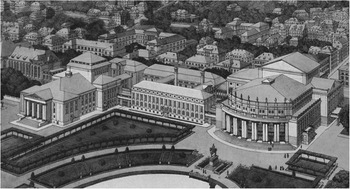
If there is instead a spectrum from obliterated to intact, then the survival narrative for the Großes Haus rested in part on its comparison to the devastated Kleines Haus. The smaller theatre had been modest compared with the grander edifice to which it was connected (Figure 1), but it held significant local and national meaning, as the charming chamber in which Richard Strauss's Ariadne auf Naxos had premiered during the complex's first season in 1912. As Kehm explained: ‘The destruction of the Kleines Haus of the Staatstheater … not only meant the loss of a part, perhaps the most architecturally beautiful part, of our theatre complex, but also inflicted intolerable long-term damage … from both a business and an artistic point of view.’Footnote 22 Yet the theatre was not immediately reconstructed; rather, it faced years of rubble and ruin, followed by a range of competing proposals and several phases of architectural competition, only coming to fruition in 1962. In the meantime, the Großes Haus provided contrast as well as constraints (since the new design would need to relate, one way or another, to the extant design) and a reminder of the cherished tradition to which many Stuttgarters wanted the new Kleines Haus held accountable.
Original Littmann design of the Staatstheater complex, with administrative and technical spaces connecting two theatres (Max Littmann, Die Königlichen Hoftheater in Stuttgart (Darmstadt: A. Koch, 1912)). Author's personal copy. The Kleines Haus is on the left, the Großes Haus on the right.

More than two years after the bombing, loss-mitigation measures to protect the remaining structure of the Kleines Haus and its assets failed to be funded. Writing to the Württembergisches Kultministerium, administrator Herbert Schorsch wrote, ‘If we don't succeed in getting a roof over this part of the house as quickly as possible, then its total destruction should be anticipated in the near future.’Footnote 23 Only in 1949 did the company raise the funds, with an artists’ ball and raffle event at the Kursaal Bad Cannstatt, to begin clearing the rubble.Footnote 24 A real plan started to take shape in the 1950s: in November 1951, the construction bureau of the Finanzministerium authorized an open competition for the ‘Wiederaufbau’ (‘reconstruction’) of the Kleines Haus.Footnote 25 Archival documents about the competition are evidence of the project's initial assumptions. Although the Kleines Haus was used primarily for drama, for example, the committee specified that opera performances must still be possible in the new hall, so designs needed to have appropriate flexibility of space and attention to operatic acoustics.Footnote 26 Designers were asked to ‘retain the approximate former external shape of the Kleines Haus’, and in particular the floor plan and proportions.Footnote 27 Redesigning the layout could occur to the extent that it met updated technical requirements, but ‘the external design [of the new Kleines Haus] should be reminiscent of the extant building [the Großes Haus]’, and, if possible, the same materials should be used (Maulbronner Schilfsandstein, a kind of sandstone found in the region).Footnote 28 A greater potential for design change, however, emerged in an August 1952 amendment to the contest rules, which changed the heading from ‘Competition for the Reconstruction [Wiederaufbau] of the Destroyed Kleines Haus’ to ‘Competition for the Construction [Aufbau] of the Destroyed Kleines Haus’ – a subtle difference implying that a new approach might be possible, or at least that the charge need not be a reconstruction by definition.Footnote 29 This easing of restrictions may have reflected emerging trends in opera house reconstruction in the 1950s, with highly publicized plans throughout West Germany for modern buildings to replace the ruins of older opera houses in several cities.
In 1953, the Stuttgarter Zeitung printed three prize-winning designs – by Paul Stohrer, Hans Paul Schmohl, and Wilhelm Riphahn – all of which completely reimagined the theatre.Footnote 30 Stohrer's design, boasting a ‘bright, elegant foyer’, was faced with substantial glass windows on three sides and had an unusually angular fly loft. Schmohl suggested a blocky structure with a triangular roof and stark fly loft, and a ‘ponderous’ facade somewhat lightened by a proposed water feature. Riphahn's model was by far the most modern, with solid glass ‘porch’ and a flat roof. The amount of glass used by Riphahn was deemed inappropriate on economic, technical, and thermal grounds; Riphahn withdrew his plan from consideration, and the two remaining architects worked towards a compromise, complicated by conflicts over money and different priorities.Footnote 31
During the long period in which the plans remained unsettled, a brisk debate over various potential approaches continued, and the 1955 reconstruction of the Vienna State Opera became a catalyst for particular public dissent.Footnote 32 A letter from a Stuttgart man named Ernst Rupp exemplifies the citizens’ backlash against modernism, using Vienna's example as a way to argue against replacing cities’ grieved-for ruins with modern designs. Rupp argued that in order to preserve the ‘unified artistic concept’ of Littmann's original, the Kleines Haus must be restored:
The published draft by architect Paul Stohrer … may be a very interesting attempt at a reworked theatre building, but it is not the building to complement Littmann's wonderful Großes Haus on this Platz, no counterpart to [the Großes Haus] – a glass house next to [Littmann's] work of art in a classicist style. And anyway: why does a modern building have to replace the small house at all costs? Why not construct the earlier Kleines Haus with the old, beautiful facade and the enchanting, acoustically excellent auditorium, for which we in Stuttgart were envied everywhere? … In other cities, people don't shy away from holding on to old traditions, where preservation is the best artistic solution (State Opera in Vienna). Only in Stuttgart must a modern building be built at all costs, even when it doesn't fit its surroundings, and huge costs are spent on a competition for it, which would be better spent on the reconstruction of the earlier house.Footnote 33
Walter Erich Schäfer, the Intendant from 1949 on, aired his own opinions about the Kleines Haus project in an essay about Vienna's re-opening, suggesting that ‘the bombs have made Germany into an ideal experimentation field for new theatre buildings. Courageous architects have created interesting and sometimes fascinating things, and it would be sad if the Vienna example meant the end of these attempts.’Footnote 34 Indeed, none of the experts now thought it prudent to rebuild the Kleines Haus in its old form; even though they had loved and mourned it too, modern theatrical technology would be too challenging to put into the old design.Footnote 35 Other architects sent additional unsolicited designs and advice, often with a more modern slant, including Raimund Doblhoff, who enthusiastically recommended that the Kleines Haus follow the path of Ludwig Mies van der Rohe's ‘impossible’ (and never built) Mannheim Nationaltheater and the CBS Television City building in Los Angeles. According to Doblhoff, many newly built theatres in Germany were only ‘superficially modernised’, and Stuttgart should create instead ‘an instrument on which a rich bounty of new, old, and not-yet-experienced theatrical events may come to fruition’.Footnote 36
The Kleines Haus project thus inevitably took its place in a much broader contemporary discourse on modernization and tradition, including similar debates occurring in the realm of music and production aesthetics. Artists and citizens were deeply invested in reconstructing cultural life from the literal and figurative rubble, sometimes using reconstruction as an opportunity to advance, sometimes as an occasion to reassert connections to a cherished past. I perceive Stuttgarters’ impassioned appeals that the Kleines Haus be rebuilt according to the old style and structure to be reminiscent of the position that a new work such as Carl Orff's Oedipus der Tyrann, which premiered in Stuttgart in 1959, was too alienating to count as opera, and correlated too with the opera fan who wrote to the Intendant to inquire, ‘on which days will you produce Parsifal and in which style – Richard or Wieland Wagner?’Footnote 37
By September 1956, yet another plan was publicized, still lacking reconciliation.Footnote 38 The administration now began considering designs by Otto Jäger and Hans Volkart, who had initially been placed in the competition's second tier.Footnote 39 An editorial in the Stuttgarter Nachrichten wrote that it was a ‘surprise’ that these two architects were now being considered over the original competition winners.Footnote 40 Jäger and Volkart were positioned as ‘opposite solutions’: Jäger's was the more progressive, and Volkart's – a sleek, octagonal structure faced with flat white marble and accented with narrow glass windows – was ‘a more conservative building’.Footnote 41 While perhaps not a reconstruction fit to satisfy the letter writers previously cited, Volkart's relative conservatism rang true as an approach to theatrical architecture in Stuttgart. It is worth recalling that the courtly and classical Littmann building had itself been considered quite conservative when built in 1912, a conservatism that served the design's remit to replace the previous eighteenth-century Hoftheater, which had burned down in 1902.Footnote 42
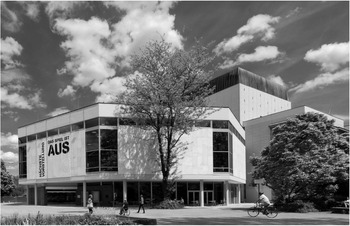
As late as 1958, a large batch of letters in the Stuttgarter Zeitung was published under the heading, ‘Old or new – that is the controversial question’.Footnote 43 Even with Volkart's solution in the works, many citizens remained stubbornly attached to the idea of reconstructing the building in its old form, and did not appear to perceive, at least consciously, that their wish for restoration could be interpreted as a political retrenchment of sorts. On the other side, likewise, the idea that there might be a reason beyond technical and aesthetic contemporaneity to reject the old seems to have been sublimated if present at all. Ultimately, the solution was arguably old and new: the repaired Großes Haus was joined by Volkart's moderate design, its gentle octagon rhyming with the curved front of the Großes Haus, and boasting fewer boxy angles and less glass than the other proposed designs. It opened in 1962 (Figure 2).
Modern Kleines Haus Stuttgart (today known as the Schauspielhaus), Volkart design (Olaf Krüger, 2012, via imageBROKER/Alamy Stock Photo).

In the second half of the twentieth century, the Stuttgart Opera sought international renown as a site of modern repertoire and innovative approaches to staging and design. This trend began in the 1950s, when Stuttgart became Wieland Wagner's ‘winter Bayreuth’, and continued with abstract and revisionist productions by Götz Friedrich, Robert Wilson, and Achim Freyer, among others.Footnote 44 (Some might draw an additional dotted line back to a brief experimental period in Stuttgart in the 1920s, led by Oskar Schlemmer and Willi Baumeister; others might point out that there were still plenty of quite traditional stagings in Stuttgart throughout the twentieth century.Footnote 45) That many ‘advanced’ operatic projects occurred in the Großes Haus, which lacked the visual tropes of modernity characteristic of other post-war West German opera houses, is not necessarily a contradiction. But perhaps Stuttgart's administration pursued bolder moves in the absence of a more extensive rebuilding project that would have demanded massive public goodwill and funding, and which in turn might have encouraged conservative choices to convince a conservative public of its worth. Perhaps the tradition-oriented cultural capital preserved in the neoclassical facade provided a kind of ‘cover’ for experimentation inside the building, even as it weighed down the architectural modernism eventually possible in the Kleines Haus. Perhaps, too, the Stuttgart Opera's status, previously stalled at ‘provincial’, was unexpectedly bolstered by the luck of its ‘surviving’ grand opera house – cultural momentum it used to secure major premieres and artists, in a virtuous reputational circle.Footnote 46
The needle to thread, both in the building itself and on its stages, was to allow tradition – a lavish Rosenkavalier here, sandstone columns there – to sit in tension with sleek glass angles, abstraction, and dissonance. Compared with modernism's alibi of rebirth (a more decisive break with the past after total destruction), or to a denial-fuelled restorationism, the Stuttgart scenario of partial damage and compromise resonates more fully with the realities of rebuilding German culture after 1945. If a narrative advantage emerged to describing the building as a historical survivor (as amply evidenced in the company's current 550 million Euro renovation campaign, necessitated this time not by bombs but merely by time), it remains incumbent upon us to be analytical about the fixed identity of places and institutions that are periodically subject to deterioration and damage, renewal and maintenance, repair and renovation of different types.Footnote 47 The Covid-19 pandemic has shaken many of our assumptions about the resilience of arts institutions; post-war Germany's era of rebuilding suggests diverse historical models for how to move forward in the wake of these disruptions. And extreme weather events, intensified by climate change, are likely to lead to more such reckoning in the future.Footnote 48 Last year, on 28 June 2021, a torrential thunderstorm in Stuttgart toppled several of the rooftop statues on the Großes Haus and caused parts of the copper roof to fly off entirely, causing internal water damage.Footnote 49 Again, seventy-six years hence, it rained into the auditorium of the Staatstheater. Repairs are now being planned.