1. Introduction
In most linguistic analyses of inflectional and derivational processes, word forms such as walked or bitterness are assumed to involve morphologically structured representations. In English, for example, regular past-tense forms and -ness derivations take a stem (or root) and combine it with an affix, yielding concatenated word forms ([walk]-ed, [bitter]-ness). Much psycholinguistic research has been devoted to the question of whether or not the speaker/hearer employs morphologically structured representations when processing inflected or derived words in real time. This research has led to a controversy between associative single-mechanism models and a family of dual-mechanism models, a discussion that extends beyond the realm of morphology and has implications for understanding the knowledge and use of language in general (e.g. Jackendoff and Pinker, Reference Jackendoff and Pinker2005).
Dual-mechanism models (Clahsen, Reference Clahsen1999; Pinker, Reference Pinker1999; Pinker and Ullman, Reference Pinker and Ullman2002) posit two distinct representational systems and corresponding processing mechanisms for morphologically complex words. Irregular past-tense forms in English, for example, are claimed to have whole-word representations stored in memory and to be directly retrieved from the lexicon during processing. Regular past-tense forms, on the other hand, are said to have morphologically structured representations making them suitable for employing morphologically-based parsing during processing. Associative single-mechanism models claim that all word forms are stored in an associative lexicon and that the morphological structure of inflected and derived words plays no direct role in the way they are processed (see Seidenberg and Gonnerman (Reference Seidenberg and Gonnerman2000) and McClelland and Patterson (Reference McClelland and Patterson2002) for review). Connectionist models of the English past tense, for example, are based on the idea that all kinds of morphologically complex word forms are represented and processed like simple words, through associatively linked orthographic, phonological and semantic codes and in terms of activation patterns over units and weighted connections between them. There is a considerable body of behavioral, brain imaging, and electrophysiological studies that have examined the processing of morphologically complex words in adult native speakers, but the theoretical interpretation of these studies is still controversial (see Clahsen (Reference Clahsen and Wunderlich2006) and Penke (Reference Penke and Wunderlich2006) for review). Specifically, the nature of regular morphology such as the past-tense -ed in English and the question of whether morphologically structured representations are required for such forms remains a subject of controversy.
Previous research on adult non-native language learners has relied mainly on speech production and other off-line data to describe non-native speakers' linguistic knowledge and how it develops over time. However, in recent years, researchers from different disciplines have begun to examine the details of language processing in adult L2 learners using experimental psycholinguistic techniques such as response time measures, eye-movement monitoring, brain imaging, and event-related brain potentials (ERPs). This line of research has provided a number of empirical findings and theoretical attempts at understanding L1/L2 differences in language processing (see Clahsen and Felser (Reference Clahsen and Felser2006a, Reference Clahsen and Felserb) for review). Two broad possibilities of accounting for L1/L2 processing differences have emerged from this research.
One view holds that L1 and L2 processing share the same system but that L2 processing is more demanding in terms of basic cognitive processes (e.g. working memory, speed of processing), and may also be influenced by the learners' native language. Thus, L2 processing may be slower and less automatized than L1 processing, and affected by L1 transfer. Nevertheless, under this view, L2 learners employ the same mechanisms for language processing as native speakers. Some evidence for shared systems comes from brain-imaging studies pointing towards overlapping cortical regions being involved in L1 and L2 processing (see Perani and Abutalebi (Reference Perani and Abutalebi2005) and Indefrey (Reference Indefrey2006) for review). There is also ample evidence that phonological and lexical-semantic properties of the L1 affect L2 processing (e.g. Weber and Cutler, Reference Weber and Cutler2003; Hernandez, Ping and MacWhinney, Reference Hernandez, Ping and MacWhinney2005). Moreover, ERP studies with L2 learners found that the so-called Left Anterior Negativity, which is indicative of early automatic processes of sentence comprehension (see Friederici (Reference Friederici2002) for review), is absent or reduced in L2 learners and that the ERP component associated with lexical-semantic processing (N400) typically has a delayed latency in L2 processing relative to native speakers (see Müller Reference Müller2005 for review). Furthermore, it has been found that the performance of native speakers under noise or memory stress conditions in a speeded grammaticality judgment task was parallel to that of adult L2 learners without these stressors (McDonald, Reference McDonald2006). These findings indicate that L2 processing is affected by L1 transfer, low L2 memory capacity, reduced automaticity, and slow L2 processing speed.
An alternative view holds that in the domain of grammar, L2 processing differs in more fundamental ways from L1 processing (Ullman, Reference Ullman2001, Reference Ullman2004, Reference Ullman and Sanz2005; Clahsen and Felser, Reference Clahsen and Felser2006a, Reference Clahsen and Felserb). For example, several on-line studies examining complex syntactic constructions – such as those involving non-local syntactic dependencies – have shown that (unlike native speakers) adult L2 learners do not make use of abstract syntactic elements (e.g. movement traces) during on-line processing (Marinis, Roberts, Felser and Clahsen, Reference Marinis, Roberts, Felser and Clahsen2005; Felser and Roberts, Reference Felser and Roberts2007). While Clahsen and Felser's (Reference Clahsen and Felser2006a, Reference Clahsen and Felserb) “shallow-structure hypothesis” focuses on L1/L2 differences in sentence processing, Ullman's declarative/procedural model also applies to morphology. The model posits two different brain memory systems for processing one's native language, a declarative system which subserves the storage of memorized words and phrases (and is rooted in a network of specific brain structures including medial temporal and prefrontal cortical regions), and a procedural system which is involved in processing combinatorial rules of language (and which depends on a network including inferior frontal brain areas). Ullman argued that L2 processing is largely dependent upon the lexical memory system while reliance on the procedural system occurs to a much lesser extent than in L1 processing. The overreliance on the declarative system in L2 processing is attributed to maturational changes that occur in childhood (e.g. increasing estrogen levels in both genders) leading to attenuation of the procedural and enhancement of the declarative system (Ullman, Reference Ullman and Sanz2005). For processing morphologically complex words, this means that L2 learners mainly rely on full-form storage, while morphological parsing is underused or even absent in L2 processing.
There is some evidence for these claims from studies examining on-line morphological processing in L2 learners. Results from a speeded production task (Brovetto and Ullman, Reference Brovetto and Ullman2001) revealed that native speaker controls showed a consistent response-time advantage for high-frequency irregulars (but not for high-frequency regulars), whereas L2 learners showed a frequency effect for both regulars and irregulars. Given that frequency effects are indicative of lexical storage, these results suggest that regularly inflected past-tense forms are stored as unanalyzed wholes in L2 learners but not in native speakers. Results from an ERP study of verb participles and noun plurals in German showed that L2 learners produced the same biphasic ERP pattern as native speaker controls, but only in domains in which they were highly proficient (Hahne, Müller and Clahsen, Reference Hahne, Müller and Clahsen2006). While the results of these two studies are consistent with the declarative/procedural model, still very little is known about how L2 learners process morphologically complex words. Considering the rich experimental literature on native speakers, more research on L2 morphological processing is clearly needed.
Against this background, the present study reports results from masked priming experiments examining the processing of past-tense and derivational forms. The specific advantage of masked priming is that it provides response-time measures that tap early automatic processes in language comprehension (see section 2). Our focus will be on the role of morphological structure in L1 and L2 processing of inflected and derived word forms. The potential role of L1 transfer will be assessed by comparing L2 learners from different language backgrounds (Chinese, Japanese, and German).
2. Morphological priming in native speakers
In priming tasks, participants are presented a prime word before a target word on which they are asked to perform a lexical (word/non-word) decision or which they have to name. The researcher manipulates the semantic, phonological, orthographic, or morphological relation between prime and target words to examine the potential influence of these variables on the participants' responses.
Two main findings from previous priming experiments with native speakers are important for our concerns. Firstly, many studies found that morphological priming cannot be reduced to either phonological/orthographic or semantic relatedness between primes and targets. Sonnenstuhl, Eisenbeiss and Clahsen (Reference Sonnenstuhl, Eisenbeiss and Clahsen1999) examined German participle forms in a cross-modal lexical priming experiment and found a full priming effect for regular participles (gekauft → kaufe “bought – buy”), i.e. the same amount of facilitation on the recognition of the target word as for an identity prime (kaufe → kaufe). Irregular participles (gelaufen → laufe “walked – walk”), however, yielded reduced priming (compared to identity primes), despite the fact that the irregular primes exhibited the same degree of semantic, orthographic, and phonological overlap to their targets as regularly inflected ones; see also Rodriguez-Fornells, Münte and Clahsen (Reference Rodriguez-Fornells, Münte and Clahsen2002). These results suggest that regular (but not irregular) participles are decomposed into their morphological constituents (e.g. [ge-+kauf-+-t]), a process by which the unmarked stem (kauf-) is isolated and becomes available for priming (i.e. stem priming).
Secondly, robust priming effects for morphologically complex words were found in many studies and in different kinds of priming paradigms. Stanners, Neiser, Hernon, and Hall (Reference Stanners, Neiser, Hernon and Hall1979) were the first to report a full priming effect for regular past-tense inflection in English. All subsequent experiments with native speakers have obtained priming effects for regularly inflected past-tense forms in English (see e.g. Marslen-Wilson and Tyler, Reference Marslen-Wilson and Tyler1998; Münte, Say, Clahsen, Schiltz and Kutas, Reference Münte, Say, Clahsen, Schiltz and Kutas1999). Priming effects in native speakers of English have also been found for derived word forms (punishment → punish), particularly for productive and (phonologically and semantically) transparent ones, even though several studies that directly compared inflection and derivation in priming tasks found stronger priming effects for (regularly) inflected forms than for derivational ones (see Clahsen, Sonnenstuhl and Blevins (Reference Clahsen, Sonnenstuhl, Blevins, Baayen and Schreuder2003) for review).
Priming effects for regularly inflected and derived word forms have also been obtained in masked priming experiments. In this paradigm, the time between the onset of the prime and the onset of the target (also labeled “stimulus onset asynchrony” SOA) is very brief (typically 30–60 ms). This reduces the possibility of episodic memory effects or of any predictive strategies, e.g. participants realizing that primes and targets often share common material (Rastle, Davis, Marslen-Wilson and Tyler, Reference Rastle, Davis, Marslen-Wilson and Tyler2000). Previous research has found priming effects for morphologically related primes in visual masked priming experiments with short SOAs of 30–60 ms that could not be reduced to just the formal or semantic overlap between primes and targets (Rastle, Davis and New, Reference Rastle, Davis and New2004; Frost, Kugler, Deutsch and Forster, Reference Frost, Kugler, Deutsch and Forster2005; Boudelaa and Marslen-Wilson, Reference Boudelaa and Marslen-Wilson2005). For example, Boudelaa and Marslen-Wilson (Reference Boudelaa and Marslen-Wilson2005) obtained robust morphological priming effects at all of the SOAs tested (32, 48, 64, and 80 ms), but orthographic and semantic priming only at the longest SOA of 80 ms. These results indicate that there is an early stage of visual word recognition (prior to the activation of semantic information and beyond pure orthographic priming) at which morphologically complex words are unconsciously and automatically decomposed into their morphological constituents.
3. The present study
The purpose of the four experiments reported below was to investigate whether native speakers and adult L2 learners of English make use of morphological structure in processing inflected and derived word forms.
In experiment 1, we examined regular past-tense forms in groups of Chinese and German L2 learners of English and in native English speakers using an SOA of 60 ms.
For experiment 2, the same materials were used as for experiment 1, but with an SOA of just 30 ms in order to determine whether any priming effects seen in experiment 1 can be replicated for a shorter prime duration. Moreover, experiment 2 adds a third group of L2 learners (with Japanese as L1).Footnote 1
Experiments 3 and 4 examined priming effects of derivational word forms with the nominalization suffixes -ness and -ity (e.g. bitterness → bitter, humidity → humid). As in experiment 1, the SOA was 60 ms, and the participants were Chinese and German L2 learners of English, and native English speakers. Although -ness and -ity are semantically similar, -ity is less productive and transparent than -ness. Derivational forms with -ity are confined to Latinate formations (Aronoff, Reference Aronoff1994), and in the derived form a stem-final long vowel sometimes changes to a short vowel (cf. hostile – hostility). Despite these differences in productivity and transparency, both -ness and -ity forms are combinatorial word forms consisting of a stem and a suffix. Previous experimental studies have found stem-priming effects for these kinds of derivational word forms (see Marslen-Wilson, Tyler, Waksler and Older (Reference Marslen-Wilson, Tyler, Waksler and Older1994) for review).
For the L1 groups, we expect to replicate results from previous studies and to find efficient priming for both inflected and derived word forms. If adult L2 learners employ the same representations and processing mechanisms as native speakers, they should exhibit the same priming effects, even though they may overall be slower in recognizing morphologically complex words. In contrast, if L2 learners rely on full-form storage of inflected and derived words in cases in which native speakers make use of morphological structure, we would expect that those kinds of morphologically complex words that yield efficient priming in native speakers will not produce any priming in L2 processing.
To examine the role of the L1 in L2 morphological processing, we mainly relied on the results from the German and the Chinese L2 groups. German and English are clearly more similar to each other in the relevant domains of inflection and derivation than Chinese and English. German has direct equivalents of the forms under study, a regular past-tense affix (-te) and two deadjectival suffixes (-heit/-keit and -ität) of which the latter is largely restricted to non-native words (like -ity in English). By contrast, Chinese does not have any affixes or affix-like forms of this kind. Thus, if L1/L2 similarity is beneficial for L2 processing (e.g. Sabourin and Haverkoort, Reference Sabourin, Haverkort, Van Hout, Hulk, Kuiken and Towell2003), we should find more native-like priming patterns in German than in Chinese L2 learners of English. With respect to the past tense, we can also rely on the results from the Japanese L2 learners tested in experiment 2. Japanese has a regular past-tense affix (-ta), like English. Thus, Japanese L2 learners may perform more similarly to native speakers of English than Chinese L2 learners (ceteris paribus).
4. Method
4.1 Participants
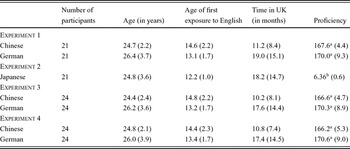
Three groups of L2 learners of English participated in the current study. Experiment 1 was performed with 21 Chinese-speaking (CL2) learners (mean age: 24.7, range: 21–30, 3 males) and 21 German-speaking (GL2) learners (mean age: 26.4, range: 21–36, 7 males), experiment 2 with 21 Japanese-speaking (JL2) learners (mean age: 24.8, range: 21–33, 6 males), experiment 3 with 24 CL2 learners (mean age: 24.4, range: 21–30, 4 males) and 24 GL2 learners (mean age: 26.2, range: 21–36, 8 males), and experiment 4 with 24 CL2 learners (mean age: 24.8, range: 21–30, 3 males) and 24 GL2 learners (mean age: 26.0, range: 20–36, 8 males); see Table 1 for additional information on the L2 learners. Sixteen each of the L1 and CL2 groups, and 21 of the GL2 group participated in more than one experiment.
Bio-data and proficiency scores for L2 learners (means; standard deviations in parentheses).

aOxford Placement Test; bIELTS
All L2 learners had first been exposed to English after the age of 11 in a classroom setting, and none of them considered themselves bilingual. The CL2 learners were all native speakers of Mandarin Chinese. To determine the learners' general proficiency in English at the time of testing, all CL2 and GL2 learners underwent the Oxford Placement Test (OPT; Allan, Reference Allan1992). For the JL2 learners this was not possible; we therefore report their IELTS scores (International English Language Testing System, http://www.ielts.org). The CL2 and GL2 learners achieved proficiency scores of 166–170 (out of a maximum score of 200), which represents an “advanced/proficient user” level. The JL2 learners achieved IELTS scores of 5.5 to 7.0 (out of a maximum score of 9) and a mean score of 6.36 representing a “competent user” level. Thus, all the L2 participants we tested were advanced learners of English, even though they had not reached the highest level of proficiency at the time of testing.
In addition, each experiment was performed with groups of native English-speaking controls, 21 in experiment 1 (mean age: 22.0, range: 18–35, 3 males), 21 in experiment 2 (mean age: 24.3, range: 19–38, 14 males), 24 in experiment 3 (mean age: 23.7, range: 18–44, 12 males), and 24 in experiment 4 (mean age: 22.9, range: 18–38, 14 males).
All participants were recruited from among the undergraduate and postgraduate student communities at the University of Essex and were paid a small fee for their participation. All participants had normal or corrected-to-normal vision, were never diagnosed with any learning or other behavioral disorders, and were naïve with respect to the purpose of the experiments.
4.2 Materials
In each of the four masked priming experiments, participants were presented with three critical types of prime–target pairs: (i) Identity (e.g. pray → pray), (ii) Test (e.g. prayed → pray), and (iii) Unrelated (e.g. bake → pray). The difference between conditions (i) and (ii) on the one hand and conditions (ii) and (iii) on the other is taken as a measure of priming. A response pattern in which the reaction times (RTs) on the target are shorter in conditions (i) and (ii) than in (iii), and in which there are no RT differences between conditions (i) and (ii) is called “full priming”. In this case, the items of the Test condition are as effective in priming as an Identity prime. If, on the other hand, the RTs for (ii) are longer than for (i) but shorter than for (iii), we call this pattern “partial priming”. “No priming” is obtained if the RTs for conditions (ii) and (iii) do not significantly differ from each other.
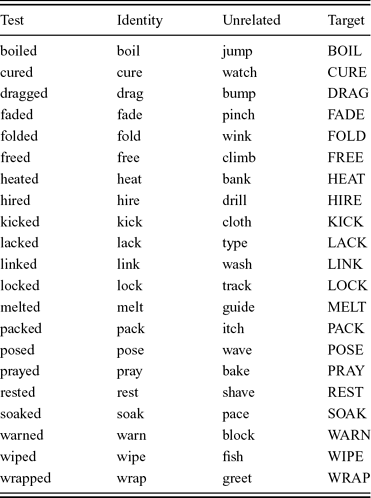
The critical items for experiments 1 and 2 were identical. There were 21 triplets of English verbs that require regular past-tense forms. For each target, three types of primes were used yielding three conditions (Test, Identity, and Unrelated); see Appendix A. The target in all conditions was the unmarked bare stem. All targets were monosyllabic, four letters long and had a mean stem/word frequency of 42.4 in the CELEX databaseFootnote 2 (Baayen, Piepenbrock and van Rijn, Reference Baayen, Piepenbrock and van Rijn1993). The primes were matched as closely as possible for frequency and length. The primes used in the three conditions were similar in terms of their (bare) stem frequencies (Identity/Test vs. Unrelated: t(20) = .32, p = .75) and in terms of their lemma-to-stem-frequency ratios (Test/Identity vs. Unrelated: t(20) = 1.76, p = .09). The mean number of letters was 4.0 (sd: 0) in the Identity and 4.5 (sd: .5) in the Unrelated condition. The items in the Test condition were longer (mean: 5.8, sd: .6) due to the presence of the past-tense affix.
The critical items for experiments 3 and 4 consisted of 21 triplets each of English adjectives, adjectives that take the nominalization suffix -ness in experiment 3 (e.g. neat, neatness) and adjectives that take -ity (e.g. rigid, rigidity) in experiment 4. The target in all conditions was the bare adjective. As in experiments 1 and 2, there were three prime types for each target (e.g. Test: neatness → neat, Identity: neat → neat, Unrelated: dark → neat); see Appendix B and C. The targets in experiment 3 were monosyllabic, four letters long and had a mean stem/word frequency of 460 in CELEX. The targets in experiment 4 were disyllabic with an average length of 5.8 letters and a mean stem/word frequency of 206 in CELEX. The primes were matched as closely as possible for frequency and length. The ratios of lemma to stem frequencies of the primes did not differ significantly across conditions (experiment 3: Test/Identity vs. Unrelated, t(20) = 1.77, p = .09; experiment 4: Test/Identity vs. Unrelated, t(20) = 1.53, p = .14). The mean numbers of letters of the primes in experiment 3 were 4.0 (sd: 0) in the Identity and 4.7 (sd: .9) in the Unrelated condition, and in experiment 4, they were 5.8 (sd: 1.0) in the Identity and 5.3 (sd: 1.2) in the Unrelated condition. The items in the Test condition of both experiments were longer (experiment 3: mean: 8, sd: .2; experiment 4: mean 8.4, sd: .7) due to the presence of -ness/-ity.
Because no participant should see the same target more than once, the prime–target pairs were distributed over three versions in each of the four experiments, so that each version included 21 different critical prime–target pairs – seven from each of the three conditions (Identity, Test, Unrelated) – and no target appeared more than once in any version. In order to dilute the proportion of related prime–target pairs and to prevent participants from developing expectations about prime–target relations, 303 filler items were constructed for each experiment. The stimulus set of each of the three versions of each experiment consisted of 324 prime–target pairs (303 fillers and 21 critical items). The following types of filler items were included:
• 70 pairs of existing words which were semantically unrelated to each other, of which half had either inflected or derived forms as primes.
• 71 non-word/word pairs, 81 word/non-word pairs, and 81 non-word/non-word pairs. Of these 233 prime–target pairs, 116 were orthographically related. Half of the non-words were created by changing the onset of the first syllable of existing words and the other half by changing the nucleus of the first syllable of existing words.
In the construction of the stimulus lists, steps were taken to prevent participants from developing strategies based on the distribution of particular word forms. The purpose of introducing orthographically related prime–target primes with non-word targets was to ensure that not all related pairs had real words as targets. In order to eliminate undesired priming effects across items, the 324 prime–target pairs in each list were pseudo-randomized making sure that no semantic associations of any kind existed between consecutive items, and that not more than three items in a row were of the same prime–target pair type and were not all real or non-words.
4.3 Procedure
The masked visual priming technique (Forster and Davis, Reference Forster and Davis1984) was used for all experiments. Each trial consisted of three visual events. First, a forward mask consisting of a series of Xs appeared on the screen for 500 ms (which also served as a fixation point) immediately followed by the prime word (displayed for 60 ms in experiments 1, 3 and 4, and for 30 ms in experiment 2), which was immediately followed by the presentation of the target word (or non-word) for 500 ms. The stimuli appeared on a 16-inch monitor in white letters (font: Arial, size: 36) with a black background. The primes were presented in lower case and the targets in upper case to minimize the visual overlap between primes and targets.
Each experiment began with a practice session consisting of 10 prime–target pairs. Participants were asked to make a quick and accurate lexical decision about the target by pressing a “yes” (word) or “no” (non-word) button on a dual push-button box. Written instructions were given to the participants prior to each experiment, and we made sure that after reading them they had understood the task. Participants were seated 82 cm away from the monitor in a dimly lit room. The presentation of the stimuli and the measurement of RTs were controlled by the NESU software package (Baumann, Nagengast and Klaas, Reference Baumann, Nagengast and Klaas1993). The experiments lasted between 25 and 30 minutes for the L1 and between 60 and 70 minutes for the L2 participants. The native speakers could take one break while the L2 learners were offered two breaks.
At the end of each masked priming experiment, all participants were asked to give a description of the experiment and of what they saw. In experiment 2 (with an SOA of 30 ms), no participant reported any awareness of the presence of a prime. In the other experiments (in which the primes were shown for 60 ms), almost all participants reported seeing the screen flash or flicker at times, but were not aware of a prime word (or non-word) before the targets. Occasionally, a few participants reported seeing a word before the target but were unable to name it (three L1 participants and one L2 participant in experiments1 and 4, two L1 participants and one L2 participant in experiment 3).
An additional test was performed for experiments 1, 3 and 4 prior to each main experiment to determine whether participants were aware of the primes. Ten prime–target pairs (with existing words) with an SOA of 60 ms were presented. Participants were asked to remember as many words as they could see and to circle all the words they remembered on a piece of paper which contained a total of 30 words (the 10 prime words, the 10 target words, and 10 additional words). Participants were generally unable to correctly identify the prime words (one correct response for one L1 participant each in experiments 1 and 3, two L1 participants each in experiment 4, two correct responses for two GL2 participants in experiment 3) confirming participants' lack of awareness of the prime words at an SOA of 60 ms.
Finally, the L2 participants took a multiple choice vocabulary test to ensure that they know the items they had to respond to in the main experiments. The vocabulary test was performed after each of the masked priming experiments and included the 21 target words of each experiment. Participants had to choose which word of four possible choices was most similar in meaning to the word in question. There were no errors in the L2 learners' responses (except for one item in experiment 3, see below).
The data from each experiment, i.e. the response times (RTs) and the error data, were submitted to a mixed-design omnibus analysis of variance (ANOVA) with two variables – Condition (Test, Identity, Unrelated) and Group (L1, CL2, GL2). In the by-subjects analysis (F1), Condition was treated as a repeated factor, and Group was treated as an unrepeated factor. In the by-items analysis (F2), both variables were treated as repeated factors. To determine potential differences between the two L2 groups in experiments 1, 3 and 4, additional ANOVAs were performed for the RT data of these experiments with two levels for the variable Group (CL2, GL2). Additional pairwise within-group comparisons using paired t-tests were conducted for the RT data in cases in which the respective omnibus ANOVAs produced significant interactions between Group and Condition. The p-values of all analyses were Greenhouse-Geisser corrected for non-sphericity whenever applicable. Reported are the uncorrected degrees of freedom and p-values following correction.
5. Results
5.1 Experiment 1
Table 2 presents mean RTs and error rates for the target words in the three experimental conditions and the three participant groups. Incorrect responses (i.e. erroneous word/non-word decisions) were excluded from the calculation of RTs; these accounted for 5% of the critical items tested.
Mean RTs (in ms) and percent error (in parentheses) in experiment 1.

The ANOVA for the error data showed a main effect of Group (F1(2,60) = 4.28, p = .02; F2(2,40) = 6.73, p < .01) reflecting the fact that the CL2 group gave more incorrect responses than the L1 and the GL2 groups. There was no main effect of Condition (F1(2,120) = 2.39, p = .11; F2(2,40) = 1.27, p = .28) and no interaction of Group and Condition (F1(4,120) = .61, p = .65; F2(4,80) =. 58, p = .68).
For the RT data, the omnibus ANOVA yielded main effects of Group (F1(2,60) = 20.58, p < .00; F2(2,40) = 53.29, p < .01) and Condition (F1(2,120) = 20.91, p < .01; F2(2,40) = 28.67, p < .01), as well as an interaction of Group and Condition that was significant for subjects but not for items (F1(4,120) = 3.67, p < .01; F2(4,80) = 2.06, p = .12). An additional ANOVA in which we compared the RT data of the two L2 groups revealed main effects of Group (F1(1,40) = 5.96, p = .019; F2(1,20) = 17.34, p < .01) and Condition (F1(2,80) = 16.01, p < .01; F2(2,40) = 24.28, p < .01), but no interaction between Group and Condition (F1(2,80) = .39, p = .68; F2(2,40) = .11, p = .90). Taken together, these results indicate that the priming patterns are similar in the two L2 groups and that the interaction in the omnibus ANOVA is due to different priming patterns in the L1 versus the two L2 groups.
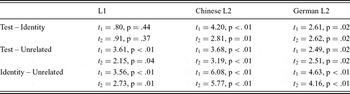
To further examine these effects, differences between conditions were compared for each participant group across subjects (see Table 3). The results demonstrate significant repetition-priming effects for all participant groups, i.e. shorter RTs for identity primes than for unrelated control primes. This finding shows that the masked priming technique with an SOA of 60 ms yields reliable priming effects in both native and non-native speakers, even though the participants were not consciously aware of the prime words. For the past-tense primes, however, the priming patterns were different in the L1 and the L2 groups. In the L1 group, both the Test and the Identity conditions had similar RTs, which were significantly shorter than those for the Unrelated condition (i.e. full priming). In the L2 groups, however, the Test and the Unrelated conditions yielded similar RTs, both of them significantly longer than the Identity condition (i.e. no priming).
Pairwise comparisons of the mean RTs in experiment 1.

The priming effect obtained for native speakers replicates results of previous studies on the English past tense (see section 2 above) and may result from morphologically structured representations for regular past-tense forms which permit efficient stem priming. In contrast to the L1 group, the L2 learners did not show any priming for past-tense forms. It is true that the L2 learners' response times were overall slower than those of the L1 group, but the L2 learners were still sensitive to masked priming at 60 ms, as shown by the facilitatory effect of identity primes. Thus, the lack of past-tense priming in L2 learners cannot be attributed to their slower RTs. Instead, if the full priming effect in native speakers can be interpreted in morphological terms, then the absence of any priming effect in the two L2 groups indicates that L2 learners do not make use of morphological structure during the recognition of regular past-tense forms.
Before we accept this interpretation, two potentially confounding variables need to be assessed. Firstly, the facilitatory effect for the L1 group in the Test condition relative to the Unrelated condition might result from the fact that the regular past-tense forms presented as primes orthographically overlapped with their targets, whereas this was not the case for the Unrelated condition. However, results from previous masked priming studies indicate this is an unlikely possibility. Recall, for example, that Boudelaa and Marslen-Wilson (Reference Boudelaa and Marslen-Wilson2005) found orthographic priming effects only for longer SOAs (≥80 ms), i.e. longer than those used in our experiments. Moreover, Rastle et al. (Reference Rastle, Davis, Marslen-Wilson and Tyler2000) showed that semantically and morphologically unrelated word–word pairs such as brothel → BROTH that had a similar degree of orthographic overlap as the Test condition in our experiment (e.g. prayed → pray) did not yield any reliable priming effect, but instead a trend towards inhibition. In addition, a recent study investigating the role of orthographic overlap in masked priming (Davis and Lupker, Reference Davis and Lupker2006) found that target response times were facilitated by orthographically related non-word primes (relative to unrelated non-word primes), but were inhibited by orthographically related word primes (relative to unrelated word primes). Given that we used word primes (and given the results of Rastle et al. Reference Rastle, Davis, Marslen-Wilson and Tyler2000), orthographic relatedness should have produced an inhibitory effect for our Test condition, but not the full priming effect we obtained.
Secondly, at an SOA of 60 ms, semantic properties of the prime word might become partially accessible (see Lavric, Clapp and Rastle, Reference Lavric, Clapp and Rastle2007). If this was the case, then the full priming effect for the L1 group in the Test condition could be due to the semantic relatedness of, for instance, walked and walk. To address this possibility, we performed an additional experiment using an SOA of 30 ms at which no semantic effects have been reported in any previous study.
5.2 Experiment 2
The purpose of this experiment was twofold: (i) to examine whether the findings of experiment 1 can be replicated for a shorter SOA of 30 ms, and (ii) to investigate a third group of L2 learners of English (with Japanese as L1). Recall that the design and the materials were the same as those used for experiment 1 with the exception that primes were shown for only 30 ms.
Table 4 presents mean RTs and percent errors for the three experimental conditions and the two participant groups. One item (melt) had to be removed from any further analysis due to high rates of incorrect word/non-word decisions in both the L1 (52%) and the L2 (48%) groups. The overall error rate was 6.4%; these incorrect responses were excluded from the RT data set.
Mean RTs (in ms) and percent error (in parentheses) in experiment 2.

The ANOVA on the error data showed a main effect of Group for subjects but not for items (F1(1,40) = 9.35, p < .01; F2(1,19) = 1, p = .33), which was due to the higher error rates in the L2 group. No effect of Condition was found (F1(2,80) = 3.02, p = .06; F2(2,38) = 1.68, p = .21), and the interaction between Group and Condition did not reach significance either (F 1(2,80) = .38, p = .68; F2(2,38) = 1, p = .38).
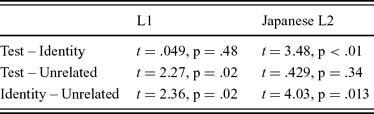
For the RT data, the ANOVA revealed main effects of Group (F1(1,40) = 6.29, p = .02; F2(1,19) = 53.62, p < .01) and Condition (F1(2,80) = 3.69, p = .03; F2(2,38) = 8.96 p < .01), and an interaction between Group and Condition for subjects but not for items (F1(2,80) = 6.04, p < .01; F2(2,38) = 1.028 p = .37). Subsequent pairwise comparisons of the differences between conditions within each participant group indicated significant repetition-priming effects for both the L1 and the L2 groups, a full priming effect for the L1 group, and no priming effect for the L2 group in the morphological condition (see Table 5).
Pairwise comparisons of the mean RTs in experiment 2.
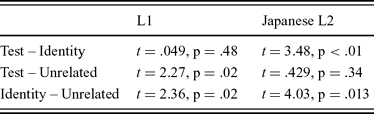
The priming effects obtained in this experiment are parallel to those found in experiment 1: a repetition-priming effect for both participant groups, and for past-tense primes, a full priming effect for the L1 and no priming for the L2 group. The possibility that the full priming effect for the L1 group is due to the semantic relatedness of primes and targets in the Test condition can be excluded because semantic properties of the prime word have not yet been activated at an SOA of 30 ms (see e.g. Lavric et al., Reference Lavric, Clapp and Rastle2007). Likewise, the full priming cannot be explained at a purely orthographical level, because orthographic relatedness between existing words should yield inhibitory effects (e.g. Davis and Lupker, Reference Davis and Lupker2006). Instead, we suggest that regular past-tense forms have morphologically structured representations in native speakers, and that these permit efficient stem priming even for a short SOA of 30 ms. Although the L2 learners exhibited a repetition-priming effect (parallel to experiment 1) indicating their sensitivity to priming at short SOAs, there were no signs of stem priming suggesting that L2 learners do not rely on morphological structure for processing regular past-tense forms.
5.3 Experiment 3
In this experiment, we examined potential priming effects from productive and transparent deadjectival word forms with the suffix -ness on the recognition of uninflected adjectives. Table 6 presents mean RTs and percent errors for the target words. Incorrect responses (mean: 5.4%) were excluded from the RT data set.
Mean RTs (in ms) and percent error (in parentheses) in experiment 3.

For the error data, the ANOVA revealed a main effect of Group (F1(2,69) = 4.19, p = .02; F2(2,40) = 5.04, p = .01) reflecting higher error rates in the CL2 group than in the L1 and the GL2 groups. There was no effect of Condition (F1(2,138) = 1.48, p = .23; F2(2,40) = 1.18, p = .32), but a significant interaction of Group and Condition in the subjects analysis only (F1(4,138) = 3.52, p = .01; F2(4,80) = 2.24, p = .07).
For the RT data, the omnibus ANOVA yielded main effects of Group (F1(2,69) = 29.1, p < .01; F2(2,40) = 224.81, p < .01) and Condition (F1(2,138) = 44.92, p < .01; F2(2,40) = 37.86, p < .01), and an interaction of Group and Condition in both the subjects and the items analyses (F1(4,138) = 5.74, p < .01; F2(4,80) = 5.21, p < .01). An additional ANOVA comparing the two L2 groups showed main effects of Group (F1(1,46) = 9.87, p < .01; F2(1,20) = 115.64, p < .01) due to faster reaction times for the GL2 group, and Condition (F1(2,92) = 36.91, p < .01; F2(2,40) = 37.14, p < .01) indicative of shorter response times in the Identity condition, but no interaction between Group and Condition (F1(2,92) = 2.28, p = .11; F2(2,40) = 2.80, p = .07). These results show that the interaction in the overall ANOVA is due to different priming patterns in the L1 versus the two L2 groups. Further examination of these results using paired t-tests showed (i) repetition-priming effects for all participant groups, (ii) a full priming effect for morphologically related primes in the L1 group, and (iii) a partial priming effect for morphologically related primes in the L2 group, (see Table 7).
Pairwise comparisons of the mean RTs in experiment 3.

For the L1 group, the priming pattern for deadjectival forms with -ness was parallel to the ones obtained for the Test conditions in experiment 1 and 2 suggesting that native speakers make use of morphological structure for processing both regularly inflected and productive derivational forms. The L2 groups, however, showed different priming patterns for inflection and derivation, no priming for the former and partial priming for the latter.
5.4 Experiment 4
The purpose of this experiment was to examine whether the findings of experiment 3 could be replicated for word forms with a different deadjectival suffix (-ity). Table 8 presents mean RTs and percent errors for the target words. The overall error rate was 12%, higher than in the other experiments, which is probably due the fact that the Latinate adjective targets used here are less common than the items in the other experiments. However, the vocabulary test revealed that the L2 learners knew the items under study except for the item solemn for which one CL2 learner did not provide an appropriate answer. This item was therefore excluded from any further analysis of this participant. Moreover, all incorrect responses were removed from the RT data set.
Mean RTs (in ms) and percent error (in parentheses) in experiment 4.

The ANOVA for the error data revealed main effects of Group (F1(2,69) = 6.74, p < .01; F2(2,40) = 7.14, p < .01) and Condition (F1(2,138) = 9.16, p < .01; F2(2,40) = 7.11, p < .01) reflecting the overall higher error rates of the CL2 group and the overall lower error rates for the Identity condition in all participant groups. There was also a marginal significant interaction of Group and Condition in the subjects analysis only (F1(4,138) = 2.45, p = .05; F2(4,80) = 1.39, p = .26).
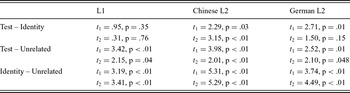
For the RT data, the omnibus ANOVA revealed main effects of Group (F1(2,69) = 25.82, p < .01; F2(2,40) = 3.03, p = .02) and Condition (F1(2,138) = 32, p < .01; F2(2,40) = 24.48 p < .01) and an interaction between Group and Condition (F1(4,138) = 4.66, p < .01; F2(4,80) = 3.03, p = .02). An additional ANOVA comparing the two L2 groups revealed a main effect of Group (F1(1,46) = 15.39, p < .01; F2(1,20) = 54.98, p < .01) and Condition (F1(2,92) = 27.56, p < .01; F2(2,40) = 22.44, p < .01), the former due to the faster reaction times for the GL2 group and the latter due to the shorter response times for the Identity condition, but there was no interaction of Group and Condition (F1(2,92) = 1.97, p = .146; F2(2,40) = .96, p = .39) showing that the interaction found in the omnibus ANOVA is due to differences between the L1 group and the two L2 groups. Subsequent pairwise comparisons (see Table 9) indicated repetition-priming effects for both the L1 and the L2 groups and a full priming effect for the L1 group. For the L2 groups, morphologically related primes yielded a partial priming effect, i.e. significantly shorter RTs for the Test than for the Unrelated condition but longer RTs for the Test than for the Identity condition (even though for the GL2 group the items analysis of the Test vs. Identity condition did not reach significance).
Pairwise comparisons of the mean RTs in experiment 4.

The priming effects in this experiment are similar to those of experiment 3: repetition priming for both the L1 and the L2 groups, and in the morphological condition, full priming for the L1 group and partial priming for the L2 groups. Taken together, the results of experiments 3 and 4 (in comparison to those of experiments 1 and 2) show the same full priming effects for inflected and derived word forms in native speakers, but different patterns for inflection and derivation in L2 learners, no priming for the former and partial priming for the latter.
6. General discussion
The aim of the experiments reported above was to determine whether and to what extent native speakers and adult L2 learners rely on morphologically structured representations for inflected and derived word forms during on-line language comprehension. Response times from masked priming experiments provided the crucial on-line measures. In order to determine stem-priming effects, our experiments included a Test condition comprising morphologically related prime–target pairs (e.g. walked → walk), a Control condition of unrelated prime–target pairs (look → walk), and an Identity condition (walk → walk). Stem-priming effects arise in cases in which the amount of priming in the morphological Test condition is equivalent to the amount of repetition priming in the Identity condition and in which the priming effect in the Test condition cannot be attributed to purely formal or semantic factors. In the following, we will first discuss the results of the native speaker group and then turn to the L2 findings.
6.1 Morphological priming in native speakers
For native speakers, we found full priming effects for morphologically related prime–target pairs. For both inflected and derived word forms used as primes, the amount of facilitation on the target RTs (relative to a control condition) was the same for the Test and Identity conditions.
To examine the role of semantic priming, we replicated experiment 1 using the same materials with an SOA of 30 ms, given that previous masked priming experiments have shown that a prime-presentation time of 30 ms does not allow participants to access any semantic properties of the primes. The results of experiment 2 were parallel to those of experiment 1 indicating that the facilitatory effect for the Test condition cannot be due to semantic priming.
With respect to orthographic relatedness, previous priming studies have shown that orthographically similar word–word pairs tend to inhibit each other at short SOAs (see e.g. Davis and Lupker, Reference Davis and Lupker2006). Thus, the full priming effects which we found for native speakers in experiments 1–4 are hard to explain in these terms. Moreover, orthographic effects in priming tasks with morphologically related words have been shown to depend on the degree of overlap. Allen and Badecker (Reference Allen and Badecker2002), for example, found that orthographically similar prime–target pairs (e.g. gave → give) caused smaller priming effects than orthographically less similar ones (e.g. taught → teach). In our study, the prime–target pairs in the Test conditions differed with respect to the degree of orthographic overlap across experiments. The average prime–target overlap for -ed, -ness, and -ity was 0.69, 0.50, and 0.64 respectively.Footnote 3 Yet, despite these differences in orthographic overlap, all experiments yielded full priming effects for morphologically related prime–target pairs in native speakers indicating that the degree of orthographic overlap did not seem to affect the observed priming effects. Furthermore, we performed a series of regression analyses over items for the four experiments and all participant groups (using the above measure of overlap) to determine whether the degree of orthographic overlap could predict the amount of priming, i.e. the RT differences between the Test and the Unrelated conditions. For all these analyses, the adjusted R square values were found to be close to 0 (all R squares > –.10 and < .10), and the degree of overlap was not a significant predictor of the amount of priming in any of the four experiments and in any participant group (all p values > .10).
Priming effects for morphologically complex word forms (that are independent of purely formal or semantic relatedness) have been obtained in previous studies with native speakers of English and other languages (see section 2 above). Our results are consistent with these findings. We interpret the full priming effects obtained in the four experiments as evidence for the use of morphological structure during L1 processing. Thus, processing of a visually presented word such as walked or bitterness involves a parsing process in which its morphological constituents (i.e. stems, derivational affixes, inflectional exponents) are extracted and accessed from lexical entries (in the case of stems and derivational affixes) or from morphological paradigms (in the case of inflectional exponents). This process makes the stems available for further processing yielding stem-priming effects. This account assumes morphologically structured representations for regularly inflected and derived word forms with -ness and -ity and is as such compatible with dual-mechanism models of morphology (e.g. Pinker, Reference Pinker1999; Pinker and Ullman, Reference Pinker and Ullman2002).
An alternative theoretical proposal comes from associative models of language such as the kinds of connectionist models that do not provide representations of morphological structure (Seidenberg and Gonnerman, Reference Seidenberg and Gonnerman2000; McClelland and Patterson, Reference McClelland and Patterson2002). It is less obvious how the results reported above as well as those of other priming studies could be explained in terms of these models. In these accounts, what appears to be a morphological priming effect is regarded as an indirect result of the language processor's sensitivity to the surface forms of words and their meanings. Evidence for this account comes from experiments (see Seidenberg and Gonnerman (Reference Seidenberg and Gonnerman2000) for review) showing that semantically transparent prime–target pairs exhibited stronger priming effects than semantically less transparent ones (e.g. baker–bake vs. backer–back) and from the finding that priming effects vary along with formal transparency, with more priming for transparent than for less transparent prime–target pairs (e.g. deletion–delete vs. introduction–introduce); see Plaut and Gonnerman (Reference Plaut and Gonnerman2000) for a connectionist simulation of these findings. There are, however, a number of priming results that are inconsistent with this account. For example, recent evidence from masked priming experiments shows equivalent amounts of priming for semantically transparent (driver–drive) and semantically opaque (corner–corn) prime–target pairs in English (Rastle et al., Reference Rastle, Davis and New2004; Lavric et al., Reference Lavric, Clapp and Rastle2007). Moreover, we found full priming effects in both experiments 3 and 4 (despite differences in formal overlap) and the same priming effects in experiments 1 and 2 (even though semantic information is less accessible in experiment 2). These findings suggest that semantic and formal overlap may not be sufficient to explain the observed priming effects but that instead morphological decomposition is applied to stimuli that can be broken into potential morphemic units. These empirical challenges do not, of course, mean that it will be impossible to develop a connectionist network that properly accounts for experimentally obtained priming effects in morphologically complex words. However, instead of denying any role for morphology in language processing, more realistic assumptions about morphological representation and processing may help to achieve that goal.
6.2 Priming patterns in L2 learners
In one respect, the L2 groups showed the same performance as native speakers. Each of the four experiments produced a repetition-priming effect, i.e. shorter RTs for the Identity than for the Unrelated condition, which were found not only for native speakers but also for L2 learners. In previous masked priming studies with native speakers, the size of the repetition-priming effect was found to be equivalent to the length of the SOA, when prime durations were between 20 ms and 60 ms (Forster, Reference Forster1999; Forster, Mohan and Hector, Reference Forster, Mohan, Hector, Kinoshita and Lupker2003). In our experiments, this was the case not only for native speakers, but also for L2 learners. Compare, for example, the amount of facilitation in the Identity condition of experiment 1 (SOA = 60 ms) to the one in experiment 2 (SOA = 30 ms); experiment 1, L1: 67 ms, L2/mean: 71.5 ms; experiment 2, L1: 38 ms, L2: 34 ms. In both groups, the amount of priming is roughly equivalent to the different SOAs. This shows that repetition priming worked as effectively in the L2 groups as in the L1 group, even though the L2 learners had overall longer RTs. Consequently, given the L2 learners' sensitivity to the masked priming technique, the L1/L2 differences obtained for morphologically related prime–target pairs cannot be attributed to the L2 learners' slower RTs or to the short prime-presentation times.
The clearest L1/L2 difference we found is that unlike native speakers, the L2 groups did not show a full priming effect for morphologically related prime–target pairs in any experiment. Given that full priming effects are indicative of morphological parsing processes, the lack of any such effect in the L2 groups suggests that L2 processing relies less on such processes than L1 processing. This is particularly obvious for inflected word forms which did not produce any priming in either experiment 1 or experiment 2. Instead, regular past-tense primes yielded the same target RTs as unrelated control words indicating that L2 learners store forms such as walked as unanalyzed whole-word forms. This interpretation is also consistent with the results of Brovetto and Ullman's (Reference Brovetto and Ullman2001) speeded production task in which L2 learners of English (but not native speakers) showed a frequency effect for regular past-tense forms.
Derivational word forms, however, yielded a priming effect in L2 learners in both experiments 3 and 4, albeit only a partial one, and not the full priming effect seen in native speakers. This partial priming effect is hard to explain in semantic terms. Specifically, if partial priming in experiments 3 and 4 was due to the semantic relatedness of, for example bitterness and bitter, then there should also be a semantic priming effect for past-tense primes in experiments 1 and 2, due to the semantic relatedness of the past-tense form (walked) and its corresponding base form (walk). This, however, was not the case. The partial priming effect is also unlikely to be due to orthographic overlap, because the prime–target pairs in experiments 3 and 4 differed significantly in terms of orthographic overlap, and yet both experiments produced the same partial priming pattern in L2 learners.
We therefore conclude that the partial priming effect for derivational word forms is due to the morphological relatedness of primes and targets and that L2 learners appear to make use of morphologically structured representations for derived (but not for inflected) word forms during processing. These representations make it possible for L2 learners to parse derivational word forms according to their morphological structure, to extract the corresponding stems and derivational affixes, and to retrieve them from entries in the mental lexicon. Through these processes, the corresponding stem entries (e.g. bitter) are activated, and residual activation of these entries causes the observed priming effects. It is true that (some or all of) these processes function less effectively in L2 learners than in native speakers yielding partial as opposed to full priming effects, but we maintain that even the partial priming effects seen in L2 learners is morphological in nature.
One way of understanding these findings is in terms of the linguistic difference between inflectional and derivational processes (see e.g. Matthews, Reference Matthews1991; Anderson, Reference Anderson1992; Stump, Reference Stump2001). Derivation creates new lexemes, whereas regular inflection creates complete word forms that are excluded from any further word formation. A derived form such as affordable, for example, can be fed into further derivational processes (unaffordable, unaffordability), but regularly inflected forms such as walks or walked cannot undergo any further word formation. In realization-based models of morphology (Matthews, Reference Matthews1991; Anderson, Reference Anderson1992; Stump Reference Stump2001), this difference is captured by assuming that derivational rules map one stem entry onto another entry, which may then provide the input for further derivational rules or the base for inflectional rules, whereas regular inflectional rules are feature-form mappings that specify the form that spells out a particular set of syntactic features, e.g. tense, person, or number. Whilst both the input and the output of a derivational rule may be listed in lexical entries that are either internally structured (for productive derivations such as [[afford[able]]) or internally unanalyzed (for frozen forms such as [strength]), the outputs of regular inflectional rules do not constitute lexical entries of any kind and can therefore not be used as input to derivational processes. These differences yield a three-way distinction between (i) pure combinatorial processes (for regular inflection), (ii) combinatorial entries (for productive derivation), and (iii) unanalyzed entries (for frozen inflected and derived forms).
Given these linguistic considerations, our findings on L1 and L2 processing suggest that forms that involve lexical entries (even combinatorial ones) are processed similarly by L1 and L2 speakers indicating that L2 learners are not incapable of employing morphological structure during processing. The domain, however, in which L2 processing does not appear to be native-like is regular inflection, which involves combinatorial processes in an L1 (hence full priming) and whole-word storage in an L2 (hence no priming).
One possible reason for the contrast between inflection and derivation in L2 processing could be limitations of L2 grammars in the domain of inflection. From the L2 literature, it is long known that inflectional morphology poses major acquisition problems for adult L2 learners (see Parodi, Schwartz and Clahsen (Reference Parodi, Schwartz and Clahsen2004) for review). Two specific proposals have been made to account for these difficulties. One idea is that the syntactic representations of the L2 grammar may lack the functional categories (e.g. INFL or TENSE) or the relevant functional features (e.g. [±past]) that are required for inflection (e.g. Meisel, Reference Meisel and Eubank1991; Hawkins and Chan, Reference Hawkins and Chan1997). Another proposal is that inflections may have incomplete or unspecified feature specifications in an L2, with default forms inserted by L2 speakers into contexts where a more highly specified form is inserted by native speakers (e.g. Lardiere, Reference Lardiere and Archibald2000; Prévost and White, Reference Prévost and White2000). What is common to these proposals is that L2 grammars (either their syntax or their morphology) are said to provide incomplete representations of those properties of inflected word forms that are independent of the lexical host. If this is correct, then the reason as to why L2 learners do not show any stem priming for regularly inflected word forms during processing could be that their grammars do not provide the kinds of structured representations in this domain that are required for morphological parsing.
A final result worth noting is that the different L2 groups showed the same priming patterns in L2 English irrespective of differences between their L1s. Specifically, the priming patterns for the German and the Chinese L2 learners were parallel, even though the GL2 learners had overall faster RTs than the CL2 learners. This suggests that the closer relatedness of the L1 and the L2 in the case of the German learners does not yield more native-like L2 processing. Moreover, the priming patterns from the Japanese L2 learners were the same as those of the German and Chinese L2 learners (repetition priming, but no stem priming) providing further evidence against L1 influence in this domain. Finally, the contrast between inflection and derivation (no priming for the former, partial priming for the latter) was also parallel for the CL2 and the GL2 learners. Taken together, the observed priming patterns appear to be characteristic of how morphologically complex words are processed in an L2 irrespective of whether or not similar morphological phenomena exist in the learners' L1.
Our findings also have more general implications for understanding how native and non-native language processing might differ from each other. L2 processing is not only slower and less automatized than native language processing but appears to differ in more fundamental ways from L1 processing. The contrast, for example, for inflected word forms (full priming in L1, no priming in L2 processing) indicates that L2 learners rely on lexical storage in cases in which native speakers rely on morphological structure. In addition, priming studies with native speakers found either the same amount of priming for inflected and for derived word forms or more priming for the former than for the latter (see Clahsen et al. (Reference Clahsen, Sonnenstuhl, Blevins, Baayen and Schreuder2003) for review). The opposite was seen in L2 processing for which derived word forms yielded a (partial) priming effect whereas inflectional forms did not prime at all. These findings are hard to reconcile with the idea of “shared processing systems” for L1 and L2 and are more in line with the view that L2 learners may employ other processing mechanisms than native speakers in certain domains of language. Specifically, our results provide support for the proposal (Ullman, Reference Ullman2001, Reference Ullman2004, Reference Ullman and Sanz2005) that L2 processing is more dependent upon the lexical memory system and invokes pure grammatical computation to a lesser extent than L1 processing. It should be noted, however, that even though the learners we tested represented an “advanced user” level, they had not reached the highest level of L2 proficiency. Hence, the question of whether morphological processing in an L2 can ever become fully native-like will have to be left to future studies investigating even more advanced learners than the ones we tested.
7. Conclusion
The present study investigated morphological priming in three groups of advanced adult L2 learners of English from different language backgrounds and a control group of adult native speakers of English using the (visual) masked priming technique. The results from the L1 group revealed stem-priming effects for regularly inflected past-tense forms and for -ness and -ity derivations indicating that native speakers rely on morphologically structured representations for these kinds of word forms during processing. The results from the L2 learners showed repetition-priming effects (like the L1 group), but no priming for inflected and reduced priming for derived word forms. Furthermore, the different L2 groups demonstrated the same priming patterns in L2 English irrespective of differences in their L1s for the phenomena under study, suggesting that L2 processing of morphologically complex words in the masked priming task is not influenced by the learners' L1. That stem-priming effects were either absent (in the case of inflection) or reduced (in the case of derivation) in the L2 groups confirms the claim that L2 processing relies less on combinatorial mechanisms than L1 processing (Ullman, Reference Ullman2004, Reference Ullman and Sanz2005). In addition, our results suggest that L2 learners employ morphologically structured representations for derived word forms during processing, albeit less effectively than native speakers. The domain, however, in which L2 and L1 processing clearly differ from each other is regular inflection. The native speakers had stem-priming effects for regular past-tense forms (indicative of morphologically structured representations), but the L2 learners did not show any priming suggesting that they store regularly inflected word forms as unanalyzed wholes.
Appendix A: Critical items for experiments 1 and 2
Appendix B: Critical items for experiment 3

Appendix C: Critical items for experiment 4