1. Introduction
A collisional orogen generally consists of a series of metamorphic complexes in the core belt and a single (or double), evolving fold-and-thrust belt(s) as the outer belt(s). Syn-orogenic granitic intrusions are generally found in both belts (e.g. Moores & Twiss, Reference Moores and Twiss1995). Foreland basins are generally little-deformed sedimentary accommodations located on either one or both sides of the orogen, receiving eroded detritus off the mountain belts. The evolving nature of an orogenic system suggests that the fold-and-thrust belt generally migrates towards the foreland area during the orogenesis, incorporating the orogen side of the foreland basin into the fold-and-thrust belt (e.g. DeCelles & Giles, Reference DeCelles and Giles1996). Both the transient margin (i.e. the frontal thrust) of an orogen and the evolving geometry and geographic extent of the foreland basin can be overprinted by younger tectonic events, making it a challenging task to define the margin(s) of an old orogenic belt. The lower Palaeozoic Wuyi-Yunkai orogen in South China is one such orogen.
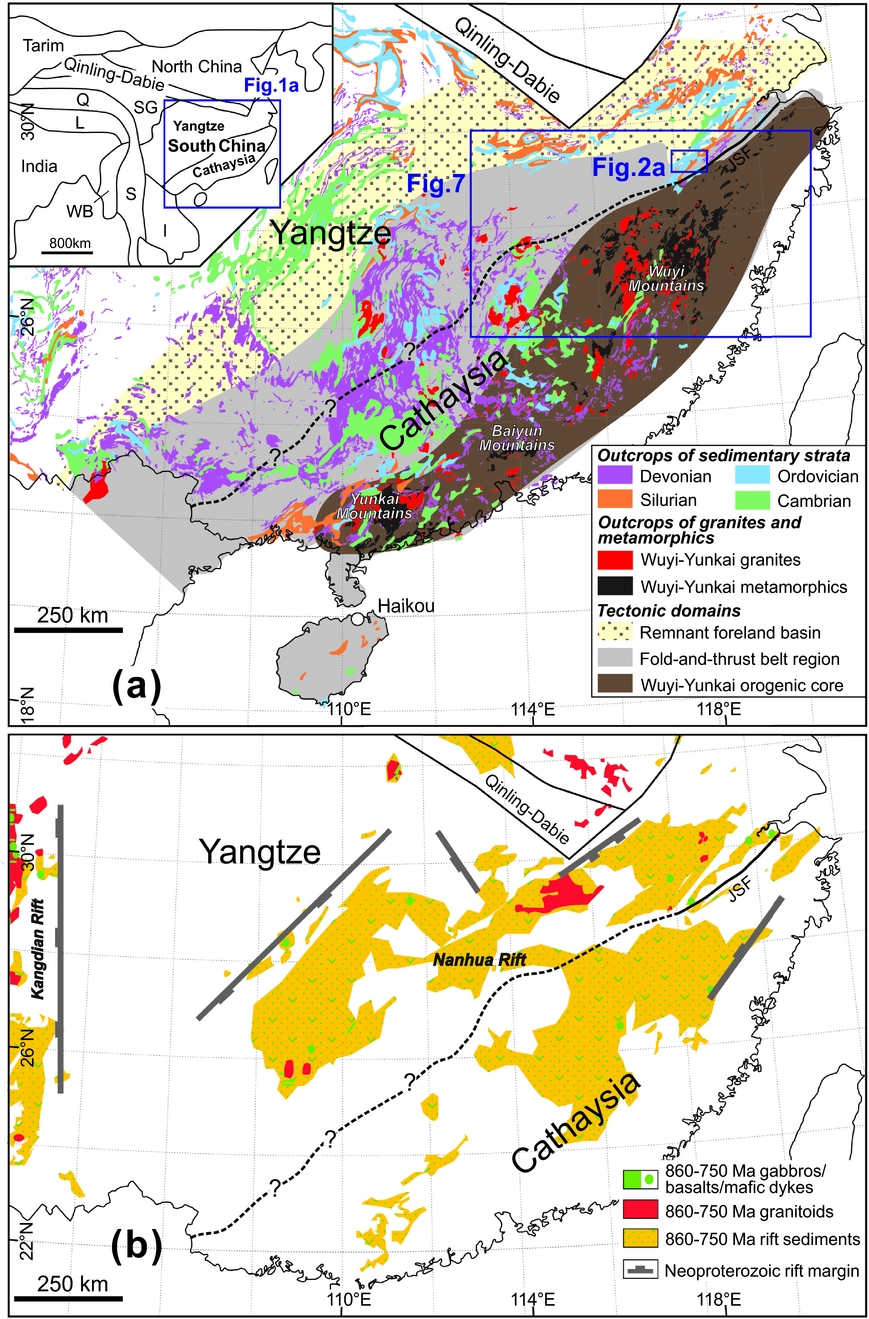
The Wuyi-Yunkai orogeny was an Ordovician–Silurian intraplate orogenic event, likely caused by the far-field stress of the collision of the South China Block with northeastern Gondwana (e.g. Li, Reference Li and Flower1998; Wang et al. Reference Wang, Zhang, Fan, Zhang, Chen, Cawood and Zhang2010; Yao et al. Reference Yao, Li, Li, Li and Yang2014; Yao & Li, Reference Yao and Li2016). This orogeny produced a series of early Palaeozoic metamorphic complexes along the Wuyi-Baiyun-Yunkai mountains (e.g. Wang et al. Reference Wang, Zhou, Griffin, Wang, Qiu, O'Reilly, Xu, Liu and Zhang2007; Yu et al. Reference Yu, O'Reilly, Wang, Griffin, Zhang, Wang, Jiang and Shu2008; Li et al. Reference Li, Li, Wartho, Clark, Li, Zhang and Bao2010; Wan et al. Reference Wan, Liu, Wilde, Cao, Chen, Dong, Song and Du2010) that define the metamorphic orogenic core (Fig. 1a). The orogen shed sediments of thousands of metres thick in the evolving Nanhua foreland basin (Li, Reference Li and Flower1998; Yao & Li, Reference Yao and Li2016), and developed a large fold-and-thrust system to its NW. The Jiangshan-Shaoxing fault in northeastern South China (Fig. 1a) marks the boundary between the Yangtze and Cathaysia blocks (e.g. Zhao & Cawood, Reference Zhao and Cawood1999; Li et al. Reference Li, Li, Zhou and Kinny2002, Reference Li, Li, Li, Lo, Wang, Ye and Yang2009), but is probably largely a Phanerozoic feature formed after the amalgamation of the two blocks during early Neoproterozoic time (Li et al. Reference Li, Li, Zhou and Kinny2002, Reference Li, Li, Li, Lo, Wang, Ye and Yang2009). Previous studies defined the Jiangshan-Shaoxing fault as the boundary between the orogenic core and fold-and-thrust zone when the Wuyi-Yunkai orogeny ceased by the end of the Silurian Period (e.g. Yao et al. Reference Yao, Li, Li, Wang, Li and Yang2012). However, due to strong Mesozoic tectonic modifications in the region, neither the lateral extent of the Wuyi-Yunkai orogen nor the nature of the early Palaeozoic sedimentary dispersals in northeastern South China have been well constrained (e.g. Li et al. Reference Li, Li, Wartho, Clark, Li, Zhang and Bao2010; Xu et al. Reference Xu, Du, Cawood, Zhu, Li and Yu2012).
(a) A simplified regional map of the South China Block (SCB), highlighting the regional extent of the Ordovician–Silurian Wuyi-Yunkai orogenic core, fold-and-thrust belt and the remnant Nanhua foreland basin. Geological components such as distributions of Cambrian–Devonian sedimentary rocks, Wuyi-Yunkai syn-orogenic metamorphic rocks and granites are also presented in the map (after Yao & Li, Reference Yao and Li2016). The inset shows a sketch of major continental blocks/terranes in East Asia. (b) Distribution of mid-Neoproterozoic magmatic rocks (750–860 Ma) and continental rift sequences in South China (after Li et al. Reference Li, Chen, Li and Zhang2014). JSF – Jiangshan-Shaoxing Fault; L – Lhasa; Q – Qiangtang; SG – Songpan-Ganzi; WB – West Burma; S –Subumasu; I – Indochina.

Here we report the identification of the northern margin of an early Palaeozoic orogenic system in South China that was severely overprinted by Mesozoic orogenic and extensional events. We achieved this by analysing the varying tectonostratigraphic records along a traverse across the fold-and-thrust belt into the hinterland basin region. Together with a detrital provenance analysis of syn- and post-orogenic successions in the foreland basin, we construct the palaeographic evolution of the orogenic system.
2. Geological setting
The South China Block (SCB) consists of the Yangtze Block in the NW and the Cathaysia Block in the SE (Fig. 1a inset), which amalgamated during either 1140–880 Ma (e.g. Li et al. Reference Li, Li, Zhou and Kinny2002, Reference Li, Bogdanova, Collins, Davidson, Dewaele, Ernst, Fitzsimons, Fuck, Gladkochub, Jacobs, Karlstrom, Lu, Natapov, Pease, Pisarevsky, Thrane and Vernikovsky2008, Reference Li, Li, Li, Lo, Wang, Ye and Yang2009; Greentree et al. Reference Greentree, Li, Li and Wu2006) or 870–820 Ma (e.g. Li, Reference Li1999; Zhao & Cawood, Reference Zhao and Cawood1999; Wang et al. Reference Wang, Zhou, Qiu, Zhang, Liu and Zhang2006, Reference Wang, Zhou, Griffin, Wang, Qiu, O'Reilly, Xu, Liu and Zhang2007; Wu et al. Reference Wu, Yang, Xie, Yang and Xu2006). The middle Neoproterozoic Rodinia break-up led to a massive production of c. 860–750 Ma bimodal magmatic rocks and deposition of rift sediments in both the southeastern South China Block (e.g. Li et al. Reference Li, Li, Ge, Zhou, Li, Liu and Wingate2003a, b; Li, Li & Li, Reference Li, Li and Li2005; Wang et al. Reference Wang, Zhou, Qiu, Zhang, Liu and Zhang2006; Shu et al. Reference Shu, Faure, Yu and Jahn2011) and near the western Yangtze margin (e.g. Zhou et al. Reference Zhou, Yan, Kennedy, Li and Ding2002, Reference Zhou, Ma, Yan, Xia, Zhao and Sun2006; Li et al. Reference Li, Li, Ge, Zhou, Li, Liu and Wingate2003a) along the middle Neoproterozoic Kangdian Rift (Fig. 1b) (Li et al. Reference Li, Li, Kinny and Wang1999).
The first Phanerozoic tectonic event in the SCB after the Neoproterozoic rifting activities was the early Palaeozoic intraplate Wuyi-Yunkai orogeny, which led to the development of a prominent angular unconformity between upper Palaeozoic (Devonian and younger) and lower Palaeozoic (Silurian and/or older) sedimentary/meta-sedimentary rocks across southeastern South China (Huang et al. Reference Huang, Ren, Jiang, Zhang and Qin1980; BGMRJX, 1984; BGMRGX, 1985; BGMRGD, 1988; BGMRHN, 1988; Ren, Reference Ren1991; Wang et al. Reference Wang, Zhou, Griffin, Wang, Qiu, O'Reilly, Xu, Liu and Zhang2007; Li et al. Reference Li, Li, Wartho, Clark, Li, Zhang and Bao2010). This tectonic event was traditionally called the Caledonian orogeny (e.g. Ren, Reference Ren1964, Reference Ren1991; Huang et al. Reference Huang, Ren, Jiang, Zhang and Qin1980; Yang, Cheng & Wang, Reference Yang, Cheng and Wang1986), but was renamed the Wuyi-Yunkai orogeny after the exposures of metamorphic orogenic core along the Wuyi, Baiyun and Yunkai mountains (Fig. 1a) (Li et al. Reference Li, Li, Wartho, Clark, Li, Zhang and Bao2010). The orogenic event began during Early Ordovician time and terminated during the Silurian Period (Yao & Li, Reference Yao and Li2016). By the end of Silurian time, the fully developed Wuyi-Yunkai orogen exhibited: (1) an orogenic core, defined by the distribution of 460–440 Ma high-grade metamorphic rocks; (2) a fold-and-thrust zone constrained by the extent of pre-Devonian deformation in the lower Palaeozoic strata as well as the distribution of 440–400 Ma granites; and (3) a remnant Nanhua foreland basin with non-deformed lower Palaeozoic sedimentary strata (Fig. 1a) (Li et al. Reference Li, Chen, Li and Zhang2014). The discovery of c. 435 Ma mafic igneous rocks in the Wuyi-Yunkai orogenic core (Yao et al. Reference Yao, Li, Li, Wang, Li and Yang2012; Wang et al. Reference Wang, Zhang, Fan, Zhang and Zhang2013) further helped to divide the Wuyi-Yunkai orogenic event into an Ordovician primary compression stage and a Silurian orogenic collapse stage (Li et al. Reference Li, Li, Wartho, Clark, Li, Zhang and Bao2010; Yao et al. Reference Yao, Li, Li, Wang, Li and Yang2012; Yao & Li, Reference Yao and Li2016).
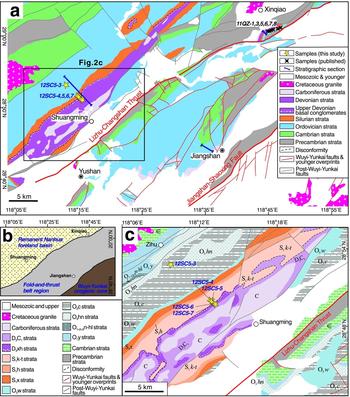
Lower–middle Palaeozoic sedimentary rocks are well preserved in the northeastern corner of South China (Fig. 2a). Cambrian carbonates and cherts are deposited in a marine platform environment (BGMRZJ, 1989) and Ordovician–Silurian siliciclastics are deposited in a coastal marine to tidal environment, featured with fluidized sand veins and flame structures (Xu et al. Reference Xu, Du, Cawood, Zhu, Li and Yu2012). Post-orogenic Devonian–Carboniferous delta to fluvial quartz-rich sediments were deposited on top of the Wuyi-Yunkai orogenic sequences, and their contact relationship varies across different localities (Fig. 3) (Li et al. Reference Li, Chen, Li and Zhang2014). The Wuyi-Yunkai fold-and-thrust belt features an angular unconformity between the Upper Ordovician and Carboniferous strata, whereas within the remnant Nanhua foreland basin there is a disconformity between the Silurian and Upper Devonian strata (Figs 2, 3). Representative tectonostratigraphic sections from the fold-and-thrust belt and the remnant foreland basin are selected for detailed investigations in order to identify the lower Palaeozoic frontal thrust between them.
(a) Geological map of the Jiangshan-Shuangming-Xinqiao region and geological traverses for stratigraphic logging and sampling (after RGMRZJ-b, 1970; Li et al. Reference Li, Chen, Li and Zhang2014). (b) A simplified map of (a), showing the three tectonics domains and relevant locations of the Jiangshan, Shuangming and Xinqiao sections. (c) Enlarged geological map of the Shuangming region NW of the Lizhu-Changshan thrust fault (after RGMRZJ-b, 1970; Li et al. Reference Li, Chen, Li and Zhang2014), highlighting sampling locations and the Cambrian–Devonian stratigraphic formations.

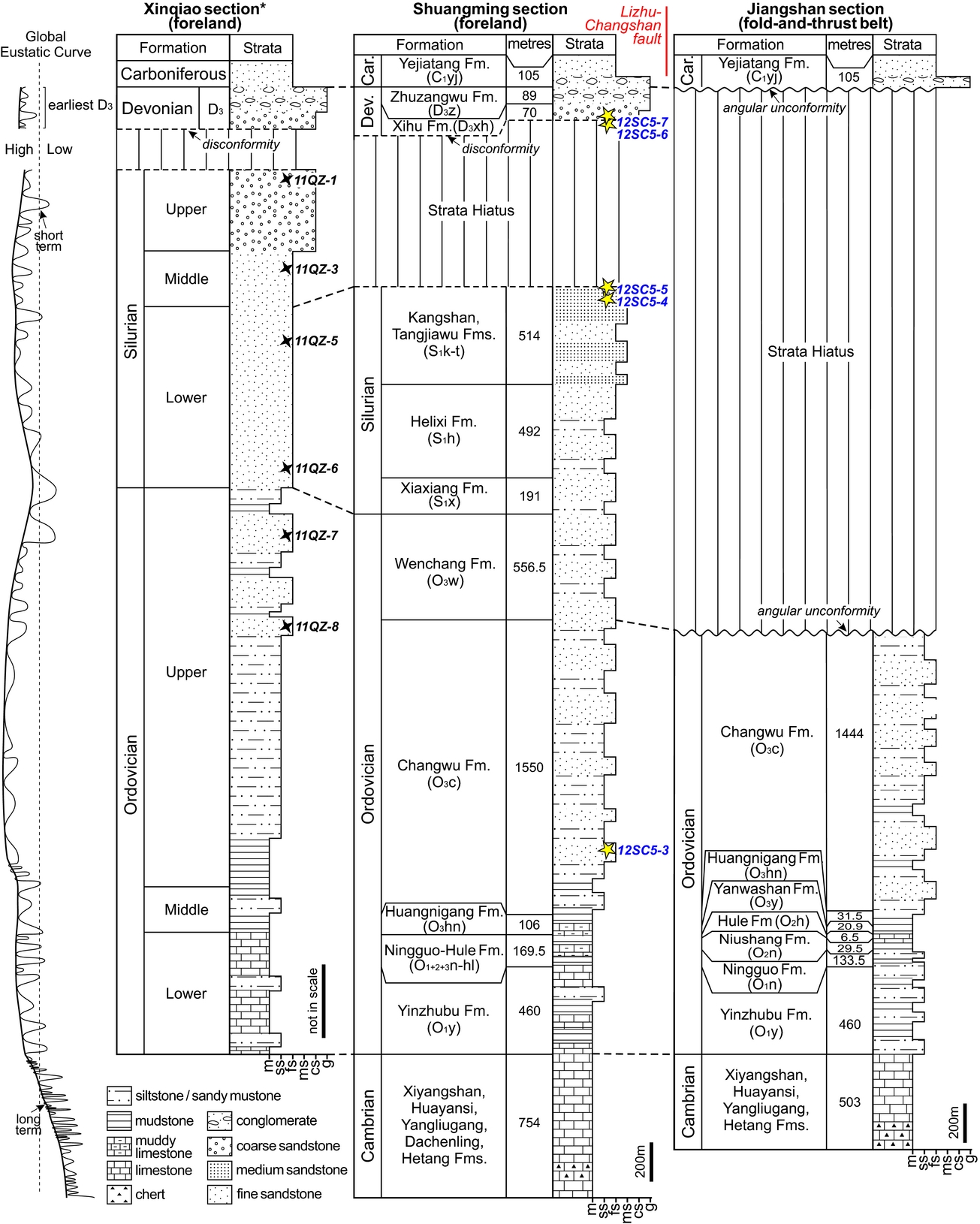
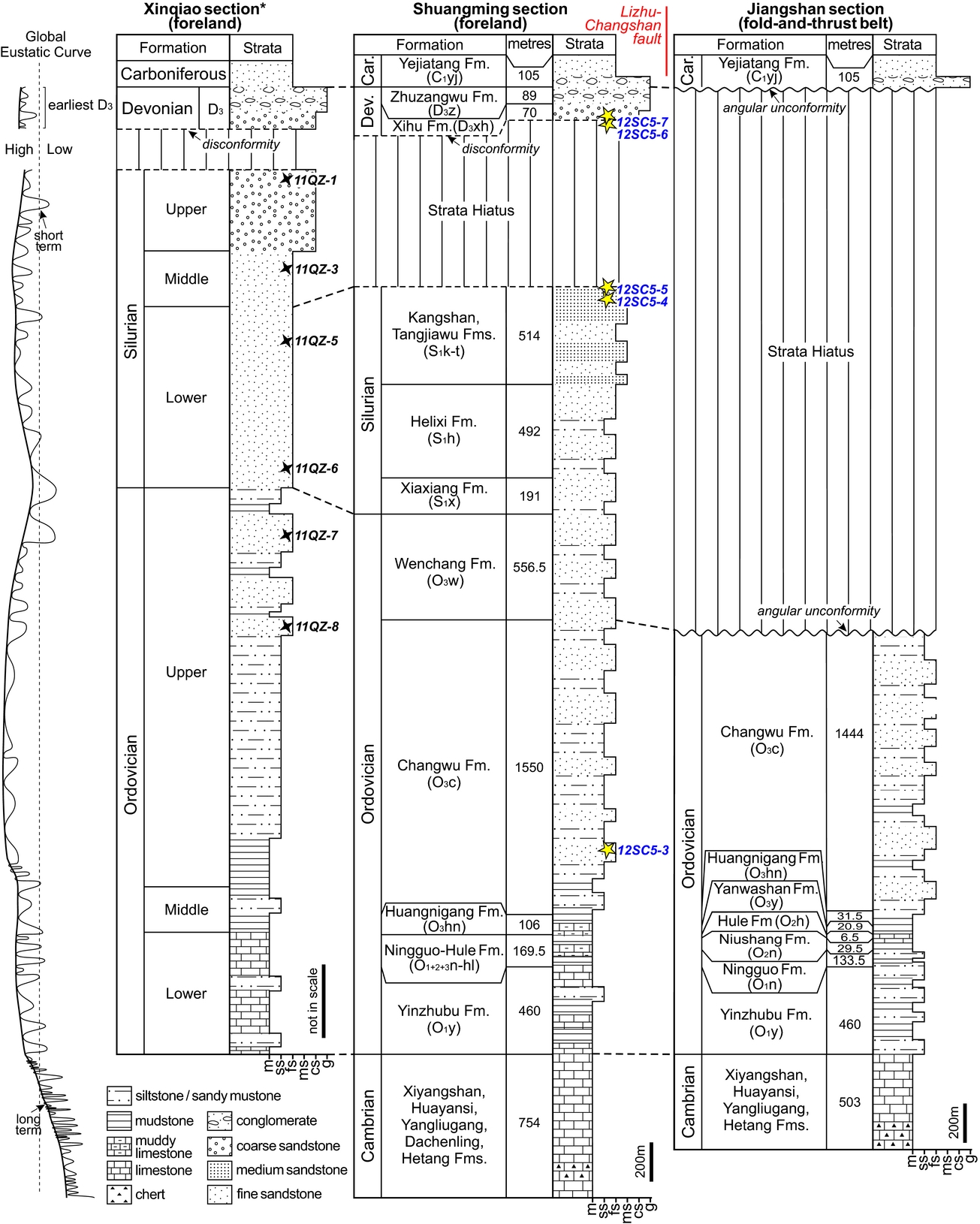
Generalized Cambrian–Devonian tectonostratigraphic columns of the Xinqiao and Shuangming sections from the remnant Nanhua foreland basin and the Jiangshan section from the Wuyi-Yunkai fold-and-thrust belt. The thickness of each stratigraphic formation in the Shuangming and Jiangshan sections is marked in metres, and siliciclastic samples for provenance analysis are marked against the columns. The long-term and short-term global eustatic curves are from Haq & Schutter (Reference Haq and Schutter2008). The asterisk-marked Xinqiao section is adopted from Xu et al. (Reference Xu, Du, Cawood, Zhu, Li and Yu2012). Lithological abbreviations: m – mudstone/shale; ss – siltstone; fs – fine-grained sandstone; ms – medium-grained sandstone; cs – coarse-grained sandstone; g – gravel/conglomerate.
3. Tectonostratigraphic records
3.a. The Jiangshan section
The Jiangshan section, located in the Wuyi-Yunkai fold-and-thrust belt (Fig. 2b), is bounded by the Lizhu-Changshan thrust to the NW and the Jiangshan-Shaoxing fault to the SE (Fig. 2a). It comprises, from bottom to top, the Cambrian Hetang, Yangliugang, Huayansi and Xiyangshan formations, the Lower Ordovician Yinzhubu and Ningguo formations, the Middle Ordovician Hule and Niushang formations, and the Upper Ordovician Huangnigang and Changwu formations (Fig. 3) (RGMRZJ-a, 1966; BGMRZJ, 1989).
The Cambrian succession, including the Hetang, Yangliugang, Huayansi and Xiyangshan formations, is dominated by greyish and grey-blackish limestones, dolomitic limestones and thin-bedded dolomites (see Li et al. Reference Li, Chen, Li and Zhang2014, fig. 2.20) with chert interlayers at the bottom (RGMRZJ-a, 1966; BGMRZJ, 1989). The Cambrian age was constrained by the presence of trilobites Paralisaniella sp. and Oidalagnostus sp. found in the strata. The Ordovician Yinzhubu and Ningguo formations are composed mainly of calcareous muddy siltstones and mudstones, interstratified with minor thin black shale layers at the upper part and manganic nodules at the bottom, and host Early Ordovician graptolites Didymograplus sp. (RGMRZJ-a, 1966). The Ordovician Niushang and Hule formations are very thin (Fig. 3), consisting mainly of black shales and carbonates, and gradually transit into yellowish siltstones near the top (RGMRZJ-a, 1966; BGMRZJ, 1989). The age of the Niushang and Hule formations is defined by Middle Ordovician graptolites Climacograptus cf. and brachiopods Shumardia sp. (RGMRZJ-a, 1966). The Yanwashan Formation nodular limestones and the Huangnigang Formation calcareous nodule-bearing silty mudstones are of Late Ordovician age constrained by the cephalopods Michelinoceras sp. and trilobites Nankinolithus nankinensis (BGMRZJ, 1989). The Changwu Formation consists mainly of yellowish siltstones and fine-grained sandstones interlayered with calcareous mudstones (Fig. 3). It contains Late Ordovician brachiopods Rafinesquaina sp. and Sowerbyella sp. and graptolites Orthograptus sp. (BGMRZJ, 1989).
The pebbly quartz sandstone layers of the lower Carboniferous Yejiatang Formation sit above the Ordovician Changwu Formation with an angular unconformity (Fig. 3; also see Li et al. Reference Li, Chen, Li and Zhang2014, fig. 2.22c of), leaving an uppermost Ordovician – Devonian hiatus in the Jiangshan section (RGMRZJ-a, 1966; BGMRZJ, 1989; Rong et al. Reference Rong, Zhang, Xu, Huang and Yu2010).
3.b. The Shuangming section
The Shuangming section, located in the remnant Nanhua foreland basin (Fig. 2b), is bounded by the Lizhu-Changshan thrust to the SE (Fig. 2a). It comprises a continuous Cambrian – lower Silurian succession conformably overlain by an Upper Devonian succession (Figs 2, 3) (BGMRZJ, 1989; RGMRZJ-b, 1970). The Cambrian strata consist of the Hetang, Dachengling, Yangliugang, Huayansi and Xiyangshan formations, all dominantly carbonates and dolomites with black carbonaceous cherts at the bottom (RGMRZJ-b, 1970; BGMRZJ, 1989). The Lower Ordovician Yinzhubu Formation consists mainly of calcareous mudstones with minor limestone nodules and siltstones, and some banded limestones near the bottom of the formation (see Li et al. Reference Li, Chen, Li and Zhang2014, fig. 2.25a). Early Ordovician graptolites Didymograplus sp. are found in the Yinzhubu Formation, making it correlatable to the Jiangshan Yinzhubu Formation (RGMRZJ-b, 1970; BGMRZJ, 1989). The Ordovician Ningguo-Hule Formation consists of black carbonaceous shales interlayered with minor nodular muddy limestones (see Li et al. Reference Li, Chen, Li and Zhang2014, fig. 2.25c). The Upper Ordovician Huangnigang Formation, featuring abundant limestone nodules in calcareous mudstones, hosts Late Ordovician trilobites Hammatocnemis, Paraphilipsinella and Sarkia (RGMRZJ-b, 1970). The Upper Ordovician Changwu and Wenchang formations are extremely thick (up to c. 2100 m in total; Fig. 3), consisting mainly of greyish siltstones and fine-grained sandstones with minor mudstone interlayers (BGMRZJ, 1989). Late Ordovician trilobites Hammatocnemis, Telephima and Amphitrion are present in these two formations (RGMRZJ-b, 1970; BGMRZJ, 1989). Sedimentary structures such as micro-ripples have been found in the Changwu Formation (see Li et al. Reference Li, Chen, Li and Zhang2014, fig. 2.26a). The overlying Xiaxiang, Helixi, Kangshan and Tangjiawu formations, defined as being of lower Silurian age by fossils Eupoikilofusa sp. and Trachysphaeridium sp. in the strata (BGMRZJ, 1989), are composed of yellowish and greenish siltstones, fine-grained sandstones and medium-grained quartz sandstones. Both the grain size and the percentage of siliciclastics increase upwards (RGMRZJ-b, 1970).
Disconformably overlying the lower Silurian strata are the Upper Devonian Xihu and Zhuzangwu formations, consisting of greyish coarse-grained quartz sandstones and pebbly sandstones (Fig. 3). They host Devonian fossils Plagiozamites oblongifolius and Platyphyllum ginkgophylloides (BGMRZJ, 1989; Rong et al. Reference Rong, Zhang, Xu, Huang and Yu2010). The Zhuzangwu Formation is in turn conformably overlain by the lower Carboniferous Yejiatang Formation siliciclastic strata (Fig. 3) (RGMRZJ-b, 1970).
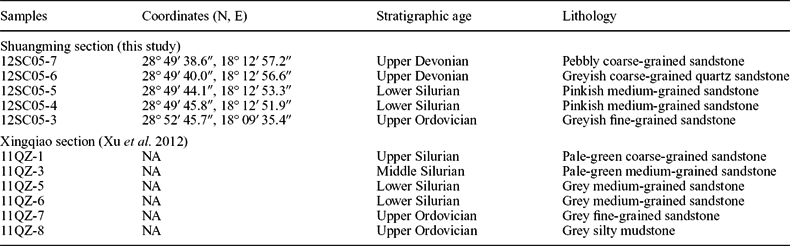
Along the Shuangming section we collected a fine-grained sandstone sample from the Upper Ordovician Changwu Formation, two medium-grained sandstone samples from the lower Silurian Kangshan and Tangjiawu formations right beneath the disconformity, and two coarse-grained quartz sandstone samples from the Upper Devonian Xihu Formation above the disconformity for detrital provenance analysis (Fig. 3). Table 1 summarizes the general information regarding the sampled siliciclastic sedimentary rocks from the region.
Summary of Palaeozoic siliciclastic samples from the Shuangming and Xinqiao sections, NE South China

NA – not applicable.
4. Analytical procedures for provenance analysis
4.a. Sample preparation
Zircon crystals were extracted from bulk rocks using standard density and magnetic separation techniques at the Hebei Regional Geology and Mineral Survey in Langfang. Zircon grains, together with zircon U–Pb standard 91500 and Plešovice were cast in epoxy mounts and then polished to section the crystal in half for analyses. All analysed zircon grains were imaged in transmitted and reflected light as well as cathodoluminescence (CL) light at Curtin University, Australia, to better reveal the internal structures of the grains.
4.b. Zircon U–Pb geochronology
U–Th–Pb concentrations were measured using the laser ablation inductively coupled plasma mass spectrometry (LA-ICP-MS) facility at the Institute of Geology and Geophysics, Chinese Academy of Sciences (IGG-CAS). External zircon standards 91500 with 207U/206Pb age of 1065.4 ± 0.6 Ma (Wiedenbeck et al., Reference Wiedenbeck, Alle, Corfu, Griffin, Meer, Oberli, Vonquadt, Roddick and Spegel1995, Reference Wiedenbeck, Hanchar, Peck, Sylvester, Valley, Whitehouse, Kronz, Morishita, Nasdala, Fiebig, Franchi, Girard, Greenwood, Hinton, Kita, Mason, Norman, Ogasawara, Piccoli, Rhede, Satoh, Schulz-Dobrick, Spicuzza, Terada, Tindle, Togashi, Vennemann, Xie and Zheng2004) and GJ-1 with 206U/238Pb age of 608.5 ± 0.4 Ma (Jackson et al. Reference Jackson, Pearson, Griffin and Belousova2004) were employed to calibrate U–Th–Pb ratios of unknown zircon grains. Glass NIST 610 was used for Th/U ratio determination. The ablation pits on zircon grains were c. 36 μm in diameter and 20–30 μm in depth, and the detailed analytical procedure followed that of Xie et al. (Reference Xie, Zhang, Zhang, Sun and Wu2008). Data reduction was carried out using Glitter v4.0 (Van Achterbergh et al. Reference Van Achterbergh, Ryan, Jackson, Griffin and Sylvester2001), ComPbCorr#3_151 (Anderson, Reference Anderson2002) and Isoplot/Ex v2.49 (Ludwig, Reference Ludwig2001) packages. Zircon U–Pb data of all five analysed samples are provided in online Supplementary Table S1 (available at http://journals.cambridge.org/geo), in which the analyses with discordance >10 % are formatted in italics.
4.c. Zircon Hf isotopic analysis
Laser ablation zircon Lu–Hf isotopic analyses were conducted at IGG-CAS using a ThermoFinnigan Neptune multicollector (MC-) ICP-MS equipped with a 193 nm laser. Zircon 91500 and GJ-1 were used as reference standards, with a recommended 176Hf/177Hf ratio of 0.282307 ± 0.000031 (2σ) (Wu et al. Reference Wu, Yang, Xie, Yang and Xu2006) and 0.282000 ± 0.000005 (2σ) (Morel et al. Reference Morel, Nebel, Nebel-Jacobsen, Miller and Vroon2008), respectively. Laser ablation Hf sites were centred as close as possible to the spots for U–Pb dating, with spot sizes of c. 60 μm in diameter and c. 45 μm in depth. More details on analytical and calibration procedures can be found in Wu et al. (Reference Wu, Yang, Xie, Yang and Xu2006). A decay constant for 176Lu of 1.867 ± 0.008 × 10⁻¹¹ a–1 (Soderlund et al. Reference Soderlund, Patchett, Vervoort and Isachsen2004), the present-day chondritic ratios of 176Hf/177Hf = 0.282772 and 176Lu/177Hf = 0.0332 (Blichert-Toft & Albarede, Reference Blichert-Toft and Albarede1997) were accepted for calculating εHf(t) values. One-stage model ages (TDM) were calculated relative to depleted mantle with a present-day (176Hf/177Hf)DM of 0.28325 and (176Lu/177Hf)DM of 0.0384 (Griffin et al. Reference Griffin, Pearson, Belousova, Jackson, Achterbergh, O'Reilly and Shee2000). Two-stage model ages (TDMC) were calculated by forcing a growth curve through the zircon initial ratio with assumed (176Lu/177Hf)C values of 0.0093 and 0.015, corresponding to the Proterozoic upper continental crust (Amelin et al. Reference Amelin, Lee, Halliday and Pidgeon1999) and Phanerozoic upper continental crust (Griffin et al. Reference Griffin, Pearson, Belousova, Jackson, Achterbergh, O'Reilly and Shee2000), respectively. Zircon Lu–Hf isotopic data of all five analysed samples are presented in online Supplementary Table S2 (available at http://journals.cambridge.org/geo).
5. Results of provenance analysis
5.a. Zircon U–Pb ages
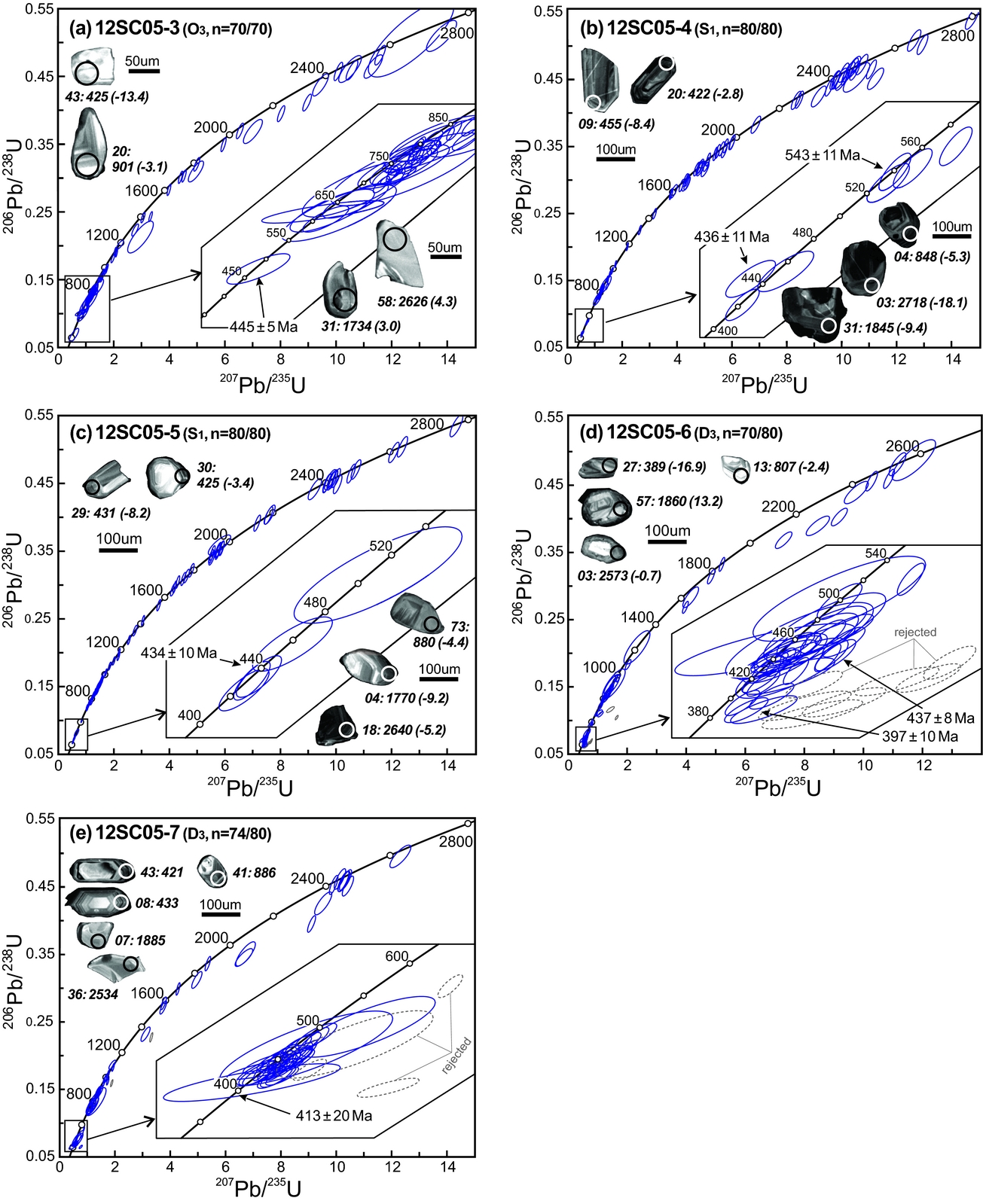
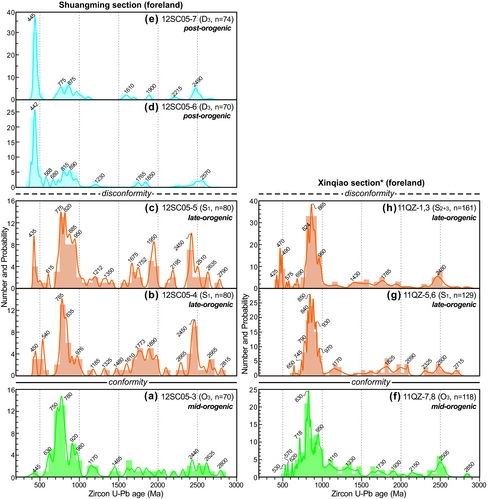
One Upper Ordovician greyish-green, fine-grained sandstone sample (12SC05-3) from the Changwu Formation (Fig. 3) was collected from the Shuangming section for detrital provenance analysis (Table 1). Seventy concordant U–Pb ages were obtained from 70 single zircon grains, ranging from 445 Ma to 2800 Ma (Fig. 4a). A predominant age peak of 780 Ma (28 % of all analyses) and a subordinate age population of 750 Ma (17 % of all analyses) are present, whereas the remaining ages are evenly distributed between 445–630 Ma and 920–2800 Ma (Fig. 5a). One single grain among the 70 analyses gives a 206Pb/238U age of 445 ± 5 Ma for the sample, which is much younger than the youngest age cluster of 630 Ma (Fig. 4a). The age of 445 ± 5 Ma from this single grain, indicating a potential maximum depositional age, is consistent within error with the Late Ordovician biostratigraphic age assigned for the Changwu Formation. More such analyses are required to provide a more robust maximum depositional age.
(a–e) Zircon U–Pb Concordia plots and CL images of the Ordovician–Devonian sandstone samples from the Shuangming section. Number of concordant analyses/total number of analyses is denoted n and the concordance is within 90–110 % for this study. Analytical spots, ages and εHf(t) values are formatted in italics next to corresponding CL images of the zircon grains, e.g. 43: 425 (–13.4) represents spot number 43 with an age of 425 Ma and εHf(t) value of –13.4 for sample 12SC05-3.

Relative probability and density histogram plots of zircon U–Pb ages with 90–110 % concordance of (a) mid-orogenic Upper Ordovician sample 12SC05-3; (b) late-orogenic Lower Silurian sample 12SC05-4; (c) late-orogenic Lower Silurian sample 12SC05-5; (d) post-orogenic Upper Devonian sample 12SC05-6; (e) post-orogenic Upper Devonian sample 12SC05-7 from the Shuangming section; (f) mid-orogenic Upper Ordovician samples; (g) late-orogenic Lower Silurian samples; and (h) late-orogenic Middle–Upper Silurian samples from the Xinqiao section. The Xinqiao samples are from Xu et al. (Reference Xu, Du, Cawood, Zhu, Li and Yu2012).

Samples 12SC05-4 and 12SC05-5 are pinkish medium-grained sandstone samples from the lower Silurian Kangshan and Tangjiawu formations of the Shuangming section (Fig. 3; Table 1). Eighty U–Pb analyses on 80 zircon grains were conducted for each sample, all of which yielded concordant ages (Fig. 4b, c). Ages for sample 12SC05-4 range from 435 Ma to 2800 Ma (Fig. 4b), with a major age population of 785 Ma and moderate populations of 450 Ma, 540 Ma and 2450 Ma (Fig. 5b). Sample 12SC05-5 yielded prevailing age peaks of 775 Ma and 820 Ma, with subordinate peaks of 435 Ma, 1950 Ma and 2450 Ma (Fig. 5c). The ‘Pan-African’ ages of 540–630 Ma also left imprints on these two samples. The youngest age group of sample 12SC05-4 (three analyses) gives a weighted mean 206Pb/238U age of 436 ± 11 Ma (n=3, MSWD=2.3, Fig. 4b), indicating a maximum depositional age of c. 435 Ma. The four youngest analyses of sample 12SC05-5 yield a weighted mean 206Pb/238U age of 434 ± 10 Ma (n=4, MSWD=1.3, Fig. 4c), implying a maximum depositional age of c. 435 Ma which is consistent with the middle Silurian biostratigraphic age.
Samples 12SC05-6 and 12SC05-7 are collected from the Upper Devonian Xihu Formation in the Shuangming section, which overlies the lower Silurian strata with a disconformable contact (Fig. 3). Sample 12SC05-6 is a greyish coarse-grained quartz sandstone (Table 1), in which 70 concordant U–Pb ages were obtained from 80 analyses on 80 individual zircon grains (Fig. 4d). The concordant ages range from 388 Ma to 2600 Ma, yielding a dominant cluster at 442 Ma (39 % of all analyses), and minor 580–680 Ma (Pan-African) and 800–890 Ma Neoproterozoic populations (Fig. 5d). Proterozoic ages older than 1200 Ma count for 20 % of all analyses (Fig. 4d). The youngest six concordant analyses of samples 12SC05-6 yield a weighted mean 206Pb/238U age of 397 ± 10 Ma (n=6, MSWD=2.3, Fig. 4d), implying a maximum depositional age of c. 400 Ma. Sample 12SC05-7 is a pebbly coarse-grained quartz sandstone (Table 1), for which 74 concordant U–Pb ages were obtained from 80 analyses on 80 individual zircon grains (Fig. 4e). The concordant ages range from 410 Ma to 2660 Ma, and form a dominant cluster of 445 Ma (45 % of all analyses, Fig. 5e). This sample also yields subordinate Neoproterozoic populations of age 775–875 Ma and a few Proterozoic ages (Fig. 5e). The youngest six concordant analyses of samples 12SC05-7 yield a weighted mean 206Pb/238U age of 413 ± 20 Ma (n=6, MSWD=0.01, Fig. 4e), implying a maximum depositional age of c. 400 Ma within error, consistent with that of sample 12SC05-6.
5.b. Zircon Hf isotopes
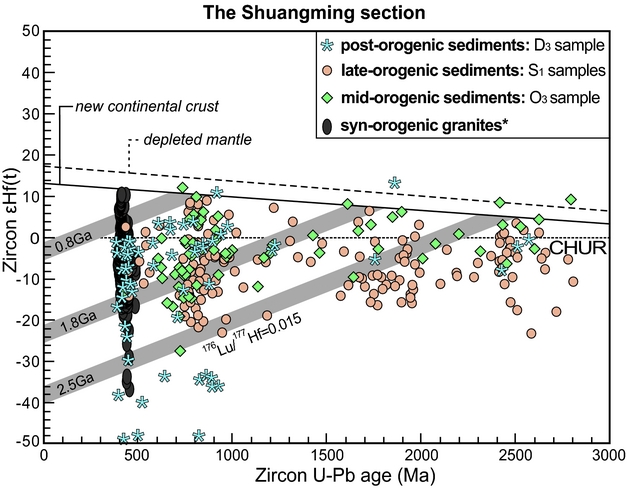
A total of 228 detrital zircons from the three mid- to late-orogenic samples (12SC05-3, 12SC05-4 and 12SC05-5) from the Shuangming section (Figs 2, 3) which gave concordant U–Pb ages were selected for in situ Hf isotopic analysis. The analysed zircons yielded highly variable 176Hf/177Hf ratios (0.280492–0.282688) and εHf(t) values (−27.6 to 12.0) (online Supplementary Table S2, available at http://journals.cambridge.org/geo). Three grains plot above the new continental crust line; the remaining 223 zircons plot on or below the line, with 78 % of them yielding negative εHf(t) values (Fig. 6).
Zircon εHf(t) values versus U–Pb ages plot for the mid-orogenic Upper Ordovician samples, late-orogenic Silurian samples and post-orogenic Upper Devonian samples. Zircon Hf values of syn-orogenic magmatic zircons from early Palaeozoic granites across the entire Wuyi-Yunkai orogen (Yu et al. Reference Yu, Huang, He and Li2016) are plotted for comparison. The depleted mantle and new continental crust evolution lines were extrapolated after Griffin et al. (Reference Griffin, Pearson, Belousova, Jackson, Achterbergh, O'Reilly and Shee2000) and Dhuime, Hawkesworth & Cawood (Reference Dhuime, Hawkesworth and Cawood2011), respectively. Potential crustal evolution lines at 2.5 Ga, 1.8 Ga and 0.8 Ga are calculated for the average continental crust of 176Lu/177Hf value of 0.015 (Griffin et al. Reference Griffin, Pearson, Belousova, Jackson, Achterbergh, O'Reilly and Shee2000).

In situ zircon Hf isotopic analysis was also conducted on 62 detrital zircons with concordant U–Pb ages from the post-orogenic sample 12SC05-6 (Figs 2, 3). The results again display highly variable 176Hf/177Hf ratios (0.280919–0.282515) and εHf(t) values (−48.2 to 13.2) (online Supplementary Table S2). Apart from one zircon grain with an age of 1860 Ma, all others plot on or below the new continental crust line (Fig. 6). Notably, all c. 440 Ma zircons plot below the chondritic uniform reservoir line with negative εHf(t) values, consistent with that of the majority of syn-orogenic magmatic zircons (Fig. 6).
6. Discussion
6.a. Contrasting tectonostratigraphic records define the northern boundary of the Wuyi-Yunkai orogen
Lower Palaeozoic stratigraphy in northeastern South China generally reflects a coarsening upwards trend. Sedimentary facies evolve from: shallow-marine carbonate platform in the Cambrian deposits; to a neritic estuary/lagoon in the Lower–Middle Ordovician stratigraphy where interlayered nodular carbonates, mudstones and siltstones were deposited; to finally delta to tidal flat in Upper Ordovician – Silurian strata with increasing terrestrial deposits (BGMRZJ, 1989; Rong et al. Reference Rong, Zhang, Xu, Huang and Yu2010; Xu et al. Reference Xu, Du, Cawood, Zhu, Li and Yu2012). The early Palaeozoic eustatic curves (Haq & Schutter, Reference Haq and Schutter2008) indicate a long-term global sea-level rise during Cambrian – Middle Ordovician time, predicting an upwards-fining sedimentary package. However, the Cambrian – Middle Ordovician sequences observed in the Shuangming and Jiangshan sections show upwards grain-coarsening and siliciclastic-increasing trends (Fig. 3), indicating that the onset of the Wuyi-Yunkai orogeny likely dominated the local sedimentation in a foreland basin environment (Li et al. Reference Li, Chen, Li and Zhang2014; Yao & Li, Reference Yao and Li2016). The global sea level fluctuated with a slight sea-level lowering during Late Ordovician time (Haq & Schutter, Reference Haq and Schutter2008), coinciding with the upwards-coarsening siliciclastic sedimentation in all three stratigraphic sections of the study region (Fig. 3). However, during Silurian time, the general trend of global sea-level rise again contradicted the upwards-coarsening Silurian packages in the region (Fig. 3) (RGMRZJ-a, 1966; RGMRZJ-b, 1970; BGMRZJ, 1989), indicating that local tectonics likely still dominated the basin evolution.
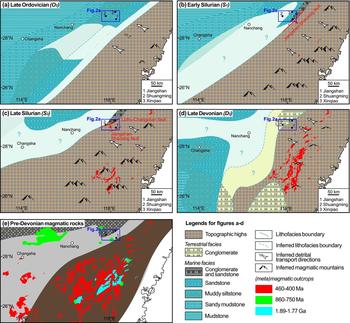
The Jiangshan section within the Wuyi-Yunkai fold-and-thrust belt (Fig. 2b) features an earlier sedimentary transition from Cambrian marine carbonates to Ordovician shallow-water siliciclastics in comparison to the other sections, as well as an angular unconformity between the Ordovician strata and the lower Carboniferous strata (Figs 2, 3). The Wuyi-Yunkai orogeny started by Early Ordovician time (c. 490–480 Ma), featuring continental uplift along the southeastern coastal Cathaysia (Liu & Xu Reference Liu and Xu1994; Yao & Li, Reference Yao and Li2016). By Late Ordovician time, the uplifted orogen expanded to a >150 km wide zone along the present-day coastal Cathaysia, but was still distant from the Jiangshan section (Fig. 7a). The study region, including the Jiangshan, Shuangming and Xinqiao sections, was still receiving fine siliciclastic sedimentation with supplies from the SE during that time.
Palaeogeographic maps of northeastern South China covering the Xinqiao, Shuangming and Jiangshan sections and surrounding areas during the time intervals: (a) Late Ordovician; (b) early Silurian; (c) late Silurian; and (d) Late Devonian (after Liu & Xu, Reference Liu and Xu1994; Yao et al. Reference Yao, Li, Li, Su and Yang2015). (e) Distribution of 1.77–1.89 Ga crystalline basement rocks, and 750–860 Ma and 400–460 Ma (meta)magmatic rocks in northeastern South China.

By early Silurian time, the uplifted orogen propagated further towards the NW hinterland, covering most of the Cathaysia Block. With the Jiangshan-Shaoxing thrust likely starting to form just west of it, the study region started to receive sediments more proximal to the orogenic front. Although no strata of early Silurian age have been preserved in the Jiangshan section (Fig. 3), elsewhere in this structural zone early Silurian conglomeratic lithofacies have been preserved. In contrast, the Shuangming and Xinqiao sections further to the NW received early Silurian sandy deposition (Fig. 7b).
Tectono-magmatic analyses and petrological studies indicate that the Wuyi-Yunkai orogen experienced orogenic root delamination no later than early Silurian time (c. 435 Ma, Li et al. Reference Li, Li, Wartho, Clark, Li, Zhang and Bao2010; Yao et al. Reference Yao, Li, Li, Wang, Li and Yang2012). As a consequence, the orogenic belt was expected to experience a phase of topographic uplift due to isostatic rebound following that event, and possibly a phase of orogenic collapse (Li et al. Reference Li, Li, Wartho, Clark, Li, Zhang and Bao2010; Yao et al. Reference Yao, Li, Li, Wang, Li and Yang2012; Yao & Li, Reference Yao and Li2016). Regardless of whether the orogen continued with compression or entered a collapse stage during Silurian time, the orogen appeared to have expanded further to the NW during this period. The Jiangshan section likely became a topographic high during this stage (Fig. 7c) with no late Silurian deposition preserved there, and older strata likely experienced erosion. In contrast, the Xinqiao section remained in a subaerial environment not far from the Jiangshan topographic high, receiving coarser-grained, proximal siliciclastics deposition (Figs 3, 7c) (BGMRZJ, 1989; Rong et al. Reference Rong, Zhang, Xu, Huang and Yu2010).
Following a widespread late Silurian – Early Devonian peneplanation, South China underwent a marine transgression from its SW corner during Devonian time (Liu & Xu, Reference Liu and Xu1994). The Shuangming and Xinqiao sections received Upper Devonian fluvial to nearshore, quartz-rich basal conglomerate and pebbly sandstones, whereas the Jiangshan section remained at an elevated palaeotopography throughout the Devonian Period (residual topography of the Wuyi-Yunkai orogen) (Figs 3, 7d).
We therefore observe two contrasting stratigraphic contact relationships on the two sides of the Lizhu-Changshan thrust (Figs 2, 3): an angular unconformity between the Upper Ordovician and lower Carboniferous strata in the Jiangshan section to its SE (Fig. 3); and a disconformity between Silurian and Devonian strata to its NW. The angular unconformity to its SE corresponds to the widespread angular unconformity between the upper Palaeozoic terrestrial and marine deposits (Devonian and younger) and the variably deformed and metamorphosed lower Palaeozoic successions (Silurian and older) over much of southeastern South China (e.g. Huang et al. Reference Huang, Ren, Jiang, Zhang and Qin1980; Ren, Reference Ren1991; Charvet et al. Reference Charvet, Shu, Faure, Choulet, Wang, Lu and Breton2010; Li et al. Reference Li, Li, Wartho, Clark, Li, Zhang and Bao2010), which defines the lateral extent of the Wuyi-Yunkai orogen (including its fold-and-thrust belt). On the contrary, disconformities between the Silurian and Upper Devonian strata to the NW of the Lizhu-Changshan thrust (Figs 2, 3) indicate that this region was the remnant Nanhua foreland basin at the end of the Wuyi-Yunkai orogeny, which experienced no early Palaeozoic deformation. Based on this contrasting tectonostratigraphic observation, we interpret the Lizhu-Changshan thrust (Fig. 2a) to be the northwestern terminal frontal thrust of the Wuyi-Yunkai fold-and-thrust belt, defining the northwestern margin of the much reworked early Palaeozoic orogen (Fig. 1a).
6.b. Detectable provenance changes defining the evolving Wuyi-Yunkai orogen
Figure 1a shows the terminating stage of the Wuyi-Yunkai orogen (including both the fold-and-thrust belt and the orogenic core) and the remnant Nanhua foreland basin towards the end of Silurian time. Due to the evolving nature of the orogen–basin system, the Nanhua foreland basin recorded dramatic changes in the detritus shed off from the Wuyi-Yunkai orogen through time. By tracking such provenance changes through time we could better define how the Wuyi-Yunkai orogen evolved.
Our provenance analysis utilizes new data from sandstone samples both below and above the disconformity in the Shuangming section (Figs 3, 5), supplemented by published data from six Ordovician–Silurian samples from the Xinqiao section (Fig. 3) (Xu et al. Reference Xu, Du, Cawood, Zhu, Li and Yu2012). The Shuangming samples can be grouped into three categories based on their U–Pb age patterns and chronostratigraphic natures: (1) the mid-orogenic group (Late Ordovician) that features a predominant c. 780 Ma age population with negligible Palaeozoic signature (Fig. 5a); (2) the late-orogenic group (early Silurian) that features a c. 780 Ma age population and increasing 435–540 Ma age peaks, and Archaean–Palaeoproterozoic basement signals (Fig. 5b, c); and (3) the post-orogenic group (Late Devonian) that shows an overwhelming c. 440 Ma age peak and suppressed Neoproterozoic and older basement age populations (Fig. 5d, e). The Xinqiao samples (Xu et al. Reference Xu, Du, Cawood, Zhu, Li and Yu2012) can be similarly divided into two groups: (1) the mid-orogenic group (Late Ordovician) that features a dominant c. 830 Ma age peak; and (2) the late-orogenic group (early Silurian) that features a predominant c. 850 Ma age peak with increasing Palaeozoic populations, although the older basement signature is not as prominent as same-aged samples from the Shuangming section (Fig. 5h).
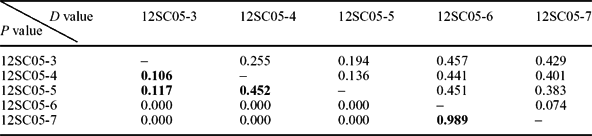
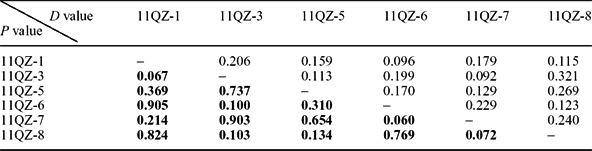
To determine whether these groups of samples had any provenance connections, we performed the Kolmogorov–Smirnov (K-S) test (Kolmogorov, Reference Kolmogorov1933; Smirnov, Reference Smirnov1944), in which probabilities (P values) > 0.05 indicate that the provenance of paired samples cannot be distinguished at a 95 % confidence level (Press et al. Reference Press, Flannery, Teukolsky and Vetterling1986; Berry et al. Reference Berry, Jenner, Meffre and Tubrett2001). The K-S test was first conducted on all paired samples within the sampling section, and then on paired sample groups that were possibly uni-sourced (with P values > 0.05 in the first-round test). The first-round results show that the P values for all three mid- to late-orogenic sample pairs from the Shuangming section are greater than 0.05, and the paired post-orogenic samples also yielded P values of greater than 0.05 (Table 2). However, all the mixing pairs of any mid- to late-orogenic sample with any post-orogenic sample yield P values of 0.00 (Table 2). This indicates that all three mid- to late-orogenic samples likely had a common provenance which was statistically different from the sources shared by the two post-orogenic samples. For the Xinqiao section, all the 15 pairs of mid- and late-orogenic samples yielded P values larger than 0.05 (Table 3), implying a common provenance for all six mid- to late-orogenic samples. All the samples were then divided into three groups based on their affinities of possible common provenances, and we ran a second round of the K-S test (Table 4). The results show that all paired sample groups yielded P values smaller than 0.05 (Table 4), implying that the provenances of the Shuangming mid- to late-orogenic sediments, the Shuangming post-orogenic sediments and the Xinqiao mid- to late-orogenic sediments are different from each other.
Two-sample Kolmogorov–Smirnov (K-S) test on the Ordovician–Devonian samples from the Shuangming section. The results reflect the input of both determined ages and errors for each zircon grain. Probability (P value) > 0.05 (in bold) indicates that the compared pair of samples cannot be statistically distinguished at 95 % confidence level. The software (K-S test 1.0.xls) used in this study is from the University of Arizona, USA.

Two-sample Kolmogorov–Smirnov (K-S) test on the Ordovician–Devonian samples from the Xinqiao section (Xu et al. Reference Xu, Du, Cawood, Zhu, Li and Yu2012).

Combined Shuangming–Xinqiao sections two-sample Kolmogorov–Smirnov (K-S) test on the Ordovician–Devonian samples. Note that 12SC05-3,4,5 is the Shuangming mid- to late-orogenic group; 12SC05-6,7 the Shuangming post-orogenic group; and 11QZ-1,3,5,6,7,8 the Xinqiao mid- to late-orogenic group.

Common provenance for the mid- to late-orogenic samples in the Shuangming section indicates that these detritus were likely transported continuously from similar source region(s) and/or involved recycling of local, older sedimentary rocks. A likely common source region is the northeastern Cathaysia Block (Fig. 1a), where topographic highs above sea level began to be present during Early Ordovician time along the Cathaysia coast (Liu & Xu, Reference Liu and Xu1994; Yao & Li, Reference Yao and Li2016), and expanded to much of the southeastern Cathaysia Block by Late Ordovician (Fig. 7a) and early Silurian (Fig. 7b) time. As a consequence, older sedimentary cover sequences (Cambrian and older) and crystalline rocks (the magmatic rocks of age 750–860 Ma and the basement rocks of age 1.77–1.89 Ga; Fig. 7e) were gradually exposed to the surface by erosion (Fig. 7a, b). The large 750–780 Ma zircon population from the interpreted mid-orogenic sample (Fig. 5a) reveals that there were probably abundant mid-Neoproterozoic rift successions and granitic intrusions (Fig. 1b) exposed to the surface during Late Ordovician time (Fig. 7a). The subordinate 920–980 Ma and 630 Ma zircon populations (Fig. 5a) are exotic signatures found in the Ediacaran–Cambrian sedimentary strata in South China (Yao et al. Reference Yao, Li, Li, Su and Yang2015), reflecting a contribution of recycled local Ediacaran–Cambrian strata that were uplifted and eroded. The minor 1.77–1.89 Ga zircon population (Fig. 5a) probably suggests either the exposure of a very limited Palaeoproterozoic basement during Late Ordovician time, or the recycling of Palaeoproterozoic zircons from pre-Ordovician sedimentary strata.
By early Silurian time, there are two prominent additions to the detrital age spectra: mid-orogenic (Ordovician) granitic plutons; and Archaean–Palaeoproterozoic ages from the metamorphic basement rocks. The appearance of the prominent 430–450 Ma zircon population in the late-orogenic sandstone samples (Fig. 5b, c) likely reflects the exposure of syn-orogenic plutons, which are widespread in the northeastern Cathaysia Block (Fig. 7b, c, e). The zircon Hf isotopes of these mid- and late-orogenic sediments are similarly distributed and suggest three major new crustal growth events at 0.8 Ga, 1.8 Ga and 2.5 Ga for the source region (Fig. 6), of which the former two episodes were locally supported by the 750–860 Ma bimodal magmatic rocks and 1.77–1.89 Ga crystallized basements, respectively. The 2.5 Ga crustal growth event is yet to be confirmed by Archaean outcrops; it could also be interpreted as imprints from the recycled Ediacaran–Cambrian strata, which are believed by some to have an external source region of northeastern Gondwana (Yu et al. Reference Yu, O'Reilly, Wang, Griffin, Zhou, Zhang and Shu2010; Yao et al. Reference Yao, Li, Li, Li and Yang2014, Reference Yao, Li, Li, Su and Yang2015).
The Xinqiao mid- and late-orogenic sandstones (Fig. 5f–h) largely mimic the provenance trend of the Shuangming samples (Fig. 5a–c), with a constant mid-Neoproterozoic age dominance and minor Archean – early Neoproterozoic peaks. Obvious differences between the two datasets are, in the Xinqiao samples: (1) early Palaeozoic populations do not show up in all the late-orogenic samples; (2) pre-1 Ga peaks are not as prominent; and (3) there is the presence of a more distinct 830–860 Ma zircon cluster (Fig. 5). Such differences likely reflect lateral variation of source region characteristics as well as varying degrees of denudation along the orogen.
The provenance of the Shuangming Upper Devonian sediments is characterized by the dominance of c. 440 Ma magmatic detritus (Fig. 5d, e), implying widespread exposure of syn-orogenic granites by that time (Fig. 7d, e). The negative Hf values of these c. 440 Ma zircons suggest that the eroded granitic plutons in the northern segment of the Wuyi-Yunkai orogen likely involved little mantle-derived materials (Fig. 6).
6.c. Topographic evolution of the northeastern segment of the Wuyi-Yunkai orogen
The Wuyi-Yunkai orogeny in South China is widely recognized as an intraplate orogeny (e.g. Li, Reference Li and Flower1998; Li et al. Reference Li, Li, Wartho, Clark, Li, Zhang and Bao2010; Wang et al. Reference Wang, Zhang, Fan, Zhang, Chen, Cawood and Zhang2010), possibly resulted from the far-field stress of the collision between South China and Indian Gondwana (Yao et al. Reference Yao, Li, Li, Li and Yang2014). With a lifespan of c. 80 Ma (from no later than Early Ordovician – late Silurian time), the orogeny produced the evolving Wuyi-Yunkai orogen and Nanhua foreland basin (Yao & Li, Reference Yao and Li2016). By late Silurian time, when the orogeny ceased, the Wuyi-Yunkai orogen covered most of the Cathaysia Block and a portion of the southeastern Yangtze Block. The depocentre of the Nanhua foreland basin migrated northwestwards during the orogeny, with the remnant, SW–NE-elongated foreland basin sitting along the southeastern Yangtze Block at the end of the orogeny (Fig. 1a). Whereas the bulk of the Wuyi-Yunkai orogen propagated to the NW by hundreds of kilometres during the orogenic event, the northeastern segment of the orogen did not propagate far into the hinterland (Fig. 1a) as evidenced by the lack of any deformation in regions NW of the Lizhu-Changshan thrust fault in the study region (Figs 1a, 2). Provenance analysis suggests that, during the mid- to late-orogenic stage, the foreland basin in northeastern South China was dominantly fed by detritus eroded from the uplifted Cathaysia coast zone of recycled Ediacaran–Cambrian sedimentary strata and middle Neoproterozoic rift-related volcanoclastic and magmatic rocks, with increasing contributions from the Cathaysia basement rocks and newly exposed mid- to late-orogenic granitic intrusions with time. After the Wuyi-Yunkai orogeny ceased to operate, much of the South China Block underwent a peneplanation process with mid- to late-orogenic granitic plutons widely exposed in the orogen, providing the predominant detrital source for post-orogenic successions. The contrasting Devonian stratigraphic records across the Lizhu-Changshan fault (Fig. 3) indicate that, during Late Devonian time, the Wuyi-Yunkai foreland fold-and-thrust belt SE of the Lizhu-Changshan fault was still on a residual palaeotopographic high above the sea level, therefore not receiving post-orogenic depositional cover until early Carboniferous time (Figs 3, 7d). However, by late Carboniferous time, the entire region of South China was covered by carbonate platform deposits (Liu & Xu, Reference Liu and Xu1994).
7. Conclusions
We analysed the contrasting tectonostratigraphic records across the Lizhu-Changshan fault in eastern South China and documented how the region to the SE of the fault was the foreland fold-and-thrust belt of the early Palaeozoic Wuyi-Yunkai orogen, whereas the region to the NW of the fault was a remnant foreland basin at the end of the orogenic event which experienced no early Palaeozoic deformation. The Lizhu-Changshan thrust fault therefore defines the northwestern margin of the northeastern segment of the Wuyi-Yunkai orogen. Regional sedimentary facies analysis further indicates that the Wuyi-Yunkai orogen in this region remained a topographic high during Devonian time, but the entire region was covered by carbonate platform deposition by early Carboniferous time, c. 60 Myr after the end of the orogenic event.
Provenance analysis of syn-orogenic sandstones from the remnant foreland basin reveals that, during the orogeny, there was a general increase of basement input and contributions from increasingly more widely exposed syn-orogenic granitic intrusions, although lateral variations are also obvious. Detritus for post-orogenic sandstones were dominantly supplied by the erosion of syn-orogenic plutons from the nearby residual topographic highs SE of the Lizhu-Changshan fault.
Acknowledgments
We thank H. Chen, F. Zhang and K. Zhu of Zhejiang University for help with the field trip; H. Ma of the Chinese Academy of Sciences for zircon mount preparations; Y. Yang and J. H. Yang of the Chinese Academy of Sciences for assistance with LA (MC)-ICP-MS analysis; and R. N. Mitchell for proofreading the paper. Constructive reviews by S. Hubbard and two anonymous reviewers greatly improved the quality of this paper. This study was supported by the Australian Research Council (DP110104799 and FL150100133). This is contribution 1011 from the ARC Centre of Excellence for Core to Crust Fluid Systems (www.ccfs.mq.edu.au) and a contribution to IGCP 648 (geodynamics.curtin.edu.au).
Declaration of interest
None.
Supplementary material
To view supplementary material for this article, please visit https://doi.org/10.1017/S0016756817000784