I. INTRODUCTION
It is not controversial to consider that the origins of Modern Portfolio Theory can be traced to articles published by Harry M. Markowitz (Reference Markowitz1952, Reference Markowitz1959), Arthur D. Roy (Reference Roy1952), and James Tobin (Reference Tobin1958), subsequently built upon by William F. Sharpe (Reference Sharpe1963, Reference Sharpe1964), John V. Lintner (Reference Lintner1965, Reference Lintner1969), Jan Mossin (Reference Mossin1966), and Fischer Black (Reference Black1972), who developed the Capital Asset Pricing Model (CAPM).Footnote 1 From then on, this theory and its developments have provided the foundations for various financial tools and innovations, despite the restrictive assumptions upon which they rest.Footnote 2 For instance, Modern Portfolio Theory takes for granted the rationality of risk-averse investors, who seek to maximize their utility function as defined by Von Neumann and Morgenstern (Reference Von Neumann and Morgenstern1944).
In his founding article, Markowitz (Reference Markowitz1952) focuses on the process of portfolio selection by investors and derives a decision rule partly from his reading of John Burr Williams ([1938] 1964) and his observation of investor behavior. According to Williams (1938), investors should build their portfolio with assets that maximize the discounted value of their future incomes. Markowitz considers that this rule would lead investors to select only the securities with the highest discounted value, and thus to build undiversified portfolios. On the contrary, it is undeniable that investors diversify their holdings in order to avoid risk: “Diversification is both observed and sensible” (1952, p. 77). According to Markowitz, portfolio diversification and maximization of the discounted value are not compatible. As a result, he draws a decision rule, both normative and positive, which takes both the risk and the expected return into account, focusing on the mean and the variance of the portfolio’s overall return: “Two uses of the E-V principle suggest themselves. We might use it in theoretical analyses or we might use it in the actual selection of portfolios” (1952, p. 91). In his article, completed in subsequent works, he graphically illustrates the implementation of this theory, using examples involving a limited number of assets and introduces the notion of “efficient E-V combinations.”Footnote 3 Depending on their aims in terms of return or of variance, investors are able to adjust the proportion of each type of asset in order to build an efficient portfolio.
Independently but similarly, Roy states that “the principle of maximizing expected return does not explain the well-known phenomenon of the diversification of resources among a wide range of assets” (1952, p. 431), and, thus, this principle cannot be accepted as a decision rule for investors. Yet, his reasoning is different, and Roy’s approach (1952) was later developed in an alternative approach to Portfolio Theory advanced by the proponents of behavioral economics.Footnote 4 Indeed, he introduces the notion of “disaster,” defined as a net loss or an income lower than the income that could have been reached if the capital had been differently employed. His reasoning was intended to reduce the probability of disaster. Yet, once the disaster probability has been minimized, the investor is free to invest his remaining wealth without following any particular rules. Lester Telser (Reference Telser1955) and Enrique R. Arzac and Vijay S. Bawa (1977) generalized the Safety First model, proposing a lexicographical approach. The first criterion is to reduce the probability of disaster below a given threshold (α). They subsequently add an additional criterion, the maximization of the portfolio’s expected return. If the first criterion cannot be fulfilled, minimizing the risk of disaster becomes the sole objective.
According to Franck Jovanovic (Reference Jovanovic and Poitras2007, Reference Jovanovic2008), the transformation of financial economics into a true scientific discipline in the 1960s was partly due to the transformation of economic phenomena—known for decades—into scientific facts, thanks to the use of mathematics and modern probability theory. Yet, the history of financial economics failed to recall its origins, and mostly focused on scholars who directly helped this transformation. For instance, the main chronological studies of the roots of Modern Portfolio Theory go back to 1935 and emphasize the revolutionary nature of the works published by Markowitz (Reference Markowitz1952) and Roy (Reference Roy1952). Fortunately, recent works trace the origins of financial economics.Footnote 5 They highlight many pioneering works such as those of three nineteenth-century authors, Jules Régnault, Henri Lefèvre, and Louis Bachelier, who discovered some of the most fundamental financial phenomena. Our article is a continuation of these works (Poitras [2006, 2007] and, more particularly, Jovanovic [Reference Jovanovic2006, Reference Jovanovic and Poitras2007], Jovanovic and Philippe Le Gall [2001], Preda [Reference Preda2006], and Dimand and Ben-El-Mechaiekh [Reference Dimand, Ben-El-Mechaiekh and Poitras2006]). Indeed, through the works of two famous nineteenth-century financial analysts, Paul Leroy-Beaulieu and Alfred Neymarck, we provide evidence that the benefits of diversification and the conditions for its correct implementation were already known before the First World War. In other words, we highlight that the fundamental notions and principles of Modern Portfolio Theory (hereafter MPT) had already been outlined by these two authors. The purpose of this article is to show that the contribution of these authors laid the foundations of the financial theory formalized later by Markowitz (Reference Markowitz1952) and Roy (Reference Roy1952). In this article, we establish the contribution of Leroy-Beaulieu (Reference Leroy-Beaulieu1906) and Neymarck (Reference Neymarck1913) to an “emerging theory of portfolio” and provide evidence that French investors at that time, following Leroy-Beaulieu and Neymarck’s advice, already knew the benefits of diversification and were able to hold diversified portfolios.Footnote 6 Our article is, therefore, a contribution to the renewed history of financial economics, in line with the works that have emphasized that the roots of financial economics should be traced back to the nineteenth century.Footnote 7 By rehabilitating the forgotten views of two financial analysts, Leroy-Beaulieu and Neymarck, writing at the beginning of the twentieth century, this article fills the gap between these early forerunners of the 1860s and the writings of John R. Hicks (Reference Hicks1935) and Williams (1938), who are designated by conventional wisdom as the ancestors of the portfolio approach. The more specific contribution of this article is to provide evidence that the writings of Leroy-Beaulieu and Neymarck account for an important step in the building of MPT and, consequently, that the origins of MPT should be traced back to the pre-WW1 period, not to the interwar period.
The article is organized as follows: the first section surveys conventional wisdom of the origins of financial economics and its remake: we first briefly recall the “canonical” history of financial economics according to Markowitz (Reference Markowitz1952).Footnote 8 We then address the first steps of a “science of investments” in nineteenth-century France, as revisited by Geoffrey Poitras (2006), Jovanovic (Reference Jovanovic2006, Reference Jovanovic and Poitras2007, Reference Jovanovic2008), Alex Pedra (2006), and Robert W. Dimand and Hichem Ben-El-Mechaiekh (2006). As a transition to the next section, we turn to the portfolio choices in nineteenth-century Great Britain and illustrate that Victorian investors already had advanced knowledge of the diversification principle. The second section is devoted to portfolio selection in France prior to WW1. After a brief presentation of some biographical elements about the authors under study, we assess some of the remarkably modern principles and notions Paul Leroy-Beaulieu and Alfred Neymarck detailed in their books: the notion of risk, the principle of capital and risk distribution they promoted, the notions of arbitrage, risk aversion, and risk premium. Our intention is to illustrate the great similarities between their discourse and the Modern Portfolio Theory expounded by Markowitz (Reference Markowitz1952). At the same time, we show that some of their analyses were also compatible with the Safety First principle developed by Roy (Reference Roy1952) and later completed by Telser (Reference Telser1955) and Arzac and Bawa (Reference Arzac and Bawa1977).
II. THE ESTABLISHED NARRATIVE OF THE ORIGINS OF FINANCIAL ECONOMICS
The “Canonical” History of Financial Economics…
Markowitz (2000, p. 36) recalls that Hicks (Reference Hicks1962) considered portfolio theory to be “a formalisation of an approach with which economists have been familiar since ... 1935.” Indeed, Hicks (Reference Hicks1935) gave a definition of diversification and considered a mean-variance approach to portfolio choices, but did not go on to develop the implications of correlation:
Where risk is present, the particular expectation of a riskless situation is replaced by a band of possibilities, each of which is considered more or less probable. It is convenient to represent these probabilities to oneself, in statistical fashion, by a mean value, and some appropriate measure of dispersion. ... In most cases, the ‘law of large numbers’ comes into play ..., so that the risk incurred by undertaking a number of separate risky investments will be less than that which would have been incurred if the same total capital had been invested altogether in one direction. When the number of separate investments is very large, the total risk may sometimes be reduced very low indeed.... By dividing up his capital into small portions, and spreading his risks, [an investor] would be able to insure himself against any large total risk on the whole amount. (1935, pp. 8–9)
When Markowitz (Reference Markowitz1999) traces the early history of Portfolio Theory, he refers to Shakespeare’s Merchant of Venice to show that diversification was already a famous principle in the sixteenth century but limited to the maxim “Don’t put all your eggs in one basket.” He goes on to acknowledge the work of Hicks (Reference Hicks1935, Reference Hicks1962), Jacob Marschak (Reference Marschak1938), and Williams (1938). Yet, between the sixteenth century and 1935, there is a gap to fill. There is no doubt that in the nineteenth century, a period of great expansion and modernization of the main financial centers, investors and financial analysts developed methodologies that were more elaborate than this aphorism.
Financial economics was recognized as a “true science” linked to economics during the 1960s (Jovanovic Reference Jovanovic and Poitras2007, Reference Jovanovic2008; Bernstein 1995). According to Jovanovic (2007; 2008, p. 215), this acknowledgment was possible for three main reasons. First, economists brought theoretical explanations to statistical and empirical outcomes gathered over the previous decades.Footnote 9 Second, economists working in finance organized themselves in a “scientific community” during the 1960s within the MIT and by the creation of the Chicago for Research in Security Prices (CRSP), and disseminated their outcomes through scientific journals such as the Journal of Finance and the Journal of Business. Finally, it was the synthesis of all the outcomes, among them Modigliani and Miller’s theorems, the CAPM and the efficient market theory, into a homogeneous theory that was the last step enabling the emergence of financial economics as a new science.
However, the history of financial economics is not homogeneous, and the “canonical” history occulted some parts of it. For instance, Jovanovic (Reference Jovanovic and Poitras2006a, Reference Jovanovic2006b, Reference Jovanovic2008) pointed out two missing contributions: those of Jules Régnault and Irving Fisher.Footnote 10 It also missed the fact that Bachelier’s outcomes were known by mathematicians and some economists prior to Jimmie Savage’s postcard.Footnote 11 In fact, this history, which was nevertheless broadly related or expanded, did not take into account many works prior to 1960, and when this “canonical” history does go back to Bachelier, it is to consider him as an isolated and unknown genius.Footnote 12 The established narrative of financial economics focuses on the outcomes of Markowitz (Reference Markowitz1952) and Roy (Reference Roy1952), then switches to the works of economists of the CRSP such as Eugene F. Fama, Harry V. Roberts, Franco Modigliani, and Merton Miller, etc.
Recent works have revisited this “canonical” history and exhibited the importance of pioneering works going back to the nineteenth century. The next subsection briefly outlines the pioneering contributions of three nineteenth-century forerunners: Régnault (Reference Régnault1863), Lefèvre (1870), and Bachelier (Reference Bachelier1900, Reference Bachelier1912). In the premises of financial economics, these three authors stand out, each of them recognized henceforth for having initiated a particular stream of the theoretical corpus of financial mathematics: respectively, probability calculus and random walk, options’ payoff profiles, stochastic calculus and Brownian motion.Footnote 13
… Recently Revisited: The First Steps of a “Science of Investments” in Nineteenth-Century France
If random walk was established as a scientific hypothesis during the 1960s by the financial theoretical corpus, Jules Régnault was the first to introduce, in his 1863 treatise Calcul des chances et philosophie de la Bourse, the notion of probabilities as applied to investments and the first to describe stock price movements according to this law.Footnote 14 This work is of the greatest interest since it states the basis of one the most important financial economics models—the random walk hypothesis—which seems to have been taken over by Bachelier (Reference Bachelier1900, Reference Bachelier1912) (Jovanovic Reference Jovanovic2006). Régnault extended Adolphe Quételet’s research program: he applied probability theory to the new field of finance (Jovanovic Reference Jovanovic and Poitras2006b, pp. 195–196). His aim was to build two models to scientifically demonstrate, using random walk, that gambling was not profitable and that only “sane” speculation was desirable.
Seven years after Régnault’s treatise, another pioneering work was published by Henri Lefèvre: Traité théorique et pratique des valeurs mobilières et des opérations de bourse (1870). Lefèvre made an attempt to theorize finance by integrating it into a general economic model.Footnote 15 His approach is determinist and proceeds by analogy: he compared society with the human body (considered as the most perfect natural creation).Footnote 16 In this society “as a body,” speculation and forward markets are useful since they favor market efficiency. The faster an operator can establish his accounting situation, the faster he can change its position on the market and the more efficient is the market. But, as the Stock Exchange has to handle a growing number of securities and goods, operations are becoming more and more complex. Thus, operators need a tool to instantaneously and easily check their payoff profile, whatever the complexity of their transactions. Lefèvre then suggested a specific alphabet for financial markets coupled with graphs representing the payoff function of operators, whatever the combination of operations set.Footnote 17 These tools were supposed to lower the “response times to market fluctuations and speed up the flow of transactions, thus improving the circulation of goods and, beyond that, the functioning of the economy as a whole” (Jovanovic Reference Jovanovic2006a, p. 184). These graphs representing securities’ payoff profile at maturity are still known and used nowadays for call/put options.
Ultimately, Louis Bachelier was another undervalued author but recent research has emphasized his noteworthy contribution: “Bachelier’s thesis is now recognized as ‘the origin of mathematical finance and of several important branches of stochastic calculus such as the theory of Brownian motion, Markov processes, diffusion processes, and even weak convergence in functional spaces. Of course, the reasoning was not rigorous but it was, on the intuitive level, basically correct’” (Courtault et al. 2000, p. 344, quoted by Dimand and Ben-El-Mechaiekh Reference Dimand, Ben-El-Mechaiekh and Poitras2006, p. 226).
Bachelier (Reference Bachelier1912) was also a pioneer because he applied his theories to the Paris financial market. Recent works defend the view, conversely to Bernstein (1995), that Bachelier has never been completely forgotten or isolated.Footnote 18 Jovanovic (2012) relates that his works were increasingly quoted between 1912 and 1923 (except during the First World War) and still mentioned between 1924 and 1960, albeit less frequently. Jovanovic (2012, p. 439) explains that until the 1950s, Bachelier’s works were used by mathematicians working on the development of the modern theory of probabilities. For instance, they directly inspired Kolmogorov’s works (1931).Footnote 19 Moreover, in 1922, during a statistical mathematics conference, his works were presented by the mathematician Arne Fisher, who suggested that economists should use them to analyze “business cycles” (Jovanovic 2012, p. 440).
The explanation for the lack of interest among economists in Bachelier’s works until the 1950s and the “rediscovery” of Jimmie Savage may be related to the fact that, before the 1960s and the creation of the American probability school, economists had no advanced education in probability. This might be one of the reasons why financial economics was unable to develop earlier in its modern form (Jovanovic 2012). Nevertheless, it is a fact that many basic notions of stochastic calculus were already present in Bachelier’s work (Dimand and Ben-El-Mechaiekh Reference Dimand, Ben-El-Mechaiekh and Poitras2006).
We recalled above that these three nineteenth-century authors alone brought many fundamental hypotheses that are now of common use in financial economics (notably random walk, stochastic calculus, the graphical representation of options’ payoff profile). But economics had waited for decades before integrating these hypotheses into its theories. We argue that the same comment is also valid for Leroy-Beaulieu and Neymarck’s works (see the following section): we consider that the fundamental notions and principles of the Modern Portfolio Theory and, more particularly, of the diversification principle were already outlined by these two authors at the beginning of the twentieth century. They put the emphasis on economic phenomena, which were transformed into scientific facts fifty years later by Roy (Reference Roy1952) and Markowitz (Reference Markowitz1952). As a transition to the assessment of their own contribution, we first recall the clues to an early understanding of diversification principles in Great Britain (Lowenfeld, Reference Lowenfeld1907).
“Geographical Distribution of Capital” (Lowenfeld, Reference Lowenfeld1907) and Portfolio Choices in Nineteenth-Century-Great Britain
William N. Goetzmann and Andrey D. Ukhov (2006) and Elaine Hutson (Reference Hutson2005) have shown that, at the turn of the nineteenth century, British investors already had a pretty modern way of considering their investments. Indeed, Goetzmann and Ukhov (Reference Goetzmann and Ukhov2006) recall the main developments of Henry Lowenfeld’s book (1907), Investment, An Exact Science, in order to reveal just how aware Victorians were of the benefits of international diversification.
In the introduction to Lowenfeld’s book (1907, pp. vii-viii), the editor contended that, as shown by Lowenfeld himself, “the only means for insuring permanent investment success consists in the adoption of a true and systematic method of averaging investment risks.” He added that “it has been theoretically and practically proved” that this system can be reached by implementing the “Geographical Distribution of Capital.”Footnote 20 Lowenfeld (Reference Lowenfeld1907) referred to the market price history of twelve British shares between 1893 and 1906 to show a high level of co-movement between these shares as proof that “market influence” existed.Footnote 21 He argued that three major forces influence the value of stocks, the two most significant being “capital security” and the “income producing power” of each stock. He defined “Market influence” as the “influence … prevalent on the stock exchange where the securities are either solely, or mainly, dealt in” (p. 21). According to him, this Market Influence is linked to the trade influence of the country.
Lowenfeld (Reference Lowenfeld1907) set “The geographical distribution of capital” as follows: “If an investor divides his capital equally among a number of stocks, every one of which is under a different trade influence, then each of these divisions of his capital will constitute a distinct investment risk, and a true system of averaging investment risks is thereby established” (Lowenfeld Reference Lowenfeld1907; p. 51, Goetzmann and Ukhov Reference Goetzmann and Ukhov2006, p. 22). According to the author, implementing this method allows the investor to obtain a higher return for the same level of risk as that of a domestic portfolio. The book provides evidence of the sophisticated way in which Victorians invested.
Moreover, Elaine Hutson (Reference Hutson2005) recalls that investment trusts are a British financial innovation – the first investment trust, the Foreign and Colonial Government Trust, having been launched in Great-Britain in 1868. Its main selling point was to allow each investor, and in particular those of smaller means, to hold a diversified portfolio. Potential investors could read the following assurance in the Trust’s prospectus: “The object of this trust is to give the investor of moderate means the same advantages as the large capitalist, in diminishing the risk of investing in Foreign and Colonial Government Stocks, by spreading the investment over a number of different Stocks… [with] no more than £100,000 being invested in the stock of any one government” (Scratchley Reference Scratchley1875, pp. 12-13). The publicity material issued by such trusts usually contained a written promise that no more than 3% to 10% of the trust’s investments would be invested in the same stock. For example, the Foreign and Colonial Government Trust was composed of nineteen different securities issued by fifteen different countries.Footnote 22 No fewer than twenty-three investments trusts were launched during the seven years following the creation of the first investment trust, with a market capitalization of more than £ 32 million which represented around 0.6% of the total market capitalization of the London Stock Exchange (Scratchley Reference Scratchley1875, p. 8). Between 1874 and 1876, with the market in recession, many investment trusts defaulted. In 1879, a group of shareholders sued the trustees of the Governments and Guaranteed Securities Permanent Trust. The judgment ruled that these investment trusts were illegal, so many of them became companies. This decision was nevertheless overturned on appeal, and although a great number of investment trusts had incorporated, they retained the “investment trust” tag.Footnote 23 The number of investment trusts grew in the 1880s. According to John F. Fowler (Reference Fowler1928), there were at least fifty-five investment trusts in Great Britain in 1890, showing the popularity of such trusts and, consequently, of the forerunner of the principle of diversification.
This discussion proves that the overseas investments of Victorian investors were motivated by the desire to hold an internationally diversified portfolio.
III. PORTFOLIO SELECTION IN FRANCE PRIOR TO WORLD WAR ONE: DIVISION OF CAPITAL AND RISK BY LEROY-BEAULIEU AND NEYMARCK
We now examine Leroy-Beaulieu and Neymarck’s works.Footnote 24 They are particularly relevant because they prefigure Modern Portfolio Theory and the diversification principle, as later defined by Markowitz (Reference Markowitz1952) and Roy (Reference Roy1952).
The Contribution of Two French Financial Analysts: Paul Leroy-Beaulieu (Reference Leroy-Beaulieu1906) and Alfred Neymarck (1913)
We focus on two books: L’art de placer et gérer sa fortune (Leroy-Beaulieu Reference Leroy-Beaulieu1906) and Que doit-on faire de son argent ? (Neymarck Reference Neymarck1913). We have chosen these works because they were the go-to reference volumes for anyone wishing to invest on the Paris Stock Exchange. They were still frequently cited as models in the interwar period and also represent the work of two of France’s most renowned pre-war financial analysts.Footnote 25 Paul Leroy-Beaulieu (1843–1916) was a distinguished French economist. The author of many books, mostly dealing with the “political economy,” he launched and managed the journal L’Economiste français from 1873 onwards. He became a member of the Académie des Sciences Morales et Politiques in 1878 and of the Collège de France after the death of Michel Chevalier in 1880. Alfred Neymarck (1848–1924) also published many works in the field of political economics. He founded the journal Le Rentier in 1869 and was a member (and subsequently president, in 1898) of the Société de Statistique de Paris.Footnote 26
These books were written on the eve of the First World War. The Paris Stock Exchange was the world’s second-largest financial center after London, exporting huge amounts of capital. Access to the Stock Exchange was open to people from all walks of life, even those of smaller means.Footnote 27 Consequently, Leroy-Beaulieu (Reference Leroy-Beaulieu1906) and Neymarck (Reference Neymarck1913) pitched their handbooks to a lay audience. This may be one of the reasons why there is no mathematical formalization in these works, since most French investors had no advanced education in mathematics and statistics. During the nineteenth century and the beginning of the twentieth century, there were intense debates about the use of mathematics and probabilities in political economics. Classical economists (pro-market), in line with Jean-Baptiste Say, rejected the use of advanced mathematics. Leroy-Beaulieu and Neymarck were part of this mainstream.Footnote 28 But, despite this absence of mathematical formalization, the discourse of these authors was very modern and introduced ideas for which we can easily find mathematical equivalents.
The financial books we consider in this article are probably the most famous ones published before World War One and the first to give French investors such detailed advice in order to guide their investments. The interwar period was characterized by the spread of technical innovations that allowed for more rapid transmission of information. From then on, authors (Cavelier Reference Cavelier1934, Donner Reference Donner1941) continued to refer to diversification but they also discussed alternative portfolio-selection methodologies.Footnote 29 They sometimes criticized diversification as an overly static way to select securities. Most of these authors were more concerned with security price determination than portfolio-selection methodology. Thus, it seems that the end of the nineteenth century and the beginning of the twentieth century were something of a Golden Age for the diversification principle in France.
The contributions of Paul Leroy-Beaulieu (Reference Leroy-Beaulieu1906) and Alfred Neymarck (Reference Neymarck1913) enable us to show that the beginnings of Modern Portfolio Theory ought to be traced back to nineteenth-century France. In this article, we provide evidence that French investors had a modern approach to their investments and that this was in line with economic rationality and Modern Portfolio Theory. Clearly, the founding articles of Modern Portfolio Theory (Markowitz Reference Markowitz1952 and Roy Reference Roy1952) are mathematical formalizations; i.e., the mathematical tools for ideas that were already common currency in France by the end of the nineteenth century.Footnote 30
The Notion of Risk and the Discrimination between Systematic and Idiosyncratic Risks
Since Markowitz (Reference Markowitz1952), portfolio theory has measured the risk of an asset by the variance of its returns. It also assumes that the value of every asset is influenced by two types of risk: a specific or idiosyncratic risk determined by the characteristics of the asset itself, and a systematic risk dependent on the market in which it belongs. The diversification principle suggests that a well-diversified portfolio no longer carries any specific risk because diversification enables the specific risk of the assets to be eliminated via imperfect correlation. Only the systematic risk cannot be eliminated. Consequently, by introducing assets that are non-correlated, imperfectly or inversely correlated to the market, investors reduce the overall variance of their portfolio without reducing their expected payoff.
The notion of risk as presented by Leroy-Beaulieu (Reference Leroy-Beaulieu1906) and Neymarck (Reference Neymarck1913) is highly compatible with the above definition. Indeed, the fundamental idea of the form of capital distribution that they championed is to protect French investors from default risk and price drops. Thus, Neymarck (Reference Neymarck1913) advised investors to select stock that cannot suffer a drop simultaneously so that, in case of need, they can sell some without suffering a loss in capital. He illustrated this method by comparing the composition of a portfolio to the manufacturing of the pendulum of a clock:
To make a scientific comparison, we might say that a portfolio should be constituted in much the same way as a pendulum is manufactured, that vital instrument designed to ensure the regular working of our clocks. The pendulum, to be perfect, must have a fixed length, resistant to the many changes in temperature which will threaten to constantly lengthen or shorten it. Its shape and composition are therefore designed so as to avoid these drawbacks and to maintain a practically constant length. Similarly, a portfolio should be composed of stocks of different sorts which will not be influenced in the same way by a given event and for which, on the contrary, the fall in price of certain stocks would be, as far as possible, counterbalanced by the simultaneous increase of the price of other stocks, in order to ensure that the portfolio’s value remains more or less constant (1913, pp. 351–352).
Since variance is a measure of dispersion, we can make an obvious connection with the work of Markowitz (Reference Markowitz1952, Reference Markowitz1959), who states that, for a given mean, investors minimize the variance of their portfolio’s return.
Neymarck (Reference Neymarck1913) recommended that investors should seek to hold a diversified portfolio in order to minimize the risk of default and to avoid high variations in their portfolio’s value (see the following sub-section). Looking for a portfolio with approximately constant income and value is nothing but looking for a portfolio with the least possible dispersion of returns; i.e., the minimum variance for a given return.
Markowitz also draws a link between ideas generally applied to financial markets and the mathematical notions embodied in the E-V decision rule: “The concepts ‘yield’ and ‘risk’ appear frequently in financial writings. Usually if the term ‘yield’ were replaced by ‘expected yield’ or ‘expected return,’ and ‘risk’ by ‘variance of return,’ little change of apparent meaning would result” (1952, p. 89).
If the discrimination between systematic and specific risks comes from the descriptions of Leroy-Beaulieu (Reference Leroy-Beaulieu1906) and Neymarck (Reference Neymarck1913) with regard to the distribution of capital, the latter provides an even more precise indication of how these two risks were understood.
Neymarck (1913, p. 357) explained that the division of capital cannot avoid all risks, but can reduce them to a minimum. He also explained why a domestic diversification or a simple increase in the stock held in a portfolio are not enough to efficiently reduce risk, distinguishing the risk of “general scale” and the risk of “inside scale”:
If an investor places his wealth in stocks which are different but which all belong to the same category - government loans for example, or industrial or mining stock - he will have succeeded in dividing up his holdings, but he will have only slightly reduced the level of risk attached to his portfolio. Indeed it remains possible that any event on a general scale which would cause the value of stock in this category to fall would also engender capital losses on all other values held in this same category. We say ‘events on a general scale’ because there are, and this is certain, specific circumstances that could cause the decrease of the stock value of one specific company without the stock of other similar companies being affected. It is only those particular risks, of inside scale, that would be reduced by an investment in several stocks within the same category. (1913, p. 357)
The terminology chosen by Neymarck in this explanation—respectively, risks of general and of inside scale—echoes what is nowadays known as systematic and specific risk.
The Distribution of Capital: A Clear Understanding of the Implications of Correlation
Markowitz (Reference Markowitz1952) explains the benefits of diversification and its implications as follows:
Not only does the E-V hypothesis imply diversification, it implies the “right kind” of diversification for the “right reason”. The adequacy of diversification is not thought by investors to depend solely on the number of different securities held. A portfolio with sixty different railway securities, for example, would not be as well diversified as the same size portfolio with some railroad, some public utility, mining, various sort of manufacturing, etc. The reason is that it is generally more likely for firms within the same industry to do poorly at the same time than for firms in dissimilar industries.
Similarly in trying to make variance small it is not enough to invest in many securities. It is necessary to avoid investing in securities with high covariances among themselves. We should diversify across industries because firms in different industries, especially industries with different economic characteristics, have lower covariances than firms within an industry. (1952, p. 89)
This demonstration is very similar to those of Leroy-Beaulieu (Reference Leroy-Beaulieu1906) and Neymarck (Reference Neymarck1913). These authors are even more innovative and foresee Bruno Solnik’s (Reference Solnik1974) outcomes when they promote international diversification while Markowitz focuses only on diversification among various domestic industries.
Neymarck expressed his faith in the international diversification of portfolios: “We believe that there is a rational method for distributing investments, which consists of offsetting the risk of possible decreases with the probability of capital gains” (1913, p. 352). For the risk compensation to be effective, he points out, investments must be distributed across stocks of many different types (government bonds, stocks of railway companies or various companies) and from many different countries:
For risk division to be effective there must be several placements of different types: national or local government loans, railway stock, various industrial companies, and so on. Dividing his capital between several types of stocks enables the investor to avoid risks resulting from the bankruptcy of an individual debtor or from the failure of a specific enterprise. But this is not enough. All stock from a given country could, at any given time, be the object of a significant decrease or could become very difficult to sell if this country was at war, for example. This is why the division and decrease of risk should be carried out by distributing investments across stock from various countries. In doing so, investors can be more or less certain that all the stock they hold will not lose value at the same time and in similar proportions. (1913, p. 348)
Thus, the idea is that the securities selected should be the ones for which the value is likely to fluctuate differently; i.e. imperfectly correlated securities.
Leroy-Beaulieu (Reference Leroy-Beaulieu1906) considered this “division of capital” as an “insurance against risk,” which can offset risks:
The division of capital acts as an insurance against risk, if we take ten, fifteen or twenty values, especially values that are not of a similar nature and which were issued by different countries. It is very rare, indeed it has never happened, that all of these values should be affected by the same calamity at the same time. There is in this case a risk offsetting, inferring that such a diversified portfolio will not see its value drop as the French rente did during the Franco-Prussian War, from which many years were needed to recover completely. (1906, p.92)
Like Neymarck (Reference Neymarck1913), Leroy-Beaulieu (Reference Leroy-Beaulieu1906) stressed that composing a portfolio of several securities is not enough. Investors must select securities of various types, from a variety of industries and countries.
Both authors also stress the necessity of international diversification: “This distribution is still not enough; investments must be distributed between stocks from various countries in order to avoid excessive exposure to a drop which might hit all the stock of a given country” (Neymarck Reference Neymarck1913, pp. 357-358).
Neymarck (Reference Neymarck1913) also defined what he considered as an international stock: a value traded on several stock exchanges, labeled in several currencies, and whose revenues and/or amortizing are paid in different currencies. These international stocks have big advantages because their market is wider. Moreover, contrary to stock traded on one market, which is subject to this market evolution, for international stock, a fall on one market can be moderated by the evolution of its price on other financial markets. They are, therefore, a key component of an efficiently diversified portfolio.
The Awareness of Arbitrage: Arbitrage between Two Financial Centers
One fundamental assumption of Modern Portfolio Theory is the Absence of Arbitrage Opportunity. This means that, except in the very short term, no gain is possible without risk and initial investment.
It seems that the notion of arbitrage had been mentioned for some time. Jules Régnault (Reference Régnault1863), for instance, refers to “arbitrages system”: “one buys a security and sells another one at the same time; the profit realized on one side is absorbed by the loss on the other side…” (1863, p. 40). Nevertheless, there is no sign of a true definition before Neymarck’s (Reference Neymarck1913) explanation of what constitutes an arbitrage opportunity between two markets:
A purchase will be risk-free only if accompanied simultaneously by the sale of the same stock for a corresponding amount, so that the buyer is never in a short position at any moment. Similarly, a sale is considered risk-free only if balanced by a simultaneous purchase. Obviously, such simultaneous purchases and sales would be of no interest if made on the same market because they would have been bought and sold at the same price; hence it would be a ‘neutral transaction’. A purchase and a sale can only be conducted at the same time, and with a market price difference that yields a profit, by using two different financial markets; this combination is called arbitrage. (1913, pp. 265-266)
Neymarck explains precisely what an arbitrage opportunity is and seems to consider its existence on a short-term basis. Yet, he offers no opinion on the existence of arbitrage opportunities in the long run.
The Depiction of Risk Aversion and Risk Premium
Like Markowitz (Reference Markowitz1952) and Roy (Reference Roy1952), Modern Portfolio Theory assumes that investors are risk averse: “We … consider the rule that the investor does (or should) consider expected return a desirable thing and variance of return an undesirable thing” (Markowitz Reference Markowitz1952, p. 77). In this context, risk aversion can be defined by the fact that, to be accepted by an investor, an additional risk measured by variance of return should be compensated by additional return. Likewise, risk premium can be viewed as the additional return of a risky asset compared to the return of a risk free asset. For Markowitz (Reference Markowitz1952), investors implement diversification in order to avoid risk: “Clearly, investors diversify to avoid risk” (2002, p. 154).
There are, in the works of our French financial analysts, the clues to a clear understanding and picturing of risk aversion and of the resulting risk premium.
Both authors, Leroy-Beaulieu and Neymarck, developed a ranking of stocks, distinguishing between sound investments, stock providing additional income, and speculative stock.Footnote 31 Leroy-Beaulieu (Reference Leroy-Beaulieu1906) explained that there are three qualities securities must possess to be considered as sound investments: they must be stable, relatively secure, and liquid. In other words, income has to be regular, the market price stable, and the stock easy to negotiate. According to him, sound investments are mainly composed of: French and British government funds; also and even if less liquid, the government debentures of Belgium, Switzerland, The Netherlands, Scandinavia and Egypt; the French colony bonds guaranteed by the French government; the bonds of big French companies, French municipalities, French Crédit Foncier, and Austrian railways; and the bonds of five, big, US railway companies. Leroy-Beaulieu admitted that “the drawback of these stocks is their low income” (1906, p.79).Footnote 32 Thus, he introduced the “stock for additional income” that he considered as “a wide and interesting category.” Indeed, Leroy-Beaulieu felt sure that these stocks, “exposed to more vagaries than our sound investments,” could boost the average income of a portfolio and were “likely to see capital gains” (1906, pp. 75, 81-82). Leroy-Beaulieu clearly illustrates the link between higher risk and higher expected return. The author considered as part of this category the “second class” government bonds, such as those from Austria, Russia, Italy, Brazil, China, and Japan.Footnote 33 He also included the bonds of most of the foreign railway companies, bonds of thriving foreign industrial companies, and the shares of French railway companies. Finally, he advised his readers to leave the “speculative stock” to specialists:
“We classify in this category [those stocks] which, on account of prevailing conditions in their country or because of the conditions of the company itself, are subject to numerous vagaries” (1906, p.84). “This group of speculative or particularly unpredictable stock, with income and market prices which can vary significantly depending on economic circumstances, is in itself very interesting” (1906, p.85). “This huge category of speculative and unpredictable stock, full of life and of movement, is the one which most seduces the general public. It makes a few rich; but on the other hand it ruins a lot of scatterbrained and foolhardy investors” (1906, p. 87). These three categories of investment are ranked according to their level of risk and their expected return: the higher the expected yield, the riskier the securities. Beyond this classification, we run once more into the principle of remuneration of risk and the attendant specters of risk aversion and risk premium.
For Leroy-Beaulieu (Reference Leroy-Beaulieu1906) and Neymarck (Reference Neymarck1913), the risk investors can shoulder is a function of their wealth. Both seemed to believe that risk aversion decreases when wealth increases. Indeed like Leroy-Beaulieu, Neymarck developed a classification of investors according to their financial means, considering that the greater their means, the more they could shoulder risk:
Workers who want to invest their savings, small rentiers who only own the resources needed for their existence, have to restrict their investments to the most secured assets and put, if necessary, this imperative condition before the importance of return. … The capitalist and the rentier of larger means are not bound by the same restrictions which affect those of smaller means… their greater wealth allows them, up to a certain limit, to tolerate certain vagaries and justifies the distribution of their holdings across several classes of assets, as long as they divide and distribute their risks carefully. (1913, p. 286)
This idea is very similar to the principle of Decreasing Absolute Risk Aversion, which forms the basis for the economic theory of uncertainty (Pratt Reference Pratt1964, Arrow Reference Arrow1971), which states that the higher the wealth, the lower the risk aversion degree of risk-averse agents.
Like Leroy-Beaulieu, Neymarck distinguished several categories of investors: the “small rentiers, small capitalists” “the middle class”; “the well-off” investors; and “the rich” investors.
Both authors suggest various portfolio compositions, depending on the risks investors can or are willing to incur and on their liquidity preference; i.e. depending on the category to which they belong.Footnote 34
The proportion of sound investments in a portfolio depends on the holder’s situation. The mass of investors of small and medium means, who have little information, technical knowledge and savings and who can incur no risk, would do well to invest their whole wealth or at least four fifths of it in sound assets. … Categories of capitalists who don’t have [to worry about their liquidity needs] and who have enormous wealth, high incomes, with regular and substantial savings, can incur more risk and vary their investments by reducing, not to four fifths but to two thirds or to half and more exceptionally to a third, the proportion of sound investments in their portfolio. (Leroy-Beaulieu Reference Leroy-Beaulieu1906, p. 79)
To investors of small and medium means, he recommended devoting a minimum of four-fifths of their portfolio to sound investments and no more than 20% or 25% to stocks for additional income. The investors with more capital could devote up to half of their portfolio to fundamental and additional stock but should carefully select the speculative stocks in limited quantities.
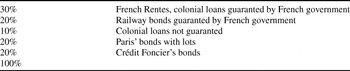
Neymarck (Reference Neymarck1913) gives even more precise suggestions about the structure of the portfolios best suited to different investors (Tables 1, 2, 3 and 4): “Small investors and small capitalists should only put their money into investments that may be called totally secure; we mean the government bonds, local or French colony loans, the Crédit Foncier or French railway bonds” (1913, pp. 365-366).
List of investments suggested for “small investors”

Source: Neymarck Reference Neymarck1913, p. 365.
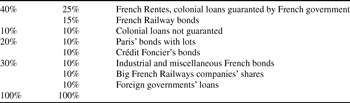
These investors of small means are not the same as those considered by Leroy-Beaulieu (1913), who seem to fall into the category of Neymarck’s “middle-class” investors. To those investors, Neymarck’s list of assets (Table 2), if slightly different, is nevertheless consistent with the advice of Leroy-Beaulieu.
List of investments suggested for “middle class investors”

Source: Neymarck Reference Neymarck1913, p. 372.
As we can see, these investors already had a reasonably diverse range of investment opportunities if they followed the advice of these two financial analysts. Here, the base makes up 70% of the suggested portfolio and, contrary to the assertions of Leroy-Beaulieu (Reference Leroy-Beaulieu1906), even foreign government loans are seen as too unpredictable to be considered as of very low risk. A portfolio management methodology similar to the Safety First principle (see Introduction) emerges from the advice of these two authors. It consists in guaranteeing a safe base, composed of relatively secure assets, and adding more volatile stock to increase portfolio income without altering the overall capital: “The base must always be composed of stock of much lower risk; other securities should remain a marginal part of the portfolio, this part being distributed among a large number of various stocks. Otherwise, the holder would be exposed to serious disappointments.”Footnote 35 This suggests Roy’s Safety First principle (1952) and its further developments in behavioral financeFootnote 36:
the following lexicographic form of the Safety First principle:
max(π, μ),
where  $\pi {\rm{ = 1 if }}P{\rm{ = }}Pr{\rm{\{ }}Y \le s{\rm{\} }} \le {\rm{a,}}$
 $\pi {\rm{ = 1-}}P{\rm{,otherwise,}}$
and  ${\rm{\mu }} = E(Y).$
Y is the random value of final wealth in a single-period choice situation, E is the expectation operator, s is the critical level of wealth, and α is the admissible probability of failure. (Arzac and Bawa Reference Arzac and Bawa1977, pp. 277-278)
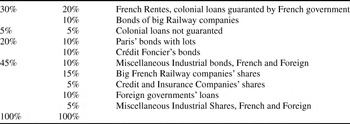
List of investments suggested to “well-off investors”

Source: Neymarck Reference Neymarck1913, p. 377.
In the list of investments suggested to “well-off investors” (Table 3), the “safe” base is reduced to 55%, as a result of a greater capacity to face additional risk.
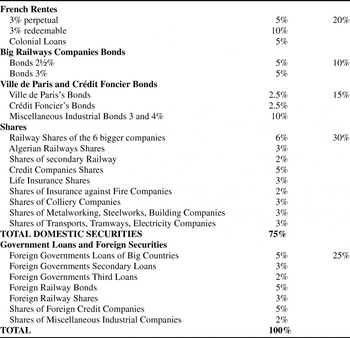
According to Neymarck (Reference Neymarck1913), the “safe” base of the portfolio suggested to richer investors is reduced to 45%, and 25% of this portfolio, which consists of foreign stock (Table 4). Once again, this shows that this author considered the fact that the wealthier the investor, the lower his risk aversion. In terms of the Safety First approach, this could just mean that the disaster probability’s threshold (α) is greater for richer investors.
list of investments suggested to investors “with large fortunes”

Source: Neymarck Reference Neymarck1913, p. 377.
Moreover, Neymarck (1913, pp. 292 and 364) clearly expressed the link between risk and return when he wrote that “stock providing higher income … should represent more risk” and that “gilt-edged stocks cost more and make less money when their degree of risk is lower.”Footnote 37
The classification of investors according to the risk they can shoulder and the portfolio suggestions for each category of investors show that these analysts already considered the portfolio as an independent whole. Its composition was considered only in terms of risk/return trade-off.
It is fascinating to see the extent to which these two authors, writing in the earliest days of financial theory, shared the vision Markowitz (Reference Markowitz1952) and Roy (Reference Roy1952) would subsequently develop further with the use of mathematical tools.
IV. Conclusion
This article is in line with seminal works that supplement the incomplete “canonical” history of financial economics. We have found a strong connection between the writings of Leroy-Beaulieu (Reference Leroy-Beaulieu1906) and Neymarck (Reference Neymarck1913) and the founding article of Markowitz (Reference Markowitz1952). Obviously, key differences remain between these works: Markowitz’ goal is both normative and positive, whereas Leroy-Beaulieu and Neymarck simply sought to guide French investors’ portfolio choices. In accordance with customary practices and their target readership, the works of Leroy-Beaulieu and Neymarck are purely literary, with occasional calculations but no advanced statistics. Conversely, Markowitz’s seminal article (1952) explains the concepts in literary terms but also introduces mathematical interpretations and rules now commonly used in finance.
Like Markowitz, who notes that diversification was common practice on the financial markets, Leroy-Beaulieu observed that the policy of division of capital was widely used by all the great financial institutions that were “well managed and thriving.” He outlined the example of the portfolio of the Banque de Paris et des Pays-Bas, which was composed of 34 different government funds, 278 different shares, and 46 categories of bonds.Footnote 38 Leroy-Beaulieu (Reference Leroy-Beaulieu1906) also mentioned an article from The Times, dated 12 September 1904, which caused a sensation, as its subject was the geographical distribution of capital. In this paper, the ex-post variations of a British domestic portfolio and an internationally diversified portfolio between 1897 and 1904 were compared. The values of the domestic portfolio declined by 17%, while the value of the international portfolio increased by 2% with its income being higher.
Fundamental notions and principles of portfolio theory were already present in Leroy-Beaulieu (Reference Leroy-Beaulieu1906) and Neymarck (Reference Neymarck1913), and familiar to French investors, on the eve of the First World War. We suggest that the beginnings of Portfolio Theory should be dated back to pre-WWI England (Lowenfeld Reference Lowenfeld1907) and France, in the persons of Leroy-Beaulieu and Neymarck. These works assessing the properties of diversification, the first step in the making of MPT, are an important part of the history of financial economics. They should probably have received more attention. Skeptics could always object that these first findings were not part of a “true science” but part of a “proto-science” or “vernacular science.” Indeed, these particular works were lacking the mathematical formalization we now expect. Preda (Reference Preda2004, Reference Preda and Poitras2006a) defines vernacular science as a “heterogeneous sets of practices, know-how techniques and rationalization procedures with the help of which social actors make sense of their economic environment and of the economic consequences of their own actions ...” (2006a, p. 150). According to him (2006a, p. 163), “Vernacular science was preoccupied with finding strict rules for evaluating financial securities and for decision-making in the trade of financial products.” This article supports the view that the preliminary notions of division of capital and risk developed by Leroy-Beaulieu (Reference Leroy-Beaulieu1906) and Neymarck (Reference Neymarck1913) laid the foundations of the formalized approach of portfolio choice. In this sense, we tally with Preda’s assertion (2006 a, p. 164–165) whereby the (proto) “science of investments” was a condition for the development of (modern) financial economics.