1. Introduction
One of the most promising features of the Coherence-Based Genealogical Method (CBGM) pioneered by Gerd Mink of the Institut für Neutestamentliche Textforschung (INTF) is the quantitative analysis of textual variants in important witnesses to determine these texts’ pre-genealogical coherence.Footnote 1 Pre-genealogical coherence refers to the frequency with which particular witnesses agree on compared variant units.
One of the factors that makes the analysis of pre-genealogical coherence such a potentially useful tool for textual criticism is the objective nature of the data. Klaus Wachtel contrasted the objectivity of pre-genealogical coherence with the greater subjectivity of another feature of the CBGM known as genealogical coherence. He acknowledged that genealogical coherence ‘involves editorial assessment’ since decisions regarding the priority of readings in local stemmata are determinative in compiling the global stemma. Yet he asserted: ‘Pre-genealogical coherence, however, is independent of any subjective element. It is based solely on the degree of agreement between witnesses.’Footnote 2
The CBGM utilises pre-genealogical coherence in two different ways. First, pre-genealogical coherence serves to measure the likelihood that two different texts are closely related.Footnote 3 Percentages of shared variations that are too high to be written off as coincidence imply a close genealogical relationship between two texts. Mink explained that ‘if the assessment of the relationship between witnesses is done only on the basis of their agreements, it is classified as pre-genealogical coherency’.Footnote 4
Second, the assessment of pre-genealogical coherence within an attestation is helpful for evaluating individual variants. For this endeavour, the critic considers the pre-genealogical coherence of texts that share a particular variant in light of this principle: ‘Normally, a lack of pre-genealogical coherence within an attestation implies a coincidental multiple development of conform variants.’Footnote 5 An ‘attestation’ refers to ‘the total of all the witnesses presenting a certain variant at any one given place of variation’.Footnote 6 ‘Coincidental multiple development of conform variants’ refers to different scribes at different times independently creating the same or very similar variant readings.
2. Pre-Genealogical Coherence and Multiple Emergence
Mink proposed that pre-genealogical coherence may be used to distinguish two different types of variation: (1) multiple emergence of a variant that resulted in coincidental agreement between texts and (2) variants that resulted from contamination. Contamination refers to cases in which a text had multiple immediate ancestors with conflicting readings and incorporated readings from these different texts at various points.Footnote 7 The editorial team of the Editio Critica Maior: Acts explained:
Pre-genealogical coherence results from a purely quantitative summation of agreements between the manuscript texts. Often it is possible on the basis of pre-genealogical coherence alone to see whether a variant has coherent support pointing to a common source or whether a lack of coherence suggests that the variant arose several times independently.Footnote 8
This theory guided the team in the formulation of two of their guidelines for constructing local stemmata:
2. An attestation lacking coherence is a sign of multiple emergence, i.e. posteriority of a variant. Multiple emergence weakens the force of internal criteria which might be used to account for the priority of the variant.Footnote 9
3. Good coherence of an attestation is primarily a sign of unfractured transmission. Good coherence is a valid argument for the priority of a variant only if supported by internal criteria.Footnote 10
Mink argued that ‘the study of coherence and contamination requires full collation of relevant witnesses’.Footnote 11 Unfortunately, this approach is not currently practical for most portions of the New Testament. Although the INTF fully collated the relevant witnesses of the Catholic Epistles and Acts for the respective volumes of the Editio Critica Maior, much less extensive collations are available for the four Gospels. The volume Parallel Pericopes in the Editio Critica Maior compares 159 manuscript texts at 1,405 variant units from fourteen groups of parallel pericopes.Footnote 12 The INTF compiled data from the study and provides online lists showing the manuscripts whose texts most closely agree.Footnote 13 The textual critic who wishes to consider pre-genealogical coherence in making text-critical decisions must resort to using this smaller data set.
When the 159 witnesses relied upon in the Parallel Pericopes volume are fully collated at all variant units, their levels of agreement are subject to change. The fourteen pericopes used in the study may not be a sufficient sample to predict levels of agreement for the documents in their entirety accurately. Mink warns that an evaluation based on this small data set ‘involves considerable risks’.Footnote 14 Furthermore, when collations of other manuscript texts are added to the database, researchers may discover that another text(s) is more closely related to a particular text than any of the 159 witnesses presently included in the database. Thus, at best, any current effort to utilise pre-genealogical coherence in making judgements for variant units in books of the New Testament other than Acts and the General Epistles can produce only tentative conclusions.
Despite these admitted limitations, the available data permit identification of some of a witness’s closest relatives so the researcher can then determine if those texts share the same reading for a particular variant unit.
3. The Use of Case Studies to Test Mink's Theory
Tommy Wasserman has made an ‘attempt to simulate the first steps of the process’ of determining pre-genealogical coherence within particular attestations by using Mark 1.1 as a test case.Footnote 15 His approach is a helpful experiment in the utilising of the smaller data set. He observed that the imperfect coherence of the shorter reading (Ἰησοῦ Χριστοῦ) correlated to historical and philological observations supporting the theory that the shorter reading was the result of accidental omission of υἱοῦ θεοῦ. In a more recent work, Wasserman and Peter Gurry helpfully proposed a clear method for measuring pre-genealogical coherence.Footnote 16 The method consisted of checking each witness listed in the NA28 apparatus and an additional apparatus supporting the principal variants in the online Parallel Pericopes Manuscript Clusters and the T&T Manuscript Clusters tools, identifying the closest single relatives that have each variant, and noting the rank and percentage of agreement for these relatives.Footnote 17 They calculated the average rank and percentage of agreement for the witnesses supporting each reading. The variant for which the witnesses had the higher average rank and percentage of agreement was deemed to exhibit greater coherence. They reapplied this method to Mark 1.1 and added a new application to Matt 16.27.Footnote 18
4. Matthew 16.2b–3 as an Ideal Case Study
Obviously, multiple case studies yielding similar results are necessary to demonstrate the reliability of pre-genealogical coherence for detecting multiple emergence of variants. The most useful case studies will focus on texts in which multiple emergence of variants can be established on other grounds. Matt 16.2b–3 is such a text.
In the NA28 Matt 16.1–4 reads:
Καὶ προσελθόντες οἱ Φαρισαῖοι καὶ Σαδδουκαῖοι πειράζοντες ἐπηρώτησαν αὐτὸν σημεῖον ἐκ τοῦ οὐρανοῦ ἐπιδεῖξαι αὐτοῖς. ὁ δὲ ἀποκριθεὶς εἶπεν αὐτοῖς· [ὀψίας γενομένης λέγετε· εὐδία, πυρράζει γὰρ ὁ οὐρανός· καὶ πρωΐ· σήμερον χειμών, πυρράζει γὰρ στυγνάζων ὁ οὐρανός. τὸ μὲν πρόσωπον τοῦ οὐρανοῦ γινώσκετε διακρίνειν, τὰ δὲ σημεῖα τῶν καιρῶν οὐ δύνασθε;] γενεὰ πονηρὰ καὶ μοιχαλὶς σημεῖον ἐπιζητεῖ, καὶ σημεῖον οὐ δοθήσεται αὐτῇ εἰ μὴ τὸ σημεῖον Ἰωνᾶ. καὶ καταλιπὼν αὐτοὺς ἀπῆλθεν.
The bracketed variant unit is the lengthiest in Matthew in the apparatus of the current major critical editions of the Greek New Testament.Footnote 19 The major variants for this unit are the ‘shorter reading’, which omits Matt 16.2b–3, and the ‘longer reading’, which includes 16.2b–3.
In a previous article I presented fresh evidence supporting the longer reading.Footnote 20 The earliest witnesses to the text of Matt 16.1–4 are the codices ℵ and B and they both preserve the shorter reading. Although Origen, who predates these codices by a century, is often listed in the apparatuses of the critical editions as the earliest witness to the shorter reading, this is uncertain. Origen often omits words, clauses and even entire verses in the Scripture citations in his commentary on Matthew.Footnote 21 Furthermore, K. W. Kim's detailed analysis of the nature of Origen's text confirmed Hort's view that Codex 1 most closely resembled Origen's text and demonstrated that 1582 was remarkably similar. Yet both of these manuscripts contain the longer reading thereby suggesting that Origen's text may have contained the longer reading as well. Presently, the evidence is not sufficient to determine with confidence the reading known to Origen.
Although both of the earliest majuscules contain the shorter reading, the manuscript used by Eusebius to develop his system for identifying sections of the Gospels and their parallels contained the longer reading. Eusebius developed his system prior to the production of ℵ, probably during the first quarter of the fourth century.Footnote 22 Eusebius marked the longer reading in Matt 16.1–4 as section number 162 (ρξβ) and assigned the section the canon number 5 (ε) indicating that the verses had a parallel in section 161 of Luke (12.54–6). Furthermore, the scribe who copied the text of Matthew in ℵ appears to have used an exemplar that contained the longer reading since (1) he assigned the canon number 5 to Matt 16.2, which is only accurate for manuscripts that include the longer reading, and (2) he initially wrote, but later corrected, the canon number 6 at his section 163. Dirk Jongkind correctly concluded: ‘The confusion suggests that the Eusebian apparatus of Sinaiticus is taken from a manuscript that included verses 2b–3.’Footnote 23 The agreement of the two earliest extant majuscules on the shorter reading is mitigated by the high probability that an exemplar of ℵ must have contained the longer reading. As far as one can tell from the evidence of the Greek manuscripts, the two readings are of equal antiquity.
Nevertheless, anomalies in the Eusebian apparatus of manuscripts with the shorter reading suggest that multiple scribes independently chose to omit the longer reading despite its presence in their exemplars. The section and canon numbers assigned to Matt 16.1–12 are very consistent in manuscripts with the longer reading. However, the handling of the section number normally assigned to Matt 16.2b–3 is very inconsistent, even haphazard, in manuscripts with the shorter reading. Various manuscripts with the shorter reading (1) shift the section number back, (2) shift the section number forward, (3) skip the section number entirely, (4) assign two different section numbers to a single verse (or even a single line), (5) contain erased and reassigned section numbers, and (6) assign incorrect canon numbers to the reordered sections. The manuscripts with these anomalies were most likely produced by scribes who consulted exemplars with the Eusebian apparatus and that contained the longer reading. These scribes chose to omit the longer reading and independently revised the Eusebian apparatus to accommodate that omission.Footnote 24
If the scribes were relying on exemplars that contained the Eusebian apparatus and the shorter reading, one would expect greater uniformity in the placement and sequencing of the section numbers and the accuracy of the canon numbers for this pericope in the manuscripts with the shorter reading. The lack of uniformity demonstrates that the shorter reading is a result of multiple emergence, a change in the text made independently by multiple scribes. The agreement of these manuscripts with the shorter reading is thus purely coincidental and does not imply a genealogical relationship between their texts. This is precisely the phenomenon which the measure of pre-genealogical coherence within an attestation is supposed to detect. Thus Matt 16.2b–3 may serve as a helpful case study for exploring the usefulness of pre-genealogical coherence for ascertaining multiple emergence of variants.
5. The Procedure for Detecting Pre-Genealogical Coherence
This article is a case study on the usefulness of pre-genealogical coherence for ascertaining multiple emergence of variants by using an approach that seeks to replicate this element of the CBGM. Consequently, although initial attempts to detect pre-genealogical coherence within the attestations for Matthew 16.2–4 essentially followed the model applied by Wasserman and Gurry, the current attempt differs in several important aspects from that approach. First, this attempt tabulates readings for that variant unit in all the manuscripts in the Parallel Pericopes database in order to take full advantage of the most comprehensive data set derived from the analysis of the largest number of variant units in the Synoptic Gospels. Failing to tabulate the readings in all these witnesses may prevent the researcher from identifying important links in the coherence chains. Second, this attempt focuses exclusively on the 159 texts included in the Editio Critica Maior volume on the Parallel Pericopes. That eliminates the need to rely on data derived from the Text und Textwert volume. Combining data from the Parallel Pericopes Manuscript Clusters tool with data from the T&T Manuscript Clusters tool potentially skews the comparison of ranks since the former database contains only 159 texts but the latter database contains approximately 2,200.Footnote 25 Third, the principle applied by Wasserman and Gurry is that ‘the more witnesses in an attestation whose closest relative shares their reading, the better the coherence’.Footnote 26 Thus Wasserman and Gurry compute the average rank and average percentage of agreement for the closest witness that shares the same reading for each text in the attestation. However, Mink's method is not concerned with averages of percentage of agreement among witnesses in an attestation or with averages of rank for agreeing witnesses.Footnote 27 The goal is ‘to detect the presence or absence of pre-genealogical coherence, but not to measure it’.Footnote 28
Mink has helpfully summarised both the theory behind using pre-genealogical coherence in the evaluation of readings and the method of assessing pre-genealogical coherence. The theory is:
A variant is likely to have arisen only once if all the witnesses in its attestation are connected by high pre-genealogical coherence. A variant is likely to have arisen more than once if one or several witnesses show weak pre-genealogical coherence with the rest of the attestation.Footnote 29
Mink described his method thus: ‘For assessing pre-genealogical coherence we need tables showing for each witness in each attestation which variants are supported by a defined number of close relatives.’Footnote 30 In recent personal correspondence, Mink clarified: ‘Primarily, coherence is a property of pairs of witnesses, and such pairs may form coherent chains. This way, coherence can be a property of chains extending within an attestation or across multiple attestations. Coherent chains can be found only by identifying coherent witness pairs which constitute them.’Footnote 31
Thus, pre-genealogical coherence within an attestation is detected by determining if pairs of witnesses form a coherent chain in which witness a is closely related to witness b within the same attestation and witness b is closely related to witness c within the same attestation, and so forth throughout the entire attestation. A significant break in the chain may signal multiple emergence of the variant that led to coincidental agreement between witnesses.
Since the purpose of the exercise is to identify coherent chains throughout the attestation, rather than isolated clusters within the attestation, analysis must extend beyond mere pairs in some scenarios. For example, the analysis below will show that several pairs of witnesses have each other as their closest relative within the attestation (e.g. 01/03; 176/1110; 346/983). Without additional data, one cannot determine if these pairs have a close relationship to any other witnesses in the attestation. To detect the presence of a coherence chain in the attestation, one must locate a closely related text that connects the pair (or larger cluster) to the rest of the attestation. Thus in the procedure that follows, when pairs of witnesses that have each other as the closest relative in the attestation are identified, the table will also report the next closest relative in the attestation that potentially links the pair to the rest of the attestation.Footnote 32
Although the primary goal of the present article is to replicate the assessment of pre-genealogical coherence as conducted in the CBGM, this article also attempts to refine the data generated by the Parallel Pericopes: Manuscript Clusters tool at several points. First, agreement with A (the text of NA28) will not be considered in the assessment of pre-genealogical coherence. The level of agreement with a modern eclectic text seems irrelevant for the present purposes since the goal is ‘a purely quantitative summation of agreements between the manuscript texts’.Footnote 33
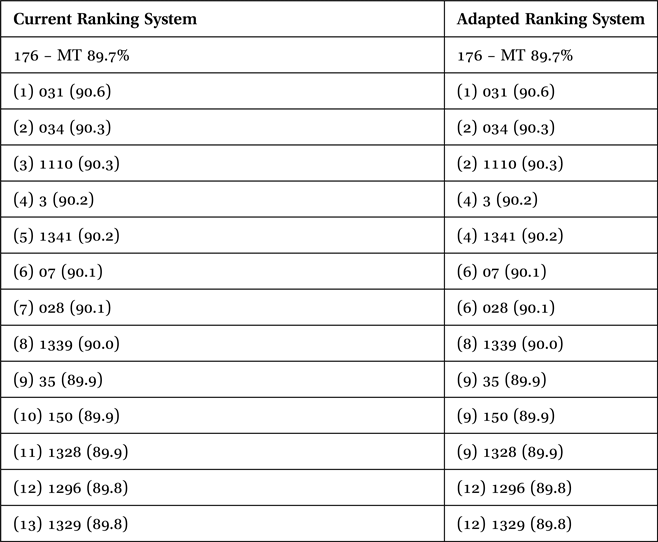
Second, some adjustments will be made to the ranking system used in the tables generated by the INTF, which display levels of agreement between texts in the Parallel Pericopes database. In the original tables, texts which have identical percentages of agreement with a particular witness do not share the same rank number. In such cases, the system ranks the texts in the order in which their manuscripts appear in the Kurzgefasste Liste der griechischen Handschriften des Neuen Testaments. In these instances, the ‘ranking’ of the text is a matter of pure coincidence. The table for minuscule 176 contains several examples of this, as shown in the left column of Table 1. In these cases, the ranking numbers should be adjusted to indicate the actual ranking, even though this will result in several texts sharing the same ranking as illustrated in the right column in the table.
Ranking Systems

Finally, in some cases, texts that are closely related to a witness are lacunose at our variant unit. These texts are also eliminated from the ranking since the reading of the text cannot be determined.
6. Assessment of the Pre-Genealogical Coherence of the Attestation for the Shorter Reading
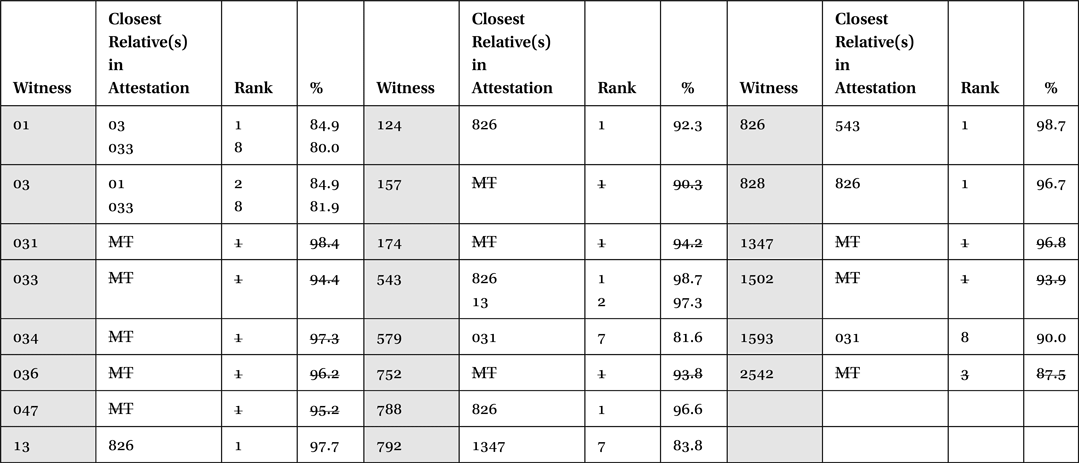
Tables 2 and 3 compile the relevant data from each attestation. Separate columns specify the witness to a reading which is identified by the Gregory-Aland number, the closest relative within the attestation, the rank of that close relative, and the percentage of examined variant units on which the two texts agree.Footnote 34 In cases in which two texts are each other's closest relative (and only in these cases), the information for the next closest relative within the attestation is also given. The strikethrough feature is used when a text's closest relative is the Majority Text but the Majority Text belongs to the other attestation.
Attestation for the Shorter Reading

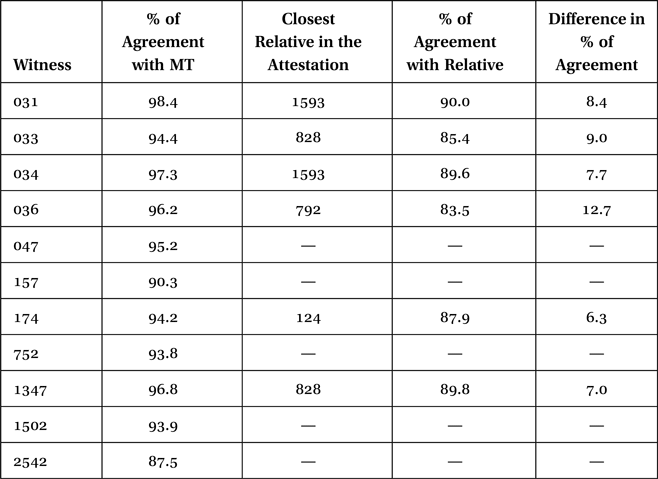
Close Relatives of the Majority Text in the Attestation for the Shorter Reading

An analysis of the data from the attestation for the shorter reading leads to several important discoveries. Although both 01 and 03 share the shorter reading, each is the closest relative of the other. One must look for another close relative of one (or both) of these witnesses to provide a link to the rest of the attestation. The next closest relative of either witness within this attestation is 033. Although 033 is a more distant relative of both 01 and 03 as is demonstrated by the drop in rank (1 to 8), the drop in percentage of agreement (84.9 to 80.0 for 01 and 84.9 to 81.9 for 03) is not necessarily sufficient to make a connection to the other texts in the attestation improbable.Footnote 35 The greater problem is that the researcher cannot determine from this data if 033 is a potential link to the rest of the attestation. The closest relative of 033 is the Majority Text. However, the Majority Text belongs to the other attestation, i.e. it supports the longer reading. The Parallel Pericopes: Manuscript Clusters tool only lists relatives for witnesses which have higher percentages of agreement with that witness than the Majority Text does. However, if another text that is less similar to the MT happens to be more closely related to 033 than to the MT, 033 will appear in the manuscript cluster report for that text. Consequently, in order to identify the closest relative of 033 that contains the shorter reading on the basis of the presently available data, the researcher must re-examine the manuscript cluster reports for all other witnesses in the attestation. Apart from 01 and 03, only one other close relative to 033 exists in the attestation: 828 which agrees with 033 in 85.4 percent of examined variant units, thus considerably more frequently than either 01 or 03. If 033's closest relative within this attestation is 828, the reduction in percentage of agreement from its closest relative (MT) to the percentage of agreement with its closest relative in the attestation is a drop from 94.4 to 85.4. This sizeable drop in percentage of agreement is almost certainly matched by a far greater drop in rank since proximity to the Majority Text implies its closer relationship to the many texts in the attestation for the longer reading. This suggests a break or at least a missing link in the coherence chain for the shorter reading.
The other witnesses in the attestation which have the Majority Text as their closest relative (031 033 034 036 047 157 174 752 1347 1502 2542) pose similar concerns. For six of the eleven texts, another close relative within the attestation could be identified (see Table 3).
Several of these texts exhibit significantly higher levels of agreement with the MT than with the closest relative in the attestation. Especially noteworthy is 036, which agrees with the MT in 96.2 per cent of variant units but with 792 in only 83.5 per cent of variant units, a difference of 12.7 per cent. Once again, this significant drop in percentage of agreement is almost certainly matched by a striking reduction in rank since proximity to the Majority Text implies its closer relationship to the much more numerous texts in the attestation for the longer reading. Even greater drops in percentage of agreement probably occur among those texts for which the closest relative within the attestation cannot presently be determined from the available data.Footnote 36 The texts in this attestation that have the Majority Text as their closest relative, particularly those that have a very high degree of agreement with the Majority Text, imply a break or a missing link in the coherence chain for the shorter reading.
Although the low rank (8) of 792's closest relative within the attestation (1347) initially raises doubts about its coherence with the rest of the attestation, the drop in the percentage of agreement from 792's closest relative (1334–84.1) to that of the closest relative within the attestation (1347–83.8) is relatively small. Thus 792 should not be regarded as lacking coherence with the rest of the attestation.
One final factor must be considered in the assessment of pre-genealogical coherence within the attestation for the shorter reading. Mink observed: ‘Multiple emergence is probable as well if the attestation consists of differing groups with strong coherence within themselves.’Footnote 37 The attestation for the shorter reading appears to contain at least one such group. Five of the witnesses (13 124 543 788 828) within the attestation share 826 as their closest relative. These witnesses constitute an 826 cluster. 826 and these close relatives amount to six of the twenty-two total texts in the attestation, a remarkable 27.27 per cent. As in the case of pairs in which each text is the closest relative of the other, one should examine the tables for each text to determine if another text is closely enough related to the cluster to connect it to the coherence chain. Witness 174 is the closest relative outside of the cluster within this attestation for 124 543 826 and 828. This raises doubts about coherence since 174's closest relative is the Majority Text. Similarly, 13's closest relative in the attestation outside of the cluster is 034, for which the closest relative in the Majority Text. 788 has no relative outside of the cluster within the attestation with which is agrees more closely than with the Majority Text. This implies another potential break in the coherent chain (or a missing link).
This attempt to assess the pre-genealogical coherence within the attestation for the shorter reading suggests multiple emergence of the shorter reading. Admittedly, the apparent breaks in the coherent chain may be the result of missing links which stem from the limited number of manuscripts utilised in the Parallel Pericopes study.Footnote 38 However, this possibility should not preclude tentative and preliminary conclusions. Since one can only interpret the available data, the most reasonable conclusion is that the attestation for the shorter reading lacks pre-genealogical coherence because of multiple emergence of the reading resulting in coincidental agreement between witnesses.
7. Assessment of the Pre-Genealogical Coherence of the Attestation for the Longer Reading
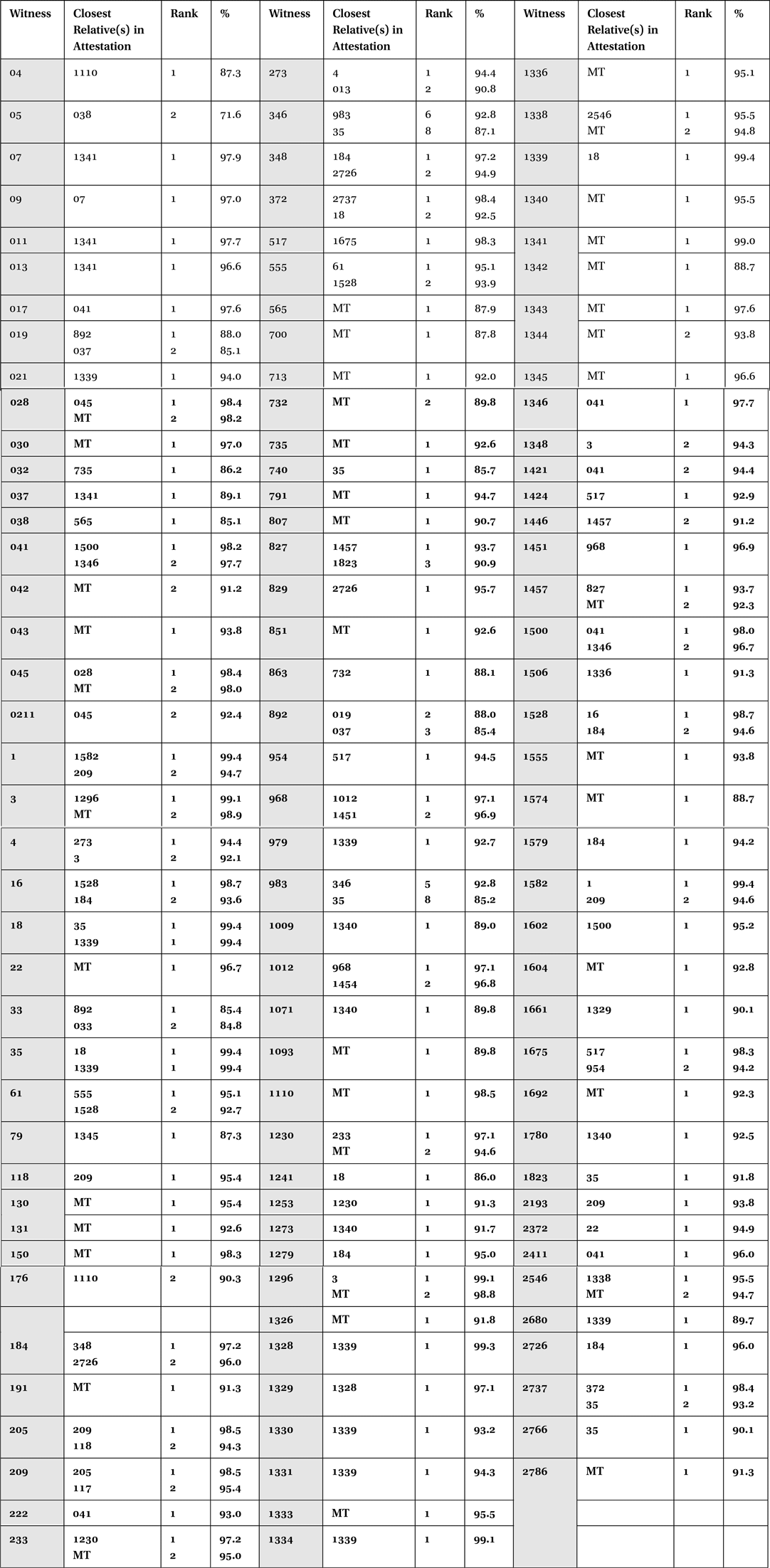
In comparison with the data related to the shorter reading, the data related to the attestation for the longer reading exhibit evidence of remarkable pre-genealogical coherence (see Table 4). In most cases (108 out of 120), a witness’ closest relative shares the same reading. In almost every other case (ten of the remaining twelve), the witness’ second closest relative shares the same reading.
Attestation for the Longer Reading

Two anomalies do seem to disrupt the coherent chain. Witnesses 346 and 983 are a pair in which each has the other as its closest witness within this attestation. They agree with each other in 92.8 per cent of the examined variant units. 346 has five closer relatives in the attestation for the shorter reading and 983 has four closer relatives in that attestation. Interestingly, all of these closer relatives belong to the 826 cluster discussed above. Both have 826 as their closest relative, with 346 agreeing in 95.8 per cent of the examined variant units and 983 agreeing in 94.7 per cent of the units.
The appearance of the longer reading in these two texts is not the consequence of multiple emergence resulting in coincidental agreement. In this case, the emergence probably stemmed from contamination. Mink states: ‘Yet in spite of weak pre-genealogical coherence the unusual character of variants may argue in favor of relatedness.’Footnote 39 The longer reading has this unusual character. Although the omission of a lengthy variant to make a passage conform to its parallel is explicable as coincidental agreement, the insertion of a lengthy variant which has no close parallel could not be a product of coincidental agreement. The extensive verbatim agreement with many of the texts in the attestation clearly shows that the reading was not the scribe's personal creation. Several scenarios seem possible. Perhaps the scribe had access to multiple exemplars or an exemplar closely related to 826 which contained the longer reading in either a marginal note or correction.Footnote 40 Any of these events would constitute an instance of contamination. The impressive pre-genealogical coherence of the attestation for the longer reading suggests that this reading emerged only once and was widely copied.Footnote 41
8. Conclusion
This case study seems to confirm Mink's theory that ‘[n]ormally, a lack of pre-genealogical coherence within an attestation implies a coincidental multiple development of conform variants.’Footnote 42 The method successfully demonstrated the shorter reading as a product of multiple emergence resulting in coincidental agreement and identified instances of contamination within the attestation for the longer reading. The analysis suggests that the longer reading, whose attestation of 120 witnesses appears to consist of an unbroken coherent chain with the exception of the two cases of contamination, probably emerged only once. Of the two variants, it is probably the prior reading. Scholars should continue to test the usefulness of the method as applied to variant units outside Acts and the Catholic Letters with additional case studies ideally related to variants that are a product of multiple emergence which can be demonstrated on other grounds.
The major drawback to this approach is the considerable amount of time required to compile the data necessary for the analysis. Wasserman and Gurry lament that their method ‘can require a real investment in time and effort.’Footnote 43 Unfortunately, the additional steps suggested here may significantly increase that investment. This approach requires analysing the readings and compiling comparative ranks and percentages from all 159 texts in the Parallel Pericopes database. Furthermore, since many of the texts in the Parallel Pericopes database are not among the witnesses cited consistently in the major critical editions of the Greek New Testament, the text critic working on variant units in the Synoptic Gospels must often examine manuscripts (or facsimiles, photographs or transcriptions of them) directly in order to determine the attestation to which their text belongs. Fortunately, the appearance of more volumes of the ECM will potentially eliminate the amount of time required to examine the readings of individual manuscripts that are not among the consistently cited witnesses in the current major critical editions. The continued publication of the ECM will also lead to improvements in the database and software utilised in the analysis and yield more reliable results.
Until these resources become available, scholars may benefit from utilising the data from the Parallel Pericopes volume to assess pre-genealogical coherence within an attestation for variant units in the Synoptic Gospels. In cases in which the attestation lacks pre-genealogical coherence, the broken coherence chain is probably a reliable indicator of the coincidental multiple emergence of the reading or contamination. Which of these two is more likely can often be determined by the nature of the variant.