Implications
Experimental comparisons of the nutritional value of different wheat cultivars commonly use feeds in meal form even though the large-scale broiler producers use steam pelleted feeds. Steam pelleting gelatinases and chemically alters the starch granules within wheat but the effect of pelleting may differ between samples. There is a need to know whether the beneficial effects of pelleting are the same for wheat samples with different chemical composition and quality characteristics. This information would inform the broiler production industry on the most appropriate wheat sample to select for broiler feeds.
Introduction
Wheat grain (Triticum spp.) is a main source of energy and protein for humans and farm animals. Although almost any wheat can be incorporated in farm animal diets, production of bread, biscuits and many other products for human consumption need a wide range of flours with specifications tightly defined by bakers for each product (Kuchel et al., Reference Kuchel, Langridge, Mosionek, Williams and Jefferies2006). Milling wheats are characterised with hard and medium hard endosperm, and relatively high protein content, yield strong flour doughs and are more suitable for the mechanised production of leavened breads, which are popular in almost all parts of the world (Wrigley, Reference Wrigley1991; Faridi and Faubion, Reference Faridi and Faubion1995). Wheats with relatively soft endosperm and low protein content are preferred for biscuits as much added liquid is baked out to produce a crisp product. In some parts of the world wheat is grown specifically as an animal feed. There are usually no varietal specifications but the highest yielding varieties are usually chosen for this.
Research on feeding value of wheat for poultry is well documented (Gutierrez-Alamo et al., Reference Hill and Anderson2008; Ball et al., Reference Ball, Owens and McCracken2013; Pirgozliev et al., 2015). However, there is inconsistence in the literature as some of the authors report responses on growth performance and nutrient availability to mash diets (Scott et al., Reference Scott, Silversides, Classen, Swift and Bedford1998; Rose et al., Reference Rose, Tucker, Kettlewell and Collier2001; Steenfeldt, Reference Steenfeldt2001; Pirgozliev et al., Reference Pirgozliev, Birch, Rose, Kettlewell and Bedford2003), others reported responses to pelleted diets (Wiseman et al., Reference Wiseman, Boorman, Short, Stringer, Snape, Orford, Angus and Garland2001; Carre et al., Reference Carre, Muley, Gomez, Oury, Laffitte, Guillou and Signoret2005). However, there is a lack of information on a direct comparison of feeding value of wheat with different chemical and quality characteristics, and the dietary form, thus more research is needed.
The specific objectives of the study were to assess the impact of wheat sample, as a part of complete diet, fed as mash and after steam pelleting on growth performance, N-corrected dietary apparent metabolisable energy (AMEn), total tract nitrogen retention (NR), dry matter retention (DMR) and fat digestibility (FD) coefficients when fed to broiler chickens. The development of bird gastrointestinal tract (GIT) was also determined.
Material and methods
Wheat samples
Four European wheat samples (two samples of UK feed wheat, samples A and B, and two samples of German milling wheat, samples C and D) with different chemical composition and endosperm characteristics were obtained from the market.
Dry matter (DM) in wheat was determined by drying of samples in forced draft oven at 105°C to constant weight. CP (N×6.25) in wheat was determined by the combustion method (Association of Official Analytical Chemists (AOAC), Reference Abdollahi, Ravindran and Svihus2000) using a Leco (FP-528 N; Leco Corp., St. Joseph, MI, USA). Oil (as ether extract) was extracted with diethyl ether by the ether extraction method (AOAC, Reference Abdollahi, Ravindran and Svihus2000) using a Soxtec system (Foss UK Ltd, Warrington, UK). The gross energy (GE) value of wheat samples was determined in a bomb calorimeter (model 6200; Parr Instrument Co., Moline, IL, USA) with benzoic acid used as a standard.
Total starch was determined by a modified version of Englyst (Reference Englyst, Hudson and Englyst2000), which involved initial heat dispersion together with heat stable amylase followed by treatment with alkali to disperse any retrograded type III resistant starch. A pH 4.5 buffered aliquot was treated with amyloglucosidase to release glucose which was quantified by HPLC with pulsed amporimetric detection. Wheat non-starch polysaccharides (NSP) content was determined by the method of Englyst (Reference Englyst, Quigley and Hudson1994), whereby starch is completely dispersed and then hydrolysed enzymatically. The NSP is isolated by precipitation in 80% ethanol then hydrolysed by sulphuric acid and the released sugars measured by gas chromatography as their alditol acetate derivatives. Wheat endosperm hardness (EH) was determined by the near IR reflectance method (Approved Method 39-70; American Association of Cereal Chemists, Reference Abdollahi, Ravindran, Wester, Ravindran and Thomas2000).
Diet preparation
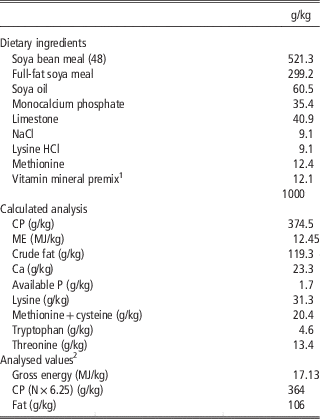
Four diets containing 670 g/kg of each of the four experimental wheat samples were prepared after mixing with 330 g/kg of a balancer (Table 1). The wheat samples were milled through a 5 mm screen. The main ingredients were 670 g/kg wheat, 172 g/kg soya bean meal, 99 g/kg full-fat soya and 20 g/kg soya oil. Each diet was then split into two batches and one of them was steam pelleted (Target Feeds Ltd, Whitchurch, UK) resulting in eight treatments. The pelleted diets were steam-conditioned with all the feed reaching 50 to 60°C for 20 s before pelleting and then pelleted using a pellet press (Paladin 350; Andritz Feed & Biofuel Technologies, Hull, UK), capable of manufacturing approximately 4 tonnes of feed/h. The steam pressure applied was 2 bar, and the pellets were cooled with ambient temperature air in a ventilated counter flow cooler for approximately 12 min. The pellet diameter was 3 mm.
Ingredient composition (g/kg, as-fed) of the experimental broiler chicken balancer formulation

ME=metabolisable energy.
This balancer was fed as a part of complete diet comprised 670 g/kg of each experimental wheat sample and 330 g/kg of the balancer. Each experimental diet met the diet specification for this strain of broiler chicken (Aviagen Ltd, Edinburgh, UK).
1 The vitamin and mineral premix contained vitamins and trace elements to meet the breeder’s recommendations (Aviagen Ltd, Edinburgh, UK). The premix provided (units/kg diet): retinol, 12 000 IU; cholecalciferol, 5000 IU; α-tocopherol, 34 mg; menadione, 3 mg; thiamine, 2 mg; riboflavin, 7 mg; pyridoxine, 5 mg; cobalamin, 15 μg; nicotinic acid, 50 mg; pantothenic acid, 15 mg; folic acid, 1 mg; biotin, 200 μg; 80 mg Fe as iron sulphate (30%); 10 mg Cu as copper sulphate (25%); 100 mg Mn as manganous oxide (62%); 80 mg Zn as zinc oxide (72%); 1 mg I as calcium iodate (52%); 0.2 mg Se as sodium selenite (4.5%); and 0.5 mg Mo as sodium molybdate (40%).
2 Analyses were performed in duplicate.
The pellet durability index (PDI) was determined in duplicates using a Holme Pellet Tester (New Holmen NHP100 Portable Pellet Durability Tester; TekPro Ltd, Willow Park, North Walsham, Norfolk, UK). Clean pellet samples (100 g), with no fines, were rapidly circulated in an air stream around a perforated test chamber for 30 s. Fines were removed continuously through the perforations (2 mm in diameter) during the test cycle. After the test cycle, the subject pellets were ejected and weighed manually. The PDI was calculated as the ratio of the pellets not passing through the perforations after test to whole pellets at the start.
Nutrient availability and broiler growth performance
Day-old male broilers (Ross 308) were obtained from a commercial hatchery, and were placed in a single floor pen and fed on a proprietary broiler starter feed until 9 days of age. On the 1st day of the experimental period (at 10 days of age), the chicks were individually weighed and two birds were randomly placed in each pen (0.4×0.4 m solid floor area) within a controlled environment room. Each pen was equipped with a separate feeder and drinker in front. Additional drinkers were allocated at each tear level away from the chicks and were used to measure evaporation water losses. Each diet was fed at random to eight pens from 10 to 24 days of age. The temperatures were kept at 32°C during first 2 days on birds arrival and were gradually reduced to 20°C at the end of the study. A standard lighting programme for broilers was used, decreasing from 23 : 1 (hours light : dark) from day old to 18 h : 6 h at 7 days of age, which was maintained until the end of the study. Access to the feed and the water was ad libitum. Feed intake (FI), water intake (WI) and BW gain of each pen were determined for the entire study period of 14 days, and feed efficiency (gain to feed (G : F) ratio) and water to feed (W : F) intake ratio were calculated.
During the last 4 days of the experiment the solid floor of each pen was replaced with a wire mesh and all excreta were collected, immediately dried at 60°C and then milled. FI were also measured for the same period. The GE, DM, nitrogen and fat of each dried excreta sample and the experimental diets were determined as described for the wheat samples. The AMEn of the diets was calculated as described by Hill and Anderson (Reference Gutierrez-Alamo, Perez de Ayala, Verstegen, Den Hartog and Villamide1958). The coefficients of total tract FD, DMR and NR were determined as the difference between intake and excretion (retention) of the nutrient, divided by their respective intake.
On the last day of the study, at 24 days of age, the two birds in each pen were weighed and killed by cervical dislocation. The relative empty weights of GIT segments from proventriculus to caeca of each bird were determined, according to the procedures described by Amerah and Ravindran (2008). All procedures were approved by The Animal Experimental Committee of Harper Adams University.
Statistical procedures
Statistical analyses were performed using the Genstat statistical software package (Genstat 15th release 3.22 for Windows; IACR, Rothamstead, Hertfordshire, UK). The AMEn content of the experimental diets, broiler growth performance and nutrient digestibility were compared statistically by ANOVA using a 4×2 factorial arrangement of treatments. The main effects were the wheat sample and the dietary form (mash or pellet). The comparison between the experimental results was performed by ANOVA. In all instances, differences were reported as significant at P<0.05. When a significant F test was detected, means were separated using the Fisher’s protected LSD. Tendencies towards significance (0.05<P<0.1) were also reported.
Results
The grain compositions are summarised in Table 2.The amounts of oil and protein were more variable than the GE concentration, and ranged from 13.5 to 17.2 g/kg DM, and 106 to 128 g/kg DM, respectively. The EH of the wheat samples ranged from 22 to 63 relative units.
Proximate composition and endosperm hardness (EH) of the experimental wheat samples

DM=dry matter.
1 EH (relative units range from 0 to 100, soft–hard).
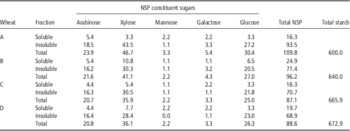
The mean total NSP content of the wheat samples was 95.4 g/kg DM, comprising 19.3 g/kg DM of soluble and 76.1 g/kg DM of insoluble NSP, respectively (Table 3). Xylose, glucose and arabinose were the main NSP constituent sugars in the wheat samples. The mean starch content of the wheat samples was 644.7 g/kg DM, as wheat sample A had the lowest starch content of 600.0 g/kg DM, and wheat sample D had the highest starch content of 672.9 g/kg, respectively.
Polysaccharide composition of the experimental wheat samples (g/kg dry matter basis)

NSP=non-starch polysaccharides.
The DM of all diets was determined. The mean DM of the mash feeds was 88.8% (88.2% diet A, 89.1% diet B, 88.8% diet C, 88.9% diet D), and the mean DM of the pelleted feeds was 88.2% (87.9% diet A, 87.8% diet B, 88.6% diet C, 88.3% diet D). The PDI for the diets based on wheat A, B, C and D was 85.4, 85.2, 83.6 and 85.3, respectively (data not included in tables).
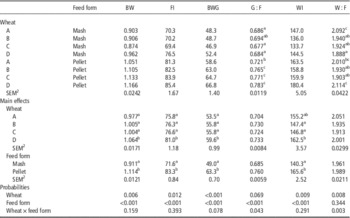
The overall weight of the birds fed pelleted diets was 1.114 kg, and in agreement with breeder’s recommendation (Aviagen Ltd, Edinburgh, UK). The birds fed pellets were 203 g (18.2%) heavier (P<0.001) than those fed the same diets as mash (Table 4). Similarly, birds fed pelleted diets had 16.3% and 18.0% higher (P<0.001) daily FI and WI, but there was a tendency (P=0.078) for interaction between wheat sample and feed type for weight gain (WG). Interactions (P<0.05) were observed between wheat type and feed processing for G : F and W : F ratios. Pelleting improved G : F ratio the greatest in the wheat sample D (with high starch and protein contents, and hard endosperm), although no improvement (P>0.05) was detected for sample A. Feeding wheat sample D also decreased (P<0.05) W : F but only in the mash diets.
The effect of wheat sample and pelleting of diets fed to broiler chickens on final BW (kg), daily feed intake (g dry matter), daily BW gain (g), gain to feed (G : F, g/g) ratio, daily water intake (g) and water to feed ratio (W : F, g/g) (data based on the feeding period from 10 to 24 days of age)Footnote 1

BW=broiler final BW; FI=average daily broiler feed intake; BWG=average daily broiler BW gain; WI=average daily broiler water intake.
a,b,cWithin wheat or main effects mean values in a column not sharing a common superscript are significantly different.
1 Each value represents the mean of eight replicates.
2 Pooled standard error of mean.
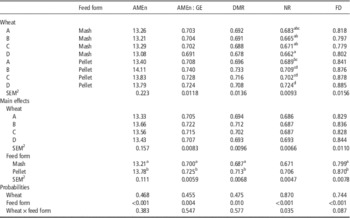
Feeding pelleted diets improved (P<0.001) dietary AMEn by 4.3%, and the AMEn : GE ratio and DMR were improved (P<0.05) by 3.6% and 3.8%, respectively (Table 5). There was a wheat sample by dietary form interaction (P<0.05) for NR coefficient showing that pelleting improved N availability in wheat sample D only. Wheat sample did not produce a difference (P>0.05) in dietary FD coefficients, although pelleting improved FD by 8.9% (P<0.05).
The effect of wheat sample and pelleting of diets fed to broiler chickens on N-corrected dietary apparent metabolisable energy (AMEn, MJ/kg dry matter (DM)), gross energy metabolisability (GE, J/J), DM retention (DMR, g/g), nitrogen retention (NR, g/g) and fat digestibility (FD, g/g) coefficients (data based on total collection from 20 to 24 days of age)Footnote 1

a,b,c,dWithin wheat or main effects mean values in a column not sharing a common superscript are significantly different.
1 Each value represents the mean of eight replicates.
2 Pooled standard error of mean.
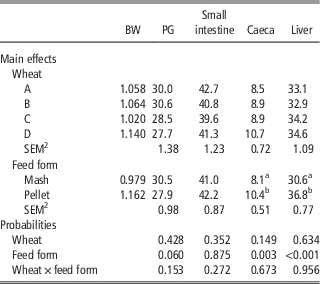
Feeding pellet diets tended (P=0.060) to reduce the weight of the proventriculus and gizzard and increased the weight of the caeca (P<0.05) and the liver (P<0.001) (Table 6). The weight of the small intestine was not influenced (P>0.05) by wheat sample or dietary type.
The effect of wheat sample and pelleting of diets fed to broiler chicken on weight of proventriculus and gizzard (PG, g), small intestine (g), caeca (g) and liver (g) (data obtained from 24 days old birds)Footnote 1

BW=weight of the bird, one each pen, used for all measurements in this table.
a,bWithin feed form mean values in a column not sharing a common superscript are significantly different.
1 Each value represents the mean of eight replicates.
2 Pooled standard error of mean.
Discussion
The study evaluated the effect of wheat samples with different chemical composition and EH and dietary form on feeding value of wheat for broilers. Feeding value of pelleted wheat diets varies due to a number of factors. These include conditioning temperature, die hole diameter, applied pressure, pellet length, use of binder, as well as feed formulation, feed particle size, and wheat chemical composition and genetics (Svihus et al., Reference Svihus, Kløvstad, Perez, Zimonja, Sahlstrom, Schuller, Jeksrud and Prestløkken2004; Abdollahi et al., Reference Amerah, Ravindran and Lentle2013). The novel aspect of this experiment was that the feeding value of a number of different wheat samples was directly compared as a part of mash or steam pelleted diets simultaneously. Previous research (Svihus and Hetland, Reference Svihus and Hetland2001; Svihus et al., Reference Svihus, Kløvstad, Perez, Zimonja, Sahlstrom, Schuller, Jeksrud and Prestløkken2004; Abdollahi et al., Reference Amerah and Ravindran2011 and Reference Amerah, Ravindran and Lentle2013) involving mash or pelleted wheat diets alone have only compared one wheat sample. The present experiment therefore provides an examination of how different wheat samples may respond to the same pelleting process. Although only small number of wheat samples was studied in this experiment, the results confirm the importance of research on wheat processing to better understand the interactions between processing and wheat chemical and quality characteristics when evaluating its feeding value for broilers.
The proximate nutrient, polysaccharide and GE contents, and EH of the experimental wheat samples were in a similar range to those measured in other studies (Rose et al., Reference Rose, Tucker, Kettlewell and Collier2001; Pirgozliev et al., Reference Pirgozliev, Birch, Rose, Kettlewell and Bedford2003; Carre et al., Reference Carre, Muley, Gomez, Oury, Laffitte, Guillou and Signoret2005).
In accord with previous reports with mash (Scott et al., Reference Scott, Silversides, Classen, Swift and Bedford1998; Rose et al., Reference Rose, Tucker, Kettlewell and Collier2001; Steenfeldt, Reference Steenfeldt2001; Pirgozliev et al., Reference Pirgozliev, Birch, Rose, Kettlewell and Bedford2003) and pelleted (Amerah et al., 2009) wheat-based diets, in the present study birds were fed wheat that had high starch and protein contents, and relatively hard endosperm, and had an improved FI and WG. The feed form by wheat-type interactions observed in this study shows that milling wheat instead of feed wheat in pelleted diets results in improved NR and G : F ratio in broiler chickens. Hardness of the endosperm affects the milling performance of wheat and hard wheats shatter when milled and the flour has larger particle sizes compared with soft wheat.
Feed wheats that have relatively soft endosperm tend to give a very dusty flour after milling, thus to be able to swallow the diet, the birds drink more water, which may explain the relatively high W : F ratio of birds fed mash soft wheat diets.
Increases in the caeca of the birds fed pelleted diets may be caused by an increased FI and increased microbial activity. Furuse et al. (Reference Furuse, Yang, Niwa and Okumura1991) reported strong relationship between FI, microbial proliferation and development of the distal part of the GIT in poultry.
Pelleting of diets involves a combination of shear, heat and water that may partially denaturise and improves bioavailability of dietary protein (Voragen et al., Reference Voragen, Gruppen, Marsman and Mul1995; Thomas et al., Reference Thomas, van Vliet and van der Poel1998; Abdollahi et al., Reference Amerah, Ravindran and Lentle2013). Heating could also improve digestibility of proteins by inactivating enzyme inhibitors and denaturing the protein, which may expose new sites for enzyme attack (Camire et al., Reference Camire, Camire and Krumhar1990). The determined protein content (g/kg) for diets including samples A, B, C and D was 188, 189, 186 and 199, respectively, and was relatively close to the breeder’s recommendations of 215.
The determined AMEn of the diets was in the expected range, and in agreement with Amerah et al. (2009) and there were no differences in metabolisable energy due to wheat sample. However, similarly to Svihus et al. (Reference Svihus, Kløvstad, Perez, Zimonja, Sahlstrom, Schuller, Jeksrud and Prestløkken2004), feeding pelleted diets increased dietary metabolisable energy and improved bird performance. The majority of the available energy in wheat grains comes from starch that is stored intracellular, and is partly inaccessible to poultry as they have limited endogenous enzyme ability to degrade plant cell wall material (Ball et al., Reference Ball, Owens and McCracken2013). Thus, a procedure capable of damaging cell walls, that is steam pelleting, may allow pancreatic enzymes access to nutrients trapped within the cell and to improve dietary metabolisable energy. The increase in AMEn in pelleted diets also coupled with improved DMR and FD coefficients in this study.
In conclusion, this study showed that there were differences between four wheat samples when they were fed in pelleted complete feed, but no differences were observed when fed in mash form complete diets. Pelleted diets are fed to broilers as industry standard, thus information on feeding value of wheat obtained with mash diets only should be carefully interpreted. Research on the interaction between pelleting and wheat chemical and quality characteristics is warranted.
Acknowledgement
The authors wish to thank Rosalind Crocker and Richard James for their technical support of this study.