Introduction
Demographic analysis is a well-recognized standard ecological method helpful in generating informative statistics about survival, developmental rate and reproductive success of an organism (Kivan and Kilic, Reference Kivan and Kilic2005). This analysis conveys information on the parental investment and adult self-maintenance of the population along with understanding of the age dynamics of adult populations (Carey, Reference Carey2001). It allows predictions of the population size and age structure of a natural enemy and other insects at any time. In addition, the demographic parameters are important quantitative indicators of interactions between insect populations and various environmental factors (Southwood, Reference Southwood1978).
Many extrinsic and intrinsic factors influence insect growth rate and fecundity (Kindlmann et al., Reference Kindlmann, Dixon and Dostaklova2001), affecting the demographic attributes (Margolies and Wrensch, Reference Margolies and Wrensch1996; Roy et al., Reference Roy, Brodeur and Cloutier2002). It is widely held that food and temperature largely affect the ecology of insects (Carey, Reference Carey1993; Jayanth and Bali, Reference Jayanth and Bali1993a; Klok and Chown, Reference Klok and Chown1997, Reference Klok and Chown1998; Omkar and Pervez, Reference Omkar and Pervez2004; Omkar et al., Reference Omkar, Rastogi and Pandey2008). Little is known about other factors, such as lights of different wavelengths and different photoperiods influencing the biological attributes, although in some beneficial insects, photoperiodic exposure significantly impacts their behaviour and performance (Mishra and Omkar, Reference Mishra and Omkar2004; Omkar et al., Reference Omkar, Mishra, Srivastava and Gupta2004, Reference Omkar, Pandey and Rastogi2009a, Reference Omkar, Pandey and Rastogib). Differences in photoperiodic exposure could also produce phenological changes in insects, e.g. producing different seasonal morphs (McPherson, Reference McPherson1974). Both temperature and photoperiod are known to be major abiotic factors that induce diapause in some insects (Goehring and Oberhauser, Reference Goehring and Oberhauser2002; Fantinou et al., Reference Fantinou, Kourti and Saitanis2003). The likelihood of diapause is more in those insects, which are reared under decreasing day lengths and fluctuating temperature (Goehring and Oberhauser, Reference Goehring and Oberhauser2002). Occurrence of diapause could negatively affect the demographic attributes of beneficial insects. A thorough knowledge of their ecology could help in their mass multiplication. Hence, optimization of essential abiotic and biotic factors may benefit the rearing techniques of many insects, which could be ascertained by their demographic analysis (Maia et al., Reference Maia, Luiz and Campanhola2000; Omkar and Pervez, Reference Omkar and Pervez2004; Srivastava and Omkar, Reference Srivastava and Omkar2004).
The parthenium beetle Zygogramma bicolorata Pallister (Coleoptera: Chrysomelidae) is an exotic (having Mexican origin) biocontrol agent of the Neotropical composite weed Parthenium hysterophorus L. (Asteraceae). Over the past decades, this weed has emerged as a major problem in the pastures, wasteland and agricultural fields of India (Gupta et al., Reference Gupta, Khan, Bali, Monobrullah and Bhagat2004; Gautam et al., Reference Gautam, Khan and Garg2006). The importance of Z. bicolorata has led to various studies on aspects such as the effects of temperature on their development and immature survival in field and laboratory conditions (Jayanth and Bali, Reference Jayanth and Bali1992, Reference Jayanth and Bali1993a; Bhoopathi and Gautam, Reference Bhoopathi and Gautam2006; Omkar et al., Reference Omkar, Rastogi and Pandey2008, Reference Omkar, Pandey and Rastogi2009b). Its life table has been studied in relation to host plants (Bhumannavar and Balasubramanian, Reference Bhumannavar-B. and Balasubramanian1998) with no attention on other abiotic and biotic factors. In addition, little is known on abiotic influences on its demographic parameters. Zygogramma bicolorata often undergoes diapause, sometimes even in the presence of favourable abiotic and biotic conditions (Jayanth and Bali, Reference Jayanth and Bali1993b; Sushilkumar and Ray, Reference Sushilkumar and Ray2010). The present study has thus been designed to identify the effect of food and abiotic (temperature, photoperiod and wavelength of light) conditions on birth rate-based demographic attributes of Z. bicolorata. This study will help in understanding the pattern of population growth in this beetle, predicting its occurrence in accordance with favourable climatic conditions along with improving its mass-rearing technique and thus facilitating Parthenium biocontrol.
Materials and methods
Stock maintenance
The life stages of Z. bicolorata collected from the campus of the University of Lucknow, India were brought to the laboratory. They were kept in plastic Petri dishes (9.0 × 2.0 cm) containing the leaves of P. hysterophorus under controlled conditions (27 ± 1 °C, 65 ± 5% relative humidity (RH) and 14L:10D) in an environmental test chamber (ETC) (CH-6S; Remi Instruments, Mumbai, Maharashtra, India). The wilted and leftover leaves were replaced daily with fresh ones and the life stages were reared until adult eclosion. These newly eclosed adults were sexed on the basis of size and shape of the last abdominal sternite. The posterior margin of the last abdominal sternite in the female is entire, slightly serrated at the tip with a faint depression in the centre in males (McClay, 1980). Adults were reared on the same diet separately in Petri dishes. On attaining sexual maturity, they were paired for mating and eggs obtained were used in the experiments.
Experimental design
Experiment i: Demographic attributes on different foods
The demographic attributes were evaluated on three diets, namely leaves, stem and inflorescence, of parthenium plants. One thousand eggs were taken from the F1 stock and reared on the above three diets until adult eclosion (100 eggs per replicate; 10 replicates). The larvae were reared separately to avoid overcrowding in plastic Petri dishes (9.0 × 2.0 cm) under the above-mentioned conditions in the ETC. Observations were taken on the developmental period and the survival of every life stage (x). The newly eclosed beetles were sexed to determine the sex ratio (a). The adults were paired in Petri dishes (size and host as above) and reared continuously with daily replenishment of the diet until the female died. Observations were made on the daily survival and fecundity (mx) of every female used in the experiment.
Experiment ii: Demographic attributes at different temperatures
The demographic analysis of Z. bicolorata was done at five temperatures. One thousand eggs (100 eggs per replicate, n= 10) of the F1 generation were kept in plastic Petri dishes (as above) at each of five constant temperatures, namely 20, 25, 27, 30 and 35 ° C, at 65 ± 5% RH and 14L:10D. The survival and mortality of the egg hatch were recorded. On hatching, the neonates were reared until adult emergence using fresh P. hysterophorus leaves as diet (space as above). The adults on eclosion were treated as in experiment (i) on dietary effects. Likewise, all observations were taken and calculations done.
Experiment iii: Demographic attributes at different photoperiods
The demographic attributes were evaluated at five photoperiods. The photoperiodic chambers were designed by making wooden chambers of 40 × 40 × 40 cm dimensions, each containing a 60 W white electric bulb (Philips brand) to maintain the photoperiod. The walls, ceiling and floor of each chamber were covered with white paper. RH (65 ± 5%) was maintained by keeping 1 litre of 1 N NaCl solution in a glass beaker in each of the chambers. One thousand eggs (100 eggs per replicate, n= 10) of the F1 generation were kept in plastic Petri dishes (9.0 × 2.0 cm) at each of five photoperiods: 24L:0D (continuous light), 14L:10D (long day), 12L:12D (equinox), 10L:14D (short day) and 0L:24D (continuous dark) at 27 °C. On hatching, the neonates were reared until adult emergence (diet and the other procedures are the same as in the above experiment (ii)).
Experiment iv: Demographic attributes at different wavelengths of light
The demographic attributes were evaluated at different wavelengths of light. The light chambers were designed by making wooden chambers of 40 × 40 × 40 cm dimensions with constant and unfluctuating light source. White, yellow, blue and red colour electric bulbs were used in different chambers to provide exposure to different wavelengths. Blue- and red-coloured bulbs of 100 W, yellow-coloured bulbs of 11 W and white (milky, broad-spectrum) bulbs of 60 W (brand Phillips) were used to ensure almost similar light intensity, thereby making light intensity constant. The walls, ceilings and floors of the light chambers were covered with glossy paper of the same colour as the light bulb, thus enhancing the effect and also providing a completely coloured arena. The three colours, namely blue, yellow and red, other than the control were selected because they make up a broad portion of the light spectrum (VIBGYOR). The light intensity was approximately 190–200 lux and was measured by the Eurisem EP-628 digital luxmeter. Humidity (65 ± 5% RH) was maintained by keeping 1 litre of 1 N NaCl solution in a glass beaker in each of the chambers. One thousand eggs (100 eggs per replicate, n= 10) of the F1 generation were kept in plastic Petri dishes (9.0 × 2.0 cm) in each of the four arenas illuminated with blue (about 475 nm), yellow (about 570 nm), red (about 650 nm) or white light (broad spectrum, control). On hatching, the neonates were reared until adult emergence (diet and other procedures are the same as in the above experiment (ii)).
Data analyses
Data obtained from the above-mentioned experiments were employed to calculate these parameters. The net reproduction rate (R o), intrinsic growth rate (r m), finite growth rate (λ), mean generation time (T) and doubling time (DT), as defined by Birch (Reference Birch1948), were calculated with the Life Tables SAS program using the Jack-knife method (Maia et al., Reference Maia, Luiz and Campanhola2000).
Results
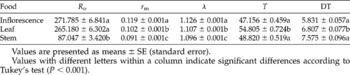
The demographic attributes of Z. bicolorata in relation to different foods are presented in Table 1. The net reproductive rate and intrinsic and finite rates of increase were maximum when the beetles were fed on inflorescences, followed by leaves and stems. The net reproductive rates of Z. bicolorata when fed on inflorescences and leaves were not significantly different compared with that of stems (Table 1). Both intrinsic and finite rates of increase differed significantly when means were compared in the three food group treatments. The mean generation and doubling times were shortest when the life stages were fed on Parthenium inflorescences and stems compared with those fed on leaves. Both generation and doubling times of the beetles fed on inflorescences and stems were not statistically significant compared with those fed on the leaves.
Demographic parameters of Zygogramma bicolorata in relation to the different foods

R o, net reproduction rate; r m, intrinsic growth rate; λ, finite growth rate; T, mean generation time; DT, doubling time.
Values are presented as means ± SE (standard error).
Values with different letters within a column indicate significant differences according to Tukey's test (P <0.001).
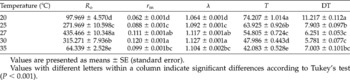
Temperature significantly affected all the demographic attributes of Z. bicolorata. The net reproductive rate of the females was significantly higher at 27 °C followed by those at 30, 25, 20 and 35 °C (Table 2). Both intrinsic and finite rates of increase of the beetles were significantly higher when they were reared at 30 and 27 °C compared with those reared at 35, 25 and 20 °C. The mean values of intrinsic and finite rates of increase of Z. bicolorata did not differ significantly when reared at 30 and 27 °C. The mean generation time was also significantly affected and shortest when the beetles were reared at 35 °C followed by those at 30, 27, 25 and 30 °C. Doubling time, however, was lowest at 30 °C, which did not differ significantly at 27 °C.
Demographic parameters of Zygogramma bicolorata in relation to the different temperatures

R o, net reproduction rate; r m, intrinsic growth rate; λ, finite growth rate; T, mean generation time; DT, doubling time.
Values are presented as means ± SE (standard error).
Values with different letters within a column indicate significant differences according to Tukey's test (P <0.001).
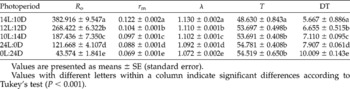
The demographic attributes of Z. bicolorata were significantly affected by the different photoperiods. The net reproductive rates along with the intrinsic and finite rates of increase were significantly higher when long-day (14L:10D) exposure was given followed by equinox (12L:12D), short day (10L:14D), continuous light (24L:0D) and continuous dark (0L:24D) (Table 3). The mean generation time of the beetles was significantly shorter under long-day exposure compared with the other photoperiodic exposures, which did not vary significantly within the treatment. The doubling time was significantly shortest under long-day exposure followed by those under equinox, short day, continuous light and continuous dark.
Demographic parameters of Zygogramma bicolorata in relation to the different photoperiods

R o, net reproduction rate; r m, intrinsic growth rate; λ, finite growth rate; T, mean generation time; DT, doubling time.
Values are presented as means ± SE (standard error).
Values with different letters within a column indicate significant differences according to Tukey's test (P <0.001).
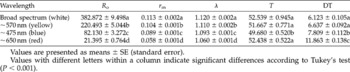
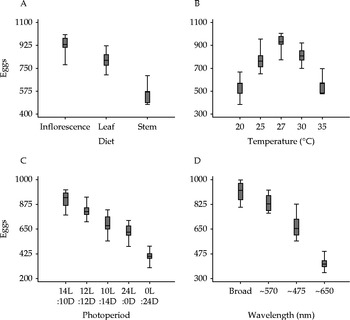
Lights of different wavelengths significantly affected the demographic attributes of Z. bicolorata. The net reproductive rate and intrinsic and finite rates of increase were significantly higher when the beetles were reared under a broad spectrum of white light followed by those under ~570 nm (yellow), ~475 nm (blue) and ~650 nm (red) conditions (Table 4). The mean generation time, however, was not significantly affected by the different wavelengths of light. The generation time was significantly shortest under ~475 nm wavelength compared with the other three wavelengths of light. The doubling times were shortest with no significant difference under the broad (white) and yellow spectra. The total eggs laid by Z. bicolorata when exposed to the different variables obtained by box-and-whisker plots of the Jack-knife method are presented in Fig. 1. The plots revealed that females laid a maximum number of eggs when feeding on inflorescences at 27 °C on long days under a broad spectrum of light.
Demographic parameters of Zygogramma bicolorata in relation to the different wavelengths

R o, net reproduction rate; r m, intrinsic growth rate; λ, finite growth rate; T, mean generation time; DT, doubling time.
Values are presented as means ± SE (standard error).
Values with different letters within a column indicate significant differences according to Tukey's test (P <0.001).
Total eggs laid per female of Zygogramma bicolorata obtained from the box-and-whisker plot of the Jack-knife method, when females were exposed to different variables such as (A) diets, (B) temperatures, (C) photoperiods and (D) wavelengths of light. Error bars show ± SE.

Discussion
This is the first study to evaluate the effect of different variables on natality-based life-table attributes of Z. bicolorata. It is now clearly evident that these four studied factors have a significant impact on the demographic attributes of the beetles. The high net reproductive rate and intrinsic and finite rates of increase were highest when larvae and adults were fed on inflorescences, which might be attributed to: (1) the presence of suitable feeding stimulants and nutrients and/or (2) higher consumption probably as a result of their palatability. Floral parts of Asteraceae plants are usually rich in plant metabolites (Bernays and Chapman, Reference Bernays, Chapman, Miller and van Emden1994; Yasumori et al., Reference Yasumori, Makoto, Kotaro, Hiroshi and Yoshiaki2004; Reifenrath and Müller, Reference Reifenrath and Müller2009), which is seemingly convincing for the high net reproductive rate and the high intrinsic rate of increase. Perhaps the combination of both quality and quantity enabled the instars to grow faster and moult early. Both inflorescences and leaves of parthenium plants are highly suitable for the developing instars of Z. bicolorata (Kumar, 2005).
The box-and-whisker plot revealed that females laid a maximum number of eggs when fed on inflorescences, indicating that Z. bicolorata can enhance its fitness if it attacks primarily the reproductive parts of the plant. These probable attacks could potentially limit plant fitness and sustenance through gamete removal (Louda and Potvin, Reference Louda and Potvin1995; Krupnick and Weis, Reference Krupnick and Weis1999) and discourage the visits of pollinators (Krupnick et al., Reference Krupnick, Weis and Campbell1999; Mothershead and Marquis, Reference Mothershead and Marquis2000), thereby being indirectly advantageous to weed biocontrol.
The suboptimal demographic values on stems may possibly be ascribed to the harder and thicker parenchymatic tissues, poor nutrients and low consumption. A significantly prolonged doubling time when life stages fed on stems is an indicator that stems are not preferably eaten but are simply a secondary alternative (Slansky, Reference Slansky1982). Thus, it can successfully consume the entire plant leaving behind only a skeleton comprising hard and uneaten stems (McFadyen, Reference McFadyen1998).
Temperature significantly affected the demographic parameters of Z. bicolorata with the highest net reproductive rate at 27 °C. This supports previous reports indicating 27 °C to be optimal for larval survival and reproduction (Pervez and Omkar, Reference Pervez and Omkar2004; Omkar et al., Reference Omkar, Rastogi and Pandey2008, Reference Omkar, Pandey and Rastogi2009a). The net reproductive rate was lowest at 35 °C, which was probably due to the decrease in the number of eggs laid by the females. A recent study has revealed that a few eggs kept for observation during the initial phase failed to hatch at 35 °C and became flaccid and wrinkled (Omkar et al., Reference Omkar, Rastogi and Pandey2008). Even their colour changed from yellow to brownish-yellow, which possibly indicates that their contents might have denatured. Perhaps the eggs in the ovary could have also been affected by extreme constant temperature (35 °C), which could be a possible reason for a significantly low net reproductive rate. This, however, needs to be ascertained by anatomical studies. Both mean generation and doubling times decreased with increases in temperature, which was possibly due to: (1) the increase in metabolic activities, (2) the increase in the rate of development and (3) a declining longevity with temperature.
Optimal demographic values were found when the beetles were reared under long-day conditions. These values decreased with decreases in light durations. Despite the significantly decreased values of the net reproductive rate and intrinsic and finite rates of increase, there was no indication of larval or adult diapause. Notwithstanding the significant increase in mean generation and doubling times with decreasing light durations compared with that of long-day conditions, diapause was not evident as there was no indication of a prolonged non-reproductive phase or arrest in the moulting of larval instars. Photoperiods could possibly affect diapause initiation but perhaps do not control diapause development and termination, as beetles undergoing diapause stay inside the soil in extreme dark conditions (Sushilkumar and Ray, Reference Sushilkumar and Ray2010). The continuous dark condition, in the present study, despite giving the poorest results in terms of the demographic attributes, still supported the immature survival and adult reproduction of the beetles. This clearly indicates that though light is important for the quantitative intrinsic rate of increase, its absence cannot possibly inhibit adult reproduction. Poor demographic values of Z. bicolorata under continuous dark conditions may be attributed to the restricted foraging in the absence of light, affecting the physiology of the beetles (Milonas and Savopoulou Soultani, Reference Milonas and Savopoulou Soultani2000). In India, Z. bicolorata usually undergoes diapause during winter and the onset of summer, i.e. a short-day condition with a decrease in temperature. Additionally, fluctuating temperature increases the probability of diapause (Goehring and Oberhauser, Reference Goehring and Oberhauser2002). Many research workers have considered extreme temperatures and scarcity of food to be the major causes of insect diapause (see reviews, Bell, Reference Bell1994; Hodek, Reference Hodek1996). Water and RH might also have a role to play in diapause development (Hodek, Reference Hodek2003). Our study reveals that although the photoperiods decreased, the temperature remained constant, which could be a reason for the beetles not undergoing diapause. However, this needs to be confirmed by future studies.
The demographic attributes of Z. bicolorata were optimal under the broad-spectrum wavelength, while lowest under red light. Insects can perceive the spectral region from ultraviolet (UV having a short wavelength and a high frequency) to red. However, insects best distinguish UV, green and blue lights due to shorter wavelengths, while they are generally insensitive to the red end of the spectrum (Arikawa et al., Reference Arikawa, Inokuma and Eguchi1987). In the present study, red light with the highest visible wavelength perhaps altered the food-searching efficiency of the beetles, thereby negatively affecting their demographic attributes. Our finding is in agreement with that of White and Shardlow (2011) who recommend that the lights of higher wavelength, especially red, should be avoided as the colour has severe negative impacts on the ecology of terrestrial insects. The demographic parameters of Z. bicolorata reveal a high suitability of broad spectrum (white light), as net reproductive rate and intrinsic and finite rates of increase were highest. The generation and doubling times were shortest under white light probably because it is similar to natural light.
Thus, from the above estimate it is predicted that Z. bicolorata will thrive best in the tropical and subtropical countries, where a normal field temperature ranges from 27 to 30 °C. The beetles will respond positively under a broad visible spectrum of light. The mass multiplication of Z. bicolorata could be strengthened by providing the life stages with the inflorescences/leaves of P. hysterophorus on long days under a broad spectrum of light at 27 °C.
Acknowledgements
Omkar thanks the Department of Higher Education, Government of UP for financial assistance under the Centre of Excellence Programme and A.P. thanks the University Grants Commission, New Delhi for financial assistance in the form of a Major Research Project (F. 41-18/2012 (S.R.)).