Introduction
European forest plantations, which are intended for timber production, are often composed of tree species that are non-native to a particular site (Bauhus et al., Reference Bauhus, Van der Meer and Kanninen2010). In Europe, the tree composition generally consists of natural beech and oak stands and large areas are given over to commercial coniferous monocultures, whereas more than three-quarters of the central European forests are managed (Hannah et al., Reference Hannah, Carr and Landerani1995). The usual method of recent forest management is still clear-cutting, when the biomass of a mature forest is completely removed from the stand, followed by replanting of the same stand (Magura et al., Reference Magura, Tóthmérész and Elek2003). Nevertheless, forest management is mostly restricted by law – e.g. in the Czech Republic, the maximum permitted area that can be clear-cut is 1 ha and the minimum age is 80 years.
Some of the most sensitive taxa to modifications by the management of plantation forests (e.g., changes in canopy openness, tree species alterations, or clear-cutting) are arthropods, of which insects are among the most studied taxonomical groups (Horak, Reference Horak2013). Beetles belong to one of the four most abundant and species-rich taxa of insects and are an important part of the forest ecosystem food chain. The intensive management of plantation forests can affect the composition of species for some beetle families.
Some authors have discussed the response of particular beetle families in forest ecology and management (Niemelä et al., Reference Niemelä, Langor and Spence1993; Sebek et al., Reference Sebek, Barnouin, Brin, Brustel, Dufrêne, Gosselin, Meriguet, Micas, Noblecourt, Rose, Velle and Bouget2012; Horák & Rébl, Reference Horák and Rébl2013) and others have also dealt with the foraging and functional ecology of particular families (e.g., ground, rove, or bark beetles) and have demonstrated that particular species of beetle families exist in several different habitats (Lövei & Sunderland, Reference Lövei and Sunderland1996; Bussler et al., Reference Bussler, Bouget, Brustel, Brändle, Riedinger, Brandl and Müller2011; Přikryl et al., Reference Přikryl, Turčani and Horák2012). Some studies have investigated different aspects of ecology (e.g., habitats) of particular families or species and have concluded that variations in habitat loss and heterogeneity play a huge role in their sensitivity in terms of distribution and life cycles (Niemelä et al., Reference Niemelä, Langor and Spence1993; Driscoll & Weir, Reference Driscoll and Weir2005). Furthermore, changes in habitat complexity can shift species richness at certain local sites (Tews et al., Reference Tews, Brose, Grimm, Tielbörger, Wichmann, Schwager and Jeltsch2004). Nevertheless, several management activities that influence beetle diversity are well known – e.g., habitat diversification and an increase in the habitat area, together with improvements in habitat connectivity via the creation of stepping stones and corridors (Kuuluvainen et al., Reference Kuuluvainen, Aapala, Ahlroth, Kuusinen, Lindholm, Sallantaus, Siitonen and Tukia2002; Horak, Reference Horak2014).
Functional or conservation traits are still not often used for evaluation of the effect of forest management. Experiments on ecological traits have been performed regarding the invertebrates (e.g., Nota et al., Reference Nota, de Korte, Ylstra, van Straalen and Roelofs2013 for springtails, Kunieda et al., Reference Kunieda, Fujiyuki, Kucharski, Foret, Ament and Toth2006 for Hymenopterans and Dipterans). Dupont & Nielsen (Reference Dupont and Nielsen2006) suggest that body length is a proxy for body size, which is an important functional trait. Saproxylic beetles are an example of complexity in the food chain and are commonly affected by habitat fragmentation (Horak, Reference Horak2014), and therefore, are at a high risk of extinction. Conservation traits could be evaluated using more approaches. Red lists serve as a useful mechanism to establish a system for the potential extinction probability of species in different geographical locations (Rodrigues et al., Reference Rodrigues, Pilgrim, Lamoreux, Hoffmann and Brooks2006). Seibold et al. (Reference Seibold, Brandl, Buse, Hothorn, Schmidl, Thorn and Müller2015) tested the red-list status for a phylogenetic signal and for some beetle families (e.g., Elateridae, Tenebrionidae, Melandryidae, and Buprestidae) and almost half of all species were considered to be threatened, whereas, e.g., Nitidulidae, Pselaphidae, and Staphylinidae contained a very low number of threatened species.
The stand and patch structure of plantation forests might be changed from year to year and furthermore, in more extensive and different ways than changes that are caused by natural disturbances (Horak, Reference Horak2015). We were interested to understand how selected beetle families are driven by stand-level disturbance using two characteristics that reflect forest fragmentation – dominant tree species (i.e., oak vs. spruce) and stand area, and also by one patch-level characteristic that reflects microclimate – canopy light conditions. In this study, we focused on the response of three beetle families: click beetles (Elateridae), as representatives of a highly diversified group in terms of habitat requirements; longhorn beetles (Cerambycidae), as representatives of a group associated with dead wood; and rove beetles (Staphylinidae), as a highly species-rich and abundant group with a low number of specialists.
Methods
Study area
The study area consisted of more than 6000 ha of forest and was situated in the southern half of a spatially continuous area of the eastern Bohemian woodlands (Pardubice Region, Czech Republic). The area was in the past mainly covered by deciduous forests dominated by Sessile oak (Quercus petraea) (Neuhauselova & Moravec, Reference Neuhauselova and Moravec2001). For more than two centuries, most of the area has been planted by conifers (Scots pine, Pinus sylvestris) and Norway spruce (Picea abies), of which the latter is non-native in the studied area.
Study families and trapping method
We used non-attractive crossed-panel window traps. The height of the center of the trap was 1.3 m. Traps were fixed using two iron sticks and were located in the center of the stand (Loskotová & Horák, Reference Loskotová and Horák2016). All of the traps were activated at the beginning of March and were deactivated at the end of September 2011. Traps were regularly emptied and cleaned in 2–3 week intervals.
We studied the response of three selected families; firstly, we selected a family of click beetles (Elateridae), which is intermediate in terms of species richness (Bouchard et al., Reference Bouchard, Grebennikov, Smith and Douglas2009) and its species are highly diversified with respect to their foraging behavior (predators, herbivores, saprophages, etc.), habitat requirements (soil-dwelling, hollow trees, phytophages, etc.), and a majority of species are associated with woodlands (Laibner, Reference Laibner2000). The second family consisted of longhorn beetles (Cerambycidae), which is a family with a medium to high species richness (Bouchard et al., Reference Bouchard, Grebennikov, Smith and Douglas2009) and the majority of species in temperate zones are associated with bast and wood of woody plants (Sláma, Reference Sláma1998). The third family consisted of rove beetles (Staphylinidae), which is a highly species-rich family (Bouchard et al., Reference Bouchard, Grebennikov, Smith and Douglas2009) and the majority of its species are generalist predators or feeders of decaying material (Boháč & Matějíček, Reference Boháč and Matějíček2003).
Study environment
We studied the influence of three important forest characteristics on mature stands (i.e., older than 80 years) in plantation forests.
The first variable was a stand-based characteristic that reflects anthropogenic disturbance and fragmentation – namely, the effect of dominant (i.e., main) tree species. This focused on the origin of the tree species, which is a potentially important factor for beetles (e.g., Bertheau et al., Reference Bertheau, Salle, Rossi, Bankhead-Dronnet, Pineau, Roux-Morabito and Lieutier2009). Norway spruce (P. abies), as the non-native tree to our study area (especially its intensive plantations), covered approximately the same area as native sessile oak (Q. petraea), which was one reason to choose spruce (instead of the widespread Scots pine) to compare the effect of dominant tree species. An additional reason was that Scots pine was potentially distributed in the study area in the past – even if only as a relict species (Neuhauselova & Moravec, Reference Neuhauselova and Moravec2001) and thus, it is native to the area. The final reason was that relatively few pine stands were mature in age and most were spatially clumped.
The second variable was again stand-based. Namely, the total area of the stand in hectares (mean = 2.06 ± SE = 0.15; min = 1.00; max = 3.81 ha). This variable was measured based on actual forest management plans and was confirmed by our observations in the field and by actual aerial photographs. The relationship of area to disparate biological variables is often studied (Horák, Reference Horák2016), but its use in forest insect ecology is, to the best of our knowledge, relatively limited (Webb et al., Reference Webb, Buddle, Drapeau and Saint-Germain2008).
The final variable was patch-based and reflected the disturbance of canopy and microclimate. Namely, the canopy light conditions of the environment, which is very important for insects (Vodka et al., Reference Vodka, Konvicka and Cizek2009). Canopy openness was measured as a percentage (9.44 ± 0.36; 6.74–14.46%) during the same weather conditions in the peak of vegetation season (i.e., under the full canopy). We used a Nikon COOLPIX 995 with a Nikon FC-E8 Fish Eye converter. Each photograph of 180° was taken at the top of the trap, 1.55 m above the ground. All photographs were then evaluated using Gap Light Analyzer 2.0.
In these conditions, we found and studied 15 pairs of spruce and oak tree-dominated stands.
Statistical analyses
We used three dependent variables that are traditionally analyzed regarding biodiversity: species richness (the number of species trapped), abundance (the number of individuals trapped), and diversity (the Shannon diversity index). We also used one dependent variable that is used in functional ecology: body length (the mean of maximum and minimum value published in the entomological literature), and two dependent variables that reflected conservation traits, i.e., rarity (the total number of unoccupied grids in the Czech Republic based on Sláma, Reference Sláma1998; Dušánek & Mertlik, Reference Dušánek and Mertlik2015 and the personal database of J. Boháč) and the red-list status (the species rank values based on the red-list index using IUCN criteria LC = 1, NT = 2, VU = 3; EN = 4 from Farkač et al., Reference Farkač, Král and Škorpík2005). Some dependent variables were transformed to reach normality (abundance of longhorn and rove beetles, click beetles’ red-list value and rove beetles’ rarity were log-transformed; rarity and body length of longhorn beetles, species richness of rove beetles, and their body length were square-root transformed).
To compute the relationship between the dependent variables and the variables that reflected the study environment, we used linear mixed-effect models in R (package nlme). Three independent variables we treated as fixed factors. Numbers of pairs of stands (spruce vs. oak, from 1 to 15) were used as a random factor. The species composition and the responses of individual species were analyzed in CANOCO. We used redundancy analyses (RDA) for click beetles (Detrended correspondence analysis length of gradient = 2.697) and canonical correspondence analyses for longhorn (8.460) and rove beetles (4.475). We used 9999 randomizations with pairs of stands as a split-plot design.
Results
In total, 2388 individuals from 31 species of click beetles, 194 individuals of longhorn beetles from 36 species, and 884 individuals from 131 species of rove beetles were trapped during the research in the lowland plantation forests.
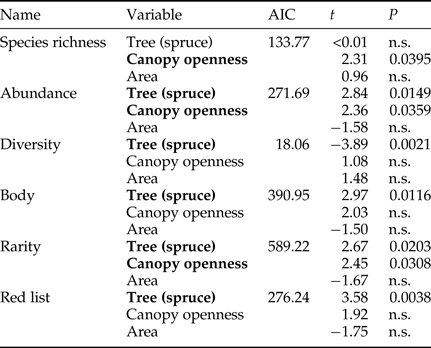
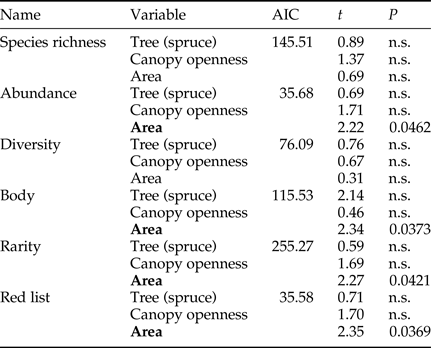
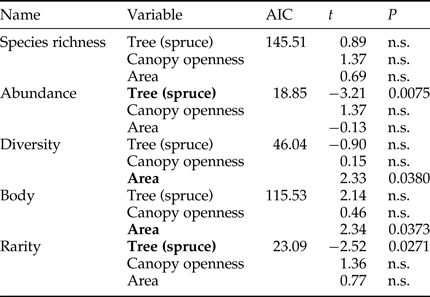
The results showed that there was no significant difference in species richness between oak- and spruce-dominated stands (figs 1, 2 and 3), although the number of click beetle species significantly benefited from increasing canopy openness (table 1). The number of individuals of click and rove beetles (figs 1 and 3) was significantly positively influenced by spruce and oak, respectively. The abundance of click beetles, furthermore, was positively influenced by canopy openness (table 1), where longhorn beetles were positively influenced only by the increasing area of the stand (table 2). The diversity of click beetles was significantly higher in oak than in spruce stands (fig. 1) and the diversity of rove beetles was significantly positively influenced by the increasing stand area (table 3). Spruce stands hosted click beetles with a higher body length than oak stands (fig. 1). The body length of longhorn and rove beetles was positively significantly influenced by an increasing stand area (tables 2 and 3). Rare click beetles were significantly more abundant in spruce than in oak stands (fig. 1) and were also positively influenced by increasing canopy openness (table 1). Rare rove beetles were more frequent in oak than in spruce stands (fig. 3) and the rarity of longhorn beetles significantly increased with an increase in area (table 2). Spruce stands hosted significantly more red-listed click beetles than oak stands (fig. 1), whereas the red-list index of longhorn beetles was positively influenced by increasing area (table 2). We did not trap red-listed rove beetles.
Results for the comparison of species richness, abundance, Shannon diversity, body length, rarity, and red-list status of click beetles (Elateridae) between stands dominated by Sessile oak (Quercus petraea) and Norway spruce (Picea abies) in lowland plantation forests – the t and P values are derived from a linear mixed-effects model (table 1); open circles show the actual values, filled squares represent the means, and thick lines show the median values.

Results of the comparison of species richness, abundance, Shannon diversity, body length, rarity, and red-list status of longhorn beetles (Cerambycidae) between stands dominated by Sessile oak (Quercus petraea) and Norway spruce (Picea abies) in lowland plantation forests – t and P values are derived from a linear mixed-effects model (table 2); open circles show the actual values, filled squares show the means, and thick lines show the medians. Note that the length and grids are root-square-transformed, and individuals and status are log-transformed.

Results of comparison of species richness, abundance, Shannon diversity, body length, and rarity of rove beetles (Staphylinidae) between stands dominated by Sessile oak (Quercus petraea) and Norway spruce (Picea abies) in lowland plantation forests – t and P values are derived from a linear mixed-effects model (table 3); open circles show actual values, filled squares show means, and thick lines show medians. Note that species and length are root-square-transformed, and individuals and grids are log-transformed.

Results of linear mixed-effect models on the species richness, abundance, Shannon diversity, body length, rarity, and red-list status of click beetles (Elateridae) in lowland plantation forests; significant variables appear in bold.

Results of linear mixed-effect models on the species richness, abundance, Shannon diversity, body length, rarity, and red-list status of longhorn beetles (Cerambycidae) in lowland plantation forests; significant variables appear in bold.

Results of linear mixed-effect models on the species richness, abundance, Shannon diversity, body length, and rarity of rove beetles (Staphylinidae) in lowland plantation forests; significant variables appear in bold.

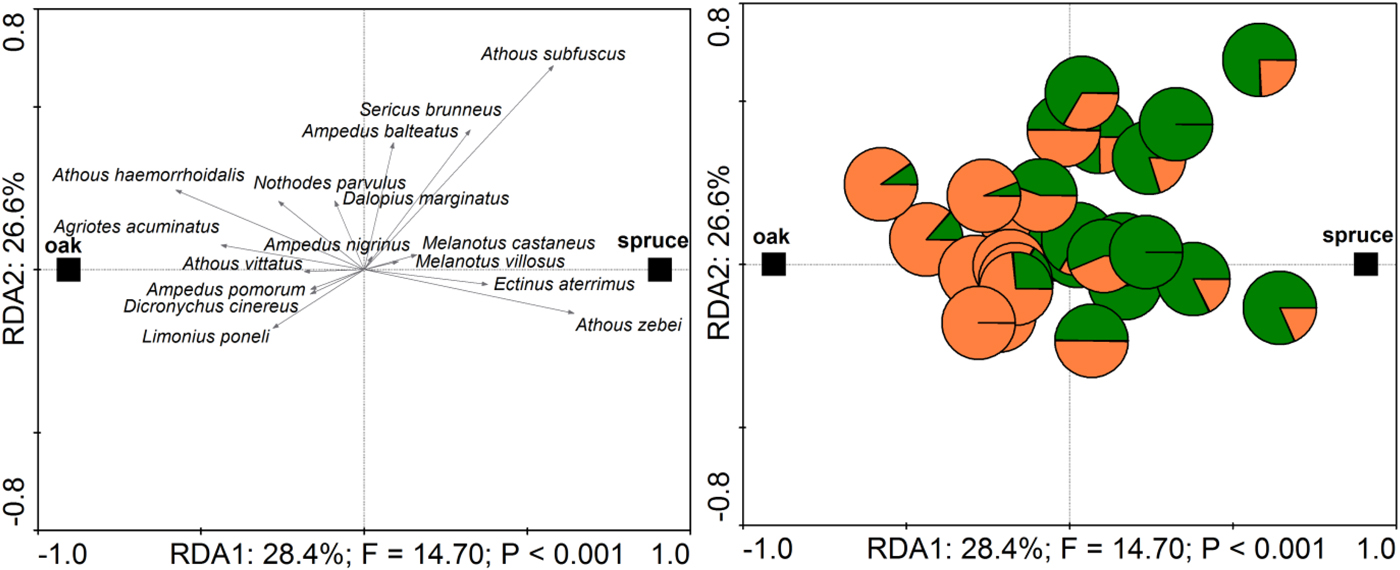
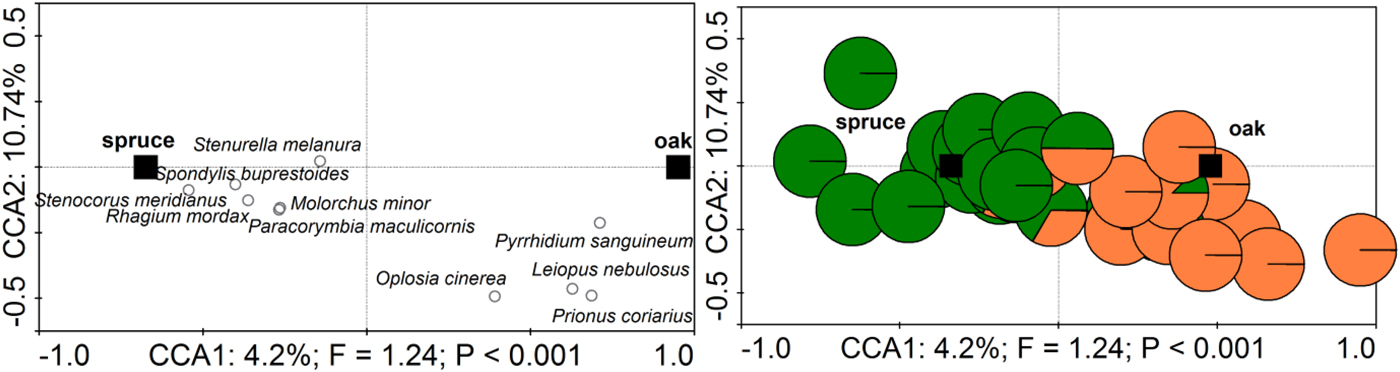
The analyses of the species composition of click beetles showed that there was significant discrimination between species preferences for oak- and spruce-dominated stands (fig. 4), similar to for longhorn beetles (fig. 5). Analyses of the species composition of rove beetles showed that there was no significant discrimination between species preferences for oak- and spruce-dominated stands (R 2 = 3.17%; F = 0.92; P = n.s.). Species composition analyses of click beetles also showed that the species that were associated with spruce stands were more influenced by canopy openness and area than those associated with oak-dominated stands, which is demonstrated by a higher clustering of spruce associates to the second axis in RDA visualization (fig. 4). Species of longhorn beetles showed a higher preference for spruce or oak stands, which is illustrated by more color-pure pies (fig. 5).
Visualization of individual click beetle (Elateridae) species preferences for stands dominated by Sessile oak (Quercus petraea) and Norway spruce (Picea abies) in lowland plantation forests using redundancy analysis. The explained variance, F and P values are derived from redundancy analysis; species with fewer than ten individuals were suppressed in the left species-environmental biplot; light-brown represents individuals on oak trees and green represents individuals captured in spruce-dominated stands in the right pie plot.

Visualization of individual longhorn beetle (Cerambycidae) species preferences in stands dominated by Sessile oak (Quercus petraea) and Norway spruce (Picea abies) in lowland plantation forests by canonical correspondence analysis. The explained variance, F and P values are derived from canonical correspondence analysis; species with fewer than five individuals were suppressed in the left species-environmental biplot; light-brown represents individuals on oak trees and green represents individuals captured in spruce-dominated stands in the right pie plot.

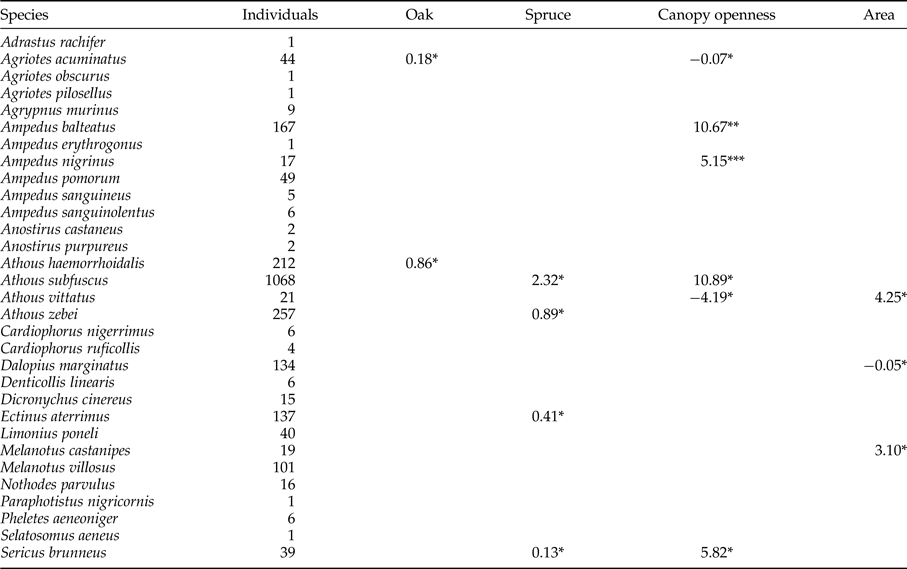
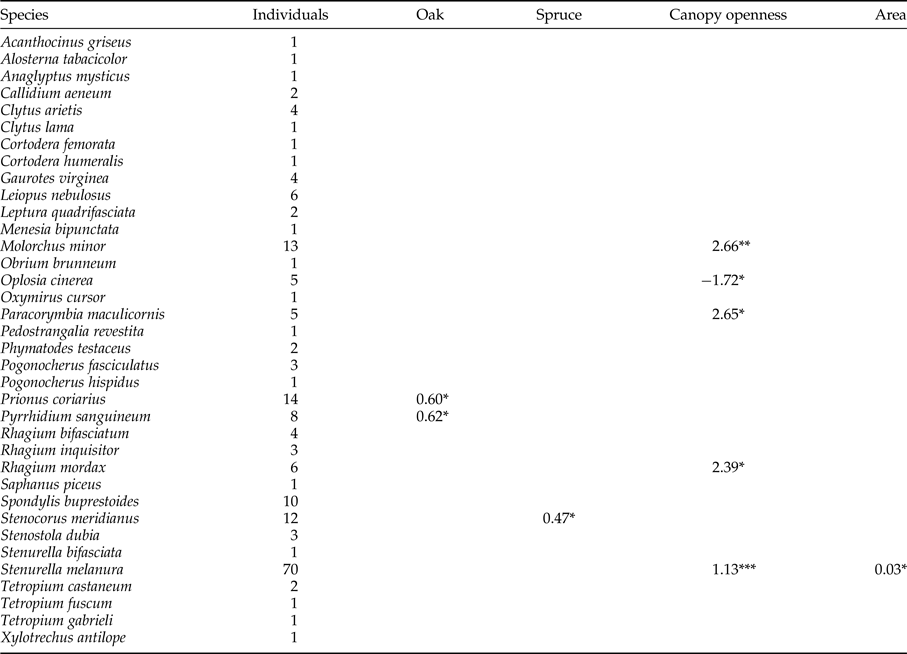
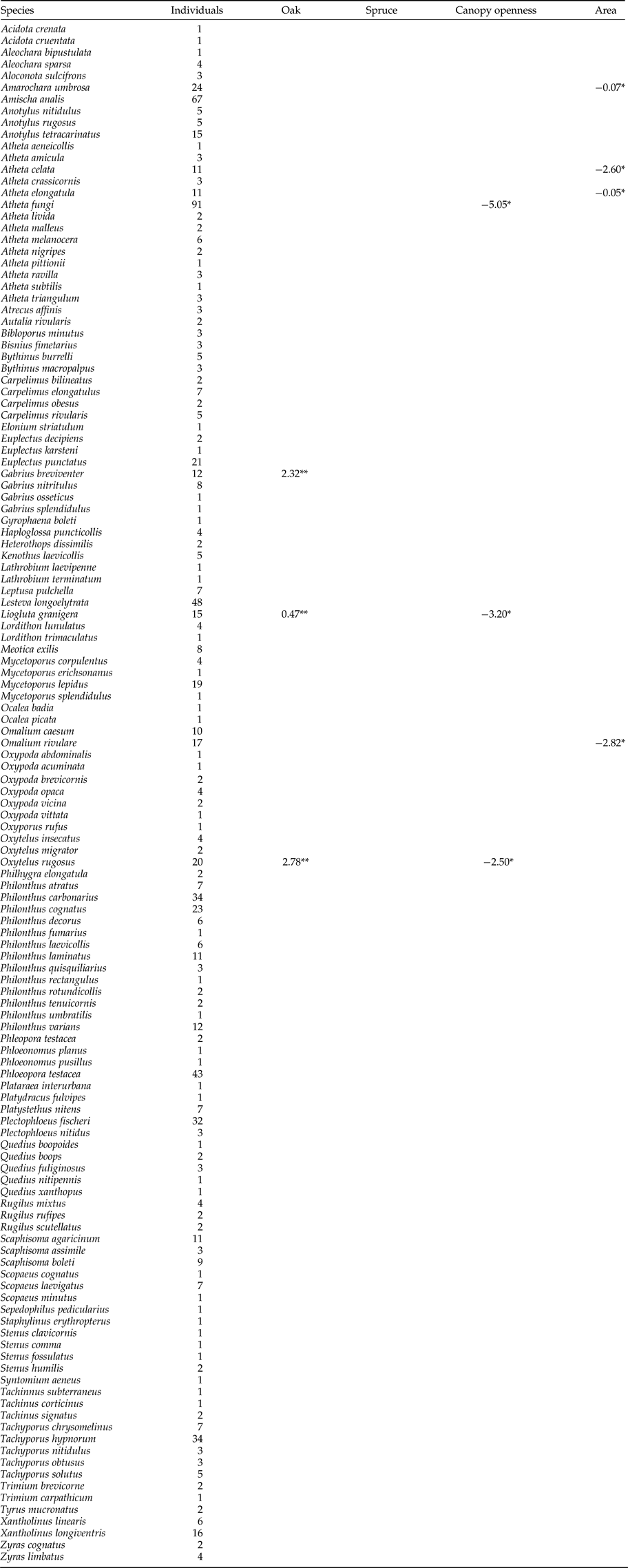
Two species (Agriotes acuminatus and Athous haemorrhoidalis) and four species (Athous subfuscus, A. zebei, Ectinus aterrimus, and Sericus brunneus) of click beetles were significantly associated with oak- and spruce-dominated stands, respectively (table 4). Two longhorn beetles (Prionus coriarius and Pyrrhidium sanguineum) preferred oak stands, whereas one (Stenocorus meridianus) preferred spruce stands (table 5). Three rove beetles (Gabrius breviventer, Liogluta granigera, and Oxytelus rugosus) preferred oak stands (table 6). Two click beetles (A. acuminatus and Athous vittatus) were negatively affected by, and four species (Ampedus balteatus, Ampedus nigrinus, A. subfuscus, and S. brunneus) thrived on canopy openness (table 4). Five longhorn beetles significantly responded to canopy openness (table 5). Four longhorn species preferred open stands (Molorchus minor, Paracorymbia maculicornis, Rhagium mordax, and Stenurella melanura), whereas Oplosia cinerea was more abundant in shaded stands. Three rove beetles (Atheta fungi, L. granigera, and O. rugosus) preferred conditions of low canopy openness (table 6). Three species of click beetles responded to the area of the stand (table 4) – A. vittatus and Melanotus castanipes preferred an increasing area of mature stands, whereas Dalopius marginatus showed the opposite relationship. Only one longhorn beetle responded to the area of the stand (table 5) – S. melanura was more abundant in large stands. Four rove beetles (Amarochara umbrosa, Atheta celata, Atheta elongatula, and Omalium rivulare) were negatively affected by an increasing stand area (table 6).
Individual click beetle (Elateridae) species preferences for stands dominated by Sessile oak (Quercus petraea) and Norway spruce (Picea abies), canopy openness and area in lowland plantation forests; t and P values (*P < 0.05; **P < 0.01; ***P < 0.001) are derived from species response curves; species with fewer than ten individuals were not analyzed.

Individual longhorn beetle (Cerambycidae) species preferences for stands dominated by Sessile oak (Quercus petraea) and Norway spruce (Picea abies), canopy openness and area in lowland plantation forests; t and P values (*P < 0.05; **P < 0.01; ***P < 0.001) are derived from species response curves; species with fewer than five individuals were not analyzed.

Individual rove beetle (Staphylinidae) species preferences for stands dominated by Sessile oak (Quercus petraea) and Norway spruce (Picea abies), canopy openness and area in lowland plantation forests; t and P values (*P < 0.05; **P < 0.01) are derived from species response curves; species with fewer than ten individuals were not analyzed.

Discussion
Our results revealed several different and contrasting responses among three studied beetle families: click beetles responded mainly to the dominant tree species and insolation of stands, whereas longhorn beetles were influenced by the stand extent and rove beetles were most influenced by the dominant tree species and stand area.
We also observed that the responses of individual species within the studied beetle families in plantation forest stands dominated by oak and spruce were in many cases complex and highly diverse and that some species indicated contrasting patterns compared to the literature (e.g., the preference of S. meridianus for conifer-dominated stands).
The response of click beetles as a highly diverse family
Click beetles revealed relatively interesting and partly contrasting responses regarding the dominant tree species. Even when their species richness did not show a significant response, the number of individuals, their length, rarity value, and red-list status was higher in spruce plantations than in oak stands. This appears to be a surprising result that might be explained by the positive influence of increasing openness in canopies (Vodka et al., Reference Vodka, Konvicka and Cizek2009; Horák & Rébl, Reference Horák and Rébl2013) in the case of abundance, but not for the other studied variables. From this point of view, it appears that click beetles represent a group that is more adaptable than is mentioned in the literature (Laibner, Reference Laibner2000). On the other hand, one of the factors that potentially influenced our results might be the long-term presence of Scots pine in our study area – even if this fact is questionable (Neuhauselova & Moravec, Reference Neuhauselova and Moravec2001). The higher adaptability of click beetles to conifer vs broadleaved tree stands rather than to particular tree species might also be relevant. Further explanations might reside in the species composition, i.e., species that were associated with oak stands were more significantly bound to it than species that preferentially occurred in spruce plantations. Another potential explanation might be that the current presence and extent of mature oak stands is below the threshold area and fragmentation caused by isolation that is acceptable for the successful development of populations of oak-associated click beetles (Alexander, Reference Alexander2002). This appears to be well reflected in the fact that only two relatively common species (Loskotová & Horák, Reference Loskotová and Horák2016) significantly preferred oak stands, whereas four species were associated with spruce plantations. The opposite relationship was observed for diversity and, thus, we concluded that tree species that is not native in the studied area can negatively influence the diversity of the family; however, why the other traits responded differently remains unclear (Loehle, Reference Loehle2003).
The response of Limonius poneli that preferred closed oak stands is different to the literature – this species prefers steppes and forest steppes where adults occur on vegetation (Mertlik, Reference Mertlik2008). This contrasts with species such as M. castanipes, which prefer spruce-dominated stands (Laibner, Reference Laibner2000). This preference was also observed for S. brunneus, which mostly prefers pine stands (Laibner, Reference Laibner2000). Thus, this relationship might indicate that species that are associated with disparate conifer stands might use stands containing different conifer tree species as a supplementary habitat. The species E. aterrimus might represent an example of contrasting preferences to those known in the literature. This click beetle prefers broadleaved forests (Laibner, Reference Laibner2000), but in this study, was significantly associated with spruce stands. As mentioned above, most of the studied click beetle traits were favored by the insolation of stands. However, we observed some species that were associated with a closed canopy (e.g., A. acuminatus). An open canopy was preferred by two Ampedus species (A. balteatus and A. nigrinus) that are known to be associated with conifer stands, whereas A. nigrinus is also associated with mountainous areas (Laibner, Reference Laibner2000). The stand area was not one of the most important variables in determining the distribution of click beetles, although some species showed a significant relationship with stand area – e.g., D. marginatus showed a negative relationship and M. castanipes a positive relationship to increasing area of stand. A positive response is unsurprising, but the negative response of D. marginatus appears to be difficult to interpret, because this species is a typical forest-dwelling species.
Longhorn beetles as representatives of a saproxylic family
Except for the species composition and the individual species, the group of longhorn beetles did not change according to the dominant tree species. This is on one hand surprising, because many species are specialized either on the wood of conifer or deciduous trees and Japanese research has shown that longhorn beetles were negatively affected by the conversion of deciduous forest stands to conifer plantations (Makino et al., Reference Makino, Goto, Hasegawa, Okabe, Tanaka and Takenari2007). On the other hand, our results might have been influenced by the fact that the stands were not absolutely pure in terms of tree species and this might also be influenced by the surrounding stands. The species composition and particularly, the abundance of three species were influenced by the dominant tree in the tree species composition. The explained variance in the tree species composition was relatively low, but the majority of species were present only in one type of stand. With respect to the individual species, the preference of P. coriarius and P. sanguineum for oak trees is not surprising, whereas the preference of S. meridianus for spruce plantations is difficult to explain. This species is known to be associated with broadleaved trees in lowland forests (Sláma, Reference Sláma1998). Furthermore, this species was present in nine stands and thus, this result cannot be influenced by a clumped distribution in one or a few spruce stands, due to the circumstantial presence of a piece of oak dead wood.
Longhorn beetles appear to be more connected to the forest environment, because of their dependence on dead wood biomass for larval development (Sláma, Reference Sláma1998). However, recent research has shown that adults are more abundant in forest edges and open forests or larvae can even develop on solitary trees (Wermelinger et al., Reference Wermelinger, Flückiger, Obrist and Duelli2007; Vodka et al., Reference Vodka, Konvicka and Cizek2009). Thus, their dependency on dead wood does not necessarily mean that this taxon is associated with forests and it is relatively surprising that longhorn beetles did not respond to canopy openness. Nevertheless, four out of five species that significantly responded to canopy openness were more associated with an increasing canopy openness. Only O. cinerea was associated with very shaded stands (for thresholds, see, e.g., Müller et al., Reference Müller, Noss, Bussler and Brandl2010), which contrasts with the known preference for avenues and solitary trees from the literature (Sláma, Reference Sláma1998). This suggests that plantation forests are still an understudied habitat type and might lead to different results than traditionally studied forest habitats such as old-growth forests or ancient woodlands (Vodka et al., Reference Vodka, Konvicka and Cizek2009; Horák & Rébl, Reference Horák and Rébl2013).
Stenurella melanura also showed a high preference for large open stands. This species is widespread throughout most of central Europe, which might be consistent with the occurrence of this species on blossoms (Sláma, Reference Sláma1998). Nevertheless, its distribution might be different in southern Europe, where S. melanura was found to be more abundant in oak forests, which generally have closed canopy (Peris-Felipo et al., Reference Peris-Felipo, Falcó-Garí and Jiménez-Peydró2011). This difference is probably because insects can find a suitable ambient temperature in warmer climates, even under the closer canopy.
The effect of isolation caused by fragmentation in forests is understudied in comparison to non-forest habitats (Krauss et al., Reference Krauss, Klein, Steffan-Dewenter and Tscharntke2004; Webb et al., Reference Webb, Buddle, Drapeau and Saint-Germain2008; Horák, Reference Horak2015) – and when studied, isolated forest fragments are usually only compared with different land uses (Pavuk & Wadsworth, Reference Pavuk and Wadsworth2013). In this study, the abundance, body size, rarity, and red-list status of longhorn beetles all increased with an increase in the area of the stand. Our results indicate that larger mature stands are highly significant not only for the total number of individuals, but also for indices that are important from the point of view of conservation biology (i.e., rare and threatened beetles) and functional ecology – larger and thus, more conspicuous longhorn beetles are associated with large stands (note that the mean value of our stand area was approximately 2 ha). The habitat area of saproxylic organisms is often characterized by the amount of dead wood or the diameter of the studied tree (Horak et al., Reference Horak, Vodka, Kout, Halda, Bogusch and Pech2014; Buse et al., Reference Buse, Entling, Ranius and Assmann2016). However, the amount of dead wood in plantation forests is generally low (Kirby et al., Reference Kirby, Reid, Thomas and Goldsmith1998); thus, we conclude that the stand area could easily contribute to the amount of dead wood available for saproxylic organisms in studies on plantation forests.
What was the response of a rove beetle family?
Rove beetles are one of the families with the highest species richness and also one of the most complicated groups for identification to the species level (Brunke et al., Reference Brunke, Klimaszewski and Anderson2012). Previous studies have identified them as potential indicators (Boháč, Reference Boháč1999); although recent findings have indicated that they are probably generalists at the habitat level, at least in semi-natural forests (Parmain et al., Reference Parmain, Bouget, Müller, Horak, Gossner, Lachat and Isacsson2015).
The generalist habitat state of rove beetles appeared to be confirmed by the absence of threatened species in this study. However, we observed significantly more rare species in oak stands. We predicted that oak stands promote most of the studied dependent variables, but this was only true for the diversity of click beetles. Therefore, the greater number of rare species and total abundance of rove beetles was relatively unexpected, especially because the hypothesis concerning higher biodiversity values in stands with prevailing native vegetation was confirmed by the taxon that is currently considered to be that with the greater number of generalists or opportunists. Setting aside the problems outlined above concerning generalist taxa, rove beetles occasionally responded positively to oak stands mainly because they avoid conifer plantations (Buse & Good, Reference Buse and Good1993). Another reason might be because even if they do not appear to show habitat preferences in general (Parmain et al., Reference Parmain, Bouget, Müller, Horak, Gossner, Lachat and Isacsson2015), it is known that individual species occupy a relatively large number of microhabitats (Caballero et al., Reference Caballero, Leon-Cortés and Moron-Ríos2007) – and disparate microhabitats are mostly more common in stands with native vegetation (Winter & Möller, Reference Winter and Möller2008).
Rove beetles did not respond to the canopy openness gradient; however, their diversity and body length increased with increasing stand area, which was a similar response to that of longhorn beetles. Nevertheless, considering individual species responses, we found that three species were promoted by the native vegetation, three species were negatively influenced by canopy openness and four species were affected by an increasing stand area. On the other hand, the species that showed a response (e.g., A. fungi, G. breviventer or O. rugosus) are mostly associated with non-specific habitats, in leaf litter or decaying plant, fungal or animal residues (Boháč & Matějíček, Reference Boháč and Matějíček2003).
Potential implications for management
Oaks that were dominant in the study territory in the past (Neuhauselova & Moravec, Reference Neuhauselova and Moravec2001) are mostly no longer present as a dominant species (Loskotová & Horák, Reference Loskotová and Horák2016). One potential reason why oak stands did not lead to the expected promotion of the majority of the studied taxa was that total area of broadleaved stands was relatively low and isolation was high compared with in conifer plantations (Loskotová, Reference Loskotová2013). Therefore, one recommendation for forest management is to at least preserve indigenous broadleaved tree species, which would help to regenerate, create, and connect new islands of deciduous trees (Webb et al., Reference Webb, Buddle, Drapeau and Saint-Germain2008). Although the natural regeneration of oak trees is occasionally considered complicated (Annighöfer et al., Reference Annighöfer, Beckschäfer, Vor and Ammer2015), it is preferred for the maintenance of beetle diversity.
Another important point for management is that legal forestry restrictions appear to be strict in most countries in central Europe. For example, clear-cuts in the Czech Republic can be performed in most cases only up to 1 ha, whereas some beetle families and their studied traits responded to an increasing area of the forest stand in our research area and the largest stand exceeded 3 ha. In Scandinavia, clear-cuts of a larger area are allowed, although with particular conservation-oriented amendments (e.g., the retention of green trees and dead wood), which might protect biodiversity (Vanha-Majamaa & Jalonen, Reference Vanha-Majamaa and Jalonen2001). This also appears to be important in the context of the first-mentioned management implication – i.e., an increase in the total area of broadleaved islands. To conserve the initial insect fauna, it is necessary to increase size of the broadleaved stands (Webb et al., Reference Webb, Buddle, Drapeau and Saint-Germain2008), including the fragmented patches of native oaks, which are generally found in the lowland forests of the central Europe (Neuhauselova & Moravec, Reference Neuhauselova and Moravec2001). On the other hand, conifer plantations also supported several beetle species of conservation interest and therefore, specific forest management applications (such as support of diversified tree species composition) should be applied to avoid the loss of biodiversity and also to conserve rare and threatened species (Roder et al., Reference Röder, Bässler, Brandl, Dvořak, Floren, Goßner, Gruppe, Jarzabek-Müller, Vojtech, Wagner and Müller2010). This is also highly connected to the fact that the majority of large forest plantations were subjected to the forest management of closed canopy stands, which is predicted to be more resistant to wind breaks (Vicena et al., Reference Vicena, Pařez and Konopka1979). Therefore, larger scales of present and future harvesting with veteran tree retention (Alexander et al., Reference Alexander, Green, Key and Read1996) might also introduce a level of mosaic structure to the stands. Moreover, if natural regeneration is applied to the new clear-cut area, beetle diversity indices and traits can benefit from the newly created ecosystem heterogeneity, as has been observed for other insects (Véle et al., Reference Véle, Holuša and Horák2016).
One of the well-known patterns in biogeography is that a large surface area of suitable habitats (i.e., stands, in this case) also means a higher species richness. Even if in this case it is rather a patch-matrix model than application of theory of island biogeography, the implication for management remains the same. The above-mentioned legal acts are oriented toward sustainable management (e.g., Gossner et al., Reference Gossner, Lachat, Brunet, Isacsson, Bouget, Brandl, Weisser and Müller2013); however, they might limit the further biodiversity-oriented management implications in the plantation forest stands. When we consider the maximal nature regeneration, one of the important issues regarding the future of clear-cut stands is the fact that the heterogeneity of tree species composition would be potentially higher in larger areas compared with in small cuts (Yasuhiro et al., Reference Yasuhiro, Hirofumi and Kihachiro2004).
The positive effect of spruce monocultures on certain families and species of click beetles was relatively surprising. This was probably because abundance of two native conifers of Scots pine and Silver fir together with Norway spruce in our research area could promote abundance of click beetles. The study area in total had a very low level of canopy openness (a mean light penetration of only 9%), which possibly negatively affected the final number of captured beetle species. Another explanation for the positive response to Norway spruce is that conifer plantations were more disturbed by abiotic factors in the past (spruce mainly by wind), which increased the insolation of stands compared with undisturbed oak-dominated stands. Regarding the improvement of conditions in native vegetation, any type of forest management of oak stands (e.g., the thinning of young trees or the intermediate felling of older and shelterwood cuttings in mature stands) can lead to a more open site canopy, to which many beetle species react positively (Vodka et al., Reference Vodka, Konvicka and Cizek2009), since the temperature of the stand is increased by the amount of sunlit space (e.g., Iverson et al., Reference Iverson, Hutchinson, Prasad and Peters2008).
Acknowledgements
The authors would like to thank to all landowners and their managers. Jan Matějíček contributed to the data on the distribution of rove beetles. The study was supported by the project of the Ministry of Agriculture NAZV KUS QJ1520197 and CULS Prague CIGA 20174307.