

1. INTRODUCTION
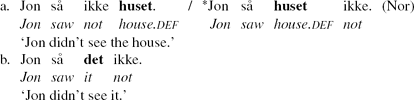
The phenomenon of Object Shift (henceforth OS) has been studied extensively in the Scandinavian languages (see e.g. Holmberg Reference Holmberg1986, Reference Holmberg1999; Vikner Reference Vikner, Corver and van Riemsdijk1994; Hellan & Platzack Reference Hellan and Platzack1995; and Thráinsson Reference Thráinsson, Baltin and Collins2001 and Vikner Reference Vikner, Everaert and van Riemsdijk2006 for overviews). Traditionally it has been assumed to apply to all ‘weak’ or unstressed pronominal objects in the Mainland Scandinavian languages (Danish (Dan), Norwegian (Nor), and Swedish (Swe)), but not to full DPs. This difference is illustrated in the Norwegian examples in (1), where the full DP huset ‘the house’ in (1a) has to remain in situ, while the pronominal object det ‘it’ in (1b) shifts across negation.
(1)

In recent years, however, it has become increasingly clear that OS is not as uniform an operation as traditionally assumed. On the basis of grammaticality judgments and written language, respectively, Josefsson (Reference Josefsson, Delsing, Falk, Josefsson and Sigurðsson2003, Reference Josefsson2010a) and Andréasson (Reference Andréasson, Butt and King2008, Reference Andréasson2009, Reference Andréasson, Butt and King2010) have shown that Swedish occasionally allows objects like unstressed honom/henne ‘him/her’ to remain in situ. Drawing on data from the Scandinavian Dialect Syntax Project, which includes both the Nordic Syntax Database (NSD), consisting of grammaticality judgments, and the Nordic Dialect Corpus (NDC), containing spontaneous corpus data, Bentzen (Reference Bentzen2013) shows that even though grammaticality judgments indicate that there is a high acceptance for unshifted pronominal objects in Danish, Norwegian, and Swedish, data from the NDC reveal that pronominal objects are much more likely to undergo OS than to remain in situ.
As has been pointed out in several works (see e.g. Lødrup Reference Lødrup1994, Borthen Reference Borthen2003, Houser, Mikkelsen & Toosarvandani Reference Houser, Mikkelsen, Toosarvandani, Brainbridge and Agbayani2008, Josefsson Reference Josefsson2010b), the neuter pronoun det ‘it’ may refer to the content of several other constituents besides neuter nouns, such as type DPs, adjectives, VP-anaphors, and full clauses. Andréasson (Reference Andréasson, Butt and King2008, Reference Andréasson2009, Reference Andréasson, Butt and King2010) also points out that pronominal object det ‘it’ typically remains in situ in Danish and Swedish when its antecedent is a clause or a VP in her written material.Footnote 1 For Norwegian, Anderssen & Bentzen (Reference Anderssen and Bentzen2011, Reference Anderssen, Bentzen, Bentzen and Fábregas2012) similarly argue that these det pronouns tend to remain in situ in the NDC spoken data. This is illustrated in (2) (from Andréasson Reference Andréasson, Butt and King2010:4), where det refers to ‘(that) Agnes bought the book’.
(2)

In this paper, we investigate how OS is employed in spontaneous spoken Mainland Scandinavian through a corpus study on OS in Danish, Norwegian, and Swedish based on the adult speech in five child language corpora. We have investigated 210,000 adult utterances of which 704 contained the relevant combinations of negation and pronominal objects. To our knowledge this is the most extensive empirical study of OS in spoken Mainland Scandinavian. For four of the corpora studied, we unfortunately do not have access to the audio files, and thus our analyses are based on transcripts of the speech. For the one corpus where we do have access to audio files, we have listened through relevant examples to determine stress patterns.Footnote 2 Our aim is to explore variation with respect to OS across the Mainland Scandinavian languages, and to evaluate our results against three recent strands of accounts of OS, namely a prosodic/phonological account (primarily focusing on the proposal by Josefsson Reference Josefsson2001, Reference Josefsson, Delsing, Falk, Josefsson and Sigurðsson2003, Reference Josefsson2010a, but see also Erteschik-Shir Reference Erteschik-Shir2005, Vogel Reference Vogel2006 and Hosono Reference Hosono2010), an account in terms of cognitive status (Andréasson Reference Andréasson, Butt and King2008, Reference Andréasson2009, Reference Andréasson, Butt and King2010, Reference Andréasson, Engdahl and Lindahl2013 this issue), and an account in terms of information structure (primarily focusing on the proposal by Anderssen & Bentzen Reference Anderssen and Bentzen2011, Reference Anderssen, Bentzen, Bentzen and Fábregas2012, but see also Holmberg Reference Holmberg1999 and Mikkelsen Reference Mikkelsen2011). As we will see, our data present different types of challenges to the various accounts.
A note on terminology is in order before we proceed. In the literature on OS, the notions of ‘weak’ and ‘strong’ pronouns are often employed. However, as these terms are used in many different contexts, with somewhat different definitions, we will avoid using them. In the following, we will refer to pronominal objects with nominal and non-nominal antecedents. An example of the former is provided in (1b) above, where the pronominal object det ‘it’ refers to ‘the house’. An example of the latter is in (2) above, where pronominal object det ‘it’ refers to the (content of the) complete previous proposition ‘(that) Agnes bought the book’. We will adopt the terms ‘stressed’ and ‘unstressed’ to characterize prosodic prominence.
The paper is structured as follows. In Section 2 we discuss central aspects of the above-mentioned approaches to OS. In Section 3 we outline our methodology and in Section 4 we present our data. Section 5 contains a discussion of our results in light of the approaches presented in Section 2, and Section 6 provides a brief conclusion.
2. APPROACHES TO OBJECT SHIFT IN MAINLAND SCANDINAVIAN
In the generative literature, OS is generally regarded as the leftward movement of pronominal objects past negation and adverbs, and studies have to a large extent focused on the question of what kinds of mechanisms drive this operation. For example, OS of pronominal objects has been argued to be related to case assignment (Holmberg Reference Holmberg1986, Vikner Reference Vikner, Corver and van Riemsdijk1994, Holmberg & Platzack Reference Holmberg and Platzack1995). It has also been claimed that OS is the result of a requirement for the order of the verb and the object within the vP phase to be preserved (Fox & Pesetsky Reference Fox and Pesetsky2005).
In this section we will focus on three accounts within different types of approaches that we perceive as prominent in the current OS debate: (i) a prosodic/phonological account (ii) an account in terms of cognitive status, and (iii) an account based on information structure. In Section 5 we evaluate our data against these three approaches.
2.1 A prosodic/phonological account
The general observation that OS is limited to unstressed pronominal objects has made prosody a natural place to look for an explanation for the phenomenon (see Erteschik-Shir Reference Erteschik-Shir2005; Vogel Reference Vogel2006; Hosono Reference Hosono2010; Josefsson Reference Josefsson, Delsing, Falk, Josefsson and Sigurðsson2003, Reference Josefsson2010a, Reference Josefsson2011, Reference Josefsson2012). In this section we consider Josefsson (Reference Josefsson2010a, Reference Josefsson2011, Reference Josefsson2012) as an example of a prosodic account of OS.
Considering grammaticality judgments from 26 Swedish-speaking informants, Josefsson (Reference Josefsson, Delsing, Falk, Josefsson and Sigurðsson2003) argues that OS is not obligatory in Swedish. Subsequently, using the same data, Josefsson (Reference Josefsson2010a, Reference Josefsson2011, Reference Josefsson2012) provides a statistical analysis of the grammaticality judgments and proposes an explanation of the observed optionality. In Josefsson (Reference Josefsson2010a), she shows that even though lack of OS is acceptable, monosyllabic pronouns such as den ‘it’ are significantly less acceptable in situ than disyllabic pronouns such as honom ‘him’. She argues that this is because the latter is prosodically heavier.Footnote 3
To account for these patterns, Josefsson (Reference Josefsson2010a, Reference Josefsson2011, Reference Josefsson2012) investigates the prosodic structure at the sentence level. Even though she takes OS to be triggered by the information-structure requirement that given information should precede new information, the optionality of OS is explained by reference to the prosodic characteristics of pronominal objects. What Josefsson refers to as weak object pronouns are clitics, which generally attach to the verb, as in (3a) or to a noun, such as the subject, as in (3b):
(3)
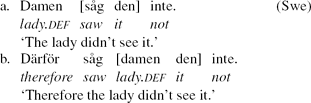
However, in some languages, these clitic pronouns may also attach to an adverb. This leads to a surface word order without OS. According to Josefsson, this is an option in Swedish, and this explains why her informants accept examples such as (4) (from Josefsson Reference Josefsson2010a:6):
(4)

Furthermore, the cliticization of disyllabic pronouns to the left of the negation also results in longer sequences of unstressed syllables, which is dispreferred by many speakers. While the prosodic weight of the pronominal element itself is used to explain within-language variation in the approach advocated in Josefsson (Reference Josefsson2010a, Reference Josefsson2011, Reference Josefsson2012), cross-linguistic variation is said to depend on how strictly a given language adheres to prosodic patterns, and which types of elements may function as the hosts of clitic pronouns. Moreover, Josefsson (Reference Josefsson2012) suggests that in Danish, demands on rhythmic alternation are stricter than in Swedish. In addition, cliticization onto adverbs is not an option in this language. Thus, according to this prosodic account, this explains why OS is obligatory in Danish but not in Swedish. With respect to pronominal objects with non-nominal antecedents, Josefsson (Reference Josefsson2012) argues that these pronouns are prosodically more prominent than objects with nominal antecendents in Swedish. As they are considered ‘strong’ (stressed) and non-specific, they are not clitics. Consequently they do not need to cliticize onto a verb or a noun. Moreover, they do not cliticize onto the adverb in the unshifted position. This explains why such pronouns in general refrain from undergoing OS in Swedish.
However, as noted in the introduction, even these pronouns may sometimes occur in the OS position. Although Josefsson (Reference Josefsson2011, Reference Josefsson2012) does not state this explicitly, it seems that these pronouns are clitics in those cases when they shift. Moreover, she links the possibility of OS with these pronouns to (contrastive) stress on the verb.
Thus, in this approach, the prosodic prominence of the pronominal object, as well as the prosodic pattern of the clause, determines the placement of these objects.
2.2 An account in terms of cognitive status
A second recent approach to OS is that developed by Andréasson (Reference Andréasson, Butt and King2008, Reference Andréasson2009, Reference Andréasson, Butt and King2010). Based on written corpora from Danish and Swedish, Andréasson investigates the position of pronominal objects. Importantly, she considers not only the shifted and unshifted in situ positions, but also the clause-initial position as well as null-realization of pronominal objects. As our study is restricted to the shifted and unshifted positions, we will focus on the results for these two positions in Andréasson's study.
Andréasson's (Reference Andréasson, Butt and King2008) study supports the findings in Josefsson (Reference Josefsson, Delsing, Falk, Josefsson and Sigurðsson2003, Reference Josefsson2010a) that unstressed pronominal objects with nominal antecedents only optionally undergo OS in Swedish, and that they occasionally remain in the unshifted position. For Danish, on the other hand, the study shows that these objects obligatorily shift across negation. Moreover, Andréasson also investigates the placement of pronominal object det ‘it’ with a clausal or VP antecedent, and finds that these elements remain in situ much more frequently than pronouns with nominal antecedents (see also Lødrup Reference Lødrup1994 for similar observations for Norwegian).
Andréasson proposes an account of these observations in terms of cognitive status, building on the Givenness Hierarchy in Gundel, Hedberg & Zacharski (Reference Gundel, Hedberg and Zacharski1993:275):

According to the Givenness Hierarchy, personal and demonstrative pronouns have the highest cognitive status, in focus and activated, respectively. Clausal entities are often referred to by demonstrative pronouns such as ‘that’; much more so than pronouns with nominal antecedents. Borthen, Fretheim & Gundel (Reference Borthen, Fretheim, Gundel, Mitkov and Boguraev1997) explain this by arguing that a referent's cognitive status is influenced partly by syntactic structure. For instance, the subject of a matrix clause is highly likely to bring its referent into focus of attention (allowing subsequent reference with a personal pronoun) whereas this is not the case for elements in subordinate clauses or prepositional phrases. Entities such as facts, events, and propositions are usually represented in terms of full sentences or VPs when first mentioned and will seldom occupy a prominent syntactic position. Consequently, such entities will only rarely achieve the cognitive status in focus – typically when mentioned more than once. This explains the tendency for clausal entities to be referred to with demonstratives such as ‘that’ rather than ‘it’. Borthen et al. (Reference Borthen, Fretheim, Gundel, Mitkov and Boguraev1997) argue that the Norwegian counterparts to it and that are unaccented and accented det ‘it’, respectively.Footnote 4 Following this, Andréasson (Reference Andréasson, Butt and King2008, Reference Andréasson2009, Reference Andréasson, Butt and King2010) argues that pronominal objects with a nominal antecedent are more typically in focus while det ‘it’/‘that’ referring to the content of a clause or a VP is generally only activated. Thus, she proposes that OS only applies to pronominal objects that are in focus.
On closer investigation of her results, Andréasson (Reference Andréasson2009, Reference Andréasson, Butt and King2010) finds that there is some variation concerning the placement of det ‘it’ with clausal antecedents, both within and across the languages. In non-declarative contexts, these elements tend to remain in situ both in Swedish and in Danish. In declarative contexts, on the other hand, this pronominal object det ‘it’ hardly ever remains in situ in Danish. However, in Swedish, both positions are used. Andréasson argues that the position of these elements is affected by the factivity of the predicate taking them as complements. In short, while det ‘it’ remains in situ when it is the complement of a non-factive verb, like tro ‘think’, it tends to shift when it is the complement of a factive verb, like förstå ‘understand’. Following Hegarty (Reference Hegarty2003), Andréasson claims that complements of factive predicates are easier to process than non-factive complements, and are therefore associated with the highest cognitive status in focus.Footnote 5
Finally, Andréasson argues that even det in a non-factive environment may undergo OS under certain conditions: (i) when the relevant clause has already been referred to by a pronoun prior to the potential OS context (see also Gundel, Borthen & Fretheim Reference Gundel, Borthen, Fretheim, Bouquet, Serafini, Brézillon and Castellani1999), and (ii) when there is contrastive focus on an element other than the pronoun. Most (though not all) instances of ‘unexpected’ OS with det as the complement in a non-factive environment in her Swedish and Danish data fall into one of these two categories.
Thus, in this approach, the cognitive status of a pronominal object determines the structural position of the object.
2.3 An information structure account
The third type of approach we will outline in this section is based on information structure. One early account that associates OS with information structure is Holmberg (Reference Holmberg1999). Holmberg argues that unstressed pronominal objects with nominal antecedents have to shift out of the VP to avoid being left in the default focus domain. On this account, OS is a defocusing operation. Consequently, strong (i.e. contrastively focused) pronouns and DPs remain in situ. See also Mikkelsen (Reference Mikkelsen2011) for a proposal in which OS is a defocusing operation.
Inspired by the accounts proposed by both Holmberg (Reference Holmberg1999) and Mikkelsen (Reference Mikkelsen2011), and also Andréasson (Reference Andréasson, Butt and King2008, Reference Andréasson2009, Reference Andréasson, Butt and King2010), Anderssen & Bentzen (Reference Anderssen and Bentzen2011, Reference Anderssen, Bentzen, Bentzen and Fábregas2012) propose that the common denominator for pronominal objects that undergo OS in Norwegian is that they are topical elements that have to shift to an IP-internal TopP.Footnote 6 They argue that while the focus-based approaches by Holmberg (Reference Holmberg1999) and Mikkelsen (Reference Mikkelsen2011) can account for OS of unstressed pronominal objects with nominal antecedents, it is harder to explain why the pronominal object det ‘it’ with clausal/VP antecedents does not shift within these approaches. These pronominal objects do not have the typical characteristics of focus elements. They may be unstressed, they are not new information, and they are not (necessarily) associated with any contrastive interpretation. In fact, they quite frequently occur in the clause-initial topicalization position (as shown in Andréasson's study, and as illustrated in Anderssen & Bentzen Reference Anderssen, Bentzen, Bentzen and Fábregas2012:16–17). Thus, Anderssen & Bentzen take these pronouns as well as pronominal objects with nominal antecedents to be topics. In order to account for this difference in placement of these two types of pronominal objects, Anderssen & Bentzen suggest that it is necessary to distinguish between different types of topics. Assuming the Topic Hierarchy proposed in Frascarelli & Hinterhölzl (Reference Frascarelli, Hinterhölzl, Winkler and Schwabe2007), they differentiate between familiar topics, aboutness topics, and continuing topics. Familiar topics are typically informationally given or accessible, destressed and realized as pronouns. Aboutness topics, on the other hand, are what the sentence is about (Reinhart Reference Reinhart1981). They have typically been ‘newly introduced’ (Frascarelli & Hinterhölzl Reference Frascarelli, Hinterhölzl, Winkler and Schwabe2007:88, from Givón Reference Givón and Givón1983) and are ‘a matter of standing and current interest or concern’ (Frascarelli & Hinterhölzl Reference Frascarelli, Hinterhölzl, Winkler and Schwabe2007:88, from Strawson Reference Strawson1963). Anderssen & Bentzen adapt these definitions to various types of pronominal objects. They argue that pronominal objects with nominal antecedents have the typical characteristics of familiar topics according to these definitions. Such objects are indeed given information, and also accessible according to e.g. Andréasson (Reference Andréasson, Butt and King2008), and Anderssen & Bentzen thus expect pronominal objects of this type to consistently undergo OS. In contrast, along with Andréasson (Reference Andréasson, Butt and King2008, Reference Andréasson2009, Reference Andréasson, Butt and King2010), they assume that pronominal objects with clausal/VP antecedents are less accessible than objects with nominal antecedents. However, they may constitute the topic of the sentence or discourse. They may also function as aboutness shifting elements. Anderssen & Bentzen therefore argue that they have the characteristics of aboutness topics. Based on this, Anderssen & Bentzen propose that OS only applies to familiar topics. Aboutness topics, on the other hand, frequently occur in the clause-initial position. However, pronominal objects in situ have a discourse status very similar to these elements when they occur in the initial position. This observation is one of the main reasons why Anderssen & Bentzen argue that these elements are aboutness topics both clause-initially and in situ.Footnote 7
However, like Andréasson (Reference Andréasson, Butt and King2008, Reference Andréasson2009, Reference Andréasson, Butt and King2010) and Josefsson (Reference Josefsson2011, Reference Josefsson2012), Anderssen & Bentzen (Reference Anderssen and Bentzen2011) note that in some situations pronominal object det ‘it’ with a clausal antecedent can undergo OS. Anderssen & Bentzen argue that this is possible when this det ‘it’ refers back to a pre-established (D(iscourse)-linked) aboutness topic. In such contexts det functions as a continuing topic. According to Frascarelli & Hinterhölzl (Reference Frascarelli, Hinterhölzl, Winkler and Schwabe2007), continuing topics behave syntactically and phonologically like familiar topics. Hence, they are expected to undergo OS in this approach. Anderssen & Bentzen back up their proposal with data from spoken Norwegian from the Nordic Dialect Corpus (NDC) (Johannessen et al. Reference Johannessen, Priestley, Hagen, Åfarli, Vangsnes, Jokinen and Bick2009).Footnote 8
Related to this approach, Bentzen, Merchant & Svenonius (to appear) argue that pronominal object det also shifts in cases of so-called ‘pragmatic control’, i.e. where the pronoun does not have an actual linguistic antecedent, but rather refers to some activity that is salient in the situation. For example, when watching a child pretending to break something, one might utter (5) with OS, but without OS the sentence is awkward, if not unacceptable (adapted from Bentzen et al. to appear):Footnote 9
(5)

Thus, in this account, whether or not various pronominal objects undergo OS is governed by their information-structure role in the discourse.
3. METHODOLOGY
3.1 The corpora
In this study, we have investigated OS in the spontaneous speech of adults in large Danish, Norwegian, and Swedish child language corpora. The corpora consist of adults interacting with children as well as with other adults participating in the recordings. For most of these corpora, audio files are unfortunately not accessible. We have therefore investigated the transcripts and looked at utterances with and without OS in the extended contexts they occur in. However, we do have access to audio files for one of the Norwegian corpora (the Anderssen corpus). We have consulted these files in this corpus in certain cases. In total, the investigated material consists of approximately 210,000 adult utterances.
The Danish material is taken from the Plunkett corpus (Plunkett Reference Plunkett1985, Reference Plunkett1986) which is available in the CHILDES database (MacWhinney Reference MacWhinney2000). We have investigated all 55 available files for the child Jens (Jens19–Jens59), and all 42 available files for the child Anne (Anne24–Anne51). In these 97 files, we analyzed the speech of the children's mothers and fathers, as well as the investigators.Footnote 10 These adult speakers altogether produce roughly 49,000 utterances. However, the father in Jens’ files does not produce any utterances relevant to our investigation, and the father and the investigators in Anne's files produce only one or two relevant examples each. Thus, the bulk of relevant examples from Danish are produced by five adults (Anne's mother, Jens’ mother, and the three investigators in Jens’ files).
The Norwegian material is taken from the Anderssen corpus (Anderssen Reference Anderssen2006) and the Simonsen corpus (Simonsen Reference Simonsen1990). The Anderssen corpus contains 70 recordings of three children, Ina (Ina01–Ina27), Ann (Ann01–Ann21) and Ole (Ole01–Ole22), interacting with their mothers, fathers and the investigators. The adults altogether produce approximately 73,000 utterances. We have included the production of the mothers, fathers and investigators in Ina's and Ole's files, and the investigator in Ann's files in our analysis.Footnote 11 All adults speak (for the present purposes) similar varieties of Northern Norwegian dialects.Footnote 12
The Simonsen corpus consists of 14 files of recordings of two children, Tomas (tomas01–tomas8) and Nora (nora01–nora06), interacting with their mothers and an investigator. This corpus is smaller than the other corpora investigated in this paper, and the adults altogether produce approximately 6,600 utterances. Nora's and Tomas’ mothers produce only two or three relevant utterances. The bulk of relevant examples from this corpus hence comes from the investigator (who is the same person in both sets of files). The adults in the Simonsen corpus speak the Eastern Norwegian dialect of Oslo. This corpus is available in the CHILDES database. A recent study on OS in Norwegian dialects (Bentzen Reference Bentzen2013) did not find any significant differences with respect to this phenomenon in Eastern and Northern Norwegian dialects. Thus, we will treat the results from the Anderssen corpus and the Simonsen corpus jointly as ‘Norwegian results’.
The Swedish material is taken from the Gothenburg corpus (Plunkett & Strömqvist Reference Plunkett, Strömqvist and Slobin1992, Strömqvist, Richthoff & Andersson Reference Strömqvist, Richthoff and Andersson1993, Richthoff Reference Richthoff2000) and the Wikström corpus (Wikström Reference Wikström2008). The former is available in the CHILDES database. In the Gothenburg corpus, the adults speak standard Swedish with a touch of the west-coast dialect. In the Wikström corpus, the adults speak either the southern Swedish dialect of Scania or central Swedish with a touch of the Dalecarlian dialect. We will treat the results from the Gothenburg corpus and the Wikström corpus jointly as ‘Swedish results’.
In the Gothenburg corpus, we have investigated 174 files of recordings of five children, Anton (ant23_08–ant47_29), Bella (bel18_09–bel41_09), Harry (har18_20–har47_20), Markus (mar15_19–mar33_29) and Tea (tea18_10–tea47_23), interacting with their mothers, fathers, grandparents and the investigators. The 19 adult speakers altogether produce roughly 75,500 utterances. However, six adults do not produce any utterances relevant to our investigation (the investigator in Bella's files, an adult acting as the cookie monster in Anton's files, and Markus’ paternal grandfather, Markus’ maternal and paternal grandmothers and an unidentified adult in Markus’ files), and four adults produce only one or two relevant examples each (Bella's father, Harry's maternal grandfather, Markus’ mother and Tea's father). Thus, the bulk of relevant examples from the Gothenburg corpus are produced by nine adults (Anton's mother, father, and paternal grandmother, Bella's mother, Harry's mother and maternal grandmother, Markus’ father, and Tea's mother and maternal grandmother).
The Wikström corpus consists of 15 files of recordings of one child, Hanna (Jo1y06m–Jo2y10m), interacting with her mother and father. The adults altogether produce approximately 5,700 utterances.
3.2 Search procedures and data analysis
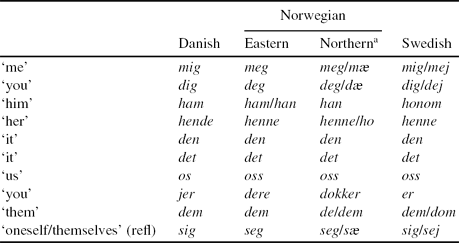
Our investigation focuses on the relative word order of pronominal objects and negation in Danish, Norwegian, and Swedish. We have extracted utterances containing pronominal objects and negation from the above-mentioned corpora. To ensure comparability between the Danish, Norwegian, and Swedish data sets, corresponding pronouns (and all versions of them) in the three languages were included in the study. The pronouns for each language are listed in Table 1.
Pronouns included in the study.
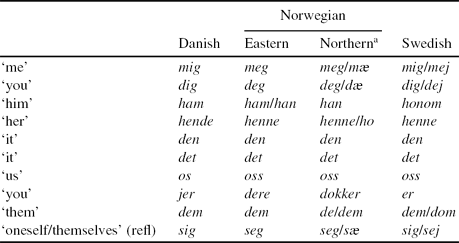
aFor Northern Norwegian, we searched for both the standard and the dialectal form of the pronouns (standard/dialectal form).
Utterances containing both negation and one of the pronouns listed in Table 1 were extracted using a combination of manual and automatic procedures. The Swedish corpora were analyzed using CLAN programs to automatically extract all utterances containing negation (inte, icke, ej ‘not’). We then manually extracted all utterances containing a pronominal object either following or preceding the negation.
To analyze the Danish and the Norwegian corpora, we used CLAN programs to automatically extract all utterances with negation (ikke, ikkje ‘not’) directly followed or preceded by the pronouns in Table 1. Because some of the pronouns in Danish (den and det), Eastern Norwegian (han, den, det and dere) and Northern Norwegian (han, ho, den, det, dokker, dem and de) are ambiguous between subject and object forms, this procedure gave us many utterances with pronominal subjects, which were excluded manually from the data sets.
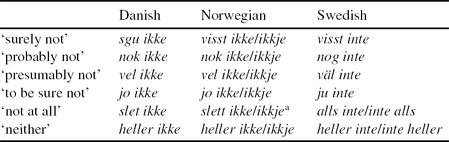
When manually analyzing the Swedish corpora we found some utterances with an adverb in combination with negation, such as alls inte ‘not at all’ and nog inte ‘probably not’. As the CLAN analyses of the Danish and the Norwegian corpora only gave us utterances with pronouns directly following and preceding negation, we performed additional CLAN searches to extract all utterances that had one of the relevant adverbs in combination with negation in these corpora. To ensure that the Danish, Norwegian, and Swedish data sets were comparable, we used the Danish and Norwegian equivalents of the adverbs that we found in the Swedish corpora. The adverb–negation combinations for each language are listed in Table 2.Footnote 13 These searches gave us a few more examples for Danish, but none for Norwegian.
Adverb–negation combinations included in the study.
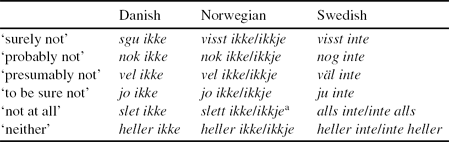
aIncluding Norwegian variants such as slettes and slettest.
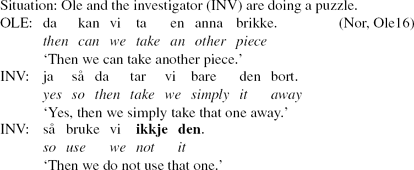
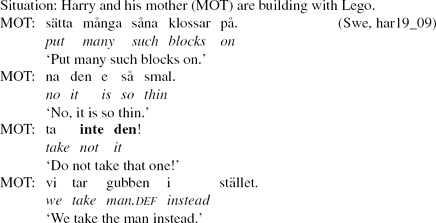
When analyzing the data we excluded contrastive pronominal objects following negation, as these are expected to follow negation. As already mentioned above, we did not have access to audio files for all transcripts. Thus, to identify contrastive pronominal objects we studied the contexts in which they occur.Footnote 14 In total, we identified and excluded 11 contrastive pronominal objects in the Danish corpus, seven in the Norwegian corpora, and 21 in the Swedish corpora. Examples illustrating pronominal objects that we have interpreted as contrastive are given for Norwegian in (6) and for Swedish in (7). In (6), den ‘it’ is referring to a puzzle piece which is contrasted with other puzzle pieces, and in (7), den ‘it’ is referring to a piece of Lego which is contrasted with other pieces of Lego.
(6)
(7)
The collected data have been analyzed considering the influence of nominal and non-nominal antecedents on the position of pronominal objects. Further, we analyze variation across Danish, Norwegian, and Swedish, and link our results to previous studies on OS. Finally, our results will also be discussed in relation to previous accounts of the role of prosody, cognitive status and information structure of the position of pronominal objects.
4. RESULTS
In this section we present the results from our corpus study of OS in Danish, Norwegian, and Swedish spontaneous spoken language. As pointed out in Anderssen et al. (Reference Anderssen, Bentzen, Rodina, Westergaard, Anderssen, Bentzen and Westergaard2011), potential contexts for OS are rather infrequent in spontaneous speech. Consequently, although we have investigated several rather large corpora, our searches yielded relatively low numbers of relevant occurrences. The upshot of this, however, is that a qualitative investigation of the individual examples is possible. We will return to a detailed discussion of our results in Section 5 below.
4.1 Danish results
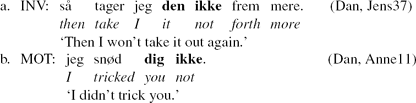
In her study of written Danish, Andréasson (Reference Andréasson, Butt and King2008, Reference Andréasson2009, Reference Andréasson, Butt and King2010) found that pronominal objects with nominal antecedents obligatorily undergo OS (see also Pedersen Reference Pedersen, Pedersen and Pedersen1993), whereas pronominal object det ‘it’ referring to a VP or a clause usually undergoes OS. Our data on spoken Danish confirm Andréasson's results with respect to pronominal objects with nominal antecedents. We see a strong tendency for such pronouns to undergo OS, 95% (21/22) of the time. Examples of shifted pronominal objects with nominal antecedents in Danish are provided in the sentences in (8), whereas (9) illustrates the one example where this type of object remains in the unshifted position.
(8)
(9)
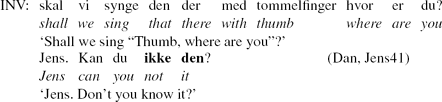
In contrast to Andréasson (Reference Andréasson2009, Reference Andréasson, Butt and King2010), who found that det ‘it’ referring to a VP or a clause practically never remains in situ in written Danish, we see a tendency for such pronouns to remain in situ in our spoken Danish data. However, we do find that such pronouns may shift, and do so as much as 15% (14/93) of the time. As will become obvious in this section, these types of pronouns undergo OS more frequently in Danish than in Norwegian and Swedish. We will return to this point when discussing our results in Section 5. Examples of both shifted and unshifted det ‘it’ referring to a VP or a clause are provided in (10)–(11), where det in (10) refers to something Jens has already done and is about to do again and in (11) to ‘go down to Great Grandmother’:
(10)
(11)


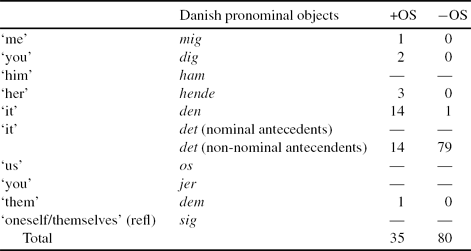
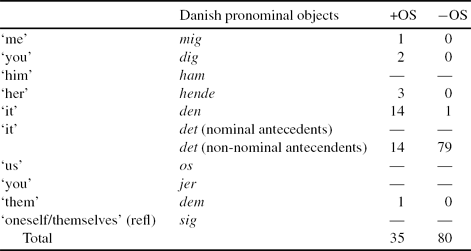
In the Danish material, we found six pronominal object types, and two of these occur in both shifted (+OS) and unshifted (–OS) position (den ‘it’ and det ‘it’), as shown in Table 3. The pronominal object den ‘it’ seems to tend to shift (14 +OS vs. 1 –OS), whereas det ‘it’ referring to a VP or a clause tends to remain in situ (14 +OS vs. 79 –OS). The remaining four pronominal objects are attested only once or twice.
Types of pronominal objects in Danish, and their positions.
In total, there are five speakers in the Danish material; of those, three speakers produce pronominal objects in both shifted and unshifted position. The remaining two speakers only produce one example each and, thus, do not show any overlap between +OS and –OS. Our Danish data thus suggest that +OS versus –OS is not dependent on the preferences of individual speakers.
4.2 Norwegian results
As in the Danish corpus, pronominal objects with nominal antecedents usually undergo OS in our Norwegian data, 87% (41/47). Examples of shifted pronominal objects with nominal antecedents are provided in (12) (HAN = Hanne, investigator):
(12)
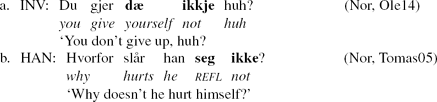
In total, we found six examples with such pronouns in situ in the Norwegian corpora. This is illustrated in (13) and (14).
(13)
(14)
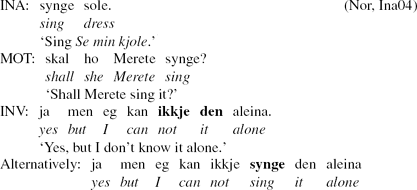
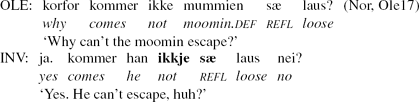
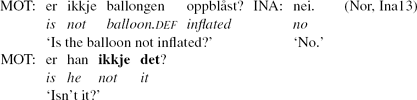
Footnote 15Footnote 16 With respect to the pronominal object det ‘it’ referring to a VP or a clause, we find that such pronouns typically remain in situ in spoken Norwegian, 95% (225/237). Examples of both unshifted and shifted det are provided in (15)–(16), where det in (15) refers to ‘inflated’ and in (16) to ‘to eat them’.
(15)
(16)

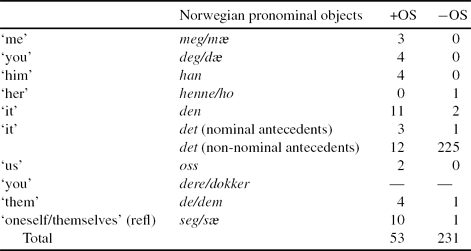
In the Norwegian corpora, we found nine pronominal object types, and four of these occur in both shifted and unshifted position (den ‘it’, det ‘it’, de/dem ‘them’ and seg/sæ ‘oneself/themselves’), as shown in Table 4. The pronouns den ‘it’ and seg/sæ ‘oneself/themselves’ more frequently occur in the shifted position, whereas det ‘it’ referring to a VP or a clause tends to remain in situ. One pronominal object (henne/ho ‘her’) was attested only once (unshifted) and thus could not show any overlap between +OS and –OS.Footnote 17 The remaining four pronominal objects (meg/mæ ‘me’, deg/dæ ‘you’, han ‘him’ and oss ‘us’) are attested only between two and four times, which makes it difficult to draw any conclusions about distributional patterns.
Types of pronominal objects in Norwegian, and their positions.
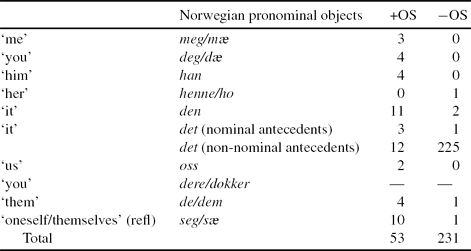
In the Norwegian corpora, there are eleven speakers, and nine of them produce pronominal objects in both shifted and unshifted positions. Two speakers only use –OS (Nora's mother and Tomas’ mother); however, both speakers only produce det ‘it’ referring to a VP or a clause and, thus, are expected to use the unshifted position. Hence, our Norwegian data also suggest that +OS versus –OS is not dependent on the preferences of individual speakers.
4.3 Swedish results
In her investigation of written Swedish, Andréasson (Reference Andréasson, Butt and King2008, Reference Andréasson2009, Reference Andréasson, Butt and King2010) found that pronominal objects with nominal antecedents tend to undergo OS (see also Josefsson Reference Josefsson, Delsing, Falk, Josefsson and Sigurðsson2003, Reference Josefsson2010a), whereas the pronominal object det ‘it’ referring to a VP or a clause tends to remain in situ. Our data on spoken Swedish confirm Andréasson's results with respect to det, but differ somewhat with respect to pronominal objects with nominal antecedents.
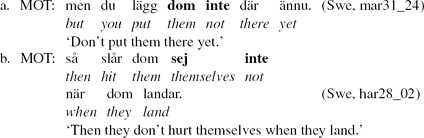
In contrast to Andréasson, who found that pronominal objects with nominal antecedents tended to undergo OS in written Swedish (95.5%), our data show that only 64% (30/47) of the pronominal objects with nominal antecedents undergo OS in spoken Swedish. Thus, we see a much stronger tendency for pronominal objects with nominal antecedents to remain in situ in our data on spoken Swedish (36%, 17/47) than in our data on spoken Danish (5%) and Norwegian (13%). Examples of shifted and unshifted pronominal objects with nominal antecedents in Swedish are provided in (17)–(18).
(17)
(18)

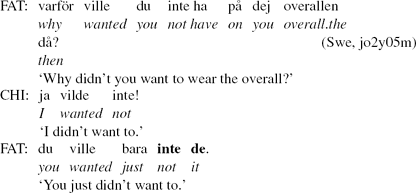
In parallel with Andréasson's (Reference Andréasson2009, Reference Andréasson, Butt and King2010) data on written Swedish, we see a strong tendency for the pronominal object det ‘it’ referring to a VP or a clause to remain in situ in spoken Swedish. Only two examples of det in the shifted position were found in our Swedish corpora; 99% (256/258) of such pronominal objects remain in situ in spoken Swedish. In our material, the tendency for det to remain in situ is stronger in spoken Swedish than in spoken Danish (85%) and Norwegian (95%). An example with the pronominal object det ‘it’ in situ in Swedish is given in (19), where det refers to the VP ‘wear the overall’. (In (19) FAT = father; CHI = child.)
(19)
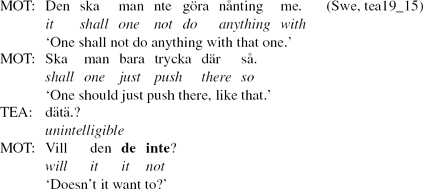
Example (20) illustrates an instance of OS with det ‘it’ referring to a VP in the Swedish data. In this case, det refers to the content of a VP meaning ‘to go down’ or ‘to turn’.
(20)
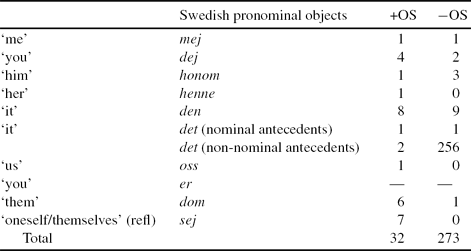
Footnote 18 In the Swedish material, we found nine pronominal object types, and six of these occur in both shifted and unshifted position (mej ‘me’, dej ‘you’, honom ‘him’, den ‘it’, det ‘it’ and dom ‘them’), as shown in Table 5. As already pointed out above, det ‘it’ referring to non-nominal antecedents typically remains in situ. Two pronominal objects (henne ‘her’ and oss ‘us’) were attested only once (shifted) and, thus, could not show any overlap between +OS and –OS. Not counting these, sej ‘oneself/themselves’ is the only pronominal object in the Swedish material that only occurs in one of the positions (shifted). This suggests that +OS versus –OS is not dependent on individual pronouns.
Types of pronominal objects in Swedish, and their positions.
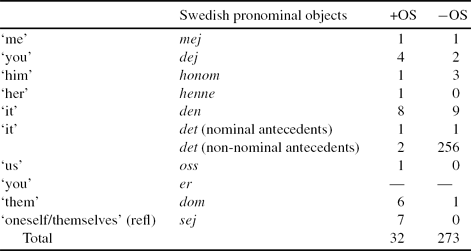
Further, our Swedish data also suggest that +OS versus –OS is not dependent on the preferences of individual speakers. In total, there are 15 speakers in the Swedish material; of those, nine speakers produce pronominal objects in both shifted and unshifted position. Three speakers only produce one example each and, thus, could not show any overlap between +OS and –OS. Not counting these speakers, there are three speakers who only use –OS (Anton's grandmother, Bella's father and Hanna's father). However, all three speakers are only producing det ‘it’ referring to non-nominal antecedents and, thus, are expected only to use the unshifted position.
5. DISCUSSION
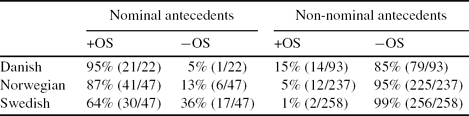
Traditionally, OS has been regarded as an obligatory operation, and it is only in recent years that it has become increasingly clear that OS involves considerably more variation than previously assumed. One type of variation pertains to the antecedent that the object pronoun refers back to (Andréasson Reference Andréasson, Butt and King2008, Reference Andréasson2009, Reference Andréasson, Butt and King2010; Anderssen & Bentzen Reference Anderssen and Bentzen2011, Reference Anderssen, Bentzen, Bentzen and Fábregas2012; Anderssen, Bentzen & Rodina Reference Anderssen, Bentzen and Rodina2012). However, variation has also been found to exist in the types of pronouns that represent the typical cases as well (Josefsson Reference Josefsson, Delsing, Falk, Josefsson and Sigurðsson2003, Reference Josefsson2010a, Reference Josefsson2011; Andréasson Reference Andréasson, Butt and King2008, Reference Andréasson2009, Reference Andréasson, Butt and King2010). The results of our investigation of spoken corpora confirm what other recent studies of OS generally have argued, namely that this is not a uniform operation of simply shifting all (unstressed) pronominal objects across adverbs and negation. As we have seen, in Swedish OS seems optional with objects with nominal antecedents and strongly dispreferred with objects with non-nominal antecedents. In Danish and Norwegian, pronominal objects with a nominal antecedent typically shift, while pronoun det ‘it’ with a non-nominal antecedent typically remains in situ. However, these pronouns also occasionally shift, especially in Danish. Our results are summarized in Table 6.
Summary of results.
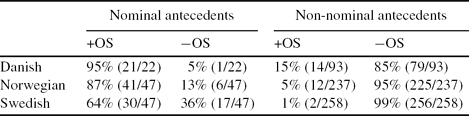
In this section we discuss our data in light of the three approaches presented in Section 2. As none of these proposals are based on spontaneous spoken language, we will highlight strengths and weaknesses of each of the approaches when faced with spoken language use. We will start by discussing to what extent the different approaches can account for the lack of OS with object pronouns referring to nominal antecedents (Josefsson Reference Josefsson, Delsing, Falk, Josefsson and Sigurðsson2003, Reference Josefsson2010a, Reference Josefsson2011, Reference Josefsson2012). We then consider how the different proposals would deal with the placement of det ‘it’ when its antecedent is a type DP, an adjective, a VP or a clause (Andréasson Reference Andréasson, Butt and King2008, Reference Andréasson2009, Reference Andréasson, Butt and King2010; Anderssen & Bentzen Reference Anderssen and Bentzen2011, Reference Anderssen, Bentzen, Bentzen and Fábregas2012). Even though OS can be said to exhibit optionality in the spoken corpora of all the Mainland Scandinavian languages, it is clear that det ‘it’ is considerably less likely to shift if it refers to a type DP, an adjective, a VP or a clause in all the varieties, while there is considerable variation between the three languages when the antecedent is nominal.
5.1 The position of pronominal objects with nominal antecedents
If we consider OS of pronominal objects with nominal antecedents, it seems to be fairly obligatory in Danish and Norwegian, especially in Danish. Only 4.5% (1/22) and 13% (6/47) of these pronouns remain in situ in Danish and Norwegian. Swedish, however, exhibits a great deal more variation, with 36% (17/47) of these pronominal objects remaining in situ. Even though OS has been shown to be optional even for pronouns with nominal antecedents in Swedish on the basis of native speaker judgment data (Josefsson Reference Josefsson, Delsing, Falk, Josefsson and Sigurðsson2003, Reference Josefsson2010a), pronominal objects have not been found to occur in the unshifted position very frequently. For example, Andréasson (Reference Andréasson, Butt and King2008) shows that the (non-contrastive) pronouns honom ‘him’ and henne ‘her’ occur in this position only 4–5% of the time in written corpora. Given this, the high number of unshifted pronominal objects with nominal antecedents in the spoken corpora, and especially in Swedish, is surprising. Let us now consider how this optionality can be dealt with in the different approaches presented in Section 2 above.
First, let us consider our data in light of the prosodic approach to OS proposed by Josefsson. As outlined in Section 2.1 above, on this account pronominal objects with nominal antecedents are clitics, and OS is a reflection of cliticization onto the verb (or the subject). As most of such pronominal objects in our data are indeed shifted across negation/adverbs, this account can explain much of our data.
However, as mentioned above, pronominal objects with nominal antecedents also occur in the unshifted position in our data, especially in Swedish. Josefsson's (Reference Josefsson2010a, Reference Josefsson2011, Reference Josefsson2012) approach was specifically intended to account for the fact that in the native speaker judgment task carried out in Josefsson (Reference Josefsson, Delsing, Falk, Josefsson and Sigurðsson2003), Swedish informants showed a very high degree of acceptability of pronominal objects with nominal antecedents in the unshifted position. In Josefsson (Reference Josefsson2010a, Reference Josefsson2011, Reference Josefsson2012), this is accounted for by assuming that pronominal objects may cliticize onto the adverb in these cases. Moreover, the author proposes that this is an option in Swedish, but not in Danish. Thus, this approach predicts the differences we find in our data, namely that OS is certainly optional in Swedish, while it seems to be obligatory in Danish. For Norwegian, the situation is a bit less clear. While OS certainly appears to be the more frequent word order, there are some examples of unshifted pronouns. However, the native speakers of Norwegian we have consulted find these examples degraded. Thus, it seems that Norwegian is more like Danish than Swedish in this respect, and that cliticization onto the adverb presumably is not an option in Norwegian either (or at least a strongly dispreferred option).
Furthermore, recall that Josefsson (Reference Josefsson2010a, Reference Josefsson2011, Reference Josefsson2012) suggests that cross-linguistic variation concerning what the pronominal object can cliticize onto is related to how strictly the language adheres to prosodic patterns. In light of this, what needs to be explained is the behaviour of Danish and Norwegian as opposed to Swedish. Josefsson (Reference Josefsson2011, Reference Josefsson2012) speculates that Danish has stricter demands on rhythmic alternations than Swedish, and that this prevents object cliticization onto adverbs/negation. It is not entirely clear what criteria for rhythmic patterns this is based on. Swedish of course has lexical tone, while Danish does not. However, Danish is a language in which many sounds are extremely reduced, and as a consequence one would expect that its prosodic structure would not be very rigid or even very clear (see Grønnum Reference Grønnum, Jacobsen, Bleses, Madsen and Thomsen2003, Bleses & Basbøll Reference Bleses, Basbøll, Schmidt, Mikkelsen, Post, Simonsen and Fruensgaard2004, Hilton, Schüppert & Gooskens Reference Hilton, Schüppert and Gooskens2011). Moreover, with respect to prosodic aspects such as tone and rhythmic patterns, in the literature, Norwegian is usually grouped with Swedish, and in contrast with Danish (e.g. Bleses, Basbøll & Vach Reference Bleses, Basbøll and Werner Vach2011). Thus, if these prosodic properties are the reasons why OS is optional in Swedish but not in Danish, we would expect Norwegian to pattern with Swedish and show more optionality with respect to OS than what we find in our data.
Josefsson (Reference Josefsson2010a) also discusses another factor that might influence whether pronominal objects shift, namely syllable structure. Josefsson (Reference Josefsson2010a:7) finds that there is a statistically significant difference between the informants’ willingness to accept the monosyllabic pronoun den ‘it’ in shifted and unshifted position, with a lower acceptability for the unshifted position. For the disyllabic pronoun honom ‘him’, on the other hand, there was no statistical difference, and Josefsson attributes the higher acceptability of honom in situ to its disyllabic status.
Generally speaking, the results from our investigation do not suggest that variability in the placement of pronominal objects with nominal antecedents is dependent on syllable structure. As can be seen in the tables in Section 4 above, there is not a stronger tendency for monosyllabic pronominal objects to undergo OS than disyllabic ones. For example, in Danish, where pronominal objects with nominal antecedents in general tend to shift, three of the 21 shifted pronouns are in fact disyllabic (three instances of hende ‘her’). Furthermore, all eight cases of unshifted pronouns in Danish and Norwegian are actually monosyllabic. Swedish also displays both monosyllabic and disyllabic pronouns in both positions, at about the same rates. Examples of monosyllabic and disyllabic pronominal objects occurring in shifted and unshifted positions are illustrated with Swedish in (21)–(22), respectively (GMM = maternal grandmother).
(21)
(22)
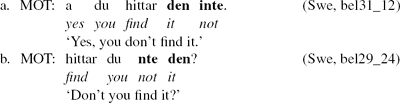
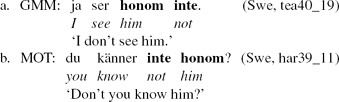
Thus, it does not seem that prosodic structure determines whether pronominal objects with nominal antecedents undergo OS or not.
Turning to the cognitive approach to OS, this approach assumes that the syntactic position of the pronominal object in structures involving OS is linked to the highest cognitive status (in focus) in the Givenness Hierarchy (Gundel et al. Reference Gundel, Hedberg and Zacharski1993). Furthermore, pronominal objects with nominal antecedents are in focus and thus generally undergo OS. This approach can also account for the majority of examples with such objects in our data.
However, as we have seen, Andréasson (Reference Andréasson, Butt and King2008, Reference Andréasson2009, Reference Andréasson, Butt and King2010) finds that Swedish seems to permit a lack of OS with object pronouns with nominal antecedents, that is, with pronouns with the highest cognitive status (in focus). As an explanation for these facts, Andréasson (Reference Andréasson, Butt and King2010) suggests that languages may vary with regard to where they can place the negation relative to the cognitive status of pronominal objects. In Danish, the negation always occurs after pronominal objects that are in focus, while in Swedish, both the Danish and another option are available, namely that negation may also precede pronominal objects that are in focus. With regard to the results presented here, it seems that the cognitive approach to OS could maintain the proposals for Danish and Swedish. Danish seems to allow very little variation, if any, in the placement of object pronouns with nominal antecedent, while Swedish clearly allows both orders. Norwegian, showing some, but clearly very limited variation, could either be regarded as similar to Swedish, in which case the negation can occur in two positions, or be classified as similar to Danish, in which case the six instances of unshifted pronominal objects with nominal antecedents would have to be explained otherwise.
Irrespective of how Norwegian is treated within this approach, it seems that the cognitive approach can account for the variation observed in the three languages. However, the variability account proposed by this approach does not make reference to the cognitive status of the pronouns, but rather to where the negation can be placed in relation to the different pronouns.Footnote 19 One interpretation of this proposal would be that the different cognitive statuses should be reflected as different positions in a syntactic tree, where the higher the cognitive status of a given lexical element is, the higher up in the structure it is found.
In the information-structure approach proposed by Anderssen & Bentzen (Reference Anderssen and Bentzen2011, Reference Anderssen, Bentzen, Bentzen and Fábregas2012), OS is treated as compulsory for pronominal objects with nominal antecedents. This approach does not prima facie have anything to say about structures in which these elements do not undergo OS. Consequently, unshifted pronominal objects with nominal antecedents are problematic for this proposal. Recall that according to Anderssen & Bentzen (Reference Anderssen and Bentzen2011, Reference Anderssen, Bentzen, Bentzen and Fábregas2012), OS is topicalization to an IP-internal topic position, and the most straightforward case is found with object pronouns with nominal antecedents. These elements are classified as familiar topics; they are informationally given, destressed and realized as pronouns. Again, this is an account that can explain most of the data with such pronominal objects in our material.
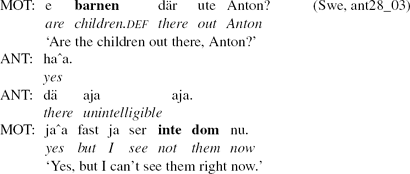
However, in Swedish, as much as 36% (17/47) of these pronouns remain in situ. Only one of these cases is judged as degraded by our native Swedish-speaking consultant. A closer examination of the Swedish contexts in which object pronouns with nominal antecedents have not undergone OS shows that these unshifted objects, like the shifted objects, clearly are familiar topics. This is illustrated by the example in (23), where the pronoun has a familiar antecedent, and according to the information-structure account should undergo OS. (The symbol ^ marks a pause between syllables.)
(23)
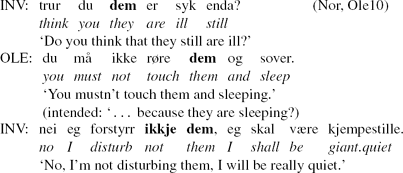
For Norwegian, there are six potential counterexamples to the information-structure account, that is, pronominal objects with nominal antecedents displaying a lack of OS. The Norwegian examples, like the Swedish ones, all seem to involve pronominal objects that have been previously introduced and that function as familiar topics. This is illustrated in (24) below. In this context, the pronominal object is clearly the topic of the conversation.
(24)
Thus, it is clear that the behaviour of these object pronouns cannot be explained by information structure. Hence, although the information-structure based approach to OS can account for the Danish and most of the Norwegian data, our Swedish data clearly represent a challenge to this approach.
In conclusion, we have seen that while all the three approaches discussed above can account for OS of pronominal objects with nominal antecedents, they all face (different types of) challenges in dealing with the lack of OS with such objects. This is unexpected on the information-structure based approach, and the other two approaches do not fully explain the variation found both within and across the Mainland Scandinavian languages.
5.2 The position of det ‘it’ with non-nominal antecedents
Now let us turn to the distribution of the pronoun det ‘it’ with non-nominal antecedents in our material. As has been pointed out in previous research (Andréasson Reference Andréasson, Butt and King2008, Reference Andréasson2009, Reference Andréasson, Butt and King2010; Anderssen & Bentzen Reference Anderssen and Bentzen2011, Reference Anderssen, Bentzen, Bentzen and Fábregas2012; Josefsson Reference Josefsson2011, Reference Josefsson2012; Lødrup Reference Lødrup2012), this pronoun typically remains unshifted in all three Mainland Scandinavian languages considered here. This tendency is clearly also found in our spoken language data, where these pronouns remain in situ 85% of the time in Danish, 95% in Norwegian, and 99% in Swedish. In Swedish there are only two instances of OS with pronominal objects with non-nominal antecedents. In Danish and Norwegian there are 14 and 12, respectively. The three approaches outlined in Section 2 above have different explanations for why these pronouns generally fail to undergo OS, as well as which conditions occasionally may make OS of them possible after all.
Recall that within the prosodic account proposed by Josefsson (Reference Josefsson2010a, Reference Josefsson2011, Reference Josefsson2012), pronominal objects with nominal antecedents are considered clitics which shift across negation/adverbs in order to cliticize onto the verb or the subject. In contrast, Josefsson (Reference Josefsson2010a, Reference Josefsson2011, Reference Josefsson2012) argues that pronominal objects with non-nominal antecedents are prosodically more prominent. Moreover, she defines them as non-specific due to their reference. They are thus argued not to be clitics, and consequently do not shift to cliticize onto the verb. This approach certainly predicts the general pattern in our data, namely that the vast majority of pronominal objects of this type remains in situ in all three languages.
However, as we saw in our results (Section 4 above), even pronominal objects with non-nominal antecedents may occasionally occur in the shifted position. According to Josefsson (Reference Josefsson2011, Reference Josefsson2012), this is possible in those cases where the verb receives contrastive stress, allowing the pronoun to be weak or unstressed in order to meet requirements for sentence-level stress. A relevant example is provided in (25) (from Josefsson Reference Josefsson2012:10).
(25)

Anderssen & Bentzen (Reference Anderssen and Bentzen2011) have claimed that these pronouns can be unstressed in the same way as pronouns with nominal antecedents. Unfortunately we have not been able to measure prosodic prominence of these pronouns in our data. However, we have listened through the relevant examples in the audio files we have had access to, and performed an auditory prosodic analysis. From this analysis, combined with studies of the contexts in which the relevant pronouns occur in, our impression is that pronouns with non-nominal antecedents may vary in prosodic prominence irrespective of their position. For example, there does not seem to be a big difference in prominence on the object pronouns in the two examples in (26) and (27).
(26)
(27)


Still, we are aware that the impression to our native ear that such pronouns indeed can be unstressed of course needs to be supported by prosodic measurements for us to be able to make such an argument. Thus, at present, we cannot refute the claim that such pronouns are more prominent prosodically than pronouns with nominal antecedents.
When studying the extended discourse of these contexts further, however, we find that the verb is not always stressed or in contrast in those situations where the pronoun det shifts. In some cases, the verb indeed appears to have some contrastive focus, as in (28) below, but in other cases this is not so clear, as in (29). In yet other cases, the contrast appears to be on the subject, see (30). As this subject then is followed by a non-focused verb, it is not clear why OS is needed in order to attain appropriate sentence-level stress.
(28)
(29)
(30)
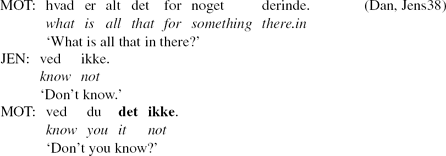
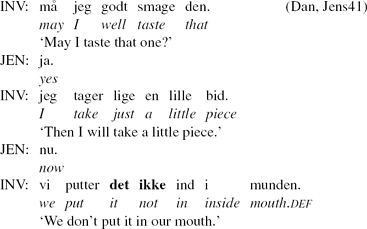
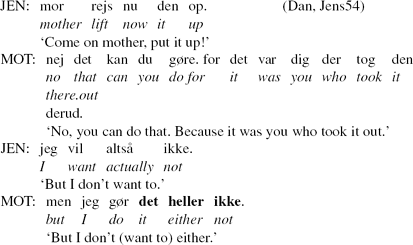
Thus, we see that a shifted pronoun with non-nominal antecedents can occur in various types of sentence stress patterns, and we therefore believe that it is challenging to explain this distribution within a purely prosodic approach.
We have seen that within the prosodic account there is an explanation as to why pronouns with non-nominal antecedents tend to remain in situ, and this accounts for the majority of our data on these pronouns. However, it is not entirely obvious how this approach will account for the cases in which these shift, or predict when they shift and when they remain in situ.
Within the approach to OS based on cognitive status, the explanation for the behaviour of these pronouns with non-nominal antecedents is quite different. As outlined in Section 2.2 above, Andréasson (Reference Andréasson2009, Reference Andréasson, Butt and King2010) claims that these pronouns are less accessible and thus have a lower cognitive status, activated, than pronouns with nominal antecedents (which are in focus). As her claim is that the OS position is associated with the highest cognitive status, pronouns with non-nominal antecedents do not undergo OS to this position. Her proposal also therefore predicts that such pronouns generally will remain in situ, a prediction that is overall met in our data. Moreover, Andréasson finds that pronouns with non-nominal antecedents quite consistently remain in situ in non-declarative contexts. As these pronouns remain in situ as much as 99% in our Swedish data, we cannot make any conclusions about the effect of a clause being declarative or not in our Swedish material. For Danish and Norwegian, however, a fairly high percentage of unshifted pronouns indeed do occur in non-declarative contexts (173/225 (77%) in Norwegian and 57/59 (97%) in Danish), illustrated in (31) below. In contrast, the majority of shifted det occur in declarative contexts (9/12 (75%) in Norwegian and 9/14 (64%) in Danish), illustrated in (32):
(31)
(32)
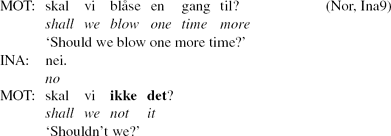
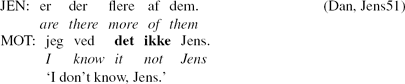
Recall further that Andréasson proposes various conditions that may enhance the cognitive status of the pronoun det to in focus, thus enabling it to shift. First of all, she claims that complements of factive predicates are more accessible than those of non-factive predicates, and thus may shift more easily. In our data, we find that contexts in which det shifts sometimes contain a factive verb (in 4/12 of non-nominal OS contexts in Norwegian, and in 9/14 of such contexts in Danish). One example of this was provided in (32) above from Danish, and (33) illustrates the same from Norwegian.
(33)
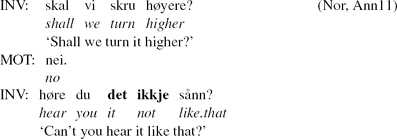
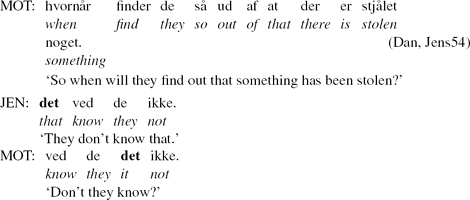
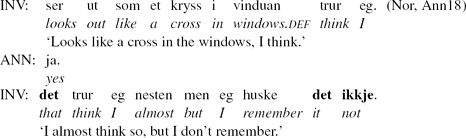
Another condition that may facilitate OS of pronouns with non-nominal antecedents according to Andréasson (Reference Andréasson2009, Reference Andréasson, Butt and King2010) is cases in which the relevant clause or VP has already been referred to by a pronominal element prior to the OS context. Again, we find that this is a common pattern in the contexts where OS of pronouns with non-nominal antecedents applies in our data. This holds for 5/12 of OS contexts with det in Norwegian and 7/14 of such contexts in Danish.Footnote 20 Examples from Danish and Norwegian are provided in (34) and (35):
(34)
(35)
We believe that the cognitive status approach fares better with our data than the prosodic approach. Like the prosodic approach, the cognitive status approach can explain why the majority of the pronominal objects with non-nominal antecedents in our spoken language corpora generally remain in situ. However, the cognitive approach can also explain the majority of the exceptional cases where det undergoes OS. OS is facilitated by declarative contexts, by contexts containing factive verbs, and by contexts where the antecedent has already been referred to with a pronoun prior to the OS context.
In the information-structure based approach proposed by Anderssen & Bentzen (Reference Anderssen and Bentzen2011, Reference Anderssen, Bentzen, Bentzen and Fábregas2012), the difference between pronominal objects with nominal antecedents and those with non-nominal antecedents is associated with different types of topichood. The authors argue that the pronominal objects with non-nominal antecedents have the characteristics of aboutness topics. When, for example, a clause, a VP, or a type DP is referred to by this pronoun, this turns it into what the discourse is about, the aboutness topic. Investigating the examples in our material, we indeed find that pronoun det in an unshifted position typically has the function of turning a new proposition or type DP in the discourse into the aboutness topic of the conversation. We illustrate this here with two examples. In the Norwegian example in (36), the topic of Ina and her mother's conversation is a bear that is watching over Ina. Then, her mother switches the topic and asks whether Ina has slept in kindergarten today. Using det ‘it’ to refer to ‘slept in kindergarten today’ now establishes this as the new aboutness topic in the discourse.
(36)

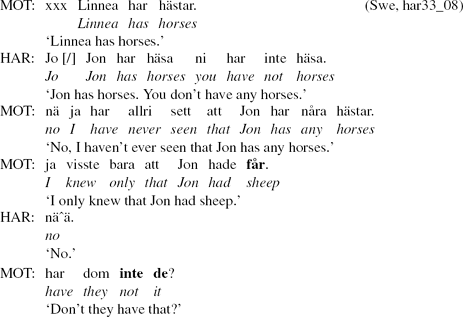
In the Swedish example in (37), Harry and his mother are talking about horses and who owns horses. Then towards the end, Harry's mother introduces sheep into the conversation, and when referring back to sheep as a type of animal, unshifted pronoun de(t) ‘it’ is used. (In (37), xxx marks an unintelligible sequence of sounds, and [/] indicates that the speaker repeats himself and starts over.)
(37)
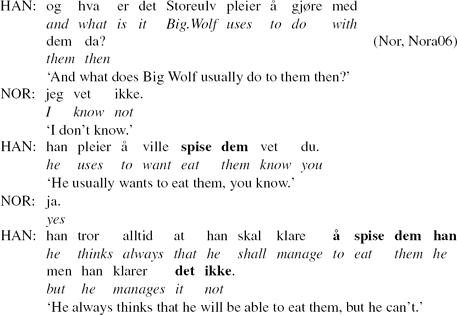
Anderssen & Bentzen (Reference Anderssen and Bentzen2011) propose that those contexts in which pronominal objects with non-nominal antecedents shift, are cases where they function as continuing topics, that is, they refer to something that has already been established as the aboutness topic of the discourse. This is somewhat reminiscent of Andréasson's observation that these pronouns tend to shift when their antecedent has already been referred to with a pronoun prior to the OS context (see also Gundel, Hegarty & Borthen Reference Borthen2003). Moreover, recall from Section 2.3 above that Bentzen et al. (to appearReference Bentzen, Merchant and Svenonus) argue that pronominal objects with non-nominal antecedents also shift in pragmatic control situations, i.e. when the pronoun refers to some activity that is salient in the discourse. In Norwegian and Danish, most of the cases of shifted det can be analyzed as meeting one of these two conditions, being continuing topics or being part of a pragmatic control situation. An example of the former is given in (38) below, where the topic is what Big Wolf does with the little pigs. When referring back to this aboutness topic in the final utterance, det ‘it’ functions as a continuing topic, and undergoes OS.
(38)
An example of pragmatic control is provided in (39), where Jens’ mother is telling him not to do something he is currently doing:
(39)

Some of our Danish examples, however, appear to be a challenge to this approach. They involve a shifted pronoun in contexts where, in the other two languages, the pronoun would preferably be simply left out. An example is given in (40):
(40)
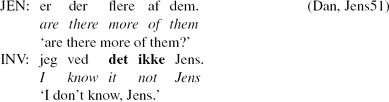
Strikingly, the pronouns in all these examples are complements of the same verb, ‘know’. Interestingly, in precisely such contexts – with main verb ‘know’ and pronominal objects det ‘it’ with non-nominal antecedents – Andréasson (Reference Andréasson, Butt and King2010) finds that in her Swedish data, leaving out complement det is quite common, while in her Danish data, this is not a frequently used strategy. In her Danish material, these pronouns are either shifted or placed in clause-initial position. We have confirmed with a Danish-speaking consultant that these two options are indeed available for all of the relevant examples in our Danish material.
Like the two previous approaches, the information-structure based approach can explain why pronominal objects with non-nominal antecedents typically remain in situ in our data. Within the information-structure based approach, these cases are classified as aboutness topics. This approach can also explain the majority of the exceptional cases in which pronominal object det undergoes OS. OS with such pronouns tends to be either a case of continuing topics or pragmatic control.
As we have seen, the main challenge for all three approaches with respect to pronominal objects with non-nominal antecedents is to account for those exceptional cases in which these pronouns undergo OS. It is not clear how a prosodic approach can incorporate these cases, but we emphasize that in order to thoroughly evaluate this, one would need to measure the pronominal objects with respect to prosodic prominence. Both the cognitive status approach and the information-structure based approach have proposals for what might trigger exceptional OS of these pronouns that we find support for in our data.
6. CONCLUDING REMARKS
In this paper, we have presented the results of a study of OS in the spontaneous speech of adults in large Danish, Norwegian and Swedish child language corpora. We investigated approximately 210,000 adult utterances and found 704 utterances containing the relevant combinations of negation and pronominal objects. The data were examined in order to explore variation in OS across these three languages, and to evaluate our results against three recent accounts of OS, namely a prosodic/phonological account, an account in terms of cognitive status, and an account in terms of information structure. As the first large-scale cross-linguistic study of OS in spoken language, we believe the results of the study represent an important step on the way towards a better understanding of OS. We have demonstrated that OS is a variable operation both within and across the languages. We have also demonstrated that all three accounts of OS can explain some of our data, and that all three accounts are faced with different challenges, in particular when explaining exceptional cases, namely lack of OS with objects with nominal antecedents and OS with objects with non-nominal antecedents. Through this study we hope to have highlighted some of the challenges that still remain for developing a unified account of the full picture of Mainland Scandinavian OS.
We recognize the importance of phonetically measuring the prosodic patterns in clauses with and without OS to establish the role of prosody and stress with respect to OS, and acknowledge this as an important aspect for future investigations. We also recognize the need for more spoken language data on OS, both spontaneous and experimental data. In particular, experimental manipulation of the cognitive status of objects and their antecedents, as well as the overall discourse information structure of the relevant clauses should constitute important aspects of future investigations into Mainland Scandinavian OS.
ACKNOWLEDGEMENTS
We would like to thank the audience at the Scandinavian Conference of Linguistics 25 in Reykjavík, May 2013 for discussion and input. We are also grateful to the three anonymous NJL reviewers and Elisabet Engdahl for all their feedback and comments. All remaining errors are our own.