


INTRODUCTION
Recent work in sociolinguistics has focused on the way that speakers and listeners imbue linguistic features with social meanings in constructing identities (e.g. Bucholtz Reference Bucholtz2001; Campbell-Kibler Reference Campbell-Kibler2007; Podesva Reference Podesva2007; Eckert Reference Eckert2008a; Johnstone & Kiesling Reference Johnstone and Kiesling2008). From this perspective, linguistic features are resources in the construction of sociolinguistic styles (Campbell-Kibler, Eckert, Mendoza-Denton, & Moore Reference Campbell-Kibler, Eckert, Mendoza-Denton and Moore2006; Coupland Reference Coupland2007; Moore Reference Moore2012), whereby speakers reproduce and recombine socially meaningful clusters of features—linguistic, paralinguistic, and extralinguistic—to some thematic end. This framework raises questions about the process by which features across semiotic channels come to be associated with social meaning. How do individual linguistic features, embodied forms, and material practices become meaningfully tied to personae, and what is the nature of the relation between individual features that, when combined, convey a coherent and legible style?
Much of the work exploring the social meaning of linguistic features takes a particular linguistic variable or combination of variables and investigates the indexical work achieved by speakers using those variables (e.g. Bucholtz Reference Bucholtz2001; Schilling-Estes Reference Schilling-Estes2004; Zhang Reference Zhang2005). Such analyses emphasize the pluralism of indexical potential for sociolinguistic variables, but far less attention has been paid to the ways in which variation in co-occurring semiotic channels might affect the interpretation of linguistic variables. That is, in the context of stylistic practice, linguistic forms occur simultaneously with other semiotic forms (e.g. embodied forms such as posture or facial expressions, and material forms such as clothing or hairstyle). Though current conceptions of style acknowledge that the co-occurrence of these semiotic channels is a fundamental feature of everyday stylistic practice (e.g. Eckert Reference Eckert2000; Mendoza-Denton Reference Mendoza-Denton2008), the ways in which such co-occurrence might shape the interpretation of linguistic variation has been underexplored. In this article, we examine the stylized use of one such embodied feature, jaw setting, and demonstrate its co-occurrence with linguistic forms that have regional associations. Examining parodic performances of Californian social types by two actors, we show that the actors deploy jaw settings that have been stereotypically associated with Californian types, along with the production of California-like vowels, in producing recognizable parodic characters. Further, we discuss the ways that these stereotyped jaw settings, unlike other embodied resources like hand gestures or posture, are directly related to the acoustic realization of these vowels. The jaw settings and the vocalic realizations used in these skits are thus intertwined both stylistically, in their co-occurrence in indexing Californian personae, and corporeally, in the mutually constraining nature of this particular embodied form and its resulting phonetic realization. Because the production of these vowels and jaw settings occurs in the context of explicitly discussed aspects of California stereotypes, these performances provide a rich breeding ground for reinforcing semiotic links between features of the California Vowel Shift, stereotyped jaw settings, and California-ness.
Embodiment as a semiotic resource
Embodiment refers here to the range of potential configurations and movements of the body, from holistic settings such as posture to localized movements such as gesture and gaze. The embodied nature of language is important to the study of style for at least two reasons: (i) the semiotics of co-occurring speech and embodied action, and (ii) the material constraints of producing language in a human body. The first, the co-occurrence of embodied and linguistic forms, even when viewed as discrete semiotic channels that overlap temporally, is central to the integrated process of interpreting variation in either channel. While much linguistic and anthropological work on interaction has foregrounded the indexical nature of linguistic variables, Goodwin (Reference Goodwin2000) and others (Mendoza-Denton & Jannedy Reference Mendoza-Denton and Jannedy2011; Walker Reference Walker2012) have shown that embodied aspects of interactional style like comportment, gesture, and gaze themselves serve as semiotic resources with social value. Though such embodied resources merit isolated study in their own right, the process of signifying in an interaction involves the simultaneous deployment of signs that mutually elaborate one another. Here, we are interested in the ways that ‘the structuring of actions in one modality is constrained by, or interacts with, those in another modality’ (Streeck, Goodwin, & LeBaron Reference Streeck, Goodwin and LeBaron2011:8). In interactions, embodied features work in tandem with speech, as well as other stylistic resources and the material environment, to bolster, complement, and elaborate the words being uttered. In a given moment of interaction, linguistic and embodied practices are semiotically inextricable. The same phonetic realization of a variable could be interpreted differently when uttered with different facial expressions, just as an affectively demonstrative posture might shape the way two distinct utterances are interpreted. That is, the ideological and material parameters of embodied and linguistic practices are in constant interaction.
The second reason that embodiment matters to linguistic style stems from consequences for the acoustic properties of variables—the embodied nature of speech places notable constraints on the potential range of phonetic realizations of a variable. A speaker who varies their pitch is influenced by normative gender ideologies about pitch and also constrained by the size of their vocal folds. Likewise, a speaker who fronts their BOOT and BOAT vowels may be reproducing regional dialect norms, but they are also constrained by the size and shape of their vocal tract, which sets the articulatory parameters for the acoustic outcome of vowel quality. Similarly, vocalic chain shifts are theorized to be the result of the phonological principle of maximal dispersion constrained by the articulatory space afforded by the mouth and vocal tract (Labov, Ash, & Boberg Reference Labov, Ash and Boberg2005).
Though embodiment is broadly defined to include a wide range of bodily practices, here we focus on jaw setting, defined as the vocal tract configurations that the articulators tend to be deployed from (and return to) in the process of producing speech (Honikman Reference Honikman, Abercrombie, Fry, MacCarthy, Scott and Trim1964; Laver Reference Laver1978; Esling & Wong Reference Esling and Wong1983). With regard to sociophonetics, we can expect variation in jaw setting (also called articulatory setting or phonetic setting) to interact with variation in the phonetic realization of sociolinguistic variables. The nature of the relation between jaw setting and vocal articulation is, at least corporeally, more fixed than the relation between other types of gesture (e.g. hand gesture or gaze) and vocal articulation. In this way, a jaw setting necessarily imposes embodied constraints on articulation, and vice versa. Indeed, x-ray and MRI data shows that speakers predictably modify their jaw setting when switching between different languages (Gick, Wilson, Koch, & Cook Reference Gick, Wilson, Koch and Cook2004; Wilson & Gick Reference Wilson and Gick2006), and even when switching between read and spontaneous speech (Ramanarayanan, Goldstein, Byrd, & Narayanan Reference Ramanarayanan, Goldstein, Byrd and Narayanan2013). Though these studies are more strictly interested in the interaction of jaw setting and phonetics (i.e. not interested in the social meaning of either component), they demonstrate the mutually constraining nature of these semiotic channels. Here we aim to discuss the semiotic entanglement of linguistic forms and jaw setting, in the interest of exploring their indexical interaction. Since the indexical potential of both language and embodiment has been established independently, there is reason to believe that the social meaning of either one is wrapped up in the other.
Though to our knowledge no studies have examined the interaction of jaw setting and sociolinguistic style, recent work has demonstrated the intertwining semiotics of embodied and sociolinguistic practice in particular communities of practice. Calder (Reference Calder2016) shows that, within a community of drag queens, the interpretation of a fronted /s/ depends on the presentation of the speaker as male-bodied or in feminine drag. And recent work by Pratt (Reference Pratt2016) demonstrates that adolescents in a high school use embodied practices such as speed of movement and posture qualities to construct affective styles, which correlate with linguistic practices like speech rate and creaky voice quality. Perhaps most relevant to the current study is the recent finding that smiling plays a role in the phonetic realization of speech; speakers produce fronter BOAT vowels in moments of smiling (Podesva, Callier, Voigt, & Jurafsky Reference Podesva, Callier, Voigt and Jurafsky2015). In this case, the embodied form of smiling constrains the phonetic realization of vowel qualities. Taken together, this work shows that embodied practices correlate with and even constrain the social meaning of linguistic variables. In this study, we explore the correlation of an understudied embodied resource—jaw setting—with vocalic forms in the context of a parodic performance.
Embodied stereotypes of Californians in parodic performances
We focus here on the way that Californian characters are stylized through performances that entextualize linguistic and bodily stereotypes associated with the state. In particular, we analyze video and audio data from sketch comedy performances that parody the social practices of Californians. Performances are ripe for the heightened use and creation of links between linguistic styles and social meanings (Rampton Reference Rampton1995; Schilling-Estes Reference Schilling-Estes1998; Coupland Reference Coupland2001; Chun Reference Chun2004; Sclafani Reference Sclafani2009; Johnstone Reference Johnstone2011; Carmichael Reference Carmichael2013). Coupland emphasizes that stylized linguistic performances bring into play ‘stereotyped semiotic ideological values associated with other groups, situations or times,’ (Reference Coupland2001:350) often via emphatic or hyperbolic realizations of linguistic styles. Exaggerated realizations, along with other performative cues, draw particular attention to the links between linguistic styles and social identities, and the genre ‘gives license to the audience to regard the act of expression and the performer with special intensity’ (Bauman Reference Bauman1977:11). In this analysis, we examine the way that earlier performances of Californian types—which include the semiotic resource of jaw setting—are recontextualized in a chain of events linking stereotyped jaw settings with California-ness in a contemporary context.
While some popular ideologies of California render it a locus of unmarked ‘good’ or ‘normal’ American English (Preston Reference Preston1999; Fought Reference Fought, Long and Preston2002), the state is also home to recognizable, or enregistered (Agha Reference Agha2003), linguistic varieties associated with Southern Californian personae – namely, the Valley Girl and Surfer Dude. These personae and their accompanying linguistic styles emerged in public discourse and popular media as early as the 1980s. In these portrayals, Valley Girls and Surfer Dudes are associated with ways of thinking, behaving, and dressing. For example, Frank and Moon Unit Zappa's 1982 song, ‘Valley Girl’ (Zappa & Zappa Reference Zappa and Zappa1982), parodically voices a Valley Girl, establishing her interests, attitudes, and practices as shallow and mindless (‘Tosses her head and flips her hair/ She's got a whole bunch of nothin’ in there…’). Whoopi Goldberg reproduces some of these characteristics in her 1984 stand-up comedy set ‘The spook show,’ in which she performs a version of a Valley Girl who reacts excitedly to seemingly trivial events, such as a conversation at the beach with a ‘total hunk’. These attributes of the persona—young, shallow, materialistic, Southern Californian, and female—have been reinforced in feature films as well, including Valley girl (Crawford, Lane, & Coolidge Reference Crawford, Lane and Coolidge1983) and Clueless (Berg & Heckerling Reference Berg and Heckerling1995). Crucially, these personae are associated with ways of speaking, which have even garnered their own derivative labels—in the case of the Valley Girl, ‘Valleyspeak’ or ‘Valspeak’ (Donald, Kikusawa, Gaul, & Holton Reference Donald, Kikusawa, Gaul, Holton, Goggans and Difranco2004). The linguistic styles linked with these personae persist in the present day: a 2015 Urban Dictionary entry for ‘California accent’ describes this ideologized style as ‘the stereotypical “surfer dude” accent in men and the “valley girl” accent in women’, describing features of the style such as discourse marker like, lexical items sick and rad, uptalk, and creaky voice.
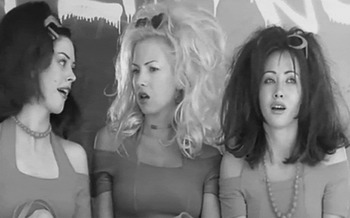
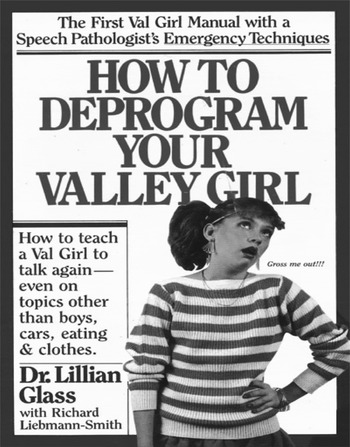
In addition to this enregistered linguistic variety, many performances of Valley Girls are characterized by an embodied stereotype: open-mouthed jaw setting. Figure 1 shows three stylized Valley Girls, played by Rose McGowan, Traci Lords, and Shannen Doherty in the 1997 film Nowhere (Araki & Sperling Reference Araki and Sperling1997). They maintain open-mouth jaw settings throughout their performances; in the given still image only Rose McGowan (left) is mid-utterance. Similarly, Alicia Silverstone's performance of the Valley Girl character Cher in the 1995 film Clueless has a resting open-mouth throughout much of the movie (Figure 2). The commodification of the Valley Girl character incorporates this jaw setting as well, visible in the cover to the book How to deprogram your valley girl (Glass Reference Glass1982), which depicts a prototypically exasperated Valley Girl rolling her eyes, hand on her hip, with an open-mouth jaw setting (Figure 3).
Rose McGowan, Traci Lords, and Shannen Doherty playing valley girls in Nowhere, with open-mouth jaw setting. In this still image, only Rose McGowan (left) is mid-utterance.

Alicia Silverstone playing Cher in Clueless, maintaining an open-mouth jaw setting.

Cover art for How to deprogram your valley girl, by Dr. Lillian Glass, depicting a prototypical valley girl with open-mouth jaw setting.

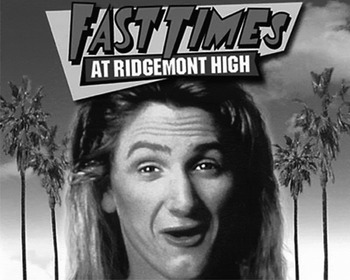
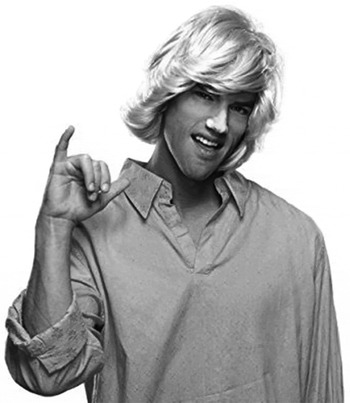
In many ways, the Surfer Dude and the Valley Girl character types serve as gendered counterparts to one another. Although the Surfer Dude shares the prototypical Valley Girl's youth, whiteness, coastal Southern Californian origin, general lack of intelligence, and marked ways of speaking, he maintains a relatively laidback stance. The persona is exemplified by Sean Penn's character Jeff Spicoli in the 1982 film Fast times at Ridgemont High (Azoff, Linson, & Heckerling Reference Azoff, Linson and Heckerling1982). Spicoli, who became emblematic of the surfer or stoner stereotype, is unintelligent, laidback, and affable, spending most of his time at the beach, smoking marijuana, and partying with friends. Like Valley Girl performances, Penn's portrayal of Spicoli popularized a linguistic style associable with the persona, and with Southern Californians more generally. This included the use of lexical items like dude and totally but, unlike the Valley Girl, involves slow speech rate and increased coarticulation across segments, likely an iconized representation of being under the influence of marijuana derived from stoner comedies of the 1970s. Complementary to the Valley Girl's stereotyped jaw setting, Spicoli's performance of a Surfer Dude includes an open-mouth, protruded jaw setting (Figure 4). In a commodification of the surfer dude trope, seen in Figure 5 below, a ‘surfer dude hair wig’ model exhibits this same open-mouth jaw protrusion in addition to a stylized hand gesture associated with surf culture (and often, the lexical items hang ten or cowabunga).
Sean Penn as Jeff Spicoli in the movie cover for Fast times at Ridgemont High, maintaining an open-mouth jaw setting with protruded jaw.

‘Surfer dude hair wig’ model, pictured using stereotypical surfer hand gesture and open-mouth jaw protrusion in costume sales photo.

Southern California personae like the Valley Girl and Surfer Dude have become culturally recognizable through such mediatized performances and commodified representations, and these portrayals illustrate that both linguistic and embodied practices can cue these social types. That is, the open-mouth, protruded jaw, exasperated eye-roll, or surfer ‘hang ten’ gesture are part of what makes these character types legible, along with the stereotypical linguistic features of ‘Valspeak’ or slow, hypoarticulated ‘surfer’ speech. Stereotypical embodied practices, or embodied stereotypes, are intertwined with stereotypical linguistic styles. The ongoing enregisterment of these personae occurs via the continued creation and dissemination of cultural products in the decades since they were introduced in the 1980s. While these character types emerged in a specific place and time, links between these personae and California-ness continue into the present day. As a result, their associated linguistic and extra-linguistic features remain recruitable resources for indexing Californian identity. In this article, we examine the embodied stereotype of jaw setting alongside vocalic features of Californian styles, specifically focusing on components of the California Vowel Shift (CVS).
The California Vowel Shift
Linguists have found Californian vowel systems to be undergoing change since at least the 1980s (Hinton, Moonwomon, Bremner, Luthin, Van Clay, Lerner, & Corcoran Reference Hinton, Moonwomon, Bremner, Luthin, Van Clay, Lerner and Corcoran1987). The change in progress, deemed the CVS, comprises three components (Figure 6) that may or may not be phonologically related to one another:Footnote 1 the merger of the low-back vowels BOT and BOUGHT (Labov et al. Reference Labov, Ash and Boberg2005; Hall-Lew Reference Hall-Lew2009), the fronting of the high- and mid-back vowels, BOOT, BOOK, and BOAT, and the central vowel BUT (Hagiwara Reference Hagiwara1997; Hall-Lew Reference Hall-Lew2009), and rotation of the front lax vowels BIT, BET, and BAT back and downward, with BAT showing a phonologically conditioned split between prenasal context, or BAN, which raises and fronts, and nonprenasal BAT, which lowers and backs (Hagiwara Reference Hagiwara1997; Eckert Reference Eckert2008b).
The California Vowel Shift.

The CVS was first documented in the urban coastal populations of Los Angeles (Hinton et al. Reference Hinton, Moonwomon, Bremner, Luthin, Van Clay, Lerner and Corcoran1987; Hagiwara Reference Hagiwara1997; Fought Reference Fought1999; Kennedy & Grama Reference Kennedy and Grama2012) and the San Francisco Bay area (Eckert Reference Eckert2008b; Hall-Lew Reference Hall-Lew2009; Eckert Reference Eckert2011), with the change continuing to progress over time in these locations. Recent evidence finds that the vowel shift has also spread to inland communities of the Central Valley (Podesva, D'Onofrio, Van Hofwegen, & Kim Reference Podesva, D'Onofrio;, Van Hofwegen and Kim2015; D'Onofrio, Eckert, Podesva, Pratt & Van Hofwegen Reference D'Onofrio, Eckert, Podesva, Pratt and Van Hofwegen2016). The CVS may then be aptly named, as it appears to characterize much of the state, not solely the urban coast. Given the time course of the CVS, however, the shift seems to have originated in urban coastal populations, including Southern Californian coastal communities, as the CVS is particularly advanced in these areas relative to their inland neighbors.
Though vocalic features are typically not mentioned explicitly in metalinguistic characterizations of the Valley Girl or Surfer Dude, these features can be found to figure in performances of Californian character types. The Zappas’ ‘Valley girl’ prominently includes elements of the California Vowel Shift, particularly BOAT-fronting in emphasized words or phrases associated with the persona, like totally, Encino, no way, toenails, and oh my god, as well as marked BIT lowering on the lexical item bitchin. Along with lexical items such as totally and like, Goldberg's ‘Spook show’ Valley girl also employs a number of linguistic features of the California Vowel Shift, including back vowel fronting, BIT and BET lowering, and BAT-backing, audible in words like max and Catholic (Hinton et al. Reference Hinton, Moonwomon, Bremner, Luthin, Van Clay, Lerner and Corcoran1987). And some lexical items perhaps index California by virtue of the California-shifted vowels that comprise them (e.g. dude with a fronted /u/ (Kiesling Reference Kiesling2004), or totally with a fronted /o/). Additionally, there is evidence that for at least one component of the CVS, BAT-backing, listeners maintain perceptual associations with both the Valley Girl persona and with broader California origin (D'Onofrio Reference D'Onofrio2015).
In the analysis that follows, we examine all components of the CVS as used by actors representing Californian social types. Specifically, we examine the connection between CVS-implicated vowels and the embodied stereotypes of jaw setting in modern-day portrayals of Californian personae. We then unpack the ways in which these embodied performances and dialect features fit into ideological bundles of California social indices, thereby identifying parodic performance as a site for (i) the intertwining of semiotic channels and (ii) the reproduction of these form-meaning links in a chain of enregisterment.
METHODS
The Californians
We draw upon a series of sketch comedy performances called The Californians, performed on NBC's late-night comedy show Saturday night live (SNL). This recurring mock soap opera, which aired between April 2012 and May 2013, lampoons the lives of affluent Los Angelenos. The series follows Karina, played by actress Kristen Wiig, and Stuart, played by actor Fred Armisen, a married couple residing in LA, as well as Rosa, their maid, and Devon, their friend with whom Karina has an affair, among other characters. The skits highlight multiple symbolic elements of stereotyped Southern Californian personae: nearly every character is blonde, presumably wealthy, and shallow. Discourse elements of the script and plot points of each skit further typify these personae; highway routes, organic local produce, and melodramatic relationship issues feature as topics of conversation in each episode. Furthermore, aspects of the set and props (expensive California-style home décor, agricultural products commonly associated with California, such as avocados and tangerines) as well as the ways in which the actors interact with them, serve as resources for stereotyping these personae.
The skits were generally well regarded as humorous, with live audiences laughing audibly in each episode, and the actors often visibly struggling not to laugh during many of the scenes. Media attention was also directed toward the skits, with synopses published by media outlets such as Slate and The Huffington Post in their coverage of entertainment and pop culture news. Given the popularity of Saturday night live, which averaged over 2.5 million US viewers in the 2012–2013 season according to Nielsen TV Ratings, as well as the online media attention paid to The Californians in particular, it is reasonable to estimate that the skits were viewed by millions across the United States via television and online video clips. Much of the explicitly discussed humor of these skits derives from the linguistic aspects of these performances. Descriptions of The Californians in popular media often drew attention to the use of language to depict these Californian personae. The Saturday night live Wiki describes the characters as having ‘Valley Girl accents exaggerated to the point of incoherence’,Footnote 2 and a Huffington Post summary remarked that ‘these California dudes and dudettes sure know how to talk. We mean, enunciate’ (Bronner Reference Bronner2012).
The speakers
We analyze the performances of two actors who play recurring characters on the series: Kristen Wiig playing Karina, who appeared in three of the six total episodes, and Fred Armisen playing Stuart, who appeared in all six episodes. At the time of the skits, both Wiig and Armisen were popular long-standing cast members of the series, Wiig in her late thirties and Armisen in his forties. Though they depict Californians in these skits, both of these actors were born and raised in the northeastern United States. Wiig was born in western New York and grew up in Lancaster, Pennsylvania and in Rochester, New York. Armisen grew up on Long Island, New York. While Wiig lived in Los Angeles, and Armisen in Chicago for a few years following college, both Armisen and Wiig have spent most of their lives on the East Coast, and at the time of filming The Californians, they both resided in New York City, where Saturday night live is filmed.
For the present analysis, we first visually analyze the actors’ manipulation of jaw settings in The Californians, coding each character's jaw setting visually for the entirety of their time on screen. We then acoustically examine these actors’ use of the California Vowel Shift in portrayals of these characters, ultimately showing that the two are intertwined in the stylization of these Californian types. For the vocalic analysis, we measured every available vowel token of eleven total vowel classes from these skits: BIT, BET, BAT, BOOT, BOAT, BOOK, BUT, BOT, BOUGHT, as well as front vowels BEET and BAIT, used to capture the front boundary of the vowel space. As Armisen played this character in twice as many skits as Wiig did, more total vowels were available for his character, Stuart, than for Wiig's character, Karina.
For the purposes of understanding whether and how each actor shifted his or her jaw setting and vowel space for these skits in particular, we chose to compare each actor's The Californians character's jaw setting and vowel space to that actor's jaw setting and vowel space when embodying a different, non-Californian character. In an attempt to control for the context of comedic performativity in these skits, we chose to compare two different Saturday night live characters for each actor rather than comparing their performances in The Californians with each actor's ‘natural’ speech, say in an interview setting. If we were to compare the vowel spaces of an actor as herself in an interview and that same actor as a character in The Californians, it would be unclear whether any differences were attributable to the voicing of that character in particular, or to differences between an explicitly staged, scripted performance and a free-form interview.
We thus selected non-Californian comparison characters for each actor using two criteria. First, we selected characters that were American but not of Californian origin, with this fact made explicit via the sketch. Second, we chose characters that each actor played multiple times, in recurring sketches. This was done to ensure a robust amount of data, as well as to minimize any differences between recurring and one-time characters, since The Californians featured each actor multiple times. In following these criteria, we chose Virgania Horsen as a comparison character for Kristen Wiig's Karina, and Fred Armisen's impression of Barack Obama as a comparison character for his The Californians character Stuart. Virgania Horsen was played by Wiig in two sketches, one airing in 2008, and another airing in 2012, a character starring in mock commercials advertising Horsen's entrepreneurial pursuits: a mail-delivery system and a hot air balloon ride service. Armisen played Barack Obama in multiple sketches during a similar timeframe, from 2008 to 2012, enacting him from his trajectory as a presidential candidate through his first term as United States President.Footnote 3 For each comparison character, we selected two sketches to analyze. As with the The Californians data, we coded jaw setting for the entirety of their on-screen time, and we acoustically measured every available token for the eleven vowel classes of interest.
Analysis and measurement criteria
Using MP4 video files available online, jaw setting was coded visually in ELAN for both characters in two full The Californians skits and in one full comparison skit per actor. Each author coded both characters for one of the two actors. For every stretch in which the character's mouth was visible, jaw setting was assigned a tag. Tags for each jaw setting emerged from qualitative assessment of the jaw in each moment, but were standardized to a set of possible jaw settings for each character (e.g. open wide, open protruded, slightly open, lips closed, etc.). Analysis results from both quantitative measures of the use of these jaw settings in both speaking and nonspeaking moments, as well as in qualitative analysis of particular moments of talk in which the visual salience of these jaw settings is heightened.
For the phonetic analysis of the CVS, audio data was extracted from Flash Video Format (FLV) using Audacity and converted to WAV format.Footnote 4 The vocalic analysis relies on F1 and F2 measurements only. Every viable stressed-vowel token longer than sixty milliseconds was used from each selected sketch (five total sketches for Wiig for a total of 199 tokens, eight total sketches for Armisen for a total of 558 tokens). Tokens that contained background noise, such as overlapping interlocutor speech, audience laughter, or audible background music, were not included. Tokens preceded or followed by a glide or vowel were eliminated from analysis due to the difficulty of identifying these segment boundaries, as were tokens that preceded rhotic segments. Within these criteria, vowel boundaries for each token were hand-aligned in Praat (Boersma & Weenink Reference Boersma and Weenink2017), using the spectrogram and waveform as guides. Formant values were automatically measured at the midpoint of each vowel token via script in Praat, with outlying values hand-checked and corrected where Praat's formant tracker incorrectly identified values. For each actor, we examined the difference between productions of a given vowel in the The Californians character and that vowel produced by the non-Californian comparison character. We examine these differences separately in the height and backness dimensions, as approximated by F1 and F2, respectively. We also examine each character's BOT-BOUGHT merger and BAT-BAN splits via Euclidean distance measures.
We chose to examine differences between each character within each actor's vowel space. To do this, we use a single anchor vowel for each actor against which to compare each character's productions of each vowel. For both actors, we selected the non-Californian comparison character's BEET vowel as this anchor. For both Wiig and Armisen, their non-Californian character's BEET vowel (Virgania Horsen's mean BEET for Wiig, and Barack Obama's mean BEET for Armisen) constituted their highest, frontest vowel class across both characters. The non-Californian character's mean BEET measurements were thus used as an approximation for the high, front boundary of that actor's vowel space, against which each character's vowels could be measured to assess the differences between the two characters.
For each vowel class, we measured the distance between each of a given character's vowels from the non-Californian comparison character's mean BEET vowel production, in both the F1 and F2 dimensions. For example, to compare BAT backness between Wiig's two characters (Californian Karina and non-Californian Virgania), we measured the distance in F2 from the anchor non-Californian character's BEET (in this case, Virgania's mean BEET) to each token of each character's BAT vowel. We then conducted statistical analysis on these distance measures.
To assess BOT-BOUGHT merger and BAT-BAN split, both elements of the California Vowel Shift, we measured Euclidean distances between the two vowel classes for each character, then compared these distances to see whether they were significantly different between characters for each actor. To measure whether Wiig shows more BOT-BOUGHT merger in her Californian character than in her non-Californian character, for example, we measured Euclidean distances between Karina's mean BOT token and each of Karina's BOUGHT tokens. We then likewise measured Euclidean distances between Virgania's mean BOT token and each of Virgania's BOUGHT tokens. This left us with a distance measure for each of these two characters’ BOUGHT tokens. This procedure was similarly performed on distances between each character's mean BAN vowel and each of her BAT tokens to assess degree of nasal split by character.
For each actor, for each vowel class and formant measure, we fit linear mixed-effects regression models on these distance measures using the lme4 package in R (R Core Team 2013). For each model, the dependent variable was distance from the anchor vowel (non-Californian character's BEET) in the relevant dimension (F1, F2), or Euclidean distance. We included character as a fixed effect (Californian versus non-Californian), and random intercepts for preceding and following segments to control for phonological context.
RESULTS
Visual analysis of jaw setting
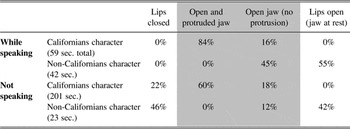
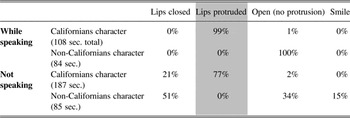
Examining the actors’ facial organization during these skits, regardless of whether or not they are speaking, indicates that jaw setting figures prominently in the actors’ performances of their California characters. As described above, we coded jaw setting for Wiig and Armisen throughout two full Californians skits, and one comparison skit per actor. While relatively fine-grained tags were assigned to each character's jaw setting (e.g. slightly open mouth with curled lip, wide open mouth with protruded jaw), these tags were culled into broader categories for each actor, which reflected visually distinct settings (Tables 1 and 2).
Frequency of jaw setting types used by Kristen Wiig, while speaking and while not speaking, as her The Californians character and as her non-Californians character. Emblematic Valley Girl jaw settings (open jaw settings) are highlighted in grey.

Frequency of jaw setting types used by Fred Armisen, while speaking and while not speaking, as his The Californians character and as his non-Californians character. Emblematic Surfer Dude jaw setting (lips protruded) is highlighted in grey.

Previous portrayals of the Valley Girl persona have deployed an open jaw setting for both speaking and resting, as discussed above. For Kristen Wiig, tags were categorized into broader groups that corresponded to an open setting in which the jaw was clearly lowered from its resting position (open), those in which her lips were parted, but her jaw was in a resting position (slightly open), and a closed setting in which the lips were sealed (closed). Furthermore, two specific types of ‘open’ jaw emerged in coding of Wiig's jaw setting. In numerous instances throughout the The Californians skits, Wiig employs both an open setting in which she both lowers and protrudes her jaw (visible in Figure 9) and an open setting without this protrusion. For Wiig, the ‘open’ category was thus subdivided into open jaw with protrusion, and open jaw without protrusion. For Fred Armisen, tags were similarly culled into broader groups: an open- mouthed setting, a setting with protrusion of the lips (lips protruded) emblematic of the Surfer Dude persona, closed with lips sealed (closed), or smiling. Frequencies were calculated for these jaw settings across the skits examined, divided by Californians versus non-Californians character, as well as whether or not the character was speaking (frequencies and total durations are provided in Tables 1 and 2).
Both Armisen and Wiig used the jaw settings emblematic of their respective Californian personae much more frequently in their portrayals of The Californians characters than in their non-Californians characters (Tables 1 and 2). This trend is visible both when the actors are speaking and when they are not speaking in the skits. Wiig deploys a fully open jaw setting throughout the entirety of her speaking time as Karina in The Californians, whereas her comparison character, Virgania, deploys a slightly open mouth with a resting jaw during approximately half of her speech time. When on camera but not speaking, Wiig was much more likely to have a fully open jaw setting (whether protruded or not) as her Californians character (78% of the time) as compared to her non-Californians character (12%). Armisen shows an even more striking pattern in his deployment of lip protrusion—his Californians character protrudes his lips for the entirety of his speaking time and for 77% of his non-speaking time, while his non-Californians character never exhibits lip protrusion. Notably, Wiig also deploys a form of protrusion—protrusion of the entire lowered jaw—as her Californians character, a jaw setting that she never uses as her comparison character. The striking and continuous presence of these stereotyped jaw settings in The Californians, whether or not the characters are speaking, suggests that the actors deploy these settings for the purpose of (re)entextualizing these embodied stereotypes of Californian personae.
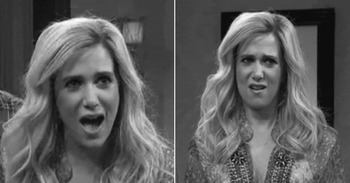
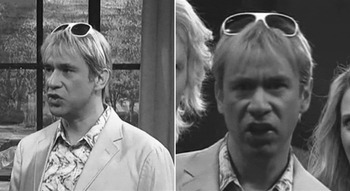
A closer look at particular instances in which these jaw settings are deployed provides further insight into the semiotic value of these settings. Still images taken from the Californians performances are shown in Figures 7 and 8. They show both characters while speaking (at left in both figures) as well as at moments in the sketch when the characters are not speaking (at right in both figures).
Kristen Wiig, playing Karina on The Californians, producing a lowered and backed BAN token, “jammed” (left), and with similar jaw setting when not speaking (right).

Fred Armisen, playing Stuart on The Californians, producing a fronted BOOT token, “Jacuzzi” (left), and with similar jaw setting when not speaking (right).

Figures 7 and 8 exemplify the open and protruded jaw setting deployed by Wiig and the protruded lip setting deployed by Armisen as quantified in Tables 1 and 2. While both actors employ the embodied resource of jaw setting to enact their Californians characters, they do so in different ways. Wiig uses an open-jawed articulatory setting (Figures 7 and 9) characteristic of the stereotyped Valley Girl jaw setting shown in Figures 1–3, while Armisen protrudes his lips and jaw when playing Stuart (Figures 8 and 10), more akin to images of the Surfer Dude persona shown in Figures 4 and 5. The indexical value of facial configuration in these performances is further emphasized in recurring montages of close-ups on each character. In each Californians skit, after a climactic event occurs, cameras show tight close-ups of each character's face in turn, accompanied by dramatic music. These montages serve as moments for each actor to achieve comedic effect with only their face, as the frame largely eliminates clothing and objects in the periphery. In some of these close-ups, each character repeats one character's name (e.g. “Trey?!”), and in others, no words are spoken, the absence of vocal cues drawing even more attention to visual aspects of the face.
Karina during close-up montages, saying “Trey” (left) and not speaking (right).

Stuart during close-up montages, saying “Trey” (left) and not speaking (right).

Images from two different montages for each of the two Californians characters are shown in Figures 9 and 10. Through focused camera angles like these, emphasis is placed on the face and especially mouth as a source of visual comedic and symbolic value in enacting these characters. The persistent and exaggerated nature of these expressions throughout the skits makes evident that facial setting itself is to be taken as part of the comedic stereotypes of these personae. We now turn to the acoustic productions that co-occur with these embodied stereotypes in The Californians.
Acoustic analysis of CVS vowels
In addition to visually observable jaw-setting differences, acoustic analysis shows that both actors use vowel productions for their Californians characters distinct from those used for their non-Californians characters. The individual vowels that are affected vary by speaker, such that each produces some subset of CVS-implicated vowels for the Californians performance in the direction consistent with the CVS. Overall, Wiig's Californians character shows relatively backer and lower vowels as compared to the non-Californians character, while Armisen's Californians character shows relatively fronter and higher vowels. While these results differ with regard to the specific vowels affected, both are articulatorily related to the stereotyped jaw setting used by each actor in these performances.
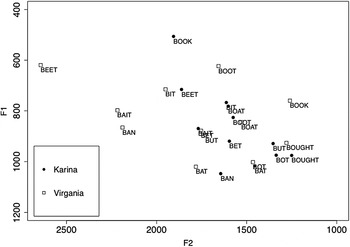
All vowel classes measured for Wiig's characters are shown in Figure 11, and a summary table of significant effects and accompanying coefficients, standard errors, and p-values is shown in Table 3. For each regression, the model tests whether character (Californians versus non-Californians) serves as a significant predictor of the formant value (F1 or F2) of the relevant vowel class. Notably, the CVS-aligned vowels that Wiig modifies in performing her Californians character are the front vowels and the low vowels. Specifically, results show that Wiig's Californians character uses significantly backer tokens (smaller F2) of front vowels BET and BAT, and marginally backer BIT than her non-Californians character. This pattern is consistent with the CVS, as the backing of these vowel classes is in line with the movement observed in previous work on the shift (e.g. Van Hofwegen, D'Onofrio, & Pratt Reference Van Hofwegen, D'Onofrio and Pratt2016). Additionally, Wiig's Californians character showed BOT and BOUGHT tokens that were significantly closer to one another than those produced in her non-Californians character, likely achieved via a relatively backer BOT, which was marginally significant. This indicates that Wiig's Californians character exhibits a greater degree of low-back merger.
Mean F1 and F2 values for Kristen Wiig's performance as a Californians character, Karina (black circles), and as a non-Californians character, Virgania (white squares).

Significantly different vowel classes between characters in Kristen Wiig's performances. Model statistics for fixed effect of Character = Virgania (^ p < 0.1; * p < 0.05; ** p < 0.001; *** p < 0.0001).

In addition to these differences in the direction of the CVS, models also indicate that Wiig's BEET, BAIT, BAN, and BUT were significantly different across performances. Wiig's BEET and BAIT show differences not predicted by most accounts of the shift, while her BAN and BUT in fact show disalignment with CVS patterns. Specifically, the regressions predicting F1 and F2 of BEET indicate that Wiig's Californians character produces a significantly lower (greater F1) and backer (smaller F2) BEET than her non-Californians character. The same pattern is true for the BAIT and BAN vowel classes, such that the Californians character's vowels are significantly lower (F1) and backer (F2) than the non-Californians’. Last, Wiig's Californians BUT vowel is backer than her non-Californians BUT. These shifts are not aligned with the California Vowel Shift, as neither BEET nor BAIT has been implicated robustly in the shift (though c.f. Van Hofwegen et al. 2016), and BAN and BUT are moving in the opposite directions as Wiig's Californians character moves them.
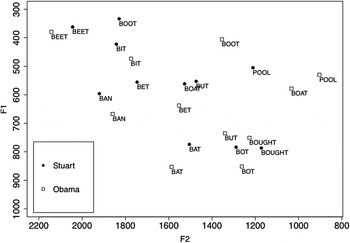
All vowel classes measured for Armisen's characters are shown in Figure 12, and a summary table of significant effects is shown in Table 4. Results show that Armisen's BOOT, BOAT, and BUT were significantly fronter (greater F2) when playing his Californians character than when playing his non-Californians character. He also produces a higher BOT (lower F1) when playing his Californians character. These effects are consistent with the CVS, which includes both back vowel fronting and BOT-raising (D'Onofrio, Eckert, Podesva, Pratt, & Van Hofwegen Reference D'Onofrio, Eckert, Podesva, Pratt and Van Hofwegen2016).
Mean F1 and F2 values for Fred Armisen's performance as a Californian character, Stuart (black circles), and as a non-Californian character, Obama (white squares).

Significantly different vowel classes between characters in Fred Armisen's performances. Model statistics for fixed effect of Character = Stuart (^ p < 0.1; * p < 0.05; ** p < 0.001; *** p < 0.0001).

In addition to the CVS-aligned vowels that Armisen produces as his Californians character, models indicate that his production of the vowel classes BAT, BET, and BIT are significantly different across characters. Armisen's Californians character produces a significantly higher BAT vowel, a significantly higher and fronter BET vowel, and a significantly fronter BIT vowel than when playing his non-Californians character. Each of these vowel classes is associated with movement in the opposite directions in the CVS as those exhibited by Armisen's Californians character. Thus, Armisen's productions of front vowels while performing Stuart show disalignment with California patterns.
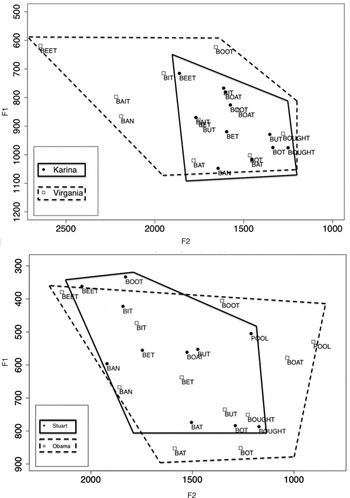
As Tables 3 and 4 show, both actors shift their vowel productions in ways that mimic the California Vowel Shift in their performances on The Californians. However, the components that each actor adjusts differ: Kristen Wiig manipulates the front and low vowels (BIT, BET, BAT, and BOT-BOUGHT), while Fred Armisen manipulates the back vowels (BOOT, BOAT, BUT, and BOT). Thus, both achieve vowel productions shifted in a direction that aligns with the CVS by modifying different areas of the vowel space. Figure 13 illustrates that each of the actors shows movement of either the front or the back portion of the vowel space in performing their respective Californians characters.
Vowel space outlines as The Californians character (solid line), and as non-Californians character (dashed line) by actor, Kristen Wiig (left), Fred Armisen (right).

Accompanying these CVS-consistent shifts are additional vowel-class shifts that are disaligned with the CVS for both actors. Notably, while these features may not be consistent with the CVS, they are consistent with a more holistic shift of the vowel space performed by each actor. When playing her Californians character, Wiig shows not only a CVS-consistent lowering and backing of BIT, BET, and BAT, but also a lowering and backing of BEET and BAIT, which are less clearly associated with the CVS (c.f. Van Hofwegen et al. Reference Van Hofwegen, D'Onofrio and Pratt2016). This indicates a more generalized lowering and backing of all front vowels. Similarly, Armisen's Californians character not only shows a CVS-consistent fronting of back vowels BOOT, BOAT, and BUT, he also shows a CVS-inconsistent fronting and raising of BAT, BET, and BIT. This suggests a more general process of fronting the entire vowel space.
For both actors, the general vowel-space shifts that occasion the CVS can be described in articulatory relation to the stereotyped jaw setting used to perform their respective Californians characters. Notably, these actors’ jaw settings correspond to the resulting acoustic shifts that characterize their performances (Tables 1 and 2). Wiig's open-jawed setting leads to articulation of vowels that are relatively lower and backer, since this setting places the tongue in a lower and backer starting position than when the jaw is not lowered (Lindblom & Sundberg Reference Lindblom and Sundberg1971). Similarly, Armisen's protrusion affects the articulatory realization of his vowels. Protrusion of the lips and jaw moves the cheeks in and the articulators forward, in addition to imposing limits on the front-back mobility of the tongue. The actors shift their articulators in such a way that some of their vocalic productions align with the California Vowel Shift, mimicking patterns observed in large-scale studies of Californian speakers. Furthermore, even when vowel productions are in disalignment with these CVS production patterns, they acoustically reflect the articulatory consequences of the stereotyped jaw settings used to perform these characters.
DISCUSSION
In the portrayals examined here, actors Wiig and Armisen draw on linguistic and embodied visual stereotypes to comedically portray Southern California personae (i.e. Valley Girl and Surfer Dude). They rely on particular jaw settings, an enregistered comportment specific to the jaw and mouth, which are linked to these social types. Their respective jaw settings are used alongside other visual symbols of California-ness, such as blond hair color, bright clothing, and furniture and props explicitly linked with an upper-middle-class West Coast aesthetic. Given the mediatization and commodification of products and performances linking the open and protruded jaw and lips with Southern Californian personae, Wiig and Armisen's performances draw on and contribute to the ongoing enregisterment of these jaw settings. The actors use these open jaw settings in both speaking and nonspeaking contexts, in contrast with performances in other skits, where their mouths are more frequently closed or only slightly open when not speaking. What's more, they use these stylized jaw settings at moments of heightened attention to their facial organization (i.e. when the camera zooms to one actor's face), which suggests an idiosyncrasy specific to the portrayal of these California characters. Visual analysis of the performances shows that jaw setting, just like hand gestures, body orientation, or gaze, can encode social meaning by virtue of the persona that is associated with it, as well as the linguistic and extralinguistic features with which it is packaged. We thus argue that these jaw settings are able to index California-ness by virtue of their existing link to California-specific social types (i.e. Valley Girl and Surfer Dude), and that these performances in turn contribute to the ongoing enregisterment of these jaw settings.
In tandem with jaw setting, we show that the actors manipulate their vowel productions in performing these characters. While both emulate the CVS in some respects, a subset of each actor's vowel productions are inconsistent with the CVS. However, these CVS-inconsistent vocalic productions are consistent with the effects of the articulatory configurations of each actor's particular jaw setting (i.e. Armisen's protruded lips push the tongue to the front of the mouth, articulatorily resulting in fronter vocalic productions, while Wiig's open jaw lowers the tongue, resulting in lower vowels). Given this phonetic and articulatory evidence, we suggest that the co-occurring visual and acoustic indices are not simply coincidental; rather, the actors’ productions of California-like vowels may in fact be derivative of these stereotyped jaw settings. There is reason to believe that the use of stylized jaw settings would result in holistic shifts in the vowel space since, as mentioned earlier, speakers have been shown to alter their jaw setting depending on which language they are using (Gick et al. Reference Gick, Wilson, Koch and Cook2004; Wilson & Gick Reference Wilson and Gick2006) or even speech context (Ramanarayanan et al. Reference Ramanarayanan, Goldstein, Byrd and Narayanan2013). And as noted above, the nature of the relation between jaw setting and vocal articulation is corporeally more fixed than the relation between other types of gesture (e.g. hand gesture or gaze) and vocal articulation. A particular jaw setting necessarily imposes embodied constraints on articulation, and vice versa. We argue that the actors analyzed here achieve particular acoustic styles that show some relation to the CVS by virtue of their use of stereotyped jaw settings, albeit in different ways. This not only accounts for the vowel space manipulations characteristic of the CVS, it also helps explain the use of vocalic features that are not consistent with documented work on the CVS.
The use of jaw setting as a semiotic resource in The Californians, and the resulting California-shifted acoustic style, operates as part of the broader project of enregisterment (Agha Reference Agha2003) by which these performances draw upon and produce a new link in the chain of events connecting culturally recognizable personae with particular semiotic resources. The jaw settings observable in Wiig's and Armisen's depictions have roots in previous performances of Southern Californian social types, such as Whoopi Goldberg's surfer chick, Sean Penn's Spicoli, and other representations described in this article. The use of these jaw settings in The Californians recasts the 1980s character types into an early 2010s setting, perpetuating these enregistered styles into the present day. In a sense, Karina and Stuart perform the ‘grown-up’ versions of these high school personae.
The process of recontextualizing these character types packages jaw setting and acoustic style with other features drawn from prior depictions of Californian personae. In each episode of The Californians, the actors’ performances encode both linguistic and extralinguistic semiotic resources that are explicitly tied to (Southern) California types. Characters in the sketch frequently use lexical items associated with California, such as totally, and they discuss such stereotyped topics as Los Angeles driving routes (Stuart: “Just get on the [Interstate] 10 and get out of here!”), local produce (Karina: “I used real California avocadoes”), and their artisanal furniture and house wares (Stuart: “Let's get on the burlap and cane daybed”). In addition to the topics discussed, aesthetic and personality-based attributes of the characters align with stereotypes of California. For example, with the exception of Stuart's domestic worker Rosa, who is Latina, all characters in the sketch are blonde; for most characters, this means wearing an intentionally visible wig. The cast's explicitly constructed blondeness draws upon and replicates the stereotype of Californians as blonde, featured in the aforementioned portrayals of Californians in the 1980s and 1990s, such as Clueless’ Cher or Fast times’ Spicoli. In some ways, hair color iconically represents qualities of California-ness such as a carefree, laidback attitude (blondeness as derived from excess leisure time in sunny weather) or superficiality (blondeness as derived from artificial dye). The Californians both reinforces and parodies not only an association between blondeness and Californian personae, but also an association between whiteness and these personae, by virtue of the contrast with dark-haired Rosa. Further, the characters occupy themselves with superficial interpersonal and professional activities that are ripe for mockery. Much like previous portrayals of the Valley Girl and Surfer Dude as interested only in appearances, romantic relationships, and partying, The Californians are largely preoccupied by activities in the realm of conspicuous consumption or relationship drama. Even occupationally, these characters are portrayed as superficial: Stuart's character is an artist whose work includes a photography book entitled Classic burger joints of California and a series of “sepia charcoals of canyons”.
The aesthetic attributes of both the characters and the set, along with the personality attributes, lifestyle, bodily and linguistic characteristics of the characters combine multimodally, producing legible personae that index the most parody-ready aspects of California stereotypes. In this way, the actors serve as ‘facilitators of cultural reassessment’ (Coupland Reference Coupland2001:371). They (re)combine acoustic, visual, and embodied resources from existing texts in order to represent localized characters, thereby newly contextualizing and thus perpetuating these features’ semiotic links with California types. This renders them available for new audiences in the continuing process of enregisterment.
CONCLUSION
In their parodic performances of Californian personae, Kristen Wiig and Fred Armisen exploit the intertwining semiotic channels of jaw setting and acoustic cues in the enactment of what we have called embodied stereotypes. Qualitative video analysis indicates that the actors adjust their respective jaw settings to embody stereotypes of California personae, and acoustic analysis of their vowel productions corresponds to these open jaw settings. That is, the jaw setting that leads to Karina's backed and lowered front vowels and Stuart's fronted back vowels in their performances of The Californians is consistent throughout the performance, as evidenced by moments when these characters are not speaking, yet still maintain their iconic jaw settings. The actors rely on embodiment to portray the stereotypical characters, in large part because jaw setting itself serves as a legible semiotic resource of Californian character types.
As one necessarily informs the other, the imbuing of jaw setting with social meaning entails the assignment of social meaning to the jaw setting's acoustic results (in the case, shifted vowels), and vice versa. These stereotyped jaw settings and their resulting vocalic productions are necessarily co-entextualized as emblematic of the performed Californian personae. They are not only linked to one another both corporeally and semiotically, they are assigned indexical social value through these performances. This analysis highlights the mutually elaborative relation between acoustic productions and facial setting, opening the door for investigations of how the body may determine or constrain social meanings associated with particular phonetic features. We thus advocate for additional work exploring the ways that embodied settings, gestures, or hexis may be determinant of and informed by the social meaning of their acoustic results, both in performance and in everyday interaction.