There have been a number of waves of new membership to the EU. Issues of social policy have been analysed most clearly in relation to two of these. The first was the accession between the mid-1970s and the mid-1980s of the smaller states of Ireland (1973), Greece (1981), and Spain and Portugal (1986). The second was the simultaneous accession of Estonia, Latvia, Lithuania, Poland, Czech, Hungary, Slovakia, Slovenia, Malta and Cyprus in 2004. In this paper, we will look at some lessons that we might learn from these two earlier waves that can help us understand the factors that will affect social policy in other candidate countries, particularly Turkey.
What is social policy?
EU social policy is rather different from social policy as understood from the perspective of the nation state. We can characterise national social policies as addressing three social functions, but not all of them are equally salient at the level of the EU. The first is to support the development of the productive capacity of a nation. This can be seen clearly in the development of education systems as one of the earliest areas of state social intervention in modern nations, oriented towards improving the productive capacity of young people and aligning them to the requirements of the labour market (Bowles and Gintis, Reference Bowles and Gintis1976), for example in terms of universal literacy. The second is designed to support the reproduction of the society, both physically and socially, for example the development of health care systems and the monitoring and protection of children's well-being. The third is the meeting of the needs of non-productive citizens such as the elderly on the basis of retaining the solidarity and legitimacy of the social system, as a signal that social needs will be met for the currently productive in their later lives.
What is the shape of Turkish social policy?
The development of Turkish social policy in the twentieth century has been dominated by two factors. The first has been the relatively recent emergence from the legacy of the Ottoman empire of the republic in 1923, and the dominance of a strong state-led model of development. The second has been the weakness of political party growth and the representation of popular opinion in the political process. From the 1920s, the state generated economic growth through paternalistic authoritarianism, with a relatively successful development of productive capacity. But from the 1940s onwards the left was suppressed, and the state presented itself as a ‘beneficent giver’: managing small farmers, tolerating urbanisation, and with a growing public service. Social reproduction was a success. However, popular support for the state was never embedded in political processes, and the third military coup, in 1980, eliminated popular organisation. Between 1989 and 1999 there were oscillations between military, popular, and religious pressures such that the state was unable to secure stable solidarity and legitimacy of the social system. By the turn of the century, the International Monetary Fund was advocating reduced social spending, and popular distrust of the state had grown. The response has been remarkable – from 1999 there has been a serious attempt to move social policy towards EU priorities in the areas of education, human rights, non-governmental organisations, women and minorities, and effective regulation. The election of 2002 brought in a mildly pro-Islamic government, both distanced from the military, and in favour of EU membership.
Against this background, Turkey formally opened EU accession negotiations in October 2005. The EU progress report for Turkey for November 2006 makes a point of highlighting new achievements: a parliamentary human rights committee, more spent on education than defence, legislation on the protection of children and on disabled people, a significant overhaul of social security and health systems, and economic growth.
What is social policy in the EU?
EU social policy has been a moving target. In the early years, economic policies were the main focus of the (EC) European Community. Social policy that was an aid to production, such as education, was an early interest, but social policies concerned with reproduction or solidarity were relatively inconspicuous. However, in the 1980s this began to change. The agenda of the EU began to encompass a wider concern with solidarity, ranging from poverty to gender equality, and to the impact of the environment on health status. And the EU was not the only international actor to become more active in social policy. At the same time the OECD began to significantly widen the scope of its advice into the social policy field (Armingeon and Beyeler, Reference Armingeon and Beyeler2004).
However, there is some confusion over the nature of European social policy. There have been two distinct approaches to this issue. One has been the systematic analysis of continuing differences in the social policy traditions of European welfare states, epitomised in Esping-Andersen's (Reference Esping-Andersen1990) seminal analysis of the ‘three worlds of welfare capitalism’. Subsequent work has confirmed the enduring differences between for example the Scandinavian social democratic tradition, the French and German conservative tradition, and the British liberal tradition, to which has been added fourth and fifth types: the ‘Latin rim’, and of course the Russian state socialist tradition (Abrahamson, Reference Abrahamson1999).
On the other hand, there is also the idea of a European social model (ESM), which has been used to highlight common European patterns in contrast to those in the USA, Russia or Latin America. The ESM is not very tightly defined, however, and although in the 1980s it had a distinctly social democratic flavour, it is now closer to an American liberal model than before (Kovács, Reference Kovács2002; Guillén and Palier, Reference Guillén and Palier2004). This is important in thinking about the consequences for social policy of accession to the EU, especially as the ‘open method of coordination’ is now designed to slowly bring social policies of member stares towards convergence.
It is also important in thinking about EU social policy to distinguish between intentions and achievements, and between activities and results, or in more traditional language, between inputs and outputs. Delhey (Reference Delhey2001) suggests that there are three ‘logics’ of EU social policy: distribution (such as regional policy and regional funds), regulation (such as institutional adjustment and capacity building) and efficiency (such as economic alignment and integration). These three areas have very different constraints on them. Clearly, as the EU expands its membership with poorer members there will be pressure on the availability of funds for poorer regions, unless the budget is very considerably expanded – which has been resisted by the older members so far. However there is much less constraint on the absorption of new members into the regulatory framework of the EU, even with transitional funding for capacity building both before and after membership is formally achieved. Also, as we shall see, it is in this area that there has been a steadily expanding set of requirements for new members to comply with. Again, economic efficiency does not necessarily require substantial funds to be transferred between EU members – rather the cost is to the new member, either financially or culturally. Thus with each successive wave of accession, European social policy has moved more and more towards regulation and away from redistribution.
How does Turkish social policy fit with the EU?
Turkey's bid for accession in 2005 has thus come at a time of rather different constraints than those in the 1970s and 1980s, and even the 2004 expansion. The stock of European legislation has grown substantially in the last 50 years, while the budget has not. It is now far easier to set legislative targets for new entrants than to offer them substantial funding support towards social policies. This is particularly the case for Turkey which at 70 million, will have one of the largest populations in Europe, and cannot expect substantial per capita funding to flow from EU accession. Even though economic growth is good, average per capita incomes are less than one third of the EU average. The accession progress reports thus make extensive reference to the state's willingness and capacity to ensure human rights, legislation on social protection and administrative reform.
In terms of welfare state classification, Turkey has less in common with Esping-Andersen's core types, than with the so-called Latin rim, where a strong state and a family-centred tradition prevailed, for example in Franco's Spain. Indeed the self-styled ‘beneficent giver’ state is also redolent of the way in which Russian state socialism presented social policies in the post-Krushchev years of rapid growth in welfare spending (George and Manning, Reference George and Manning1980). Nevertheless, this actually means that the state does have good capacity for change, if the political will is there. This has been seen spectacularly in the case of Spain, where the process of ‘cognitive Europeanisation’ (discussed in detail below) led to rapid change.
Indeed the speed with which new social legislation has developed under the current Turkish government has been unprecedented. However, as the EU 2006 progress report points out, there is still a long way to go to eliminate the fundamental problems of human rights violations, such as torture and economic corruption. The 2006 EU report makes a point, for example, of praising new 2006 legislation on social protection, but sets it alongside the lived reality of life in Turkey:
1.29% of the population live below the hunger line, while 25.6% live below the poverty line. The percentage of the latter increased to 40% in the rural areas. According to the same study, the child poverty rate (below 6 years of age) is 34%, while this rate reaches almost 40% in rural areas. (EU, 2006: 54)
How does social policy change?
For the nation state, the development of social policy has traditionally been a matter of internal resources and political choice. While policies may have been transferred between political elites of different nation states quite extensively, this was never coerced, and always domestically funded. Explanations of change have in general fallen into two types. The first is that social policy has been basically shaped by economic factors. This might be the result of the openness of an economy to international competition, thereby encouraging the protection of the domestic workforce, or investment in the workforce as a way of developing a nation's human capital stock, or more simply a matter of the capacity to provide and consume public goods, such as health care. The second type of explanation has focussed on the balance of political forces in a nation, generally arguing that the greater the power of organised labour, then the greater the development of social policy (Manning, Reference Manning, Hantrais and Mangen1993).
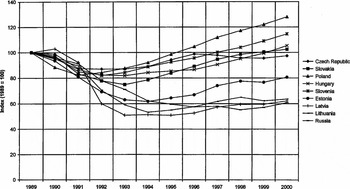
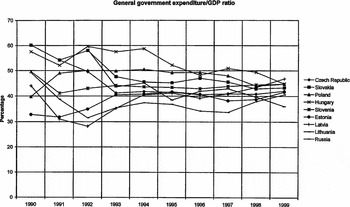
We can neatly illustrate this point by comparing the growing spread of economic performance amongst the post socialist states of Central and Eastern Europe, to their growing convergence over government spending as a proportion of GDP. Changing economic capacity has accompanied common political choices – see Figure 1.
Real GDP growth.
Note: Figures were generated from the micro-data available through TransMONEE 2001, Florence: UNICEF. Each figure includes the 8 CEE accession countries, plus Russia for comparison)


These explanations have often been qualified through a variety of particular historical circumstances (for example war), institutional legacies, technical innovations, or other aspects unique to a nation. However the implication is that ‘politics matters’, and that social policies in nation states are increasingly constrained in common ways. This has been reinforced since the latter half of the twentieth century by the growing involvement in domestic social policies of powerful international actors in the form of the International Monetary Fund, the World Bank and, of course, the EU, and that have come to modify the play of domestic forces. An example can be seen in the UK, where there was significant turning point in 1976, when the then Labour government was forced to turn to the aid of the IMF to deal with a currency crisis, but in return for which there was sharp pressure to cut back on social spending.
Turkey and social policy change
In the case of Turkey, there is no doubt that the structure and power of the state, and especially of the military, are the dominating factors in social policy development. The interaction of international forces, actors and structures with those of any particular nation state is at the heart of social policy change in the EU. Guillén and Palier (Reference Guillén and Palier2004) develop a model adapted from Caporaso et al. (Reference Caporaso, Cowles and Risse2001), to suggest that:
changes in social policy in candidate countries should be understood as an interaction between adaptive pressures coming from both the EU and international organisations; and the capabilities and constraints their interaction with domestic structure creates.
Such pressures might include both direct and indirect influences. Thus directives and the acquis along the lines laid down in the ‘Copenhagen criteria’ are clear requirements for candidate countries to meet. However, Guillén and Palier (Reference Guillén and Palier2004) are also interested in less direct channels of influence. They observe that these might include non-binding recommendations, the ‘open method of coordination’ and the deployment of incentives through structural and cohesion funds. But their particular attention falls on the concept of ‘cognitive Europeanization’, which they adapt from Radaelli (Reference Radaelli2000). This is the notion that attitudes and perceptions about social issues and social problems, and the best way to tackle them, are shaped informally through debates and discourses, for example as to the nature of the ‘European social model’ and the kind of policies which should be developed. Clearly, the open method of coordination is an explicit mechanism for this kind of influence.
A related model developed in the field of international relations is presented by Öniş (Reference Öniş2004). In this paper, the dimension of ‘external–internal’, suggested by Guillén and Palier as the key to understanding EU influence over social policy, is extended through a detailed case study comparing the trajectories of Poland and Turkey in relation to EU accession. An additional dimension is added, separating elite and mass or civil society views from both inside and outside the candidate country, giving a more complex 2 × 2 table. Öniş suggests that Poland and Turkey have occupied changing positions on this table. Poland has only been a liberal democracy since 1989, and an EU membership applicant since 1994. For Poland there has been a coincidence of EU elite support (especially coming from Germany, keen to secure its eastern border) and Polish elite support (keen to remove the legacy of state socialism), together with civil society support amongst both Polish and EU people, such that all segments have been in favour of EU accession, which has indeed proceeded quickly

However, although Turkey has had formal relations with the EU since 1963, and applied for full membership in 1987, the pattern of support was very different, and the initial application was rejected. There was little enthusiasm for EU membership from either Turkish civil society or the general EU public:
However, Öniş argues that since 2002, the pattern of both elite and civil society support for Turkish accession has made a remarkable turn around, such that the pattern is moving towards the situation for Poland in 1994.
Turkey and the experience of new members – ‘a comparison of enlargements’
The experience of EU membership has changed with each new wave of accessions. There are patterns and earlier experiences that are instructive but we cannot simply extrapolate the future from the past. A number of models of EU enlargement have been offered in the literature, which together throw light on the likely social policy consequences for Turkey's accession. It is important in trying to draw lessons from this experience to separate pre-accession processes from post-accession membership effects. These cases have also been selected to throw light on particular processes, and are inevitably partial.
Catching up
There have been fundamental differences between the experiences of those countries that joined up before the mid 1980s, and those that joined later. There was an expectation, which has in fact been realised, that countries in the earlier waves could ‘catch up’ with EU economic, social and political conditions. Delhey (Reference Delhey2001) reviews data for Ireland, Greece, Portugal and Spain in three areas: per capita income, social protection spending and eurobarometer measures of life satisfaction. He finds that in all these areas there was indeed a ‘catching up’, measured in terms of convergence in comparison with the existing membership, with the single exception of Greece's per capita income. However, he suggests this is very unlikely to be the case for the later waves, noting that in the EU 15, the ratio between the richest and the poorest country is 2.5:1 (Luxembourg vs. Greece). He suggests that with the candidates of the 1998 accession, the ratio will double, and triple with the 2004 accession (Delhey, Reference Delhey2001: 208). The accession of Turkey, where per capita income is only 29 per cent of the EU average, will accentuate this pattern.
Cognitive Europeanisation
Although the accession process is far more prescriptive for economic and political affairs than for social policies in detail, nevertheless social policy can be significantly changed. The case of Spain is instructive here. Before the death of Franco in 1975, Spain was in a similar position to Turkey in the 1990s, with the EU elite and its own elite at best only marginally interested in membership. But by the late 1970s, as with Turkey in recent years, there was a major shift to enthusiasm by both elites. As the accession process developed, there was little difficulty in Spain absorbing the specific economic and political requirements since most of them were already in existence in what had rapidly become a modern industrial democracy. But in the area of social policy, in the 1980s and 1990s Spain at first expanded and then rationalised its welfare state in a period of almost revolutionary development for social affairs. In both phases, it is clear that the EU provided both a model and a means for all political groups (elites, interest groups such as the trade unions, and the general public) to establish a vision of their preferred future, and to grasp the means of realising the vision in both procedural and substantive change. Guillén and Álvarez (2004: 289) call this ‘cognitive Europeanization’. They suggest that it has an impact on national political discourses, identities, elite ideologies, the attitudes of policymakers and public preferences. Their argument is that this kind of ‘soft’ policy change has had more influence on the evolution of Spanish social policy than formal EU policies. Thus, they see the reorientation of Spanish social policy coming about through the EU emphasis on such areas as social inclusion and equity between women and men.
Of course, hard policies are not irrelevant, but the EU 2006 progress report on Turkey shows that in many areas the government can merely ignore or delay policy change. Guillén and Álvarez (Reference Guillén and Álvarez2004) would be looking for a clearer indication of a change in the hearts and minds of elites, policy makers and Turkish public opinion. And in fact this has already begun in part with the many changes that have occurred under the current government. The next election, later this year, will be a clear test of the extent to which there is popular support for these changes.
Regulatory distance
For the Central and East European countries that have joined the EU, or are now in the process of doing so, there have been other powerful international actors in addition to the EU that have had an interest in their social policy changes. Indeed, in many ways these other actors have had a greater interest in social policy than the EU itself. The reasons for this are partly ideological – the ‘Washinghton consensus’ was intent on establishing a clear change of direction from the established structures of the state socialist system, seen as providing heavy subsidies with weak marketisation. In reality, however, the Central European societies already had well-developed systems of social policy, including gender equality. To that extent the EU could maintain distance from social policy, and leave space for the international agencies, especially the World Bank to take the lead in adjusting social policy to the new world of the market (for example in areas such as unemployment protection, and social assistance, which had not been perceived as priorities under the old system).
In a systematic analysis of the EU Regular Reports leading up to Hungary's accession, Ferge (Reference Ferge2002) demonstrates that social policy was a very minor theme in the chapters. She notes that there appeared to be a divergence of impact on the central European societies compared with the southern European accession states. While the latter were encouraged to develop and extend their social policies, Ferge argues that the CEE states were left to the mercy of the IMF and the World Bank's neo-liberal social policy agenda:
The EU seems to attach increasing importance to social policy . . . while it has approved the changes in the new member states that promoted the ‘Americanisation’ rather than the Europeanisation of social policy. (Ferge and Juhász, Reference Ferge and Juhász2004: 249)
This is less likely to be the case for Turkey for two reasons. Like Spain, Turkey already has a market-based economy. Secondly, with a poorly developed set of social policies, there is no need to dismantle a coherent and functioning welfare model.
Resource redistribution
Of those countries considered in this paper, Ireland was the earliest to accede (in 1973), and has had a spectacular period of growth in the last 15 years. Like Greece, Portugal and Spain later, the first years as an EU member saw Ireland more or less maintaining its relative GDP per capita standing at around 60 per cent of the EU average, in other words it was growing, but no faster than anyone else. Then there appeared a quite remarkable second period of 15 years, during which Ireland steadily gained ground, and eventually overtook, the rest of the EU, and even briefly appeared to have reached the status as one the richest per capita countries in the world in 2005. It is widely observed that this has been the EU's greatest success story and the best advertisement for the spoils that can fall to a country that joins the EU and makes a success of the opportunities that this provides.
However, it is not entirely clear to what extent EU membership was the key factor. Delhey (2001: 216) argues that a national pact to suppress wage increases, massive state subsidies to foreign investors, and the focus of EU subsidies on infrastructure and economic restructuring, created favourable conditions for growth. Certainly, Ireland received a level of per capita subsidy from the EU in the 1970s that is now unsustainable for the much enlarged EU. If Turkey is to sustain or improve its currently very positive 7 per cent growth rate, it will need to rely on its own resources.
Cultural context
One of the significant factors that has been emphasised, particularly in relation to Turkey, is the cultural affinity between candidate countries and the EU. This is a rather difficult matter to measure clearly in relation to social policy development. For Turkey the key issue is the likely effect of its Islamic and military/state traditions. The EU 2006 progress report on Turkey observes a reluctance to abandon old ways: ‘The Armed Forces have continued to exercise significant political influence. Senior members of the armed forces have expressed their opinion on domestic and foreign policy issues’ (p. 8). As we have noted Islamic and military/state traditions do not pull in the same direction themselves, and there has been a regular oscillation in their hold over governments since the late 1980s. The further influence of western values makes for an unstable swirl of values, captured brilliantly by the 2006 Nobel laureate Orhan Pamuk's novels, such as Snow.
The experience of previous candidate countries can be illustrated through the case of Malta, one of the 2004 entrants. Malta is a fiercely catholic country, with political traditions typical of Mediterranean ‘clientalist’ relations (Davis, Reference Davis1977). The church has traditionally taken the lead on social policy issues, and political parties have had to negotiate with a powerful and well-institutionalised religious influence, sometimes felt to amount to an alternative state system. The effects of this power duality have been significant in the areas of gender equality – a key concern for the EU social policy agenda. Despite Malta's entry to the EU, and its official ratification of a number of measures supporting gender equality, the implementation of these measures has been half-hearted. The church still has very traditional views of women in Malta, and this has undoubtedly undermined the enthusiasm with which such measures have been pursued ‘on the ground’ (Camillari-Cassar, Reference Camillari-Cassar2005).
Conclusion – some key dimensions
This brief review of the experiences of previous countries that have joined the EU has raised a number of issues that have a bearing on the effects of EU membership on social policy. Firstly, we need to distinguish between ‘accession’ and ‘enlargement’. Clearly, the motives for the EU to take on new members may be at odds with the hopes and aspirations of the candidates themselves. Even for existing EU members the reasons for enlargement may vary. It is well known that the UK hoped that enlargement would in fact lead to a weakening of the EU, whereas we have seen for example that Germany looked forward to creating a buffer between its borders and countries further to the East. For social policy issues this means that it has not always been clear exactly what kind of social policies should be developed by EU members. In the case of Turkey, some observers have argued that it would desirable to have a moderately Islamic state within the EU.
Öniş (Reference Öniş2004) has argued that it is important to distinguish between the attitudes of elites and civil society on both sides, since these both have been crucial to the rate at which accession takes place. Moreover, as we have seen in the case of the EU constitution, gaps between elites and the general population have emerged. In the case of Turkey there is a further complication of conflict between elites: military, religious, industrial. Thus the actions of states or at least the elites that control them, and civil society, cannot be assumed to be in line. For social policy this means that some functions, for example production, may come into conflict with others, such as the development of solidarity. At the very least there will be choices to be made between, for example, spending money on poverty, or on education. When the EU or a candidate country is in conflict over the prioritisation of these functions, or when they are championed by different groups, there will inevitably be uncertainty about the extent to which a candidate has or can fulfil EU expectations.
There is a group of other issues that seem to run together as successive waves of accession have taken place. We have seen that inevitably EU action is moving more towards regulation rather than the kind of funding support that Ireland has enjoyed in the past. EU social policy may then become more a matter of formal structures and processes than any substantial service developments in themselves. This is related to the fact that new members are further and further away from the traditional heartland of EU countries, and there may well be the development of a sense of EU core and periphery, including the question as to whether for example Turkey is ‘really’ in Europe at all.
Finally, of course there is the continuing question of what the changing face of EU social policy really is. In the social charter, the final draft famously substituted the key term of citizen with the term worker, emphasising the intimate relationship between the labour market and social policy. This focus is consistent with the peculiar make up of EU social policy: education is central, but not housing; social exclusion and poverty are central, but not pensions; environmental issues are important, but not healthcare. The European social model is already rather hazy in outline, and will become more so with the inclusion of Turkey, where religious and military values have a continuing influence over the development of social welfare institutions.
Note
* Plenary paper to the conference ‘Transformation of Social Policy in Europe: Patterns, Issues and Challenges for the EU-25 and Candidate Countries’, Middle East Technical University, 13–15 April, Ankara, Turkey.