Artistic creations in the performing arts are integral to the growth in political and economic status and in the socio-cultural sophistication of the various Akan states in the central forest and the coastal areas of modern-day Ghana and Côte d’Ivoire. Used for aesthetic purposes or for setting and sustaining the mood of rituals, musical instruments, as mediating material culture and the performing arts, are indexes of political power and the hierarchical structure of chieftaincy.Footnote 1 The extent to which the performing arts lend prestige and power to chieftaincy is not limited to only the Akan. Peter Cooke informs us that during the coronation of the 36th Kabaka of the Buganda Kingdom in Uganda, over 220 mujaguzo drummers, several trumpeters, and seventy-four praise drummers performed (Reference Cooke1996:439). In Akanland, a variety of musical instruments preceded the infantry to war and sounded coded messages as signals for the combatants, gaining a reputation as war trumpets (akobɛn) or war drums (asafo twene). Akan oral tradition informs us that, in the past, several battles were won or lost just by capturing the musical instruments of an adversary.Footnote 2 With such considerations in mind, one of the ivory trumpet groups (nkɔntwema) at Manhyia Palace in Kumase-Ghana sought to elevate the Asante king (Asantehene) above his adversaries by means of instrumental poetry: any person who claims your status, let him show his trumpets, let him show his people (nipa ɔne wo sɛ, kyerɛ wo mmɛn, kyerɛ wo dɔm).Footnote 3 The ivory trumpeters may have a point, for in all Akan polities; the court of the Asantehene arguably has the largest collection of musical instruments, ensembles, musicians, and poets.
Although the legitimacy and power in Akan kingship reside in the ancestral Black Stools (Gilbert Reference Gilbert, Arens and Karp1989), it is the musical arts which define and sustain the power of rulers in the public domain during periodic rituals, annual festivals, and funerary rites, when history is recalled and performed as part of the lived and embodied experience for the orderly function of the state. Unlike ornamented chairs, Black Stools are sacred objects, and as a result, the Chapel of Stools (Nkonwadanmu) is one of the most restricted spaces in the palace, and the Akan in general have no idea what takes place there (Gilbert Reference Gilbert, Canadine and Price1987:305). Rituals involving stools are invariably private, exclusive, and limited to just a ruler and a handful of court attendants. The sacred nature of the stools is taken further in Asante, where the heavenly origin of the Gold Stool confers unequalled powers to the king.Footnote 4 This inevitably leads to several questions. For instance, how is royal power emphasized and sustained in public celebrations? How do the musical arts and kingship interface in varied socio-political environments? And how does music act as the enabler for the performance of royal power and responsibility?
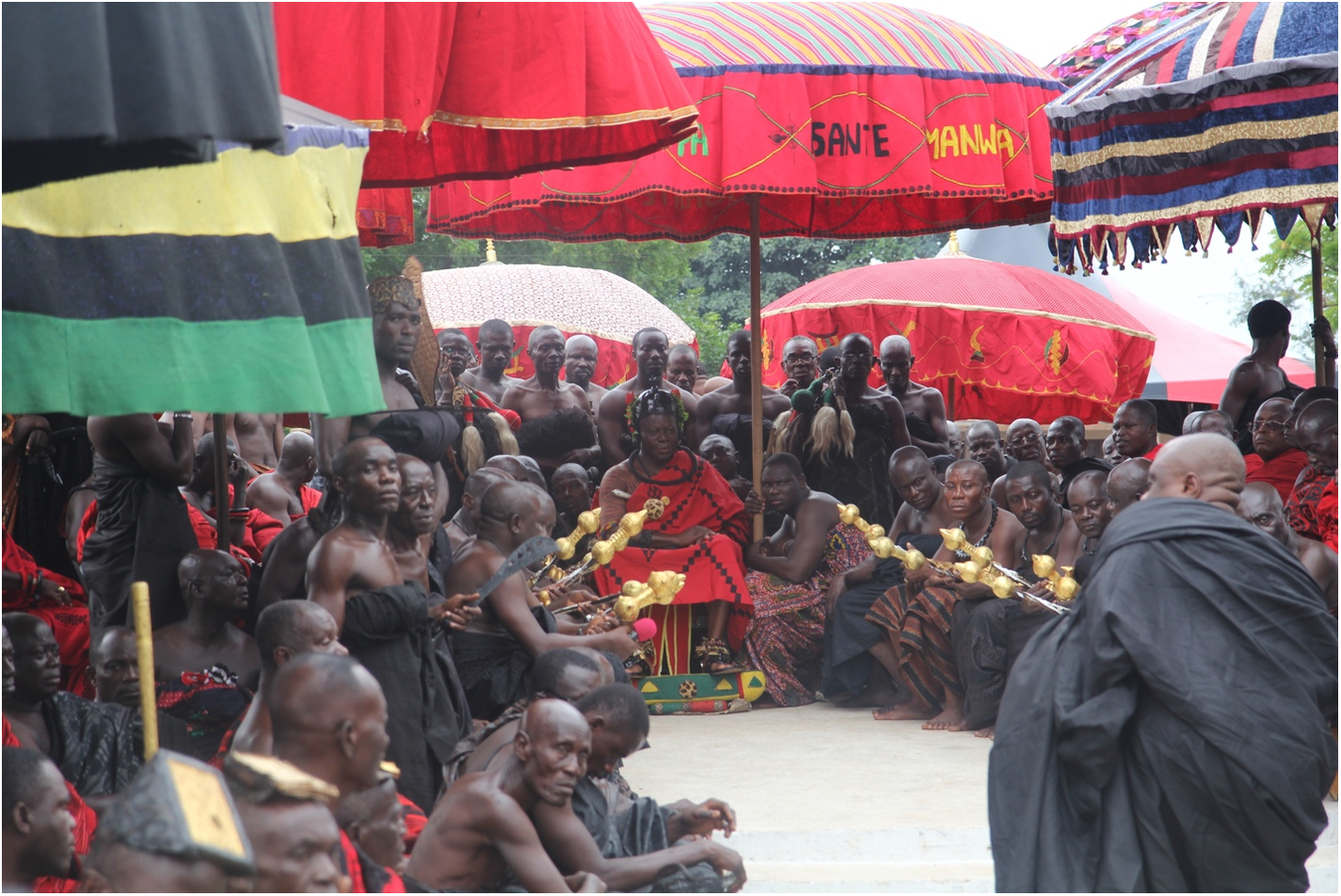
Focusing on the Asante, one of several Akan states in Ghana, the Asantehene, and performing arts at Manhyia Palace in Kumase, this article offers an ethnographic narrative and analysis of the 2014 Grand Worship (Brɛman Ɛsomkɛseɛ) at the Royal Mausoleum in Brɛman, about thirty minutes northwest of Kumase.Footnote 5 Far from being a sheer drama of pomp and pageantry, the annual Grand Worship (hereafter Worship) in Asanteman provides a rare opportunity for the performing arts to affirm, reinforce, and elevate royal power, as the Asantehene directly participates in musical performances and dances with court musicians and the general public. Further, the Asantehene’s active participation in the performing arts creates fleeting moments when royal distancing protocols, marked by the use of swords and other regalia during formal proceedings, dissolve and make it possible for participants to be in close proximity to the ruler (see Figure 1). At certain stages in the ritual, royal power is projected, articulated, and channeled through multiple performance outlets, but this study focuses on the following acts by the Asantehene: 1) his participation in heroic shouts; 2) his fɔntɔmfrɔm dance; and 3) his triumphant return from Brɛman to Kumase. To begin, I will clarify the reference to power and responsibility in the title, and following that, rehearse a few theoretical formulations that are foundational to the multifaceted landscape of musical performance and power relations that has engaged ethnomusicologists since the 1990s.
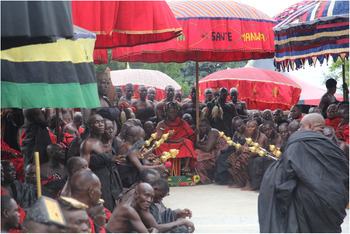
The Asantehene, Otumfoɔ Ɔsɛe Tutu II, in a formal sitting at Bogyaweɛ during funerary rites for the head of the royal family in 2012. Royal space and distancing protocols are enforced by his sitting on a raised dais (simpie), surrounded by courtiers including sword bearers, royal spokespersons, court criers, and others holding a variety of regalia around the Asantehene. Picture by author.
In all Akan polities, the ancestral Black Stools, which belong to the matriclan, are the source of political power.Footnote 6 The word “stool” refers to the actual seat, and symbolically to the Akan state or office of chiefship (Sarpong Reference Sarpong1971:8). As the seat of power, the Black Stool is all-encompassing and ensures the legitimacy of kingship. For instance, a chief is said to occupy the ancestral stool (ɔte Nananom akonwa so), and the land in the state is said to be “the stool lands.” In addition to the Black Stools, the Gold Stool (Sikadwa Kofi) in Asante represents “the highest level at which political power was [sic] exercised” (Wilks Reference Wilks1979:17). Unlike the wooden stools which are carved by known individuals, the heavenly origin of the Gold Stool ascribes divine origin to the stool, marking it as a special gift from God (Onyankopɔn). A reigning Asantehene is said to be the occupant of the Gold Stool (ɔte Kɔkɔɔ so). The stools connect a ruler to his deceased forebears who, according to Akan cosmology, are also closer to God. In that sense, the Asantehene is entrusted with the “highest level of politico-jural authority” (Wilks Reference Wilks1979:17) as well as spiritual authority when he leads rituals, such as the Worship, on behalf of his subjects. His titles, Otumfoɔ (the Most Powerful) and Ɔsagyefoɔ (the Redeemer), take into account his major responsibilities as described above (Wilks Reference Wilks1979). Accompanying the Asantehene’s position and titles are enormous responsibilities to the Gold Stool and the stools of his forebears, as well as his responsibilities to his subjects. Periodic rituals in the Chapel of Stools differentiate the former, while the latter is characterized by his swearing the oath of office with the Mpɔnpɔnsɔn sword during his enstoolment and his use of that same sword in his dance. According to courtiers, the sum of his responsibilities is like wearing the hat that comes with the Bosomuru sword (Gyemerikutu Kyɛ), which signifies the ruler is carrying the entire problems of Asanteman on his head.
Theoretical Formulations
Ethnomusicologists have been interested in what Laudan Nooshin refers to as “music’s affective power and its role in religious and other ritual contexts” since the field’s inception (Reference Nooshin and Nooshin2009:9). Despite the noted interests, music’s central role in religion and rituals was only implicit in publications by authors such as Paul Berliner (Reference Berliner1978), Lester Monts (Reference Monts1984), or more recently Jacqueline Djedje (Reference Djedje2008). Following on the heels of cultural studies and anthropology, the 1990s saw a dramatic shift and a critical treatment of music and power relations in a flurry of popular music scholarship with those focusing on Latin America and the Caribbean comprising the overwhelming majority (for instance, Guilbault Reference Guilbaut1993 and Averill Reference Averill1997). With its focus on globalization, identity, gender, transnationalism, hybridity, and a host of topics in the 2000s, African music scholarship had its fair share in the proliferation of publications in popular music studies. A brief list of researchers includes Thomas Turino (Reference Turino2000), Kelly Askew (Reference Askew2002), Lisa Gilman (Reference Gilman2009), Michael Veal (Reference Veal2000), Eric Charry (Reference Charry2012), Tsitsi Ella Jaji (Reference Jaji2014), Mwenda Ntarangwi (Reference Ntarangwi2016), and Msia Kibona Clark (Reference Clark2018). Askew’s observation that contestation and mediation of power border on reflexive narratives and that the process enhances experience is in line with my ethnographic analysis of the Worship (Reference Askew2002:23–24). By its very nature, the annual Worship is the site for reflexive narratives which imply performed history, where the Asante past, encased in a variety of visual symbols and performing arts, is aligned with the present. Further, my analyses of the texts of shouts resonate with Askew’s repertory analysis of taarab, a genre of sung poetry in Tanzania.
Additionally, the 2000s ushered in conferences with the music/power theme that resulted in multi-authored publications. Two volumes, edited by Annie Randall (Reference Randall2005) and Laudan Nooshin (Reference Nooshin and Nooshin2009), resulted from papers presented at the 2001 Annual Conference of the British Forum for Ethnomusicology. The focus in Randall’s volume is on the “uses to which music is put, the controls placed on it, and discursive treatment of it” (Reference Randall2005:1). While Euro-American theorists and philosophers are central to both volumes, Randall admits that the studies in her volume are focused primarily on the ideas espoused by Antonio Gramsci. Michel Foucault’s counternarrative against dominant tropes based on binary oppositions between the powerful and the powerless, action and reaction, and domination and resistance is central to the chapters in Nooshin’s volume (Foucault Reference Foucault1977). My theoretical framework is in line with Nooshin’s volume, particularly regarding her emphasis on the inherent power of music and its performance to reinforce political authority for the orderly function of the state.
While I admire the application of Euro-American theories and philosophies to the understanding of power relations in the Global North, I am concerned that the preponderance of the same in discourses on African societies with no consideration of African theories and philosophies leaves critical blind spots in the scholarly literature. As noted above, power relations in the previously mentioned publications are mostly couched in binary terms and overlaid with discussions of class systems that are mapped onto African societies with no reference to African cosmologies. It is such concerns that animate critiques of Euro-American colonial and racist discourse and knowledge production in Africa.Footnote 7 Alternatively, there are scholars, including Nomi Dave (Reference Dave2014) and Barbara Hoffman (Reference Hoffmann2017), who for various reasons argue that the potential power of music to contest dominant power structures has been overemphasized in African popular music discourse. While they have valid reasons for critiquing dominant tropes in the literature, Dave, for instance, puts forth a compelling case and rationale for Guinean artists and their emphasis on “silence and guardedness” in their songs that points to a system of accommodating state power in musical genres across generations (Reference Dave2014:2). However, in the absence of a considered discussion of Guinean cosmology about silence, we are perhaps made to believe that there is a wholesale acceptance of the status quo. The apparent silence of performing artists to the political turmoil in Guinea may not necessarily mean the absence of sound or protest; it may well be that being silent is a way of protesting the never ending succession of totalitarian regimes in Guinea over the past fifty years. In other words, what is not verbally articulated is as important as that which is actually verbalized. In musical terms, silence is not absolute; neither is silence the opposite of music, for silence is integral to music (Nooshin Reference Nooshin and Nooshin2009:30).
Recent publications on kingship in Buganda in East Africa and the Yorùbá in West Africa resonate with my assertion in the opening paragraph that musical instruments and performances are indexes of political power and the hierarchical structure of chieftaincy in African societies. In the case of the Buganda, Kafumbe interrogates one of the oldest surviving ensembles, Kawuugulu, which historically has “managed, structured, modeled, and legitimized power relations in the kingdom” (Reference Kafumbe2018:xxi). Writing on the Yorùbá, Bode Omojola is able to point out how “the status and authority of female chiefs are elevated through musical creativity and performance” (Reference Omojola2012:91–112). Given my critiques of the prevalence of Euro-American theories on knowledge systems in Africa, a consideration of Akan theories and philosophical thought on power relations is in order.
Akan Philosophy on Power Relations
The literature on power relations in Akan is mostly written by Euro-American historians, anthropologists, and sociologists with minimal or no reference to the musical arts, and as a result, this article will expand on the existing literature by introducing ethnomusicological perspectives to the discourse. Of particular interest is John Kofi Fynn’s rather forceful observation that “an Akan paramount chief is not an autocrat”; he goes on to demonstrate how a Territorial Chief is assisted by divisional chiefs (Reference Fynn1982:4). Fynn’s position is supported by Michelle Gilbert, who made similar observations that the Akan king cannot rule alone and that abuse of power is abhorred (Reference Gilbert, Canadine and Price1987:329).Footnote 8 Fynn’s account is in stark contrast to historical and anthropological literatures that view Akan kingship through the prism of European monarchy systems and therefore assumes autocracy or undemocratic governance. Akan cosmology and philosophical thought on power relations are mediated through proverbs encoded on a palette of visual pictograms, such as the well-known Adinkra symbols and a variety of visual symbols, but for our purpose, I will cite an example from the performing arts.
Kete songs are performed by a chorus of selected ahemaa and widows of past rulers as commentary on prevailing social events, especially grief, or to index the contrapuntal voices of the masses in times of crisis.Footnote 9 For instance, the song “It is Now Your Turn” (Aka Wo Deɛ) is based on referential poetry and recalls the names of deceased forebears (male and female) in times of crisis to remind the ruler that his forebears faced similar challenges during their reign, emphasizing that they succeeded in finding solutions and now it is his turn to rise to the occasion. In a sense, the annual Worship is more than an autocratic ruler imposing his will over his subjects; rather, the rituals bring the diverse groups of Asante together and ensure political stability and unity in the kingdom (Gilbert Reference Gilbert1994:102). In line with Kwame Arhin’s (Reference Arhin1983) deconstruction of class and stratification in nineteenth century Asante and Fante societies, it is obvious that the Worship is not based on class but rather on a broader network of relationships and military ranks that reinforce Asante militarism in peaceful times.
The three articles by Gilbert (Reference Gilbert, Canadine and Price1987, Reference Gilbert, Arens and Karp1989, and Reference Gilbert1994) offer nuanced discussions of power relations in Akuropon-Akuapem, an Akan state in south-eastern Ghana. I will draw and elaborate on some of the key issues from her observations on the indigenous concepts of power and its relation to cosmology (Reference Gilbert, Canadine and Price1987:289–298). Another key issue in celebrating the historical past is the ability of the past to validate the present—the cosmic order on earth—and to provide a sense of ethnic identity and embodied history for the citizens (Reference Gilbert, Canadine and Price1987:302–3). T.C. McCaskie’s observation that the Asante live in a “highly structured temporal universe” and that the annual Odwira rite is “derived from the natural cycle, of the concepts of ending and renewal” is similar to the Worship (Reference McCaskie1980:192). On his part, Wilks invokes the well-established fact that the Gold Stool “symbolized the highest level at which political power was exercised,” and while this study will benefit from similar observations, his assertion that the Golden Elephant Tail (Sika Mena) “symbolized the highest level at which wealth was appropriated,” thus placing it on a higher pedestal than the Gold Stool in his schemata is factually incorrect (Reference Wilks1979:17). The Twi word ɛmena technically refers to a broom, and as a result, the gold-plated elephant tail embodies all the symbolism that comes with the linguistic import that is beyond the scope of the present article.Footnote 10
Despite my use of aspects of theoretical frameworks from these four authors, one critical concern is the lack of performing arts in the historical and anthropological literature. It seems the authors are so engrossed in historical narratives and symbolism in rituals that they fail to recognize all of the myriad strands of performing arts that connect the dots in kingship rituals. Writing about Odwira (McCaskie Reference McCaskie1980) and the detailed enumeration of death and mortuary rituals (McCaskie Reference McCaskie1989) with no recourse to musical arts is simply unacceptable (see Bowdich’s Reference Bowdich1819 classic drawing of a festival in Asante). On the contrary, there are tangential references to performing arts by Gilbert, and even so, they are cast in stark ethnocentric terms as in “… to beat the palace drums to announce that …” (Reference Gilbert, Canadine and Price1987:315); “… men’s sorrow is either hidden … or expressed more aggressively by drumming” (Reference Gilbert1994:102); and … “the king emerged from the palace on foot … and followed by an ordinary village dance group (Kete)” (Reference Gilbert1994:112). Even in cross-cultural analysis, it is not out of the norm to imagine that musical instruments are meant to be played but not to be “beaten.” The description of one of the most coveted ensembles of kingship did not take into consideration the value of kete in Akan (see Nketia Reference Nketia and Schildkrout1987).Footnote 11 There are also references to war songs with no considered discussion of the performance style or meaning of song texts and their relevance to the enstoolment rituals (Gilbert Reference Gilbert, Canadine and Price1987:317–19). Finally, it would have been helpful for Gilbert to include Twi texts with English translations in order to provide us with a window into Akan poetics (Reference Gilbert, Canadine and Price1987:307, 321–22, and 328).
It is worth mentioning that there is Akan nomenclature for a variety of drums, and while there is always the temptation to refer to each one with the umbrella term, drum, in English, such usages cast doubts on the rationale for developing indigenous taxonomy and their assigned role in the culture.Footnote 12 Compared with linear chronological events that are the hallmark of historical studies in Euro-America, Akan history is fragmented and multi-directional. A case in point is when Gilbert correctly revealed that Akuropon’s oral historical tradition about the aburukuwa drum is that they captured it from the Asante in the Akatamanso War in 1826 (Reference Gilbert1994:106).Footnote 13 In line with Portia Owusu’s (Reference Owusu2020:42) observations, the physical body of aburukuwa is a mnemonic device that is activated during the night when it is performed as part of the rituals from odosu and Nsorem (Gilbert Reference Gilbert1994:106). For the people of Akuropon, the history of the aburukuwa and the Akatamanso War is performed in the present but not relegated to the past. The absence of Akan nomenclature for drums and Twi words in instrumental and songs in Gilbert’s publications makes it difficult to explicate music’s social meaning in the enstoolment and death rituals in Akuropon. For, like power, music’s meaning is relational. It is now necessary to consider one of the most crucial aspects of Akan cosmology, the concept of creation, with critical implications for the principles of power relations.
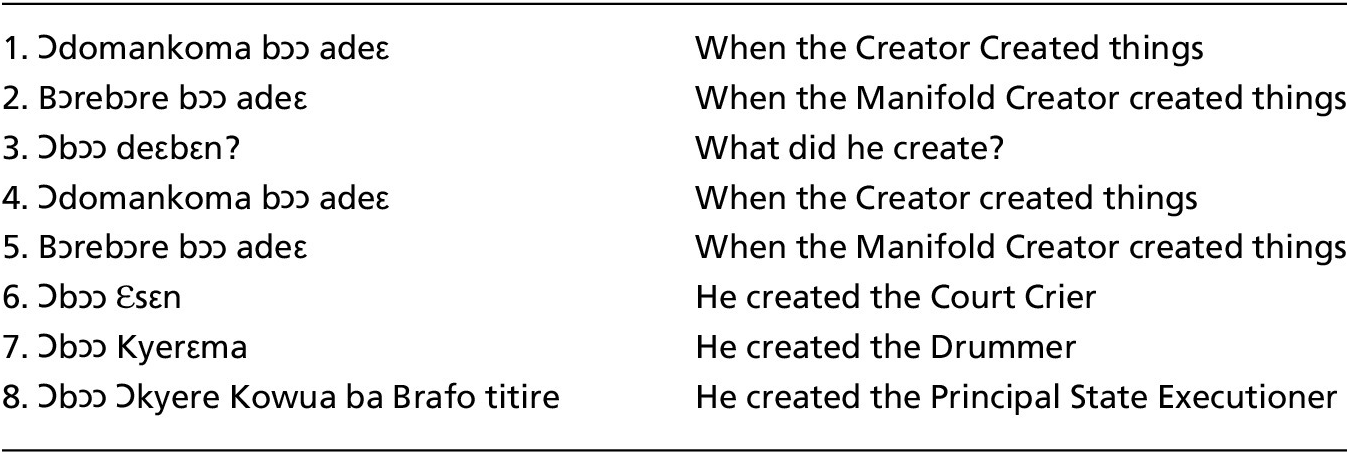
The Akan concept of creation is artistically coded and performed as drum poetry (ayan) on atumpan drums by the Court Drummer (Ɔkyerɛma) as the Awakening (Anyaneanyane). It is usually performed at dawn on Adae Sunday (Akwasidae), the last day on the Akan forty-two-day calendar, as a waking signal for the Asantehene.Footnote 14 The following excerpt is from Nketia (Reference Nketia1974:50 no. 48).
Ɔbrafoɔ (Executioner).

Full of repetitions and performed as a riddle, the first answer identifies the Court Crier (Ɛsɛn) in Line 6 as an individual who is entrusted with keeping order in Akan societies, primarily at the courts. Named after the gold-plated rectangular hat that they wear, the Court Crier is responsible for maintaining order during ceremonies as well as when Akan chiefs preside over court cases. Further, they are couriers who deliver messages from rulers to rulers inside and outside the state. For the Akan, the Court Crier is the consummate symbol of order and the physical validation of their understanding that God created an orderly universe.Footnote 15 The Court Drummer in Line 7 uses his drum to send messages and to play welcome verses, eulogies, proverbs, oral lore, and history; as a result, he is considered the embodiment of knowledge and wisdom. He is the Creator’s Drummer (Ɔdomankoma Kyerɛma), since his artistic skills and knowledge are given to him by divine inspiration. Essentially, the Creator created an orderly universe, and in this universe there is knowledge to be acquired. Line 8 identifies the executioner, Ɔbrafoɔ, as symbolizing death, the ultimate end of man in the physical world. The social meaning of death in Akan, in the words of one critical observer of ancient and contemporary Asante, “remains central to much reflection, discourse, and social practice” (McCaskie Reference McCaskie1989:417). Grief resulting from death is expressed in a variety of genres in the performing arts, from spontaneous vocal genres such as cries (nsui), to popular ensembles, including adowa and nnwonkorɔ, instrumental dance suites in kete, fɔntɔmfrɔm, and the instrumental poetry of ivory trumpets.Footnote 16 In all these, in accordance with Akan cosmology, death is not final. Death is not the opposite of birth; rather, death is like a revolving door where the soul (sunsum) enters to renew itself. The relevance of the Akan concept of creation to the issues at stake is that the preference for kingship as the framework for centralized government is guided by these three foundational elements of creation. Kingship ensures order and social harmony on three levels: the political, judicial, and the spiritual, which in turn creates opportunities for humans to learn from their environment. The knowledge gained from the environment inspires artistic expressions in the visual, musical, and verbal arts. Spiritual life and periodic rituals are entrusted into the hands of leadership, kings, chiefs, and ahemaa, who perform rituals periodically on behalf of the citizenry and lead collective celebrations of harvest and end-of-year festivals. A king, for instance, is the center of socio-political relations and the embodiment of unity and social values. Thinking in dialectic terms, there is power in order and order in power. The three elements of creation, the Court Crier, the Creator’s Drummer, and the Executioner, are not inanimate objects; they are living beings. The preceding discussions provide the contextual framework for an ethnographic interpretation of the Worship at Brɛman.
Grand Worship (Brɛman Ɛsomkɛseɛ)
Monday, May 5, 2014, was indeed no ordinary day in Asanteman. It was a day when the reigning Asantehene would represent his subjects in the Royal Mausoleum to perform what is aptly described as the Grand Worship. As a form of remembrance ritual, a visit to the Royal Mausoleum by the ruler and a handful of selected chiefs is a recurring event that is part of the forty-two day Adae rituals that take place on the Monday (Adaedwoada) following the Sunday Adae. Attendance and participation is, however, different when it is included in the events leading up to the Grand Adae (Adaekɛseɛ). In addition to the citizenry, a large contingent of Kumase chiefs, divisional chiefs, and ahemaa traveled from various locations to Brɛman. Due to her advanced age at the time, members of her court and the royal family represented the Asantehemaa.
While it was business as usual in all facets of life in Kumase, the situation was quite different the closer one got to the Manhyia Palace. Busloads of courtiers intermittently departed for the approximately thirty-minute ride to Brɛman. When I arrived at Brɛman on this occasion, adowa and nnwonkorɔ groups were already in place and had been performing since seven o’clock that morning. The relatively small and quiet town was inundated with the sudden influx of the large number of participants from all over the state. The color profile, deep black cloth known in Akan as Kuntunkuni, was indicative of the solemnity of the occasion. Just after eleven o’clock AM, the sirens from the motorcycles and police vehicles signaled the approach of the Asantehene’s motorcade. In a sudden burst of activity, the people of Brɛman rushed toward the outskirts of town where they had erected a makeshift barricade to prevent the ruler from riding his motorcade straight to the doors of the mausoleum. One by one, the vehicles stopped at the barricade and discharged the security detail until finally the ruler’s vehicle arrived. Like those who had arrived ahead of him, he also stepped out of his automobile. The barricade was a symbolic statement from the people that, while they understood the need for the Asantehene to travel in a motorcade in modern times, allowing the motorcade to go all the way to the gates of the royal mausoleum would have deprived them of the reflexive narrative the procession engendered.
Procession (Santene)
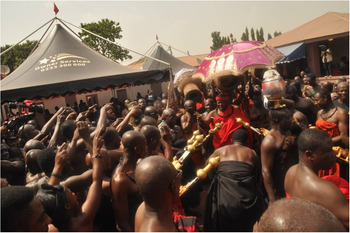
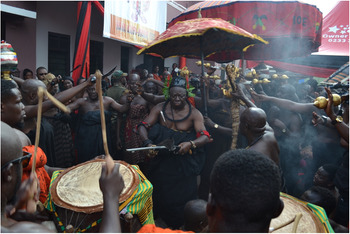
The Brɛman Chief, Baafoɔ Kokyin Srama II, the Ɔhemaa, Nana Frimpomaa Adakabrɛ, and the people of Brɛman rushed to the Asantehene’s side the moment he alighted from his vehicle. This action immediately dissolved the typical royal distance usually maintained by sword bearers, (afenasoafoɔ) as in Figure 1. One of the song leaders from Brɛman initiated a heroic shout (hereafter shouts), and the Asantehene immediately joined the group response, thus providing the first evidence of the performing arts reinforcing his authority and affirming the “received hierarchy… and of the preponderant role of the Asantehene” (McCaskie Reference McCaskie1980:192). What is it about musical performance that makes it possible for the ruler to express his power and responsibility to his subjects? What are the mechanisms in the shouts that enable the collapse of royal distance? Answers to these questions may be found in the setup of the procession and the integration of musical performance as the enabler for collective action. Processions require several casts of participants, including the ruler, courtiers, and active participants who lined up on both sides of the route as the ruler and his retinue proceeded from the outskirts of Brɛman to the gates of the mausoleum (Figure 2). Preceding the Asantehene and the people of Brɛman were a variety of ivory trumpeters performing instrumental verses and courtiers decked out in regalia who were part of the Advance Group.Footnote 17 With its characteristic red and black checkered cloth covering the drum shells and to project the gravity of the event, the kete drum ensemble was performing the historical piece Adinkra Kofi behind the Asantehene for the entire duration of the procession. Named after King Adinkra, the piece recalls events leading up to the Asante-Gyaaman war, when the king of Gyaaman created a Gold Stool against the wishes of the Asante. The combined forces of aburukua, apentema, and petia drummers all played the same text: slowly slowly slowly slowly slowly will kill Adinkra (brɛ brɛ brɛ brɛ brɛ bekum Adinkra). This demonstrated the resolve of the Asante in the three years it took to prepare for the war in the time of Asantehene Ɔsɛe Bonsu in 1818.Footnote 18 After the defeat of the Gyaaman, the Asantehene temporary settled at Brɛman, leading to a series of events which culminated in the relocation of the royal mausoleum from Bantama to Brɛman. Rhetorical devices were combined with a series of sonic actions in four different shouts that were repeated for the duration of the procession.
As in the procession at Brɛman, performing arts project the power and responsibility of the Asantehene as he participates in heroic shouts in a funeral procession. Royal distancing protocols are dissolved when the people from Brɛman, with raised hands, engage him in a call and response dialogue. Picture by author.

Focusing on formal structures and rhetorical expressions, I will present textual transcriptions and English translations of two out of the four shouts and then follow each example with a textual analysis. Like power, the social meaning of musical performance is relational, and as a result it is not enough to just mention that they performed shouts. An informed textual analysis will emphasize how rhetorical devices were deployed in combination with musical codes and prompters to elevate the power and responsibility of the ruler.
Ɔsɛe Ara Na Yɛsuro No (We Are Terribly Afraid of Ɔsɛe).

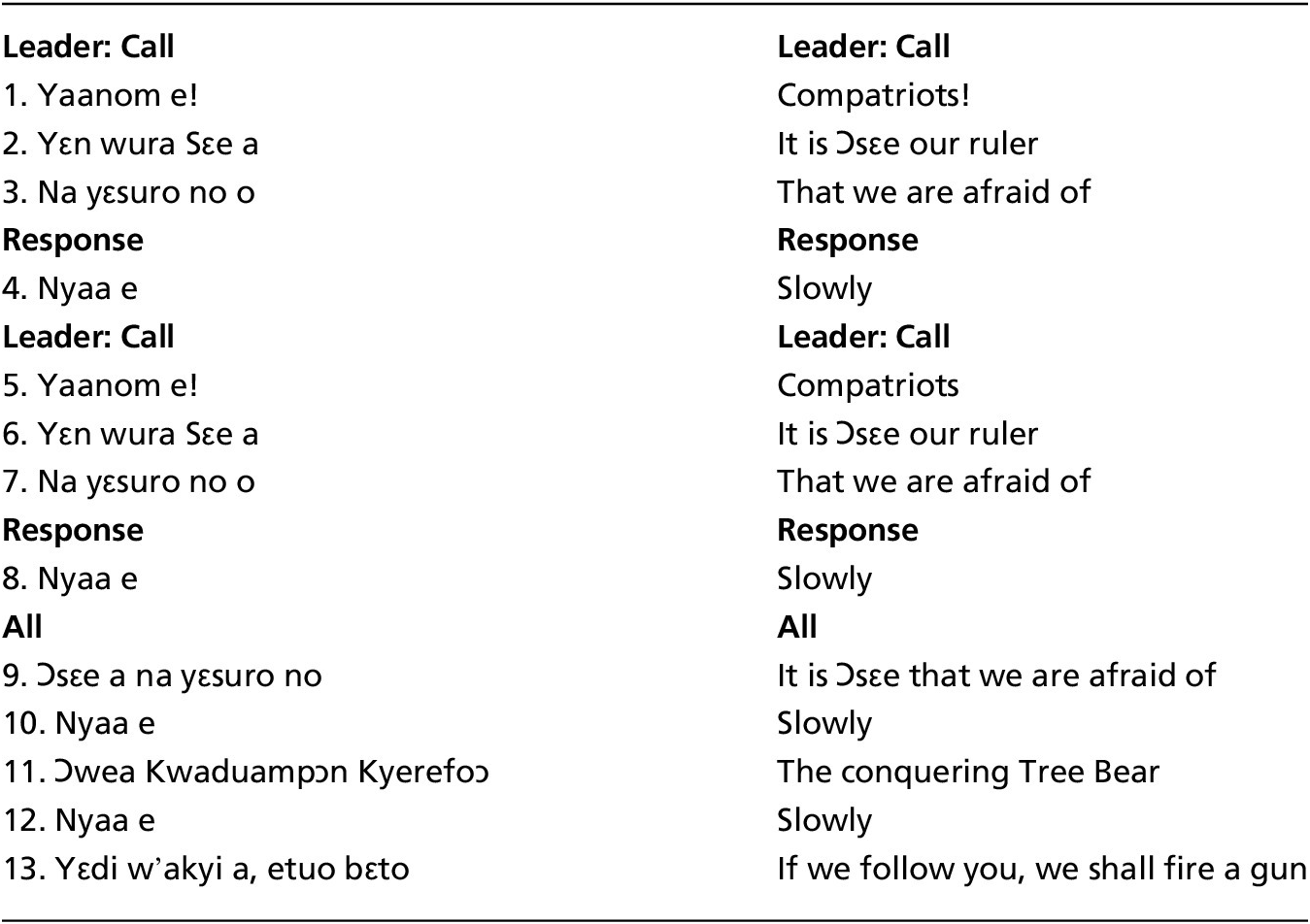
Heroic shouts is a mega-genre known in Akan as ose or ahum. Performed in times of joy or grief, or as a rallying cry, it is highly animated and arouses heroic sentiments in the performers and the general public.Footnote 19 It is founded primarily on the principles of call and response form, a fundamental characteristic of musical expressions in Africa and the African Diaspora. Portia Maultsby spoke eloquently for Africans and African Americans when she observed that the call and response form enables African American singers and instrumentalists “to manipulate time, text, and pitch” (Reference Maultsby and Holloway1990:163). Call and response is intrinsically dialogic, antiphonal, and dynamic, and founded on a communal approach to musical performance. In vocal performances, a lead voice or sometimes more voices verbally call out a phrase for a group to respond to at appropriate intervals. In instrumental ensembles, call and response form leads to sophisticated systems of interactive structures between the lead and supporting drums. In Example 2, the Leader discharges three lines of animated verbiage that is complemented by the response, Nyaa e (slowly), in Line 4. The solo voice repeats his call from Lines 5 through 7, followed by the same single-word response in Line 8. Having been fully activated, the leader and the group response combine forces in a series of agitated shouts from Lines 9 through 13 that I have labeled All. The concluding gesture in Line 13 is dramatically abrupt. The resultant form points to a cyclical ABABB1 architectural design, where A represents the leader’s call and B is the group response, while B1 is when the leader and group combine forces to the end (from Lines 9 through 13). The resultant form, ABABB1, and the network of “intended sonic actions” (Agawu Reference Agawu2016:240), reveal a story that will be coherent with a critical interpretation of the semantic field of texts in the next section.
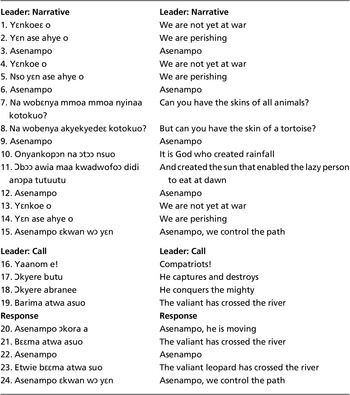
The leader calls upon the entire community with the rallying phrase Yaanom, which is sustained with the appended particle, e, in Line 1. In fact, the lead phrases from Lines 1 through 3 all end with sustained particles, e, a, and o, to stimulate an equally prolonged group response, Nyaa e in Lines 4 and 8. The notion that the people are really afraid of the ruler, Lines 2 and 3, 6 and 7, and 9, could be interpreted within the economy of a larger historical setting. The reigning Asantehene, Otumfoɔ Ɔsɛe Tutu II, is the sixteenth occupant of the Gold Stool and a direct successor to the founder of Asanteman, Ɔpemsoɔ Ɔsɛe Tutu. Grave matters associated with founding and successive rulers are therefore matters of utmost concern to Asanteman. It is within this historical memory that the reference to the notorious tree bear (ɔwea), a common feature in Ananse Stories (Anansesɛm) and songs in Line 11 is understood. According to Akan oral lore, the tree bear’s excessive cry in the forest, especially in the night, was causing undue problems for members of the animal kingdom. After ignoring several appeals by animals in the immediate vicinity, a hunter followed the loud cries and shot the uncompromising tree bear. It fell to its death right by a turtle which had taken cover in the undergrowth. The hunter picked up both animals, and that set off a series of unintended consequences for several animals in the forest. The concluding phrase in Line 13 can be interpreted as a caution to imaginary adversaries to be careful lest they end up like the proverbial tree bear. Nyaa e (slowly) is repeated throughout the shout; this becomes a formulaic marker in the sense that the Worship is a solemn event and that they will not be rushed in the procession. They will take as much time as necessary to arrive at the gates of the mausoleum. A distinctive feature of the combined lead and group responses from Lines 9 through 13 is the sense of agitation caused by the absence of end particles in Lines 9, 11, and 13.
Asenampo ɛkwan Wɔ Yɛn (Asenampo, We Control the Path).

Unlike the previous example, Example 3 points to three broad overarching sequences of events that begin with fifteen lines of introductory narrative by the leader (Lines 1 through 15), followed by the proper call (Lines 16 through 19), and lastly, the group response from Lines 20 through 24. The formal design can be represented by NAB, where N stands for the introductory narrative that is followed by the cyclical AB section, since the narrative is performed only once in a performance unit. That is, after the first performance, the lead voice does not go back to the narrative; rather, he returns to Line 16 to establish a cyclical pattern where the call is followed by the group response B. In terms of the semantic meaning of texts, the narrative sequence involves a commentary on their present predicament, stating that they are perishing even in peaceful times. They are reminded of the inter-war years, when even winning a battle came with its toll in human suffering. In that sense, the text may not necessarily refer to suffering in the present but the historical memory of past events. This noted dilemma was compounded when they realized they could not skin the tortoise like other animals, and that they were left with the hard shell to contend with (Lines 7 through 8). The pairing of relatively soft animal skins with that of hard shells that protect the land-dwelling tortoise from predators is instructive on two levels. With some effort, we could fashion animal skins; even those of leopards and lions, into protective body armor in the days of spears, bows, and arrows. However, it will take the resources and imagination of a powerful ruler to do the same with hard tortoise shells, and the people believe that the Asantehene is symbolically capable of accomplishing that feat. Fortunately, God will bless them with rain and sunshine, two interventions from the cosmic order with abundant blessings. Rain is seen as a blessing from God when they use the multi-syllabic and compound word, nyankonsuo (God’s rain).
The concluding phrase of the narrative, Line 15, is a resolve not to give up despite their dilemma; they will succeed, for like the mighty leopard strolling through the forest, they control the path to their destiny. The power of the Asantehene is affirmed through symbolic association with the leopard (Etwie in Line 23), which is considered the king of the forest in Akan lore; as it wanders through the forest with the other animals taking cover and avoiding its path until it passes by, the leopard controls the path (Lines 23 through 24). Like the leopard, the Asantehene is slowly making his way through challenging situations to the resting place of his forebears, and while it is a grave and solemn trip, potential adversaries should avoid causing problems in his way. Channeled through the artistic expressions are metaphoric allusions to the river as a sustainer of life and challenges in human life (Line 19). The last rhetorical device occurs when the technique of contraction transforms the spoken word from ɔkɔ ara to ɔkora (Line 20), with a prolonged particle at the end. Given the setup in the procession and the formal structure and rhetorical devices in the shouts, the noted royal distance is temporarily dissolved when the Asantehene actively participates in the shouts by joining the group response. It is evident in these two examples of shouts that a network of sonic actions, predicated upon the call and response form and the resourceful use of rhetorical devices and semantic field of texts all conspired to project the power and responsibility of the Asantehene within the procession. The performance of shouts continued until the Asantehene and his courtiers reached the main gate of the mausoleum. Finally, the ruler made his way through the double gates with Ɔheneba Adusei Poku closely behind him. As the Akyempemhene and the Kyidɔmhene (Chief of the Rear Guard) of Kumase, Ɔheneba Adusei Poku symbolically held his father’s waist while protecting his blind side in the rear from unwanted actions from potential adversaries. After about an hour and half, the Asantehene emerged from the mausoleum with his cloth wrapped around his armpit in deference to his deceased forebears. He walked straight to where the fɔntɔmfrɔm ensemble was positioned, about a hundred and fifty yards across from the entrance of the mausoleum, and that led to the second performance outlet, fɔntɔmfrɔm dance. How does the performance of fɔntɔmfrɔm and the Asantehene’s dance temporarily collapse royal distance while projecting his power and at the same time demonstrate his responsibility toward his forebears and his subjects?
Fɔntɔmfrɔm Dance
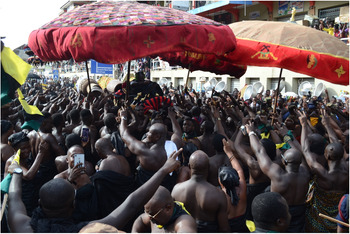
The fɔntɔmfrɔm ensemble includes two of the largest drums in all Akan, known as the male and female bɔmaa drums. The drum ensemble, the music, and the dances represent heroism, as the five dance types are said to project militancy (mmɛnsɛm) in all performing situations. In this Grand Worship occasion, participants gathered around the Asantehene, leaving a small space between him and the ensemble (Figure 3).Footnote 20 In a display of support, the sword bearers raised their swords in the direction of the Asantehene while participants raised both hands, or just the right hand, with the index and third fingers pointing toward him, and took a few dance steps back and forth. As is evident in Figure 3, this setup led to a momentary breakdown of royal distance, enabling the participants to get as close to the ruler as possible. The fɔntɔmfrɔm ensemble was by now performing atoprɛtia, and the Asantehene was handed a gun. He raised it and pointed it to his right, forward, and to his left, to signify that he was responsible for all corners of the kingdom. That action received immediate response from the people with shouts of congratulations (mo peaw). In a dramatic fashion, the carrier of the Mpɔnpɔnsɔn sword pointed the hilt of the sword to him. Grasping the hilt, the Asantehene pulled the sword from its sheath and began his dance gestures by pointing both weapons in a forward and backward motion. Both of these motions corresponded with the call and response dialogue between the atumpan and bɔmaa drummers. The ruler’s forward hand motion corresponded with the atumpan calls, yeeeeeee, ma’nka, Prɛmpɛ, and monka; while his backward motion corresponded to the repeated response, y’akye Odikuro (we have captured a chief) by the two bɔmaa drummers. However, the Asantehene’s dance movements became intense when the atumpan and bɔmaa joined forces to perform the non-lexical text, gede gede gede gede gede. He danced in a counter-clockwise motion, to dramatize engaging an adversary on the battlefield. The agitation and dancing in circles went on until the atumpan drummer reverted to his initial call, yeeeeeee. As would be expected, the Asantehene also reverted to the forward and backward motions as previously described.
A performance of power as the Asantehene dances to fɔntɔmfrɔm atoprɛtia with the Mpɔnpɔnsɔn sword and a gun, two regalia objects that represent visible extensions of power and responsibility. Note the support and encouragement from sword bearers who raise swords in his direction while participants raise hands and point the index and third fingers towards him. The momentary breakdown of royal distancing protocols makes it possible for participants to be in close proximity to the Asantehene. Picture by author.
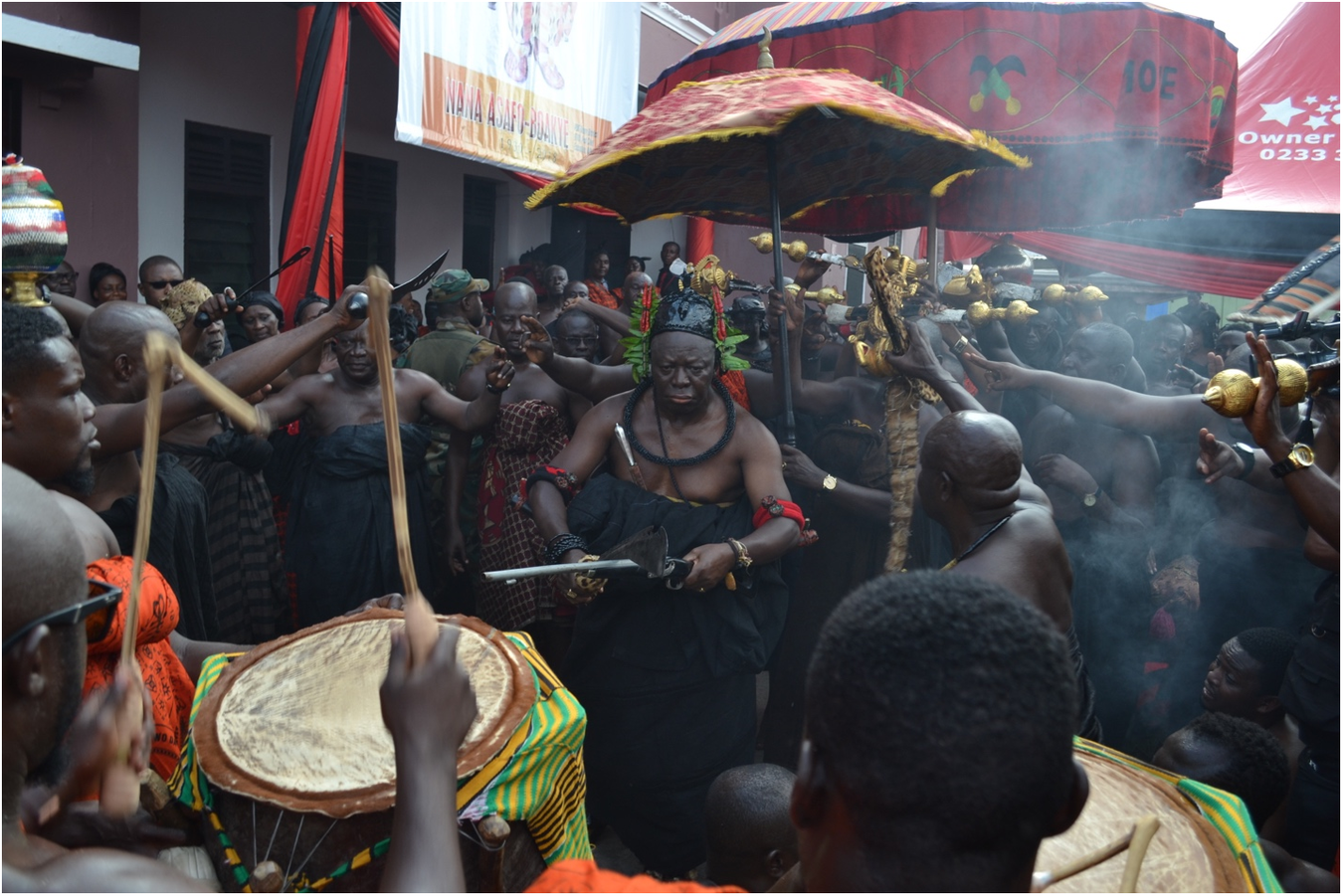
Dancing with a gun and a sword is essentially a performance of power, since both objects represent visible extensions of the ruler’s powers (Gilbert Reference Gilbert1994:99).Footnote 21 Harking back to the term “responsibility” in the title of this article, the function of the gun is to assure the Asantehene’s deceased forebears as well as the citizenry that he will protect the ideals, the institutions, the values, and the tangible and intangible stool regalia they bequeathed to Asanteman to the end of his life. The Mpɔnpɔnsɔn sword signifies his responsibility to his subjects, since it is used by the Asantehene and the territorial chiefs to swear the oath of office. When he is wielding the sword, there is no doubt in the minds of the participants that he is a legitimate ruler who did not seize power unlawfully, and that he went through all the prescribed customary rites for enstoolment. After a while, the atumpan drummer played a signal to transition from the slow-paced atoprɛtia to the relatively fast-paced naawea.
Once the topos, or the temporal reference, was established by the three gong (nnawuro) players, the atumpan and bɔmaa players began another call and response dialogue (Agawu Reference Agawu2003:73). The fast tempo of naawea symbolized success on the battlefield and contrasted the uncertainty of warfare that is built into atoprɛtia. The emotional contrast that naawea conveyed was evident when the courtiers immediately took away the sword and the gun from the Asantehene and handed him a big handkerchief (dɛbɔ). The linear repetition of bɔmaa texts, Ɔhene ko, Ɔhene nnwane (a king fights, a king does not flee), was coordinated with the fast-paced dance movements of the Asantehene bumping his fists together. With his hand gestures, he implored his subjects to come together, for in unity lies strength. The excitement was compounded by the cyclical bɔmaa phrases, which enabled the Creator’s Drummer to disengage from the call and response phrases and engage in a speech mode of drumming with strong appellations, by-names, and praise names of the Asantehene. Upon hearing the speech mode of drumming, the Asantehene stopped dancing, listened, and occasionally nodded his head to acknowledge the drum texts; he immediately resumed dancing as soon as the Creator’s Drummer switched from speech back to dance mode drumming. Combined with the Asantehene’s use of a gun and a sword, and his dance gestures and motions in atoprɛtia and naawea, power and responsibility are located, as affirmed by Askew (Reference Askew2002), within the economy of a mixed bag of sonic and visual actions. At the intersection of drum texts and performed actions, these sonic and visual actions made vivid reference to reflexive and historical narratives.
The performance of atoprɛtia and naawea at the gate of the mausoleum provoked deep-seated sentiments of the Asante past that were at once intense, grave, and emotional, but at the same time celebratory and reassuring that the Asante had survived insurmountable challenges including colonialism. After joining in collective dances and co-performances with all groups present, the ruler made his way back to the mausoleum. The plural performance continued, as all ensembles sustained the event with a variety of activities. Within an hour, and having completed the rituals inside the mausoleum, the Asantehene emerged again to another round of animated reception, which confirmed the success of the Worship. Before departing for Kumase, he went around and thanked the assembled chiefs and ahemaa and the participating ensembles, as well as the citizenry, for a successful Worship. Finally, he was back in the convoy for the triumphant return to Kumase, where chiefs and their retinue from Kumase along with territorial chiefs were gathered and anxiously awaiting his arrival.
Triumphant Return From Brɛman to Manhyia Palace
Instead of heading straight to Manhyia Palace, the convoy took the Asantehene to the residence of A.A.Y. Kyerematen, located in Adɔmmerɛm.Footnote 22 According to tradition, Adɔmmerɛm was founded by a member of the Abenase Fekuo, the group responsible for the Asantehene’s wardrobe, and that explains the choice of Kyerematen’s house in that location. The location offered a temporary respite for refreshment and a change of clothes for the next stage. The procession from Kyerematen’s house to Manhyia Palace was reconfigured to highlight the overall success of the Worship in addition to the power and responsibility of the ruler. The Asantehene next was carried in the Leopard Palanquin (Etwie Apakan), seen in Figure 4. While ivory trumpeters and other ensembles maintained their usual positions in the Advance Group, the kete ensemble that played behind the ruler at Brɛman was now replaced by the fɔntɔmfrɔm ensemble as a demonstration of heroism and of the further authority of the ruler. The new position of the kete ensemble was right in front of the Kukuruboɔ Asipimtia chair with its own umbrella, while the Apirede drum ensemble was performing immediately behind the chair.Footnote 23 The Asantehene expressed his triumphant return to Kumase by alternating two dances as he was being carried in the palanquin. He danced with the big black handkerchief when the fɔntɔmfrɔm ensemble performed naawea, but he danced with a gun when they changed to atoprɛtia, while the audience participants affirmed their support and approval with raised hands and shouts of congratulations (peaw). On his right-hand side were the people of Brɛman, who continued to engage the ruler with shouts as previously described. The ruler’s authority and responsibility were emphasized at this point as the palanquin elevated him above all the participants, including those lined up on both sides of the street (see Figure 4).
Triumphant return and procession from Adɔmmrɛm to Manhyia Palace. The power and responsibility of the Asantehene is more pronounced as he is elevated in the palanquin above all participants and those lined up on both sides of the street. Note the proximity of active participants, hand gestures, and actions as he dances to fɔntɔmfrɔm atoprɛtia. Picture by author.
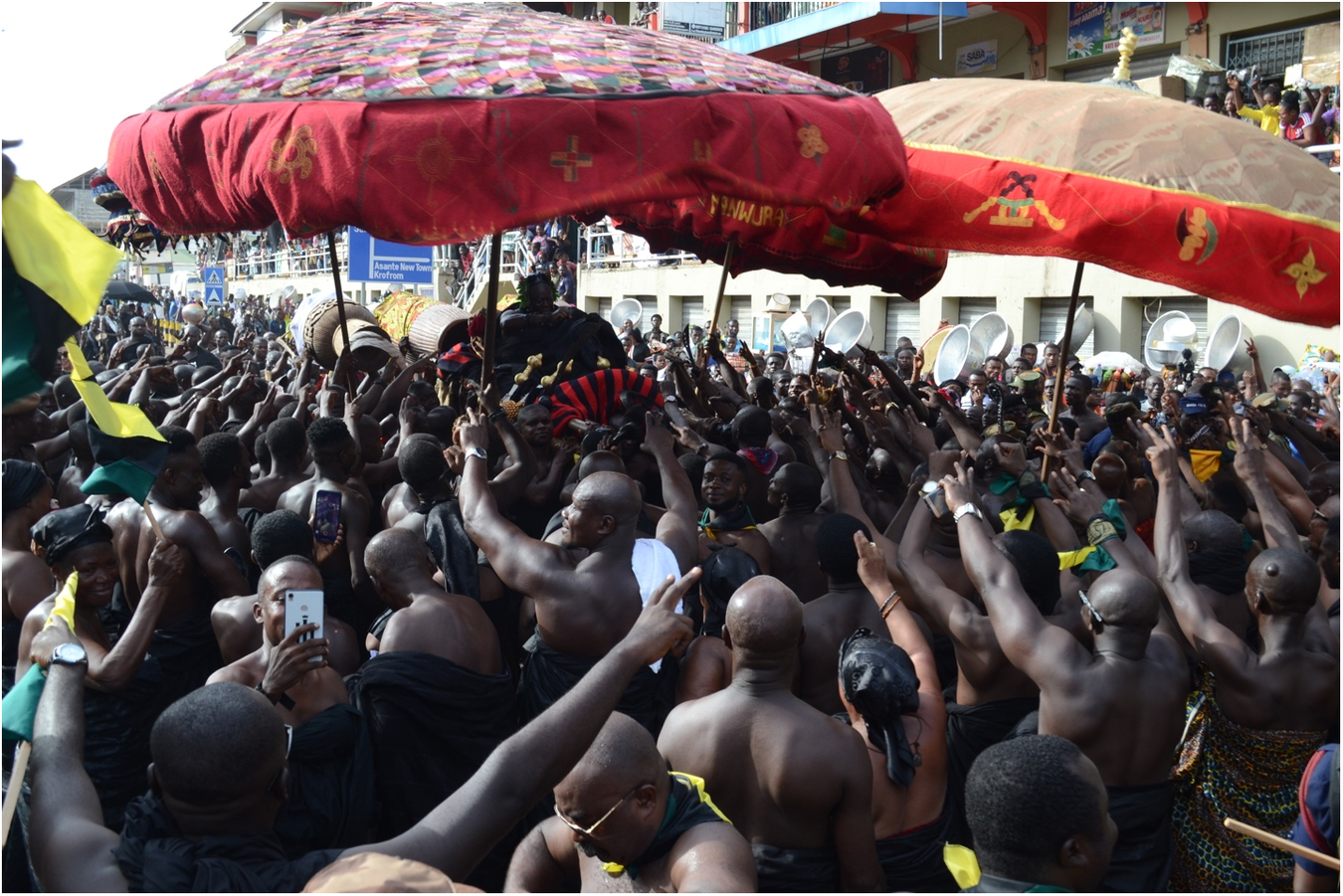
The intensity of performed actions increased the closer the procession came to the Manhyia Palace. By the time the Asantehene’s inner circle arrived at the palace, a cadre of chiefs and their corresponding ahemaa had taken their appropriate positions at Bogyaweɛ and were all standing in deference to him. As soon as he was formally seated on the raised dais (simpie), the sitting arrangement was reconfigured to re-establish royal space and distance, as in Figure 1. As the Krontihene and Bantamahene, the late Baafoɔ Asare Owusu Amankwaatia V was the first in line to congratulate the ruler, and that paved the way for the assembled chiefs to follow suit. The Asantehene later distributed pots of palm wine as a sign of his gratitude to all the assembled chiefs and ahemaa for coming out to support the day’s rituals. After the exchanges of pleasantries, the day’s event was brought to a close. The recession began with the Advance Group as usual leading the way to the palace, as the Asantehene went around to express his gratitude to the assembled chiefs and the general public.
Conclusion
This description of the Grand Worship points to additional ways of contemplating power and responsibility in Asante kingship. It situates the legitimacy of kingship in ancestral Black Stools and the Gold Stool. These Stools are sacred, and consequently the general public has limited access to the rituals related to them. Instead, it is the performing arts which articulate, define, and uphold political power and responsibility in Asante chiefship, in particular the office of the Asantehene, to the general public. In order to address the questions posed at the beginning of this article, I offer this ethnographic description of the 2014 Grand Worship at the Royal Mausoleum in Brɛman. Far from being a simple display of culture, the Worship provides the space for the performing arts to reinforce and elevate royal power and responsibility, particularly when the Asantehene directly participates in musical performances and dances with court musicians and the general public. The call and response form and rhetorical devices in the two shouts cited here establish a global regime for collective action that momentarily dissolves royal distancing protocols during formal proceedings and makes it possible for participants to be in close proximity to the Asantehene. Of the multiple performance outlets in the Worship, I focus on the ruler’s participation in the shouts, his fɔntɔmfrɔm dance, his triumphant return to Kumase, and his elevation in the palanquin as tangible demonstrations of his power and responsibility.
For the theoretical framework, I acknowledge some of the early literature on popular music scholarship from the Caribbean, Latin America, and Africa. I reference two landmark volumes edited by Randall and Nooshin as representative of discourses on music and power relations. While I recognize European theorists and philosophers who are cited in the literature, I question the imposition of those knowledge systems on African systems of thought and lived realities. The literature on Akan kingship and power relations is overwhelmingly written by Euro-American historians and anthropologists who often fail to recognize all the innumerable strands of musical arts that connect the dots in kingship and its associated rituals. By focusing on performing arts while drawing and expanding on some of the theoretical concepts in the literature cited, one may gain critical insights into power relations in Akan. Following these critiques, I recommend the use of African-based cosmologies as frameworks for studying systems of thought and knowledge production in African societies. The critical aspects of Akan cosmology, order, knowledge, and death, the three fundamental elements of creation which over the centuries have been coded and performed as drum poetry on atumpan, are on display in the Grand Worship ceremony. The rituals related to the Worship articulate Akan cosmology and connect the living with their ancestors for the successful ordering of life on earth (Gilbert Reference Gilbert, Canadine and Price1987:302; McCaskie Reference McCaskie1980:190). A successful worship event is a conduit to peace and harmony, ethnic identity, and pride. With power comes responsibility, and this is reflected in the Akan saying, yɛ gye tumi na yɛ de asom (we acquire power in order to serve). With his link to the stools, the Asantehene is first and foremost subject to the authority of his forebears and then to the Asante State (Asanteman), which is symbolized by the Mpɔnpɔnsɔn sword. Dancing atoprɛtia with a gun and the sword is, therefore, a performance of the Asantehene’s authority and power endowed to him by his forebears and his subjects. With the Mpɔnpɔnsɔn sword in his hands as he dances, he assures his subjects of his commitment and his responsibility toward them. Similar to the concepts of power, the social meaning of musical performance is also relational, and as a result, I embarked on textual analysis to explicate rhetorical devices, particularly the call and response form, and musical codes and prompts that enable the performers to project and affirm royal power and responsibility. Ultimately, the myriad activities described in the Worship are all relatable actions that are linked to the display of power and responsibility in Asante kingship. They are sonic actions and visual drama expressing the analogous emotions of all participants, who rely on the performing arts to affirm royal power and social responsibility for the orderly function of Asanteman.
Acknowledgments
I would like to acknowledge, with gratitude, the following entities at the University of Michigan for supporting my field research at the Manhyia Palace in Kumase: LSA Scholarship/Research Fund, UM Office of Research, Department of Afroamerican and African Studies, African Studies Center, Office of Diversity, Equity and Inclusion, and African Humanities and Heritage Initiative.