Introduction
Biological tissues are soft, curvilinear, and elastic, while traditional devices tend to be stiff and rigid, resulting in a mechanical mismatch that limits the functionality of these devices for biological and everyday applications. For example, the human wrist can be easily bent and the human skin stretched, but everyday devices such as the cell phone cannot be deformed in order to conform to the bent wrist. With the current explosive advancements in technology, there is an increasing demand for applications that are impossible to realize with traditional hard and planar integrated circuits, such as artificial skin for robotics, sensing devices for human health monitoring, and wearable communications devices. Reference Gao, Zhang, Malyarchuk, Jia, Jang, Webb, Fu, Shi, Zhou, Shi, Shah, Huang, Xu, Yu, Huang and Rogers1–Reference Liu, Qi, Guo, Liu, Zhu, Yang, Liu, Li, Zhang, Yu, Liedberg and Chen6 To overcome these challenges, it is crucial to develop stretchable devices that can accommodate stretching while retaining high performance. These devices would require electrical and electronic circuits that can be elastically or inelastically stretched by more than a few percent while retaining their functionalities. Such elastic technology would surmount the mismatch in mechanics between biology and devices and provide a vast improvement to our daily lives. Reference Lipomi7–Reference Mannsfeld, Tee, Stoltenberg, Chen, Barman, Muir, Sokolov, Reese and Bao9
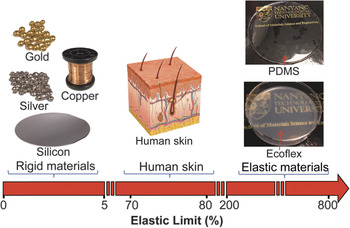
An ideal strategy to achieve fully stretchable devices is to enable the electronic components themselves to be intrinsically stretchable; all materials used for the electronic circuits should possess the ability to maintain good electrical function under stretching. In reality, however, typical materials used for electrical functions (e.g., copper and silicon) are stiff and easily form cracks when a strain is applied, due to their low elastic limits (≤5%), as shown in Figure 1 . 10 In contrast, the average elastic limit of human skin is 75%, which is several times larger than that of traditional electronics. Reference Chortos, Liu and Bao11 To surmount this problem, researchers have integrated the active electrical components with elastic substrates such as poly(dimethylsiloxane) (PDMS) and Ecoflex (a type of platinum-catalyzed silicone), the elastic limits of which exceed 200%, in order to achieve stretchable devices. Reference McCoul, Hu, Gao, Mehta and Pei12
Elastic limits of commonly used materials (silver, copper, gold, and silicon) in traditional electronics, human skin, 10 and new elastic substrate materials (poly(dimethylsiloxane) [PDMS] and Ecoflex, a platinum-catalyzed silicone).

Two strategies have been widely used in the fabrication of stretchable devices: (1) embedding of nanomaterials into elastic matrixes; Reference Yao and Zhu13 and (2) transfer of active materials (thin films or ribbons) onto the surface of elastic substrates. Reference Cheng, Zhang, Lai and Huang14 In such configurations, the role of the stretchable substrate for stretchable devices is just like that of foundation for a skyscraper. The substrate not only determines the stretchability of stretchable devices, but also influences the functional stability of the active components integrated on it. Therefore, the selection of the stretchable substrate material plays an important role in the overall performance of a stretchable device. PDMS, Ecoflex, and polyurethane are common candidates for stretchable substrates for stretchable devices. The choice of the elastic material depends on the strategy employed to achieve the stretchable devices.
Elastic matrix for embedded strategy
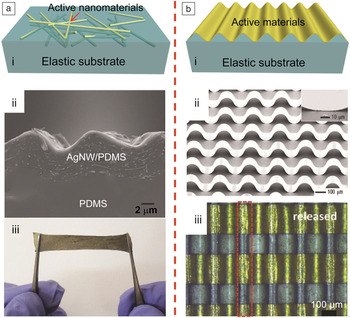
A simple way to fabricate stretchable devices is the random composite method, which generally comprises nanostructures dispersed into the bulk or on the surface of a stretchable matrix, as shown in Figure 2a(i). During the stretching process, the nanostructures preserve their interconnectivity to provide the charge-transfer pathway. Metal nanowires and carbon nanotubes have all been employed in this strategy. Reference Yao and Zhu13,Reference Xu and Zhu15 An example of this strategy is shown in Figure 2a(ii), in which silver nanowires are embedded into the PDMS surface to achieve stretchable conductors. Reference Xu and Zhu15
(a[i]) A schematic of nanomaterials embedded in an elastic substrate. (a[ii]) Cross-sectional scanning electron microscope (SEM) image of a silver nanowire (AgNW)/poly(dimethylsiloxane) (PDMS) layer. Reproduced with permission from Reference Reference Xu and Zhu15. © 2012 Wiley. (a[iii]) The composite fiber mat with silver nanoparticles inside and on the surface is highly stretchable and does not lose conductivity at large strains. Reproduced with permission from Reference Reference Park, Im, Shin, Min, Park, Cho, Park, Shim, Jeon, Chung, Bae, Park, Jeong and Kim16. © 2012 Nature Publishing Group. (b[i]) A schematic of the wrinkles formed on a layer of active material after relaxing the prestrain of the elastic substrate. (b[ii]) SEM image of semiconductor (GaAs) wrinkles. The prestrain used for generating this sample was 60% (the inset shows a SEM image of a bonded region). Reproduced with permission from Reference Reference Sun, Choi, Jiang, Huang and Rogers19. © 2006 Nature Publishing Group. (b[iii]) Optical microscope image of gold microbelts on a tripod-structured PDMS substrate using stripes of PDMS as an adhesive and supporting layer; the prestrain in the PDMS substrate was 50%. Reproduced with permission from Reference Reference Qi, Liu, Yu, Liu, Tang, Lv, Li, Wei, Bo, Yu and Chen2. © 2015 Wiley.

Such embedded strategy entails the following requirements. First, during processing, the monomer precursors must possess low viscosity and low surface energy, such that when poured onto a film of nanomaterials, the monomer can penetrate the networks of the film. Second, when metal nanowires (e.g., Ag nanowires) are employed as conductive fillers, the polymer matrix should prevent the penetration of air in order to mitigate oxidation of the nanowires, which would result in a decrease in conductivity.
It should be noted that nanoscale holes in the polymer matrix can act as a double-edged sword; although the penetration of air is enhanced, the nanoholes also constitute channels for the advantageous penetration of metal precursor solution. Reference Park, Im, Shin, Min, Park, Cho, Park, Shim, Jeon, Chung, Bae, Park, Jeong and Kim16 In this alternative approach, the metal precursor and solvent are absorbed by the polymer matrix, and subsequently, dried and reduced to form embedded networks of metal nanoparticles. Through this fabrication strategy, electrical conductance can be maintained during stretching, due to the percolation of metal nanoparticles inside the polymer matrix (Figure 2a[iii]). It is extremely important that the polymer matrix possess the capability to absorb sufficient metal precursors for the synthesis of metal nanoparticles. The rate of solidification of the polymer chains through solvent evaporation should also be much faster than the rate of self-assembly, as the self-assembly of the polymer chains would force the metal nanoparticles from the core to the outer shell, causing the composite to lose conductance even under low strain (i.e., ɛ = 0.3, ɛ = (L – L 0)/L 0, where L is the length after stretching and L 0 the initial length).
In short, the embedding of nanomaterials into an elastic substrate constitutes a viable strategy for the fabrication of stretchable devices. It is the properties of the elastic substrate that permit the strategy to be successful. On the one hand, low viscosity and low surface energy of the polymer prior to curing enable it to penetrate the networks of the nanomaterial film. On the other hand, the channels in the elastic substrate are necessary for the penetration of a metal precursor solution. However, oxidation of the embedded metal nanoparticles can also occur as a result of air entering through the channels. This is a critical problem that mitigates the electrical performance of the devices. To address this issue, encapsulation is typically required to prevent the conductive metal nanomaterials from oxidizing.
Elastic substrate for prestrained strategy
In the previous section, it was seen that by embedding metal nanomaterials into a polymer matrix, the electrical conductance of the composite could be preserved during stretching (>100%). However, for devices fabricated through this strategy, the conductivity dramatically decreases as the stretching length increases. Strain sensors are a type of stretchable device that operate by taking advantage of this property. Reference Mannsfeld, Tee, Stoltenberg, Chen, Barman, Muir, Sokolov, Reese and Bao9 For other types of stretchable devices, such as stretchable displays and stretchable energy-storage devices, stable conductivity during the stretching process is highly desired. Structural deformation can be used to buffer the strain introduced to the active components during the stretching process.
One of the most effective structural designs to achieve this is the wavy or wrinkled structure. A common approach is to transfer the active materials on to the surface of a prestretched elastomeric substrate, which, upon release of the prestretch, would result in the formation of wrinkles in the active materials due to compressive stress (Figure 2b[i]). In this approach, the elastic substrate must provide enough adhesive force to the active materials such that the active materials are not peeled off during the stretching-relaxing processes. For instance, super-elastic graphene wrinkles have been produced on elastic PDMS substrates using van der Waals interactions. Reference Wang, Yang, Shi, Zhang, Shi, Wang and Zhang17
For metal thin films, an adhesion layer (Cr is widely used for this purpose) is always employed to enhance the adhesion between the metal thin film and the PDMS substrate. Reference Lacour, Jones, Suo and Wagner18 An advantage of the wrinkles formed through this approach is that their periods and amplitudes are defined by the elastic moduli of the conductive materials and the thickness of the thin film. However, there is little control over the geometries of the phases of the wrinkles. Furthermore, due to the spontaneous formation of nonoptimal wrinkle structures, the maximum strains they can accommodate are limited (normally in the range of 20–30%). An effective way to achieve wrinkle configurations with deterministic control over their geometries is to define the adhesion sites according to the prestretching length of the elastic substrate. Reference Sun, Choi, Jiang, Huang and Rogers19
To facilitate this strategy, the surface of the elastic substrate must have the capability to be selectively modified in order to provide patterned adhesion sites for the active materials. For this purpose, a preferred elastic substrate is PDMS, since its hydrophobic surface with –OSi(CH3)2O– groups is easily converted to a highly polar and reactive surface dominated with –OnSi(OH)4–n functionalities, through the use of ultraviolet (UV) light or an oxygen plasma. The activated surface can then react with various inorganic surfaces to form strong chemical bonds. This allows the PDMS surface to be patterned by employing a shadow mask; the area exposed to UV light or oxygen plasma is activated to bond with the active material, while the unexposed area can only interact with the active material through weak van der Waals interactions. For example, by patterning the PDMS surface with activated and inactivated stripes, precisely engineered wrinkle geometries can be induced in nanoribbons of GaAs and Si, which endows electronics with extremely high levels of stretchability (up to ∼100%), compressibility (∼25%), and bendability (with curvature radius down to ∼5 mm) (Figure 2b[ii]). These excellent properties can be attributed to the reduction in strain induced in the geometrically optimal wrinkles. Reference Sun, Choi, Jiang, Huang and Rogers19
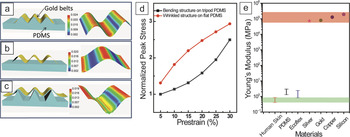
The strain induced on the active materials can be further reduced through rational design of the substrate structure. For example, by employing prestretched tripod-structured PDMS (featuring a surface with uniform triangular corrugations) as the elastic substrate and a thin PDMS film as the glue, as well as a supporting layer, highly stretchable gold microbelts with sinusoidal structures have been produced (Figure 2b[iii]). Reference Qi, Liu, Yu, Liu, Tang, Lv, Li, Wei, Bo, Yu and Chen2 These tripod-structured PDMS substrates provide sufficient space for the bending of the gold belts, so that less strain is induced and high stretchability and good mechanical stability can be realized ( Figure 3c). Other examples of rational substrate designs for stretchable devices include in-plane horseshoe-like structures and intentionally microcracked metal thin films on an elastic substrate. Reference Gonzalez, Axisa, Bulcke, Brosteaux, Vandevelde and Vanfleteren20,Reference Liu, Yu, Lv, Li and Yu21 In this construct, the strain induced in the active material via adhesive force from the substrate plays an important role in the performance of stretchable devices. Reference Tang, Li, Vlassak and Suo22
Schematic of different prestretched structures and analysis of the relevant strain distribution by the finite element method, (a) wrinkled structure, (b) suspended structure, and (c) a bending structure (a suspended wrinkle) on tripod-structured poly(dimethylsiloxane) (PDMS). Reproduced with permission from Reference Reference Qi, Liu, Yu, Liu, Tang, Lv, Li, Wei, Bo, Yu and Chen2. © 2015 Wiley. (d) The peak stress in the wrinkled and bending structures. Reproduced with permission from Reference Reference Qi, Liu, Yu, Liu, Tang, Lv, Li, Wei, Bo, Yu and Chen2. © 2015 Wiley. (e) Young’s modulus of human skin (green band), elastic substrates (PDMS and Ecoflex), and commonly used materials (silver, copper, gold, and silicon) in traditional electronics (red band).

In summary, elastic substrates that can provide suitable interfacial properties play an important role in the construction of effective wrinkle structures. These elastic substrates need to fulfill the following requirements: (1) provide weak adhesive forces (i.e., van der Waals force) toward the active materials for the fabrication of random wrinkles; or (2) have an abundance of reactive groups, which can be patterned into active sites for selective binding of conductive materials, in order to construct wrinkle structures with controllable geometries; and (3) have the capability of being shaped to desired architectures that can provide sufficient space for the bending of the wrinkles, in order to achieve wrinkle structures with high stretchability and stability.
Conclusions and perspectives
To date, PDMS is the most widely used polymer matrix for the elastic substrate of stretchable devices, owing to its reversible stretchability, good stability, and excellent biocompatibility. One drawback of PDMS is its limited stretchability, typically less than 200% (cross-linker to curing agent ratio of 1:10, which is the optimized ratio suggested by Dow Corning, a major silicone manufacturer). Therefore, other elastic substrates need to be sought for highly stretchable devices that can undergo >200% stretching.
An attractive candidate for the elastic substrate of highly stretchable devices is Ecoflex, a type of platinum-catalyzed silicone, Reference Hu, Krull, de Graff, Dowling, Rogers and Arora23 which can sustain strain as high as 700%. Reference Wang, Yan, Cai, Cui, Eh and Lee24 Poly[styrene-b-(ethylene-co-butylene)-b-styrene] resin and 3M VHB 4905 (transparent tape with a general purpose acrylic adhesive) Reference Hu, Yuan, Brochu, Gruner and Pei25 can also realize stretchabilities of up to 700%. Reference Zhu, So, Mays, Desai, Barnes, Pourdeyhimi and Dickey26 Other candidates for the elastic substrate of stretchable devices include polyurethane Reference Urdaneta, Delille and Smela27 and polyacrylate elastomer. Reference Hu, Niu, Li, Yun, Yu and Pei28
In selecting elastic substrates for stretchable devices, the following aspects must be considered. The first is the physical performance of the elastic material, which includes high stretchability, prominent cycling stability, and good thermostability. For the embedding strategy, the liquid polymer should possess low viscosity and low surface energy of the liquid polymer prior to curing, in order to facilitate penetration into the networks of the nanomaterials film. The polymer matrix should also prevent air penetration to avoid oxidation of the metal nanomaterials. The second is chemical properties of the material; it is preferable that the elastic substrate provide an active surface for the bonding of active materials, such that both the enhanced adhesion of active materials and the controllable geometries of the wrinkle structures can be realized.
It is also a requirement for the elastic substrates to be chemically inert. This is because the devices may be exposed to solvents during fabrication, such as to remove the sacrificial materials (e.g., the photoresist). In order to prevent breakdown of the devices, there should be no reaction between the elastic substrate and solvent, nor should there be a huge volume expansion of the substrate. Furthermore, in the case of stretchable energy-storage devices such as stretchable batteries and supercapacitors, the elastic substrates need to be completely inert against the electrolyte and other chemicals in the system.
The third aspect is the biocompatibility of the elastic material, since the main objective for the development of stretchable devices is to overcome the mismatch between traditional stiff electronics and soft biological tissues. Excellent biocompatibility should be the basic requirement for the elastic substrate of stretchable devices, especially for those that need to be implanted in the body for disease diagnosis and therapy.
In this article, we have mainly discussed how the elastic matrix could enable the fabrication of stretchable devices through the embedding of nanomaterials or the formation of wrinkle structures. However, further development of the elastic matrix is still needed. First, more research still needs to be conducted in the area of self-healing elastic materials, as a small crack would inevitably result in the complete fracture of stretchable devices, due to the strain concentration on the crack point when the device is stretched. Self-healing substrates are therefore important, allowing small cracks to heal by themselves and prevent any subsequent fracture.
Second, elastic materials with smaller Poisson’s ratios are required to facilitate the development of stretchable devices. Today, wrinkled structures prepared by transferring the thin film on to a prestrained substrate are widely used for stretchable devices. However, cracks perpendicular to the prestrained direction easily form in thin films due to the Poisson effect, especially when a large prestrain is applied. Elastic substrates with smaller Poisson’s ratios (i.e., near zero), also known as metamaterials, can help avoid the formation of such cracks.
Third, much effort needs to be invested in the development of elastic materials that can provide adjustable interactions with active materials. As shown in Figure 3a–d, the interaction between the active materials and the elastic substrate influence the strain induced in the active material, therefore, the stretchability and stability of stretchable devices could be optimized by adjusting the interaction between the active material and the elastic substrate.
Last, but not least, the demand for elastic materials with Young’s modulus in the range of that of human skin needs to be addressed. Currently, the Young’s moduli of elastic materials employed for stretchable devices are larger than that of human skin (Figure 3e), which would restrict the application of stretchable devices for epidermal human health monitoring systems, especially for surgical and diagnostic applications. Therefore, elastic materials with similar Young’s modulus as that of biological tissues are desired.
This article shows that the development of stretchable devices is still at an early stage and many challenges lie ahead. More efforts on the design and optimization of elastic substrates will greatly promote the development of stretchable devices. A convenient and comfortable lifestyle and a better quality of life brought about by stretchable devices can be anticipated in the near future and beyond.

Dianpeng Qi has been a postdoctoral fellow in the School of Materials Science and Engineering at Nanyang Technological University, Singapore, since 2012. He received his BS degree in chemistry in 2007 and his PhD degree in physical chemistry in 2012 from Jilin University, China. His current research focuses on flexible electronics for bio-electrophysiology and energy conversion. Qi can be reached by email at dpqi@ntu.edu.sg.

Zhiyuan Liu has been a doctoral student in the School of Materials Science and Engineering at Nanyang Technological University, Singapore, since 2014. He received his BEng degree in thermal engineering in 2009 and MEng degree in engineering thermophysics in 2012 from the Harbin Institute of Technology, China. His current research focuses on flexible devices for sensing and bio-electrophysiology. Liu can be reached by email at LI0037AN@e.ntu.edu.sg.

Wan Ru Leow has been a doctoral student in the School of Materials Science and Engineering at Nanyang Technological University, Singapore, since 2012. She received her BEng degree in chemical and biomolecular engineering in 2012. Her current research focuses on synthesis of photocatalytic materials and flexible devices for energy conversion and storage. Leow can be reached by email at WLEOW001@e.ntu.edu.sg.

Xiaodong Chen is a professor at Nanyang Technological University, Singapore. He received his BS degree in chemistry from Fuzhou University, China, in 1999; MS degree in physical chemistry from the Chinese Academy of Sciences, China, in 2002; and PhD degree in biochemistry from the University of Muenster, Germany, in 2006. After working as a postdoctoral fellow at Northwestern University, he started his independent research career as a Singapore National Research Foundation Fellow and assistant professor at Nanyang Technological University in 2009. His research current interests include programmable materials for energy conversion and integrated nano–bio interfaces. Chen can be reached by phone at (65) 6513-7350 or by email at chenxd@ntu.edu.sg.