Developmental perspectives on the origins of adult psychopathology have increasingly employed the concept of allostatic load to help elucidate the processes that give rise to clinical disorders. Allostatic load was first invoked by McEwen and Stellar (Reference McEwen and Stellar1993) to explain the chronic wear and tear on the body that results from being forced to adapt to adverse psychosocial or physical demands (McEwen, Reference McEwen2000; McEwen & Stellar, Reference McEwen and Stellar1993). Allostatic load represents the cumulative price the body pays for adaptation to changing environmental demands (McEwen, Reference McEwen1998a) and can be conceived of as either an overabundance of stress or the inefficient operation of the stress response system (McEwen, Reference McEwen2000). McEwen (Reference McEwen1998b) proposed four different scenarios that lead to allostatic load: failure to habituate to repeated stressors of the same kind, repeated exposure to multiple novel stressors, delayed shut-down of each stress response after a challenge leading to a prolonged response, and inadequate response in one physiological system leading to compensatory hyperactivity of other systems.
In contrast to homeostasis, which proposes a fixed set point for physiological parameters, allostasis refers to a highly dynamic and interactive process by which physiological systems continuously adjust their set points in order to adapt to changes in environmental demands (Bauer, Quas, & Boyce, Reference Bauer, Quas and Boyce2002; Evans, Reference Evans2003; McEwen, Reference McEwen1998b; McEwen & Seeman, Reference McEwen1999; McEwen & Stellar, Reference McEwen and Stellar1993; Seeman & McEwen, Reference Seeman and McEwen1996; Sterling & Eyer, Reference Sterling, Eyer, Fisher and Reason1988). Allostasis differs from homeostasis not only in its focus on dynamic rather than fixed physiological end points, but also in its emphasis on the brain's role in feedback regulation as it attempts to maintain internal stability amidst changing external circumstances (Juster, McEwen, & Lupien, Reference Juster, McEwen and Lupien2010; Schulkin, Reference Schulkin2003). Regulation of allostasis thus depends upon the brain's interpretation of threatening situations and coordination of physiological responses to those situations (Juster et al., Reference Juster, McEwen and Lupien2010). The perception and evaluation of a real or interpreted threat involves prefrontal–limbic coordination, in particular between the prefrontal cortex, hippocampus, and amygdala, in order to mobilize resources to respond to the situation appropriately (Herman, Ostrander, Mueller, & Figueiredo, Reference Herman, Ostrander, Mueller and Figueiredo2005; McEwen, Reference McEwen2007).
One of two main systems that coordinate the stress response, the sympathetic nervous system governs a host of effects commonly referred to as the “fight or flight” response, which includes elevated sweat rate, cardiovascular rate, blood flow to muscles, and blood glucose levels. Although much research has focused on the neuroendocrine response to stress, investigating other measures of sympathetic nervous system functioning may prove informative in expanding our understanding of allostatic load. One measure of sympathetic nervous system activity that has received little attention in the allostatic load literature is electrodermal activity (i.e., skin conductance activity). The electrodermal response is an increase in the electrical conductivity of the skin that is evoked by an eliciting stimulus. At a neural level, it reflects a purely sympathetic influence on palmar sweat glands (Ohman, Hamm, & Hugdahl, 2000; Wallin, Reference Wallin1981). Research has shown that there is strong correlation between bursts of sympathetic nerve activity and electrodermal activity (Wallin, Reference Wallin1981). The electrodermal response thus reflects an easily measurable and identifiable index of sympathetic nervous system activity that can be used to evaluate how an individual responds to a stressor.
Although stimuli at low to moderate intensities elicit an orienting reflex, intense, or aversive stimuli evoke a defensive response, a generalized response that indexes somatic and sympathetic activity independent of the sensory modality of the stimulus (Ohman et al., 2000). Although the orienting reflex reflects allocation of attentional resources within the stimulus field and serves to open an individual to the environment (Ohman et al., 2000; Raine, Lencz, & Benishay, Reference Raine, Lencz, Benishay, Raine, Lencz and Mednick1995; Sokolov, Reference Sokolov1963), the purpose of the defensive response is to close an individual to the environment (Ohman et al., 2000; Sokolov, Reference Sokolov1963). Although a moderate stressor would be expected to initially result in a significant defensive response, repeated presentations should result in habituation. Because maintenance of allostasis depends upon physiological responses to environmental challenges, examining the defensive response may provide a novel means of assessing allostatic load.
Although numerous studies have linked high allostatic load (frequently defined as the top 25% of the distribution) to adverse outcomes, the majority of these studies are either cross-sectional, or alternatively have measured allostatic load at one time point and pathophysiological conditions at a subsequent time point or period. Yet, one of the key features of allostatic load is that it operates gradually over long periods of time (Lupien et al., Reference Lupien, Ouellet-Morin, Hupbach, Tu, Buss, Walker, Cicchetti and Cohen2006). Given the scope of developmental change during early–midchildhood, increased understanding of individual differences in the functioning of physiological systems during this period may provide new insight into how allostatic load accumulates and leads to adverse outcomes. It may be particularly important to investigate how physiological systems change during childhood, as research suggests that early experiences are critically important in shaping stress responsivity.
One form of psychopathology that has received little attention from an allostatic load perspective is schizotypal personality. Schizotypy is characterized by a constellation of traits that fall into three main clusters: cognitive–perceptual disturbances, interpersonal disturbances, and disorganized, eccentric behavior (Raine et al., Reference Raine, Reynolds, Lencz, Scerbo, Triphon and Kim1994). Although there is a large body of research on allostatic load in relation to mood and anxiety disorders, to our knowledge there have been no studies on the relationship between allostatic load and schizotypal personality. Yet an increasing number of studies have demonstrated that early psychosocial stressors and adversity represent critical risk factors for the development of schizotypal personality, particularly cognitive–perceptual features (Raine, Reference Raine2006). Moreover, studies have shown that individuals with schizotypal personality exhibit abnormal physiological responses to threatening or aversive stimuli (Raine, Venables, Mednick, & Mellingen, Reference Raine, Venables, Mednick and Mellingen2002). Thus, integrating research on allostatic load and schizotypal personality may prove fruitful. In particular, investigating whether developmental changes in the stress response reflective of increasing allostatic load during childhood predict later schizotypal personality may provide new insights into how impairments to the body's ability to respond to stress may lead to the deficits observed in schizotypal personality.
Although a number of studies have linked electrodermal responding abnormalities to schizotypal personality, the majority of these studies have investigated electrodermal orienting responses. Nevertheless, within this literature, studies tend to fall into one of two domains: those that find evidence for hyporesponding among individuals who score highly on schizotypal personality measures (Mason, Claridge, & Clark, Reference Mason, Claridge and Clark1997; Venables, Reference Venables, Roy, Boucsein, Fowles and Gruzelier1993), and those that find evidence for impaired habituation, or hyperresponding, among such individuals (Gruzelier & Raine, Reference Gruzelier and Raine1994; Raine et al., Reference Raine, Lencz, Benishay, Raine, Lencz and Mednick1995, Reference Raine, Venables, Mednick and Mellingen2002). It has been argued that there may be subgroups of individuals with schizotypal personality, some of whom are characterized by a lack of inhibitory processes as indicated by impaired habituation, while others are characterized by excessive inhibition and hyporesponding, and that these subgroups tend to correspond to predominantly positive or negative symptom schizotypy, respectively (Dawson, Filion, & Schell, Reference Dawson, Filion and Schell1989; Raine et al., Reference Raine, Lencz, Benishay, Raine, Lencz and Mednick1995). Indeed, numerous studies have found that electrodermal hyperarousal and impaired habituation is associated with a preponderance of positive symptoms (Allen, Freeman, & Mcguire, Reference Allen, Freeman and McGuire2007; Raine, Benishay, Lencz, & Scarpa, Reference Raine, Benishay, Lencz and Scarpa1997), whereas electrodermal hypoarousal is associated with predominantly negative symptom schizotypy (Gruzelier & Raine, Reference Gruzelier and Raine1994; Mason et al., Reference Mason, Claridge and Clark1997; Raine et al., Reference Raine, Venables, Mednick and Mellingen2002; Venables, Reference Venables, Roy, Boucsein, Fowles and Gruzelier1993), although studies have not always been consistent (Raine et al., Reference Raine, Lencz, Benishay, Raine, Lencz and Mednick1995).
It has been hypothesized that impaired habituation, hyperresponding, and difficulty filtering environmental stimuli that normally should be ignored reflect a general failure of inhibitory processes and could account for the more cognitive–perceptual features of schizotypal personality, and that this may reflect deficits in prefrontal, hippocampal, and thalamic brain structures involved in attention and inhibition (Raine, Reference Raine2006). There have been repeated demonstrations of this inhibitory deficit in schizotypals as indicated by reduced suppression of the auditory P50 event-related potential (Cadenhead, Light, Geyer, & Braff, Reference Cadenhead, Light, Geyer and Braff2000; Wang, Miyazato, Hokama, Hiramatsu, & Kondo, Reference Wang, Miyazato, Hokama, Hiramatsu and Kondo2004), reduced prepulse inhibition of the startle reflex (Hazlett et al., Reference Hazlett, Levine, Buchsbaum, Silverman and New2003), and excessive orienting (Raine et al., Reference Raine, Lencz, Benishay, Raine, Lencz and Mednick1995, Reference Raine, Venables, Mednick and Mellingen2002). This filtering impairment has been viewed as reducing the ability to discriminate relevant from irrelevant information and making it more difficult to ignore hallucinations, delusions, and inappropriate associations (Dawson & Schell, Reference Dawson and Schell2002). Dawson and colleagues (Dawson, Nuechterlein, & Liberman, Reference Dawson, Nuechterlein, Liberman, Rosenbaum, Franks and Jaffe1983; Dawson, Nuechterlein, Schell, Gitlin, & Ventura, Reference Dawson, Nuechterlein, Schell, Gitlin and Ventura1994; Dawson & Schell, Reference Dawson and Schell2002) have suggested that individuals with schizophrenia-spectrum disorders have fragile mechanisms of arousal modulation, and that environmental stressors may produce hyperarousal, which interacts with social variables to lead to increased symptoms and relapse. A central deficit in schizotypal personality may therefore be a disturbance in the balance between excitatory and inhibitory processes, with the direction of this imbalance leading to either positive or negative symptom schizotypy (Raine et al., Reference Raine, Lencz, Benishay, Raine, Lencz and Mednick1995).
In this study we thus sought to integrate concepts from the allostatic load literature with research on the development of schizotypal personality by examining how changes in sympathetic nervous system functioning in childhood predict schizotypal personality in adulthood. We were particularly interested in developmental changes in allostasis over time, and how such changes in allostatic load are associated with adult schizotypal personality. This study utilized habituation of the electrodermal response to repeated aversive stimuli as a measure of sympathetic nervous system activity and allostatic load, and employed a multilevel developmental framework to examine whether the development of impaired sympathetic nervous system habituation from ages 3 to 11 is associated with increased schizotypal personality at age 23. We predicted that individuals who show a relative failure to habituate to aversive stimuli as they progress throughout childhood will show higher levels of adult schizotypal personality compared to children who at an early age show reduced habituation, but who at a later stage of childhood show increased habituation. Given prior theorizing on a faulty filtering/disinhibition hypothesis of the positive features of schizophrenia-spectrum disorders (Dawson & Schell, Reference Dawson and Schell2002), it was hypothesized that this developmental difference in allostasis would particularly characterize the cognitive–perceptual features of schizotypal personality.
Methods
Participants
Participants were drawn from a population of 1,795 children from the island of Mauritius. All children born in 1969 to 1970 in two towns on the island were recruited into the study based on vaccination records when they were age 3 years. Informed consent was obtained from participants' mothers. The total sample consisted of 51.4% males and the ethnic makeup was as follows: Indian (68.7%), Creoles (25.7%), and others (5.6%).
From this birth cohort, electrodermal data were available for 1,795 subjects at age 3 and 1,149 at age 11. Attrition was due to a major cyclone hitting the island, destroying over 7,000 homes, and bringing the age 11 data collection to a premature end. Habituation slope data were not available for those who did not show electrodermal responses to any of the six aversive stimuli (n = 224 at age 3 and n = 13 at age 11; see below for details). Those with complete slope data at both ages (n = 995, 52.6% were males, 69.0% were Indians, 26.9% were Creoles, and 4.1% were others) do not differ from the rest of the sample on sex, χ2 (1) = 0.51, p = .48, ethnicity, χ2 (2) = 0.59, p = .74, age 3 electrodermal habituation slope, t (1569) = 1.50, p = .14, or total Schizotypal Personality Questionaire (SPQ) score, t (1199) = 0.66, p = .51.
Electrodermal measures at ages 3 and 11 years
Electrodermal data were collected using a Grass Type 79 polygraph with a constant voltage system, Beckman miniature silver/silver chloride electrodes, and an electrolyte consisting of 0.5% KCl in 2% agar–agar. Responses greater than 0.05 microseimens occurring within a 1- to 3-s poststimulus window were scored. Electrodermal activity was recorded from the medial phalanges of the index and middle fingers of the left hand (Venables, Reference Venables1978).
At both ages, subjects were presented with six aversive tones of 90-dB intensity, with the interstimulus interval ranging from 30 to 45 s and the duration of 1 s. Full details of these measures and stimuli are given in Venables (Reference Venables1978) and Raine et al. (Reference Raine, Venables, Dalais, Mellingen, Reynolds and Mednick2001). The stimuli were presented to the participant binaurally through headphones. At age 3, the child was positioned on his/her mother's lap. At age 11, the child was seated in the psychophysiological room by himself/herself. The habituation slope was calculated using linear regression based on the six electrodermal response magnitudes. A negative slope represents normal habituation across trials, whereas a positive slope indicates a relative failure to habituate.
Formation of habituation change groups
Means (standard deviations) of habituation slopes were −0.25 (SD = 0.48) and −0.22 (SD = 0.40) for ages 3 and 11, respectively. At age 3, subjects with slopes in the top and bottom 25% of the distribution (Juster et al., Reference Juster, McEwen and Lupien2010; Singer, Ryff, & Seeman, Reference Singer, Ryff, Seeman and Schulkin2004) were grouped into high allostatic (i.e., high slope, n = 251) and low allostatic groups (i.e., low slope, n = 294). Similarly two groups were also formed based on age 11 slopes: high allostatic (i.e., high slope, n = 212) and low allostatic group (i.e., low slope, n = 210).
In order to examine the effect of developmental change in allostatic load, a difference score between age 3 and 11 slopes was calculated for each participant. This difference score was used to delineate two groups (top vs. bottom 25% of the slope change): increasing allostatic load (n = 196, slopes increasing from ages 3 to 11) and decreasing allostatic load (n = 180, slopes decreasing from ages 3 to 11). The two groups do not differ on sex, χ2 (1) = 0.07, p = .79, or ethnicity, χ2 (2) = 0.42, p = .81.
Schizotypal personality disorder at age 23 years
The SPQ (Raine, Reference Raine1991) was administered to 1201 of the subjects at age 23 years. Full details on reliability and validity are provided in Raine (Reference Raine1991). Briefly, the SPQ has high internal consistency (α = 0.91), test–retest reliability (r = .82), and also criterion validity (r = .68 between the SPQ and dimensional scores of schizotypal personality disorder derived from diagnostic interviews). The SPQ in Mauritius had a mean score of 24.2 (SD = 13.1) and internal reliability of 0.93, and has been found to have a factor structure that very closely replicates that found in other countries (Reynolds, Raine, Mellingen, Venables, & Mednick, Reference Reynolds, Raine, Mellingen, Venables and Mednick2000). Scores of the three factors, cognitive–perceptual (including four subscales: ideas of reference, unusual perceptual experiences, odd beliefs or magical thinking, and suspiciousness), interpersonal (including four subscales: excessive social anxiety, no close friends, constricted affect, and suspiciousnessFootnote 1), and disorganized behavior (including two subscales: odd or eccentric behavior and odd speech) were also calculated according to Raine et al. (Reference Raine, Reynolds, Lencz, Scerbo, Triphon and Kim1994).
Statistical analyses
At both ages 3 and 11 years, analysis of variance was conducted with allostatic load group (high vs. low) as the between-subjects factor and total SPQ score as the dependent variable to investigate whether allostatic load at any one time point was associated with adult schizotypy. To investigate the effects of allostatic load development on schizotypal personality disorder, the above analyses were repeated with allostatic load change group (increasing vs. decreasing) as the between-subjects factor for the total SPQ and each of the three factors. Multivariate analysis of variance (MANOVA) with the three factors scores (cognitive–perceptual, interpersonal, and disorganized) as dependent variables was conducted to test the hypothesis that increased allostatic load would be associated with increased cognitive–perceptual scores. Cohen d was reported for effect sizes of significant group differences (Cohen, Reference Cohen1988).
Results
Descriptive statistics
Means and standard deviations of the study variables are as follows: for the total SPQ, M = 24.21, SD = 13.12; for the cognitive–perceptual factor, M = 11.14, SD = 6.09; for the interpersonal factor, M = 12.38, SD = 6.68; and for the disorganized factor, M = 4.62 SD = 3.90. The total SPQ score did not differ between males and females, F (1, 1195) = 0.95, p = .33. Creoles showed higher SPQ total scores than Indians, F (2, 1198) = 3.04, p = .048. Therefore ethnicity was entered as a covariate in the analyses below.
Ages 3 and 11 allostatic load and schizotypal personality at age 23
At age 3, the high and low allostatic load groups did not differ on total SPQ scores, F (1, 542) = 2.66, p = .10. Similarly, no group difference was observed between age 11 allostatic load groups, F (1, 419) = 0.62, p = .43.
Development of allostatic load from ages 3 to 11 and schizotypal personality at age 23
An analysis of variance revealed a significant main effect for allostatic load change group, F (1, 672) = 4.26, p = .039. The increasing allostatic load group (M = 24.87, SD = 13.97) had significantly higher schizotypy scores at age 23 compared to the decreasing group (M = 23.70, SD = 12.83, d = 0.09).
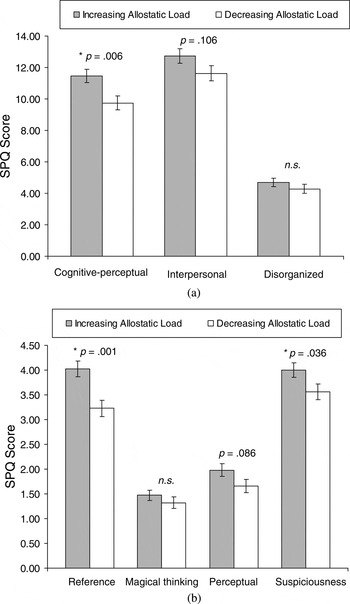
A MANOVA showed that there was a significant main effect of allostatic load change group on the three schizotypy factors, F (3, 371) = 2.75, p = .042. The increasing allostatic load group had significantly higher scores on the cognitive-perceptual factor, F (3, 371) = 7.62, p = .006 (for the increasing group, M = 11.46, SD = 6.29, for the decreasing group, M = 9.76, SD = 5.66, d = 0.28). Groups did not differ on the interpersonal factor,Footnote 2F (3, 371) = 2.63, p = .106 (for the increasing group, M = 12.72, SD = 7.00, for the decreasing group, M = 11.64, SD = 5.78), or the disorganized factor, F (3, 371) = 0.87, p = .352 (for the increasing group, M = 4.68, SD = 4.10, for the decreasing group, M = 4.31, SD = 3.60; see Figure 1a.)
Means (±SE) of (a) the cognitive–perceptual, interpersonal, and disorganized factors of the Schizotypal Personality Questionnaire for the increased and decreased allostatic load groups and (b) the four subscales (idea of reference, unusual perceptual experiences, odd beliefs or magical thinking, and suspiciousness) of the cognitive–perceptual factor for the increased and decreased allostatic load groups.

To further understand the association between allostatic load change and the cognitive–perceptual factor of the SPQ, a MANOVA was conducted with the four subscales (i.e., ideas of reference, unusual perceptual experiences, odd beliefs or magical thinking, and suspiciousness) as dependent variables. The increasing allostatic load group had higher scores on the subscales of ideas of reference, F (1, 373) = 12.31, p = .001 (for the increasing group, M = 4.02, SD = 2.25; for the decreasing group, M = 3.23, SD = 2.17, d = 0.36), and suspiciousness, F (1, 373) = 4.431, p = .036 (for the increasing group, M = 4.00, SD = 2.11; for the decreasing group, M = 3.56, SD = 2.06, d = 0.21). No group differences were found for unusual perceptual experiences, F (1, 373) = 2.97, p = .086 (for the increasing group, M = 1.98, SD = 1.98; for the decreasing group, M = 1.66, SD = 1.67) or the odd beliefs or magical thinking subscale, F (1, 373) = 0.90, p = .34 (for the increasing group, M = 1.47, SD = 1.54; for the decreasing group, M = 1.32, SD = 1.47; see Figure 1b).
Discussion
This study utilized a multilevel developmental approach to investigate whether increased allostatic load, as indicated by reduced sympathetic nervous system habituation from ages 3 to 11 years, predisposes to schizotypal personality at age 23 years. Key findings are that children who showed a developmental decrease in habituation from ages 3 to 11, reflecting increased allostatic load, had higher levels of schizotypal personality at age 23 years. A further breakdown of total schizotypy into its three constituent subfactors revealed that this overall effect was largely attributable to higher scores among this group of children on the cognitive–perceptual subfactor of the SPQ, with a small to medium effect size of 0.28. Whereas measures of habituation at single time points (i.e., at ages 3 or 11) did not predict future schizotypy, developmental change in habituation from ages 3 to 11 did predispose to schizotypy, specifically cognitive–perceptual features. These findings highlight the importance of employing a multilevel developmental perspective that examines the functioning of physiological systems over time in addition to using static measures of allostatic load as predictors of future psychopathology.
A wide body of literature suggests that in addition to the prefrontal cortex and amygdala, the hippocampus is particularly susceptible to the effects of increased allostatic load (McEwen, Reference McEwen2009). Studies have found that increased allostatic load leads to dendritic remodeling in hippocampal neurons (McEwen, Reference McEwen1999; Vyas, Mitra, Rao, & Chattarji, Reference Vyas, Mitra, Rao and Chattarji2002), suppression of neurogenesis in the dentate gyrus (Gould & Tanapat, Reference Gould and Tanapat1999; Gould, Tanapat, McEwen, Flugge, & Fuchs, Reference Gould, Tanapat, McEwen, Flugge and Fuchs1998; McEwen, Reference McEwen1999), and can, over many months, lead to permanent loss of hippocampal nerve cells (Uno, Tarara, Else, Suleman, & Sapolsky, Reference Uno, Ross, Else, Suleman and Sapolsky1989). The hippocampus is critically involved in habituation, including of electrodermal activity. Although limbic influences on electrodermal activity are complex, there is considerable evidence that one neural pathway involves inhibitory effects stemming from the hippocampus, that in concert with excitatory influences from the amygdala, gives rise to electrodermal activity (Dawson, Schell, & Filion, Reference Dawson, Schell, Filion, Cacioppo, Tassinary and Berntson2007; Sequeira & Roy, Reference Sequeira, Roy, Roy, Boucsein, Fowles and Gruzelier1993).
Given the central role of the hippocampus as a target of allostatic load and mediator of electrodermal activity, it is perhaps noteworthy that there is extensive evidence of hippocampal abnormalities in schizophrenia spectrum disorders. The hippocampus shows the largest reduction in volume relative to other brain regions examined in schizophrenia patients (Walker, Mittal, & Tessner, Reference Walker, Mittal and Tessner2008), and schizotypals have been found to have reduced hippocampal volume compared to normal controls (Dickey et al., Reference Dickey, McCarley, Xu, Seidman, Voglmaier and Niznikiewicz2007; Suzuki et al., Reference Suzuki, Zhou, Takahashi, Hagino, Kawasaki and Niu2005), although studies have not always been consistent (Dickey et al., Reference Dickey, McCarley, Voglmaier, Niznikiewicz, Seidman and Hirayasu1999; Gur et al., Reference Gur, Turetsky, Cowell, Finkelman, Maany and Grossman2000). In addition to differences between normal controls and schizotypal individuals, greater symptom severity in schizotypy has been associated with significantly reduced hippocampal volume (Flaum & Andreason, Reference Flaum, Andreasen, Raine, Lencz and Mednick1995) and positive-symptom schizotypals have been found to exhibit abnormalities in the ventral limbic cortical–basal ganglia circuit, including decreased activity in nucleus accumbens and increased activity in the hippocampus and amygdala, during an emotional Stroop task (Mohanty et al., Reference Mohanty, Herrington, Koven, Fisher, Wenzel and Webb2005). This parallels findings in schizophrenia patients of an association between positive symptoms and overactivity of the hippocampus and parahippocampal gyrus (Bogerts, Reference Bogerts1997; Epstein, Stern, & Silbersweig, Reference Epstein, Stern, Silbersweig and McGinty1999; Liddle, Friston, Frith, Frackowiak, Reference Liddle, Friston, Frith and Frackowiak1992; Silbersweig et al., Reference Silbersweig, Stern, Frith, Cahill, Hommes and Grootoonk1995). Findings from several lines of investigation thus converge to suggest that hippocampal impairment and decreased inhibitory modulation in a key neural circuit may partly underlie the inhibitory deficits seen in schizophrenic disorders and give rise to the more cognitive–perceptual features of the disorder (Raine, Reference Raine2006). Consequently, the developmental shift toward failure to habituate to stressful stimuli throughout childhood may reflect a failure of inhibition linked to hippocampal dysfunction.
From a methodological standpoint there is convergence of the cognitive–perceptual measure of allostatic load used in this study and cognitive–perceptual features of schizotypy. According to one influential information-processing model of skin conductance orienting (Dawson et al., Reference Dawson, Schell, Filion, Cacioppo, Tassinary and Berntson2007; Ohman et al., 2000), electrodermal responding to discrete time-locked stimuli occurs when preattentive processes make a call for additional controlled processing. Responding reflects a change from automatic to controlled processing as a result of initial preattentive processing. Normal habituation occurs when a neural template, built up from the perception of the first stimulus and held in short-term memory during the interstimulus interval, is compared with a second stimulus and a perceptual match obtained. However, degradation in the accurate representation of the neural trace of the first stimulus due, for example, to cognitive and perceptual information-processing deficits, would result in a mismatch with the second stimulus and produce a call for more cognitive processing resources to further analyze the second stimulus, producing a substantial electrodermal response. Consequently, those with higher cognitive–perceptual schizotypal features may fail to show the expected decrement in amplitude across the six trials, and consequently reduced habituation. The fact that a cognitive–perceptual measure of allostasis was selectively related to cognitive–perceptual features of schizotypal personality provides a conceptual convergence that highlights an abnormality in cognitive–perceptual processing in schizotypal individuals.
A breakdown of the four subcomponents of the cognitive–perceptual factor of schizotypy revealed that two subscales—ideas of reference and paranoid ideation—were selectively elevated in those who developed increased allostatic load over time. The strongest effect was for ideas of reference (d = 0.36), which is itself a foundation cognitive process for the development of self-referential paranoid ideas. Experimental brain imaging research has demonstrated that self-referential thinking invokes increased activation of the medial prefrontal cortex compared to cognitive control tasks (D'Argembeau et al., Reference D'Argembeau, Collette, Van der Linden, Laureys, Del Fiore and Degueldre2005; Mitchell, Banaji, & Macrae, Reference Mitchell, Banaji and Macrae2005; Northoff et al., Reference Northoff, Heinzel, Greck, Bennpohl, Dobrowolny and Panksepp2006). Experimental animal work in turn has documented the causal top-down role played by the medial prefrontal cortex in modulating the response to repeated stress. In particular, recent experimental manipulation of activity in the medial prefrontal cortex has shown that increased activation of this executive control region hampers the subsequent habituation of the stress response (Weinberg, Johnson, Bhatt, & Spencer, Reference Weinberg, Johnson, Bhatt and Spencer2010). Furthermore, increased prefrontal and medial prefrontal activation has been reported in several studies of schizotypal personality (Buchsbaum et al., Reference Buchsbaum, Nenadic, Hazlett, Spiegel-Cohen, Fleischman and Akhavan2002; Hazlett et al., Reference Hazlett, Buchsbaum, Zhang, Newmark, Glanton and Zelmanova2008; Modinos, Ormel, & Aleman, Reference Modinos, Ormel and Aleman2010). Consequently, there is reason to hypothesize that abnormal functioning of the medial prefrontal cortex may be a common neural mechanism underlying both maldevelopment of stress response habituation from ages 3 to 11, and also ideas of reference at age 23.
It is rather unusual that the two subscales that we found to relate to allostatic load (ideas of reference and paranoid ideation) are two features that Cannon and colleagues (2008) found to be predictive of conversion to psychosis in a large, multisite longitudinal study of youth at high clinical risk. These features, unusual thought content and suspicion/paranoia, in addition to genetic risk for schizophrenia with recent deterioration in functioning, greater social impairment, and a history of substance abuse, were the only features among 77 baseline potential predictor variables that contributed uniquely to the prediction of psychosis during a 2.5-year follow-up period (Cannon et al., Reference Cannon, Cadenhead, Cornblatt, Woods, Addington and Walker2008). Other studies have also found that ideas of reference and suspicion/paranoia constitute a risk for psychosis (Klosterkotter, Hellmich, Steinmeyer, & Schultze-Lutter, Reference Klosterkotter, Hellmich, Steinmeyer and Schultze-Lutter2001; Yung & McGorry, Reference Yung and McGorry1996), and a recent study found that perceived negative attitude of others, which relates most strongly to feelings of reference, predicts vulnerability to, and current risk of, psychosis (Salokangas et al., Reference Salokangas, Heinimaa, Svirskis, Laine, Huttunen and Ristkari2009). Thus, cognitive features, and in particular, ideas of reference and suspiciousness of others, may be particularly linked to conversion to psychosis. Our findings suggest that we may have tapped into a process that is particularly linked to cognitive abnormalities, which are themselves particularly linked to psychotic breakdown.
One implication of our findings is that future research may benefit not only from continuing to investigate how developmental changes in allostatic load relate to schizotypy, but also whether such changes predispose to schizophrenia and transition to psychosis. Such undertakings may be especially relevant given Cannon et al.'s (2008) recent findings that cognitive–perceptual features predict conversion to psychosis, and our findings of a link between allostatic load in childhood and cognitive–perceptual features in adulthood. Although research has explored links between HPA axis abnormalities and the developmental course of schizophrenia (for a review see Walker etr al., Reference Walker, Mittal and Tessner2008), studies examining allostatic load in relation to schizophrenia have been rare. In addition to research that examines measures of stress reactivity at particular time points, studies that examine whether developmental changes in the stress response predispose to schizophrenia may represent a fruitful avenue for exploration, particularly given the increasingly widespread conceptualization of schizophrenia as a neurodevelopmental disorder. From this perspective, examining changes in allostatic load during childhood may offer novel insights into neurodevelopmental processes that static assessments of allostatic load alone cannot provide.
Our findings also have implications for the prevention of schizotypal personality and schizophrenia. Although several studies have investigated the efficacy of psychotherapeutic and pharmacological interventions for individuals at high risk of transition to psychosis and schizophrenia, these studies have focused on adolescence and adulthood, rather than childhood. However, given that schizophrenia and schizotypal personality are increasingly viewed as neurodevelopmental disorders with roots in the early years of life, prevention efforts that focus not just on delaying progression to psychosis in adolescents or adults at high risk, but that begin earlier, when critical neural circuits may be less affected, offer potentially unique opportunities for intervention. To our knowledge, only one study has specifically investigated whether an early-childhood prevention program leads to reduced rates of schizotypal personality in adulthood. In a randomized controlled trial, Raine, Mellingen, Liu, Venables, and Mednick (Reference Raine, Mellingen, Liu, Venables and Mednick2003) demonstrated that an enrichment program consisting of nutrition, education, and physical exercise from ages 3 to 5 years led to significantly reduced rates of schizotypal personality at age 17 years. In addition, the authors found that malnourished children in the enrichment condition had significantly lower SPQ scores at age 23 than malnourished children who did not receive the intervention. Although this study focused on schizotypal personality, the fact that schizotypal personality shares many neurocognitive, neurophysiological, genetic, psychophysiological, and symptom characteristics with schizophrenia suggests that similar approaches may be beneficial in preventing the onset of schizophrenia (Raine et al., Reference Raine, Mellingen, Liu, Venables and Mednick2003).
The fact that measures of allostatic load at individual time points did not predict later schizotypy, whereas developmental change in allostatic load did, suggests that it may be important to take into account developmental changes in the stress response that occur during childhood when examining how allostatic load relates to psychopathology. This would be broadly consistent with a wide body of research suggesting that the origins of adult disease can be found in developmental and biological changes that occur during the early years of life, and even before birth (Shonkoff, Boyce, & McEwan, Reference Shonkoff, Boyce and McEwen2009). For example, studies show that adult morbidity and risk factors for psychopathology can be embedded biologically during sensitive periods in which the developing brain is particularly susceptible to the impact of stressors (Shonkoff et al., Reference Shonkoff, Boyce and McEwen2009). This is particularly well documented in the literature on schizotypy, where studies have found that early prenatal and postnatal experiences that negatively affect brain development lead to increased rates of schizotypy (Raine, Reference Raine2006). Thus, examining changes in the functioning of physiological systems during sensitive periods during development may shed new light on how early developmental and biological alterations lead to increased risk for psychopathology.
Our findings also highlight the importance of applying a multiple levels of analysis perspective to the study of atypical developmental processes, an approach that has gained increasing momentum in the field of developmental psychopathology after repeated calls for interdisciplinary research that integrates different levels and methods of analysis (Cicchetti & Curtis, Reference Cicchetti and Curtis2007; Cicchetti & Dawson, Reference Cicchetti and Dawson2002; Cicchetti & Posner, Reference Cicchetti and Posner2005; Cicchetti & Toth, Reference Cicchetti and Toth2009). Although great strides have been made in this direction, until fairly recently developmental psychopathology research investigating the dynamic interplay between neurobiological, social, and psychological influences across the life span has been the exception, not the norm. Given that allostasis by definition invokes a transactional and interactive process through which biological systems respond to the social and physical environment, developmental psychopathology research that examines allostatic processes may represent a particularly promising avenue for continued exploration. Our findings suggest that multilevel investigations that assess changes in psychophysiological functioning across development are an important addition to the growing literature on allostatic load and psychopathology.
Potential limitations of this study should be noted. First, findings relate specifically to individual differences in schizotypal personality in the community, rather than to clinically diagnosed schizotypal personality disorder. Replication of findings in clinical samples may provide further confirmation of developmental differences in allostasis in individuals with clinical diagnoses of schizotypal personality disorder. Second, our sample comprised community-recruited children from the African subcontinent. Nonetheless, findings on these non-Western children have broadly confirmed findings from adult studies in Western cultures of an association between hyperarousal and positive schizotypy (Allen et al., Reference Allen, Freeman and McGuire2007; Raine, Benishay, Lencz, & Scarpa, Reference Raine, Benishay, Lencz and Scarpa1997; Raine et al., Reference Raine, Venables, Mednick and Mellingen2002). Furthermore, with very few exceptions, findings from Mauritius parallel findings from Western countries in terms of risk factors for antisocial behavior (Raine, Venables, & Mednick, Reference Raine, Benishay, Lencz and Scarpa1997), psychopathy (Glenn, Raine, Venables, & Mednick, Reference Glenn, Raine, Venables and Mednick2007), crime (Gao et al., Reference Gao, Raine, Venables, Dawson and Mednick2010a), aggression (Gao et al., Reference Gao, Raine, Venables, Dawson and Mednick2010b), nutrition (Liu, Raine, Venables, & Mednick, Reference Liu, Raine, Venables and Mednick2004), temperament (Raine, Reynolds, Venables, Mednick, & Farrington, Reference Raine, Reynolds, Venables, Mednick and Farrington1998), abuse (Gao, Raine, Chan, Venables, & Mednick, Reference Gao, Raine, Chan, Venables and Mednick2010), intelligence (Liu, Raine, Venables, Dalais, & Mednick, Reference Liu, Raine, Venables, Dalais and Mednick2003), psychophysiology (Venables, Reference Venables1978), and personality (Reynolds et al., Reference Reynolds, Raine, Mellingen, Venables and Mednick2000). These findings indicate cross-cultural generalizability of prior Western findings, and also show that theoretical conceptualizations of the etiology of psychopathology from the West find substantiation in Mauritius. Third, although we used two time points to examine individual differences in habituation trajectories during childhood, the addition of a third time point would have allowed for latent growth curve analysis and a richer understanding of more complex developmental change in sympathetic nervous system functioning during this developmental period. Fourth, although our measure of allostatic load provides a sensitive index of the sympathetic stress response, we assessed physiological functioning in only one response system, and studies that assess allostatic load in multiple systems may shed further light on the relationship between allostatic load and schizotypy.
Despite these limitations, we feel that the study has also relative strengths. From a theoretical level, no previous work to our knowledge has drawn empirical links between allostatic load and schizotypal personality; we have also been unable to uncover any work on other schizophrenia-spectrum disorders or even schizophrenia itself. As such, it is felt that the current study makes a novel conceptual contribution. From a methodological standpoint, developmental psychopathology research on a sample size of almost 1000 starting early in childhood is not common, and such work employing biological measures is the exception rather than the rule. The repetition of biological measures across time adds to the uniqueness of the study. Furthermore, it is felt that the utilization of electrodermal measures of sympathetic nervous system functioning, while quite consistent with prior conceptualizations of allostatic load that examine sympathetic activity (Karlamangla, Singer, Greendale, & Seeman, Reference Karlamangla, Singer, Greendale and Seeman2005; Reuben, Talvi, Rowe, & Seeman, Reference Reuben, Talvi, Rowe and Seeman2000), is unusual in the allostasis field and that the current study suggests a relatively quick and easy psychophysiological paradigm to assess allostatic load in young children. Finally, the time linkage of developmental changes in psychophysiological responsivity from ages 3–11 years to adult psychopathology 12 years later is relatively unusual.
In conclusion, this study demonstrated that children who show a relative failure to habituate to aversive stimuli as they progress throughout childhood show increased levels of schizotypy in adulthood, particularly cognitive–perceptual features. The relative failure to develop normal habituation to repeated stressors throughout childhood and the resulting prolonged exposure to catecholamines and glucocorticoids might lead to an accumulation of allostatic load and increased risk for schizotypy in adulthood. Although measures of habituation at individual time points did not predict future schizotypy, habituation trajectories during this period of developmental change were associated with adult schizotypal personality, suggesting that a better understanding of how the stress response functions over time may be important. Despite study limitations, these initial findings provide a new health perspective on the etiology of schizotypal personality disorder, which could have theoretical implications for schizophrenia.