INTRODUCTION
The samples in this study were collected during excavations at the archaeological site Czarnówko in 2008 and 2010. One of the principal objectives of the project was to compare dates obtained by radiocarbon measurements with the chronology established using archaeological artifacts. The second purpose was taxonomic identification of wood types. This can determine whether the material was local or if it was brought from other areas. We try to establish if the particular tree species were chosen for different aims, e.g. because of their properties. Identification of wood types may also be helpful when interpreting 14C dating results; i.e. if only long-lived plant material was available for dating, the possibility of an occurrence of old wood effect must be taken into account.
Charcoal samples selected for 14C dating were subjected to an acid-base-acid (ABA) pretreatment. Following the methodological studies on the influence of environmental exposure and preservation state on charcoal decontamination for 14C dating (Rebollo et al. Reference Rebollo, Cohen-Ofri, Popovitz-Biro, Bar-Yosef, Meignen, Goldberg, Weiner and Boaretto2008; Ascough et al. Reference Ascough, Bird, Francis and Lebl2011a, Reference Ascough, Bird, Francis, Thornton, Midwood, Scott and Apperley2011b; Bird et al. Reference Bird, Levchenko, Ascough, Meredith, Wurster, Williams, Tilston, Snape and Apperley2014), pH measurements of soil from the closest vicinity were conducted together with geological and geomorphological studies of the Czarnówko site area.
The choice of samples was motivated not only by the lack of any previous 14C analyses from this stage of excavation, but also because of Czarnówko’s regional significance. Czarnówko is the largest cemetery of late antiquity in Polish territory. The large number of various and luxurious grave goods, many of them being imports found in numerous burials, show that the archaeology of burials provides insight into the lives of people in the past. In the case of Czarnówko, many of these may have been representatives of regional elites. In the vicinity of Czarnówko, several sites from the same period have been found, but none with so many burials with wealthy grave goods as in Czarnówko (Krzysiak Reference Krzysiak2013).
Problems in Radiocarbon Dating of Charcoal
Charcoal is one of the materials most frequently dated by 14C, and is vitally important not only in geological and biological studies but also in archaeological research. However, the 14C measurements made on charcoal samples sometimes give ages that are older than expected according to the archaeological context. The main sources of these errors seem to be related to the “old wood effect” connected with the mechanism of tree growth. Taking into account growth of the tree by addition of rings, it has been noted that the 14C age of twigs, heartwood, and sapwood can differ significantly from each other depending on the tree species. Additionally, the wood material could have been treated prior to its use or reused in other structures.
Looking at the broad spectrum of materials used in 14C dating, charcoal is relatively easy to prepare and to eliminate the source of potential errors by the use of appropriate preparation, adapted to the analyzed sample groups. Seemingly erroneous results, in the context of archaeological interpretation, can be obtained due to unremoved contamination during the pretreatment. However, the standard pretreatment could destroy a small, poorly preserved charcoal sample (Ascough et al. Reference Ascough, Bird, Francis and Lebl2011a; Bird et al. Reference Bird, Levchenko, Ascough, Meredith, Wurster, Williams, Tilston, Snape and Apperley2014).
The initial chemical pretreatment of charcoal for 14C dating uses the acid-base-acid method (ABA) to remove external contamination, coming from the period after death of the organism (i.e. after cutting the tree). Experimental studies have shown that each of the three ABA steps influences the sample in different ways depending on the state of charcoal preservation, age, and environment (Rebollo et al. Reference Rebollo, Cohen-Ofri, Popovitz-Biro, Bar-Yosef, Meignen, Goldberg, Weiner and Boaretto2008; Ascough et al. Reference Ascough, Bird, Francis and Lebl2011a, Reference Ascough, Bird, Francis, Thornton, Midwood, Scott and Apperley2011b; Bird et al. Reference Bird, Levchenko, Ascough, Meredith, Wurster, Williams, Tilston, Snape and Apperley2014).
Proper preselection of charcoal samples with respect to their preservation state, as well as good estimation of the level of contamination, is strongly advisable before 14C dating. Some studies have compared the ability of different pretreatment techniques to remove 14C contamination from charcoal made at different temperatures (300, 400, 500°C) and exposed to the environmental contamination for different time periods (Bird et al. Reference Bird, Levchenko, Ascough, Meredith, Wurster, Williams, Tilston, Snape and Apperley2014). Rebollo et al. (Reference Rebollo, Cohen-Ofri, Popovitz-Biro, Bar-Yosef, Meignen, Goldberg, Weiner and Boaretto2008) inferred that slightly acidic environments conserve charcoal by preventing its oxidation, a process common in neutral or basic environments. As proposed by Rebollo et al. (Reference Rebollo, Cohen-Ofri, Popovitz-Biro, Bar-Yosef, Meignen, Goldberg, Weiner and Boaretto2008), the preservation mechanism should be verified with geomorphological studies and careful reconstruction of postdepositional processes of the site.
In the Czarnówko data, the situation is different than in the case described by Rebollo et al. (Reference Rebollo, Cohen-Ofri, Popovitz-Biro, Bar-Yosef, Meignen, Goldberg, Weiner and Boaretto2008) concerning the context of environmental and geological conditions and state of samples, but indicate what is particularly important in terms of methodology. Experimental studies carried out by Rebollo et al. (Reference Rebollo, Cohen-Ofri, Popovitz-Biro, Bar-Yosef, Meignen, Goldberg, Weiner and Boaretto2008) and Schiegl et al. (Reference Schiegl, Goldberg, Bar-Yosef and Weiner1996) have helped in determining the type and the order of analyses for samples from Czarnówko. Following the macro- and microscopic observations, together with knowledge of the local geology and relatively small weight loss after chemical pretreatment (ABA procedure, Appendix 1), additional analyses proposed by Rebollo et al. (Reference Rebollo, Cohen-Ofri, Popovitz-Biro, Bar-Yosef, Meignen, Goldberg, Weiner and Boaretto2008) to evaluate samples contaminations was not necessary in this study.
SITE DESCRIPTION
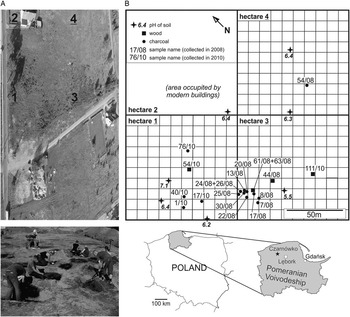
Czarnówko is a village located in northern Poland (54°33′28″N, 17°41′31″E), near Lębork, 80 km west of Gdańsk (Figure 1). The excavation site is located on a gently inclined southeastern slope of a hill, 1800 m from the Łeba River, in area that has been agriculturally exploited for many years.
Location of archaeological site: (A) aerial view of Czarnówko site (Andrzejowski Reference Andrzejowski2015) with the location of hectares (1–4) and photo of excavated part of cemetery area (from the Museum in Lębork 2014); (B) map of the excavation site (in 2010) with the location of sampling and pH of the depositional environment noted.

The Czarnówko site has been used for over 900 yr by populations of different archaeological cultures (Figure 5A). From the 7th to 3rd century BC, it was occupied by a settlement of the Lusatian culture, then replaced by a cemetery of Pomeranian culture of an undefined extent. Archaeological features of both cultures were discovered in the area of hectare 4, and in particular, in the part excavated in August 2008 (Figure 1A,B). From the 1st century BC up to the 3rd century AD, the site was occupied by a cemetery of the Oksywie and Wielbark cultures, when it reached its maximum extent. Unfortunately, the settlement or settlements associated with this burial site have not yet been located.
GEOLOGICAL SETTING AND GEOMORPOHLOGY
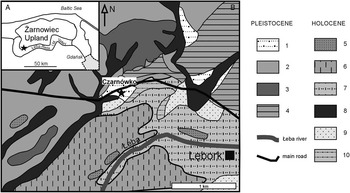
The Czarnówko excavation site has a surficial geology shaped by the Quaternary glaciation processes, particularly by the latest one, the Vistulian Glaciation. The site is situated in the area of the Łeba-Reda Ice-Marginal Valley (LRIMV), a regional erosional form produced by the activity of meltwaters at the end of the Pleistocene (Oldest Dryas, ~15 kyr BP), after the Pomeranian phase of the Vistulian Glaciation. The evolution of this landform is still debatable due to the related complex sedimentary and geomorphological record (Gołębiewski and Woźniak Reference Gołębiewski and Woźniak2003; Mojski Reference Mojski2005 and references therein). Czarnówko is situated in the Łeba River part of the LRIMV, in its E-W trending fragment (Figure 2). More precisely, the archaeological site was established at the northern slope of the ice-marginal valley, formed by the margin of the Żarnowiec Upland—an elevated area built by mainly glacial tills, which borders the LRIMV from the north (Kondracki Reference Kondracki2011), (Figure 2). The excavations were located on a small plateau (Andrzejowski et al. 2015) cut in the lower part of the upland slope, with an altitude of ~22 m asl. This local flat morphological step is situated ~40 to 60 m below a typical height of the Żarnowiec Upland in this area, and ~7 m above the flood terrace of the LRIMV. The local culmination of end-moraine hills, which its distance from the excavation is ~2 km NNE, is situated at ~114 m asl. This plateau is interpreted to be a local denudation plain formed by erosion of the overling the deposits of the Żarnowiec Upland (Morawski Reference Morawski1990).
(A) Location of Czarnówko in the Łeba River part of the LRIMV (Łeba-Reda Ice-Marginal Valley), (after Kondracki Reference Kondracki2011); (B) geological map showing the location of excavation in the Pleistocene fluvioglacial deposits, sheet Lębork, 1:50,000 (Morawski Reference Morawski1986, Reference Morawski1990); 1 – lower fluvio-glacial sands and gravels, 2 – moraine glacial tills, 3 – end-moraine sands and gravels, 4 – varve clays, 5 – eolian sands, 6 – peats, 7 – peat sands and hummus sands with muds, 8 – alluvial sands, 9 – alluvial fan sands, 10 – alluvial fan sands and eolian sands with muds.

According to the results of detailed geological mapping (Morawski Reference Morawski1986, Reference Morawski1990), the excavation is located in the Pleistocene fluvioglacial deposits, namely, in the lower fluvioglacial sands and gravels formed during the recession stages of the Vistulian Glaciation (Figure 2). This rock series is built by medium- to coarse-grained sands with an admixture of gravels and cobbles. It should be stressed that their lower position is referred to in relation to glacial tills, which originally covered these sediments. The discussed fluvioglacial sediments were originally overlain by glacial moraine deposits (tills), and less probably also by end-moraine sands and gravels, which can be found in the vicinity (N/NE of Czarnówko). This implies that the sediments at the excavation site, as formed during a glaciation, do not contain original organic matter, which would be synchronuous with depositional processes. Absence of primary, syndepositional organic matter makes them strongly different from the organic-rich Holocene peat sands that occur several hundred meters to the south of an excavation, in the ice-marginal valley (Figure 2). The depth of base of the Pleistocene sands and gravels in the excavation site is unknown. However, the lower fluvioglacial sands are usually tens of meters thick, and the exposures located on the southern slope of the LRIM Valley in this area reach over 50 m (Morawski Reference Morawski1990).
STUDY METHODS
Soil pH Measurement Method
Soil pH measurement was performed using the potentiometric method, based on instrumental measurements of pH value for the cell constructed with of a reference electrode, measurement electrode, and soil-to-water suspension (Elbanowska et al. Reference Elbanowska, Zerbe, Górski and Siepak1997). Some 20 g of the studied soil were placed in a 200-mL beaker. Then, 100 mL of water and potassium chloride solution (KCl=1 mol/L) were added and mixed together. Subsequently, the control pH measurements for buffer solutions were carried out with a calibrated pH meter. The electrodes were rinsed with water and dried after measuring. In the next step, the electrodes were submerged in the reconstituted soil suspension, and after stabilization, the pH value was recorded. The soil pH detection described was conducted in the Institute of Geology, AMU Poznań, using an Elmetron CP-401 pH meter. Samples of the analyzed soils were taken from the closest possible vicinity of the charcoals and wood fragments selected for dating. The location of all samples, both the soils and the dated materials, is shown at Figure 1B.
Typological Method
Archaeological artifacts are widely used for relative dating using typological methods. Artifacts made of metals are preferred, generally speaking, due to their characteristic forms. Their advantage is also high durability and preservation, compared to objects made of clay, glass, or wood.
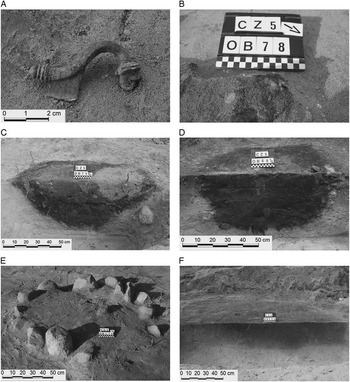
The typologies are established as a result of long-term studies, primarily using assemblages (artifacts found together in context indicating their original common occurrence), e.g. graves. Based on their common features, the artifacts are combined into groups; then by observation of their concurrence, the chronology is determined. Typologies are frequently applied in archaeology of pre-Roman and Roman periods in northern Europe (e.g. Almgren Reference Almgren1897 for fibulae, Eggers Reference Eggers1951 for imports from Roman Empire, Wołągiewicz Reference Wołągiewicz1993 for Wielbark Culture pottery) and the artifacts are treated as chronological indicators. The basic artifacts applied in this region are fibulae; buckles and belt tips are less frequently used. Fibulae (Figure 3A) are decorative brooches or pins for fastening garments usually made of bronze or iron, or rarely of noble metals. They are present over a long time range, from the Halstatt period (~1300 BC) up to the Early Middle Ages (5th century AD), and are the most frequently found costume elements at archaeological sites. Fibulae are characterized by a wide variety of fast changing forms, which makes them good chronology indicators, allowing precision as fine as several years.
Features from which the samples for 14C measurement were chosen, together with photos of a fibulae as example artifacts, which are the base of relative chronology in Czarnówko; (A) bronze fibula found in feature 98 (with sample 30/08); (B) sample 63/08 in situ in feature 78 with the fibula to which the organic material was attached; (C) section of feature 74 (sample 13/08 collected); (D) section of feature 69 (sample 7/08 collected); (E) plan view of feature 175 (sample 54/08 collected); (F) section of feature 66 (sample 8/08 collected).

The currently used typology of fibulae was created by Oskar Almgren (Almgren Reference Almgren1897). He collected the forms known from the area of Europe and distinguished 248 types. They are divided into 7 groups, denoted I–VII (but there are also other types that do not fit to any group), which are subdivided into series. The typology of fibulae is based on technological criteria: their construction and ornamental elements. Almgren chronologically ordered fibulae and described the evolution of their forms. For individual types, he determined the time of usage, ranging from several tens of years up to <20 yr.
In the dating of Czarnówko archaeological features, apart from Almgren’s fibulae typology, the typology of buckles was also applied (Madyda Reference Madyda1977). It is, however, much less precise because buckles do not possess such a wide variety of forms as fibulae.
Sample Selection
Samples of charcoal and wood were collected during the excavations at Czarnówko in 2008 and 2010. From all the samples taken in Czarnówko, 20 were selected for further analysis (Table 1), including 15 containing charcoal, five with wood, and one with textile.
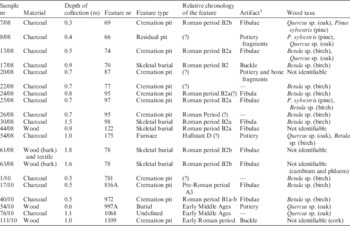
Samples from Czarnówko with archaeological context of features and wood taxa identification (1 type of artifact used to determine relative chronology of the feature).

The studied material was collected from 18 features of different types (Table 1, Figure 3). Most of the samples (i.e. 7/08, 8/08, 13/08, 17/08, 20/08, 22/08, 24/08, 25/08, 26/08, 30/08, 61/08 and 63/08) come from the southwestern part of the area referred to as hectare 3, which was the main excavation area in 2008 (Figure 1). About 10 m east of these samples, samples 44/08 and 111/10 were collected. Five samples, 1/10, 17/10, 40/10, 54/10 and 76/10, come from the western part of the site (hectare 1). Only sample 54/08 was taken in the eastern part of the site (hectare 4), which is associated with the oldest settlement horizon on the site.
The selection of samples for 14C dating was dictated by the occurrence of features with chronological indicators, in particular metal artifacts, mostly fibulae. Thus, the 14C dating results could be compared with the archaeological relative chronology (Table 1). Additionally, a few samples were chosen from features of unknown chronology, but potentially related to the oldest horizons of the site exploitation.
For the selected material, microscopic observations aimed at identification of wood taxa. The observations were planned to provide some information about the wood economy of the populations of the Czarnówko and to decide the best sample preparation method for 14C dating. For 15 samples from the chosen group collected in 2008 and 2010, the identification of wood taxa was possible (Table 1).
Finally, 13 samples collected in 2008 were 14C dated. One of the samples, no. 61/08 of bark fragment and textile, was dated twice.
Identification of Wood
The samples of charcoal and wood were subjected to microscopic observations in order to determine the wood taxa. Transverse, radial, and tangential sections of wood were observed with a polarizing optical microscope and a scanning electron microscope (SEM). Apart from delivering documentation images, which facilitated the taxonomic identification of wood, these observations provided the portunity for detailed examination of internal structure of wood and its alteration caused by postdepositional conditions, which influenced the sample state of preservation. The taxonomic identification was carried out based on the internal structure of wood. In the first stage, the conifers were differentiated from ring-porous and diffuse-porous angiosperms. Then, according to the spatial arrangement of tissues, the individual wood taxa were determined (Table 1). In some cases, the identification was impossible due to the available sample size and lack of proper section. The morphology of the wood and charcoal fragments were outsourced at Adam Mickiewicz University in Poznań, Institute of Geology, The Scientific-Didactic Scanning Microscopy and Microanalysis Laboratory. Analyses were performed under a polarizing microscope Olympus AX-70 Prons and scanning electron microscope Hitachi S-3700N under an accelerating voltage of 15–20 kV and vacuum of 25–30 Pa.
Preparation of Czarnówko Charcoal for Radiocarbon Dating
The samples from Czarnówko have been prepared for 14C dating and subsequently measured in the Poznań Radiocarbon Laboratory. The contaminants adhering to well-preserved and poorly preserved materials can differ, so for their efficient removal, the preparation protocol should be adjusted for individual samples (Rebollo et al. Reference Rebollo, Cohen-Ofri, Popovitz-Biro, Bar-Yosef, Meignen, Goldberg, Weiner and Boaretto2008). In the case of the Czarnówko samples, the first step of their purification was removal of macroscopically visible plant roots (Damblon et al. Reference Damblon, Haesaerts and van der Plicht1996). Then, the samples were subjected to a preliminary ABA preparation step (Brock et al. Reference Brock, Thomas, Higham, Ditchfield and Bronk Ramsey2010) by treatment with 1M HCl solution aimed at dissolving carbonates and other acid-soluble minerals. The second stage was submerging the samples in the base solution (0.1M NaOH) to remove humic compounds. Successive treatments with alkali (base solution) were applied until the supernatant was almost colorless (Sakamoto et al. Reference Sakamoto, Kodaira and Imamura2004). The last ABA step repeated the 1M HCl treatments. Each time, a sample submerged in acid or alkaline solution was placed for 2 hr in the bath at 50°C. After every step, the samples were bathed in deionized water to restore the neutral pH. Subsequently, the samples were dried and their weight loss was monitored (see the Appendix in the online Supplemental Material).
The treatment described above was applied to the 10–30 mg charcoal fragments. Following sample pretreatment, 2 mg of charcoal was used in the combustion step. The unused sample was then stored. Combustion in a vacuum produced carbon dioxide from organic material, which was then reduced to graphite in the presence of iron (Czernik and Goslar Reference Czernik and Goslar2001). Finally, the graphite with iron was pressed together to form a cathode ready for AMS measurement, in accordance with the standard procedure applied in the Poznań Radiocarbon Laboratory.
The 14C measurements were conducted using an accelerator mass spectrometer (the 1.5 SDH-Pelletron Compact Carbon AMS as described in Goslar et al. Reference Goslar, Czernik and Goslar2004). The application of this method and the availability of sufficient amounts of material allowed for dating the samples with a standard precision of ±30 yr.
RESULTS
State of Preservation
Charcoal was found in most of cremation pits in the Czarnówko site and the majority of charcoal samples were in a relatively good state of preservation. Wood fragments survived in skeletal burials due to the contact with bronze artifacts that release tin oxide that preserved the buried organic substances (Figure 3B) (Unger et al. Reference Unger, Schniewind and Unger2001).
Mechanical postdepositional processes may affect part of the samples (Ascough et al. 2011), e.g. by deep plowing (up to 0.5 m) on the site area, which had formerly been farmland. Six samples were collected from a depth of 0.5 m or less (7/08, 8/08, 13/08, 1/10, 17/10, and 40/10). Of these, the first three were 14C dated. In the features above and around position, where the samples were collected, no major disturbance nor mixing in the top soil was visible during excavation (one of the authors was present on the site during the features’ excavation; Figure 3).
Some fragments of charcoal from the cremation pits, i.e. samples 7/08, 1/10, 17/10, and 40/10, were overgrown with plant roots. These were collected at a maximum depth of 0.5 m (Table 1). Notably, the great depth of sampling did not guarantee a lack of root contaminations, which is evidenced by samples 24/08 (taken from 0.8 m depth), 76/10 (1.1 m), and 54/08 (1.0 m). By contrast, samples 13/08, 17/08, 20/08, 22/08, 25/08, 30/08, collected at varying depths (0.5–1.5 m), were not overgrown with plant roots.
The wood samples 44/08, 61/08, and 63/08 were all contaminated with plant roots and soil, despite being collected from depths between 0.9 and 1.8 m. Sample 111/10 contained humus, while sample 54/10 (depth 0.6 m) had no macroscopically visible contaminants.
The preservation state of charcoal fragments was also a result of the site geology and location. The fills of all the features that the samples were collected from consisted of podzolized soil, medium sand, and wood combustion remains mixed in different proportions. The sediments at the excavation site (Pleistocene sands and gravels) were formed during the Vistulian Glaciation. Therefore, they do not contain syndepositional organic matter, which makes them strongly different from the organic-rich Holocene peat sands from the vicinity, and also indicates the good conditions of analyzed materials. That type of geological formation (permeable lithology) implies that water did not stagnate at shallow soil levels, but infiltrated and migrated deeper into the sediment, which contributed to the good preservation state of the charcoal. This process could cause the movement of charcoals into lower levels, but detailed site observations indicated that no major disturbances were visible in the excavated profiles. Moreover, all collected samples comprise large charcoal fragments, suggesting that it is highly probable that they were found in situ (Figure 3).
The pH level of the depositional environment has an important influence on 14C dating. The average pH value for this excavation site is 6.3, i.e. slightly acidic (Figure 1B), which together with the favorable geological conditions, resulted in the good preservation state of the charcoals. The state of preservation of charcoal (or wood) is essential for influencing the degree of mass loss. The possible transformation of wood charcoal generates problems in eliminating contaminants from poorly preserved material by the ABA method, because large sample weight losses occur in this case (Rebollo et al. Reference Rebollo, Cohen-Ofri, Popovitz-Biro, Bar-Yosef, Meignen, Goldberg, Weiner and Boaretto2008). The loss was monitored for a group of samples from Czarnówko, and indicated relatively small (28% excluding bark samples) loss after the entire ABA procedure (Appendix).
Wood Taxa Identification
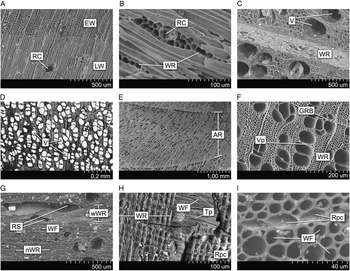
Taxonomic identification of wood was attempted for 25 fragments (from 20 samples, Table 1). For five samples, the identification was impossible due to the character of available material that contained only the outer, non-xylem components of cambium, phloem, and cork. Among the presented samples, 11 fragments were identified as birch (Betula sp.), including one from a furnace. All of them were charcoal from either cremation or skeletal burials (Table 1, Figure 4D–F). Oak (Quercus sp.) was assigned to six fragments: five of charcoal and one of wood (Figure 4C, G–I). Three of them came from pits: one each from a furnace, from a burial, and from a feature of unknown function (Table 1). Three other charcoal fragments identified as pine (Pinus sylvestris) came from cremation pits (two fragments) and residual pit (Figure 4A, B).
Microphotographs of the chosen charcoal fragments; SEM images (besides D): (A) cross-section of pine, sample Cz7/08, single vertical resin canal, and growth ring boundary between early and latewood visible, magnification 90×; (B) tangential longitudinal wood section showing horizontal resin duct, sample Cz7/08 after first step of ABA protocol, magnification 450×; (C) oak cross-section with tyloses, sample 13/08, 80×; (D) optical microscope image of cross-section of sample 22/08 without damages to wood structure, birch, vessels, and apotracheal parenchyma, 10×; (E) cross-section of birch sample Cz25/08, 1-year growth ring visible, 35×; (F) cross-section of xylem tissue, large xylem vessels surrounded by fibers and parenchyma, birch, sample Cz30/08, 230×; (G) cross-section of oak, sample 54/08, wide wood ray with radial shakes (defect due to natural forces), big vessels in earlywood (springwood), latewood (summerwood) with small vessels, located along wood rays, 100×; (H) radial section of oak, wood ray visible, sample 54/08, 450×; (I) sample 54/08 after first step of ABA protocol, 1400×. Abbreviations: AR=annual ring; EW=earlywood; LW=latewood; GRB=growth ring boundary; RC=resin canal; Tp=tracheids with border pits; WF=wood fibers; WR=wood ray; nWR=narrow wood ray; wWR=wide wood ray; RS=radial shakes; Rpc=ray parenchyma cells; V=vessel; Vp=vessels separated by perforation plate.

The charcoal fragments from five features were represented by mixed material. Three cremation pits (samples 7/08, 13/08, 25/08), one residual pit (sample 8/08), and one furnace (sample 54/08) contained materials belonging to two wood taxa.
Additional dendrological analyses for Czarnówko wood and charcoal fragments made by (Stępnik Reference Stępnik2015) established that 80% of all coffins were made of oak, whereas charcoal fragments from burials, cremation pits, and other features represent were mainly pine and birch, and less often of oak and alder.
Radiocarbon Dating
Charcoal fragments selected for radiocarbon measurements were cohesive, relatively hard, in good preservation state. Preparation for dating was preceded by chemical ABA pretreatment. The first acid step in the ABA protocol did not disintegrate the structure of the analyzed charcoals (Figure 4B, I), in contrast to poorly preserved geological charcoal fragments from different environmental conditions described by Rebollo at al. (2008). In the next step, NaOH treatments were repeated 2–3 times before the final acid treatment. After all three alkali treatments, the supernatants were nearly colorless, a light beige. It should be noted that the greatest influence on the Czarnówko samples was the second (alkali) stage of ABA pretreatment; however, even in this case the weight loss was not large. The average weight loss after the entire ABA procedure was about 28%.
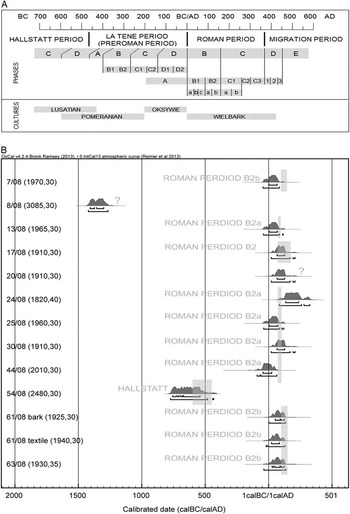
14C analyses were carried out on 13 samples (for sample no. 61/08, two measurements were carried out: for bark and textile). The calibrated dates (Appendix) were compared with the chronology based on archaeological artifacts (Figure 5).
Absolute and relative chronology of Czarnówko: (A) simplified chronology of the Iron Age in Poland (Kaczanowski and Kozłowski Reference Kaczanowski and Kozłowski2003, simplified); (B1a) different phases of existence of particular cultures; ? indicates lack of additional data from archaeological context; (B) results of calibration with relative chronology (marked in yellow). Calibration of 14C dates obtained with OxCal v 4.2.4 (Bronk Ramsey and Lee Reference Bronk Ramsey and Lee2013) and the IntCal13 atmospheric curve (Reimer et al. Reference Reimer, Bard, Bayliss, Beck, Blackwell, Bronk Ramsey, Buck, Cheng, Edwards, Friedrich, Grootes, Guilderson, Haflidason, Hajdas, Hatté, Heaton, Hoffmann, Hogg, Hughen, Kaiser, Kromer, Manning, Niu, Reimer, Richards, Scott, Southon, Staff, Turney and van der Plicht2013).

For most of the features sampled for 14C dating, two main archaeological periods were established using the typological method, based on the fibulae and a buckle found in them (Table 1). The older one, the Roman period B2a (Figure 5A), was determined for features 74, 95, 97, 98, and 122 (samples 13/08, 24/08, 25/08, 30/08, and 44/08). The younger one, the Roman period B2b (Figure 5A), was established for features 69 and 78 (samples 7/08, 61/08, and 63/08). Furthermore, feature 70 (sample 17/08) was less precisely associated with Roman period B2. There is an agreement between the results obtained by typology and 14C dating (Figure 5B). A significantly older date was obtained from sample 54/08 (Figure 3E: Figure 4G-I). Fragments of pottery found in feature 175 allowed to associate it with the Pomeranian culture (Figure 5A). Accordingly, the chronology of the feature can be estimated at 600 to 450 BC, while the calibrated age of the sample is 775 to 480 BC (94.9%). Thus, the results obtained with both methods clearly overlap (the span of the dates is mainly due to the shape of the calibration curve). Two features, nr 66 and 87, being the sources of samples 8/08 and 20/08, did not contain any artifacts applicable for age estimation based on typological analysis. However, burial nr 87, from which sample 20/08 was taken, based on its form (cremation pit with stone stela) was associated with the Wielbark culture, as were most of the Czarnówko features. It appeared to be a correct assumption; the sample was dated at AD 20 to 170 (93.6%), so it does not differ from the results obtained for the rest of the Wielbark features, which allows linking 20/08 with this episode of site usage.
Pit nr 66 (Figure 3F), from which sample 8/08 was collected, was situated at the studied site within a cluster of features dated for Roman period B2; thus, it was initially interpreted as a feature of possibly similar age, but the 14C measurement indicates much older age of 1425–1265 BC (95.4%).
DISCUSSION
For the majority of the samples from Czarnówko dated by 14C, the dates were close to the chronology determined from archaeological artifacts. Eleven out of 13 investigate samples can be ascribed to the same episode of Czarnówko site usage as the cemetery (Figure 5). When interpreting 14C results, it should be remembered that they indicate the time of the tree cutting and not its usage. This may contribute to the difference between the obtained 14C age and the age of the feature from which the sample was taken. This effect can be partly eliminated by identification of the tree taxon, which provides information on its provenance (local or imported). That was done for 20 samples of charcoal and wood. Three taxa have been recognized: birch (Betula sp.), oak (Quercus sp.), and pine (Pinus sylvestris), with the explicit domination of birch. Betula sp. domination is easily explained by its mechanical properties. The wood is soft and thus easy to acquire and process, in contrast to oak (Quercus sp.) with its much greater hardness, which is especially important when needing to collect large amounts of fuel material for a cremation pile. All three taxa are local, occurring in the territory of northern Poland in the Subatlantic period. This implies that the population groups, which successively used the area eventually occupied by the cemetery, utilized local wood resources. This leads to conclusion that the time between cutting the tree and its burning and deposition was probably relatively short; thus, the 14C ages of features were not overestimated (only the interpretation of sample 8/08 is problematic).
Another issue that has to be taken into account when interpreting dating results is a methodological problem that lies in the difficulty with identifying the part of the tree from which the analyzed material comes. Samples from the inner rings yield older ages than those from outer rings or from twigs, which results in age overestimation for the dated objects (old-wood effect). In the case of the wood samples 44/08, 61/08, and 63/08, this effect did not hinder the interpretation of obtained ages. These three samples were collected from wooden coffins. It is known from many previous excavations (e.g. in Weklice; Okulicz-Kozaryn Reference Okulicz-Kozaryn1991) that coffins found in Wielbark culture burials were made by hollowing out logs. As a result, the inner parts of the trunks were removed during the preparation. Therefore, it is certain that these three samples came from the outer parts of the trunks. Apart from that, sample 63/08 comprises cambium and phloem, proving that it was taken from the outermost part of the tree.
Moreover, erroneous results due to poor preservation of samples and weight loss of the material during ABA pretreatment in the case of Czarnówko material can be excluded. The environment of Czarnówko samples was slightly acidic (~6.3 pH), which, together with the favorable geological conditions, resulted in the good preservation state of the charcoal.
The combination of results of 14C dating, relative chronology, and wood taxa identification is very useful for the interpretation of archaeological features, especially those that are unusual for an analyzed site. There were two such features sampled in Czarnówko, feature 175 and the more problematic feature 66. For feature 66, a residual pit from which sample 8/08 (Figure 3F) was collected, two tree taxa were identified in the sample, pine (Pinus sylvestris) and oak (Quercus sp.). The archaeological chronology of the pit is unknown (Figure 5B, Table 1), as no finds were collected from its fill. Dating of the charcoal sample indicated a much older age than the majority of features on the site: 1425–1265 BC (95.4%). It seems that the pit came from the earliest identified episode of site usage related with the yet unrecognized Middle Bronze Age settlement in the area later occupied by the cemetery, or may represent the age of wood, not related to its intentional human application. This oldest sample provides interpretation difficulties (8/08, hectare 1), as the feature from which the sample was collected did not have any analogies on the site suggesting such an old settlement. It is therefore impossible to verify its validity. Taking into account the location of the feature between some younger burials and lack of any other similar data in the vicinity, it can be assumed that this sample (8/08) should reflect the same Roman period as the adjacent samples (7/08, 17/08).
The other unusual feature, nr 175 (Figure 4E), was situated a considerable distance from the rest of the sampling locations. In the fill of the feature, apart from the podzolized soil, sand, and several combustion remains, clay daub was also found, which allows its identification as a furnace. With its calibrated age of 775–480 BC (94.9%), it represents an earlier episode of site usage than most of the features. As has been already mentioned, this result is consistent with an archaeological chronology based on pottery found in the feature that yields the range of 600–450 BC and associates it with the Pomeranian culture.
CONCLUSIONS
In summary, the 14C dates are in agreement with the relative chronology. Both methods, together with the wood taxa identification, are complementary. Tree taxon identification of dated material together with the broader dendrochronological analyses made by Stępnik indicate local wood resources. The coffins were made predominantly of oak, but oak was not the dominant tree species in the forests of that time. Taking into account that oak is hard and requires more effort for use in the manufacture of coffins than other species of hardwood, the intentional usage is confirmed (Stępnik Reference Stępnik2015). Among the charcoals, pine and birch were predominant, followed by oak and alder.
Verification of the site chronology by using two independent methods, 14C dating and typology of artifacts, provided a reliable interpretation of the obtained data. The results proved a long timespan of site usage, reaching the Early Iron Age of 8th–7th century BC (Pomeranian culture, Hallstatt period) until Roman period B of the 1st–2nd century AD. It could also reach as far back as 15th century BC (Middle Bronze Age, sample 8/08), although this datum is problematic. The location of this sample between the youngest features dated for Roman period and the lack of relative chronology complementary for this measurement does not allow for unambiguous interpretation.
Eleven out of 13 dates came from the Roman period and Wielbark culture, that according to archaeological evidence, dominated the site. The Early Iron Age (Hallstatt period) date is in agreement with the archaeological finds as well; numerous other features, mostly cremations associated with the Pomaranian culture were recorded on the site (confirmed by 14C date of sample 54/08, hectare 4).
The analyzed Czarnówko charcoals were in a relatively good preservation state. The average weight loss after the entire ABA procedure was about 28% (excluding bark). It should be noted that all analyzed charcoals were deposited in favorable geological conditions: sands and gravels formed during a glaciation, strongly different from the organic-rich peat sands from the vicinity. The local geology had an important role in the preservation state of charcoal.
Application of the aforementioned methods allowed to establish the first chronology for the site. The Czarnowko biritual cemetery (skeletal burials and cremation graves) is thus currently the largest necropolis of late antiquity so far found in Poland.
Acknowledgments
We express thanks to Andrzej Jacek Wasilewski and Maria Irena Wasilewska for content-related and practical help, devoted time, fruitful discussions, and a lot of patience. We kindly thank Agnieszka Krzysiak from the Lębork Museum for providing samples for analysis, as well as photographs of the features and the fibula, and Jacek Andrzejowski from National Museum of Archaeology in Warsaw for his guidance on the relative chronology. SEM observations were conducted in the Scientific-Didactic Laboratory of Scanning Microscopy and Microanalysis at the Faculty of Geographical and Geological Sciences of Adam Mickiewicz University in Poznań. The research was supported by the National Science Centre (Poland) grant no. NN307059437.
SUPPLEMENTARY MATERIAL
To view supplementary material for this article, please visit https://doi.org/10.1017/RDC.2016.101