

1. Introduction
Since Borch (Reference Borch1960) first studies the problem of optimal insurance designs by minimizing the variance of the insured’s retained loss, optimal insurance designs have attracted significant attention and have been extensively studied. There are two kinds of optimal insurance designs if the source of risk is taken into account: one is optimal insurance with one source of risk and the other is optimal insurance with more than one source of risk.
In optimal insurance with one source of risk, it is assumed that the insured only faces a kind of risk which is total insurable. For instance, see Cai et al. (Reference Cai, Tan, Weng and Zhang2008), Tan et al. (Reference Tan, Wei, Wei and Zhuang2020), Chen (Reference Chen2021), Meng et al. (Reference Meng, Wei, Zhang and Zhuang2022), and so on. However, in the insurance practice, the insured may face some multiplicative background risk like counterparty risk. Counterparty risk, also called default risk, has been taken into consideration extensively in optimal insurance designs. By assuming that the probability of total default of the insurer is positive, Cummins and Mahul (Reference Cummins and Mahul2003) study optimal insurance with counterparty risk. By assuming that the coverage received by the insured is given by the product of the ceded loss function and a random recovery rate, Bernard and Ludkovski (Reference Bernard and Ludkovski2012) study optimal insurance with counterparty risk. Cai et al. (Reference Cai, Lemieux and Liu2014) derive optimal insurance strategies by taking counterparty risk and the regulatory capital into insurance contracts. Li and Li (Reference Li and Li2018) study Pareto optimal insurance under counterparty risk. For more works on insurance under counterparty risk, see Asimit et al. (Reference Asimit, Badescu and Cheung2013), Filipovic et al. (Reference Filipovic, Kremslehner and Muermann2015), Boonen and Jiang (Reference Boonen and Jiang2023), and references therein.
In the insurance practice, in addition to counterparty risk, there exists another very common risk called (additiveFootnote 1) background risk. Doherty and Schlesinger (Reference Doherty and Schlesinger1983) prove that background risk affects the insured’s demand of insurance, see also Mayers and Smith (Reference Mayers and Smith1983). Under the framework of maximizing the insured’s expected utility, Gollier (Reference Gollier1996) obtains that the optimal strategy is a disappearing deductible when insurable and background risk satisfy some dependence structures. Lu et al. (Reference Lu, Liu, Zhang and Meng2012, Reference Lu, Meng, Liu and Han2018) investigate optimal insurance contracts under background risk by maximizing expected utility or minimizing risk measures, respectively. Chi and Wei (Reference Chi and Wei2020) study optimal insurance problem with background risk for a general dependence structure between insurable and background risk. By maximizing the insured’s expected utility and using the calculus of variations, they obtain an implicit representation of the optimal solution irrespective of the dependence structure. They also provide an explicit representation of the optimal ceded loss function when insurable and background risk have some special dependence structures such as positively (negatively) quadrant dependence and right tail increasing dependence. Under general background risk, Chi and Tan (Reference Chi and Tan2021) explore optimal insurance contracts and give the optimal parametric ceded loss function under the mean-variance framework by using a constructive approach. Under counterparty risk and mean-variance optimization, Boonen and Jiang (Reference Boonen and Jiang2022) provide the form of optimal ceded loss function by utilizing a constructive approach. Boonen and Jiang (Reference Boonen and Jiang2022) extend the background risk model of Chi and Tan (Reference Chi and Tan2021) to the case of counterparty risk.
The above works on optimal insurance with more than one source of risk all assume that the insured faces two kinds of risk: insurable and counterparty risk or insurable and background risk. In the reality, it is more likely that the insured may face insurable, counterparty, and background risk at the same time. A natural question is how to design the optimal insurance when there exist not only counterparty risk but also background risk. In the present paper, we aim to solve this issue. We explore the optimal insurance when the insured faces insurable, counterparty, and background risk simultaneously. The aim is to find a representation of the optimal solution to the mean-variance optimization problem. First, by using the classical calculus of variations, we obtain an implicit representation of the optimal solution irrespective of the dependence structure. Second, by making full use of the implicit representation and the constructive method used in Chi and Tan (Reference Chi and Tan2021) and Boonen and Jiang (Reference Boonen and Jiang2022), we obtain an explicit structure of the optimal solution. Third, we derive a much simpler solution under some special dependence structures among these three kinds of risk. Finally, a numerical example is provided to illustrate the main results of the paper.
The rest of this paper is organized as follows. In Section 2, we formulate the optimization problems. In Section 3, we provide two kinds of representation of the optimal solution: an implicit representation and an explicit representation. In Section 4, we derive optimal insurance strategies when these three kinds of risk have some special dependence structures. In Section 5, we provide an illustrative numerical example to analyze the effect of the counterparty risk on optimal insurance strategies. In Section 6, we conclude the paper. All the proofs are delegated to the appendix.
2. Problem formulation
Let non-negative random variable X be insurable risk faced by the insured, whose support is [0, M]. Let Y be background risk suffered by the insured, which is uninsurable and may be negative. Let Z be a random recovery rate distributed over [0, 1]. Assume that X, Y, and Z are all defined on a probability space
 $(\Omega, \mathbb{F}, \mathbb{P})$
with finite expectation. The cumulative distribution function of X is denoted as
 $F_X(x)$
, and the density function of X is denoted as
 $f_X(x)$
. The expectation and variance of X are written as
 $\mathbb{E}[X]$
and
 $\text{var}[X]$
, respectively. Write
 $x \wedge 0 \;:\!=\;\min\{x, 0\}$
and
 $x \vee 0 \;:\!=\; \max\{x, 0\}$
. Given a set A, the indicator function of A is denoted as
 $\mathbf{1}_{A}$
, that is,
 $\mathbf{1}_{A}(s) =1$
if
 $s \in A$
, and
 $\mathbf{1}_{A}(s) =0$
if
 $s \notin A$
.
Let I be the ceded loss function, that is, the insured cedes I(X) to the insurer. To avoid moral hazard, the set of all admissible ceded loss functions
 $\mathcal{I}$
is defined as
 \begin{eqnarray*} & & \mathcal{I}\;:\!=\;\left\{I\;:\; [0, M] \mapsto [0, M] \mid I(0)=0, 0 \leq I(x_2) -I(x_1) \leq x_2 -x_1, \right.\\[5pt] & & \left.\qquad\qquad \forall\ 0 \leq x_1 \leq x_2 \leq M\right\}.\end{eqnarray*}
Let
 \[\hat{\mathcal{I}}\;:\!=\;\{\eta\;:\; [0, M] \mapsto [0, 1]\mid \eta \text{ is Lebesgue measurable with } 0\leq \eta \leq 1 \text{ a.s.}\}.\]
Then for every
 $I \in \mathcal{I}$
, there is
 $\eta \in \hat{\mathcal{I}}$
such that
 \[I(x) =\int_0^x \eta(t) {\textrm{d}} t, \quad x \in [0, M].\]
Suppose that there exists counterparty risk. In other words, at the end of the period, instead of paying the promised indemnity I(X) as per the contract, the insurer undertakes the loss I(X)Z. The insurance premium charged by the insurer is assumed to be calculated on the basis of the expectation of the coverage I(X) Z, that is,
 $\pi(I)=h(\mathbb{E}[I(X)Z])$
for some differentiable function
 $h(\cdot)$
with
 $h(0)=0$
and
 $h^{\prime}(x) >1$
for any
 $x\geq 0$
. Note that there is no counterparty risk if
 $Z=1, a.s.$
. Setting
 $h(x) =(1+\theta)x$
with
 $\theta > 0$
, then the above premium is reduced to the expected value principle.
As the existence of both counterparty and background risk, the insured’s total loss is given by
 \begin{eqnarray*}\mathcal{L}_I(X;\; Y,Z)=X+Y-I(X)Z+\pi(I).\end{eqnarray*}
Throughout this paper, Assumption 1 is adopted to avoid some trivial cases of counterparty risk.
Assumption 1.
 $\mathbb{P}(Z =1) <1$
and
 $\mathbb{P}(Z =0 | X=x) <1$
for any
 $x \in [0, M]$
.
We follow Boonen and Jiang (Reference Boonen and Jiang2022) and Chi and Tan (Reference Chi and Tan2021) to study optimal insurance design in the framework of mean-variance. We consider the following general optimal insurance problem with both counterparty and background risk.
 \begin{eqnarray}\min\limits_{I \in \mathcal{I}}\mathcal{M}\left(\mathbb{E}[\mathcal{L}_I(X;\; Y,Z)], \text{var}[\mathcal{L}_I(X;\; Y,Z)]\right),\end{eqnarray}
where
 $\mathcal{M}(x_1, x_2)$
is an increasingFootnote 2 function over
 $\mathbb{R}_+^2.$
It should be noted that the traditional mean-variance optimization is included in the above framework by setting
 $\mathcal{M}(x_1, x_2) = x_1+ \frac{B}{2}x_2$
for some
 $B > 0$
.
To this end, we give some dependence structures by following Hong et al. (Reference Hong, Lew, Macminn and Brockett2011), which will be used in the later. We call Y has strongly positive (negative) expectation dependence with X, denoted as
 $Y \uparrow_{SPED} X$
(
 $Y \downarrow_{SNED} X$
, resp.) if
 $\mathbb{E}[Y | X=x]$
is increasing (decreasing, resp.) in x. There are many other dependence structures used in optimal insurance such as stochastic increasingness, positively quadrant dependence, and right tail increasingness. For their detailed definitions, see Chi and Wei (Reference Chi and Wei2020). The strongly positive expectation dependence used in this paper is a weaker dependence than stochastic increasingness. There is no inclusion relationship between strongly positive expectation dependence and positively quadrant dependence or right tail increasingness.
3. Optimal ceded loss function
To solve Problem (2.1), we use a two-step procedure as usually do. First, we minimize the second component of
 $\mathcal{M}(\cdot, \cdot)$
by fixing the first component of
 $\mathcal{M}(\cdot, \cdot)$
. That is,
 \begin{eqnarray}\min\limits_{I \in \mathcal{I}} \text{var}[\mathcal{L}_I(X;\; Y,Z)],\quad \text{ s.t. } \quad \mathbb{E}[\mathcal{L}_I(X;\; Y,Z)] =c,\end{eqnarray}
where
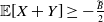
 $c \in [\mathbb{E}[X +Y], \mathbb{E}[X +Y] + h(\mathbb{E}[XZ]) -\mathbb{E}[XZ]]$
is a given constant. Its solution is denoted as
 $I_c$
. Then the second step is to find c such that
 $\mathcal{M}(c, \text{var}[\mathcal{L}_{I_c}(X;\; Y,Z)])$
reaches its minimum.
Using the decomposition formulation of variance, it follows that
 \begin{eqnarray}\text{var}[\mathcal{L}_I(X;\; Y,Z)] =\mathbb{E}[\text{var}[\mathcal{L}_I(X;\; Y,Z) | X]]+ \text{var}[\mathbb{E}[\mathcal{L}_I(X;\; Y,Z) | X]].\end{eqnarray}
For any
 $x \in [0, M]$
, let
 \begin{eqnarray*}&\psi_1(x) =\mathbb{E}[Z | X=x],\qquad\psi_2(x) =\mathbb{E}[Z^2 | X=x],\\[5pt] & \psi_3(x) =\mathbb{E}[Y | X=x],\qquad \bar{\psi}(x) =\mathbb{E}[ZY | X=x].\end{eqnarray*}
From Assumption 1, it follows that both functions
 $\psi_1(x)$
and
 $\psi_2(x)$
are greater than 0 for any
 $x \in [0, M]$
. Note that
 \begin{align*}\text{var}[\mathcal{L}_I(X;\; Y,Z) | X]&= \mathbb{E}[Y^2|X]-\psi_3(X)^2 + I(X)^2 \{\psi_2(X) -\psi_1(X)^2\}\\[5pt] &\quad +2 I(X) \{\psi_3(X) \psi_1(X)- \bar{\psi}(X)\},\end{align*}
it follows that
 \begin{align}\mathbb{E}[\text{var}[\mathcal{L}_I(X;\; Y,Z) | X]]&= \mathbb{E}[Y^2]-\mathbb{E}[\psi_3(X)^2] + \mathbb{E}[I(X)^2 \{\psi_2(X) -\psi_1(X)^2\}]\nonumber\\[5pt] &\quad +2 \mathbb{E}[I(X) \{\psi_3(X) \psi_1(X) - \bar\psi(X)\}].\end{align}
Note that
 \begin{eqnarray}\text{var}[\mathbb{E}[\mathcal{L}_I(X;\; Y,Z) | X]]&=& \text{var}[X] + \mathbb{E}[\psi_3(X)^2] + \mathbb{E}[I(X)^2 \psi_1(X)^2] + \mathbb{E}[2 X \psi_3(X)]\nonumber\\[5pt] && -\; 2\mathbb{E}[X I(X) \psi_1(X)] - 2\mathbb{E}[I(X) \psi_3(X) \psi_1(X)]- (E[Y])^2 \nonumber\\[5pt] &&-\;(\mathbb{E}[I(X) \psi_1(X)])^2 -2\mathbb{E}[X]\mathbb{E}[Y] + 2\mathbb{E}[X] \mathbb{E}[I(X) \psi_1(X)]\nonumber\\[5pt] && +\; 2\mathbb{E}[Y] \mathbb{E}[I(X) \psi_1(X)].\end{eqnarray}
Hence, from (3.2), (3.3), and (3.4), we have that
 \begin{eqnarray*}& &\text{var}[\mathcal{L}_I(X;\; Y,Z)]\nonumber\\[5pt] &=& \text{var}[X] + \text{var}[Y] + 2 \mathbb{E}[X \psi_3(X)]-2 \mathbb{E}[X I(X) \psi_1(X)]\nonumber\\[5pt] & & - \;(\mathbb{E}[I(X) \psi_1(X)])^2 -2 \mathbb{E}[X]\mathbb{E}[Y]+2 \mathbb{E}[X] \mathbb{E}[I(X) \psi_1(X)] \nonumber\\[5pt] &&+\; 2 \mathbb{E}[Y] \mathbb{E}[I(X) \psi_1(X)]+\mathbb{E}[I(X)^2 \psi_2(X)]-2\mathbb{E}[I(X) \bar{\psi}(X)].\end{eqnarray*}
The constraint of (3.1) is equivalent to
 \begin{eqnarray*}&\mathbb{E}[X+Y-I(X)Z +\pi(I)]=\mathbb{E}[X] + \mathbb{E}[Y] -\mathbb{E}[I(X)Z] + \pi(I) =c\\[5pt] &\Rightarrow h(\mathbb{E}[I(X) Z]) -\mathbb{E}[I(X) Z] =c-\mathbb{E}[X] -\mathbb{E}[Y]\\[5pt] &\Rightarrow h(\mathbb{E}[I(X) \psi_1(X)]) -\mathbb{E}[I(X) \psi_1(X)] =c-\mathbb{E}[X] -\mathbb{E}[Y].\end{eqnarray*}
From the conditions that
 $h(0) =0$
and
 $h^{\prime}(x) >1$
for any
 $x \geq 0$
, we have that
 $h(x) -x =c -\mathbb{E}[X] -\mathbb{E}[Y]$
has only one solution for any given
 $c \geq \mathbb{E}[X] +\mathbb{E}[Y]$
, and denote the solution as
 $x^*$
. Obviously,
 $x^* \in [0, \mathbb{E}[XZ]]$
. Therefore, Problem (3.1) is reduced to
 \begin{eqnarray}&&\min\limits_{I \in \mathcal{I}}\mathbb{E}[I(X)^2 \psi_2(X)] - 2\mathbb{E}[X I(X) \psi_1(X)]-2 \mathbb{E}[I(X) \bar\psi(X)], \nonumber\\[5pt] && \text{s.t.} \quad \mathbb{E}[I(X) \psi_1(X)] = x^*.\end{eqnarray}
The Lagrangian dual problem of Problem (3.5) is given by
 \begin{eqnarray}&\min\limits_{I \in \mathcal{I}}\mathbb{E}[I(X)^2 \psi_2(X)] - 2\mathbb{E}[I(X) X \psi_1(X)] -2 \mathbb{E}[I(X) \bar{\psi}(X)]+ \lambda \mathbb{E}[I(X) \psi_1(X)],\end{eqnarray}
with the Lagrangian coefficient
 $\lambda \in \mathbb{R}$
. Let
 $I_1(x) =\frac{x^*}{\mathbb{E}[XZ]} x$
, then
 $I_1 \in \mathcal{I}$
and
 $\mathbb{E}[I_1(X)\psi_1(X)]$
 $=$
 $x^*$
. Hence, the strong duality holds, and we have that solving Problem (3.5) is equivalent to solving Problem (3.6).
The optimal ceded loss function to Problem (3.6) is characterized by the following lemma.
Lemma 1. Let Assumption 1 hold. Define
 \begin{eqnarray*}L(t;\; I^*, \lambda) =\int_t^M \psi_2(x)\left[I^*(x) - \frac{\psi_1(x)}{\psi_2(x)}\left(x-\frac{\lambda}{2}\right) -\frac{\bar{\psi}(x)}{\psi_2(x)}\right] {\textrm{d}} F_X(x).\end{eqnarray*}
Then
 $I^*(x) = \int_0^{x} \eta^*(t) {\textrm{d}} t$
is an optimal solution to Problem (3.6) if and only if
 \[\eta^*(t) = \mathbf{1}_{D_\lambda}(t) + \xi(t) \mathbf{1}_{E_\lambda}(t),\]
where
 \[D_\lambda =\{t\;:\; L(t;\; I^*, \lambda) < 0\}, \quad E_\lambda =\{t\;:\; L(t;\; I^*, \lambda) = 0\},\]
and
 $\xi(t) \in [0, 1]$
is such that
 $I^* \in \mathcal{I}.$
Remark 2.
-
(i) If
 $Z=1, a.s.,$
that is, there only exists background risk and no counterparty risk, then Lemma 1 provides an implicit representation for mean-variance optimal insurance design with background risk and no counterparty risk. This topic has been studied in Chi and Tan (Reference Chi and Tan2021), where they use a constructive approach and some stochastic ordering technique to obtain an explicit representation of the optimal solution. Hence, they do not give the implicit representation.
\[L(t;\; I^*, \lambda)=\int_t^M \left(I^*(x) - x+ \frac{\lambda}{2} -\psi_3(x)\right) {\textrm{d}} F_X(x).\]
-
(ii) If
$Y=0, a.s.,$
the result is reduced to Lemma 3.1 of Boonen and Jiang (Reference Boonen and Jiang2022).


For any fixed
 $\lambda$
, define
 \begin{eqnarray}\phi_\lambda(x)=\frac{\psi_1(x)}{\psi_2(x)}\left(x-\frac{\lambda}{2}\right) +\frac{\bar{\psi}(x)}{\psi_2(x)}.\end{eqnarray}
Assumption 2. Functions
 $\psi_1(x), \psi_2(x),$
and
 $ \bar{\psi}(x)$
are continuously differentiable.
Under Assumption 2, function
 $\phi_\lambda(x)$
is continuous and differentiable over [0, M]. As a result, we can partition [0, M] into some disjoint intervals according to the value of
 $\phi_\lambda^\prime(x)$
such that
 \begin{eqnarray}[0, M] =\bigcup\limits_{i=1}^m S_{i, j_i},\end{eqnarray}
where
 $j_{i} = 1, 2, 3$
is calculated as
 \begin{eqnarray}\phi_{\lambda}^{\prime}(x) \begin{cases} \in (1, \infty), \qquad \text{ if } x \in S_{i, 1},\\[5pt] \in [0, 1], \quad\quad\ \text{ if } x \in S_{i, 2},\\[5pt] \in (\!-\!\infty, 0), \quad \text{ if } x \in S_{i, 3},\end{cases}\end{eqnarray}
and m is a positive integer representing the minimum number required for such a partition. It should be noted that m could be equal to infinity. Let
 $x_{i-1}=\inf\{x \mid x \in S_{i, j_i}\}$
for
 $i \in \{1, 2, \ldots, m\}$
and
 $x_m =M$
, it follows that
 $0=x_0 \leq x_1 \leq \cdots \leq x_{m-1} \leq x_m =M$
. Clearly,
 $x_{i}=\sup\{x \mid x \in S_{i, j_i}\}$
for
 $i \in \{1, 2, \ldots, m\}$
and
 $|j_{i+1} - j_i| =1$
for
 $i \in \{1, 2, \ldots, m-1\}.$
 $\{x_1, x_2, \ldots, x_{m-1}\}$
are called the change points (see Boonen and Jiang, Reference Boonen and Jiang2022). Define the layer-type function as
 \begin{eqnarray*}L_{(a, b]}(x) = (x-a)_+ -(x-b)_+,\quad x \geq 0,\end{eqnarray*}
where
 $0 \leq a \leq b \leq M.$
Finally, we use the constructive approach used in Chi and Tan (Reference Chi and Tan2021) and Boonen and Jiang (Reference Boonen and Jiang2022) to give the optimal parametric ceded loss function on any
 $S_{i, j_i}$
for
 $i \in \{1, 2, \ldots, m\}$
. By the same argument as in the proof of Theorem 3.1 of Boonen and Jiang (Reference Boonen and Jiang2022), one can get Theorem 3 below, hence its proof is omitted.
Theorem 3. Let Assumptions 1 and 2 hold. The optimal ceded loss function to Problem (3.6) is given by
 $I^*(x)$
such that, for
 $x \in S_{i, j_i}$
,
 $i \in \{1, 2, \ldots, m-1\}$
,
-
(i) if
$j_i =1$
, then
$I^*(x) = I^*(x_{i-1}) + L_{(\gamma_{i, 1}, \gamma_{i, 1} +I^*(x_i)-I^*(x_{i-1})]}(x)$
for some
$\gamma_{i, 1} \in [x_{i-1}, x_i]$
, -
(ii) if
$j_i =2$
, then
$I^*(x) =\min\{\max\{\phi_\lambda(x), I^*(x_i) + x- x_i, I^*(x_{i-1})\}, I^*(x_{i-1})+ x-x_{i-1}, I^*({x_i})\},$
-
(iii) if
$j_i =3$
, then
$I^*(x) =I^*(x_{i-1}) + x-x_{i-1} - L_{(\gamma_{i, 3}, \gamma_{i, 3} +x_i-x_{i-1} -(I^*(x_i)-I^*(x_{i-1}))]}(x)$
for some
$\gamma_{i, 3} \in [x_{i-1}, x_i]$
,and for
$x \in S_{m, j_m},$
-
(iv) if
$j_m =1$
, then
$I^*(x) = I^*(x_{m-1}) + (x- \gamma_{m, 1})_+$
for some
$\gamma_{m, 1} \in [x_{m-1}, M]$
, -
(v) if
$j_m=2$
, then
$I^*(x) =\min\{\max\{\phi_\lambda(x), I^*(x_{m-1})\}, I^*(x_{m-1})+ x-x_{m-1}\},$
-
(vi) if
$j_m=3$
, then
$I^*(x) =I^*(x_{m-1}) + L_{(x_{m-1}, \gamma_{m, 3}]}(x)$
for some
$\gamma_{m, 3} \in [x_{m-1}, M]$
.
















Theorem 3 provides an explicit representation of the optimal ceded loss function. Figure 1 shows the form of the optimal ceded loss function
 $I^*$
when
 $m=3$
and
 $[0, M]=S_{1,1} \bigcup S_{2,2} \bigcup S_{3,3}.$
An illustration of an optimal ceded loss function
 $I^*$
solving Problem (7) with
 $[0, M] = S_{1, 1} \bigcup S_{2, 2} \bigcup S_{3, 3}.$

Remark 4. According to the proof of Theorem 3 (see also the proof of Theorem 3.1 of Boonen and Jiang, Reference Boonen and Jiang2022), it is not hard to see that we can also partition [0, M] by
 \begin{eqnarray}[0, M] =\bigcup\limits_{i=1}^m \widetilde{S}_{i, k_i},\end{eqnarray}
where
 $k_i \in \{1, 2, 3\}$
is determined by
 \begin{eqnarray} \phi_{\lambda}^{\prime}(x) \begin{cases}\in [1, \infty), \qquad x \in \widetilde{S}_{i, 1},\\[5pt] \in (0, 1), \qquad\quad x \in \widetilde{S}_{i, 2},\\[5pt] \in (\!-\!\infty, 0],\qquad x \in \widetilde{S}_{i, 3},\end{cases}\end{eqnarray}
and
 $x_{i-1}= \inf\{x \mid x \in \widetilde{S}_{i, k_i}\}$
for
 $i=1,2, \ldots, m$
. For this partition, the results in Theorem 3 still hold.
Remark 5.
-
(i) If
$Z=1, a.s.,$
that is, there only exists background risk and no counterparty risk, then the corresponding partition is where
\begin{eqnarray*}[0, M] = \bigcup\limits_{i=1}^m S_{i, j_i},\end{eqnarray*}
$j_i \in \{1, 2, 3\}$
is determined by From Theorem 3, the optimal solution to Problem (3.6) is given by
\begin{eqnarray*}\psi_3^\prime(x) \begin{cases}\in (0, \infty), \qquad\quad x \in S_{i, 1},\\[5pt] \in [\!-\!1, 0], \qquad\quad x \in S_{i, 2}, \\[5pt] \in (\!-\!\infty, -1), \qquad x \in S_{i, 3}.\end{cases}\end{eqnarray*}
$I^*(x)$
such that, for
$x \in S_{i, j_i}$
,
$i=1, 2, \ldots, m-1$
,



-
(i) if
$j_i =1$
, then
$I^*(x) = I^*(x_{i-1}) + L_{(\gamma_{i, 1}, \gamma_{i, 1} +I^*(x_i)-I^*(x_{i-1})]}(x)$
for some
$\gamma_{i, 1} \in [x_{i-1}, x_i]$
, -
(ii) if
$j_i =2$
, then
$I^*(x) =\min\{\max\{x+\psi_3(x) -\frac{\lambda}{2}, I^*(x_i) + x- x_i, I^*(x_{i-1})\}, I^*(x_{i-1})+ x-x_{i-1}, I^*({x_i})\},$
-
(iii) if
$j_i =3$
, then
$I^*(x) =I^*(x_{i-1}) + x-x_{i-1} - L_{(\gamma_{i, 3}, \gamma_{i, 3} +x_i-x_{i-1} -(I^*(x_i)-I^*(x_{i-1}))]}(x)$
for some
$\gamma_{i, 3} \in [x_{i-1}, x_i]$
,and for
$x \in S_{m, j_m},$
-
(iv) if
$j_m =1$
, then
$I^*(x) = I^*(x_{m-1}) + (x- \gamma_{m, 1})_+$
for some
$\gamma_{m, 1} \in [x_{m-1}, M]$
, -
(v) if
$j_m=2$
, then
$I^*(x) =\min\{\max\{x+\psi_3(x) -\frac{\lambda}{2}, I^*(x_{m-1})\}, I^*(x_{m-1})+ x-x_{m-1}\},$
-
(vi) if
$j_m=3$
, then
$I^*(x) =I^*(x_{m-1}) + L_{(x_{m-1}, \gamma_{m, 3}]}(x)$
for some
$\gamma_{m, 3} \in [x_{m-1}, M]$
.This result is similar to Chi and Tan (Reference Chi and Tan2021, Theorem 3.1), where the construction approach and some stochastic ordering technique are used. Here, we use the construction approach and Lemma 2.1 about the implicit characterization of the optimal solution.













-
(i) If
$Y=0, a.s.,$
then Theorem 3 is reduced to Boonen and Jiang (Reference Boonen and Jiang2022, Theorem 3.1).

As the mean-variance objective is quite related to the quadratic utility objective, in what follows, we tend to give a characterization of their relationship. Let
 $\mathcal{M}(x_1, x_2) = x_1+ \frac{B}{2}x_2$
for some
 $B >0$
, then Problem (2.1) is reduced to the traditional mean-variance optimization
 \begin{eqnarray}\min\limits_{I \in \mathcal{I}}\mathbb{E}[\mathcal{L}_I(X;\; Y,Z)]+ \frac{B}{2} \text{var}[\mathcal{L}_I(X;\; Y,Z)].\end{eqnarray}
The optimal insurance problem with counterparty and additive background risk in the expected utility framework is given by
 \begin{align}\max\limits_{I \in \mathcal{I}} \mathbb{E}[u(w -\mathcal{L}_I(X;\; Y,Z))].\end{align}
Let
 $w =0$
and take a quadratic utility
 $u(x) = x -\frac{\widetilde{B}}{2} x^2$
with some
 $\widetilde{B} >0$
in (3.13), then Problem (3.13) is reduced to
 \begin{align} \max\limits_{I \in \mathcal{I}}\mathbb{E}[\!-\!\mathcal{L}_I(X;\; Y,Z) -\frac{\widetilde{B}}{2} \mathcal{L}_I^2(X;\; Y,Z)].\end{align}
It is not hard to prove that the solutions to Problem (3.12) and to Problem (3.14) are the same under certain conditions.



4. Some special dependence structures
In this section, we focus on some special cases: when one of insurable risk X, background risk Y, and counterparty risk Z is independent of the other two; when both counterparty risk Z and background risk Y are functions of insurable risk X.
4.1. X is independent of Y and Z
We first suppose that both background risk Y and counterparty risk Z are independent of insurable risk X. As we know, when background and insurable risks are independent of each other and there exists no counterparty risk, stop-loss insurance has been proved to be optimal in Proposition 4.1 of Chi and Tan (Reference Chi and Tan2021). When counterparty and insurable risks are independent of each other and there exists no background risk, Corollary 4.1 of Boonen and Jiang (Reference Boonen and Jiang2022) also proves that the optimal strategy is stop-loss insurance. A natural question is whether stop-loss insurance is still optimal when there exist both background and counterparty risks and both of them are independent of insurable risk. Proposition 7 below gives a positive answer to this question and Figure 2 below provides the graph of the corresponding optimal solution.
Y and Z are independent of X.

Proposition 7. Suppose that both Y and Z are independent of X, then stop-loss insurance is optimal to Problem (2.1), that is, the optimal ceded loss function is
 $I^*(x) =(x-d)_+$
for some
 $d \geq 0$
.
Remark 8.
-
(i) The result in Proposition 7 is consistent with Chi and Wei (Reference Chi and Wei2020, Proposition 5.1), where they show that stop-loss insurance is optimal if Y is independent of X in the expected utility framework without counterparty risk.
-
(ii) Under the condition that Y and Z are independent of X, Problem (3.6) is reduced to
(4.1)From Proposition 7 and (4.1), we obtain that the dependence structure between Y and Z does not affect the form of the optimal solution but may have an impact on the optimal retention level d.
\begin{eqnarray}&\min\limits_{I \in \mathcal{I}}\mathbb{E}[Z^2]\mathbb{E}[I(X)^2] - 2 \mathbb{E}[Z] \mathbb{E}[XI(X)] -2 \mathbb{E}[ZY] \mathbb{E}[I(X)]+ \lambda \mathbb{E}[Z]\mathbb{E}[I(X)].\end{eqnarray}

 $Y \uparrow_{SPED} X$
and Z is independent of X.

4.2. Z is independent of X and Y
The next Proposition 9 gives the optimal ceded loss functions when Z is independent of X and Y. The graphs of the corresponding optimal solutions are given by Figures 3–7, respectively.
Z is independent of X and
 $(X+Y) \downarrow_{SNED} X$
.

Z is independent of X,
 $Y \downarrow_{SNED} X$
,
 $(X+Y) \uparrow_{SPED} X$
and
 $\psi_3^{\prime\prime}(x) \geq 0$
.

Z is independent of X,
 $Y \downarrow_{SNED} X$
,
 $(X+Y) \uparrow_{SPED} X$
,
 $\psi_3^{\prime\prime}(x) \leq 0$
and
 $\hat{x} =M$
.

Z is independent of X,
 $Y \downarrow_{SNED} X$
,
 $(X+Y) \uparrow_{SPED} X$
and
 $\psi_3^{\prime\prime}(x) \leq 0$
and
 $\hat{x} < M$
.

Proposition 9. Suppose that counterparty risk Z is independent of background risk Y and insurable risk X.
-
(i) If
$Y \uparrow_{SPED} X$
, then stop-loss insurance is optimal for Problem (2.1). -
(ii) If
$(X+Y)\downarrow_{SNED} X$
, then the optimal ceded loss function to Problem (2.1) is given by
$I^*(x) =x \wedge c$
for some
$c \in [0, M]$
. -
(iii) Assume that
$Y \downarrow_{SNED} X$
,
$(X+Y) \uparrow_{SPED} X$
, and
$\psi_3^{\prime\prime}(x)\geq 0$
for any
$x \in [0, M]$
, then the optimal solution to Problem (2.1) is given by (4.2)for some
\begin{eqnarray}I^*(x)=\left\{\begin{array}{l@{\quad}l}\min\{\max\{\phi_\lambda(x), a + x -\widetilde{x}, 0\}, x, a\}, & 0 \leq x \leq \widetilde{x},\\[5pt] a +(x-b)_+, & x >\widetilde{x},\end{array}\right. \end{eqnarray}
$\lambda \in \mathbb{R}$
,
$0 \leq a \leq \widetilde{x} \leq b \leq M$
and
$\widetilde{x} = \inf\left\{x \in [0, M]\;:\; \psi_3^\prime(x) > \frac{\mathbb{E}[Z^2]}{\mathbb{E}[Z]} -1\right\}$
.
-
(iv) Assume that
$Y \downarrow_{SNED} X$
,
$(X+Y) \uparrow_{SPED} X$
, and
$\psi_3^{\prime\prime}(x) \leq 0$
for any
$x \in [0, M]$
. Denote
$\hat{x} = \sup\left\{x \in [0, M] \;:\; \psi_3^\prime(x) > \frac{\mathbb{E}[Z^2]}{\mathbb{E}[Z]} -1\right\}$
.-
(a) If
$\hat{x}=M$
, then the optimal solution to Problem (2.1) is given by
$I^*(x) =(x-d)_+$
for some
$d \geq 0$
. -
(b) If
$\hat{x}<M$
, then the optimal solution to Problem (2.1) is characterized by (4.3)where
\begin{eqnarray}I^*(x)=\begin{cases}(x-a)_+ -(x-a-b)_+, \qquad 0 \leq x < \hat{x},\\[5pt] \min\{\max\{\phi_\lambda(x), b\}, b+x -\hat{x}\}, \quad x >\hat{x},\end{cases}\end{eqnarray}
$\lambda \in \mathbb{R}$
,
$a \geq 0$
,
$b \geq 0$
and
$0 \leq a + b \leq \hat{x}$
.
-















Remark 10. When insurable risk X, counterparty risk Z, and background risk Y are pairwise independent, then the conditions of part (i), (iii), and (iv) in Proposition 9 all hold. It is not hard to see that stop-loss insurance is optimal for Problem (2.1) no matter using the results of part (i), (iii), or (iv) in Proposition 9. That is also consistent with Proposition 7.
Remark 11.
-
(i) Under the conditions that counterparty risk does not exist and
$Y \uparrow_{SPED} X$
, part (i) of Chi and Tan (Reference Chi and Tan2021, Proposition 4.1) shows that the optimal strategy is stop-loss insurance. Part (i) of Proposition 9 proves that the optimal strategy is still stop-loss insurance in spite of the existing of counterparty risk. We conclude that under the condition that
$Y \uparrow_{SPED} X$
, stop-loss insurance is an optimal strategy no matter there exists counterparty risk or not. That is, counterparty risk does not affect the form of the optimal solution but may have an effect on the optimal deductible. -
(ii) If
$(X + Y) \downarrow_{SNED}X$
and
$Z=1, a.s.$
, part (iii) of Chi and Tan (Reference Chi and Tan2021, Proposition 4.1) shows that the optimal strategy is no insurance. Part (ii) of Proposition 9 proves that
$I^*(x) = x \wedge c$
is optimal as the presence of counterparty risk. Note that
$I^*(x) = x \wedge 0$
is just no insurance. Hence, in this sense, we can see that counterparty risk does not affect the form of the optimal solution but has an effect on the value of truncation c. -
(iii) Let
$h(x) =(1 +\theta) x$
and
$Z=1, a.s.$
in Problem (3.14), then from Chi and Wei (Reference Chi and Wei2020, Corollary 3.4), it follows that
$I^*(x) =0$
over
$[0, VaR_{\frac{\theta}{1+\theta}}(X)]$
Footnote 3 if
$I^*(x)$
is an optimal solution to Problem (3.14). However, as the presence of counterparty risk, this property may not hold as shown by part (ii) of Proposition 9, and the insured chooses full insurance for small loss x when
$X +Y$
has SNED with X. -
(iv) Let
$h(x) =(1 +\theta) x$
and
$Z=1, a.s.$
in Problem (3.14), Chi and Wei (Reference Chi and Wei2020, Proposition 6.2, Corollary 6.4) provide the optimal solution to Problem (3.14) under the conditions
$(X +Y) \uparrow_{st} X$
and
$Y \downarrow_{st} X$
. As
$(X +Y) \uparrow_{st} X$
implies
$(X +Y) \uparrow_{SPED} X$
and
$Y \downarrow_{st} X$
implies
$Y \downarrow_{SNED} X$
. Hence, part (iii) of Proposition 9 provides another method to obtain the optimal solution. Chi and Wei (Reference Chi and Wei2020) also study some other dependence structures including positively (negatively) quadrant dependence and right tail increasingness. As we know, there is no implication relationship between SPED (SNED) and positively (negatively) quadrant dependence or right tail increasingness. In this sense, Proposition 9 has made some supplements for Problem (3.14) by considering strong expectation dependence structure and extending the expected value principle to a wide class of principles.














4.3. Y is independent of X and Z
Lemma 12 below gives some properties of the optimal ceded loss function when Y is independent of X and Z.
Lemma 12. Suppose that background risk Y is independent of insurable and counterparty risk X and Z. Then for any
 $\lambda > 2\mathbb{E}[Y]$
, the optimal solution to Problem (3.6) over
 $[0, \frac{\lambda}{2} - \mathbb{E}[Y]]$
is
 $I^*(x) =(x-d)_+$
for some
 $d \in [0, \frac{\lambda}{2} - \mathbb{E}[Y]]$
.
Lemma 12 indicates that stop-loss function is optimal in a neighborhood of 0 if
 $\lambda > 2 \mathbb{E}[Y]$
under the condition that Y is independent of X and Z. In order to obtain the optimal solution to Problem (2.1) when Y is independent of X and Z, more conditions should be given. Proposition 13 below, by adding the condition that Z is a decreasing function of X, provides the optimal solution to Problem (2.1) for the case that Y is independent of X and Z. The graph of the corresponding optimal solution is given by Figure 8.
Y is independent of X and
 $Z=g(X).$

Proposition 13. Suppose that background risk Y and insurable risk X are independent of each other and
 $Z=g(X)$
. Further assume that g is a decreasing function satisfying the following assumption: There exists an
 $x_1 \in [0, M]$
such that
 $g(x) =1$
for any
 $x \in (0, x_1]$
, and
 $g(x) <1 $
for any
 $x \in (x_1, M]$
, and
 $g(M) > 0$
. Then there exist constants
 $a_1, a_2, a_3$
satisfying
 $0 \leq a_1 \leq a_2 \leq a_3 \leq M$
, such that
 \begin{eqnarray}I^*(x) =(\!\min\{x, a_2\} -a_1)_+ + (x-a_3)_+ \end{eqnarray}
is an optimal solution to Problem (2.1).
Remark 14. The form of the optimal solution is the same as that in Corollary 4.2 of Boonen and Jiang (Reference Boonen and Jiang2022), where background risk does not exist.
4.4. Both Y and Z are functions of X
Lemma 15 below gives some properties of the optimal ceded loss function when both Y and Z are functions of X.
Lemma 15. Suppose that both counterparty risk Z and background risk Y are functions of insurable risk X, that is,
 $Z = g_1(X)$
with
 $g_1\;:\; [0, M] \rightarrow [0, 1]$
and
 $Y= g_2(X)$
.
-
(i) If
$x+ g_2(x)$
is increasing, let then the optimal ceded loss function over
\begin{eqnarray*}x_0 = \inf\left\{x \in [0, M]\;:\; x+g_2(x) \geq \frac{\lambda}{2}\right\},\end{eqnarray*}
$[0, x_0]$
is provided by
$I^*(x) =(x-d)_+$
for some
$d \in [0, x_0]$
.
-
(ii) If
$x+ g_2(x)$
is decreasing, let then the optimal ceded loss function over
\begin{eqnarray*}\bar{x}_0 = \inf\left\{x \in [0, M]\;:\; x+g_2(x) - \frac{\lambda}{2} \leq 1\right\},\end{eqnarray*}
$[0, \bar{x}_0]$
is provided by
$I^*(x) =x \wedge d$
for some
$d \in [0, \bar{x}_0]$
.





Remark 16. Let
 $Y=0, a.s.$
in Lemma 12 or let
 $g_2(x) =0$
in Lemma 15, then the corresponding results are reduced to Proposition 3.1 of Boonen and Jiang (Reference Boonen and Jiang2022).
Lemma 15 gives the optimal solution in a neighborhood of 0, which is stop-loss insurance or full insurance. By making use of this lemma and adding more conditions on the relationship between Y and X, we obtain Proposition 17, which provides the optimal ceded loss function for this case. Figures 9 and 10 give the graphs of the corresponding optimal solutions.
 $Z=g_1(X)$
,
 $Y=g_2(X)$
with
 $g_2^\prime(x) \geq 0.$

 $Z=g_1(X)$
,
 $Y=g_2(X)$
with
 $-1 \leq g_2^\prime(x) \leq 0.$

Proposition 17. Suppose that both background risk Y and counterparty risk Z are functions of insurable risk X, that is,
 $Z =g_1(X)$
and
 $Y =g_2(X)$
. Further assume that
 $g_1$
is a decreasing function satisfying the following assumption: There exists an
 $x_1 \in [0, M]$
such that
 $g_1(x) =1$
for any
 $x \in (0, x_1]$
, and
 $g_1(x) <1 $
for any
 $x \in (x_1, M]$
, and
 $g_1(M) > 0$
.
-
(i) If
$g_2(x)$
is an increasing function, then the optimal solution to Problem (2.1) is characterized as (4.5)where
\begin{eqnarray}I^*(x) =(\!\min\{x, a_2\} -a_1)_+ + (x-a_3)_+, \end{eqnarray}
$0 \leq a_1 \leq a_2 \leq a_3 \leq M$
.
-
(ii) Suppose that
$g_2(x)$
is a decreasing function and
$x+g_2(x)$
is an increasing function. Then the optimal solution to Problem (2.1) is one of the following two functions: (4.6)or
\begin{eqnarray}I^*(x) =(\!\min\{x, x_0\} -a_1)_+ + (x-a_2)_+, \end{eqnarray}
(4.7)for some
\begin{eqnarray}I^*(x) = \begin{cases}(x-d_1)_+, \quad x \in [0, x_0],\\[5pt] \min\{\max\{x+g_2(x) - \frac{\lambda}{2}, d_2 + x-x_1, x_0 -d_1\}, x-d_1, d_2\}, x \in (x_0, x_1],\\[5pt] d_2 + (x-d_3)_+, \quad x \in (x_1, M],\end{cases} \end{eqnarray}
$\lambda \in \mathbb{R}$
,
$0 \leq a_1 \leq x_0 \leq a_2$
,
$0 \leq d_1 \leq x_0 \leq d_1 +d_2\leq x_1\leq d_3,$
where
\begin{eqnarray*}x_0 = \inf\left\{x \in [0, M]\;:\; x+g_2(x) \geq \frac{\lambda}{2}\right\}.\end{eqnarray*}








Remark 18.
-
(i) Under the condition that
$Y =g_2(X)$
,
$Y \uparrow_{SPED} X$
if and only if
$g_2(x)$
is increasing, and
$Y \downarrow_{SNED} X$
if and only if
$g_2(x)$
is decreasing. In other words, Proposition 17 considers a special form of strong expectation dependence. -
(ii) As we know, if Y is independent of X, then
$Y \uparrow_{SPED} X$
. Hence, Proposition 13 can also be obtained from Proposition 17.


5. Examples
In this section, we give a numerical example to illustrate the main result of this paper and analyze the impact of counterparty risk Z on the optimal insurance treaties.
Suppose that the traditional mean-variance optimization and the expectation premium principle are used in this example. That is,
 $\mathcal{M}(x_1, x_2)$
 $=$
 $x_1+\frac{B}{2} x_2$
with coefficient
 $B > 0$
, and
 $\pi(I) = (1+\theta)\mathbb{E}[I(X) Z]$
with
 $\theta > 0.$
Assume that Z is independent of Y and X, and
 $Y \uparrow_{SPED} X$
. By calculating, we have that
 \begin{eqnarray*}\mathbb{E}\!\left[\mathcal{L}_{I}(X;\; Y, Z)\right]&=& \mathbb{E}[X] + \mathbb{E}[Y] + \theta \mathbb{E}[Z]\mathbb{E}[I(X)],\\[5pt] \text{var}[\mathcal{L}_{I}(X;\; Y, Z)]&=&\text{var}[X] + \text{var}[Y] +2 \mathbb{E}[XY] -2\mathbb{E}[X] \mathbb{E}[Y]\nonumber\\[5pt] &&-\;2\mathbb{E}[XI(X)]\mathbb{E}[Z] - \mathbb{E}[I(X)]^2\mathbb{E}[Z]^2\nonumber\\[5pt] &&+\; 2 \mathbb{E}[X]\mathbb{E}[Z]\mathbb{E}[I(X)] + 2\mathbb{E}[Y]\mathbb{E}[Z]\mathbb{E}[I(X)]\nonumber\\[5pt] &&+\; \mathbb{E}[Z^2]\mathbb{E}[I^2(X)] -2\mathbb{E}[Z]\mathbb{E}[I(X) E[Y|X]].\end{eqnarray*}
Hence, our goal is to minimize
 \begin{eqnarray}&&\mathcal{M}(\mathbb{E}[\mathcal{L}_{I}(X;\; Y, Z)], \text{var}[\mathcal{L}_{I}(X;\; Y, Z)])\nonumber\\[5pt] &=&\mathbb{E}[X]+\mathbb{E}[Y]+\frac{B}{2}\left(\text{var}[X] +\text{var}[Y] + 2 \mathbb{E}[XY] -2\mathbb{E}[X]\mathbb{E}[Y]\right)\nonumber\\[5pt] &&+\left\{\theta \mathbb{E}[Z] + B\mathbb{E}[X]\mathbb{E}[Z] + B\mathbb{E}[Y]\mathbb{E}[Z]\right\} \mathbb{E}[I(X)] -B\mathbb{E}[Z] \mathbb{E}[XI(X)]\nonumber\\[5pt] &&-\;B\mathbb{E}[Z]\mathbb{E}[I(X)\mathbb{E}[Y|X]]-\frac{B}{2}\mathbb{E}[I(X)]^2 \mathbb{E}[Z]^2 +\frac{B}{2}\mathbb{E}[Z^2]\mathbb{E}[I^2(X)].\end{eqnarray}
Suppose that both X and Y follow exponential distributions with the same mean of
 $\frac{1}{\gamma}$
, and the copula function between X and Y is given by
 \begin{eqnarray*}C_\alpha(u, v) = uv +\alpha uv(1-u)(1-v),\end{eqnarray*}
where
 $\alpha \in [0, 1]$
. It is not hard to see that the joint distribution function of (X, Y) is
 \begin{eqnarray*}F(x, y)=(1-e^{-\gamma x})(1-e^{-\gamma y})(1+ \alpha e^{-\gamma x}e^{-\gamma y}),\quad x \geq 0, y \geq 0,\end{eqnarray*}
and the joint density function of (X, Y) is
 \begin{eqnarray*}f(x, y)= \gamma^2 e^{-\gamma x}e^{-\gamma y} + \alpha \gamma^2 (2 e^{-2 \gamma x}- e^{-\gamma x})(2 e^{-2 \gamma y} -e^{-\gamma y}),\quad x \geq 0, y \geq 0.\end{eqnarray*}
Given
 $X =x >0$
, the conditional density function of Y is
 \begin{eqnarray*}f_{Y|X}(y|x) = \gamma e^{-\gamma y} + \alpha \gamma (2 e^{-\gamma x}- 1)(2 e^{-2 \gamma y} -e^{-\gamma y}),\quad y \geq 0.\end{eqnarray*}
Hence, the conditional expectation of Y given
 $X =x >0$
is
 \begin{eqnarray*}\mathbb{E}[Y|X=x] =\frac{1}{\gamma} -\frac{\alpha (2e^{-\gamma x} -1)}{2 \gamma},\end{eqnarray*}
which implies that
 $Y \uparrow_{SPED} X$
.
The effects of
 $x\;:\!=\;\mathbb{E}[Z]$
and
 $y\;:\!=\;\mathbb{E}[Z^2]$
on the optimal ceded loss function for
 $\gamma =0.4$
,
 $\theta =0.2$
,
 $B=0.01,$
and
 $\alpha =0.2.$

From Proposition 9, it follows that stop-loss insurance is optimal. For any given
 $d \geq 0$
, denote
 $I_d(x)\;:\!=\;(x-d)_+$
. By calculating, we have that
 \begin{eqnarray*}&&\mathbb{E}[X I_d(X)] =[d^2 +\frac{(\gamma d+1)(2-d)}{\gamma^2}] e^{-\gamma d},\qquad\ \mathbb{E}[I_d(X)]= \frac{1}{\gamma}e^{-\gamma d},\\[5pt] &&\mathbb{E}[I_d(X) \mathbb{E}[Y|X]] =\frac{2+\alpha}{2 \gamma^2} e^{-\gamma d} -\frac{\alpha}{4 \gamma^2} e^{-2 \gamma d},\qquad \mathbb{E}[I_d^2(X)] = \frac{2}{\gamma^2}e^{-\gamma d}.\end{eqnarray*}
Hence, minimizing (5.1) is equivalent to solving the optimization problem (5.2):
 \begin{eqnarray}&&\min\limits_{0 \leq d <\infty}\left(\left(\frac{\theta}{\gamma} + B\left[\frac{\mathbb{E}[X]+\mathbb{E}[Y]}{\gamma} -d^2 - \frac{(\gamma d+1)(2-d)}{\gamma^2} -\frac{2+\alpha}{2 \gamma^2}\right]\right) \mathbb{E}[Z] \right.\nonumber\\[5pt] &&\qquad\quad \left.+\; \frac{B \mathbb{E}[Z^2]}{\gamma^2}\right) e^{-\gamma d}+\left(\frac{B \alpha}{4 \gamma^2} \mathbb{E}[Z] - \frac{B \mathbb{E}[Z]^2}{2 \gamma^2}\right)e^{-2 \gamma d}.\end{eqnarray}
From (5.2), we can see that the impact of counterparty risk on optimal insurance strategies is through its expectation and variance. Hence, we take different
 $\mathbb{E}[Z]$
and
 $\mathbb{E}[Z^2]$
to study the impact. Obviously,
 $(\mathbb{E}[Z])^2 \leq \mathbb{E}[Z^2] \leq \mathbb{E}[Z]$
. When let
 $\gamma$
go from 0.0001 to 0.1 at 0.001 intervals, we find that full insurance is always optimal no matter whether there exists counterparty risk or not. When let
 $\gamma$
go from 12 to 100 at 1 intervals, we find that any element
 $d \in [0.99, M]$
is optimal no matter whether there exists counterparty risk or not. Meanwhile, under different
 $\mathbb{E}[Z]$
and
 $\mathbb{E}[Z^2]$
, the optimal deductible
 $d^*$
is given in Table 1 by setting
 $\gamma =0.4, \theta =0.2$
,
 $B=0.01,$
and
 $\alpha =0.2$
. From the above findings and Table 1, we have the following observations.
-
(a) When the expectation of the insurable risk is large enough (i.e.,
$\gamma \leq 0.1$
), full insurance is always optimal (i.e.,
$d^* =0$
is an optimal solution) no matter whether there exists counterparty risk or not. -
(b) When the expectation of the insurable risk is small enough (i.e.,
$\gamma \geq 12$
), any element d belonging to
$[0.99, M]$
is optimal no matter whether there exists counterparty risk or not. -
(c) When the expectation of the insurable risk is large enough or small enough, the counterparty risk has no effects on the optimal deductible
$d^*$
. -
(d) When the expectation of the insurable risk is moderate (i.e.,
$\gamma \in (0.1, 12)$
), for a given
$\mathbb{E}[Z^2]$
, the retention point
$d^*$
is increasing as the increasing of
$\mathbb{E}[Z]$
. For a given
$\mathbb{E}[Z]$
,
$d^*$
is decreasing as the increasing of
$\mathbb{E}[Z^2]$
. The retention point is largest when there is no counterparty risk.


6. Conclusions
We study optimal insurance with counterparty and background risk by minimizing the mean-variance of the insured’s loss. The insurance premium is calculated as a function of the expected indemnity. Irrespective of the dependence among insurable, counterparty, and background risk, we give an implicit characterization of the optimal solution by utilizing the conditional variance formula and the calculus of variations. We also obtain an explicit structure of the optimal ceded loss function by using its implicit characterization. We further present a much simpler solution under some special dependence structures among insurable, counterparty, and background risk. We find that stop-loss insurance is optimal if both counterparty and background risk are independent of insurable risk. Under the condition that counterparty risk is independent of background and insurable risk and background risk has SPED with insurable risk, we find that stop-loss insurance is an optimal strategy no matter there exists counterparty risk or not. Under the conditions that counterparty risk is independent of background and insurable risk and the sum of insurable and background risk has SNED with insurable risk, we find that full insurance with truncation is optimal and counterparty risk does not affect the form of the optimal solution but has an effect on the value of truncation. Finally, we present an illustrating numerical example to analyze the effects of counterparty risk on the optimal insurance.
Acknowledgments
The author is very grateful to the editors and the anonymous referees for their comments and suggestions, which led to the present greatly improved version of the manuscript. Yanhong Chen acknowledges the National Natural Science Foundation of China (No. 11901184) and the Natural Science Foundation of Hunan Province (No. 2020JJ5025).
A. Proofs of main results
A.1. Proof of Lemma 1
Proof. We use the calculus of variations approach to prove this lemma. Denote
 \begin{eqnarray*}J(I) &\;:\!=\;& \mathbb{E}[(I(X))^2 \psi_2(X)] - 2\mathbb{E}[I(X) X \psi_1(X)] \\[5pt] &&-\;2 \mathbb{E}[I(X) \bar{\psi}(X)]+ \lambda \mathbb{E}[I(X) \psi_1(X)].\end{eqnarray*}
If
 $I^* \in \mathcal{I}$
is an optimal solution to Problem (3.6), then for any given
 $I \in \mathcal{I}$
, it follows that
 $\varepsilon I^* + (1-\varepsilon) I \in \mathcal{I}$
for any
 $\varepsilon \in [0, 1]$
. The first- and second-order derivatives of
 $J(\varepsilon I^* + (1-\varepsilon) I)$
with respect to
 $\varepsilon$
are
 \begin{eqnarray*} \frac{{\textrm{d}} J(\varepsilon I^* + (1-\varepsilon) I)}{{\textrm{d}} \varepsilon} &=&\mathbb{E}[2\left(\varepsilon I^*(X) + (1-\varepsilon) I(X)\right)\psi_2(X) \left(I^*(X) - I(X)\right)]\\[5pt] &&-\;2\mathbb{E}[X \left(I^*(X) -I(X)\right) \psi_1(X)] -2\mathbb{E}[\!\left(I^*(X) -I(X)\right) \bar{\psi}(X)]\\[5pt] && +\; \lambda \mathbb{E}[\!\left(I^*(X) - I(X)\right) \psi_1(X)],\\[5pt] \frac{{\textrm{d}}^2 J(\varepsilon I^* + (1-\varepsilon) I)}{{\textrm{d}} \varepsilon^2} &=&\mathbb{E}[2 (I^*(X) - I(X))^2 \psi_2(X)] \geq 0. \end{eqnarray*}
Therefore,
 $J(\varepsilon I^* + (1-\varepsilon) I)$
is convex with respect to
 $\varepsilon$
. It reaches its minimum at
 $\varepsilon =1$
and then
 $\frac{{\textrm{d}} J(\varepsilon I^* + (1-\varepsilon) I)}{{\textrm{d}} \varepsilon}|_{\varepsilon=1} \leq 0$
, which yields that
 \begin{eqnarray*} \mathbb{E}[2 I^*(X)I^*(X) \psi_2(X)] -2\mathbb{E}[X I^*(X)\psi_1(X)] -2\mathbb{E}[I^*(X)\bar{\psi}(X)] + \lambda \mathbb{E}[I^*(X)\psi_1(X)]\\[5pt] \quad \leq \mathbb{E}[2 I^*(X)I(X) \psi_2(X)] -2\mathbb{E}[X I(X)\psi_1(X)] -2\mathbb{E}[I(X)\bar{\psi}(X)] + \lambda \mathbb{E}[I(X)\psi_1(X)]. \end{eqnarray*}
Hence,
 \begin{eqnarray*} I^* &=& \mathop{\arg\min}_{I \in \mathcal{I}} \mathbb{E}[2 I^*(X)I(X) \psi_2(X)] -2\mathbb{E}[X I(X)\psi_1(X)]\\[5pt] & & -\;2\mathbb{E}[I(X)\bar{\psi}(X)] + \lambda \mathbb{E}[I(X)\psi_1(X)]. \end{eqnarray*}
Note that
 \begin{eqnarray} &&2\mathbb{E}[I^*(X)I(X) \psi_2(X)] -2\mathbb{E}[X I(X)\psi_1(X)] -2\mathbb{E}[I(X)\bar{\psi}(X)] + \lambda \mathbb{E}[I(X)\psi_1(X)]\nonumber\\[5pt] &=&\int_0^M \left(2 I^*(x) \psi_2(x) -2 x \psi_1(x) -2\bar{\psi}(x) + \lambda \psi_1(x)\right) \left(\int_0^x \eta(t) {\textrm{d}} t\right) {\textrm{d}} F_X(x)\nonumber\\[5pt] &=&\int_0^M \left\{\int_t^M \left(2 I^*(x) \psi_2(x) -2 x \psi_1(x) -2\bar{\psi}(x) + \lambda \psi_1(x)\right) {\textrm{d}} F_X(x)\right\} \eta(t) {\textrm{d}} t \nonumber\\[5pt] &=&\int_0^M \int_t^M 2 \psi_2(x)\left(I^*(x) - \frac{\psi_1(x)}{\psi_2(x)}\left(x -\frac{\lambda}{2}\right) -\frac{\bar{\psi}(x)}{\psi_2(x)}\right) {\textrm{d}} F_X(x) \eta(t) {\textrm{d}} t, \end{eqnarray}
where the second equation follows from the Fubini’s theorem. Hence, in order to minimize (A1), we need and only need to minimize its integrand function element-wisely. Therefore,
 \begin{eqnarray*} \eta^*(t)=\begin{cases} 1, \qquad\quad \text{if } L(t;\; I^*, \lambda) < 0,\\[5pt] \xi(t), \qquad \text{if } L(t;\; I^*, \lambda) =0,\\[5pt] 0, \qquad\quad \text{if } L(t;\; I^*, \lambda) > 0, \end{cases} \end{eqnarray*}
where
 $L(t;\; I^*, \lambda) =\int_t^M \psi_2(x)\left[I^*(x) - \frac{\psi_1(x)}{\psi_2(x)}\left(x-\frac{\lambda}{2}\right) -\frac{\bar{\psi}(x)}{\psi_2(x)}\right] {\textrm{d}} F_X(x)$
and
 $\xi(t) \in [0, 1]$
such that
 $\eta^* \in \hat{\mathcal{I}}.$
This finishes the proof.
A.2. Proof of Proposition 7
Proof. As both Y and Z are independent of X, we have that
 \begin{eqnarray*}\phi_\lambda(x)= \frac{\mathbb{E}[Z]}{\mathbb{E}[Z^2]}\left(x- \frac{\lambda}{2}\right)+ \frac{\mathbb{E}[YZ]}{\mathbb{E}[Z^2]},\end{eqnarray*}
which implies that
 \begin{eqnarray*}\phi_\lambda^\prime(x)= \frac{\mathbb{E}[Z]}{\mathbb{E}[Z^2]} > 1\end{eqnarray*}
for any
 $x \geq 0.$
Hence, from Theorem 3, it follows that the optimal ceded loss function to Problem (2.1) is given by
 \begin{eqnarray*}I^*(x) =(x-d)_+, \qquad x \geq 0,\end{eqnarray*}
for some
 $d \geq 0$
. This ends the proof.
A.3. Proof of Proposition 9
Proof. Assume that Z is independent of X and Y, then we have that
 \begin{eqnarray*}\phi_\lambda(x)= \frac{\mathbb{E}[Z]}{\mathbb{E}[Z^2]}\left(x- \frac{\lambda}{2}\right)+ \frac{\mathbb{E}[Z]}{\mathbb{E}[Z^2]}\psi_3(x),\end{eqnarray*}
and
 \begin{eqnarray*}\phi_\lambda^\prime(x)= \frac{\mathbb{E}[Z]}{\mathbb{E}[Z^2]}\left(1 + \psi_3^\prime(x)\right).\end{eqnarray*}
Hence,
 \begin{eqnarray*}&&\phi_\lambda^\prime(x) > 1\Leftrightarrow \psi_3^\prime(x) > \frac{\mathbb{E}[Z^2]}{\mathbb{E}[Z]} -1,\\[5pt] &&\phi_\lambda^\prime(x) <0 \Leftrightarrow \psi_3^\prime(x) < -1,\\[5pt] && 0 \leq\phi_\lambda^\prime(x)\leq 1 \Leftrightarrow -1 \leq \psi_3^\prime(x) \leq \frac{\mathbb{E}[Z^2]}{\mathbb{E}[Z]} -1.\end{eqnarray*}
-
(i) If
$Y \uparrow_{SPED} X$
, then
$\psi_3^\prime(x) \geq 0$
for any
$x \geq 0$
, which yields that
$\phi_\lambda^\prime(x) > 1$
for any
$x \geq 0$
. Hence, from Theorem 3, the optimal solution to Problem (2.1) is given by
$I^*(x) =(x-d)_+$
for some
$d \geq 0.$
-
(ii) Assume that
$(X+Y) \downarrow_{SNED} X$
, then
$\psi_3^\prime(x) \leq -1$
for any
$x \geq 0$
, which yields that
$\phi_\lambda^\prime(x) \leq 0$
for any
$x \geq 0$
. Hence, from Theorem 3 and Remark 4, we have that the optimal solution to Problem (2.1) is given by
$I^*(x) =x \wedge d$
for some
$d \geq 0.$
-
(iii) Assume that
$Y \downarrow_{SNED} X$
and
$(X+Y) \uparrow_{SPED} X$
, and
$\psi_3^{\prime\prime}(x) \geq 0$
for any
$x \geq 0$
. Then
$-1 \leq \psi_3^{\prime}(x) \leq 0$
and
$\psi_3^{\prime}(x)$
is increasing for any
$x \geq 0$
.Let
$\widetilde{x} = \inf\!\left\{x \in [0, M] \;:\; \psi_3^\prime(x) > \frac{\mathbb{E}[Z^2]}{\mathbb{E}[Z]} -1\right\},$
then
$0 \leq \phi_\lambda^\prime(x)\leq 1$
for any
$x \in [0, \widetilde{x}]$
, and
$\phi_\lambda^\prime(x) > 1$
for any
$x >\widetilde{x}$
. Hence, it follows from Theorem 3 that where
\begin{eqnarray*}I^*(x)=\begin{cases}\min\{\max\{\phi_\lambda(x), I^*(\widetilde{x}) + x -\widetilde{x}, 0\}, x, I^*(\widetilde{x})\}, \quad 0 \leq x \leq \widetilde{x},\\[5pt] I^*(\widetilde{x}) +(x-b)_+, \quad\qquad\qquad\qquad\qquad\qquad\quad x >\widetilde{x},\end{cases}\end{eqnarray*}
$b \geq \widetilde{x}.$
Thus, the optimal ceded loss function to Problem (3.6) is in the form of (4.2).
-
(iv) Assume that
$Y \downarrow_{SNED} X$
and
$(X+Y) \uparrow_{SPED} X$
, and
$\psi_3^{\prime\prime}(x) \leq 0$
for any
$x \geq 0$
. Then
$\psi_3^{\prime}(x) \in [\!-\!1, 0]$
and
$\psi_3^{\prime}(x)$
is decreasing for any
$x \geq 0$
.Let
$\hat{x} = \sup\!\left\{x \in [0, M] \;:\; \psi_3^\prime(x) > \frac{\mathbb{E}[Z^2]}{\mathbb{E}[Z]} -1\right\},$
then
$\phi_\lambda^\prime(x) >1$
for
$x \in [0, \hat{x})$
, and
$\phi_\lambda^\prime(x) \in [0, 1] $
for
$x \in [\hat{x}, M]$
.
















-
(1) If
$\hat{x} = M$
, then
$[0, M] =S_{1, 1}$
, from Theorem 3 it follows that the optimal ceded loss function to Problem (3.6) is given by
$I^*(x) =(x-d)_+$
for some
$d \geq 0$
. -
(2) If
$\hat{x} < M$
, then
$[0, M] =S_{1, 1} \cup S_{2, 2}$
, from Theorem 3, we have that where
\begin{eqnarray*}I^*(x)=\begin{cases}(x-a)_+ -(x-a-I^*(\hat{x}))_+, \quad\qquad\qquad\ 0 \leq x < \hat{x},\\[5pt] \min\{\max\{\phi_\lambda(x), I^*(\hat{x})\}, I^*(\hat{x})+x -\hat{x}\}, \quad x >\hat{x},\end{cases}\end{eqnarray*}
$0 \leq a\leq \hat{x}$
. Thus, the optimal ceded loss function to Problem (3.6) is in the form of (4.3).
The proof of Proposition 9 is finished.








A.4. Proof of Lemma 12
Proof. As Y is independent of Z and X, we have that
 $\bar{\psi}(x) =\mathbb{E}[ZY |X =x] =\mathbb{E}[Y] \psi_1(x).$
Hence, for any
 $t \in [0, \frac{\lambda}{2} -\mathbb{E}[Y])$
,
 \begin{eqnarray*} I^*(t) -\phi_\lambda(t) =I^*(t) - \frac{\psi_1(t)}{\psi_2(t)}\left(t + \mathbb{E}[Y] - \frac{\lambda}{2}\right) > 0, \end{eqnarray*}
which yields that for any
 $t \in [0, \frac{\lambda}{2} -\mathbb{E}[Y])$
, it holds that
 \begin{eqnarray*} L^{\prime}(t;\; I^*, \lambda) =-\psi_2(t)\left(I^*(t) - \frac{\psi_1(t)}{\psi_2(t)}\left(t + \mathbb{E}[Y] - \frac{\lambda}{2}\right)\right) f_X(t) < 0. \end{eqnarray*}
Let
 \begin{eqnarray*} t_1=\inf\left\{t \in [0, \frac{\lambda}{2} -\mathbb{E}[Y]]\;:\; L(t;\; I^*, \lambda) \leq 0 \right\}. \end{eqnarray*}
Then
 $L(t;\; I^*, \lambda) > 0$
for
 $t \in [0, t_1)$
and
 $L(t;\; I^*, \lambda) < 0$
for
 $t \in (t_1, \frac{\lambda}{2} -\mathbb{E}[Y])$
. Hence, it follows Lemma 1 that
 $(I^*)^\prime(x) =\mathbf{1}_{(t_1, \frac{\lambda}{2} -\mathbb{E}[Y])}(x)$
for
 $x \in [0, \frac{\lambda}{2} -\mathbb{E}[Y]]$
. As a result,
 $I^*(x) = (x-t_1)_+$
for any
 $x \in [0, \frac{\lambda}{2} -\mathbb{E}[Y]]$
. The proof of Lemma 12 is finished.
A.5. Proof of Proposition 13
Proof. As background risk Y is independent of insurable risk X and counterparty risk Z, we have that
 \begin{eqnarray*}\phi_\lambda(x)=\begin{cases}x+\mathbb{E}[Y] -\frac{\lambda}{2}, \qquad\quad\quad x \in [0, x_1],\\[5pt] \frac{1}{g(x)}\left(x+ \mathbb{E}[Y] -\frac{\lambda}{2}\right), \quad x \in (x_1, M].\end{cases}\end{eqnarray*}
For
 $x > \max\{x_1, \frac{\lambda}{2} - \mathbb{E}[Y]\}$
, it holds that
 \begin{eqnarray*}\phi_\lambda^\prime(x)=-\frac{g^\prime(x)}{g(x)^2} \left(x+\mathbb{E}[Y] -\frac{\lambda}{2}\right) + \frac{1}{g(x)} \geq \frac{1}{g(x)}>1.\end{eqnarray*}
-
(i) If
$\lambda > 2(x_1 + \mathbb{E}[Y])$
, then
$\frac{\lambda}{2} - \mathbb{E}[Y] > x_1$
. From Lemma 12, we have that the optimal ceded loss function over
$[0, \frac{\lambda}{2} - \mathbb{E}[Y]]$
is given by (A2)for some
\begin{eqnarray} I^*(x) =(x-d_1)_+ \end{eqnarray}
$d_1 \in [0, \frac{\lambda}{2} - \mathbb{E}[Y]].$
For any
$x \in (\frac{\lambda}{2} - \mathbb{E}[Y], M]$
,
$\phi_\lambda^\prime(x) > 1$
. Hence, from Theorem 3, we have that the optimal ceded loss function over
$(\frac{\lambda}{2} - \mathbb{E}[Y], M]$
is given by (A3)for some
\begin{eqnarray} I^*(x) =I^*\left(\frac{\lambda}{2} - \mathbb{E}[Y]\right)+ (x-d_2)_+ \end{eqnarray}
$d_2 \in [\frac{\lambda}{2} - \mathbb{E}[Y], M].$
From (A2) and (A3), it follows that the optimal ceded loss function is given by
(A4)where
\begin{eqnarray} I^*(x) =\left(\!\min\left\{x, \frac{\lambda}{2} - \mathbb{E}[Y]\right\} -d_1\right)_+ + (x-d_2)_+,\quad x \geq 0, \end{eqnarray}
$0 \leq d_1 \leq \frac{\lambda}{2} - \mathbb{E}[Y] \leq d_2$
.
-
(ii) Assume that
$\lambda \leq 2 \mathbb{E}[Y]$
. Then
$\phi_\lambda^\prime(x) =1$
for any
$x \in [0, x_1]$
.
$\phi_\lambda^\prime(x) >1$
for any
$x > x_1$
. Hence, from Theorem 3, the optimal ceded loss function over
$[0, x_1]$
is given by The optimal ceded loss function over
\begin{eqnarray*}I^*(x) &=&\min\{\max\{x - \frac{\lambda}{2} + \mathbb{E}[Y], I^*(x_1) +x -x_1\}, x, I^*(x_1)\} \nonumber\\[5pt] &=& \min\{x, I^*(x_1)\}.\end{eqnarray*}
$[x_1, M]$
is given by for some
\begin{eqnarray*} I^*(x) =I^*(x_1) + (x-d_2)_+ \end{eqnarray*}
$d_2 \geq x_1$
. Hence, the optimal ceded loss function is in the form of (A5)where
\begin{eqnarray} I^*(x) =\min\{x, d_1\} + (x-d_2)_+, \quad x \geq 0, \end{eqnarray}
$0 \leq d_1 \leq x_1 \leq d_2$
.
-
(iii) Assume that
$2\mathbb{E}[Y] < \lambda \leq 2(x_1 + \mathbb{E}[Y])$
. Then from Lemma 12, it follows that the optimal ceded loss function over
$[0, \frac{\lambda}{2} - \mathbb{E}[Y]]$
is given by (A6)for some
\begin{eqnarray} I^*(x) =(x-d_1)_+ \end{eqnarray}
$0 \leq d_1 \leq \frac{\lambda}{2} - \mathbb{E}[Y].$
For
$x \in (\frac{\lambda}{2} - \mathbb{E}[Y], x_1]$
,
$\phi_\lambda^\prime(x) =1$
. Hence, the optimal ceded loss function over
$(\frac{\lambda}{2} - \mathbb{E}[Y], x_1]$
is given by (A7)Note that
\begin{eqnarray} I^*(x) &=&\min\!\left\{\max\{x -\frac{\lambda}{2} + \mathbb{E}[Y], I^*(x_1) +x -x_1\}, x, I^*(x_1)\right\} \nonumber\\[5pt] &=&\min\!\left\{x -\min\{\frac{\lambda}{2} - \mathbb{E}[Y], x_1 -I^*(x_1)\}, I^*(x_1)\right\}. \end{eqnarray}
we have that
\begin{eqnarray*}\min\!\left\{\frac{\lambda}{2} - \mathbb{E}[Y] -\min\!\left\{\frac{\lambda}{2} - \mathbb{E}[Y], x_1 -I^*(x_1)\right\}, I^*(x_1)\right\} =(\frac{\lambda}{2} - \mathbb{E}[Y] -d_1)_+,\end{eqnarray*}
which together with (A7) implies that the optimal ceded loss function over
\[\min\!\left\{\frac{\lambda}{2} - \mathbb{E}[Y], x_1 -I^*(x_1)\right\} =d_1,\]
$(\frac{\lambda}{2} - \mathbb{E}[Y], x_1] $
is given by (A8)where
\begin{eqnarray} I^*(x) =(\!\min\{x, d_2\} -d_1)+, \end{eqnarray}
$0 \leq d_1 \leq \frac{\lambda}{2} - \mathbb{E}[Y] \leq d_2.$
For
$x >x_1$
,
$\phi_\lambda^\prime(x) >1$
. Hence, from Theorem 3, the optimal ceded loss function over
$(x_1, M]$
is given by (A9)for some
\begin{eqnarray} I^*(x)=I^*(x_1) + (x-d_3)_+ \end{eqnarray}
$d_3 \geq x_1.$
Thus, from (A6), (A8), and (A9), we obtain that the optimal ceded loss function is given by
(A10)where
\begin{eqnarray} I^*(x)=(\!\min\{x, d_2\}-d_1)+(x-d_3)_+, \quad x \geq 0, \end{eqnarray}
$0 \leq d_1 \leq \frac{\lambda}{2} - \mathbb{E}[Y] \leq d_2 \leq x_1 \leq d_3$
.























Note that (A4), (A5), and (A10) are of similar formats. Hence, the optimal ceded loss function to Problem (2.1) is given by (4.4). The proof of Proposition 13 is finished.
A.6. Proof of Lemma 15
Proof. As
 $Z =g_1(X)$
and
 $Y=g_2(X)$
, then
 $\psi_1(x) =g_1(x)$
,
 $\psi_2(x) = (g_1(x))^2$
and
 $\bar{\psi}(x) =g_1(x) g_2(x)$
. Hence,
 \begin{eqnarray*}\phi_\lambda(x) =\frac{1}{g_1(x)}\left(x+ g_2(x) -\frac{\lambda}{2}\right).\end{eqnarray*}
Note that
 \begin{eqnarray*} L^{\prime}(t;\; I^*, \lambda) &=- (g_1(x))^2 [I^*(t) - \phi_\lambda(t)] f_X(t), \end{eqnarray*}
we will prove this lemma by discussing the following two cases.
-
(i) Assume that
$x+g_2(x)$
is increasing. Let Then for any
\begin{eqnarray*} x_0 = \inf\!\left\{x \in [0, M]\;:\; x +g_2(x) \geq \frac{\lambda}{2}\right\}. \end{eqnarray*}
$t \in [0, x_0)$
,
$t + g_2(t) < \frac{\lambda}{2}$
, and thus
$\phi_\lambda(t) <0$
, which implies that
$L^{\prime}(t;\; I^*, \lambda) <0$
for any
$t \in [0, x_0)$
. Let From the monotonicity of
\begin{eqnarray*} t_1 = \inf\{x \in [0, x_0]\;:\; L(t;\; I^*, \lambda) \leq 0\}. \end{eqnarray*}
$L(t;\; I^*, \lambda) $
over
$[0, x_0)$
, it follows that
$L(t;\; I^*, \lambda) >0$
for
$t \in [0, t_1)$
and
$L(t;\; I^*, \lambda) <0$
for
$t \in (t_1, x_0]$
. Hence, from Lemma 1, we obtain that
$(I^*)^{\prime}(x) =\mathbf{1}_{(t_1, x_0)}(x)$
for any
$x \in [0, x_0)$
. As a result,
$I^*(x) = \int_0^x (I^*)^{\prime}(t) {\textrm{d}} t =(x-t_1)_+$
for any
$x \in [0, x_0]$
.
-
(ii) Assume that
$x+g_2(x)$
is decreasing. Let Then
\begin{eqnarray*} \bar{x}_0 = \inf\{x \in [0, M]\;:\; x +g_2(x) -\frac{\lambda}{2} \leq 1\}. \end{eqnarray*}
$x+g_2(x) -\frac{\lambda}{2} >1$
for any
$x \in [0, \bar{x}_0)$
, which implies that
$I^*(x) - (x+g_2(x) -\frac{\lambda}{2}) < 0$
for any
$x \in [0, \bar{x}_0)$
, thus
$L^{\prime}(t;\; I^*, \lambda) > 0$
for any
$t \in [0, \bar{x}_0)$
. Let Then from the monotonicity of
\begin{eqnarray*} t_2 = \inf\{x \in [0, \bar{x}_0]\;:\; L(t;\; I^*, \lambda) \geq 0\}, \end{eqnarray*}
$L(t;\; I^*, \lambda) $
over
$[0, \bar{x}_0)$
, we have that
$L(t;\; I^*, \lambda) <0$
for
$t \in [0, t_2)$
and
$L(t;\; I^*, \lambda) >0$
for
$t \in (t_2, \bar{x}_0)$
. Hence, it follows Lemma 1 that
$(I^*)^{\prime}(x) =\mathbf{1}_{[0, t_2)}(x)$
for any
$x \in [0, \bar{x}_0]$
. As a result,
$I^*(x) = \int_0^x (I^*)^{\prime}(t) {\textrm{d}} t = x \wedge t_2$
for any
$x \in [0, \bar{x}_0]$
. The proof of Lemma 15 is finished.
















A.7. Proof of Proposition 17
Proof.
 \begin{eqnarray*}\phi_\lambda(x)=\begin{cases}x+g_2(x) -\frac{\lambda}{2}, \qquad\quad\quad x \in [0, x_1],\\[5pt] \frac{1}{g_1(x)}\left(x+g_2(x) -\frac{\lambda}{2}\right), \quad x \in (x_1, M].\end{cases}\end{eqnarray*}
-
(i) Assume that Y has SPED with X. Let
(A11)For
\begin{eqnarray}x_0 =\inf\!\left\{x \in [0, M]\;:\; x+g_2(x) \geq \frac{\lambda}{2}\right\}.\end{eqnarray}
$x > \max\{x_0, x_1\}$
, we have that
\begin{eqnarray*}\phi_\lambda^\prime(x)=-\frac{g_1^\prime(x)}{(g_1(x))^2} \left(x+g_2(x) -\frac{\lambda}{2}\right) + \frac{1}{g_1(x)} \geq \frac{1}{g_1(x)}>1.\end{eqnarray*}
Assume that
$x_0 \geq x_1$
. From Lemma 15, we have that the optimal ceded loss function over
$[0, x_0]$
is given by (A12)for some
\begin{eqnarray} I^*(x) =(x-d_1)_+\end{eqnarray}
$d_1 \in [0, x_0]$
.
For
$x > x_0$
,
$\phi_\lambda^\prime(x) > 1$
. Hence, it follows from Theorem 3 that the optimal ceded loss function over
$(x_0, M]$
is given by (A13)for some
\begin{eqnarray}I^*(x) =I^*(x_0) + (x-d_2)_+\end{eqnarray}
$d_2 \geq x_0$
.
From (A12) and (A13), we obtain that the optimal ceded loss function to Problem (3.6) is in the form of
(A14)where
\begin{eqnarray}I^*(x) = \left(\!\min\{x, x_0\}-d_1\right)_++ (x-d_2)_+, \quad x \geq 0,\end{eqnarray}
$0 \leq d_1 \leq x_0 \leq d_2$
.
Assume that
$x_0 < x_1$
. From Lemma 15, we have that the optimal solution to Problem (3.6) over
$[0, x_0]$
is given by (A15)for some
\begin{eqnarray}I^*(x) =(x-d_1)_+\end{eqnarray}
$d_1 \in [0, x_0]$
.
For
$x \in (x_0, x_1)$
,
$\phi_\lambda^\prime(x) =1+g_2^\prime(x) > 1$
as
$g_2$
is a strictly increasing function. For
$x \in [x_1, M]$
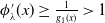
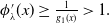
,
$\phi_\lambda^\prime(x) \geq \frac{1}{g_1(x)} > 1$
. Hence, by Theorem 3, the optimal solution to Problem (3.6) over
$(x_0, M]$
is given by (A16)where
\begin{eqnarray}I^*(x) =I^*(x_0) + (x-d_2)_+\end{eqnarray}
$d_2 \geq x_0$
.
Hence, From (A15) and (A16), we have that the optimal ceded loss function is given by
(A17)where
\begin{eqnarray}I^*(x) = \left(\!\min\{x, x_0\}-d_1\right)_++ (x-d_2)_+, \quad x \geq 0,\end{eqnarray}
$0 \leq d_1 \leq x_0 \leq d_2$
.
From (A14) and (A17), we obtain that the optimal solution to Problem (2.1) is given by (4.5).
-
(ii) Assume that
$Y \downarrow_{SNED} X$
and
$(X+ Y) \uparrow_{SPED} X$
. If
$x_0 \geq x_1$
, by the same way as in the proof of (i) of Proposition 17, we obtain that the optimal ceded loss function to Problem (3.6) is given by (4.6).Next we assume that
$x_0 < x_1$
. From Lemma 15, it follows that the optimal ceded loss function over
$[0, x_0]$
is given by (A18)for some
\begin{eqnarray}I^*(x) =(x-d_1)_+\end{eqnarray}
$d_1 \in [0, x_0]$
.
For
$x \in [x_0, x_1]$
,
$\phi_\lambda^\prime(x) =1+g_2^\prime(x) \in [0, 1]$
. For
$x \in (x_1, M]$
,
$\phi_\lambda^\prime(x) \geq \frac{1}{g_1(x)} >1.$
Hence, from Theorem 3, we obtain that for any
$x \in (x_0, x_1]$
, (A19)and for any
\begin{eqnarray}I^*(x) =\min\!\left\{\max\{x + g_2(x) -\frac{\lambda}{2}, I^*(x_1) + x- x_1, x_0 -d_1\}, x-d_1, I^*(x_1)\right\},\end{eqnarray}
$x > x_1$
, (A20)for some
\begin{eqnarray}I^*(x) &=& I^*(x_1) + (x-d_3)_+\end{eqnarray}
$d_3 \geq x_1$
. From (A18)–(A20), we obtain that the optimal solution to Problem (3.6) is given by (4.7). This ends the proof.