Introduction
Canadian cities with large Chinese diasporic populations such as Toronto, Vancouver, Ottawa, and Montreal are home to numerous Chinese music ensembles and orchestras. Members of the Chinese diaspora in these metropolitan areas have carried their musical traditions with them and now share these traditions with broader multicultural audiences. These commonalities in shared experiences form part of a larger picture of Chinese diasporic experience and diasporic experience in general.
Existing literature that has focussed on these complex social, cultural, and musical phenomena (e.g. Zheng Reference Zheng2010; Rao Reference Rao2017; Yu and Stock Reference Yu and Stock2023) has revealed general patterns and directions apparent in North American settings, providing valuable contextualization for research on the Canadian Chinese diasporic musical scene. However, while the general topic of Chinese diasporic musical practices in Canada has received ethnomusicological attention (e.g. Chow-Morris Reference Chow-Morris2013; McGuire Reference McGuire2014; Chan Reference Chan2015, Reference Chan2022), the specific topic of how musicians negotiate the internal musical and cultural spaces within Canadian Chinese orchestras in particular locales has not.
This article locates specific features of two of Toronto’s Chinese diasporic orchestras in the broader scholarly context. Through detailed ethnographic accounts of rehearsals in the Toronto Chinese Orchestra (TCO)Footnote 1 and the Canadian Chinese Orchestra (CCO),Footnote 2 , Footnote 3 it explores key dynamics of identities, self-positioning, means of communication, and power relations operating within the arena of the orchestras. I analyse and compare the internal negotiations of TCO and CCO members as these are expressed through choices relating to musical notation, competence, membership, and social interaction. In analysing and comparing the two orchestras, I will explore how choices made by individual members influence the dynamics and development of specific orchestral communities.
In order to provide context for my analysis of the internal negotiations within the orchestras, I here assemble a composite of ethnographic data I compiled during my observations of and participation in TCO rehearsals from February 2022 to June 2023. As a member of TCO and a guest musician with CCO, I regularly attended TCO’s rehearsals and concerts, while my participation in CCO’s activities was less frequent. As a result, I am able to discuss negotiations and concerns in relation to TCO more extensively than I do those of CCO.
A typical rehearsal at Toronto Chinese Orchestra
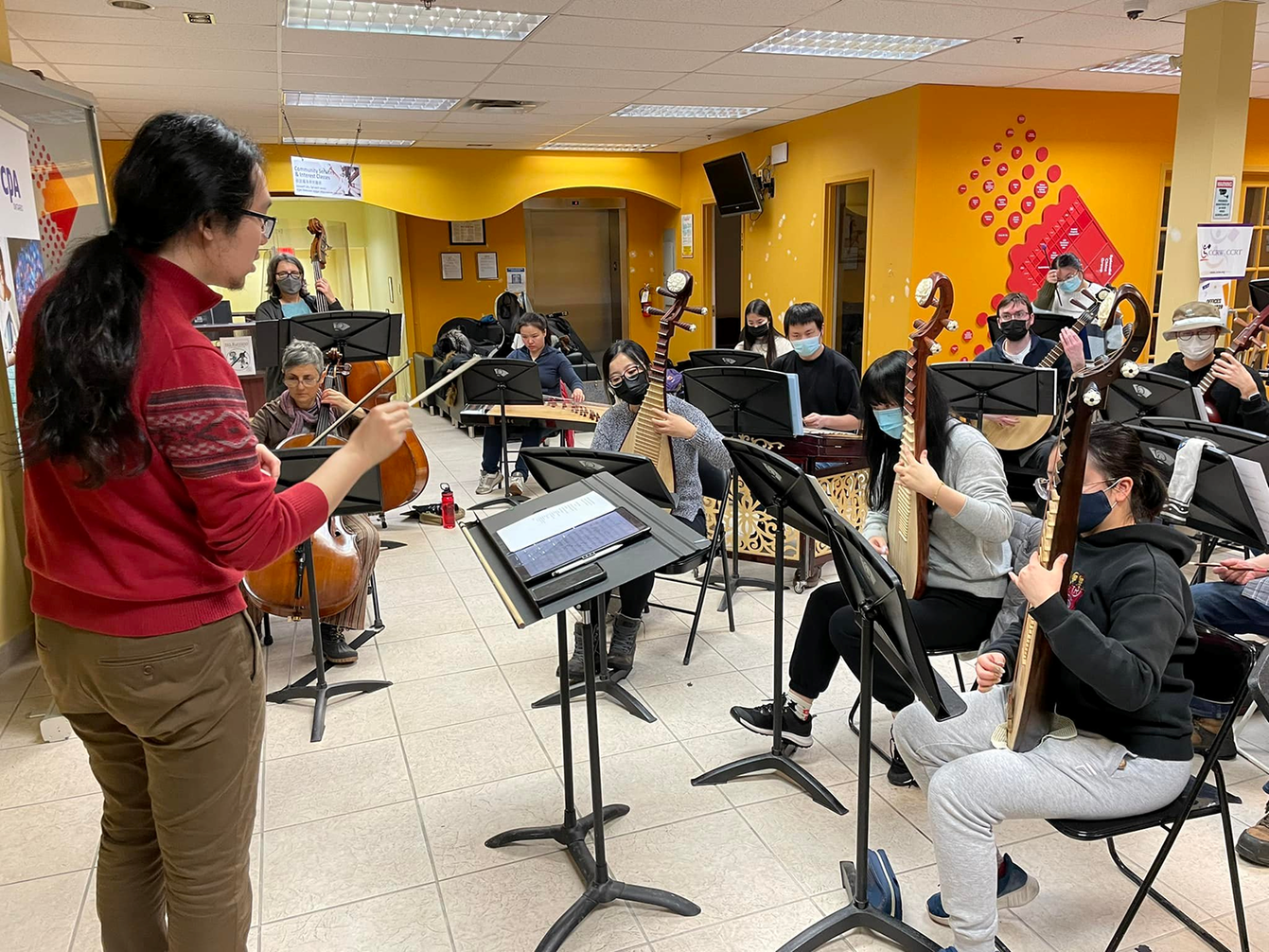
Rehearsals of the TCO take place every Friday evening at 8 p.m. at the Centre for Immigrant and Community Services (CICS) in a Toronto suburb where many newcomers settle, a facility funded by combined charitable and government sources (see Figure 1).Footnote 4 The Centre’s mission is “to empower newcomers in settling and integrating as contributing members of Canadian society through diverse, professional and innovative services” (Centre for Immigrant and Community Services 2023). The orchestra rents the hall for rehearsal space and storage space for their equipment.
TCO members practising at CICS. Photo credit: Patty Chan, 12 March 2023.

Figure 1. Long description
In the foreground on the left, a conductor with long dark hair and a red sweater stands in profile, holding a baton and facing the ensemble. The musicians are seated in a semi-circle across a bright room with yellow walls.
In the front row, musicians play the pipa, a pear-shaped plucked lute, and the cello. Moving toward the center and right, other members play instruments including the guzheng, a long zither, and the yangqin, a hammered dulcimer. In the background, a double bass player stands near the left wall.
Most musicians are wearing face masks and have black music stands in front of them. The room features a tiled floor, fluorescent ceiling lights, and a yellow accent wall with a red decorative graphic on the right side. A digital tablet displaying sheet music is visible on a stand in the center foreground.
On the evening of 15 April 2022, I arrive at the hall at 7:50 p.m. Chatting casually with five members who are also early, I help to prepare the space by arranging chairs and music stands into a semicircle around the conductor. On the right side of the conductor is one of the bowed string sections including erhu and zhonghu. The wind section including dizi, suona, sheng, and clarinet is behind this bowed string section. On the left side of the conductor is the other bowed string section including cello and double bass, and behind this section are guzheng and yangqin, two plucked string instruments. In front of the conductor is the main plucked string section, including pipa in the first row and zhongruan, daruan, and liuqin in the second row. The percussion section is behind this plucked string section.
By 8 p.m., everyone has arrived, and I take my place in the plucked string section on the right side, facing the conductor. There are twenty-five orchestral members who are here this evening, about five probably over age fifty. The rest are a mix of high school students, university students, and young professionals. These are all “regulars,” evenly split between men and women. Twenty members were born in Hong Kong, three were born in mainland China, and two are non-Chinese. One non-Chinese has been playing the zhongruan in the orchestra for eleven years. He told me that he joined the orchestra because it seemed like a lot of fun. He could get performing experience and grow as a musician. The other non-Chinese participant is a university colleague of the director who plays the cello and has recently joined the group to provide more bass support.
We all tune our instruments; for the yangqin, this can take up to ten minutes. For instruments like the erhu, it can be done quickly. Once my pipa is tuned, I practice sections of the pieces that the conductor has identified by email during the week. I notice the person sitting beside me—a young girl about fifteen years old—is having trouble with one of the passages and I offer my help. We go over the four-bar section slowly and then gradually speed it up. After five times, she is successful in playing the passage cleanly. She smiles at me and says thank you. The conductor spends these first few minutes looking at the music scores. When he thinks that everyone is ready to play, he steps up to the podium, taps twice with his baton, and calls out the name of the first section in English, “Red Chamber Suite, movement five.” There is a lot of paper shuffling as we find the score and put it on our music stands. The score is written in Western notation but with jianpu (numbered notation) written on top.
红楼梦组曲 (Hong lou meng zuqu/Red Chamber Suite), taken from the soundtrack of the famous Chinese TV show Dream of the Red Chamber (named after the famous novel of the same title) consists of eight movements and was composed by 王立平 Wang Liping. During rehearsals, the conductor always begins by working on specific sections or movements of pieces. He then puts them together in the last few rehearsals prior to concerts. In the first half of today’s rehearsal, the fifth and eighth movements of the suite are rehearsed. The conductor first leads the orchestra through the fifth movement. Then he points out that the plucked string section should be louder in measure 23, and we should play a decrescendo from piano to pianissimo in the last measure. He also notes that the bowed string section should play ornaments together. After we play this movement two more times for about fifteen minutes total, we move on to the eighth movement. This movement is the last movement of the suite, which features many changes in dynamics, especially at the end. The conductor stops at measure 110 and reminds the percussion section to pay attention to the forte to fortissimo change in dynamics from measure 110 to the end. The percussionists indicate their understanding. This is the only correction the conductor makes. This movement is played two times, which lasts for about fifteen minutes.
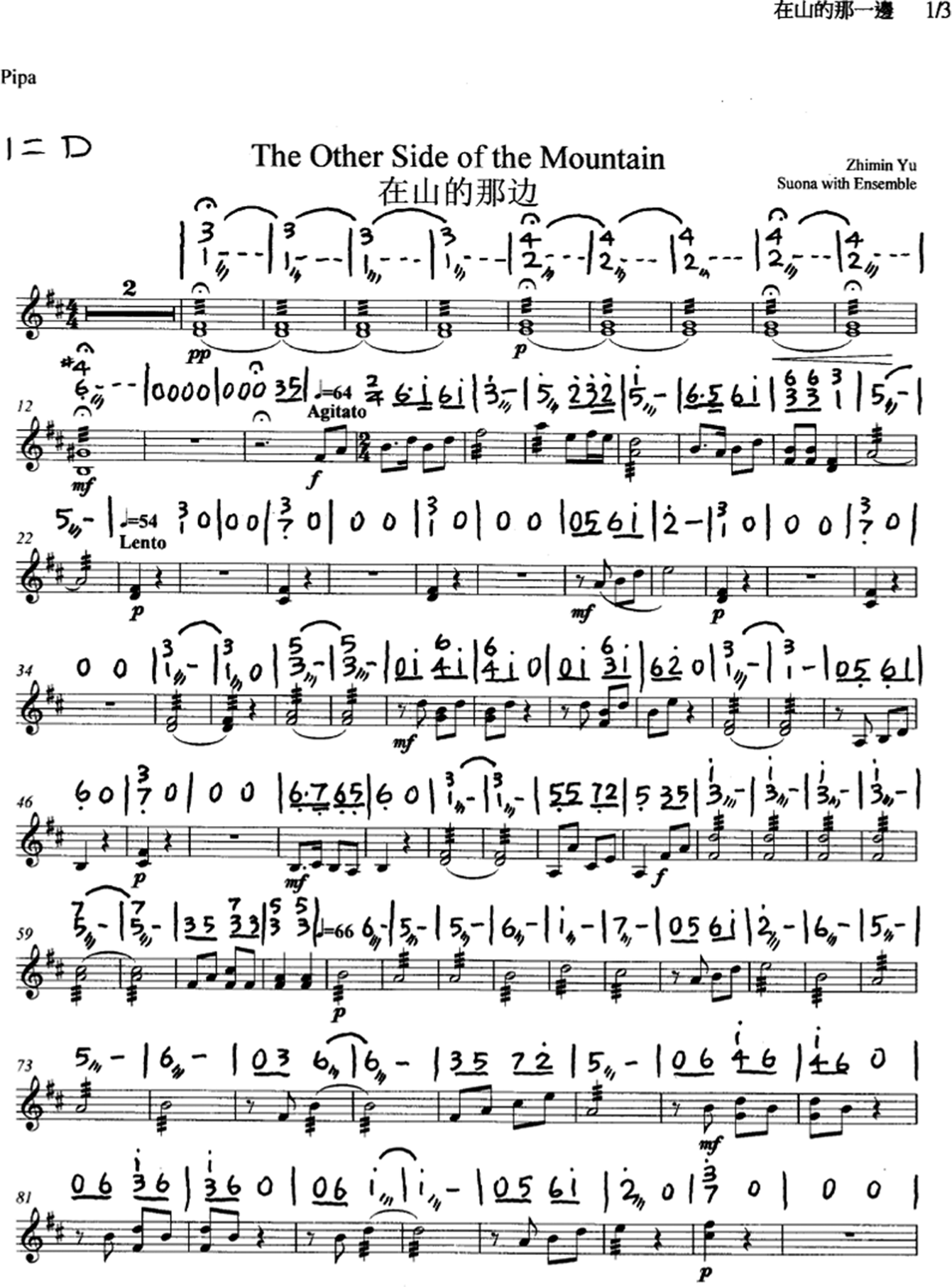
The next piece is 在山的那边 (Zai shan de nabian/The Other Side of the Mountain), a new composition by 于志敏 Yu Zhimin, a Chinese composer based in Vancouver (see Figure 2). As Figure 2 shows, this score is also written in Western notation with jianpu written on top. We have rehearsed all the sections of this piece before. However, I hear a pipa player groan. She is a senior and has been in this orchestra for over twenty years. Her playing level is not high, and this piece demands advanced playing techniques. She told me during a previous rehearsal that this piece was a challenge for her and that she could not play fast. We play through the entire piece first, and then the conductor instructs us to play from measures 127 to 190, the most challenging part of the piece. He later stops and says, “We still need to practice more; please take your time to practice this part at home.” We play the entire piece two more times and spend about thirty minutes on this piece.
Part of the TCO’s music score 在山的那边 (Zai shan de nabian/The Other Side of the Mountain) with jianpu added above the Western notation.

Figure 2. Long description
The score is titled The Other Side of the Mountain with the Chinese title Zai shan de nabian below it. The top right corner attributes the work to Zhimin Yu for Suona with Ensemble. The top left indicates the instrument Pipa and the key signature 1 equals D.
The document contains eight systems of music. Each system consists of a line of handwritten Jianpu notation (using Arabic numerals 1 through 7 with various dots and dashes for pitch and rhythm) positioned above a corresponding staff of Western musical notation.
* The first system shows long sustained notes with fermatas and tremolo markings in both notations.
* The second system, starting at measure 12, is marked Agitato with a tempo of quarter note equals 64. It features rapid sixteenth-note passages in the Western staff and corresponding underlined numerals in the Jianpu.
* The third system, starting at measure 22, is marked Lento with a tempo of quarter note equals 54, showing a more sparse melodic line with frequent rests.
* Subsequent systems (measures 34, 46, 59, 73, and 81) continue this dual-notation format, including dynamic markings such as p for piano, mf for mezzo-forte, and f for forte.
* Slurs and ties are drawn across both the Jianpu and the Western staff to indicate phrasing. The Jianpu includes specific fingerings or technique symbols written as small superscripts next to the numerals.
Around 9 p.m., the conductor says it is time for a break. A young woman in the bowed string section sighs and stands up to stretch. “I’m so tired!” she tells me, “I was up very late last night doing homework. I didn’t want to come tonight. I wanted to go to bed early, but my mom made me come.” She goes off to get her water bottle out of her backpack. I join a group of musicians who are examining a yangqin. They’re talking about how old the strings are and whether the man who plays it should change them all so they have an even tone, or just the ones that are in the worst condition. The man is lamenting the high price of strings and tells us that it will take him over four hours to change them all. We reassure him that he only needs to change the four strings that show the worst wear and that the others will be fine.
Soon, ten minutes have passed and people are returning to their seats. The conductor walks to the stand, taps it twice with his baton, and calls out the name of the piece, “Red Chamber Suite, movement three.” Despite its short length—only twenty-three measures—this movement is the “loudest” in the suite. All the percussion instruments play in forte to fortissimo for almost the whole movement. A young dizi player frowns, as she sits in front of the percussion section, anticipating how loud it will become! The conductor first has the percussion section play the movement by themselves and points out that one of the cymbal players should play a bit louder; then the other instrument sections join. We play the movement together three times, taking about ten minutes. After practising this piece, the conductor moves on to the next piece 满面春风 (Man mian chun feng/Glowing with Joy), composed by 邓雨贤 Deng Yuxian and arranged by 黄新财 Huang Xincai. Once again, the score is written in Western notation with jianpu written over the top. Even though we had practiced this composition in previous rehearsals, we needed to review some complicated sections that required more attention. The conductor first goes through the entire piece and then instructs the wind section to pay attention to the dynamics from measure 92 to the end. Members of the wind section then play this section individually. While the wind section is playing, some members of the plucked string section are also playing quietly, as the section from measure 18 to 46 is challenging for some members due to the complex techniques involved. They want to take this time to practice. A young girl sitting next to me focuses on practising measures 23, 36, and 37 repeatedly. After the wind section finishes practising, the conductor instructs the plucked string section to play from measure 18 to 46. It turns out that the members play well, and I can see the young girl feels relieved from her smiley face. The conductor then instructs all the instrument sections to play the piece together from the beginning to the end. However, I feel something is missing in the sound while I am playing. Later, the conductor expresses regret that the double-bass players and one cellist are not there. Their absence results in a lack of bass support for the orchestra. We then play the piece two more times. It takes about thirty-five minutes to rehearse this piece. Finally, we finish playing it for the last time, and the conductor says, “Thank you everyone for coming to the rehearsal. Please practice these pieces at home. I will see you next Friday.”
The rehearsal usually finishes around 9:55 p.m. In reverse of setting up, now everything gets packed away; chairs, music stands, and instruments are all safely put back in storage. The sofas are moved back to their original places. After the rehearsal, depending on people’s schedules or moods, members gather for a late dinner or go home. It is generally the younger players who make their way to a restaurant, since they may have freer schedules.
This account of a rehearsal of the TCO reveals key dynamics operating within the arena of the orchestra—those involving music notation, musical competence, membership, social interaction—revealing, in different degrees, variations in identities, means of communication, and power relations. I will now explore each of these dynamics in turn, while also providing some essential background for any reader less familiar with Chinese music.
Discussion
Notation
Choices of what system of music notation to use in diasporic Chinese orchestras and ensembles involve complex factors of identity and communication (Tan Reference Tan and Ramnarine2018; Kaminski Reference Kaminski, Schuiling and Payne2022). While in ancient China, oral/aural transmission was the main teaching method for musical education with notation used just as a reminder, various types of music notation have been used in China dating back thousands of years. Eventually, because these forms of notation were too intricate and not very accurate, they have all fallen into disuse, except for the gongche notation, which is still used for some music, such as nanyin (also known as nanguan) and Cantonese opera.
Western notation was introduced to China by Portuguese Catholic missionaries in the middle of the seventeenth century, and originally only used to record and disseminate liturgy and chants sung in Catholic church ceremonies. However, throughout the nineteenth and twentieth centuries, Western notation continued to spread throughout China through Catholic churches and schools. Today, Western notation plays an important role in compositions by Chinese composers, the performance and singing of professional music groups, the music teaching of professional music schools, as well as in people’s learning of Western instruments such as piano and violin (Qi and Zhao Reference Qi and Jian2003: 28).
Meanwhile, in the early twentieth century, a new form of notation known in Chinese as jianpu began to be adopted. Originally French, it was taken up in Japan and brought to China as a modernizing method of music education by Chinese students studying there. The method of recording the notes for jianpu is simpler and more precise than the gongche notation. Therefore, jianpu was popularized in China and continues to be used even more broadly than Western notation (Qi and Zhao Reference Qi and Jian2003: 28). Currently then, two types of notation are commonly used in the study and performance of Chinese music: jianpu notation and Western staff notation.
齐易 Qi Yi (Reference Qi1997: 29), a well-known ethnomusicologist in China, provides some comparisons between Chinese and Western notation. He notes that in terms of usage, since Western staff notation indicates absolute pitch, it is not too difficult to read no matter how it is modulated, while reading jianpu, which only indicates relative pitch, requires going through a series of “conversions” to determine its absolute pitch. It is inconvenient to use jianpu for music with complex harmonies and frequent modulations. In comparison with jianpu, Western staff notation holds more information, so it is better than jianpu for writing large, instrumental pieces with a wide range, many voices, and frequent modulations. However, jianpu has played an important role in the popularization of music in China, and many people have started to learn music using it (30).
杨春林 Yang Chunlin (Reference Yang2016), a famous Chinese conductor, claims that jianpu best suits China’s national conditions for three reasons. First, Chinese music was mainly monophonic until Western music was introduced to China, and jianpu works well for writing monophonic music. Second, Chinese people who are not educated in Western music basically play or listen to music in the “movable do” system in which the tonic changes according to the key; again, jianpu is well able to work with this system. Third, Chinese music generally does not modulate, and the melody is the most important element, which best suits the characteristics of jianpu. These are the reasons that jianpu has “ruled” the folk music scene in mainland China and neighbouring countries and regions for decades.
Yang (Reference Yang2016) goes on to state that although jianpu works well for traditional Chinese music, Western staff notation is, in fact, the most serviceable. First, staff notation works best for intercultural communication. The first national orchestra in China to use staff notation was an orchestra directly under the Ministry of Culture. Earlier, when they visited foreign countries and people asked to see the scores, the scores were all jianpu, which was an obstacle to seamless communication about music. Second, the education in Chinese music conservatories is based on standard Western staff notation. So all musicians educated in the conservatories communicate through staff notation. Third, Western notation software can be seen as the last straw that broke the camel’s back for jianpu. In the past, full scores were written by hand. With the introduction of Western notation software, composers no longer need to write by hand and are able to produce a score electronically, which is undoubtedly good news for major music institutions. The software facilitates the extraction of separate instrumental parts that can be distributed to orchestra members. However, the national orchestra still had to translate it into jianpu; so the question naturally arose: why not learn to use the staff notation, and create the score directly using the software? In the end, Western notation became popularized in professional national orchestras.
Yang (Reference Yang2016) states that even though it is logical for Western staff notation to be used for Western symphonic music, either Western notation or jianpu (the preferred option) should be used for tonal, traditionally inspired Chinese repertoire played by Chinese national orchestras and smaller ensembles. Western staff notation would be the preferred choice for polyphonic or non-tonal music performed by professional national Chinese orchestras while amateur national orchestras can choose between Western notation or jianpu. Although it is accepted that Western staff notation can be used to generate scores for local opera and religious music, the use of jianpu is essential for preserving authenticity in traditional musical practices, specifically jianpu that has been transmitted orally/aurally from master to apprentice.
Social, cultural, and historical forces determine music notation choices (Schuiling Reference Schuiling2019; Schuiling and Payne Reference Schuiling and Payne2022). In mainland China, the majority of non-professional music ensembles and orchestras still use jianpu most of the time, and this practice has been exported to overseas contexts. In my personal experience in participating and performing with some university Chinese ensembles in the United States, knowing how to read jianpu is a required skill for members, and they begin learning it in the first ensemble rehearsal. However, some Chinese orchestras in some Asian countries or districts tend to use staff notation. For example, as ethnomusicologist Shzr Ee Tan (Reference Tan and Ramnarine2018: 278), who specializes in the music of Sinophone and Southeast Asia, notes, the Singapore Chinese Orchestra and the Singapore Indian Orchestra have traditionally elected to use jianpu or “a form of Tamil solfège” supported by oral instruction. She notes as well the irony that in fact it is Western staff notation that offers “neutrality, accessibility and readability,” facilitating collaborations across musical and cultural boundaries. These advantages of Western notation have reinforced the “position of Western musical literacy and notions of a Western ‘standard’ in the creation of any new ‘Asian,’ ‘Southeast Asian’ or ‘Singaporean’ music.”
Like Chinese music ensembles and orchestras in the United States (Zheng Reference Zheng2010; Kaminski Reference Kaminski, Schuiling and Payne2022), the Toronto Chinese music community also mainly employs jianpu. While the TCO has been trying to promote the use of staff notation, it has not yet succeeded. At the TCO, newer members are required to be capable of reading both jianpu and Western staff notation.Footnote 5 The importance of being able to read Western staff notation became evident to me from the TCO audition package I received before my audition for the group in January 2022; it contained scores for three music excerpts. The first one was written in Western staff notation, and on the top of the first score, there was a note: “You may transcribe this into jianpu; however, none will be provided for you.” The second and third scores were written in jianpu. I had to play the excerpt written in Western notation and then choose between the two written in jianpu. In a conversation after rehearsal on a Friday night in April 2022, TCO director Patty Chan said she preferred staff notation because, presently, everyone composes in Western notation, and not just for orchestral pieces but also for individual instrument pieces. For example, she sometimes receives scores from 陈志昇 Chen Zhisheng, the director of Taiwan’s Little Giant Chinese Chamber Orchestra (LGCCO), and the scores are written in Western staff notation. Until the requirement to read Western notation became conventional, she had to transfer them into jianpu for TCO members.
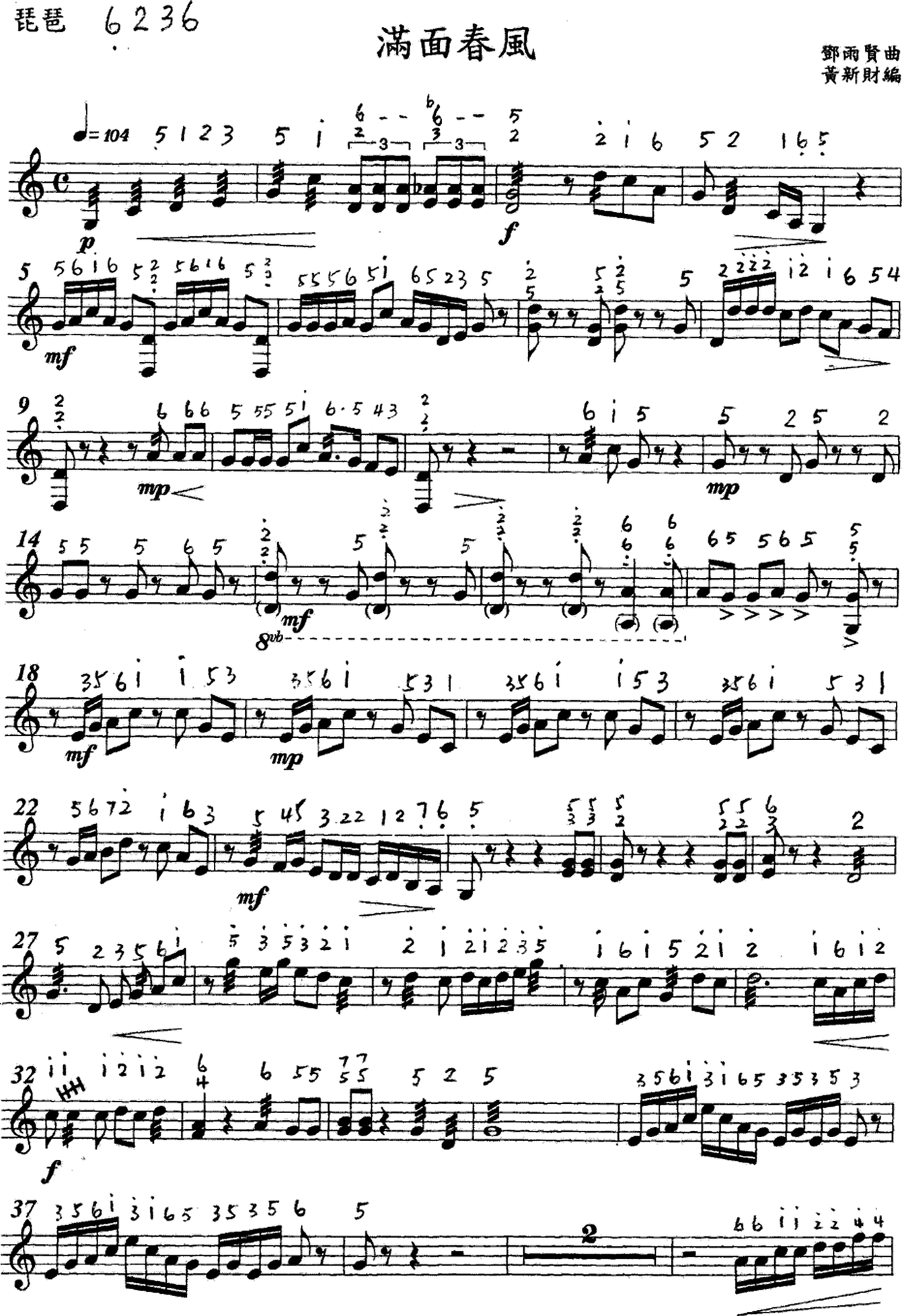
In an interview, Chan said she tried to teach her students to read Western notation so that she would not need to translate the scores from staff notation to jianpu (Patty Chan, pers. comm., 6 May Reference Chan2022). Although she is working towards all members being able to read Western notation, I have noticed in rehearsals that many members are still using scores that have the jianpu notation above the Western staff notation, as shown in Figure 3. Richard Ng, the librarian of the TCO, who has been a member of the orchestra for over twenty years, is in charge of translating Western notation to jianpu for those members who need it.
Part of the TCO’s music score 满面春风 (Man mian chun feng/Glowing with Joy) with jianpu added above the Western notation.

Figure 3. Long description
The score is titled with Chinese characters and the numbers 6 2 3 6 at the top. It consists of eight horizontal staves of Western musical notation.
* Header: The top left identifies the instrument as Pipa. The top right contains composer and arranger credits in Chinese characters.
* Notation Style: Each staff contains standard Western five-line notation with a treble clef. Directly above the staff, handwritten Jianpu (numbered musical notation) corresponds to the notes below. Numbers 1 through 7 represent the scale degrees, with dots above or below indicating octaves.
* Musical Markings: The score includes a tempo marking of quarter note equals 104. Dynamic markings such as p, mf, f, and mp are placed below the staves. Articulations like slurs, staccato dots, and accent marks are visible.
* Structure: The measures are numbered at the start of each line (1, 5, 9, 14, 18, 22, 27, 32, 37). The time signature is common time (4/4).
* Specific Details: Staff 4 includes an 8 v b sub octave marking. Staff 8 contains a multi-measure rest indicated by a thick horizontal bar with the number 2 above it. The final measures show a descending melodic line in both notation systems.
I assumed that the two non-Chinese members of the orchestra would prefer to read Western staff notation; however, during a string section rehearsal in April 2022, Lorne MacDonald, a non-Chinese zhongruan player, held up scores written in staff notation and inquired if there was a jianpu version available. I was intrigued by his preference for reading jianpu. I learned that he had joined the Chinese music ensemble at York University in 2011 to try something new. The course director, Kim Chow-Morris, taught him to read jianpu when he started to learn the zhongruan. Since then, he has become accustomed to reading jianpu while playing zhongruan and daruan. Marko Koumoulas, another non-Chinese former zhongruan player in the TCO, prefers reading in staff notation; however, Koumoulas believes that jianpu is particularly useful when people first start to learn Chinese instruments, since it directly indicates the music scale and fingering and therefore makes it easy for players to position their fingers on the instruments (Marko Koumoulas, pers. comm., 5 May 2022).
Even if Chan expects that members can read staff notation, within the orchestra there is some degree of resistance to using it consistently. After talking to the members in different instrument sections of the TCO, I noticed that the resistance is primarily due to the members’ habits and preferences for reading jianpu or their difficulties in reading Western notation, especially among members of the older generations and musicians who were trained in mainland China. As a case in point, I play the pipa in the TCO. I received my Bachelor of Arts in pipa performance from an art institute in China, where I received formal music training and can read in both Western notation and jianpu; however, I still prefer to read in jianpu because it is what I have been used to since the first day I learned the instrument. However, only myself and one other musician in the TCO received formal Chinese musical instrument training from Chinese conservatories/institutions.
In contrast to the TCO, the CCO almost exclusively utilizes jianpu. All of the music scores are written in jianpu to accommodate the members of the orchestra who are not required to be capable of reading Western staff notation. Some of these would have been translated from Western notation to jianpu by CCO’s director, Amely Zhou. Jianpu has a “premigration value” for Chinese immigrants who associate it with China (Kaminski Reference Kaminski, Schuiling and Payne2022: 111). This notation system serves as a cultural anchor, connecting the musicians to their roots and providing a sense of familiarity and comfort. My surveys and interviews with the CCO members confirm that the orchestra mainly consists of senior and junior amateur musicians who are familiar with jianpu since they began to learn how to read it when they first started learning their instruments. Furthermore, Amely Zhou and the instrument laoshi also play a crucial role in this decision. They were originally from mainland China and received their formal music training from there, so they are also used to reading jianpu. In Zhou’s opinion, the familiarity and comfort that jianpu provides to the members of the orchestra are invaluable. Since jianpu is the notation system that all the members are familiar with, using any other system would be counterintuitive. It would not only create unnecessary barriers to learning and performance but also disrupt the cultural and emotional connection that jianpu fosters among the musicians. These TCO and CCO approaches and preferences to music notation testify that the music directors’ and members’ preferences are based on where they learned their instruments, what instruments they learned, and their generation—all factors influencing the decision of which music notation to use within rehearsal. Kaminski (Reference Kaminski, Schuiling and Payne2022: 121) states that notation is, therefore, more than a visual representation of sound but an emic equivalent to sound: it mediates culture as musicians read and share it to make sound. Not surprisingly, people like to use the musical notation they have been brought up with and are resistant to change. As mature members participating with other mature members, they naturally opt to use the notation system they share—as is the case with any “language.”
Competence
Another challenge that members negotiate within rehearsals is that of accommodating the variety of their playing levels (Tan Reference Tan2000; Kwan Reference Kwan2021; Chan Reference Chan2022). This complexity affects both the TCO and CCO, in slightly differing ways.
The TCO consists of a few professional and semi-professional musicians, but the majority are non-professional. While the professional musicians may prefer to play instruments at a high level, there is not a huge “supply” of opportunities to do so in Toronto. Some professionals may opt to play without being paid with semi-professionals, such as university students. Collectively they help “stack” the orchestra, thereby improving overall performance.
Scholars have noted the effects of such mixed levels of expertise within orchestras (Livingston Reference Livingston, Livingston, Russell, Ward and Nettl1993; Veblen Reference Veblen, McPherson and Welch2018). Livingston (Reference Livingston, Livingston, Russell, Ward and Nettl1993: 124) notes, “The uneven technical ability of the players requires that the conductor work more extensively with each section to ensure that the proper notes and rhythms are played.” The TCO does indeed reveal a range of such teaching and learning opportunities in the orchestras. In some pieces, there are several parts that are rather challenging for non-professional musicians who lack the necessary techniques or practice. Therefore, the conductor repeatedly reminds them, especially during rehearsals, “Keep the rhythm. Pitch is less important.”
However, in general, my observation of TCO rehearsals showed varying evidence of special attention to members with lower levels of playing techniques from either the director or other members; despite the availability of opportunities at monthly sectional rehearsals for learning from leaders more skilled, which they may sometimes take up, less skilled members are often “on their own” to improve themselves. For example, the senior pipa player mentioned earlier in this article (in the section entitled “A typical rehearsal at Toronto Chinese Orchestra”) practices regularly between rehearsals. Though she expresses her frustration with her own level of ability and knows she faces limitations in her skill levels, she carries on out of interest and passion. While the orchestra helps sustain these less proficient players, I notice that some musicians with advanced techniques do not even regularly come to the rehearsals. This is because the music is easier for them, and they are reluctant to spend their time with those for whom it is challenging. Each member often seems to make his or her own call about how involved to be in rehearsals, a habit which everyone also seems to accept without any tension––whether or not this is to the disadvantage of less proficient players.
Aside from the reluctance to attend rehearsals of proficient players, there are other barriers to adequate practice time. Teenagers do not care so much about playing at a high level because they have little time to practice, and local/community members who have jobs and might once have played a high level also do not have much time to practice. Some seniors and community members who play at a lower level find it difficult to improve their playing techniques quickly with advanced age and in restricted circumstances. Balancing all these factors and levels is a challenge for the music director. However, if a performance is imminent, proficient players would be motivated to come to prepare and practice.
The CCO, on the other hand, by adeptly navigating challenges related to repertoire selection and skill-level management, seldom encounters the issues that the TCO has in working up certain “challenging” pieces. First, the CCO usually selects pieces that are suitable for the members’ overall performance levels. In other words, they select the pieces that are less difficult due to the fact that most of the members are amateur musicians with lower to medium performance levels. The orchestra ensures members can focus on expression and cohesion rather than grappling with overly demanding techniques. In addition, distinctive to the CCO in Toronto and atypical of orchestras of mainland China and other overseas Chinese orchestras, they have laoshi in each instrument section to assist with rehearsals. If any members have difficulties with techniques during rehearsals, laoshi will help them. This hands-on support enables members to refine their skills during practice, preventing bottlenecks and ensuring steady progress. In these ways, the CCO avoids the difficulties in managing varying skill levels that the TCO faces.
Membership
The TCO and CCO face challenges in negotiating the quality of rehearsals or performance levels due to attendance issues, a shortage of members, and variations in instrument playing levels among members. Since 2018, the TCO has utilized an online attendance sheet to track members’ attendance. But from March 2020 to February 2022, due to COVID-19, the rehearsals were held virtually and the orchestra did not take attendance. There were also no formal concerts. The rehearsals resumed in person in March 2022. At the time, only about half of the orchestra had returned and were able to regularly attend rehearsals, which has resulted in a decline in overall rehearsal quality––a pattern common in many areas and professions affected by the pandemic (O’Hagan and Borowiecki Reference O’Hagan, Borowiecki, Salvador, Navarrete and Srakar2021; Kurzbauer Reference Kurzbauer, Hendrickx and Blanpain2023). The online attendance sheet has also been revived at the same time, which the conductor uses as a guidepost for planning rehearsals. Members mark their attendance in advance, allowing the conductor to know beforehand who will be attending.
Although attendance worsened temporarily during and after the pandemic, the orchestra director, Patty Chan, told me that it has always been an issue for the TCO because the orchestra is not a professional one. Some members do not have time on Friday nights; therefore, they do not attend rehearsals. Then again, as mentioned above, some may consider the rehearsal below their level. Still, most members do tend to show up more frequently before performance. Only about thirty per cent of the members attend rehearsals on an infrequent basis. Of course, these may be uninformed of the conductor’s instructions for certain parts of each piece, such as tempo, dynamics, and bowings, resulting in errors and ironically the need for more rehearsal time. They may be contacted by the director to ask if they can attend the last few rehearsals before performances, since otherwise their participation may jeopardize the quality of the performance.
Messages that the conductor, Jonathan Wong, sent to members prior to their spring 2022 concert indicate his concern about attendance: “After our April sectionals, we enter May with only 6 rehearsals left before our Vaughan International Music Festival performance! Please fill in your availability below as known from now to the end of the season, especially for all June dates.” Wong delivered another message to members on 5 May 2022, stating,
Welcome back to full rehearsals: only 6 left until our first June performance! Big rehearsal this week–we want maximum attendance and we’ve called as many of our extra players as possible for our first full run-throughs of Red Chamber Suite and Colourful Dragon Boat. It’s also our last chance to rehearse The Other Side of the Mountain with Joshua until June.
If this is your first rehearsal with TCO or if you’ve been away for a while, welcome (back)! Please make an effort to get markings/bowings/dynamics/etc. from your section leader Footnote 6 during setup time before our 8pm start or in advance.
Clearly, the maintenance of cultural forms in a diasporic setting relies very much on highly motivated individual efforts (Tan Reference Tan2000; Kwan Reference Kwan2021; Chan Reference Chan2022). Wong’s messages to members indicate that the conductor had to encourage members to attend rehearsals and put in an effort.
The CCO has also experienced difficulties with membership shortages and attendance issues. Before the COVID-19 pandemic, the CCO’s youth orchestra (Canadian Youth Chinese Orchestra) had around thirty members and the CCO’s elder orchestra (Canadian Philharmonic Chinese Orchestra) had around twenty members. However, from the beginning of the COVID-19 pandemic, the youth orchestra saw a significant decline in membership. Over ten members who had strong playing skills graduated from high schools and left for universities. In 2022, the two orchestras were combined with approximately twenty seniors and ten youth orchestra members attending rehearsals regularly. Additionally, some members were sometimes unable to attend rehearsals, leading to a decrease in the quality of rehearsals. For instance, on 5 June 2022, only one zhongruan player attended the rehearsal. As a result, the pipa laoshi stepped in to provide support and compensate for the missing part.
Such membership issues have a significant impact on internal negotiations within the orchestras. The absence and shortage of members pose challenges to negotiating the quality of rehearsals and the level of repertoire. The changes in the number and playing level of members can make it difficult for orchestras to maintain a consistent performance level.
Social interaction
Orchestras can be understood as a “microcosm of society” (Gillinson and Vaughan Reference Gillinson, Vaughan and Lawson2003; Cheah Reference Cheah2009; Ramnarine Reference Ramnarine2011). According to Tina K. Ramnarine (Reference Ramnarine2011: 329), to see the orchestra as a “microcosm of society” involves a “perception of the institution reflecting the social world in miniature that has led to metaphoric conceptualisations of its inner workings to describe and theorise the functioning of different kinds of collectives and social relationships.” I consider Chinese orchestra rehearsals to be a social space in a network of human relationships, governed by shifting dynamics and hierarchies involving age, languages spoken, fluency in English, where they were born and/or previously lived, and length of time in the orchestra.
The characteristics of specific orchestra members that I examine here are age, language, performance ability, and personality (assertiveness, originality/creativity, bravery, shyness, conservativeness). While the orchestra members are not the decision-makers of their group, the directors do take all the characteristics of the members into consideration in making decisions about how to approach the music and how to communicate within the group. In this sense, the TCO and CCO function as microcosms of Chinese communities in Toronto in their social and cultural practices such as respecting seniors, language usage, and hierarchy among the members.
In Chinese society and culture, valuing and showing respect to elders is viewed as an important principle (Fei et al. Reference Fei, Hamilton and Zheng1992; Hofstede Reference Hofstede2001). Regarding decision-making procedures, elders in the Toronto Community Chinese Orchestra (the community orchestra of the TCO) carry more weight in making decisions than in the TCO as they make up the majority of the members. Most of them immigrated from Hong Kong to Canada, and there are no non-Chinese members in the orchestra. Unlike her decisions about the TCO’s repertoire, which she makes without consulting members, for the TCCO, Patty Chan sometimes directly asks members during rehearsals which pieces they would like to play. They usually respond by choosing the repertoire in which they are most proficient. In this manner, the elder members are able, to some degree, to determine their own repertoire.
Hierarchies of age are noticeable within the dynamics of the orchestra. In the TCCO, some senior musicians are braver and more confident than younger ones, who tend to follow the elders’ decisions. The elders like to express their thoughts and talk loudly. They also seem to like to correct each other when someone plays the music incorrectly, even though their own playing techniques may not be strong. Traditional respectful attitudes towards seniors therefore strongly influence the dynamics of the group. Similar to the senior members of the TCCO, a few TCO senior members expressed the difficulty they had in playing fast in the sectional rehearsal on 22 April 2022; in contrast, some new members or younger members whose playing techniques are also not strong remain silent on this topic.
Performance level also factors into the dynamics of the groups (Wong Shengmiao Reference Wong Shengmiao2009; Kwan Reference Kwan2021; Chan Reference Chan2022). Musicians with high performance levels often have some privilege, independent of age. The suona soloist for “The Other Side of the Mountain,” who is a younger member, asked the conductor to speed up a part of the piece in the rehearsal on 6 May 2022, and the conductor instructed the orchestra to follow the soloist’s tempo. Some young members with lower performance levels would never express their opinions in this way.
For members and conductors, rehearsal is not just a learning process but also a community-building process inside the orchestra (Tan Reference Tan2000: 112). For example, in August 2022, members gathered to have a barbecue in a park, where they very successfully and enjoyably bonded. In a further community-building practice, the orchestra frequently has an online “group chat.” Before each rehearsal, the TCO’s director always sends an email to the members with rehearsal plans or important messages from the conductor, Jonathan Wong. For example, while, as noted above, members negotiate their practice requirements by themselves, for planning and coordinating they share this group chat. When the members had the sectional rehearsal playing “The Other Side of the Mountain” from the presto part to the end, Wong suggested in an email sent on 21 April 2022 that musicians who played plucked string and wind instruments “work out ways to simplify passages if too fast,” because this part of the piece has a fast tempo and requires advanced playing abilities. Since some members’ abilities do not meet the necessary standards, the conductor instructed the members to simplify the music so that they were playing only some of the notes to be able to keep up with the tempo. These communications function to cement the group members into a whole as a community.
In the CCO, although most of the members are amateur musicians, a few professional musicians and high-level non-professional musicians serve as laoshi guides for the lower- or medium-level amateur musicians (students) during rehearsals and teach them how to play the instruments. Laoshi also have the authority to instruct or criticize students about how they perform. For example, when they finished practising the piece for string instruments on 5 June 2022, the pipa laoshi advised the pipa players to perform more gently. She told them that they sounded like marching bands were playing. The students then nodded in agreement. When rehearsing, the conductor and other members pay attention to the laoshi’s suggestions and ideas.
Of course, individual personality plays an important role in communication within the orchestra. Members who are shy or new to the group are less sociable. For instance, one of the TCO’s pipa players was only fifteen years old when she joined the orchestra in early 2022. She almost never talks to anyone during the rehearsal break or after rehearsal, possibly because she is timid and does not feel comfortable approaching strangers. By contrast, sociable people or old members like to talk to each other and hang out after rehearsal to go to eat dinner together or simply catch up. After each annual concert, the members of the TCO gather for a post-performance dinner to celebrate the success of the concert. This is a time for them to reflect on their achievements and connect with each other. In this way, the orchestras are clearly serving the function of providing community in the diaspora.
The orchestras are also microcosms of language in the diaspora. The language usage in the CCO is unique among the Chinese orchestras in Toronto. The conductor has to take into account the language usage habits of all the members so that she is able to communicate musical details to everyone. Since all of the senior members were originally from Hong Kong and speak Cantonese and the younger generation members speak English, the conductor speaks both Cantonese and English during the rehearsals. I also noticed that 吴立鹏 Wu Lipeng (Amely Zhou’s husband), a dizi/xiao player and a laoshi of the orchestra who comes to rehearsals regularly to assist the dizi players, also speaks Cantonese with the senior members. I asked him why he speaks Cantonese with them as he was originally from a region that does not speak Cantonese. Wu responded that before he learned Cantonese, his wife Amely Zhou, a native Cantonese speaker, helped him to translate Cantonese into Mandarin. He then learned Cantonese slowly in order to communicate with older members of the orchestra, and over time, he was able to speak Cantonese (Wu Lipeng, pers. comm., 5 June 2022). Wu’s language experience within the orchestra reflects the multiple pressures and opportunities faced in a diasporic context, suggesting that even within one community there are multiple identities––that is, that cultures are never homogenous or monolithic. The orchestra thus operates as a culturally varied entity within the larger Canadian cultural complexity.
The TCO and CCO are each like a small community. They are spaces for music-making and building personal connections. As Zheng (Reference Zheng2010: 286) observes regarding the Chinese American musical context: “It provides emotional shelter for feelings of nostalgia, creates ritualistic frames for community events, channels individual creativity, supports social interaction, showcases cultural pluralism, sustains diasporic sentiments, and expresses cultural difference and resistance as cultural identity.” The orchestras have their own protocols, etiquette, privilege, and hierarchies. Only by understanding the orchestras’ social rules can members be more integrated into these communities. Being a part of a Chinese orchestra in diaspora helps one at once to reinforce the ideologies and etiquette in their respective cultures and also to learn how to fit into a more multicultural context.
Conclusion
In this article, I embark on a comprehensive exploration of the intricate dynamics within the TCO and the CCO through the lens of ethnographic research. Beginning with a detailed ethnography of a TCO rehearsal, I aim to provide a vivid and immersive account of the rehearsal process, revealing the multifaceted musical and cultural issues that typically arise during rehearsals. This ethnographic approach has allowed me to observe first-hand how these issues are negotiated among the members, highlighting the collaborative and adaptive nature of the rehearsal process.
The ethnography has uncovered several key issues that frequently emerge during TCO rehearsals. These include the choice and use of musical notation systems––jianpu or Western staff notation––and the challenges that arise from the coexistence of these systems. Also prominent are the varying levels of musical competence among members and how these differences are managed to ensure cohesive performances. Additionally, the diverse backgrounds and experiences of orchestra members, including their roles and contributions to the orchestra, add other layers of complexity. Finally, the social dynamics and interpersonal relationships within the orchestra, which influence the rehearsal process and the overall musical experience, also emerge as crucial.
Rehearsals are a rich site for research, and the findings shared here could be applied to further critical ethnographic analysis. They could also be extended to explore other aspects of social significance such as performer interactions beyond the orchestra and how they impact social integration, mental health, and cultural identity in diasporic communities, and the potential for intercultural exchange within broader Canadian society. While the scope for these investigations has been here limited by space, it is hoped that these aspects can be explored in future work.
The article illustrates how the members of the orchestras navigate the various challenges they encounter through negotiation, compromise, and cooperation. This detailed examination reveals that the TCO and CCO function as microcosms of society, reflecting the broader social and cultural dynamics within Toronto’s Chinese communities. The orchestras demonstrate how Chinese social and cultural practices are maintained and adapted in the diaspora, highlighting the importance of community, collaboration, and cultural continuity. In these ways, the orchestras contribute to and participate in wider global cosmopolitan phenomena.
Glossary
- daruan
-
large-sized, moon-shaped, vertically held, plucked lute
- dizi
-
transverse bamboo flute
- erhu
-
two-stringed, vertically held, bowed fiddle
- gongche
-
notation traditional Chinese musical notation that uses Chinese characters to represent musical notes
- guzheng
-
twenty-one-stringed zither
- jianpu
-
a notation system that uses numbers to notate music
- laoshi
-
members who participate regularly in rehearsals while also serving as teachers to less proficient members
- liuqin
-
high-pitched, four-stringed, vertically held, plucked lute
- pipa
-
four-stringed, vertically held, plucked lute
- sheng
-
mouth organ
- suona
-
double-reed aerophone
- xiao
-
vertically held, bamboo flute
- yangqin
-
hammered dulcimer
- zhonghu
-
low-pitched, vertically held, bowed fiddle
- zhongruan
-
medium-sized, moon-shaped, vertically held, plucked lute