This article deals with the interface between elderly care and emergency preparedness in Swedish municipalities. Emergency preparedness involves planning for and managing what is understood as high-consequence negative events, also referred to as crises and disasters. 1 The article presents a study that sets out to examine not only the elderly care staff’s experiences of emergency preparedness but also their familiarity with and evaluations of the area.
In Sweden, elderly care is a public responsibility. The 290 Swedish municipalities have, under the Social Services Act (No. 453/2001), 2 the ultimate responsibility for ensuring that the individual receives the support and help he or she needs (Chapter 2, § 1). As regards seniors, the municipalities’ responsibility is further outlined in terms of objectives involving, inter alia, safety and independence, and access to care (Chapter 5, § 4). Elderly care is organized and provided according to needs and not according to the ability to pay for the care.Reference Szebehely and Trydegård 3
Seniors can apply for homecare services or for residential care. The extent of services is subject to an assessment of needs. Homecare services can be rather comprehensive, ranging from home deliveries of ready-cooked meals to support in daytime activities and caring. Further, health care as well as palliative care can be provided in the seniors’ homes. 4
The Social Services Act does not address emergency preparedness. Rather, what the act outlines in terms of objectives and ultimate responsibilities for the individuals also applies under adverse circumstances. 5 The responsibility during emergencies relates to ordinary requirements of quality, safety, sustainability, and planning, in order to maintain existing operations and manage the tasks ahead. 5 This involves upholding the given services, as well as providing extra services in the wake of an emergency situation (such as psychosocial support and evacuation). The latter might also involve seniors with no previous contact with elderly care.
Just like elderly care in Sweden, emergency preparedness is a public responsibility and organized by the municipalities. The Act on Measures to be Taken by Municipalities and County Councils in Preparedness for and during Extraordinary Incidents during Peacetime and Periods of Heightened Alert (No 544/2006) outlines the municipal responsibilities. 6 It involves the performance of risk and vulnerability analyses, the development of preparedness plans and preparations for emergencies, organization of an emergency management committee, as well as training and education of staff and politicians. This study is focused on the elderly care staff’s familiarity with and experiences of such concrete activities. This could indicate the extent to which the municipalities generally involve elderly care staff in emergency preparedness, as well as to what extent elderly care staff are targeted when education and training are being organized.
The emergency preparedness in Sweden forms part of a wider approach to societal security and preparedness, which also involves protection against accidents (including fire and chemicals) and civil defense.Reference Lindberg and Sundelius 7 In the area of emergency preparedness, a common denominator, regardless of the scale of the event, is “societal disturbances.” 8 This construct indicates that the orientation is toward high-consequence adverse events with a collective impact. The law refers to such events in terms of “extraordinary events” and/or “crises.” In this article I will, consequently, use those concepts, whose meaning overlaps with that of “disaster” in the international literature.Reference Cuadra 9 However, I will refer to “adverse events” according to my general reasoning when going beyond the official understanding of the legal terms.
As it is a municipal function, elderly care is targeted by the law on “extraordinary events,” and elderly care staff can therefore be expected to be involved in emergency preparedness. Emergency preparedness is traditionally enacted by professionals dedicated to technology and security.Reference Danielsson 10 Elderly care, however, appertains to human services.Reference Hasenfeld 11 This means that elderly care, as well as other forms of social work, has an important role in providing safety or a feeling of security to vulnerable people in everyday life.Reference Webb 12
Although agents in the emergency preparedness system can be expected to be oriented toward societal security under adverse events, elderly care staff might still be oriented toward ensuring individuals’ safety or feeling of security. In this venture, intersubjective dimensions, such as routine, trust, and continuity in everyday life, are vital ingredients.Reference Webb 12 In this respect, elderly care staff have, to my understanding, a mediating position between the individuals who are dependent on collective goods (ie publicly funded elderly care) and the enactment of societal responsibilities in relation to high-consequence adverse events.
Social work has, in the literature, been found to be important in relation to emergencies.Reference Desai 13 , 14 Yet, little is known about the role of the municipal Social Services, as well as of elderly care, in a Swedish context in general.Reference Cuadra 9 There are, however, some studies shedding light on the experiences of executives,Reference Enander, Hede and Lajksjö 15 cross-sectorial collaboration,Reference Danielsson 10 support to persons with functional disabilities,Reference Sparf 16 and interventions in traumatic events.Reference Nieminen Kristofersson 17 Internationally, a lack of clear plans for reaching older populations during emergencies has been identifiedReference Teasley and Moore 18 because of the disproportionate impact of emergencies on seniors.Reference Thomas and Healy 19 There is, thus, a need to explicitly address seniors in preparedness programs and during emergency responses.Reference Gillespie and Danso 20 Further, information gaps have been identified concerning issues such as seniors’ reactions to evacuation and the risk for being abandoned by staff,Reference Soligman and Rogge 21 as well as their susceptibility to abuse in a crisis situation.Reference Gutman and Yon 22 However, there is a growing amount of literature on how emergency intervention programs can be adjusted to meet the needs of vulnerable groups such as seniors.Reference Eydal, Ómarsdóttir and Cuadra 23
The general lack of knowledge in the area of elderly care in relation to emergencies leaves considerable gaps to be filled in. The aim of this article is, however, limited to the investigation of the interface between elderly care and emergency preparedness. This is done by studying the staff’s experiences of, familiarity with, and evaluations of emergency preparedness.
METHODS
This article draws upon a data set on elderly care staff that forms a part of larger material gathered in a project led by the author. The project involved the development of emergency preparedness in the Social Services and involved staff employed in all functions of the Social Services (such as services for families, children, individuals, and the functionally impaired). The gathering of material within this larger project was conducted as follows.
Four municipalities were invited to take part. The municipalities were not similar in size (17,000-53,000 inhabitants) but represented common sizes of Swedish municipalities. The criterion for inclusion was that they took part in the ongoing project. This implied an engagement of the executive and management levels in the topic at hand. General consent was provided by the Head of Social Services and the Head of Security in the municipalities after a process involving dissemination of information and anchoring in each municipality.
The study was conducted using the Artologik Survey & Report software (version 4.x). It is a software for web-based questionnaires and computing service offered by the Swedish University Computing Network.
A questionnaire was developed by the author with the aim of getting an initial overview of the staff perspective. It was validated through interaction with experts in the participating municipalities.
The questionnaire consisted of 23 questions (3 of which covered background information). All but 2 questions were closed. The closed questions had prespecified optional answers. All questions offered a possibility to specify and comment on the answers. The given options for the closed questions were yes or no, an ordinal scale (eg, from “none at all” to “well”), or a Likert scale (from [none] 0 to [high] 5). The questions covered experiences of extraordinary events, risk and vulnerability analyses, education, exercises, as well as the respondent’s evaluation of the main risks and of emergency preparedness. Moreover, familiarity with preparedness plans was asked about. In this article I make use of 13 questions.
The questionnaire was distributed to 1722 employees in direct contact with seniors as well as immediate supervisors. A link to the questionnaire and two reminders were distributed by executives via the organizations’ internal e-mail system.
A total of 1020 employees answered, corresponding to 59%. However, the focus of this article is limited to elderly care. Only data from respondents working in home-based (n=221) or institution-based elderly care (n=347), in total 568 individuals, form the basis for the analysis.
The design of the study did not fall under the requirements for ethical vetting under The Ethical Review Act (No. 460/2003). 24 It did not involve information that is understood to be sensitive or personal. However, general ethical considerations informed the conduct of the study and the introduction letter. The letter informed the respondents of the aim of the study, its focus on emergency preparedness, and of their voluntary participation and guaranteed anonymity. Consent was given by each respondent by filling in and submitting the questionnaire. Moreover, a definition of “extraordinary events” was provided, with reference to the law, so as to further underline the focus as well as the context of the study.
A basic descriptive statistical analysis in terms of frequencies was offered by the Artologik Survey and Report. No further statistical analysis has been made, as comparisons (eg, between different categories of staff) fall outside the scope of the study.
The open answers and comments (ie the free text) were subject to qualitative analysisReference Robson 25 in order to connect them to the study’s themes. They were, thus, subject to open coding. Units of content were identified, such as descriptions of situations and statements. They were condensed into codes and further developed into categories and synthetized to emerging themes.Reference Bryman 26 However, for the open questions (ie specific experiences of extraordinary events and evaluations of the 3 main risks), the coding also relied on the official categorization used by the National Board of Health and Welfare. 27 Hence, the respondents’ answers were, when possible, categorized as pertaining to the following 5 fields: nature; accidents; technical, infrastructural, and supply system failures; antagonistic threats and social risks; diseases. The coding process was carried out with the support of IBM SPSS Statistics (version 22) in order to give an account of frequencies.
The overall result was further interpreted from a theoretical viewpoint. First, it was analyzed in relation to a theory of policy implementation. This theory outlines 3 general prerequisites for implementation: (i) to understand, (ii) to be able, and (iii) to be motivated.Reference Sannerstedt 28 “To understand” means having a clear understanding of the goals of the policy at hand.Reference Sannerstedt 28 I associate this dimension with the understanding of emergency preparedness as it comes to the fore in the respondents’ use of central concepts such as “extraordinary event” and “risk.” I also associate it with education that can, potentially, offer an opportunity to develop a basic understanding of the policy area, and its scope and contexts. “To be able” means having access to resources and competences.Reference Sannerstedt 28 I associate this dimension with skills and familiarity, which can be obtained, for example, through exercises, and with being acquainted with the organization’s preparedness plan. The third and last prerequisite, “to be motivated,” is crucial for the staff’s engagement in an implementation.Reference Sannerstedt 28 I associate this with the general evaluation of emergency preparedness as well as with an interest in education and exercises.
Given that the central basis for emergency preparedness consists of a risk and vulnerability analysis and risk management, I used a risk governance modelReference Renn, Klinke and van Asselt 29 as a second interpretative framework. The model is normative and outlines 5 sequential activities leading up to decisions involving emergency management: pre-estimation, interdisciplinary estimation, evaluation, management, and monitoring of risks.Reference Renn, Klinke and van Asselt 29 The first activity involves a pre-estimation of possible risks. In view of the fact that risks have real consequences but still have a quality of being social constructions that vary with people’s perceptions and interpretations, the outcome of the estimations is dependent on the participants.Reference Renn, Klinke and van Asselt 29 Interdisciplinary involvement and participation in the communication and deliberations, throughout the risk governance process, is expected to contribute to the quality of the outcome, in that it will be anchored in the involved organization’s area of operations and their values and conditions. The model also underlines the fact that the activities presuppose human as well as financial and technical resources in addition to institutional means.Reference Renn, Klinke and van Asselt 29
RESULTS
The presentation of the result is structured according to the studied themes, namely, experiences, evaluations, and familiarity. Further, it will refer to elderly care staff and not differentiate between staff in home-based and institution-based care. As some respondents did not answer all questions and/or gave multiple answers (to the open questions), the Valid N differs between the questions. When the data are presented in terms of frequencies, “system missing” (understood as respondents not answering the question at hand) is considered when computing percentages. The category “not coded” is used to indicate answers that I found too ambiguous to be coded.
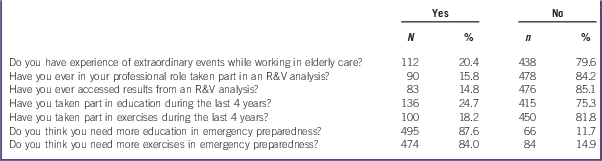
As regards experiences, ~one-fifth (20.4%) of the respondents claimed to have had experiences of extraordinary events. The result was the same regarding exercises (18.2%) involving emergency preparedness. A higher proportion of respondents had taken part in education (24.7%). Taking part in a risk and vulnerability analysis was less common (15.8%), however, as was having accessed results from such an analysis (14.8%). A majority of the respondents answered that they need more education (87.6%) and exercises (84.0%) (Table 1).
Experiences of Extraordinary Events, Risk and Vulnerability Analysis, and Education and Exercises Concerning Extraordinary Events and Emergency Preparedness, As Well As Evaluations of the Need For Education and Exercises

Abbreviation: R&V, risk and vulnerability analysis.
According to the free-text specifications, the topics of the education received, to a large extent, involved dealing with threats and violence, self-defense, interaction with seniors, cardiac resuscitation, fire security, and how to act if a senior disappears. However, themes that relate to emergency preparedness, such as a municipality’s emergency preparedness in general, severe storms, infrastructural failures, pandemics, and psychosocial support, are also referred to.
The exercises that the respondents refer to involved issues that do not pertain to emergency management, such as fire drills, ergonomics, self-defense, cardiac resuscitation, fall accidents, and interaction with seniors. However, examples of exercises in emergency preparedness are also given. The examples involve dialogues at staff meetings about preparedness plans in general or, more specifically, about how to act in case of storms, heavy snowfall, failure of water and electricity, evacuation, pandemics, and crisis support. One respondent mentions an exercise that involved “writing down routines and thinking about how we get the organization’s operations to function in a big crisis where evacuations are needed.”
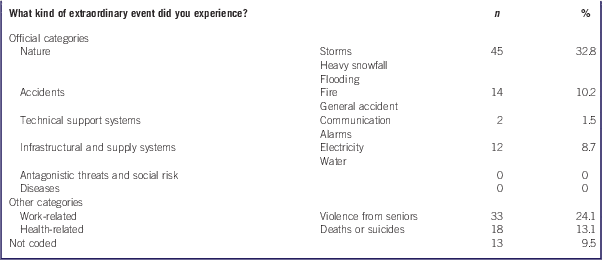
The analysis of the open questions regarding specific experiences of extraordinary events revealed a broad spectrum of answers. As stated, the coding relied on official categorization as well as on leaving space for emerging categories in the material. The result is consequently categorized into 2 main groups (Table 2).
Specified Experiences of Adverse Events (Valid N=137)

In the group “official categories,” experienced events related to nature are most common (32.8%), followed by accidents (10.2%) and infrastructural failures (8.7%). The group of experiences coded as “other categories” involves the respondents’ work conditions (24.1%) or the seniors’ health (13.1%) (Table 2).
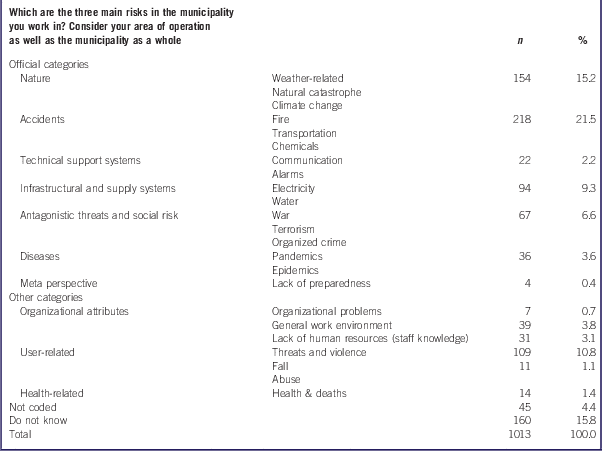
Evaluation of the three main risks also revealed a broad spectrum of answers. A total number of 1013 unique answers were given. In the group coded as per the official categories, accidents (21.5%) are most common, followed by nature-related events (15.2%), and infrastructural failures (9.3%). As regards the group “other categories,” they relate to issues that are connected to the respondents’ organization (in total 7.6%), to the seniors (threats, violence, falls, and abuse) (in total 11.9%), as well as to the health of the seniors or the staff (1.4%) (Table 3).
Overview of the Evaluations of the Three Main Risks (Valid N=1013)

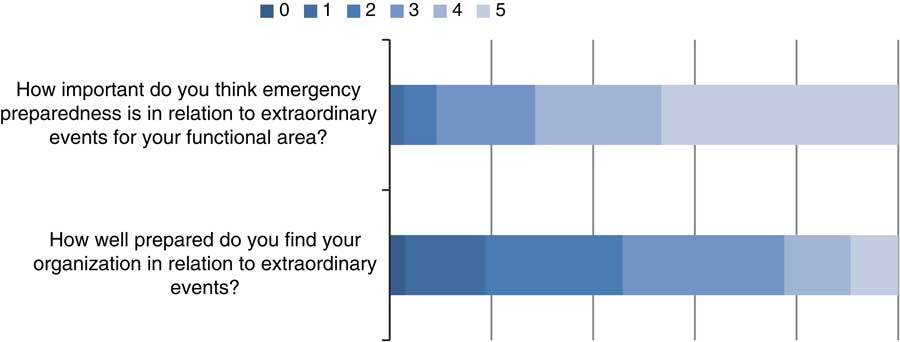
The respondents’ evaluation of the importance of emergency preparedness for their functional area corresponds to 4.0 (calculated average of all individual respondents) when asked to make an evaluation on a scale of 0 (none) to 5 (high). However, the evaluation of the actual emergency preparedness in their own organization was 2.7 (calculated average of all individual respondents) (Figure 1).
Evaluation of Crisis Preparedness on a Scale From 0 (None) to 5 (High) (Valid N=555).

The respondents also evaluated their familiarity with the municipal preparedness plan and the preparedness plan of their own organization. They seem to be more acquainted with the plan of their own organization (26.9% answered “well”) than with that of the municipalities (8.1% answered “well”) (Table 4).
Evaluation of Acquaintance With Preparedness Plans at the Municipal and Organizational Level, Respectively

DISCUSSION
From my theoretical perspective, the result shows that the first prerequisite for policy implementation (“to understand”)Reference Sannerstedt 28 is not fully met. The fairly low degree of experience of education suggests that the respondents have not been given the opportunity, through education, to develop a general understanding of emergency preparedness, and its scope and contexts. A fair number of specifications of experiences of events, education, and exercises not only concern emergency preparedness but also other areas. The respondents do not seem to differentiate between the high-consequence events that pertain to the area of emergency preparedness and events that concern their own organization or individuals. This is also the case when evaluating main risks. In addition, the understanding of the relationship to adjacent areas, such as work environmental issues and protection against accidents (eg fire security), seems to be unclear from the respondents’ perspective.
As regards the second prerequisite (“to be able”),Reference Sannerstedt 28 the equally low degree of experience of exercises, as well as a fairly low familiarity with preparedness plans, support the same interpretation. It is also supported by some self-critical remarks on the lack of ability. Comments by respondents, such as “As both me and my co-workers are uncertain of what we are expected to do, we are very vulnerable” or “one knows too little about crisis preparedness,” illustrate this.
The third prerequisite, “to be motivated,”Reference Sannerstedt 28 gives the impression of being satisfied to a higher degree than the other prerequisites, based on the respondents’ positive evaluation of emergency preparedness and strong interest in education and exercises. The interest in education and exercises is also expressed in remarks such as “I think it is important when you work with people,” along with comments involving the importance of regularity and updates of information, as well as introductory information for new employees on emergency preparedness.
Seen in the perspective of the risk governance model and its 5 stepwise activities,Reference Renn, Klinke and van Asselt 29 the respondents have not participated substantially in activities involving the first step (pre-estimation of possible risks). This can be expected to have an impact on the collective outcome of the forms of such estimations. Such consequences can, further, be expected to be reproduced in the second activity, when an interdisciplinary assessment is made of the first output in terms of its social, economic, environmental, and health implications. Further, the conditions for an articulation of relevant risks, and their possible consequences for seniors and the area of operations, are fairly weak in the encounter with other disciplines. This implies that the perspectives based on the frames of referenceReference Renn, Klinke and van Asselt 29 of elderly care staff is probably absent even in the third activity, the overarching evaluation. This step involves the evaluation of the identified risks in terms of being acceptable and tolerable. As the first 3 activities provide guidance for activities 4 and 5,Reference Renn, Klinke and van Asselt 29 a weak elderly care perspective can be assumed to be reproduced in those steps, namely risk management and monitoring.
Participation, communication, and deliberation are integrated elements in the risk governance model.Reference Renn, Klinke and van Asselt 29 The lack of elderly care staff’s participation indicates that the processes involving risk and vulnerability analyses are not organized and structured in order to facilitate their participation. However, when discussing participation it is relevant to acknowledge that the result also indicated that the respondents seem to have a composite understanding of emergencies and high-consequence adverse events, as well as of underlying concepts, such as risk, vulnerability, and security.
The elderly care staff’s notion of extraordinary events includes situations involving individuals’ security and critical psychosocial events, such as when a senior (ie a person with dementia) disappears or commits suicide, along with situations pertaining to the policy area of emergency preparedness. This suggests that the respondents’ notion of emergencies moves along a continuum of adverse events. The continuum ranges from high-consequence events, addressed in the emergency management framework in terms of societal disturbances, to the negative events that can be challenging for the individual’s security regardless of their scope. My understanding of the inclusion of the latter in a continuum is that elderly care staff are oriented toward the intersubjective dimensions of the security of seniors, such as routine, trust, and continuity, when evaluating an adverse event, irrespective of the events’ degree of consequences and scope. Consequently, the importance of routine, trust, and continuity in forming individuals’ feelings of security seems to be what holds the continuum together.
The result suggests that, by virtue of their mediating position, elderly care staff have the potential to contribute to the evaluation of impacts of adverse events on elderly care and seniors, as well as of risks and vulnerabilities in those regards. This can be done on the basis of the staff’s frame of reference and regardless of scope. However, I believe that, in order to contribute qualitatively to such estimations, staff need to have a more solid general understanding of the relationships between the two policy areas at hand, so as to be able to orient themselves in their interface. A more solid understanding has the potential to contribute to an integration of an understanding of the emergency preparedness, and its scope and contexts, with the operational area of elderly care.
The strength of this study is that it approaches an under-researched issue. Its limitations involve the limited material and the fact that it leaves seniors as well as practices aside because of its focus on the perspective of staffs, as expressed in written accounts. Further, a more comprehensive survey and qualitative material (such as interviews and observations) would probably have contributed with more nuances.
CONCLUSIONS
This study deals with the interface of elderly care and emergency preparedness, with a special focus on the extent to which the municipalities involve elderly care staff in emergency preparedness. Given that focus, a first conclusion is that elderly care staff, though highly motivated, generally do not seem to be involved in emergency preparedness. Further, in the studied municipalities, elderly care staff is not targeted to a large extent when education and training are organized. A second conclusion is that the development of an interface between emergency preparedness and elderly care could require a clarification of the scope and context of emergency preparedness. A clarification of different understandings of central concepts, such as emergencies and extraordinary events, and the underlying concepts of risk and security, could also be required. Such clarifications would benefit from an acknowledgment of the mediating position of elderly care staff between the individuals that are dependent on collective goods (ie publicly funded elderly care) and the enactment of societal responsibilities in relation to emergencies, understood as high-consequence events with a collective impact.
Bearing the limitations of this study in mind, I will now formulate some recommendations. I do this with the normative risk government model as a backdrop. According to that model, interdisciplinary involvement and broad participation throughout the risk governance can be expected to contribute to the quality of the outcome.
-
∙ Ensure participation of elderly care staff in emergency preparedness by making space for them in activities leading to decisions involving emergency management.
-
∙ Ensure the development of human resources to secure the quality of participation of staff involved in elderly care. Promote education and exercises aimed at developing a clear understanding of emergency preparedness as a field and its interface with elderly care.
-
∙ Ensure financial and technical resources, as well as institutional means, in order to develop a sustainable structure involving the elderly care staff’s active participation in emergency preparedness.
Acknowledgment
This study has been possible because of funding from the Swedish Civil Contingencies Agency and the National Board of Health and Welfare.