Introduction
In most countries of the world, older adults kill themselves at higher rates than any other age group (Conwell, Reference Conwell2009). Worldwide demographic aging means that the absolute number of suicides by elderly people is likely to increase (O'Connell et al., Reference O'Connell, Chin, Cunningham and Lawlor2004). Cross-national comparative study of elderly suicide rates in the European Union has revealed wide variations between European regions: elderly suicide rates have been found to be lowest in Western European and Mediterranean countries and highest in Central and Eastern Europe (Shah et al., Reference Shah, Bhat, McKenzie and Koen2009).
The World Health Organization explains the phenomenon of suicide using individual, relational, communal and societal models. At the individual level, characteristics like psychological or personality traits are considered. At relational and communal levels, the focus is on social relationships within people's immediate surroundings (family members, communal contexts, workplaces). At the societal level, institutional or economic environments are considered (Wu and Bond, Reference Wu and Bond2006).
Shah and colleagues have conducted various studies in which they reviewed elderly suicide in socioeconomic and demographic contexts, considering the associations between elderly suicide and human development, life expectancy and elderly dependency (Shah, Reference Shah2009; Shah et al., Reference Shah, Bhat, Mackenzie and Koen2008a; Reference Shah, Padayatchi and Das2008b). Psychosocial factors and stressful life events, such as declining social support, family discord and living alone, have been considered risk factors for elderly suicide (Lawrence et al., Reference Lawrence, Almeida, Hulse, Jablensky and Holman2000; Rubenowitz et al., Reference Rubenowitz, Waern, Wilhelmson and Allebeck2001; Yip et al., Reference Yip, Chi, Chiu, Chi Wai, Conwell and Caine2003; Duberstein et al., Reference Duberstein, Conwell, Conner, Eberly, Evinger and Caine2004b; O'Connell et al., Reference O'Connell, Chin, Cunningham and Lawlor2004). The predictive role of low social interaction and loneliness for elderly suicide behavior has also been reported (Conwell et al., Reference Conwell, Olsen, Caine and Flannery1991; Rubenowitz et al., Reference Rubenowitz, Waern, Wilhelmson and Allebeck2001; Chiu et al., Reference Chiu2004; Duberstein et al., Reference Duberstein, Conwell, Conner, Eberly, Evinger and Caine2004b). Similar results concerning family relations, emotional dependency and a mismatch of expectations between generations were reported by a study in Taiwan (Liu et al., Reference Liu, Wang and Yang2006). Wu and Bond (Reference Wu and Bond2006) considered issues of social activity, dependency on family satisfaction and domestic integration, with the expectation that elderly suicide can be predicted better on the basis of cognitive and emotional factors and social support.
The hypothesis of the present study is that disparities in elderly suicide mortality may be largely explained by society's attitudes towards the elderly population. These attitudes include a number of cognitive and emotional factors, such as respect, friendliness, recognition, consideration, prejudice and contempt.
The objectives of this study were to (1) identify elderly suicide rates in 26 European countries, (2) assess the relationship between elderly suicide mortality and national attitudes towards the elderly in these countries, and (3) compare patterns of elderly suicide mortality and attitudes towards the elderly in Eastern and Western Europe.
Methods
Twenty-six European countries participating in the European Social Survey (ESS) were included in the study. The ESS (http://www.europeansocialsurvey.org) is an academically driven social survey designed to chart and explain the interaction between Europe's changing institutions and the attitudes, beliefs and behavior patterns of its diverse populations. Full ESS data are available on an open-access basis. Suicide rates in the 65+ age group, adjusted by gender, were evaluated in the context of attitudes towards the elderly in society. Age-aggregated elderly suicide rates were obtained from the WHO European Mortality Database, updated in January 2010 (http://data.euro.who.int/hfamdb/). For each country, mean annual elderly suicide rates were calculated, for males and females separately, for the last five years for which data had been available.
The attitude data from the third edition of the European Social Survey Round 4, collected in 2008–9 in the “ageism” category, were selected. The term “ageism” was proposed by Robert Butler (Butler, Reference Butler1987) to define a process of systematic stereotyping and discrimination against people because of their age. Seven questions that represent society's attitudes towards the elderly and may correspond to the “group” dimension of social exclusion (Percy-Smith, Reference Percy-Smith and Percy-Smith2000) were considered for the purpose of the study:
A. How do most people view the status of people aged over 70 years? (Score: 0–10, where 0 means “extremely low status”’ and 10 means “extremely high status”.)
B. All things considered, do you think people over 70 contribute very little or a great deal economically to [country] these days? (Score: 0–10, where 0 means “they contribute very little economically to [country]” and 10 means “they contribute a great deal”.)
C. How likely it is that most people view those over 70 as friendly? (Score: 0–4, where 0 means “not at all likely to be viewed that way” and 4 means “very likely to be viewed that way”.)
D. How likely it is that most people view those over 70 as having high moral standards? (Score: 0–4, where 0 means “not at all likely to be viewed that way” and 4 means “very likely to be viewed that way”.)
E. How likely it is that most people view those over 70 with admiration? (Score: 0–4, where 0 means “not at all likely to be viewed that way” and 4 means “very likely to be viewed that way”.)
F. Are any members of your family aged over 70? [interviewer note: “Family includes any relative whether they are a blood relative or through marriage”] (1 means “yes”, 2 means “no”.).
G. How much time of your working time have you spent with colleagues aged over 70 in the past month? (Score: 1–5, where 1 means “none of the time” and 5 means “almost all the time”.)
For each country, mean scores for all responses were aggregated and correlated with average suicide rates over the last five years for which data were available. Correlations were analyzed using Pearson's test (r).
To arrive at mean scores for responses to the questions selected, the countries were divided into two groups: Western and Eastern Europe. The “Western European” group comprised 13 countries (Belgium, Denmark, Finland, France, Germany, Greece, the Netherlands, Norway, Portugal, Spain, Sweden, Switzerland and the U.K.) and Israel. The “Eastern European” group comprised 12 countries (Bulgaria, Croatia, the Czech Republic, Estonia, Hungary, Latvia, Poland, Romania, the Russian Federation, Slovakia, Slovenia and Ukraine). Differences between mean scores for attitudes in Western and Eastern countries were presented as percentages of the highest scores on the appropriate scale. This approach was optimal to account for differences in the length (1, 4 or 10) and starting points (0 or 1) of the scales, especially since these scores are national averages, while individual respondents range throughout the scale.
Data on labor-market exit age were taken from the EUROSTAT database (http://epp.eurostat.ec.europa.eu) and were not available for Russia, Ukraine or Israel. The pattern of covariance between suicide mortality and country-level attitudes was considered, using Pearson's correlation coefficient.
Results
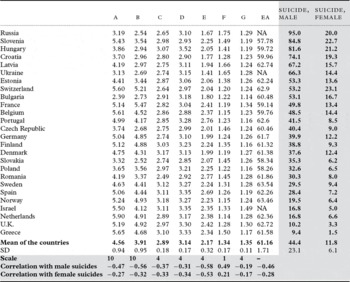
Mean annual suicide rates among the elderly were lowest in Greece for both males (9.4 per 100,000) and females (1.5 per 100,000). The highest male elderly suicide rate (95.0 per 100,000) was in Russia. The highest female elderly suicide rate (23.1 per 100,000) was in Switzerland (Table 1).
Country-level and aggregated means of attitudes towards elderly and elderly suicide rates per 100 000 in European countries.

Abbreviations:
A - How do most people view status of people over 70?
B - Do you think people over 70 contribute very little or a great deal economically to the country these days?
C - How likely it is that most people view those over 70 as friendly?
D - How likely it is that most people view those over 70 as having high moral standards?
E - How likely it is that most people view those over 70 with admiration?
F – Are any members of your family aged over 70?
G – How much time did you spend working with colleagues aged over 70 last month?
EA - Exit age from labor market.
NA – Data are not available.
The following associations were revealed between elderly suicide rates and society's attitudes towards this age group (Table 1).
Perception of elderly people as having higher status is inversely correlated with mortality from suicide in this age group. The male population shows a relatively strong negative association for this factor (−0.47), while for females it is weak (−0.27). Recognition of the elderly as contributing to the economy is also inversely correlated with suicide mortality. This correlation is higher among males (−0.56) than among females (−0.32). In both males and females, suicide mortality is inversely correlated with attitudes of friendliness (males −0.37, females −0.33) and admiration (males −0.58, females −0.53). A weak inverse correlation also emerged between rates of suicide mortality and the notion of elderly people as embodying higher moral standards (−0.31 among males, −0.34 among females). Working alongside elderly colleagues is inversely correlated with elderly suicide, and this association is weak in both sexes (males −0.19, females −0.17). Suicide rates are lower in countries where respondents more often have elderly members in their families. This correlation is stronger for males (0.49) than for the female population (0.21).
In addition, an inverse correlation between suicide mortality among elderly people and their labor-market exit age was revealed. This correlation is higher for males (−0.46) than for females (−0.28).
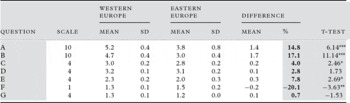
A more thorough study of attitudes towards elderly people shows several remarkable differences in attitudes between Eastern and Western Europe (Table 2). The elderly are accorded a lower status in Eastern Europe countries (difference 14.8%). People in Western Europe recognize the economic contribution of elderly people as 17.1% higher than in Eastern Europe. Western Europeans also regard the elderly with more admiration and as more friendly (the differences being 7.8% and 4%, respectively). Western Europeans have elderly members in their families more often than Eastern Europeans (difference 20.1%).
Attitudes towards elderly people in Eastern and Western Europe

Abbreviations:
A – How do most people view status of people over 70?
B – Do you think people over 70 contribute very little or a great deal economically to the country these days?
C – How likely it is that most people view those over 70 as friendly?
D – How likely it is that most people view those over 70 as having high moral standards?
E – How likely it is that most people view those over 70 with admiration?
F – Are any members of your family aged over 70?
G – How much time did you spend working with colleagues aged over 70 last month?
*p < 0.05; **p < 0.01; ***p < 0.001.
Discussion
Objective 1 of the Madrid International Plan of Action on Ageing, 2002 (United Nations, 2002) proclaims that “older persons should be treated fairly and with dignity, regardless of disability or other status, and should be valued independently of their economic contribution”. The latter part of life is often linked with declining social and economic status, as well as limited independence and significant lifestyle changes (Duberstein et al., Reference Duberstein, Conwell, Conner, Eberly, Evinger and Caine2004b). These changes result in an increased burden of stress. Many elderly persons feel lonely, empty and isolated, and their self-esteem suffers (Devons, Reference Devons1996; Yip et al., Reference Yip, Chi, Chiu, Chi Wai, Conwell and Caine2003). Emotional and social aspects start to play a particularly important role in determining the risk for suicide behavior in the elderly age group (Conwell et al., Reference Conwell, Duberstein and Caine2002; Turvey et al., Reference Turvey2002). Industrial and post-industrial societies demand great mobility in families, and this has led to a dramatic shift in attitudes towards older people. Very often, elderly people are treated as second-class citizens with nothing to offer society, and the negative attitudes about aging that give rise to ageism tend to manifest themselves in subtle ways in the average older person's daily life (Nelson, Reference Nelson2005).
European social policy recognizes the elderly population as an at-risk group for social exclusion (Percy-Smith, Reference Percy-Smith and Percy-Smith2000). In the current study, we attempted to evaluate how society's attitudes towards the elderly affect suicide mortality in this age group. We assumed that the part of the European Social Survey module selected (the E1–E55 rotating module) corresponds to the “group” dimension of social exclusion and describes factors that affect the confidence, self-esteem and psychological well-being of elderly persons; nevertheless it may not be a direct measure of this concept. The results support the hypothesis that elderly people are prone to be affected by the level of social and family integration and societal attitudes towards them. Attitudes of society towards its elderly members play an important role and significantly influence suicide mortality. Seemingly trivial favorable behaviors, such as regarding elderly people as friendly, perceiving them as having higher status and moral standards, and experiencing feelings of admiration towards them may be considered protective factors that support elderly people and reduce suicide mortality among them. These positive feelings and cognitions are themselves derived from societal factors that predispose the population towards these psychological reactions (Wu and Bond, Reference Wu and Bond2006).
The results of our study support Durkheim's theory, as well as some newer studies (Johnson, Reference Johnson1965) that consider a higher level of social and family integration to be protective. Whereas Durkheim suggested that both extremely high and extremely low levels of social integration and social regulation are associated with high suicide rates, Johnson (Reference Johnson1965) argues that in modern societies only low levels of these social characteristics are associated with high suicide rates (Leenaars and Lester, Reference Leenaars and Lester1999). According to Durkheim, traditional family life provides the best protection against self-destructive behavior. The elderly in a country with an elevated level of family integration have more positive emotions (e.g. happiness) and sustaining cognitions (e.g. perceived health), and hence less probability of committing suicide (Wu and Bond, Reference Wu and Bond2006). Conversely, elderly people living alone usually have the highest risk of suicide (Liu et al., Reference Liu, Wang and Yang2006). According to our results, suicide rates are lower among elderly people in countries where people prefer to keep elderly relatives within the family. This outcome is in line with the results of several other studies that consider grandparent–grandchild relationships and argue that such contact reduces prejudice and increases positive attitudes (Silverstein and Parrott, Reference Silverstein and Parrott1997; Wright et al., Reference Wright, Aron and Tropp2002). Social and family support may play a buffering role, fending off functional and financial decline in the elderly population. The complex structure of social support and the moderating role it conceivably plays regarding suicide risk associated with stressful life events is mentioned by some authors (Conwell et al., Reference Conwell, Duberstein and Caine2002).
Other outcomes of the study reveal that suicide rates are more strongly correlated with attitudes in the male population. There is greater divergence between male and female correlation strengths in attitude issues connected with elderly people's economic contribution and the general status of the elderly in society. For males, the correlation between elderly suicide rates and labor-market exit age is also much stronger than it is for females. A greater concern among males about their socioeconomic contribution and career achievements and also higher expectations of males on the part of family members and society may be among the possible explanations why this factor shows a stronger association in the male population. Another finding is that male elderly suicide rates are related to the issue of family belonging much more strongly than female rates. Durkheim regards women as more socially integrated in daily life, which gives much stronger protection against suicide. Stronger self-reliance and control in daily life, as well as more independence in running the home, may also help to explain the weaker association with female elderly suicide (De Leo, Reference De Leo1998). In addition, the relationship between suicide rates and society's attitudes concerning the moral standards of elderly people is revealed. Society's perception of elderly people as having higher moral standards is inversely correlated with mortality from suicide among elderly males and females alike, but for females the correlation is slightly stronger.
Differences in attitudes towards the elderly in Eastern and Western European countries also deserve consideration. Citizens of Eastern Europe place less value on the status of the elderly, who are seen as 14.8% less important than they are in Western Europe, and estimate their contribution to the economy as 17% lower. The emotional component of attitudes towards the elderly in Eastern Europe is less manifest than in Western European countries. Western Europeans regard elderly people with admiration and see them as more friendly. They also have elderly people as members of their families more often than Eastern Europeans. The results listed above support the conclusion about the role of a more positive emotional approach towards the elderly in preventing suicide mortality in Western European society. Enhancing elderly people's social inclusion could be highly beneficial in terms of mental health. Eastern European countries seem to merit higher priority in terms of intervention deployment.
One remarkable result in our study is the inverse correlation between elderly suicide mortality and labor-market exit age. Suicide mortality is lower in countries where elderly people can continue to participate longer in employment. There are several possible explanations for this phenomenon. Some studies link an elevated risk of suicide among elderly adults with lower incomes (Duberstein et al., Reference Duberstein, Conwell, Conner, Eberly and Caine2004a). Yip and co-authors revealed that the ratio of economically inactive to active elderly suicide victims is about six to one (Yip et al., Reference Yip, Chi, Chiu, Chi Wai, Conwell and Caine2003). They also consider that jobs for the elderly are important not only to provide additional income but also to give them an active lifestyle, which is very important for their psychological well-being. Affording opportunities for the elderly to maintain an active lifestyle after retirement seems to be beneficial in terms of suicide prevention. This notion is suggested by another finding of our study: more time spent by people aged 70 years and over at work, the more suicide mortality might be reduced (a weak correlation is present). The beneficial influence of social interaction at work on elderly people's adaptability may constitute a possible explanation for the relatively low suicide mortality among those elderly people who are employed. The positive influence of employment as a means of preventing suicide is more significant among elderly males. The hypothesis of our study is supported by a study of the social context of well-being based on the World Values Survey, U.S. Benchmark Survey and Canadian Survey (Helliwell and Putnam, Reference Helliwell and Putnam2004). Strong support from family and friends, frequent social interactions and civic participation, as well as higher incomes, exert a beneficial influence on well-being. The relationship between well-being and suicide is mentioned by many authors (Sisask et al., Reference Sisask, Varnik, Kolves, Konstabel and Wasserman2008; Voracek, Reference Voracek2009), although some of them do not support this notion (Lester, Reference Lester1998). Revision of European countries’ employment strategies for the elderly towards broadening their employment options and creating favorable opportunities for them to remain employed for longer would not only encourage elderly people to maintain an active lifestyle but also reduce their suicide mortality. Finally, these outcomes are in line with the United Nations Program on Ageing, which calls for promotion of “a favorable attitude among employers regarding the productive capacity of older workers as being conducive to their continued employment and promotes awareness of their worth, including their self-awareness, in the labor market” (United Nations, 2002). We would advise governments to consider these results in policy-making when it comes to elderly employment.
Nevertheless, it is important to keep in mind the limitations of our study design. As with most ecological studies, conclusions are prone to ecological fallacies in which we may have ascribed to group members characteristics that they do not, in fact, possess as individuals. Other macro-social indicators, such as religious affiliation, access to health care and social welfare facilities, and the baseline socioeconomic status of the nations (e.g. GDP per capita) studied, may be risk factors for suicide mortality in older adults.
The higher proportion of elderly people in the population of Western Europe owing to longer life expectancy may influence the basis for conclusions regarding question F (“Are any members of your family aged over 70?”) in our study. This should therefore be considered among its possible limitations.
Conclusions
1 Society's attitudes towards elderly people affect their suicide mortality.
2 Attitudes towards elderly people are more favorable among Western European than Eastern European citizens.
3 Extended labor-market participation by the elderly is a suicide-protective factor for this age group.
Conflict of interest
None.
Description of authors' roles
Airi Värnik, Lauri Leppik, Liina-Mai Tooding and Andriy Yur`yev designed the study, and Andriy Yur`yev, Airi Värnik, Peeter Värnik, Merike Sisask and Lauri Leppik contributed to its conceptualization. Airi Värnik was responsible for collecting the data, and Andriy Yur`yev, Liina-Mai Tooding, Airi Värnik, Peeter Värnik and Merike Sisask analyzed the data. Andriy Yur`yev wrote the first draft of the paper and Airi Värnik, Peeter Värnik, Merike Sisask and Jing Wu contributed to the writing of subsequent versions. Lauri Leppik assisted with interpretation of the results and contributed to the writing of the final paper, and reviewed and approved the contributions of others.
Acknowledgments
The research leading to these results received funding from the European Community's Seventh Framework Program (FP/2007–2013) OSPI-Europe under grant agreement no. 223138 and from the Estonian Ministry of Social Affairs. Thanks are due to Clare James for her thorough linguistic and stylistic revision of the paper.