INTRODUCTION
Perioculodes aequimanus (Kossmann, Reference Kossmann and Kossmann1880) is an oedicerotid amphipod that inhabits sedimentary bottoms (Ledoyer, Reference Ledoyer and Ruffo1993). This species was described from the Red Sea (Kossman, 1880, as Oedicerus aequimanus), and later reported from the Suez Canal (Schellenberg, Reference Schellenberg1928). There are records of this species along the Mediterranean Sea, from the Israel coasts (Sorbe et al., Reference Sorbe, Basin and Galil2002), Cyprus (Kocatas et al., Reference Kocatas, Katagan and Benli2001), Aegean Sea (Ledoyer, Reference Ledoyer and Ruffo1993; Baxevanis & Chintiroglou, Reference Baxevanis and Chintiroglou2000; Antoniadou et al., Reference Antoniadou, Krestenitis and Chintiroglou2004; Dağli et al., Reference Dağlı, Bakır, Doğan, Özcan, Kırkım, Cınar, Öztürk, Önen and Katağan2008), Adriatic Sea (Ledoyer, Reference Ledoyer and Ruffo1993; Dondi et al., Reference Dondi, Marchini and Sconfietti2003), Tyrrhenian Sea (Ledoyer, Reference Ledoyer and Ruffo1993; Sparla et al., Reference Sparla, Scipione and Riggio1993), the Tunisian coast (Ledoyer, Reference Ledoyer and Ruffo1993; Zakhama-Sraieb et al., Reference Zakhama-Sraieb, Sghaier and Charfi-Cheikhrouha2009), France (Ledoyer, Reference Ledoyer1972, Reference Ledoyer and Ruffo1993) and eastern Iberian Peninsula (Cartes & Sorbe, Reference Cartes and Sorbe1999; Munilla & San Vicente, Reference Munilla and San Vicente2005).
To date, the only species of the genus Perioculodes Sars, 1895 reported from Atlantic European waters is Perioculodes longimanus (Bate & Westwood, 1868). Although there have been records of P. aequimanus for the Indian Ocean (Ledoyer, Reference Ledoyer1986), this species was later considered as having a distribution circumscribed to the Mediterranean and Red Seas (Ledoyer, Reference Ledoyer and Ruffo1993). A record pending confirmation from Brazil (Serejo, Reference Serejo1998, as Perioculodes cf. aequimanus) would expand the distribution of this species to the western Atlantic.
An examination of samples from sediments collected in the O Grove inlet (Galicia, north-western Spain) during 1996 yielded a number of specimens identified as P. aequimanus. This confirms, therefore, the presence of P. aequimanus in the Atlantic Ocean, and represents its first record for the eastern Atlantic.
MATERIALS AND METHODS
Benthic samples were taken at the O Grove, an estuarine inlet located on the north-west Atlantic coast of the Iberian Peninsula, between 42°41′–42°28′N and 9°01′–8°44′W. Most of its intertidal and shallow subtidal sediments are covered by meadows of Zostera marina L. and Z. noltii Hornem. In December 1996, ten sites were sampled by means of a van Veen grab in order to characterize the macrofaunal assemblages of these meadows. Five replicate samples were taken at each site, thus covering a total area of 0.28 m2 for each site. Samples were sieved through a 0.5-mm mesh and fixed in 10% formalin for later sorting and identification of the fauna. An additional sample was taken at each site for granulometric analyses and to determine calcium carbonate content (%, estimated by treatment with hydrochloric acid) and organic matter content (TOM, %, estimated from the weight loss after placing samples in a furnace for 4 hours, at 450°C). Salinity, pH and temperature measurements were taken in situ.
Line drawings of Perioculodes aequimanus were done with a camera lucida connected to a light microscope. Length of the individuals was measured from the rostrum to the posterior margin of the third epimeral plate. Nomenclature follows that used by Ledoyer (Reference Ledoyer and Ruffo1993). Six specimens were deposited in the Museo Nacional de Ciencias Naturales, Madrid, Spain (MNCN).
SYSTEMATICS
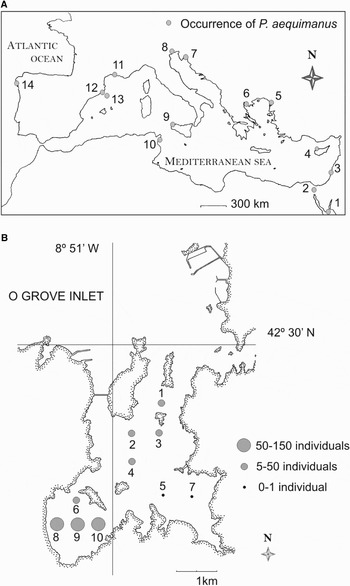
(A) Records of Perioculodes aequimanus in European waters, including this study: 1, Red Sea (Kossmann, Reference Kossmann and Kossmann1880); 2, Suez Canal (Schellenberg, 1982); 3, Israel coasts (Sorbe et al., Reference Sorbe, Basin and Galil2002); 4, Cyprus (Kocatas et al., Reference Kocatas, Katagan and Benli2001); 5, Tunisian coasts (Dağli et al., Reference Dağlı, Bakır, Doğan, Özcan, Kırkım, Cınar, Öztürk, Önen and Katağan2008); 6, Aegean Sea (Ledoyer, Reference Ledoyer and Ruffo1993; Baxevanis & Chintiroglou, Reference Baxevanis and Chintiroglou2000; Antoniadou et al., Reference Antoniadou, Krestenitis and Chintiroglou2004); 7&8, Adriatic Sea (Ledoyer, Reference Ledoyer and Ruffo1993; Dondi et al., Reference Dondi, Marchini and Sconfietti2003); 9, Sicily (Sparla et al., Reference Sparla, Scipione and Riggio1993); 10, Tunisian coasts (Ledoyer, Reference Ledoyer and Ruffo1993; Zakhama-Sraieb et al., Reference Zakhama-Sraieb, Sghaier and Charfi-Cheikhrouha2009); 11, French coasts (Ledoyer, Reference Ledoyer1972, Reference Ledoyer and Ruffo1993); 12&13, eastern Iberian Peninsula (Cartes & Sorbe, Reference Cartes and Sorbe1999; Munilla & San Vicente, Reference Munilla and San Vicente2005, respectively); 14, Galician coast (this study); (B) location of the O Grove inlet showing the position of the sampling sites and numbers of individuals of P. aequimanus found at each site.

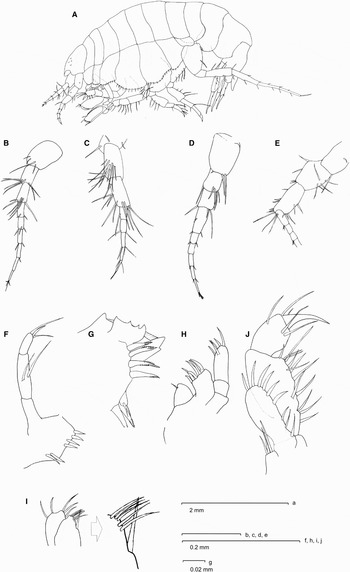
Perioculodes aequimanus. Female: (A) entire animal, lateral view; (B) antenna 1; (C) antenna 2. Male: (D) antenna 1; (E) antenna 2. Female: (F) mandibular palp; (G) detail of the mandible; (H) maxilla 1; (I) maxilla 2; (J) maxilliped.

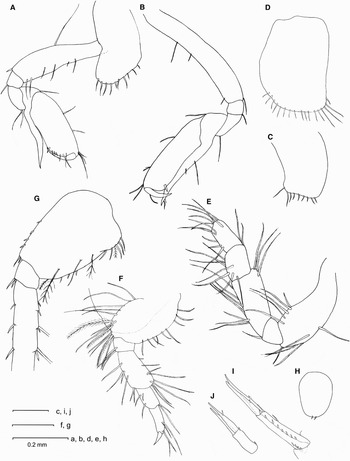
Perioculodes aequimanus. Female: (A) gnathopod 1; (B) gnathopod 2; (C) coxa 3; (D) coxa 4; (E) pereiopod 3; (F) pereiopod 5; (G) pereiopod 7; (H) telson; (I) uropod 1; (J) uropod 3.

Oedicerus aequimanus Kossmann, Reference Kossmann and Kossmann1880, 130, pl. 13, figures 6–8.
Perioculodes aequimanus Schellenberg, Reference Schellenberg1928, 641, figure 200. Ledoyer, Reference Ledoyer1972, 775, figure 1. Ledoyer, Reference Ledoyer and Ruffo1993, 600, figure 412.
MATERIAL EXAMINED
Specimens totalling 288 (1.85% of total amphipod abundance): 12 ♀♀, 2 ♂♂, 14 juveniles, 42°29.12′N 08°50.25′W, mud with Zostera marina, 0.8 m, coll. J.S. Troncoso, 11 December 1996; 5 ♀♀, 42°28.75′N 08°50.75′W, fine sand with rests of shells and Z. marina, 0.3 m, coll. J.S. Troncoso, 4 December 1996; 5 ♀♀, 2 juveniles, 42°29.75′N 08°50.25′W, mud with Z. marina, 5.9 m, coll. J.S. Troncoso, 4 December 1996; 6 ♀♀, 1 ♂, 1 juvenile, 42°28.25′N 08°50.75′W, fine sand with Z. marina, 0.3 m, coll. J.S. Troncoso, 11 December 1996; 1 ♀, 42°27.75′N 08°51.25′W, mud with Z. marina and Z. noltii, 0.3 m, coll. J.S. Troncoso, 18 December 1996; 8 ♀♀, 1 ♂, 2 juveniles, 42°27.75′N 08°51.25′W, fine sand with Z. noltii, 0.3 m, coll. J.S. Troncoso, 11 December 1996; 39 ♀♀, 5 ♂♂, 11 juveniles, 42°27.25′N 08°52.25′W, mud, 0.3 m, coll. J.S. Troncoso, 18 December 1996; 3 ♀♀ (MNCN 20.04/8371), 63 ♀♀, 7 ♂♂, 32 juveniles, 42°27.25′N 08°51.25′W, mud with Z. marina and Z. noltii, 0.3 m, coll. J.S. Troncoso, 18 December 1996; 1 ♀ and 2 ♂♂ (MNCN 20.04/8419), 40 ♀♀, 4 ♂♂, 21 juveniles, 42°27.25′N 08°51.75′W, mud with Z. marina and Z. noltii, 0.3 m, coll. J.S. Troncoso, 18 December 1996.
ADDITIONAL COMPARATIVE MATERIAL
Perioculodes longimanus (Bate & Westwood, 1868). Fifty-nine specimens: 33 ♀♀, 1 ovigerous ♀, 4 ♂♂, 7 juveniles, 42°29.12′N 08°50.25′W, mud with Z. marina, 0.8 m, coll. J.S. Troncoso, 11 December 1996; 2 ♀♀, 1 unsexed, 42°28.75′N 08°50.75′W, fine sand with rests of shells and Z. marina, 0.3 m, coll. J.S. Troncoso, 4 December 1996; 3 ♀♀, 1 ♂, 42°29.75′N 08°50.25′W, mud with Z. marina, 5.9 m, coll. J.S. Troncoso, 4 December 1996; 3 ♀♀, 1 ♂, 42°28.25′N 08°50.75′W, fine sand with Z. marina, 0.3 m, coll. J.S. Troncoso, 11 December 1996; 2 ♀♀, 1 ♂, 42°27.75′N 08°51.25′W, mud with Z. marina and Z. noltii, 0.3 m, coll. J.S. Troncoso, 18 December 1996.
DESCRIPTION
Female: body length of 1.5–4.0 mm. Head with rostrum, downturned (Figure 2A). Eyes coalesced, large; often not defined in preserved specimens. Antenna 1 peduncular articles 1–3 subequal in length, flagellum—six-articulated (Figure 2B). Antenna 2 flagellum short—five-articulated (Figure 2C). Mandible with six spines (Figure 2F, G). Maxilla 1 inner lobe with one setule (Figure 2H). Maxilla 2 bilobed, reduced, with terminal setae (Figure 2I). Maxiliped basic (Figure 2J). Gnathopods subchelated, carpal lobe long and narrow, reaching beyond end of propodus. Palm delimited by one stout spine (Figure 3A, B). Gnathopod 1 propodus ovate, 2.1–2.5 times as long as broad (Figure 3A). Gnathopod 2 propodus longer, three times as long as wide (Figure 3B). Coxa 1 oblique, with pronounced anterior distal margin (Figure 3A). Coxa 3 slightly concave on distal margin (Figure 3C). Coxa 4 with 3–4 long setae on posterodistal corner (Figure 3D). Pereiopod 3 (Figure 3E) and four dactylus at least half of length of propodus. Pereiopods 5 and 6 (Figure 3F) basis ovate, bearing long plumose setae and not plumose setae. Pereiopod 7 distinctly longer, basis not broadened (Figure 3G). Telson entire, ovate, bearing a pair of small setae (Figure 3H). Uropod 1 peduncle long, subequal in length with rami (Figure 3I). Uropod 2 reaching end of uropod 3. Uropods rami subequal. No ovigerous female in samples examined.
Male: antenna 1 peduncular articles 2 and 3 of same length. Antennal flagellum with six articles; first article approximately twice in length than the others (Figure 2D). Antenna 2 flagellum long, up to 20–30 articulated articles; articles longer than wide (Figure 2E). Antenna 2 of fully developed males reaching half or more of body length. Otherwise males similar to females. Male:female ratio: 1:6–1:10 (for any given sample with at least one male and > 10 individuals).
Subadults/juvenile stages: antennal flagellum sometimes reduced in specimens <2.5 mm long; females with antenna 1 and two flagellum with 4–5 articles. In subadult males, antenna 2 flagellum short, reaching less than 1/3 of body length; articles wider than long. Gnathopod 1 propodus stout, 1.5–2 times as long as wide.
HABITAT
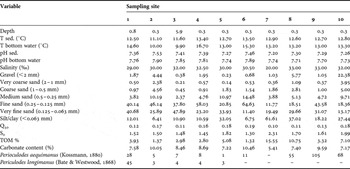
This species was found in Zostera meadows on sediments which are mainly composed of muddy sand, with high percentages of fine and very fine sand (up to 64.6% and 47.9%, respectively), and silt/clay (up to 61.6%). Content in organic matter was high (up to 15.55%), whereas content in calcium carbonate was low (<10.5%). Salinity was relatively low (20–33‰). Values of the studied variables and number of individuals at each sampling site are detailed in Table 1.
Environmental variables and number of individuals (ind 0.28 m2) of Perioculodes aequimanus and P. longimanus at each sampling site. Granulometric fractions expressed in percentages (%).

T sed., temperature of the sediment; T bottom water, temperature of the bottom water; pH sed., pH of the sediment; pH bottom, pH of the bottom water; Q50, median grain size, S0, sorting coefficient; TOM, total organic matter.
REMARKS
There are some morphological differences of Atlantic specimens when compared with the diagnosis reported by Ledoyer (Reference Ledoyer1972, Reference Ledoyer and Ruffo1993) for Mediterranean specimens. Thus, in our specimens, coxa 4 (Figure 3D) presents 3–4 long setae in the posterodistal margin, while Mediterranean individuals have only small setae along the distal margin. The basis of pereiopod 3 is notably broadened in Mediterranean specimens, but only slightly broadened in specimens from the O Grove (Figure 3E). Nevertheless, the features of gnathopod 1 and coxa 1 (Figure 3A), the basis of the pereiopod 7 (Figure 3G) and the antennal peduncle (Figure 2B–E) are those typical of Perioculodes aequimanus.
The other European species, P. longimanus, is very similar to P. aequimanus but differs in the following features: the length of the peduncle articles of antenna 1, the propodus of gnathopod 1 is more than four times longer than wide, the coxa 1 is rounded and not produced, the basis of pereiopod 3 is distinctively narrower, and the basis of pereiopod 7 is broadened (Ledoyer, Reference Ledoyer and Ruffo1993).
DISCUSSION
In general, the morphological characteristics of the Atlantic specimens examined here fit well with those described by Ledoyer (Reference Ledoyer1972, Reference Ledoyer and Ruffo1993) for the Mediterranean Perioculodes aequimanus, although with minor differences. Serejo (Reference Serejo1998) found similar differences in a single specimen from Brazilian coasts, which she identified as Perioculodes cf. aequimanus. The distal border of coxa 4 and pereiopod 3 basis (Figure 3D, E) are similar in Brazilian and Iberian specimens; gnathopod 2 propodus (Figure 3B) is, however, shorter and wider in the Brazilian specimens than in those from north-west Spain. Morphological variability (e.g. number of setae, body size) is frequent between individuals from one species undergoing different conditions or inhabiting different regions (Berezina, Reference Berezina2007). Therefore, we consider that the minor differences found between our material and the specimens described from the Mediterranean and the Red Sea should be considered as intraspecific variations.
Taking the aforementioned intraspecific variations into account, we conclude that the shape of gnathopod 1 propodus, coxa 1, the pereiopod 7 basis and the antennal peduncle can be considered the main diagnostic characters for the identification of this species, as well as for differentiation from other species within the genus. On the other hand, early juvenile or small specimens (<2 mm), in which most of the taxonomic characters are slightly or not defined at all and the antennae are not properly developed, could only be distinguished because of the oval and stout shape of the gnathopod 1 propodus.
The examination of individuals of various sizes and the range of definition of the morphological characters show that the specimens from north-west Spain have several levels of development. Besides, a high number of individuals were found in the samples (Figure 1; Table 1), even when compared with most of the aforementioned studies. These two circumstances lead to the conclusion that P. aequimanus is a well-established species in the O Grove inlet, and consequently we infer that the environmental conditions in this inlet are adequate for the development of the species. Nevertheless, little is described about the ecology of this species in the available literature.
In general, P. aequimanus is found in warm-temperate waters (i.e. the Mediterranean Sea, the Red Sea and the coast of Brazil). However, the seawater off the north-west coast of the Iberian Peninsula is often colder than in those areas, suggesting that the temperature tolerance of this species is wider than previously thought. A recent record from the Catalonian continental slope (western Mediterranean; Cartes & Sorbe, Reference Cartes and Sorbe1999) supports this idea. On the other hand, our study seems to confirm that the preferred habitat for P. aequimanus corresponds to sedimentary bottoms of sheltered, shallow areas, according to most of the records for this species (Bellan-Santini, Reference Bellan-Santini and Bellan-Santini1998; Dondi et al., Reference Dondi, Marchini and Sconfietti2003; Antoniadou et al., Reference Antoniadou, Krestenitis and Chintiroglou2004; Basset et al., Reference Basset, Galuppo and Sabetta2006; Dağli et al., Reference Dağlı, Bakır, Doğan, Özcan, Kırkım, Cınar, Öztürk, Önen and Katağan2008). Indeed, in our samples, this species is much more abundant in Sites 8, 9 and 10 which are sheltered from oceanic influence and the seasonal freshwater streams that affect, for instance, Sites 5 and 7 (Figure 1). Besides, no specimens were collected at Site 7, the closest to these streams, which could indicate either that P. aequimanus does not tolerate frequent changes in salinity or rather the hydrodynamics derived from the freshwater flux. The nature of the substratum does not, however, seem to be a limiting condition for P. aequimanus; according to Ledoyer (Reference Ledoyer and Ruffo1993) and Bellan-Santini (Reference Bellan-Santini and Bellan-Santini1998) this species can be found in a range of sedimentary types, from muddy sands to coarse sand and gravels. Other substrata on which this species has been cited include ‘Amphioxus sands’ (Antoniadou et al., Reference Antoniadou, Krestenitis and Chintiroglou2004), the sponge Dysidea fragilis (Serejo, Reference Serejo1998), aegagropylae of red algae (Sparla et al., Reference Sparla, Scipione and Riggio1993) and artificial hard substratum (Baxevanis & Chintiroglou, Reference Baxevanis and Chintiroglou2000). Other conditions, such as the high organic matter content or the presence of the seagrasses could contribute to the maintenance of high densities of P. aequimanus in the O Grove inlet, but further data are necessary to test these observations.
In addition, Periculodes longimanus is also present in the O Grove inlet but in smaller numbers, and is absent in those sites in which P. aequimanus is more abundant (Table 1). The lack of data on large-scale temporal variations of the benthic assemblage at the studied area does not allow further conclusions, but benthic studies done in nearby areas (Sánchez-Mata et al., Reference Sánchez-Mata, Lastra and Mora1993; Lourido et al., Reference Lourido, Moreira and Troncoso2008; Moreira et al., Reference Moreira, Gestoso and Troncoso2008a, Reference Moreira, Lourido and Troncosob; Cacabelos et al., Reference Cacabelos, Lourido and Troncoso2010) do frequently report P. longimanus, sometimes in large numbers, indicating that this species is common in sedimentary bottoms in north-west Spain. This fact could be related to competitive exclusion among these species, as was previously reported for other benthic taxa introduced in the O Grove as a consequence of ship transport, shellfish culture and trade (Rolán, Reference Rolán1992; Bañón et al., Reference Bañón, Rolán and García-Tasende2008). Nevertheless, experimental work would be needed to explore that possibility.
ACKNOWLEDGEMENTS
This research was supported by the Xunta de Galicia (grant no. XUGA30101A98). The authors would like to thank their colleague R.R. Tato for his taxonomic advice and helpful comments. Comments from two anonymous referees are greatly acknowledged.