Having a depressed parent is one of the strongest predictors of the onset of depression in adolescence and young adulthood. Recent estimates indicate that having a depressed parent is associated with a three- to fivefold increase in the risk to the offspring for developing a depressive episode during adolescence (Beardslee, Versage, & Gladstone, Reference Beardslee, Versage and Gladstone1998; Williamson, Birmaher, Axelson, Ryan, & Dahl, Reference Williamson, Birmaher, Axelson, Ryan and Dahl2004). Maternal depression in particular has been associated with a higher risk for psychological problems in children (Connell & Goodman, Reference Connell and Goodman2002), including an earlier age of onset and more severe course of depression (Lieb, Isensee, Höfler, Pfister, & Wittchen, Reference Lieb, Isensee, Höfler, Pfister and Wittchen2002). Given these findings, efforts to identify the biological, psychological, and interpersonal processes through which parental depression increases children's risk for the disorder are clearly pressing.
One of the most frequently documented variables involved in mediating the intergenerational risk for depression is the experience of chronic stress associated with living with a depressed parent (Hammen, Brennan, & Shih, Reference Hammen, Brennan and Shih2004). Observational studies indicate that relative to nondepressed parents, parents with major depression exhibit more negative affect toward their children (Lovejoy, Graczyk, O'Hare, & Neuman, Reference Lovejoy, Graczyk, O'Hare and Neuman2000). Depressed parents are also characterized by increased parental withdrawal (e.g., avoidance, unresponsiveness to children's needs) and greater parental intrusiveness (e.g., hostility, irritability, and overinvolvement in children's lives; Lovejoy et al., Reference Lovejoy, Graczyk, O'Hare and Neuman2000; Nelson, Hammen, Brennan, & Ullman, Reference Nelson, Hammen, Brennan and Ullman2003). These behaviors contribute to stressful family environments for children of depressed parents (Hammen et al., Reference Hammen, Brennan and Shih2004) and are correlated with symptoms of anxiety and depression in the child (Langrock, Compas, Keller, Merchant, & Copeland, Reference Langrock, Compas, Keller, Merchant and Copeland2002). Further, associations between maladaptive parenting behavior and emotional dysfunction in offspring have been reported in analyses that control for parents’ current levels of depression (Seifer, Dickstein, Sameroff, Magee, & Hayden, Reference Seifer, Dickstein, Sameroff, Magee and Hayden2001), suggesting negative parenting styles associated with depression persist regardless of mood state.
However, it is important to note that not all children of depressed parents will go on to develop a mood disorder. Prior research demonstrates that one factor that influences the mental health of offspring involves the nature of children's and adolescents’ responses to the stress of parental depression (Jaser, Champion, Dharamsi, Riesing, & Compas, Reference Jaser, Champion, Dharamsi, Riesing and Compas2011; Jaser et al., Reference Jaser, Langrock, Keller, Merchant, Benson and Reeslund2005, Reference Jaser, Fear, Reeslund, Champion, Reising and Compas2008). Adolescents who use controlled, voluntary coping responses to deal with adverse interactions involving their depressed parents, for example, by accepting and reappraising their interactions or by engaging in positive thoughts or activities to distract themselves, have been found to exhibit lower levels of internalizing and externalizing symptoms than adolescents who use these coping strategies less frequently (Jaser et al., Reference Jaser, Langrock, Keller, Merchant, Benson and Reeslund2005, Reference Jaser, Fear, Reeslund, Champion, Reising and Compas2008; Langrock et al., Reference Langrock, Compas, Keller, Merchant and Copeland2002). Conversely, offspring who tend to respond their depressed parents’ with more involuntary strategies involving behaviors such as emotional numbing, escape, or ruminative thought have higher symptoms of anxiety and depression (Langrock et al., Reference Langrock, Compas, Keller, Merchant and Copeland2002). Confirmatory factor analyses, using data from diverse samples of adolescents responding to a variety of stressors, provide empirical support for a model that distinguishes voluntary from involuntary responses to stress. This distinction, taken in context with the broader literature linking stress and vulnerability for depression, highlights the assessment of coping as a valuable tool in understanding more precisely how stressful parent–child interactions increase the likelihood of the development of depression in offspring.
Among a wide range of physiological changes that occur in response to stress is an increase in cortisol secretion by the hypothalamic–pituitary–adrenal (HPA) axis. The findings that child and adolescent offspring of depressed parents experience high levels of interpersonal stress in the family (Hammen, Reference Hammen, Wolchik and Sandler1997; Jaser et al., Reference Jaser, Langrock, Keller, Merchant, Benson and Reeslund2005) and secrete abnormally high levels of cortisol during the day (Lupien, King, Meaney, & McEwen, Reference Lupien, King, Meaney and McEwen2000; Mannie, Harmer, & Cowen, Reference Mannie, Harmer and Cowen2007; Vreeburg et al., Reference Vreeburg, Hartman, Hoogendijk, van Dyck, Zitman and Ormel2010) are consistent with a large literature implicating stress and dysfunction of the HPA axis in the vulnerability for the development of depression (Monroe, Slavich, & Georgiades, Reference Monroe, Slavich, Georgiades, Gotlib and Hammen2008). Further evidence that underscores the importance of examining stress sensitivity and reactivity in the risk for depression comes from longitudinal studies that find that relative to children who remain well, never-depressed youth who subsequently develop a clinically significant episode of major depression exhibit higher levels of morning salivary cortisol at baseline (Adam et al., Reference Adam, Doane, Zinbarg, Mineka, Craske and Griffith2010; Goodyer, Herbert, & Altham, Reference Goodyer, Herbert and Altham2000; Rao, Hammen, & Poland, Reference Rao, Hammen and Poland2009).
Given these findings documenting the importance of stress and coping in the risk for depression, we sought to address, in daughters of recurrent depressed mothers, associations between these factors and functioning in the HPA axis. We examined only female participants given evidence (a) that major depressive disorder (MDD) is twice as prevalent in females as in males (Nolen-Hoeksema & Hilt, Reference Nolen-Hoeksema, Hilt, Gotlib and Hammen2008), (b) that females are more likely than are males to have an earlier onset and more severe course of depression (Lewinsohn, Rohde, Seeley, Klein, & Gotlib, Reference Lewinsohn, Rohde, Seeley, Klein and Gotlib2000), and (c) that maternal depression is associated with an earlier onset and more severe course of depression in offspring than is paternal depression (Lieb et al., Reference Lieb, Isensee, Höfler, Pfister and Wittchen2002). Based on the literature cited above linking adolescents’ coping and stress responses with risk for depression in families with depressed parents, we hypothesized that the stress of having a mother with recurrent depression would be directly associated with anomalous HPA-axis functioning in the daughter and that daughters’ tendency to use involuntary, rather than voluntary, strategies in coping with this stress would be associated with an exacerbation of HPA-axis dysfunction.
Method
Participants
Sixty-four never-disordered daughters of mothers with recurrent depression (i.e., daughters at high familial risk for depression; age: M = 12.4 years, SD = 1.6) and 64 never-disordered daughters of never-disordered mothers (i.e., daughters at low familial risk; age: M = 12.8 years, SD = 1.5) participated in this study. Participants were recruited through advertisements posted within the local community. A telephone screening interview established that both the participants and their mothers were fluent in English and that the daughters were between 9 and 17 years of age. Girls in the high-risk group were eligible to participate in the study if they did not meet criteria for any past or current Axis I disorder and if their mothers met DSM-IV criteria for at least two distinct episodes of MDD since the birth of their daughters but did not meet criteria for current MDD or any other current Axis I disorder. Girls in the low-risk group were eligible to participate if they did not meet criteria for any past or current Axis I disorder and if their mothers did not meet criteria for any Axis I disorder during their lifetime. Girls were excluded from either group if they had experienced traumatic early life events, such as physical or sexual abuse; if they had learning disabilities; or if they or their mothers reported current or past substance abuse. Consistent with the absence of diagnosed depression in the daughters, no girls in the study were taking psychotropic medications.
Assessment of depression and psychopathology
Diagnostic status of the study participants was assessed using the Kiddie Schedule for Affective Disorders and Schizophrenia for School-Age Children—Present and lifetime version (K-SADS-PL; Kaufman et al., Reference Kaufman, Birmaher, Brent, Rao, Flynn and Moreci1997). The K-SADS-PL was administered to both the girls and their mothers (regarding the daughters). A different interviewer administered the Structured Clinical Interview for DSM-IV (First, Spitzer, Gibbon, & Williams, Reference First, Spitzer, Gibbon and Williams1996) to the mothers. Interviewers for the K-SADS-PL and Structured Clinical Interview for DSM-IV had extensive training and previous experience administering structured clinical interviews and achieved excellent interrater reliability (κ > .92). The daughters also completed the Children's Depression Inventory—Short Form (CDI-S; Kovacs, Reference Kovacs1992) and the Multidimensional Anxiety Scale for Children (MASC; March, Parker, Sullivan, Stallings, & Conners, Reference March, Parker, Sullivan, Stallings and Conners1997) to assess symptoms of depression and anxiety, respectively. Finally, all girls completed the vocabulary section of the verbal subtest of the Wechsler Intelligence Scale for Children—III (Weschler, Reference Weschler1991) to ensure that the low- and high-risk groups did not differ in intellectual ability.
Assessment of girls’ responses to stress
The Responses to Stress Questionnaire (RSQ; Connor-Smith, Compas, Wadsworth, Thomsen, & Saltzman, Reference Connor-Smith, Compas, Wadsworth, Thomsen and Saltzman2000) was administered to assess stressors associated with maternal depression and how the daughters responded to and coped with these stressors. In the first section of the RSQ, girls are asked to report how often in the previous 6 months they had experienced each of 12 different stressful situations associated with having a depressed mother. These situations reflected three areas of parenting behavior found in previous research to be affected by parental depression (Gelfand & Teti, Reference Gelfand and Teti1990; Malphurs, Field, Larraine, Pickens, & Pelaez-Nogueras, Reference Malphurs, Field, Larraine, Pickens and Pelaez-Nogueras1996), including parental withdrawal (e.g., “My mom does not want to spend as much time with me as I would like”), parental intrusiveness (e.g., “My mom is too upset, tense, grouchy, angry and easily frustrated”), and the construct of marital conflict (e.g., “I see my parents get angry with each other”). Girls indicated on a 4-point Likert scale how often each of the stressors occurred in the previous 6 months, with scores of 0 (never), 1 (a few times), 2 (many times), or 3 (almost every day). A total score was computed as the sum of these ratings. The internal consistency for items assessing stressors associated with maternal depression in this study was α = 0.74.
The second section of the RSQ contains 64 items that daughters were asked to complete to indicate how they responded during the previous 6 months to the three most stressful topics that they endorsed. Items in this section cover five factors of coping and stress responses (Connor-Smith et al., Reference Connor-Smith, Compas, Wadsworth, Thomsen and Saltzman2000): primary control engagement coping, secondary control engagement coping, disengagement coping, involuntary engagement coping, and involuntary disengagement coping. Girls were asked to indicate on a 4-point Likert scale from 1 (not at all) to 4 (a lot) how much they respond or identify with different coping skills when they have problems with their mother like the ones they just endorsed. As in a previous study of responses to stress in adolescent daughters of depressed parents (Thompson et al., Reference Thompson, Mata, Jaeggi, Buschkuehl, Jonides and Gotlib2010), girls’ use of voluntary forms of coping was assessed by computing the total score for the two factors identified by Connor-Smith et al. (Reference Connor-Smith, Compas, Wadsworth, Thomsen and Saltzman2000) as assessing (a) primary control, composed of items involving problem solving, emotional expression, emotional regulation (e.g., “I try to think of different ways to change the problem or fix the situation”), and (b) secondary control, composed of items assessing positive thinking, cognitive restructuring, acceptance and distraction scales (e.g., “I tell myself everything will be alright”). The internal consistencies for primary and secondary control coping in the present study were α = 0.78 and 0.80, respectively. Because primary and secondary control scores were highly correlated in the original factor analyses (Connor-Smith et al., Reference Connor-Smith, Compas, Wadsworth, Thomsen and Saltzman2000), we combined the two factors to yield a single measure of voluntary coping. The internal consistency of the combined factors was α = 0.84.
Girls’ use of involuntary forms of coping was assessed by computing the total score for two factors identified by Connor-Smith et al. (Reference Connor-Smith, Compas, Wadsworth, Thomsen and Saltzman2000) as (a) involuntary engagement, composed of items assessing rumination, intrusive thoughts, physiological arousal, emotional arousal, and involuntary action (e.g., ‘‘When problems with my family come up, I can't stop thinking about how I'm feeling’’); and (b) involuntary disengagement, composed of items assessing emotional numbing, cognitive interferences, inaction, and escape (e.g., ‘‘My mind goes blank when I have problems with my family”). The internal consistencies for involuntary engagement and involuntary disengagement in the present study were α = 0.86 and 0.82, respectively. Again, because these factors were found to be highly correlated in original factor analyses (Connor-Smith et al., Reference Connor-Smith, Compas, Wadsworth, Thomsen and Saltzman2000), the total score for each factor was computed and the two total scores were combined to yield a single measure of involuntary coping. The internal consistency of the combined factors was α = 0.90. To control for individual differences in base rates of item endorsement, proportion scores were computed by dividing the total involuntary coping score by the total voluntary coping score in order to yield an index of the relative degree to which girls used involuntary versus voluntary forms of coping. Thus, higher scores reflected a greater tendency to use involuntary rather than voluntary coping. Proportion scores were used in all analyses examining associations between diurnal cortisol and coping.
Diurnal cortisol collection
Within two weeks of the initial assessment, daughters were given Salivette kits (Sarstedt, Germany) for at-home measurement of cortisol. Daughters completed two consecutive days of measurements, with four measurements per day: at awakening, 30 min postawakening, midafternoon, and 30 min before bedtime. Participants were instructed to place the Salivettes in a freezer immediately after sampling and to note the time at which each measurement was obtained. Participants kept their saliva samples in a freezer until they completed all measurements. Samples were then transferred to a 20 °F freezer in the Stanford University General Clinical Research Center, where they were kept until radioimmunoassay. Samples were assayed together to control for interassay error, with control samples included to evaluate variability. A minimum of 0.2 ml of liquid saliva was collected by absorption into a small cotton roll and expressed through a plastic tube into a sterile vial. Cortisol levels were assayed by luminescence immunoassay reagents using a commercial kit from Immuno-Biological Laboratories Inc. (Hamburg, Germany). The assay sensitivity was set at 0.015 mg/dl. The intraassay variation on three saliva pools of the low, medium, and high controls were averaged 2.78%, 10.45%, and 4.79%, respectively. The mean values of the low, medium, and high controls were 0.054, 0.228, and 0.863 mg/dl, respectively. The interassay coefficients of the variations of the low, medium, and high controls were 10.9%, 10.5%, and 5.5%, respectively.
Results
Participant characteristics
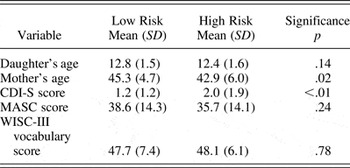
Demographic and clinical characteristics of the participants and their mothers are presented in Table 1. The two groups of girls did not differ in age, t (126) = 1.48, scores on the MASC, t (126) = 1.17, or the vocabulary subscale of the Wechsler Intelligence Scale for Children—III, t (1, 122) = 0.28, all ps > .05. High-risk girls had slightly but significantly higher scores on the CDI-S than low-risk girls, low-risk: M = 1.16, SD = 1.54; high-risk: M = 2.03, SD = 1.85; t (122) = –2.9, p = .004. However, the CDI-S scores of all girls were well below the cutoff of 8 used to indicate possible depression. The two groups of mothers did not differ in socioeconomic status as measured by household income, χ2 (6) = 10.5, p = .11, and differed slightly but significantly in age, low-risk mothers: M = 45.3, SD = 4.7; high-risk: M = 42.9, SD = 6.0; t (126) = 2.47, p = .02.
Characteristics of girls at low and high familial risk for depression

Note: CDI-S, Child Depression Inventory—Short Form; MASC, Multidimensional Anxiety Scale for Children; WISC-III, Wechsler Intelligence Scale for Children—III.
Stress and coping
High-risk girls reported a significantly greater amount of stress involving their mother than did low-risk girls, low risk: M = 5.53, SD = 3.45; high-risk: M = 7.71, SD = 4.62; t (116) = −3.01, p = .003. High-risk girls reported using more involuntary relative to voluntary coping strategies than did low-risk girls, low risk: M = 0.847, SD = 0.235; high risk: M = 0.964, SD = 0.249; t (126) = –2.73, p = .007. This difference in coping between low- and high-risk girls showed only a trend toward significance when we covaried for total stress experienced, t (125) = 1.68, p = .096.
Cortisol
As in previous studies (Chen, Joormann, Hallmayer, & Gotlib, Reference Chen, Joormann, Hallmayer and Gotlib2010), we Winsorized cortisol values to the 2 SD level based on methods described by Tukey (Reference Tukey1977). Values for each collection time were averaged across the two days to calculate a more reliable mean at each time point, a procedure used in previous studies of cortisol in adolescent depression (e.g., Goodyer et al., Reference Goodyer, Herbert and Altham2000). Collection times did not differ by risk group, F (1, 124) = 3.42, p > .05. To obtain a summary marker of daily cortisol output, we computed an index of area under the curve with respect to ground (AUCg; Pruessner, Kirschbaum, Meinlschmid, & Hellhammer, Reference Pruessner, Kirschbaum, Meinlschmid and Hellhammer2003). AUCg values were significantly positively skewed and were therefore log-transformed. All analyses were conducted using the transformed values.
Hierarchical regression analyses (Cohen & Cohen, Reference Cohen and Cohen1983) were conducted to test the unique associations of group, stress, and coping, and the interactions of group and stress and coping, with diurnal cortisol secretion, controlling for the girls’ ages. First, to assess differences between low- and high-risk girls in diurnal cortisol secretion, group (b 1) and age (b 2) were entered in Model 1. Second, stress (b 3) and coping (b 4) were entered in Model 2. Third, the interactions of group with stress (b 5) and with coping (b 6) were entered in Model 3. The low-risk group was coded as 0 and the high-risk group was coded as 1; all other variables were centered at their respective grand means.
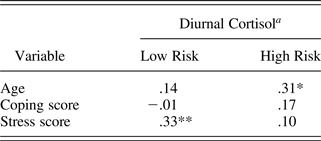
Because the groups differed slightly but significantly in CDI-S score, supplementary analyses were conducted adding CDI-S score to Model 1. This covariate was nonsignificant (t = 0.73, p > .05) and was dropped from the model. Correlations among the remaining study variables are presented in Table 2.
Correlations among variables within the low- and high-risk groups

Note: The coping score is the proportion score (involuntary coping score divided by the total voluntary coping score). See text for details.
a Log-transformed area under the curve with respect to ground.
*p < .05. **p < .01.
Main effect of risk
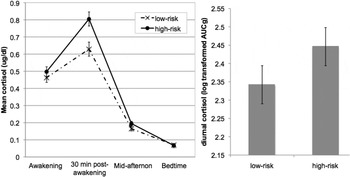
We first examined whether familial risk for depression predicted participants’ diurnal cortisol, controlling for age. The results from Model 1 indicated that the two predictors explained 9.3% of the variance in diurnal cortisol secretion, adjusted R 2 = 0.079, F (2, 125) = 6.44, p = .002. Both the presence of familial risk, b 1 = 0.24, t (125) = 2.85, p = .005, and older age, b 2 = 0.22, t (125) = 2.54, p = .012, significantly predicted higher AUCg (Figure 1).
Diurnal cortisol for girls at low and high risk for depression. (Left) Mean diurnal cortisol (μg/dl) plotted as a function of time and group. (Right) Mean log transformed cortisol, indexed by area under the curve with respect to ground (AUCg), plotted as a function of group. All values are adjusted for age. Error bars represent standard error of the mean.

Main effect of stress and coping
The four predictors in Model 2 explained 11.8% of the variance, adjusted R 2 = 0.089, F (4, 123) = 4.10, p = .004. The main effects of group, b 1 = 0.20, t (123) = 2.18, p = .031, and age, b 2 = 0.19, t (123) = 2.16, p = .033, remained significant. There were no significant associations across groups between diurnal cortisol and stress, b 3 = 0.16, t (123) = 1.66, p = .10, or between diurnal cortisol and coping, b 4 = 0.01, t (123) = 0.12, p = .90.
Interactions of group with stress and coping
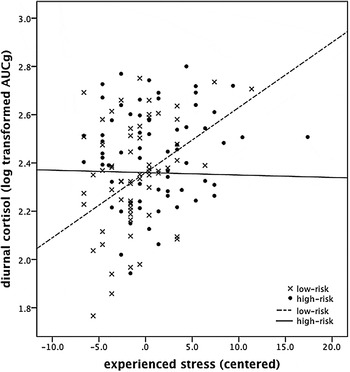
The six predictors in Model 3 explained 17.6% of the variance, adjusted R 2 = 0.135, F (6, 121) = 1.31, p = .001. Again, there were significant main effects of group, b 1 = 0.19, t (121) = 2.13, p = .036, and age, b 2 = 0.21, t (121) = 2.44, p = .016. A significant difference was obtained between the two risk groups in the association of diurnal cortisol with stress, b 5 = –0.43, t (121) = −2.76, p = .007. Tests of simple slopes indicated that, whereas for the low-risk girls increased stress was associated with higher cortisol, t (121) = 3.27, p = .001, 95% confidence interval (CI) for β = 0.011 to 0.043, for the high-risk girls stress was unrelated to diurnal cortisol, t (121) = –1.43, p = .089, 95% CI for β = –0.012 to 0.011 (Figure 2).
Association between diurnal cortisol (log transformed area under the curve with respect to ground [AUCg]) and girls’ reported stress associated with having a depressed mother within never-depressed girls at low and high familial risk for depression. Group reference lines were computed using unstandardized coefficients from the hierarchical regression.

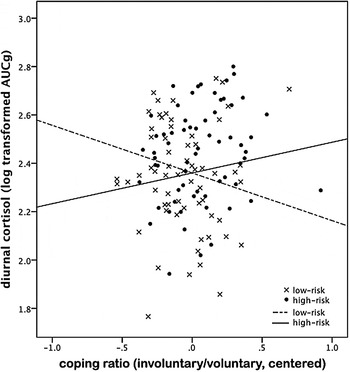
The low- and high-risk groups also differed in the association between diurnal cortisol and coping, b 6 = 0.27, t (121) = 2.03, p = .045. Whereas for the low-risk girls increased involuntary relative to voluntary coping was associated with lower cortisol, for the high-risk girls, increased involuntary relative to voluntary coping was associated with higher cortisol (Figure 3). Although these simple slopes differed significantly from one another, tests of simple slopes indicated that the association between coping and diurnal cortisol was not significantly different from zero for the high-risk girls, t (121) = 1.20, p = .232, 95% CI for β = –0.082 to 0.335, or the low-risk girls, t (121) = –1.64, p = .10, 95% CI for β = –0.44 to 0.04.
Association between diurnal cortisol (log transformed area under the curve with respect to ground [AUCg]) and the tendency to use involuntary as opposed to voluntary coping responses to stress associated with maternal depression within never-depressed girls at low and high familial risk for depression. Group reference lines were computed using unstandardized coefficients from the hierarchical regression.

The main effect of group and the interactions of group with stress and coping remained significant after controlling for scores on the CDI-S and MASC and for mothers’ age.
Discussion
Research has established that two mechanisms involved in mediating the intergenerational transmission of depression are the level of stress experienced in families of depressed parents (Adrian & Hammen, Reference Adrian and Hammen1993; Hammen, Reference Hammen, Wolchik and Sandler1997, Reference Hammen, Goodman and Gotlib2002) and the ways that children and adolescents respond to and cope with this stress (Compas, Langrock, Keller, Merchant, & Copeland, Reference Compas, Langrock, Keller, Merchant, Copeland, Goodman and Gotlib2002). The present study was designed to elucidate, in a sample of adolescent girls at familial risk for developing depression, the relation between these factors and physiological functioning of the HPA axis. Results of our investigation confirm previous findings that familial risk for depression is associated with both higher diurnal cortisol (Lupien et al., Reference Lupien, King, Meaney and McEwen2000; Mannie et al., Reference Mannie, Harmer and Cowen2007; Vreeburg et al., Reference Vreeburg, Hartman, Hoogendijk, van Dyck, Zitman and Ormel2010) and greater exposure to stressful parenting behaviors (Hammen et al., Reference Hammen, Brennan and Shih2004; Lovejoy et al., Reference Lovejoy, Graczyk, O'Hare and Neuman2000). Our findings add to this literature by demonstrating that having a depressed mother is associated with an increased tendency to use involuntary, as opposed to voluntary, coping strategies in dealing with parent–child stress and that this tendency is associated with an exacerbation of HPA axis dysfunction.
These findings are important in demonstrating that the ways in which adolescents cope with the stress that they experience as a result of their mother's depression are associated with dysfunction in the HPA axis. The significantly more positive association that we obtained in high-risk girls between cortisol and coping scores indicates that responding to the stressful consequences of their mother's depression using involuntary coping strategies (e.g., escape, emotional numbing, and intrusive thought) uniquely exacerbates HPA-axis dysfunction in this group. These findings complement results of prior prospective studies indicating that the use of involuntary coping strategies may play a causal role in the onset of depressive symptoms in adolescents (Sawyer, Pfeiffer, & Spence, Reference Sawyer, Pfeiffer and Spence2009). For example, adolescents who used voluntary coping strategies in response to the stress associated with having a depressed parent exhibited lower levels of symptoms of anxiety/depression and aggression than did adolescents who engagee more frequently in involuntary coping strategies (Langrock et al., Reference Langrock, Compas, Keller, Merchant and Copeland2002).
Contrary to our hypotheses, the stress associated with having a depressed mother was not associated with increased cortisol in daughters of depressed mothers. Whereas low-risk girls exhibited higher diurnal cortisol with increasing stress involving their mother, in high-risk girls stress was unrelated to diurnal cortisol output. Risk status remained a significant predictor of level of diurnal cortisol when stress was added to the regression model. It is possible, therefore, that other factors not assessed here but that are also related to having a depressed mother (e.g., genes, behaviors) may influence cortisol output more strongly than does interpersonal stress involving mothers and their daughters. Alternatively, persistent dysfunction in stress adaptation, rather than stress per se, may be an important determinant of cortisol output. The literature on stress, coping, and HPA-axis function supports this latter possibility. Prior studies (Abelson, Khan, Liberzon, Erickson, & Young, Reference Abelson, Khan, Liberzon, Erickson and Young2008; Dickerson & Kemeny, Reference Dickerson and Kemeny2004; O'Donnell, Badrick, Kumari, & Steptoe, Reference O'Donnell, Badrick, Kumari and Steptoe2008), including one investigation of depressed adults (Hori et al., in press), have noted an absence of an association between stress and cortisol but the presence of a significant relation between coping and cortisol.
It is noteworthy that, in contrast to high-risk girls, low-risk girls exhibited a more negative association between cortisol and the tendency to use involuntary (relative to voluntary) coping strategies. Thus, while involuntary coping mechanisms are generally considered to be maladaptive, they appeared to serve to blunt cortisol secretion in the low-risk daughters. In light of this finding, it is of interest that some theorists have argued that voluntary or involuntary coping strategies are not inherently good or bad (Lazarus & Folkman, Reference Lazarus and Folkman1984) but rather depend on the context of the stressful situation. According to this view, one coping strategy may be effective at the outset of a given event but less effective with subsequent presentations of that stressor. Other researchers have documented that the efficacy of coping strategies depends on the extent to which the stressor is controllable (Folkman & Moskowitz, Reference Folkman and Moskowitz2004). In this context, our findings indicate that involuntary coping strategies may be effective in managing low-risk girls’ cortisol levels in response to occasional interpersonal stress involving their mothers. In the long run, however, as in the case of daughters of depressed mothers who experience this stress on a more chronic basis, such defenses could hinder successful adaptation. Future studies that address the influence of familial risk on the relation between coping and cortisol more thoroughly, with particular attention paid to the severity and chronicity of interpersonal stress, are needed to test these formulations.
The results of this study have potentially important implications for intervention. Because coping strategies can be taught, interventions that promote the use of voluntary coping strategies, such as cognitive reframing and distraction, may be beneficial to adolescents exposed to maternal depression. Promise for this approach comes from a study of a family-based cognitive behavioral intervention developed by Compas and colleagues (Reference Compas, Champion, Forehand, Cole, Reeslund and Fear2010, Reference Compas, Forehand, Keller, Champion, Rakow and Reeslund2009) that included a component to teach children of depressed parents voluntary coping strategies. Compas and colleagues found that adolescents’ use of voluntary coping skills partially mediated the effects of the intervention on children's internalizing and externalizing symptoms. Whether these changes also converge on normalization of HPA dysfunction is not known and warrants attention in future research, particularly in light of evidence that baseline cortisol levels may be useful in predicting which high-risk offspring of depressed parents are at the greatest risk for developing MDD (Adam et al., Reference Adam, Doane, Zinbarg, Mineka, Craske and Griffith2010; Goodyer et al., Reference Goodyer, Herbert and Altham2000; Rao et al., Reference Rao, Hammen and Poland2009).
We should note three limitations of this investigation. First, because our study was cross-sectional, it is not possible to assess the causal nature of the relation between coping styles and alterations in HPA-axis function. Second, the CDI-S scores of the high-risk girls were higher than those of their low-risk peers. However, it is important to note that the CDI-S scores of both groups of girls were well below the suggested cutoff scores for clinically significant depression (Kovacs, Reference Kovacs1992). Moreover, because entering this score as a covariate in our analyses did not affect the significance of our results, we are confident that our findings are not attributable to differences in current levels of depressive symptomatology. Third, we cannot rule out the possibility that genetic factors contributed to higher cortisol in high-risk relative to low-risk girls. Given that the cortisol awakening response has a heritability of 32% to 48% (Kupper et al., Reference Kupper, de Geus, van den Berg, Kirschbaum, Boomsma and Willemsen2005; Wust, Federenko, Hellhammer, & Kirschbaum, Reference Wust, Federenko, Hellhammer and Kirschbaum2000) and that depression has a heritability of approximately 37% (Sullivan, Neale, & Kendler, Reference Sullivan, Neale and Kendler2000), an important future research direction involves delineating the unique contributions of genetic and environmental factors to HPA-axis dysfunction in youth at familial risk for MDD.
In conclusion, our findings support previous research indicating that familial risk for depression is associated with abnormalities in HPA-axis function. We have extended this research by demonstrating that a tendency to utilize involuntary, as opposed to voluntary, coping strategies in dealing with the stress of living with a depressed parent is uniquely associated with the exacerbation of cortisol levels. Future studies that investigate the effectiveness of interventions aimed at increasing the use of voluntary coping strategies to protect against the effects of stress related to having a depressed mother will be important in helping to prevent the onset of this debilitating illness.