Music for real airports?
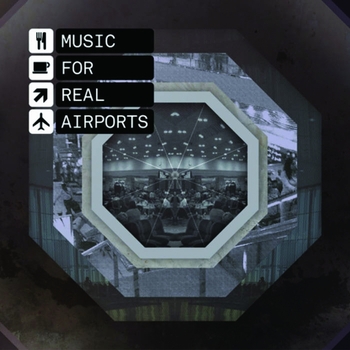
On 24 April 2010, electronic musicians Martin Dust, Richard Dust, and Ken Downie, together known as The Black Dog, debuted music from their forthcoming LP, Music for Real Airports, to a sold-out gallery audience in their hometown of Sheffield, England. The trio treated the audience to a live mix of field recordings and musical snippets from the album, many of which they originally made using smartphones, portable keyboards, and laptops while travelling through real airports. A local visual design team, Human, mixed digital animations in conjunction with the set.Footnote 1 The images, reported one member of Human, were meant to expressively ‘amplify’ the music's implications, such as ‘the movement you might get from a conveyer belt, or being orchestrated in line, or the feeling you get when you look out of a window and see things moving beneath you’.Footnote 2 The Black Dog concurred that the music and field recordings, even without a visual accompaniment, should conjure something of ‘the journey and the emotions’ involved in air travel.Footnote 3 Their efforts proved fruitful when the group released Real Airports commercially two weeks later on Soma Quality Recordings, a Glaswegian independent label, to critical and fan praise (Figure 1).Footnote 4
The Black Dog's Music for Real Airports (Reference Dog2010). Thanks to Martin Dust for permission to reproduce this image.

Despite its title, The Black Dog did not wish Music for Real Airports to be played at or in actual airports. As album promotions asserted, ‘This record is not a utilitarian accompaniment to airports, in the sense of reinforcing the false utopia and fake idealism of air travel’.Footnote 5 Rather than romanticize the flight experience (something commercial airlines and airports do enough in selling their services, the group says), Real Airports coldly reflects upon the calculative control and bureaucratic management airports impose on their public. As one member put it, the group wanted to ‘create a really intense, enjoyable experience that reminds people of how they're actually being treated and what they are being subjected to, and paying for’.Footnote 6 The track titles accordingly paint the album's progression from arrival to departure as a trudge through some of the least appealing, yet common fixtures of airport experience, from information desks to passport control, strip lighting to sleep deprivation, security lines to flight delays. The album's successively apprehensive, nervy, tense, and weary electronica delivers as disenchanting and dispiriting an experience as airports provide at their antiseptic, authoritarian worst.
Take how ‘Empty Seat Calculations’, like most tracks on the album, slowly transitions from one form of unpleasantness to another; here out of the plodding synth-string dirge of ‘Wait Behind this Line’ into the sizzling granular techno of ‘Strip Light Hate’. The track begins shortly after the A♭5 drone in ‘Wait’ moves a step up to B♭m11; staticky percussion enters soon after, scraping along at a slightly slower 55 bpm. The B♭m11 drone builds in volume, tentatively, almost imperceptibly, for nearly two minutes. Finally the strings swell expectantly into a brief, hopeful G♭sus4 – only to return, deflated, back to the B♭m11. The treble percussion then launches into a double-time diminution, joined by a syncopated half-time heartbeat-kick, as the front-loaded Aeolian pendulum continues, with embellishment, in the bass.Footnote 7 The trepid, gritted-teeth percussion break that ends the track only seems an appropriate anticipation of the fizzy, laser-streaked aural patdown of ‘Strip Light Hate’. Any hint of hope once audible in the affectively pregnant beginning of ‘Calculations’ has by now buckled to the authority of the album's forward march into anxious pressure.
Other lowlights include ‘Passport Control’, in which a lone, sad tom plods through a hollow Fm7 choral patch as laser-high Bs sear the track's overhead; and ‘Sleep Deprivation 1’, wherein jarred kick-drum heartbeats flutter starkly atop a dial tone, and children's incomprehensible whines bounce off cold tile. The band's description of airports in the album's promotions could just as well apply to the frazzled Ambient techno it advertises: ‘Airports promise travel, exploration and excitement but endlessly break that promise with their stale, tedious pressure. They are intense and overwhelming environments.’Footnote 8 No wonder when asked whether the album was made for listening in airports, Ken Downie half jokingly answered, ‘Being in an airport is bad enough. Listening to Music for Real Airports in a real airport would make me want to punch somebody.’Footnote 9
While calling the album ‘for real airports’ partly reflects this facetious attitude, the title's wording chiefly refers – probably obviously to anyone acquainted with the Ambient genre of music – to Brian Eno's Ambient 1: Music for Airports (Editions E. G., 1978).Footnote 10 Although Discreet Music (Obscure, 1975), by Eno's own account, was the artist's first solo Ambient album, many now consider Music for Airports an equally important watershed in the development of the genre. Not only did the album kick off a four-part series of Ambient LPs (1978–82) in which Eno and collaborators sketched out several forms that Ambient music might take, but it also included in the liner notes Eno's now-famous ‘Ambient Music’ essay coining the new term.Footnote 11 Ambient music, it pronounced, would be music made for use as ‘an atmosphere, or a surrounding influence: a tint’.Footnote 12
As Eno has told it, the inspiration for the album arose during a stop at Flughafen Köln/Bonn (the Cologne/Bonn Airport) on a clear, sunny Sunday morning in late 1977:
The light was beautiful; everything was beautiful, except they were playing awful music. And I thought, there's something completely wrong that people don't think about the music that goes into situations like this. You know, they spend hundreds of millions of pounds on the architecture, on everything, except the music. The music comes down to someone bringing in a tape of their favourite songs this week, and sticking them in, and the whole airport is filled with this sound. So, I thought, it would be interesting to start writing music for public spaces like that.Footnote 13
Over the next several months, Eno produced four tape-loop-based tracks as solutions for what he perceived to be a naïve or thoughtless approach to music in airports. As Eno asserted in the liner notes, these tracks would be aesthetically different from ‘conventional background music’ and ‘canned music’ such as Muzak's symphonic pop arrangements.Footnote 14 Rather than merely ‘adding stimulus’ to the environment, Ambient music should ‘induce calm and a space to think’. ‘Ambient music’, the essay concludes, ‘must be able to accommodate many levels of listening attention without enforcing one in particular; it must be as ignorable as it is interesting’.Footnote 15
The Black Dog has described Real Airports as a riposte to Eno's famous project: ‘Unlike Eno's Music for Airports, this is not a record to be used by airport authorities to lull their customers.’Footnote 16 The group's provocation serves as a foil for my analysis and interpretation of Eno's landmark album, since their charge illuminates some common misapprehensions regarding the modes of application and aesthetic significance of Ambient music records such as Airports. Such misapprehensions are understandable, since the comparison between Ambient music and Muzak was initially made by none other than Eno himself – and on an album titled Music for Airports, no less. The comparison between Airports and Muzak, however, is just as misleading as the album title when it comes to understanding Ambient music's import as a present-day genre of popular music. For although Airports appears to have been made for public administration in actual airports – as Eno originally conceived it – it landed far more influentially in the hands and ears of thousands of music consumers as a commercial recording. Ambient music's present significance as a genre is accordingly best understood not within the reception context of public administration, but rather in relation to personal practices of recorded music programming and listening. Eno's general claim to Ambient music's superiority over Muzak, much like Music for Airports’s site-specific title, obscures Ambient music's most salient meanings and functions within this reception context.
This article positions Eno's Music for Airports as a point of departure for understanding the organizing role of the Ambient genre, and the place of its commercial recordings, within the sphere of everyday record consumption. An analysis of Airports’s conceptual, musical, and visual design clarifies this role by showing how Eno's album, like The Black Dog's, preserves uncertainties and anxieties that pervade the experience of air travel. As Eno once attested, Airports needed to reflect the fact that travelling by plane always carries an element of ‘flirting with death’.Footnote 17 In illustrating the ways in which Airports subtly and ambivalently retains this sense of danger, and by relating this expressive import to those of later Ambient albums such as The Black Dog's Real Airports, this analysis demonstrates how Eno's Airports established certain thematic and affective coordinates that surveyed Ambient music's later expansion as a genre. Ambient music, I argue, often followed Airports’s lead by providing consumers what media scholar Paul Roquet calls ‘ambivalent calm’, a ‘form of provisional comfort that nonetheless registers the presence of external threats’.Footnote 18
I conclude with the observation that Ambient music's unsettling atmospheric designs may be understood as both anticipations of, and metaphors for, the transportive role of recorded music within the everyday ecology of personal audio consumption. Within this ecology, recorded music virtually conveys senses of place while also ‘taking place’ in actual spaces, motivating ‘a continuous cycle of displacement and re-placement’ that consumers selectively issue and navigate.Footnote 19 As an organizing force within this ecology, the Ambient category is not and never was, as Thom Holmes describes it, ‘a blank canvas’,Footnote 20 nor have its possibilities ever been, as Mark Prendergast claims, ‘endless’.Footnote 21 Rather, the genre since Eno's Airports has expanded upon the album's distinct expressive design and concept by indexing its producers’ and consumers’ ambivalence towards the technological mediation of space and movement – a phenomenon that includes recorded music programming. Ambient music's aesthetic and cultural significance, from this perspective, has less to do with improving upon ‘conventional’ background music, and more to do with the ways it expressively addresses its own place in our increasingly pre-programmed world.
Airports’s certain uncertainties and uncertain certainty
One can easily imagine how the gently paced and smoothly consistent recordings on Eno's Airports might be heard as lulling from a critical perspective such as The Black Dog's. Each track establishes early on an invariant instrumentation and texture, as well as a contained repertory of pitches, gestural shapes, and motivic content that lasts throughout its entirety. Each recording also sits within a narrow dynamic range and avoids timbral distortion. In these ways, the atmospheres on Music for Airports can quickly instill certainty about how they will continue to sound throughout, and can seem unchallenging for this reason. Perhaps because of these consistencies, many of Music for Airports’s early reviewers derided the album as bland. Rolling Stone’s Michael Bloom called the album ‘unfocused . . . aesthetic white noise’, while New York Times’s Ken Emerson quipped that its ‘hues are as faint as the flavor of those Japanese teas so delicate you're never quite sure you aren't just simply sipping hot water’.Footnote 22 NME’s Lynden Barber later suggested that the ‘simply ignorable’ album's ‘white-tiled atmosphere’ could have earned it the title ‘Music for Toilets’; and Robert Christgau registered it, pointedly, ‘a bore’.Footnote 23 Still, for purposes of environmental music design in public spaces, such ‘boring’ consistencies make sense, as they would allow passers-by to enter and exit the field of sound without leaving them feeling like they missed out on anything. The music's unobtrusive and predictable features would also assure airport auditors that the music will continue similarly, thereby facilitating their attentional freedom.
Yet The Black Dog may have had a point – feelings of assurance are precisely what market researchers in the 1950s and 1960s found to be conducive to consumer purchasing of services and goods in commercial spaces.Footnote 24 Public music programming of the time largely proffered consumers this sense of security through the familiarity of well-known popular songs, which signalled that the listener was ‘at home’ in public spaces of commerce.Footnote 25 Today, following the diversification of publicly programmed music during the 1970s and 1980s, familiar-sounding music in commercial spaces works to foster a social sort of security by marking out areas where consumers may find their identities recognized and affirmed.Footnote 26 By contrast, while Music for Airports too works to soothe (and perhaps even ‘lull’) its listeners, it accomplishes this differently from most publicly programmed music – not so much by sounding familiar as by reliably serving as a consistent feature of one's auditory environment.
However, despite Music for Airports’s recordings being remarkable consistency over time, various listener accounts give reason to question the extent to which Eno's album ameliorates anxiety, and proffers a sense of security, within real airports. When Eno's music was first installed at New York's LaGuardia Airport in 1980, some airport workers and travellers reportedly complained that the music induced unease.Footnote 27 As one remarked, ‘It sounds like funeral music’.Footnote 28 The album's later installation in Pittsburgh International Airport allegedly garnered requests for the usual background music to be restored.Footnote 29 And if that weren't enough, in 1984 the music sparked protest from employees at Berlin's Tegel Airport who were annoyed by the acoustic ‘interference’.Footnote 30
How are these decidedly agitated reactions to be explained? A closer examination of Music for Airports’s four recordings provides some clues. While these tracks promote an overarching sense of stability by constraining the parameters of global, or long-term change, a number of local, or short-term variabilities keep the music from resting on certain ground. Although the sounds used in each recording remain within a single modal pitch collection, the irregular, seemingly unmotivated oscillations between major and minor sonorities within each collection lend the music an emotional mercuriality. And although the non-periodicity of repeated sonic iterations relieves listeners of expecting their metric placement, these sound events also overlap indiscriminately, and dissipate into indefinitely long echoes, creating a bounty of micro-variations in timing and timbre. Within the tracks’ overall stable texture, such irregularities generate just enough light turbulence to keep those on board with the music from nodding off. Though seemingly weightless and placid at a distance, the music remains astir and amiss, possibly fostering an uncanny sense that the music's stability is a ruse.
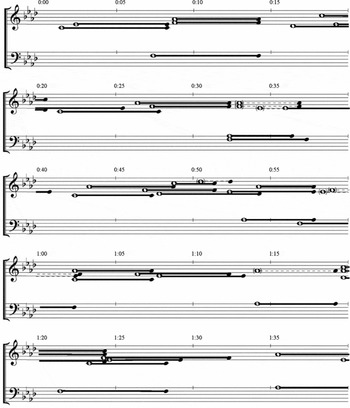
Of all the Airports recordings, the ghostly ‘2/1’ probably contributed most to the discomfort expressed by airport workers and patrons (Example 1). For this track, Eno recorded onto tape three women singing ‘ah’, unison and non-vibrato, within an F Aeolian pitch collection. Eno treated each of these tones with reverb and synthesizer, then separated them into different tape segments, with long gaps of silent tape about twice the length of each pitch following the end of each note. The final recording is almost entirely automated, with eight total tape segments of uncannily lifeless vocals looping simultaneously.Footnote 31 Due to the loops’ irregular, uneven lengths, the voices overlap in slightly different configurations over the course of the piece. (Table 1 shows the approximate length of each loop.) At times, this results in lengthy silences arising unpredictably (and somewhat mournfully) between sounding patches of voice; the durations of sounding material in the first two minutes, for example, proceed as follows: 13˝–25˝–31˝–5˝–12˝–37˝. The pitch content also gives reason for the ‘funereal’ associations of one airport listener; while the overall composition mainly tends towards F Aeolian due to the bass f notes, the occasional appearance of the d♭1 implies a major subtonic triad or seventh chord (VI or VI7) before proceeding back to an implied tonic (e.g., 0:48; 1:20). This i–VI Aeolian pendulum, as Philip Tagg has found, is often associated with ominousness, resignation, or death in much European and American music (for instance, an Aeolian pendulum famously starts Chopin's Marche funèbre).Footnote 32 Scott Murphy has more recently illustrated a corollary to Tagg's finding, as he has found the mirror-image triadic pairing of I–iii frequently accompanying scenes of loss or grief in film and television scores; this pairing might be observed in ‘2/1’ in the slow reversions from D♭ major back to F minor, with D♭ acting as a temporary tonic.Footnote 33 Through such compositional techniques and affective-expressive codes, ‘2/1’ intimates human absence more overtly than any other track on Music for Airports.
Approximate length of each voice loop in ‘2/1’.

Transcription of ‘2/1’ (0:00–1:40). Open noteheads indicate the notes’ initiations; closed noteheads indicate the notes’ endings; the bars in between indicate the length of the notes’ sustains. Open noteheads in parentheses indicate overtones or ‘ghost’ notes; dotted lines indicate the length of the notes’ sustain.

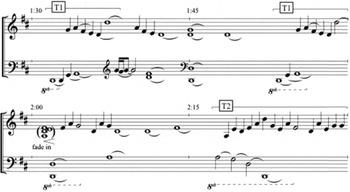
In all the tracks on Airports, added sixths, sevenths, ninths, and elevenths above the bass also create mild harmonic dissonance and melodic irresolution, leading to an overarching soft sense of tension. Take ‘1/1’, for instance, a track largely constructed through the recurring use of two similar-sounding melodic themes in D Mixolydian (marked T1 and T2 in Example 2). Both themes melodically elaborate a D major triad, with non-harmonic tones G and E operating as incomplete neighbours or passing tones. These melodic lines alternate with shorter melodic fragments and chords that utilize the g1 eleventh above the D bass. While the use of g1, in these instances, does not necessarily call for a resolution to the third below (f#1), it does not necessarily persist independently of its potential to resolve downward either, due to its proximity and similarity to the more ‘classically’ resolving T1 and T2. For this reason, when the g1 does appear outside the context of the theme, as it does at 1:45, and between 2:00 and 2:15, it can seem expectant and unresolved, even without necessarily calling for a ‘proper’ contrapuntal resolution.
Reduction of ‘1/1’ (1:30–2:30).

Such moments of irresolution as these may register more strongly with listeners who otherwise expect more security in their environmental music. These listeners might find, as mood music aficionado Joseph Lanza describes it, that Eno's Ambient music produces ‘a kind of sonic ambivalence that encourages grave contemplation of feelings of impending doom . . . Behind all of Eno's cold, metallic engineering is a frightening and moody world that is anything but emotionally neutral.’Footnote 34 Lanza's intense descriptions of Eno's music, along with the comments of the airport listeners, contrast starkly with the unimpressed assessments of The Black Dog and Music for Airports’s reviewers. While the latter hear Eno's album as neutrally utilitarian to the point of total blandness, the former are palpably discomfited by Eno's ambiences. Are they really all talking about the same music?
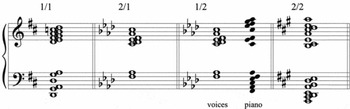
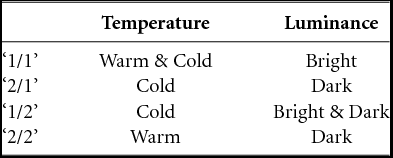
One possibility is that, simply, no – they are not talking about the same music exactly, but rather responding chiefly to different tracks, and taking their particular global affects to be representative of the whole album. Tracks ‘1/1’ and ‘2/2’ imply global D Mixolydian and A Ionian modal areas, respectively, while tracks ‘2/1’ and ‘1/2’ globally imply the more dour F Aeolian modal area (Example 3). Each track also enjoys different combinations of timbral characteristics (Table 2). Generally, the combination in ‘1/1’ and ‘2/2’ of more uplifting global modes with warmer timbres can seem more inviting than the glummer global modes and cold, dark timbres of ‘2/1’ and ‘1/2’.
Pitch repertories used on Music for Airports.

Timbral characteristics of Music for Airports’s recordings.Footnote 35

Given their drastically divergent criticisms, Airports’s various naysayers probably found different aspects of the music undesirable against different backdrops of expectation. To a rock critic or countercultural musician, Music for Airports might offend with its generally dispassionate pleasantness and overarching predictability, while failing to generate interest for those features that undercut these auras of certainty. By contrast, for the average light-music enthusiast or Top 40 listener in expectation of the extraverted, peppy, or familiar, Airports might come off as icy, eerie, or depressed. Either way, for the album's critics, the most salient aspects of Airports’s ambivalent moods appear to counteract the moods they would prefer to sustain – whether from antagonistic to complacent, or from assured to uncertain.
Ambivalent ambience
In perhaps the most overlooked sentence of his ‘Ambient Music’ essay, Eno identifies ambivalence as essential to Ambient music: ‘Whereas conventional background music is produced by stripping away all sense of doubt and uncertainty (and thus all genuine interest) from the music, Ambient Music retains these qualities.’Footnote 36 Eno's description reveals, perhaps more than anything else in the essay, the sort of ‘interest’ he had in mind with the phrase ‘as ignorable as it is interesting’. It is also, perhaps, the essay's vaguest claim. Just what would it mean for a type of music to ‘retain’ a ‘sense of doubt and uncertainty’ – retain from what, and doubt about what? How would it convey this sense of doubt? And what makes doubt and uncertainty more ‘genuinely interesting’ than their absence, anyway?
On one level, ‘doubt and uncertainty’ seem to describe the sorts of feelings Ambient music should elicit in the listener. On another, they seem to point to something inherent to the recorded ‘production’. Eno has described his compositional activity in the studio as an experimental process of linking the two by discovering musical textures that bring out in the listener a predetermined mood or feeling.Footnote 37 ‘A composer, or any artist really, is a kind of curator of feelings’, Eno once stated.Footnote 38 The connection between musical texture and mood, however, might seem too mysterious or subjective to substantively qualify. Possibly due to this seeming vagueness, critics and scholars writing about Ambient music have often passed over this distinction, focusing on chewier concepts such as attentional variability.Footnote 39 But what would it look like to more deeply investigate Eno's claim that Ambient music evokes doubt and uncertainty?
One could start with doubt and uncertainty themselves. Commonly, doubt and uncertainty are delivered to experience as emotions rather than moods. As Noël Carroll explains the difference, emotions are phenomenologically intentional, or ‘about’ particular objects or scenarios, whereas moods are objectless affective frames through which cognition and emotion operate.Footnote 40 Doubt and uncertainty, as emotions, combine cognitive assurance about a stated, expected, or ideal state of affairs with scepticism, distrust, anxiety, or fear that the real state of affairs does not match this ideal. Doubt gets sparked when something seems ‘off’ about the thing or state of affairs at hand, and yet the cause for suspicion cannot be detected or confirmed. Within the affective space of doubt lies a gap between what is expected and what is given, a gap that cannot be totally bridged through observation. In short, doubt involves the perception of a false or illusory appearance of stability in some statement, thing, or state of affairs.
A musical evocation of doubt, then, might either indicate some sort of musico-representational or lyrical ‘object’ or state of affairs about which it conveys uncertainty, or it might capture the affective shape or gist of uncertainty without any referent. To do the latter, it seems that the music would have to convey stability or assurance, while at the same time hinting that this assurance might be a false pretence. As the earlier analyses indicate, Airports’s recordings do just this by establishing a global sense of stability (through use of a limited range of melodic gestures, a narrow dynamic range, etc.), while remaining inconstant on the local level (through unpredictable entrances, shifts in colour, changes in harmonic quality, and so on). The album's recorded design, in this sense, establishes ‘constant inconstancy’ of musical texture as a quintessentially Ambient mode of setting a doubtful or uncertain mood.Footnote 41
But what makes doubt and uncertainty more ‘genuinely interesting’ than their absence, anyway? One might chalk this up to the composer's personal preference, as Eno has admitted on a number of occasions his predilection for affectively ambiguous art experiences, especially those tinged with melancholy.Footnote 42 Any departure from certainty, he mused in one interview, calls ‘partly for celebration and partly for melancholy. It's both exciting and unnerving.’Footnote 43 Yet Eno has also proposed that art creates a ‘safe space’ for both artists and audiences to deal with disorientation. ‘Good art’, Eno summarizes, ‘forces people to either accept disorientation or to retreat. If they retreat from life as they do from art, they eventually come to live in the past.’Footnote 44
Airports’s recordings, by establishing invariant parameters, produce across time ‘safe’ zones wherein listeners might accept their more disorienting contingencies.Footnote 45 The ambivalent moods resulting from this mixture may be helpfully contrasted with those arising from publicly programmed musics such as Muzak or ‘foreground music’, which, as mentioned earlier, aim to mitigate anxiety by enhancing the familiarity of listeners’ surroundings.Footnote 46 These forms of publicly programmed music accomplish this sense of familiarity through pop songs and styles that represent a shared Anglo-American history, and that work to conjure a sense of domestic well-being.Footnote 47 The less assured moods of Ambient music, by contrast, reject these idealizations of pop-culture comfort, while yet accommodating inhabitants with their overarching unobtrusiveness. Such moods might even bring comfort to audiences who find themselves more irritated than eased by Muzak's or foreground music's claim to consensus.
Since Airports’s release, Eno has observed affective ambivalence or mixture as a constant across his oeuvre of solo recordings:
I suppose that one of the things I was often doing in music was trying to recreate that sense of being wide-eyed in a surrounding that was both familiar and new, where there was just enough unknown to stay alert, the consciousness of the passage of time and change. These feelings are always going to be joyous and regretful at the same time: but for me the interesting feelings are complicated ones, blends of bitter and sweet, of familiar and strange, new and old.Footnote 48
The complicated moods Eno describes here expand upon his original conception of Ambient uncertainty in terms of affective mixture. Eno's production design aids in this affective complication; while emotionally poignant and lovingly crafted, Eno's productions can also come off as distant, synthetic, only indirectly compassionate. (As Frank Rose put it presciently in 1977, Eno's music ‘reflects warmth but does not seem to generate it’.Footnote 49 ) In many ways, Eno's blended moods set the tone for the genre's development over the next several decades into a less rosy alternative to New Age's more straightforward uplift.Footnote 50 During the early 1990s, to give just one example, proponents of ‘ambient house’ such as The Orb's Alex Paterson and Spacetime Continuum's Jonah Sharp used the term ‘Ambient’ to distinguish their more ‘left-field’ chill out music from New Age.Footnote 51 To this day, Ambient music more often than not delivers technologized sounds to unpredictable mixtures of serenity and loneliness and wakefulness and wistfulness, sponsoring detachment while triggering melancholy, and vacillating unpredictably between shades of feeling.
You are now going to sit in space: interpreting Airports
In a 1999 interview, Eno amusingly explained why maintaining a musical sense of uncertainty would be desirable in the context of air travel:
When you went into an airport, or an airplane, they always played this very happy music, which is sort of saying, ‘You're not going to die! There's not going to be an accident! Don't worry!’ And I thought that was really the wrong way around. I thought that it would be much better to have music that said, ‘Well, if you die, it doesn't really matter’. You know? And so I wanted to create a different feeling that you were sort of suspended in the universe, and your life or death wasn't so important. So, rather than trivialize the thing, I wanted to take it seriously: the possibility that you were actually, now, going to sit in space. Which is what you do when you travel on an airplane.Footnote 52
As Eno conceived it, Airports should enable nothing less than an existential epiphany for the anxious air traveller. Rather than distracting or shielding listeners from their anxiety (the standard approach to airport music, according to Eno), Airports maintains the tension inherent to the prospect of flying, while yet diminishing the stakes at doubt. Rather than dispelling irresolution, Eno's recordings perpetuate and contextualize irresolution within a broader stability that renders the unknown ‘not so important’ in the grand scheme. The unpredictable soundings and silences on Airports’s recordings leave unknown listeners’ immediate futures – a state not unlike the prospect of flight delays, lost baggage, and plane crashes, but one certainly less consequential. The global stabilities couching this constant transience delineate a frictionless musical world wherein inhabitants may become accustomed to consistent, low-stakes irresolution.
For Eno, musically preserving a modicum of uncertainty was a way of ‘taking seriously’ the existential suspension and loss of control both intensified and literalized by air travel. Yet for this reason, Music for Airports cannot be thought of as strictly utilitarian – a metaphorical suggestiveness about the reality of air travel, however idealized, persists throughout. Christopher Schaberg, along these lines, contends that Eno's airport installations sparked protest because they ‘enhanced the peculiar feel of airport life: being in between’.Footnote 53 The music, in generating localized rhythmic and tonal tensions within a static global framework, paradoxically conveys both movement and hesitation, and in doing so evokes what Schaberg calls the ‘elimination of speed’ produced by airports, where one travels ‘even when standing in barely moving lines, or waiting for baggage to appear’.Footnote 54 Airplanes similarly suspend passengers’ physical agency, even as they move these passengers over great distances, at great speeds. Much like airplane passengers, the sounds of Eno's album seem inert while being yet carried along, both suspended and adrift, neither at home nor at their destination, but sitting in space somewhere between.
In addition to its mixtures of stability and irresolution, Airports evokes a sense of airport space by conveying an impersonal, functionalist distance from human affairs.Footnote 55 It relates this distance in a number of ways. For one, the incidental interactions of sound events on its recordings replicate the transient sociality of airport travellers. Whereas the sounds of ‘conventional’ publicly programmed music normally consort cooperatively in homophonic textures and commonly held meter, the motives and pitches of Airports loop independently of one another, a loose aggregate rather than unified assembly of sound events. Second, while most publicly programmed music stages its familiarity via popular song forms and tunes, Airports’s recordings avoid such external referentiality, instead remaining internally consistent through commonalities of musical material (pitch repertory, amplitude range, etc.) and of technological origin (sequence lengths, looping system, synthesizer, etc.). And third, whereas most musical programming in the English-speaking world relies upon conventional pop orchestral or R&B/rock instrumentation, Airports’s electronic timbres defamiliarize the pop orchestra. Whether sterilized by the synthesizer, or clouded and delicately mixed in post-production, its sounds exercise an alien, uncanny mimesis of Western instruments and natural voices.Footnote 56 These elements place Airports at a windowed remove from Western music's most familiar musical conventions, supplanting this familiarity with the music's smoothly manufactured internal consistencies.
Eno's design of the album's front cover likewise conveys this sense of abstraction and distance from the familiar world. The drawing depicts a magnified square section of a map framing topographic regions and a river system, with one letter from the map intruding upon the landscape. At the scale drawn, its beige, pale yellows, greenish browns, and light blues recall the view of a landscape from an airplane window. Yet while replicating the perspective of the airplane traveller hovering off the ground, the absence of colour gradation and serifed ‘T’ reveal this perspective as that of a map viewer, and the ‘ground’ as human artefact. The ambiguity of perspective enhances the sense of a map viewer's dislocation from authentic emplacement above the landscape, while the air traveller's perspective too involves an abstracting distance from earth. As when listening, Airports’s map viewers might imagine or recall what it is like to travel by air – including the sense of disconnection from grounded living air travel produces.
Through such conveyances of distance from both nature and human sociality, the recordings of Music for Airports evoke something of what Marc Augé calls ‘non-place’: ‘A world surrendered to solitary individuality, to the fleeting, temporary and ephemeral.’Footnote 57 Functionalist architecture, vehicles of transport, and commercial venues comprise this ‘evacuated world’ of globalized circulation, consumption, and communication. The transitory spaces of non-place, Augé explains, disperse the social relations or collective histories that would otherwise be embedded in what he calls ‘anthropological place’.Footnote 58 This scattering or smudging of personal and collective pasts operates according to late capitalism's demand for abstraction and efficient transaction, and results in experiences of anonymity, solitude, and empty passage throughout. Airports’s smooth, sterilized textures and distance from conventional expressiveness promote the solitary experiences Augé describes.
Cecilia Sun, in a comparative analysis of Eno's Airports with Bang on a Can's live arrangement, has likewise connected Eno's Airports to Augé’s concept of non-place. My understanding of Airports’s evocation of non-place differs from Sun's, however. For Sun, since non-places seem devoid of collective human significance, Music for Airports should analogously be thought of as empty of meaning, a ‘non-piece’.Footnote 59 She asserts, along these lines, that Ambient music by definition ‘obviates questions of interpretation . . . it is what it is’.Footnote 60 Others have characterized Ambient music similarly; for instance, Eldritch Priest calls Eno's Ambient music one of only a few ‘un-thematic’ musical forms in the Western world ‘that express only their own occurrence and do nothing but relay potential’.Footnote 61 Such observations are understandable, since the generic name ‘Ambient’ appears neutrally descriptive of the music's atmospheric function, and thereby suggests an absence of expressive or representational content. Yet while the genre label implies both value-neutrality and all-purpose functionality, the tendency to read Ambient music as semiotically vacuous and value-neutral may be more inspired by the notion of a strictly functional musical technology than reflective of Ambient music's actual affective implications and investments. After all, as various unsettled Airports listeners have suggested, the music's ephemeral blankness is not simply a neutral environmental frame or atmospheric tint; it is also expressively rich. Rather than understanding Music for Airports’s evocation of non-place as obviating interpretation, then, I read this evocation as precisely the music's substance.
With this in mind, one may find that Eno's album has more in common with Music for Real Airports than The Black Dog purports. A comparison between Eno's and The Black Dog's albums illuminates how different pieces of Ambient music script listening experience not due to different utilitarian aims or reception locations, but rather according to the sorts of space they aim to conjure, the sense of movement through space they evoke, and the moods they bring to the journey. In The Black Dog's Real Airports, rigid rhythmic repetitions, nervous plodding, brittle percussion, and sprays of harsh high-frequency hiss palpably manifest the anxieties of the passenger beholden to tedious bureaucracy and heightened airport security throughout the experience of air travel. Such features of airport experience have progressively intensified since the 1970s, especially following the events of 9/11. Listeners today may well have reason to perceive Real Airports’s rattled anxiety and defeated exhaustion as more ‘real’ or experientially authentic than Eno's subtle alienation, since calculative control is so much more iconic of airport experience now than in the 1970s. As Peter Adey points out, risk management has remained at the forefront of airport planning and design ever since the eruption of international aviation terrorism.Footnote 62 Post-1970s airport designs often openly, blatantly reduce possibilities for movement in order to make inhabitants aware of the fact that they are in a highly controlled environment, thereby ensuring compliance with airport security.Footnote 63 The oppressive moods invoked by these buildings, and The Black Dog's album, are hence likely more familiar to contemporary travellers than the elegant, staid openness of older airports such as Flughafen Köln/Bonn.
As far as Eno's architectural muse goes, such open-ended designs as the Cologne/Bonn Airport exert what John Allen calls ‘ambient power’, a ‘soft’ power that works through seduction rather than domination, and inclusion rather than exclusion.Footnote 64 Conveying an aura of detachment through visual transparency and spatial accessibility, such spaces appear to offer many choices for movement while being yet limited in broadly scripted ways.Footnote 65 Music for Airports works similarly. Its recordings’ sparse, minimalist textures, long silences, and heavy reverb convey spaciousness and evoke transparency, even while timbral and harmonic shifts gently impose their own emotional agenda. Each recording promotes a feeling of stillness and solitude in open space, virtually manifesting a ‘space to think’ via long and distant echoes. Sleek and luminous, Airports invites listeners to dwell serenely and alone in a limbo where, as Eno's collaborator David Byrne once described heaven, ‘nothing ever happens’.Footnote 66 It locates listeners within the experiential architecture of the airport, and of air travel more generally, while yet giving them more ‘room’ to breathe and reflect than does your average modern airport or airplane.
In this way, Eno's audio productions on Airports idealize airports and airplanes as spaces conducive to calm and contemplation. As Eno himself recalls, he created Airports while imagining ‘this ideal airport where it's late at night; you're sitting there and there are not many people around you: you're just seeing planes take off through the smoked windows’.Footnote 67 Yet Eno's designs neither contradict the anxiety-inducing reality in which inhabitants’ immediate futures are suspended between architecture, automated machinery, ground control, and their own thoughts. Rather, his recordings subtly acknowledge this reality while also aestheticizing it, smoothing its intensities, and diminishing the stakes of its consequences.
Eno's Airports recordings might hence be understood as mimicking the ‘softer’ ways in which modern institutions of human management, such as airports and airlines, manage risk and anxiety on a large scale. Their virtual arrays bolster listeners’ cognitive sense of ‘safety’ by predictably remaining within a constrained framework of possibility, a feature that allows the recordings to recede outside listeners’ attentional fields. Eno's sounds thus mimic the manner in which infrastructural institutions such as airports attempt to stabilize individuals’ phenomenological horizons. Anthony Giddens has most broadly theorized how vast infrastructures such as public transportation, global capitalism, and public health aim to ‘bracket’ and defer the possibility of high-risk consequence outside individuals’ subjective worlds of experience, buttressing the positions from which each person ‘orders contingent events in relation to risk and potential alarms’.Footnote 68 On the face of these institutions’ facades of safety and invisibility, however, openly lurks the reality that these systems regulate both a heightened intensity and widened scope of disaster, the prevention of which lies outside any one individual's control.Footnote 69 The contingency of one's own security within these operations, Giddens asserts, results in a generalized unease pervading the modern experiential world: ‘Radical doubt’, he writes, ‘filters into most aspects of day-to-day life . . . Living in a secular risk culture is inherently unsettling.’Footnote 70
Giddens's analysis gives insight into another parallel between airport experience and Eno's Airports: even as the recordings’ monotony promises to assure listeners of future stability, their reductionism can seem uncannily facile – over-certain, even, in light of their variably fortuitous permutations. From the perspective of listeners such as The Black Dog, this mimesis might seem like an extension of the ‘false utopia’ enacted through airports’ slick architectural designs. Yet the hints of estrangement running through Eno's album, as with The Black Dog's more overt malaise, give the lie to the security airports promise. Shades of loss and longing undercut the music's ongoingness, almost as if the recordings themselves felt melancholy over the impermanence of their own playback.
Domestic departures
The fact that Eno's Airports conveys a mixture of awe and apprehension characteristic of airport dwelling and commercial air travel hides behind a number of fronts: by the ‘for’ in the album title, by Eno's comparisons with Muzak, and by the genre term ‘Ambient’. These factors insinuate that the music is meant to be a tool of public management in airports, not a depiction or evocation of what air travel is like.Footnote 71 A slippage between the genre term and colloquialism ‘ambient music’ hence arises easily and naturally, such as in Anahid Kassabian's claim that Ambient music was rendered obsolete in the 1980s when corporate music service providers largely switched from ‘background music’ to vocal-pop ‘foreground music’.Footnote 72 This misapprehension of the ‘Ambient’ genre term as referring to publicly programmed music (or ‘music not chosen’, as Kassabian calls it) ignores the contexts of commercial record production, mass distribution, and personal consumption through which Eno's Ambient records, and most music categorized as ‘Ambient’ since, have primarily circulated.
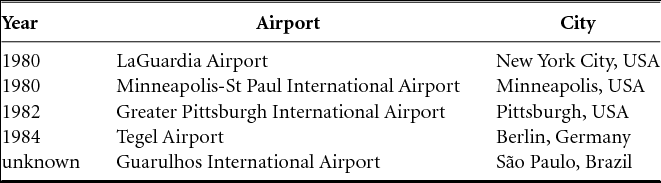
Although Eno sold Airports in 1978 on the merits of its readiness to airport reception, he did so mainly through the rock record market. Within its first year of release, Music for Airports was publicized and reviewed as a crossover avant-rock record in periodicals such as Melody Maker, Musician, New York Times, Rolling Stone, Village Voice, and Vogue. Footnote 73 Airports would eventually become programmed in real airports, but not for over a year after its commercial debut. The documented instances of airport installations since then make up a short list (Table 3). Given the record's quarter-million sales numbers (and exceeding number of YouTube plays, in 2016), one can soundly assume that at least as many people have listened to Eno's album intentionally as have had it imposed upon them in public. Eno admitted as much in a 1984 interview when asked where he imagined his Ambient music being heard. ‘Initially public places’, he answered, ‘but when you make a record you are making it for a living room’.Footnote 74
Documented airport installations of Music for Airports.

Eno amended his conception of Ambient music shortly following the release of Airports. Although he continued to use Ambient music in site-specific audiovisual installations, Eno began regarding Ambient music as adaptable to different listening situations, with personal listening imagined as its most likely mode of reception.Footnote 75 It became evident to the jet-setting avant-pop producer as he increasingly travelled long distances that this need not occur in one's ‘living room’: ‘When I was travelling a lot, I used to carry four or five cassettes that I knew could reliably produce a certain condition for me’, Eno recalled in 1984. ‘I realized that while I was living this nomadic life, the one thing that was really keeping me in place, or giving me a sense of place, was music.’Footnote 76 Due to this realization, developing musical atmospheres became less about enhancing a given place for Eno, and more about delivering listeners into ‘more desirable’ worlds. ‘This is escapism in a sense’, Eno has reflected, ‘but it isn't retreating from one world so much as advancing on another.’Footnote 77 (Ironically, portable listening devices would also make more available to willing listeners the possibility of hearing Airports within real airports, as Eno originally imagined.)
Eno reinforced his revised expectations for Ambient music in the liner notes to Ambient 4: On Land, released in March 1982 as the fourth and final instalment of the Ambient series. With this album, Eno sought to exploit the music recording's ability to generate, for individual listeners, a ‘sense of place that complements and alters your environment’.Footnote 78 When Editions E. G. re-released the album on CD in 1986, Eno reflected in the liner notes that he had been exploiting this capability for quite some time already:
The idea of making music that in some way related to a sense of place – landscape, environment – had occurred to me many times over the years preceding On Land. Each time, however, I relegated it to a mental shelf because it hadn't risen above being just another idea – a diagram rather than a living and breathing music. In retrospect, I now see the influence of this idea, and the many covert attempts to realise it, running through most of the work that I've released like an unacknowledged but central theme.Footnote 79
Eno's reflection gives reason to interpret Music for Airports as one such covert attempt to relate to listeners, musically, a sense of place.
Eno's revised conception of his music also gives reason to locate the affective and associational aspects of Airports, and of Ambient music more broadly, within the times and spaces of personal musical programming. To help demarcate Ambient music's place within this regime, I borrow from Steven Brown and Töres Theorell, who distinguish self-programmed music from publicly administered music by calling the former ‘personal enhancement background music’ (or PEBM), and the latter ‘milieu music’.Footnote 80 Individuals generally select PEBM themselves, and use it for emotional control and motivational assistance.Footnote 81 Eno's ‘Ambient Music’ essay, in stating that Ambient music is ‘ostensibly (but not exclusively)’ for specified public spaces, notably retains the possibility that Airports and other Ambient music might be used as PEBM, despite their apparent site-specificity.Footnote 82 His references to ‘conventional background music’ in the essay notably encompass the light classical arrangements found on ‘mood music’ records or easy-listening radio stations.Footnote 83 Eno hence distinguished Ambient music from ‘conventional background music’, it seems, not simply to convince listeners of Ambient's superior suitability for public environments, but also to assert its preferability over most other music marketed as PEBM.
Eno additionally insisted that Ambient music need not remain in the ‘background’ of listeners’ perceptual fields. Though unobtrusive, Ambient music should be capable of sustaining aesthetic interest within the fluidly more-or-less-attentive conditions of everyday record listening. One may well use Ambient recordings to transform space and mood while also, intermittently, contemplating the expressive forms guiding these sensuous (dis)orientations. From this perspective, aesthetic listening sits aside Ambient music's other uses; the less specific ‘personal enhancement music’, or PEM, may hence be a more apt description of Ambient music's applicability within a regime of flexibly attentive or ‘ubiquitous’ listening.Footnote 84
Eno's assertions that Ambient music should retain a sense of doubt, and that art should provide a space for disorientation, also offer insight into how he might have imagined Ambient music's ambivalent moods as providing ‘personal enhancement’ for the record user. His insistence on the primacy of art's disorienting function recalls a range of aesthetic techniques and theories, from Victor Shklovsky's остранение (ostranenie or defamiliarization) to Berthold Brecht's Verfremdungseffekt (estrangement effect), Sergei Eisenstein's montage theory, Walter Benjamin's ‘profane illumination’, and Guy Debord's détournement, all of which advanced the modernist avant-garde goal of shocking art's audiences out of habitual perception, and into an enhanced or altered awareness of everyday life.Footnote 85 Eno's Ambient music, as Daniel Barbiero puts it, ‘sublimates’ this alienating shock of modernist art ‘into a nuanced undertone’.Footnote 86 In the form of PEM, this undertone may slip quietly into that realm of habit, home, and routine called ‘everyday life’, where listeners might wake up to disorientation and uncertainty on their own time.Footnote 87
Future study of Ambient music may well expand upon the ways this ambivalence serves listeners not just as a resource for personal enhancement on a day-to-day level, but also as a resource for self-identity. Ambient music, anonymous as it might seem, may nonetheless as PEM help listeners condition their private environments to reflect their personal identities and ideals, a process that Tia DeNora calls ‘identity work’.Footnote 88 By producing moods involving melancholy, alienation, and uncertainty, Ambient recordings offer their listeners the unconventional pleasure of electing to feel ambivalent – perhaps a more appealing sort of mood enhancement for social critics, or sceptics of the idea that musical listening should be entirely ‘easy’.
Ambient recordings as ambivalent places of passage
The preceding analysis of Music for Airports provides a blueprint for interpreting Ambient music recordings as tools of personal enhancement whose conceptual, visual, and musical designs promote affective mixtures of safety and uncertainty.Footnote 89 Ambient recordings offer listeners an everyday resource for relaxation, mood enhancement or adjustment, and enhanced or altered awareness of their situations and surroundings. The preceding analysis of Airports illustrates how predictable musical consistencies or invariants over long stretches of time typically make these functions central to the Ambient aesthetic. Such invariants – including drones and loops, as well as stable textures, dynamics, and pitch repertories – produce indefinitely continuous experiential worlds that ground listeners’ cognitive security. In so establishing stabilities to which listeners might become entrained or habituated, Ambient recordings contour an extended virtual present that listeners might navigate and inhabit as though it were spatial. Their indistinct evocations of other spaces provide listeners imagined transport into an aestheticized time–space ‘in between’ the workaday and transcendent, a place in time for reflection or gathering energy, or what Eno calls ‘the dream time, in your daily life, times when things get sorted out and reshuffled’.Footnote 90
As with Eno's Airports or The Black Dog's Real Airports, Ambient recordings might accomplish these functions by evoking a sense of place or space associated with the mixed moods they convey.Footnote 91 Ambient music's virtual spaces, in their unique makeup of stable and unstable elements, may spark or stir experiential associations with various sorts of real places. Listeners need not consciously reflect upon Ambient recordings’ space- and place-oriented evocations to enjoy their atmospheres; such associations might even be beside the point of Ambient music's affective work while listening. Yet because PEM users normally program recordings themselves, for themselves, these users’ aural experiences are often led by a space- or place-oriented title and concept before the music gets selected, played, and heard. Place- and space-based themes can inform listeners’ intentions as programmers of experience, while successful pairings of music and concept might also inspire listeners to return repeatedly to these well-marked medial locations.
And yet, as scholars of ‘ubiquitous music’, ‘portable music’, and ‘music in everyday life’ have variously described, such functions are not unique to Ambient music recordings. PEM users play music of many different kinds as part of a reflexive project of self-care that enhances their daily living.Footnote 92 By using music to establish stable spatial and temporal environments, PEM users program and ‘colonize’ their own future comfort and mood much in the same way that modern institutions plan, organize, and manage human experience to make it more reliable.Footnote 93 Moreover, the Ambient recording is not alone in its ability to conjure a sense of place or space. All sorts of recorded music can be understood as virtual sites of association with real spaces by dint of their conceptual frames, aesthetic designs, and affective qualities. So what makes Ambient music special here?
As I have alluded earlier, Ambient aesthetics point to the medial place of recorded music design in everyday life. Various scholars in media theory and philosophy have provided some conceptual tools for understanding this medial space. Media scholar Jody Berland, for instance, has described music recordings as reconfiguring spatial situations into temporal designs that operate within a ‘sociomusical “third space”’ or ‘time-outside-of-space’.Footnote 94 In playback, recordings disembed listeners from local space, while ‘“placing” listeners in their affective and topographic worlds’.Footnote 95 One might otherwise imagine this temporalized world in terms of Augé’s ‘non-place’, or perhaps in terms of the virtual spaces-outside-of-place that Foucault calls ‘heterotopias’.Footnote 96 These designs’ mediating function, however, may best be captured by Henri Bergson's concept of the place of passage, ‘A connecting link between the things which act upon me and the things upon which I act – the seat, in a word, of sensori-motor phenomena.’Footnote 97 As Edward Casey theorizes it, a place of passage may simultaneously act as an intra-place, an environing place (or mood) within which things move, and as an inter-place, or a transportive place (or mood) that sends masses into motion.Footnote 98 Recorded music, like the listening bodies it both contains and is contained by, affectively stabilizes physical spaces of reception at the same time as it unsettles them, disposing inhabitants to departures from their given locations and arrivals at new moods. As active medial locations, musical recordings structure and orient the terrain of the personal and habitual everyday, while also opening this terrain to new possible corridors, vectors, passages, and paths.
Do these descriptions of recorded music's place in personal listening seem reminiscent of the discussions of airport space earlier? I should hope so. As Music for Airports illustrates, Ambient music is not just well suited to evoking place, creating space, and altering mood, but also aesthetically thematizes these functionalities of recorded music through its place-oriented metaphors, spatializing techniques, and mixed moods. Hence, it is no coincidence that Eno came to describe Ambient recordings’ functional flexibility in terms of the paradoxical duality of predictability and uncertainty conveyed by Airports’s design. As Eno has attested, the Ambient record provides a ‘reliable experience’ for its consumer; yet, at the same time, it ‘generates unpredictability rather than repetition’ by variously adapting to different listening scenarios.Footnote 99 By summoning a sense of ‘being in between’ predictability and the unknown, Airports aestheticizes the flexible applicability of recorded music within our contemporary everyday auditory ecology. The planned openness rendered by Eno's expressive designs on Airports gives shape, weight, and texture to the idea of musical recordings as transportive places, determinate in form and progression, but underdetermined with regard to their personal uses and emplacements. The Ambient recording's seemingly placeless evocations of space and ambivalence are accordingly not simply atmospheric, functional, or personally enhancing, but also express the intra-place/inter-place undecidability of the Ambient recording's mediation.
In short, Ambient designs interpret, metaphorize, and aestheticize the atmospheres and transportations their recordings provide. The aesthetics of Ambient music are thus central, not ancillary to the music's typification as such. The genre name does not primarily communicate that Ambient music can function as a transportive environment; rather, it communicates that the music's space- and transport-based aesthetics reflexively afford atmospheric and transportive use.Footnote 100 The Ambient genre name's evocation of the motile atmospheric surround may be understood as what John Frow calls a ‘metacommunication’ about the mediations its recordings perform.Footnote 101 Ambient recordings belong to the Ambient genre by reflecting aesthetically upon their own environing and transportive functions.
What's more, as the prior comparison of Eno's and The Black Dog's albums illustrates, Ambient music's mixed moods inflect these aesthetic reflections in particular ways. In so far as it is seductively beautiful – and it is, often – Ambient music affirms the value of personal withdrawal, solitude, and aesthetic reflection in everyday life, virtues that most media scholars of ‘everyday’ music have, perhaps cynically, denied the modern everyday subject.Footnote 102 Yet Ambient music's self-reflexively ambivalent aesthetics, I would venture, is what makes Ambient music both useful as an everyday resource for living, and as ‘interesting’ as it is ignorable (to paraphrase Eno). Its ambivalence reflects back upon the ease of its purposing, rendering the isolating act of personal programming at once edifying and troubled. As Paul Roquet more generally observes of what he calls ‘ambient media’, works such as Airports and Real Airports ‘hint’ that their own ‘mediated provision of calm may ultimately be a fragile cover for larger social landscapes that are anything but relaxing’.Footnote 103 Characteristically, Ambient music's more desirable worlds involve the inadequacy of our own, preserving as part of their use a lingering trace of the inhumanity and social disconnection reinforced by personal electronics. Tinged as they are with uncertainty, these atmospheres might especially nourish those consumers who find the neoliberal technologization of the self both alluring and potentially nefarious. They allow such listeners to externalize this ambivalence by immersing themselves in a halo of vague, possibly unsettling reminiscence. One might reasonably consider this use of recorded music of a piece with the Romantic quietism of what Timothy Morton calls, after Hegel, ‘beautiful soul syndrome’; while its unsettling undertones may also resonate with what Rita Felski calls the ‘suspicious sensibility’ of the social critic.Footnote 104 Yet, at its best, Ambient's doubtful moods all the same re-enchant the world that it holds in doubt, deepening and sharpening listeners’ capacity to slow down and take it all in.
Eno's Music for Airports may not have inspired a trend in programmed music for public spaces, but it did establish a new aesthetic framework for experiential design and programming in personal listening. Then and now, recordings described as ‘Ambient’ revive the impersonality, transience, and alienation experienced in modern transportation, re-producing the experience of technologically administered passage as one equally inviting and alienating, connective and isolating, futuristic and nostalgic, moving and grounding. Yet because Ambient recordings not only reflect upon living with technologies of transport, but also take part in it, one may just as well regard airport experience, and the experience of flight more broadly, as metaphors for the equally pacifying and unsettling experience of Ambient music listening.