Introduction
Over 1.8 million US troops have been deployed to the wars in Afghanistan (Operation Enduring Freedom; OEF) and Iraq (Operation Iraqi Freedom; OIF). Combat is associated with considerable mental health risk, including elevated rates of post-traumatic stress disorder (PTSD), a psychiatric disorder characterized by intrusive and distressing reliving of traumatic events (through memories or dreams), avoidance of reminders about those events, and hyperarousal symptoms such as impaired sleep, irritability and decreased concentration (APA, 1994). While most combat-exposed troops will fortunately not develop PTSD (Hoge et al. Reference Hoge, Castro, Messer, McGurk, Cotting and Koffman2004), the substantial minority who do will face considerable difficulties in interpersonal relationships, occupational functioning, and quality of life as well as high rates of co-morbidity with other psychiatric disorders (Kessler, Reference Kessler2000). PTSD occurs in as many as 1 in 5 Vietnam veterans, in contrast to rates of less than 1 in 10 for the general population (Kessler et al. Reference Kessler, Berglund, Demler, Jin, Merikangas and Walters2005; Dohrenwend et al. Reference Dohrenwend, Turner, Turse, Adams, Koenen and Marshall2006). In military personnel deployed to OEF/OIF, about 1 in 8 service members return with PTSD (Hoge et al. Reference Hoge, Castro, Messer, McGurk, Cotting and Koffman2004; Schell & Marshall, Reference Schell, Marshall, Tanielian and Jaycox2008).
The US military has increasingly relied on large numbers of National Guard and Reserve (NGR) troop deployments to support OEF/OIF. Several reports indicate that NGR troops are at heightened risk for post-deployment psychiatric distress compared with regular active duty troops (US Army Surgeon General, 2005; Hotopf et al. Reference Hotopf, Hull, Fear, Browne, Horn, Iversen, Jones, Murphy, Bland, Earnshaw, Greenberg, Hughes, Tate, Dandeker, Rona and Wessely2006; Browne et al. Reference Browne, Hull, Horn, Jones, Murphy, Fear, Greenberg, French, Rona, Wessely and Hotopf2007; Milliken et al. Reference Milliken, Auchterlonie and Hoge2007; Smith et al. Reference Smith, Ryan, Wingard, Slymen, Sallis and Kritz-Silverstein2008; Iversen et al. Reference Iversen, van Staden, Hughes, Browne, Hull, Hall, Greenberg, Rona, Hotopf, Wessely and Fear2009), and this heightened risk appears to increase even more in the months and years following combat deployment (Wolfe et al. Reference Wolfe, Erickson, Sharkansky, King and King1999; Milliken et al. Reference Milliken, Auchterlonie and Hoge2007). For example, Milliken et al. found that rates of positive screening for PTSD symptoms more than doubled among NGR soldiers from their immediate post-deployment screening (12.7%) compared with when they were re-evaluated 6 months later (24.5%). In contrast, the PTSD screening rate increased by only 4.9% in regular active duty troops during the same time-frame (Milliken et al. Reference Milliken, Auchterlonie and Hoge2007). Combat deployment may be especially stressful for NGR troops or ‘civilian soldiers’ who may be unaccustomed to prolonged separations from family and who may experience harmful career disruptions in their civilian occupations. NGR troops' military training, perceptions of preparedness and unit cohesion might also differ from regular component troops in ways that increase NGR troops' risks for harmful post-combat sequelae. In a recent cross-sectional study of UK troops deployed to Iraq, reserve component UK troops reported lower levels of unit cohesion and felt less informed than regular active duty component UK troops (Browne et al. Reference Browne, Hull, Horn, Jones, Murphy, Fear, Greenberg, French, Rona, Wessely and Hotopf2007). Despite indications of elevated PTSD risk among NGR troops, however, most PTSD research focuses on active duty component soldiers, and little is known about risk and resilience in this important population.
Three decades of research has demonstrated that severity of trauma exposure robustly predicts PTSD (Ozer et al. Reference Ozer, Best, Lipsey and Weiss2003). However, other factors have also been implicated in PTSD's development. For example, childhood trauma and adversity (King et al. Reference King, King, Foy, Keane and Fairbank1999; Iversen et al. Reference Iversen, Fear, Simonoff, Hull, Horn, Greenberg, Hotopf, Rona and Wessely2007), neuroticism (Miller et al. Reference Miller, Kaloupek, Dillon and Keane2004; Rubin et al. Reference Rubin, Berntsen and Bohni2008; Lahey, Reference Lahey2009), worries about families and civilian life while deployed (Vogt et al. Reference Vogt, Pless, King and King2005), subsequent life stressors (King et al. Reference King, King, Fairbank, Keane and Adams1998; Dirkzwager et al. Reference Dirkzwager, Bramsen and van der Ploeg2003; Ozer et al. Reference Ozer, Best, Lipsey and Weiss2003) and lack of social support (Ozer et al. Reference Ozer, Best, Lipsey and Weiss2003) have been associated with increased odds of developing PTSD. However, positive childhood family environments (Foy et al. Reference Foy, Resnick, Sipprelle and Carroll1987; Schnurr et al. Reference Schnurr, Lunney and Sengupta2004), unit cohesion (Brailey et al. Reference Brailey, Vasterling, Proctor, Constans and Friedman2007; Iversen et al. Reference Iversen, Fear, Ehlers, Hacker, Hull, Earnshaw, Greenberg, Rona, Wessely and Hotopf2008; Rona et al. Reference Rona, Hooper, Jones, Iversen, Hull, Murphy, Hotopf and Wessely2009), military preparedness (King et al. Reference King, King, Vogt, Knight and Samper2006) and greater social support following deployment (Benotsch et al. Reference Benotsch, Brailey, Vasterling, Uddo, Constans and Sutker2000; Dirkzwager et al. Reference Dirkzwager, Bramsen and van der Ploeg2003) have been associated with lower odds of developing PTSD.
Furthermore, what is known about combat-related PTSD has largely been derived from cross-sectional studies of veterans from earlier wars, where retrospective data were often collected a decade or more after hostilities ceased (Ozer et al. Reference Ozer, Best, Lipsey and Weiss2003). Consequently, these studies have been limited by the potential for recall errors and ambiguity about the temporal sequence of events (i.e. direction of cause and effect) (King et al. Reference King, King, Erickson, Huang, Sharkansky and Wolfe2000). More recent, prospective studies of troops deployed to OEF/OIF suggest that new-onset PTSD following deployment is associated with female gender, younger age, enlisted (non-officer) rank, NGR status, being a smoker prior to deployment (Smith et al. Reference Smith, Ryan, Wingard, Slymen, Sallis and Kritz-Silverstein2008), and reporting PTSD symptoms or poorer physical health prior to deployment (Rona et al. Reference Rona, Hooper, Jones, Iversen, Hull, Murphy, Hotopf and Wessely2009). While these studies are an advance over earlier research, they evaluated very few modifiable risk and protective factors for PTSD. Identifying risk and protective factors for PTSD is critical to understanding the disorder's etiology, identifying those most vulnerable, and informing prevention and treatment-development efforts.
Our goals were to go beyond generally fixed demographic variables (e.g. age, race, gender) and identify pre-trauma (pre-deployment), trauma (deployment-related), and post-trauma (post-deploy ment) risk and protective factors for developing new-onset PTSD in a cohort of National Guard troops deployed to OIF. Even after accounting for the influence of combat exposure on PTSD, we hypothesized that new-onset probable PTSD would be uniquely predicted by soldiers' pre-deployment reports of their childhood family environments, past exposure to potentially traumatic events, military preparedness, unit cohesion, and worries about the impact of deployment on civilian life and family. We also hypothesized, after accounting for pre-deployment variables and the impact of combat deployment stressors, that post-deployment social support would be uniquely associated with lower risk of new-onset probable PTSD, while soldiers' experiences of stressful life events since deployment would be uniquely associated with risk of new-onset probable PTSD.
Method
Study design and participants
This prospective panel study followed the classic epidemiological strategy of defining a panel of National Guard soldiers prior to deployment (i.e. prior to ‘exposure’) and then excluding from analysis those who were already symptomatic for the disorder of interest – in this instance, PTSD. After deployment, all National Guard soldiers who had initially been asymptomatic for PTSD were examined for new-onset probable PTSD. Hypothesized risk and protective factors were then compared across those who did and did not develop new-onset probable PTSD.
Data were collected as part of the Readiness and Resilience in National Guard Soldiers (RINGS) study, a prospective study of 522 Army National Guard soldiers (462 men and 60 women) from a Brigade Combat Team (BCT) deployed to Iraq. In March 2006, questionnaires assessing psychosocial risk/protective factors and baseline psychiatric symptoms were collected 1 month prior to troops' deployment to Iraq. Troops were informed about the study through flyers as well as announcements by mid-level leadership. Although no specific time for participation was allotted in troops' intense pre-deployment training schedule, about 20% of the total BCT force met with investigators for a group briefing and received information about the study. Precise participation rates could not be obtained, but participation appeared to be high among those units that attended group briefings. Participants completed questionnaires in group classrooms under standardized conditions. Consistent with military regulations, no incentives were provided pre-deployment when soldiers were on active duty. Troops had just completed 5 months of intensive mobilization training at Camp Shelby, Mississippi and were poised for a 1-year deployment, which was later extended by 4 months. The BCT was deployed to Iraq from March 2006 to July 2007.
Post-deployment data were collected via mailed survey. Approximately 2 months after the panel's return (September 2007), we mailed a follow-up questionnaire, cover letter containing the elements of informed consent, and $50 cash incentive to all panel members. A postcard reminder and two additional mailings were sent to non-respondents at 2-week intervals. Survey tests were counterbalanced to control for the potential influence of ordering effects (Reddy et al. Reference Reddy, Polusny and Murdoch2009).
Of the original panel, 424 (81%) returned post-deployment questionnaires. Panel members who completed the post-deployment questionnaire did not differ from those who did not complete it in terms of gender, rank, pre-deployment measures of vulnerability and protective factors, or baseline PTSD symptoms. Panel members who did not complete the post-deployment questionnaire were younger [25.3 (s.d.=6.9) v. 29.9 (s.d.=8.8) years, p<0.0001] and more likely to be non-white (11% v. 6%, p<0.05) or unmarried (49% v. 31%, p<0.001) compared with those who completed the post-deployment questionnaire. Non-responders also reported fewer years of education [13.5 (s.d.=1.7) v. 14.4 (s.d.=2.0) years, p<0.0001].
The RINGS study was approved by the human subject research review boards of the Army, Department of Veterans Affairs, University of Minnesota, and relevant Army National Guard (ARNG) command. After complete description of the study to subjects, written informed consent was obtained.
Assessment of new-onset PTSD
New-onset probable PTSD was assessed using the 17-item PTSD Checklist (PCL; Weathers et al. Reference Weathers, Litz, Herman, Huska and Keane1993), which measures PTSD symptoms corresponding to the Diagnostic and Statistical Manual of Mental Disorders, 4th edition (DSM-IV) diagnostic criteria (APA, 1994). Respondents rated the severity of each symptom during the past month on a Likert scale from 1 (not at all) to 5 (extremely) (range 17–85). Baseline PTSD symptoms were assessed prior to deployment using the civilian version of the PCL (PCL-C); military deployment-related PTSD symptoms were assessed following deployment using the military version of the PCL (PCL-M; Weathers et al. Reference Weathers, Litz, Herman, Huska and Keane1993). The PCL has excellent test–retest reliability and high overall convergent validity (Weathers et al. Reference Weathers, Litz, Herman, Huska and Keane1993; Blanchard et al. Reference Blanchard, Jones-Alexander, Buckley and Forneris1996).
A range of criteria has been recommended for identifying probable PTSD among military personnel using the PCL (Weathers et al. Reference Weathers, Litz, Herman, Huska and Keane1993; Bliese et al. Reference Bliese, Wright, Adler, Cabrera, Castro and Hoge2008; Terhakopian et al. Reference Terhakopian, Sinaii, Engel, Schnurr and Hoge2008). Based on our analytical strategy, we wanted to be as certain as possible that our analysis was restricted only to panel members who did not have PTSD prior to deployment. Therefore, we used a ‘liberal’ screening cut-off (PCL total of ⩾34) to identify soldiers with PTSD symptoms prior to deployment. This cut-off score has 71% sensitivity and 91% specificity for PTSD diagnosis based on the Mini International Neuropsychiatric Interview (MINI; Bliese et al. Reference Bliese, Wright, Adler, Cabrera, Castro and Hoge2008). It tends to err on the side of being overly inclusive, which was acceptable for our purposes. Conversely, after deployment, we wanted to be as certain as possible that panel members defined as having PTSD truly did have a new-onset diagnosis. Therefore, we used a ‘stringent’ definition for probable PTSD that required the following: (1) participants had to report DSM-IV diagnostic criteria (endorsing at least one intrusion symptom, three avoidance symptoms and two hyperarousal symptoms at the moderate level) and (2) have a total PCL score of ⩾50 (Hoge et al. Reference Hoge, Castro, Messer, McGurk, Cotting and Koffman2004). While this stringent method has been widely used in military studies (Ramchand et al. Reference Ramchand, Karney, Osilla, Burns, Caldarone, Tanielian and Jaycox2008), sensitivity and specificity has not been evaluated (Terhakopian et al. Reference Terhakopian, Sinaii, Engel, Schnurr and Hoge2008). However, using pooled data from validation studies comparing the PCL cut-off of 50 against ‘gold standard’ structured diagnostic interviews yields a weighted average sensitivity of 54% and a weighted average specificity of 93% (Terhakopian et al. Reference Terhakopian, Sinaii, Engel, Schnurr and Hoge2008); the use of criteria using DSM-IV symptom endorsement to identify PTSD caseness based on the SCID yields 40% sensitivity and 97% specificity (Widows et al. Reference Widows, Jacobsen and Fields2000).
Risk and protective factors assessed at pre-deployment
Five valid and reliable scales from the Deployment Risk and Resilience Inventory (DRRI) (King et al. Reference King, King, Vogt, Knight and Samper2006; Vogt et al. Reference Vogt, Proctor, King, King and Vasterling2008) were used to prospectively measure risk and protective factors prior to soldiers' deployment. The 17-item Prior Stressors scale measured soldiers' exposure to stressful and potentially traumatic events before deployment, i.e. sexual abuse, physical assault and natural disaster. Responses (0=no, 1=yes) were summed to create a prior stressors severity score. A modified Concerns about Family/Life Disruptions scale (sum of 14 items rated on a Likert scale from 4=a great deal to 1=not at all) assessed soldiers' pre-deployment worries about how the upcoming deployment might lead to losses and disruptions in their family and civilian career. The Childhood Family Environment scale (sum of 15 items rated on a Likert scale from 1=almost none of the time to 5=almost all of the time) measured the quality of soldiers' childhood family environments in terms of cohesion, accord and closeness among family members. The 14-item Preparedness scale measured the extent to which prior to deployment soldiers perceived they had mastered technical military skills needed for combat operations and had adequate knowledge of what to expect during deployment. Finally, soldiers' perceptions of military cohesion and unit support were measured pre-deployment using the 12-item Unit Social Support scale.
Deployment-related factors assessed at follow-up
When soldiers returned from deployment, we used three DRRI subscales to measure deployment-related stressor exposure (King et al. Reference King, King, Vogt, Knight and Samper2006; Vogt et al. Reference Vogt, Proctor, King, King and Vasterling2008). The Combat Experiences scale asked about specific combat exposures during deployment; responses were summed to create a combat exposure severity score. The Aftermath of Battle scale measured exposure to the consequences of combat including handling human remains. The Perceived Threat scale measured soldiers' subjective experience of fear or threat to well-being during deployment. Higher scores indicate greater levels of exposure to each deployment-related risk factor.
Post-deployment risk and protective factors assessed at follow-up
Soldiers' exposure to stressful life events since return from deployment (e.g. death of a loved one, serious accident, unemployment, legal problems) was assessed using the Post-deployment Stressors scale (King et al. Reference King, King, Vogt, Knight and Samper2006; Vogt et al. Reference Vogt, Proctor, King, King and Vasterling2008). The Post-Deployment Social Support scale (King et al. Reference King, King, Vogt, Knight and Samper2006; Vogt et al. Reference Vogt, Proctor, King, King and Vasterling2008) measured soldiers' perceived emotional and instrumental support from family, friends, employers, co-workers and community. Higher scores indicate greater levels of each construct.
Statistical analyses
We describe the panel's deployment experiences overall and, among those without PTSD symptoms at baseline, by post-deployment PTSD status (new-onset probable PTSD versus not). Among those without PTSD symptoms at baseline, we tested for unadjusted differences in risk and protective factors by new-onset probable PTSD status using independent t tests. We used hierarchical logistic regression to determine the adjusted odds of association between these same factors and new-onset probable PTSD. All continuously distributed variables were converted to z-scores prior to entry into regression models. Variables were entered in three blocks. In the first block, we entered participants' sociodemographic characteristics (gender, age, race/ethnicity and military rank), their pre-deployment PCL score, and their pre-deployment risk and protective factors. By adding participants' baseline PCL scores to this block, we control for any pre-existing, low-level, PTSD symptoms that might have facilitated later development of full-syndrome PTSD. The two pre-deployment risk factors entered in this block were prior stressful life events and concerns about the impact that deployment might have on participants' life and family. The three pre-deployment protective factors were childhood family environment, military preparedness and unit social support. Deployment-related risk factors (combat exposure, witnessing the aftermath of battle, perceived life threat) were entered in the second block. In the third and final block, we entered post-deployment variables (post-deployment stressful life events and post-deployment social support). Adjusted odds ratios for predictor variables were examined, with a two-tailed α of <0.05 used to determine statistical significance. All analyses were conducted using SPSS version 17 (SPSS Inc., USA).
Results
Sample characteristics
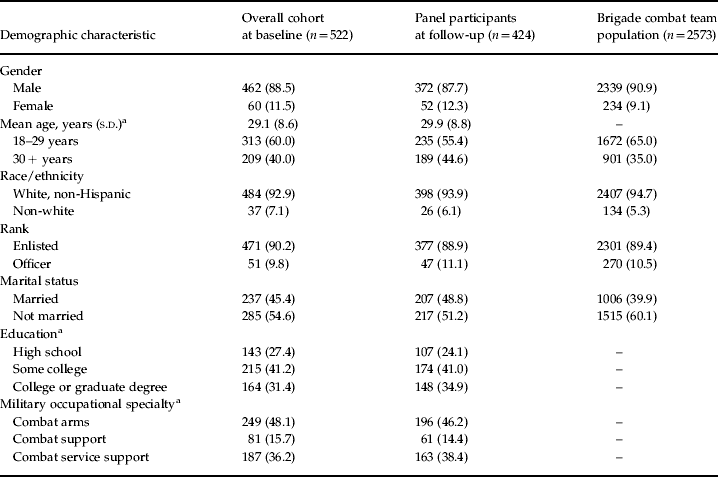
As shown in Table 1 and consistent with characteristics of the entire BCT, 88% of the cohort was male. Most were white, enlisted rank and aged <30 years. There were no significant differences between cohort members and the BCT population in terms of gender, race/ethnicity, or rank; however, a greater percentage of cohort members were aged ⩾30 years and married.
Baseline demographic characteristics of the RINGS cohort participants compared with follow-up panel and Brigade Combat Team population

RINGS, Readiness and Resilience in National Guard Soldiers.
Values are given as number (%). Numbers might not add up to totals because of missing data. Percentages reported are the proportion of individuals endorsing each demographic characteristic adjusted to take account of sample and missing data.
a Comparable demographic data for mean age, education and military occupational specialty at the brigade level were not available.
Rates of reported PTSD symptoms at baseline and new-onset probable PTSD at follow-up
The majority of soldiers (430/516) were asymptomatic for PTSD symptoms prior to deployment. At baseline, 16.7% (86/516 met the liberal screening cut-off of ⩾34 on the PCL-C) had pre-existing PTSD symptoms, while 3.7% (19/516 soldiers met stringent criteria) had probable PTSD. Among those without PTSD symptoms at baseline who were assessed at follow-up, 13.8% (48 of 349 met stringent criteria on the PCL-M) developed post-deployment, new-onset probable PTSD.
Combat deployment experiences overall and among those without PTSD at baseline
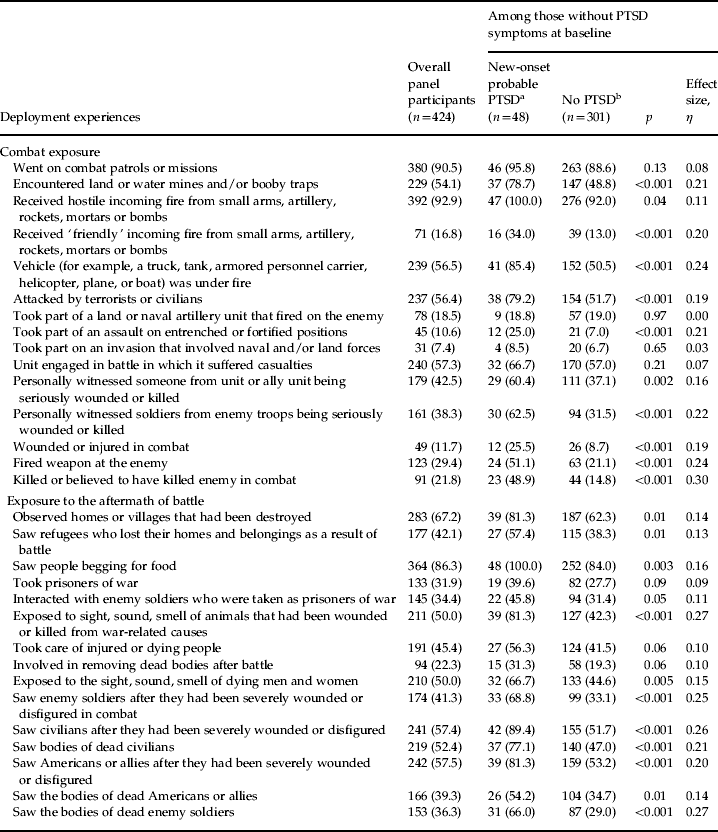
Table 2 reports panel members' combat experiences overall and, among those without PTSD at baseline, compares these experiences according to whether the participant had new-onset probable PTSD after deployment. Overall, more than 90% of panel members went on combat missions and patrols and received hostile, incoming fire. More than half served in units that suffered casualties, and about one-fifth believed they may have killed enemies in combat. Despite this overall high prevalence of intense combat experiences, Table 2 also shows that, among those without PTSD at baseline, these and other experiences were significantly more common for those who developed new-onset probable PTSD compared with those who did not develop PTSD. Effect sizes for new-onset probable PTSD were particularly large for activities related to killing or killing's aftermath, being in a vehicle under fire, and encountering land or water mines.
Frequency of deployment stressor exposures reported by National Guard troops deployed to Iraq overall and among those without PTSD at baseline (n=349) by new-onset probable PTSD status

PTSD, Post-traumatic stress disorder; PCL-C, civilian version of the PTSD Checklist; PCL-M, military version of the PTSD Checklist.
Values are given as number (%). Percentages reported are the proportion of individuals endorsing each response adjusted to take account of sample and missing data.
a Among those without PTSD symptoms at baseline (PCL-C total score fell below liberal PTSD symptom screening cut-off of ⩾34), participants had new-onset probable PTSD if stringent criteria were met (total PCL-M score ⩾50 and endorsement of at least one intrusion symptom, three avoidance symptoms, and two hyperarousal symptoms each at the moderate or higher level) at follow-up/post-deployment.
b Among those without PTSD symptoms at baseline, participants had no PTSD if stringent criteria for probable PTSD were not met at follow-up/post-deployment.
Risk and protective factors overall and among those without PTSD at baseline
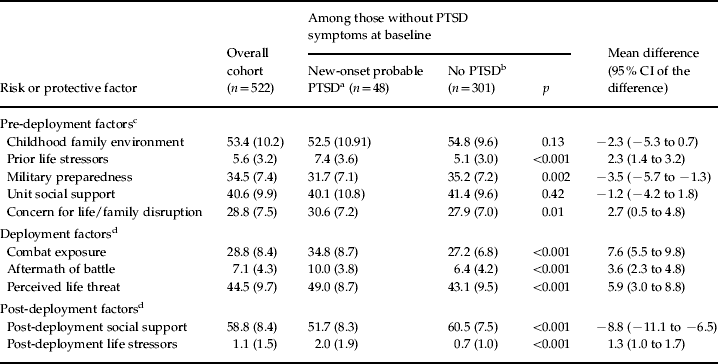
Table 3 presents the mean scale scores for DRRI subscales overall and, among those without PTSD at baseline, by post-deployment new-onset probable PTSD status. With the exception of supportive childhood family environments and unit social support, participants with new-onset probable PTSD averaged significantly higher scores on all hypothesized risk factors and significantly lower scores on all hypothesized protective factors than panel members without new-onset probable PTSD.
Risk and protective factors reported by the RINGS cohort participants overall and among those without PTSD at baseline (n=349) by new-onset probable PTSD status

RINGS, Readiness and Resilience in National Guard Soldiers; PTSD, post-traumatic stress disorder; PCL-C, civilian version of the PTSD Checklist; PCL-M, military version of the PTSD Checklist.
Values are given as mean (standard deviation).
a Among those without PTSD symptoms at baseline (PCL-C total score fell below liberal PTSD symptom screening cut-off of ⩾34), participants had new-onset probable PTSD if stringent criteria were met (total PCL-M score ⩾50 and endorsement of at least one intrusion symptom, three avoidance symptoms, and two hyperarousal symptoms each at the moderate or higher level) at follow-up/post-deployment.
b Among those without PTSD symptoms at baseline, participants had no PTSD if stringent criteria for probable PTSD were not met at follow-up/post-deployment.
c Assessed at baseline/pre-deployment.
d Assessed at follow-up.
Predictors of new-onset probable PTSD
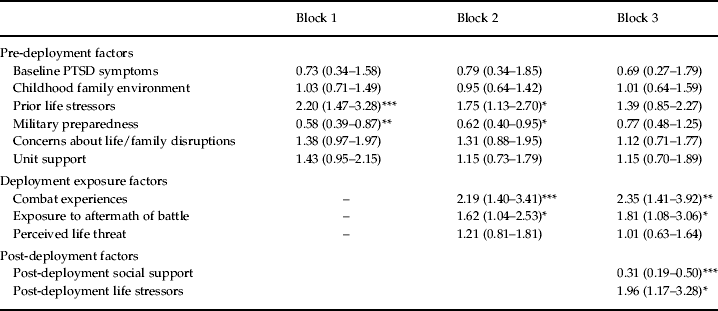
Among those without PTSD symptoms at baseline, we used hierarchical logistic regression analysis to identify independent pre-deployment, deployment-related, and post-deployment predictors of new-onset probable PTSD. As shown in Table 4 (see Block 1), after adjusting for sociodemographic characteristics and controlling for pre-existing, low-level PTSD symptoms at baseline, unique pre-deployment determinants of new-onset probable PTSD assessed prior to deployment included: prior stressful life events and perceived military preparedness. As expected and shown in Table 4 (see Block 2), after controlling for sociodemographics, baseline PTSD symptoms, and pre-deployment risk and protective variables, combat experiences and the aftermath of battle each independently predicted new-onset probable PTSD. However, even after controlling for deployment-related stressors, prior exposure to potentially traumatic events and perceived lack of military preparedness remained significant independent predictors of new-onset probable PTSD. Table 4 also shows adjusted post-deployment correlates of new-onset probable PTSD (see Block 3). After controlling for participants' sociodemographic characteristics, baseline PTSD symptoms and all other predictor variables, exposure to recent stressful events and post-deployment social support were significant independent correlates of new-onset probable PTSD.
Hierarchical logistic regression analysis predicting new-onset probable PTSD in National Guard soldiers deployed to Iraq among those without PTSD at baseline (n=349)Footnote a,Footnote b

PTSD, Post-traumatic stress disorder; PCL-C, civilian version of the PTSD Checklist; PCL-M, military version of the PTSD Checklist.
Values are given as odds ratio (95% confidence interval) after controlling for age, gender, race, and military rank.
a New-onset probable PTSD defined as no pre-existing PTSD symptoms (baseline PCL-C total score fell below liberal PTSD symptom screening cut-off of ⩾34) at baseline and met stringent criteria for probable PTSD (total PCL-M score ⩾50 and endorsement of at least one intrusion symptom, three avoidance symptoms, and two hyperarousal symptoms each at the moderate or higher level) at follow-up/post-deployment.
b Data from the Readiness and Resilience in National Guard Soldiers (RINGS) study (baseline data assessing pre-deployment factors were collected 1 month prior to troops' deployment to Iraq in March 2006; follow-up data assessing deployment exposure and post-deployment factors were collected 2–3 months following troops' return from deployment).
* p<0.05, ** p<0.01, *** p<0.001.
Discussion
In this longitudinal panel of US National Guard soldiers, we demonstrated a nearly 4-fold increase in new-onset probable PTSD 3 months after soldiers returned from OIF deployment compared with their pre-deployment base rates. This longitudinal cohort of US National Guard soldiers reported high combat exposure, comparable with that reported by US active duty soldiers and Marines deployed to Iraq (Hoge et al. Reference Hoge, Castro, Messer, McGurk, Cotting and Koffman2004). Not surprisingly, frequency and intensity of combat were potent predictors of new-onset probable PTSD. However, exposure to the sight, sound and smell of combat's aftermath also independently predicted probable PTSD. Besides combat, new-onset probable PTSD was uniquely predicted by soldiers' pre-deployment stressor exposures and their perceptions of military preparedness. Both these pre-deployment factors remained significant even after controlling for participants' baseline PTSD symptoms and their deployment stressor exposures. However, after controlling for post-deployment factors, none of the pre-deployment factors significantly predicted the development of probable PTSD.
The wars in Iraq and Afghanistan have been characterized by unconventional features (e.g. use of improvised explosive devices by an indistinctive enemy, counterinsurgency, and urban warfare) that may produce ambiguous combat situations for which the warrior may feel especially unprepared (e.g. killing a non-combatant) and may significantly contribute to PTSD risk (Litz et al. Reference Litz, Stein, Delaney, Lebowitz, Nash, Silva and Maguen2009). When examining specific aspects of combat stressors, we found that killing (e.g. ‘killed or believed to have killed enem[ies] during combat’) was an important predictor of new-onset probable PTSD. This association is consistent with others' recent reports (Rona et al. Reference Rona, Hooper, Jones, Iversen, Hull, Murphy, Hotopf and Wessely2009). One explanation for the association between soldiers' reports of killing in combat and new-onset PTSD is that killing reflects intense combat exposure and life threat due to being in close contact with the enemy. However, Maguen et al. found that killing was a significant predictor of PTSD symptoms even after controlling for combat exposure (Maguen et al. Reference Maguen, Lucenko, Reger, Gahm, Litz, Seal, Knight and Marmar2010). Litz et al. have argued that warriors' vulnerability to PTSD after killing results not simply from exposure to traumatic events, but from moral injuries that may be signs of the warrior's humanity (Litz et al. Reference Litz, Stein, Delaney, Lebowitz, Nash, Silva and Maguen2009). Consistent with this notion, these authors have suggested that self-forgiveness may play an important role in recovery after moral injury. While it may not be possible to fully prepare for the challenges of combat, prevention strategies aimed at enhancing soldiers' sense of mastery and self-efficacy could buffer soldiers against the stressful effects of combat exposure (Hobfoll, Reference Hobfoll1989) and by extension reduce risk for later PTSD.
In this prospective study, we found that soldiers' risk of developing new-onset probable PTSD following deployment was predicted by soldiers' reports of prior stressor exposures even after controlling for their baseline PTSD symptoms and deployment stressor exposures. This finding is contrary to other recent findings that prior trauma exposure in the absence of PTSD was not associated with increased vulnerability of developing PTSD following a subsequent trauma (Breslau et al. Reference Breslau, Peterson and Schultz2008; Breslau & Peterson, Reference Breslau and Peterson2010). Prior stressful life events may sensitize soldiers to the deleterious effects of combat exposure and amplify previously traumatized soldiers' vulnerability to developing PTSD (Schumm et al. Reference Schumm, Stines, Hobfoll and Jackson2005). Our finding that previous exposure to traumatic stressors increased soldiers' risk for new-onset probable PTSD is concerning in light of the high rates of pre-military trauma exposure reported by military personnel (Bolton et al. Reference Bolton, Litz, Britt, Adler and Roemer2001) and the large numbers of personnel serving multiple deployments. With the US military's sustained operations in Afghanistan and Iraq, it will be important to understand how multiple combat deployments have an impact on risk for new-onset PTSD among redeploying military personnel.
The fact that pre-deployment factors were no longer significant predictors of new-onset probable PTSD after controlling for the influence of post-deployment factors cannot be due to pre-deployment factors being caused by post-deployment factors. This is because of the temporal nature of variables in this study (e.g. pre-deployment factors were assessed prospectively before the occurrence of post-deployment factors). While it is possible that the pre-deployment factors may have remained significant with a larger sample, it is also possible that some third variable (e.g. personality) was predictive of both pre-deployment and post-deployment factors. For example, soldiers' reporting of prior stressful life events and other risk factors may reflect, at least in part, individual differences in personality (e.g. the tendency to be more ‘stressed’ by life circumstances). Future studies need to examine the role of personality factors, such as neuroticism which is a robust risk factor for PTSD (Rubin et al. Reference Rubin, Berntsen and Bohni2008), in understanding these relationships.
Our findings also suggest that the development of PTSD following deployment is associated with lower perceived social support and experiencing a greater number of recent stressful life events. As National Guard soldiers transition from the combat zone to their civilian lives, lack of post-deployment social support and additional life stressors represent two important resource losses that appear to erode soldiers' resilience and increase vulnerability to PTSD. These findings are consistent with other studies (Benotsch et al. Reference Benotsch, Brailey, Vasterling, Uddo, Constans and Sutker2000; Browne et al. Reference Browne, Hull, Horn, Jones, Murphy, Fear, Greenberg, French, Rona, Wessely and Hotopf2007), and suggest that post-deployment interventions aimed at enhancing soldiers' interpersonal resources at home, work, and in the community and alleviating subsequent stressors (e.g. unemployment, family distress) might enhance recovery and resiliency. Further research is needed to understand the role of military families in harnessing social support for soldiers and how stressors associated with impaired family functioning may further increase vulnerability for PTSD.
The rate of new-onset probable PTSD (13.8%) in our panel was similar to the PTSD prevalence reported for Army infantry soldiers and Marines about 3–4 months after their return from deployment to Iraq (12.9%) (Hoge et al. Reference Hoge, Castro, Messer, McGurk, Cotting and Koffman2004), but higher than that reported for the Millennium Cohort Study (7.6%) (Smith et al. Reference Smith, Ryan, Wingard, Slymen, Sallis and Kritz-Silverstein2008) and UK reservists deployed to Iraq (6.5%) in the King's Centre for Military Health Research Study (Hotopf et al. Reference Hotopf, Hull, Fear, Browne, Horn, Iversen, Jones, Murphy, Bland, Earnshaw, Greenberg, Hughes, Tate, Dandeker, Rona and Wessely2006). Given that these studies used the same instrument and criteria to define PTSD, the higher PTSD rate documented in this panel may be due to greater combat exposure (Iversen et al. Reference Iversen, van Staden, Hughes, Browne, Hull, Hall, Greenberg, Rona, Hotopf, Wessely and Fear2009).
This study had several strengths, including its prospective assessment of risk and protective factors prior to participants' deployment to OIF, its focus on US National Guard soldiers, and its focus on potentially modifiable risk factors for PTSD. In terms of limitations, participants were self-selected, although the panel was representative of the overall brigade in terms of gender, race/ethnicity and rank, and results may not generalize to active duty military personnel or to other military branches. More research is needed to test whether predictors of new-onset PTSD differ for active duty members. Although we obtained follow-up data from more than 80% of the original panel and our analyses of responders and non-responders showed few differences in pre-deployment measures of risk and protective factors, non-responders to follow-up were importantly different from responders (younger, more likely to be non-white, unmarried and less educated) and post-deployment findings could have been influenced by response biases.
While we used a valid and reliable measure of PTSD symptomatology, with highly sensitive and specific definitions for probable PTSD diagnosis, self-report data are susceptible to information biases, and misclassification error could have dampened associations between some variables. This suggests, however, that the associations between new-onset probable PTSD and military preparedness, post-deployment social support and other trauma exposures are even stronger than our data suggest. An important limitation of relying on self-reported PTSD symptomatology is that PCL-M scores were not tied to a specific traumatic stressor, and therefore could represent generalized distress or other disorders (e.g. anxiety or dysphoria) not examined in this study. Future researchers should consider incorporating ‘gold standard’ clinical interviews that allow for careful PTSD diagnosis and co-morbid conditions in at least a subset of their participants.
Post-deployment social support, life stressors and PTSD were assessed simultaneously. Thus, temporal relationships between these variables cannot be disentangled (e.g. PTSD symptoms may erode social support, or low social support could exacerbate PTSD symptoms). Additionally, monomethod variance bias could have caused us to overstate the associations among these three variables. Although data on deployment stressor exposure were assessed within 2–3 months of deployment, reducing the likelihood of recall bias, reports of combat exposure are based on self-report and were not cross-validated with military records.
Despite these limitations, this study significantly advances the literature on the etiology of combat-related PTSD by addressing important limitations of previous cross-sectional, retrospective studies. To our knowledge, this is the first study to prospectively investigate a range of pre-deployment, deployment, and post-deployment risk and protective factors associated with new-onset probable PTSD in US National Guard troops deployed to Iraq. While combat cannot be detoxified, interventions focusing on enhancing soldiers' sense of preparedness, bolstering social support, and building their capacity to face adversities in the context of both prior and current stressors might help reduce PTSD incidence.
Acknowledgements
This research was supported by grants to M.A.P. from Minnesota Medical Foundation (grant no. 3662-9227-06) and Department of Defense Congressionally Directed Medical Research Program (CDMRP) (W81XWH-07-2-003). The authors acknowledge Major Cora Courage, PsyD, for her assistance with subject recruitment for this project. We also thank Madhavi Reddy, MA, and numerous research assistants who have volunteered their assistance on this study. This material is the result of work supported with resources and the use of facilities at the Minneapolis VA Health Care System, Minneapolis, MN, USA.
The views expressed in this article are those of the authors and do not reflect the official policy or position of the Department of Veterans Affairs, Department of the Army, or Department of Defense.
Declaration of Interest
None.