Introduction
War is a known pathogenic agent that is often followed by psychiatric and somatic disorders (e.g. Grinker & Spiegel, Reference Grinker and Spiegel1945; Nash, Reference Nash, Figley and Nash2007). The most common manifestation of acute combat-induced psychopathology identified during the war or shortly thereafter is combat stress reaction (CSR). CSR is characterized by various labile and polymorphic psychiatric symptoms, such as overwhelming anxiety or total withdrawal, that seriously impair functioning (e.g. Kardiner & Spiegel, Reference Kardiner and Spiegel1947). As battles cease, the acute reactions may crystallize into post-traumatic stress disorder (PTSD), manifested by intrusive and avoidance tendencies, accompanied by intensified levels of hyper-arousal (APA, 2000).
Nevertheless, the evidence regarding the longitudinal course of post-traumatic stress reactions is inconsistent (Solomon, Reference Solomon1993). Some studies have documented elevated levels of distress in the period immediately following trauma, followed by a gradual decrease with time (e.g. Solomon, Reference Solomon1993; Schnurr & Green, Reference Schnurr and Green2003), whereas others have found an increase in levels of stress reaction that become chronic (e.g. Bremner et al. Reference Bremner, Southwick, Darnell and Charney1996). Elevated levels of both reactivated and delayed-onset post-traumatic stress symptoms have been observed in some studies (e.g. Solomon, Reference Solomon1993) whereas a fluctuating course, with symptoms waxing and waning, was documented by others (e.g. Hyer et al. Reference Hyer, Summers, Braswell and Boyd1995; Port et al. Reference Port, Engdahl and Frazier2001).
The trauma literature has recognized the concomitant somatic symptoms that often emerge or exacerbate following trauma. It has frequently been found that exposure to traumatic events is related to increased risk of physical health problems, somatic symptoms and chronic health conditions (e.g. Dohrenwend & Dohrenwend, Reference Dohrenwend and Dohrenwend1974; Escobar et al. Reference Escobar, Caninom, Rubio-Stipec and Bravo1992; Felitti et al. Reference Felitti, Anda, Nordenberg, Williamson, Spitz, Edwards, Koss and Marks1998; Green & Kimerling, Reference Green, Kimerling, Schnurr and Green2004), and even early mortality (Green & Kimerling, Reference Green, Kimerling, Schnurr and Green2004). There is also an indication for a dose–response relationship; that is, when the intensity of exposure increases, the severity of somatic impairment increases (Sledjeski et al. Reference Sledjeski, Delahanty and Bogart2005).
Yet others suggest that impaired physical health does not follow directly from exposure to traumatic events as such, but is conveyed through stress reactions (Lang et al. Reference Lang, Aarons, Gearity, Laffaye, Satz, Dresselhaus and Stein2008; O'Toole & Catts, Reference O'Toole and Catts2008). Indeed, immediate stress reactions were shown to be related to somatic complaints among war veterans in the first 3 years after the war (Solomon & Mikulincer, Reference Solomon and Mikulincer1992; Wagner et al. Reference Wagner, Wolfe, Rotnitsky, Proctor and Erickson2000). Similarly, longer-term PTSD was shown to be related to physical symptoms (Solomon & Mikulincer, Reference Solomon and Mikulincer1987; Beckham et al. Reference Beckham, Moore, Feldman, Hertzberg, Kirby and Fairbank1998; Kimerling et al. Reference Kimerling, Clum and Wolfe2000; Schnurr et al. Reference Schnurr, Hayes, Lunney, McFall and Uddo2006; Dirkzwager et al. Reference Dirkzwager, Van der Velden, Grievink and Yzermans2007; Jakupcak et al. Reference Jakupcak, Luterek, Hunt, Conybeare and McFall2008; Vasterling et al. Reference Vasterling, Schumm, Proctor, Gentry, King and King2008). In a previous cross-sectional study with the current sample, we found that CSR veterans reported more chronic disease and physical symptoms than comparable combat veterans, and that PTSD was related to poorer health in both groups (Benyamini & Solomon, Reference Benyamini and Solomon2005).
However, most studies are cross-sectional, and the few longitudinal studies that assessed changes in stress reactions and somatic symptoms in trauma survivors are restricted to 3-year follow-ups (e.g. Solomon & Mikulincer, Reference Solomon and Mikulincer1992; Schnurr et al. Reference Schnurr, Hayes, Lunney, McFall and Uddo2006) and are limited to two assessments (e.g. Wagner et al. Reference Wagner, Wolfe, Rotnitsky, Proctor and Erickson2000; Vasterling et al. Reference Vasterling, Schumm, Proctor, Gentry, King and King2008). Such studies cannot capture the long-term nature of trajectories of stress reactions and somatization symptoms, and the chronological inter-relationships between them could not be addressed. This study aimed to fill this gap in the literature.
Two alternative scenarios of the reciprocal relationship between stress reactions and somatization symptoms are suggested. On the one hand, it may be that stress reactions precede the development of somatization symptoms. Chronic anxiety and elevated levels of arousal that characterize life under chronic stress may elicit measurable physiological changes that are implicated in various symptoms and diseases (e.g. Brotman et al. Reference Brotman, Golden and Wittstein2007). On the other hand, earlier levels of somatization symptoms may serve as marker of later stress reactions. The anxiety that is evoked by somatic symptoms may reactivate war experiences and exacerbate stress reaction (see, for example, Solomon & Ginzburg, Reference Solomon, Ginzburg and Lomranz1998).
The present study used data from a longitudinal study of a cohort of Israeli veterans, with and without antecedent CSR, who participated in the 1982 Lebanon War. The participants were assessed 1, 2, 3 and 20 years following their combat experience. This study had two research aims: (1) to explore the pattern of change in post-traumatic stress reactions (i.e. intrusive and avoidance tendencies) and somatization symptoms among war veterans with and without antecedent CSR; and (2) to examine longitudinally the chronological inter-relationships between post-traumatic stress reactions and somatization symptoms over time; that is, whether post-traumatic stress reactions precede the development of somatization symptoms, or earlier levels of somatization symptoms predict later stress reactions.
Method
Participants
Two groups of Israeli male veterans participated in this study. The first group consisted of 363 Israeli soldiers who fought in the Lebanon War and had been identified by military mental health personnel as suffering from CSR on the battlefield. The target group included all combatants who came for treatment in an Israel Defense Forces (IDF) mental health facility from the beginning of the war, up to February 1983. The sample represented 78% of this group.
The control group consisted of 301 soldiers who had participated in combat in the same units as those of the CSR group but were not identified as suffering from CSR (response rate=84%). Using a matched-pair case-control method, the two groups were matched in age, education, military rank and assignment. This sampling procedure was chosen to ensure that soldiers in both groups were exposed to a similar amount and type of stress.
Participants were assessed at four points of time: in 1983, 1984, 1985 and 2002. All participants (n=664) had completed all the measures at the first wave of measurement (1983). Of these, 67% (n=448) were assessed in 1984, 58% (n=383) in 1985, and 64% (n=424) in 2002. Data retrieved from official military records and from the questionnaires filled out at 1983 revealed that the men who participated in all four waves of the study did not differ significantly from those who declined to participate at 1984, 1985 or 2002 in sociodemographic and military background, pre-military adjustment, intelligence, mental and somatic health 1 year after the war.
Participants with missing data in the 1984, 1985 or 2002 assessment were included in the analyses. The software program WinMICE was used to handle missing data by means of Multiple Imputation as recommended by Bollen & Curran (Reference Bollen and Curran2006). In this method, missing values are imputed for each participant, conditioned on his values of other variables that were included in the tested model.
Veterans' age in 1983 ranged between 18 and 37 years (mean=25.81, s.d.=4.72). Sixteen percent of the participants had completed only eighth grade, 27% had at most some high-school education, 39% had completed only high school, and 18% had studied beyond high school. All the veterans in both groups underwent stringent physical and psychiatric screening before commencing their military service and no indication of pre-morbid symptomatology was recorded in their medical files.
Measures
Negative life events in childhood
Childhood trauma was assessed by a checklist of events that included events such as the death of a parent, death of a sibling, divorce, or familial violence (response scale: yes/no). Positive responses were counted. This checklist was used in studies of other traumatized populations, such as former prisoners of war (e.g. Solomon, Reference Solomon1995).
Impact of Event Scale (IES)
The IES (Horowitz et al. Reference Horowitz, Wilner and Alvarez1979) assesses post-traumatic stress symptoms of intrusion and avoidance. The scale consists of 15 items, seven of which measure intrusive thoughts, nightmares and imagery, and eight tap avoidance symptoms, such as numbing of responsiveness, avoidance of feelings or situations. The respondents are asked to indicate on a four-point scale how frequently they had experienced each reaction during the previous week. High test–retest reliability was found for the IES on previous measurements (e.g. Solomon & Mikulincer, Reference Solomon and Mikulincer1988). In this study, Cronbach α coefficients were high for both avoidance (range 0.82–0.89) and intrusion (0.85–0.95).
Symptoms Checklist-90-R (SCL-90-R) – somatization subscale
This subscale (Derogatis, Reference Derogatis1977) is composed of 12 items tapping physical symptoms (e.g. headaches, chest pains, lower-back pains). The respondents are asked to indicate on a five-point scale the degree to which they endorsed each symptom during the preceding 2 weeks. The mean score reflects the respondent's level of somatization symptoms, as a higher score reflects a higher level of somatization. A score of 0.73 is considered as a threshold for a clinical level of somatization (Derogatis, Reference Derogatis1977). The SCL-90-R was found to have good validity (Peveler & Fairburn, Reference Peveler and Fairburn1990) and reliability (Solomon et al. Reference Solomon, Shklar and Mikulincer2005). In this study Cronbach's α for the somatization subscale ranged from 0.88 to 0.92.
Procedure
One, two and three years following their participation in the war, participants were asked to report to the Headquarters of the Surgeon General to take part in this study. Participants filled out a battery of questionnaires in small groups. Twenty years after the war, data were collected at the veterans' homes. Participants' informed consent was obtained and they were informed that the data would remain confidential and in no way influence their status in military or civilian life. Approval was obtained by both the IDF and Tel Aviv University human use committees.
Data analysis
To explore the trajectories of somatization symptoms and post-traumatic stress reactions along the course of 20 years, we used Latent Growth Modeling (LGM; see Bollen & Curran, Reference Bollen and Curran2006, for an extensive review) and autoregressive cross-lagged (ARCL) modeling strategies (e.g. Anderson, Reference Anderson, Arrow, Karlin and Suppes1960). These techniques are superior to more traditional analytical methods, such as multivariate analyses of variance, random- and fixed-effects panel data models, or repeated measures, because the traditional techniques focus on change across time by examining the relationship between two adjacent time-points and predicting change using parameters that are common across cases. LGM, combined with ARCL techniques, enabled us to explore the existence of a continuous underlying (or latent) trajectory of change in study variables, to assess its shape, and to assess the bidirectional relationships between the two measures across time.
The basic LGM begins with the premise that a set of repeated measures is functionally related to the passage of time. We explored whether the trajectory of change in post-traumatic stress reactions and somatization symptoms was constant over time (i.e. linear), accelerated or decelerated over time (i.e. quadratic), or took any other shape, by assessing which type of trajectory was the best fit to our observed dataFootnote 1Footnote †. These kinds of models are known as unconditional LGMs. If the unconditional models fit the data well, other variables can be included to predict the initial level of the phenomenon and its degree of change. These models are known as conditional LGMs. Age and negative life events in childhood were added as predictors to all of the analysis runs to assess whether these measures affect the rate of change over time.
To further understand the bidirectional relationships between post-traumatic stress reactions and somatization symptoms, we used ARCL modeling. This enabled us to assess simultaneously whether earlier measures of somatization symptoms predict later measures of stress reactions, and whether earlier measures of stress reactions predict later measures of somatization symptoms.
To assess the appropriateness of the LGMs and ARCLs, we used the EQS 6.1 Structural Equation Models (SEM) software (Bentler & Wu, Reference Bentler and Wu1995). We estimated the model fit by using the comparative fit index (CFI) and the root mean square error of approximation (RMSEA). A model is judged as fitting the data reasonably well when CFI and 1 – RMSEA are >0.90 (Bollen & Curran, Reference Bollen and Curran2006).
Results
Descriptive analyses
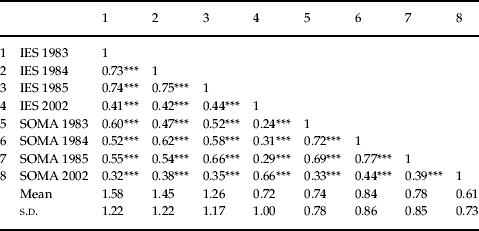
Table 1 presents the means and standard deviations of the study variables, and the inter-correlations between them. This table shows that participants' stress reactions and somatization symptoms levels were significantly linked across time.
Means, standard deviation, Pearson correlation coefficients, and their level of significance for examining the association between the main study measures

IES, Impact of Event Scale; SOMA, somatization symptoms; s.d., standard deviation.
*** p<0.001.
Trajectories of post-traumatic stress reactions
We examined (a) the shape of the developmental trajectory of post-traumatic stress reactions that best fit the data; (b) whether CSR and control veterans differ in their stress reaction trajectory; and (c) whether age and number of negative life events in childhood predict this developmental trajectory.
To examine the growth in stress reactions, we estimated an unconditional LGM for the repeated measures of IES. Two latent factors were estimated: one to define the intercept of the developmental trajectory of post-traumatic stress reactions (with all factor loadings fixed to 1.0), and one to define the shape of the trajectory. A mean was estimated for the intercept and shape factors, and these values represented the mean model-implied developmental trajectory pooled over all individuals. We also estimated the covariance between the two factors, which represented the covariation between the initial level and the rate of change.
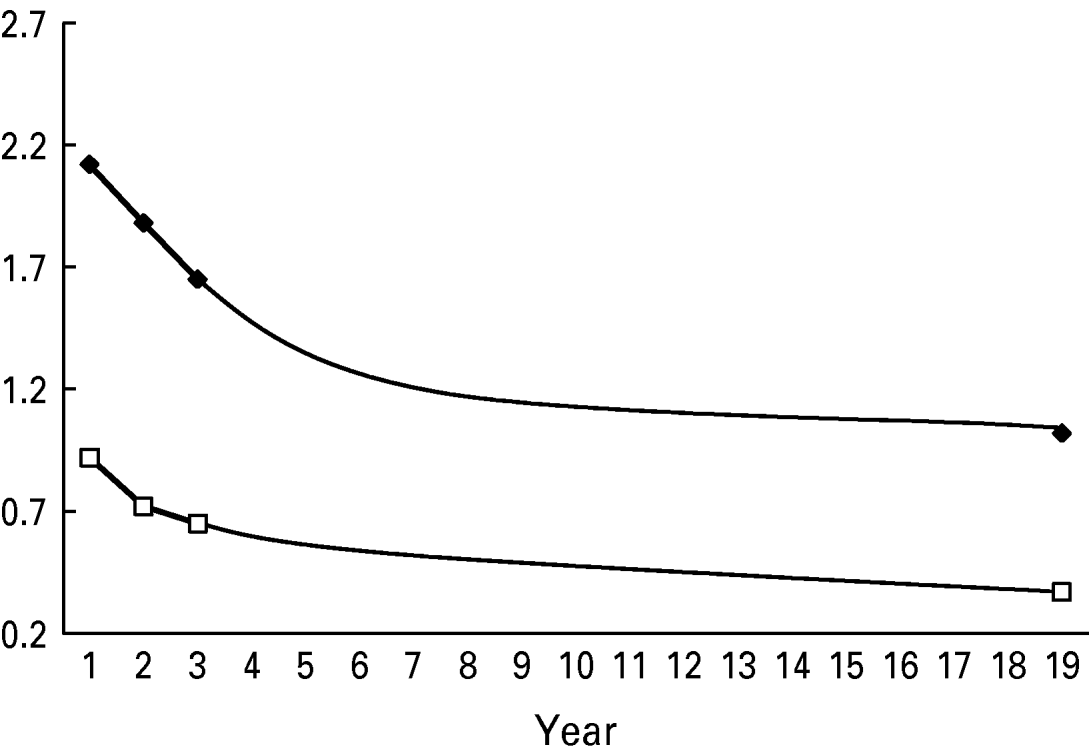
The unconditional LGM was estimated for the CSR group and found to fit the observed data well [χ2 (5)=14.45, p=0.01, CFI=0.99, 1 – RMSEA=0.94]. The model revealed a significant intercept of 2.12, indicating the mean level of IES at the first time period (t=35.02, p<0.001) and a significantly nonlinear decrease over time (mean=−1.12, t=−16.63, p<0.001; see Fig. 1). Thus, the model-implied mean rate of post-traumatic stress reactions decreased significantly from 2.12 to 1.02 over the study period. However, this decrease is decelerating as time progressed: from 1983 to 1984 the mean decrease was 20.5% of the overall decline; from 1984 to 1985 the mean decrease was 17.4%, establishing a total decrease of 37.9%. The remaining 62.1% decline took place from 1985 until 2002.
The group-averaged trajectory of change for Impact of Event Scale score in combat stress reaction veterans (–◆–) and controls (–□–).

The unconditional LGM estimated for the control group found an excellent fit to the observed data [χ2 (5)=10.13, p=0.07, CFI=1, 1 – RMSEA=1]. The model revealed a significant intercept of 0.92, indicating the mean level of stress reactions at the first time period (t=17.94, p<0.001), and a significantly non-linear decrease over time (mean=−0.58, t=−10.03, p<0.001; see Fig. 1). Thus, the model-implied mean rate of stress reactions decreased significantly from 0.92 to 0.37 over the period of the study. However, this decrease was also decelerating as time progressed: from 1983 to 1984 the mean decrease was 35.6% of the overall decline; from 1984 to 1985 the mean decrease was 6.6%, establishing a total decrease of 42.2%. The remaining 57.8% decline took place from 1985 until 2002.
Finally, the negative correlation between the intercept and shape factors (r=−0.74, t=−5.83, p<0.001 and r=−0.9, t=−7.63, p<0.001, for the CSR and control groups respectively) indicated that higher initial values of post-traumatic stress reactions were associated with dampened decreases over time.
Following the separate unconditional LGM for the CSR and control groups, we conducted multiple group unconditional LGM analysis to examine whether the developmental trajectories were the same for both groups. The results indicated significant differences between the default model and the intercept factor constrained model (Δχ2=546.55, df=1, p<0.001), and the shape factor constrained model (Δχ2=28.27, df=1, p<0.001). CSR veterans were characterized by significantly higher levels of post-traumatic stress reactions at the first assessment, and with dampened decline over time as compared to the control veterans.
Finally, conditional LGMs were conducted for each group separately, to test whether the magnitude of intercepts and shapes underlying post-traumatic stress reactions varied as a function of age and number of negative life events in childhood. The resulting models provided a good fit to the data for both groups [χ2
(7)=20.08, p<0.01, CFI=0.98, 1 – RMSEA=0.94 for CSR veterans, and χ2
(7)=22.84, p<0.01, CFI=0.97, 1 – RMSEA=0.91 for the controls]. Age and number of negative life events in childhood did not significantly predict either the intercept or the shape of CSR veterans' post-traumatic stress reactions trajectory  values <0.13, t values <0.9, p=n.s.). However, age significantly predicted the intercept of control veterans' post-traumatic stress reaction trajectory (=0.01, t=2.13, p<0.05). In other words, age was associated with a higher initial level of post-traumatic stress reaction in the control group. All other effects were not significant.
Trajectories of somatization symptoms
We examined (a) the shape of the developmental trajectory of somatization symptoms that best fit the data; (b) whether somatization symptoms take a different course over time in the CSR than in the control group; and (c) whether age and number of negative life events in childhood predict this developmental trajectory in each group.
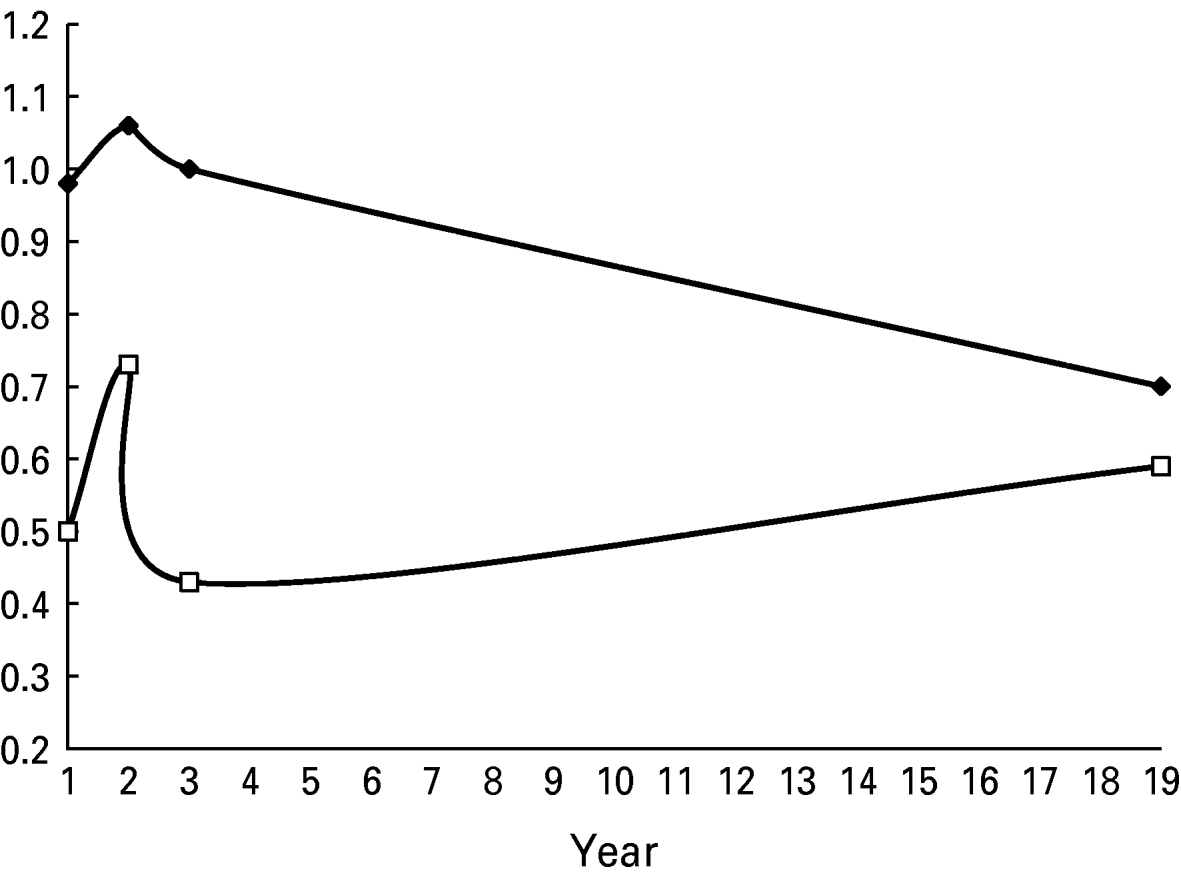
The unconditional LGM for the CSR group was found to fit the observed data well [χ2 (5)=16.79, p<0.01, CFI=0.99, 1 – RMSEA=0.94]. The model revealed a significant intercept of 0.97, indicating the mean level of somatization symptoms at the first assessment (t=27.12, p<0.001), and a significantly non-linear decrease over time (mean=−0.23, t=−5.46, p<0.001; see Fig. 2). Thus, the model-implied mean rate of somatization symptoms decreased significantly from 0.97 to 0.70 over the period of study. However, the pattern of change was not constant. From 1983 to 1984 the mean level of somatization symptoms increased from 0.97 to 1.07. The annual change that followed in 1985 was a mean decrease from 1.07 to 1.00. From 1985 until 2002 the mean level of somatization symptoms showed a moderate decrease from 1.00 to 0.70. Of note, the mean level of CSR veterans' somatization symptoms was above the threshold of 0.73 across most of the 20-year period.
The group-averaged trajectory of change for somatization symptoms in combat stress reaction veterans (–◆–) and controls (–□–).

The unconditional LGM estimated for the control group found a marginally adequate fit to the observed data [χ2 (5)=77.52, p<0.01, CFI=0.94, 1 – RMSEA=0.89]. The model revealed a significant intercept of 0.50, indicating the mean level of somatization at the first assessment (t=14.16, p<0.001) and a non-significantly shape factor (mean=0.06, t=1.68, p=n.s.; see Fig. 2). From 1983 to 1984 the mean level of somatization symptoms increased from 0.50 to 0.73. The annual change that followed in 1985 was a mean decrease from 0.73 to 0.43. From 1985 until 2002 the mean level of somatization symptoms showed an increase from 0.43 to 0.59. Thus, the analyses revealed that, overall, there was a significant increase from 1983 to 2002 in the mean level of the control group's somatization symptoms (t=2.06, p<0.05). However, because we had only four waves of data, we could not estimate the pattern of change to account for its complex pattern of development. Of importance, the mean level of the control group's somatization symptoms was below the threshold (i.e. 0.73) across most of the 20-year period.
Finally, because of our inability to estimate the shape of the developmental trajectory for the control group's somatization symptoms, we calculated a correlation between the intercept and shape factors only for CSR veterans. The negative correlation between the intercept and shape factors (r=−0.94, t=−5.83, p<0.001) indicated that higher initial values were associated with dampened decrease over time.
Following the separate unconditional LGM for the CSR and control groups, we conducted multiple group unconditional LGM analysis to examine whether the developmental trajectories were the same for the CSR and control groups. The results indicate a significant difference between the default model and the intercept factor constrained model (Δχ2=16.35, df=1, p<0.01). In other words, the findings indicated that the mean level of somatization symptoms in the first assessment differed in the CSR and the control groups. CSR veterans were characterized by a significantly higher mean level of somatization symptoms in 1983, compared to the control group.
Finally, conditional LGMs conducted for each group separately tested whether the magnitude of intercepts and shapes underlying somatization symptoms varied as a function of age and number of negative life events in childhood. The resulting models provided a good fit for the data [χ2
(7)=17.75, p=0.01, CFI=0.99, 1 – RMSEA=0.96 for CSR veterans, and χ2
(7)=77.85, p<0.01, CFI=0.94, 1 – RMSEA=0.89 for controls). Age and number of negative life events in childhood did not significantly predict the intercept or shape of the two groups' somatization symptoms developmental trajectory ( values <0.07, t values <1.28, p=n.s.).
ARCL modeling
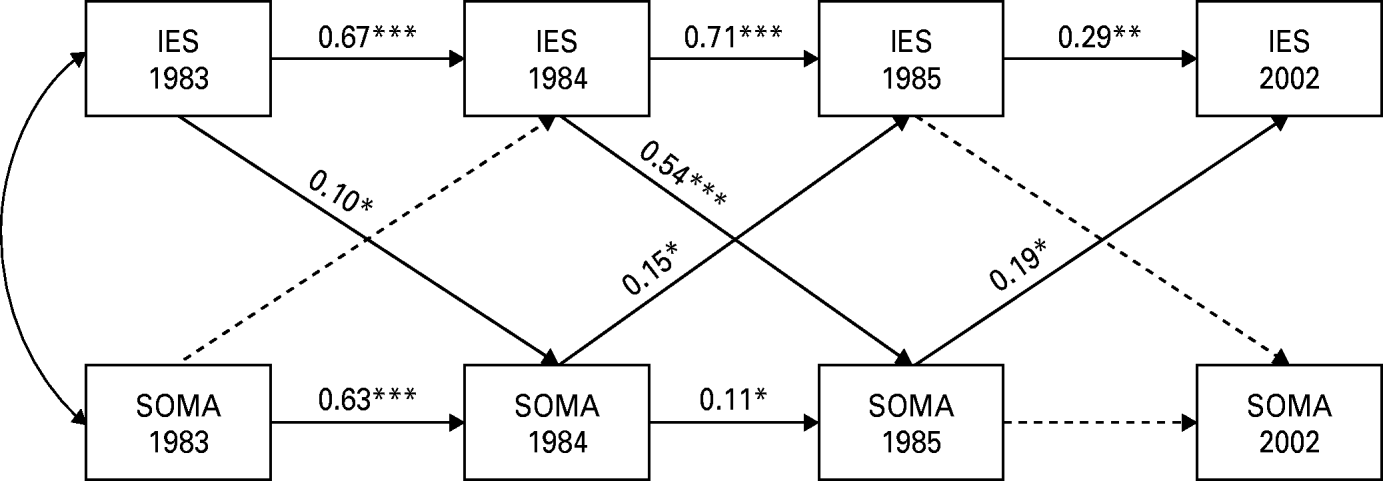
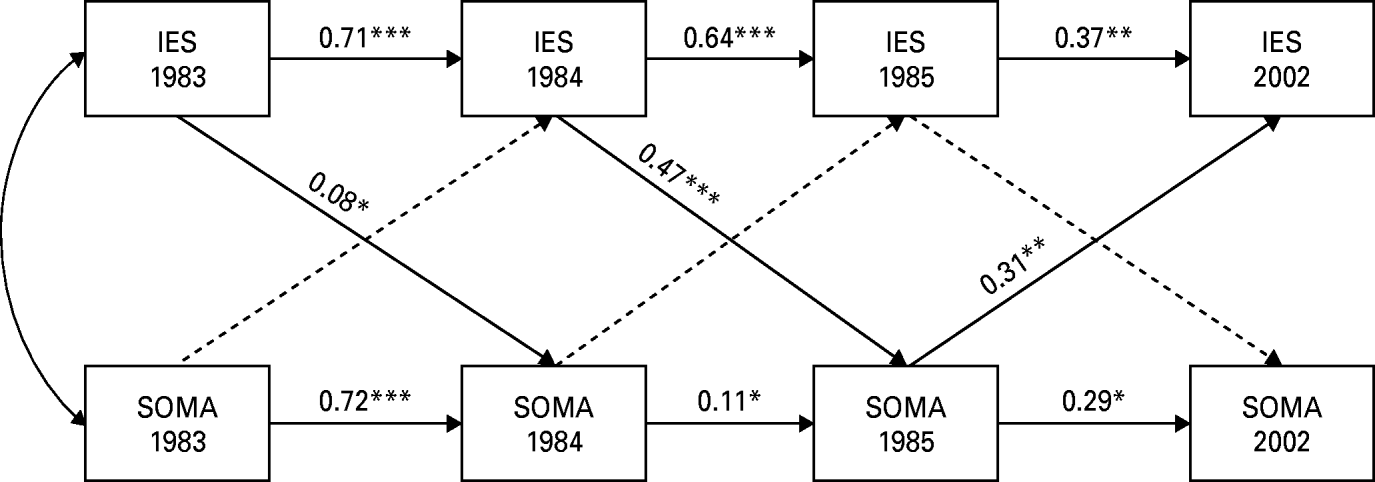
In this section, we examined the bidirectional relationships between somatization symptoms and post-traumatic stress reactions across time. Given that the CSR and control groups' developmental trajectories were significantly different, we ran separate ARCL models for each group separately. Figure 3 presents the bidirectional relationships between CSR veterans' somatization symptoms and post-traumatic stress reactions across time. The diagonal lines represent the cross-lagged association between somatization and post-traumatic stress reactions, and vice versa. The horizontal lines represent the association between each variable and its subsequent assessment.
Autoregressive cross-lagged (ARCL) model assessing bidirectional relationships between combat stress reaction (CSR) veterans' somatization symptoms (SOMA) and Impact of Event Scale (IES) score across time. Curved lines represent covariates between constructs. Dashed lines represent non-significant predictions. Solid lines represent significant predictions. * p<0.05, ** p<0.01, *** p<0.001.

The model fits the data fairly well [χ2 (12)=42.84, p<0.01, CFI=0.98, 1 – RMSEA=0.94]. The analyses reveal that the stability of post-traumatic stress reactions was notably high: CSR veterans with high levels of post-traumatic stress reactions in 1983 tended to have high levels of stress reactions in 1984, 1985 and 2002. By contrast, the stability of the somatization among this group was moderate: veterans high in somatization symptoms in 1983 tended to be high in somatization symptoms in 1984, and 1985, but not in 2002.
Figure 4 presents the bidirectional relationships between somatization symptoms and stress reactions among the control group. Again, the diagonal lines represent the cross-lagged association between somatization and post-traumatic stress reactions, and vice versa, and the horizontal lines represent the association between each variable and its subsequent assessment.
Autoregressive cross-lagged (ARCL) model assessing bidirectional relationships between control veterans' somatization symptoms (SOMA) and Impact of Event Scale (IES) score across time. Curved lines represent covariates between constructs. Dashed lines represent non-significant predictions. Solid lines represent significant predictions. * p<0.05, ** p<0.01, *** p<0.001.

The model fits the data adequately [χ2 (12)=84.20, p<0.01, CFI=0.93, 1 – RMSEA=0.90]. The analyses revealed that the stability of stress reactions was notably high: control veterans with high levels of stress reactions in 1983 tended to endorse high levels of stress reactions in 1984, 1985 and 2002. Likewise, the stability of somatization symptoms was evident: control veterans with high levels of somatization in 1983 tended to endorse high levels of somatization in the subsequent assessments (1984, 1985 and 2002).
More importantly, the analyses revealed that, in both groups, the initial level of stress reactions in 1983 predicted somatization symptoms in 1984, above and beyond the stability of the somatization symptoms, but not vice versa. However, with time, the somatization symptoms predicted post-traumatic stress reactions, above and beyond the post-traumatic stress reactions stability, but not vice versa: the higher the veterans' level of somatization symptoms in 1985, the higher their post-traumatic stress reactions in the subsequent wave of measurements in 2002.
Discussion
The current study revealed that, at all four waves of the study, over a 20-year period, veterans from the CSR group were characterized by a significantly higher mean level of stress reactions. In a similar vein, CSR veterans reported higher somatization levels than the control veterans (both higher initial levels and above clinical average). These findings indicate that CSR is by no means a transient episode that subsides rapidly after combat, but is instead a marker for vulnerability many years after the war (e.g. Solomon, Reference Solomon1993; Nash, Reference Nash, Figley and Nash2007). The detrimental effects of CSR are not limited to recognized post-traumatic symptoms but also give rise to somatic symptoms (Boudewyns et al. Reference Boudewyns, Albrecht, Talbert and Hyer1991; Jones et al. Reference Jones, Hodgins-Vermaas, McCartney, Everitt, Beech, Poynter, Palmer, Hyams and Wessely2002).
Most importantly, our findings highlight the link between stress reactions and somatization, at all points of time, and are in line with other studies that support this association (e.g. Tagay et al. Reference Tagay, Herpertz, Langkafel and Senf2004; Olden, Reference Olden2006). These findings imply that post-traumatic distress may change and be expressed through both emotional and somatic channels, suggesting that researchers and clinicians should not settle for the tunnel vision approach, limiting post-traumatic sequelae to PTSD.
The uniqueness of the current study lies in its longitudinal follow-up, which depicts both the individual trajectories of post-traumatic stress reactions and somatization and their interplay many years after the initial trauma. The results demonstrate a more substantial decline in intrusion and avoidance symptoms among the CSR veterans over time, compared to the controls. Nevertheless, our findings also point to the persistent nature of post-traumatic symptoms. It seems that the two perspectives that Figley (Reference Figley1978) suggested, ‘stress evaporation’ and ‘residual stress’, are not mutually exclusive. The stress evaporation perspective, which posits that the initial intense readjustment period to traumatic stress is followed by a gradual return to a pre-morbid level of psychological well-being, for which there is some empirical support (Tennant et al. Reference Tennant, Fairley, Dent, Sulway and Broe1997; Koenen et al. Reference Koenen, Stellman, Stellman and Sommer2003), is somewhat supported by our findings. At the same time, however, the imprint of CSR, which is persistently and clearly evident, lends support to the residual stress perspective that posits that the psychological damage of trauma cannot be completely erased.
The trend of fluctuation in somatization may reflect the interactive effect of the external situation and personal factors on the shape of the developmental trajectory of somatization symptoms. The First Lebanon War took place between 1982 and 1984. During those years the somatization symptoms levels of both CSR and control groups increased over time. The pattern of decrease evident from 1985 may reflect the same stress evaporation trend that was observed in the post-traumatic stress reaction assessment. The trend of increase in somatization symptoms observed in the control group may reflect the implications of the aging process.
More important is the interplay of the developmental trajectories of post-traumatic stress reactions and somatization over 20 years. In both study groups post-traumatic stress reactions 1 and 2 years after the war predicted somatization 2 and 3 years after the war, but as time passed, somatization predicted post-traumatic stress reactions but not vice versa. The finding that post-traumatic stress reactions predicted somatization in the first years after the war is not new, and is consistent with the notion that psychological distress increases vulnerability to somatic problems. Moreover, these findings are in line with those reported by Andreski et al. (Reference Andreski, Chilcoat and Breslau1998), who followed up a group of young adults (ages 21–30) for 5 years, and found a link between history of PTSD and subsequent onset of somatization.
Our findings demonstrate that the relationship between stress reactions and somatization is complex, as somatization becomes a predictor of post-traumatic stress reactions later in participants' life. This change in interplay between these factors may be attributed either to the passage of time or to the aging process. One suggestion is that somatization may first emerge as secondary to the stress reactions, but as years go by and somatization becomes chronic, it begins to stand on its own and thus becomes a stressor in and of itself and may, in turn, elevate psychological stress reactions. Another possible explanation is that, during their aging process, veterans may become more aware of and focus on bodily symptoms that may hinder their functioning. The bodily symptoms may direct veterans to ruminations of their post-traumatic experiences and their roots in combat stresses. This explanation is in line with van der Kolk's (Reference van der Kolk1994) contention that somatic or symbolic memories related to the original trauma are elicited by heightened arousal. This suggestion receives support from a study of cancer patients, demonstrating that patients who were Holocaust survivors manifested higher levels of distress than either cancer patients without a Holocaust background or Holocaust survivors without cancer (Peretz et al. Reference Peretz, Baider, Ever-Hadani and De-Nour1994). The complex relationships between stress reactions and somatization symptoms may be further complicated by veterans' attribution, as individuals who attribute their somatic symptoms to psychological causes endorse higher levels of anxiety than those who attribute these symptoms to somatic causes (e.g. Duddu et al. Reference Duddu, Isaac and Chaturvedi2006).
The findings of this study should be considered in the light of its limitations. First, the use of self-report measures, although very common in trauma studies, may be limited. Future studies may consider using more objective measures of physical symptoms and clinical interviews for psychiatric diagnoses. A second limitation is that a 20-year trajectory was assessed at four waves of time, and the fact that our measurements did not cover the entire 20-year span since the war. Specifically, we did not monitor changes in the course of post-traumatic stress reactions and somatization symptoms between 1985 and 2002. A third limitation is the lack of pre-combat assessment of somatization. However, as all combatants underwent physical and psychological screening during recruitment (pre-combat), there is a small likelihood for significant pre-combat vulnerability.
Despite its limitations, this study yielded several important findings. First, it distinguished between clinical and non-clinical populations. Our findings suggest that the detrimental effects of psychological breakdown on the battlefield are deep, enduring, and may spread into the physical spectrum, even many years after the war. They also shed light on the dynamic interplay of emotional and somatic aspects of traumatization. These findings imply that stress reactions should be viewed from a multi-systemic perspective that incorporates both psychological and physical aspects of distress. An important clinical implication of this conclusion is that the treatment of war veterans with CSR should address these somatic disorders in addition to the clinical features of post-traumatic intrusion and avoidance symptoms.
Declaration of Interest
None.