Introduction
The economic growth of modern Japan generated distribution problems, related to labor, wage, and the environment. For example, Nakamura described that labor, including farming, faced circumstances involving an impoverished life and poor working conditions.Footnote 1 However, even in Nakamura's study the problem of disability generated by industrialization was hardly mentioned. Moreover, World War II (WWII) brought about the sacrifice of not only soldiers but also civilians, with many railway workers dying or becoming disabled due to industrial accidents or air raids.
Although it is said that disabilities are mirrors that reflect society,Footnote 2 the historical study of industrial disability has not progressed. There are some studies on the topic, such as Yoshino Reference Yoshino, Imura and Fujiwara2007 and Yamada Reference Yamada2013,Footnote 3 however, they do not indicate the stage of the field of historical studies of Japanese industrial disability. Therefore, individual cases should be studied.
When particularly examining industrial disability, company compensation reflects the disability welfare. The Factory Law Kōjō Hō 工場法, enforced in 1916, had a limitation in industrial disability compensation, and disabled welfare provided by companies had not progressed before the end of WWII.Footnote 4 However, the life pension system given to retired soldiers and public officers started in the late 1870s, and the disabled welfare developed in the military and government sectors before the war.
The disabled welfare of the Japanese National Railways (JNR), Nihon Kokuyū Testudō 日本国有鉄道, which employed many workers in government enterprises, therefore warrants examination as a large non-military government enterprise, which set a standard for other enterprises.
The reason for focusing on the Japanese railroad industry is that not only the pioneering disabled welfare progressed, but because its welfare system of the disabled was unique. JNR workers and their families were guaranteed assistance by the Mutual Aid Association, Testudō Kōsaikai 鉄道弘済会, an organization of the JNR established in 1931. Its idea was that disabled people should have a job and live independently, rather than only receiving pecuniary compensation. To cover welfare costs, such as providing workshops for disabled people, Kōsaikai conducted profit-making businesses. This linkage between profit and welfare was rare from both the national and global perspective.
This study searches for the possibility of regarding Kōsaikai's characteristic welfare as a “social enterprise.” According to Tanimoto, a social enterprise has the following characteristics: a social mission (to cope with a social issue), social business (to transform the social mission into a business endeavor), and social innovation (to create new values through social business).Footnote 5 The primary factor for social business is the relationship between a social mission and business. For example, Akio Ogura 小倉昌男, the founder of Yamato Transport Co. Ltd, stated that reform is needed in disabled people's workshops to increase profitability, allowing disabled workers to earn enough to be able to live independently.Footnote 6 In contemporary Japan, the management of welfare costs has become an important task. Thus, the way income is earned by profitable businesses operating as social enterprises applied to welfare costs is attracting an increasing attention. However, few contemporary studies have explored the historical development of this system. The historical case of Kōsaikai can provide many suggestions for the Japanese welfare system.
Based on these trends of study, this paper examines the industrial disability of JNR and Kōsaikai.
The welfare of Japanese National Railways before World War II
The Mutual Aid Association (MAA), Nihon Kokuyū Testudō Kyōsai Kumiai 日本国有鉄道共済組合 of the JNR, which enforced compulsory insurance on members, was established in 1907.Footnote 7 The fund comprised of 3,000 wages of members, combined with two thousands of each member's wage provided by the Japanese government. However, the MAA faced a financial crisis, caused by the expense of healthcare benefits for injured members, which was larger than expected. Faced with this situation, the government helped the MAA and covered all healthcare benefit expenses for injuries resulting from industrial accidents, beginning in 1914. Therefore, MAA could afford to establish a new benefits program for self-injury and illness.
Although the World War I contributed to an extraordinary prosperity in Japan, real wages became low, as it could not catch up with the increase in prices. Against this situation, movements demanding the improvement of workers' living occurred, such as the Rice Riot in 1918. Some bureaucrats and intellectuals became interested in the labor situation. Within this social trend, MAA established a pension system in 1920.Footnote 8 The pensions were paid to members as employment injury benefits (occupational disability and injury benefits resulting from industrial accidents) – kōshō kyūfu 公傷給付; disablement benefits (non-occupational disability and injury benefits) – haisitsu kyūfu 廃失給付; disease benefits (including medical expense, compensation for absence from work, and parturition expenses) – sippei kyūfu 疾病給付; retirement benefits – taishoku kyūfu 退職給付; and benefits for surviving family members – izoku kyūfu 遺族給付. The employment injury and disability benefits corresponded to the pensions for disabled people: the payment of pensions was both first grade (people who could not live independently) and second grade (people who could not hold jobs in their lifetime). However, only a single sum was paid for the third grade (people who left the JNR due to injury or disease) and the fourth grade (people who could work in the JNR after having injury or disease). The pension amounted to an equivalent of 7–9 months of annual income for the first grade, and 3–5 months for the second grade. Similarly, the first grade of the disease benefits was equivalent to 5–6 months from the annual income and the second grade was of 3–4 months.
On the contrary, people who worked for the MAA for 20 years and were over 40 years old were annually paid their 4 months' salary and for 15 years were paid 3 months' worth of salary every year, only for 15 years, as the retirement benefit. Benefits for surviving family members, such as their spouses, ensured that they received at least a 3 months' salary of the deceased every year, as pension.
The pension system based on compulsory insurance was mainly introduced in public affairs, which was trailblazing in the Japanese society. In Japan, although social security was developed by the establishment of the Factory Law (1910) and the Health Insurance Act (1922), most private companies had not built pension systems and introduced only a one-time payment for injury, disease, and death.Footnote 9
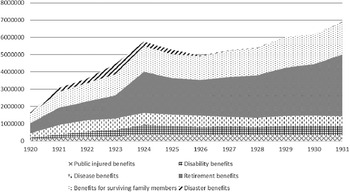
With the introduction of the pension system, the premium increased twofold and the government subsidy increased two and a half times.Footnote 10 However, Figures 1 and 2 show MAA sustaining losses in 1922–1931, due to the large sum of retirement benefits and benefits for surviving family members. In addition, the management of MAA was stressed by a downdrift in yields on valuable papers.Footnote 11 Therefore, the MAA decided that the payment of retirement benefits would be pushed back from 15 to 20 years after hiring. Moreover, the premium increased by 17,000 wages in 1933, improving the revenue of the MAA.
Profit and loss account of the MAA (1,000 yen). Source: Japanese National Railways 1958, Appendixes 18–31.

Benefits in MAA (yen). Source: Japanese National Railways 1958, pp. 10–13, 20–21.

The actual condition of MAA's disability benefits
During 1920–1935, the total number of pensioners receiving employment injury benefits was 200 for the first grade and 1,420 for the second grade, while that of disablement benefits was 2,484 people in the first grade, 1,673 in the second grade.
The meaning of employment injury and disablement benefits should be noted. Employment injury refers to the disability that results from injury under railroad work, while disablement refers to the disability that was mainly caused by the disease, regardless of working hours. In 1920–1935, in particular, tuberculosis accounted for 57.7 percent of the entire amount of disablement benefits, followed by 7.5 percent in cerebral hemorrhage, 2.8 percent in hepatitis, and 2.3 percent in stomach cancer, in this order. The amount of disablement benefits caused by injuries, such as leg amputations (0.8 percent), was small.
The approval of these benefits was given by the doctor and was generally accepted unless the injury was a willful act or resulted from gross negligence. If a person was certified for employment injury benefits from the first to third grades, and disablement benefits from first to second grades, he had to retire from the JNR. For example, a man, Mr. I, suffered an electric shock cataract after his head was touched by an overhead transmission line during the installation of an electric pole in 1923.Footnote 12 After 2 years of treatment, he retired from the JNR as a first-grade pensioner of the employment injury benefits. As another example, a piece of broken glass got into Mr. Y's left eye when he replaced an electric lamp and dropped it. After the accident, his eyesight became 0.03 and suffered from a narrowing of the visual field in 1926. He retired from the JNR as a third-grade pensioner of employment injury benefits, as the doctor decided that he could not return to his post. On the contrary, Mr. Y had a disability due to brain contusion and was accepted to receiving employment injury benefits in 1924. He felt it necessary to remove the snow on his way home from work. When he went back to the office to report on this, he slipped on frazil and was hit by a train. Although the accident occurred after business hours, his benefits were approved by his employer, who certified his fidelity and difficulties in his economic situation.
However, there were cases in which benefits were not approved. Mr. K, whose left foot was amputated, did not receive benefits in 1924.Footnote 13 The reason was his negligence: although he commuted on foot, being late for work due to a headache, he tried to get on a train and had an accident. Similarly, Mr. K, whose leg was amputated mid-thigh, could not be granted benefits in 1925.Footnote 14 When he was crossing a line, his left leg was damaged in a locomotive collusion. The reason of disapproval was that his accident was attributed to anamnesis: he felt sick that day and had been absent due to his asthma. He died 4 months after the accident, as his sickness took a turn for the worse. Him being refused means that his family could not obtain the benefits for surviving family members. His wife and five children received only a special bonus of 950 yen.
As mentioned above, most disablement benefits were given for pulmonary tuberculosis, and only the grade of disability was decided; as a rule, all diseases placed the worker off the job. For example, Mr. M was considered a first-grade disability, not being able to work at JNR.Footnote 15 However, some cases were rejected. Mr. F, a train coupler, lost three of his left toes during work in 1925. The accident caused him a terrible mental state, suffering from depression, headaches, and insomnia. Although the JNR office lost contact with him, suddenly he came to work and hoped to be reinstated in his former position. The stationmaster advised him to retire, only to find out afterward about his death due to pulmonary tuberculosis. In this case, the loss of toes was approved as employment injury benefits; however, his pulmonary tuberculosis was not accepted.
The birth of Testudō Kōsaikai
These retirements or deaths generated people who were not able to maintain their livelihood. As already seen, even the second grade of employment injury benefits amounted to only 5–6 months from the annual income. Moreover, it is predicted that people who were rejected from receiving benefits and their family members had financial difficulties in living.
Testudō Kōsaikai 鉄道弘済会 was established in 1931 with the aim of workshop job training, jusamba 授産場, in which people with disabilities worked and learned skills. As such, its goal was to support people with disabilities who had retired because of an industrial injury, those who had reached retirement age, and their families.Footnote 16 After the establishment of JNR, there were a few organizations and workshops that were managed by the disabled themselves, who had previously worked for JNR. However, the establishment of Kōsaikai was planned by government officials from the Railway Ministry, such as Utarō Kataoka 片岡謌郎 and Kamazō Horiki 堀木鎌三.
Kataoka criticized the fact that retired people often became poor, and he thought that welfare awareness should be enhanced in the Railway Ministry. In 1922, Kataoka was promoted to business manager of the transportation office of the Tokyo Railway Bureau, Tōkyō, Tetsudō Kyoku 東京鉄道局. He conceived the idea that disabled and retired people could work in station stalls, ekibaiten 駅売店, to improve their lives. This idea was related to the fact that the Professional Union for the Public Injured of National Railways, Kokutetsu Kōshōsya Shokugyō Kumiai 国鉄公傷者職業組合, established in 1925, managed mobile sales in stations.Footnote 17 However, this plan was difficult to implement due to claims from the station stall managers and pressures from an influential person. In 1929, Kataoka became the subsection head of passenger transportation in the Transportation Division of the Tokyo Railway Bureau, Tōkyō Tetsudōkyoku Unyuka Ryokyaku Kachō 東京鉄道局運輸課旅客掛長, which had the power to govern station stalls. He decided to entrust the management of 161 station stalls to disabled people, retired people, and their families. He placed a blanket refusal on renewal of the licenses of original shop managers, who effectively needed to close shop. Sometimes, this created outrage, with Kataoka known to have negotiated directly with the Yakuza ヤクザ.Footnote 18
Initially, Kataoka planned to institutionalize this welfare service only within the Tokyo Railway Bureau. However, the Minister of Railways joined the plan as part of the commemorative events celebrating the Showa Emperor's ascent to the throne. Thus, Testudō Kōsaikai was established in 1931 as a domestic organization. At Ueno station 上野駅, the stall managers resisted vacating their shops; however, Horiki stopped their resistance. Horiki and Kataoka were close friends; Horiki took over Kataoka's post as subsection head and maintained similar welfare policies to Kataoka's. Horiki was twice appointed as the second subsection head for passenger transportation on Kataoka's recommendation.
Thus, disabled and retired people institutionally worked in station stalls. The number of such station stalls increased from twenty-five shops in 1932 to 306 in 1942. On the contrary, the profits of all station stalls grew from 903 yen in 1932 to 31,734 yen in 1942.Footnote 19 Most employees were inexperienced in this type of business; therefore, wives and children learned business skills at Matsuzakaya Store 松坂屋, in advance.Footnote 20
Through profits from the station stalls, Kōsaikai began to organize another workshop.Footnote 21 The Tokyo branch of Kōsaikai established a workshop to repair sheet-rope for railroad vehicles in 1933. This compensated for a loss in station stall profits, as the business generated losses of 2,000 yen. The workshop generated losses of 2,000 yen. This loss was compensated by the station stall profits. Moreover, the Tokyo branch established a printing workshop and a footwear workshop however, both facilities a budget deficit in the first year. Therefore, the deficit was compensated by the profits of station stalls grew from 1932 to 1943.
Other branches also established workshops.Footnote 22 In 1936, the Nagoya branch established a workshop to make clothes with a sewing machine, and some families of those killed in industrial accidents in JNR worked for this workshop. This facility netted 5,000 yen in the first year. The Hiroshima branch established a facility selling daily necessities in 1936, the Osaka branch established the Ikeda workshop for dressmaking in 1938, and the Fukuoka branch established a ceramics workshop in 1939. On the contrary, there were people who could not work at these facilities due to their degree of disability.Footnote 23 Kōsaikai provided these people with skills training in shoe manufacturing and dressmaking at Keiseisya, which was the only national vocational training facility in Japan.
In this way, Kōsaikai had paved the way for the welfare of people with disability. In particular, the 1930s was a period expanding Kōsaikai's activities, however, the WWII impacted it.
JNR and Kōsaikai in the World War II
Most directly, the WWII resulted in many disabled people and deaths.Footnote 24 Within JNR, many lives were lost in accidents due to the desperate defense of their workshop and the full-capacity operation of trains despite air raids. There were 1,250 deaths (904 due to bombs, 165 due to gunfire, 177 due to incendiary bombs, and 4 due to naval gunfire) and 3,000 people injured (2,479 due to bombs, 398 due to gunfire, and 262 due to incendiary bombs).
As shown in Table 1, the number of MAA pensioners increased between 1937 and 1945. The increase in retired pensioners was due to members moving to occupied territory as part of a special military unit and transportation company. In addition, when they died in battle in the occupied territory, their family received benefits for surviving family members.
Number of pensioners in MAA (people)

Source: Japanese National Railways 1958, pp. 287, 357–358.
The war also impacted Kōsaikai business indirectly. Throughout the war period, the government unitarily controlled the distribution of goods. This restricted Kōsaikai activities, which managed welfare facilities through profit making businesses, such as sales in station stalls. However, they planned to intensify the vocational re-education, advise on business, educational support for children, money loans, and life support services.Footnote 25 In particular, Kōsaikai shifted from the securing employment project to offering loans or providing money to the retired, disabled, and needy people: Kōsaikai introduced new benefit structures, a maximum of 20 yen a month for 5 years, in case of financial difficulty, 500 yen to be lent without interest when for started a business, and 10 and 50 yen loans for junior high and school students, respectively.
In the late 1930s, workshops were established one after another. In 1939, by enacting the Rule of Vocational Re-education and Guidance, Shokugyō Saikyōiku oyobi Hodō Kitei 職業再教育及補導規定, Kōsaikai introduced a project enabling a person with disability retired from JNR to receive vocational education in a workshop or factory for 3 years. As a result, Ikeda Workshop 池田授産所, which instructed dressmaking and Japanese traditional bamboo ware making, as well as Osaka Wastepaper Factory 大阪廃紙工場, which crushed old paper for recycling, were established in 1938. The cleaning factories, established in Sapporo 札幌 and Nagoya 名古屋 in 1938, prioritized the employment of surviving families of JNR employees. These factories secured demands, such as uniforms, covers, and curtains, for JNR. In addition, the Sasaguri Ceramic Factory 篠栗窯業工場 was established in Fukuoka in 1939. From 1937, disabled people who were able to work at a workshop according to the grade of disability could receive vocational education, such as shoe making or dressmaking, at Keiseisya 啓成社, the only vocational training school in Japan.Footnote 26
However, the business of Kōsaikai was made extremely difficult by the distribution control policy.Footnote 27 From 1941, Kōsaikai could not sell much food, as they were under ration. The sales of cigarettes and newspapers were tightly controlled from 1944.Footnote 28 They applied to the Tobacco Monopoly Bureau for special treatment due to their aim of welfare, but it was not approved. Therefore, Horiki planned to transition from station stall sales to business providing goods for JNR workers.Footnote 29 However, it was difficult to stock up daily necessities from 1945, as Japan was defeated before this plan could be carried out.
Moreover, the war brought labor shortage. With a sharp decline in the workforce, the government facilitated the work of women and disabled people.Footnote 30 In particular, the labor shortage became more serious after the beginning of the Pacific War, in 1941. The ratio of women workers at JNR increased from 3.6 percent (1941) to 22.8 percent (1944). The number of workers aged 16–20 years increased from 14 percent (1936) to 42 percent (1942).Footnote 31 The station stall salespeople became only women, since men were enlisted or recruited to work in factories.
The labor shortage was further compensated for by employing the disabled. In fact, in 1939, it was decided to employ wounded soldiers at JNR.Footnote 32 The important change for people with disabilities was that MAA pensioners, who were forced to retire from JNR, returned to work at JNR. Indeed, the MAA rules for disabled people deciding who is able to work were reconsidered. For first-grade pensioners of the employment injury benefits, it was difficult to work due to the disabled situation, such as loss of hearing, eyesight, and upper or lower limb. However, the second grade had the possibility to work due to their physical condition, such as loss of eyesight from one eye, hearing from one ear, one upper limb, or one lower limb.Footnote 33 Disabled people who had retired from JNR (the pensioner of MAA) were able to work at JNR from 1943 if they had the ability to work, wearing an artificial leg or auxiliary tool. Reemployment was judged by the work ability, their desire, family members, and instructors. After reemployment, special benefits were paid, from 1 year to 7 months of the regular annual income as compensation for the suspension of pension payment.
Kōsaikai's profit making business and welfare in the early post war period
After Japan's defeat in WWII, Kōsaikai was investigated as an organization under the Excessive Economic Power Deconcentration Law by the General Headquarters, the Supreme Commander for the Allied Powers (GHQ). Kōsaikai was faced with the prospect of being split up into east and west divisions.Footnote 34 However, this fate could be escaped by transforming from a welfare service for JNR workers and travelers to a welfare provider for all people. Thus, Kōsaikai was permitted to continue conducting exclusive businesses, such as operating station stalls, by GHQ.
In September 1945, Kōsaikai established the postwar business management scheme, Tetsudō Kōsaikai Sengo Jigyōkeiei Yōkō 鉄道弘済会戦後事業経営要綱 to determine postwar welfare policy.Footnote 35 According to this scheme, welfare would need to be strengthened, since the number of people needing relief would be greatly increased. Therefore, Kōsaikai decided to expand welfare to incumbent workers and travelers. Accordingly, Kōsaikai needed to increase its profits.
Based on this scheme, Kōsaikai began “the doubling movement,” called baizō undō 倍増運動, aiming to double its profits from 1945 by July 1946. Kōsaikai aimed to restore buildings collapsed in the war and to strengthen distribution and production.Footnote 36 These large-scale business endeavors were socially demanded in order to provide jobs to the railroad workers repatriated from Japan's occupied areas and to those affected by military personnel reductions.Footnote 37 Kōsaikai restarted trading newspapers in 1946 and increased the number of station stalls. In particular, Kōsaikai opened tearooms and restaurants, starting with Ueno Hirokōji Store 上野広小路ストアー tearoom.Footnote 38
Although “the doubling movement” finished in 1947, Kōsaikai actively diversified its businesses. The diversification seemed to lack forethought regarding management strategy. Rather, it aimed to react to the demands of life in the postwar period. Specifically, Kōsaikai undertook endeavors in many different sectors, such as salt, coal briquettes, ice pops, lumber, chicken, honey, timetable guides, desks, chairs, bricks, and noodles.Footnote 39 Although businesses such as sewing, printing, adverting, publishing, and repairing were maintained in corporate form, other production businesses were abolished due to the increasing competition in the market, accompanied by Japan's economic recovery. In particular, the production and sale of ice pops, which was developed as a joint company between Kōsaikai Food and Fuji Ice in 1947, achieved success. It became a staple good in situations where water-supplying facilities in stations had not been restored. However, the sales of ice pops continued to remain low because of the appearance of competing products as the economy recovered.
In “The Service News,” Gyōmu Nyūsu 業務ニュース published by Kōsaikai, the efforts of each sales department, such as Yokohama train food service department and Okayama's department of stocking and selling of goods, were introduced to members.Footnote 40 After the end of “the doubling movement,” Kōsaikai continued the expansion of sales, inspiring competition among shops. Sales rankings were announced in the Banzuke 番付 style, similarly to wrestlers in the Japanese traditional sport Sumo.Footnote 41 It indicated the existence of competition among stores, as if they were private enterprises. This is also understood from the following remark of Hasimoto, leader of the Kōsaikai's guidance division.Footnote 42
It is an outrageous mistake if you think that passengers will buy goods at the station store. The city is gradually restoring and many nice shops are opening recently. The demand will decline to some degree. We cannot take things easy because those shops make serious efforts. Today is already a period of competition. Don't neglect to pay attention to the variety, quality, service, and choice of goods.
In addition to the station stalls and stores, Kōsaikai developed businesses such as coffee shops, restaurants, department stores, coin lockers, telephone companies, and life insurance agencies.Footnote 43 In particular, the Shimonoseki Department Store 下関デパート in 1950 and the Matsue Kanko Department Store 松江観光デパート in 1953 were established.
Kōsaikai facilitated its welfare expansion through the profits of these businesses. Due to war, Kōsaikai's workshops, apart from Ikeda, were shut down. After the war, the Sendai workshop was established in 1946, and other facilities were opened one after another.Footnote 44 However, artificial limbs tended to be preferentially provided to soldiers. Therefore, Kōsaikai established the Tokyo Gishi Shūrijyo 義肢修理所 (a workshop to repair artificial limbs) in 1944, however, it was not fully functional since it was difficult to obtain the necessary resources as a result of the war.Footnote 45 After the war, Tokyo Gishi Seisakusyo 東京義肢製作所 (a workshop to produce artificial limbs) was established by Kōsaikai, and in 1952 Tokyo Gishi Kenkyūsyo 義肢研究所 (a workshop for research and development of artificial limbs) was established.Footnote 46
In 1953, Kōsaikai launched the management of Hyūga Kōsai Gakuen 日向弘済学園, where woodwork, animal husbandry, and farming skills were taught.Footnote 47 The reason of the establishment was that Shinji Sogō 十河信二, Kōsaikai's chairman, was impressed by the ideal of Ōmigakuen 近江学園, which was established for mentally retarded children based on the Child Welfare Act 児童福祉法, in 1947. Moreover, Sapporo Nansō-en 札幌南藻園, which was a children's educational and care facility, was established, provided with land without compensation from Hokkaido Takushoku Ginkō 北海道拓殖銀行. In addition, Kōsaikai established a nursery and student housing, and introduced a scholarship system for university students with disability.
Ideals and reality
Kōsaikai established the welfare ideals of the prewar period. Horiki pointed out two peculiarities of Kōsaiai from the point of view of “autonomy and independence,” Jishu Jiritsu 自主自立. The first is that Kōsaikai had managed its welfare endeavors through the profits of its own businesses since its inception. The second is that disabled people were provided with the opportunity to work and live independently. He stressed how impressive it was that the people who were seriously injured and disabled could work as hard as the non-disabled. It was seen as an ideal model of independent living and the most beautiful in the world, in which people with disabilities could work and conduct their lives under the same circumstances as the non-disabled and without national aid.Footnote 48
When Kōsaikai was established, there were some negative views: the poor could not save money because of the profit shortfalls of the stand stalls, and it was difficult to make welfare and business compatible.Footnote 49 Kōsaikai's profits increased from 2,107,590,000 yen in 1947 to 20,302,221,000 yen in 1955. However, when converted into rice prices to consider the postwar inflation, profits in 1947 were of 2,760,685 yen and of 2,653,885 in 1955; therefore, the real profits did not change significantly between 1947 and 1955.Footnote 50 On the contrary, the balance between profits and welfare costs in 1950 was in deficit (−46,912 yen), however, it was in surplus in 1951–1953 (32,763 yen, 45,691 yen, and 7,135 yen, respectively).
Kōsaikai's welfare finance system consisted of (1) social welfare revenue, such as the amount of workshop products sold and the entrusted services, (2) social welfare facilities expenditure, and (3) relief loan expenditure. Because the expenditure was almost over the revenue, the funds obtained by profit-making businesses, such as station stalls, were transferred in order to balance both accounts.Footnote 51 For example, from April to June 1949, Kōsaikai's workshops revenues amounted to 615,985 yen, while the expenditure was of 76,612 yen, therefore, it was compensated with 180,198 yen from the profit-making businesses.
Figure 3 shows Kōsaikai's revenue and expenditures. Although they were balanced in the early 1950s, the expenditures were greater than the revenue after the late 1950s. Although the gross sales of Kōsaikai increased by 1980, its profits reached a deficit of 1,423,512 yen in 1975 and continued to decline thereafter.Footnote 52 Figure 3 shows that the slump in business profits constrained Kōsaikai's welfare activities, since no growth was seen in its expenditures after 1975. Therefore, it can be said that Kōsaikai's business continued to expand despite losses following the late 1950s, however, it reached a plateau after 1975.
Revenue and expenditure in Kōsaikai's welfare businesses (yen). Source: Testudō Kōsaikai Reference Testudō Kōsaikai1983, p. 387.

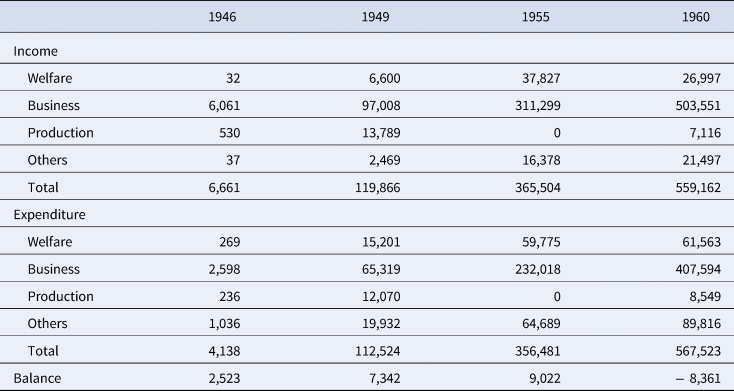
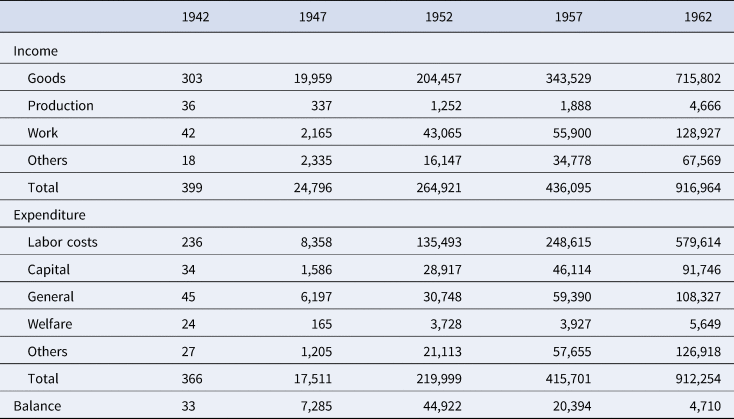
Tables 2 and 3 show the income and expenditure statements of two branches. If this balance is positive, it can be said that the ideal of Kōsaikai was achieved. According to Table 1, the balance of the Chubu branch 中部支部 in central Japan was in surplus in 1946–1955. According to Table 2, although the balance of the Hokkaido branch 北海道支部 was in surplus in 1942–1962, it fell in 1962. Thus, the ideal of Kōsaikai, its welfare endeavors through profits from its own businesses, was maintained until at least the mid-1950s.
Income and expenditure of Chubu blanch (yen)

Source: Chūbu Shibu Reference Chūbu Shibu1962, Appendix 8.
Income and expenditure of Hokkaido blanch (yen)

Source: Hokkaidō Shibu Reference Hokkaidō Shibu1954, Appendix 13.
The employees of Kōsaikai
There were mainly two ways of receiving Kōsaikai's disabled welfare: (1) employment at Kōsaikai as a seller or officer and (2) skill training in workshops. As described above, Kōsaikai institutionally created employment for the disabled. However, they only accounted for a small percentage. The number of employees increased from 129 people in 1932 to 2,987 in 1942. Of them, 6.9 percent were disabled people (including their family members), 37.7 percent were retired (resigned as they reached retirement age), 2.3 percent were family members of retired people, and 53.1 percent were other people.Footnote 53
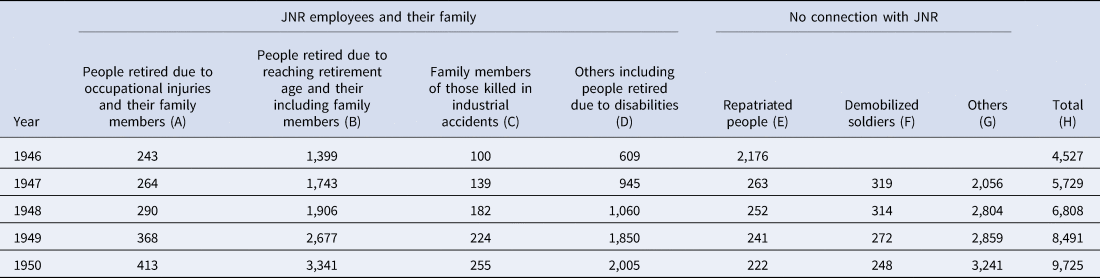
This tendency was maintained after the defeat. Table 4 shows the employees of Kōsaikai in 1946–1950. Disabled people and their families were institutionally employed by Kōsaikai when they received welfare. As shown in Table 4, in 1945, Kōsaikai began employing people with no connection to JNR, such as repatriated people and demobilized soldiers, including railroad employees in Japanese colonies. As shown in this table, the number of Kōsaikai employees increased from 1946 to 1950. This corresponded to the previously mentioned expansion of Kōsaikai's business. Table 4 also indicates that this expansion resulted from an increase in retired people and people with no connection to JNR (representing an average of 62.5 percent of the employees between 1946 and 1950).
Number of employees of Kōsaikai (people)

Source: Testudō Kōsaikai Reference Testudō Kōsaikai1952, Appendix 1.
The important fact is that most of Kōsaikai's employees were not disabled. Although the disabled people with employment injury benefits are included in column A in Table 4 and those with disablement benefits are in column D, the accurate figure is unknown. However, according to another survey, the number of disabled people employed by Kōsaikai was 276 people in 1950,Footnote 54 or only 2.8 percent of all employees. Most of them had lower degrees of disability, one-limb amputees (133 worked in office jobs and 116 in sales jobs). In addition to them, two people had both upper limbs amputated, twenty-three had both lower limbs amputated, and only two people had three limbs amputated.
This occurred because of Kōsaikai's policy of employing the family of the disabled people rather than the disabled people of higher grades themselves. Considering the 276 people included in column A in Table 4, the number of family members is 137 people in 1950. Generally, although 30 percent of the retired disabled people (2,335 people) in JNR were able to support a family only through their income, 60 percent of them were able to live through both their income (pension) and the support of their family due to higher degrees of disability.Footnote 55 Therefore, it can be said that Kōsaikai employed their family members in order to support the higher-grade disabled people, who could not afford living only from the pension.
According to a report, Kōsaikai planned to hire JNR's disabled people as much as possible, since they were young; however, the plan could not progress properly.Footnote 56 One of the reasons was that JNR employed disabled people more proactively than Kōsaikai. It is therefore beneficial to consider Kōsaikai's employment of the disabled as a complement to that of JNR.
It was estimated that the number of disabled people associated with JNR was 5,272 in 1950 (1,920 were employed and 2,412 were retired, along with another 940).Footnote 57 When conducting a survey, it received responses from 4,360 people (1,593 employees, 2,335 retired people, and 432 family members). The number of people who indicated that industrial accidents caused their disability was 3,734, whereas 2,002 indicated war injuries.
Among the 1,593 employees of JNR, 90 percent had experienced an upper or lower limb amputation, such as finger amputation (130 people) or one-limb amputation (1,220 people). On the contrary, of the 2,335 disabled people who left JNR, 75 percent were employed (878 were self-employed and 860 were employed by others, 276 of 860 were employed by Kōsaikai). In addition, 318 of 2,335 people were unemployed, which included 130 over 51 years old. Of the self-employed, 669 people were one-limb amputees (204 were employed in Agriculture, 191 in service, and 79 in sewing), and 80 were two-limb amputees. Of the employed, 681 were one-limb amputees, and 70 were two-limb amputees. One-upper-limb amputees tended to work in the office or in sales for Kōsaikai or other companies, rather than working in production.
Such reemployment for the disabled person in JNR came to be supported by Kōsaikai through the rehabilitation guidance from 1950. As already shown, the employment of pensioners of MAA began in 1943, which continued after the war. In 1950, Kōsaikai played a role in rehabilitation guidance based on the Implementation Plan on Disabled Persons Guidance in Japanese National Railroad, Nihon Kokuyū Testudō Shōisya Sidō Jisshi Yōryō 日本国有鉄道傷痍者指導実施要領. The aim of guidance was to make disabled people independent, physically, mentally, and professionally, to support them after returning to their previous vocational status.Footnote 58 Kōsaikai was consigned the guidance by JNR, establishing the seven railroad sanatoriums, Tetsudō Ryōyōsyo 鉄道療養所, all over Japan such as Shirahama Tetsudō Ryōyōsyo 白浜鉄道療養所.Footnote 59 The disabled person was instructed in mental training and the physical training.Footnote 60 The former was the training that encouraged the disabled person, who had feelings such as inferiority complex, to have a strong desire to come back. The latter was to improve physically, to learn prosthesis fitting and to train working, including the vocational training.
Once an injured person in JNR had their disability confirmed by a doctor, they entered the railroad sanatorium.Footnote 61 After 137 days, the disabled person took five tests: in aptitude, intelligence, introversion-extroversion, performance aptitude, and vocational aptitude. Finally, the disabled person was classified into one of four types by the instructor, doctor, psychologist, another disabled person, and a Kōsaikai member. The classifications were: people able to return to his/her previous JNR job (the first class); able to return to another job in the same branch of JNR (the second class), able to return to another branch of JNR (the third class), and those who had to leave from JNR and work another occupation (the forth class).Footnote 62 The fourth class had priority in being employed by Kōsaikai, again illustrating the complementary nature of the latter.
The total number of people admitted to the sanatorium was 1,523 in 1950–1954. Rehabilitation through the railroad sanatorium succeeded. According to a survey of 1,142 people who entered the sanatorium, 965 returned to JNR (85.4 percent): the first class consisted of 509 people (52.7 percent), the second class, of 257 people (26.6 present), and the third class was of 199 people (20.6 percent). The number of people who had a leg or arm amputated was 264, more than two limbs, 57, and those who had a disablement of lower limb were 162 people.Footnote 63
Disabled people and their jobs in workshops
Another Kōsaikai's disability welfare was the management of workshops. However, these were small: the Futsukaichi workshop 二日市授産所 (which made wooden toys) employed five workers; the Motoyama workshop 基山補導所 (producing bamboo products) employed five workers; the Kumamoto woodworking workshop 熊本家具木工補導所 employed seven workers; the Moji dressmaking-training workshop 門司洋裁補導所 employed seven workers; and the Sanjō workshop 三條授産所 (which made hardware) employed eight workers.
Although the workshops were small, they played an important role for people with disabilities. These workshops were the place where they and their families maintained their livelihood and had the independence to learn a skill. Tokiji Nakamura 中村時次 produced and sold bamboo works after he left JNR as a retired person with disabilities.Footnote 64 Nakamura accepted the disabled people from JNR and lived alongside them. In 1948, the management of his workshop was transferred to Kōsaikai. After this, he received many orders, such as cages for coal from the Moji Railway Bureau. Disabled people could become independent as bamboo makers after 6 months.
Kōtaro Sekikawa 関川幸太郎 worked for a sales shop after he retired from JNR due to an above-knee amputation of his right leg.Footnote 65 He went to his wife's parents' house in Chiba because of his declining health during the war and received income assistance from Kōsaikai to provide for his three children. After the war, he worked for the Iwai Shoe Store, which was established by Shigeru Iwai 岩井茂, and learned a skill. Iwai became a shoemaker at eighteen because of a disability caused by an industrial accident at JNR. Iwai devoted himself to the skill training of disabled people as a group leader in the Disabled Railroad Worker Association. Sekikawa started a shoe repair enterprise in a station with the assistance of Iwai.
The case of Iwai illustrates that the network of the disabled in JNR is important. Although associations for people disabled due to railway accidents existed in the Meiji period, the Japanese National Railroad Public Injured Friendship, Kokutesu Kōshōsya Gojyokai 国鉄公傷者互助会 was established as a domestic association in 1921 and was reformed as the Railroad Disabled Society (RDS) in 1944. In 1948, the Railroad Disabled Association (RDA) 国鉄傷痍者連合会 was established as an organization of JNR employees aside from RDS, and both RDA and RDS were integrated into the Association of Japanese Railroad Disabled Group, which was established in 1950. Disabled people were re-trained by these associations and obtained jobs through the association's network, while these lacked sufficient funds.
On the contrary, there were JNR women workers who trained at the Tokyo Disabled Vocational Training Center (TDVTC), Tōkyō Shintai Shōgaisha Shokugyō Hodōsyo 東京身体障害者職業補導所 established by the Employment Security Law as a national organization in 1948, through the activities of Kōsaikai.Footnote 66 Hatsu Kogure 小暮ハツ was amputated in the right femoral region after falling from the deck of a train during a commute in 1947. After the accident, she was provided an artificial leg by Kōsaikai and became a stall salesperson at Ueno Station. Take Kuribayashi 栗林タケ had both lower limbs amputated due to an injury while working. Her training in dressmaking was funded by Kōsaikai for 6 months after she received training to walk with artificial legs. Kogure and Kuribyashi entered the TDVTC and learned dressmaking in 1949 with support for their living and educational costs. On the contrary, Mieko Nomura 野村ミエコ worked at Ueno Station as a ticket clerk after her graduation from Asakusa Higher Women School. While working, she lost her right arm because of a machine gun attack. She requested office work at Kōsaikai; however, she was advised to learn dressmaking, which could be done at home, and enrolled at the TDVTC.
These young women could complete skills training wearing artificial leg limbs. However, middle-aged disabled people sometimes could not find jobs and could not easily acquire new knowledge and skills. Therefore, they requested Kōsaikai for simple jobs, such as mobile catering.Footnote 67
Furthermore, the welfare of Kōsaikai was extended to people with no connection to JNR. As an example, a woman worked as salesperson at the Hiroshima Station after returning to Japan from a colony, and another one worked for a workshop in Fukushima after her husband's death.Footnote 68
Conclusion
The railroad industry generated many disabilities. The structure of disability welfare in the Japanese railroad industry until the mid-1950s is as follows. (1) The people with disability of a lower degree, such as one upper or lower limb amputation, were employed by JNR. Some of these people were (2) employed by Kōsaikai as sellers or officers, or (3) accepted to job training in Kōsaikai's workshops. Additionally, from 1950, Kōsaikai decided whether a person with disability was able to work in the JNR or not through rehabilitation guidance in the sanatorium. On the contrary, although a few people with higher degrees of disability (mostly after leaving JNR as pensioners) were employed by JNR and Kōsaikai, (4) the latter employed their family members to compensate for the living costs.
Although Kōsaikai employed a small number of disabled people (estimated to 2.8 percent in 1950), it tackled a new social mission: serving the many needy people, such as those with disabilities and returnees from Japan's colonies after WWII. Kōsaikai addressed this social mission through social business: the linkage of a profit-making business and the provision of welfare. Although Kōsaikai was a bureaucratic initiative, its business methods were similar to those of private companies, as typified by the “doubling movement.” It can be said that Kōsaikai played an important role in welfare while the JNR labor union was mainly interested in wage and employment.Footnote 69 In Japan, it was not until 1964 Miike coal mine explosion that labor unions started to struggle for consideration of conditions, such as industrial accident and disease.Footnote 70 In doing so, Kōsaikai's employment of disabled people and management of workshops was based on a strategy that united business and welfare.
After the late 1950s, with Japan's high economic growth, the role of Kōsaikai changed.Footnote 71 Its activities came to an end following the privatization of JNR in 1987. Ten workshops were abolished by 1965, as workers continued to decrease. This form of welfare ended with the abolition of the Sendai workshop in 1981. Although the production of artificial limbs at the Tokyo Welfare Center for the Handicapped was maintained, Kōsaikai refocused on child and elderly welfare, such as services for mentally disabled children.Footnote 72 As for its profit-generating business, Kōsaikai changed the station stalls to kiosks キヨスク.Footnote 73 As JNR continued to generate deficits since the 1970s, Kōsaikai split into six companies, when JNR was privatized in 1987.
Although its disabled welfare, at least by the mid-1950s, excluding the higher grades disability, Kōsaikai made valuable and innovative contributions to disability welfare. Kōsaikai created new social values that linked profit and welfare. It can be said that Kōsaikai served as a social enterprise during the postwar period and the economic reconstruction.