Introduction
In thinking about meaning, language, and identity construction (cf. Ochs Reference Ochs, Duranti and Goodwin1992; Bucholtz Reference Bucholtz1999; Holmes & Meyerhoff Reference Holmes and Meyerhoff1999; McConnell-Ginet Reference McConnell-Ginet2011), the notion of indexicality has been central to both the analysis of macro-level interaction and micro-level interaction in the form of stance (Silverstein Reference Silverstein, Basso and Shelby1976, Reference Silverstein2003; Ochs Reference Ochs, Duranti and Goodwin1992; Kiesling Reference Kiesling2004, Reference Kiesling2009, Reference Kiesling2011; Eckert Reference Eckert2008; Johnstone & Kiesling Reference Johnstone and Kiesling2008; Jaffe Reference Jaffe2009). In this article, I revisit some of the revolutionary theories of indexicality and stance, building on the increasingly large volume of sociolinguistic work in these areas. I then attempt to answer some critical questions through the interactional analysis of Japanese compliments that are central to the ongoing discussion on indexicality in sociolinguistic theory:
• How is indexical meaning structured? How and why does it vary and change?
• How are linguistic forms used interactionally to contribute to building complex meanings such as stance? How and why does this process occur?
In order to tackle these questions, I examine interactional data relating to Japanese compliments with a particular focus on the variation between sugoi and sugee.
The lexical items sugoi and sugee (literally meaning ‘amazing, incredible’) have been around for some time in Japanese. Traditionally, the variation between the two forms has been recognised as gender-preferential—the phonologically reduced variant sugee is a male-preferred form and was ‘not allowed’ in women's repertoire (Ide Reference Ide1992). During at least the past two decades, however, as female speakers have started to use the sugee variant increasingly in interaction, the use and associated (social) meanings of these two words have been renegotiated and reconstructed, especially among young speakers of Japanese, expanding and changing the indexical landscape of the forms sugoi and sugee. I have therefore set out to investigate this mystery—that Japanese women as well as men are increasingly employing the traditionally male-preferred variant sugee and that the meanings of sugoi/sugee variation are changing through the interactional analysis of Japanese compliments.
Goodwin & Goodwin (Reference Goodwin, Goodwin, Duranti and Goodwin1996) analyse assessments and alignment in interactions and claim that ‘assessments provide an arena within which language structure, cognition, and social coordination can be investigated in fine detail as integrated components of a single process’ (Reference Goodwin, Goodwin, Duranti and Goodwin1996:184). Complimenting is a type of speech act that inherently involves social assessments (as in Goodwin & Goodwin's term above) and speakers’ alignment towards the referents—in other words, the topic of the compliment (cf. Brown & Levinson Reference Brown and Levinson1987; Ochs Reference Ochs, Duranti and Goodwin1992; Holmes Reference Holmes1995; Du Bois Reference Du Bois and Englebretson2007), which holds up ‘a mirror of cultural values’ (Manes Reference Manes, Wolfson and Judd1983:96). Compliments, therefore, are useful linguistic resources for investigating indexicality and stancetaking practices, because they are necessarily socially and culturally loaded and closely intertwined with social indexes and meanings.
I first outline some prominent theoretical frameworks of indexicality with particular attention to defining stance. I then turn to the lexical item sugoi in the context of Japanese complimenting and illustrate how variation in the realisation of this single form performs multiple pragmatic functions in moment-to-moment interaction. Next, I move on to investigate stancetaking practice and indexicality through an analysis of metapragmatic data as the speakers discuss and evaluate their own language use in playback interviews (Gumperz Reference Gumperz1982). This section forms the core part of the discussion in this article. As the existing literature demonstrates, it is often difficult to pinpoint what exactly indexical meanings are and to recognise how they are related to each other, if we merely analyse speakers’ sociolinguistic utterances. In this article, I offer a different approach by allowing speakers themselves to unpack and analyse their own sociolinguistic behaviour. This part of the discussion thus provides rich insights and brings us a step closer towards understanding the interactional purposes that young Japanese speakers use this lexical item for when (re)producing indexical relations and stance. Finally, I conclude with the claim that the polyvalency of the lexical forms sugoi and sugee in fact allows young Japanese speakers to weave complex stances into particular moments of interaction, which ultimately help construct an indexical field that is specific to their community of practice (Meyerhoff & Strycharz Reference Meyerhoff, Schleef, Strycharz, Chambers and Schilling2013). It is through the interactional data and analysis of the variation between sugoi and sugee observed in Japanese compliments that the article contributes to the sociolinguistic theory of indexicality.
Indexicality, stance, style, and complimenting
Some of the most influential work in our endeavour to understand indexicality—that is, the relationship between language use and social meanings in interaction—is, perhaps, that of Ochs (Reference Ochs, Duranti and Goodwin1992, Reference Ochs, Gumpertz and Levinson1996). Although her model is primarily concerned with the indexing of gender in language socialisation, the proposed framework is particularly useful in theorising how the indexing of certain meanings operates through social activities, stances, and acts. More specifically, Ochs argues that there are two types of indexes: direct and indirect. While there are only a few direct indexes to gender in English (e.g. terms of address, such as Mr. indexing a male referent, or the pronouns he and she, which directly index the gender of the referent), indirect indexes are widely used and drawn on by language users to construct meanings and make sense of the world, as a single linguistic form can index a number of related meanings (both referential and social).
Silverstein's (Reference Silverstein, Basso and Shelby1976, Reference Silverstein2003) approach is also important. Silverstein claims that there is an order of indexes and argues that meanings evolve in such a way that a newly created index latches on to a previously created one over time through repeated use. His model is particularly useful when looking at changes in language variation and their meanings from an historical point of view. Kiesling (Reference Kiesling2011) builds on this view further, proposing the notion of an indexical cycle where (re)cycling of creative indexical meanings is possible.
Some indexes are rather fluid and subject to moment-specific changes, whereas others are more transportable beyond various speech events and depict social ideology and categories more deeply. Kiesling (Reference Kiesling2009) defines these as having interior and exterior indexicality. Using the example of the address term dude, he argues that the interior index of dude is particular to specific speech events and can manifest momentarily created stances (e.g. cool solidarity), while the exterior index of dude can point to a larger level of social category, such as identity or persona—in this case, masculinity (cf. Bucholtz Reference Bucholtz2009 on güey).
In the more recent history of sociolinguistics, efforts to grasp the mechanisms of indexicality have emphasised the importance of understanding stance (cf. Englebretson Reference Englebretson2007; Bucholtz Reference Bucholtz2009; Jaffe Reference Jaffe2009; Kiesling Reference Kiesling2009, Reference Kiesling2011). Stance, as Kiesling states (Reference Kiesling2009:172), is ‘a person's expression of their relationship to their talk (their epistemic stance—e.g. how certain they are about their assertions), and a person's expression of their relationship to their interlocutors (their interpersonal stance—e.g. friendly or dominating)’. In Kiesling's view, stance is at the heart of any interaction. Speakers cannot avoid taking a stance when they interact with others through language; to put it differently, speakers are inevitably involved with displaying alignments towards either the propositions that they are making or the individual(s) with whom they are interacting (Eckert Reference Eckert2008; Kiesling Reference Kiesling2011). Through an analysis of the use of the (ING) variable amongst fraternity members, and the lowering and backing of the variable (-er) among migrants in Sydney, Kiesling (Reference Kiesling1998, Reference Kiesling2011) argues that stancetaking is the primary concern in speakers’ interaction and that analysing stance can help sociolinguists better understand the patterns and motivations of linguistic variation and change.
When some stances are repeatedly used and recognised at certain levels, these repeated repertoires may contribute to establishing style (Johnstone Reference Johnstone2009). The process of how stancetaking comes to embody style is illustrated in many recent sociolinguistic studies (e.g. Eckert Reference Eckert2000, Reference Eckert2008; Mendoza-Denton Reference Mendoza-Denton2008; Zhang Reference Zhang2008; Johnstone Reference Johnstone2009; Moore & Podesva Reference Moore and Podesva2009; Snell Reference Snell2010). One of the best known and pioneering of these is perhaps Eckert's (Reference Eckert1989, Reference Eckert2000) work on Detroit high-school girls. Her research shows that speakers actively draw not only on linguistic resources (e.g. vowel variants), but also on social resources/activities (e.g. clothing) to create and index their social categories or particular persona or personal style, such as ‘burnout’ and ‘jock’ girls.
In her argument about indexicality, Eckert (Reference Eckert2008) also highlights the importance of stances: the fact that speakers are more concerned with the most immediate interactions in which they are involved (i.e. stancetaking, alignments, and other social and linguistic factors that are meaningful in that particular moment and context), though these meanings are connected to larger concepts such as identity and ideology at a higher level. For example, when girls use a female-led variant, they do not simply mean to index their femininity; rather, there must be other micro-level meanings, such as stances (e.g. friendly), that they intend to express through that variant.
Building on Silverstein's work on indexical order, the framework on which the current study draws most deeply is Eckert's (Reference Eckert2008) notion of indexical field. She formulates the concept in the following way: ‘the meanings of variables are not precise or fixed but rather constitute a field of potential meanings—an indexical field, or constellation of ideologically related meanings, any one of which can be activated in the situated use of the variable’ (Reference Eckert2008:454).
The idea that all of the potential meanings, indexes, stances, and identity work co-exist and are all at work in a field (rather than identifying some as more direct/indirect or interior/exterior) is a useful and powerful one, especially when one analyses the interactional data collected at a particular point in time. As my data reveal, however, it is also instructive to illuminate the ways in which all of the potential indexes co-exist and co-occur in ways that are meaningfully related. It is therefore relevant to talk first about stance at the interactional micro-level in order to discuss style or the overall picture of indexicality that might emerge at the macro-level. The current study demonstrates this approach by examining the stancetaking practice that speakers adopt with a particular lexical item, sugoi, in a particular social context—complimenting.
The reason why the current study has taken the speech act of complimenting as a resource for analysing indexicality and stance is that complimenting is a speech act that is inherently social (Manes Reference Manes, Wolfson and Judd1983). It involves assessment of the referents and the negotiation of interactants’ mutual alignments. Compliments are highly complex and performative, covering and offering many ‘social moves’ (Eckert & McConnell-Ginet Reference Eckert and McConnell-Ginet2003). They not only facilitate and establish solidarity, acting as ‘social lubricants’ (Manes Reference Manes, Wolfson and Judd1983:89), but also (mostly) address interactants’ positive face needs (Brown & Levinson Reference Brown and Levinson1987). While there have been many attempts to define what a compliment is, the present study follows Holmes's definition (Reference Holmes1988:446; Reference Holmes1995:117): ‘A compliment is a speech act which explicitly or implicitly attributes credit to someone other than the speaker, usually the person addressed, for some “good” (possession, characteristic, skill etc.) which is positively valued by the speaker and the hearer’.
Throughout the whole complimenting sequence, the speakers directly and/or indirectly align themselves with the referents while showing their approval of whatever is being assessed. To give a compliment (and to accept or reject it) is inherently to adopt a stance. Kiesling's definition of stance was mentioned earlier; Du Bois's definition has a slightly different focus, one that is particularly relevant to complimenting: ‘a public act by a social actor, achieved dialogically through overt communicative means, of simultaneously evaluating objects, positioning subjects (self and others), and aligning with other subjects, with respect to any salient dimension of the sociocultural field’ (Du Bois Reference Du Bois and Englebretson2007:163).
Through an analysis of this social act, in particular through the act that is embedded in a single linguistic form, I discuss stancetaking practice and explore the associated system of indexicality—that is, how linguistic resources are used interactionally in the context of complimenting, and what indexicals there are and how they are interconnected.
Methodology and data set
The data analysed here are based on a corpus of more than forty hours of recordings of sixty-seven Japanese university students. The recordings of naturally occurring conversations were conducted on a university campus in the southern part of Japan in 2007–2008 drawing on the techniques of ethnography (Besnier & Phillips Reference Besnier, Phillips, Ehrlich, Meyerhoff and Holmes2014) and sociolinguistic interviews (Meyerhoff, Schleef, & MacKenzie Reference Meyerhoff, Schleef and MacKenzie2015). Group recordings were selected as one of the mitigation methods to counter-balance the Observer's Paradox (Labov Reference Labov1972). The fact that participants were interviewed with a group of friends whom they knew relaxed the tension in the interviews and facilitated the production of as much natural and spontaneous conversation as possible. The corpus consists of two sets of data from two settings: sociolinguistic interviews and lunchtime recordings. In the sociolinguistic interviews, the researcher was present to monitor the conversations loosely, although the flow and direction of conversation were largely determined by the participants themselves. The lunchtime recordings, by contrast, allowed even more dynamic and fluid participation for the interactants; participants were free to join the conversation over lunch whenever it suited them and the recordings were sometimes made without the presence of the researcher (for details see Adachi Reference Adachi2012). As co-members of the same university degree programme and regular lunch and study partners, these students formed a distinct community of practice (Eckert & McConnell-Ginet Reference Eckert and McConnell-Ginet1992; Meyerhoff & Strycharz Reference Meyerhoff, Schleef, Strycharz, Chambers and Schilling2013).
Through extensive fieldwork over three stages, a total of 369 compliments were identified in the corpus and their surrounding discourses were transcribed using ELANFootnote 1 and the Basic Transcription System for Japanese (Usami Reference Usami2003). The transcription conventions used for all of the subsequent data described in this article can be found in the appendix.
The lexical item sugoi
The lexical item under investigation is a Japanese adjective, sugoi (lit. ‘something beyond the ordinary’, ‘amazing’, ‘incredible’), whose use, along with its variant sugee, is often informally claimed to be on the increase, particularly among young Japanese speakers. Sugee is a phonologically reduced variant of sugoi (the final diphthong [oi] becomes reduced to a lower front prolonged vowel [e:]). While sugoi is a standard form in the lexicon, the sugee variant is traditionally considered a male-preferred form (Ide Reference Ide1992). Both variants share the same grammatical roles (they both occur as adjectives and, less frequently, as intensifiers) and referential meanings, although they seem to index socially distinctive meanings and stances, as the data below reveal.
The use of these variants in Japanese compliments is highly frequent and salient in the data set. Out of 369 compliment utterances and subsequent discourses collected for the corpus, seventy-nine compliments were marked with the variants sugoi and sugee (sixty-six and thirteen, respectively). This accounts for more than twenty percent of the entire data set of compliments, indicating the nontrivial use of both forms. As found in previous research (e.g. Holmes Reference Holmes1988), women gave more compliments than men (238 of the 369 compliments—sixty-four percent—were given by women).
Sugoi, both in and out of the context of complimenting, is an adjective when it appears in predicate positions. In other cases, it precedes and modifies noun/adjective/adverbial phrases, functioning as an intensifier, similarly to English very. An example of each case is illustrated in (1) and (2).Footnote 2
(1) Sugoi as an adjective
Heta ja nai shi sugoiyo:.
bad copnegand amazing sfp
‘[Your Japanese or English] is not bad, it's amazing.’
(2) Sugoi as an intensifier
Ano toki no karami ga sugoiomosirokatta yo.
that time geninteraction nomvery funny.pastsfp
‘That interaction was very funny.’
Multiple pragmatic functions of sugoi
When examining how the lexical item is used and what it is used for in the moment-to-moment interaction of Japanese compliments, it becomes clear that it serves multiple pragmatic functions beyond the prescribed meanings. In the corpus there were at least five pragmatic functions of sugoi in interaction—it was used to indicate (i) praise, (ii) surprise, (iii) emphasis, (iv) a silence-filler, and (v) mock impoliteness. For convenience and clarity, only examples using sugoi are outlined here, although the sugee variant can potentially also perform the same pragmatic functions (but not the same stances, as we see later). Though the functions of emphasis, silence-filler, and mock impoliteness are relatively minor and less frequently observed, they are also illustrated, as one of the fundamental goals of this article is to illustrate how a single linguistic form fulfils multiple (pragmatic) functions and performs diverse stances, building on the wider indexical field. Below, I explore each pragmatic function in interaction.
Sugoi as a linguistic indicator of praise
First of all, the main and most frequently observed function of sugoi is to indicate speakers’ praise for hearers in the context of complimenting. This could easily be predicted, drawing on the general positive meanings of sugoi: ‘something amazing, something beyond the ordinary’. Because it carries a positive semantic evaluative load, this meaning can go hand in hand with the main function of complimenting: to make the addressee feel good. Extract (3) below illustrates a case in point. Compliments are highlighted in bold in all of the extracts. Each extract gives the name (pseudonym) of the speaker, the transcribed speech, and an English translation.
(3) Sugoi as praise
All four of the speakers are fourth-year students. Takeshi is a male student, and Mie, Yoriko, and Rie are female students. Mie is a student who belongs to Professor Shibamoto's seminar group. They are talking about this professor's seminar students, who are practising their presentation.
1 Takeshi: Kyou, teka, kyou, renshuu‘Will you practise [the
suru no?. presentation] today?’
2 Mie: Kyo:, u:n, go-jikanme ‘Yeah, we will practise in
owatte kara:, ano go-maru-570 after fifth period today.’
nana de renshuu.
3 Yoriko: He:. ‘Heh.’
4 Rie: /3sec/ O: sugoi ne:,‘Shibamoto seminar students
Shibamoto-zemi.‘are amazing.’
5 Takeshi: E, ii na: sore.‘That's good.’
6 Mie: Kuru? <laughing>. ‘Do you want to come?’
7 Takeshi: E, kite ii no?. ‘May I?’
8 Mie: A kurunda, hahaha <laugh>. ‘You really want to come, haha.’
In response to the question asked by Takeshi in line 1, Mie responds and gives the required information for Takeshi in turn 2: in fact, they are practising after the fifth period in room 570. This triggers an ‘appreciation sound’ (cf. Golato Reference Golato2005:29), he:, in turn 3 by Yoriko. In turn 4, the use of sugoi and Rie's general tone indicate that the speaker is sincerely praising Mie and Shibamoto's seminar students. Just before sugoi occurs in turn 4, there is an admiration sound, o:, reinforcing the function of praise in this context. This generates one more compliment from the third person, Takeshi, in turn 5. This type of compliment using sugoi illustrates nicely the purposes that complimenting can serve: to fulfil the addressees’ positive face needs, conveying the positive attributes of the addressees.
Sugoi as a linguistic indicator of surprise
The second main function of sugoi is to imply surprise at an event previously mentioned or an utterance previously made in conversation. This meaning might be easily predicted from the general referential meaning, since one could be readily surprised at other people's attributes that are ‘something beyond the ordinary’.
(4) Sugoi as surprise
Both Akiko and Arata are female fourth-year students. They are talking about their career plans after graduation.
1 Akiko: Atashi, koko de hataraku‘I intend to work here.’
yotei desu.
2 Arata: Doko doko? ‘Where where?’
3 Akiko: Koko de. ‘Here [at this university].’
4 Arata: Koko? [↑] (Akiko: hahaha), ‘Here? Amazing.’
sugo:i.
5 Akiko: Atashi koko ga daiichi‘My first choice is [to work]
shibou nande.here.’
In turn 1, Akiko sets out the direction of the conversational topic: future career after graduation. Arata is clearly intrigued by the utterance Akiko made and so asks a question to clarify the content of the proposition in turn 2. When Arata finds out that Akiko wants to work at the administrative office of the university, a post that is considered challenging to obtain, Arata puts rising intonation on the final segment koko ‘here’, implying surprise, and sugoi right after confirms its function as a further indicator of surprise with the prolonged and emphasised vowel /o:/. This type of rising intonation followed by sugoi soon after is frequently observed in the data set. Also, there is a slight pause between koko with rising intonation and sugoi. Both factors signal that Arata might have needed a moment to understand the utterance, possibly because of the surprise or shock.
Sugoi as an intensifier
Though relatively infrequently found, sugoi can be used for emphasis and as an intensifier. Since sugoi is not simply an adjective but also an adverb, it can also be used to reinforce and emphasise the force of the predicate. Consider the example in (5).
(5) Sugoi as an intensifier
Interaction between two fourth-year females. Yoshiko is thanking Rie for the postcard she received from her.
1 Yoshiko: Ne sugoi sa:, ano sa:, hagaki‘Hey, the postcard came.’
kimashita.
2 Rie: N?. ‘What?’
3 Yoshiko: Hagaki ga ne: kita no:. ‘The postcard came.’
4 Rie: A, a: <laughing>. ‘Ah haha.’
5 Yoshiko: Arigato:u. ‘Thank you.’
6 Yoshiko: Sugoi, nanka, go, go-teineini‘I thought it was like
doumo: to omotte.very polite.’
7 Rie: Haha, ieie. ‘No, not at all.’
Here, as we have seen in extract (2) earlier, sugoi modifies the adverbial phrase immediately following, go-teineini ‘hon.prefix-polite’. Sugoi in turn 6 emphasises the degree of teineini ‘polite’ and Yoshiko takes it to a further degree of politeness by using the honorific prefix go. These types of appreciation compliments are commonly found. In turn 5, Yoshiko thanks Rie for sending the postcard to her. Then in turn 6, she states how she felt about Rie—Rie was very polite for sending the postcard. It seems clear from this example that the relationship between the speech acts of complimenting and thanking is closely intertwined. Doing something admirable or doing someone a favour can cause benefit for the addressee. In these cases, thanking, possibly as part of complimenting, tends to co-occur with it (cf. Holmes Reference Holmes1995).
Sugoi as a silence-filler
There are some cases where sugoi potentially functions as a silence-filler. The idea that frequent use of sugoi signals the ‘meaningless’ and acts as a filler in conversations is something that was frequently raised in the playback interviewsFootnote 3 by the participants, as we will see later on. Extract (6) is an example of this use.
(6) Sugoi as a silence-filler
Both Maho (female) and Takeshi (male) are fourth-year students. Rie (female) is in a relationship with an older man, who does not do much housework. Prior to this extract, Rie has been expressing her anger in describing an event where she had to clean up his apartment after a party at which she was not present. Takeshi thinks it is admirable of her to do so and therefore that she has a good character as a woman.
1 Maho: Era:i.‘Admirable.’
2 Takeshi: Sugoi yo ne: erai.‘Amazing, admirable.’
3 Rie: Mou maji mukatuite ne:‘I was really irritated and I came
kyou ira ira shinagara kitato university irritated.’
<laughing>.
4 Takeshi: A: erai.‘Admirable.’
5 Takeshi: Ahahaha <laugh>. ‘Hahaha <laugh>.’
6 Rie: Arien. ‘This has to stop.’
7 Takeshi: Iya, ne, sugoi, souiu buki‘But, see, that's like a weapon
tte iu ka ne:, hai…[which you can use to attract
men].’
Throughout this interaction, a number of compliments were generated: in turn 1 erai ‘admirable’, in turn 2 sugoi and erai, and in turn 4 erai. These compliments are all addressed to Rie and comment on her performance: how she completed the housework for her boyfriend. Rie does not acknowledge these compliments anywhere in this interaction. In turn 3, she simply explains how irritated she felt about having to do her boyfriend's housework. Even after the third compliment in turn 4, she does not directly accept the compliment but instead states ‘This has to stop’ in an ominous tone in turn 6. Takeshi attempts to respond to this comment in turn 7 with yet another compliment.
There are some keys to interpreting this use of sugoi as a silence-filler by Takeshi in line 7. First, there are a lot of pauses in this utterance. In fact, there is a pause after every word, indicating that he might be looking for something he can say to this poor girl. Second, this sugoi is interlocated between other silence-fillers such as iya, ne, and souiu. Even if we get rid of iya, ne, sugoi, and souiu in line 7, the literal meaning of the entire sentence remains the same. Therefore, it seems that the referential meaning of sugoi is bleached out and almost empty amongst all of the other silence-fillers. It might be said that this use of sugoi adds to the stance of hesitation. The close relationship of discourse features such as silence-fillers to stancetaking has been reported in some sociolinguistic studies (Moore & Podesva Reference Moore and Podesva2009; Pichler Reference Pichler2013).
It seems reasonable to state that we are observing a shift from the canonical use of sugoi. The participants were also aware of the fact that they use this lexical item to this effect every so often, as reported in the playback interviews. My participants frequently raised the point that the word ‘does not mean too much these days’, one informant actually articulating the opinion that sugoi is meaningless in some contexts. These comments seem to suggest a change in progress or a phase of grammaticalisation, and that these young speakers might be aware of this potential change. This data set, however, does not provide the real time data—or at least the apparent time data—to compare and confirm this trend. This, then, may be a suggestion for future research.
Sugoi as mock impoliteness
This final example of sugoi functioning in an atypical way shows that the classically positive evaluative word sugoi can be used as a conversation strategy to mock the addressee for interactional purposes: in this case, fostering solidarity between the speakers. At first glance, the utterance seems to be a typical compliment, that is, fulfilling the addressee's face needs by giving positive evaluations. A closer reading of the contextual keys, however, can give rise to a different interpretation of its illocutionary force. Golato also discusses these nonprototype compliments, stating that ‘it is the placement of a potential compliment turn that is the crucial feature determining whether or not an utterance comes across as a compliment, or as some other (face-threatening) action’ (Reference Golato2005:127).
Mock impoliteness (Culpeper Reference Culpeper1996; Haugh & Bousfield Reference Haugh and Bousfield2012) and the banter principle (Leech Reference Leech1983) help us understand this type of compliment better. Culpeper suggests that ‘mock impoliteness, or banter, is impoliteness that remains on the surface, since it is understood that it is not intended to cause offence’ (Reference Culpeper1996:352). Hence, it is important to note that a face threat is not intended in mock impoliteness. Leech's (Reference Leech1983) banter principle suggests a similar point: ‘in order to show solidarity with h [the hearer], say something which is (i) obviously untrue and (ii) obviously impolite to h’ (Reference Leech1983:144). Because what the speaker says is clearly untrue and impolite, this generates a conversational implicature that the opposite is the intended effect. Furthermore, Culpeper (Reference Culpeper1996) and Leech (Reference Leech1983) both agree that banter and mock impoliteness most frequently occur between speakers of the same status and indicate that ‘the more intimate a relationship, the less necessary and important politeness is’ (Culpeper Reference Culpeper1996:352; cf. Wolfson Reference Wolfson and Fine1988).
In the case of sugoi, too, we see that the contexts in which this variant is used are essential for accurate retrieval of the illocutionary force of the utterance as a compliment. The next example (7) is a case in point.
(7) Sugoi as mock impoliteness
Both Takeshi and Gengoro are male fourth-year students. This interaction takes place as soon as Gengoro comes into the common room. Gengoro handed in his assignment late this morning and Takeshi was informed of this by another mutual friend before this interaction.
1 Takeshi: Sugoi ne:, nanka shachou-‘Amazing, I heard that you
shukkin rashii ne, Gengoro-came in late like a boss,
kun.Gengoro.’
2 Gengoro: Nante, nante, nante?. ‘What what what?’
3 Takeshi: Touzen no youni motte itta ‘You handed [the assignment]
rashii ne:. in late as if it's normal.’
4 Gengoro: Chigau…chigau. ‘No no it's not like that.’
Shachou-shukkin (lit. ‘boss-commute’) in turn 1 is a phrase in Japanese that denotes the high status of powerful bosses in the workplace. It indicates that these bosses are so powerful that they can come into work much later than the rest of their subordinates or even choose not to come in at all. This phrase is often used sarcastically against people who are actually not the ones with the power, and yet seem to be acting like them. In this case, Gengoro is, in fact, merely a student and also a close friend of Takeshi. Takeshi is teasing Gengoro that he handed in his assignment late—taking the kind of liberties with deadlines and schedules that a boss would. This interpretation fits well with the banter principle (Leech Reference Leech1983) since the statement is both obviously untrue and is interpreted as ostensibly impolite among these students.
This type of compliment, exploiting a mock impoliteness strategy, may not be canonical. It looks like a compliment at the surface level; however, taken in the context of the larger discourse, it reveals a deeper level of face work—teasing the addressee's face, thereby fostering solidarity between the participants.
The variants sugoi and sugee in Japanese compliments
As previously discussed, sugee is a phonologically reduced variant of the standard lexical form sugoi. While they carry the same referential meanings and grammatical functions, at least in the context of Japanese compliments, the social meanings assigned to each variant seem to be quite distinctive. According to Ide (Reference Ide1992), these phonologically reduced variantsFootnote 4 have derogatory connotations; they are typical of men's repertoires and are generally considered vulgar. Ide goes further to state that these vulgar expressions are ‘not allowed’ in women's repertoire of morphemes and lexical items (Reference Ide1992:125). Much of the previous literature on Japanese language and gender has noted that there are gender-preferential forms that index either male or female language use. The best-known examples are sentence-final particles and address terms and pronouns: for instance, -ze indexes male speakers’ use whereas -wa points to female speakers. This dichotomy of male and female preferred linguistic forms has been reinforced over time and it has been considered important to encourage its ‘appropriate’ use for both genders, though the pressure has been greater for females to select female-preferred forms (Jugaku Reference Jugaku1979; Okamoto & Sato Reference Okamoto, Sato, Hall, Bucholtz and Moonwomon1992; Nakamura Reference Nakamura2001).
This is what Ochs (Reference Ochs, Duranti and Goodwin1992) calls an indirect index of gender as opposed to a direct index. Under indirect indexing, linguistic forms ultimately point towards the gender of speakers but they are not exclusive and prescribed. For instance, female speakers may choose to use (even against societal norms and pressure) male-preferred forms like -ze to express or achieve particular stances and interactional and social goals, and these consequently contribute to indexing various social meanings beyond the prescribed ones.
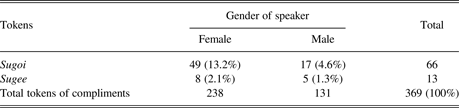
Certainly, the current data set shows that women do not necessarily follow the traditional view of the use of gender-preferential forms with sugoi and sugee. Table 1 presents results showing that although both men and women use sugee less often than sugoi, women use sugee more frequently than men, though the difference does not prove to be significant.
Number (percentage) tokens of sugoi/sugee by speaker gender
(chi-square = 0.8724, p = 0.350303, not significant).
In order to investigate further why young Japanese female speakers utilise the ‘vulgar’ variant traditionally used by male speakers and to explore the ultimate social meanings and stances these variants carry, the data from the playback interviews were analysed. These metadata are extremely useful for unpacking speakers’ evaluations of the particular variants under question as they assess their own linguistic practice. The analysis of their metalanguage undoubtedly adds to a better understanding of how forms vary and why they vary the way they do.
The playback interviews
The playback interviews were conducted in the last stage of my fieldwork with forty-one university students in total, some of whom were interviewed for a second time after the first recording made six months previously (either sociolinguistic interviews or lunchtime recordings, or both). The aim of the playback interviews was to access native speakers’ judgements of certain complimenting-like behaviours. Ten instances of complimenting behaviour were extracted from the first stage of data collection. These were then transcribed and provided for participants in the playback interviews to follow as they listened to the sound files. Participants were then asked to provide comments about the underlined segments—namely, complimenting-like behaviours that contained somewhat unclear or unusual aspects that made it difficult to code them as prototypical compliments. One of the ten extracts included an interaction in which girls used the positive evaluative form sugee, but for rather unclear reasons. The extract that participants were invited to analyse is shown in (8) below.
(8) Excerpt of sugoi/sugee use in the interaction used in the playback interview
Except for the female researcher (R), all three speakers (Saki, Motoko, and Takeo) are second-year students. Saki and Motoko are female students while Takeo is a male student. They are talking about what first person pronoun forms they use towards people of higher status.
1 R: Tatoeba jaa, sore wa tomodachi ‘Okay, then, that's between
no aida to shite, meue no hitoyour friends, how about when
toka niwa, nante iimasu?. talking to someone higher in
status?’
2 R: Jibun no koto iu toki wa, meue‘When you refer to yourself,
no hito ni hanashite iru toki. talking to someone higher.’
3 Saki: “Watashi wa”. ‘“Watashi [female-preferred
first person pronoun] wa”’
4 Motoko: U:n, “watashi wa”. ‘Right, “watashi wa”.’
5 R: “Wa” “watashi wa” desho?‘Wa, isn't it? As in “watashi”.’
“wa”.
6 Motoko: “Wa”. ‘“Wa”.’
7 Saki: /3sec/ “Boku wa” tte iun ja‘Don't you say “boku [male-
nai?. preferred first person
pronoun]”?’
8 Takeo: A, souiu toki ni, <“jibun wa”‘Ah, I think I use “zibun
ga>{<} detari suru kamo[male-preferred first person
shiremasen. pronoun]” in these cases.’
9 Motoko: <“boku wa” tte iu?>{>}. ‘Do you use “boku”?’
10 Motoko: A: sugee.‘Ah, amazing.’
11 Saki: Sugee.‘Amazing.’
12 Takeo: “Boku wa” wa tabun tukai‘I use “boku” sometimes.’
masu.
13 Motoko: “Boku wa” wo tsukau to?. ‘Do you use “boku”?’
14 Takeo: Ue dattara… (R:a:). ‘If I'm talking to someone
higher.’
15 Motoko: Sugee.‘Amazing.’
16 Takeo: “Watashi”…“watashi” mo‘I might use “watashi” …
tsukau kana. “watashi”.’
The forty-one students came up with a wide range of comments about and possible interpretations of the use of sugee by the two young females (i.e. Motoko and Saki) in this particular interaction. They often made effective comments on the difference in usage between sugoi and sugee. It was important that the sound file was also listened to, as this gave participants more contextual cues (e.g. intonation and tone). In analysing their metalanguage and observations, it became clear that there were a few recurring themes—stances and indexical meanings, in effect—to which the speakers were referring. The use of sugee seems to index a wide range of stances, which then contribute to building an indexical field for sugee. I consider these in more detail below.
Stancetaking and indexical meanings of sugoi and sugee
In the playback interviews, when speakers were asked to interpret the meaning of and reasons why these girls used the sugee variant, instead of sugoi, in the interaction shown in (8), they pointed to a diverse range of meanings; some of these are more stance-related, while others have more to do with persona and social category. In this section, I touch on the five most frequently repeated meanings that emerged in the playback interview: maleness, power, informality/solidarity, supportive listening, and meaninglessness.
First, as has been widely discussed in the past (cf. Ide Reference Ide1992), there seems to be a relatively strong association between users of sugee and a social category of masculine speech. Male participants especially showed more obvious and stronger attitudes concerning this association than the females in the interviews. The following comments were all extracted from male participants in the interviews.
(9) Nori, male, 20
Otoko rashii onna dakara.
man like woman because
‘Because she is a man-like girl.’
(10) Katsu, male, 19
Onna rashiku wa nai yo ne.
woman like topnegspfsfp
‘She is not feminine like.’
(11) Ichiro, male, 20
Kankyou da to omoimasu. Mawarini otoko ga ooin ja nai desu ka.
environment copq think.pol surrounding man top many copnegpolqm
‘I think it's the environment. I bet she is surrounded by a lot of boys.’
(12) Ryoya, male, 19
Sugee wa sugoi yori otokoppoi.
Sugee topsugoi than manly
‘Sugee is more manly than sugoi.’
As seen in (9), there is a direct comment on a clear evaluation of sugee as more typical of projecting a masculine persona compared to sugoi. Although the data set demonstrates females often using the variant sugee, as shown in Table 1, the overt comments of these male participants show they consider that the use of sugee still points towards the social category or persona of maleness, especially when used by female speakers. Put differently, the girls’ atypical use of the male-preferred form sugee might even suggest that the girls are orienting to unconventional personae, and distancing themselves from the conventional feminine personae attached to sugoi. It is worth noting that speakers most strongly associate the sugee variant with masculinity, a social category and/or persona.
Second, this variant seems to presuppose some power relation between speakers in the interaction. The comments in (13) and (14) support this claim.
(13) Eiji, male, 21
Joge kankei desu. Takeo no hou ga kono
high-low relation copTakeo gencomparison nomthis
hutari yori
two than
shitani imasu yo.
Down exist sfp
‘It's the status high and low relationship thing. The boy has a lower status than these girls.’
(14) Hanako, female, 20
Sensei ni wa sugee to wa ie nai desu kedo.
Teacher to top sugee q top say neg cop but
‘I wouldn't be able to use sugee to sensei.’
Extract (13) explains clearly who is assumed to hold higher status or more power—the two girls who used sugee—and who has the lower status in the relationship—the boy being addressed with sugee. Extract (14) orients to another important power relationship in Japanese society. In other words, social norms discourage students from using the variant sugee to higher-status speakers such as sensei ‘teachers/professors’. Therefore, it appears that the second stance the sugee variant indexes is the powerful and authoritative stance of the user in relation to the addressee.
Third, and closely related to the stance of powerfulness discussed above, this variant indexes some form of informal and/or solidarity stance (i.e. equality of power or status) in the interaction. Consider the comments in (15) and (16).
(15) Kyoichi, male, 19
Dou gakunen de kudaketa kanji.
same year and relax feeling
‘Between the same grade, they feel relaxed.’
(16) Mako, female, 21
Shitashikute ki wo tsukawa nai aite, kotoba tsukai ni
Intimate care omuse negpartner language use om
ki wo tsukawa
care omuse
nakute ii aite ni tsukau.
neg good partner om use
‘I would use it to someone intimate with whom I don't have to think too much about which [linguistic] form to use.’
The second comment, shown in (16), demonstrates in particular just how much the Japanese are aware of different forms of language to be exploited in order to reflect their social relations to the addressee both linguistically and interactionally. Mako frames an interesting relationship between language use, linguistic form, and social relations. Depending on their social relationships with whomever they are talking to, Japanese speakers are aware that they modify their utterances and choose specific linguistic forms. Social relations and distance (sometimes this also includes physical distance) are key constraints for speakers, who must determine which linguistic form to use (cf. Bell Reference Bell1984; Rickford & McNair-Knox Reference Rickford, McNair-Knox, Biber and Finegan1994). As discussed in Adachi (Reference Adachi2012), the salience and relevance of social status were found to be significant within this particular community of university students. The senior-junior relationship (senpai-kouhai) proved to be of high importance, especially in this speech community. Evidently, as indicated by these comments from the Japanese speakers, the variant sugee seems to index a stance of informality and solidarity.
Finally, and perhaps even most interestingly, interviewees often stated that the variant sugee actually does not have any (social) meaning. Consider the comments in (17) through (19) from the interviews.
(17) Shotaro, male, 21
Sugoi to omotte nai to omou.
sugoi qthink negqthink
‘I don't think [she] really thinks it's amazing.’
(18) Ayumi, female, 21
Demo zettai kore hukai imi ga atte no sugee
but definitely this profound meaning nomhave gensugee
janaiyo ne.
copnegsfpsfp
‘This is definitely not thesugee that has profound meanings’
(19) Noriko, female, 21
Sugoi tte itte mo ironna imi de tsukawareru kara.
sugoi qsay even various meanings by use.passbecause
Aiduti no isshu mitaina.
nodding gen kind like
‘Because sugoi has a range of meanings. It's like a type of nodding.’
It is apparent from the comments above that the interviewees are aware of the literal meaning of sugee ‘amazing’ (as seen in (17)). They further explain, however, that sugee has ‘a range of meanings’ and also functions as ‘a type of nodding’ (see (19)). Bearing in mind that this data set demonstrates the pragmatic function of sugoi/sugee as a silence-filler, it might be plausible to think that the variant sugee indexes the stance of supportive listening in interaction. It does not mean much in a literal sense, working instead as a discourse marker and/or interactional marker to indicate that the speaker is actively listening and contributing to the conversation. From these comments, it seems that young Japanese are aware of this newly created discourse function as they seem to orient to the fact that the original semantics of sugoi/sugee are virtually bleached in some interactions. It is interesting that speakers themselves are aware of a change in the meaning of sugoi/sugee, shifting from the literal senses to practically bleached, empty ones.
Overall, these comments are interesting because they indicate that these variants might be going through, or have already gone through, some stage of change in meaning-making and functions, given that participants can talk about the shift/change from the literal meaning at a recognisable level. As mentioned earlier, one might even consider the possibility that this form is going through a phase of grammaticalisation.
Analysis of the playback interviews led to the observation that speakers can point to a diverse range of social meanings attached to sugoi/sugee—stances (e.g. informal, powerful), pragmatic functions (affirmation, supportive listening), and social categories such as gender (e.g. masculinity). In the next section, in consolidating and making sense of all the data I have presented so far, both interactional data looking at pragmatic functions and metadata exploring speakers’ perceptions, I summarise the indexicality of sugoi/sugee in Japanese compliments, drawing on Eckert's (Reference Eckert2008) model of the indexical field.
Indexicality of sugoi and sugee in the community of practice
As my data have revealed, through an analysis of interactional language and metalanguage, the indexicality of sugoi and sugee retains a great deal of complexity and diversity, involving multiple levels of meaning. The first and most foregrounded indexicality of this form is that it is embedded within the speech act of complimenting. As Ochs (Reference Ochs, Duranti and Goodwin1992) argued, social acts such as complimenting can be closely related to other social acts (such as thanking and encouraging) and may express stances (e.g. informal, vulgar, powerful), pragmatic/illocutionary events (e.g. praising, showing surprise, mock impoliteness), and social activities (e.g. solidarity-building, attention to positive face). While some meanings may in fact be more direct than indirect (Ochs Reference Ochs, Duranti and Goodwin1992), or even more interior than exterior (Kiesling Reference Kiesling2009), or related to each other in a more hierarchical manner (Silverstein Reference Silverstein2003), given that speakers in the playback interviews pointed to a wide range of complex meanings (e.g. from stance to social category) at the same time, it is safe to assume that meanings and indexicalities co-exist in a field that can push some meanings out to be significant and more foregrounded in specific contexts. Eckert articulates this idea clearly:
the very fact that the same variables may stratify regularly with multiple categories—e.g. gender, ethnicity and class—indicates that their meanings are not directly related to these categories but to something that is related to all of them. In other words, variables index demographic categories not directly but indirectly (Silverstein Reference Silverstein, Mertz and Parmentier1985) through their association with qualities and stances that enter into the construction of categories. (Reference Eckert2008:455)
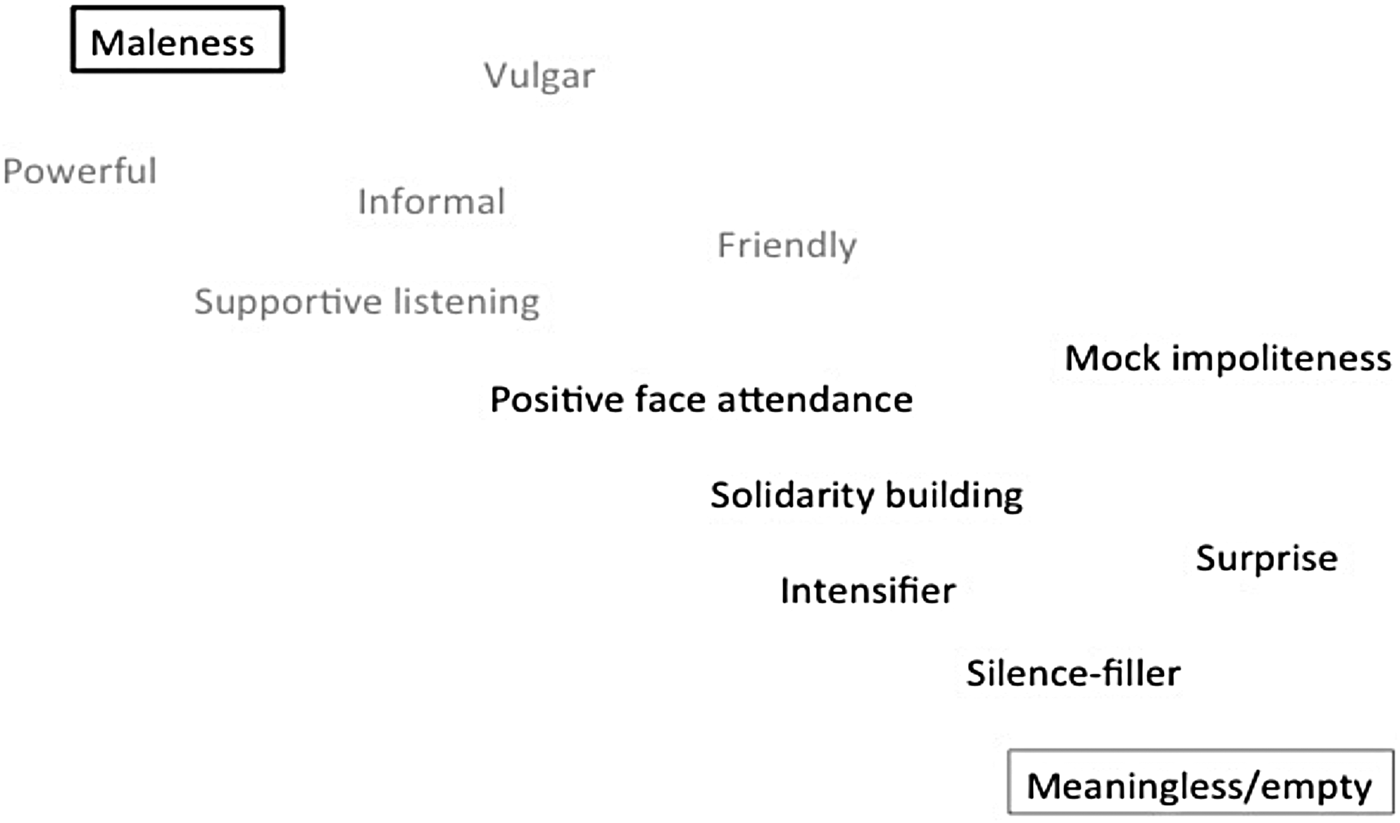
Speakers, in other words, are ultimately associating with social categories like maleness through the stances and pragmatic functions of sugee that are embedded in the act of complimenting. Drawing on Eckert's model of the indexical field, Figure 1 illustrates the relationships between sugee's meanings and indexicality.
Indexicality of sugee. The black box indicates social category. Grey type indicates stance. Black type indicates pragmatic functions pertaining to the speech act of complimenting (i.e. shared with sugoi).

As we have seen in the metadata from the playback interviews, on the one hand, speakers are aware that sugee indexes stances that are specific to this variant—for example, informal, vulgar, powerful, friendly, and supportive (listening). On the other hand, because we are looking at the variant sugee only in the context of complimenting, this can point to some indexes and/or meaning that pertain to this speech act as part of pragmatic functions (the micro-level of functions in interaction—that is, what they ‘do’ in interaction as opposed to what they ‘mean’). These functions are, for instance, solidarity-building, attention to positive face, intensification, indication of surprise, mock impoliteness, and silence-filler. These indexes are simultaneously, interactionally, and temporarily drawn and created in on-going moment-to-moment interaction. And, obviously, these indexicalities are always under pressure to change whilst speakers produce and reproduce new meanings associated with particular linguistic forms such as sugee through repeated use. With sugee and sugoi in particular, the trace of this process or change has come to be apparent; as speakers articulately and repeatedly noted, their meanings have become obsolete and bleached. But when they use the term ‘meaningless’, they do not mean that there is absolutely no meaning attached anymore to sugoi/sugee; instead, they indicate that the original literal meanings have become diffuse and have expanded to index something else—such as more unconventional stances (e.g. supportive listening) and interactional functions (e.g. mock impoliteness). To put it differently, the speakers are overtly expressing observations of language change.
Recall Ide's claim that the vulgar variant sugee was not prototypically allowed in women's repertoire. My data, however, reveal that masculinity associated with the sugee variant is just one index in sugee's vast field of indexicality. It might be worth noting that these Japanese women may not be aiming to do gender work through the sugee variant, but rather other kinds of social and interactional work, which are indexed through these variants as they establish more immediate and meaningful senses in interaction. Female and male speakers strategically exploit these two variants in different contexts to suit their intricate interactional goals and purposes. The distributional result and variability of the variants sugoi and sugee point to how the systems of indexicality attached to these variants co-exist for individuals as options for intraspeaker variation. As Eckert puts it: ‘variables have indexical fields rather than fixed meanings because speakers use variables not simply to reflect or reassert their particular pre-ordinated place on the social map but to make ideological moves’ (Reference Eckert2008:464).
Conclusion
In conclusion, I examined and contested the notion of indexicality through the analysis of both interactional and metalanguage data as speakers themselves evaluate their sociolinguistic behaviour. In particular, I focused on the lexical items sugoi and sugee in the context of complimenting among young Japanese speakers. I first showed how the forms are interactionally used and embedded in the context of complimenting. Further analysis then revealed that these two variants index a number of social meanings, stances, and indexicalities through the act of complimenting and in fact allow the young Japanese speakers to carry out a variety of kinds of interactional work. I addressed how and why these variants bring certain meanings forward and inaugurate stancetaking practice in the context of complimenting. Analysis of the playback interview data made it clear that speakers are aware of, and capable of talking about, a number of potential stances and indexicalities attached to sugoi/sugee variants at the same time.
Through an examination of the use and distribution of sugoi/sugee variants in interaction, this article provides a richer picture of how and why lexical items may perform as a marker of social functions and stances among young Japanese speakers. Largely, the study supports Kiesling's argument that ‘stance is the speaker's primary concern, and that linguistic features index social meanings in the service of the speaker creating or performing a certain stance’ (Reference Kiesling, Kiesling and Paulston2005:102). The analysis illustrates that young Japanese speakers simultaneously, interactionally, and even temporarily index their choice of stance through the use of the linguistic forms sugoi and sugee in performing the social act of complimenting. Further, we have seen change in the meaning attached to these variants as the speakers oriented to this change at a recognisable level—the ‘bleached’ meaning of sugoi and sugee. Finally, as studies of indexicality in sociolinguistics continue to advance, I hope that this article contributes to our understanding by highlighting the importance of combining interactional data with metalinguistic data that are directly attuned to speakers’ own voices and their evaluation of indexical meanings.
APPENDIX: TRANSCRIPTION CONVENTIONS
- .
end of utterance
- ,
short pause
- ?
question utterance
- :
prolonged vowel
- [↑][→][↓]
rising, parallel, falling intonation
- /number sec/
seconds of silence
- …
reluctance to continue/finish the utterance
- < >{<}
where overlapping starts
- < >{>}
where overlapping ends
- ()
short back-channelling
- < >
laughter; <laugh>
- ” ”
quoted speech