The carving of rock reliefs was a widespread artistic technique for ceremonial and commemorative purposes throughout the ancient Near East, from Egypt and Iran to Mesopotamia and Turkey (Vanden Berghe Reference Vanden Berghe1983; Harmanşah Reference Harmanşah, Knapp and Dommelen2015; Woods Reference Woods and Hartwig2015). It was, however, relatively marginal in the Arabian peninsula during antiquity—with the notable exceptions of the Neo-Babylonian reliefs of Hâ’it, the carved lions of the Khuraybah tombs, and in the betyls and the majestic façades of the Nabataean tombs of Hegra, al-Bad‘ and Qaryat al-Dîssa (Jaussen & Savignac Reference Jaussen and Savignac1997: pls XXXIV–V; Râshid Reference Râshid2003; Nehmé et al. Reference Nehmé, Bessac, Braun and Dentzer-Feydy2015; Hausleiter et al. forthcoming). Engraving and, less often, painting, was the technique most commonly employed, whereas sunken reliefs and sculptures in high- and low-relief were reserved for architectural decoration (Inizan & Rachad Reference Inizan and Rachad2007; Khan Reference Khan2007; Ziolkowski Reference Ziolkowski2007; Antonini Reference Antonini2012). As a result, Arabian rock art, from the Neolithic to modern times, is characteristically linear, two-dimensional and schematic. Among the most common themes in the peninsula are scenes of war, raids and hunting, as well as processions of animals (dromedaries, ibex, wild goats, cattle and the like), enigmatic symbols and geometric, zoomorphic and anthropomorphic figures engraved among innumerable graffiti and monumental rock-cut inscriptions (e.g. DASI project, http://dasi.humnet.unipi.it).
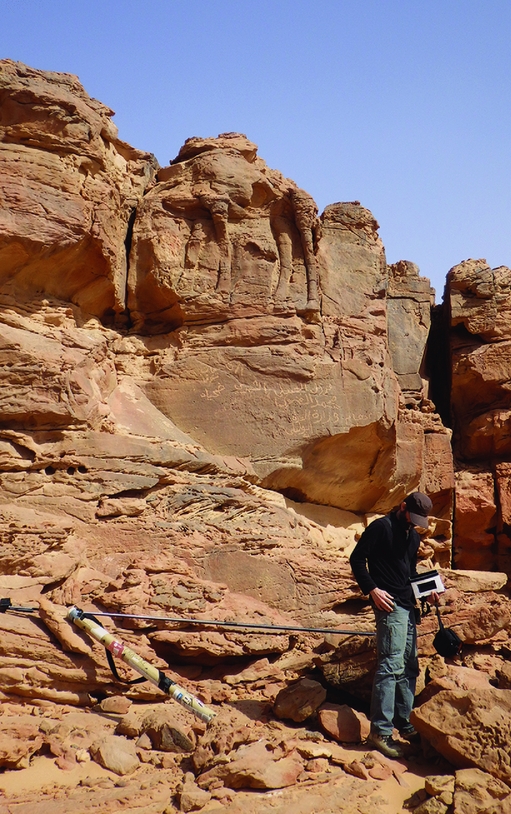
A newly discovered rock-cut site, henceforth named the ‘Camel Site’ (DaJ155, Figure 1), exhibits the first-known examples from the peninsula of both dynamic and realistic monumental art carved in low- and high-relief on bedrock. Here we present the environmental context of the site and analyse and compare the reliefs of the Camel Site using contemporary methods (Chippindale & Taçon Reference Chippindale and Taçon1998: 1–10). The main objective of this preliminary examination is to generate awareness of endangered cultural heritage and to ensure the rapid preservation of the site by the Saudi state. The ‘Camel Site’, enclosed within a private property, has indeed suffered considerable damage from modern activities (e.g. destruction by bulldozers, removal of blocks and vandalism of sculptures).
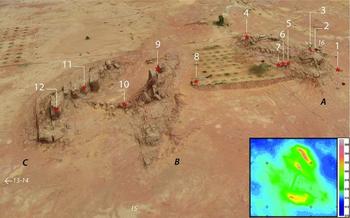
View of spur B of the Camel Site (© Saudi-Italian-French archaeological project in Dûmat al-Jandal (SIFAP DaJ), G. Charloux).

Survey area and method
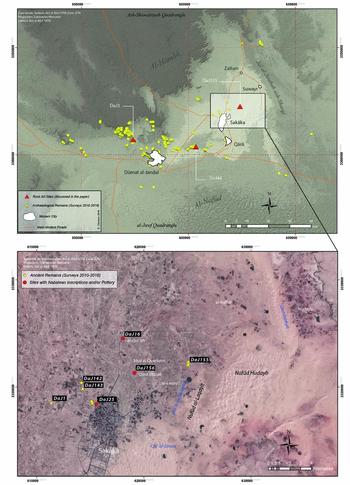
The study area lies at the edge of the Ash-Shuwaitiyah and al-Jawf quadrangles (Figure 2), in an area of Late Cretaceous rock formations (Wallace et al. Reference Wallace, Dini and Farasani (al-)1997). The easily carved sandstone of the Wasia Group (Kwl) tends to weather rapidly through natural processes, both on the surface (by abrasion, alveolation, pitting and hollowing) and in deep horizontal and vertical fissures. This can lead to exfoliation and the detachment of blocks and large parts of the façades (Figure 1). The layer of black varnished patina (ferruginous) on the surface is formed by the exposure to the air of the iron oxides within the rock.
Maps with the locations of the Camel Site and other sites in the Sakâkâ basin mentioned in the text (© SIFAP DaJ, G. Charloux).

The Camel Site sits at the centre of a large, oval topographic depression measuring approximately 48 (north–south) × 38km (east–west), referred to here as the Sakâkâ basin (Figure 2). This depression, at an elevation between 650 and 550m, receives water from the many north-west/south-east wadis that flow down from the limestone Hamâd plateau (between 800 and 650m asl).
Thick Quaternary sediments, particularly aeolian sands, have accumulated in the lower parts of the basin. Thus, the location of the Camel Site is bounded on the east by a barrier of north–south dunes (known as Nufûd al-Laqayît and Nufûd Hudayb), which in turn are blocked to the east by the plateau of Jâl al-Jawbah ash-Sharqî. This environmental setting determines the position of the north–south routes linking Sakâkâ and Zallum and the south-west/north-east routes between the Sakâkâ region and Suwayr or Hudayb. These routes continue in a straight line towards Mesopotamia through long wadis, most notably the Wadi Badana, via the town of ‘Ar'ar. Proceeding westwards, the Wadi Sirhan fault provides a natural route leading to Jordan and the southern Levant. Other routes go southwards towards the Hijaz or Jubbah across the Nafûd desert (contra Jennings et al. Reference Jennings, Shipton, al-Omari, Alsharekh, Crassard, Groucutt and Petraglia2013).
Jawf Province, in northern Saudi Arabia, is particularly rich in rock-cut sites often located close to palaeo-lakes or ancient trade routes (Winnett & Reed Reference Winnett and Reed1970; Adams et al. Reference Adams, Parr, Ibrahim and al-Mughannum1977; Parr et al. Reference Parr, Zarins, Ibrahim, Waechter, Garrard, Clarke, Bidmead and al-Badr1978; Muaikel (al-) Reference Muaikel (al-)1994; Theeb [Dhuyayb] (al-) Reference Theeb [Dhuyayb] (al-)2010). In the Sakâkâ basin alone, the French contingent of the Saudi-Italian-French archaeological project at Dûmat al-Jandal has recorded 56 rock-cut sites since 2010 (Figure 2), using non-systematic surveys focused on geological and topographic zones conducive to carving and concentrations of petroglyphs.
The area around the Camel Site remains virtually unexplored (see maps in Parr et al. Reference Parr, Zarins, Ibrahim, Waechter, Garrard, Clarke, Bidmead and al-Badr1978: pl. 21; Muaikel (al-) Reference Muaikel (al-)1994: 70; Theeb [Dhuyayb] (al-) Reference Theeb [Dhuyayb] (al-)2010: 1277). Located 8km to the north-east of Sakâkâ, and 4.5km from the village of al-Laqâyit, close to Jibâl al-Qûwayim, the site consists of three rocky spurs approximately 10m apart (Figure 3). The central spur (B) is distinct in that it has a very clear natural profile suggestive of a camel silhouette. It is possible that this represented an easily recognisable point in the landscape.
Ortho-rectified aerial view of the site with digital terrain model (© SIFAP DaJ, R. Schwerdtner & G. Charloux).

The site was surveyed on foot over a radius of 300m during three short visits in March 2016 and March 2017. During this survey, some 50 non-diagnostic flint pieces were collected from the surface around the rocky outcrops (Figure 3: 15–16). They consist mainly of irregular blades removed by direct percussion, and discoidal debitage flakes, which probably belong to historical-period industries (Angevin pers. comm.).
A series of outcrops farther north were also explored, and a rough engraving of an indeterminate, life-sized animal was discovered (Figure 3, 13), as well as a short inscription in north Arabian—probably Hismaic—script (c. second century BC to first century AD) (Figure 3: 14). The survey also took aerial views using a kite, and produced rectified 3D orthophotos and a Digital Terrain Model based on topographic points recorded with a differential GPS.
The Camel Site does not seem propitious for permanent human settlement. No water source was noted near the site itself, and the hyper-arid climate would not have been suitable for agriculture in antiquity without a supply of water. Rainfall of less than 50mm/year could, however, have permitted short-term settlement. The 1/50000 topographic map of the region also indicates the presence of wells to the north and south, less than 2km away.
Brief description of the reliefs
The 12 panels and reliefs identified in the field are described from north to south (spurs A–C).
Spur A
-
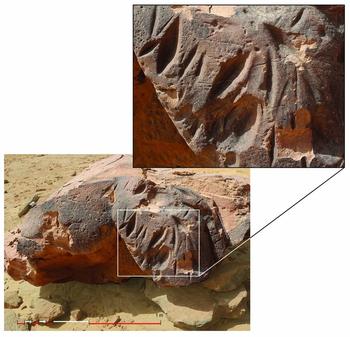
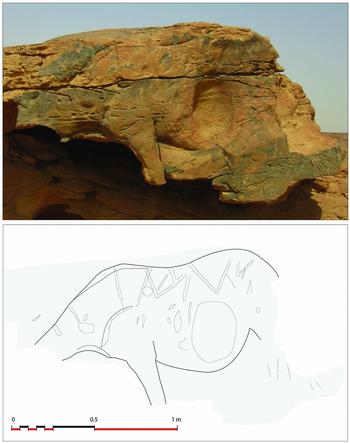
• Number 1 is a fallen block from the south face of spur A, revealing the back part of a standing camelid, without harness, carved in high-relief (Figure 4). There is a concentration of boat-shaped and sometimes more rounded cup marks on the top of the thigh of the rear left leg. The block has, unfortunately, been subjected to vandalism in recent times.
-
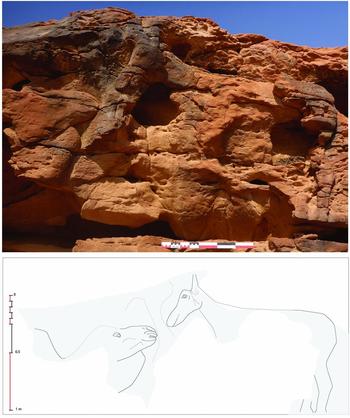
• Number 2 is an engraved panel in low-relief, representing a dromedary (Camelus dromedarius) in profile, possibly lying down, raising its head towards a standing equid to its right (Figure 5). This heavily eroded panel on the south side of spur A shows only the centre of the scene; the head, neck and beginning of the dorsal hump of the camel are the only elements that survive.
All that remains of the equid (probably a donkey or mule) is the dorsal outline, the head and hindquarters (left rump and hind leg). The head is finely carved, although schematic. The muzzle seems to be unusually elongated, while the skull curves unrealistically above the left eye. This eye is engraved in a simple way, with a circular iris in the centre of a curved lozenge. The dark patina of this scene indicates its antiquity. The camel's head nevertheless seems to have been protected from wind erosion by a slight overhang of the rock face, which might actually represent the rear leg of a second equid.
-
• Number 3 is a low-relief of a grazing animal on a badly damaged detached block on the top of spur A (Figure 6). The prominent muscles of the body are represented in a leftward facing profile. Its head and hind legs are missing, which makes its identification more difficult. There are numerous later cup marks, but also V-shaped lines on the back of the animal that are perhaps part of the original carving. These marks resemble modern decorative practices that consist of shaving an animal's hair in geometric patterns, and point towards the animal being an equid—possibly a horse.
-
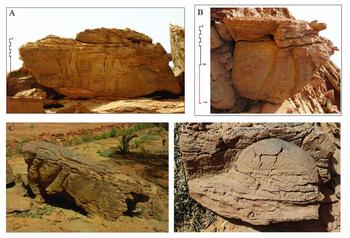
• Number 4 is an unfinished, low-relief representation of a camelid, on a sandstone block on the east side of spur A (Figure 7A). The front and hind legs of the animal, which is facing to the right, were engraved by straight lines and deep pick marks.
-
• Number 5 is a low-relief carving of the lower rear part of a camel on a block that has fallen from the north face of spur A (Figure 7B). The rounded flank of the animal joins the left thigh. The rear left leg seems to be in front of the back right leg, as if the animal were walking.
-
• Number 6 represents two carved limbs on a sandstone block that had fallen upside down (Figure 7C). No other limbs appear on the large, smooth, empty space to the left of the representation. It is possible that these are the legs of a human, perhaps a camel drover.
-
• Number 7 is a camel hump on a fallen block that had been heavily wind-eroded (Figure 7D). Circular lines on and at the base of the hump may represent ropes.
Camel number 1 and detail (© SIFAP DaJ, C. Poliakoff).

Animal scene number 2 (picture and drawing) (© SIFAP DaJ, G. Charloux).

Equid number 3 (picture and drawing) (© SIFAP DaJ, G. Charloux).

(A–D). Panels numbers 4, 5, 6 and 7 (© SIFAP DaJ, G. Charloux & C. Poliakoff).

Spur B:
-
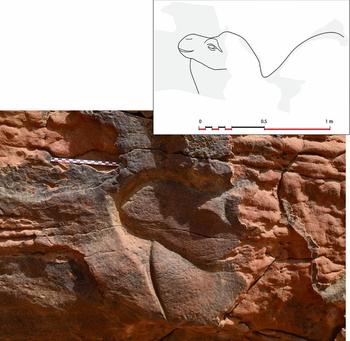
• Number 8 is the low-relief profile of the neck, head and hump of a camel on a badly damaged block that is probably displaced, south of spur B. The animal's head is finely carved, realistically depicting the nostril, left eye-lid and corner of the mouth (Figure 8).
-
• Number 9 is a panel of modern graffiti engraved on the north façade of spur B. This vertical façade is formed naturally by the detachment of blocks from the cliff face.
-
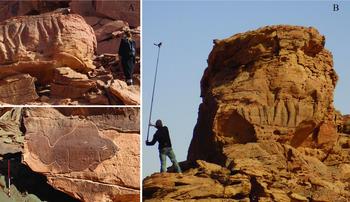
• Number 10 is a low-relief representation of a camelid followed by its calf (Figure 9a). Its legs are more than 1.1m high. The representation was probably originally located on the north flank of spur B (Figure 3).
Camel head number 8 (picture and drawing) (© SIFAP DaJ, C. Poliakoff and G. Charloux).

Panels with camels 10 (A) and 12 (B), and the panel with the camel from site DaJ44 (C) (© SIFAP DaJ, G. Charloux & C. Poliakoff).

Spur C:
-
• Number 11 is a standing camel in high- and low-relief, high up on the south face of spur C (Figure 10). Modern inscriptions and engravings have damaged the sculpture and the patina.
-
• Number 12 is a panel high up on the south face of spur C. It depicts a badly eroded camel preceded by its calf (Figure 9b). The legs are tubular, thick and lacking detail.
Camel number 11 (© SIFAP DaJ, G. Charloux).

Discussion
Reflections on the themes and workmanship of the representations
Originally located high on the rock spurs of the Camel Site, the animals illustrated exclusively represent mammals—either camelids (most probably dromedaries: a minimum of 11 individuals), or equids (perhaps 2 individuals). The identification of number 6 is less certain.
The dimensions of the anatomical parts (approximately 1.1m for the adult camel legs) correspond to those of life-sized adults (both male and female) and juvenile animals.
The scenes reflect varied themes, including the meeting of different species (number 2), grazing (number 3) and a procession of camels (numbers 10 and 12). Even though the presence of ropes (numbers 2 and 7) is suspected, the animals seem to be mostly depicted in active postures in a natural setting, with man taking a secondary place.
Erosion and patination have almost completely destroyed any traces of tool marks. A preliminary examination of the associated lithic material was unable to conclude whether it had been used to create the reliefs on the rock faces. This was notably due to the absence of any well-known contemporaneous engraving tools, such as large picks, engravers and burins. Some small flakes, however, seem to be debitage from tool production (Angevin pers. comm.).
The initial stage involved choosing a location and a motif to carve based on the natural contours and defects of the rock face. The shapes of the animals were then outlined by incision. These incisions were widened obliquely towards the exterior of the motif—possibly using picks (Bessac pers. comm.)—to create contrast and make the image stand out in relief. The incisions along the legs of relief numbers 10, 11 and 12 are particularly deep and wide, and testify to the use of a tool with a flat end—a tool that does not seem to have been systematically used for the other figures. This same tool (perhaps a chisel) was then employed to carve and smooth the surfaces of the animal bodies. The animals’ eyes were then incised with a fine point. On relief number 3, the decoration of undulating lines on the animal's rump was probably made by linear friction on the sandstone using a wide object with a rounded cross-section—perhaps simply a convenient unshaped stone. The time required to produce these representations is difficult to estimate, but several days of work would certainly have been needed for each.
Even though the site is isolated, we can conclude that the reliefs were made by accomplished artists who respected the proportions of the animals, and who were capable of reproducing the models and the details with a well-developed aesthetic sense. The various realistic and schematic styles that were employed in creating these figures can be observed in differential modelling of the muscles and the heads (particularly the muzzles and eyes of the camels), and in the thickness of the legs (for example, compare numbers 10 and 12). These styles suggest that the reliefs were made by several individuals who deliberately searched for originality in composition by depicting animals in distinct and dynamic positions. The elevated placement of some of the carvings would have required the use of scaffolding or, at the very least, a system of ropes (Bessac Reference Bessac2007: 228, fig. 30).
The themes represented and the techniques employed are quite different from those of official art. The camelids of the Camel Site are shown without loads, as in nature. Some reliefs are even unfinished (numbers 4 and 12). Additionally, we note the probable presence of a donkey or mule (number 2)—animals that are rarely illustrated in relief—and the absence of monumental inscriptions (although the latter have often been stolen, when they did exist). These indications suggest that the carvers were locally based, rather than nomadic artists (such as experienced caravaneers).
Dating and parallels
Dating this exceptional group of rock art is difficult owing to the absence of any associated diagnostic artefacts, even though the latter are abundant at other rock-cut sites in the region (Jennings et al. Reference Jennings, Shipton, al-Omari, Alsharekh, Crassard, Groucutt and Petraglia2013: 678; Hilbert & Crassard in press). It should be noted that no scientific dating or micro-erosion analysis (Bednarik & Khan Reference Bednarik and Khan2005) has so far been carried out on these eroded sandstones, but such analyses should be attempted in the future.
Indirect evidence for the antiquity of the site rests firstly on the fact that the blocks fell from their original positions after they were carved—a result of the slow processes of erosion. Secondly, the patina on the animals and on the cup marks (and other later marks), indicate a succession of ancient human and natural events (Keyser Reference Keyser and Whitley2001: 126–27).
The themes represented on the rock faces do not provide a specific date. Although the wild dromedary had probably been present in Africa and Asia since the Pleistocene, its presence in Arabia has been confirmed only from the fifth millennium BC (Uepermann & Uepermann Reference Uepermann and Uepermann2002: 236; Beech et al. Reference Beech, Mashkour, Huels and Zazzo2009: 26–27). Camel domestication is only securely attested at the end of the second millennium BC (Uepermann & Uepermann Reference Uepermann and Uepermann2002). The dominating role of the camel for Arabian nomadic populations during antiquity is attested in figurative art, in pre-Islamic literature and from recent excavations (Thilo Reference Thilo1958: 25, 36, 42, 45, 70; Khan Reference Khan2007: 131–63; Monchot Reference Monchot2014). Camels appear in rock art from the Neolithic to modern times (Arbach et al. Reference Arbach, Charloux, Dridi, Gajda, âl-Murayh, Robin, al-Sa’îd, Schiettecatte and Tayrân2015: 37–38).
The presence of equids is also attested in Arabia by the numerous petroglyphs in the region (Khan Reference Khan2007: 165–79; Olsen Reference Olsen2017) and by carvings discovered recently at al-Maqar (Harrigan Reference Harrigan2012). The date of their domestication nevertheless remains unresolved (Vila Reference Vila and Mashkour2006: 116–20). Donkeys were definitely being used in the second half of the fourth millennium BC in Egypt, the southern Levant and Mesopotamia (Vila Reference Vila, Butterlin, Margueron, Muller, al-Maqdissi, Beyer and Cavigneaux2014: 433–34), although the domestication of the horse in the Near East occurred during the second millennium BC. Horses were most probably introduced in Arabia in the second half of the first millennium BC (Schiettecatte & Zouache Reference Schiettecatte and Zouache2017), and remains of equids have been found only in early first-century AD contexts at Dûmat al-Jandal (Monchot Reference Monchot, Charloux and Loreto2016).
None of this evidence, however, is sufficient to date the Camel Site rock reliefs. Stylistic and iconographic parallels with neighbouring regions must, therefore, be used, at the same time bearing in mind the caution necessary in this type of comparison (Bednarik Reference Bednarik2002). The camel and equid figures of the Camel Site are easily distinguishable from the majority of Near Eastern representations from the Neolithic to the Iron Age (Staubli Reference Staubli1991: 184–90, pls 54–70). Assyrian, north Syrian and Neo-Babylonian orthostats, for example, depict camels with long necks, elongated heads and flattened crania. Despite the naturalism and dynamism of the figures, details of the hind legs—particularly the grooves depicting muscles and tendons—differentiate them from the camels of the Camel Site. Camels on south Arabian stelae appear more schematic and static, and lacking in detail, even with the strong Mesopotamian influence shown in emphasising the eyes (Staubli Reference Staubli1991: pls 81–83). The camelids of the Camel Site also depart from the stylistic tradition of Achaemenid art (see in particular Schmidt Reference Schmidt1953: 89, pl. 46).
Conversely, the sculpted figures of the Jawf show traits that are familiar in Mesopotamian representations of animals from the early centuries AD. The architectural reliefs of Palmyra in Syria give pride of place to the camelids (Tanabe Reference Tanabe1986: 89, 99, 128, 174–76, 458). Perhaps the closest parallels, however, come from Hatra in Lower Mesopotamia (Salihi Reference Salihi1998). Here, camels with fairly cylindrical legs are represented in lying or standing positions. The sculptors chose naturalistic representations, sometimes with no harnessing ropes. The hair on the neck is also illustrated in some cases. The workmanship of a sculpted deer head recovered from excavations (Mashkour Reference Mashkour2009: 42) compares closely with the donkey/mule (number 2) of the Camel Site.
Nabataean art is clearly the other source of influence for the Camel Site. Famous for their mastery in carving rock-cut monuments, the Nabataeans developed their own style of large-scale animal art in low- and high-relief, as seen on the rock faces at Petra in Jordan (McKenzie Reference McKenzie1990; Bessac Reference Bessac2007). These animals include eagles, horses, lions, elephants and particularly camels (Orr-Ewing Reference Orr-Ewing1927: 155–57; Bessac Reference Bessac2007: 212–13; Joukowsky Reference Joukowsky2007: fig. 78; Nehmé Reference Nehmé2012: pl. XXI, 118). Although erosion of the tool marks at the Camel Site currently prevents any direct technical comparison, the resemblance to the procession of camels in the Petra Siq (dated to around the first century BC) is striking, both in the dimensions and the mix of high- and low-relief techniques (Knauf Reference Knauf, Hübner, Knauf and Wenning1998: 95–97, fig. 1; Bellwald & Ruben Reference Bellwald and Ruben2003: 40–43, figs 57–60, 77; Nehmé Reference Nehmé2012: 151–52, pl. XIX). The first group in the procession consists of a camel drover and two camels carrying undefined loads. Two further camels in poorer condition form a second group, 25m upstream of the first. According to the reconstruction by Musil (Reference Musil1907: 147–48, fig. 117, but compare with Lindner et al. Reference Lindner, Gunsam, Just, Schmid and Schreyer1984: 176, fig. 10), a third group at the Deir at Petra consisted of two half-sized camels and drovers positioned on either side of an altar.
A parallel with Parthian and Nabataean models—and consequently a date of around the first centuries BC/AD—would be consistent with the archaeological and epigraphic data from the Sakâkâ basin (Muaikel (al-) Reference Muaikel (al-)1997; Theeb [Dhuyayb] (al-) Reference Theeb [Dhuyayb] (al-)2010; Loreto Reference Loreto2012; Charloux et al. Reference Charloux, Bouchaud, Durand, Monchot and Thomas2016: 29). The Camel Site is located 5–9km to the east of several Nabataean sites: al-Qal‘ah (DaJ16), Qârat al-Mazâd (DaJ156) and Sakâkâ (DaJ25) (Theeb [Dhuyayb] (al-) Reference Theeb [Dhuyayb] (al-)2010: 891–929, 935) (Figure 3). Furthermore, study of the Dûmat al-Jandal necropolis has demonstrated the presence of Parthian objects dating to the turn of the first century BC/AD (Charloux et al. Reference Charloux, Cotty and Thomas2014: 193–206). The mix of Nabataean and Mesopotamian influences in the representations at the Camel Site is consistent with the location of the Sakâkâ basin on a route between Transjordan and southern Mesopotamia, and on the fringes of the Roman trade routes (Charloux et al. Reference Charloux, Cotty and Thomas2014: 208). Dûmat al-Jandal is, incidentally, often considered the eastern limit of the Nabataean kingdom and an important caravan staging post on the route leading to Mesopotamia and the Persian Gulf (Glueck Reference Glueck1944: 11–15; Sartre Reference Sartre2001: 20; Schmid Reference Schmid2007: 67–68).
Taking only these relatively distant artistic influences into account without considering the regional practice of carving life-sized camels on rock faces would, however, be overly simplistic. Initially, two panels were discovered in 2013 at the site of Jibal al-Hiqna, 15km south of the Sakâkâ oasis (DaJ44, Figures 2 & 9c). The life-sized camels are represented in profile on the adjacent faces of a rock recess. These figures of high aesthetic value were engraved by first incising the outline, then emphasising that outline by a continuous and tightly packed pecking (Monchot & Poliakoff Reference Monchot and Poliakoff2016: 80–81, figs 2–3). One senses a search for realism and detail in the representation of the stylised hair on the neck and rump, as well as in the musculature and the protruding ribs on the flank of the animal, which testify to a different workmanship from that of the Camel Site.
Four other life-sized camelids of naturalistic appearance were found in 2016 on a rocky outcrop of Jabal al-Mindassa (DaJ3; Figure 2), 12km north-west of Dumât al-Jandal. Made by pecking the rock, these depictions were found upside down on fallen and patinated blocks. Other engravings of the same type are known from Wadi Rum in Jordan. The first, associated with a Thamudic inscription, is oversized, and in a different style from that of the Camel Site camels, most notably in the schematic representation of the head (nabatea.net 2015). The second is more similar in style to the engravings of sites DaJ3 and DaJ44 (alamy.com 2017). Another engraving, naturalistic but with no clear dimensions, was recorded to the south of Tayma’ during Jaussen and Savignac's expedition to Arabia (Jaussen & Savignac Reference Jaussen and Savignac1997: pl. LXV, no. 3).
All of these engravings testify to a north-west Arabian artistic tradition of naturalistic life-sized dromedaries, but the lack of regional surveys makes it difficult to define its date and exact geographic extent. Currently, the associated areas—where various desert tribes lived in the past—seem to be restricted to those that were for a period under Nabataean control.
The reasons for the existence of two principal techniques for creating rock art in the same geographic area (one using high- and low-relief, the other engraving) might be attributed to different artistic traditions. Unless the difference is simply chronological, one tradition could be of Nabataean-Parthian inspiration, the other of local inspiration more specific to desert tribes. At least some of the reliefs being studied here might indeed date to a post-Nabataean early Islamic occupation of the area. This was a period when figurative representations on Arabian rock faces diminished in number but did not cease. It is worth emphasising that this tradition is not limited to historical periods, but perhaps took its origins from the large rock-cut animals (bovids, goats and the like) of the Neolithic and Bronze Age known in the region of Dûmat al-Jandal and other Arabian provinces—although those are quite distinct stylistically.
Site function
The Camel Site is completely different from all other rock-cut sites in Arabia and in the Jawf region, where numerous incised schematic figures and graffiti were superimposed on one another over several millennia (Khan Reference Khan2007). The site is also atypical in the scarcity of inscriptions and archaeological material, with the exception of the lithic pieces and the cup marks on the flanks of animal numbers 2 and 3. These cup marks are testimony to multiple visits, and are found at many sites across Arabia (Jennings et al. Reference Jennings, Shipton, al-Omari, Alsharekh, Crassard, Groucutt and Petraglia2013: 675–77). According to Traunecker (Reference Traunecker, Roccati and Siliotti1987: 226–35), the powder obtained by friction—and leading to the creation of these marks—was often invested with magical healing powers, notably against sterility. Another well-known devotional gesture in antiquity consisted of touching certain body parts of an image (particularly the head, genitals and horns), which subsequently became polished over time (evidenced on the camel's muzzle at site DaJ44). It is tempting to suggest that these rock-cut images were the object of some sort of veneration.
From all the arguments presented above (e.g. themes, techniques, aesthetic inspirations, location and environmental context), we conclude that the Camel Site was an emblematic place of transit, one that was easily spotted in the landscape, and that indicated a way to, or the starting-point of, a long desert crossing. Although bereft of water and vegetation today, the Camel Site is located at the fringe of the Sakâkâ basin, only 7–10km from areas settled in antiquity. This place, which was uninviting for a long stop-over, could therefore mark the invisible boundary of tribal or political space, perhaps the edge of Nabataean territory.
The Camel Site carvings in low- and high-relief, dating perhaps to the first centuries BC and AD, hence provide a major contribution to our understanding of the evolution of rock art in Arabia.
Acknowledgements
The Saudi-Italian-French archaeological project in Dûmat al-Jandal, directed by Guillaume Charloux (CNRS) and Romolo Loreto (University of Naples L'Orientale), is supported by several French (CNRS, Ministry of Foreign Affairs, French Embassy in Riyadh), Italian (MFA, L'Orientale) and Saudi (Saudi Commission for Tourism and National Heritage) institutions. This research is also supported by the LABEX RESMED (ANR-10-LABX-72), under the investment programme ANR-11-IDEX-0004-02. The authors wish to thank Raphaël Angevin, Jean-Claude Bessac and Alessia Prioletta for their expertise.