Introduction
About 90% of cancer patients in the terminal phase have delirium (Breitbart and Strout, Reference Breitbart and Strout2000; Lawlor et al., Reference Lawlor, Gagnon and Mancini2000; Morita et al., Reference Morita, Tei and Tsunoda2001; Hosie et al., Reference Hosie, Davidson and Agar2013; Lawlor and Bush, Reference Lawlor and Bush2015), and 50–70% of them die without recovering from delirium (Leonard et al., Reference Leonard, Raju and Conroy2008; de la Cruz et al., Reference de la Cruz, Ransing and Yennu2015). Terminal delirium is defined as the occurrence of delirium in the dying phase, where reversal is unlikely (Bush et al., Reference Bush, Leonard and Agar2014). Delirium is a burden not only to the patients but also to their family and the medical staff (Cohen et al., Reference Cohen, Pace and Kaur2009; Kerr et al., Reference Kerr, Donnelly and Wright2013; Partridge et al., Reference Partridge, Martin and Harari2013; Finucane et al., Reference Finucane, Lugton and Kennedy2017). In particular, terminal delirium has a strong impact on important decisions about how to end one's life (Goswami et al., Reference Goswami, Moore and Bruera2020). In addition, if patients develop terminal delirium, communication between the patients and medical staff becomes difficult (Lawlor and Bush, Reference Lawlor and Bush2015), and it places a great burden on a family member who becomes a proxy decision maker (Sweet et al., Reference Sweet, Adamis and Meagher2014).
In the dying process, most patients experience a decreased level of consciousness (Raus et al., Reference Raus, Sterckx and Mortier2012) and have difficulty in communication as part of the natural course. However, we sometimes consider palliative sedation when patients have continuous distress and/or severe agitated delirium in the terminal phase (Maltoni et al., Reference Maltoni, Scarpi and Rosati2012; Parra Palacio et al., Reference Parra Palacio, Giraldo Hoyos and Arias Rodriguez2018). It becomes challenging to evaluate delirium and cognitive function when patients are sedated or have a decreased level of consciousness (Hui, Reference Hui2018). In this situation, it is difficult to assess delirium with the existing delirium assessment tool, which was developed to assess reversible delirium and is often used in daily clinical practice.
In addition, although we think about the overall management of delirium based on the patients’ estimated prognosis and the values of their family (Lawlor and Bush, Reference Lawlor and Bush2015), there is no consensus on the treatment and care of terminal delirium, both domestically and internationally. To provide the most appropriate treatment and care for terminal delirium, it is necessary to establish an assessment tool to evaluate terminal delirium. Furthermore, when we evaluate patients in the terminal phase, the balance between the burden on patients and an accurate evaluation is also important (Uchida et al., Reference Uchida, Morita and Ito2018). Therefore, we developed an assessment tool to evaluate terminal delirium, targeted toward the people around the patients. The aims of this study were to develop an evaluation scale to assess distress from irreversible terminal delirium and to examine its validity.
Methods
This study was part of a nationwide self-reported questionnaire survey of bereaved family members of patients with cancer who died in 76 hospices/palliative care units certified by Hospice Palliative Care Japan. The questionnaire was sent to the bereaved family members from each participating institution in May 2016 along with a letter explaining the survey. Participants were asked to return the completed questionnaire within two weeks, with a reminder to non-responders after 1 month. We sent the same mail to non-responders again in June 2016.
Subjects
The study subjects were adult bereaved family members of adult patients with cancer who died in participating inpatient hospices from November 2013 to January 2016. Cases were excluded if family members could not be identified, if the primary physician judged that a potential participant may have serious psychological distress, or if a potential participant was incapable of answering the self-completed questionnaire because of cognitive impairment or visual disability. In addition, as this study was originally a quality improvement project using feedback from bereaved families, the families of the patients who used inpatient hospices for fewer than three days were excluded on the assumption that they could not precisely rate the quality of care they received.
Outline of the study
This study was composed of two steps: scale development and validation.
(1) Development of the Terminal Delirium-Related Distress Scale (TDDS)
We conducted interviews with healthcare professionals engaged in the treatment of terminally ill cancer patients to explore treatment goals in irreversible terminal delirium for patients and their families. Based on this qualitative analysis (Uchida et al., Reference Uchida, Morita and Ito2018) and systematic literature searches, we designed a questionnaire and then carried out a questionnaire survey regarding the views of bereaved families about treatment goals in terminal delirium. We extracted the items that bereaved families regarded as important and developed an evaluation scale of terminal delirium. The draft TDDS consists of 25 items.
-
(2) Validation of the TDDS
We conducted a cross-sectional, self-completed questionnaire survey for bereaved relatives of cancer patients who were admitted to a hospice or a palliative care unit. The development of the TDDS was based on factor analysis. The validity and reliability of this scale were investigated by evaluating its (1) construct validity, (2) convergent validity, (3) discriminant validity, (4) concurrent validity, and (5) internal consistency.
Measures
Good Death Inventory-short version (Miyashita et al., Reference Miyashita, Morita and Sato2008)
We used the short version of the Good Death Inventory (GDI) to evaluate the patients’ achievement of a good death from the bereaved family member's perspective. The original version of the GDI consists of 10 core domains, 8 optional domains, and 54 attributes. The 10 core domains (environmental comfort, life completion, dying in a favorite place, maintaining hope and pleasure, independence, physical and psychological comfort, a good relationship with medical staff, not being a burden to others, a good relationship with family, and being respected as an individual) measure the attributes that Japanese consistently regard as important, and the 8 optional domains (religious and spiritual comfort, receiving enough treatment, control over the future, feeling that one's life is worth living, unawareness of death, pride and beauty, natural death, and preparation for death) measure attributes that are regarded as important by some, based on individual values. The short version of the GDI is composed of 18 representative items from each domain, and the validity and reliability of the scale have been confirmed. Participants evaluate each item using a seven-point Likert scale (1: absolutely disagree, 2: disagree, 3: somewhat disagree, 4: unsure, 5: somewhat agree, 6: agree, and 7: absolutely agree). The total score is calculated by summing the scores for all attributes, with a high total score indicating the achievement of a good death.
Care Evaluation Scale-short version (Miyashita et al., Reference Miyashita, Aoyama and Nakahata2017)
We used the revised short version of the Care Evaluation Scale (CES2) in the current study. The Care Evaluation Scale (CES; Morita et al., Reference Morita, Hirai and Sakaguchi2004) was developed to evaluate end-of-life care from the perspective of bereaved family members, with a focus on the structure and process of care. The original version of the CES was comprised of 28 items with 10 subscales: physical care by physicians, physical care by nurses, psycho-existential care, help with decision making for patients, help with decision making for the family, environment, family burden, cost, availability, and coordination/consistency. The questions were designed, so that the respondents evaluated the necessity for improvement for each item on a six-point Likert-type scale from “improvement is not necessary (1)” to “highly necessary (6).” The total score is transferred to a 100-point scale, with higher scores indicating better care. The short version of the CES is composed of 10 representative items from each domain, and the validity and reliability of the scale have been confirmed.
Delirium Experience Questionnaire distress score by the bereaved family
The Delirium Experience Questionnaire (DEQ; Breitbart et al., Reference Breitbart, Gibson and Tremblay2002) was developed to assess recall of the delirium experience and the degree of distress related to the delirium episode among patients, spouses/caregivers, and nurses. It asks six questions of patients who have recovered from an episode of delirium. In addition, spouse/caregivers and nurses are each asked a single question. In this study, we used this question to ask the spouse/caregiver “How distressed were you during the patient's delirium? 0–4 NRS.”
Statistical methods
We developed the TDDS by factor analysis of the draft items followed by varimax rotation. The number of factors was identified by the Scree test. The construct validity was examined based on whether repeating the factor analysis reproduced the factor loading pattern that was seen in the scale development phase. The convergent validity was examined by calculating Pearson's correlations between the TDDS scores and the CES and the GDS scores. The discriminant validity was examined by calculating Pearson's correlations between the TDDS scores and the DEQ distress score of the bereaved family. For internal consistency, we calculated Cronbach's alpha coefficient. All statistical analyses were conducted with SPSS statistical software (version 22; IBM Corporation, Armonk, NY).
Results
Development of the TDDS
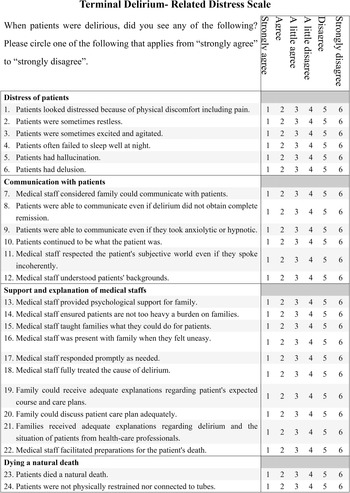
We developed a 25-item draft questionnaire. The responses to it were evaluated by factor analysis followed by varimax rotation. Six factors were identified by the Scree test. The factor that included only one item was then deleted. The first subscale consisted of 8 items related to support for family and esteem for the patient; we called it the subscale of support for families and respecting the patient. The second subscale consisted of 3 items related to communication; we called it the subscale of the ability to communicate. The third subscale consisted of 2 items related to hallucinations and delusions; we called of the subscale of hallucinations and delusions. The fourth subscale consisted of 7 items that explained delirium and dying naturally; we called it the subscale of adequate information about the treatment of delirium. The fifth subscale was composed of 4 items that were related to comfort; we called it the subscale of agitation and restlessness. An English version of the complete scale is presented in Figure 1.
Terminal delirium- related distress scale.

Validation of TDDS
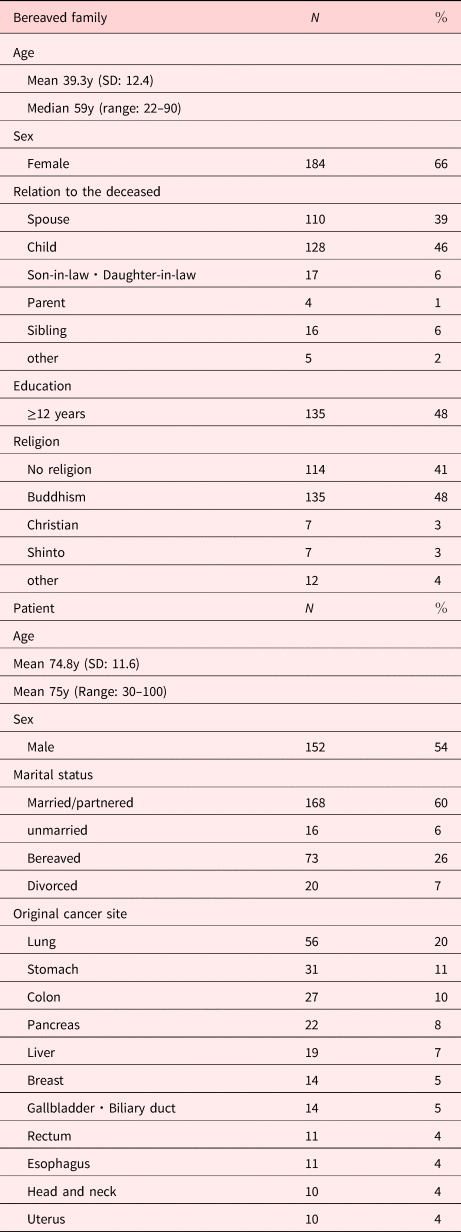
Five hundred and ninety-three of 787 (75%) bereaved family members returned the survey, and 513 (65%) completed the survey. Two hundred and eighty-one bereaved (55% of the responders) answered that their patients had experienced delirium, even if only a little. The characteristics of the participants are shown in Table 1.
Bereaved families’ and patients’ characteristics (N = 281)

Validity
(a) Construct validity
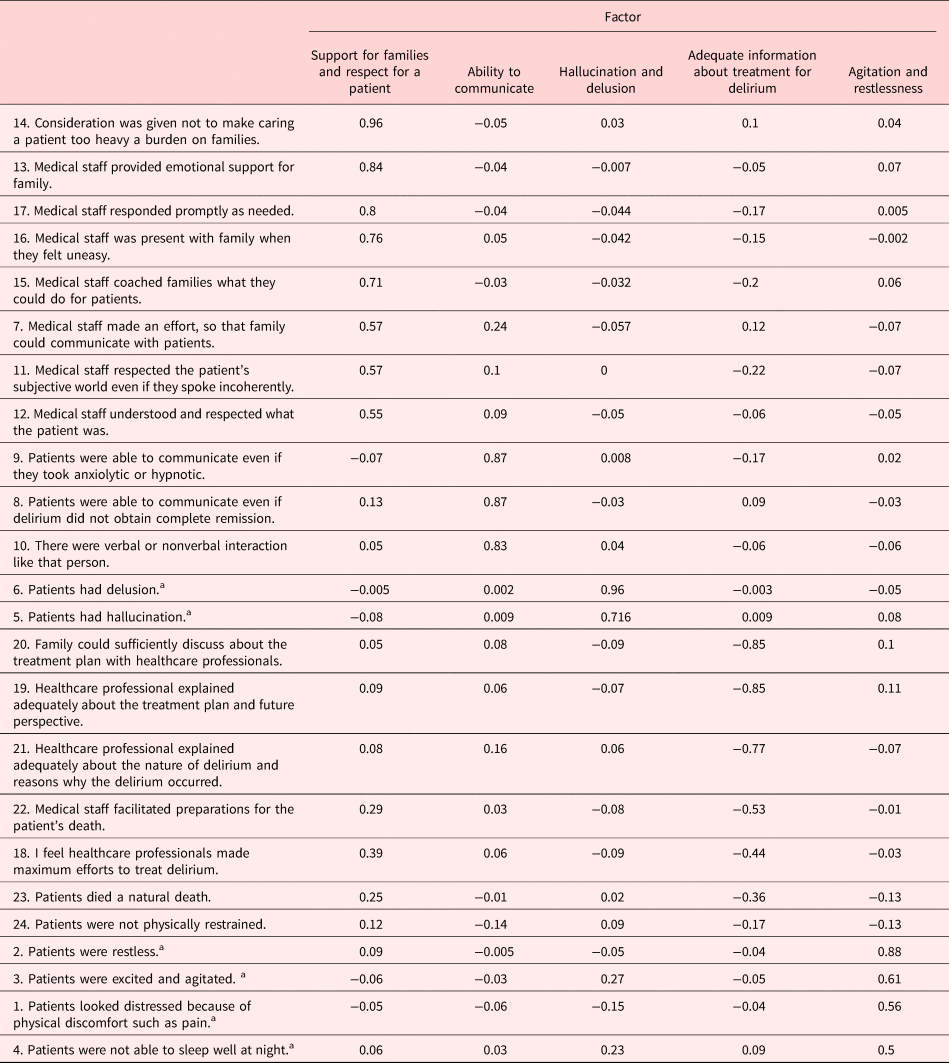
The results of the factor analysis are shown in Table 2. The construct validity was shown to be good by repeated factor analysis.
(b) Convergent validity and discriminant validity (Table 3)
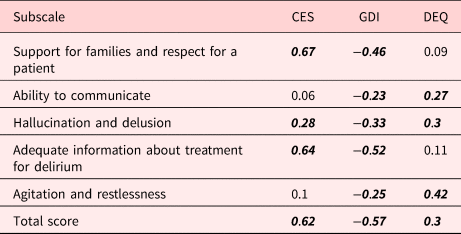
Convergent validity, confirmed by the correlation between the TDDS and the CES (r = 0.62, P < 0.001) and the GDI (r = −0.57, P < 0.001), was good. Discriminant validity was confirmed by a poor correlation between the TDDS and the distress score of the bereaved family member on the DEQ (r = 0.30, P < 0.001).
(c) Reliability (Table 4)
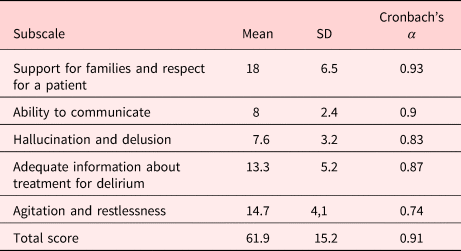
The TDDS had good internal consistency (Cronbach's alpha coefficient for all 24 items = 0.84).
Factor validity of the terminal delirium distress scale, optimal five domains (N = 281)

a Reverse item.
Correlation between terminal delirium related distress scale and CES⋅DEQ

CES, Care Evaluation Scale.
GDI, Good Death Inventory.
DEQ, Distress score of bereaved family in Delirium Experience Questionnaire.
The bold value indicates P < 0.001.
Reliability of terminal delirium related distress scale

SD, standard deviation.
Discussion
The present study described the development and validation of the TDDS. This is the first assessment tool that targets irreversible terminal delirium. It might be better to ask patients about their treatment and care during terminal delirium. However, in the clinical situation, most patients who are in a state of terminal delirium have difficulty in responding to questionnaires because of their distressing cognitive, physical, and psychological symptoms. Therefore, in this study, we asked bereaved family members instead. It is hard to decide who is the best target person (the patients themselves? family members? medical staff?) to ask about the treatment and care of patients in terminal delirium. Terminal delirium often cooccurs with various states of physical distress, such as severe pain, difficulties in breathing, and multi-organ failure. It is certainly difficult for family members and maybe for medical staff to discriminant them completely from the delirium. To measure the distress related to delirium specifically, we asked the respondents to rate the situation related to the delirium with this assessment tool.
The factor analysis confirmed the structure of the scale. The analysis also indicated that appropriate treatment and care of terminal delirium consists of five dimensions (support for families and respect for a patient, ability to communicate, hallucinations and delusions, adequate information about the treatment of delirium, and agitation and restlessness). Although the assessment tools for treatable reversible delirium mainly target cognitive function and psychiatric symptoms, this scale included the other four subscales (support for families and esteeming a patient highly, ability to communicate, adequate explanation of treatment and care for delirium and dying in a natural way, and generally at peace and secure). This is feasible because this scale includes the special situation of terminal delirium, in that delirium is a natural dying process and that sedation is needed to alleviate the patient's distress.
One item was used for two factors. Item 24 “Patients were not physically restrained nor connected to tubes” was loaded a little heavier on the “Adequate explanation of treatment and care for delirium and dying in a natural way” subscale than on the “Generally at peace and secure” subscale. The meanings of “Dying in a natural way” and “Generally at peace and secure” are close, and we thought this was why one item could be loaded for two factors.
We did not delete the items for which the factor loading was relatively small as we plan to conduct research in the future targeting the medical staff, who may have another viewpoint.
The convergent validity was shown by significant correlations between the three subscales of the TDDS and the CES. The subscale of “Support for families and esteeming a patient highly” and “Adequate explanation of treatment and care for delirium and dying in a natural way” were moderately correlated with the CES total score. This was because these two subscales are related to the structure and process of care, which the CES assessed. The subscales of “Ability to communicate” and “Agitation and restlessness” were not significantly correlated with the CES because they are about relationships between the patients and the bereaved family members rather than the structure and process of care.
The convergent validity was also shown by significant correlations between the five subscales of the terminal delirium scale and the GDI. The subscales of “Support for families and respect for a patient” and “Adequate information about treatment for delirium” were moderately correlated to the GDI total score. This was because the content of these two subscales is necessary to achieve a good death. The subscales of “Ability to communicate,” “Hallucinations and delusions,” and “Agitation and restlessness” were only slightly correlated with the GDI total score. This was because the GDI-short version does not include items about communication and psychiatric symptoms.
Discriminant validity was shown by significant correlations between two subscales of the TDDS and the DEQ. The DEQ assesses the degree of distress related to a reversible delirium episode and just includes the distress from psychiatric symptoms such as disorientation, hallucinations, and agitation. In our measurement, there was a moderate correlation of the subscales of “Hallucinations and delusions” and "Agitation and restlessness” with the DEQ (Table 3). There was no correlation of the DEQ with the other subscales about the information giving and care from healthcare professionals, but these subscales were moderately correlated with the CES, i.e., a measure to quantify the degree to which families rated the care quality. We believe these findings demonstrated the concurrent validity of this measure.
Each of the five subscales and the total score of the TDDS showed high internal consistency. We did not try to measure test-retest reliability since we asked the bereaved family member to answer the survey only once, considering their burden.
There are some limitations. First, the response rate was 65%. We do not think this is a fatal flaw since bereaved family members whose patient had delirium could still be included. Second, there may be a recall bias as we mailed the questionnaires to the bereaved family members instead of asking them to complete them immediately after the death of their patient. Third, the subjects were bereaved family whose patients died in a hospice or a palliative care unit. Therefore, the results of this study might not be generalizable to other settings. Fourth, we did not examine the criterion validity as there is no gold standard assessment tool for terminal delirium. Fifth, this scale has not been validated for use with medical staff. Sixth, the TDDS has 24 items and thus is a little long for use in busy clinical settings. Last, this study was only conducted in Japan, and we could not demonstrate cross-cultural validity.
In conclusion, the findings of this study indicated that the TDDS is a valid and reliable scale for evaluating five dimensions of terminal delirium care and treatment by a bereaved family member. This scale will help medical staff to provide appropriate care and treatment for terminal delirium. We plan in the future to divide this scale into a TDDS for family members as assessed by themselves and a TDDS for the patients as assessed by medical staff.
Funding
This study was part of the Japan Hospice and Palliative Care Evaluation 2016 (J-HOPE2016) study. This study was funded by the Hospice Palliative Care Japan and JSPS KAKENHI Grant Number 16KT0001.
Compliance with ethical standards
This study was approved by all participating institutional review boards and the Ethics Committee of Tohoku University. It was conducted in accordance with the principles of the Declaration of Helsinki. When the subjects voluntarily completed and returned their questionnaire, we took this to mean they consented to this study.
Conflict of interest
The authors declare that there is no conflict of interest.